Intro to Coriolanus


Why no Coriolanus?? David Oyelowo is playing him at the National Theatre and it’s the one analysis of Shakespeare you don’t have! Please hurry! I’m seeing it on Friday!

User Noittickles, sent to me today

Well, with a request like that, how can I refuse!

Coriolanus is the only Shakespearean story about Republican Rome, which is to say, before Julius Caesar turned Rome into a dictatorship. The play has been called pro-democracy, pro-monarchy, fascist, Marxist, and many other things. In some ways, the play is rather simple and its verse isn’t much fun to read, but the questions it poses, and the way Coriolanus shows the clash between power and common people, makes it fascinating to think about.

The play’s title character is also the most opaque one Shakespeare ever wrote. Some say he is a war hero, undone by the mob. Some say he is a want-to-be dictator who hates the common people and wants to keep power among the military elite. Unlike Hamlet, Macbeth, or any of Shakespeare’s other tragic heroes, we never get a sense of his true intent, or his actual feelings on anything. 

To illustrate this, let’s look at two very different interpretations of the same speech. In Act III, Scene iii, the tribunes (representatives of the commons in the Senate), have organized a smear campaign to prevent Coriolanus from becoming Consul, (the highest rank a Roman aristocrat could achieve before Emperor Augustus). Coriolanus is furious at the Tribunes, and vows to leave Rome to take his revenge on the city. Here’s the text of the speech:

Coriolanus. You common cry of curs! whose breath I hate
As reek o' the rotten fens, whose loves I prize
As the dead carcasses of unburied men
That do corrupt my air, I banish you;
And here remain with your uncertainty!
Let every feeble rumour shake your hearts!
Your enemies, with nodding of their plumes,
Fan you into despair! Have the power still
To banish your defenders; till at length
Your ignorance, which finds not till it feels,
Making not reservation of yourselves,
Still your own foes, deliver you as most
Abated captives to some nation
That won you without blows! Despising,
For you, the city, thus I turn my back:
There is a world elsewhere.
[Exeunt CORIOLANUS, COMINIUS, MENENIUS, Senators,]
and Patricians]
Aedile. The people's enemy is gone, is gone!
Citizens. Our enemy is banish'd! he is gone! Hoo! hoo!

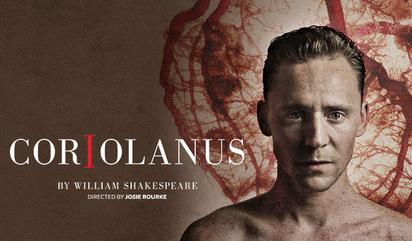
In the first speech, Tom Huddleston plays Coriolanus as a heroic soldier, disgusted and hurt by the lies of the scheming  Tribunes:

Hiddleston chose to play Coriolanus not as a villain but as a frustrated demagogue- someone who wants to lead his people to greatness, whether they like it or not. Whether you approve of his methods, Hiddleston’s Caius Martius does care about the good of Rome. You can almost see the tears in his eyes as he leaves the city he loves, the city he bled for, and that has now betrayed him.

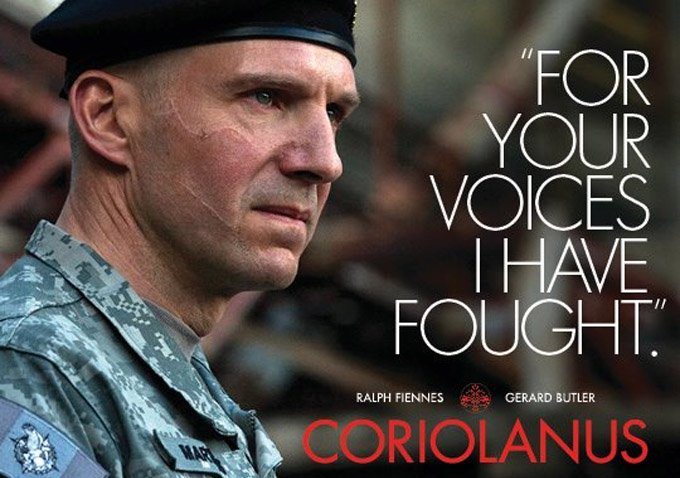
By Contrast, Ralph Fiennes takes a much more authoritarian and cruel route in the film Coriolanus, which Fiennes also directed:

Youtube critic Kyle Kallgren made the excellent case that Fiennes’ Coriolanus is first and foremost, a soldier. You could argue that perhaps Coriolanus has no political ambition whatsoever; he merely wants to keep fighting because war is all he knows. Maybe he purposefully sabotaged himself during his campaign for Consul, because all he wishes to rule is the battlefield:

Kalgren also highlights the “proto fascist” parts of Fiennes’ performance, since Fiennes himself has played Nazis, serial killers, and of course, Lord Voldemort, who is essentially a fascist dictator. Like Merchant of Venice, the Nazi party used Coriolanus as a propaganda tool, claiming that Caius’ fall from grace showed the failure of a weak democracy:

The poet deals with the problem of the people and its leader, he depicts the true nature of the leader in contrast to the aimless masses; he shows a people led in a false manner, a false democracy, whose exponents yield to the wishes of the people for egotistical reasons. Above these weaklings towers the figure of the true hero and leader, Coriolanus, who would like to guide the deceived people to its health in the same way as, in our days, Adolf Hitler would do with our beloved German Fatherland.

Martin Brunkhorst, “Shakespeare’s Coriolanus in Deutscher Bearbeitung. Quoted from Weida

It makes sense that fascists would gravitate towards a play about a seemingly virtuous Roman military leader. After all, the word “fascism” is an Italian word, coined by Benito Mussolini, to evoke the glory days of the Roman Empire- days when Roman society was based on military conquest under a strong leader. What these fascists fail to recognize is that Coriolanus is not a strong leader- he hates politics and is unable to gain any support from the people or from the elites in power. His inability to “play the game” of Roman politics, does make him appealing to some, but on the whole, his career is a disaster.

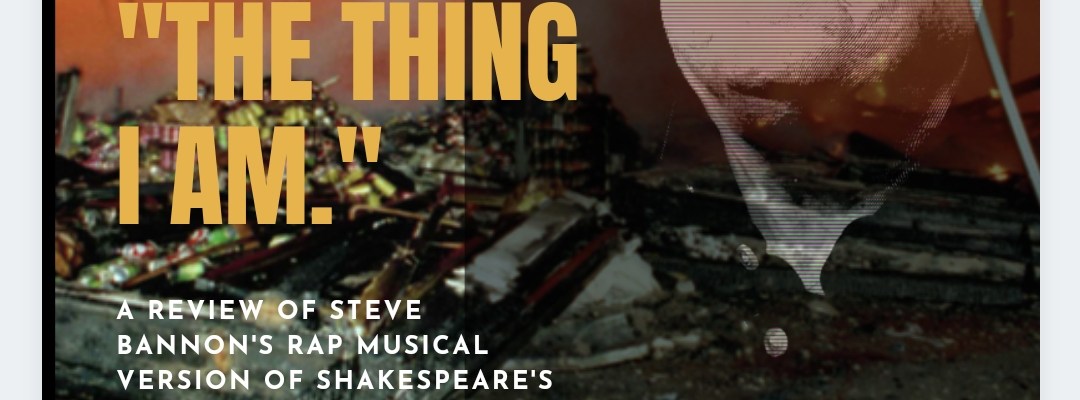
Some have chosen to interpret the story of Coriolanus as a sort of action-movie wish fulfillment- a man in a lawless society who uses his fists rather than words. Back in the 1990s, Steve Bannon (former advisor to President Donald Trump), wrote a hip-hop musical called: The Thing I Am, which re-interpreted the story of Coriolanus as a police captain who is trying to clean up downtown LA, which is embroiled in gang warfare. I find this interpretation paper-thin and not at all conducive to the spirit of the original play. It also has very racist and paternalistic undertones. You can read my review of it here:

Coriolanus Today

https://www.nationaltheatre.org.uk/productions/coriolanus/

Shakespeare refuses to be prescriptive on political or social issues. He tries to represent all sides of an issue and let the audience decide. With the rise of neo-fascist movements, sectarian violence, and the persistent questions surrounding police and military forces, Coriolanus is more relevant than ever. I haven’t seen this production at the National Theater, but I hope it calls attention to the various angles and points of view of the play- Coriolanus the war hero, Coriolanus the traitor, Coriolanus the soldier, Coriolanus the would-be-dictator. David Oyelowo is a fantastic Shakespearean actor, so I’m sure he can bring a great deal of complexity and nuance to this complicated man.

What I find interesting is that the trailer chooses to use this speech, when Coriolanus has defected to Rome’s enemies, the Volskies. He seems sorrowful, desperate, and afraid of what the Volskies will do to him, now that he is in their camp. One line that Oyelowo delivered exceptionally well was the line “Only the name remains.” I haven’t seen the whole play, but it seems THIS Coriolanus is concerned with the glory of his name living after him. The final question this play asks is, for such a complicated man, how will Coriolanus be remembered?

Well, there you go, Stopittickles! Hope you enjoyed this overview of the play Coriolanus. If you like this review, you might like to sign up for my online class on Julius Caesar via outschool.com:

Click here to sign up and get a $5 discount: https://outschool.com/teachers/The-Shakespearean-Student

My Top 10 Favorite Shakespeare/ Harry Potter Actors

This list is not about skill or the talent of the actor. This is to honor the contributions of Shakespearean actors who also appeared in one of my favorite film and book franchises of all time: Harry Potter. Accordingly, some of the actors who weren’t essential to either Harry Potter or Shakespeare or both are placed lower on the list even if I personally love the actor or the character they portrayed.

#10: Richard Harris- Albus Dumbledore

The Irish-born actor has been a veteran of stage and screen for decades before his death in 2002, after the second Harry Potter film. Here is him on Johnny Carson, telling a funny story about a production of Macbeth he did early in his career:

#9: Kenneth Branaugh- Gilderoy Lockheart

If you visit this website regularly, you know I’m a fan of Kenneth Branaugh– I’ve reviewed three of his Shakespeare movies and he’s my all-time favorite Hamlet. I’m also aware that he has a reputation of being a bit of an egotist and a womanizer, (since he had affairs with two women on this list), so even though he was a bit too old to play the part, it was nice to see him have a laugh at his own expense as the attention-hogging Gilderoy Lockheart. The humbug professor’s name actually Gilderoy (as in a man painted with false gold), gives away the twist that he takes credit for other witches and wizards’ work and Branaugh shamelessly mugs to the camera whenever he’s on screen. My favorite scene of his though, is the one serious scene where he teaches dueling with the help of the much more competent Professor Snape:

Kenneth Branaugh and Alan Rickman in Harry Potter and the Chamber of Secrets, (2002).

If you saw my post on the duel at the end of Hamlet, you can see that the way wizards duel is directly inspired by the way fencers fought in Hamlet, right down to the flashy salute and bow beforehand, and it’s neat to see two legendary Hamlets fight in it.

#8: Jim Broadbent (Horace Slughorn) / Timothy Spall (Peter Pettigrew [aka ‘Wormtail’]

I couldn’t decide between these fabulous actors, so I grouped them together. After seeing Timothy Spall as the cowardly, foolish incompetent spy and traitor Rosencrantz in Hamlet, I knew that the only Harry Potter role for him would be as Lord Voldemort’s toady and pathetic rat, Peter Pettigrew, aka Wormtail.

Broadbent on the other hand, is completely different and unrecognizable during his excellent portrayal of Lord Buckingham in Ian McKellen’s 1995 film version of Shakespeare’s Richard III. Unlike the meek and easily broken Horace Slughorn, Broadbent as Buckingham is an oily politician who very nearly sells his soul to McKellen’s diabolical Richard:

What unites these two portrayals is that both characters are corrupted by a figure of pure evil, but both have a breaking point- Buckingham, (as you see in the clip above), refuses to be a party to child murder, while Slughorn eventually helps Harry Potter destroy Voldemort. In a way, they’re two sides of a very flawed coin.

#7 Michael Gambon (Albus Dumbledore 2)

Like Richard Harris, Michael Gambon, (who passed away in September of 2023) was an accomplished stage and screen actor, famous for playing King Lear multiple times, including a famous performance with Antony Sher at the Royal Shakespeare Company. Here are some highlights of his stage work:

https://www.theguardian.com/stage/gallery/2015/feb/09/michael-gambon-on-stage-from-king-lear-to-krapp-in-pictures

#6: Fiona Shaw (Petunia Dursley)

I feel I have to give Fiona Shaw a good spot on this list, though I think her talent was wasted in the role of Petunia Dursley. She is an icon of British theater and her work in Shakespeare is superb. She famously played Richard II back in 1995, and in the short film below, she talks about her amazing interpretation of Measure For Measure, with fellow Harry Potter alumn, David Tennant.

I’d also like to include the best-deleted scene from Deathly Hallows with Shaw in it, where she admits to Harry for the first time that she misses her sister Lilly.

#5: Ralph Fiennes (Lord Voldemort)

In a way, Lord Voldemort was a role that Fiennes had trained for all his life. He has played smarmy, serpentine characters before in films like Red Dragon and Schindler’s List. But Fiennes’ Shakespeare training allowed him to tap into the evil megalomaniac at the heart of Voldemort when he played roles like Richard III, (another deformed autocrat), and Coriolanus, the Roman general who is himself compared to a dragon. In the video above, YouTube critic Kyle Kalgren analyzes how Fiennes’ past roles and experience with Shakespeare translated well in his performance and his direction of the 2011 film Coriolanus.

#4 Imelda Stanton (Delores Umbridge)

By contrast, I give more credit to Imelda Stanton, who mainly plays sweet mom-like characters (or nurse-like in the case of Shakespeare In Love), for embodying the utterly loathsome Delores Umbridge. Reportedly, the role made Stanton feel physically ill and unlike Richard III, people hate her character with a passion. By contrast, look at her sweet and charming portrayal of Maria in the 1996 film Twelfth Night, (which also starred Helena Bonham Carter):

#3 Helena Bonham Carter (Bellatrix Lestrange)/ Emma Thompson (Sybyl Trelawney)

Again, I had to give credit to both of these women for the startling transformations they did for their Harry Potter characters, as well as their stellar work in Shakespeare. Helena Bonham Carter mainly plays apealing aristocratic characters such as Olivia in Twelfth Night, and Ophelia in Hamlet:

Seeing Ms. Carter as the demented Bellatrix Lestrange was quite a shock for me, yet the performance was no less impressive. I especially love this scene in Deathly Hallows where she has to act like a 17 year old girl, TRYING TO BE BELLATRIX LESTRANGE

#2: Alan Rickman (Severus Snape)

I already wrote a tribute to Alan Rickman after his death in 2016, so I don’t wish to repeat myself. Suffice it to say that Mr. Rickman was always a consummate professional, and his iconic portrayal of Severus Snape was the performance of a lifetime.

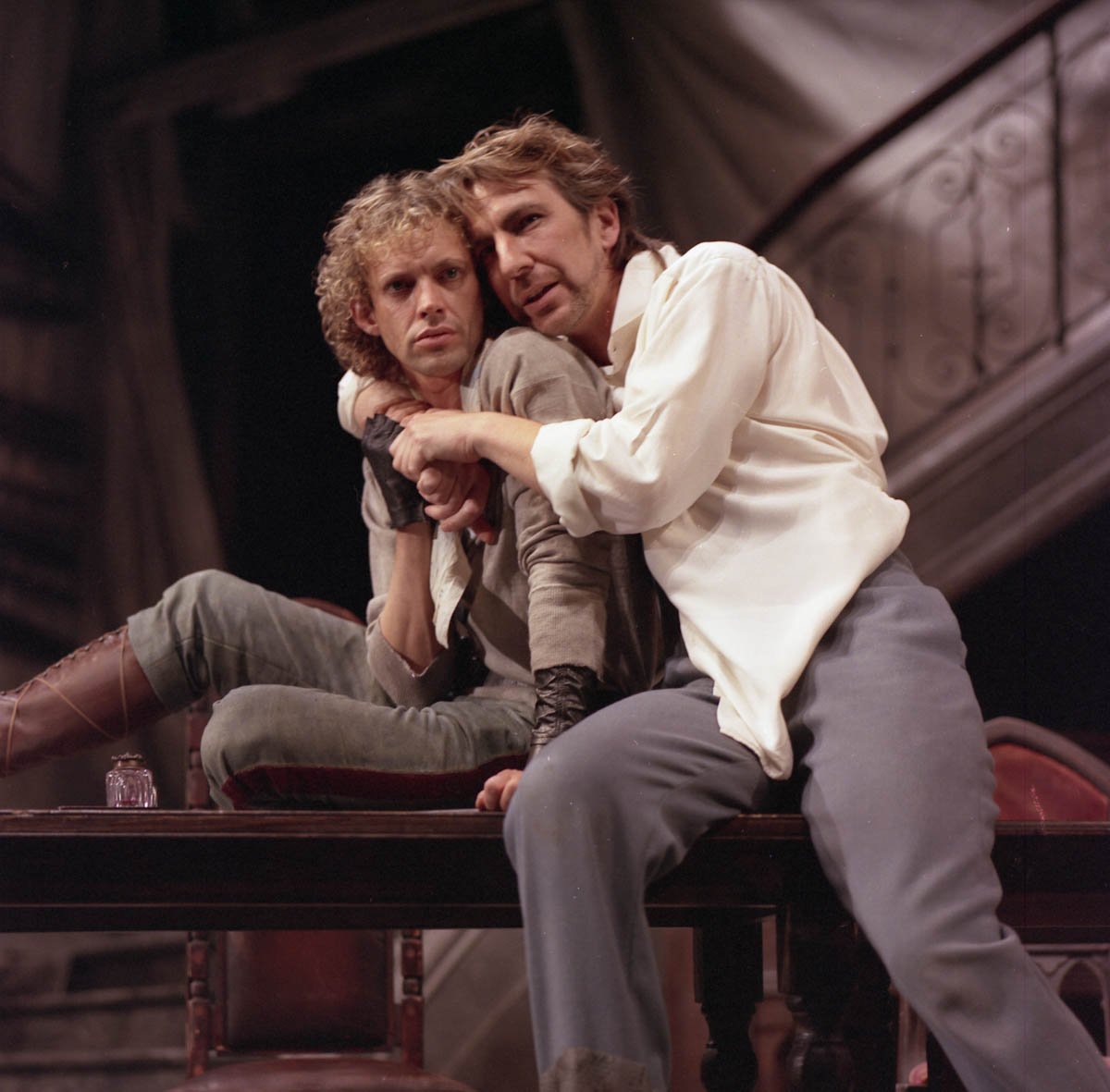
Alan Rickman as Achilles in Troilus and Cressida, Royal Shakespeare Company.

Honorable Mention: David Tennent (Barty Crouch)

To be honest, I thought Tennant was miscast in Harry Potter- he can play villains, (as Good Omens fans know well), but he just isn’t great at being maniacal and evil. That said, Tennant is a rising Shakespearean star and has created many memorable performances from Richard II, to Benedick in Much Ado About Nothing, to Hamlet.

#1: Dame  Maggie Smith (Professor McGonigal)

Say it with me… you probably saw this coming. No one can deny that Dame Maggie’s contributions to Shakespeare, as well as her ubiquitous portrayal of Hogwarts’ current Headmistress Minerva McGonigal, stand the test of time as strongly as the animated chess pieces she placed in the school basement. Let’s look at some of her greatest Shakespearean moments.

Plug for my Acting Class

If you enjoyed this list, you might want to sign up for my Intro to Acting class or my extended acting course, where I delve into Shakespearean acting techniques, and answer the big question, “WHY DO SHAKESPEAREAN ACTORS KEEP GETTING CAST AS WITCHES AND WIZARDS?” To sign up, click the link below: https://outschool.com/classes/609658d1-3f9f-4371-8af2-4fe81ad13d8c

Cover art for my Outschool Beginning Acting Class.

Thanks for reading!

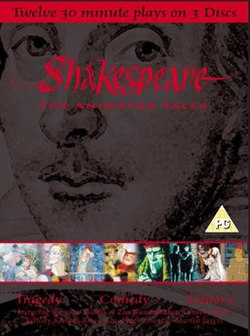
Shakespeare: The Animated Tales- “Macbeth”

This is a 30 minute cartoon version of Macbeth originally produced for the BBC in 1992. It features Brian Cox  as the voice of Macbeth (before he was the voice of McDonald’s), and Zoë Wanamaker as Lady Macbeth (before she was a witch who teaches at Hogwarts).

I like the way it portrays the horror imagery of the play in sort of a European-manga animation hybrid. Admittedly, there are better ones in the series, but this one is still pretty neat.

DVD box art for “Shakespeare the Animated Tales.”

To check out other episodes in the series, view this playlist:

What is a Soldiers Due?

On this Memorial Day, I’m inspired by a quote to ponder what it really means to “Support Our Troops,” living and dead. The quote comes from an epilogue written for a 1778 performance of Shakespeare’s obscure Roman Tragedy, “Coriolanus:”

The most interesting thing about the play is how modern it is. One of his few plays that deals directly with the drama of democracy. And more than that, it deals with the seemingly modern phenomenon of officials undone by public opinion. So many of Shakespeare’s characters have to answer to their God or their king, or (as Coriolanus does), his family. Only rarely, do they answer to the people.

Kyle Kallgren: “Coriolanus- Universal Soldier” (2016)

https://www.nationaltheatre.org.uk/shows/nt-at-home-coriolanus

Play Summary

Coriolanus is one of Shakespeare’s strangest and most controversial plays. Its principal figure is a warrior, exemplary in his courage and single-minded dedication, who finds it difficult to adjust to life away from the battlefield. Refusing to compromise and contemptuous of anyone who does not live up to his exacting standards, Coriolanus, not long after being nominated for the high political office of consul, is cast into exile, accused of treason and ends up leading an army to invade and destroy Rome.

Warren Chernaik, Emeritus Professor of English in the University of London

What do we not owe soldiers?

Throughout the play, Coriolanus shows nothing but contempt for popular rule. This certainly suggests that he is aristocratic in his political views, but arguably he is much more militaristic. Remember that to be a Consul or any kind of high ranking position in the Senate, the senators all served in the army for a set term. Coriolanus respects the Senate more than the Assembly because the former is full of his fellow comrades in arms.

Coriolanus is first and last a soldier, and he represents a society run by the war machine. For centuries, authoritarians who rule through a cult of personality have propped up Caius Martius as an ideal of a military society. After all, it was Mussoluini who organized his fascist dictatorship around the Roman Empire, and the play Coriolanus was taught in literature classes during the Third Reich. They probably looked like Starship Troopers.

https://www.theguardian.com/stage/2020/mar/05/coriolanus-shakespeare-laurence-olivier-ralph-fiennes-ian-mckellan

So to recap, though we owe soldiers a lot for their courage and sacrifice, nobody owes them Blind obedience, because that is the root of fascism. Look at this actual excerpt from a literary textbook about Coriolanus that was given to children in Nazi Germany.

The poet deals with the problem of the peaople and its leader, he depicts the ture nature of the leader in contrast to the aimless masses; he shows a people led in a false manner, a false democracy, whose exponents yield to the wishes of the people for egotistical reasons. Above these weaklings towers the figure of the true hero and leader, Coriolanus, who would like ot guide the deceived people to its health in the same way as, in our days, Adolf Hitler would do with our beloved German Fatherland.

Martin Brunkhorst, “Shakespeare’s Coriolanus in Deutscher Bearbeitung. Quoted from Weida

So now that I’ve established what we don’t owe our soldiers, what do we owe them?

What do we owe our soldiers?

[  ] Honesty- why are you fighting? Is dying for one’s country worth it? Unlike Henry V, in which Shakespeare makes it very clear why the king is trying to conquer France, we don’t really understand why Rome wants to destroy the Volskies, and it seems somewhat arbitrary. I think one of the ways we sympathize with Coriolanus is that he never “asks the reason why; his is but to do and die,” as Tennyson puts it. He has one speech where he rallies the troops, but it just seems flat and hollow without a clear reason why the soldiers should risk their lives.


[  ] A chance to heal When he comes home to run for Consul, Coriolanus is required to show his battle scars to the people and refuses to stay in the room when the patricians talk about them. This could be interpreted as more arrogance where he is disgusted to be in the same room as common men, but I think there’s another aspect. I think Coriolanus has PTSD, and every time he sees or hears about his scars, his repressed memories bubble up to the surface and drown him in fear. His story is partially a story of how all soldiers need help to deal with the trauma they endure on a regular basis.


] Love for their courage and sacrifice. Whether the conflict is right or wrong men and women risked their lives for it, and that is worth compassion.
[  ] Good leaders. Coriolanus is a play where arguably nobody cares about the people. Coriolanus and the Patricians look down on them, and the tribunes see them as a means to gain power. With all this political in fighting who is really trying to make life better? Better for the starving Romans? Better for soldiers like Coriolanus? In a republican society like Rome, we owe it to our soldiers to participate in politics so men like Coriolanus aren’t sent to die on a whim. If we don’t use our voices, we are the common cry of curs that Coriolanus characterizes us as:

Compassion– in John Osborne’s version the title character goes mad from his trauma and of course, in Shakespeare’s version, he’s driven out of Rome and then killed by Aufidius. Even today, many soldiers suffer from poverty, sickness, life-altering injuries, and of course, PTSD. This Memorial Day, let’s all try to help ease the lives of the men and women who have suffered for us.

Sources:

SHAKESPEARE AND BRITISH OCCUPATION POLICY IN GERMANY, 1945-1949 by Katherine Elizabeth Weida B.A. (Washington College) 2011

https://www.bl.uk/shakespeare/articles/an-introduction-to-coriolanus

Steve Bannon’s Rap Musical Version of Coriolanus is Just as Messed-Up As It Sounds

Steve Bannon, the man I’ve described in the past as Buckingham to Trump’s Richard III, is once again in the news. He’s been charged with criminal contempt for refusing to cooperate with the Senate with the January 6th commission.

Bannon, the former head of Breitbart news, and Former President Trump’s former chief strategist, has long been a controversial figure with his extreme right wing views on immigration, race, and politics in general.

One thing many people might not know about Bannon though, is that before he was a publisher and a politician, he was an aspiring writer in Hollywood, and in the late 1990s, Bannon wrote, “The Thing I Am,” a rap-musical version of Shakespeare’s Roman tragedy “Coriolanus.”

What Is Coriolanus?

Coriolanus is one of Shakespeare’s most obscure tragedies, but arguably, one of his most fascinating ones. It’s the only play set in republican Rome, so it’s the only Shakespeare play that deals with issues of democracy. The play starts with a riot where poor Romans are complaining about grain shortages, loudly condemning rich landowners who are hoarding grain while they starve. Ironically, Shakespeare wrote this at the same time when he himself was guilty of hoarding grain during a shortage, and tensions were so high that some farmers called for people like him to be “hanged on their own gibbit.”

The play has been called fascist, communist, democratic, republican, and monarchist. It’s main character is a Roman general who wants to be consul, (a high governmental position in the Senate), despite the fact that he hates the common people. Like Julius Caesar, it raises interesting questions about who should be in charge of our society, without prescribing an answer, (which would have been impossible for Shakespeare living in Jacobean England). In the play’s most famous scene, Coriolanus finally bursts out and rails against the commoners for their ignorance and their distrust of other would-be millitary dictators:

A review of Bannon’s Show:

Bannon updated the text and set it in Los Angelos during the riots of 1992, which if you remember, were protests to the earlier police brutality trial over the death of Rodney King.

The show was never produced, though a staged reading of the text was held in 2016. I was unable to find it on Youtube, but I did find a link to a video on Facebook under Now This Politics. The full reading is here:

https://nowthisnews.com/steve-bannon-hip-hop-rap-musical

https://nowthisnews.com/steve-bannon-hip-hop-rap-musical?fbclid=IwAR1PAvOo4q-xZTw1SemDEz33fRM44kvJuw0Mabw7rLaI6MVEspfSVi8z1U4

Quotes:

They say! F#$% they! They hang out shooting pool and think they know what’s going down – who’s up, who’s out, who bounds, and if there’s crack enough. If I had my way, I’d make a quarry of these slaves.”

Whoever deserves greatness, wants their hate. Peep game, boy. To count on them for favors is to swim with fins of lead.”

“So f#$% you! Trust you? Ha! With each passing minute, you change your common mind. You call him noble that was once your enemy, then dis your king. You cry against the “other” – crackers, Blood, Crip, popo, Pol, the rich – it don’t matter, n!@$; awe keeps you feeding each another.”

I never knew the ‘racist Steve’ that’s being reported now,” Jones told The Daily Beast last year. “I never heard him make any racist jokes, and his best friend was an African-American who went to [college] with him… I never saw even a hint of racism.

“But I did see this elitism… He would always look down on poor people of any color. At one point, he told me that only people who own property should vote. -Julia Jones (Bannon’s Co writer)

The Cast included Rob Corddrey, Kate Berlant, Jordan Black, and Cedric Yarborough.

My Thoughts:

The subject matter is poorly handled and the way it treats the LA riots is at best, a historically inaccurate attempt for Bannon to play ‘white savior’ to a group he considers inferior, and at worst, a call to action for racists to imprison and oppress the black residents of LA.

The riots were not a war, they were a result of a protest. Instead of addressing the Rodney King trial which was the cause of the riots, Bannon focuses on the ‘war’ between the Crips and the Bloods, saying the riot was a result of this war.

If you read Breitbarts article about the riot, (and I don’t recommend it), it is described like a war. It’s the same war conservative pundits are continually trying to convince us is coming- a race war between ‘gangs’, ‘immigrants,’ and the politicians who enable them, who don’t want you to defend yourself.

The opinion piece I read found it ironic that Bannon makes Coriolanus the leader of the Crips, but if you look at his politics, It’s clear why- Bannon is attracted to masculine violence and his base of violent, predominantly white males see modern life as a culture war between them and the rest of the world. His Coriolanus is a BAMF who defends himself with his gun . A politician or a policeman ‍♂️ would have someone to answer to (more like Shakespeare’s Coriolanus,) but Bannon’s Martus has no restaint and can indulge his violent tendencies in the lawless hellscape of LA.

It should be noted that Bannon is clearly not speaking from experience or research, merely his ugly stereotypes of black gang members that he got from reading his biased Brietbart articles. Though the hero is black, the dog whistle racism is still there- these people are out to get you, and even though they have guts, they are a threat to “civilization.”

References/ Other Reviews:

  1. New York Times Steve Bannon’s Hip Hop Shakespeare: https://www.nytimes.com/2016/12/17/opinion/sunday/steve-bannon-hip-hop-shakespeare-rewrite-coriolanus.html
  2. Refinery 29: https://www.refinery29.com/en-us/2017/05/152427/steve-bannon-rap-musical-the-thing-i-am
  3. Rolling Stone: He Approaches the Baby Gangster. Steve Bannon’s Rap Musical: https://www.rollingstone.com/politics/politics-news/he-approaches-the-baby-gangsta-watch-steve-bannons-rap-musical-115694/
  4. Hooton, Christopher. Watch a script read of Steve Bannon’s rap musical: ‘If I had my way, I’d make a quarry of these slaves.’ The Independent. Retrieved online from: https://www.google.com/amp/s/www.independent.co.uk/arts-entertainment/films/news/steve-bannon-musical-rap-film-script-screenwriter-shakespeare-coriolanus-compton-table-script-read-a7712736.html%3famp

Announcing The Best Fathers In the Shakespearean Cannon

Announcing The Best and Worst Fathers In the Shakespearean Cannon

Podcast Link: https://www.buzzsprout.com/45002/282555-the-shakespearean-student-episode-5-the-best-dads-in-the-shakespearean-cannon

Shakespeare himself was a father, and he frequently wrote about the dynamic between fathers and their children. There are many different types of fathers in Shakespeare’s 40 plus plays, and this week I’m ranking them in terms of three categories: Good Dads, Bad Dads, and “Dad Dads.” You’ve probably already read the “Worst Dad” post, so now we’re looking at the good, and the not so good. I used the following criteria when choosing the top 5 dads in each categories:

The Good Dads

  • Are supportive for their kids
  • Try to keep their children happy
  • Offer help and advice, especially on their children’s future.
  • Are willing to sacrifice themselves
  • They let their children become their own people.

The Bad Dads

  • Treat their children as property
  • Have little to no interest in their children
  • Put their children in danger
  • Subject their children to abuse
  • In some cases, they murder them!

The “Dad” Dads

  • Are basically good hearted, but they have some kind of flaw that prevents them from becoming really good parents.
  • In my view, are the most human, modern dads on the list.
  • I’ve chosen to award these dads a necktie, something every ok dad needs.

Now, onto the Dad Dads:

aclk

aclk

5. Aegean from The Comedy Of Errors. Aegean wonders around for 20 years looking for his lost children, which I call devoted parenting, but a little aimless and undisciplined. I therefore award Aegean two ties with little anchors on them, to remind him to stay in one place and wait for his sons to find him!

Alexandre Bida,
Alexandre Bida, “The death of Lord and John Talbott,” 1895

4. Lord Talbott from Henry the Sixth Part I. Talbott is the hero of the English fight against the French at the close of the Hundred Years War. He goes toe to toe with Joan of Arc on numerous occasions. He also raises a fine and valliant son, John Talbott who is also a warrior. The two die bravely in a siege against the French, rather than surrendering, or leaving the other to die. Talbott is clearly also devoted to his child, but his career choice doesn’t allow his son to grow up in a safe environment! I therefore award Talbott two ties with little English and French flags on them.

imgres-3

imgres-1

The Ghost of Hamlet's Father by William Blake, 1806.
The Ghost of Hamlet’s Father by William Blake, 1806.

3. The Ghost Of Hamlet’s Father from Hamlet/ Portia’s Dad from Merchant Of Venice. Both these parents die before their plays begin, yet they still try to improve their children’s lives from beyond the grave! The Ghost helps Hamlet become king of Denmark, and Portia’s dad tries to help her find a good husband, (one who will love her for something besides her beauty or riches). Although these parents achieve their goals, waiting this long to help their kids seems a bit like absentee parenting! I therefore award these posthumous parents ties with little skulls on them.

imgres-4

imgres-4

https://youtu.be/mx6mEMnNK4A

2

imgres-5

. King Henry IV, from King Henry IV King Henry is the classic career dad, one who wants his son Hal (the future King Henry V), to follow in his footsteps. The two have a terrible fight when Henry thinks Hal is trying to steal his crown on his deathbed! Eventually though, father and son reconcile, and dad even gives the future king some last minute advice; if you fight a war with France it’ll help secure your crown, which Hal does and succeeds! I therefore award King Henry a tie with little crowns on it, hoping that nobody with a dagger ties tries to steal it when he’s sleeping!

42-44949227-1

1. Prince Pericles from Pericles Pericles is another busy dad- King Antiocus tries to murder him, and he has to leave his own kingdom. Then he gets shipwrecked 3 times! In fact, his only daughter is born onboard a ship in the middle of a storm! Pericles raises the girl for a number of years, but then has to leave again, and guess what, he gets shipwrecked AGAIN! He eventually finds his daughter and they live happily ever after, but you kind of get the idea that Pericles is a little accident-prone, which keeps him from being on the Best Dads list. Sorry Pericles, but at least you get a tie with, what else, Boats on it! Maybe next Fathers Day, someone will get you a life preserver.

url-2

And now at Long LAST, the BEST Dads in Shakespeare!

Aaron fights to protect his baby child.

5. Aaron the Moor from Titus Andronicus. Ironically, one of the worst villains in Shakespeare is also one of the best fathers. Aaron is fiercely protective of his child, even threatening people at sword point if they dare come near his baby. He also plans out the child’s future and is willing to give his own life for a promise that Lucius will protect and nourish his son. He may be a monster to everyone else, but to his baby, Aaron is simply, a good dad!

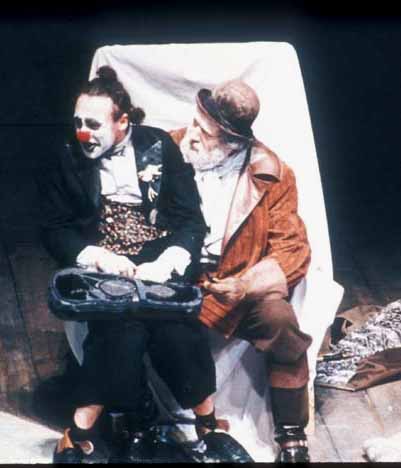
4. The Old Shepherd from The Winter’s Tale. This character is a very mirror of generosity and kindness; not only does he take care of his son The Clown, he adopts a poor discarded child, the princess Perdita, with no obligation to do so. He raises her for 16 years and constantly brags about her to the entire town. She becomes a beautiful, wise, and modest girl who fills her adopted father with pride because of his good parenting. Even when Perdita meets her real father, she speaks of The Old Shepherd with real filial affection “Oh my poor father.”

3.

Lord Capulet, from Romeo and Juliet. I know this was a controversial choice, and I discuss my choice in detail on my podcast, but I’ll sum up my major arguments here:

  1. Even though a lot of actors choose to have him smack Juliet around, there’s no mention of it in Shakespeare’s text. The most he ever does is threaten to strike her, but the stage directions never indicate he does it. Capulet is clearly more bark than bite.
  2. From the very beginning of the play, Capulet has shown that he cares about Juliet, and wants her to marry for love, not money.
  3. Lord Capulet hovers and frets constantly when Juliet tells him she will marry Paris, staying up late to plan the wedding! I ask you, does that sound like a tyrannical father? I wonder sometimes if Lord Capulet would’ve forgiven Juliet for marrying Romeo if she had just told him. In any case, based on my criteria above, Capulet is a good dad, bad tempered, yes, but fundamentally concerned for the welfare of his children.

BOL143705 Prospero and Miranda, fragment from 'The Tempest', c.1790 (oil on canvas) by Romney, George (1734-1802); © Bolton Museum and Art Gallery, Lancashire, UK; English,  out of copyright
Prospero and Miranda, fragment from ‘The Tempest’, c.1790 (oil on canvas) by Romney, George (1734-1802); ¬© Bolton Museum and Art Gallery, Lancashire, UK; English, out of copyright

3. Prospero from The Tempest I chose this high spot for Prospero mainly because he seems to have the most success of any other dad in the cannon. Like Pericles, he too is shipwrecked with his daughter, but Prospero stays with Miranda, raises her alone, teaches her everything she knows, and calls her an angel that helped preserve his life. Prospero cares so much for his daughter that he refuses to give into despair, even though he’s lost his wife, his dukedom, and his home.

Prospero also hatches a plan to get him and Miranda off the island, to get his dukedom back, and to get her married to a handsome prince name Ferdinand, and he succeeds with every one of these endeavors, even though it takes 12 years. Prospero gets extra points for his patience and his wisdom, but I have to admit he’s a bit of a control freak; he demands that Miranda listen to him and obey him no matter what, and he warns Ferdinand that there will be dire consequences if he dare try to do anything illicit with his daughter before the wedding. In addition, there’s no denying that Prospero is also acting out of self interest- he wants to become duke again, and he wants revenge against his enemies and that’s partially why he raises a tempest, (or a huge storm), instead of just sending a message back to Milan.

1.

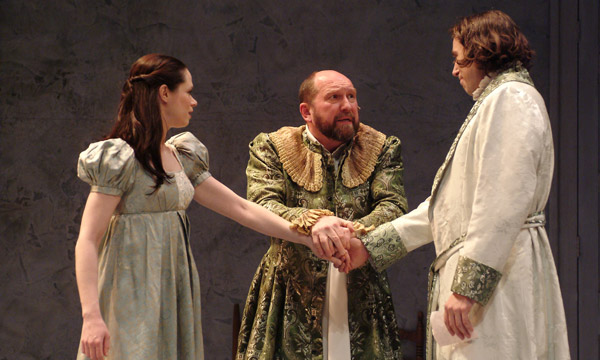
Simonides grants permission for Pericles to wed his daughter. Production shot from Mary Zimmerman's 2006 production of
Simonides grants permission for Pericles to wed his daughter. Production shot from Mary Zimmerman’s 2006 production of “Pericles.”

King Simonedes from Pericles, Prince Of Tyre You might forget this character because he only has a short time onstage, but I defy anyone to come up with a better father. He’s kind, supportive, stable, funny, and has a wonderful relationship with his daughter Thaisa. Above all, Simonedes actually listens to his child and does everything in his power to help her when she decides she wants to marry Pericles. Also, like Prospero, Simonedes pretends to object to the marriage, but you kind of get the sense that, rather than testing the affection of the couple, he’s actually just playing a joke on them. You can hear a “gotcha” and a fatherly wink in the final line of the speech in Act II, where he pretends to object to their marriage:

Congratulations to all our fabulous fictional fathers! Thank you for reading, and see you soon!