How to Throw Your  Own  12th Night Party  

Part One: The Invitation:Tradition says the 12th night does not actually start until nightfall on January 5th; it’s the celebration of the night when the wise men finally got to Bethlehem, so make sure you you’re clear on that in the invitation. If you need help on designing clever 12th night invitations, view my previous post on creating Valentine’s Day cards!Part Two: The FeastTraditionally celebrated with, (as Sir Toby puts it), “cakes and ale,” there’s a lovely recipe for a 12 night cake below.Picture/ recipe is available here: Jane Austin.com: Twelfth Night cakeA Twelfth Night cake is basically a fruitcake stuffed with spices and dried fruit, that symbolizes of the three kings that came from the orient to Bethlehem all those years ago. One game you can play with your guests is putting a bean in the center of the cake. Tradition holds that whoever finds the bean has good luck for the coming year.The alternative version favored in France and Switzerland, is made of puff pastry, egg, and rum. Here’s a recipe I found on food.com: Swiss Twelfth night cakeMusicSinging is a big part of 12th night as evidenced in this scene where sir Toby, Mariah and Sir Andrew start singing songs: Act II Scene III I have taken the liberty of putting down all the songs from 12th night and some YouTube clips of my favorite renditions.Hold Thy Peace, Thou Knave (Shakespeare Songbook)O Mistress Mine (2011)Come Away Death(2014 Shakepeare in the Park SoundtrackHey Robin, Jolly Robin ( Shakespeare Birthplace)I Am Gone Sir (Stratford Shakespeare Festival 2011)The Wind and Rain (Alabama Shakespeare Festival)Games
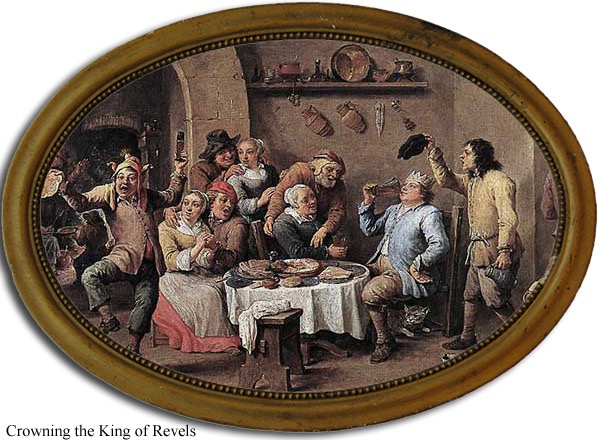
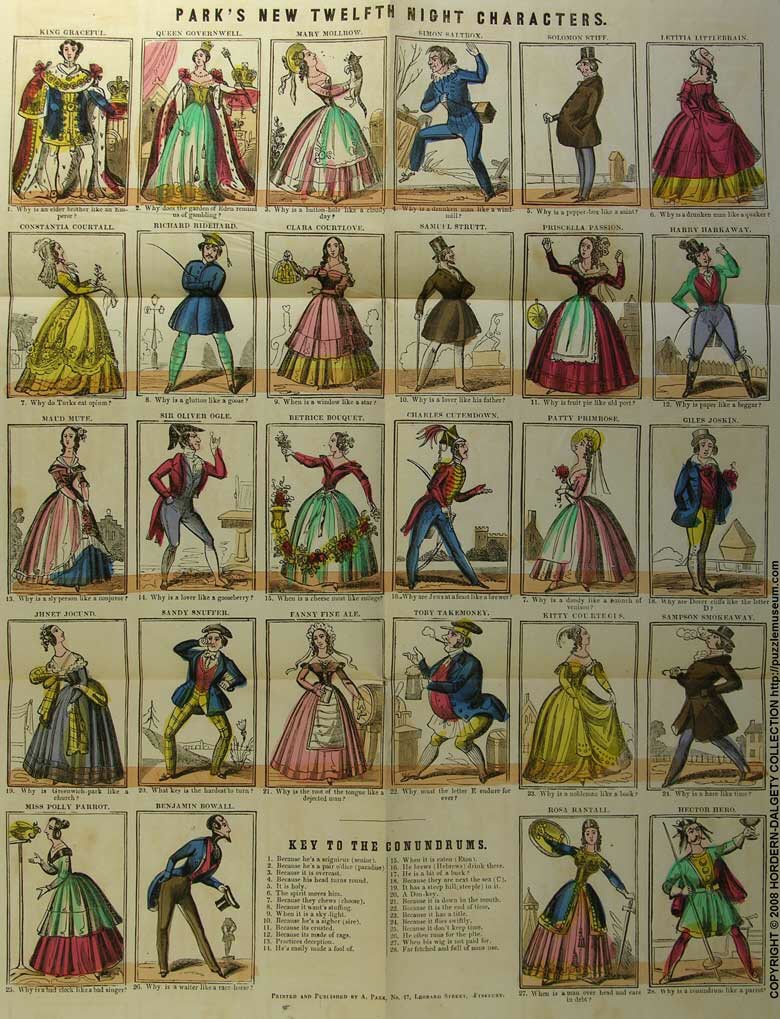
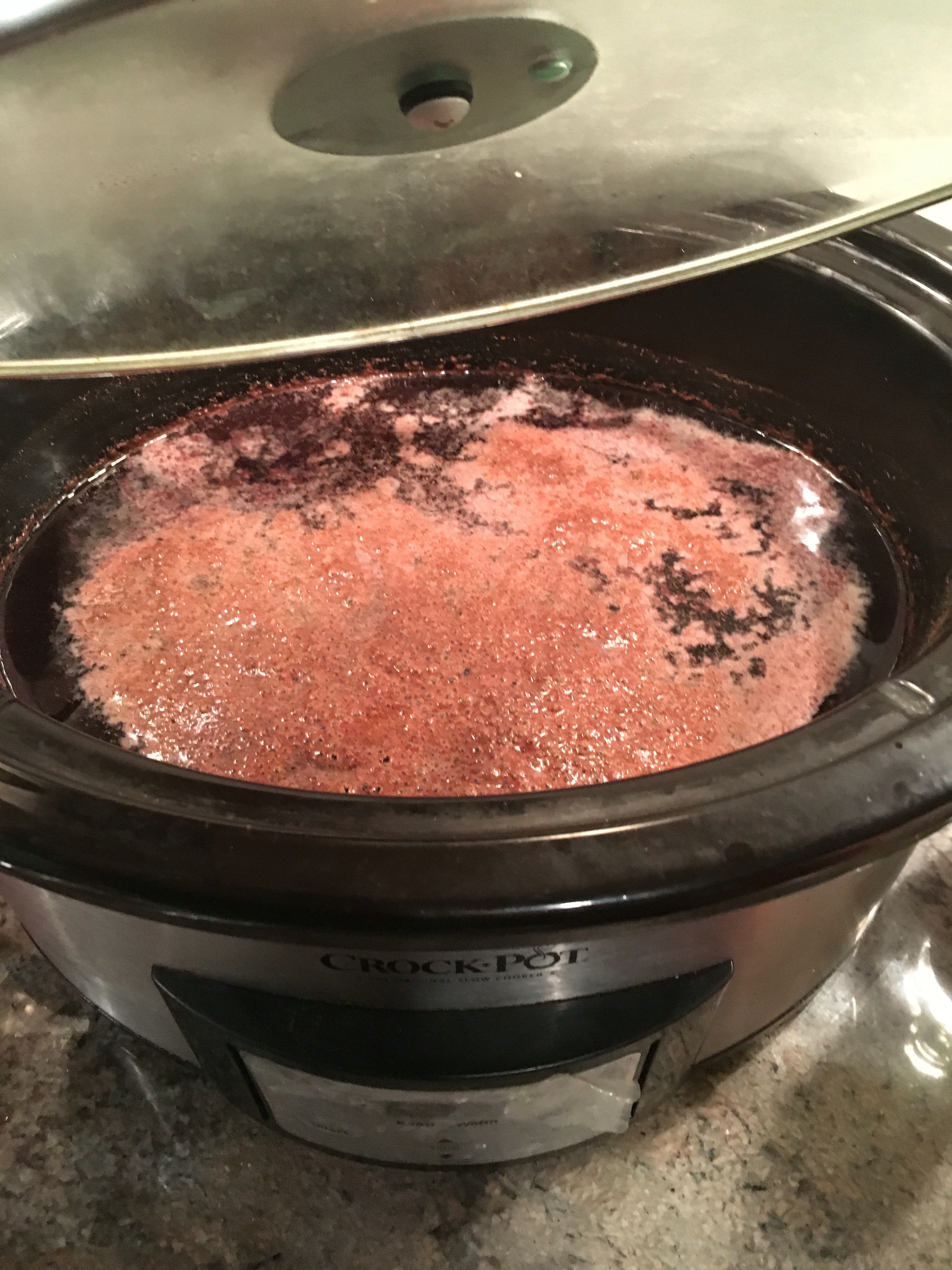
As I’ve mentioned in my previous posts one big part of the Christmas season was appointing a lord of misrule, and ancient tradition that goes back even before Christian times. In the play 12th night Feste basically serves as Lord Of Misrule; he presides over all the games and songs in the house, and he helps Sir Toby baffle Malvolio. In real life a Lord of Misrule presided over each Twelfth Night celebration, choosing which games and dances everyone would engage in.Most early Twelfth Night celebrations included a masked ball. In the 18th century, merrymakers engaged in a sort of role playing game, where they drew a character based on a popular archetype like the soldier Charles Cuttemdown or Beatrice Bouquet, and had to act like that character the rest of the night. Finally, a holiday that encourages you to LARP!Wassail.As I mentioned in my previous post wassail was the quintessential winter beverage and 12 night was not an exception. In this post you can see some photos of me actually making wassail myself in accordance with a trip up recipe I found on the food from the food network’s Alton Brown.Alton Brown Wassail recipe I didn’t have Madeira wine so I substituted port, but otherwise I used all the ingredients he mentioned in the recipe.Like I said in the previous post, Wassail is derived from an old word meaning “lamb’s wool,” and you can see why when you see the frothy mixture on top.I served this wassail to my in laws on Christmas night, and the only complaint I got was that the weather was a little too hot to enjoy it. I can personally attest that wassail warms you right down to your toes, which is great if you’ve been out caroling in 17th century England, but indoors during the hottest Christmas on record, it was a little uncomfortable- I was already wearing shorts and I was still too hot. My advice is- if you get a white Christmas, enjoy your wassail, but if it’s 60 degrees outside, stick to ale or Madeira, or some other kind of spicy spirit that you can serve

Well, that’s my advice, happy Twelfth Night everyone!Update: I’ve adapted the material from this post into an interactive, multimedia online class for kids aged 13-18! It will cover Elizabethan Christmas traditions and the plot and themed of Twelfth Night. You can register now at Outschool.com!Sources:Brownie Locks.com- History of Twelfth Night Catholic Encyclopedia: Feast of Fools
Jane Austin.com: Twelfth Night Celebrations
Lost Past Remembered: Twelfth night Why Christmas.com: the Twelve Days of Christmastime Project Britain: Twelfth Night http://projectbritain.com/Xmas/twelfth.htm

Christmas For Shakespeare Part III: Performing for Queen Elizabeth 

Merry Christmas Eve everyone! Today I will be talking about how Shakepeare’s two royal patrons, Queen Elizabeth I and James I celebrated this holiday!

We have surviving records that prove Shakespeare and his troupe performed at Christmas during the reigns of Queen Elizabeth and King James I. The buildings still exist so we can imagine what Shakespeare’s performancesal at court might have looked like. What follows is a bit of historical detective work, with a nice holiday flavor to boot.

How did Good Queen Bess celebrate Christmas?

Like her predecessor Henry VIII, Her Majesty Elizabeth accepted presents from the nobles on New Year’s Day instead of Christmas morning. From all over the kingdom, people would bring the best and most extravagant presents to the queen, hoping to gain her favor at court. Take a look at this true case of what her favorite courtier, Robert Dudley gave the queen for Christmas in 1588:

Dudley gives Queen Elizabeth a wristwatch
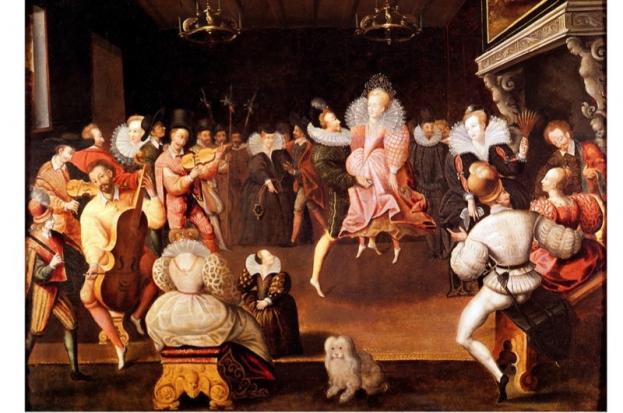
Unlike her dad however, Elizabethan Christmas was a more elaborate affair than a week of sitting and feasting. Yes, Gloriana had elaborate feasts, but she preferred to impress her nobles and visiting dignitaries with dances, jousts, and plays. She was an accomplished dancer and poet, and she loved court masques.

A masque is sort of like a combination masked ball and performance art piece. The nobles would put on costumes and masks and enact a historical or mythological event, like “the Golden Age Restored,” a masque Ben Johnson wrote for Twelfth Night in 1616. The intent was to flatter the queen and her court, as well as having a good time. Of course, Liz still made time on the dance floor for Shakepeare’s company!

.

How the plays were performed:

The plays would be in a large empty hall like the banquet hall or dance hall. Probably the tables would be removed from the feasting, then the dancing would begin. At around 10PM, the actors would take their places. There might be a makeshift tiring house, which was mainly just a curtain that the actors could hide behind to wait for their entrances.
The queen or King would be sitting on a throne on a raised platform so that she or he could be clearly seen by the actors and the audience.
Which plays did They Perform?

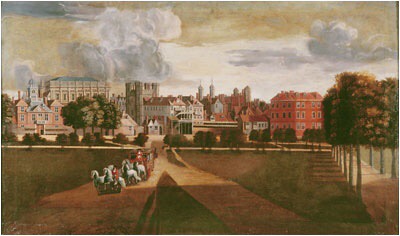
In 1594 The Lord Chamberlain’s Men played before the Queen at Greenwich Palace. Alas, we don’t know which plays they performed this time. What follows is a list of the plays we do know Shakepeare’s company played at Christmas.

Whitehall Palace by Dankerts, 1675.

Love’s Labors Lost– 1597 at Whitehall palace. This time we know which play they performed before the Queen, because it’s listed right on the title page. I suspect that printing where the play was performed was designed to fire the imagination of the people who bought it. If you couldn’t be at court to see Shakespeare’s play, you could at least read his words and imagine you were there.

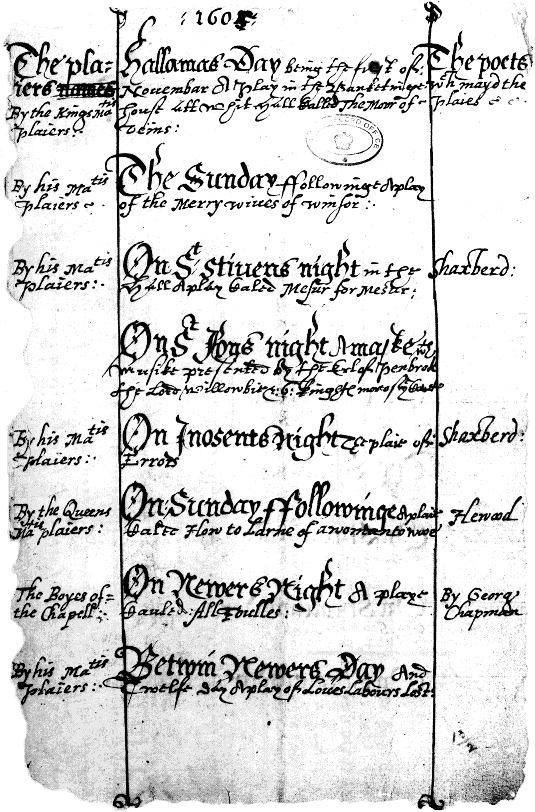
James I invited Shakepeare’s company to perform at Hampton Court many times. Below is an account of the plays for the Christmas holiday in 1603. Notice that Shakepeare’s name is spelled “Shaxberd.”

Here’s a list of some more plays we know Shakepeare’ performed at Christmas:

  1. Midsummer Nights Dream- 1603 on New Years Day, Hampton Court.
  2. Measure for Measure on Boxing Day 1603, Hampton Court.
  3. King Lear on Boxing Day 1606.
  4. Twelfth Night- Candlemas (Feb 2nd 1602).
  5. Twelfth Night 1618 and 1619 (location unknown).

Below is an episode of the incredible documentary “In Search of Shakepeare.” The first twelve minutes show what Christmas might have been like at Hampton Court in 1603, the first year of King James’ reign.

In Search of Shakespeare: For All Time

James loved plays and masques even more than Liz, which is why he employed one of the greatest scenic artists of all time, Inigo Jones, to come up with extravagant stage designs and costumes for plays and masques. James’ Queen Anne Of Denmark performed in quite a few masques herself. James also treated the Christmas season as a time of charity, which might have inspired some of the lines in King Lear, which was performed ‘on the feast of Steven’ 1606:

“Poor naked wretches… who soer you are. I have taken too little care of this.” -King Lear, Act III, scene I (The Storm Scene).

We can recall the contrast between King Lear and Good King Wenceslas. In the scene I quoted earlier, Lear laments that he hasn’t been more charitable to the poor, now that he himself feels cold and homeless.

The Christmas season would carry on until oh January 6, aka Twelfth Night. This was the day when, according to Christian tradition, the Three Wise Men finally got to Bethlehem and delivered their presents. Shakespeare’s play Twelfth Night is all about celebrations of feasting, fools and clowns, and of course, epiphanies.

If you liked this post, please consider signing up for my new online class, “What Was Christmas Like For William Shakespeare?” I’ll go further into the traditions of Elizabethan Christmas and add some insight into Shakespeare’s play “Twelfth Night.” Register now at Outschool.com!

The Shakepearean Student

Sources: http://www.unofficialroyalty.com/columnists/the-laird-othistle/will-shakespeare-at-christmas-court/

http://home.hiwaay.net/~paul/shakespeare/revels/revelsacct1.html

http://www.timetravel-britain.com/articles/christmas/jacobean.shtml

http://www.shakespeare-online.com/theatre/theroyalpalaces.html

http://internetshakespeare.uvic.ca/m/lifetimes/society/court%20life/festivals.html

FMI look at “The Christmas Revels”

Shakespeare Uncovered: Romeo and Juliet

While I work on this week’s posts, enjoy this wonderful documentary from the series Shakespeare Uncovered, about the great Shakespeare play, hosted by Joseph Fiennes, who played Romeo and Shakespeare in the film “Shakespeare In Love.” It talks about where the play comes from, and examines why this 400 year old love story endures. For you teachers, I’ve also included a great series of lesson plans that accompany the video

http://www.pbs.org/wnet/shakespeare-uncovered/uncategorized/romeo-juliet-joseph-fiennes-full-episode/

Fun Posts about Friar Lawrence from our Friends at “Zounds, Alack, and By My Troth.”

I love it every time I come across some Shakespearean humor. One of the ideas I keep coming back to in “Romeo and Juliet,” is how close the play comes to being a comedy- it has two lovers, a funny nurse, a wisecracking friend, if people didn’t die it could be a sitcom. Even more ridiculous is the clichéd comic device of having people fake their own deaths, which Shakespeare does again in his comedy Much Ado About Nothing. So here is a humorous take on the old friar, and his go-to advice:

Web comic strip from “Zounds, Alack and By My Troth,” Used with permission.

https://zoundsalackandbymytroth.wordpress.com/comic/friar/

Ira Glass Backtracks From “Shakespeare Sucks” Tweet.

I just saw on the “Tonight Show” a clip where Ira Glass from NPR retracts his statement on Twitter a week ago that “Shakespeare sucks,” after seeing a production of Shakespeare In the Park. Glass said to Jimmy Fallon that he immediately caught heat on the internet “Apparently Shakespeare has a huge internet presence.” To that i say, “Good job Shakespeare nerds!” As Fallon pointed out, Shakespeare is a rallying symbol to all smart people, and that’s why we need to defend him.

Enjoy this video, and enjoy watching Ira squirm.

By the way, if you’re interested in seeing John Lithgow in King Lear, here’s the official website: http://www.publictheater.org/en/Tickets/Calendar/PlayDetailsCollection/SITP/King-Lear/

Benedick and Beatrice’s Infinite Playlist, Part 2

Posted on May 8, 2012

Hello loyal subscribers and first time visitors!

If you missed my earlier post, this week I’ve created a little game for you to play at home: you try to match up the songs that express a fictional character’s personality with the events that happen to him/her through the course of play. Yesterday I posted a playlist for Benedick from Shakespeare’s Much Ado About Nothing, and today I’m going to post one for Beatrice. Your mission is to read the events that happen to Beatrice below, and figure out which songs on the playlist below correspond to these events. If you want to suggest more songs, please leave a comment below and I’ll create an extended playlist for the end of the week!  I’ll also post the correct results so you can see how well you did. Enjoy the game and, as Shakespeare said: “Play on!”

Paul Rycik 5/9/12

Events For Beatrice (Match these with the songs from the playlist below)

  1. Benedick and Beatrice have a brief fling and break up before the play begins

  2. Beatrice sees Benedick again at Leonato’s house and blows a flurry of words at him.

  3. Beatrice advises Hero not to worry about her wedding, but instead tells her to “Dance out your answer.”

  4. Beatrice dances with Benedick and pretends not to recognize him.

  5. Beatrice overhears Margaret, Hero, and Ursula ‘secretly confessing’ Benedick’s love for Beatrice.

  6. Beatrice is thunderstruck to discover that not only does Benedick love her, she loves him.

  7. Beatrice is furious at Claudio’s treatment of Hero, and the way men in general treat women.

  8. Beatrice challenges Benedick to prove his love to her by killing Claudio

  9. After soul searching and after Benedick challenges Claudio, Beatrice is on the mend.

  10. Having proved his worthiness to her like a chivalric soldier, Beatrice marries Benedick.

“The Fashion Is the Fashion:” An exploration of Costumes in “Much Ado About Nothing”

Much Ado About Nothing is about upper class people preparing for a wedding, which means fashion is a frequent topic of their conversation. Below I’ve provided a few costume references from the play with definitions from Shakespeare’s Lexicon by Alexander Schmidt.

Elizabethan Cap
Elizabethan Cap
  • Cap- A loose-fitting headdress, or soft brimless head-dress.
    1. “Hath not the world one man but he will wear his cap with suspicion?” (BENEDICK, I,I,)
    2. “Doth not my wit become me rarely? “It is not seen enough, you should wear it in your cap” (MARGARET/ BEATRICE, Act III, Scene iv).
A Fool or Jester's cap or Coxcomb
A Fool or Jester’s cap or Coxcomb
  • Coxcomb- The iconic fool or jester’s cap.
          1. DOGBERRY Let him write the prince’s officer coxcomb” (DOGBERRY, Act IV, Scene ii).
Drawing of a doublet, an Elizabethan leather jacket
  • Doublet– A leather jacket worn outside one’s regular shirt.
        • And now will he lie ten nights awake, carving the fashion of a new doublet” (BENEDICK, Act II, Scene iii).

457px-Doubletvanda

Authentic reproduction of of real doublet.

jerkins

        • Jerkin– Long close-fitting jacket worn over or in the place of a doublet.
        • Codpiece (below)- cloth case or pocket worn by men at the front of breeches or hose. codpiece11
  • Seest thou not, I say, what a deformed thief this fashion is? how giddily a’ turns about all the hot bloods between fourteen and five-and-thirty? Sometimes fashioning them like Pharaoh’s soldiers in the reeky painting, sometime like god Bel’s priests in the old church-window, sometime like the shaven Hercules in the smirched worm-eaten tapestry, where his codpiece seems as massy as his club? (MARGARET, Act III, Scene iii).

Sometimes entire passages in Much Ado About Nothing refer to fashion, as in this example from Act III, Scene iii:

BORACCIO: Thou knowest that the fashion of a doublet, or a hat, or a cloak, is nothing to a man.

CONRAD: Yes, it is apparel.

BORACHIO: I mean, the fashion.

CONRAD: Yes, the fashion is the fashion (Act III, Scene iii).

This passage tells a lot about Boraccio’s motivations, and also shows a lot about the role of fashion in the Elizabethan period. “Fashion” in this case refers not only to the clothing, (its fine craftsmanship and contemporary style), but also to its wealth. Back in the Elizabethan era, people showed off their wealth and status with the clothes they wear; they literally wore their money on their backs. When Boracchio refers to fashion being nothing to a man, he means that a man of wealth and property has no reason to worry about buying fancy clothes. This betrays the reason Boraccio wants to work for Don John- money, and aspirations of becoming a wealthy gentleman. Act III, Scene iii.

Close Reading- Act III, Scene ii

DON PEDRO: There is no appearance of fancy in him, unless it be a fancy that he hath to strange disguises; as, to be a Dutchman today, a Frenchman to-morrow, or in the shape of two countries at once, as, a German from the waist downward, all slops, and a Spaniard from the hip upward, no doublet. Unless he have a fancy to this foolery, as it appears he hath, he is no fool for fancy, as you would have it appear he is (Act III, Scene ii).

In this passage, Don Pedro observes Benedick and mockingly tries to get Benedick to confess that he is in love. Benedick has fallen in love with Beatrice and it has changed his behavior completely- including his manner of dress, which Pedro singles out as a sign of love. This is not unlike a similar passage in As You Like It, where Rosaline tells Orlando that disorder in dress is one of the signs of love. To understand Don Pedro’s remarks, one must first look at some of the European fashions of the time.

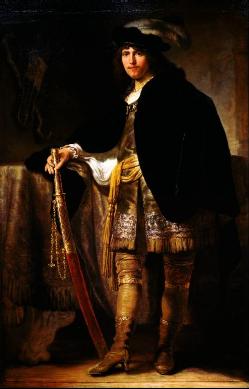
Ferdinand Bol, c. 1640, "Portrait of Youth With A Sword."
Ferdinand Bol, c. 1640, “Portrait of Youth With A Sword.”

Image 1: The Dutch

Consider this picture of a Dutch courtier by Ferdinand Bol, c. 1640. Notice that though he looks rich, his outfit is fairly austere, no exaggerated codpiece, pants that cover and do not emphasize the shape of the man’s thigh or legs. This is the demure image of the Dutch aristocrat, which is why the liberal prince makes fun of him.

This is an image of a French courtier from the Valois Tapestry (1576). This man’s outfit is practically the opposite of the smart, modest Dutchman. His hose are tight-fitting, decorated with fine embroidery to draw the eye, and his hose show off the shape of his leg. This would be like wearing leather pants today- this outfit is all about flash and sex appeal.  Here is a sketch of German aristocrats from the late 16th century. The English liked to make fun of the baggy clothing of the Germans with their padded slops and their peascod belly doublets. These men look like their clothing is only designed to ward off Germany’s cold winters, rather than looking strong, sexy, or powerful.

Image #3: The Germans

German aristocrats from the late 16th century.

To the right is a picture of German  slops, which, as the century wore on, got bigger,

flying canoe slops
flying canoe slops

and baggier. Going back to the passage quoted earlier, you’ll notice how the people that Pedro makes fun of are all foreigners, none of them are English or Italian. The English liked to make fun of the fashions in other countries, especially the Spanish and the French, (their political enemies). They made fun of the German and French for their slops in particular, probably because slops were so baggy; a man wearing them looked like he was concealing an erection. Pedro is implying Benedick has ‘something to hide,’ since he is thinking about Beatrice all day. Mercutio makes the same joke, when he makes fun of Romeo’s “French slop.”

Don Pedro’s comment about a doublet suggests that Benedick has been walking around with no jacket. This was considered a sign of madness and Ophelia uses it as evidence of Hamlet’s madness in Hamlet, Act II, Scene i: Notice how both passages shockingly refer to the unusual fashion of not keeping ones doublet in proper order. Once again, Pedro is subtly hinting to how Benedick must be in love based on his erratic behavior, which fits in with the stereotype of Spaniards as sex-crazed hot bloods. Spaniards did not Remember, Elizabethans had no heating systems to spare them from cold, so not wearing one’s doublet was very dangerous. Only a madman (and by extension, an unrequited lover), would engage in such self-destructive behavior. Thus, through Don Pedro’s subtle pokes at Benedick, the prince lets him know that he cannot hide his love for Beatrice; it has already manifest itself in his clothes.

As mentioned before, wealthy Elizabethans spent their money on clothes the way modern rich people spend money on yachts and home entertainment systems. Dukes and counts would buy tailor-made, beautifully embroidered clothes, and their outfits sometimes were as famous as the people who wore them.

This final quote from Act III, Scene IV illustrates this principle. The day of Hero’s wedding, her gentlewoman Margaret is comparing her gown to the famous dress of the Duchess of Milan:

By my troth, ‘s but a night-gown in respect of yours: cloth o’ gold, and cuts, and laced with silver, set with pearls, down sleeves, side sleeves, and skirts, round underborne with a bluish tinsel: but for a fine, quaint, graceful and excellent fashion, yours is worth ten on ‘t ( MARGARET, Much Ado, Act III, Scene iv).

Portrait of Christtine of Denmark, 1568

Margaret refers to a famous gown worn by Christine of Denmark, a real noblewoman who was immortalized in this portrait: This is a portrait of Christtine of Denmark, Dutchess of Milan from 1521-1590. Notice that, just like Margaret’s description, the cloth is cut with gold, the sleeves and gown are adorned with gold, silver, and pearls, and the dress itself is mostly black (the most expensive color to produce back in the 1590s). These were all common fashions for the upper class in the 16th century. Notice also that the cloth on the sleeves is slashed, (cut open) to reveal the much more expensive silk embroidered with silver and gold. Pearls were a symbol of virginity to the Elizabethans, and at this point, Chistine had been widowed twice over, which is why she is clutching the tassel with the pearl around it, as a symbolic assertion of her chastity. The image was scanned from the Weiss Gallery catalogue: A Noble Visage, Early Portraiture, 1545 – 1660, London, 2001.

I hope you’ve enjoyed this look at the material culture of Elizabethan England. If you would like more info on Elizabethan fashion, please leave a comment below