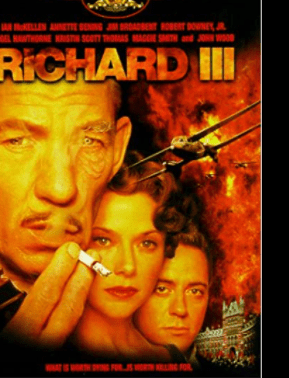
Introducing our new Play of the Month: Shakespeare’s dark history play about murder and corruption, Richard III. First, a short presentation I made that introduces the characters and themes of the play.
Second, a quick, funny summary of the play from the Reduced Shakespeare Company
And finally, this incredible animated version of the play, which looks like a stained-glass window come to life!
Well, Christmas is almost here; soon many of us will be traveling home to celebrate the holidays with our families, enjoying parties, presents, carols, and decorations. However, our modern traditions weren’t always the norm for people who celebrate Christmas. In the interest of historical curiosity, we here at Shakespearean Student would like to talk a little bit about how William Shakespeare might’ve celebrated Christmas!
As with everything in Shakespeare’s life, many times scholars have nothing but “what if’s” to go on, because few records exist, there were no photos from the period, and very few documents survive related to Shakespeare. He also kept no journals or diaries to record what his life might’ve been like. However, based in the holiday traditions of England that have lingered on to this day, we can surmise what Christmas might’ve been like in the late 16th century.
Part 1: Stratford
Shakespeare was born in 1564, in the town of Stratford-Upon-Avon in the county of Warwickshire England. As I mentioned earlier, Shakespeare would not have known many of our modern Christmas traditions. The Christmas Tree as we know it didn’t come into being until Queen Victoria’s reign, (and she certainly didn’t light hers with electric lights). Victoria also invented the idea of putting presents under the tree. I’m not an expert on Christmas, but my research would indicate that probably Elizabethans like Shakespeare didn’t even give out presents on Christmas Day! Instead, in country towns like Stratford in Tudor times, Christmas was a time of feasting, singing, caroling, and theatre!
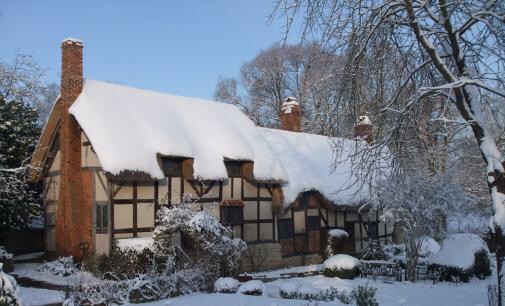
The Shakespeare family home at Christmas
The Christmas season in Shakespeare’s day usually extended from Christmas Eve to the twelfth night after Christmas also known as Twelfth Night or Epithany. Common people usually decorated their homes with holly and ivy, and celebrated Christmas Eve by lighting their homes with candles and by burning the Yule log, an ancient tradition dating back over 1,000 years when the Vikings controlled most of England. It was a symbol of light and warmth in the darkest time of the year.
Replica of Shakespeare’s kitchen.
Feasting-
Roast goose was a staple of the common man’s feast at Christmas. In 1588, Queen Elizabeth commanded the whole country to consume geese to commemorate England’s victory over the Spanish Armada. Other traditional fare included plum porridge, beer or ale, and the most celebrated Christmas beverage of all: Wassail!
Wasailing-
The old tradition of caroling comes from an ancient pagan holiday tradition of showing charity to the poor at the winter solstice. People would go door to door asking for alms and occasionally a warm beverage. This ancient practice evolved into caroling and Wasailing!
The word “wassail” is an old Celtic word that means “lambswool,” it refers to the fact that the drink is covered with a thin foam that looks kind of like the wool of a sheep. It is also derived from the Anglo-Saxon “wassail,” which means “be in health,” so it is simultaneously a drink, a toast, and an explanation of what the drink looks like.
Like our modern-day caroling, people would sing and dance going door to door asking for a traditional glass of wassail or a mince pie. A mince pie is a traditional meat pie that is often filled with 12 different ingredients to symbolize the 12 days of Christmas.
Mince pies were popular with both peasants and kings, and contains both fruit and different types of meat including rabbit chicken duck and hare.
Wasailing also has its roots in ancient pagan holidays and that’s why it’s often accompanied with a traditional Morris dance, where the dancers are waving handkerchiefs, knocking sticks together and dancing with brightly colored ribbons. This was a great tradition back in the small towns and shires of England and continues to this very day. Below you’ll find a video where you can make some wassail yourself! I Just a note that in this recipe, the cook has left out the alcohol and has also left out the egg which is necessary to create the foamy lambswool. Nonetheless I think it’s a very good recipe and I welcome you to try it for yourself.
Plays–
As the mayor’s son, young William had a VIP pass to see all traveling actors who came to town. Shakespeare’s dad would’ve decided who got to perform at the guild halls and local inns, so he and his son would’ve watched private performances of all the shows first. After that, John Shakespeare decided who got to perform, and who would be sent away. In addition to professional troupes at Christmas, craftsmen in Will’s hometown people in Warwickshire would come together and put on a show! These amateur dramatic pieces were known as Mystery Plays.
Mystery Plays got their name from the old meaning of mystery: a trade or skill. Much like modern nativity plays or community theaters, every year all the craftsmen from the town would put on a series of short shows derived from Bible stories at Christmas time, and showcase their crafts as well as their acting talents. For example the goldsmiths were in charge of the Three Wise Men story.
We know that Shakespeare liked these plays because he refers to one in particular many, many times: The play of King Herod. in the Bible, Herod The Great is fearful of the baby Jesus and sends his soldiers to kill any young baby that they can find in the city of Jerusalem. Very often when Shakespeare refers to any of his villainous characters he describes them as Herod-like.
The Mysteries were printed during Shakespeare’s lifetime and people in York, Coventry, and Wakefield England still perform them today! Here’s a video of a little girl who performed in the York Mystery play last year:
I hope you enjoyed this little sojourn into the ancient traditions of the common folk back in Shakespeare’s England.
If you liked this post, please consider signing up for my new online class, “What Was Christmas Like For William Shakespeare?” I’ll go further into the traditions of Elizabethan Christmas and add some insight into Shakespeare’s play “Twelfth Night.” Register now at Outschool.com!
Tonight I’d like to discuss some of the spookiest, most enigmatic, and above all WEIRDEST characters in Shakespeare: the Three Weird Sisters in Macbeth.
1. Who are they?
Every production has to answer who the witches are, and many have very different answers. Are they temptress? Are they evil agents controlling Macbeth?Furies trying to destroy Macbeth?
I would argue in their basic form the witches are harbingers of change. Their very name “Wyrd Sisters” refers to an old Anglo Saxon concept of fate or destiny. Whether or not they have any effect on Macbeth mind or soul, they point the finger at him and say “things are going to change for you.” Then, he either makes the choices that determine his fate, or they change his fate for him.
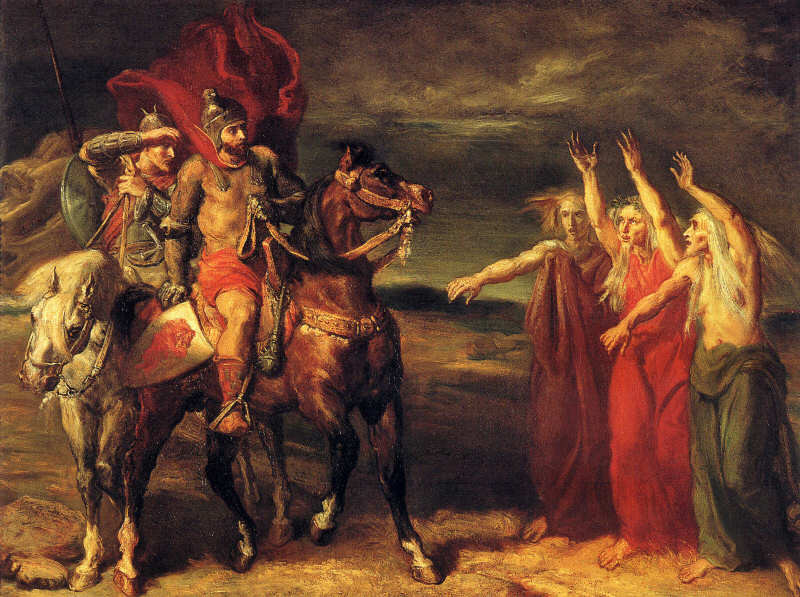
“Macbeth and Banquo First Encounter the Witches,” Théodore Chassériau, 1854.
Macbeth meets the witches on a heath, which means land that is literally out of bounds– the wild, untamed wilderness, which the old Anglo Saxons believed was the lair of many cursed spirits and monsters. This could symbolize Macbeth’ sin or transgressions, slowly turning into a murderer, usurper, and a tyrant. It could also symbolize the chaos in Macbeth’s life.
What Do They Look Like?
Shakespeare’s descriptions of the witches are highly contradictory- they seem to be floating, yet on the ground, they seem to be women, but they have beards! They don’t look Earthly, but here they are on the Earth. This gives them an other worldly quality that keeps us guessing as to who they are, and helps them tempt Macbeth more easily.
BANQUO What are these So wither’d and so wild in their attire, That look not like the inhabitants o’ the earth, And yet are on’t? Live you? or are you aught That man may question? You seem to understand me, By each at once her chappy finger laying Upon her skinny lips: you should be women, And yet your beards forbid me to interpret That you are so.
MACBETH Speak, if you can: what are you? (Act I, Scene iii).
The Witches’ Language:
You know from my earlier posts that the norm for Shakespearean characters is to speak in iambic pentameter- 10 syllable lines of unrhymed poetry that sounds like a normal heartbeat. The witches break these norms- they generally speak in Trochaic Tetrameter- 8 syllable lines with the off beat emphasized. The witches are literally offbeat, and that’s why their speeches are unsettling. Look at the contrast between a normal iambic line like:
“In sooth I know not why I am so sad.” (Merchant Of Venice I,i).
and
“Dou-ble Dou-ble, Toil and Tro-ble.
Fire burn and Caul-dren Bu-ble. (Macbeth, Act IV, Scene i).
For more info on the verse forms of the Witches, click here:
The witches also speak their prophesies in a vague, ambiguous manner They like to play with obscuring their prophesies with lines that make Macbeth think one thing, but the opposite is true. The famous example here is when they claim Macbeth will never be vanquished “until Birnam Wood comes to Dunsinane Hill.” Macbeth assumes this means he’s invincible, but it actually means that the enemy carry wood from the forrest. This is called Equivocation.
Witches and mythology
Illustration from William Blake’s “Europe a Prophecy,” 1794.
1. During the reign of King James, the modern witch hunt began; the king was fascinated with witches and even wrote a book called Daemonology on how to identify and destroy them. This was the era where people believed that witchcraft, rather than a pagan religious practice, was a forbidden craft that could only come from a pact with the devil. However, Shakespeare borrows from both Satanic and early pagan ritual in the characters of his witches.
2. Shakespeare took a couple of details about witchcraft from ancient Celtic and Greek mythology. First of all, the use of a cauldron. In Celtic myth, a cauldron is a symbol of rebirth and was sometimes used to resurrect the dead, just as the witches do in IV i. Of course, the ideal time for raising the spirits was on the feast of the pagan god Samhain, at the point where the veil between the living and dead was the thinnest. The feast took place on October 31st, our modern day Halloween!
Illustration of witches and their familiar spirits, 1647.
3. Familiar spirits In Act I, the witches speak to animal spirits called familiar spirits, which call to them and tell them where to go. King James himself wrote about how the witches found and communicated with these spirits.
Hecate.
In Act IV, Hecate, Ancient Greek goddess of magic appears. She is clearly the lord of all the witches, and is very displeased that they are riddling with Macbeth. Maybe not all witches believe in giving out prophesies that can destroy the Scottish monarchy. Hecate was always enigmatic in myths- she was born one of the Titans who opposed the gods, but frequently changed sides. More then being two faced, she was often portrayed as having three faces! Shakespeare refers to her frequently as “Triple Hecate.”
“The Triple Hecate,” by William Blake, 1794.
For more information on this mysterious goddess, consult the video below, (WARNING, ADULT-ONLY CONTENT).
In conclusion, the witches are meant to be ambiguous because the play examines the source of evil- whether it is inspired by other people, or if it comes from one’s own heart. The witches can be either or both, depending on how you want to tell the story, which is why they act and speak in contradictory ways.
Thanks for reading! If you enjoyed this posting, please consider signing up for my online class, “Macbeth: An Immersive Horror Experience.” I tell you the story of Macbeth and you get to play through an escape room, where you must solve the witches’ puzzles or be added to their Cauldron!
One of the greatest icons of female villainy, Lady Macbeth has been portrayed onstage by our greatest actresses, and immortalized in many alluring and terrifying works of art. Here are some of my favorites:
Shakespeare himself was a father, and he frequently wrote about the dynamic between fathers and their children. There are many different types of fathers in Shakespeare’s 40 plus plays, and this week I’m ranking them in terms of three categories: Good Dads, Bad Dads, and “Dad Dads.” You’ve probably already read the “Worst Dad” post, so now we’re looking at the good, and the not so good. I used the following criteria when choosing the top 5 dads in each categories:
The Good Dads
Are supportive for their kids
Try to keep their children happy
Offer help and advice, especially on their children’s future.
Are willing to sacrifice themselves
They let their children become their own people.
The Bad Dads
Treat their children as property
Have little to no interest in their children
Put their children in danger
Subject their children to abuse
In some cases, they murder them!
The “Dad” Dads
Are basically good hearted, but they have some kind of flaw that prevents them from becoming really good parents.
In my view, are the most human, modern dads on the list.
I’ve chosen to award these dads a necktie, something every ok dad needs.
Now, onto the Dad Dads:
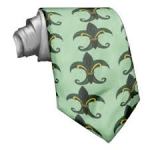
5. Aegean from The Comedy Of Errors. Aegean wonders around for 20 years looking for his lost children, which I call devoted parenting, but a little aimless and undisciplined. I therefore award Aegean two ties with little anchors on them, to remind him to stay in one place and wait for his sons to find him!
Alexandre Bida, “The death of Lord and John Talbott,” 1895
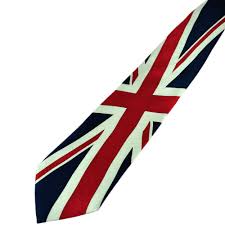
4. Lord Talbott from Henry the Sixth Part I. Talbott is the hero of the English fight against the French at the close of the Hundred Years War. He goes toe to toe with Joan of Arc on numerous occasions. He also raises a fine and valliant son, John Talbott who is also a warrior. The two die bravely in a siege against the French, rather than surrendering, or leaving the other to die. Talbott is clearly also devoted to his child, but his career choice doesn’t allow his son to grow up in a safe environment! I therefore award Talbott two ties with little English and French flags on them.
The Ghost of Hamlet’s Father by William Blake, 1806.
3. The Ghost Of Hamlet’s Father from Hamlet/ Portia’s Dad from Merchant Of Venice. Both these parents die before their plays begin, yet they still try to improve their children’s lives from beyond the grave! The Ghost helps Hamlet become king of Denmark, and Portia’s dad tries to help her find a good husband, (one who will love her for something besides her beauty or riches). Although these parents achieve their goals, waiting this long to help their kids seems a bit like absentee parenting! I therefore award these posthumous parents ties with little skulls on them.
2
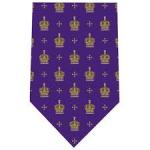
. King Henry IV, from King Henry IV King Henry is the classic career dad, one who wants his son Hal (the future King Henry V), to follow in his footsteps. The two have a terrible fight when Henry thinks Hal is trying to steal his crown on his deathbed! Eventually though, father and son reconcile, and dad even gives the future king some last minute advice; if you fight a war with France it’ll help secure your crown, which Hal does and succeeds! I therefore award King Henry a tie with little crowns on it, hoping that nobody with a dagger ties tries to steal it when he’s sleeping!
1. Prince Pericles from Pericles Pericles is another busy dad- King Antiocus tries to murder him, and he has to leave his own kingdom. Then he gets shipwrecked 3 times! In fact, his only daughter is born onboard a ship in the middle of a storm! Pericles raises the girl for a number of years, but then has to leave again, and guess what, he gets shipwrecked AGAIN! He eventually finds his daughter and they live happily ever after, but you kind of get the idea that Pericles is a little accident-prone, which keeps him from being on the Best Dads list. Sorry Pericles, but at least you get a tie with, what else, Boats on it! Maybe next Fathers Day, someone will get you a life preserver.
And now at Long LAST, the BEST Dads in Shakespeare!
Aaron fights to protect his baby child.
5. Aaron the Moor from Titus Andronicus. Ironically, one of the worst villains in Shakespeare is also one of the best fathers. Aaron is fiercely protective of his child, even threatening people at sword point if they dare come near his baby. He also plans out the child’s future and is willing to give his own life for a promise that Lucius will protect and nourish his son. He may be a monster to everyone else, but to his baby, Aaron is simply, a good dad!
4. The Old Shepherd from The Winter’s Tale. This character is a very mirror of generosity and kindness; not only does he take care of his son The Clown, he adopts a poor discarded child, the princess Perdita, with no obligation to do so. He raises her for 16 years and constantly brags about her to the entire town. She becomes a beautiful, wise, and modest girl who fills her adopted father with pride because of his good parenting. Even when Perdita meets her real father, she speaks of The Old Shepherd with real filial affection “Oh my poor father.”
3.
Lord Capulet, from Romeo and Juliet. I know this was a controversial choice, and I discuss my choice in detail on my podcast, but I’ll sum up my major arguments here:
Even though a lot of actors choose to have him smack Juliet around, there’s no mention of it in Shakespeare’s text. The most he ever does is threaten to strike her, but the stage directions never indicate he does it. Capulet is clearly more bark than bite.
From the very beginning of the play, Capulet has shown that he cares about Juliet, and wants her to marry for love, not money.
Lord Capulet hovers and frets constantly when Juliet tells him she will marry Paris, staying up late to plan the wedding! I ask you, does that sound like a tyrannical father? I wonder sometimes if Lord Capulet would’ve forgiven Juliet for marrying Romeo if she had just told him. In any case, based on my criteria above, Capulet is a good dad, bad tempered, yes, but fundamentally concerned for the welfare of his children.
3. Prospero fromThe Tempest I chose this high spot for Prospero mainly because he seems to have the most success of any other dad in the cannon. Like Pericles, he too is shipwrecked with his daughter, but Prospero stays with Miranda, raises her alone, teaches her everything she knows, and calls her an angel that helped preserve his life. Prospero cares so much for his daughter that he refuses to give into despair, even though he’s lost his wife, his dukedom, and his home.
Prospero also hatches a plan to get him and Miranda off the island, to get his dukedom back, and to get her married to a handsome prince name Ferdinand, and he succeeds with every one of these endeavors, even though it takes 12 years. Prospero gets extra points for his patience and his wisdom, but I have to admit he’s a bit of a control freak; he demands that Miranda listen to him and obey him no matter what, and he warns Ferdinand that there will be dire consequences if he dare try to do anything illicit with his daughter before the wedding. In addition, there’s no denying that Prospero is also acting out of self interest- he wants to become duke again, and he wants revenge against his enemies and that’s partially why he raises a tempest, (or a huge storm), instead of just sending a message back to Milan.
1.
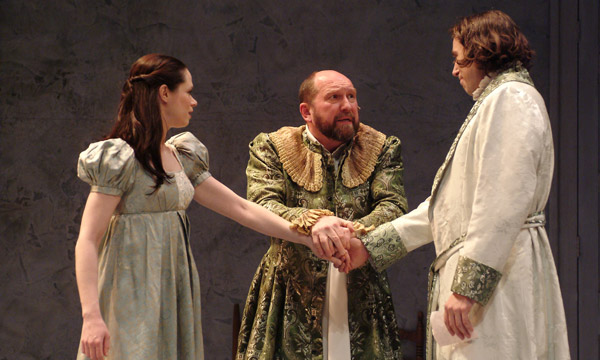
Simonides grants permission for Pericles to wed his daughter. Production shot from Mary Zimmerman’s 2006 production of “Pericles.”
King Simonedes from Pericles, Prince Of Tyre You might forget this character because he only has a short time onstage, but I defy anyone to come up with a better father. He’s kind, supportive, stable, funny, and has a wonderful relationship with his daughter Thaisa. Above all, Simonedes actually listens to his child and does everything in his power to help her when she decides she wants to marry Pericles. Also, like Prospero, Simonedes pretends to object to the marriage, but you kind of get the sense that, rather than testing the affection of the couple, he’s actually just playing a joke on them. You can hear a “gotcha” and a fatherly wink in the final line of the speech in Act II, where he pretends to object to their marriage:
Congratulations to all our fabulous fictional fathers! Thank you for reading, and see you soon!



![Candleglow%20PR%20small[1]](https://shakespeareanstudent.com/wp-content/uploads/2015/12/candleglow20pr20small1.jpg?w=764)













 The Shakespearean Student