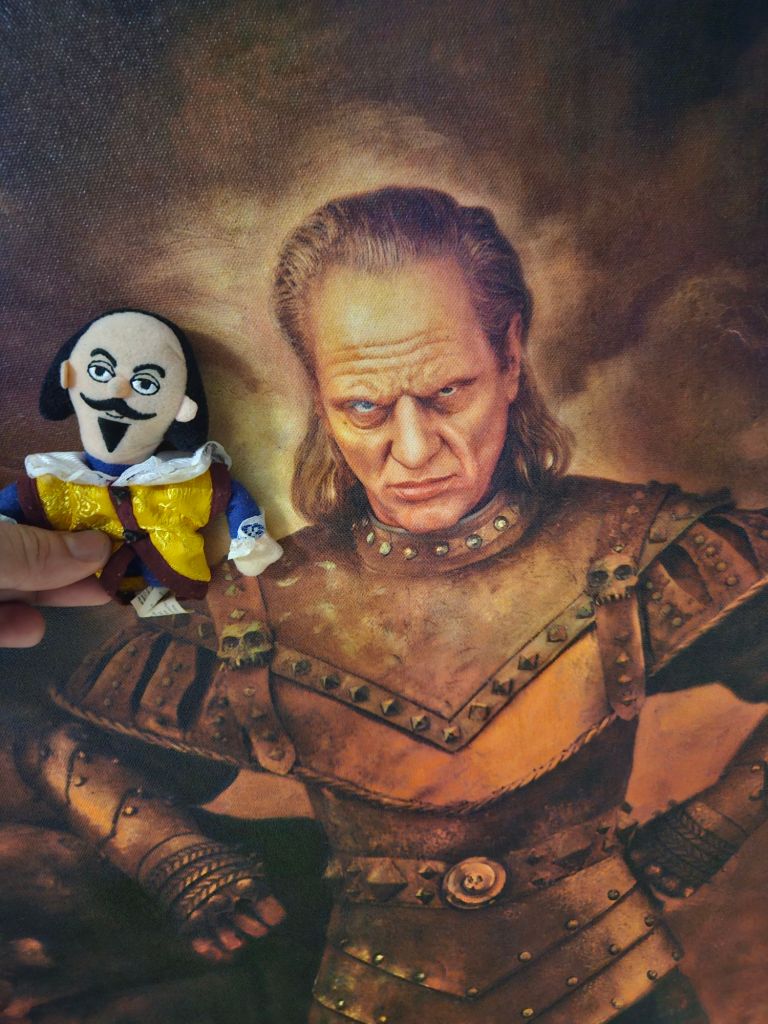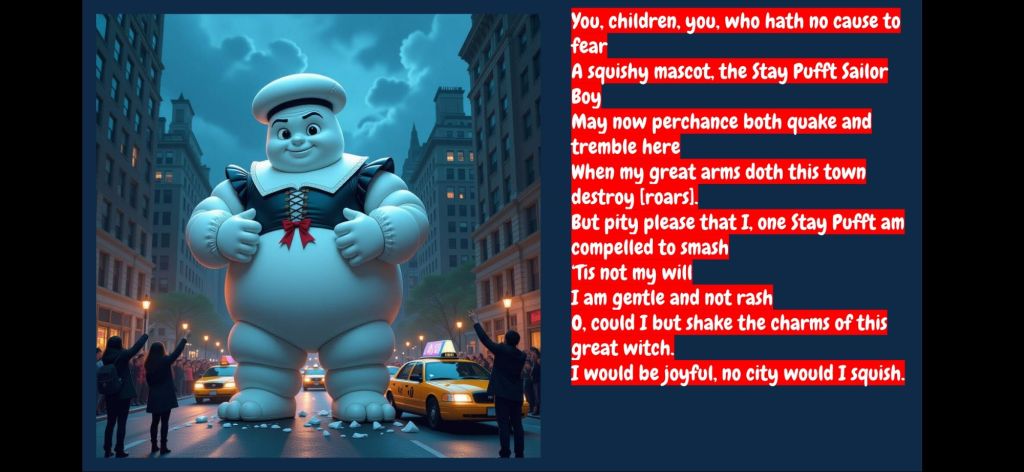
So, why Ghostbusters? Well, as William Shakespeare’s Star Wars has shown, it’s not only fun to adapt popular stories into Shakespearean parodies, it can also be educational. I knew I wanted to do a short play for my school’s fall festival, but I didn’t think to do “Ghostbusters” until I saw the final joke in the Simpson’s parody of Hamlet, where Homer says: “Son, [Hamlet] is not only a great play, but also became a great movie, called Ghostbusters!”
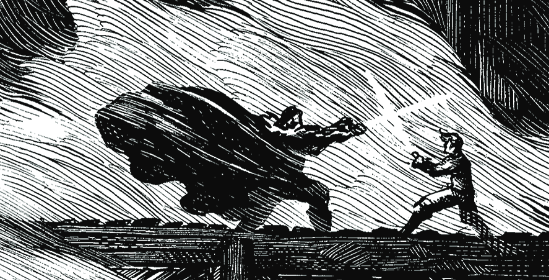
This joke got me thinking- Hamlet has a comic scene where the prince and his two friends are running around the stage away from a ghost, one that refuses to speak to them and then terrifies them. This reminds me of the moment where the ghost of the librarian shushes the heroes, and becomes a hideous creature:
The librarian in Ghostbusters is similar to the Ghost of Hamlet’s Father.
From this realization. I took it as a personal challenge to adapt Ghostbusters into a one-act stage play with as much Shakespearean dialogue as possible.
My Process
Re-writing the script of a movie into a Shakespeare text required me to overhaul the story of Ghostbusters, as well as retrofitting Shakespearean lines and speeches from Hamlet, Macbeth, Henry IV & Henry V. I knew I wanted to freely cut-and-paste from Shakespeare, as if he’d written the original Ghostbusters. The result is a sort of stitched together blanket of Shakespeare lines, lines adapted from Ghostbusters, and some lines I created myself.
The Outline
Like I said, I kept the story limited to how the four Ghostbusters learn that ghosts are real, become professional ghost catchers, and then receive a call from a damsel in distress (Ms. Dana Barrett), who allows them to become heroes by defeating the ghost that has possessed her. I also decided to use the commercial in the movie as a framing device:
In my version, the Ghostbusters start by doing a commercial that then becomes a flashback where the heroes recap everything that has happened to them over the past week. I then ended the play by joking referring to the play as “A very long commercial.”
Scenes I Included/ Scenes I Cut
I only had 30 minutes allocated for my show, so I knew I’d have to pare down the story to its bare bones. This meant I had to eliminate a lot of subplots and characters and condense several scenes. As much as I love Walter Peck, Dean Jaeger, Louis Tully, Janine Melnitz, and the guy who gets electrocuted, they are not absolutely essential to the plot, so I cut them from my version. I also combined the characters of Dana and Gozer, eliminating the two terror dogs and limiting the antagonists to Gozer and the Stay Pufft Marshmallow Man. So I watched the film a few times, and created an outline of just 7 scenes.
Character Models
One thing I’ve said again and again is that Shakespeare’s characters are all based on archetypes that we see everywhere throughout literature, theater, and yes, movies. While I was watching Ghostbusters, I tried to find the Shakespearean archetypes that match the best with the characters in the movie:
Ray Stantz- Hamlet from Hamlet– Ray is a bookish man who is obsessed with death and with the occult, which makes him very much like the scholarly Prince Hamlet. He’s also a man on a mission to try and understand the supernatural and help keep it from destroying our world. Dr. Venkman describes him as “The heart of the Ghostbusters”, and that humorous heart gets him into trouble sometimes.
Egon Spangler- Horatio from Hamlet If Ray is the heart of the team, Egon is the brain. He is the no-nonsense scientist who provides the team with data and equipment to help them fight ghosts effectively, much like how Horatio reports to Hamlet that his father’s ghost has returned from the grave.
Dr. Venkman– Sir John Falstaff/ King Henry V
Dana Barret- Ophelia from Hamlet
Gozer– Hecate from Macbeth
The Stay Pufft Marshmallow Man- Snug the Joiner from A Midsummer Night’s Dream
Sneak Peak
Here’s one of the scenes I wrote, with the original scene for context
[The ghostbusters climb the stairway to the penthouse, where Gozer is sitting in a cloud. They have been going for a while and are clearly tired]. Venkman: Though I have not known fair Dana long, I know she must be a virtuous maid. Ascend this penthouse tower and let’s rescue she! Like to the Knights of ancient chivalry! Egon: These apparitions whizzing in the air Give so much light that I may read by them. [They reach the top and behold Gozer] Ray: I am resolved to speak to Gozer. This is the latest parle we will admit. Gozer: Art thou a god? Ray: Nay. Gozer: Then perish, half-man! Winston: Enough Ray of thy diplomacy! Speak, thou proton pack for me! [He fires, then the rest join in] Gozer disappears Venkman: The sky hath bubbles as the water hath, and she be one of them! Gozer [in Voice Over]: Sub creatures! Hark! Tis time! Pick the Destructor’s form Be it a Goblin damned or angel bright! Tornado or a earthy bright Or greatest Monkey with an appetite! Winson: Our thoughts contain the form that seals our doom? Then make them blank as a new-made room! [They all gesture to their heads as if pushing thoughts out] Gozer: Thy choice is made. Prepare to meet thy doom! Venkman: Nay! I chose nothing Winston: Nor I! Egon: Nor I [Pause] All: Ray? Ray: Twas not my fault! It popped into my mind Venkman: What? What hast popped in? Egon: LOOOK!!!
According to Branaugh, the idea behind the film was to emphasize beautiful things like tranquility and love, but preserve and heighten the danger of being hunted by a powerful warlord like the Duke
Interview with the director and cast at the Barbican
The Plot Of the Play
Historical Context
Branaugh set the film in 19th century Japan, at a time when English people came to Japan for the first time, and created small English communities in the country. I’ll discuss later that I have very conflicting feelings with this choice, but I will give Branaugh this- it does highlight the fish out of water journey that Rosalind and the other characters go through leaving their homes at court, and becoming enamored with a new country.
The Cast
The cast is full of veteran Shakespeareans and gifted Hollywood stars. Bryce Dallas Howard is charming as Rosalind, and has good chemistry with RSC actor David Oyelowo. I also enjoyed Brian Blessed’s dual role as Duke Senior and Duke Frederick. Kevin Klein is very sincere as Jaques but I wish he had a bit more fun with the over exaggerated melancholy that Jaques puts on. The overall effect of the performances is a sentimental, charming, beautiful, witty group of people who are having a fun time.
My Reaction
The cast is great, the cinematography is stunning, and the music is charming. Overall, Branaugh has done a great job of bringing the spirit of the play alive- that of a sweet, pastoral comedy about love, unrestrained by wealth or status. What I worry about though, is that Branaugh might inadvertently be celebrating colonialism. Yes, Japan is a beautiful country with a highly sophisticated and rich culture, so it makes sense that English people would be drawn to it. That does not justify the cruel way the English and Americans colonized parts of Japan, made the people mine for gold, and forced them to trade with the west. I worry that, like The Mikado, Branaugh celebrates Japan in a way that makes it seem like westerners were justified in taking so much away from it. I wish the plot had more of a “look but don’t touch” attitude to Japanese culture.
I also question the decision to cast barely any Asian actors. Given the story Branaugh wants to tell, it makes sense to cast non-asian actors as Thr Duke, Rosalind, Celia, and even Orlando, since they are the ones who come to the forest from an English-style court. But the roles of Corin, Silvius, Audry, Phoebe, and even Old Adam are people who are supposed to be familiar with the country, meaning it would make perfect sense to cast Asian actors in these roles. Frankly, there are very few well known Asian actors in Hollywood and I would love to give some of them a chance to shine, especially since Shakespeare has long been a way for actors to show their skills.
In conclusion, I can see why people like this movie and I too enjoy it, despite its questionable subtext. I don’t want to take away anyone’s enjoyment of the film, just to remind people not to be too seduced by the historical practice of taking something “As You Like It”
If you like this analysis, you might be interested in signing up for my Outschool Course on Shakespeare’s Comedies. Link down below. Share this class with a friend and you will get $20 USD off! You’ll also get $20 USD when you sign up with your link and take their first class!
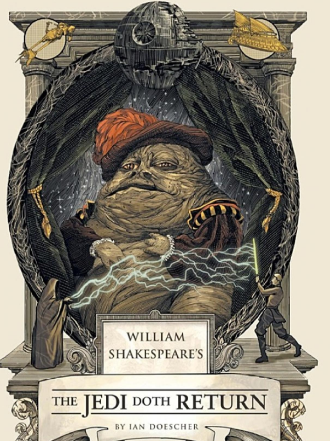
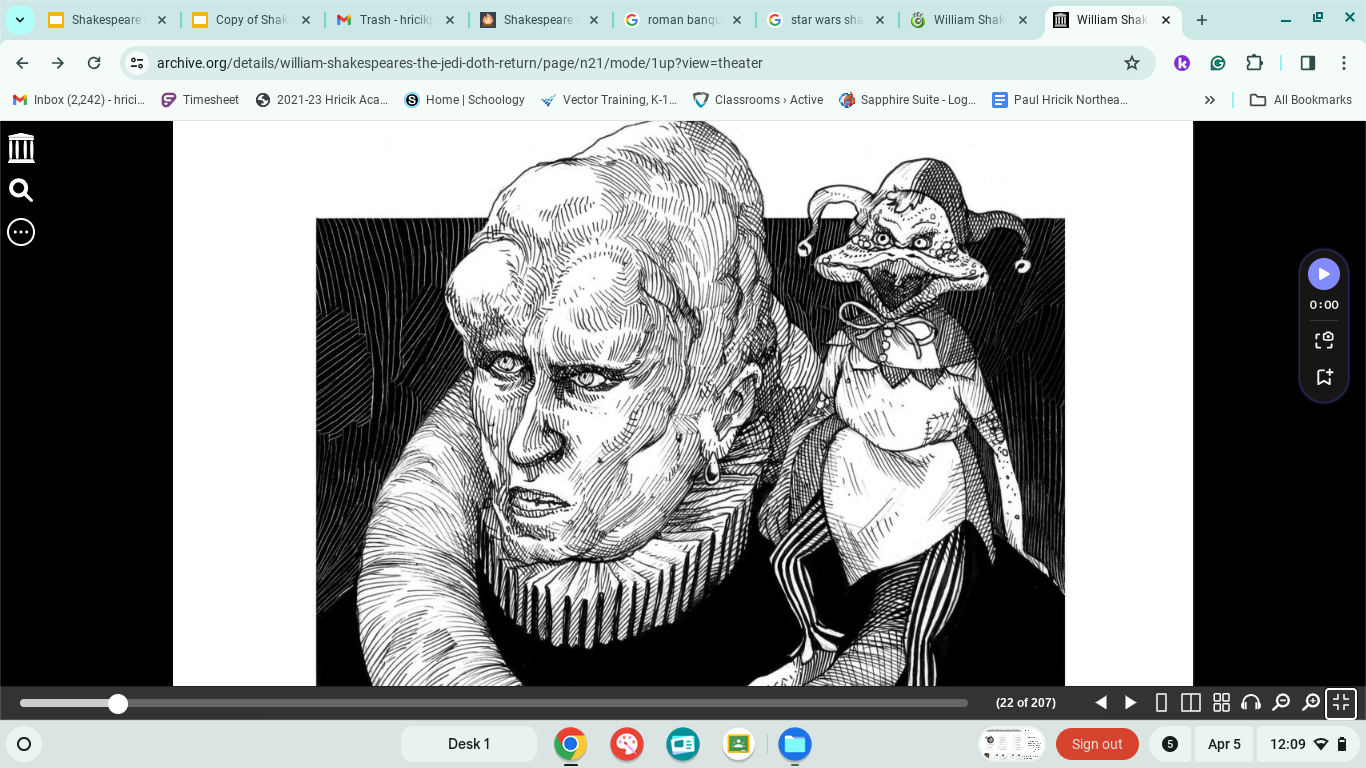
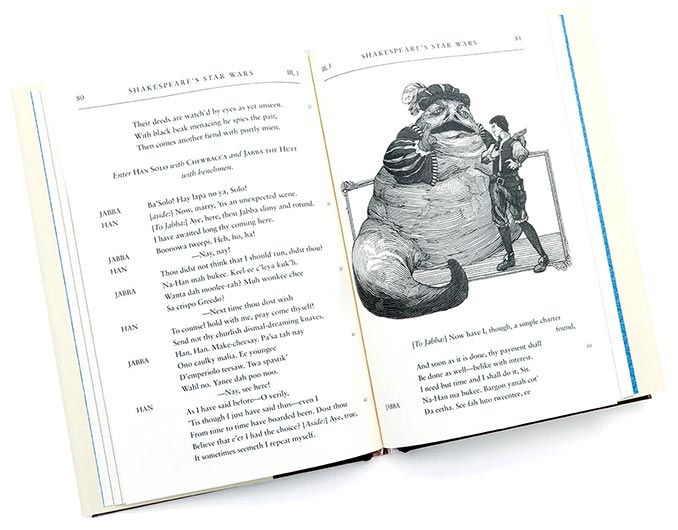
William Shakespeare’s Star Wars is a series of parody plays written by Ian Doescher that takes the prose screenplays of the Star Wars story and transforms them into Elizabethan verse. Last time I mentioned how much I loved the cheeky references to Shakespeare and Star Wars, and how Doescher adapts the cinematic quality into Elizabethan drama very well. In my podcast, I also emphasized the way Doescher gives each character verbose Shakespearean language that works very well for radio and theater:
My podcast episode where I do dramatic readings of “Verily A New Hope.”
I must confess, Return of the Jedi is my favorite Star Wars movie. I’ve seen all 9 films and it’s still my favorite. I adore the effects, the tight storytelling, the emotional farewells, and the dramatic victories. What I want to do with this post, (and the accompanying podcast), is to see whether this edition captures what I love about Jedi. The short answer is- no. It doesn’t capture it, IT EXPANDS IT! In many ways this play is Doescher’s triumph- he manages to capture the tone and characters of Star Wars perfectly, and makes the Shakespearean style his own!
Notes about the play
The first play in the series, “Verily, A New Hope,” took plot and structure inspiration from Henry V; it tells the story as an epic heroic story of Luke’s heroic deeds, much like how Henry V is about a king who grows from boy to man.
The second play “The Empire Striketh Back,” takes inspiration from Hamlet and Macbeth to explore Luke’s temptation by the Dark Side of the Force. It also uses Much Ado About Nothing as an inspiration for the burgeoning relationship between Han and Leia
I would argue that “Jedi Doth Return” is a mixture of all the other plays Doescher took inspiration from. Unlike the previous plays, this feels less like a parody, and more like an adaptation. I feel that Doescher has finally become so comfortable writing in the Shakespearean style, that he rarely needs to flat out parody lines and speeches, and simply uses Shakespearean dialogue to tell the story.
Moments to Watch for:
The Language
I’ll discuss the language of Jedi in greater detail in my podcast, but I’d like to highlight one or two here.
Extended metaphors:
Vader: It is the role I play, my destiny— The grand performance for which I am made. Come, author of the dark side of the Force, Make me the servant of thy quill and write The tale wherein my son and I are seal’d As one. Come, take mine ev’ry doubt from me, And fashion from my heart of flesh and wires A perfect actor: callous, cold, and harsh. Let this, the second Death Star, be the stage, And all the galaxy be setting to The greatest moment of my narrative:
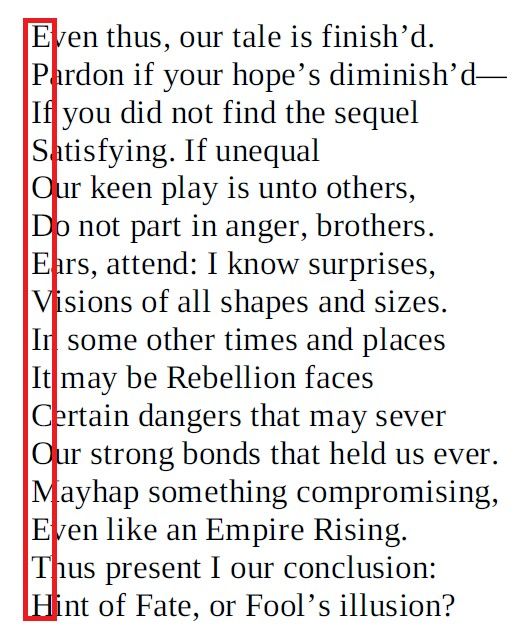
The scene in which the Empire’s fight is won Whilst I decide the Fate of mine own son - The Jedi Doth Return Act I, Scene i
3. Parody Lines
The biggest appeal of William Shakespeare’s Star Wars is the fact that it is a parody, and I’ve said for many years that parody and gentle riffing on Shakespeare is a great way to get students to overcome their fear of Shakespeare and engage with him. Students who know Star Wars but don’t know Shakespeare will recognize the familiar characters and plots of the movies and then see how Shakespeare’s language tells the story anew. Similarly, people who know Shakespeare will recognize the way Doescher re-tools famous Shakespeare quotes to give to characters in the Star Wars Universe, like here, where he spoofs the famous “All the World’s A Stage” speech:
In the Educator’s guide, which I’ve attached below, Doescher tells you exactly which lines he has parodied and the plots of the original plays so the students can learn about Shakespeare through these famous speeches. Orson Wells once said: “We sit through Shakespeare to recognize the quotations,” and this edition gives us thrilling space battle, wonderful characters, and witty dialogue to keep us entertained while we wait.
Characterizations
What I love the most about the movie and the play is that it’s a very character-driven story. Instead of long trench runs with pilots we’ve never met, we get duels to the death between characters we’ve known for years. At its heart, Jedi is the story of the Skywalker family reuniting after Darth Vader ripped it apart. It’s also the culmination of Luke growing from a boy to a man. Doescher does an incredible job voicing these characters through the verse, and his use of the language helps highlight each character’s struggle and journey.
Luke/ Vader
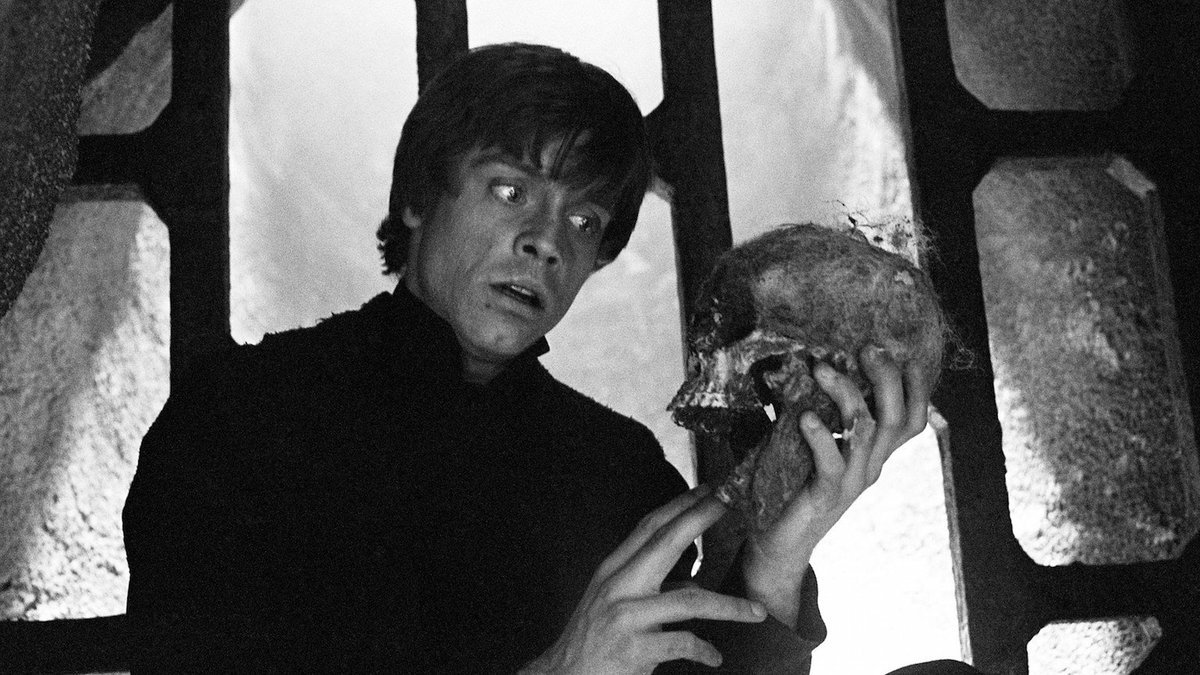
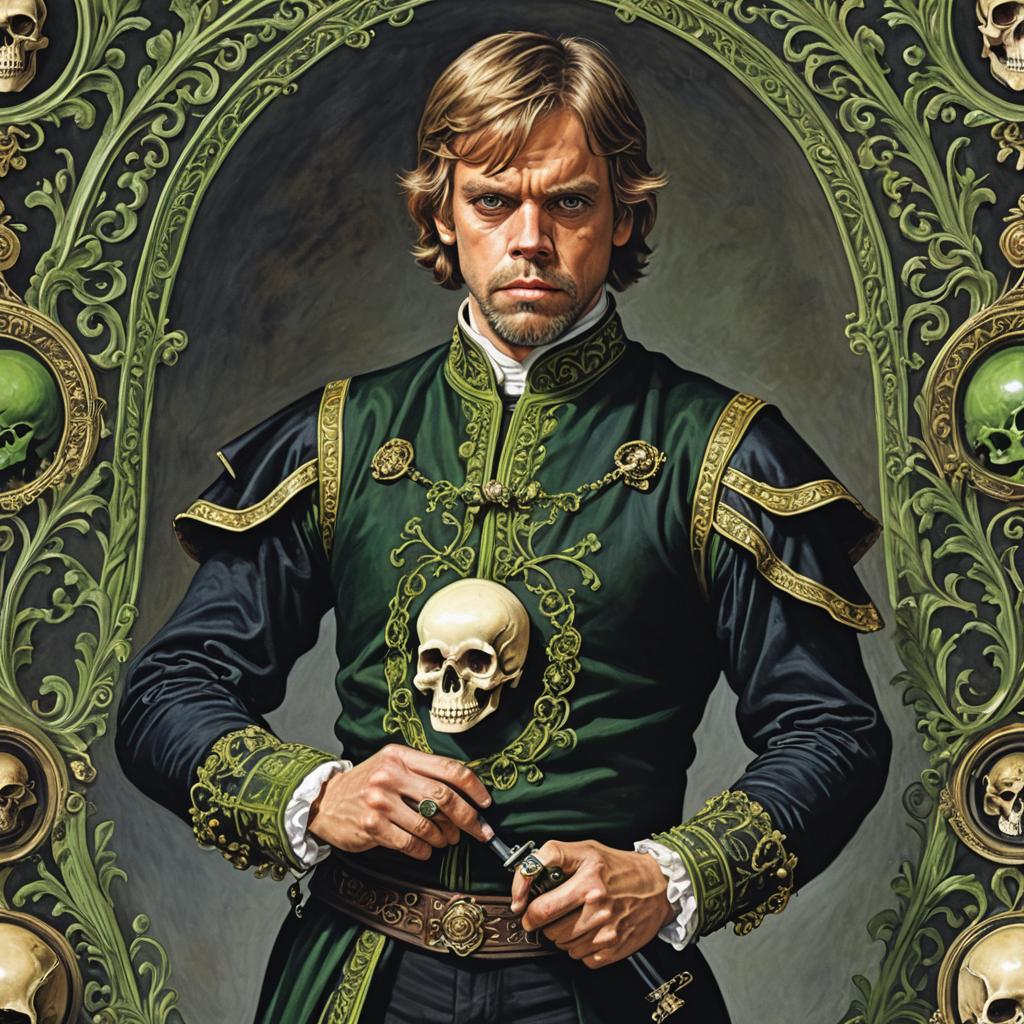
Left- production photo of Mark Hamil holding a skull Yorrick-style. Right- AI art I created of Luke as Hamlet.
Luke has more of a duality in this story- sometimes his speeches are hopeful, positive, and full of decisive language, while other times he is bitter, angry, and mournful. This is a perfect characterization for a young man whom the Emperor hopes to turn to the Dark Side, and these speeches excellently bring out his character. Sometimes Luke even repeats lines spoken by Vader and the Emperor just to drive this point home.
Emperor
A speech from “Jedi Doth Return.” Notice how the ideas run on past the ends of lines and how long each sentence is
As for Emperor Palpatine, his speech is similar to Claudius in Hamlet in the sense that he has many run-on lines that only get to the point at the very end. This man knows he has the ea of the entire galaxy, so he can afford to make people wait for him to finish talking. As Luke himself says: “Your overconfidence is your weakness,” and Doescher does a great job conveying that weakness through the language.
Leia/ Han
My favorite part of The Empire Striketh Back was how Doescher conveys the love between Han and Leia. In that play/ movie, it was done through irritating each other in public, and soliloquizing in private. In Jedi, Han and Leia are more of a couple, supporting each other in their fights and the language has more of a romantic tone.
Han (Hal Jourdan) and Leia (Janine Ashley) finally confess their love in this scene.
My Criticism
To sum up, Jedi is a milestone in the William Shakespeare’s Star Wars Series where Ian Doescher learned how to make the language his own, rather than borrowing lines and phrases from Shakespeare. It’s a pity there aren’t more books in this series…. right?
If you enjoyed the accompanying podcast episode to this post, please consider subscribing and donating to help me continue making fun and educational content like this!
Last weekend I saw a wonderful production of “Six” The Musical at the Cab Calloway School Of the Arts in Wilmington DE. After seeing the professional production, I was worried that I wouldn’t enjoy these student performers but it was incredible! The young performers were all terrific and the director managed to use inventive, creative, and entertaining setpieces to both capture the essence of the Broadway show, and also make a version that is distinct and its own with student performers!
The Direction
DIRECTOR’S NOTE I thought original I’d never Broadway get a show chance only to has direct six it at actors Cab. in AS the luck cast, would so/ have it, the teen edition came out this past summer, which allows the addition of a singing and dancing ensemble. I immediately applied for the rights and we were one of the lucky schools to get them. This new teen edition is the perfect fit for our school community and it highlights the talents of studentsfrom every arts area. I wanted to create a Beyoncé or Taylor Swift concert-type at- mosphere, and I think we have achieved that with our show. The fabulous lighting, the beautiful costumes and make-up, the rocking pit band, the fabulous cast and crew and especially the epic choreography have culminated into quite a spectacle! It has always been a joy to work with my colleagues on these projects. and I want to give a particular shout-out to my team of choreog- raphers. They have taken my vision and turned it into something amazing. The creativity in this team is fierce, and if ever there was a group that fed off of each other’s ideas, it’s this one. We’ve had a blast collaborating on this production Also, I would like to acknowledge Brian Touchette, Peter Kuo and Jared DeStafney for their tireless work on this production. With- out them, this show would not be possible.
Marjorie Eldreth
As the director notes in the program, the challenge with doing a musical like “Six” at a high school or community setting is that there are only six major roles, which means it would be hard to find ways for the whole student body to participate. What I loved about this version is that, by utilizing dance, pantomime, and choruses, the director has found ways to not only involve more people, but help use the additional cast to tell the story in ways that the professional touring production I saw earlier didn’t!
My Favorite Moments
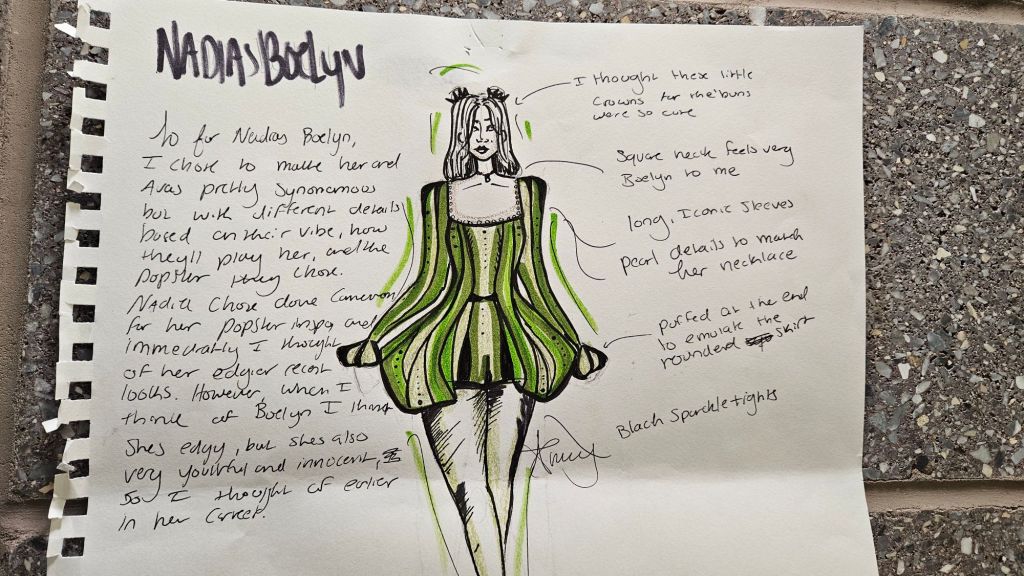
Normally I hate dance numbers in musicals. Don’t get me wrong, I admire the skill and athleticism that dancers have, but when I see a play or musical, I come for the story and the songs. Dance always seems like the black sheep in the musical theater trifecta to me. Not so with this production of “Six.” The dance numbers help tell the story in clever and moving ways! For instance, during Anne Boleyn’s “Don’t Lose Your Head,” a team of dancers with green sticks accompanied her. Their movements were cheeky and brash, which helps encapsulate her bubbly yet tart personality. During the choruses, the dancers and Anne rested their hands on the sticks, drawing attention to their heads moving back and forth, which reinforced both the title, and Anne’s air-headedness. Then, at the end of the number, the dancers got into a circle and pointed their sticks at Anne’s neck- pantomiming how she would eventually be beheaded! Thus, the dancers complimented Anne’s song perfectly, in a way that was not originally part of the show!
“My Heart Of Stone”
The most moving moment of dance was during Jane Seymore’s song “My Heart Of Stone.” When I saw this number in Hershey, it was by far my least favorite. I thought the lyrics were generic, that the song itself was bland, and that gave little depth to Jane character. All that changed this time around. While Jane belted her heart out about the son she never got to raise and the husband who mistreated her, we got to see elegant ballet dancers perform those moments for us. I particularly liked that the male dancers had red hair, (much like the real Henry VIII and his son). The dance actually helped me see Jane’s conflicting feelings for Henry- how she feels genuine love and affection one minute, and terror the next. How she and her son are both ghosts, now that they were denied the chance to live together on Earth. I don’t wish to diminish the wonderful singing and acting of the Hershey production, but Six: Teen Edition did a masterful job of showing, in addition to telling Jane’s story.
THe Cast
The Cab Calloway School of the Arts boasts some of the top young actors in the country, and all of them have tremendous chops as actors, dancers, and singers. Some of them already have professional acting credits. So it should come as no surprise that all the performances were incredible. It was very exciting, however to see a real 19-year-old play Catherine Howard, (since that was the real age she was when she died).
This production also took the bold leap of casting two men in the show. In one cast Anne of Cleaves was played by a man, and in the other (the one I watched), Katherine of Aragon was played by a man. I have no problem with this choice, (after all boys have been playing Katherine ever since Shakespeare’s Day), but I was a little disappointed that the actor had to modify the song to fit his range- I was looking forward to the extravagantly high Shakira and Beyonce inspired vocals that I’ve come to expect from the part. Nevertheless, the actor I saw was incredibly talented and his acting and dancing were completely appropriate for the part.
THe Dramaturg
For those of you who don’t know, a dramaturg’s responsibility is to help the actors, director, and production designer by doing research into the play’s historical or political context. It’s a role that is very important in period plays like Shakespeare. I’ve worked as a dramaturg myself and, though the work one does as a dramaturg is mostly unnoticed by the audience, the dramaturg can greatly contribute to the way the actors understand the text and give the director tools and ideas with which to explore themes and ideas present in it. I don’t know what the dramaturg did for this production, but I could tell based on the performances that every cast member was fully committed to their character. Each actor was able to clearly articulate their character’s emotional journey and that meant they must have learned the history and context of the Tudor period. Again, I don’t know if the dramaturg had any effect on this, but I’m going to assume they did a terrific job, because their end goal was accomplished- the actors and director gave a coherent and well thought out performance that captures the spirit of the Tudor period, so great job!
I’m really excited about the Disney Plus release of the Percy Jackson TV show. My family and I are really enjoying it and I think it’s a very good adaptation, (much more faithful than the previous movie versions). The tone is darker, the characters are better fleshed out, and also there’s a much more nuanced take on Percy’s character, which I believe is at the core of the series. The movie is essentially just a fetch quest where Percy is going from location A to location B looking for various magic items and fighting monsters. Movie Percy is a very static character but in the books and the show, they keep all of those journeys but also delve into his complicated relationship with the gods, his own insecurities growing up without a father, and his overwhelming feeling that this world of gods and mortals is fundamentally flawed and that he is the one to fix it.
“Families are messy. Immortal families are eternally messy. Sometimes the best we can do is to remind each other that we’re related for better or for worse…and try to keep the maiming and killing to a minimum.”
-Percy Jackson, The Sea of Monsters
In short, what makes the show great is that it emphasizes the elements of the book that make it a classic story of a young man who is trying to find his place in the world and complete the quest that his father set for him. Of course, once I started watching it, my Shakespeare Brain activated, and I immediately compared him to Shakespeare’s ultimate example of a hero trying to complete a quest given to him by an absent father- Hamlet. So today I’ll Talk about why I think Percy Jackson is actually a descendant of Hamlet or rather that Hamlet and Percy Jackson are both descendants of the same common ancestor in Greek mythology and touch on what these classic stories can say to us today.
1. The Plot
AI Art I created of Percy Jackson. Nightcreator.com.
As I touched on earlier, there are some glaring similarities between the plots of Percy Jackson and Hamlet- we have a young man who has who hates his stepfather, who is deeply protective of his mother, who goes on a magical quest given to him by his father, (who cannot directly aid him because he’s not physically there). In Percy Jackson, his father is a god- the ancient Greek water god Poseidon, while Hamlet’s father is a ghost. Both heroes have to deal with treachery, uncover a plot, avert potential wars, and get caught up in great military and political power schemes. While Hamlet is trying to restore the rightful heir to the throne (himself), Percy is trying to avoid a war between the gods. Both heroes have stoic sidekicks- Hamlet has Horatio whereas Percy has Annabeth and his friend Grover the Satyr. Hamlet’s friend l Horatio is kind of like a combination of Annabeth’s intelligence and Grover’s kindness and empathy. Finally, both stories conclude in a duel (spoiler alert) where they fight against a near-impossible adversary, and in the end, succeed in their quest, although in Hamlet’s case, he does so at the cost of his own life.
The main difference between these stories is connected to tone and genre- Hamlet is a revenge play, and most Revenge tragedies end in the death of the avenger. Percy Jackson is an adventure quest so based on the conventions, he can succeed, survive, and go off to fight another day. Nevertheless, in terms of the broad outline, the plots are very similar. I would argue this is probably because Hamlet has its roots in many ancient mythological stories like Oedipus, Orestes, and of course, the Danish Viking myth of Amleth. I would argue that both Percy Jackson and Hamlet have a very clear direct common ancestor: the ancient Greek myth of …
As this funny cartoon illustrates, the plots of Percy Jackson and Hamlet can be seen as a modern incarnation of the Perseus myth, from the villainous stepfather to the hero’s protective feelings to the mother to the magical quest to get rid of a stepfather who takes away his birthright. These plot elements follow a very similar formula; as Jake also alluded to, all three of these stories are part of what writers and scholars like to call the monomyth or the “Hero’s journey,” a concept in mythology and storytelling that has inspired works such as Percy Jackson, Star Wars, and many others.
What Is the Monomyth?
Crash Course Mythology- The Monomyth
In 1949, scholar Joseph Campbell wrote a book called “The Hero With a Thousand Faces,” which posited that every culture has stories that fit into universal archetypes- that essentially all human cultures have unique stories, but also call to mind universal truths about humanity. He then distilled the common archetypes and plot tropes of these myths into something called “The monomyth” or “The Hero’s Journey,” a 17-step process that is at the core of many ancient myths, modern adventure stories, or revenge stories such as Hamlet. Below are some of the common tropes of the Hero’s Journey. When you see it spelled out like this, it is very clear that both Hamlet, Percy Jackson, and Perseus follow the Monomyth formula:
Where’s the glory in repeating what others have done?
The Lightining Thief
Every Greek hero starts with a call to adventure- Theseus finds his father’s sword and sets out to find him. Oedipus needs to lift the plague on Thebes, and Hamlet needs to find out why his father’s ghost has returned.
A Half-Blood of the eldest gods, Shall reach sixteen against all odds And see the world in endless sleep The Hero’s soul, cursed blade shall reap A single choice shall end his days Olympus to preserve or raze.
The Oracle- Sea of Mosters
Part II: Refusing the Call
If my life is going to mean anything, I have to live it myself.
The Lighting Thief
I won’t go looking for trouble. I usually don’t have to
Neither Hamlet nor Percy outright refuse to go on their quests, but both experience doubts. Percy, looking at how the gods have cursed and fought and betrayed each other, wonders whether or not they deserve his help:
Percy watches the story of the gods in the Tunnel of Love (Episode 5, Disney Plus 2024.)
Hamlet on the other hand, is so worried that the ghost is trying to deceive him into killing an innocent man, that he nearly kills himself in the most famous speech in all of Shakespeare.
Part III: Supernatural Aide
Supernatural Aid – A magical helper appears or becomes known
Go on with what your heart tells you, or you will lose all.
The Nereiads, Lighting Thief Chapter 17
Both Percy and Perseus get help from the gods- magical weapons, advice, etc. Hamlet gets the revelation from his father that his uncle killed him and how. What sets Hamlet apart from any number of myths is that, since there’s no tangible evidence that his father was there, Hamlet is not sure if his father helped him, or if he is going insane.
Suspecting and knowing are not the same.
-The Lighting Thief
Crossing the first threshold
In Perseus, the first threshold would be when he leaves Acrisius’ palace and sails to the island of Cerebos. In Percy Jackson, this would be when he leaves Yancy Academy and goes to Camp Half-Blood, and in Hamlet, it would be when he meets the ghost.
My fate cries out, and makes each petty artery in this body as hardy as the Nemian Lion’s mane. Still am I called!
Hamlet, Act I, Scene iii.
Belly of THe BEast
There’s always a part of the story when a character feels they are in too deep. Sometimes it’s a literal belly of the beast- Pinocchio and the whale, Luke Skywalker and the Sarlaac pit, Frodo when he reaches Mordor, and Agent K in Men In Black when he literally gets eaten by the Bug. In Percy Jackson, it would definitely be when he journeys to Hades, like many Greek heroes like Orpheus or Hercules.
I’d love to tell you I had some deep revelation on my way down, that I came to terms with my own mortality, laughed in the face of death, et cetera.
The truth? My only thought was: Aaaaggghhhhh!.
Usually, the belly of the beast occurs near the climax of the story- the ultimate test of the hero’s courage and resolve. For Hamlet, this would be the duel with Laertes- he’s in a situation where Claudius has total control of what he does.
“You weren’t able to talk sense into him?” “Well, we kind of tried to kill each other in a duel to the death.” “I see. You tried the diplomatic approach.” (The Sea of Monsters)
I’ll get into a deeper summary of the steps of the Hero’s journey on my podcast later this month, but to summarize, the Hero’s Journey is essentially a story of growth, maturity, and enlightenment. It’s not a coincidence that all three of these heroes are young men who leave home and then return to confront an evil stepfather or uncle. Campbell regarded the Hero’s journey as a metaphor for young men growing up, learning about themselves, gaining confidence in themselves and their abilities, and taking their rightful place in society by displacing a corrupt older authority figure. This is also why these stories often resonate with young people, and why storytellers like Disney often use the Hero’s Journey as a template for children’s movies.
These universal stories of growing up, maturity, and a life worth living have always inspired people and even though the stories have different purposes and the plots take different forms, the core of what makes them universal remains the same.
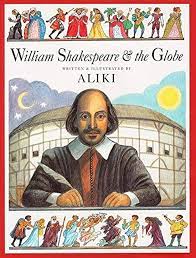
This is a story of two boys, centuries apart, but united by their love of theater in general, and the Globe Theater in particular. The first is William Shakespeare, whose story Aliki tells from his birth, to his boyhood days, to his rise to prominence in the theater. The second is Sam Wannamaker, the man who spearheaded the project of re-building the Globe Theater from 1949 to the first performance of the Globe in June of 1997.
Aliki tells this story in the format of an Elizabethan play, dividing it into five acts. Acts I-4 tell the story of Shakespeare’s life while Act V focuses on Sam Wannamaker pursuing his dream. The book concludes with a chronology of Shakespeare’s plays, and a table of his most famous words and expressions, illustrated with adorable characters.
Illustrations: Medium and Style of Illustration
Like many of her books, Aliki’s illustrations are layered and detailed. She uses ink pen outlines to draw her characters, but then fills them in with bright, vibrant colors. She then painstakingly shades them using the crosshatching technique, to create textures that are complex but have a hand-drawn almost impressionistic feel. The characters aren’t ultra-realistic, and the color palette is limited mainly to bright primaries and warm browns, making it look like a child’s box of crayons or colored pencils. This book is designed to appeal to children with its hand-drawn quality.
Format:
Cover- The cover makes the subject of the book clear to the audience. We see Shakespeare and Globe Theater, but also illustrated moments from his plays. This helps establish that this is not only a biography, it is an introduction to Shakespeare’s plays and poems as well.
Front Matter: The book opens with four pages of quotes from Shakespeare’s plays illustrated with fairies, pipers, and Elizabethan men and women. There is no half-title, no frontispiece and no Half title verso.
Title page verso (copyright page) In the center of the copyright page is an Illustration of Shakespeare standing atop a globe, over the famous lines: “All the world’s a stage, and all the men and women merely players.” Below the quote in very small letters is the copyright date, a short summary, the ISBN data, card catalog information, and the typography information.
Title Page The title is laid out on a white background with a thin black border. Below the title is an image of a boy (presumably Sam Wanamaker), assembling a paper model of Shakespeare’s globe, with a portrait of Shakespeare in the background. This helps establish that this biography focuses on both Shakespeare and Wanamaker, and makes the reader excited to see the real Globe brought to life in full illustration.
Table of Contents As stated before, the book is organized like an Elizabethan play, so rather than Chapter 1, etc. the book has five Acts with 1-4 scenes in them. Each chapter in the table of contents is labeled with a description that sets the scene; either a location (like London, Stratford, The Globe), or what will happen in the scene (such as “Building” or “Uncovering”). The table then details four appendices that are part of the back matter.
Preface: The Preface is referred in the book as an aside, (an Elizabethan theater term meaning something spoken between a character and the audience). This preface acknowledges that, because of the lack of surviving historical information on William Shakespeare, Aliki, like many Shakespearean biographers, has to use some guesswork to fill out the narrative of his life. A second preface (referred to as a Prologue), introduces the story of the book, (namely the lives of Will Shakespeare and Sam Wanamaker). This preface mimics how in Shakespeare’s plays, a prologue would tell the audience what would happen before the narrative started.
Back Matter/ Appendices: There are four appendices in the back matter- A table of Shakespeare’s collected works, a timeline of the book’s events from 1564-1999, an illustrated list of Shakespearean words and expressions, and finally a list of Shakespearean sites to visit in London and Shakespeare’s home town of Stratford Upon Avon. These appendices show the reader that Shakespeare has an important role in history and in the English language, and encourage the reader to learn more about him.
Value As an Educational Tool
This story not only tells Shakespeare’s life, it also introduces the reader to his plays and his influence on the English language through the illustrations and frequent Shakespearean quotations. The reader also gains an insight into Elizabethan life and culture by following Will’s journey from Stratford to London. Finally, by juxtaposing Shakespeare’s life with Sam Wannamaker’s, the reader sees Shakespeare through Sam’s eyes as he works his whole life to restore Shakespeare’s Globe to its former glory. The reader develops a love of Shakespeare, (or at least an empathetic respect), and may feel empowered to read more about Shakespeare, see his plays or maybe even become a Shakespearean artist in the future. In short, Aliki’s book brings the world of Shakespeare to young readers in a way that is beautiful to look at, full of insight, and with enough supplemental materials to encourage them to learn more.
Overall Impression:
Like Prospero’s magic in The Tempest, this story is magically told- it is not intended to create a totally realistic representation of Elizabethan life, but to give an exciting, colorful impression of Will’s life and work to the reader. Due to the scant historical details of Will’s life, Aliki chose not to do a standard biography, but, like Shakespeare’s own history plays, to tell a historically authentic story, rooted in truth that brings a time and a place to life, while portraying it an exciting and visually appealing way.
Citation:
Aliki. (2000). William Shakespeare & the Globe. HarperCollins Publishers.
I’ve written before that Shakespeare helped influence Halloween as we know it- the images of holding skulls, witches chanting over a cauldron, and even ghosts coming back to plague their murderers all have Shakespearean roots. Exhibit A is how these images and tropes can even be found in beloved Halloween costume stores like Spirit Halloween!
If you like creepy Halloween activities and Shakespeare, please sign up for my fully online, fully asynchronous class: “An Immersive Guide To Shakespeare’s Macbeth!” The class features a digital escape room, an interactive quiz, and a special, undead guest!
I am just ecstatic to talk about this year’s hit Broadway Musical Six. It swept the Tonys, and has opened up touring productions across the country, and I JUST GOT TO SEE IT!
This vibrant, clever retelling of Tudor her-story was created by TOBY MARLOW & LUCY MOSS in association with the Chicago Shakespeare Festival. The show is incredibly smart, and creative, and delves into the lives of some fascinating women, re-told as a singing contest with the characters singing their lives for you to judge what it was like being the queen of England and living with the turbulent and fickle Henry VIII.
What really appeals to me in this show is that like Hamilton, the musical takes these six semi-mythical women and tells their story in a way that is fresh and exciting. It bridges the gap between Tudor History and the modern-day by equating being a queen with being a celebrity, with all the drama of ambitious parents, romantic drama, public opinion, and even being exploited and sexualized by a male-dominated society. This comes across in the music, the costumes, the lyrics, and even the lighting!
Why “Six” Slaps
The costumes are brilliant and iconic. Catherine Of Aragon is like a cross between Beyonce, a saint, and a medieval knight. The lighting is incredible! You could tell the whole story using the lighting design as it pulsates, dances, changes into different colors, turns into different shapes, and finally flashes the name of the show in triumphant gold letters.
One particularly brilliant way the music works in “Six” is the fact that it uses the song “Greensleeves” as a motif both musically and thematically. One big theme of the show is how, unlike Henry VIII, most of the history of his six queens is lost and replaced by legends and even songs. The first line of the show is the famous rhyme about their fates: “Divorced. Beheaded. Died. Divorced. Beheaded. Survived.” As the video above helps illustrate, Marlowe and Moss know that most people only know the rhyme about their deaths and the myth that Henry wrote a song about one of them; that their lives are overshadowed by their deaths and the misconceptions that people have written over the years. Howard Ho points out how the song musically forces itself into the first number, “Ex Wives,” but by the end of the show, the six queens break free from these musical bars! You can hear the change of key and notes during this performance at the Tonys, which puts the opening number and closing reprise together.
The Cast of “Six” perform live at the 2021 Tony Awards.
But how do the queens go from “one word in a stupid rhyme,” to a group of powerful, individual queens singing in harmony, without the man who made them famous? That’s what the solo numbers in “Six” do so incredibly well- tell each queen’s solo stories as rocking ballads, hilarious dis-tracks, soulful love songs, and… well stay tuned.
Catherine of Aragon was Henry’s first wife and is still universally beloved, even though Henry decided to divorce her. As the epitome of a stand-alone power queen, it makes sense that Six modeled her character, costume, and songs after Beyonce, with a Shakira-inspired Spanish beat for good measure:
My favorite thing about her solo, “No Way” is how the writers paraphrase her real-life speech during the divorce trial in 1529. Below are the lyrics and the real speech:
Alas, Sir, where have I offended you? Or what occasion have you of displeasure, that you intend to put me from you? I take God and all the world to witness that I have been to you a true, humble and obedient wife, ever conformable to your will and pleasure. This twenty years and more I have been your true wife, and whether it be true or no, I put it to your conscience.
— Katherine of Aragon, 1529
2. Anne Boleyn
In some ways, the version of Anne Boleyn in “Six” is less a pop version of the real queen and more of a commentary on the nature of celebrity. If you watch the video, you can see how in life she was admired for her beauty and fashion but hated for her comments on Queen Katherine, her scandalous love affairs, and her brash nature. This explains the spiky pop-punk princess look they gave her, (which evidently resonates with many audiences since I saw at least two girls cosplaying as Anne in the audience). Sort of like a celebrity who gets canceled on Twitter or Princess Diana, Anne shows how a person can be undone when they dare challenge an established order, especially the Royal Family.
After the show, I found it a bit weird that they portrayed Anne Boleyn as a jetsetting airhead, but then again she is one of the best-known queens in history, so they can get away with it. In reality, Anne Boleyn was highly educated and a member of an ambitious and social climbing family who basically pushed her to woo Henry. As you can see in this clip from “Anne Of A Thousand Days,” Henry and Anne’s family bullied her constantly to become the King’s mistress after HE ALREADY GOT HER SISTER PREGNANT, so Anne knew that the only way to keep Henry from ruining her life was to convince him to divorce Katherine of Aragon and marry her.
Of course, this strategy didn’t save Anne in the end, which says more about how cruel Henry VIII was, chewing up women and spitting them out in his ravenous quest for a son. So is this an accurate portrayal of Anne’s life? No. Is it fun, ABSOLUTELY!
III. Jane Seymore
I’m more than I seem, or am I?
“Six” The Musical.
This version of Jane Seymore was inspired by Adele, so appropriately, she has a heart-wrenching power ballad about her turbulent relationship with Henry. Sadly, we don’t know much about Jane’s real life, so the song takes some liberties. If you go to the Hampton Court Website, you can actually vote as to whether Jane was a devoted wife or a social climbing gold-digger. Probably the real woman was something even more complicated, though we’ll never know for sure.
IV. Anne of Cleaves
Anne of Cleaves is the funniest part of the show! Many of us have heard the story that Henry divorced Anne after he found her ‘ugly.’ What “Six The Musical” does is amend the story, by pointing out that after he divorced her, Henry gave her a castle and a huge retainer, allowing her to live like a queen, without being married to a king! Accordingly, her song is a Rhianna-style dis track that shows off her awesome lifestyle, and spits in Henry’s stupid face!
As fun as this, rags-to-riches story is, the truth is less fun- Anne was the sister of a German duke, so Henry’s lord Chancellor Thomas Cromwell probably forced Henry to marry her for diplomatic reasons (source: Hampton Court: “Anne of Cleaves”). Naturally, Henry didn’t like being told what to do- I suspect he resented Anne before even meeting her because he didn’t get to pick her himself.
As for whether Anne was actually ugly, the truth is really surprising- Henry actually disguised himself as a peasant during a masked ball when he first courted Anne, and she foundhim repulsive. At the time, Henry was 49 years old, and in very poor health. As such, he was intermittently impotent and blamed his inability to conceive a child with her on her supposed ugliness to save face.
Even though Anne in the show hates Henry, in reality, once the marriage was annulled, Anne and Henry remained good friends for years! She attended his next wedding to Katherine Howard, and, just like in the show, Henry treated her much better after the divorce:
‘YOU SHALL FIND US A PERFECT FRIEND, CONTENT TO REPUTE YOU AS OUR DEAREST SISTER. WE SHALL, WITHIN FIVE OR SIX DAYS …DETERMINE YOUR STATE MINDING TO ENDOW YOU WITH £4000 OF YEARLY REVENUE…YOUR LOVING BROTHER AND FRIEND.’
Henry VIII, 1548, six months after their wedding, when the annullment went through.
V. Katherine Howard
Without question, Katherine Howard is portrayed as the most tragic of Henry’s six wives and her song is a huge sucker punch. The writers never let you forget that Katherine’s first affair was when she was 13, and she died at age 19. Like Anne Boleyn and Jane Seymore, Henry picked Katherine for his queen among his ladies in waiting and her song “All You Wanna Do” satirizes his and many other men’s lustful appetites. The song begins as a raunchy, sexy pop ballad in the vein of Britney Spears’ “Toxic” and “Womanizer” about Katherine Howard’s love affairs, but then devolves into a cry for help, as Katherine confesses how she was abused, used, and manipulated by the men in her life, (including her own cousin Thomas Culpepper) until she was beheaded in 1542. It masterfully satires both Henry’s cruelty and the hypersexualization of teenage pop stars which certainly took its toll on Britney Spears and Ariana Grande, Katherine’s major ‘Queenspirations.’
VI. Katherine Parr
Historically, Katherine Parr had to turn away her fiancee Thomas Seymore (just like Anne Boleyn was previously engaged to Henry Percy) once the king set his eyes on her for his wife, so her song is a sad, soulful Alicia Keys-inspired bittersweet song where she tearfully says goodbye to Thomas to spare his feelings and probably his life.
Not only does this song once again show how Henry’s selfishness and his lust ruined the lives of the women he married, (as well as the men who already wanted to marry them), but it also sets up the main idea of the show:
His-Story overthrown
In the final number, the wives turn the tables on Henry- they have spent centuries being defined by him, but in reality, he is just as much defined by them! Going forward, history should not define these great women as just, “The Six Wives of Henry the Eighth,” but to celebrate their individual lives and contributions to history. Katherine Parr mentions this when she points out that in life, she fought to allow women to be educated, she wrote books, and was a scholar of theology. Historically, Henry and Katherine would argue about religion and he nearly executed her after she disagreed on points of theology, but Katherine kept her life by claiming she was “Not disagreeing with [him], but simply learning from [him].”
I Don’t Need Your Love is sung by Catherine Parr in SIX: The Musical. The first part of the song refers to her love of Thomas Seymour, whom she probably wanted to marry rather than Henry (and did marry after Henry’s death). However, the song also protests at the fact that women are often defined by their relationship with men, rather than as people in their own right. Catherine wants to be remembered for what she did, rather than the men she married or loved.
Katherine Parr, Six.
The final number completes the idea of the ‘historemix’ by having the Six queens/pop stars come up with a re-imagined happy ending for themselves, one that doesn’t include the pain that Henry inflicted on them: Katherine A becomes a singing nun, (like Whoopi Goldberg in Sister Act), while Anne Boleyn starts writing lyrics for Shakespeare (which is a fun idea since he does mention “Greensleeves” twice). Jane Seymore forms a band with her many surviving children, Katherine Howard goes solo, and Katherine Parr joins the other queens in a supergroup. It’s not at all historical, but it is a fun and sweet way to put an epilogue on these (mostly) tragic lives.
It’s odd, however, that the show invents an epilogue instead of talking about the six queen’s greatest legacy- Queens Elizabeth and MaryI. For a show that wants to highlight the often-forgotten legacy of these queens, it is an odd oversight. Remember Catherine and Anne gave birth to queens who eventually ruled England without a king. Jane Seymore gave birth to a king, and Catherine Parr helped raise them and restored them to the line of succession- She’s the reason her stepdaughters were able to become queens in the first place.
My issues with the epilogue aside, it is great to see history be recontextualized and shared in such an accessible way. We all know that European history is dominated by the names of white guys- king whoever, duke what’s-his name. To see important women in history be given a voice by a multi-ethnic cast is a great way to make it resonate, and using the metaphor of pop stars works extremely well in this context- these women mostly didn’t choose stardom, but they deserve it for what they went through.
Brava.
Educational links related to the six wives of Henry VIII: