

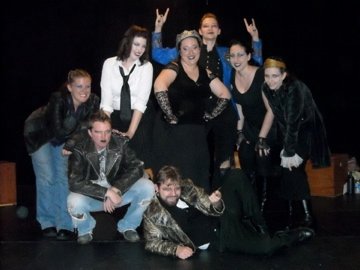
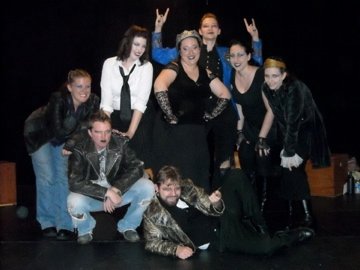
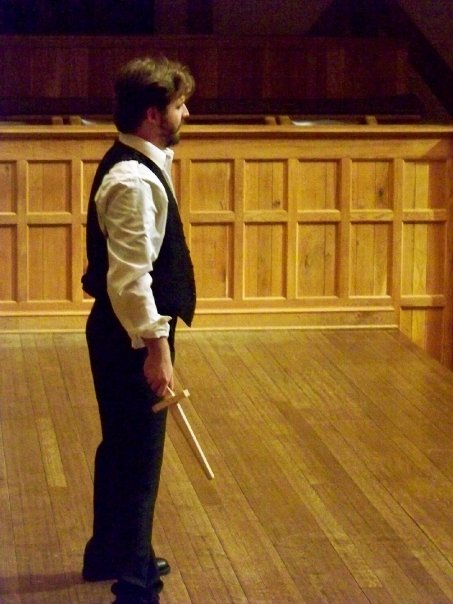
Back in 2009, I had the opportunity to play the lead in a touring production of “Macbeth.” It was the first time I’d ever played a titular Shakespearean character and I was really excited to play this part. I feel that playing one of these parts gives you an insight into the character that no other research can, so I’d like to share the steps of my process, with some pictures and videos from other famous Macbeths to give you an idea of what I learned.
- The Auditions-
- As I said in one of my earliest posts, if you’re auditioning for a Shakespeare play, Read the whole play, not just a monologue book. Monologue books won’t give you a sense of the whole story and you’ll miss a lot of details about who your character is by not hearing what he/she says, and what other people say about him/her. Fortunately for me, I first read the play when I was 17 and remembered the story pretty well. Unfortunately, my first reading of the part was a disaster. Unlike Hamlet, Macbeth didn’t feel like a part I could play; he seemed like this huge Scottish warrior who everyone loved until he turned into a psycho killer. I’m not a warrior, not a psycho, and (like most actors), often feel a lot of doubt and loneliness about my self. Ironically, that was what helped me get into the heart of the character!
- Figure out what’s the hard part. When directors cast, they need to make sure you can handle the part. If your character has to sing, you better be able to carry a tune. If your character needs to be able to contort into a pretzel and talk to dolphins, he or she will probably make that part of the audition. My advice to anyone auditioning for a specific part in a play (Shakespeare or not), is to think like a director and try and figure out what the hardest thing that your character will have to do, and try to prepare for that. For me, the hardest part of playing Macbeth, was the famous Dagger Speech.
- Perform your monologue for someone first. I was fortunate that while I was prepping for the audition, the great Shakespearean director Rob Claire was doing a workshop and he helped me work on Macbeth’s soliloquy in Act I, where he decides whether or not to murder Duncan.
- Table work
Table work is the point in the process where the actors sit around and read the play, trying to get an idea of the character’s journey from beginning to end. To me is the most exciting time in rehearsals because it’s just the actor and Shakespeare’s words- you can imagine how the play will go, discover how the lines make you feel, and form a bond with your character and fellow actors.

Macbeth’s Motive- During the table read, I decided on Macbeth’s motivation: to prove himself to his wife. In the play, Lady Macbeth frequently criticizes him and seems to define true manhood as taking what you want, regardless of fear or ethics. Take a look at this horrific passage where she first critiques Macbeth’s manhood, then says she would rather bash her baby’s head in rather than give up on murdering the king!
MACBETH
Prithee, peace:
I dare do all that may become a man;
Who dares do more is none.
LADY MACBETH
What beast was’t, then,
That made you break this enterprise to me?
When you durst do it, then you were a man;
I have given suck, and know
How tender ’tis to love the babe that milks me:
I would, while it was smiling in my face,
Have pluck’d my nipple from his boneless gums,
And dash’d the brains out, had I so sworn as you
Have done to this.
MACBETH
If we should fail?
LADY MACBETH
We fail!
But screw your courage to the sticking-place,
And we’ll not fail. (Macbeth, Act I, Scene vii).
One interesting contradiction in the play, although Lady M mentions that she’s nursed a baby, later on in the play Macduff says that Macbeth has no children. I therefore decided that Lady Macbeth has lost a child, and this has caused unimaginable pain for the couple. Therefore, Macbeth is willing to do anything to win his wife’s affection again, even murder.

Study the verse– Another point I’d advise when you’re doing table work is pay attention to Shakespeare’s verse because it provides clues to help you keep your hand on the pulse of your character. Just like a heartbeat, when a line of verse changes or fragments it usually signals an emotional or mental change in the character. Here is a quick analysis of the verse in Shakespeare’s Macbeth. Click here to find some great books about how to study Shakespeare’s verse.
- Voice and Body
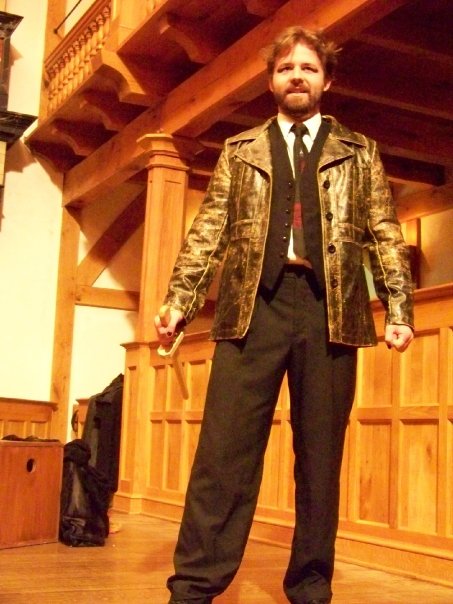 When creating any character, you have to decide how (s)he walks and talks. Most Macbeth’s I’ve seen are big, heroic guys, and I’m not big and imposing. I talked to one of my mentors at American Shakespeare Center and he suggested that maybe Macbeth has a bit of a Napoleonic Complex. This made a lot of sense to me. I thought about how Macbeth gets honored at the beginning of the play; what if he just got lucky killing the Norwegians? What if deep down, he doesn’t feel he deserves to be honored just for killing in war? That kind of self hatred and desire for approval could easily lead to violent behavior. I therefore based my physical choices on alternately shrinking and sulking when Macbeth feels low, and trying very hard to look big and imposing for the rest of the play.
- I worked on my arms for the sword work and my back because I believe that’s where Macbeth caries himself. When I wanted to appear like a king I would stand straight and puff out my chest, however in moments like the appearance of Banquo’s ghost, I shrank and turned my head away.
- I didn’t try to do a voice for Macbeth, I just tried to let my voice go through the changes. When Macbeth is paranoid or afraid, my voice went up, when he feels in control, I kept it at a low, strong register.
- The one time I shouted was at the end, when Macduff demands that

I prepare to fight Macduff. Macbeth surrender. I snarled and barked the line: “I WILL NOT YIELD!” At the end of the play, when Macbeth gets to fight Macduff, I feel he finally feels brave and strong, challenging Macduff even though he knows he will lose. At last he can feel like a valliant hero, even though everyone else sees him as a villain. I gleefully assumed a fighting stance and put all the power in my body into my limbs, ready to attack!

- The Speeches. All of Shakespeare’s great characters have fabulous speeches that allow the audience to peer into their hearts. With Macbeth, we see a good man’s journey into becoming a demented, paranoid tyrant through the following speeches.
-

I contemplate murder in Act I, scene vii. “If It Were Done,” Act I, Scene vii. This speech was my favorite. It’s basically Macbeth’s version of “To Be Or Not To Be.” In both speeches, the character is contemplating murder, without saying the word “murder.” This is the “IT” Macbeth refers to; killing the king to get his crown. Macbeth is tortured by his ambition and his desire, and you get to see him wrack his brain and body over what to do. Below is Sir Ian McKellen’s interpretation of the speech in a 1979 RSC production.
- The Dagger Speech Act II, Scene i. The night of the murder,
Macbeth stands alone during the Dagger Speech, Act II, scene i Macbeth sees a bloody dagger that points his way to the king. It’s up to the actor to determine where and what the dagger is: if it is the Witches’ magic, his own psychosis, or a hellish prophesy. Does Macbeth love or fear the dagger? Does it stay in one place or move? Answering these questions and keeping track of the answers makes the speech very hard to do. Here is Sir Antony Sher’s kinetic and frantic version of the Dagger Speech:
-

 “Tomorrow and Tomorrow” Act V, Scene v. This speech is often quoted out of context, given that it has a nearly perfect metaphor for the futility of life: “Life’s but a walking shadow, a poor player who struts and frets his hour upon the stage… it is a tale, told by an idiot, full of sound and fury, signifying nothing.” Since this is the most famous speech in the play, I had to do something different than other Macbeths. What many people forget is that Macbeth says all this when he’s trying to command his army, and gets word that his wife is dead.

I chose to play the speech as a fight within Macbeth to not give into despair. At first he’s furious when he hears the news; he didn’t need this news, especially not today! He tries to suppress his grief, delaying it until tomorrow, but he can’t; now that he knows his wife is dead, his life seems completely pointless, including the battle he was trying to fight. I then gave Macbeth an epithany near the end of the speech: If life is pointless, fighting a battle and dying would be a glorious way to end it! Why not die, after all, life is just “a tale told by an idiot?” At last, Macbeth has a reason to fight again, and he concludes the speech as a call to his soldiers to fight without fear of death. Now, you may disagree with my interpretation, but the point is that it’s mine. I wasn’t trying to imitate Antony Sher, or Laurence Olivier, or Patrick Stewart when they played the part. I was doing my Macbeth, and that’s what made it worth watching.
- I also drew some inspiration from this video where Ian McKellen analyzes the imagery and ideas within this speech:http://www.youtube.com/watch?v=zGbZCgHQ9m8
I hope you enjoyed this look into the process of creating this complex and fascinating character. If you’ve played this character before, leave me a comment about your interpretation, or tell me which Macbeth you liked best and why. Finally, below are links to two full-length productions of Macbeth for your viewing pleasure.
The full Ian McKellen production of Macbeth: https://www.youtube.com/watch?v=YpKWWK0Pj34
BBC Macbeth https://www.youtube.com/watch?v=w0LrdOa7uZQ







 The Shakespearean Student