I made a digital escape room for Macbeth, as part of my Outschool.com class, “Macbeth: An Immersive Educational Experience,” which you can register for at a discount this week only. I’m presenting this digital escape room as an activity for teachers to teach their student’s knowledge of the plot of the play and use their observation and research skills to escape from a “cursed castle.”
What Is a digital escape room?
In a normal escape room, you are locked in a room and have to follow clues and solve puzzles in order to find a series of keys, codes, and combinations to unlock the door and get out of the room. In a digital escape room, you solve online puzzles and use passwords and key codes to unlock some kind of digital content.
My escape room is designed to test your knowledge of the play, give you a chance to learn about the history behind it. Most escape rooms use the a variety of locks such as:
Standard combination locks
Direction locks (where the lock has arrows taht you have to push in the correct direction, in the right order).
Color locks (where we put different colors in a sequence.
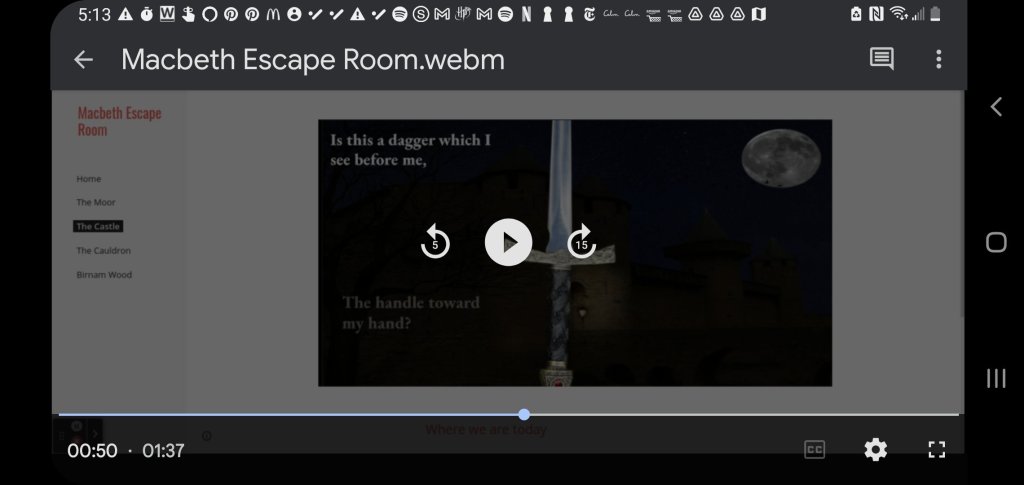
A digital escape room uses these concepts and adapts them to work within the context of a website or other digital experience. For example, I made a direction lock based on the direction a dagger points and made a short animation of a dagger with the text of Macbeth’s famous dagger speech.
The student has to surf through five webpages to find the answers to the puzzles, then imputs the answer in a Google form. Once he or she unlocks all six puzzles, they are permitted to leave the witches’ castle. Here’s a preview of the puzzles:
Part I: The Gate
There’s a website called Flippity which allows you to make little online puzzles so I embedded it on one page of my website. In this case, it has six locks that you have to unlock by typing answers to trivia questions related to “Macbeth,” such as “What object appeared to Macbeth before he killed the king?” The final lock requires you to read a short article on the curse of Macbeth, so you can enter it on the website.
Part II: The Magic Mirror
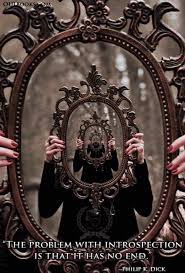
There’s a website called a magic mirror, which if you click on the mirror, it hyperlinks to an image that spells out the next answer for the Google form.
Part III: Birnam Wood
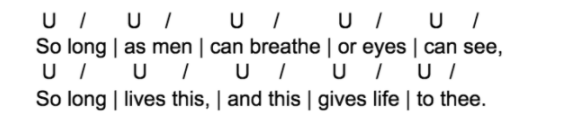
I wanted to teach the students about verse scantion and what an iambic pentamer iine is. I wanted to get the class to learn the pattern of unaccented beats (which Shakespeare scholars mark with a U), and accented beats marked with a /, as in the couplet below:
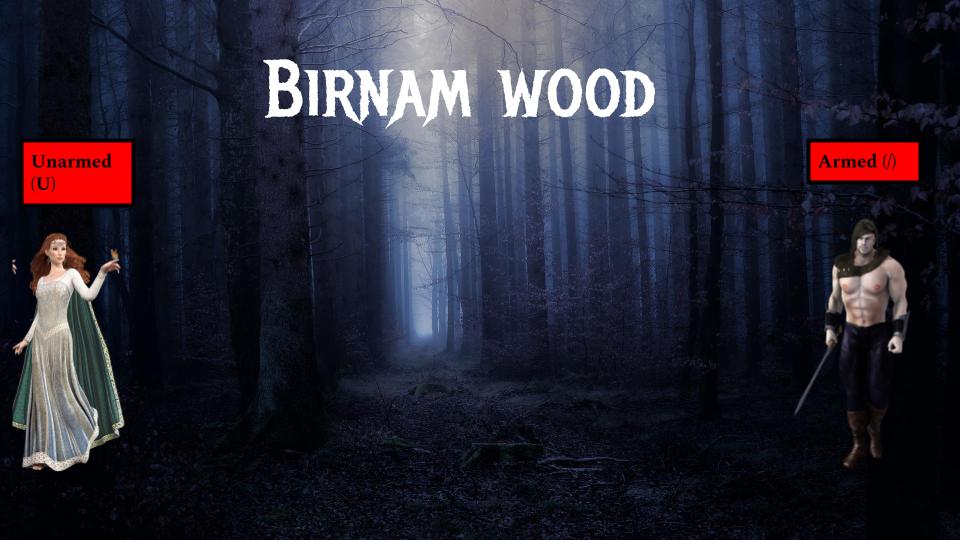
To get the students to practice making an iambic pentameter line, I embedded a Google Slides presentation in the website which has pictures of unarmed and armed soldiers. A key indicates that you are to count the soldiers and input the U/U/ pattern into the Google Form:
Screenshot from my Birnam Wood Activity.
So, there’s a preview of the Digital Escape Room I hope this inspires you to try this type of activity in your class. If you want to use this activity, shoot me an email and I’ll give you a teacher’s guide. Please also consider signing up for my Outschool.com class!
“Is not this something more than fantasy?”“O, that this too too solid flesh would melt, thaw, and resolve itself into a dew.”“Do not forever with thy veiled lids, search for thy noble father in the dust.” “A combination and a form indeed, where every God did set his seal…”“Thou knoweth ’tis common, all that lives must die. Passing through nature to eternity.”
So loving.. that he might not not between the winds of heaven, visit her face too roughly.”“There are more things in heaven and earth than are dreamt of in our philosophy.”“The Serpent that did sting thy father’s life, now wears his crown.”“O VILLAIN, SMILING, DAMNED VILLAIN!” “To Be, Or Not To Be, that is the question.”“Alas, poor Yorick… quite chop-fallen.”“O my offense is rank. A brother’s murder!”“A fellow of infinite jest, of most excellent fancy.”“There is a special providence in the fall of a sparrow.”“Thou art slain. In thee there is not half an hour of life.”
Trailer for Globe Theater’s 2021 production of A Midsummer Night’s Dream
What do you think of when you think of “Shakespeare?” What do you think of when you think of “A Midsummer Night’s Dream?”
Ruffs and Tights?
Mostly white dudes?
Elizabethan music?
Dark night and moon?
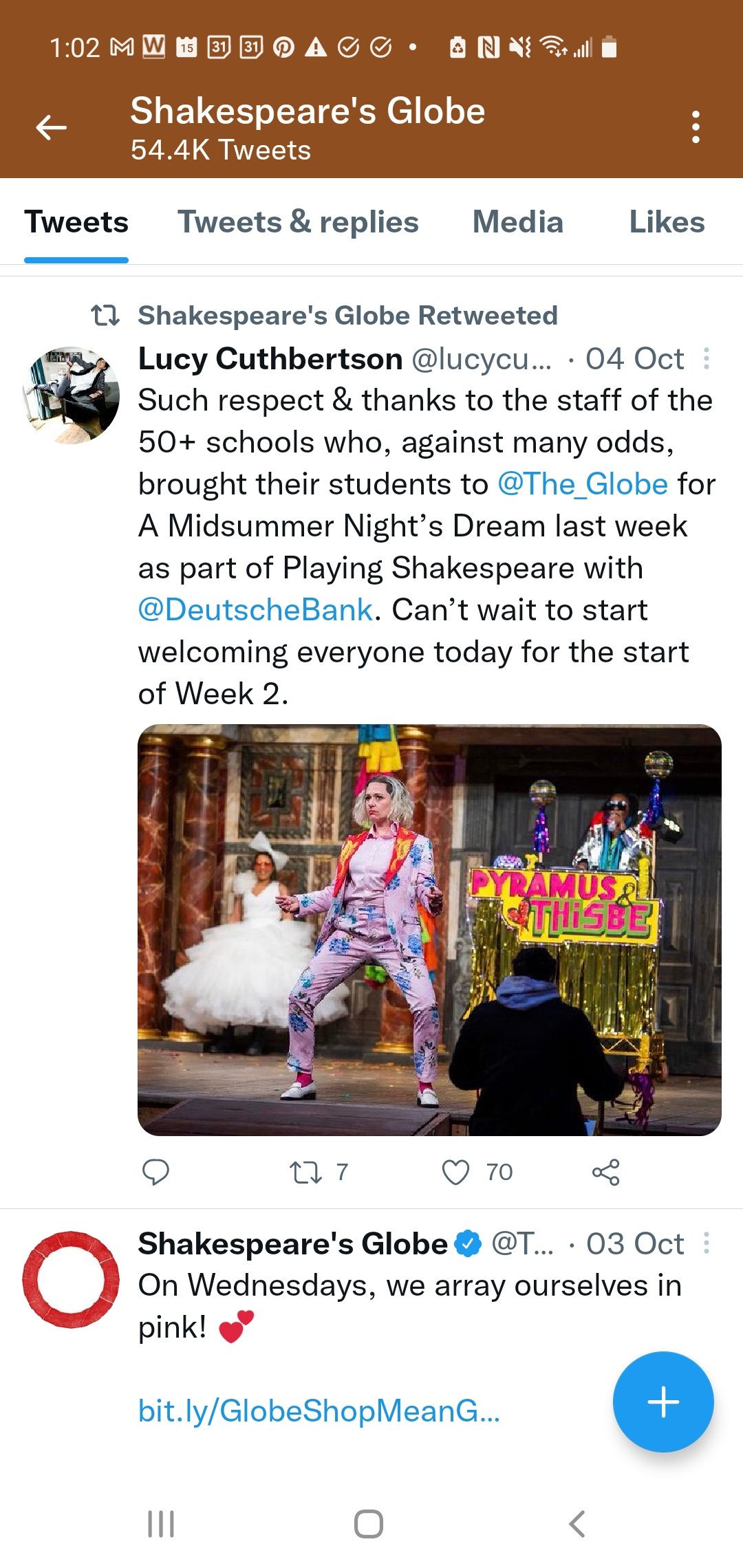
This production, directed by Michelle Terry, is gleefully throwing out every preconceived notion of what A Midsummer Night’s Dream can or should be. In terms of design, casting, music, and interpretation, it breaks all the rules, while still remaining true to the text. This allows the production to appeal to not only hard-core Shakespeare fans, but first time audiences and children too!
I would describe the concept behind the show as “Suggestive,” that is, it doesn’t belong to a literal time and place. Even though the play is set in Ancient Greece, the play refuses to be constrained by historical accuracy, which arguably, fits nicely with Shakespeare in particular, and the Globe itself; a modern building in a modern city, based on a 400-year-old building.
The music and costumes evoke a New Orleans Mardis Gras, a Pride parade, or a Spanish pinata with its bright colors, heavy use of fringes, and bright, energetic jazz music. The only people who don’t wear bright colors are the four lovers, which reflects their continuous frustration with being unable to marry the person they really want.
The show is also Color blind and gender blind, with women playing men’s parts and a cast with black, white, and mixed race actors. Terry’s direction also calls attention to the patriarchial, racist, and sexist elements of Athens which are often overlooked in other interpretations of Dream that I’ve seen or read about. Rather than being a hero, Theseus is a horny old man in a ludicrous pink uniform, looking like a cross between M. Bison and a Christmas nutcracker. To reinforce this point, the actor chose to perform one of Theseus’ most patriarchial speeches as a joke:
Theseus. What say you, Hermia? be advised fair maid:50
To you your father should be as a god;
One that composed your beauties, yea, and one
To whom you are but as a form in wax
By him imprinted and within his power
To leave the figure or disfigure it. -Midsummer Night's Dream, Act I, Scene i.
I’ve seen this speech heavily cut and played seriously, but never till now did I see it played to ridicule the ludicrous notion that women are in any way bound to worship their fathers.
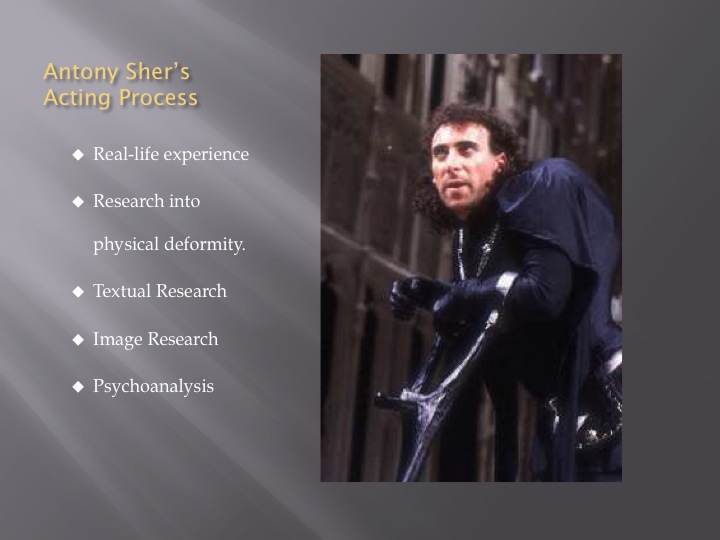
In another nod to contemporary gender politics, the actress who plays Hippolyta and Titania chose to perform her role on crutches. As far as I can tell, this was a deliberate choice and not a result of real injury. There is a precedent for this: In 1984, Sir Antony Sher performed Richard iii on crutches because it highlighted the cruelty people with disabilities often suffer.
I could be wrong, but I think that the reason the actress was on crutches was a symbolic way of confronting the way gender politics can cripple women.
Many scholars have pointed out how Hippolyta rarely speaks despite the fact that she is supposed to be the powerful Queen of the Amazons, and Theseus’ fiance besides. Shakespeare makes it clear that their marriage was arranged as a political alliance after the Amazons lost to Athens in a war:
Hippolyta, I woo'd thee with my sword,
And won thy love, doing thee injuries;20
But I will wed thee in another key,
With pomp, with triumph and with revelling.
With this in mind, it makes sense to have Hippolyta on crutches as a result of her injuries. Those injuries might also explain her silence; she has lost her agency now that she is essentially Theseus’ prisoner. One might think of any number of war atrocious where women have been sold to powerful men over the centuries. In short, by putting Hippolyta on crutches, we see a glimpse into her tragic story that most productions just gloss over- that she has lost a war, been separated from her people, and is now her enemies’ prisoner through marriage.
I’ve come to expect high quality acting from The Globe Theater Company and this cast did not disappoint. As we watched it together, my family concluded that this was one of the best acted productions of Dream that we’ve ever seen, which between us has to be over 30 plus productions.
The delivery is crisp and fast paced. Every actor has taken these words and made them their own. They speak them as if they were written yesterday. One thing I love about the Globe is that the directors encourage this kind of fast paced delivery; with no distracting special effects or sets, the actors have to captivate the audience with their delivery of Shakespeare’s text, without being melodramatic or self-indulgent. I’m pleased to say that this cast does a fantastic job of telling this magical story in a compelling and very modern way.
I’ve shown my recording to kids, teens, adults, and my family, and everyone has a different reaction to the show. Maybe this isn’t quite your cup of tea, but the concept is sound, the acting is high caliber, and it utilizes the Globe’s unique qualities extremely well.
I personally didn’t care for Bottom just because I felt the actress was playing a very energetic part with too much sarcasm and tongue in cheek, but that’s mostly personal preference. I did however love Peter Quince, Snout, Snug, and the rest of the Mechanicals. Peter Quince is a rather thankless part but it’s great to see someone balance being a straight man trying to reign in Bottom’s antics. and an idiot who has no idea how to direct a company of actors, which the actress playing Quince did very well.
Steve Bannon, the man I’ve described in the past as Buckingham to Trump’s Richard III, is once again in the news. He’s been charged with criminal contempt for refusing to cooperate with the Senate with the January 6th commission.
Bannon, the former head of Breitbart news, and Former President Trump’s former chief strategist, has long been a controversial figure with his extreme right wing views on immigration, race, and politics in general.
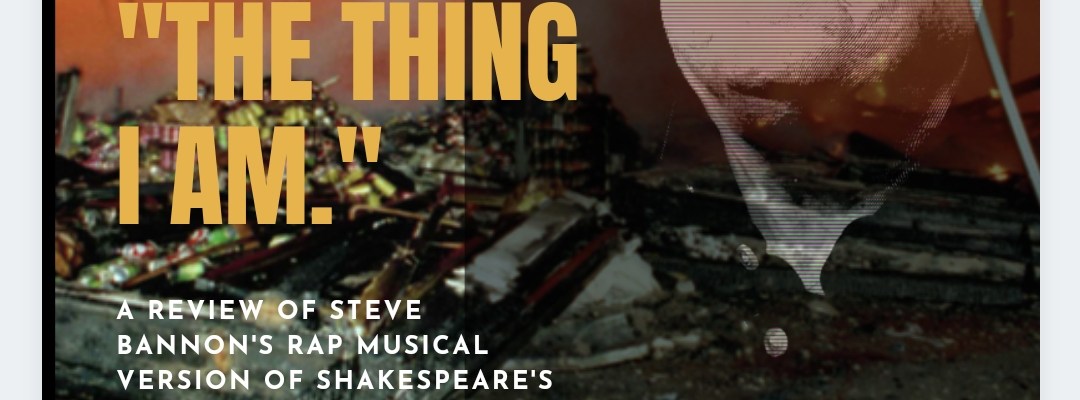
One thing many people might not know about Bannon though, is that before he was a publisher and a politician, he was an aspiring writer in Hollywood, and in the late 1990s, Bannon wrote, “The Thing I Am,” a rap-musical version of Shakespeare’s Roman tragedy “Coriolanus.”
What Is Coriolanus?
Coriolanus is one of Shakespeare’s most obscure tragedies, but arguably, one of his most fascinating ones. It’s the only play set in republican Rome, so it’s the only Shakespeare play that deals with issues of democracy. The play starts with a riot where poor Romans are complaining about grain shortages, loudly condemning rich landowners who are hoarding grain while they starve. Ironically, Shakespeare wrote this at the same time when he himself was guilty of hoarding grain during a shortage, and tensions were so high that some farmers called for people like him to be “hanged on their own gibbit.”
The play has been called fascist, communist, democratic, republican, and monarchist. It’s main character is a Roman general who wants to be consul, (a high governmental position in the Senate), despite the fact that he hates the common people. Like Julius Caesar, it raises interesting questions about who should be in charge of our society, without prescribing an answer, (which would have been impossible for Shakespeare living in Jacobean England). In the play’s most famous scene, Coriolanus finally bursts out and rails against the commoners for their ignorance and their distrust of other would-be millitary dictators:
A review of Bannon’s Show:
Bannon updated the text and set it in Los Angelos during the riots of 1992, which if you remember, were protests to the earlier police brutality trial over the death of Rodney King.
The show was never produced, though a staged reading of the text was held in 2016. I was unable to find it on Youtube, but I did find a link to a video on Facebook under Now This Politics. The full reading is here:
They say! F#$% they! They hang out shooting pool and think they know what’s going down – who’s up, who’s out, who bounds, and if there’s crack enough. If I had my way, I’d make a quarry of these slaves.”
Whoever deserves greatness, wants their hate. Peep game, boy. To count on them for favors is to swim with fins of lead.”
“So f#$% you! Trust you? Ha! With each passing minute, you change your common mind. You call him noble that was once your enemy, then dis your king. You cry against the “other” – crackers, Blood, Crip, popo, Pol, the rich – it don’t matter, n!@$; awe keeps you feeding each another.”
I never knew the ‘racist Steve’ that’s being reported now,” Jones told The Daily Beast last year. “I never heard him make any racist jokes, and his best friend was an African-American who went to [college] with him… I never saw even a hint of racism.
“But I did see this elitism… He would always look down on poor people of any color. At one point, he told me that only people who own property should vote. -Julia Jones (Bannon’s Co writer)
The Cast included Rob Corddrey, Kate Berlant, Jordan Black, and Cedric Yarborough.
The subject matter is poorly handled and the way it treats the LA riots is at best, a historically inaccurate attempt for Bannon to play ‘white savior’ to a group he considers inferior, and at worst, a call to action for racists to imprison and oppress the black residents of LA.
The riots were not a war, they were a result of a protest. Instead of addressing the Rodney King trial which was the cause of the riots, Bannon focuses on the ‘war’ between the Crips and the Bloods, saying the riot was a result of this war.
If you read Breitbarts article about the riot, (and I don’t recommend it), it is described like a war. It’s the same war conservative pundits are continually trying to convince us is coming- a race war between ‘gangs’, ‘immigrants,’ and the politicians who enable them, who don’t want you to defend yourself.
The opinion piece I read found it ironic that Bannon makes Coriolanus the leader of the Crips, but if you look at his politics, It’s clear why- Bannon is attracted to masculine violence and his base of violent, predominantly white males see modern life as a culture war between them and the rest of the world. His Coriolanus is a BAMF who defends himself with his gun . A politician or a policeman ♂️ would have someone to answer to (more like Shakespeare’s Coriolanus,) but Bannon’s Martus has no restaint and can indulge his violent tendencies in the lawless hellscape of LA.
It should be noted that Bannon is clearly not speaking from experience or research, merely his ugly stereotypes of black gang members that he got from reading his biased Brietbart articles. Though the hero is black, the dog whistle racism is still there- these people are out to get you, and even though they have guts, they are a threat to “civilization.”
This video is part of my Outschool course “Macbeth: An Immersive Horror Experience.” I use it to explain the plot of the play before playing a game and an escape room to test the student’s knowledge. Let me know in the comments what you think of it, and if you like it, please consider signing up for the course on Outschool.com
Just in time for October, I’m offering an online class for kids ages 13-18 about Shakespeare’s most spooky and cursed play:
If you follow this blog you know I’ve written a lot about this play before. Though this class will be more like a game where I teach the class using multimedia, games, and a digital escape room!
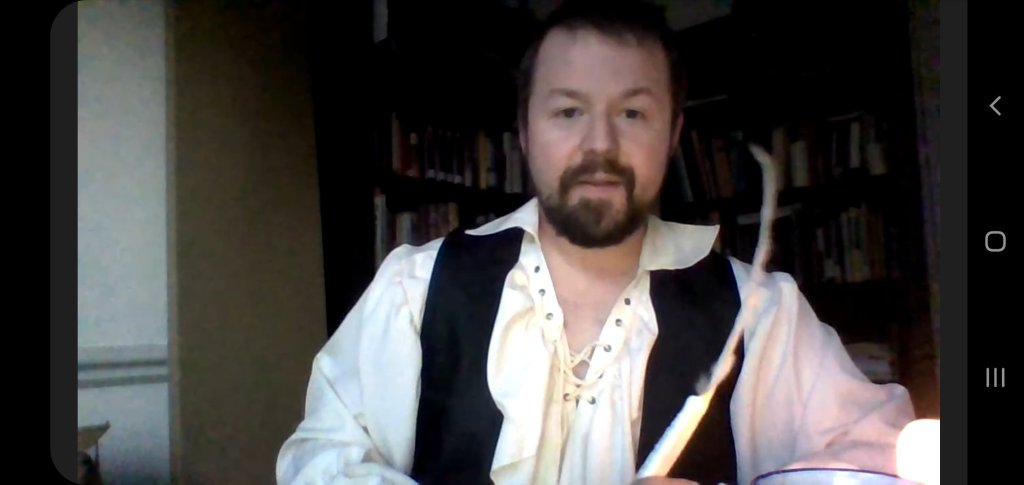
Me in my Shakespeare gatb
I’ll start by speaking to the students in character as Shakespeare, and tell them the story of Macbeth using a multimedia presentation.
I will then test the students’ knowledge with a fun quiz that was inspired by the popular mobile game Among Us. As you know, the game is similar to a scene from the play, so I thought it would be an appropriate way to test the kids’ knowledge.
Screenshot from the Gimkit game “Trust No One.” Like Among Us, players need to figure out who the Imposter is, but they greatly increase the chances of surviving if they answer the quiz questions correctly.
The final part of the class is a digital escape room I’ve created. I don’t want to give too much away, and you can’t play it unless you sign up for the class, but let’s just say it’s fun, spooky, educational, and challenging!
Screenshot from my Macbeth Escape Room.
If you want to sign up now, the course is available every weekend in October, and then by request after that. Register now at Outschool.com. if you take the course, please leave me a good review.
Thanks for recommending this topic. I really enjoyed researching it. Disclaimer: Although I have a degree in Renaissance literature, I don’t have a degree in world religions. I don’t pretend to be an expert in Judaism and I apologize if I have gotten any cultural details wrong. As I have written before, this play has been used to spread harmful stereotypes and misinformation against Jews and Muslims, and I have no desire to do so. So don’t take this information as a comprehensive guide to the lives of Jews or indeed any 16th century Venetians. What I do intend to do is analyze how costumes from the play can evoke the people and cultures of that time.
Venice in the 16th century was a lot like modern day Manhattan- a multicultural epicenter of trade and commerce. https://youtu.be/FNZa9qazTvc
Many productions have costumes that emphasize the wealth and privilege of the Venetian world, except for Shylock
As this video shows, Jews in 16th century Venice were segregated into separate communities known as ghettos. Although the Jews found ways to survive and thrive in this situation, they faced constant discrimination and harassment.
In a modern productions or a period production the costume has to reflect a single vision for the show. Watch this interview with Globe Costume coordinator Laura Rushton: https://youtu.be/PaZmAuKE-Jg
2. Men’s Fashion- Italian fashion was all the rage in Shakespeare’s day. Gone were the stiff woolen tunics of the Middle ages, in with brightly colored silks and leathers. Young Men wore leather jackets called doublets and tight pants that showed off their legs. In the hot sun of Venice, light linnen undershirts were wore underneath the doublet. Wealthy men would wear fine silks and their jackets had slashed sleeves to show off the fine embroidered silk underneath.
Joseph Fiennes’ costume as Bassanio in The Merchant of Venice
Servants- Servants were given distinctive clothes known as liveries by their masters, which for a man would typically be a distinct colorful jacket. Women like Narissa, who were high-ranking ladies maids, would wear hand me down clothes from their mistresses. So this is why in most productions I have seen, Narissa and Portia wear similar clothing. This also helps show the trust and respect they have for each other.
A Note On Masks:
Act II, Scene 5, takes place during Carnival, one of the most celebrated holidays of Venice, and it’s usually celebrated by people wearing brightly colored masks. This great video below from history YouTuber Metetron shows just a little bit of background on Venetian masks:
3. Women’s Fashion- The women in the play Merchant Of Venice are treated line birds in a cage, especially Portia who literally lives on an island and has to marry the man who wins her at a carnival! With the restrictions of garments like partlets, bodies, or corsets, if you wore the fashions of the period, you would feel like your lungs were birds in a cage!
Although the dress was richer and more ornate (reflecting the relative peace during this period), the clothing was much more physically restrictive than medieval dresses: https://youtu.be/KCeqG47LI1Y
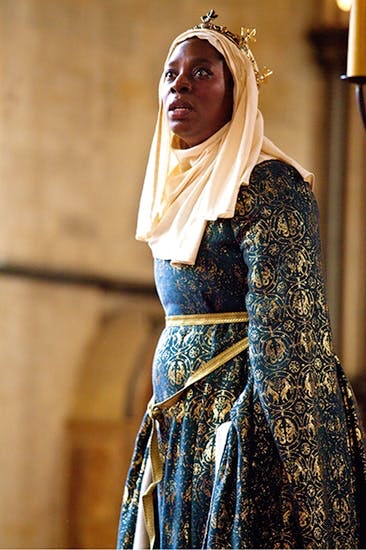
Costume for a production of King John. The fashion is reminiscent of the late 15th century. There is no corset, the dress helps shape the silhouette. Notice also the long sleeves.Jessica
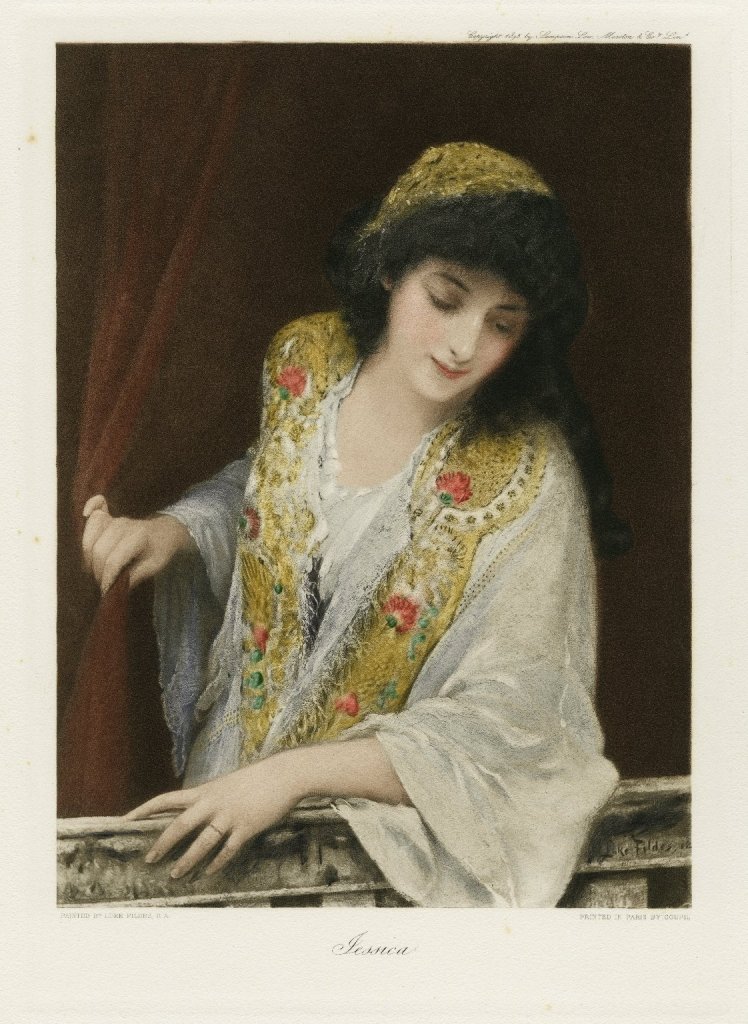
Jessica- Though most productions have Shylock’s daughter dressing like the Christian women, there is a long history of distinctive clothing for Jewish women as well as men. Sadly, the only video I could find refers to 14th century clothes, I think this video is very informative and extremely thoughtful
4. Shylock
It’s worth noting that Shylock is not the central character in the story; the titular merchant is Antonio. Probably Shakespeare’s original audience saw him as a one dimensional villain for the audience to boo and hiss, then rejoice when he fails. He probably came onstage in 1596 wearing stereotypical red wig, a long gown, and a grotesquely oversized nose. The costume and performance gave the impression of someone foreign, alien, even demonic. This was one reason why some modern actors have balked at playing Shylock, as Patrick Stewart explains: https://youtu.be/7UOdMHW7J2Q
That said, Shakespeare clearly didn’t write him as one dimensional; he dominates the scenes he’s in and for centuries great actors have yearned to play Shylock over all the other characters. Slowly Shylock has become the focus of the play and the romantic comedy aspect has become less and less important in most modern productions. Like every great part, Shylock’s costume proclaims his social class, his background, and his relationship with other people.
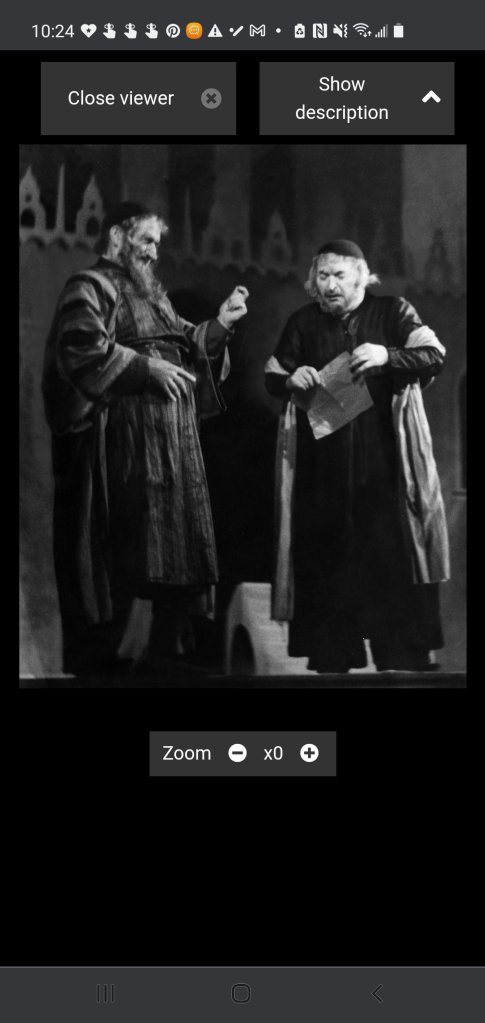
In the play, Shylock only refers to his clothes once, referring to the gown he wears as “My Jewish gaberdine.” A Gaberdine is a long cloak like the one in the painting above, but as you can see, Jews were not the only people wearing them.
Because of rampant antisemitism and fear of the growing influence of the Jewish community in the 16th century, the Senate and local magistrates segregated and kept constant watch on the Jews of Venice, and one way they did that was by forcing Jewish people to wear distinctive clothes.
According to the Online Jewish Museum:
Jews were forced to wear various markings on their clothing to identify themselves as Jews. In 1394 they had to wear a yellow badge, it was changed to a yellow hat in 1496 and to a red hat in 1500.
Charles Keen as Shylock
As Shylock grew in popularity with actors and audiences, actors played him with more nuance. Contrast the foreign looking gown in the previous picture, with Charles Keen in the 19th century.
That is not to say that all productions played Shylock as a fully formed human: in 1934, the Nazi Party sponsored a German production of Merchant with horror actor Werner Krauss, (famous for films like The Cabinet of Dr. Caligari) asShylock. You’ll notice that the costume again emphasizes otherness, and exaggerates Jewish stereotypes.
Warner Krauss in the infamous 1934 production of Merchant sponsored by the Nazi party.
Patrick Stewart when he played Shylock in the 1970s, emphasized how Shylock is essentially an immigrant in his own country and played him with tattered clothes, a dirty bushy beard, and with an air of a stray dog. His clothes emphasise both his race’s oppression, while also telegraphing Shylock’s miserly attitude. Sir Patrick emphasized that his Shylock had lost so much in his life that he clings to Earthly wealth to feel in control of his life.
Patrick Stewart as Shylock David Suchet as Shylock David Suchet as Shylock, RSC.
By contrast, David Suchet. (famous for his portrayal of detective Hercule Poirot), chose a near polar opposite interpretation of Shylock at about the same time. The main difference between Suchet and Stewart could basically be summed up by this fact, Suchet is actually Jewish, Stewart is not.
Because Stewart was portraying a member of a community to which he didn’t belong, his portrayal downplayed Shylock’s Jewish identity since he didn’t want to make assumptions about what being Jewish is like. This is why Stewart gave his Shylock an over-refined accent and made sure his costume didn’t emphasize any stereotypical Jewish elements.
Since Suchet actually is Jewish, he did not shy away from portraying Shylock’s jewishness. His Shylock is proud of being Jewish but is well aware of how other people see him. He knows that he is othered by the other Venetians, and can use their fear and hatred of him as a weapon against them. Suchet also dressed his Shylock as well to do, but not gawdy to try and command respect from other people, but also carried around a walking stick to use as a weapon.
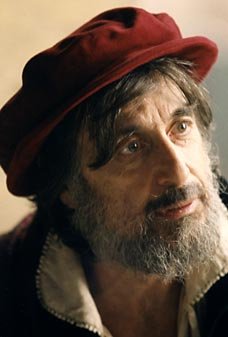
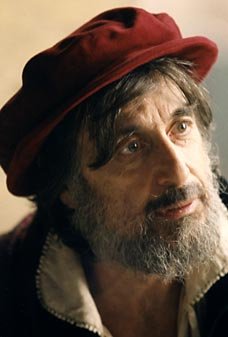
Ian McKellen Al Pacino in the 2009 movie of Merchant, wearing the red hat that real Jews were required to wear in the 1590s.
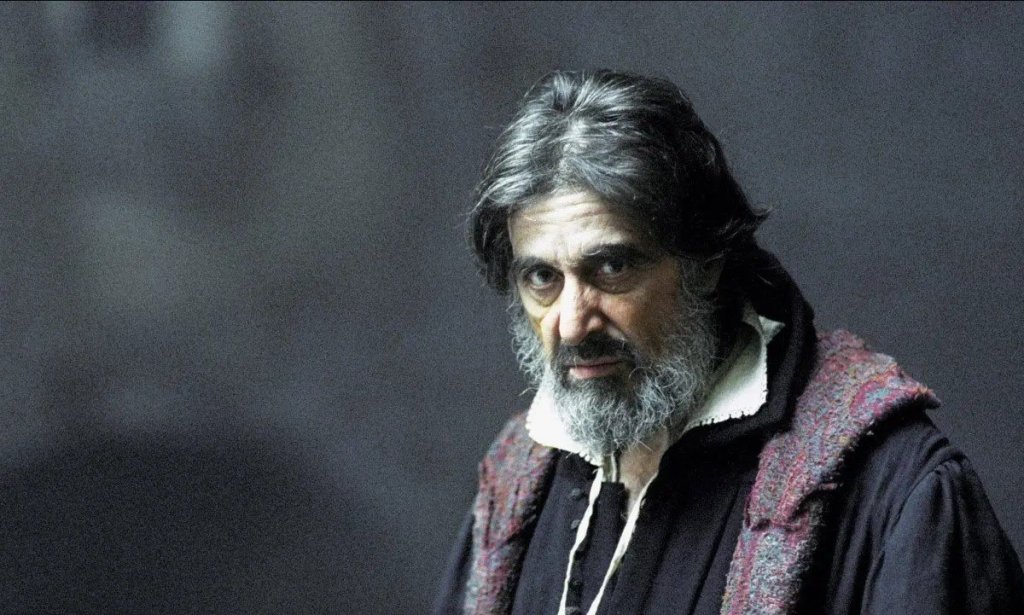
6. Case study: the 2009 movie
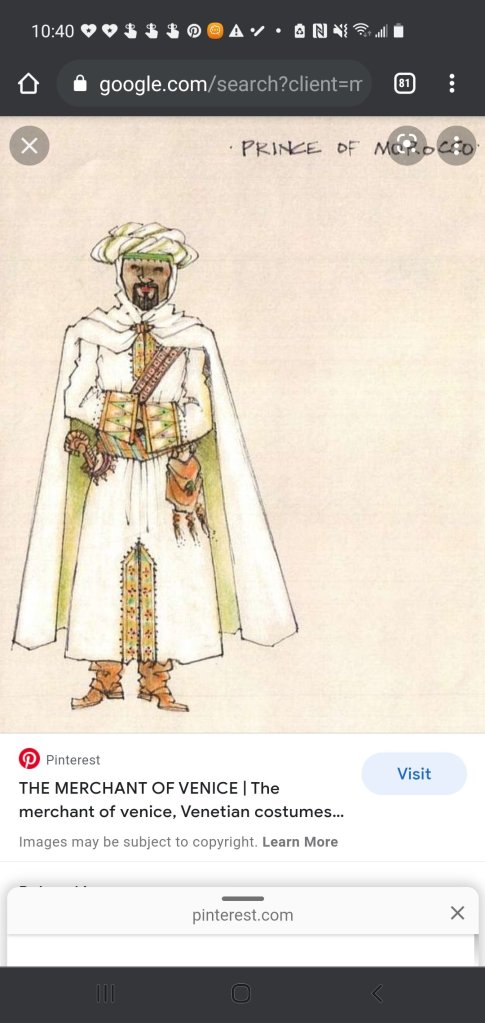
The Prince of Morrocco: In Act II, Scene 7, The Princes of Morrocco and Aaragon (A region of Spain), come to Portia’s home on the island of Belmont to try solve the riddle of the three caskets. In order to show the audience that these men are foreigners, their costumes have to be distinct from the Venetians. Take a look at this was accomplished in the 2004 movie:
The Prince of Morrocco (David Harewood) tries to guess the casket in the 2004 movie.
Mr. Harewood’s costume was inspired by the real Morroccon ambassador to Queen Elizabeth, Abd el-Ouahed ben Messaoud, who many scholars believe, might have also inspired Shakespeare to write Othello 6 years later.
Abd el-Ouahed ben MessaoudAl Pacino dons the distinctive red cap that all Venetian Jews were required to wear in the 1590s.Shylock after he converts to Christianity.
I really loved the new “Black Widow,” movie. Like many people, I think it’s long overdue that Natasha Romanov got her own movie, especially since in many ways, she’s the most tragic and dramatic of the avengers.
First of all, the performances are great, the fights are excellent, and the plot hints on many contemporary issues such as abuse, human trafficking, trauma, and PTSD, while not forgetting it’s a Marvel action movie. If you hated the movie, I won’t argue with you, but what I want to do is to point out that each character has inside them an archetype that Shakespeare used in his history plays about soldiers.
The four central characters Alexei Shostakov (David Harbour), Melina Vostokoff (Rachel Weisz). Yelena Belova, and Black Widow herself, Natasha Romanov (Scarlett Johanssen), represent in a sense, the full spectrum of how Shakespeare’s soldier characters cope with the trauma of war, and it’s fascinating to see their journey through the film.
David Harbour as Red Guardian. Black Widow, Disney 2021.
Alexei Shostakov / Red Guardian: Sir John Falstaff. Alexi begins the movie motivated by a desire for glory, and becomes a braggart, a drunk, and overweight. The movie starts out with Alexei going undercover in Ohio as Natasha and Yelena’s father, when in reality he’s a Russian agent who becomes the only Soviet supersoldier. The Red Guardian was supposed to be the equal of Captain America and after (spoiler alert), Alexei is betrayed and sent to prison, he spends over 20 years telling tall tales about his ‘glory days’ and how he nearly defeated Captain America, (despite the fact that Captain America was frozen at the time). This is simmilar to how Shakespeare’s Sir John Falstaff lies about a daring robbery he committed at night, when in reality, he was robbed by his friends Poins and Prince Hal:
Henry V. Pray God you have not murdered some of them.
Falstaff. Nay, that's past praying for: I have peppered two
of them; two I am sure I have paid, two rogues
in buckram suits. I tell thee what, Hal, if I tell1180
thee a lie, spit in my face, call me horse. Thou
knowest my old ward; here I lay and thus I bore my
point. Four rogues in buckram let drive at me—
Henry V. What, four? thou saidst but two even now.
Falstaff. Four, Hal; I told thee four.1185
Edward Poins. Ay, ay, he said four.
Falstaff. These four came all a-front, and mainly thrust at
me. I made me no more ado but took all their seven
points in my target, thus.
Henry V. Seven? why, there were but four even now.1190
Falstaff. In buckram?
Edward Poins. Ay, four, in buckram suits.
Falstaff. Seven, by these hilts, or I am a villain else.
Henry V. Prithee, let him alone; we shall have more anon.
Falstaff. Dost thou hear me, Hal?1195
Henry V. Ay, and mark thee too, Jack.
Falstaff. Do so, for it is worth the listening to. These nine
in buckram that I told thee of—
Henry V. So, two more already.
Falstaff. Their points being broken,—1200
Edward Poins. Down fell their hose.
Falstaff. Began to give me ground: but I followed me close,
came in foot and hand; and with a thought seven of
the eleven I paid.
Henry V. O monstrous! eleven buckram men grown out of two!
Both Alexei and Falstaff fool themselves into thinking they’re still great heroes and manage to charm the other characters into giving them sympathy (to a point). Worst of all, even though he knows about the disgusting deeds of General Dreykov, the man responsible for the way Yelena and Natasha were recruited, brainwashed, forced to kill, and forced to be sterilized, he still defends the actions of Dreykov because Alexei benefited from the supersoldier program.
You both have killed so many people,” Alexei exults, embracing them both. “Your ledgers must be dripping, just gushing red. I couldn’t be more proud of you!”
Alexei
But in the climax of the movie, Alexei abandons his swagger in order to protect Natasha and Yelena; he goes from being a fake father to a real father. He also adopts a more Falstaffian view of ‘honor,’ as a thing not useful in itself:
Falstaff used this ‘catechism to become a thieving, conniving rascal, but the same words could be used to show how Alexei decided that his ‘family’ is more important than his persona as Red Guardian, how he values Natasha and Yelena more than his own glory.
2. Yelena Belova – Hotspur
Both Yelena and Hotspur are great warriors who work for the other side, but aren’t played as villains. Unlike the French in Henry V, the rebels in Henry IV Parts 1&2 are treated with respect by everyone, even the king they fight against! Likewise, even though she works for Dreykov, and was a willing assassin in his army of widows, she isn’t seen as a villain. She’s seen as a woman who had no other choice. She was raised to kill, so she did so, she just had the misfortune of being on the losing side.
Henry Percy is also a warrior fighting for the losing side This is why Hotspur has a lot of bitterness and envy towards Prince Hal- the man who gets to become a hero and king. Meanwhile Yelena is very jealous of Natasha, who not only became a valued assassin for Dreykov, she eventually became an Avenger and is seen as a hero by most people now:
“We’re both killers, but I’m not the one that’s on the cover of a magazine. I’m not the killer that little girls call their hero.”
Yelena- Black Widow.
Though in reality Natasha and Yelena are not sisters, they were raised together, trained together, and form a sister like bond, which makes the jealousy Yelena feels all the more poignant. Likewise, though Henry Plantagenet (Prince Hal) and Henry Percy aren’t brothers, everyone acts as if they were, even the Prince’s father:
 O that it could be proved
That some night-tripping fairy had exchanged
In cradle-clothes our children where they lay,
And call'd mine Percy, his Plantagenet!
Then would I have his Harry, and he mine.
But let him from my thoughts.- Henry IV, Part I, Act I, Scene 1.
In Black Widow, the envy the sisters feel towards each other is the central conflict of the movie, just as it is in Shakespeare’s play. Tragically, both works (spoiler alert), end the same way- with one warrior dying and the other essentially taking his or her place. In Black Widow, Yelena takes up the mantle after her sister sacrifices her life in Avengers Engame, but in Shakespeare’s version, the two Henry’s have a duel to the death:
Yelena represents the trauma that can destroy some soldiers when they don’t have someone to confide in. Everything she was told to believe in wound up being a lie, and everyone she trusted betrayed her. This is why she and her sister cling to the idea of family- the only thing that helps her get through the pain of their past.
Rachel Weisz as Melina Vostokoff. “BLACK Widow.” Disney/ Marvel, 2021.
3. Melina Vostokoff- Lord Northumberland I’ll keep this brief because Melina’s character has some MAJOR SPOILERS attached to her, but let’s just say she is the mother of the family and like Alexei she put her devotion to the Communist Party and to General Dreykov above all else, and failed to support her family, much like how Northumberland failed to support his son Henry Percy and let him get killed in the battle of Shrewsbury. I love Rachel Weisz’s performance in this part where she seems to mourn her lack of courage; she seems to deeply hate herself and what she’s done to her ‘daughters,’ which is painful to watch but very human.
Scarlett Johansen as Natasha Romanov/ Black Widow. “Black Widow.” Marvel/ Disney, 2021.
4. Natasha Romanaov/ Black Widow- King Henry V. Like Yelena, Natasha has to deal with the fact that she is a killer and has been trained to kill men, women, and sometimes even children. What’s fascinating to watch is how, even though she’s an Avenger and therefore one of the “good guys,” she knows that her actions have hurt people. It makes sense that in Age Of Ultron, she forms a close bond with The Hulk, since she probably sees herself as a monster.
For nearly 400 years, King Henry has been portrayed as a great hero on the stage, but ever since the Vietnam War, more recent productions have questioned whether his actions make him more of a hero, or a villain. He conquers France which he believes he legally owns but does that justify the bloodshed he’s committed?
One film that examines the ambiguous nature of Henry’s bloody conquest is Kenneth Branaugh’s 1989 movie, Henry V. Take a look at this clip at the end of the Battle of Agincourt. This was Henry’s greatest victory in the play and in real life, but after the battle, we see Kenneth Branaugh as King Henry slogging through the mud, looking at the bodies of French and English troops, with a look of pain and perhaps remorse on his face:
The Non Nobis number from “Henry V” directed by Kenneth Branaugh, 1989.
In Black Widow, Natasha is on a quest to make up for her past as an assassin and attempt to prevent more women from being recruited in such a dehumanizing way. Her kinship with the other widows, and her desire to help them, reinforces her humanity and makes her more than just a killer. Simillarly, her love for her sister and her love of the Avengers gives Natasha purpose and validation that she isn’t the monster she thinks she is. Finally, when her fake family joins her in the climax to defeat General Dreykov, she feels a strong sense of comraderie. Having her fellow soldiers, fight with her in a righteous cause makes her feel redeemed from her past.
Black Widow and Henry V are examples of how soldiers cannot survive a war alone. Even if they live through the war, the mental and physical scars of war are too much for one person to bear. This is why both films focus on how family is stronger than war, than causes, then pain, if one has the good fortune to have a group of people who love each other like a family, or as King Henry puts it:
We few, we happy few, we band of brothers;
For he to-day that sheds his blood with me
Shall be my brother; be he ne’er so vile,
This day shall gentle his condition:
Henry V, Act IV, Scene iii.
Thanks for reading this post, let me know if you’d like me to analyze any other movies in the comments. I’ll leave you with one more clip where Scar-Jo talks about her career as Black Widow:
Happy Juneteenth Everyone. On this day, when we pause to think of the injustices the African American community has endured, listen to this podcast about thh history of African Americans and Shakespeare:






























 The Shakespearean Student