Outschool.com will be honoring the contributions of Shakespeare during the very first Shakespeare Week on March 21-27th.
course image: Immersive Guide To Romeo and JulietCourse image: Intro To Stage Combat
Course image: Shakespearean Acting Course image: The Violent Rhetoric Of Julius Caesar Course image: Basics of Shakespearean ActingCourse image: Immersive Guide To Macbeth course image: How to Write Like Shakespeare course image: Intro to Shakespeare
I’m honored to take part in this celebration, and I’m offering several aclasses which relate to Shakespeare in an engaging way. Here’s the schedule below:
If you want to sign up for one of my classes, please visit my Outschool page:
Myth 1: Everyone wore togas! The toga was a formal garment that was worn by male citizens, usually on business, therefore women and slaves couldn’t wear them. Basically, think of a toga as like a 3 piece suit, (which is probably how it felt to those men in the hot Mediterranean sun). Togas were very hot because they were made of wool. As the video below shows, many Romans couldn’t wait to get out of their togas and wear a simple tunic.
Myth 2: All Togas were white
In most movies, and pictures set in Rome, we see rooms full of men wearing white togas, especially in the Senate. However, togas gradually evolved into a variety of styles and colors and helped indicate a Roman man’s status and maturity.
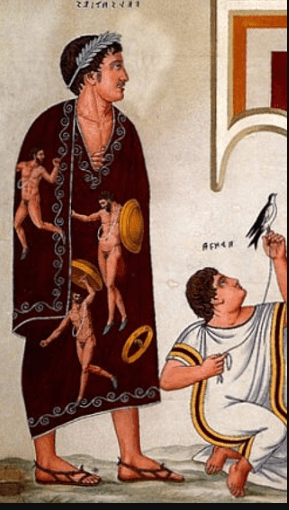
Mosaic of Virgil
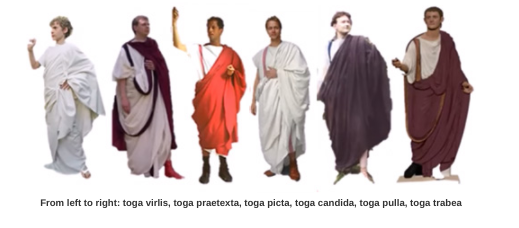
Types of Togas and how to wear them:
Shakespeare makes reference to a specific type of toga called a Toga candida: "Bright toga"; a toga rubbed with white chalk to make it appear bright white. In Titus Andronicus, the title character is offered a toga candida by his brother Marcus, when the Senate nominates him for emperor:
Marcus: Titus Andronicus, the people of Rome,
Whose friend in justice thou hast ever been,
Send thee by me, their tribune and their trust,
This palliament of white and spotless hue;
And name thee in election for the empire,
With these our late-deceased emperor's sons:
Be candidatus then, and put it on- Titus Andronicus, Act I, Scene i.
There were many other types of togas for different occasions:
- Dark colors were for funerals
- Red and purple sleeves were for magistrates and senators
- Purple togas with gold embroidery were for victorious generals, and later emperors
Manly garb: Toga virillis
A Toga virilis ("toga of manhood") also known as toga alba or toga pura was A plain white toga, worn on formal occasions by adult male commoners, and by senators not having a curule magistracy. It was a right of passage for young men to put on their toga virilis and assume adult male citizenship and its attendant rights, freedoms and responsibilities.
Women’s fashion
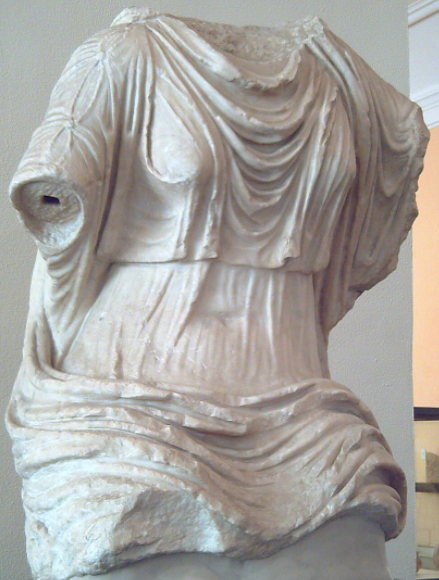
Like men, women most commonly wore tunics, especially when they were unmarried. When women married, they would don a long, elaborate garment called a Stola . The stola was a long dress held on by belts. Sometimes women decorated their Stolas with ribbons and they came in many colors. In the statue below, note how the belts below the breast drape the fabric into elaborate folds, and how the sleeves are slightly slashed on this sumptuous 1st century stola.
Torso of a Roman woman wearing a Stoa (1st century)
Women’s Beauty Regimen
Since Roman women were not legally citizens and couldn’t hold employment, their hair, dress, and makeup were in a way, a celebration of idleness, especially in the case of upper-class women. Aristocratic Roman women had their hair done in elaborate shapes like the Flavian hairstyle and wore elaborate Stoas to indicate how they didn’t have to work or labor in the fields.
In a production of Julius Caesar or Coriolanus, the director could exploit this concept of idleness by giving the more passive characters like Calpurnia or Fulvia more elaborate hairdos and elaborate brightly colored Stolas, while the more active characters like Portia or Valumnia could have a more austere or less fussy hairstyle and dress to show that they are more interested in engaging in politics or the military than sitting around and looking pretty.
One way to learn about Julius Caesar is to learn about the weapons he used as general of on of the most fearsome legions in Rome. In this blade-forging competition from the History Channel, 2 master blacksmiths forge their own versions of a Roman Gladius, and put them to the test!
In honor of Black history month, and the impending Ides of March, I’d like to highlight two wonderful black British actors, Ray Fearon and Paterson Joseph, two of the best actors at the Royal Shakespeare Company. In this video, they discuss their interpretation of Act III, Scene ii of Julius Caesar, in a groundbreaking production set in Africa.
This 7 part class is geared towards students who have taken my class or some other combat class in the past. We will go in-depth into how to train for, rehearse, and perform a fight from a Shakespeare play. We'll cover fight safety, footwork, proper cuing, and selling the fight. I will also contextualize the fights in "Romeo and Juliet," (the play with more fights than any other in Shakespeare), to explain how the Elizabethans felt about violence, and what this play says about violence in our own time.
The class will mostly be up-on- your feet demonstrations with me in front of the camera and the students mirroring my movements, but there will also be handouts, websites, and video presentations to help supplement what I say.
Class Structure: Week of March 5th: Background on swords/ sword crafts -We will learn about the history of swords from ancient military weapons, to the instrument of private dueling. We’ll also cover the culture of duelling that permeated 17th century Europe, as well as the text of Shakespeare’s Romeo and Juliet. The class will conclude with me instructing the kids how to make a practice sword themselves!
Week of March 12: Proper Footwork/ Stances For Sword Combat- We’ll cover proper stance and en guard positions We’ll practice advances and retreats We’ll show you how to do a lunge and the footwork involved. We’ll incorporate advances and retreats with simple high-low parries and cuts.
Week of March 19th : Cuts, Swipes, and Thrusts You’ll learn the lines of attack and defense You’ll learn the proper way to hold a blade and deliver realistic-looking cuts. Learn how to thrust (online and offline)
Week of March 26th: Parries and other defensive moves We’ll cover the 6 basic parries to stop an attacker’s blade. We’ll also cover ducking, avoidances, and
Week April 2nd: Fight Rehearsal 1 We’ll assign roles for the fight between Mercutio, Tybalt and Romeo in Act III I of "Romeo and Juliet." The students will then get a fight script, and you can practice the fight at ½ speed. We will also explain the concept of Cue-Reaction-Action: A basic stage combat principle/process used to achieve a safe and dramatically effective sequence of events. We will discuss the importance of eye contact and cuing to ensure that the combatants know what to expect at all times.
Week of April 9th: Fight practice 2 - We'll go through a warm-up fight drill - We'll rehearse the fight at 3/4 speed to make sure you understand all the moves. - We'll Incorporate acting into the fight- selling pain, anger, and fear. Use distance to show character relationships.
Week of April 16th: Final Fight performance - We'll go through a warm-up fight drill again - We'll rehearse the fight at 3/4 speed again to make sure you understand all the moves. -We’ll pretend we’re doing this fight for an audience at ¾ speed. If need be, I’ll play one of the aggressors and you can do the fight pretending I’m in the room with you. At the end of class, I’ll show you a similar fight from my production of Romeo and Juliet and we’ll discuss the differences between our fight and the one I showed the students. Finally, we will discuss the way Shakespeare portrays violence in the play and its relevance in our world.
If you read my blog for an extended period of time, or if you listen to my podcasts, or if you’ve taken any of my classes online, then I probably told you the notion that I believe that you could find Shakespearean roots in just about every single work of Western and quite a few of Eastern literature. Shakespeare is ingrained in our culture and therefore a lot of his influence can be felt in almost every bit of media we take in. One of my favorite ways to illustrate this, is by looking at Disney movies, trying to prove that every Disney story is at least a little bit inspired by a Shakespeare play as you’ve seen from my comedy series if Shakespeare wrote for Disney:
I had an enormous challenge on my hands when Disney came out with the new film Encanto. Previously I’ve found it very easy to deconstruct Disney film plots and spot their Shakespearean roots: Pocahontas is Romeo and Juliet by Disney’s own admission, Aladdin is basically the Tempest, Mulan is Twelfth Night, and the Lion King is Hamlet, (as many people have pointed out).
Encanto was really really hard because it is such a fresh and original story. It is deeply rooted in Columbian culture, so trying to defend the notion that it has anything in common with the works of a 400-year-old English male playwright is a tough claim. I don’t mean to suggest that this movie is a deliberate reinterpretation of Shakespeare. That would be insulting and limiting to the breadth of the story. My main purpose with this post is to show how universal and powerful these two stories are- to pay Encanto the compliment that, like Shakespeare, the story transcends cultural and historical boundaries and tells a story we can all relate to, and this is why I am making this bold claim, that Encanto resembles King Lear, albeit with a happy ending.
Mirabelle- the Cordelia of “Encanto”
It was hard for me to realize that Encanto resembles Lear because the Lear character is not the focus of the movie; the focus of the movie is the Cordelia character, Mirabelle. If you’ve read King Lear , then you know that Cordelia is vital to the first 2 scenes of the play, and then goes offstage until Act 4 when where she is reunited with her father in prison, then cures his madness just long enough for her to be hanged. Her death is the darkest, grimmest, bleakest moment that Shakespeare ever wrote. She is the heart of the play and Lear’s failure to listen to her forms the heart of the play’s message; when an older generation clings to power and power or money or status or anything else besides their family, ultimately they suffer tremendously.
In his first line, King Lear says that he wants to give up his kingdom, conferring it to his daughters and their husbands, but what he is really trying to do is to get his daughters to say they love him and to give them the kingdom as a reward.
This deal also has more strings attached; Lear basically says: “Now that I’ve given you my kingdom, you have to house me in your castle with a retinue of 100 knights.” And the only child who really loves Lear and has his best interest in heart is Cordelia, and Lear violently renounces his parental claims on her and banishes her from the kingdom along with her husband the king of France.
The Lear of “Encanto”
Abuela Alma Madrigal, from Disney’s Encanto.
So who is the King Lear figure in Encanto? Abuela Alma! Think about it, she is an older person who is spending the whole play clinging and holding on to the power that the Magic Candle gives to her. She spends the whole movie trying to protect the Encanto, and when she mistakenly believes that Mirabelle is a threat, she pushes her away. She rules her other children Papa, Julietta, and Brunowith an iron fist, and she flies into panics and rages whenever anything seems to threaten the safety of the candle. For example, when Bruno gets the magic prophecy that Mirabelle might destroy the house and destroy the Encanto, Abuela refuses to let Mirabelle talk to anybody ever and generally acts in a cruel controlling way.
Look at this passage when Lear rejects his loving daughter Cordelia. Given what I’ve mentioned- the fists of rage, the clinging to supernatural powers, and the controlling demands for loyalty and obedience from his children, whom does King Lear sound like?
Lear: For, by the sacred radiance of the sun, The mysteries of Hecate and the night; By all the operation of the orbs115 From whom we do exist and cease to be; Here I disclaim all my paternal care, Propinquity and property of blood, And as a stranger to my heart and me Hold thee from this for ever. The barbarous Scythian,120 Or he that makes his generation messes To gorge his appetite, shall to my bosom Be as well neighbour'd, pitied, and reliev'd, As thou my sometime daughter. King Lear, Act I, Scene i.
As Ian McKellen explains in this interview, like Abuella, Lear clings to power, which he derives from supernatural forces, ignores people who care about him, and believes that his authority is absolute:
Trauma and Violence in Encanto and King Lear
Marxist critics believe that Lear’s power is based on violence, (like most medieval kings), and violence is actually connected to Abuela as well. Let’s not forget that the candle was forged after the faceless men with machetes attempted to murder Abuela and her whole village. The candle is Abuela’s power, but it is also a constant reminder of the violence that she escaped. It is also therefore a symbol of her trauma. Perhaps these characters became so controlling, distant, and cold because of the trauma they endured. Lear is supposed to be a king of Britain back in the pre-Christian era of the Anglo-Saxons so he must have seen countless invasions:
The former king says himself that he’s fought in wars with his “Good biting falchion” (a kind of sword). Whether they’ve seen falchions or machetes, these characters have seen violence and want to protect themselves against seeing the pain of it again, and ultimately it is their children that suffer because of it.
In King Lear, the kingdom is ripped apart between the three daughters, and in Encanto, the house is literally ripped apart by the rift between the family and Abuela. Lear foolishly tries to bribe his daughters into flattering him; promising them the kingdom if they demonstrate how much they love him. Therefore Lear demands obedience and love and expects his family to fawn on him as if they were his subjects, not his family.
Lear’s favorite daughter Cordelia refuses to take the bribe, so she says nothing. Lear is enraged and treats this small disobedience like an act of treason:
Act 1 Scene ii: Lear disowns Cordelia
Arguably Abuella makes the same mistake. She treats her children like her subjects too and exploits their gifts in order to keep the community happy. Her fear of losing her home is the reason she pushes the Madrigals to be indispensable to the community. Think of the psychological and physical pressure Louisa mentions in her song:
As you can see in this video, Lin Manuel Miranda, who wrote the music for Encanto, was actually inspired by Shakespearean verse for the lyrics and rhythms in her song “Surface Pressure.” Whether or not he or the screenwriters were inspired by “Lear,” the fact remains that Mirabelle suffers much like Cordellia. She also can’t stand to see her sister Louisa in pain like this, so she sets out to save her family, which forces her to confront Alma. Much like Lear and Cordelia, Mirabelle and Abuela argue about how her clinging to the past is hurting her family and how the pressure she puts on them is literally ripping their home and family apart:
Sight and Sightlessness in “Encanto” and “King Lear”
Perhaps the biggest connective motif between Encanto and King Lear is the motif of sight and sightlessness. Both Lear and Lord Gloucester are blind to the danger that they’re in and blind to who their real friends and enemies are. Lear trusts his two elder daughters because they flatter him, he trusts his drunken knights who only succeed in getting him forced out of the cold. Conversely, Lear ignores Cordelia. who really loves him, as well as Kent, who is a loyal nobleman to the very end, and he ignores the Fool because he’s a fool. If he had heeded any of their advice he would not have died alone and powerless. Therefore his sightlessness is a deadly weakness.
Gloucester, the other old man character in Lear has another problem with sightlessness and is punished for it figuratively and literally. Gloucester’s bastard son Edmond deceives him into thinking that his legitimate son Edgar is plotting to kill him. The old man sends Edgar away, makes Edmund his heir, and then Edmond betrays him and gets him arrested for treason.
In the play’s most savage scene, Gloucester is tortured and his eyes are literally pulled out of his head. From this moment Gloucester finally sees Edmond’s treachery, and he laments that he “Stumbled when he saw”. Gloucester feels like he is finally able to see clearly now that he is blind, not unlike the ancient Greek tragedy Oedipus Rex. Of course, nothing this gruesome can be shown in a Disney movie but the image of sight is constantly referenced in Encanto visually, and also through the lyrics of the songs. Even the name of the character; Mirabelle comes from the Spanish word ‘mira’ which means “to look”, and the first thing one might notice about her is her brightly painted green glasses, which constantly draw attention to her ability to see.
Mirabelle, like Cordelia, is able to see that her family is in pain, she sees that her family, the Encanto, and the house is in danger, while Abuela is constantly deluding herself and everybody else in thinking that nothing is wrong.
Through the course of the movie, Mirabelle is able to fix the various problems she sees. For instance, she sees that her sister Louisa is taking on too many responsibilities and refusing to admit that she is tired and feels weak. She realizes that her sister Isabella is tired of being the perfect golden child, that her Uncle Bruno is not the monster that the family declares him to be, (however catchy their song about him is).
Through her sight and her perceptiveness, Mirabelle is able to heal the wounds in her family, The last wounds that she heals are the cracks on her house, and her own Abuella’s wounds, the wounds that went deep through her and even deep through her house; she mends the problems that happened the instant that the candle came into being:
Once Mirabelle and Alma reconcile, they set about rebuilding the house in this song. Notice how many times the words “look,” and “see” are mentioned in the lyrics. Mirabelle re-iterates how each person in her family is more than their gifts, more than just the roles Abuella put them in, and they respond by telling her to look at her own gifts and be proud of who she is. She heals them by seeing them as they are, and they heal her by seeing her too.
It was when I realized this that I understood that this movie is what would have happened if King Lear had only listened to the people who really cared about him, and did not succumb to idle flattery. If only he did not let his pain and his trauma dictate the rest of his life. There’s a wonderful hopeful message here that family wounds can be healed if we take the time to see and address them. If you read King Lear and then see Encanto you can see both how these family wounds can be healed, and the tragic consequences if they are not.
I hope that this little post has helped you appreciate both works because they are both magnificent and they are both carefully constructed and they both tell a very simple lesson for all families. As families, we need to recognize our faults, forgive faults in others, and work together to mend the pain and suffering that we experience in our lives. Mirabelle and Cordelia show that we can all be heroes if we see the truth, and speak what they feel not what they ought to say.
Gloucester and His Sons, PBS Learning Media: Shakespeare Uncovered: witf.pbslearningmedia.org/resource/shak15.ela.lit.gloucester/gloucester-and-his-sons-king-lears-subplot-shakespeare-uncovered/?student=true
James Earl Jones in King LEar at Shakespeare In the Park, 1974. In my opinion, this is the BEST version of “King Lear” on film.
I’m very proud to announce that just in time for Valentines’ Day, I’m offering a course of classes about Shakespeare’s most popular play about love. The play will include fight choreography, dramatic readings, games, escape rooms, and an activity where the students create their own Shakespearean insults!
Course Description:
We’ll engage with the play with thoughtful discussion.
You’ll go on a virtual tour to the Globe Theater!
You’ll play detective and solve a Shakespearean murder!
Instead of just reading the play "Romeo and Juliet," this class will actively delve into the world of the play through a combination of lectures, dramatic readings, virtual field trips, online quizzes and activities, and finally, a digital escape room to test the student's knowledge of the play and its ideas. Each class is ala carte, meaning that once you take one class, you choose whether to stop at one class or continue onwards. Each class will delve into a different theme, literary device, and historical concept in the play:
Class Structure:
Class 1: Why Read Romeo and Juliet?
- The teacher will decode the Prologue of Romeo and Juliet and tell the basic story of the play
- We will explain dramatic irony through looking at the prologue,
- The teacher will explain why Shakespeare used poetry in the play, instead of just writing in common prose
- We will discuss why we still read Shakespeare and Romeo and Juliet in particular.
Class 2: Foils and Fights
- The learner will learn about the culture of dueling and sword fighting that was rampant in the 17th century.
- The teacher will explain and the learner will learn to recognize character foils in the play like Romeo and Friar Laurence
- We will cover the topic of antithesis- how opposite imagery permeates the play.
- We will discuss figurative language through insults and the students will have a contest to see who can craft the best Elizabethan insults!
Class 3: Acts 1& 2- The Language of Love and Hate
- We will recap how insults work- hyperbole and metaphor used to make someone seem the worst, the smallest, the ugliest, the dumbest, etc.
- We'll examine passages from Act II that show how these techniques apply to wooing and expressing love through metaphor, hyperbole, and allusions.
- The teacher will explain what a sonnet is and how Shakespeare uses them repeatedly in "Romeo and Juliet"
- We will discuss staging the famous Balcony Scene of Romeo and Juliet and ask if it's possible to do so in a virtual environment.
Class 3: Act 3 fighting 💪 swordplay and plague imagery
The teacher will explain the plot structure of Elizabethan tragedies and explain that Act III is the climax of the play.
We will recap the events that led to the deaths of Mercutio and Tybalt
The teacher will unpack Mercutio’s famous curse "A plague on both your houses," which is a foreshadowing, and the climax of the action.
The class will end with a short, safe demonstration of stage fighting where the students may choose to enact Mercutio's fight with Tybalt and/ or Romeo's fight with Tybalt.
Class 4: Act 4 antithesis and dramatic irony
We will talk about the imagery in Act IV, scene 1, which foreshadows the end of the play. I will also do a dramatic re-enactment of Juliet's soliloquy in Act IV,
We'll go on a virtual field trip to an Elizabethan wedding.
The teacher will historical context of the black death and its relevance to the play and Shakespeare's life.
Class 5: The final curtain
We will discuss Act V of the play and how so many forces seemed to be out of Romeo and Juliet's control, pushing them apart. We will also discuss whether or not Friar Laurence should be punished for encouraging Romeo and Juliet to disobey their parents.
Class 6: Performance then and Now
The teacher will perform in character as William Shakespeare, and teach the students how to act like real Elizabethan actors. This will include a virtual tour of the Globe Theater, a virtual costume fitting, stage fighting lessons, and DIY Elizabethan crafts. The teacher will then engage the class by discussing different adaptations, sequels, and spin-offs of Romeo and Juliet, in order to illustrate how popular and long-lasting this story is. The students will watch and discuss clips from various movies, plays, and ballets based on Romeo and Juliet. The instructor will conclude by sharing his own experience acting in Romeo and Juliet three times as The Prince, Friar Laurence, and Peter.
Class 7:
Final project- CSI ROMEO AND JULIET STYLE
The class will play the role of a detective trying to solve the mystery of Juliet's death in Act IV, (when she actually takes the sleeping potion). (S)he doesn't know what happened but must piece together clues hidden in a digital escape room, such as handwritten notes, blog posts, receipts from "The Apothecary," etc. The clues will not only test the student's knowledge of the play, but their understanding of metaphor, verse, Elizabethan history, and more! In the end, the Detective will be the one who tells Lord and Lady Capulet the true story of what happened to Juliet. To unlock the digital escape room, the students will decode messages hidden in the clues and enter them into a Google Form.
First course runs from February 2nd to March 19th, 7PM EST. If you can’t make it to this section, I can schedule one for you.