

If you enjoyed this video, please consider signing up for my online class, “Basics Of Stage Combat,” on Outschool.com: https://outschool.com/classes/basics-of-stage-combat-pUrfWBtA?usid=MaRDyJ13&signup=true&utm_campaign=share_activity_link
2022
Happy Twelfth Day Of Christmas!
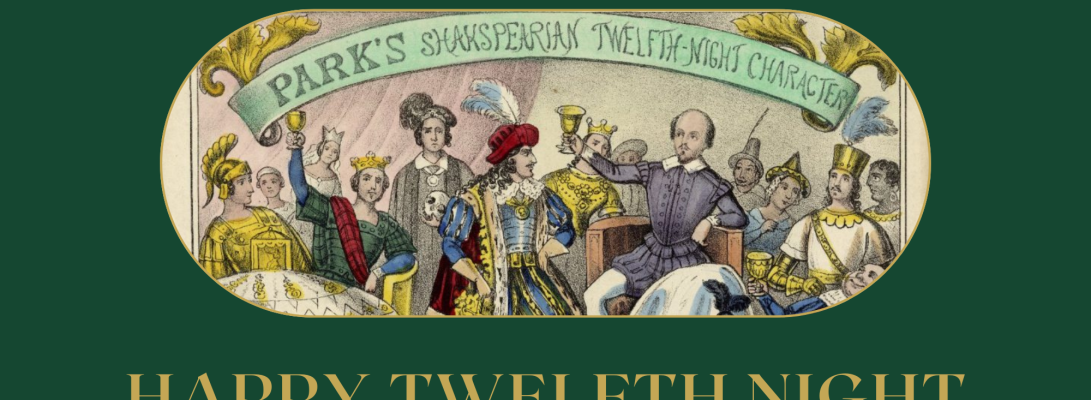
Happy Twelfth Night and farewell to the Christmas season!

This weekend I am offering a special discount on my class on Shakespeare’s Twelfth Night! You can take the course at a $5 discount with coupon code HTHESNIF6B5 until Jan 13, 2022. Go to https://outschool.com/classes/what-was-christmas-like-for-william-shakespeare-BwVLyBPp?usid=MaRDyJ13&signup=true&utm_campaign=share_activity_link and enter the coupon code at checkout.
Finally, here’s a short musical interlude from the movie version of Twelfth Night: Ben Kingsley singing “O Mistress Mine,” from Twelfth Night:
Happy Twelfth Night, and enjoy your cakes and ale responsibly!
More Twelfth Night Posts:
1. Play of the Month: Twelfth Night
2. Creating a Character: Malvolio
New OUtschool Class: Love Poetry, Shakespeare Style
Your child will learn how to write poetry like Shakespeare himself, through a mix of presentations, a printable guideline, and some fun quizzes to test your knowledge of Shakespeare’s sonnets! Designed for ages 13-18.
Class Description:
We will cover what a sonnet is, namely a type of poetry Shakespeare wrote in iambic pentameter with a particular rhyme scheme. Using a combination of Prezi video presentation and Google Slides, I will go in-depth to explain how he organized his poetic ideas into a very compact form.
Using primarily Google slides, we will then analyze Shakespeare's sonnets for their themes, literary devices, and the way he uses the poetry to enhance and heighten emotion and ideas. I will focus mainly on Sonnet 18, "Shall I compare thee to a summer's day?" I will cover Shakespeare's use of such literary devices as:
- Metaphor
- Simile
- Personification
- Rhetorical Question
- Irony
- Paranomasia
Analyzing this sonnet will allow the class to grasp the basics of how a sonnet is constructed, and begin to prepare to write their own. While the presentation is in play, students will be given an access code to an optional Nearpod presentation, that will allow them to construct an iambic pentameter line, quiz themselves on the vocabulary I cover, and provide visual aides to better understand Shakespeare's sonnets.

In the next part of the course, We will engage in a group brainstorming session. I will provide the students with potential topics (assuming they don't have one of their own), and then we will construct a short story using madlibs around that topic that will later be condensed into a sonnet. I will demonstrate to the students how to use imagery and poetic language to enhance the ideas and feelings in the poem. After this, I will use the nearpod and Google slide presentations to guide the students how to tell their own story using such devices as metaphor, personification, allusion, and sensory details. They can jot their ideas down on the provided handout to help organize their thoughts. In addition, the optional handout will have useful brainstorming activities such as a web link to websites like Rhymezone.com, (which helps poets find rhymes to words), and imagery boards that will allow the students to think of sensory details to include in the sonnet . The class will draw attention to the handout activities, and pause briefly to allow the students to do them.


In the last part of the class, I will give the students step-by-step instructions on how to transform their brainstorming ideas into a sonnet. I will begin by showing them how to construct an iambic pentameter line. I will engage the students by clapping out the beats for this line and allow them time to do the same, so they may internalize the rhythm. This will be accomplished via a Google Slides screen.
The final page of the handout has a page to write a draft of their final sonnet, with the line numbers conveniently provided. I will go over every section of the worksheet so the students know how to utilize it effectively.

After all this practice and training, the students will be able to create a basic 14 line sonnet which will give them practice not only writing poetry but also using and recognizing literary devices. It is my hope that this course will not only help the student(s) gain an appreciation for Shakespeare's poetry but also develop their own ability to speak and write eloquently and persuasively.
Link to the OUtschool Class:
Shakespeare Recipes: How to Make a Twelfth Night Cake!

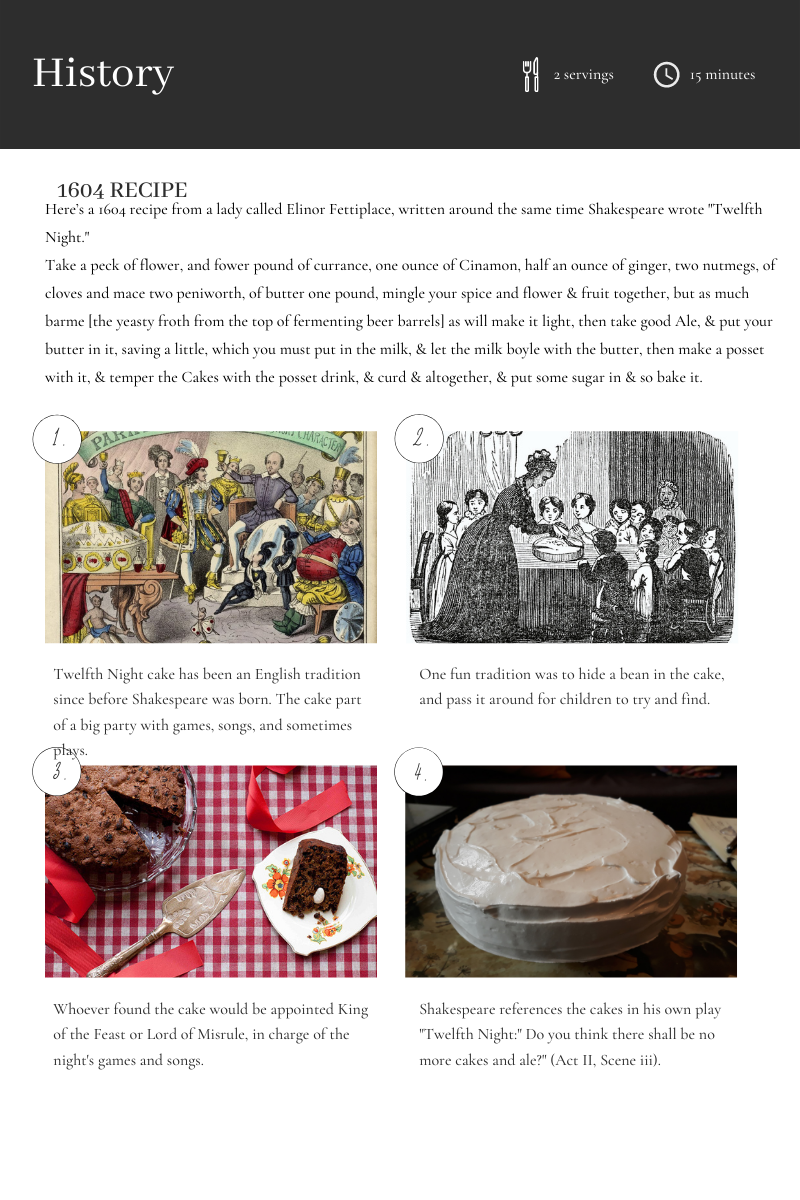
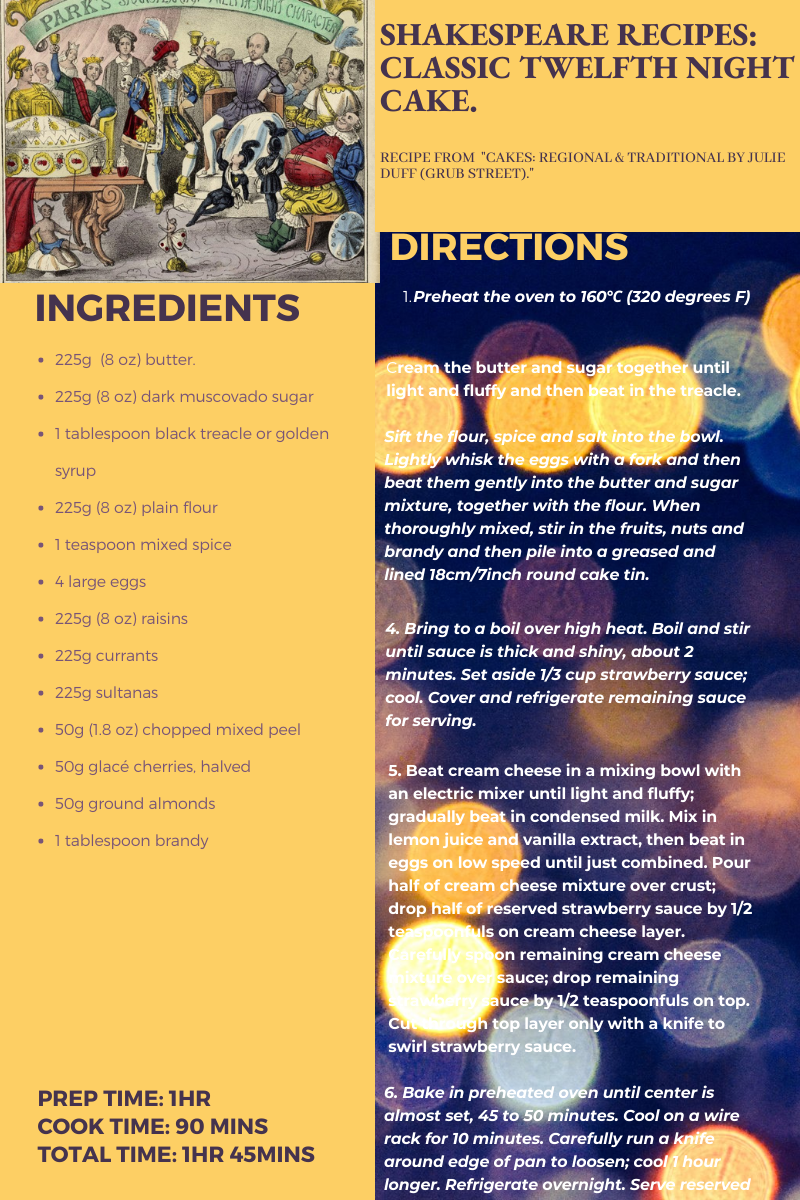
If you’re pressed for time for your annual Twelfth Night party, I’ve got this quick and easy recipe card about how to make a Twelfth Night cake! I have three recipes in these cards- one 1604 recipe, which might have been used by Shakespeare himself, another Twelfth Night cake recipe, with modernized ingredients, and a more contemporary Christmas cake, (just in case you need a more kid-friendly recipe).
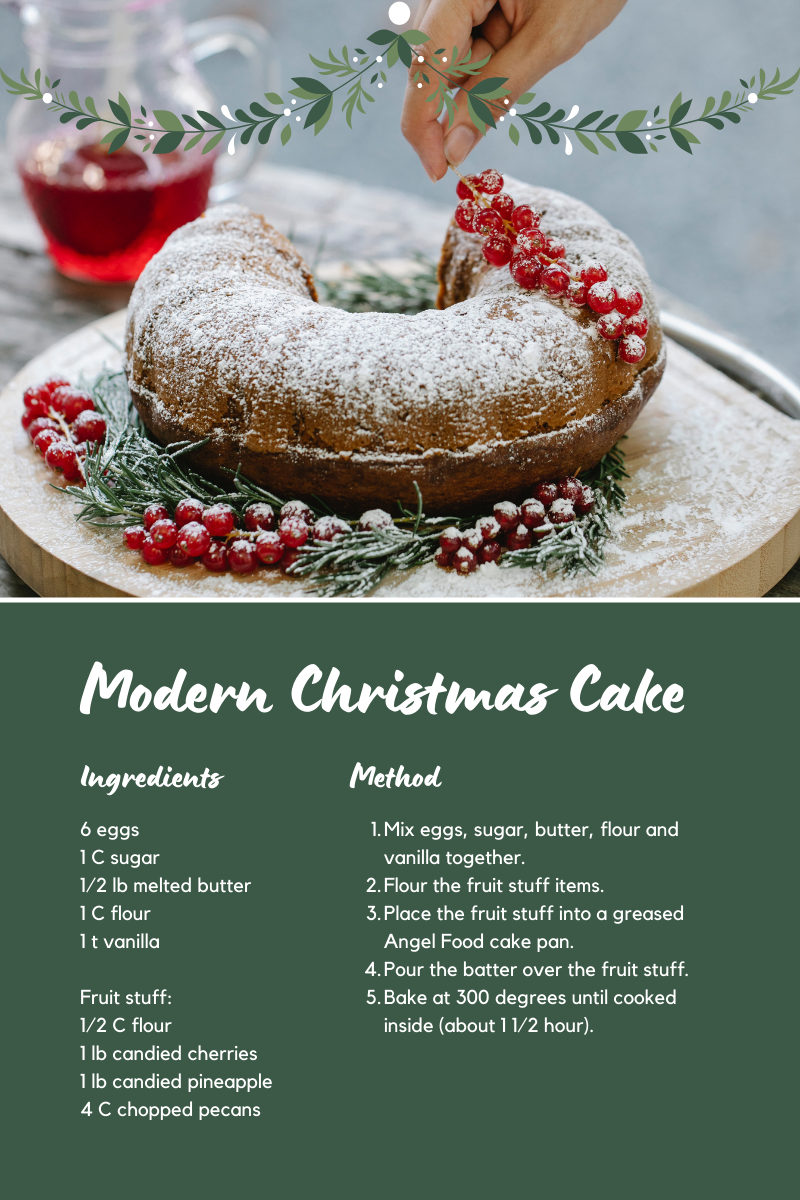
Finally, here’s a video about the most celebrated traditions surrounding Twelfth Night cake- the bean and coin in the cake!.
Short Review: “She’s The Man”
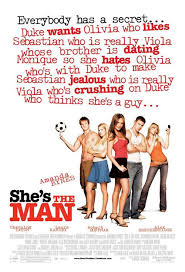
Since Twelfth Night is coming up, I’m going to review a blast from the past, the Amanda Bynes teen comedy remake of Twelfth Night called “She’s The Man”.

Some of you might remember that the late 90s and early 2000s were the heyday of Hollywood remakes of Shakespeare: Romeo + Juliet directed by Baz Luhrman, 10 Things I Hate About You, (The Taming Of the Shrew) “O” (Othello), and even “Get Over It” (“A Midsummer Night’s Dream”). Shakespeare was actually hot for a few years and many writers were riding his doublet.
Sadly, not all Shakespeare remakes are created equal. Most of them were created with care to try and either show love for the text (as in Romeo and ‘O’) or to improve or contemporize the text like in ‘O‘ and “10 Things I Hate About You,” (which interestingly, both starred Julia Styles). “She’s The Man” doesn’t feel like a faithful retelling of “Twelfth NIght” despite the fact that it keeps most of the characters and the central conceit of the story- a girl disguising herself as her twin brother, going to a new place called Ilyria and inspiring love in both a powerful man and a beautiful woman.
- Amanda Bynes as Sebastian is a characature of 90’s bro culture and rarely ever plays her male role straight or convincingly. Nobody would be fooled into thinking this girl is a boy.
- Bynes’ Viola rarely challenges anything or does a good job playing soccer until the end of the movie. Her main reason for her masquerade is that her brother forced to do it, so he can run away to become a musician.
- I also don’t like that Sebastian never seems to impress or endeer the coach. If her goal was to prove that girls are just as good as guys, he should be her focus, but they rarely evershare the screen.
- This Viola also never challengers Duke (her love interest played by Channing Tatum). One of the best parts of Shakespeare’s version is that Duke Orsino is a mopey would-be incel who puts women on a pedestal one minute, and condemns them the next. One of the best things about his relationship with Viola is that it makes him better able to appreciate women, but his counterpart in She’s All That has no such epithany.
- I do want to give a shoutout to Laura Ramsey as Olivia . She frankly is a better actress then Bynes and plays Olivia’s unrequited love for Viola very well. Initially, she gets a copy of Sebastian’s song lyrics and she’s smitten by Sebastian’s words, rather than his looks. This makes you hope the real Sebastian will return.
- Below is a montage of the jokes in the film. I hope you notice that most of them are very lowbrow and pretty cliche, even for teen movies. At 5:20 is the only really good part of the movie- it explains why Olivia’s love for Viola is funny and tragic. Guys are taught never to open up to women, but women want emotional connections. Men are taught women aren’t equal, but women yearn for acceptance. Viola in disguise has no concept of these unspoken ‘rules’ of male behavior, so she seems like the perfect man to Olivia- someone who treats her like an equal, isn’t afraid to open up, and is also male. The fact that she’s actually developing feelings for a woman is what makes it funny and tragic.
In conclusion, I’m kind of glad this Shakespeare rom-com is slinking into obscurity since it adds nothing and waters down the original to oceanic degrees. Frankly, I think there was a much better adaptation of Twelfth Night that, although it changed the names, location, and text, was a more thought-provoking and insightful rendition of the story- the 1996 animated film, Mulan.
Happy New Year!

design: Canva
Play Review: “William Shakespeare’s Star Wars”


Play review: William Shakespeare’s Star Wars
Since Monday was May the Fourth, and since I got some encouraging comments about the previous post, I’m happy to review one of the most interesting Shakespeare spin-offs I’ve ever encountered: William Shakespeare’s Star Wars by Ian Doescher. For those of you who haven’t heard of this play, it’s basically the script of Star Wars put into Shakespearean verse. The writer clearly loves both Shakespeare and Star Wars, and puts lots of cheeky Shakespearean references in the text, such as Luke Skywalker parodying Hamlet as he steals a Stormtrooper’s uniform and Yorrick-like, holds up the helmet to his face:

“Alas poor Stormtrooper, I knew ye not,” (Doescher IV, vi, 1) The play lends itself perfectly for performance in an Elizabethan playhouse with its sparse stage directions and an Elizabethan chorus that comments on the action and tells the audience whenever action occurs offstage, such as when the Death Star gunners prepare their mighty laser to destroy the planet Alderon. I certainly got a kick out of reading this play since I too am a huge Shakespeare/ Star Wars fan. However, since this blog is meant to help us learn and appreciate Shakespeare, the question is, does this play have any value to Shakespearean students? At first I wasn’t sure, but now I say yes!
Before I read the play, I was a little apprehensive as I’ve seen Shakespearean gimmicks fall flat before; I once saw a dreadful production of Macbeth where the whole cast was made up to look like zombies for absolutely no purpose except to cash in on the zombie fad. So at first, I wondered, “Why bother translate Star Wars into Shakespearean language”? As I read on though, I realized what the author had done was give readers a rare glimpse into how Shakespeare himself wrote.
This helps prove one thing I’ve always felt about teaching Shakespeare- parody and gentle satire are a great way to deconstruct his plays into something a little easier to grasp. As I said before, Doescher’s play is full of tiny bite-size portions of real Shakespearean dialogue that allow you to digest some of The Bard’s most famous lines. Also, he’s following the same ‘recipe’ Shakespeare used in his plays and speeches, so I’m going to deconstruct some of the Shakespearean elements that Doescher employed to concoct this Shakespeare/Sci-fi classic hybrid. I’ll focus on the first play in the series: Verily A New Hope, but you can find these components in all of the plays in the Star Wars Saga.
- Iambic pentameter- the most obvious difference between the original Star wars is that Doescher took the dialogue and put it into the same poetic meter Shakespeare used. For those who don’t know, Iambic pentameter is a kind of unrhymed poetry with 10 syllables per line. Each line also has 5 stressed beats that strike like a heart beat- Da DUM Da DUM Da DUM Da DUM Da DUM. To keep the emphasis on the right syllables, sometimes the writer has to shift the syntax or add and subtract words to get them to fit. This is why instead of the famous: “A long time ago, in a galaxy far, far away,” the Prologue at the beginning says:
“ In time so long ago begins our play,
In star-crossed galaxy far, far away.”
Doescher’s time-consuming process of translating a prose movie script into blank verse poetry is exactly Shakespeare did when he wrote his plays, only instead of movie scripts, he took the chronicles of English history to become Hamlet, Macbeth, Lear, and many others. With all the work involved in crafting poetry like this, it’s no wonder he didn’t have time to think up an original story!
- Telling the audience what you’re doing- As I said last week, one thing to keep in mind when you read Shakespeare is that his plays were performed outdoors with no microphones, in an audience of nearly 3,000 people! It must have been extremely hard to see or hear the action onstage. Shakespeare tried to solve this problem by having characters announce what they’re doing, which would be tedious, if he didn’t also know how to spice up the dialogue with lines that reveal the character’s emotional state, like when Lord Capulet says: “My fingers itch,” to warn his daughter he’s about to hit her. Doescher captures this extremely well in the speech where Vader lifts up the Rebel Leader and begins to choke him to death:

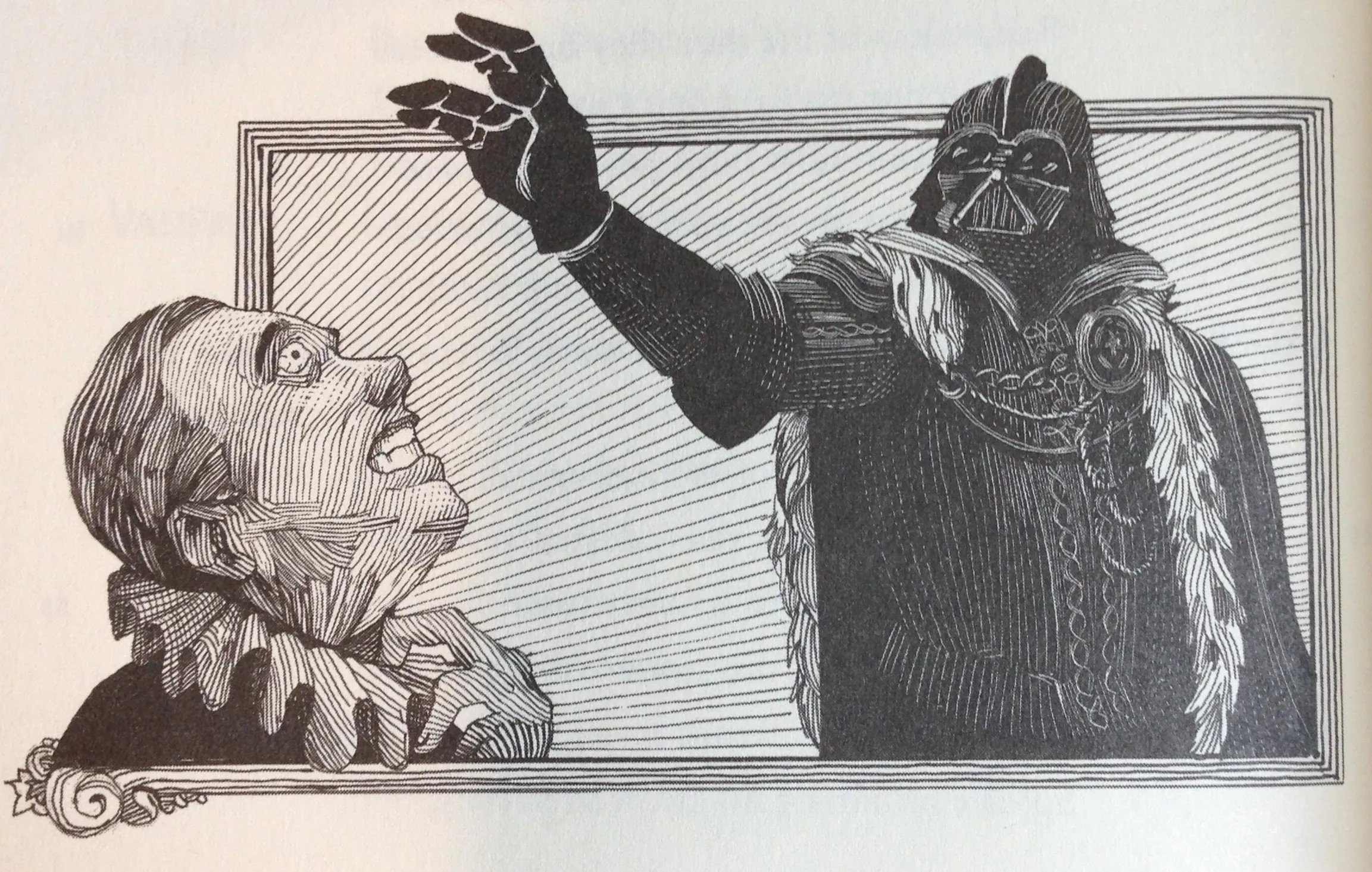
I turn to thee, thou rebel. Aye, I lift
Thy head above my own. Thou canst now choose
To keep thy secrets lock’d safe in that head
Or else to keep thy head, and thus thy life (Doescher I, ii 6-10).
This passage explains to the reader or playgoer that Vader has lifted the man over his head, (demonstrating his cruelty and his strength), and subtly plays on the fact that Vader is looking at his head, wants the knowledge in his head, and will crush his head if the Rebel doesn’t cooperate. Shakespeare’s Richard III makes a similar threat: “Villain, set down the corpse, or by St. Paul, I’ll make a corpse of him that disobeys!”
- The Aside One thing Shakespeare does that few modern writers ever do is have characters talk directly to the audience; thus establishing an intimate relationship between you and a person who is confiding their secrets in you. The most striking example of this in Shakespeare’s Star Wars is R2D2, who in the movie never spoke at all, but made cute little electronic beeps and whirrs. Having R2 speak gives the reader an unexpected closeness because R2 never speaks to anyone else.
- Personification Shakespeare is really good at finding a clever visual metaphor for an abstract idea, and will write speeches or dialogue where characters explore the nature of that idea, a meditation if you will. One of my favorite examples from Shakespeare’s Star Wars is the scene in which Luke and his uncle debate about whether Luke will stay on the farm. Luke compares himself to a bird that’s trying to fly away, while his uncle uses farm metaphors to try and keep him to stay:
OWEN: Wilt thou here in the desert yet desert? Tis only one more season.
LUKE: Now cracks a hopeful heart, when by the land,
A man’s ambitions firmly grounded are:
So shall a bird ne’er learn to fly or soar
When wings are clipp’d by crops and roots and soil.
It’s really very clever the way Doescher mimicks Shakespeare’s wordplay here. Luke is like a bird because he’s a pilot and longs to fly. Owen is a farmer on a desert and is worried about Luke deserting him. We get a clear picture of their relationship from this scene.
- Chorus Shakespeare sometimes uses a Chorus to tell us what is going on in plays where the location shifts from place to place- it’s a time honored device in epic storytelling. Nowadays we use a Chorus too, we just call it a Narrator. The difference is that a Chorus also can explain the tone and the mood of the action onstage, so that you can imagine it in your own mind. Take a look at this passage where the chorus describes the famous Star Wars Cantina:
Now mark thee well, good viewer, what you see,
The creatures gather round the central bar
While hammerheads and hornéd monsters talk.
A band composed of aliens bizarre:
This is the great cantina- thou may’st gawk! (III, I, 45-49).
You can see how, unlike a narrator who would just tell you there are a bunch of aliens here, the Chorus describes the sights and sounds of the bar so you can imagine it yourself. The Chorus in Shakespeare’s Henry the Fifth explicitly states that the audience needs to use their imagination to fill out the story of Henry’s conquest of France.
- The soliloquy A soliloquy is a speech spoken by a character alone on stage. It often has to do with a complex dilemma such as Hamlet’s “To Be Or Not To Be.”

In Shakespeare’s Star Wars, Luke and Vader have the most soliloquis and with good reason- they have the most complicated emotional journeys- Luke goes from a simple farmboy from Tatooine to a Jedi Knight, while Vader goes from a Jedi to a Sith to a father. Shakespeare’s greatest power is his ability to put complex emotional journeys like these into speeches that the characters share right with us. I loved both these speeches too much to choose, so I’m going to talk about of both. The first is a soliloquy Vader speaks after he kills the Rebel leader:
And so another dies by my own hand,
This hand, which now encas’d in blackness is
O that the fingers of this wretched hand
Had not the pain of suffring ever known. Droescher I.ii, 27-30
This speech reminds me very much of Richard III, one of Shakespeare’s greatest villains. Richard, like Vader, has his life story told in 6 installments where he slowly becomes an evil mastermind. The images of this speech conjure up parts of Vader’s life story: how he lost his hand in Episode II and now has a robotic hand in a black glove. The speech also conjures the fact that his master the Emperor is able to shoot lightning from his hands, and of course, how Vader himself is able to kill by merely gesturing with his hand. Richard has a speech where he talks about all the people he’s killed to become king, and how he now has to kill even more to stay king:
I must be married to my brother’s daughter,
Or else my kingdom stands on brittle glass.
Murder her brothers, and then marry her!
Uncertain way of gain! But I am in
So far in blood that sin will pluck on sin:
Tear-falling pity dwells not in this eye (Richard III, Act IV, Scene i)
Luke has another speech where he talks about his destiny staring at the twin suns of Tatooine, but I won’t spoil that one for you! Needless to say, it’s awesome. I bring it up because In the movie, it was John Williams’ job to literally underscore Luke’s emotions as the music swelled. Shakespeare’s gift on the other hand was to put powerful emotions and thoughts into carefully composed soliloquys that sound like music when spoken well.
So as you can see, the author’s loving parody of Shakespeare allows us a rare glimpse of how the Bard wrote; his cleverness at adapting stories, his use of verse, wordplay, metaphor, personification, choruses, and his unique ability to write characters that talk to us as if we were in on their deepest secrets.
By the way, if you’re still unconvinced on this play’s educational value, check out this link to their educational website: http://www.iandoescher.com/wp-content/uploads/2013/08/ShakespeareStarWars_EducatorsGuide.pdf
 The Shakespearean Student