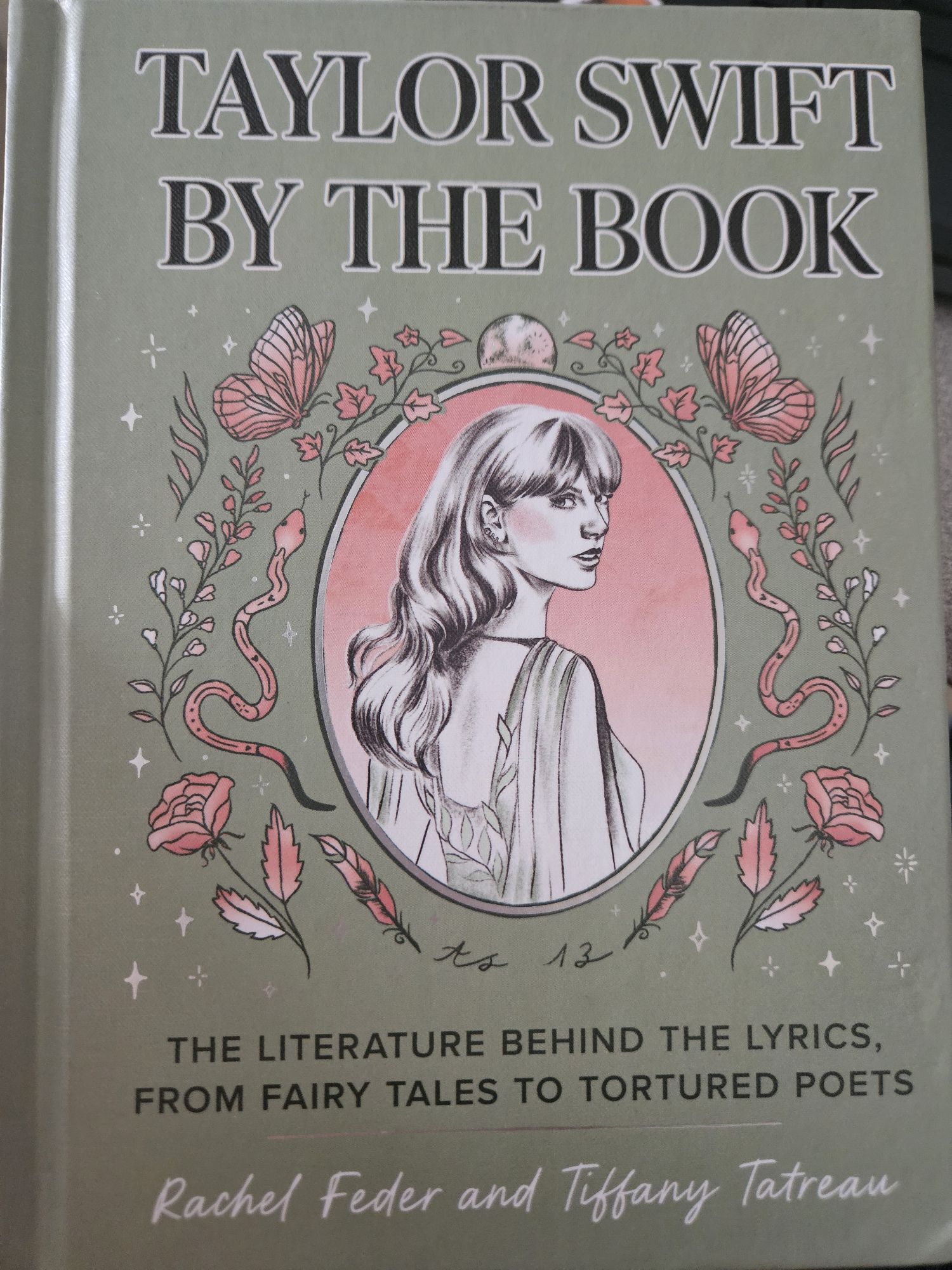
One of my colleagues at work showed me this book, and it really fired my imagination. Taylor Swift is one of the most if not THE MOST successful singer/songwriter of our era. Her songs go across multiple genres and tones and, like many writers, they often contain allusions to classical poetry, nursery rhymes, and occassionally even Shakespeare.
My own Reservations with Taylor
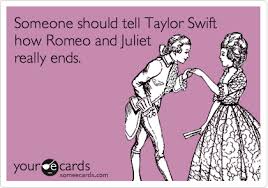
I’m not exactly a Swifite, and I know I’m running the risk of offending MILLIONS of people here by offering criticisms of Taylor Swift, but I honestly think it’s a good idea to be able to critique the things you love. In the past I’ve criticized Shakespeare’s plays, his characters, and even suggested that he might be racist. I would like to offer that, in the case of Love Story, Ms. Swift simplifies the plot of Romeo and Juliet, and leaves out its tragic elements, which kind of misses the point. As an allusion, it seems a little watered down. That said, I feel other TS songs are better, use their allusions more skillfully, and create a more coherent picture in the listeners’ mind. Dispite my issues with this one song, I heartily admit that Ms. Swift is prolific, talented, and has created songs that are classic works of art!
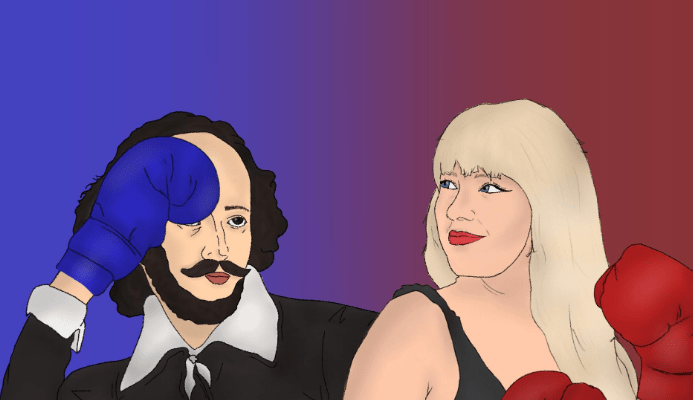
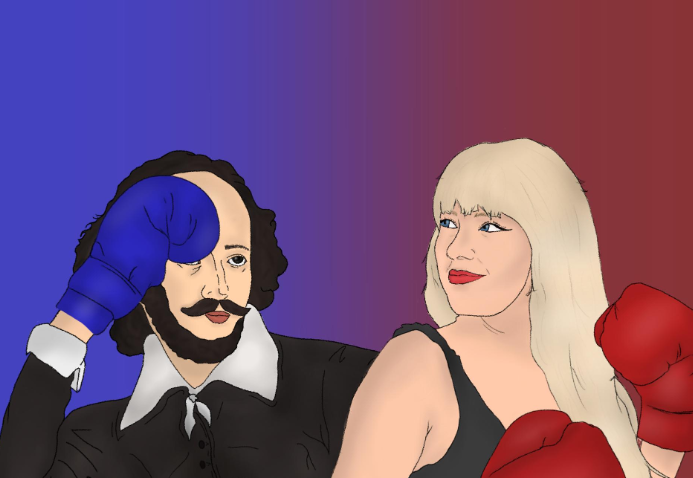
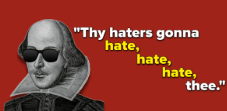
What I’m not interested in doing is getting into a “battle” where I try to justify Shakespeare as being better than Taylor Swift. When I see memes like the one above, it makes me immediately disengage with whoever posted it. I don’t want a Swiftie to talk in the comments about how Shakespeare was a talentless hack. Alternatively, I don’t want a Shakespeare nerd to dismiss Taylor as being infantile or any other critique. Both these writers had different goals, went about them differently, and achieved success in their own special ways. So now, let’s look at how Taylor Swift borrowed from different literary traditions to make her songs more dramatic, more visceral, more insightful, and more poetic.
Her Literary Allusions
Obviously, Love Story mentions Romeo and Juliet, as well as The Scarlet Letter and various princess stories. TS rarely makes direct references to Shakespeare in her work, but some scholars have suggested that there might be more oblique references in some of her songs. For instance, when I look at the lyrics of Willow, I can’t help wonder if she wasn’t at least partially inspired by Shakespeare’s song of the same name in Othello:
Wait for the signal and I’ll meet you after dark Show me the places where the others gave you scars Now this is an open-shut case Guess I should’ve known from the look on your face Every bait and switch was a work of art
The more that you say The less I know Wherever you stray I follow I’m begging for you to take my hand Wreck my plans That’s my man
I can’t hear this song and not hear the parallels with the Othello story- the speaker alludes to eloping with her beloved (which Desdemona nearly does in the first act), that he has scars (which Othello clearly does mentally and physically). In addition, I imagine the refrain as like a duet between Othello (who is reluctant to kill Desdemona), and Desdemona (who wants to leave Cyprus and have a normal married life with Othello:
Desdemona: The more that you say
The less I know
Othello: Wherever you stray
I follow
I'm begging for you to take my hand
Wreck my plans
Desdemona: That's my man

Even if Shakespeare isn't mentioned directly in many of Taylor's songs, like Shakespeare she often uses Greek myths, the Bible, and other popular works as allusions. Some scholars have suggested that both Shakespeare and TS write using their own experiences through the lenses of classical poetry and literature. Simmilar to how Shakespeare probably wrote Hamlet to deal with his grief over his son's death, Taylor writes songs about past relationships, feuds with pop stars, and her own evolution as an artist through the lens of Shakespeare, novels, poetry, and other works.
TS’s Poetry
Ms. Swift’s songs are more than just catchy beats with a few allusions stuffed in. Like Shakespeare, she makes use of alliterations, internal rhymes, clever metaphors, and strong rhythms that help her songs tell their stories clearly and effectively. As an exercise, I fed the lyrics to “Bad Blood” into a poetry analyzer and found a very interesting analysis:
The poem features a rhythmic and catchy structure, typical of song lyrics. The syllabic patterns vary but often maintain a consistent beat, enhancing its musical quality. The use of internal rhymes and alliteration (e.g., “mad love,” “bad blood”) adds to the flow and memorability. The stresses often fall on the first word of each line, creating a strong start and a compelling rhythm that engages the listener. The word choice in the poem is evocative and charged with emotion. Phrases like “bad blood,” “deep cut,” and “salt in the wound” create vivid imagery and convey the depth of the narrator’s pain. The use of questions, such as “Did you have to do this?” and “Did you think we’d be fine?” emphasizes feelings of confusion and hurt. –Studycorgi.com
I highly encourage students and teachers to do an analysis of both Shakespeare and Taylor Swift because studying one can help us appreciate the other. Similarly, learning the way each writer conveys ideas can help the reader become more creative!
Who Said It? Shakespeare or T.Swift?
Lots of teachers play this game and there are many Youtube videos of people playing it. Occassionally, even Shakespearean actors have played it:
There are also online quiz forms available on Quizlet and Gimkit. You can also show your students this video below:
What iF SHakespeare’s Characters were Swifties?
I posted on Reddit a while back to ask the internet which Swift songs would be great soundtracks for the lives of Shakespearean characters. This is sort of an outgrowth of my: Infinite (Variety) Playlist activity. Here are some of the results I got:
Mercutio from “Romeo and Juliet”- 22 and “Shake it Off”
Goneril from “King Lear”- Blank Space
Do you agree with my list?
I hope this post can help teachers see the value in analyzing Taylor Swift with their students, and help students in analyzing Shakespeare. I think the term “classic” applies to anything good enough to stand the test of time. Shakespeare has already passed that test, and based on her clever allusions, evocative wordplay, and emotionally-charged subjects, I believe Taylor Swift to be classic too!
Ages: Pre Teen- teen. The story is highly condensed so older readers might want a more in-depth adaptation to understand the themes and ideas of the plot.
Premise: This graphic novel is a good introduction to “A Midsummer Night’s Dream.” It tells the bare minimum of the story with very little dialogue and almost none of the original text. Most of the story is conveyed through the visual medium.
ABOUT THE ILLUSTRATORS (Reprinted from the graphic novel)
https://www.behance.net/berelince?locale=en_US Berenice Muniz is a graphic designer and illustrator from Monterrey, Mexico. In the past, she has done work for publicity agencies, art exhibitions, and she’s even created her own webcomic. These days, Berenice is devoted to illustrating comics as part of the CGraphikslava crew. In her spare time, “Bere” loves to draw, read manga, watch animated movies, play videogames, and kill zombies Fares Maese is a graphic designer and illustrator. He has worked as a colorist for Marvel Comics and as a concept artist for the card and role-playing games Pathfinder and Warhammer. Fares loves spending time playing video games with his Graphikslava comrades, and he’s an awesome drum player: https://faresmaese.artstation.com/
About the Retelling Author
The career path of Nel Yomtov has taken him from the halls of Marvel Comics, as an editor, writer, and colorist, to the world of toy development. He then became editorial and art director at a children’s nonfiction book publisher, and now Nel is a writer and editor of books, websites, and comics for children. A harmonica-honking blues enthusiast, Nel lives in New York with his wife, Nancy. They have a son. Jess.
mY rEACTION
I read this version to my five year old son and he enjoyed the colors and characters, which is why I feel confident recommending this version to younger children. It won’t help you pass a test on Midsummer and you won’t get the whole story. But you might get a tantalizing glimpse of Shakespeare’s world of fairies, lovers, and funny fools and honestly, that’s fine with me. As I’ve stated before, parody and short pop-culture adaptations of Shakespeare are great ways to connect with young people, and I see this book as a tool to do just that.
tECHNICAL eXECUTION
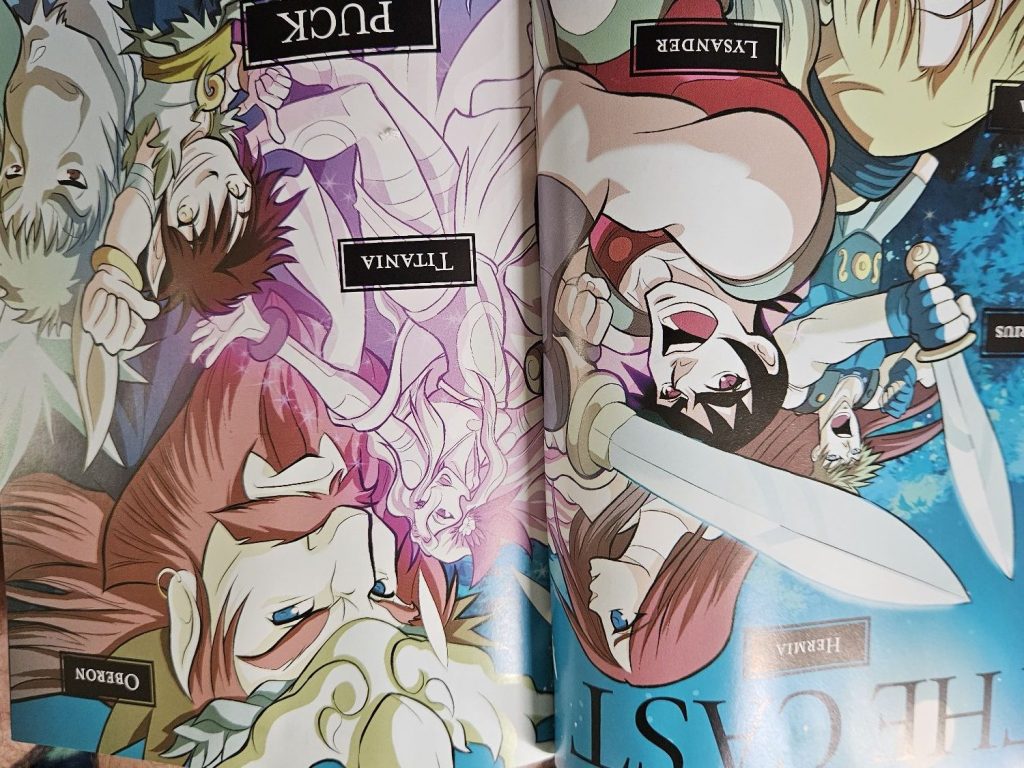
Character Design. It’s interesting to see the difference in style between this version, and the Manga Shakespeare version I previously read. That one was very much inspired by the Shoujo manga style, which emphasizes drama and relationships. This version’s drawings are softer, more cartoonish, and the expressions are less stiff, (except for Oberon, who is drawn very austerely). I particularly like the design for Puck with his big mischievous eyes and squat, childlike shape. I would argue however that the lovers and Mechanicals aren’t distinct enough, which is a problem since they are the most important characters.
The Adaptation
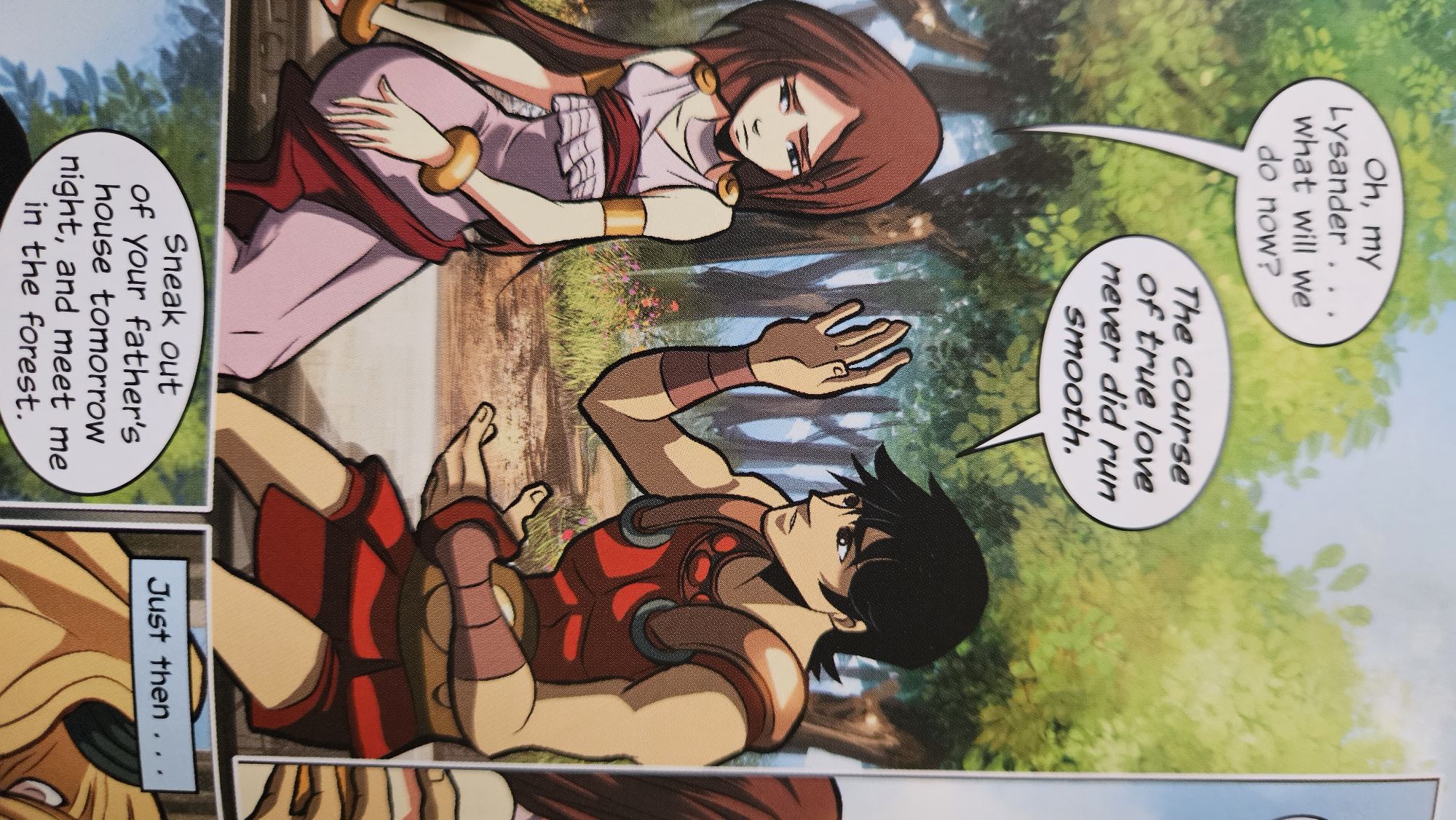
Like I said, this is a bare minimum adaptation of the play. None of Shakespeare’s text is used and the lines and speeches are cut liberally. The entire book is only 77 pages which of course means, that there are a lot of cuts. There’s no mention of the Indian boy, Titania’s tiff with Oberon, Philostrate, the other fairies, and all the great speeches are cut. This version is focused entirely on the plot, and it cuts it quite efficiently. To demonstrate this, below on the left is a panel that shows how Lysander and Hermia express their frustration with not being allowed to marry. On the right is the original text of the scene.
Ay me! for aught that I could ever read, Could ever hear by tale or history, The course of true love never did run smooth; But, either it was different in blood, Lysander. Or else misgraffed in respect of years, Lysander. Or else it stood upon the choice of friends, Or, if there were a sympathy in choice, War, death, or sickness did lay siege to it, Making it momentany as a sound, Swift as a shadow, short as any dream; Brief as the lightning in the collied night, That, in a spleen, unfolds both heaven and earth, And ere a man hath power to say ‘Behold!’ The jaws of darkness do devour it up: So quick bright things come to confusion.
The Colors
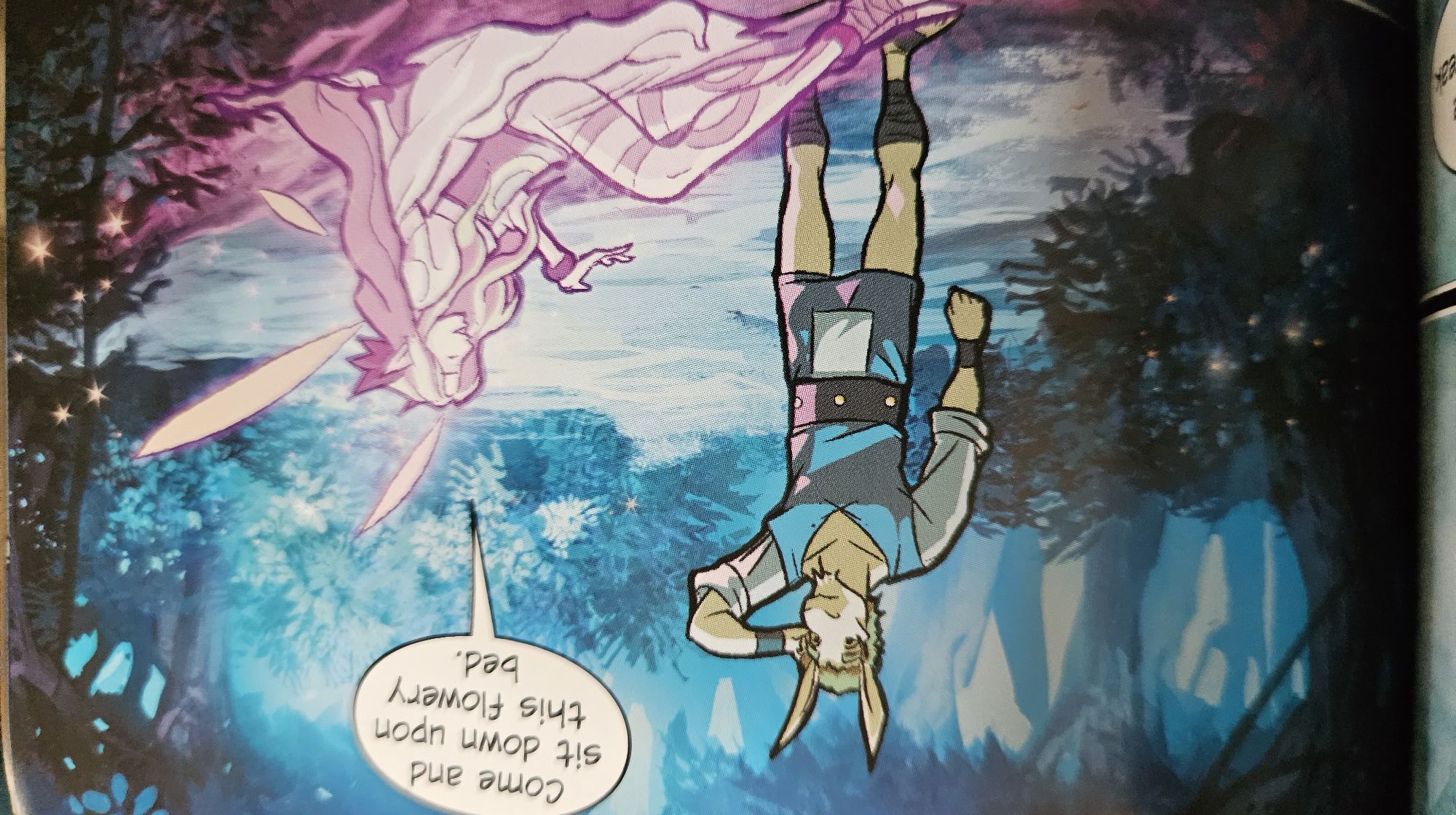
The colors are very beautiful. Other manga stories have colorful title pages but no color in the panels. This comic is alive with color and the colors help tell the story. Athens represents the world of the daytime, so the colors are very warm and vibrant. In the nighttime, the colors are cool and the characters are drawn with very sharp lines to make sure they don’t fade into the background.
IN Conclusion
This version tells l the story quickly and entertainingly with a vibrant and colorful style that was lacking in the Manga version. Granted, the Manga Shakespeare did allow me to focus on the text more, but I think I actually prefer this version, simply because of its beautiful artwork. Check it out if you get a chance!.
Title Card- “The Violent Rhetoric Of Julius Caesar”Title for my Outschool class on Codes and Ciphers, inspired by the Disney show “Gravity Falls.”Digital business card for my online classes with a QR code if you want to know moreTitle art for my Outschool course on Shakespeare’s comediesCover art for my Outschool class: “Shakespeare- the Lost Play”Title of my Outschool murder mystery gameTitle image for my online course on “Romeo and Juliet.”Title card for my Outchool Intro To Shakespeare cs.Title art for my Outschool course on Shakespeare’s comediesTitle for my Outschool class in swords and Stage Combat.
Great online classes in Shakespeare and science are available for students all this month at Outschool.com.
From now until June 1st, you can get a $20 discount with referral code PAULHT20. Share the joy with other curious minds in the family too! Spread the word and let’s ignite the passion for learning together!
Class Descriptions
Live Classes
For these classes you meet with me live over Zoom:
Introduction to Shakespeare- Tuesdays 9-9:30AM (EST)
This is my 30 minute short and sweet intro to Shakespeare’s life, his plays, and why his work still matters to us today!
Intro To STage Combat (With SwordS)- Tuesdays 9:30-10AM (EST)-
Like the Intro to Shakespeare class above, this is an intro to the basic footwork, attacks, and defensive parries of swordplays for someone just begeinning to learn about swords.
Title image for my online course on “Romeo and Juliet.”
An Immersive Guide To “Romeo and Juliet- Tuesdays from 10-11AM (EST)
This multi-week course delves into the plot, characters and themes of “Romeo and Juliet,” while also providing interactive activities, virtual tours, and webquests.
Shakespeare’s History Plays- SaturdAYs 8:30 AM IST
This is a new course I’m working on to cover all of Shakespeare’s History plays including Henry V, Richard II, and Richard III. More info as it becomes available.
Asynchronous Classes
These classes are Flex Schedule, which means the teacher prepares the activities in advance and allows you to do them at your own pace without direct consultation.
A flexible schedule class that teaches kids the plot and characters of “Romeo and Juliet,” in the context of a detective story where you solve the mystery of the young lovers’ deaths.
Did you know that Star Wars is based on the ideas and writings of William Shakespeare? This class will teach you about writing and characters though games, interactive activities and dramatic readings of both Star Wars and Shakespeare!
Concept: To explore the plot, characters, and themes of Shakespeare’s Julius Caesar while also gaining an insight into Ancient Roman history and culture.
Student Description: Delve into the passionate speeches of Brutus and Antony in Shakespeare’s Julius Caesar, which led a whole country to revolution.
Parent Description Using self-paced online activities, and a helpful handout, your child(ren) will analyze the rhetoric and persuasive power in two speeches from Shakespeare’s “Julius Caesar.” The course will also cover the culture of Ancient Rome, and the circumstances that led to Julius Caesar’s assasination, which inadvertently led to the birth of the Roman Empire.
Course Organizaiton (the class is divided into 4 parts that students can complete at their own pace over a week-long period
Each lesson will have:
“That Is the Question” (Essential Question)
Lesson Objectives
Set the Scene (Background and context)- 1-3 slides
The Players (biography) 1-3 slides
Go Deeper (Webquest)
Explore military life and the lives of women in Rome using my blog and other websites as a guide.
Post 3 things you learned to the Outschool page or send a photo of your completed handout.
Words, Words Words (Vocabulary, famous lines)
A Taste of Your Quality (Independant Project)
Show us your mettle (Test)
So each class should be 14-15 slides long.
Outline
Class I- Background on Caesar and Roman Culture
That is the Question:
Why did Brutus feel Julius Caesar had to die?
What was the aftermath?
Can one person’s speech effect an entire nation?
Lesson Objectives
To provide historical and political context to explain why Julius Caesar was assassinated, and how his death inadvertantly created the Roman Empire.
To explain the Rhetorical Triangle, the building blocks of persuasive speech.
To go through the story of Julius Caesar focusing on the effect of the speeches.
To study the famous “Friends, Romans Countrymen” speech.
To contrast this speech with some more recent political speeches and you think critically about:
Brutus- Podcast episode. I posit in this episode that Brutus is
Words, Words, Words-
Traitor
Republic
Dictator
Revolution
Ethos
Pathos
Logos
Rhetoric
Colossus
Aeneus
A Taste Of Your Quality:
(Independent work): We’ll examine a painting of Brutus’ ancestor Lucius and learn why Brutus values Rome more than even family.
Show Us Your Mettle:
Quizzes on Brutus
Class 3- Antony and Brutus’ Dueling Speeches
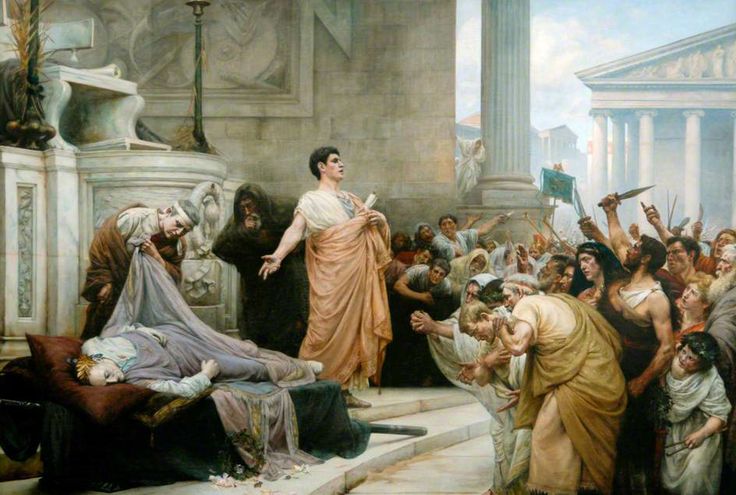
(c) Hartlepool Museums and Heritage Service; Supplied by The Public Catalogue Foundation
That Is the Question
After Caesar’s Death, his friend Marc Antony held a funeral for him where he gives the famous “Friends, Romans, Countrymen” speech. How did Antony’s speech affect the crowd?
Brutus has a speech where he explains why he killed Caesar. What does he say, and how effectively does he say it?
Antony was secretly plotting to take power for himself, and get Brutus and Cassius killed. How did he do it?
Do speeches have the power to change a nation?
Learning Objectives
To explain the Rhetorical Triangle, the building blocks of persuasive speech.
To study the famous “Friends, Romans Countrymen” speech, as well
To look at these speeches and get you to think critically about:
We’ll talk about the consequences of violent revolutions and how Julius Caesar has inspired some of the greatest speeches in political history.
-Patrick Henry
– Gettysburg Address
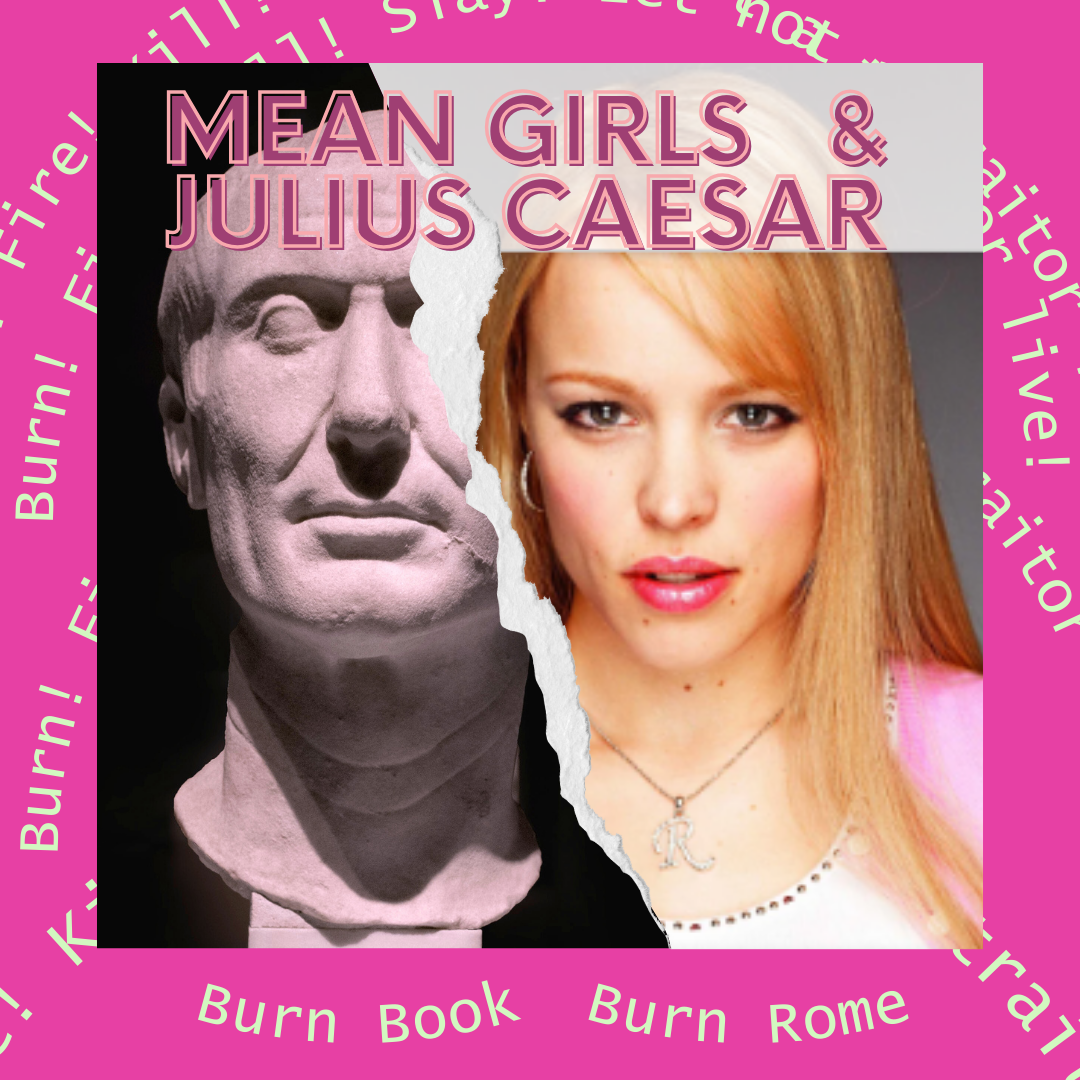
– Mean Girls
That Is the Question
How have people interpreted the play “Julius Caesar” in America?
Does this play promote violence?
What kind of violent speech do we deal with in politics today?
Learning Objectives
To show the link between American History and Julius Caesar
To address the controversy and the misconception that the play promotes violent assassination.
To end on a cautionary note people must think critically about what they hear in politics and not make rash decisions based on appeals to fear.
Setting the Scene- US History
America was founded using the principles of republican government that Ancient Rome used- with a senate, and a series of checks and balances to ensure no one has too much power.
America was founded in a violent revolution, and some of our country’s early leaders used Brutus as an inspiration- to overcome a tyrannical king.
In later years, however, some people have forgotten what happened to Brutus
Today, we are often bombarded with speech that encourages fear and anger and we must think critically when we hear such speech in whatever forum- Roman, or Reddit.
The Players (use my JC lecture?)
Patrick Henry
Abraham Lincoln
John Wilkes Booth
Donald Trump
Go Deeper
-Watch the Caesar Video
– How does the play promote nonviolence?
– How did Brutus’ assassination fail to save the Roman Republic?
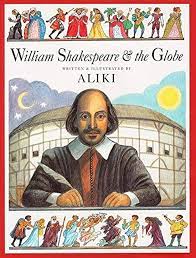
This is a story of two boys, centuries apart, but united by their love of theater in general, and the Globe Theater in particular. The first is William Shakespeare, whose story Aliki tells from his birth, to his boyhood days, to his rise to prominence in the theater. The second is Sam Wannamaker, the man who spearheaded the project of re-building the Globe Theater from 1949 to the first performance of the Globe in June of 1997.
Aliki tells this story in the format of an Elizabethan play, dividing it into five acts. Acts I-4 tell the story of Shakespeare’s life while Act V focuses on Sam Wannamaker pursuing his dream. The book concludes with a chronology of Shakespeare’s plays, and a table of his most famous words and expressions, illustrated with adorable characters.
Illustrations: Medium and Style of Illustration
Like many of her books, Aliki’s illustrations are layered and detailed. She uses ink pen outlines to draw her characters, but then fills them in with bright, vibrant colors. She then painstakingly shades them using the crosshatching technique, to create textures that are complex but have a hand-drawn almost impressionistic feel. The characters aren’t ultra-realistic, and the color palette is limited mainly to bright primaries and warm browns, making it look like a child’s box of crayons or colored pencils. This book is designed to appeal to children with its hand-drawn quality.
Format:
Cover- The cover makes the subject of the book clear to the audience. We see Shakespeare and Globe Theater, but also illustrated moments from his plays. This helps establish that this is not only a biography, it is an introduction to Shakespeare’s plays and poems as well.
Front Matter: The book opens with four pages of quotes from Shakespeare’s plays illustrated with fairies, pipers, and Elizabethan men and women. There is no half-title, no frontispiece and no Half title verso.
Title page verso (copyright page) In the center of the copyright page is an Illustration of Shakespeare standing atop a globe, over the famous lines: “All the world’s a stage, and all the men and women merely players.” Below the quote in very small letters is the copyright date, a short summary, the ISBN data, card catalog information, and the typography information.
Title Page The title is laid out on a white background with a thin black border. Below the title is an image of a boy (presumably Sam Wanamaker), assembling a paper model of Shakespeare’s globe, with a portrait of Shakespeare in the background. This helps establish that this biography focuses on both Shakespeare and Wanamaker, and makes the reader excited to see the real Globe brought to life in full illustration.
Table of Contents As stated before, the book is organized like an Elizabethan play, so rather than Chapter 1, etc. the book has five Acts with 1-4 scenes in them. Each chapter in the table of contents is labeled with a description that sets the scene; either a location (like London, Stratford, The Globe), or what will happen in the scene (such as “Building” or “Uncovering”). The table then details four appendices that are part of the back matter.
Preface: The Preface is referred in the book as an aside, (an Elizabethan theater term meaning something spoken between a character and the audience). This preface acknowledges that, because of the lack of surviving historical information on William Shakespeare, Aliki, like many Shakespearean biographers, has to use some guesswork to fill out the narrative of his life. A second preface (referred to as a Prologue), introduces the story of the book, (namely the lives of Will Shakespeare and Sam Wanamaker). This preface mimics how in Shakespeare’s plays, a prologue would tell the audience what would happen before the narrative started.
Back Matter/ Appendices: There are four appendices in the back matter- A table of Shakespeare’s collected works, a timeline of the book’s events from 1564-1999, an illustrated list of Shakespearean words and expressions, and finally a list of Shakespearean sites to visit in London and Shakespeare’s home town of Stratford Upon Avon. These appendices show the reader that Shakespeare has an important role in history and in the English language, and encourage the reader to learn more about him.
Value As an Educational Tool
This story not only tells Shakespeare’s life, it also introduces the reader to his plays and his influence on the English language through the illustrations and frequent Shakespearean quotations. The reader also gains an insight into Elizabethan life and culture by following Will’s journey from Stratford to London. Finally, by juxtaposing Shakespeare’s life with Sam Wannamaker’s, the reader sees Shakespeare through Sam’s eyes as he works his whole life to restore Shakespeare’s Globe to its former glory. The reader develops a love of Shakespeare, (or at least an empathetic respect), and may feel empowered to read more about Shakespeare, see his plays or maybe even become a Shakespearean artist in the future. In short, Aliki’s book brings the world of Shakespeare to young readers in a way that is beautiful to look at, full of insight, and with enough supplemental materials to encourage them to learn more.
Overall Impression:
Like Prospero’s magic in The Tempest, this story is magically told- it is not intended to create a totally realistic representation of Elizabethan life, but to give an exciting, colorful impression of Will’s life and work to the reader. Due to the scant historical details of Will’s life, Aliki chose not to do a standard biography, but, like Shakespeare’s own history plays, to tell a historically authentic story, rooted in truth that brings a time and a place to life, while portraying it an exciting and visually appealing way.
Citation:
Aliki. (2000). William Shakespeare & the Globe. HarperCollins Publishers.
For Shakespeare’s birthday, I thought I’d re-visit one of my most popular posts, especially since the Royal Shakespeare Company is celebrating by putting on an adaptation of Maggie O’Farrell’s novel Hamnet:
RSC video of the first day of rehearsals for Hamnet
Biography of Hamnet
Just like his famous father, we know very little about the life of Hamnet Shakespeare. Since infant mortality rates were high, we don’t know his exact birthday, only that he was baptized on February 2nd, 1582. Like most 11-year old boys, he probably had started going to school at the King Edward Grammer School, the same as his father. This means he spent long hours away from his parents learning to read and write in Latin and Greek. When he was home, he lived with his mother, his two sisters, and his grandparents in the house of Henley Street.
O’Farrel portrays the boy Hamnet as sensitive and somewhat lonely, which makes sense, since he probably didn’t see his father for long periods of the year; Will Shakespeare spent much of the year writing, going on tour, and performing at the Globe- he commuted from London to Stratford for most of the year. He probably only came around during Lent, Christmas, and times of plague when the theaters were closed.
1589-1596
Never mind what I know. You must go.” She pushes at his chest, putting air and space between them, feeling his arms slide off her, disentangling them. His face is crumpled, tense, uncertain. She smiles at him, drawing in breath. “I won’t say goodbye,” she says, keeping her voice steady. “Neither will I.” “I won’t watch you walk away.” “I’ll walk backwards,” he says, backing away, “so I can keep you in my sights.” “All the way to London?” “If I have to.” She laughs. “You’ll fall into a ditch. You’ll crash into a cart.” “So be it.
O’Farrell
Hollar’s panorama of London, 1647
The novel portrays Anne Shakespeare realizing that her husband is stifled and unhappy living with his parents in Stratford, and so she suggests to his father that he go to London to ‘expand the family business,’ though in reality, she wants him to go to make his fortune and find more fulfilling work. Scholars have wondered for years how Shakespeare got his start in theater- as a man with children he was legally unable to become an apprentice, and as a glover’s son from Stratford, he didn’t know anyone in London. O’Farrell solves the mystery by making him start out as a costume maker and mender for a theater company, who later became a writer and actor.
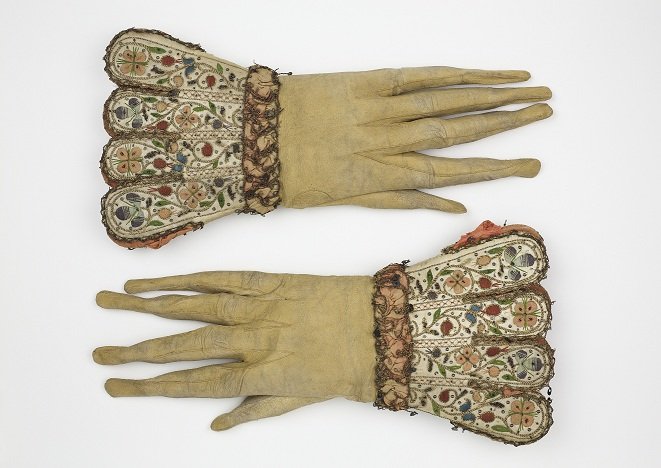
This idea of Shakespeare starting out as the company’s glove mender actually has some historical merit- records from the time confirm that many playwrights and actors were also local artisans. Men like John Webster, Richard Tarlton, Edward Kyneston, and even Richard Burbage were skilled drapers, textile merchants, haberdashers (men’s tailors) and ( like the Bottom in “A Midsummer Night’s Dream,”) some of these men were weavers-turned actors (Source: Anna Gonzales) So it’s entirely possible that Shakespeare started in London by selling gloves to theaters, before selling his plays.
When Will moved to London, he lived in a number of locations throughout the city, probably because it wasn’t a safe place. Theaters were located in the same districts as bear baiting and brothels, so Will probably had to move to get away from bad neighborhoods, as this video from The History Squad illustrates:
A glover will only ever want the skin, the surface, the outer layer. Everything else is useless, an inconvenience, an unnecessary mess. She thinks of the private cruelty behind something as beautiful and perfect as a glove.
Almost immediately after Will leaves, Anne is full of remorse. She knows his work in London will consume him and his success will make the distance between him and her even greater.
She walks back, more slowly, the way she came. How odd it feels, to move along the same streets, the route in reverse, like inking over old words, her feet the quill, going back over work, rewriting, erasing. Partings are strange. It seems so simple: one minute ago, four, five, he was here, at her side; now, he is gone. She was with him; she is alone. She feels exposed, chill, peeled like an onion.
The Plague
He wants to tear down the sky, he wants to rip every blossom from that tree, he wishes to take a burning branch and drive that pink-clad girl and her nag over a cliff, just to be rid of them, to clear them all out of his way. So many miles, so much road stands between him and his child, and so few hours left.
Hamnet
As I’ve said in previous posts, Shakespeare survived three epidemics of Plague; one in 1563, (before he was born), one in 1593, and one in 1603. In O’Farell’s novel, the germs that kill Hamnet came not from a massive outbreak, but a few germs that were transported in a box that his sister had the misfortune of opening. This frightful passage shows the grim tenacity and eve-present fear that, while England expanded and became more interconnected with the world, it also brought death and disease to and from the rest of Europe.
In the book, the plague germs that infect Judith and later Hamnet, lie inside a box with some glass beads that the Shakespeare’s ordered from Italy to decorate a pair of fancy gloves. As this video from National Geographic shows, trade routs then as now are prime spreaders of disease and even one ship that slips by can turn any box of goods into a Pandora’s Box, waiting for a poor unsuspecting girl like Judith to release it unto the world.
Hamnet’s Death
He can feel Death in the room, hovering in the shadows, over there beside the door, head averted, but watching all the same, always watching. It is waiting, biding its time. It will slide forward on skinless feet, with breath of damp ashes, to take her, to clasp her in its cold embrace, and he, Hamnet, will not be able to wrest her free.
Hamnet
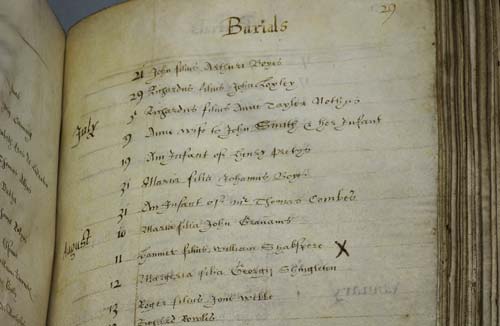
Burial Registry of Hamnet Shakespeare
In the novel, Hamnet somehow takes the plague away from his sister and dies in her place. Though it is hardly conclusive, I do find it interesting that Shakespeare stopped writing comedies about twins for another four years after Hamnet’s death, until he wrote Twelfth Night, which unlike earlier comedies like The Comedy of Errors, has a pair of twins mourning each other’s apparent death. They seem to share one soul, and one tries to resurrect the other, like Viola mourning her brother by, (in a sense), becoming her brother.
What should I do in Ilyria? My brother is in Elysium
Viola- “Twelfth Night”, Act I, Scene ii.
ELIZABETHAN FUNERAL CUSTOMS
In the book, Anne makes a winding sheet for her son. This was a cloth of linen or wool that was wrapped around dead bodies, since at the time, coffins were re-used. This must have been a somber and deeply upsetting activity for Anne.
J4W9B7 Woodcut Woman Spinning
As this quote from “The Evolution of the English Shroud” illustrates, the act of making a winding sheet was a sort of sad family responsibility, a way of ensuring that your loved ones die with dignity, and Anne clearly takes the task of making one very seriously.
The 16th-century shroud for the poor and lower middle classes was a large sheet that was gathered at the head and feet, and tied in knots at both ends, covering every part of the body. It resembled earlier Medieval practices and was a functional, yet modest way of preserving the deceased’s dignity. It was also economical, with very little cost involved, as the burial sheet was usually taken from the family home. At this point, linens dominated as the material of choice; after all, it was a biblical tradition as Jesus was wrapped in a linen cloth. Linen was also considered more fashionable than wool.
Coffin Works Archive
The Aftermath Of Hamnet’s Death (Spoilers)
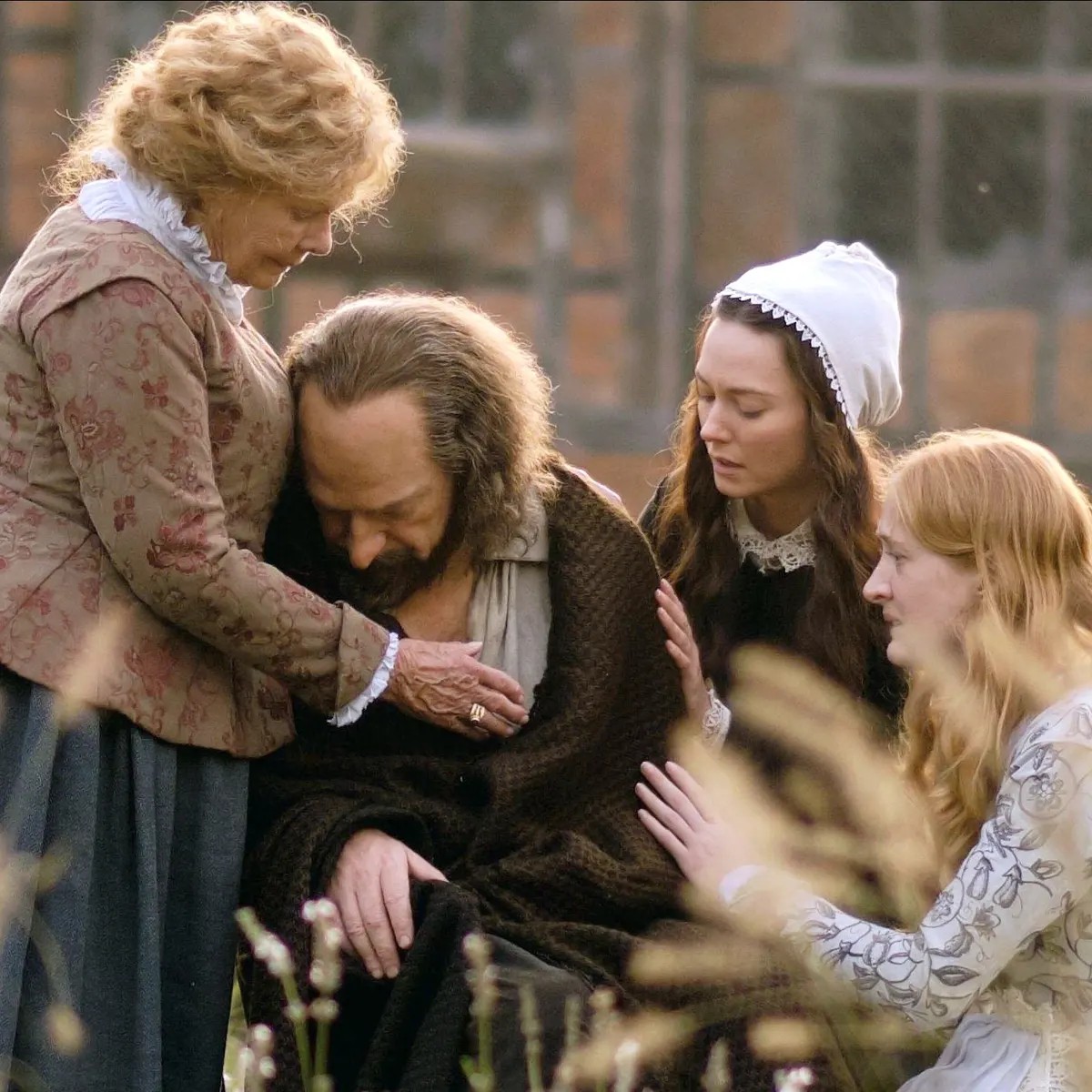
The Shakespeares in the 2011 film “All Is True,” starring Kenneth Branaugh as Will and Judy Dench as Anne Hathaway.
She discovers that it is possible to cry all day and all night. That there are many different ways to cry: the sudden outpouring of tears, the deep, racking sobs, the soundless and endless leaking of water from the eyes. That sore skin around the eyes may be treated with oil infused with a tincture of eyebright and chamomile. That it is possible to comfort your daughters with assurances about places in Heaven and eternal joy and how they may all be reunited after death and how he will be waiting for them, while not believing any of it. That people don’t always know what to say to a woman whose child has died. That some will cross the street to avoid her merely because of this. That people not considered to be good friends will come, without warning, to the fore, will leave bread and cakes on your sill, will say a kind and apt word to you after church, will ruffle Judith’s hair and pinch her wan cheek.
The Women of Hamnet
The most unique thing about this novel is how it shows the interdependence of women in Elizabethan society. Since Shakespeare spends most of the novel away from Anne, her support system mostly comes from Will’s mother Mary, as well as Anne’s daughters, her sister, and all the other women of the town. Nowadays we do most of our socialization online and barely know our own neighbors, but in the 1590s, especially for women, community was a way of building strength where women got through things like childbirth, loss, the managing of households, and many other difficulties through their relationships with other women. This video below shows the kinds of home remedies that women would share and later write down during the Tudor period:
Other Mysteries Solved
Once Hamnet dies, Will buys her a new house, New Place so she isn’t forced to live with his parents and no longer has to live in the house where her son died. But Will’s success comes with a price- he still has to leave for London. he offers to move them there but Agnes won’t hear of it. This solves the riddle of why Shakespeare commuted between town and country for his entire career- she knows the plague that took her son literally came from London, and she won’t risk losing her daughteras well. She probably also sees London like another woman that took her husband away as well, and therefore refuses to look it in the face.
It is no matter,” she pants, as they struggle there, beside the guzzling swine. “I know. You are caught by that place, like a hooked fish.” “What place? You mean London?” “No, the place in your head. I saw it once, a long time ago, a whole country in there, a landscape. You have gone to that place and it is now more real to you than anywhere else. Nothing can keep you from it. Not even the death of your own child. I see this,” she says to him, as he binds her wrists together with one of his hands, reaching down for the bag at his feet with the other. “Don’t think I don’t.”
O’Farrell, Hamnet.
The Shakespeares’ Marriage after Hamnet
I mean’, he says, ‘that I don´t think you have any idea what it is like to be married to someone like you.’ ‘Like me?’ ‘Someone who knows everything about you, before you even know it yourself. Someone who can just loo at you and divine your deepest secrets, just with a glance. Someone who can tell what you are about to say- and what you might not- before you say it. It is’ he says, ‘both a joy and a curse.
Hamnet
The ugly truth that O’Farrell highlights in Hamnet is that it must have been very hard for the Shakespeares to endure Hamnet’s death, especially since Will was probably not there when it happened, and probably didn’t stay around long after burying his son. It must have been catastrophic on his marriage, sort of like this tragic moment in the musical Hamilton, where the couple mourns the loss of their son, who died in a duel trying to defend his father’s honor.
Agnes is a woman broken into pieces, crumbled and scattered around. She would not be surprised to look down, one of these days, and see a foot over in the corner, an arm left on the ground, a hand dropped to the floor. Her daughters are the same. Susanna’s face is set, her brows lowered in something like anger. Judith just cries, on and on, silently; the tears leak from her and will, it seems, never stop. — How were they to know that Hamnet was the pin holding them together? That without him they would all fragment and fall apart, like a cup shattered on the floor?
Maggie O’Farrell, Hamnet
The Second Best Bed mystery
Though Anne is angry at Will for a while, she does eventually forgive him, as evidenced by another solved historical mystery. In Shakespeare’s will he gives his wife “My second-best bed, with the furniture,” which O’Farell explains, is their marriage bed. The best bed was the one they gave to guests and was therefore newer. In the book, Will offers to replace it after Hamnet dies, but Anne won’t hear of it; although she partially blames Will for Hamnet’s death, she still loves him and her love is stronger than her grief, as is her love for her surviving daughters.
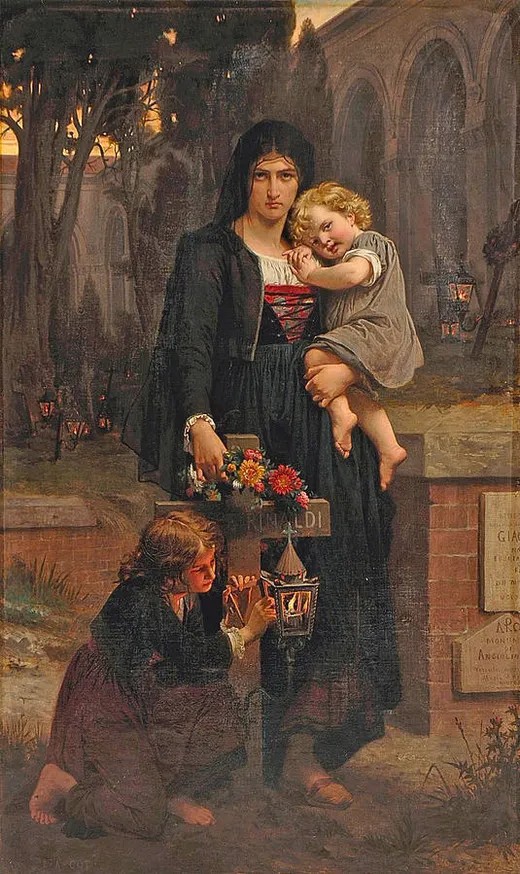
Sa Mere Avec Ses Deux Enfants A La Tombe Du Pere. / The Mother With Her Two Children at the Tomb of Her Father by Pierre Auguste Cot, 1870.
What is the word, Judith asks her mother, for someone who was a twin but is no longer a twin? Her mother, dipping a folded, doubled wick into heated tallow, pauses, but doesn’t turn around. If you were a wife, Judith continues, and your husband dies, then you are a widow. And if its parents die, a child becomes an orphan. But what is the word for what I am? I don’t know, her mother says. Judith watches the liquid slide off the ends of the wicks, into the bowl below. Maybe there isn’t one, she suggests. Maybe not, says her mother
Raising the Dead
Aran Murphy in the Abbey Theater’s production of Hamnet, a play not based on O’Farell’s novel.
At the end of the book, Shakespeare plays the Ghost of Hamlet’s father, and writes Hamlet as a tribute to his late son. We don’t know for a fact that the real William Shakespeare did this but Stratford legend says that Shakespeare played the Ghost of Hamlet’s father onstage, and this has captivated the imagination of authors and scholars alike. In any case, as Stephen Greenblatt says in his book Will In The World, Shakespeare’s father’s health faded around the same time that he wrote Hamlet. it must have been hard for Shakespeare to write a name that was one letter away from his son’s over and over again. Hamlet is Shakespeare’s longest play, and the titular character has over 40% of the dialogue, so it must have been haunting at the very least for Shakespeare to have to write his son’s name nearly 4,000 times.
Whatever he determined at the time, Shakespeare must have still
   been brooding in late 1600 and early 1601, when he sat down to
   write a tragedy whose doomed hero bore the name of his dead son.
   His thoughts may have been intensified by news that his elderly
   father was seriously ill back in Stratford, for the thought of his
   father's death is deeply woven into the play. And the death of his
   son and the impending death of his father--a crisis of mourning
   and memory--could have caused a psychic disturbance that helps to
   explain the explosive power and inwardness of Hamlet.
Greenblatt, 2004, p. 8)
In the book, Anne secretly goes to London to see Hamlet onstage and is overcome with emotion. Not only does Will play a ghost as tribute to his dying father, not only does he put his son’s name onstage, he directs the actor playing Hamlet to affect his own son’s mannerisms and gestures, to use theater to bring his son back from the dead. Anne is both appalled and moved by this act- Hamnet is dead, but his story is now immortal.
O’ Farrell has done a fantastic job of taking what little we know about the Shakespeare’s lives, infusing them with some clever inferences from the plays of Will Shakespeare, and finally fleshing them out with her own Shakespearean knowledge of the human heart- how it feels to bury someone, how it feels to go through trauma and what it’s like to be part of a family and to truly love someone, even though they often fail to properly love you back. As the end of the book implies, maybe Will didn’t intend to immortalize his son and share his powers of theatrical resurrection with the world, maybe this was just his way of apologizing to the love of his life. To try to make amends for the time he lost and to express a wish that he could give her son back to her, which in a way, he does:
Hamlet, here, on this stage, is two people, the young man, alive, and the father, dead. He is both alive and dead. Her husband has brought him back to life, in the only way he can. As the ghost talks, she sees that her husband, in writing this, in taking the role of the ghost, has changed places with his son. He has taken his son’s death and made it his own; he has put himself in death’s clutches, resurrecting the boy in his place. “O horrible! O horrible! Most horrible!” murmurs her husband’s ghoulish voice, recalling the agony of his death.
O’Farrell, “Hamnet”
References
Journals
Bray, Peter. “Men, loss and spiritual emergency: Shakespeare, the death of Hamnet and the making of Hamlet.” Journal of Men, Masculinities and Spirituality, vol. 2, no. 2, June 2008, pp. 95+. Gale Literature Resource Center, link.gale.com/apps/doc/A189052376/LitRC?u=pl9286&sid=bookmark-LitRC&xid=ea79f235. Accessed 20 Apr. 2023.
Period Documents
Document-specific information Creator: Holy Trinity Church, Stratford-upon-Avon Title: Parish Register of Holy Trinity Church, Stratford-upon-Avon Date: 1558-1776 Repository: The Shakespeare Birthplace Trust, Stratford-upon-Avon, UK Call number and opening: DR243/1: Baptismal register, fol. 22v View online bibliographic record
It’s hard for me to be objective about this film. I watched it when I was 16, and it started my lifelong love affair with Shakespeare. For the vast majority of people, I feel this movie will not appeal- it’s Shakespeare, it’s set in the past, and it’s FOUR HOURS LONG! That said, I ADORE this movie, and I probably always will.
The Concept
There is a long tradition of actors directing and starring in Hamlet from Irving to Garrick to Olivier and Guilgud. It’s very much an actor’s play and since the lead part also orchestrates much of the action, it’s understandable that he or she would also want to direct.
Once Kenneth Branaugh started filming this film, he had already played the part onstage and as a radio play. Branaugh’s director, Derek Jacobi, was himself a celebrated and acclaimed Hamlet of the 1970s, and Branaugh would later cast him as Claudius in the film. So, once he approached making the film, Branaugh had lots of experience behind him.
Clip from the documentary “Discovering Hamlet” which shows the whole process of Branaugh’s 1990 production, directed by Derek Jacobi.
Much like Antony Sher, Branaugh was aware that any film he made, would probably be compared to Laurence Olivier’s 1948 film. Sir Laurence’s film was dark, gothic, focused on dark, Freudian psychological disorders, and was mostly a star vehicle for Olivier himself.
Short review of Olivier’s Hamlet, (1948).
Branaugh’s concept was to do an inverse of Olivier- his castle Elsinore is bright, more modern, set in a sort of Napoleonic era, with cannons, muskets, and soldiers with mutton chops. While Oliver’s film was a contemplative look at the protagonist’s mind, Branaugh’s film focuses on intrigue and court drama. One of my favorite features of the film is Branaugh’s use of a hall of doors that contain two-way mirrors. In this castle, you never know who’s watching you.
Original theatrical trailer
The setting
While most of the castle was shot at Shepperdon Studious in England, Branaugh filmed most of the exterior shots at Blenheim Palace, the home of the Duke of Marlborough, and Sir Winston Churchill:
Unlike every other Shakespeare movie, Branaugh chose not to cut a single line of Hamlet, which is why his version is four hours long. He chose to use the text of the second Quarto of 1603, the longest edition of the play.
I am deeply conflicted about this choice. On the one hand, the long run time makes it nearly impossible to show the whole movie in a classroom or a theater. On the other time, like Gone With the Wind or Dr. Zhivago, what Branaugh has done is created an epic full of lush settings, gorgeous music, and incredible performances that will at least always be remembered as an incredible artistic achievement.
The Cast
Hamlet is Shakespeare’s longest part and has 40% of the dialogue, which means Branaugh has the majority of the screen time. Yet, Branaugh isn’t the biggest star in the film. His casting choices emphasize the notion that, since anyone can enjoy Shakespeare, anyone can perform it too. With only two exceptions, I love every performance in the film. Here are some of my favorites:
Horatio is a rather thankless part, since mostly what he does is give Hamlet someone to talk to. In one production I saw, they did away with the part entirely and made the audience Horatio. That said, Farell does a beautiful job portraying Horatio’s patience, boundless empathy, and his slow discovery of these “carnal, bloody, and unnatural acts.” Just watch how heartbroken he is as he watches Hamlet slowly die:
Clip of Nick Farell as Horatio from Act V, Scene iii of Hamlet.Brian Blessed as “The Ghost”
Brian Blessed As “The Ghost”
As I said in my review of “Henry V,” Branaugh usually assigns the core of his cast to his Renaissance Acting Troupe. Accordingly, Branagh cast Brian Blessed as the Ghost of Hamlet’s Father. Brian already is a physically imposing man (he’s actually climbed Mount Everest), and we see through flashbacks that when he was alive, the former king was a powerful, warlike ruler, yet tender to his wife and son.
As the ghost, however, Blessed seems shaken to his core, which might be due to the pain he suffered as a result of the murder, or (as I mentioned in my Shakespeare On Ghosts Post), he might also suffer in the afterlife because Claudius killed him while he was sleeping. Seeing such a powerful man worn to a whisper and full of pain and fear, is a great way to spur Hamlet to his revenge.
Charlton Heston as the player king
When the company of players arrive in the middle of Act II, Scene ii, Hamlet is filled with joy and treats the Player King like an old friend and surrogate father. I’ve seen productions where the same actor plays the Ghost and the Player King, which helps drive this point home.
In the play, the Player King inspires Hamlet with a passionate speech. Hamlet muses how, while the Player is able to conjure emotion and tears when talking about the fictional Queen Hecuba, Hamlet has done nothing yet to revenge the Ghost. Then, thinking about the Player’s performance gives Hamlet the idea to stage a play-within-a-play, to test whether or not Claudius is guilty:
About, my brain! Hum, I have heard
That guilty creatures, sitting at a play,
Have by the very cunning of the scene1665
Been struck so to the soul that presently
They have proclaim'd their malefactions;
For murther, though it have no tongue, will speak
With most miraculous organ, I'll have these Players
Play something like the murther of my father1670
Before mine uncle. I'll observe his looks;
I'll tent him to the quick. If he but blench,
I know my course. Act II, Scene ii, lines 1663-1674
With all this in mind, The Player King is very important to Hamlet’s journey and Heston’s mighty delivery is inspiring and full of passion.
Robin Williams as Osric
Robin Williams as Osric
It seems like an insane idea; cast a stand-up comedian in a Shakespeare movie? Yet, in fact, the late Robin Williams was a classically-trained actor and studied at New York’s Julliard academy, so he must have done Shakespeare in the past.
Branaugh clearly loved working with Williams. Not only did he keep all of Osric’s lines (like all the other lines in the play), Branaugh gave Williams more to do, making him basically a second Horatio who cares for Laertes in the final act of the play.
Usually Osric is played as a classist-joke. He’s a sychophant, a social climber who, because he wasn’t born a noble, the nobles treat him as a suck-up and a fool. Williams gives Osric much more warmth and depth, in addition to his manic charm. Branaugh even gives him a tragic death, to make him stand out even more!
Kate Winslet as Ophelia
Five film versions of Ophelia compilation.
I summarize Ms. Winslet’s performance in one word: Heartbreaking. In Oliver’s version, she seems like an airhead, and Helena Bonham Carter plays the part as sort of a rebellious teenager. Winslet’s performance is just as if not even more tragic than Branaugh’s and it is truly heartbreaking to see her journey.
In the 1990 stage production of Hamlet, Jacobi decided to turn “To Be Or Not To Be” from a soliloquy into a speech that Hamlet says to Ophelia, which then plants into her mind the ideas of madness and suicide that she herself follows to their tragic conclusion. In Branaugh’s film, it seems very clear that he gave Winslet that same direction, (even though the speech is filmed like a soliloquy). Before “To Be” and the subsequent “Get Thee to A Nunnery” scene, Winslet’s Ophelia is happy, sweet, obedient to the men in her life, but still her own person. We see in flashbacks her sneaking off to be with Hamlet and she seems to enjoy her secret romance. Probably Branaugh pulled some ideas from her role in Titanic too. But Polonius and Laertes shut her down at every turn and keep her from being with Hamlet. Winslet shows beautifully Ophelia’s struggle to be an obedient daughter and Hamlet’s girlfriend.
In the “Get Thee To a Nunnery Scene,” it’s not clear whether Hamlet knows he’s being watched (at first), so when he speaks to her gently, he might be trying to get her to leave to protect her. But once Polonius audibly closes a door, Hamlet is full of mysogynistic fury. Again, he might be playing mad in order to deceive Claudius and Polonius, or he might be genuinely mad at Ophelia for going along with this attempt to spy on him, but in any case, It certainly breaks her heart, and Winslet plays that heartbreak with a great deal of skill and passion.
Billy Crystal as the Gravedigger
Billy Crystal as the Gravedigger
Again, it seems bizarre to cast an American comedian as a Shakespearean character, but Crystal did a great job making this 400 year old comic bit seem like he wrote it himself! Plus, Crystal listens very quietly and attentively during the “Alas Poor Yorrick” speech, and doesn’t pull focus.
Kenneth Branaugh as Hamlet
Even though this was a four-hour Shakespeare movie of a play I had not yet read, at 16 I was hooked by Branaugh’s performance. Like Olivier before him, Branaugh knows Shakespeare’s reputation as being boring and out-of-touch, so his film is full of violence, sex, and manic energy. This also comes across in his own performance. Branaugh lost weight and dyed his hair to appear younger and attractive (since he knows Hamlet is supposed to be just out of college). He fills the mad scenes with a dark and silly sense of humor, and he plays the angst of Hamlet in Act One very much like a grieving teenager, lashing out at his stepfather and his mother.
That said, Branaugh is also capable of great depth and gravitas in the soliloquies. I particularly love his delivery of “How All Occasions Do Inform Against Me…” soliloquy in Act IV.
The long tracking shot makes it look like Hamlet is expanding his worldview as he contemplates his role in the play, after failing to avenge his father’s death. It’s almost like this young man is growing up in the course of the movie; from a confused and angsty little rich kid, to a man who would make a good king if his life wasn’t tragically cut short.
For a more sober audience, Branaugh’s energy could probably be seen as annoying and lacking subtlety, but for 16 year old me- I ate it right up.
Notable Moments
Branaugh’s interpretation of “To Be Or Not To Be.” Every actor who takes on Hamlet frets over the problem of how to make this speech engaging and fresh. Fortunately, Branaugh did a great job of staging and delivering this speech for the screen. He uses the two-way mirrors brilliantly creating an atmosphere of suspense where Claudius and Polonius are watching this speech, but it’s not quite clear whether Hamlet knows they’re there. His delivery is hushed but intense. It seems like he’s trying to unnerve Claudius without letting him know Hamlet plans to murder him. Everything from the performance, to the filming, to the setting is iconic, and no matter what people think of the film, this version of the speech should be remembered as an achievement in and of itself.
2. Kate Winslet In “The Mad Scene” Just as “To Be Or Not To Be” is the test for any Hamlet, Ophelia’s greatest challenge is the Mad Scene, Act IV, Scene v. After her brother leaves, and her boyfriend is banished for murdering her father, Ophelia has nothing left to lose, except her mind. Many actresses play the mad scene as a chance for Ophelia to let loose, and explode with all the pent-up emotions she’s been repressing- rage, sexual desire, grief, etc. Winslet plays all of them and is very distinct when and why they hit. She refuses to let the men in the court touch her, except for Laertes, and seems disgusted by Claudius. With her brother, she seems to regress into a childlike state, pretending to hold flowers to give to him. The only lucid moment she has is when she quotes songs (simmilar to the Fool in King Lear), where she expresses sorrow that Hamlet abandoned her, grief for her father, and a nihilistic sadness that her life no longer matters, much like the frustration Hamlet expresses in “To Be Or Not to Be.”
Kate Winslet in the mad scene, (Act IV, v)
3. All of Act II, Scene ii. I found myself rewatching this scene, the longest scene in the play. It’s the scene where Polonius claims Hamlet is mad for Ophelia’s love, where Rosencrantz and Guildenstern spy on Hamlet, the Player King delivers his aforementioned speech, and Hamlet has his “O what a rogue and peasant slave am I” soliloquy.
Every performance is fast-paced and entertaining. Even Don Warrington, as the often-cut character of Voltimand, who only gives one long speech about how Fortinbras is totally NOT GOING TO INVADE DENMARK, captivated my ear with his beautiful voice. The drama keeps coming as new characters keep coming in and interacting with Hamlet, and his mood changes drastically throughout the scene; he’s silly and condescending to Polonius, jovial to the players, guarded and brooding to Rosencrantz and Guildenstern, and tortured and full of grief and remorse once he’s finally alone.
Branaugh actually starts the soliloquy with Hamlet taking a series of huge, heaving breaths as if performing for all of these people is truly exhausting. It’s almost like a movie within a movie, and everyone is wonderful in it.
4. The Duel As I detailed in my post on the duel at the end of Hamlet, there are three separate bouts which each have a different feeling- ranging from a sporting fencing match to a deadly blood combat. Branaugh shows the character shift of the duel incredibly well, with his use of music, choreography, and costume. First, the combatants meet before the king, dressed in their white fencing uniforms. Their fight is quick and agressive, but not yet tense or lethal. Then, once Gertrude takes the poisoned cup, the action stops. Claudius is frozen and his voice is only a whisper. Laertes starts to ramp up the tension as he prepares to really attack Hamlet, which he does by slashing his uncovered shoulder!
The climactic duel between Hamlet and Laertes, with Hamlet, finally taking revenge on Claudius (Derek Jacobi).
From this moment in the duel, all Hell brakes loose. Branaugh chases Michael Maloney all around the castle, not stopping until he grabs Laertes’ sword. Meanwhile, Osric shouts for help as Gertrude is dying near the throne. A string quartet ramps the music up up to a wild, whilrling low-pitched tremulo, with the violins playing pizzicato on top. Plucking their strings like the lethal poison that plucks all the characters’ lives.
My Reaction
Even though this film is long, I adore every scene. Branaugh’s boundless energy and endless love of Shakespeare translate through his direction and performance. At the same time, he lets the other actors shine and takes to heart the lessons of Olivier, Gielgud, Jakobi, and others to create a Hamlet that is epic in scale, beautiful to the eye, and timeless in its handling of the material. Clearly, Branaugh wanted this film to be his masterpiece, and whether you like it or not, it certainly is that.
My advice is If you choose to watch it yourself, read a summary of the play first, then watch the film. Also, take some breaks in between the scenes and watch it in chunks. I actually taped it off of live TV so I could watch it in segments.
If you like this analysis, you might be interested in signing up for my Outschool Course on Shakespeare’s Tragedies. I also have a class on Shakespeare’s writing where I analyze “To Be Or Not to Be:”






















 The Shakespearean Student