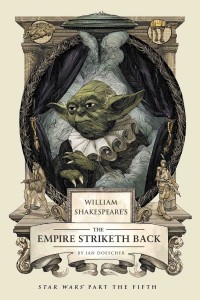
Greetings and welcome to part 2 of my podcast on The Empire Striketh back, the 5th installment in the William Shakespeare’s Star Wars Series.
Last time I mentioned Luke’s journey and how Droesher adapts the cinematic quality into Elizabethan drama through soliloquies.This time, I’m going to talk about the other main characters, Han and Leia. In my opinion, Doescher writes their journey much better and gives them lots of good romantic and comedic dialogue. I am also privileged that this time I will have some help with the voices- two professional actors, Hal Jourdan and Janine Ashley have graciously agreed to be part of this podcast, lending their voices to Han, Leia, the Wampa, and Luke. I’m grateful for their involvement and would love for you to check out their other work onstage. Below are some Youtube clips I made using their voices. Enjoy!
For Pride Month, I’d like to draw some focus to a celebrated LGBTQ film, based on a play that, while not Shakespearean, it was by one of Shakespeare’s contemporaries and one who influenced Shakespeare a lot. This film, Edward II, directed by Derek Jarman, was based on the play of the same name by Christopher Marlowe (1564-1593). The film came out in 1991, during the AIDS crisis, when gay and lesbian people were not only fighting for their lives against a devastating epidemic but also for acceptance from the heterosexual community. This film is not only a striking, well-acted, well-directed adaptation of Marlowe’s play; it is also an encapsulation of the fears, struggles, and anxieties of the LGBTQ+ community at the time.
Plot Summary/ Great Quotes
Biography Of King Edward II
Edward II was the son of the infamous King Edward I, aka, Edward the Longshanks, the Scottish Hammer. He lived from 1307-1327 – until he was assassinated.
Fact Vs. Fiction
Peter Hanley as Prince Edward in “Braveheart” (1995) directed by Mel Gibson.
Aside from a few historical footnotes, I’m betting that when we think of Edward II, we mostly think of this portrayal in the 1995 film Braveheart. Frankly, most contemporary accounts of Edward II’s reign are similar to this portrayal- vain, spoiled, weak, deluded, and an utter disgrace to his warrior father. One of his greatest embarrassments was his army’s catastrophic defeat at the Battle of Bannockburn in 1314. Edward’s sources mainly portray him as weak and feeble compared to his father, but we have to remember that this was a cruel, warlike society with very little place for anyone who didn’t conform to stereotypical masculine virtues. Probably in the minds of the English court, Edward’s homosexuality was linked with his failures as a king. It was up to Jarman’s production to make Edward feel more like a real man, and not just a gay stereotype.
Play Vs. Movie
In the play, it’s ambiguous whether Galveston really loves Edward, or if he’s using him for the king’s power and protection. In the movie, Galveston is definitely using Edward, making the king’s fawning all the more pathetic and tragic. As his son asks: “Why do you love him when all the world hates him?” This makes our sympathies teter between Edward and his court- we wish Edward would open his eyes and get rid of Galveston, but at the same time, who hasn’t been blinded by love? At the same time, Galveston has been hurting the country, and taking Edward away from his court and his queen. Like many other stories of monarchs in love, including the real-life story of our current king, there is a constant tension in the court between the monarch’s personal desires, and his or her responsibilities to the country.
Biography of Marlowe
Edward II and Richard II
Many scholars believe that Marlowe’s play helped influence Shakespeare’s Richard II, as they both center around weak, sometimes effeminate kings that fall prey to the machinations of other lords. In Shakespeare’s play, it is possible to play Richard as being in love with some of his favorite courtiers, but nothing is explicit. Obviously, Marlowe was much more overt in Edward’s love for Gaveston. To demonstrate how these plays are similar, here’s Ian McKellen playing Richard II:
Is this play Homophobic?
On the one hand, the story shows Edward as effeminate, weak-willed, and poor in judgment which does align with offensive homosexual stereotypes. On the other hand, the other lords of the court are portrayed as cruel and intolerant, and Jarman definitely makes Mortimer a cruel and homophobic individual. In addition, when Edward’s son Edward III, who famously conquered England and France, he is shown in the movie wearing drag, which clearly shows that a member of the LGBTQ community need not be weak or ineffective. It also shows that Edward III has inherited his mother’s strength, not his father’s weakness.
a sufficiently entertaining, adamantly old-fashioned adaptation that follows the play’s general outline without ever rising to the passionate intensity of its star-cross’d crazy kids
Romeo and Juliet is still taught more than any other text in American high schools, and since it’s a play not a book, teachers will inevitably want to show a movie in class to show some of the action to the students. Since this is the most recent high-profile film version of Romeo and Juliet, it seems inevitable that this will be the one teachers will show to students, so I will try to review this film from the point of view of an educator, not a Shakespeare fan.
The Concept
This film was financed by the Swarosvski Crystal Company and in the words of their own chairperson, the film is an extension of the Swarosvki brand. So if I were to describe this film’s concept it would be to dazzle the viewers with expensive costumes, exotic locations, beautiful visuals, and young, attractive actors:
To be clear, I agree with the director that Shakespeare should be updated every few years to keep it fresh and relevant. However, I would argue that this film doesn’t go far enough to make this concept fresh, and this version is destined to age poorly. Without a unique view of the play other than- “love is pretty”, the film lacks vision and is not very distinct. That said, it perhaps is a good way to introduce young people to the play, as we’ll see below:
Changes to The Plot
The Act I Tournament
The film opens, not with two servants fighting (yet), but with a tournament between the Monaegues and Capulets, where they joust instead of fight to avoid bloodshed. It is a striking image to be sure, and it is less confusing than starting a fight over biting a thumb, but it is a little odd that the Prince has this tournament to avoid street fights, and then they wind up fighting anyway over the results of the tournament. It works within the story but it makes the Prince seem dumb and it adds little to the story other than spectacle.
The Dialogue
As you can see from this clip, the dialogue of this film is changed liberally. The writers change Shakespeare’s lines to make them sound less Shakespearean. They also heavily cut the speeches to shorten the duration of the film. Cutting long speeches and substituting a word here and there is pretty standard for most Shakespeare movies, but what I find really irritating in this film is the number of lines that they add. It’s generally understood in Shakespeare that a director or actor can subtly change a few lines in a play- change pronouns, change an archaic word or two to make it easier for an audience, but this movie has the dubious record for most lines added to a Shakespeare movie. Some of these lines are paraphrases of the Shakespearean text, like all the dialogue of Sampson and Friar Laurence’s speech explaining the sleeping drug plan to Juliet. Some of the additions are character lines, like the scene where Benvolio admits he wants to woo Rosaline, (which to be fair, is an interesting change and I don’t mind it). Finally, some of the lines are designed to summarize speeches that the script cuts.
I know I sound like a purist here, but I feel that if you’re going to do Romeo and Juliet, use the text of Romeo and Juliet, and don’t change it unless it’s absolutely necessary. If you’re going to do an adaptation like Gnomio and Juliet or Tromeo and Juliet, you can throw out the Shakespearean dialogue and play around with dialogue using the plot and characters Shakespeare wrote. This film does neither- it mangles Shakespeare’s text but rigidly adheres to the story and characters, so it fails to pick a lane between faithful depiction or creative adaptation.
Small changes:
Mercutio is a Montegue now. This matters because in Shakespeare’s version, he was related to the Prince, which is why the Prince takes pity on Romeo for avenging Tybalt’s death. Changing his allegiance robs his death of some of the tragedy that he was a neutral party who got caught up in other people’s quarrels.
Tybalt is in love with his cousin Juliet, (which admittedly I’ve seen in other productions). It gives him more motivation to hate Romeo and makes him even more distasteful to the audience.
Sampson and Gregory appear, but they are not named, nor do they bite a thumb.
Benvolio’s role is merged with Balthazar and the actor is the youngest person in the cast. I honestly like this change a lot- Balthazar is a great character but he is functionally identical to Benvolio in the plot, so merging the two parts makes a lot of sense. Both Balthazar and Benvolio spend the play looking out for Romeo yet Benvolio disappears once Tybalt dies, so giving the actor Balthazar’s lines is a welcome change. Now Benvolio is literally with Romeo to the end, which makes us feel sorry for Romeo and his best friend.
Benvolio is in love with Rosaline and makes a play for her after Romeo falls in love with Juliet. This might be a subtle nod to their relationship in the novel “Romeo’s Ex.”
Rosaline is Juliet’s cousin now, which is not mentioned in Shakespeare’s version.
Rosaline actually speaks, remarking on the foolish nature of silly Romeo, the Montague, and the Capulets. She still has no effect on the plot though, and her dialogue adds nothing.
Concerns for Teachers
If you are a teacher, I would recommend you show parts of the movie, specifically the fights and some of the action in the second half rather than the whole thing, but once you read the rest of this review, you can draw your own conclusions. As I mentioned before the Shakespearean dialogue is heavily cut, new ‘modern’ dialogue is added in, and even some of the action is also changed. Because of this, DO NOT TRY to read the play along with this film, as your students will get extremely frustrated. In my class, I actually played a game where the students write down what the movie changed from the play to try and get them to engage with it. I would also recommend asking questions or quizzing the students on the plot or the famous lines since those are more or less intact.
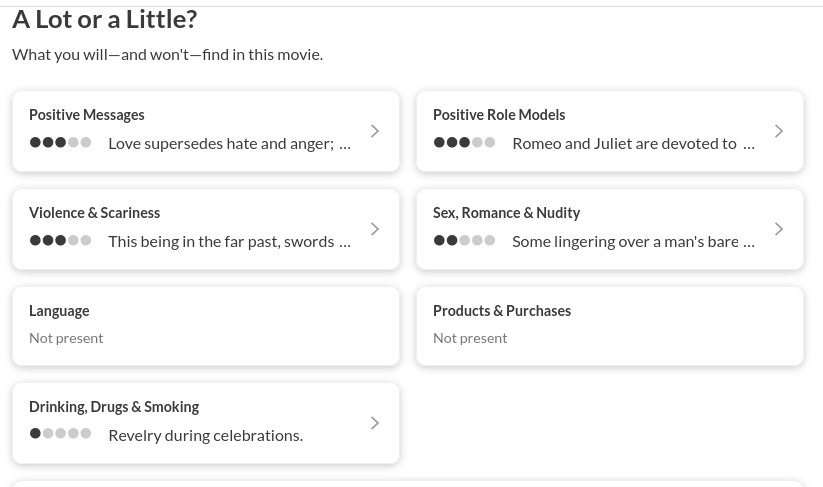
According to Common Sense Media, the film is relatively tame for students, (which of course was one of the goals of making it), so the violence is toned down, there is little nudity and little cursing (there actually is a little PG-13 language added near the beginning, but not much).
Though the film is populated with English and American actors, the majority of the crew is Italian and principal photography was done in Italy, both on-location in places like Verona, Mantua, Rome, and other Italian locations.
Historical Context
The original story of Romeo and Juliet is set in the 1400s but based on the references to Early Modern fashion and music, we can assume Shakespeare set his version around 1593- (the year it was probably written). This production, based on its fashion and architecture is probably set around the early Baroque period, (c. 1600).
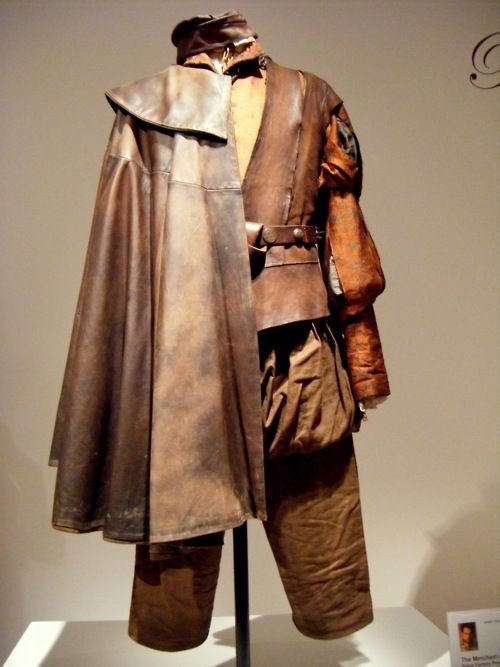
This time period was notable for abandoning neck and sleeve ruffs in favor of lace or linen collars (Source: https://fashionintherenaissance.weebly.com/fashion-timeline.html) . The famous pumpkin pants were also replaced with less fussy breeches as well. All these fashion choices are in the Romeo and Juliet movie and it’s fascinating to look at the choices they made for the film in behind-the-scenes documentaries. I shouldn’t be surprised here, but studying this period made me enjoy the film more- I lost myself in the spectacle and ignored their handling of the story.
The Costumes
Costume featurette from Romeo and Juliet (2013)
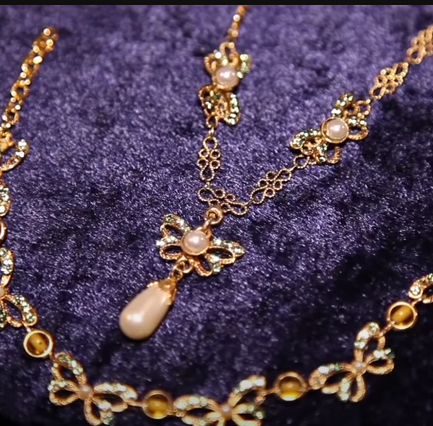
As you can see from the close-ups above, the Swarovski Crystal company definitely showed off some of their wares in Juliet’s costume. In fact, Swarovski sells a version of Juliet’s wedding ring.
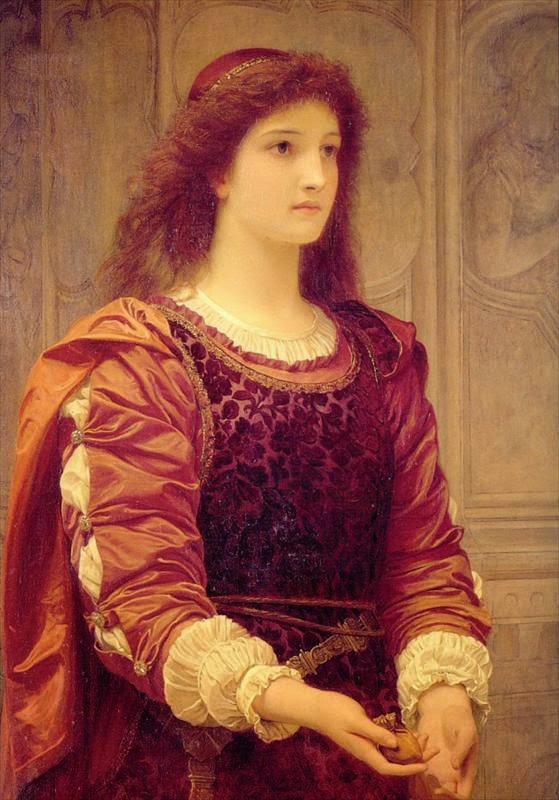
You can also see in these costume renderings the influence of Pre-Raphelite artwork on the costumes, like this famous painting by Francis Dicksee (1884).
The Sets
Many of the street locations for Romeo and Juliet were filmed at Cinecitta Studios in Italy, but as you can see from this behind-the-scenes footage, most of the film was filmed on location in beautiful real-life baroque buildings in Italy:
The Locations
Many of the locations remind me of the high baroque architecture of the celebrated Italian sculptor and architect Gian-Lorenzo Bernini (1598-1680), who had his own Romeo and Juliet-style drama in terms of sordid love affairs, duels, and exiles:
One location I found very interesting to research was the Grotto of Sacro Speco in Subiaco, which was the location for Friar Laurence’s cell. This is a very holy site to many Catholics- it is the celebrated Cave of St. Benedict, the founder of the Benedictine monks. Friar Laurence is a Franciscan monk so this isn’t entirely accurate, but it does provide some wonderful religious eye candy during the scenes at his cell, and it does beautify the wedding scene.
The Music (rant alert)
THE MUSIC NEEDS TO SHUT UP! Especially in the love scenes, the music is too loud and drowns out the dialogue. I personally find it irritating that the score makes so much use of the piano, which wasn’t invented until 1700, since the movie is trying to be historically accurate. To be fair, the loud piano is actually the sound department’s fault, but the fact that pianos didn’t exist at this time took me out almost as much as the overpowering score, (which somehow won two International Film Music Critics Awards (IFMCA)!
The Cast
Reviewers usually love to rag on whoever plays Romeo and Juliet. It’s kind of a no-win scenario here- If they’re young, they’re inexperienced and thus, don’t know how to speak Shakespeare. If they’re older, they’re too old and shouldn’t have been cast in such a youthful role. So rather than falling into that trap, I’ll be positive about the casting and say what I like about the performances, while criticizing the direction, because I feel that in general, the acting in this film is fine, but there are some odd choices that the director should’ve thought twice about.
Romeo (Douglas Booth)
Booth might actually be my favorite film Romeo- he’s beautiful to look at, sweet, impulsive, naive, everything Romeo should be. He also knows how to deliver Shakespeare and can convey complex ideas through poetry. I could argue that he lacks the rage that Romeo should have when killing Tybalt, but I don’t think that’s what he was going for this Romeo is a good guy who is too sheltered and lacks proper guidance, so he makes rash choices because nobody is there to tell him why they are.
Juliet (Hailiee Steinfeld)
I don’t fault Ms. Steinfeld for this, but her worst scenes are sadly, the most famous. Her delivery during the Act I dance and the famous balcony scene is monotonous and dull. I think the director told her to act as if love put her in a trance, but the effect is that she sounds like she’s half asleep. Again, I know she can do Shakespeare because her scenes with the Nurse and Lord Capulet are much better; she’s passionate, articulate, and full of emotion. I think the director failed to give her proper direction to play a love scene realistically, and intentionally slowed the scene down so the audience could pick out the famous lines.
Lord Capulet
Some people argue that Lord Capulet is actually a good dad, but not this film. As I’ll show you later, this film is trying to play up the forbidden love aspect of the story, and what is more classic than an angry, disapproving father? To this end, even though Damien Lewis starts out jovial and sweet to Juliet, by Act III he is full of resentment and rage:
Damien Lewis as Lord Capulet, in a scene from Act III, Scene v
Tybalt (Edward Westwick)
Ed Westwick steals the show every time he’s on screen. He knows how to speak the Shakespearean lines and he makes the added lines sound Shakespearean (which is to say, actually good). With his fiery gaze and his thick, deep voice, he reminds me of a young Mark Strong and is equally good at playing smarmy yet compelling antagonists. You love to hate this guy, yet you feel sorry when he dies.
Friar Laurence (Paul Giamatti)
Giamatti rivals Pete Postlethwaite for my favorite Friar Laurence. He was a perfect choice and he has an effortless Shakespearean delivery. I think it’s telling that his lines of dialogue are the least altered from Shakespeare- the director knew Giamatti could make them work without any alteration. He also has a great rapport with both Douglas Booth and Hailee Steinfeld.
Moments to Watch For:
This film does well at portraying the forces that rip Romeo and Juliet apart- Tybalt’s maniacal hatred of the Montagues, Lord Capulet’s scheme to marry Juliet, and the influence of maligning fate. For this reason, the film is actually better in the second half, once the romance is over and the tragedy sets in. Again, a lot of this is due to the excellent performances of Ed Westwick as Tybalt, and Paul Giamatti as Friar Laurence, who frantically strains his brain to help the lovers and is thwarted at every turn. I wonder if, since the film was adapted by the creator of Downton Abbey, in which Giamatti starred, the writer placed most of the success of the film on Giamatti’s shoulders, intentionally or not.
My Reaction: Shakespeare for Twi-hards.
Forgive me for getting a little conspiracy-theory-ey here but, since the Twilight saga concluded in 2012 and this film came out the next year, I suspect that thisRomeo and Juliet was partially produced to cash in on the success of Twilight. After all, Twilight: New Moon is full of references to Romeo and Juliet:
As the video below demonstrates, Twilight and Romeo and Juliet are both examples of Petrachian love, which is to say, love thwarted, so similar themes and tropes are baked into both stories.
There are also stylistic similarities to how this particular Romeo and Juliet are filmed, such as the lush landscapes, the prevalence of piano in the score, the heavy uses of glamour shots, and even some of the Italian locations evoke Twilight:
Worst of all, I feel that this film tried to make Hailee Steinfeld, an Academy Award-nominated actress, try to act like Bella Swan in the Balcony scene. I think this is why the first half of the film drags and seems slow and dull- it is trying to emulate Twilight’s visual style and forces the actors to adopt a “Twilight School of Acting.”
So in conclusion, the film is uneven- it has talented people working on it, but I think the studio and the company were a little preoccupied with selling the film to a specific group of young people. Does it work for classrooms? For now, but I worry that this version won’t connect with young people for long, and because of its lack of focus and clear direction, it will probably go the way of Twilight– a brief cultural blip that is pretty to look at, but that is quickly forgotten.
Title image for my online course on “Romeo and Juliet.”
If you like this analysis, you might be interested in signing up for one of my Outschool Course on Romeo and Juliet Link down below. Share this class with a friend and you will get $20 USD off!
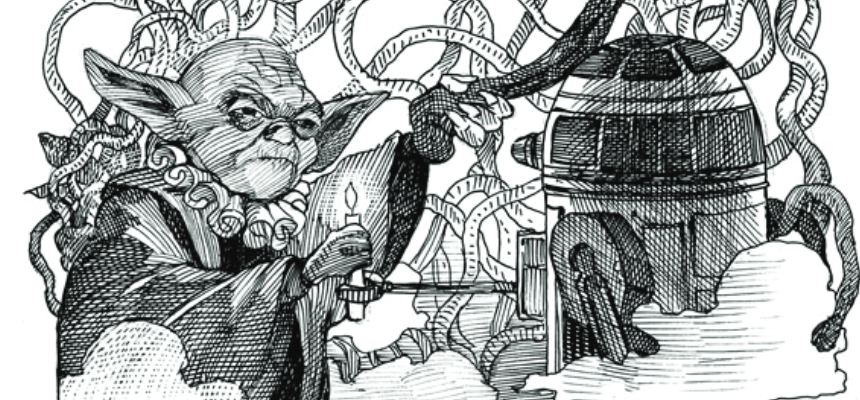
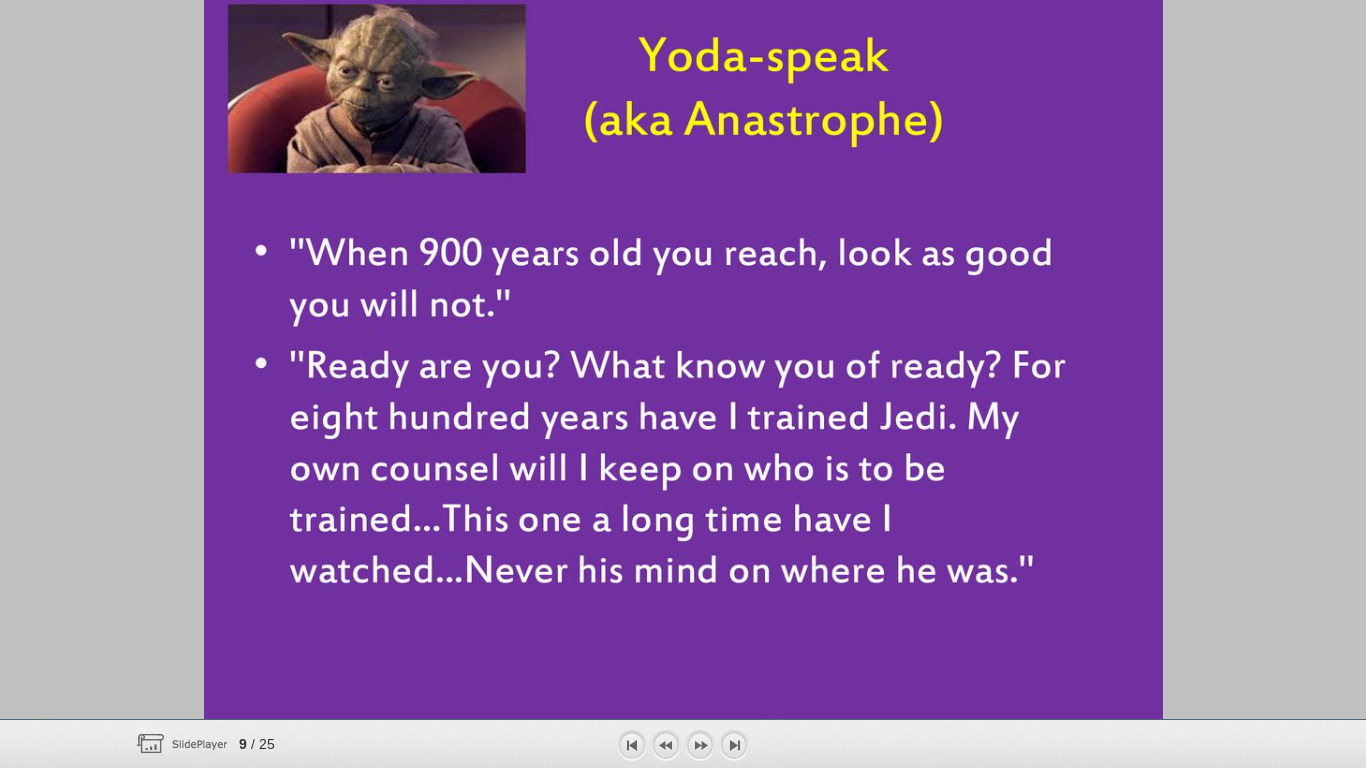
This is part of my upcoming podcast where I demonstrate how similar Yoda’s speech is to some Shakespearean dialogue. Actor and puppeteer Frank Oz, who puppeteered the character and supplied the voice explained that the idea behind the character’s iconic speech pattern was a discovery he made reading through the script:
“It’s funny you ask about [Yoda] because I was just looking at the original script of The Empire Strikes Back the other day and there was a bit of that odd syntax in it, but also it had Yoda speaking very colloquially. So I said to George [Lucas]: ‘Can I do the whole thing like this?’ And he said: ‘Sure!’ It just felt so right.”
There are a lot of in-universe theories as to why Yoda speaks like this. David Adger, from Queen Mary University of London has a theory that, much like many Latin languages have a different syntax than English, perhaps Yoda is speaking in the syntax of his language while speaking English:
He’s speaking English but changed the structure of it to be like his native language,” Adger points out. “We can find out something about Yoda’s native language by looking at how he speaks English, in the same way as I can find out about a French person’s native language by looking at how that French person speaks English. Yoda says things like ‘the greatest teacher failure is’… If you were to say that in a language like Hawaiian … it would be almost exactly the same … putting the predicate before the subject,” the professor used as an example.
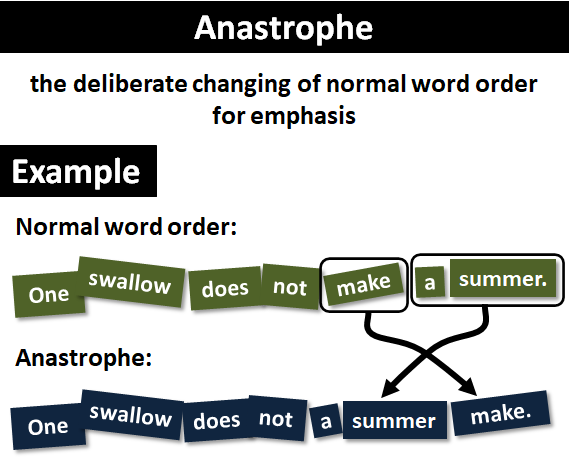
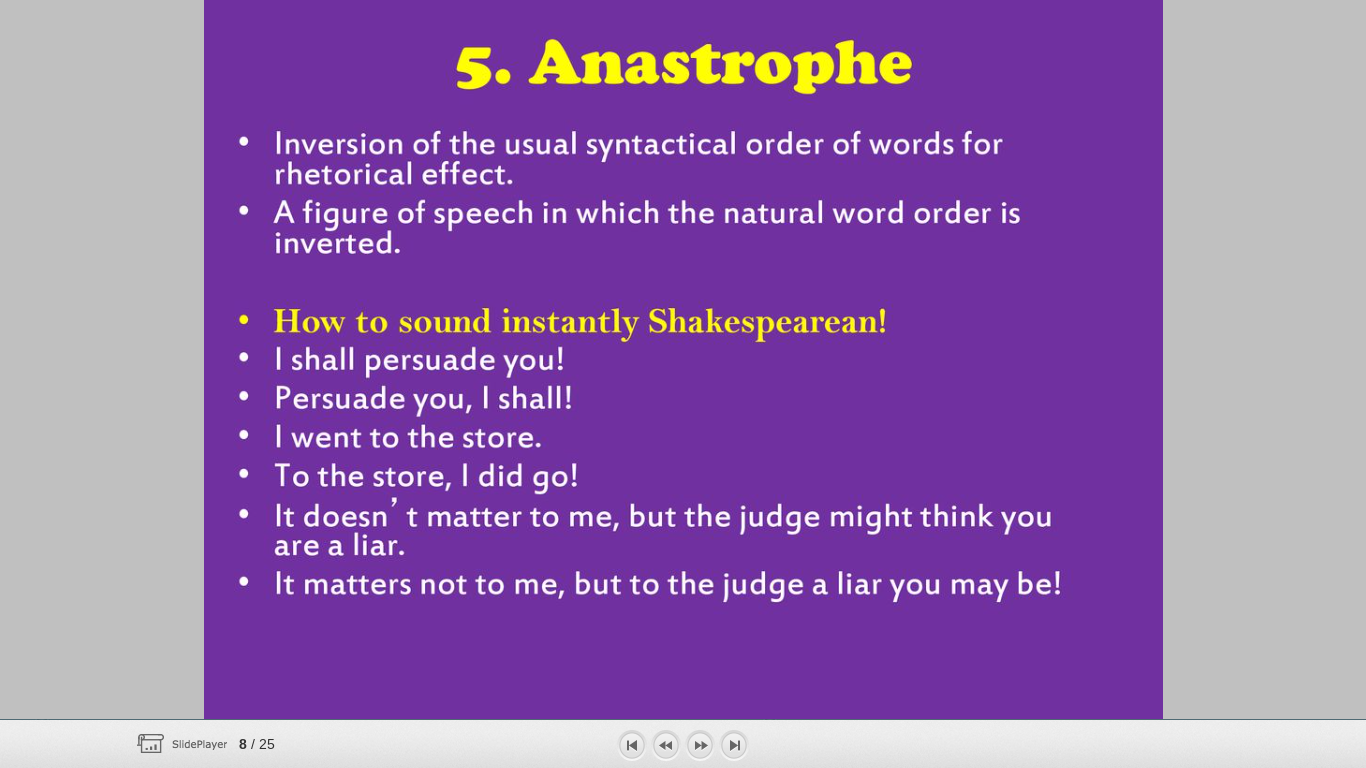
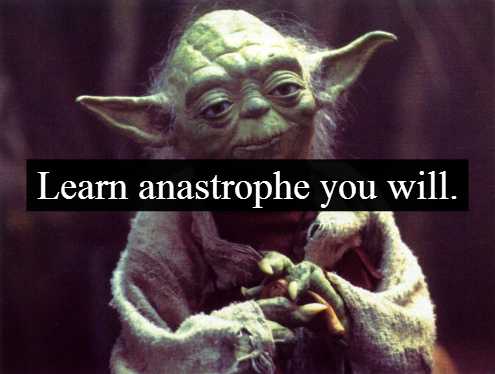
From a Shakespearean perspective, what Yoda is doing is called anastrophe, a rhetorical technique that is used for emphasis. Instead of the familiar- Subject-Verb-Object syntax of English, the order is flipped to grab the reader/ listener’s attention:
According to Silvae Rhetorica (The Forest of Rhetoric), the word Anastrophe is Greek for “backward turning,” where the writer twist the word order around. As I said before, this creates a surprising effect, much like this painting by Picasso:
“People take the eye for granted. If I paint an eye in an eye socket, they take it for granted. If I take it out of the eye socket and stick it somewhere else, it comes as a shock, and they see the eye anew.”
— Pablo Picasso
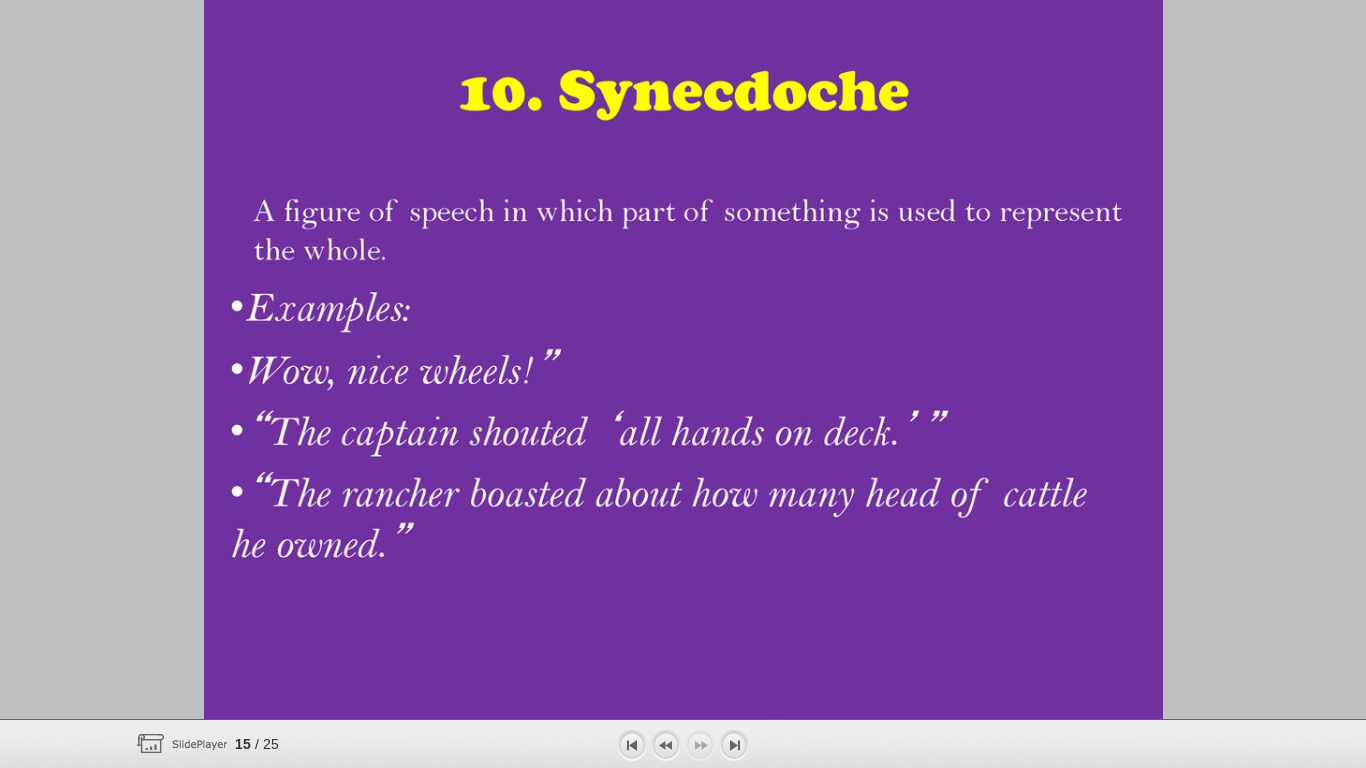
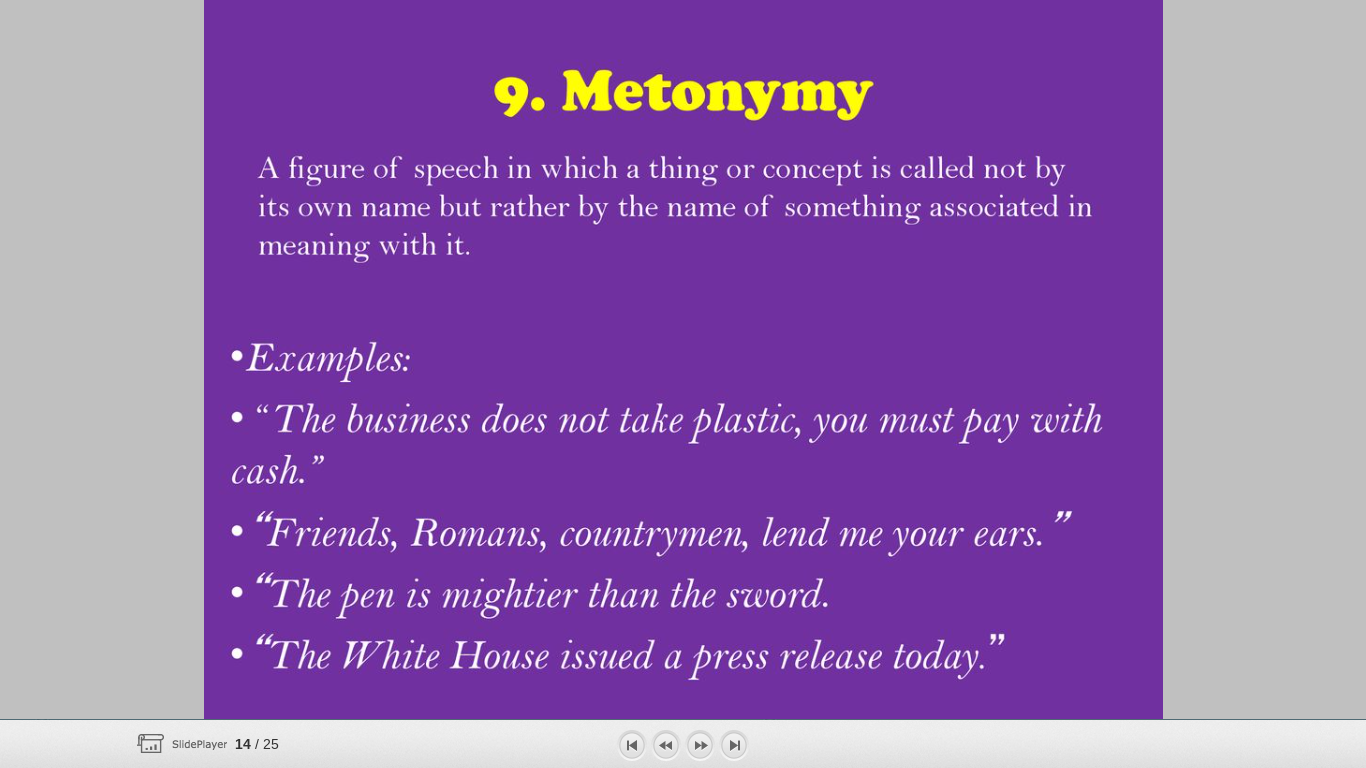
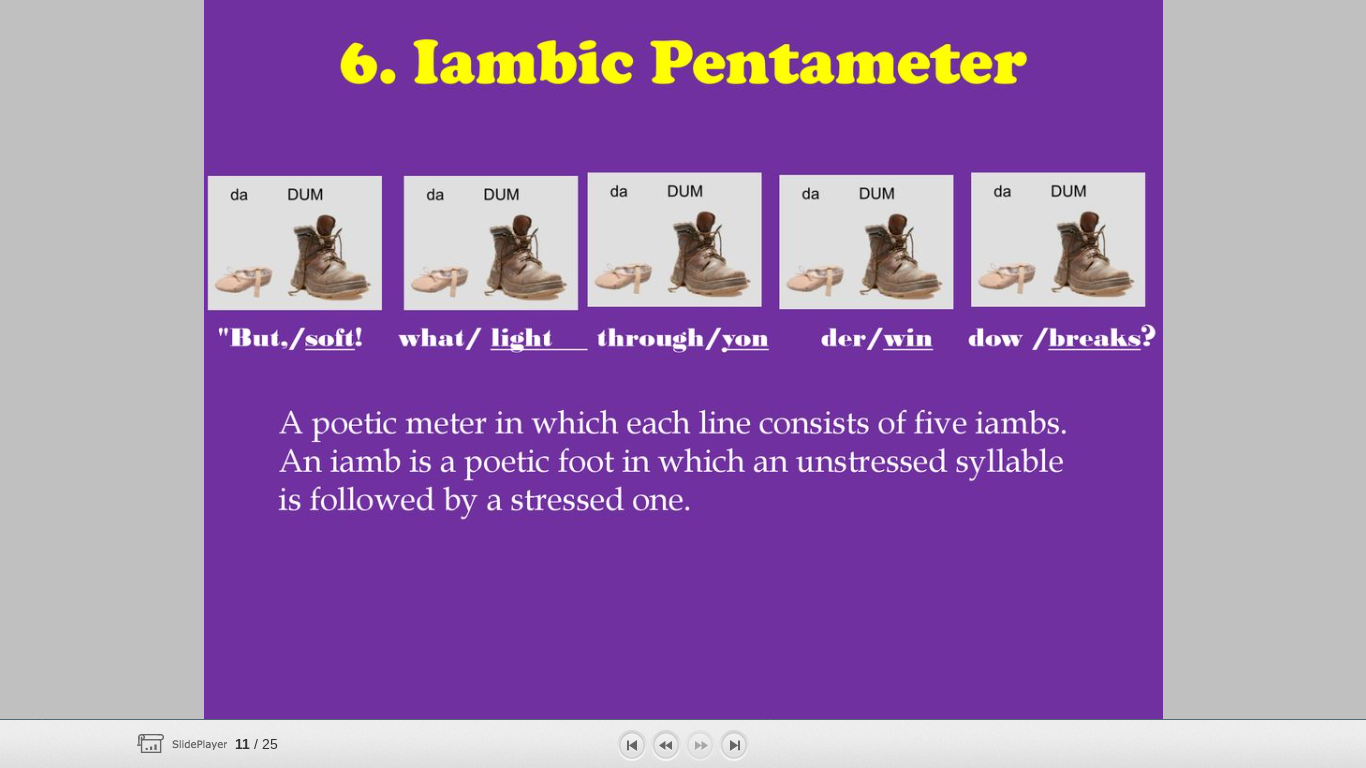
In the following slides, (which I found from Slideplayer.com), you can see examples of how Shakespeare and Yoda use anastrophe.
So I hope this post has helped you understand the force of Yoda’s unique style of speaking that was first used by The Bard!
If you liked this post, please listen to my new podcast about Ian Doescher’s Shakespearean parody of Star Wars: The Empire Strikes Back, which I’ll publish on May 4rth (hopefully)
This Friday is the grand premiere of my new online class: “Shakespeare: The Lost Play,” where you discover who stole Shakespeare’s play. Below is the latest trailer.
Since I want as many people to play as possible, I’m creating a coupon: Get $10 off my class “Shakespeare’s Lost Play Mystery Game” with coupon code HTHES4OXNY10 until May 8, 2023. Get started at https://outschool.com/classes/shakespeares-lost-play-mystery-game-ny9HhlxI and enter the coupon code at checkout.
This is an interactive game that teaches the craft of Shakespeare’s writing and stagecraft in the form of an Elizabethan escape room. You must find the lost play of William Shakespeare before a mystery thief destroys it! Solve the clues and learn about Shakespeare’s writing and theater to uncover a historical mystery!
Course Description
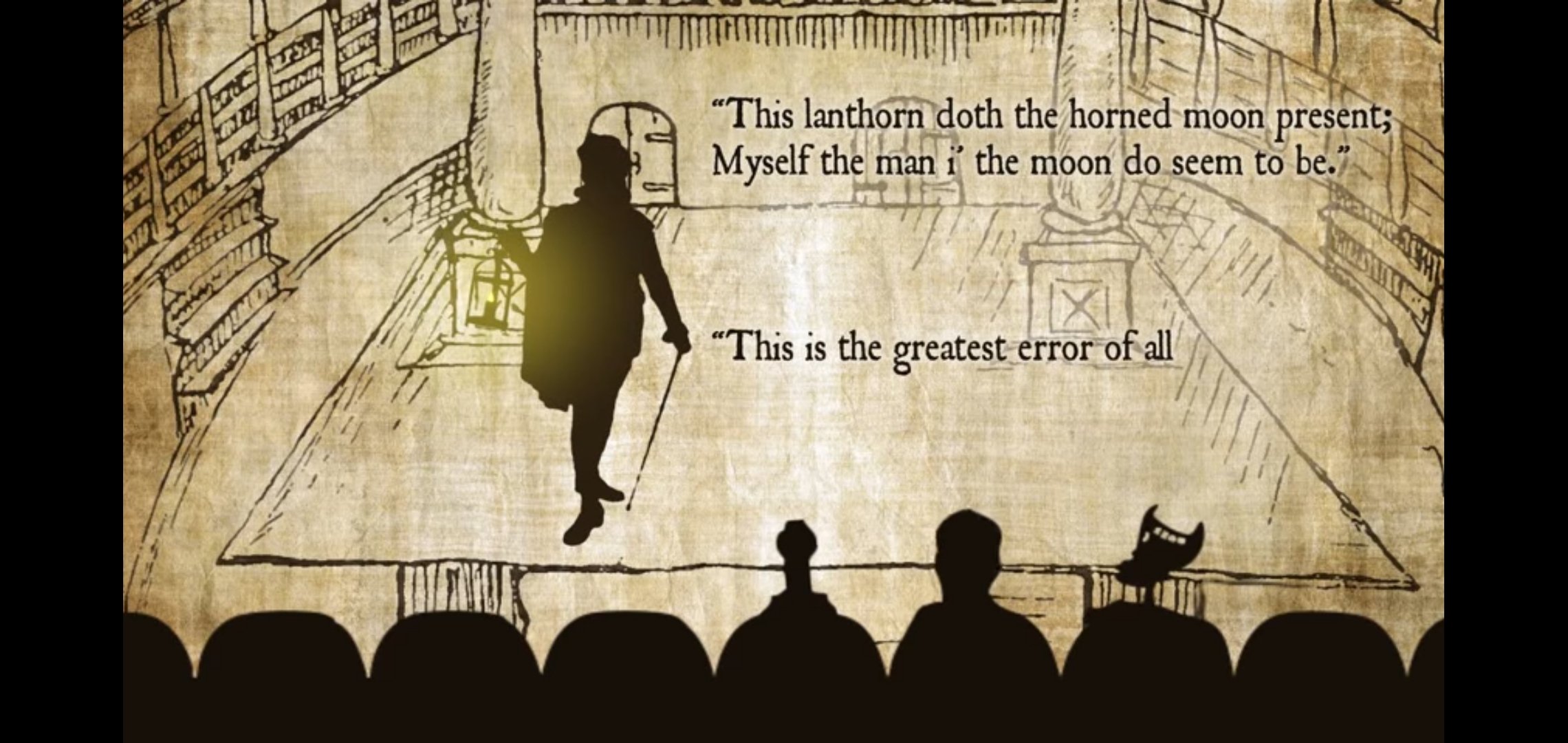
In this fully online, fully interactive game, you play as a member of Shakespeare’s company. You’ve just discovered that someone has stolen Shakespeare’s new play “Love’s Labors Won,” and you need to find it before the show tonight! In the course of the game, you search the Globe Theater and Shakespeare’s study. Then a mysterious note reveals that someone has stolen the play! You must figure out who it is, and find the play before the thief burns it! Through the course of the game, you will learn about Shakespeare’s theater, the secrets of how he wrote some of his great plays and beautiful poetry, and the work of his contemporaries in a fun, interactive way.
The class is organized into four parts, based on four locations where you will search for the missing play:
Part I- Search the Theater
Part I- Search the theater (website/ Slides/ Jamboard) You learn the basic parts of an Elizabethan stage (Google slides) You label the parts of the theater (Google Forms) You do a virtual tour of the theater (via Globe Theater.com) Web quest- answer 3 questions about Shakespeare’s Globe: https://www.shakespearesglobe.com/ (handout) You search the tiring house (the backstage area of the Globe), and find the letter from the thief (Sites).
Part II- THe Crime
A video plays where the thief declares that he’s stolen Shakespeare’s play for money and revenge. After the video, you will learn about plays, printing, and theft in Shakespeare’s day through a series of Google Slides Activity- make a folio, quarto, and octavio with just a piece of paper (handout) Web Quest- answer 3 questions about how Shakespeare’s plays were printed and the first folio (Slides) Activity 2: make an actors’ scroll or roll the way that Elizabethans might use (video) Easter egg- find a pair of gloves in the print shop and answer questions.
You’ll gain new understanding of the types of plays Shakespeare wrote and their basic plot structure via Google Slides. You’ll then take a short quiz to confirm what you learned.
-Plot Structure You’ll learn about the basic structure of Elizabethan plays via Google Slides. A second set of slides will demonstrate the plot structure of Romeo &Juliet You’ll mix and match a series of plot elements to create your own Elizabethan play via Jamboard
Tragedy:
A hero is given some unwelcome news
He feels betrayed by those close to him
He agonizes about the ethics of killing someone close to him.
He kills someone (or banishes an honest man) and immediately falls into a downward spiral.
The hero does (this will be a mandatory choice)
Comedy:
The heroine disguises herself as a boy
A hero or heroine swears (s)he will never fall in love and immediately falls in love
The heroine pretends not to be interested in the hero, (but secretly loves him).
A loyal best friend is captured, sent to prison, or bewitched
The hero and heroine hate each other due to a series of misunderstandings.
The hero and heroine get married (this will be a mandatory choice).
History:
An ambitious young man arises to challenge the king for the throne.
The old king dies, (or is murdered)
A new king becomes king
Duels and or battles
Someone dies in battle
Someone is murdered, assassinated, or sentenced to death.
New King gets married
King and Queen reign peacefully (at least for now)
Romance ( if students pick this option, they can mix and match everything (except the main character dying)
Verse practice- You’ll learn about the verse Shakespeare wrote, through a series of slides and a jam board. Activity- You will be given a series of famous lines from plays and movies, (such as a quote from a Disney Movie, a Star Wars film, or a song). You will then determine if it is an iambic pentameter line (Google Slides). Easter egg- you find a second note from the thief (Google Sites).
Part IV- THe Tavern
You will look at a series of pictures and videos about Shakespeare’s contemporaries and try to figure out which of them stole the play. Through the handout, you will conclude who the thief is. You find a dagger in the tavern and take it. Outside the tavern, you will fight the thief in a short animation. GAME OVER.
THe FIrst Class starts April 28th, 2023. CLick here to register!
Shakespeare’s birthday is coming up! This is the week where I usually stop talking about individual plays, and talk about the man himself. Today I’d like to cover how he’s been portrayed in fiction. As you’ll see, with such a famous and at the same time mysterious figure like Shakespeare, there is a lot of leeway in terms of how you portray him. This list shows multiple interpretations of Shakespeare and at different stages (ages) of his life. Some are comic, some are tragic, but all are fascinating to discuss:
#10: Rhys Ivans (Anonymous, as The Earl Of Oxford).
Like I said in my podcast, I don’t believe Oxford was the real Shakespeare, and I have some issues with the character and his lack of humanity. That said, I do like the character they were going for- a tortured genius who has to create, in spite of himself, and it destroys him and his family.
#9: Hugh Laurie
I love what they do here- Shakespeare’s a temperamental artist who hates editors, but ultimately accepts that he has to put butts in seats. It’s very true-to-life and Rowan Atkinson and Hugh Laurie do a great job in this sketch!
#8: Kill Shakespeare Volume 2
Like I said in my full review, I really like the idea of an aging Shakespeare buckling under the pressures of being an icon. Bardolatry, the worship of Shakespeare as a literary god, has been a real thing in academic circles for at least the last 200 years and I think it really hampers first-time readers from even attempting to read Shakespeare. Since this comic is very much attempting to get people to do just that, it makes sense that they portray Shakespeare as a deeply flawed human who is trying his best, but not able to live up to his god-like persona.
#7 Matthew Baynton- Horrible Histories
Even though this history show for kids is also trying to make Shakespeare accessible for British schoolchildren, it actually takes the opposite approach for Shakespeare- make him cocky, self-assured, silly, and a bit of a schlamaazel, who like his own creation of Mercutio, talks too much and invariably gets himself into trouble.
#6: King Of Shadows
Cover of “King Of Shadows,” an excellent Young adult novel for anyone who loves Shakespeare.
“Nat, say hello to William Shakespeare”. They might as well have said, “Nat, say hello to GOD!”
-King Of Shadows
Again, most interpretations of Shakespeare are aware of and try to subvert the god-like status he has in our culture, which is why this YA novel attempts to humanize him, by having him interact with the hero, Nathan, a 20th-century child actor, go back in time and finds himself switching places with another Nathan Field, a real boy actor in Shakespeare’s company. Nathan then meets and befriends Shakespeare and the two form a father-son bond.
This book takes place just a few years after the death of Shakespeare’s own son, Hamnet, so this William Shakespeare has a son-shaped hole in his heart. It’s really heartwarming to see the two broken people form a family bond.
#5: Hamnet
As I said before, Shakespeare is not the main character of this novel; he pops in and out of the life of the real main character; his wife Anne, as he visits her at his parents’ home, and later when he sees her on periodic trips home from London. His characterization is entirely indirect. That said, we learn a ton about him through her perceptive eyes. We see his hatred of his abusive father, his frustration with being a glover’s son with no time to make a living in the theater. We see his ambition take hold as he travels to London, and at last, his contrite return to finally become a good husband after the death of his son. This Shakespeare is sort of a prodigal son, who searches for fame and fortune as a young man in the big city, but eventually comes to value his life at home. This solves the mystery of why Shakespeare never moved his family to London, why he retired in the early 1610s, and why his writings have nothing about his relationship with his family, his wife, or especially his son. This Shakespeare is scarred; trying to redeem himself from the sins of his past.
#3 Kenneth Branaugh- “All Is True”
This Shakespeare is at the end of the journey he took in “Hamnet.” He’s retired from theater, trying to pick up the pieces of his life in Stratford, and trying to reconcile his feelings for the fair-young-man (played by Ian McKellen), and his wife, (played by Judy Dench). It’s melancholic, but still funny in a dour way.
#3: Christian Borle- “Something Rotten”
Like I said in the review of the Broadway musical, Borle is the best part of this show. Like Matthew Baynton, he plays Shakespeare as a cocky young self-assured genius on the outside, but unlike Baynton, we see he has a deeper side underneath. As he sings in the incredibly catchy “Hard To Be the Bard,” Shakespeare is once again dealing with the problem of maintaining his success and is under a tremendous amount of pressure to crank out new and successful plays all the time. Even though he’s the antagonist, he’s more sympathetic than the heroes.
#2: Jacob Fiennes- “Shakespeare In Love”
I realize this movie has lost a lot of prestige over the years, thanks to the controversy over its loathsome producer, Harvey Weinstein. I realize that the film Shakespeare In Love might not have deserved best picture over films like Saving Private Ryan. That said, I still think it’s a fantastic movie and every single element from the sets to the costumes to the near-perfect casting, is top-notch, especially the casting of Jacob Fiennes as Shakespeare. This young, heartthrob Shakespeare hasn’t yet become the self-assured genius we see elsewhere on this list. He’s constantly out-classed by Christopher Marlowe, which is a very good choice because it helps us sympathize and root for this man, whom we all know will become a rich, successful genius, but hasn’t yet.
Fiennes also gives Shakespeare a very good arc- he’s a selfish dreamer like Bottom at the beginning and a sweet, sensitive man at the end. In the end, he writes for all the right reasons- supporting his family, immortalizing his love Lady Viola, and helping his friends and partners in the Chamberlain’s Men. Most of these Shakespeare are fairly static, but this movie gives him a great hero’s arc which allows us to like him and hope that his play is a success. As you can see in this alternate version of the final scene, Shakespeare makes a tearful goodbye to Viola, and sets about paying tribute to her in a play that will eventually become Twelfth Night. He also begins his lifelong partnership with Richard Burbage, who will go on to play Malvolio in that play, as well as Hamlet, Othello, and many others. It’s a satisfying conclusion to his arch, which like Viola, shows that Shakespeare is ready to take on a “brave new world” with a new sense of purpose.
#1: Dean Lennox Kelly From Dr. Who: The Shakespeare Code
Dr. Who (David Tennent) and Dr. Martha Jones ( Freema Agymann), are… disappointed when they meet Shakespeare in person in 1599.
Though this episode has an inauspicious start, Dean Lennox Kelly from this 2007 episode of Dr. Who finds a way to incorporate every aspect of every other Shakespeare on this list! He’s a cocky, self-assured showman on the outside who knows he’s a genius but is also a middle-class man of the people, playing to the groundlings. On the inside though, he is mourning the loss of his son and yearning for love, which is why he falls in love with Martha and (spoiler alert) makes her the Dark Lady of the sonnets. He also is clever enough to figure out what’s going on as three aliens try to manipulate him into using his gift of words to conjure the end of the world for them. Finally, he is still a hard-working writer and does occasionally doubt his own work:
Shakespeare: “To be or not to be”. Oh, that’s quite good.
10th Doctor: You should write that down
Shakespeare: I dunno… bit pretentious?
-The Shakespeare Code.
Again, the best thing about this Shakespeare is his arc- he drops his mask of genius and opens up to Martha and the Doctor, just like how the Doctor confides in Shakespeare how he is mourning the loss of his previous companion, Rose. In the end though, he draws strength in the memory of his son, and actually uses it to save the world!
Is this a historically accurate biopic? No. Is it a silly cartoon? Also no. The reason I ranked this episode the highest is because they managed to encompass the myth and the man of Shakespeare in a very compressed time, with tons of Shakespeare easter eggs, and historical references, and it was filmed in the real re-creation of Shakespeare’s own theater! Someday I’ll write a full review of this episode, but for now, I hope you’ve enjoyed this list, and are hungry for more Shakespeare’s Birthday Week content!
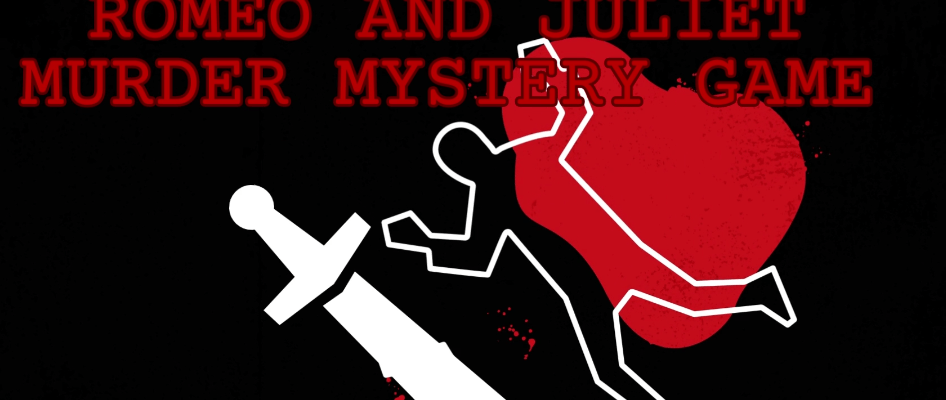
This is my new trailer for my fully online, fully immersive murder mystery game based on Shakespeare’s “Romeo and Juliet.” You play as a detective hired to solve the mystery of Juliet’s murder. You will piece together the plot and characters of Romeo and Juliet, but also use forensic science to identify clues, interrogate suspects, and examine the crime scene just like a real detective! Register now at Outschool.com SPECIAL OFFER: Get $5 off the murder mystery class with coupon code HTHESSQ76F5 until Apr 22, 2023. Get started at https://outschool.com/classes/romeo-a… and enter the coupon code at checkout.
















 The Shakespearean Student