The Witches Of Macbeth

Happy Halloween everybody!

Tonight I’d like to discuss some of the spookiest, most enigmatic, and above all WEIRDEST characters in Shakespeare: the Three Weird Sisters in Macbeth.

1. Who are they?

Every production has to answer who the witches are, and many have very different answers. Are they temptress? Are they evil agents controlling Macbeth?Furies trying to destroy Macbeth?

https://www.youtube.com/watch?v=clG8ha2D26g
I would argue in their basic form the witches are harbingers of change. Their very name “Wyrd Sisters” refers to an old Anglo Saxon concept of fate or destiny. Whether or not they have any effect on Macbeth mind or soul, they point the finger at him and say “things are going to change for you.” Then, he either makes the choices that determine his fate, or they change his fate for him.
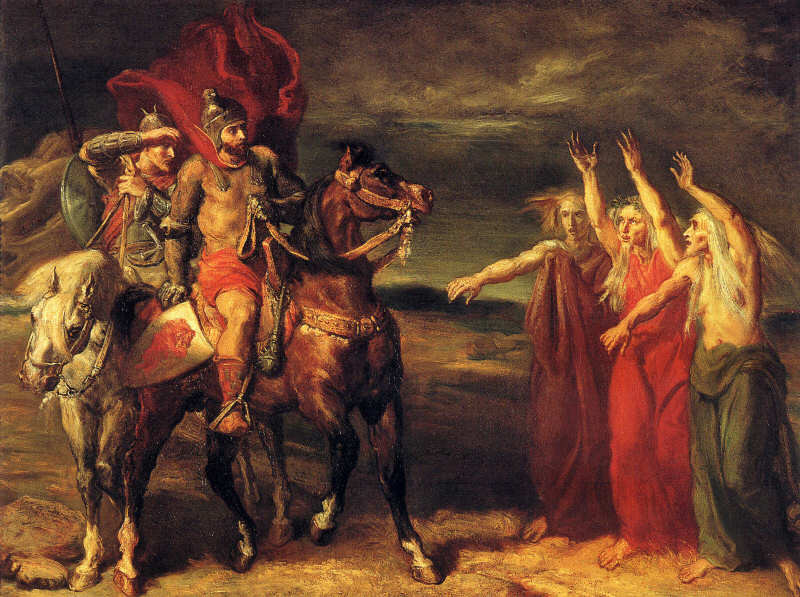
“Macbeth and Banquo First Encounter the Witches,” Théodore Chassériau, 1854.

Macbeth meets the witches on a heath, which means land that is literally out of bounds– the wild, untamed wilderness, which the old Anglo Saxons believed was the lair of many cursed spirits and monsters. This could symbolize Macbeth’ sin or transgressions, slowly turning into a murderer, usurper, and a tyrant. It could also symbolize the chaos in Macbeth’s life.

What Do They Look Like?

Shakespeare’s descriptions of the witches are highly contradictory- they seem to be floating, yet on the ground, they seem to be women, but they have beards! They don’t look Earthly, but here they are on the Earth. This gives them an other worldly quality that keeps us guessing as to who they are, and helps them tempt Macbeth more easily.

BANQUO
What are these
So wither’d and so wild in their attire,
That look not like the inhabitants o’ the earth,
And yet are on’t? Live you? or are you aught
That man may question? You seem to understand me,
By each at once her chappy finger laying
Upon her skinny lips: you should be women,
And yet your beards forbid me to interpret
That you are so.

MACBETH
Speak, if you can: what are you? (Act I, Scene iii).

The Witches’ Language:
You know from my earlier posts that the norm for Shakespearean characters is to speak in iambic pentameter- 10 syllable lines of unrhymed poetry that sounds like a normal heartbeat. The witches break these norms- they generally speak in Trochaic Tetrameter- 8 syllable lines with the off beat emphasized. The witches are literally offbeat, and that’s why their speeches are unsettling. Look at the contrast between a normal iambic line like:

“In sooth I know not why I am so sad.” (Merchant Of Venice I,i).

and

Dou-ble Dou-ble, Toil and Tro-ble.

Fire burn and Caul-dren Bu-ble. (Macbeth, Act IV, Scene i).

For more info on the verse forms of the Witches, click here:

The witches also speak their prophesies in a vague, ambiguous manner They like to play with obscuring their prophesies with lines that make Macbeth think one thing, but the opposite is true. The famous example here is when they claim Macbeth will never be vanquished “until Birnam Wood comes to Dunsinane Hill.” Macbeth assumes this means he’s invincible, but it actually means that the enemy carry wood from the forrest. This is called Equivocation.

Witches and mythology

Illustration from William Blake's
Illustration from William Blake’s “Europe a Prophecy,” 1794.

1. During the reign of King James, the modern witch hunt began; the king was fascinated with witches and even wrote a book called Daemonology on how to identify and destroy them. This was the era where people believed that witchcraft, rather than a pagan religious practice, was a forbidden craft that could only come from a pact with the devil. However, Shakespeare borrows from both Satanic and early pagan ritual in the characters of his witches.

2. Shakespeare took a couple of details about witchcraft from ancient Celtic and Greek mythology. First of all, the use of a cauldron. In Celtic myth, a cauldron is a symbol of rebirth and was sometimes used to resurrect the dead, just as the witches do in IV i. Of course, the ideal time for raising the spirits was on the feast of the pagan god Samhain, at the point where the veil between the living and dead was the thinnest. The feast took place on October 31st, our modern day Halloween!

Illustration of witches and their familiar spirits, 1647.

3. Familiar spirits In Act I, the witches speak to animal spirits called familiar spirits, which call to them and tell them where to go. King James himself wrote about how the witches found and communicated with these spirits.

Hecate.
In Act IV, Hecate, Ancient Greek goddess of magic appears. She is clearly the lord of all the witches, and is very displeased that they are riddling with Macbeth. Maybe not all witches believe in giving out prophesies that can destroy the Scottish monarchy. Hecate was always enigmatic in myths- she was born one of the Titans who opposed the gods, but frequently changed sides. More then being two faced, she was often portrayed as having three faces! Shakespeare refers to her frequently as “Triple Hecate.”

“The Triple Hecate,” by William Blake, 1794.

For more information on this mysterious goddess, consult the video below, (WARNING, ADULT-ONLY CONTENT).

In conclusion, the witches are meant to be ambiguous because the play examines the source of evil- whether it is inspired by other people, or if it comes from one’s own heart. The witches can be either or both, depending on how you want to tell the story, which is why they act and speak in contradictory ways.

Thanks for reading! If you enjoyed this posting, please consider signing up for my online class, “Macbeth: An Immersive Horror Experience.” I tell you the story of Macbeth and you get to play through an escape room, where you must solve the witches’ puzzles or be added to their Cauldron!
Crafting A Character: Macbeth

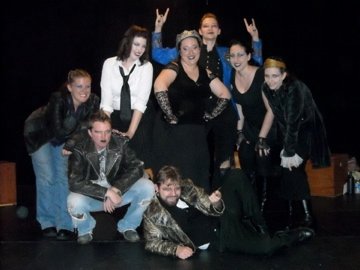
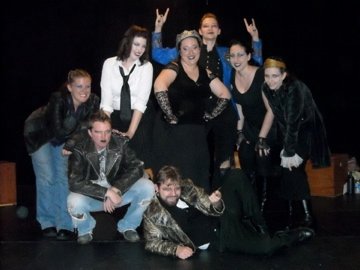
Me and the cast of “Macbeth,” 2009.

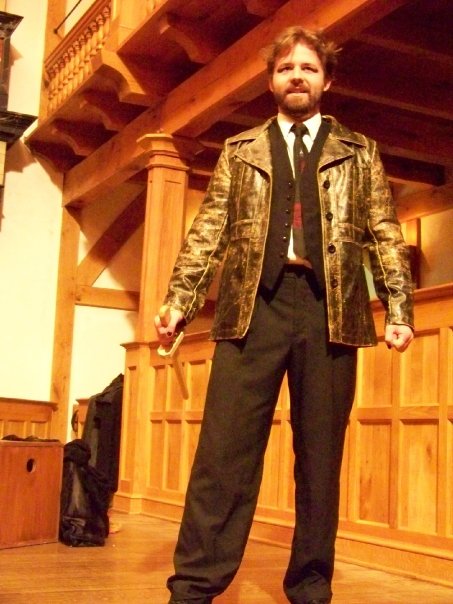
Back in 2009, I had the opportunity to play the lead in a touring production of “Macbeth.” It was the first time I’d ever played a titular Shakespearean character and I was really excited to play this part. I feel that playing one of these parts gives you an insight into the character that no other research can, so I’d like to share the steps of my process, with some pictures and videos from other famous Macbeths to give you an idea of what I learned.


  1. The Auditions-
    1. As I said in one of my earliest posts, if you’re auditioning for a Shakespeare play, Read the whole play, not just a monologue book. Monologue books won’t give you a sense of the whole story and you’ll miss a lot of details about who your character is by not hearing what he/she says, and what other people say about him/her. Fortunately for me, I first read the play when I was 17 and remembered the story pretty well. Unfortunately, my first reading of the part was a disaster. Unlike Hamlet, Macbeth didn’t feel like a part I could play; he seemed like this huge Scottish warrior who everyone loved until he turned into a psycho killer. I’m not a warrior, not a psycho, and (like most actors), often feel a lot of doubt and loneliness about my self. Ironically, that was what helped me get into the heart of the character!
    2. Figure out what’s the hard part. When directors cast, they need to make sure you can handle the part. If your character has to sing, you better be able to carry a tune. If your character needs to be able to contort into a pretzel and talk to dolphins, he or she will probably make that part of the audition. My advice to anyone auditioning for a specific part in a play (Shakespeare or not), is to think like a director and try and figure out what the hardest thing that your character will have to do, and try to prepare for that. For me, the hardest part of playing Macbeth, was the famous Dagger Speech.
    3. Perform your monologue for someone first. I was fortunate that while I was prepping for the audition, the great Shakespearean director Rob Claire was doing a workshop and he helped me work on Macbeth’s soliloquy in Act I, where he decides whether or not to murder Duncan.
  2. Table work

Table work is the point in the process where the actors sit around and read the play, trying to get an idea of the character’s journey from beginning to end. To me is the most exciting time in rehearsals because it’s just the actor and Shakespeare’s words- you can imagine how the play will go, discover how the lines make you feel, and form a bond with your character and fellow actors.

Me and my Lady Macbeth, Katie Crandol.

Macbeth’s Motive- During the table read, I decided on Macbeth’s motivation: to prove himself to his wife. In the play, Lady Macbeth frequently criticizes him and seems to define true manhood as taking what you want, regardless of fear or ethics. Take a look at this horrific passage where she first critiques Macbeth’s manhood, then says she would rather bash her baby’s head in rather than give up on murdering the king!


MACBETH

Prithee, peace:
I dare do all that may become a man;
Who dares do more is none.

LADY MACBETH

What beast was’t, then,
That made you break this enterprise to me?
When you durst do it, then you were a man;

I have given suck, and know
How tender ’tis to love the babe that milks me:
I would, while it was smiling in my face,
Have pluck’d my nipple from his boneless gums,
And dash’d the brains out, had I so sworn as you
Have done to this.

MACBETH

If we should fail?

LADY MACBETH

We fail!
But screw your courage to the sticking-place,
And we’ll not fail. (Macbeth, Act I, Scene vii).

One interesting contradiction in the play, although Lady M mentions that she’s nursed a baby, later on in the play Macduff says that Macbeth has no children. I therefore decided that Lady Macbeth has lost a child, and this has caused unimaginable pain for the couple. Therefore, Macbeth is willing to do anything to win his wife’s affection again, even murder.

5136_1180294546018_2683021_n

Study the verse– Another point I’d advise when you’re doing table work is pay attention to Shakespeare’s verse because it provides clues to help you keep your hand on the pulse of your character. Just like a heartbeat, when a line of verse changes or fragments it usually signals an emotional or mental change in the character. Here is a quick analysis of the verse in Shakespeare’s Macbeth. Click here to find some great books about how to study Shakespeare’s verse.

  • Voice and Body

Mackers poseWhen creating any character, you have to decide how (s)he walks and talks. Most Macbeth’s I’ve seen are big, heroic guys, and I’m not big and imposing. I talked to one of my mentors at American Shakespeare Center and he suggested that maybe Macbeth has a bit of a Napoleonic Complex. This made a lot of sense to me. I thought about how Macbeth gets honored at the beginning of the play; what if he just got lucky killing the Norwegians? What if deep down, he doesn’t feel he deserves to be honored just for killing in war? That kind of self hatred and desire for approval could easily lead to violent behavior. I therefore based my physical choices on alternately shrinking and sulking when Macbeth feels low, and trying very hard to look big and imposing for the rest of the play.

  1. I worked on my arms for the sword work and my back because I believe that’s where Macbeth caries himself. When I wanted to appear like a king I would stand straight and puff out my chest, however in moments like the appearance of Banquo’s ghost, I shrank and turned my head away.
  2. I didn’t try to do a voice for Macbeth, I just tried to let my voice go through the changes. When Macbeth is paranoid or afraid, my voice went up, when he feels in control, I kept it at a low, strong register.
  3. The one time I shouted was at the end, when Macduff demands that
    I prepare to fight Macduff.
    I prepare to fight Macduff.

    Macbeth surrender. I snarled and barked the line: “I WILL NOT YIELD!” At the end of the play, when Macbeth gets to fight Macduff, I feel he finally feels brave and strong, challenging Macduff even though he knows he will lose. At last he can feel like a valliant hero, even though everyone else sees him as a villain. I gleefully assumed a fighting stance and put all the power in my body into my limbs, ready to attack!

    1. The Speeches. All of Shakespeare’s great characters have fabulous speeches that allow the audience to peer into their hearts. With Macbeth, we see a good man’s journey into becoming a demented, paranoid tyrant through the following speeches.
      1. I contemplate murder in Act I, scene vii.
        I contemplate murder in Act I, scene vii.

        “If It Were Done,” Act I, Scene vii. This speech was my favorite. It’s basically Macbeth’s version of “To Be Or Not To Be.” In both speeches, the character is contemplating murder, without saying the word “murder.” This is the “IT” Macbeth refers to; killing the king to get his crown. Macbeth is tortured by his ambition and his desire, and you get to see him wrack his brain and body over what to do. Below is Sir Ian McKellen’s interpretation of the speech in a 1979 RSC production.

      2. The Dagger Speech Act II, Scene i. The night of the murder,
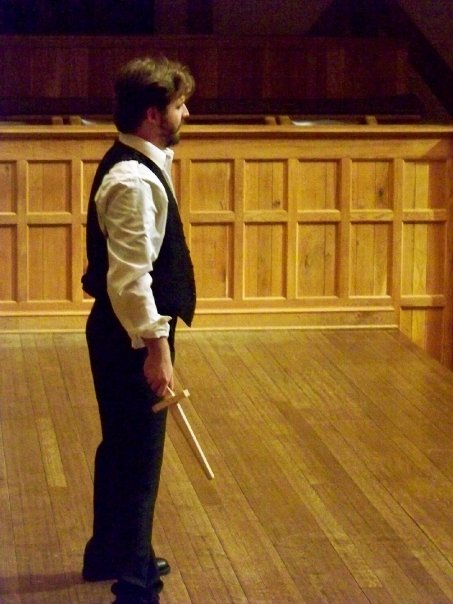
        Macbeth stands alone during the Dagger Speech, Act II, scene i
        Macbeth stands alone during the Dagger Speech, Act II, scene i

        Macbeth sees a bloody dagger that points his way to the king. It’s up to the actor to determine where and what the dagger is: if it is the Witches’ magic, his own psychosis, or a hellish prophesy. Does Macbeth love or fear the dagger? Does it stay in one place or move? Answering these questions and keeping track of the answers makes the speech very hard to do. Here is Sir Antony Sher’s kinetic and frantic version of the Dagger Speech:


  1. 5136_1180295466041_8211516_n“Tomorrow and Tomorrow” Act V, Scene v. This speech is often quoted out of context, given that it has a nearly perfect metaphor for the futility of life: “Life’s but a walking shadow, a poor player who struts and frets his hour upon the stage… it is a tale, told by an idiot, full of sound and fury, signifying nothing.” Since this is the most famous speech in the play, I had to do something different than other Macbeths. What many people forget is that Macbeth says all this when he’s trying to command his army, and gets word that his wife is dead.


I chose to play the speech as a fight within Macbeth to not give into despair. At first he’s furious when he hears the news; he didn’t need this news, especially not today! He tries to suppress his grief, delaying it until tomorrow, but he can’t; now that he knows his wife is dead, his life seems completely pointless, including the battle he was trying to fight. I then gave Macbeth an epithany near the end of the speech: If life is pointless, fighting a battle and dying would be a glorious way to end it! Why not die, after all, life is just “a tale told by an idiot?” At last, Macbeth has a reason to fight again, and he concludes the speech as a call to his soldiers to fight without fear of death. Now, you may disagree with my interpretation, but the point is that it’s mine. I wasn’t trying to imitate Antony Sher, or Laurence Olivier, or Patrick Stewart when they played the part. I was doing my Macbeth, and that’s what made it worth watching.

  1. I also drew some inspiration from this video where Ian McKellen analyzes the imagery and ideas within this speech:http://www.youtube.com/watch?v=zGbZCgHQ9m8


I hope you enjoyed this look into the process of creating this complex and fascinating character. If you’ve played this character before, leave me a comment about your interpretation, or tell me which Macbeth you liked best and why. Finally, below are links to two full-length productions of Macbeth for your viewing pleasure.

The full Ian McKellen production of Macbeth: https://www.youtube.com/watch?v=YpKWWK0Pj34


BBC Macbeth https://www.youtube.com/watch?v=w0LrdOa7uZQ


Benedick and Beatrice’s Infinite (Variety) Playlist

Benedick and Beatrice’s Infinite (Variety) Playlist

This is a game I created for a Shakespeare workshop back in 2012. I would recommend it for any teacher who wants to connect their students to a piece of literature: basically you make a list of songs that A: relate to the personality of a Shakespearean character, and B: relate to moments of the show.

Introduction:

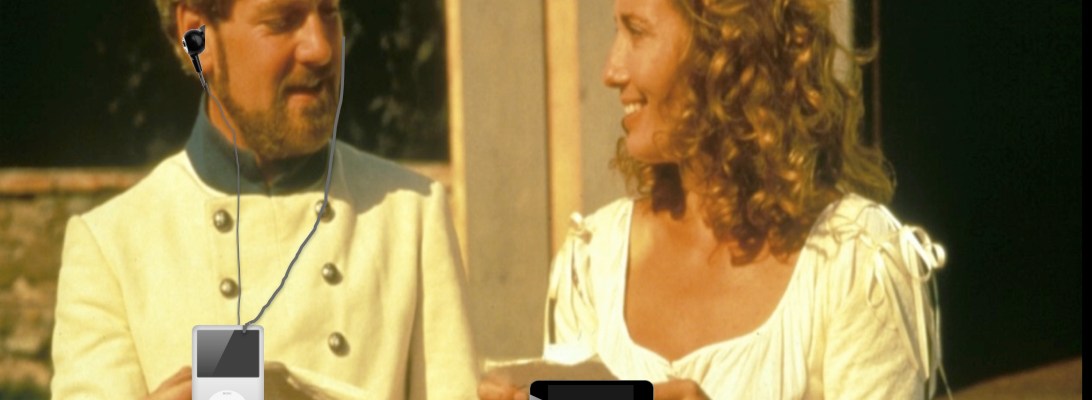
Have you ever met people who go around everywhere with their MP3 players and their earbuds? The kind of people who walk around playing their own personal soundtrack? Well, what do you think would happen if the characters from Much Ado did this, and you happened to glance at Benedick or Beatrice’s iPod? Well that’s what we’re going to pretend in a little game I like to call “Benedick’s Infinite Variety Playlist.” Below is a list of the major events in the play that happen to Benedick. The problem is: they’re all on shuffle. Your job is to figure which song matches which event, put them in chronological order, and submit your answer in the comments below. Later this week, you can play the same game with Beatrice’s playlist. Have fun and remember, as Shakespeare said: “If music be the food of love, play on!”

Events For Benedick in Much Ado About Nothing in random order (Match these with the songs from the playlist below)

  1. Benedick and Beatrice have a brief fling and break up before the play begins
  2. Benedick sees Beatrice and fights with her with his wits.
  3. Benedick dances with Beatrice at the party.
  4. Beatrice insults Benedick mercilessly at the party.
  5. Don Pedro, Claudio, and Leonato claim they overheard Beatrice confessing her love to Benedick.
  6. Benedick decides to be “horribly in love” with Beatrice.
  7. Convinced that Beatrice loves him, Benedick tries to spruce up his appearance.
  8. After the wedding scene, (where Claudio discraces Hero), Beatrice asks Benedick to “Kill Claudio.” Benedick must choose between being Claudio’s friend, and becoming a real man.
  9. Benedick tries to coax Beatrice into admitting that she loves him
  10. Benedick marries Beatrice

Which Shakespeare Edition is Right For You?

What’s the best Shakespeare edition to read? You may not know it, but all of Shakespeare’s plays are contained in just one little book that has been printed and re-printed for 400 years. Today you can find thousands of different versions of Shakespeare for your needs as a student, scholar, or just regular Shakespeare fan, and today I’m here to guide you through some of the most popular! Let’s take a look!

A Little Background:

Shakespeare's First Folio
The original printed edition of Shakespeare’s First Folio, 1623

During Shakespeare’s lifetime, he wrote his plays just for his company to perform. The scripts were distributed among the cast as little rolls of paper that had each actor’s part written on it (this is why an actor’s part is sometimes called his “role”). Sometimes the plays were published when the company wanted to make a little extra money, but they weren’t exactly best-sellers. After Shakespeare died, two actors from his company, John Hemmings and Henry Condell, decided to preserve Shakespeare’s work for all time, printing his plays in a beautiful book called Shakespeare’s First Folio in the year 1623. This book helped preserve 36 of Shakespeare’s plays, 17 of which were never printed before, and would have been lost forever if Hemmings and Condell hadn’t preserved them.

Today some purists say that the only way to read Shakespeare is by reading a facsimile of the First Folio, because it preserves Shakespeare’s original spelling, his stage directions, and the natural integrity of the verse form because of the way it’s printed on the page. To be honest, I see the merit in this, but only for actors and scholars who often need every clue in the text to inspire them to construct creative and inventive interpretations of Shakespeare’s work. However, for first time readers I recommend a modern edition, since the Folio has very few stage directions, and no standard spelling or punctuation, making it very hard to understand. Shakespeare is hard enough to read without love being spelled “loove” all the time.

imgres-1Shakespeare in modern type by Neil Freeman. These editions are the kind i urlmentioned earlier, the ones for Shakespeare Fundamentalists. These are the people who believe Shakespeare left clues for performance in every line, every punctuation mark, and every change in verse. I don’t dispute this view, but I also can’t fully support it because it encourages actors and directors to become slaves to iambic and to never deviate from the rigid construction of Shakespeare’s verse, even if they have a creative reason not to. Even classical musicians must be allowed some form of improvisation. Actors should have the same liberty to interpret the text as they see fit. You can rent or purchase individual versions of the Freeman Folio texts, or purchase the full version of the First Folio in modern type. For sample pages, click here: https://books.google.com/books?.

Editions of T
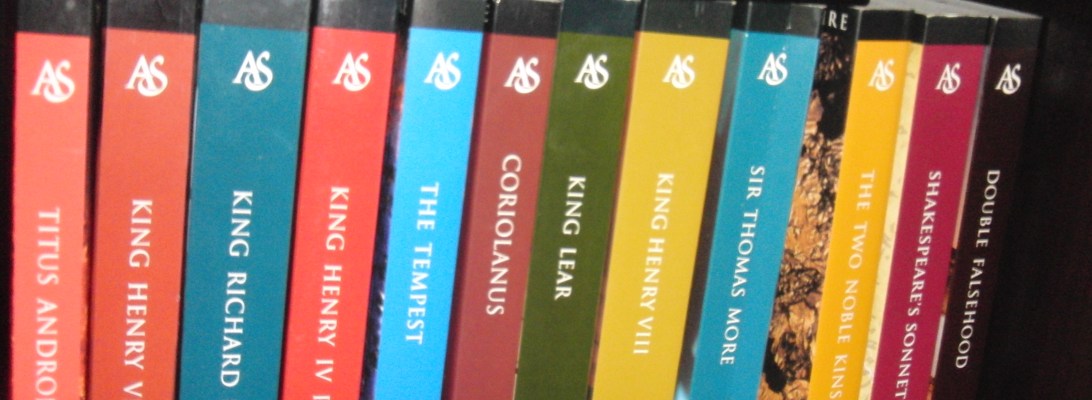
Editions of The Arden Shakespreare

The Arden Shakespeare– For over 100 years, this edition has been a favorite of scholars and actors alike. It focuses on the world of Shakespeare to help you understand the characters by detailing the interpretations directors have favored for the last 400 years. The Arden edition has excellent notes and is great for college students and honors high schoolers. http://www.bloomsbury.com/us/academic/academic-subjects/drama-and-performance-studies/the-arden-shakespeare/

The Norton Shakespeare

The Norton Shakespeare- This version is a more academic version with great notes by the venerated Steven Greenblatt of Harvard University. It focuses on the world of Shakespeare with notes about Elizabethan society, history, poetry, and mythology. I would recommend it for college students and adult readers.

Click here to sample some of this edition: https://books.google.com/books?id=2

Folger Shakespeare Library Edition of Hamlet

The Folger Shakespeare- Edited by the premiere Shakespeare scholarship institution in America: The Folger Shakespeare Libary, this version has very clear and simple explanations for what the characters are saying and has lots of pictures and notes. This version is excellent for high schoolers and is one of the standards in most school districts. Click here to sample some of their work. Be sure to also check out the Folger’s website! http://www.folger.edu/

Penguin Shakespeare: The Winter's Tale
Penguin Shakespeare: The Winter’s Tale

The Penguin Shakespeare– this is probably the cheapest version of Shakespeare. It has a glossary and a few notes, but not as many pictures and clever editor’s notes as the Folger. http://www.amazon.com/s/?ie=UTF8&keywords=shakespeare+penguin+books&tag=googhydr-

No Fear Shakespeare: Macbeth

No-Fear Shakespeare- As I’ve said before, this edition is fundamentally flawed, and I don’t recommend it to anyone. It purports itself to be a “translation” of Shakespeare, when in fact it’s just a loose paraphrase. I don’t agree with most of the choices that the editors put in these editions, and I think it dumbs down Shakespeare too much. In addition, I reject the concept that the plays need a translation- they were written in English, and purporting that a student needs a translation of Shakespeare just makes him or her dependent on this edition and still assume that they cannot understand Shakespeare’s text. So once again, I don’t recommend this version, but if you’d like to check it out, here’s a link below: https://books.google.com/books?

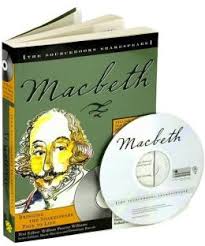
Sourcebook Shakespeare: Macbeth

The Sourcebook Shakespeare– This is my favorite version of Shakespeare to study. They are probably too expensive to use in a classroom, but they really are worth it for a Shakespeare appreciation class. Not only do they have tons of notes and a really reader-friendly layout, each edition also contains a CD with up to 30 scenes and speeches from Shakespearean productions dating back 100 years! These editions focus specifically on how directors and actors have taken the same plays and interpreted them in new and interesting ways. In my view, this combination of reading and listening is one of the purest ways to demonstrate Shakespeare’s versatility, and why we keep reading him today. The same company is also developing versions for iPad to make the experience even more interactive: http://www.sourcebooks.com/blog/

Filthy ShakespeareFilthy Shakespeare- To be honest, this version is really more of a dictionary of naughty topics Shakespeare explored about in his plays, and is really just for entertainment purposes, but I thought I’d mention it anyway. I should of course mention that this version is not for children since it has lots of adult language. Click here for a sample: https://books.google.com/books?id=E523EogqB84C

Thanks for reading this post. If you’d like to learn more about the issues of editing and adapting Shakespeare, check out The Struggle For Shakespeare’s Text by Gabriel Egan. Let me know how you liked this post! I’m also planning on creating a series of audio interpretations of Shakespeare. Stay tuned!

How to read a Shakespeare Play for the first time!

Hi folks! Since this site is basically a Shakespeare appreciation site, I wanted to start off this week by showing you how you can enjoy Shakespeare at the first reading, even if you’ve never read him before! What follows is a list of advice based on the way I myself learned to enjoy Shakespeare, backed up with some nuggets of wisdom I’ve picked up from teachers along the way.
https://youtu.be/knWg6Mf4MiM?feature=shared
I. Learn the Story of the play.
I would argue that the biggest advantage the Elizabethans had over us was they knew the story of the play before they even came into the theater. All of Shakespeare’s plays were adapted from other sources, including myths and fairy tales. A Midsummer Night’s Dream is literally a fairy tale about the Fairy Queen Titania. There was no such thing as “spoiler alert” in Shakespeare’s day, in fact the prologue of “Romeo and Juliet” gives away the ending before the play has begun!
Clearly, Shakespeare wasn’t interested in making his plays a surprise. The thing is that back then audiences didn’t want new stories, they wanted familiar stories told in a new way, the same way we base movies off of comic books and novels. So the first thing you can do to put you on the same level is read the story of the play before hand. Quiz yourself about what happens: who are the characters you should be rooting for? Whom are they fighting against? What is stopping the hero(s) from achieving their goals? This is a rare time when cliff notes and spark notes actually help; learning the story of the play will help you connect with the action on the stage and instead allow you to concentrate on the characters and the language. I also recommend websites like Crash Course that tell the story with a sense of fun.
II. Read the play- the whole thing, (preferably out loud).
The first time you read Shakespeare, you probably won’t get every word, but don’t worry, you’re not supposed to. Every single edition of Shakespeare has a glossary on the opposite page that translates the basic idea of what you’re reading. If you’re a first time reader, I highly recommend the Folger Shakespeare edition, (available at amazon.com). These editions not only have a good glossary, but big, friendly pictures of a lot of the terms. They also have a free online version of Shakespeare’s texts which you can look at here: http://www.folgerdigitaltexts.org/
I would also advise you to read the plays out loud. Shakespeare loved playing with the sounds of words- having characters hiss and bellow and whisper and seduce the ear. Some of the most fun I ever had with Shakespeare was having a Shakespeare reading party with my friends, where we discovered a play by reading it together and playing with voices and accents.
Another option is to listen to the play while you read it. There are great websites like Audible.com and Librivox that allow you to listen to the play spoken by voice actors. Hearing the play will open it up in a way that just reading it can’t After all, the plays are meant to be heard, that’s why they call it an audience (audio- to hear).
Finally, if you go to nearly every public library there’s a recording of The Archangel Shakespeare, a series of CD recordings of professional actors performing every one of Shakespeare’s plays. Many of these performers have done Shakespeare professionally, so you know they know what they’re taking about.
III. Watch a movie. There are hundreds of Shakespeare movies out there, and each one can show you a little bit about how the play feels and looks when it is placed in the hands of an actor or director. You may be expecting some guy in wrinkled tights bellowing his lines in a fake-Elizabethan set, but lots of Shakespeare movies have chosen inventive settings for Shakespeare in different times and places, like Ian McKellen’s Fascist-era Richard III, Michael Hoffman’s 19th century Midsummer Night’s Dream, or my favorite, Julie Taymor’s epic retelling of Titus Andronicus in a fictionalized blend of ancient Rome and modern Italy. A movie allows you to hear the text read, and allows you to see ideas from the play brought to life on the big screen.
IV. Go see it if you can. Almost every major city has a Shakespeare festival, and lots of regional theaters also choose to do Shakespeare. The reason is simple- he’s royalty free, and everyone recognizes his name. As you watch the play, try to answer these questions:
-Which characters did you like?
-Was there a line you really liked or one that seemed to speak to you?
-Did this play remind you of another play or movie? Did it remind you of something from your own life?
V. If I can recommend a good play to start with, start with Å Midsummer Night’s Dream. This play is not only very easy to understand, it’s also charming, funny, romantic, magical, and has a lot of colorful characters. I myself have directed and starred in Dream, and seen no less than 15 productions on stage and screen! If I can quell the fear you may have about Shakespeare, my wife and I directed the play with actors who had never read Shakespeare before, never acted before, and most of them were only 8 years old! So if they can learn this play and grow to love it as much as I do, then I firmly believe you can too!
Helpful hints-
1. Shakespeare’s company performed outdoors in the middle of the day, so they had no control over their environment. All the actors had was a bare stage, costumes, and a couple of props. This is why Shakespeare devotes lots of passages to just tell you where the characters are, and what time of day it is. His is a theater of the imagination, so read the descriptions and let the world come to life in your head.
2. Shakespeare drew heavily on images from Greek/Roman mythology and the Bible. If you need help looking up some of these resources up, I can recommend the Encyclopedia Mythica for Greco-roman references, and the Catholic Encyclopedia for Christian references.
3. There is a glossary of every single word Shakespeare ever used and plenty of books too. In terms of simplicity and ease of use, I recommend http://www.shakespeareswords.com/Glossary.
4. Shakespeare wrote four types of plays – Comedy, History, Tragedy, and Romances.

In Tragedy, the hero dies by the end, and the overall tone is one of change and struggle.
In Comedy, the hero and the heroine usually get married by the end.
The History Plays- are all about a struggle for the English crown and are based on historical chronicles. Most of them conclude in a battle or in the peace after a battle.
Romances– “Romance” is a term invented by scholars to describe some of the last plays Shakespeare wrote that don’t end in death like tragedies, and don’t end as happily as the comedies. One such play has a man get eaten by a bear, and another has a man forced to marry a prostitute! Some scholars don’t like this title, but i keep it here because it’s the most common term for these weird plays that include Cymbeline, Pericles, The Winter’s Tale, and The Tempest.
4. DO NOT READ THE NO-FEAR SHAKESPEARE EDITIONS. These books and websites advertise to be a clear-cut translation of Shakespeare with his text on the left, and a modern translation on the right. I believe these editions don’t do justice to the cleverness of Shakespeare’s writing. For example, here’s the famous speech of Macbeth when he discovers that his wife is dead:
https://youtu.be/pDdhiTvFcFw?si=mMy6zg8gmM9_K9bo

She should have died hereafter.
There would have been a time for such a word.
Tomorrow, and tomorrow, and tomorrow,
Creeps in this petty pace from day to day
To the last syllable of recorded time,
And all our yesterdays have lighted fools
The way to dusty death. Out, out, brief candle!
Life’s but a walking shadow, a poor player
That struts and frets his hour upon the stage
And then is heard no more. It is a tale
Told by an idiot, full of sound and fury,
Signifying nothing.
I’ve actually played Macbeth, and when I saw this speech, I played it as a struggle to deal with the loss of his wife, (the only person he truly cares about), while at the same time dealing with imminent war. Macbeth wants to put off dealing with the news until tomorrow because he can’t possibly handle it now. What’s really cool about Shakespeare is you don’t have to agree with me; you could just as easily interpret the speech as a manifestation of psychosis, of loneliness, or how bitter and unfair Macbeth’s life is and it would still work! That’s why actors and directors love going on and on about Shakespeare; he gives us the freedom to interpret the speech the way we want, as long as we stay true to the basic text. I don’t think anybody could claim that this is a happy speech! The problem is that No Fear Shakespeare makes it too simple, and doesn’t allow you to really consider the possibilities for interpretation. Read their translation of the speech below:

MACBETH
She would have died later anyway. That news was bound to come someday. Tomorrow, and tomorrow, and tomorrow. The days creep slowly along until the end of time. And every day that’s already happened has taken fools that much closer to their deaths. Out, out, brief candle. Life is nothing more than an illusion. It’s like a poor actor who struts and worries for his hour on the stage and then is never heard from again. Life is a story told by an idiot, full of noise and emotional disturbance, but devoid of meaning.

Of course, if you bear in mind the limitations of translating Shakespeare and give yourself the freedom to take it with a grain of salt, that could work too.
So there’s a basic guide for first time readers. Let me know if you agree with my approach, what strategies work for you, and if these techniques were helpful!

For more tips and tricks on analyzing Shakespeare, please sign up for my 30 minute Online Shakespeare class on Outschool.com:

Title card for my Intro to Shakespeare Class

https://outschool.com/classes/8535d86b-c4c5-4c75-aec0-6b43e020ee4e/schedule