Julius Caesar’s success as a politician was deeply tied to his success as a military leader. Therefore studying the Roman army during Caesar’s life helps one understand why he was so popular and why the Senate wanted him dead.
Uniforms of the 10th Legion (Julius Caesar’s Legion) during Caesar’s life, the reign of Augustus, and afterwards.
Caesar was commander (or legatus legionis) of the 10th mounted legion, which means his soldiers were mounted on horseback. Caesar was in charge of maintaining control over the warring tribes in Gaul (modern day France). Each legion was organized into 6 companies (cohorts) of 100 men, led by a Centurian, Source : http://thedioscuricollection.com/ejercito_romano_en.php
Organization of the 10th Legion. As you can see from the key below, each company of 80 to 100 men is led by a Centurian, and each company has 3 Tesserarius (watch commanders)
According to Imperiumromium.com, Caesar helped reform his army, and his Centurians carried out many different campaigns in Gaul:
As you can see, his soldiers were mainly armed with helmets, leather armor, and their large shields and Gladius swords. Below is an exploration of the different parts of the Roman uniform:
One way to learn about Julius Caesar is to learn about the weapons he used as general of on of the most fearsome legions in Rome. In this blade-forging competition from the History Channel, 2 master blacksmiths forge their own versions of a Roman Gladius, and put them to the test!
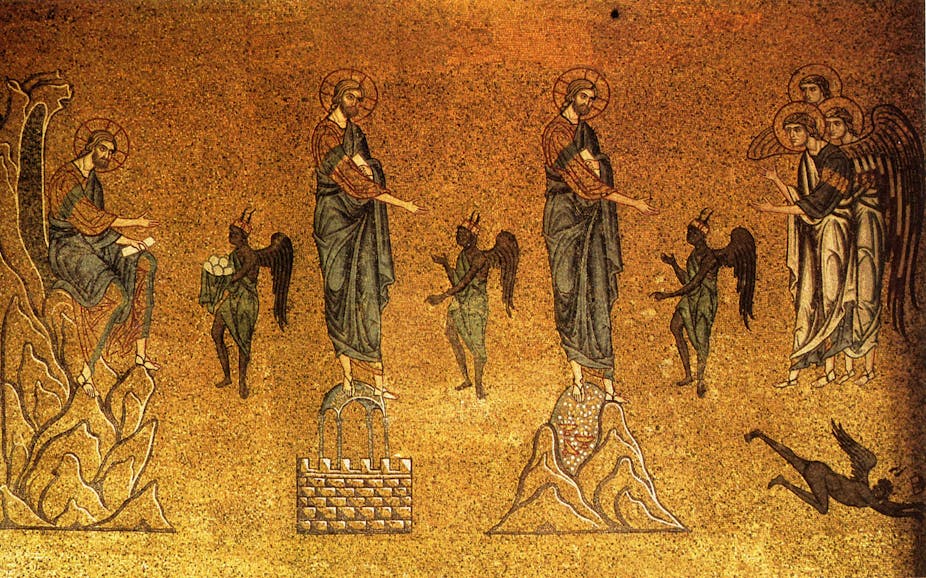
Forty days in the wilderness: Temptations of Christ, St Mark’s Basilica.
According to the Christian calendar, today (Tuesday) is Shrove Tuesday AKA fat Tuesday, AKA pancake day, AKA Fasnacht Day, (if you live in Pennsylvania ) It is the season that commemorates the time when Jesus Christ fasted in the desert for 40 days, before the holy week of Maudlin Thursday, Good Friday, and Easter Sunday. It is a time when believers give up a material comfort like sweets or fat, and meditate on Christ’s journey from Heaven to Earth and back.
Every aspect of the Easter story from Christ’s entry to Jerusalem to the Holy Thursday celebration of the Last Supper, to his death on the cross on Good Friday has been ritualized by the Catholic and many Protestant churches. Incidentally, Holy Thursday is determined by the Jewish calendar, which is in itself coordinated by the Paschal moon, the last full moon before the Vernal Equinox.
Growth and fertility; pain and pleasure, privation, and excess, things dying and things born. These extreme states of being and the dramatic stories of Christ’s passion are, of course, very good theater, so it’s no wonder that Shakespeare would choose to incorporate the themes and motifs of Shrove Tuesday into his plays.
Shakespeare and Shrove Tuesday
Peter Bruegel the Elder- The Fight Between Shrove Tuesday and Lent, 1559. Notice on the left there is a pancake supper and a rotund man playing a song on a stringed instrument, while on the right there is an emaciated woman wearing an austere head covering.
Shakespeare Loved Pancakes!
Shakespeare uses a lot of Christian imagery and theology in all of his plays but he also specifically refers to Shrove Tuesday, with its pancake suppers, use of theatrical disguise, and carefree attitude. He also refers to Lent, and the threadbare and lean times it represents.
In a general sense, a lot of Shakespeare’s plays deal with the swinging back-and-forth of Time, where society is simultaneously getting ready to purge itself of sin and deny itself pleasure. I thought I’d explore that by taking a look at some examples of text Shakespeare that deal with these themes.
First, let’s talk about Shrove Tuesday; in As You Like It, Touchstone makes reference to eating pancakes, traditional food for Shrove Tuesday in a lot of Christian communities. There are variations like donuts and fasnachts, but the idea is to eat up the fat and oil in your house. This is because to begin the start of length a time when Christians are supposed to abstain from fat, people would use the remaining oil and butter in their houses to have pancake suppers.
This modest pancake supper is one tradition of Shrove Tuesday, but there are many more elaborate ones. Shrove Tuesday goes by many names, but the most extreme and extravagant pre-Lent celebration is, of course, Mardi Gras. The celebration of Mardi gras in New Orleans is an offshoot of the Shrove Tuesday tradition, which is why it is often celebrated as an extravagant party with food, drink, and sometimes lewd behavior. Sometimes, Mardi Gras celebrations even incorporate Shakespeare plays as a theme:
Masks and Mardi Gras
As you can imagine getting the chance to purge yourself from sin and do things that you wish you wanted to do might make you a bit self-conscious, which is why traditionally in a lot of cultures mardi gras is celebrated by the wearing of masks. With a mask, revlers can hide their faces, and adopt an extreme personality, and indulge in dancing and drinking. Venice is another city famous for its Mardi Gras celebrations, and Shakespeare uses this tradition heavily in his play The Merchant Of Venice.
Shakespeare’s debt to Italy
Many of Shakespeare’s comic characters are directly inspired from character types created in a form of Italian comedy called “Commedia Del’Arte-” The Comedy of Art. These were short improvised vignettes where performers donned masks and acted improvised skits. Each actor spent years learning the voices and mannerisms of these stock characters like the scheming maid, (Columbina) the crafty servant (Arlequinno or Harlequin), or the greedy, dishonest innkeeper Brighella, who might have influenced Shylock himself. If you click on this website, there are some great scholarly articles about Commedia’s influence on Shakespeare, and how these characters helped forge all of his comedies, not just Merchant Of Venice.
Masks and Venetian culture
As this video from the Youtube historian Metatron explains, Commedia masks were just one of the masks that were front and center in Merchant Of Venice. Masks were part of Venetian society, not just during Carnival, which allowed Shakespeare to make masks part of the plot of Merchant Of Venice.
It’s not explicitly said, but I believe Shakespeare sets Act II of The Merchant Of Venice during a Carnival masquerade revel, where young men danced through the streets wearing masks. This might very well be during a carnival celebration, which means the play might very well be taking place during the twin seasons of Easter for Christians and Passover for Jews. This might very well be what Shakespeare was intending, as this clashing of religious dogma is at the heart of the play.
Shylock isn’t the only Commedia inspired character in Merchant. There’s also Graziano, Bassanio’s wild and raunchy friend. In this speech, he deftly parodies the duelling concepts of Shrove Tuesday and Lent, by promising to be austere, wise, and virtuous tomorrow, but not tonight, when he and his friend Lorenzo will be walking through the streets in their masks.
Bassanio. Why then you must. But hear thee, Gratiano;745
Thou art too wild, too rude and bold of voice;
Parts that become thee happily enough
And in such eyes as ours appear not faults;
But where thou art not known, why, there they show
Something too liberal. Pray thee, take pain750
To allay with some cold drops of modesty
Thy skipping spirit, lest through thy wild behavior
I be misconstrued in the place I go to,
And lose my hopes.
Gratiano. Signior Bassanio, hear me:755
If I do not put on a sober habit,
Talk with respect and swear but now and then,
Wear prayer-books in my pocket, look demurely,
Nay more, while grace is saying, hood mine eyes
Thus with my hat, and sigh and say 'amen,'760
Use all the observance of civility,
Like one well studied in a sad ostent
To please his grandam, never trust me more.
Bassanio. Well, we shall see your bearing.
Gratiano. Nay, but I bar to-night: you shall not gauge me765
By what we do to-night.
Bassanio. No, that were pity:
I would entreat you rather to put on
Your boldest suit of mirth, for we have friends
That purpose merriment. But fare you well:770
I have some business.
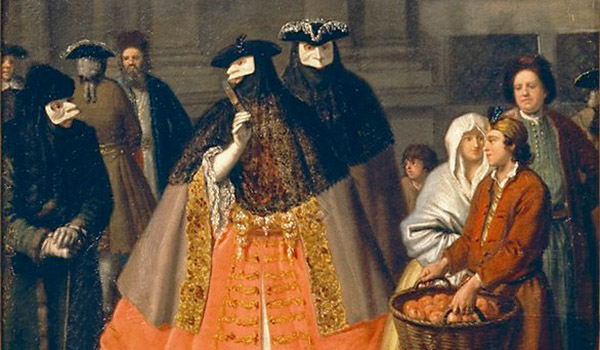
Detail, Conversation between Baute Masks, by Pietro Longhi (1701-1785); Museo Del Settecento Veneziano
While Gratziano and his friends are playing masquerade outside, Shylock instructs his daughter Jessica to shut up his doors and do not let the maskers in, or even look at them.
Merchant of Venice, Act II, Scene v.
It’s entirely possible that the play itself might very well conclude around the time of Easter which is especially significant considering that it ends with a scene that inverts, subverts, and questions the Passion story of Jesus.
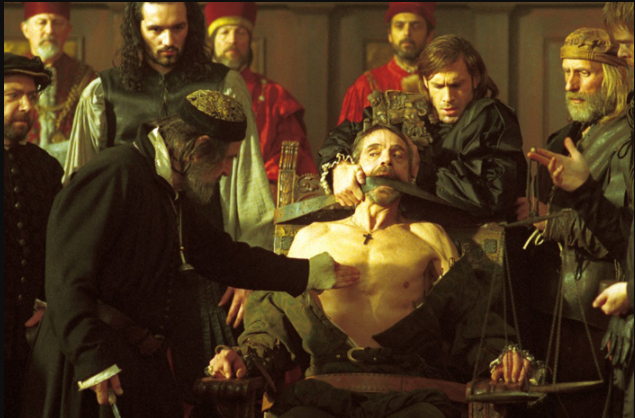
The courtroom scene from Merchant of Venice is almost a Passion Play in itself, where Shylock attempts to take a pound of flesh from the Christian Antonio, (who gives it as willingly as if he were Christ himself). Even though Jesus was crucified by Romans, for millennia the Jews were blamed for his death, and Shakespeare uses this anti-semetic imagery where Shylock stands in for the austerity of Mosaic law, rejecting the concept of divine Grace. Meanwhile, Portia is playing the judge, and she utters a poignant speech about mercy with almost God-like eloquence. This scene illustrates the established theological basis of Lent and Easter. According to Christian theology, the whole point of Lent is to remember and celebrate Christ’s sacrifice where we are redeemed from our sins. As she says, “We do pray for mercy, and that same prayer teaches us to render the deeds of mercy.” In a way, the sinful nature of mardi gras is not just a purging of human sin, it is also a way of acknowledging how far we fall short of God’s perfect ideals.
In that sense, Mardi Gras and Carnival are not a flouting or a rejection of Christian theology; it’s a reinforcement of it. Christians indulge in sin and acknowledge their sins the next day on Ash Wednesday, where they don black clothes and become contrite and this is our way of remembering Christ’s sacrifice and how necessary it was.
However, Shakespeare doesn’t have Antonio die like Christ, instead, it is Shylock the Jew who will metaphorically die and be reborn; he will convert to Christianity (and thus be dead to his former community), and his riches will give stability to Jessica and Lorenzo when Shylock dies. Shylock’s punishment at the end of the play is intentionally harsh and cruel, and many scholars have shown it as a demonstration of the limits of Christian mercy. Like the masks they put on every day, Venetian Christians seem pure and pious, but are inwardly corrupt and degenerate.
Shakespeare and Lent
You might have noticed that I used the word “purge” repeatedly in reference to what people do on carnival and mardi gras as a way of releasing their sins. The Purge movies do in fact have a basis in this concept. Traditionally the flowers that are part of purge days are actually given at Shrove tide. The Purge is also traditionally celebrated in mid March around the time of the vernal equinox, so the purge movies are a more extreme version of mardi gras, with the belief that the one illegal tendency people would indulge in alloed, would be murder, (which is a very bleak comment on human society).
What’s interesting is that Shakespeare creates his own sort of purging of society in his play Measure For Measure, and he creates a villain who is very much like an embodiment of um of lentin But
no man can is without sin and no and it is incredibly dangerous to assume that 1 Possibly making fun of her clothing and possibly also calling her a whore or a prostitute that that um you see it was traditional to eat Is the food a drink length until It’s a sexual It’s not as enjoyable and probably lower quality than the norm normal because of course the tradition of lent is a tradition of self denial and and in measure for measure he creates a character who is obsessed with his own piety and self denial the character of the judge Angelo in measure for measure he is a judge who is known for his piety and a society that is that it’s become too loose too loose to carnival ish and he is charged by the Duke who has chosen to Leave Vienna to with to become more dracodian to become more our strict and and legalistic and punish people use the fear of the law in order to command good behavior he sets the same standards for everybody else that he does for himself and that’s why the central conflict of the play is between him and Isabella whose brother who hasn’t committed any sins on stage but her brother Claudio is guilty of adultery well not no not guilty of adultery hes technically guilty of fornication in that he has consummated his marriage with the Woman before proceeding with the marriage rituals that I mentioned in my most recent Romeo Juliette portpost so hes being punished by 4 and a Kate for fornication fornication in in the the strictest and most technical definition of fornication he loves this woman he has made a pledge for her to be his wife legally they are married but it’s not good enough unless they make a formal request they get the consent of the parents and they and they are and they have a marriage ceremony performed in a church unless he does all of those things in Angelo’s mind he is guilty of fornication So you can see that Angelo has a stricter nature than most people would permit themselves and he is utterly and the concept of mercy is just as alien to hit him as it was to Shylock the main difference between the 2 characters that’s Angelo heights behind Christian piety not Jewish piety Ione and he turns out to be even more morally degenerate than Shylock because he is it is he is trying to manipulate uh manipulate Isabella in order to get her to sleep with him he wants to sleep with a nun because he thinks he deserves her he thinks that she is a reward for his piety
Angelo forgot what any person who celebrates mardi gras and ash Wednesday does that the purpose of lent is to remind ourselves that we are human know that we need mercy and to celebrate the sacrifice the Christ made so that we can continue to be human and not try to utter utterly lady destroy our imperfections that make us human so measure for meta The diconomy between Lynton and and a boccanelli or carnum Leonora carnival’s morals morals and in the end Isabella emerges from that crucible Victorious she defeats Angelo she exposes him as a failure as a failure she failure she ransoms her brother almost as definitely as Christ renziming humanity humanity and in the end she is offered the chance to either become a nun as she wanted or to become the Duke’s wife and therefore Queen of the whole country Taking a face value it looks like it seems like a fairy tale ending where this is the sort of person who should be governing somebody whose morality is tempered with mercy but but Shakespeare’s play is much Messier than that if you actually read it or see it performed formed it has Siri it’s a racist serious questions about how helpful oh helpful this this particular concept the concept is to women especially since Particularly when it comes to failings of the Flash in most productions I’ve seen you’ve Jew seen Juliet in measure for measure to for measure is as mocked and as disdained and is the and abused it’s viewed as Claudio is and Is life a reputation which is really all a woman had back in this period so Shakespeare does a good job of of showing the virtues of letting and carnival in Is illings of such rules it’s all very well and good to say we are allowed to be human man but very often women are set to higher standards than the men when it comes to if comes to standards of purity and piety
No hare, sir; unless a hare, sir, in a lenten pie, that is something stale and hoar ere it be spent. [Sings] An old hare hoar, And an old hare hoar, Is very good meat in lent But a hare that is hoar Is too much for a score, When it hoars ere it be spent. Romeo, will you come to your father’s? we’ll to dinner, thither.
–Mercutio, Romeo and Juliet
Lent and Measure FOr Measure
Conclusion
the Lenten season probably appealed to Shakespeare because much like “Twelfth Night” it is a season that momentarily subverts and then enforces the status quo. People indulge themselves in debauchery briefly, then commit themselves whole-heartedly to sobriety and piety. It shows the tendency towards the extreme in human nature, whether it be the grotesque, the sinful, the lusty, or even the austere. Like the masks at Carnival, we find these extremes of nature fascinating to watch as they dance before us and therefore, they also make for very good drama.
Juliet (Hailey Steinfield) marries Romeo in the 2013 movie version of “Romeo and Juliet.”
We all know that Romeo and Juliet married in secret because their feuding families made it impossible for them to publicly profess their love, but would it have been like if they were able to have a proper Italian Renaissance Wedding? As opposed to the small, intimate wedding that you see in the 2013 clip above, a wedding in 1590s Italy was a much more involved, lavish, and expensive affair.
During the Renaissance period marriages, (which were also mergers), were potentially explosive moments, and lavish festivities may have diffused some of the tensions that might arise between families over dowry arrangements and other touchy subjects. The bridal procession might even face dangers from hostile mobs or individuals, as suggested by a Florentine statute from 1415, which forbade the throwing of stones or garbage at the home of the couple. Wedding processions were often compared to ancient triumphal processions. The idea of the wedding as a triumph is reflected in the imagery on cassoni (marriage chests) panels such as Apollonio di Giovanni’s Triumph of Scipio Africanus, known in several versions.
Deborah L. Krohn The Bard Graduate Center November 2008
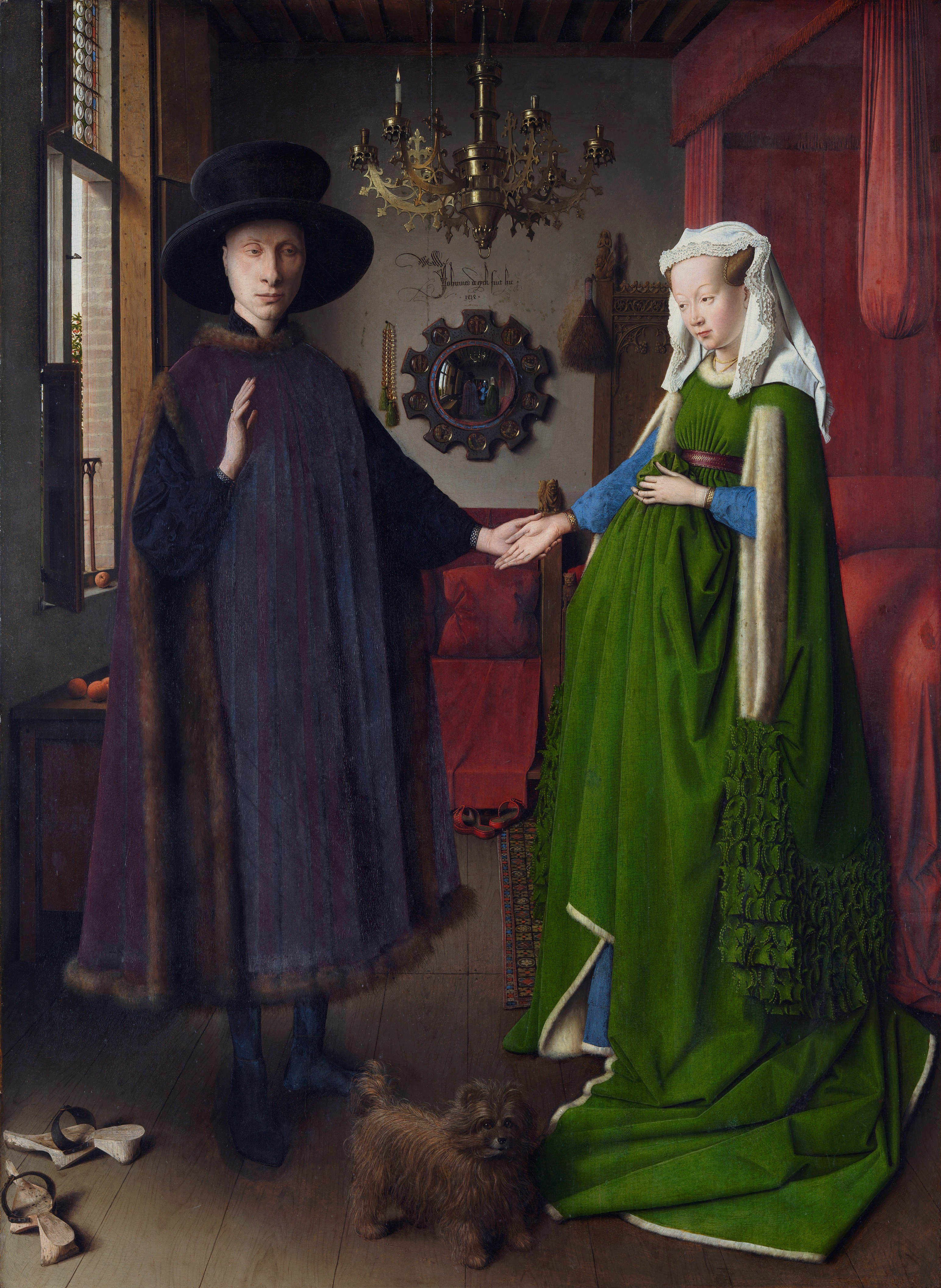
An Italian wedding had four rituals that were highly elaborate and each required a lot of food, drink, special clothes, and music. Part of the reason for this verbose process was the belief that marriage was simultaneously an economic arrangement, a formal promise of fidelity and affection, and a sacrament blessed by the church. In the article, “The Arnolfini Betrothal,” from the University of California, Hall traces the evolution of these ideas from pre-Christian Roman marriage traditions, and 17th century, Roman-catholic Italian tradition:
European ideas about marriage were profoundly influenced by ancient Roman precedent. Because intent was the most basic principle of Roman law, the great jurisconsults of the second and third centuries logically held that marriage was concluded by the consent of the parties, and Ulpian’s concise expression of this view, “Not cohabitation but consent makes a marriage,” came to be included among the legal maxims of the final section of the Digest in Justinian’s codification of the Roman law.[2] Roman lawyers termed this matrimonial consent affectio maritalis, or “conjugal affection,” by which they meant, not some momentary expression of assent as part of a marriage rite, but rather a continuing mental state, shared by the partners. From a juridical point of view, this permanent emotive condition constituted the marriage. The Digest also envisioned marriage in ideal terms as a lifelong association of husband and wife for the procreation of legitimate children. But if affectio maritalis ceased to exist, the requisite legal consent no longer prevailed, and a divorce could easily be arranged.[3]
The
The Impalmamento– The joining of hands, a sort of ritual engagement
The Sponsalia- The formal betrothal ceremony (a promise of marriage)
The Matrimonium– The wedding contract and procession
The Nozze- The church ceremony and feast!
The Cassone
One of the best ways I can illustrate that a wedding in Italian Renaissance Italy was essentially a socio-economic merging of families is to look at the custom of the cassone- an ornately carved box that the groom gave to the bride to keep her needlework and other possessions. It symbolized the transition from living in her parent’s house to her new husband’s house, and how essentially, she was a possession that was bought by the groom and taken to his home. To see more examples of a cassone, visit this website:
If Juliet had chosen to marry Paris instead of Romeo, the cassone would’ve made it abundantly clear to her that, just as Paris says: “Thy face is mine,” he feels he has bought her, money, body, and soul, and taken her and this elaborate casket to his home, till death do they part.
Impalmamemnto
The verb impalmare is equivalent to pledging one’s troth and originates from an old custom according to which the groom, as a confirmatory token of his marriage promise, grasped, touched, or poked the right hand or palm
of his future wife. Impalmamento signifies an engagement, a promise of marriage, specifically, as a confirmation of prior agreements, it signifies the early phase of the
Much like how in Britain, handfasting rituals served as a serious promise or engagement of marriage, the Sponsalia was a formal promise of marriage before the actual ceremony. Incidently, according to “A History Of Matrimonial Institutions by George Elliott Howard, Romeo and Juliet’s marriage went this far, but no farther. This kind of promise of marriage had legal authority but was not recognized officially by the church. It also didn’t require witnesses or parental consent (Howard 339). A Sponsalia marriage could also only be dissolved if the bride or groom became a priest or nun, which is exactly what Friar Laurence offers to do for Juliet once Romeo dies:
Come, I’ll dispose of thee Among a sisterhood of holy nuns: Stay not to question, for the watch is coming; Come, go, good Juliet, [Noise again] I dare no longer stay.
— Romeo and Juliet, Act V, Scene 3
Friar Laurence (Paul Rycik) tries to save Juliet (Alesia Lawson) after she finds Romeo dead. (Ashland University 2007).
Today, this would be the equivalent of getting a marriage license at city hall, rather than having a marriage ceremony.
matrimonium
Li emergenti bisogni matrimoniali – namely, the urgent necessity at the outset of marriage to adorn brides with extravagant clothing and jewelry, to decorate the nuptial chamber, and to arrange wedding festivities – entailed sizable expenditures of capital on the part of new husbands and their kin in Renaissance Florence. In a legal opinion written in 1400, the Florentine jurist Philippus de Corsinis observed that “even before sexual intercourse, it is necessary for the husband to shoulder the expenses for his wife’s clothing and other accessories, as well as other expenses related to the wedding.”2 In another opinion, Paulus de Castro, who taught and practiced law in early-fifteenth-century Florence, emphasized that in both Florence and Bologna the outfitting of the bride and expenses for the wed-ding consumed the whole dowry even before the couple had exchanged marriage vows and rings.-
Source: Kirshner, Julius. “2. Li Emergenti Bisogni Matrimoniali In Renaissance Florence”. Marriage, Dowry, and Citizenship in Late Medieval and Renaissance Italy, Toronto: University of Toronto Press, 2018, pp. 55-73. https://doi.org/10.3138/9781442664517-005
Wedding dress and bridegroom dress
Nozze
The wedding feast
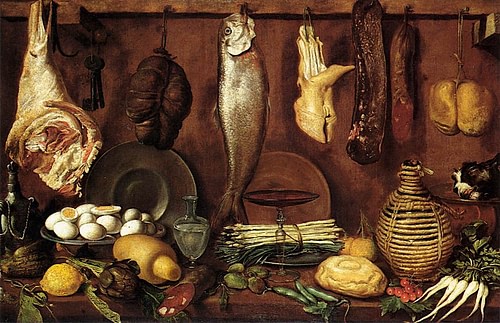
16th century still life.
Since marriages were affairs for two families, their friends, etc. A wedding feast was a very involved and elaborate affair. On the Dutch Cooking site, ” Coquinaria” I found a reproduction of a summer wedding feast from 1546:
The menu for Wednesday 18 August 1546, on a meat day during Summer
Antipasti – Melloni (watermelons), cascio vecchio Parmigiano (old Parmesan cheese), quaglie arroste (grilled quails), vua moscatella (muscadines), crostate di piccioni (pie with pigeons), capretto (kid), limoni trinciati (cut lemons). Alesso – Anadrine (duck?), capretto (again kid, or a mistake), pollastri stuffati con presciutto (stuffed chicken with ham), agresto (verjuice), sauor di verzure(sauce with greens?).
Frutte – Visciole con le suppe (morellos in soup -with bread), cascio marzolino (cheese from March?), pere (pears), persiche in vino (peaches in wine), nocchie (hazelnuts), finocchio (fennel).
Below is a recipe card I made with one of the recipes I found on the site:
3. Krohn, Deborah L. “Weddings in the Italian Renaissance.” In Heilbrunn Timeline of Art History. New York: The Metropolitan Museum of Art, 2000–. http://www.metmuseum.org/toah/hd/wedd/hd_wedd.htm (November 2008)
4. Hall, Edwin. The Arnolfini Betrothal: Medieval Marriage and the Enigma of Van Eyck’s Double Portrait. Berkeley: University of California Press, c1994 1994. http://ark.cdlib.org/ark:/13030/ft1d5nb0d9/
6. Kirshner, Julius. “2. Li Emergenti Bisogni Matrimoniali In Renaissance Florence”. Marriage, Dowry, and Citizenship in Late Medieval and Renaissance Italy, Toronto: University of Toronto Press, 2018, pp. 55-73. https://doi.org/10.3138/9781442664517-005
7. Muusers, Christianne: A Recipe for Italian Crostini from the 16th Century: . Published online January 28th, 2005. https://coquinaria.nl/en/panunto/
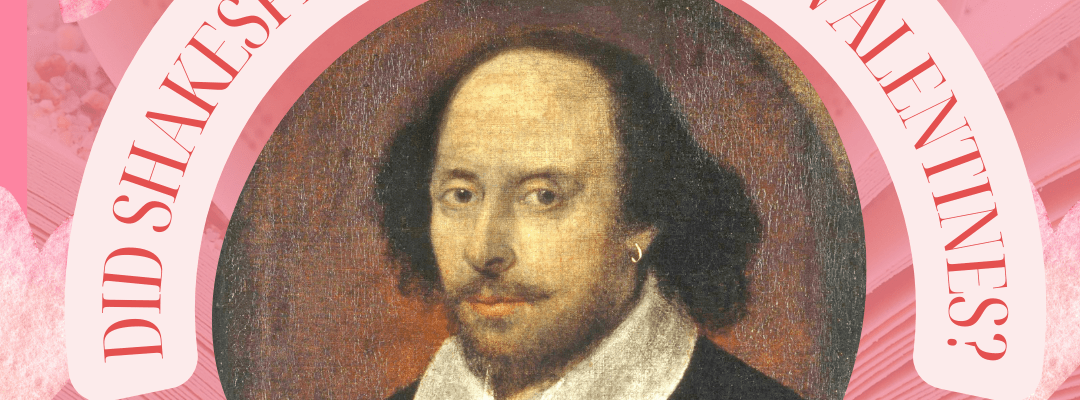
You probably know that I love to speculate and do a little historical detective work and find out whether Elizabethans like Shakespeare celebrated our modern holidays and then compare and contrast how they celebrated them back then versus how we do today. Valentine’s Day is a day we associate with love and poetry, so of course, I wondered if the most celebrated poet of the Renaissance celebrated it himself!
Based on my findings, if Shakespeare celebrated Valentine’s Day, he probably did mainly what we did- writing letters and poems to his beloved and maybe sending a trinket of love. It’s unlikely he celebrated it like modern Catholics do to honor the martyrdom of a Catholic saint. In my research, I was surprised to learn that Valentine’s Day has been celebrated for hundreds of years and has its roots in a holiday that Shakespeare describes in one of his most famous plays.
Part I: The Feast of Lupercal: Valentine’s Day’s Dark Ancestor
According to NPR’s podcast: “The Dark Origins of Valentine’s Day”, like Christmas, Halloween, and many other holidays, the Christian holiday of St. Valentine’s day was designed to replace the pagan holiday of Lupercal, which was a Roman fertility festival where men engaged in basically what we’d now call- swingers’ parties or key parties where they’d draw a woman’s name from a lottery and… couple for the night.
The Lupercal was also synonymous with the founding of Rome. Lupa is the name of the wolf that saved the infants Romulus and Remus, who would become the first kings of Rome. If you click here, you can read an article about a recent archeological discovery; a cave found under Rome that was once revered as the place where Romulus and Remus lived with Lupa:
Shakespeare actually starts his play of Julius Caesar on the Lupercal, and makes reference to its status as a fertility festival. In Act I, Caesar is watching Antony run a race and tells him to be sure to touch Calpurnia, owing to the superstition that if a man touches a barren woman on Lupercal, it will make her capable of bearing children:
Caesar. Calpurnia!
Calpurnia. Here, my lord. 85
Caesar. Stand you directly in Antonius' way,
When he doth run his course. Antonius!
Antony. Caesar, my lord?
Caesar. Forget not, in your speed, Antonius,
To touch Calpurnia; for our elders say, 90

The barren, touched in this holy chase,
Shake off their sterile curse.
Antony. I shall remember:
When Caesar says 'do this,' it is perform'd.
Caesar. Set on; and leave no ceremony out. Julius Caesar, Act I, Scene ii, Lines 84-95
Shakespeare leaves out that, according to tradition, Antony should be naked and anointed with goat’s blood and slap Calpurnia with a goatskin thong, but that was part of the Roman Lupercal festival.
St. Valentine was either a Catholic priest or bishop who was martyred in the 3rd century AD (Source History.com). According to tradition, he conducted Christian marriages in defiance of Roman law, and rejected the concept of Lupercalian coupling, which is why Emperor Claudius murdered him. Thus, the holiday is intentionally meant to replace Lupercalia, and celebrate monogamous relationships under the Christian God. The popular story is that before his death, he sent a letter to the young daughter of a family he converted to Christianity and signed it: “Your Valentine,” thus starting the tradition of signing cards in this manner. In the 5th century, Pope Gelasius made Valentine’s day an official Catholic feast day to replace Lupercal once and for all.
Part III: The oldest surviving Valentines
Evidence is sketchy on how the traditions of Valentine’s Day evolved, in the Middle Ages, but in Catholic Europe, the concept of celebrating married love on Valentine’s Day spread, and poets like Chaucer and Shakespeare helped popularize it.
Geoffrey Chaucer wrote in the 14th century of how birds would choose their mates on Valentine’s Day:
For this was sent on Seynt Valentyne's day
Whan every foul cometh ther to choose his mate.
According to History.com, there’s a possibility that Chaucer invented the idea of a St. Valentine’s feast, and forever linked it with the celebration of love:
The medieval English poet Geoffrey Chaucer often took liberties with history, placing his poetic characters into fictitious historical contexts that he represented as real. No record exists of romantic celebrations on Valentine’s Day prior to a poem Chaucer wrote around 1375. In his work “Parliament of Foules,” he links a tradition of courtly love with the celebration of St. Valentine’s feast day–an association that didn’t exist until after his poem received widespread attention. The poem refers to February 14 as the day birds (and humans) come together to find a mate.
This theme has been repeated in other pieces of literature. In John Lydgate’s 15th-century poem, “A Valentine to Her that Excelleth All”, he writes of how it was the custom on Valentine’s Day for people to choose their love:
To look and search Cupid’s Calendar and choose their choose by great affection.
John Ludgate: “”A Valentine to her that Excelleth All”
The Paston’s oldest surviving valentines
In the 1470s in a series of correspondence, from Margery Brews to her husband John Paston refers to the latter as “My right well-beloved Valentine, John Paston, Esquire.”
Margery also wrote adoring letters to John, who was probably away frequently, fighting in the Hundred Years War, and advising Margary’s kinsman, John Fastolfe, (whom Shakespeare mentions in Henry VI, Part I. Her poetry is very tender and must have comforted her husband much:
And if ye command me to keep me true wherever I go,
I wis I will de all my might you to love, and never no mo(re).
And if my friends say, that I do amiss,
They shall not me let so for to do,
Mine heart me bids ever more to love you
Truly over all earthly thing,
And if they be never so wrath
I trust it shall be better in time coming.
Margery’s letters are some of the earliest surviving Valentine’s poetry. Her letters prove that the tradition of giving poetry to one’s beloved during February was around in the 15th century, and probably while Shakespeare was a child in the 16th.
Shakespeare’s contributions to Valentine’s Day
Shakespeare mentions Saint Valentine’s Day twice in his works. In A Midsummer Night’s Dream, (a play that is set in Ancient Greece and has connections to Lupercal), he builds on Chaucer’s claim that Valentine’s Day is the day that birds couple for the night. Duke Theseus and Aegeus discover the four lovers asleep. They are surprised that they are sharing the same ground, since Lysander and Demetrius (as far as the old men know), are rivals for Hermia’s affection.
Good morrow, friends. Saint Valentine is past: Begin these wood-birds but to couple now?
— A Midsummer Night Dream, Act IV, Scene ii.
Egeus. My lord, this is my daughter here asleep; And this, Lysander; this Demetrius is; This Helena, old Nedar’s Helena:1685 I wonder of their being here together. Theseus. No doubt they rose up early to observe The rite of May, and hearing our intent, Came here in grace our solemnity. But speak, Egeus; is not this the day1690 That Hermia should give answer of her choice? Egeus. It is, my lord. Theseus. Go, bid the huntsmen wake them with their horns. [Horns and shout within. LYSANDER, DEMETRIUS,] HELENA, and HERMIA wake and start up]1695 Good morrow, friends. Saint Valentine is past: Begin these wood-birds but to couple now?
Shakespeare has a much darker reference to Valentine’s Day in Hamlet:
Ophelia has gone mad with the loss of her brother, her father, and Hamlet breaking her heart. She starts wandering the castle and can only communicate through songs. She sings a very melancholy song that alludes to the superstition that if two single people meet on the morning of Saint Valentine’s Day they will likely get married: Tomorrow is Saint Valentine’s Day, All in the morning betime, And I a maid at your window, To be your Valentine. Then up he rose And donned his clothes And dupped the chamber door Let in a maid then out a maid Never departed more.
Ophelia seems to be darkly admitting that she and Hamlet have had pre-marital intimate relations and she is no longer a virgin, The song implies that Ophelia entered Hamlet’s chamber a maid (that is, an unmarried virgin), but is let out a maid (unmarried), while the Hamlet very clearly has taken her virginity. Hamlet re-enforces this suspicion by commanding her to go to a nunnery, one of the only recourse for single mothers. It is reasonable to assume that Shakespeare is implying that Ophelia is in fact pregnant, and is driven mad with sorrow that she now has to deliver her baby without any form of support from her father (who is dead), from her brother (who is in France), or her baby’s father, who wants her to leave and never return. Ophelia’s song is a lament that she wishes the superstition were true, and Hamlet had indeed married her.
It’s unlikely that Shakespeare celebrated Valentine’s Day as a religious holiday, after all, Queen Elizabeth had made England a Protestant country. Celebrating a saint day could have been seen as idolatrous in Protestant England. Nevertheless, Shakespeare and other romantic writers helped transform Valentine’s Day into less of a religious holiday, and more as a secular celebration of love and monogamy, very different from its bloody, promiscuous roots.
Happy Groundhog’s Day Everybody. Since today is all about doubling and big realizations (seeing your shadow, meeting your long-lost twin), I thought I’d repost my old post on “The Comedy Of Errors,” the definition of Double Trouble!
Have a good groundhog’s day, and remember, spring will be here before you know it!
Have a good groundhog’s day, and remember, spring will be here before you know it!
Have a good groundhog’s day, and remember, spring will be here before you know it!
Have a good groundhog’s day, and remember, spring will be here before you know it!Have a good groundhog’s day, and remember, spring will be here before you know it!Have a good groundhog’s day, and remember, spring will be here before you know it!Have a good groundhog’s day, and remember, spring will be here before you know it!Have a good groundhog’s day, and remember, spring will be here before you know it!Have a good groundhog’s day, and remember, spring will be here before you know it!Have a good groundhog’s day, and remember, spring will be here before you know it!Have a good groundhog’s day, and remember, spring will be here before you know it!Have a good groundhog’s day, and remember, spring will be here before you know it!Have a good groundhog’s day, and remember, spring will be here before you know it!Have a good groundhog’s day, and remember, spring will be here before you know it!Have a good groundhog’s day, and remember, spring will be here before you know it!Have a good groundhog’s day, and remember, spring will be here before you know it!Have a good groundhog’s day, and remember, spring will be here before you know it!
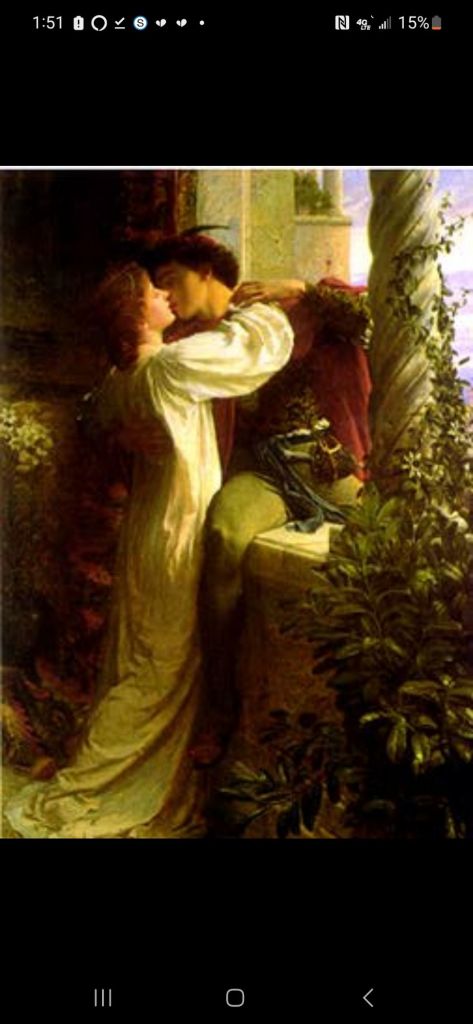
Costumes from thr 1968 Romeo and Juliet FilmOlivia Hussey as Juliet, 1968.“Romeo and Juliet” by Francis Dicksee, 1884.Juliet- Glibe Theater 2007
I’ve seen four live productions of Romeo and Juliet, (5 if you include West Side Story). I’ve also watched four films (6 if you include West Side Story and Gnomio and Juliet) and one thing that I’ve noticed again and again, and again is that you can tell the whole story of the play with clothing. This is a story about families who are part of opposite factions whose children secretly meet, marry, die, and fuse the families into one, and their clothes can show each step of that journey.
The feud Nearly every story about a conflict or war uses contrasting colors to show the different factions. Sometimes even real wars become famous for the clothes of the opposing armies. The Revolutionary War between the redcoats and the blue and gold Continentals, the American Civil War between the Rebel Grays and the Yankee Bluebellies. In almost every production I’ve ever seen, the feud in Romeo and Juliet is also demonstrated by the opposing factions wearing distinctive clothing.
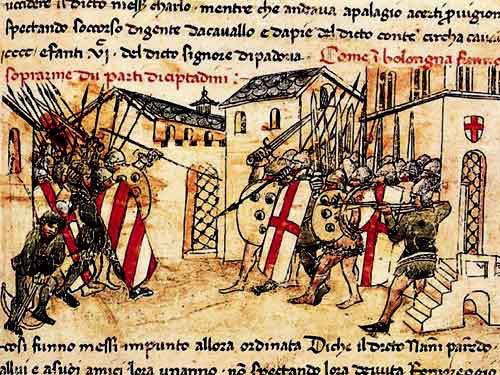
Historically, warring factions in Itally during the period the original Romeo and Juliet is set, wore distinctive clothes and banners as well. . In this medieval drawing, you can see Italians in the Ghibelline faction, who were loyal to the Holy Roman Empire, fighting the Guelph faction (red cross), who supported the Pope. Powerful families were constantly fighting and taking sides in the Guelf vs. ghibelines conflict in Verona, which might have inspired the Capulet Montegue feud in Romeo and Juliet.
Even the servants of the nobles got roped into these conflicts, and they literally wore their loyalties on their sleeves. The servants wore a kind of uniform or livery to show what household they belonged to. The servants Gregory and Sampson owe their jobs to Lord Capulet, and are willing to fight to protect his honor. Perhaps Shakespeare started the play with these servants to make this distinction very obvious. Here’s a short overview on Italian Liveries from the Metropolitan Museum of Art:
In 1966, director Franco Zepherelli set a trend with his iconic use of color in his movie. He chose to make the Capulets wear warm tones while the Montegues wore blue and silver. Juliet (Olivia Hussey) wore a gorgeous red dress that made her look youthful, passionate, and lovely, while Tybalt (Michael York), wore red, orange, and black to emphasize his anger, and jealousy (which has been associated for centuries with the color orange). By contrast, the Montagues like Romeo (Leonard Whiting) wore blue, making him look peaceful and cool. These color choices not only clearly indicate who belongs to which contrasting factions, but also help telegraph the character’s personalities. Look at the way these costumes make the two lovers stand out even when they’re surrounded by people at the Capulet ball:
Dance scene from the iconic 1968 film of Romeo and Juliet, directed by Franco Zeffirelli.Poster for “Gnomio and Juliet, 2011
Zepherilli’s color choices were most blatantly exploited in the kids film Gnomio and Juliet, where they did away with the names Capulet and Montegue altogether, and just called the two groups of gnomes the Reds and the Blues.
The Dance
To get Romeo and Juliet to meet and fall in love, Shakespeare gives them a dance scene for them to meet and fall in love. He further makes it clear that when they first meet, Romeo is in disguise. The original source Shakespeare used made the dance a carnival ball, (which even today is celebrated in Italy with masks). Most productions today have Romeo wearing a mask or some other costume so that he is not easily recognizable as a Montague. Masks are a big part of Italian culture, especially in Venice during Carnival:
In the 1996 movie, Baz Luhrman creates a bacchanal costume party, where nobody wears masks but the costumes help telegraph important character points. Mercutio is dressed in drag, which not only displays his vibrant personality but also conveniently distracts everyone from the fact that Romeo is at the Capulet party with no mask on.
Capulet is dressed like a Roman emperor, which emphasizes his role as the patriarch of the Capulet family. Juliet (Claire Danes) is dressed as an angel, to emphasize the celestial imagery Shakespeare uses to describe her. Finally, Romeo (Leonardo DiCaprio) is dressed as a crusader knight because of the dialogue in the play when he first meets Juliet:
Romeo. [To JULIET] If I profane with my unworthiest hand
This holy shrine, the gentle fine is this:720
My lips, two blushing pilgrims, ready stand
To smooth that rough touch with a tender kiss.
Juliet. Good pilgrim, you do wrong your hand too much,
Which mannerly devotion shows in this;
For saints have hands that pilgrims' hands do touch,725
And palm to palm is holy palmers' kiss.
Romeo. Have not saints lips, and holy palmers too?
Juliet. Ay, pilgrim, lips that they must use in prayer.
Romeo. O, then, dear saint, let lips do what hands do;
They pray, grant thou, lest faith turn to despair.730
Juliet. Saints do not move, though grant for prayers' sake.
Romeo. Then move not, while my prayer's effect I take.
Thus from my lips, by yours, my sin is purged.
Juliet. Then have my lips the sin that they have took.
Romeo. Sin from thy lips? O trespass sweetly urged!735
Give me my sin again.
Juliet. You kiss by the book. Romeo and Juliet, Act I, Scene V, Lines 719-737.
Notice that Romeo calls Juliet a saint, and later an angel in the famous balcony scene, which explains her costume at the ball. Juliet refers to Romoe as a Pilgrim, which is a cheeky comment on his crusader knight costume. In the Crusades, crusader knights made pilgrimages to the holy land, with the hope that God (and presumably, his angels) would forgive their sins. Romeo’s name even means “Pilgrim.” Luhrman makes clever nods to Shakespeare’s text by dressing Romeo and Juliet in this way, and gives the dialogue a bit of a playful roleplay as the characters make jokes about each other’s costumes- Romeo hopes that he will go on a pilgrimage and that this angel will take his sin with a kiss.
In Gnomio and Juliet, the titular characters meet in a different kind of disguise. Rather than going to a dance with their family, they are both simultaneously trying to sneak into a garden and steal a flower, so they are both wearing black, ninja-inspired outfits. Their black clothing helps them meet and interact without fear of retribution from their parents (since they do not yet know that they are supposed to be enemies. The ninja clothes also establishes that for these two gnomes, love of adventure unites them. Alas though, it doesn’t last; Juliet finds out that Gnomio is a Blue, when they both accidentally fall in a pool, stripping their warpaint off and revealing who they are.
Trailer for “West Side Story,” (2021) directed by Steven Spielberg.
Sometimes the dance shows a fundamental difference between the lovers and the feuding factions. West Side Story is a 20th-century musical that re-imagines the feuding families as juvenile street gangs, who like their Veronese counterparts, wear contrasting colors. The Jets (who represent the Montagues) wear Blue and yellow, while the Sharks (Capulets), wear red and black. The gang members continue wearing these colors on the night of the high school dance, except for Tony and Maria (the Romeo and Juliet analogs). In most productions I’ve seen, (including the 2021 movie), these young lovers wear white throughout the majority of the play, to emphasize the purity of their feelings, and their rejection of violence. Thus, unlike Shakespeare’s version of the story, West Side Story makes the lovers unquestionably purer are more peaceful than Shakespeare’s Romeo and Juliet, and their clothing makes this clear.
Romeo (John Warren), meets Juliet (Alesia Lawson) in the 2010 Ashland University production of “Romeo and Juliet,” directed by Ric Goodwin.
The Merging of the family (8:30-11:00)
Costume Designer Charlene in the 2006 AU production deliberately had the characters change clothes when they get married. Juliet was wearing the same iconic red dress as Olivia Hussey for the first two acts of the play but then changed into a pale blue gown that matches Romeo. The clothes re-enforce the idea that the marriage represents Romeo and Juliet abandoning their family’s conflicts, and simply showing their true colors.
Two sets of costumes for Juliet in the 2006 Ashland University Production. Pull the slider bar left to see how Juliet’s costume changes from the start of the show to the end.
Another way of getting everyone in the family to subconsciously unite in grief would be to costume everyone wearing black except Romeo and Juliet. At the end of the play, The Capulets are already mourning Juliet, (because she faked her death in Act IV), and the Montegues are already mourning Lady Montegue (who died offstage). Just by these circumstances, everyone could come onstage wearing black, uniting in their grief, which is further solidified when they see their children dead onstage.
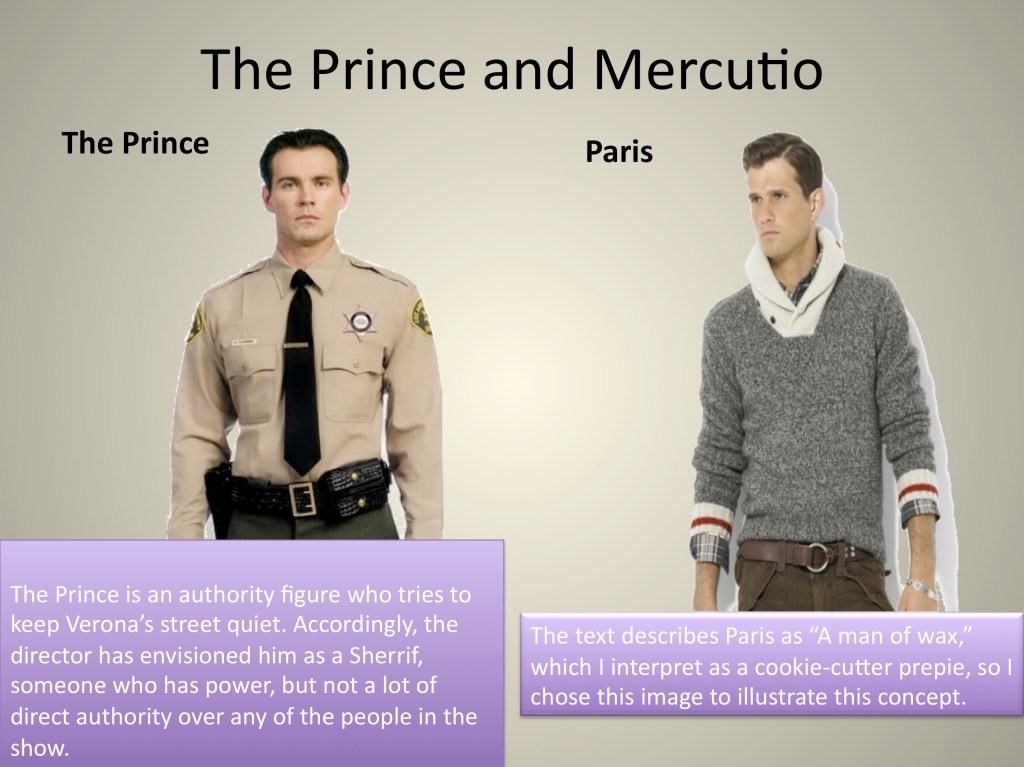
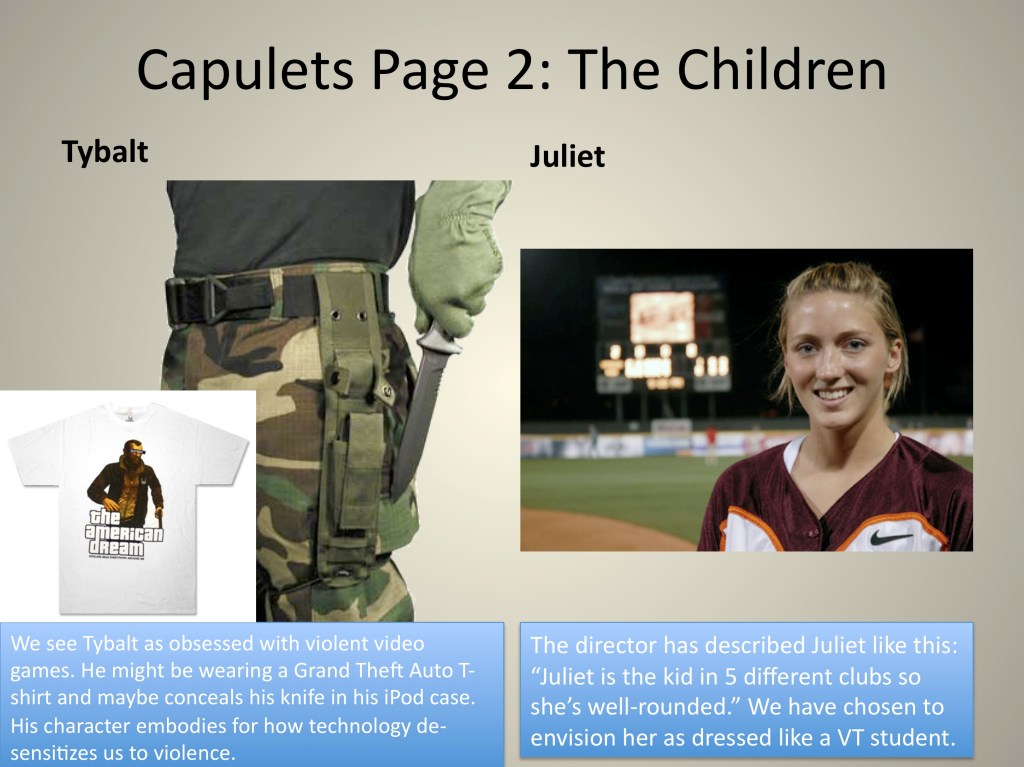
Not all productions choose to costume the characters like warring factions, but nevertheless, any theatrical production’s costumes must telegraph something about the characters. In these production slides for a production I worked on in 2012, the costumes reflect the distinct personality of each character and show a class difference between the Montagues and the Capulets.
The 2013 Film: Costumes Done Badly
The 2013 movie is more concerned with showing off the beauty of the actor’s faces, and the literal jewels than the clothes:
Most of the actors and costumes are literally in the dark for most of the film, probably because the film was financed by the Swarofski Crystal company, who literally wanted the film to sparkle. Ultimately, like most jewelry, I thought the film was pretty to look at, but the costumes and cinematography had little utilitarian value. The costumes and visual didn’t tell the story efficiently, but mainly was designed to distract the audience with the beauty of the sets, costumes and the attractive young actors. The only thing I liked was a subtle choice to make Juliet’s mask reminiscent of Medusa, the monster in Greek Myth, who could turn people to stone with a look. I liked that the film was subtly implying that love, at first sight, can be lethal.
As I said in my “Is Shakespeare Being Cancelled?” post, there is a long tradition of using Shakespeare as the epitome of creative arts, especially in England. For centuries, British imperialists have justified their subjugation of other cultures by claiming that English culture is superior, and Shakespeare became an unknowing cog in the machinery of cultural imperialism.
Since it is pretty much impossible to de-throne Shakespeare, one response that other cultures have used is to elevate their own artists to Shakespearean status. People are already calling Lin-Manuel Miranda the American Shakespeare, and there have been many other Shakespeares around the globe (Feng). Thre’s nothing wrong with this; after all, every culture has its own cultural heroes and they help embody what is important to that culture, which is why it’s fascinating to ponder the question- what makes someone The Chinese Shakespeare?
One other response to cultural imperialism is of course, to reject it, and since its inception, the Communist Party has sought to exclude, belittle, and suppress access to Western imperialist art. Shakespeare was banned during the Cultural Revolution of the 1960s, and even today the Communist Party is quicker to praise Chinese artists as being “Shakespearean,” than to praise Shakespeare directly. Just last year, President Xi Xinping officially declared that poet Tang Xianzu was “The Chinese Shakespeare.”
To be fair, Tang XIanzu was Shakespeare’s contemporary and there are some startling similarities between the themes and ideas expressed by the two poets:
China has produced some wonderful ballets, operas, and poetry so even though the government has suppressed Shakespeare in the past, the Chinese people have expressed a love of Shakespeare for over a century. As early as 1903, Chinese intellectuals started reading and translating Shakespeare and the first Chinese adaptation of Shakspeare was a rhymed ballad version of Romeo and Juliet’s balcony scene written by Deng Yizhe in 1910 (Sun, 1932). Today productions of Shakespeare are very popular in China and Shakespeare has facilitated a fascinating cultural exchange between east and west.
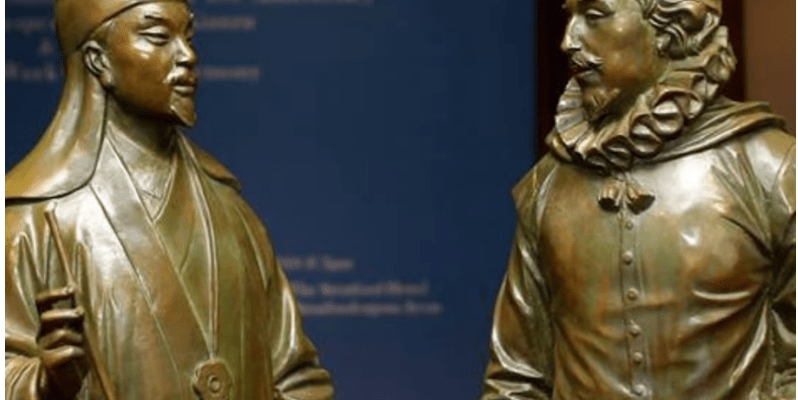
In addition to Chinese students encountering Shakespeare in the classroom, and the popularity of theater productions of Shakespeare in China, there are some fascinating efforts for English and Chinese speaking audiences to use Shakespeare as a bridge to cultural understanding. Right now, plans are underway to build a replica of Shakespeare’s birthplace in the southern Chinese city of Fuzhou. Meanwhile in Stratford Upon Avon, the government of Fuzhou gave a statue of Tang Xianzu to be featured prominently in the garden of the actual Shakespeare birthplace on Henley Street (Woodings).
Professor, Sir Stanley Wells, Honorary President of the Shakespeare Birthplace Trust with Wu Jianchun, Executive Vice Mayor of Fuzhou Municipal Government stand in front of a stature of Shakespeare and Tang Xianzu.
In addition, Royal Shakespeare Company Artistic Director Greg Doran, (former husband of the great RSC actor Antony Sher), has spearheaded a number of outreach projects designed to translate Shakespeare’s The Tempest into a format better suited for theater productions in China. The final show, which premiered in 2018, was not only a successful collaboration between east and western artist, but the production, with its themes of freedom and liberty, was likely to ruffle feathers in the Chinese government, according to (Yuan Yang).
Gallery of photos from the RSC’s translation of “The Tempest,” which premiered in Beijing at the National Center For the Performing Arts in 2018.
In Xi’s closely controlled China, The Tempest’s themes of liberty and identity clearly carry political ideas at odds with the ruling party — “thought is free”, the sprite Ariel sings. The implicit challenge to the status quo extended from the ideas to the production itself at the National Centre for the Performing Arts in Beijing. It offered new freedoms to the Chinese actors from the centre’s in-house theatre ensemble. Under the guidance of director Tim Supple, this was the first time they had been invited to experiment with performance and alter the text.
Yuang Yang. “The Bard in Beijing: how Shakespeare is subverting China”
To sum up, every culture has been exposed to Shakespeare, and many have found ways to re-interpret him, appropriate him, and use him as a tool of cultural exchange. This is neither good nor bad, it just is. What is interesting is that China has taken Shakespeare from a tool of imperialism into a tool of both multiculturalism, and subversion of their government. Studying the way other China and cultures have interpreted Shakespeare is a window into the values of those cultures and thus helps to further build a global community.
Below is a scene from a Chinese opera version of Hamlet for your viewing pleasure!
























 The Shakespearean Student