Shakespeare on Riots

Today is March 15th, a day that history still bewares, because of the infamous day when armed, violent conspirators went to the Senate and attempted to overthrow elected rulers. For obvious reasons, this put me in mind of the heinous actions of another group of conspirators stormed another Senate and tried, unsuccessfully, to overthrow democracy.

January 6th, 2021 (which, coincidently, was Twelfth Night, one of my favorite Shakespeare-themed holidays), was a tragedy for multiple reasons. The protestors broke windows, destroyed furniture, defaced statues, broke into both chambers of Congress, and probably would have harmed lawmakers, in a violent protest of both the US presidential election and the Senate vote in Georgia that week.


Let me be clear, this was sedition and treason and everyone involved should be prosecuted to the full extent of the law. Anyone who says otherwise is blatantly attacking our cherished democracy, and spitting in the face of the rule of law. Unfortunately, Republicans in both chambers have been unwilling to condemn their actions for fear of alienating their base. If this is what the Republican party has come to, the party doesn’t deserve the name. A republic protects the right of the people to elect its representatives and dedicates itself to the peaceful transition of power. Left unchallenged, groups like this will bring anarchy and tyranny to our country.

How do I know this? Because it happened before. Shakespeare has long dramatized real historic events where people rise up against their governments (for better or worse). In all cases, whether protesting a famine, a war, or a cruel tyrannical usurper, the riots never accomplish anything except bringing chaos and bloodshed. Sometimes these ignorant rioters are goaded by charismatic powerful figures, but these upper-class characters are only exploiting the rioters, using their violence as a way to get power for themselves. So, let’s examine the language, tactics, and effects of rioters in three of Shakespeare’s plays: Julius Caesar, Henry VI Part III, and Sir Thomas More:

Example 1: Julius Caesar

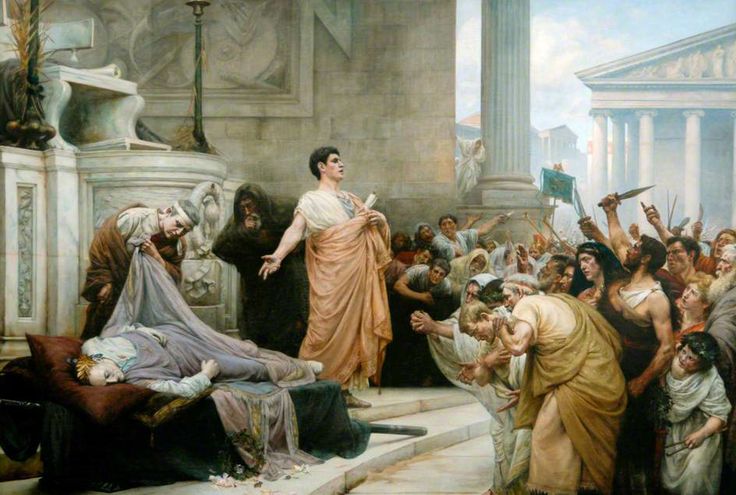
George Ed Robertson Antony
(c) Hartlepool Museums and Heritage Service; Supplied by The Public Catalogue Foundation

As I covered before in my “Friends, Romans, Countrymen,” post, during Antony’s famous funeral speech, he galvanizes the Roman crowd, first to mourn Caesar, then to revenge his death. How do they do this? By burning the houses of the conspirators and rioting in the street. They even kill a man just because he has the same name as one of the conspirators:

https://www.rsc.org.uk/shakespeare-learning-zone/julius-caesar/story/timeline

What does this violence accomplish? Nothing. Caesar is still dead. Brutus is still alive (though on the run). Antony merely wished to punish Brutus, and get the mob to hate him while he secretly cheats them out of their money. In Act Four, Antony becomes the de facto ruler of Rome because he leveraged his performance at the funeral, and uses his newfound powers to take money away from the citizens that Caesar promised to give them in his will. He manipulated them for his own purposes and duped them for political power.

Example 2: Jack Cade in Henry VI, Part ii.

Henry VI is the only king in English history to be crowned twice, deposed twice, and buried twice (Saccio 91). As the play begins, King Henry has already lost France, lost his mind, and lost the respect of his people. Around 1455, John Hardyng wrote a contrast between Henry’s father and himself. He laments that Henry the Fifth died so soon and then exhorts Henry to keep the quarrelsome lords in his government from warring among themselves.

Withstand, good lord, the outbreak of debates.
And chastise well also the rioters
Who in each shire are now confederates
Against your peace, and all their maintainers
For truly else will fall the fairest flowers
Of your great crown and noble monarchy
Which God defend and keep through his mercy.

(Excerpt from Harding’s Chronicle, English Historical Documents, 274).

Henry’s political ineptness was why Richard of York challenged his claim to the throne. Though Richard had little legal claim as king, he believed himself to be better than Henry.

In Shakespeare’s play Henry VI, Part ii, York tries to get the people’s support by engineering a crisis that he can easily solve. York dupes a man named Jack Cade to start a riot in London and demand that the magistrates crown Cade as the true king.

Biography of Richard, Duke of York, who challenged King Henry VI for his right to be king.

York and Cade start a conspiracy theory that Cade is the true heir to the throne and the royal family suppressed his claim and lied about his identity. Cade starts calling himself John Mortimer, a distant uncle of the king whom York himself admits is long dead:

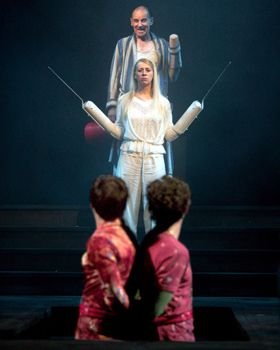
The Royal National Theater’s production of Henry VI, Parts II, and 7. Jack Cade appears at about the 7-minute mark.
And this fell tempest shall not cease to rage
Until the golden circuit on my head,
Like to the glorious sun's transparent beams,
Do calm the fury of this mad-bred flaw.
And, for a minister of my intent,
I have seduced a headstrong Kentishman,
John Cade of Ashford,
To make commotion, as full well he can,
Under the title of John Mortimer.

Just like Cade and his rebels, the January 6th rioters were motivated by lies and conspiracies designed to crush their faith in their legitimate ruler. Even more disturbing, these rioters are pawns in the master plan of a corrupt political group. York doesn’t care that Cade isn’t the real king; he just wants to use Cade’s violence as an excuse to raise an army, one that he can eventually use against King Henry himself.

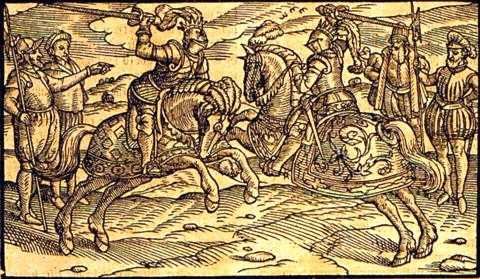
15th century woodcut from the War Of the Roses.

Similar to York’s lies and conspiracy-mongering, many Republicans have refused to accept the legitimacy of Joe Biden’s election, and some are actual proponents of Q Anon conspiracies!

A lot of Republicans deserve blame for fanning the flames of rebellion on January 6th, but arguably former President Trump deserves most of the blame. Even Rush Limbaugh admitted that Trump spread a huge amount of conspiracy theories without believing in any of them. He does this because he wants Americans to be afraid of imaginary threats that he claims he can solve. What’s easier to solve than a problem that doesn’t exist? Much like York, Trump tried to hold onto power by pressuring his supporters to pressure the Capital, feeding them lies about election fraud, and a secret democratic Satanic cult. Thus radicalized, they resolved to do what Cade’s mob did: “Kill all the lawyers.” Unfortunately, there are a lot of lawyers in the Senate.

As Dick the Butcher points out, most people don’t actually believe Cade is truly John Mortimer, they are just so angry at the king and the oppressive English government, that they are willing to follow him in a violent mob to take their vengeance upon the monarchy. This is why they try Lord Saye and execute him just for the crime of reading and writing! Similarly, the mob attacking the capital was made up of die-hard conspiracy adherents, and people just angry at the Democratic Party.

https://www.washingtonpost.com/technology/2021/01/20/qanon-trump-era-ends/

Like I said before, Cade and his mob is just a pawn in the machinations of York. Eventually the king’s enforcer, Lord Clifford convinces most of them to abandon Cade, and Cade himself dies a humiliating death- on the run from the law and starving, Cade is murdered by a farmer after trying to steal some food. After Joe Biden became the 46th President, many of the conspiracy group Q-Anon, who had many prominent members in the January 6th riot, began to disbelieve and abandon the conspiracies of the group. However, as this news story shows, some Q-Anon supporters are die-hard adherents and will never abandon their conspiracy theories, and some, like York’s supporters, are being recruited by other extreme groups. Sadly, as York shows, sometimes a riot is a rehearsal for another riot. In Shakespeare’s Henry VI, Part III, York finally amasses an army and challenges the Lancastrians in all-out war. Hopefully, the US government will hunt down and arrest these violent insurrectionists before they have the chance to do the same.

Example 3: Sir Thomas More

In the unfinished play “Sir Thomas More, a racist mob again attempts to attack London. This time they have no political pretenses; they want to lynch immigrants who they believe are taking English jobs. As I said in my “Who Would Shakespeare Vote For?” post, More’s speech is a perfect explanation of why this behavior cheapens and denigrated a country’s image, and weakens its ability to command respect from the rest of the world. Last time I posted a video of Sir Ian McKellen speaking this speech, but this time.. well just watch:

Crafting a Character: Brutus

Happy Ides of March every one. I hope you have enjoyed all the posts for my Roman week. If I have time, I will try to post a few more, since I have not touched on Cymbaline or Titus Andronicus.This will not be an in depth character analysis. I won’t go into every scene and speech of Brutus’. My goal is to look at the history and the actions of Brutus in the play to show why he is such an amazing and ambigous character.

Marcus Brutus was born in 85 BC. Shakespeare’s source for the play, Plutarch’s lives of the Noble Greeks and Romans, mentions that his desire to kill Caesar might have been tied to his family: Brutus’ ancestor was Lucius Junius Brutus, the man who drove out the last king of Rome, and first consul. Below is the famous painting of Lucius foiling a plot to restore the monarchy, but to do so, he had to sentence his own sons to death:

Jaques Louis David, The Lictors Bring to Brutus the Bodies of His Sons, 1789.

https://www.khanacademy.org/humanities/monarchy-enlightenment/neo-classicism/v/david-the-lictors-returning-to-brutus-the-bodies-of-his-sons-1789

This was how seriously the Brutus family took defending the Roman Republic, they valued it even beyond their own family.

Brutus’ mother was Servilia, half sister of Caesar’s longtime critic, the senator Cato. He even married Cato’s daughter Portia! So you can see that once Caesar starts acting like a king, Brutus must have felt a tremendous amount of pressure from his Family to stay true to his Republican ideology. On the other hand, Servillia was actually Caesar’s mistress and Brutus owed his life to Caesar. After Brutus fought against Casesar, they reconciled after the Battle of Pharsalus in 48 BC:

Most of those who were taken alive Caesar incorporated in his legions, and to many men of prominence he granted immunity. One of these was Brutus, who afterwards slew him. Caesar was distressed, we are told, when Brutus was not to be found, but when he was brought into his presence safe and sound, was pleased beyond measure- Plutarch, retrieved from: http://penelope.uchicago.edu/Thayer/E/Roman/Texts/Plutarch/Lives/Caesar*.html

Despite his close ties to Caesar, Brutus chose to betray and assassinate him, so the question remains, why?

In the play and in Plutarch, Brutus is persuaded by Cassius Longinus, his brother in law and colleague in the Roman Senate. As you remember from my post on “Friends, Romans, Countrymen,” there are three basic kinds of persuasive speech, and Cassius uses all three:

1. Ethos “If you do know that I do fawn on men, and hold them hard, and after scandal them… then hold me dangerous.”

2. Logos- Cassius points out a series of embarrassing stories about Caesar that set up the following argument:

• Caesar is weak and frail

• Gods cannot be frail

• Why is Caesar treated like a god?

3. Pathos

• The people

• Fear of tyranny

• Brutus’ family honor- this is the real knife that kills any doubt Brutus had. Cassius reminds Brutus of his ancestor Lucius and how he would rather die than see a king in Rome again.

The soliloquy

Brutus. It must be by his death: and for my part,
I know no personal cause to spurn at him,

But for the general. He would be crown’d:
How that might change his nature, there’s the question.
It is the bright day that brings forth the adder;
And that craves wary walking. Crown him?—that;—
And then, I grant, we put a sting in him,
That at his will he may do danger with.
The abuse of greatness is, when it disjoins
Remorse from power: and, to speak truth of Caesar,
I have not known when his affections sway’d
More than his reason. But ’tis a common proof,
That lowliness is young ambition’s ladder,
Whereto the climber-upward turns his face;
But when he once attains the upmost round.
He then unto the ladder turns his back,
Looks in the clouds, scorning the base degrees
By which he did ascend. So Caesar may.
Then, lest he may, prevent. And, since the quarrel
Will bear no colour for the thing he is,
Fashion it thus; that what he is, augmented,
Would run to these and these extremities:
And therefore think him as a serpent’s egg
Which, hatch’d, would, as his kind, grow mischievous,
And kill him in the shell.

• This speech is a direct predecessor for “To be or not to be,” and Macbeth’s “If it were done,” soliloquy. https://youtu.be/IoDwXjKIenI

  • All three speakers are talking about murder and can’t bring themselves to say either the word murder, nor mention the name of the man who will die.

• All references to murder are in passive voice, as if Brutus wishes a lightning bolt would kill Caesar, so he doesn’t have to accept the responsibility of killing.

•Compared to Hamlet and Macbeth, Brutus’ text is flat, The speech depends on the actor to show the torment in his soul.

  • One question that the actor must answer for himself is, is Brutus really concerned for the well being of Rome, or does he want Caesar dead for another reason?

After the soliloquy, Brutus throws himself into the role of head conspirator: https://youtu.be/ibzqdoV-BcU https://youtu.be/ibzqdoV-BcU

You can see in this video that Brutus speaks eloquently about how just the cause is and how only Caesar will die. This illustrates that Brutus is well spoken but not pragmatic. As we all know, Marc Anthony eventually gets the crowd to turn on Brutus and will become part of the army that hunts him and Cassius down. The dramatic irony is what helps the argument that Brutus is the real tragic hero of this play.

The murder and its aftermath

The rest as they say, is history. On March 15th, 44 BC, Brutus and the conspirators stabbed Caesar 17 times. In the play, before Caesar dies, he utters the famous line, “Et tu, Brute? Then fall Caesar!”

The line stands out because it is the only time anyone in this Roman play speaks in Latin. Now, I have heard a compelling argument from Professor J. Rufus Fears, that this might actually be a misquote, and what Caesar really said will amaze you. As I have mentioned, Brutus’ mother was Caesar’s mistress and the two of them were very close. At the time of Caesar’s death he was 40, while Caesar was 16 years his senior. Why did Caesar forgive Brutus fighing against him? Is it not possible that what he actually said was: “Et tu, son?” That’s a question for directors and actors, but it does heighten Brutus’ emotional conflic. Much like his ancestor Lucius, Marcus Brutus is caught between his ideals and his family.

During the funeral, Brutus has a very well crafted speech where he lays out his reasons for killing Caesar. He sets himself up as the friend of Rome. This video from the Royal Shakespeare Company explores the techniques that Brutus uses to get the crowd on his side: https://youtu.be/nyPlvuv8SSk

After Antony makes his speech however, the mob burns Brutus’ house and even slaughters a man just because he shares a name with one of the conspirators. Brutus and Cassius take their armies and flee Rome, and prepare to take on Antony and Octavian. The adversity Cassius and Brutus go through pushes them together and they behave like brothers; they fight and reconcile constantly: https://youtu.be/K9EAxjVC22M

In a way, these men are two sides of the same coin: Cassius is fiery but pragmatic while Brutus is stoic and idealistic. It’s like a tragedy in and of itself that these men weren’t melded into one man with Brutus’ heart and Cassius’ mind.

Is Brutus A Traitor?

Unlike Macbeth, Shakespeare’s text leaves it ambiguous as to whether Brutus was right or wrong to kill Caesar. Even Antony, who leads an army against him, ends the play by calling Brutus “The noblest Roman of them all.” Shakespeare also gives us few clues to Brutus’ motivations other than the speech I quoted earlier. Mainly we have to go on Brutus’ actions and their consequences.

One moment that I think perfectly encapsulates the ambiguity of Brutus’ actions is the moment where he’s visited by Caesar’s ghost. In other tragedies like Macbeth and Richard III, the villain is tormented by the ghost or ghosts of people he murdered. The ghost serves as a manifestation of the murderer’s guilty conscience and torments him before his death. When Brutus sees Caesar, he does not follow this trope. He isn’t horrified, not struck by guilt, in fact, he wishes that the ghost would stay longer.

Julius Caesar by William Shakespeare

Julius Caesar book cover

MENU

In Act 4, why does Caesar’s ghost appear? I don’t understand why Caesar’s ghost shows up. I dont understand the significance of that scene.

Expert Answers info

JUANAMAC

eNotes educator

| CERTIFIED EDUCATOR

Shakespeare, as other Elizabethan writers, uses the idea of ghosts in his plays usually as a foreshadowing of events to come. In “Hamlet,” Hamlet has to deal with working out what to do with his father’s request for revenge, and also, whether the ghost is indeed his father. In “Macbeth“, Macbeth has to deal with the Ghost of Banquo showing up to dinner, literally haunting him. In “Richard III“, Richard deals with the ghosts of the men he has wronged right at the start of the play.

This haunting is significant also in “Julius Caesar“. The Ghost of Julius arrives on the eve of battle to literally haunt Brutus. Brutus had hoped that by killing Caesar he would enact change in Rome, however, the Roman Empire goes on, as does the reign of Caesar (albeit, a new Caesar).

As Brutus goes into battle, and the battle doesn’t go his way, he again turns to Julius Caesar, blaming him for the outcome of the battle,

O Julius Caesar, thou art mighty yet!
Thy spirit walks abroad, and turns our swords
In our own proper entrails. (5.3.94–96)

Shakespeare’s ghosts are visible to one person (as well as the audience, clearly) so those who react to the ghost are the ones who are supposed to learn from the arrival of the ghost, heeding the message from beyond the grave.

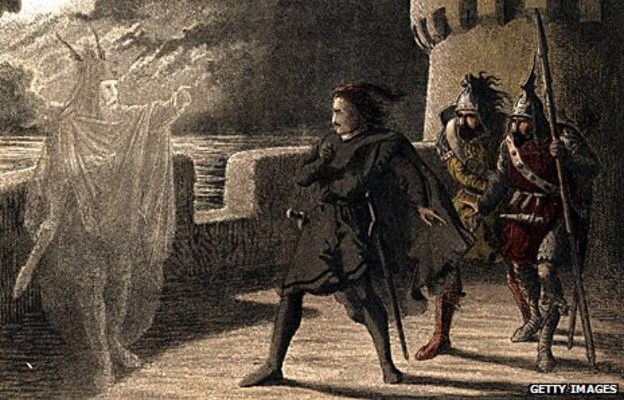
Enter the Ghost of CAESAR

How ill this taper burns! Ha! who comes here?
I think it is the weakness of mine eyes
That shapes this monstrous apparition.
It comes upon me. Art thou any thing?
Art thou some god, some angel, or some devil,
That makest my blood cold and my hair to stare?
Speak to me what thou art.

GHOST

Thy evil spirit, Brutus.

BRUTUS

Why comest thou?

GHOST

To tell thee thou shalt see me at Philippi.

BRUTUS

Well; then I shall see thee again?

GHOST

Ay, at Philippi.

BRUTUS

Why, I will see thee at Philippi, then.

Exit Ghost

Now I have taken heart thou vanishest.
Ill spirit, I would hold more talk with thee.

The ghost itself also resists the clearcut definition as a sign of a guilty conscience. It doesn’t accuse Brutus of murder, it doesn’t curse in fact, all the ghost says is that Brutus will see him at Philippi. Unlike Richard III or Macbeth, the ghost utters no curses or scare Brutus out of his mind.

The only conclusion that Brutus gleans is that his end is near. According to Dr. John Langdon, many Elizabethan ghosts serve as a shorthand to indicate that the play’s denouement is on its way. Brutus seems aware of this as well- he knows that if he sees a ghost, he’s likely to be one soon. Yet the reality of his impending death doesnt change Brutus; he doesn’t express remorse like Richard III or hopelessness like Macbeth, if anything his stocism and seeming world weariness makes him seem more like a hero like Hamlet during his “Not a whit, we defy augery,” speech. This passive embrace of fate is at the core Brutus and it illustrates how hard it is to truly decide if he is a villain or a hero.

Though Shakespeare wrote the character of Brutus as ambiguous, over the centuries many artists and cultures have passed judgment on Brutus. Dante in his book Inferno example places Brutus and Cassius in the lowest circle of Hell, who along with Judas Iscariot, are being forever devoured by Satan himself, imagined below in a medieval illustration as a three-headed beast. You can see the name Brut in the head on the right.

By contrast, during the French Revolution, many statesmen referred to Brutus as a hero for his noble attempt to destroy a corrupt monarchy.

One day men will be astonished by the fact that humanity in the eighteenth century was less advanced than in the time of Caesar. Then a tyrant was slain in the midst of the Senate with no formalities but thirty blows of a dagger and with no other law save the liberty of Rome Louis Antoine de Saint-Just, November 13th, 1792, (2 months before the execution of Louis XVI).

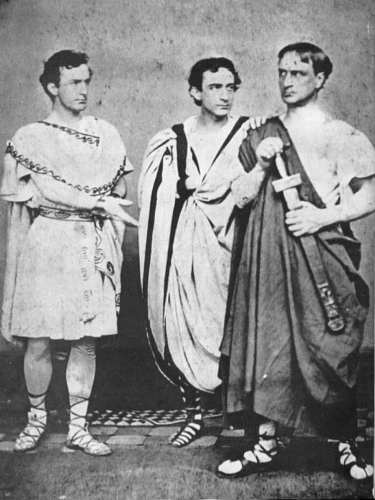
As I have written before, in the 20th and 21st centuries, America has a somewhat more complex relationship with the character of Brutus. On the one hand, America was founded on the principle of resisting tyranny; it’s even on the state flag of Virginia, which is why some early productions of the play make Brutus a hero. On the other hand, as you see above, rebels and traitors like John Wilkes Booth have also taken inspiration from Brutus. His father and brother’s middle name was Brutus and all three brothers performed in the play one year before John turned theater performance into American tragedy.

Like Brutus, Booth seemed amazed with the world’s reaction to his deed, for after he assassinated the president, he wrote this in his journal:

[W]ith every man’s hand against me, I am here in despair. And why; For doing what Brutus was honored for … And yet I for striking down a greater tyrant than they ever knew am looked upon as a common cutthroat.”

John Wilkes Booth, April 21, 1865.

The most recent controversy over Brutus’ actions is the 2017 Shakespeare in the Park production of Caesar directed by Oscar Eustis. As I wrote before, when portraying Caesar as an American president, it tends to anger the political party of his supporters, but the play shows how unplanned political violence can destabilize a country. In these productions, Brutus seems a bit of a well meaning dupe or an naive patsy acting out of fear. On the other hand in cultures that have suffered many violent uprisings, Brutus is a figure that is all to common in places like Uganda, Iran, and the Taliban controlled world: https://youtu.be/5HU8SA33j2w

Brutus is a great character because Shakespeare keeps enough of his motives in the dark to allow for new interpretations, but also showing a man with relatable desires and fears get swept up in a dangerous and unpredictable time.

Teaching Titus through creepy cooking

Titus Andronicus is one of the most bloody, disgusting plays in Shakespeare. As this infographic from the Royal Shakespeare Company shows, there are tons of deaths and some of them are even the result of cannibalism!

One way to capture the macabre nature of this play in the classroom, (which some scholars see as a horror comedy), is to characterize it through cooking, after all, revenge is a dish best served cold.

Me in costume as Titus Androgynous, a crazy cooking show host who butchers two people in the same manner as Titus

So here are some ghoulish gourmet dishes and revolting recipes that you can share with your students to help them get into this tragic tale of violence, revenge, and cooking:

Idea 1: recipe cards

Design a recipe card like the ones in cooking magazines based on Titus speech where he murders Chiron and Demetrius

Idea 2: Create a menu that summarizes the play:

Act I:

Starter: Caesar Salad, toad in the hole

As the play begins, Caesar has died and Saturnine wants to devour his father’s empire. Enjoy this light salad in anticipation of far more bloody feasts to come.https://youtu.be/UxZ5NOkRwj0

Act II Scene 3: Breakfast:

Lamb Benedict

Lamb Benedict recipe I found on Reddit

While on an early morning hunting trip, Bassianus is slaughtered like a lamb by his own nephews. Enjoy this sweet treachery with a golden egg in the hole.

Act II, Scene 4: Main course:

Roast venison with all the trimmings

“As the deer that hath some unrecuring wound.”

“She was washed and cut and trimmed.”

Titus compares his daughter to a deer or welkin, and in the play’s most barbaric scene, the emperor’s sons ravish her and cut out her tongue. They enjoy the cruel rape and mutilation just like two starving lions enjoying their prey.

Act V:

Just desserts: people pot pie.

“More stern and bloody than the centaur’s feast,” A truly unforgettable dessert for this feast of carnage. The cook, Titus, reinvents the term rich food by cooking two emperor’s sons into pies.

Served cold, like revenge!

“Set him breast deep in Earth and famish him.”

Idea 3: Real Titus foods inspired by my favorite Halloween diy recipes

1. Lavinia’s tongue and hands

• horrific Halloween punch with ice cold hand cubes: https://youtu.be/XLYwcX7Ud-E

• Bloody lady fingers https://pin.it/xbnfxcs4bxbhsq

2. Titus hand: Hot dog fingers for Titus’ hand.

https://pin.it/ofn6cotybnvn4n

Or this grisly appetizer: cheese hand in prosciutto

3.

People Pies:

There are many horrific pie recipes on the internet, but for a busy teacher on a budget, I’m adapting this one from the YouTube channel Threadbanger: https://youtu.be/E6U6xUl3A5M. Don’t show this video to your students because there’s far too much cursing. That said this recipe is very cheap and it’s easy. He used only store bought items and no fancy cooking techniques, which means if you choose to bake it as a classroom activity, even your students can help make it. Here are some tips from the video to get the most horrible ppeople pie you can make:

• Use red filling like cherry or strawberry for filling.

• Use excess dough for a nose.

• Cut out little pieces of apple to make teeth

• Cut holes for the eyes and mouth

• The bloodier, the better!

Bone appetit!

How Game Of Thrones is like a Shakespearean Play

I love Game Of Thrones! If you’ve ever read the books or seen the series on HBO, like me you might be amazed by the scale and complexity of the world author George RR Martin created. He wove together a rich tapestry of medieval history, legends, and yes, Shakespeare. He used some of Shakespeare’s plots, commented and expanded on his themes, and adapted some of his iconic characters into a very rich and in a way, very modern story. Today I’m going to examine the components of Martin’s narrative that he embroidered off of Shakespeare’s plots, themes, and characters. If you like my take on this, or if you disagree, please leave a comment below! If you have any suggestions for other popular works adapted from Shakespeare, let me know and I’ll review them on the blog!

Part I: Story

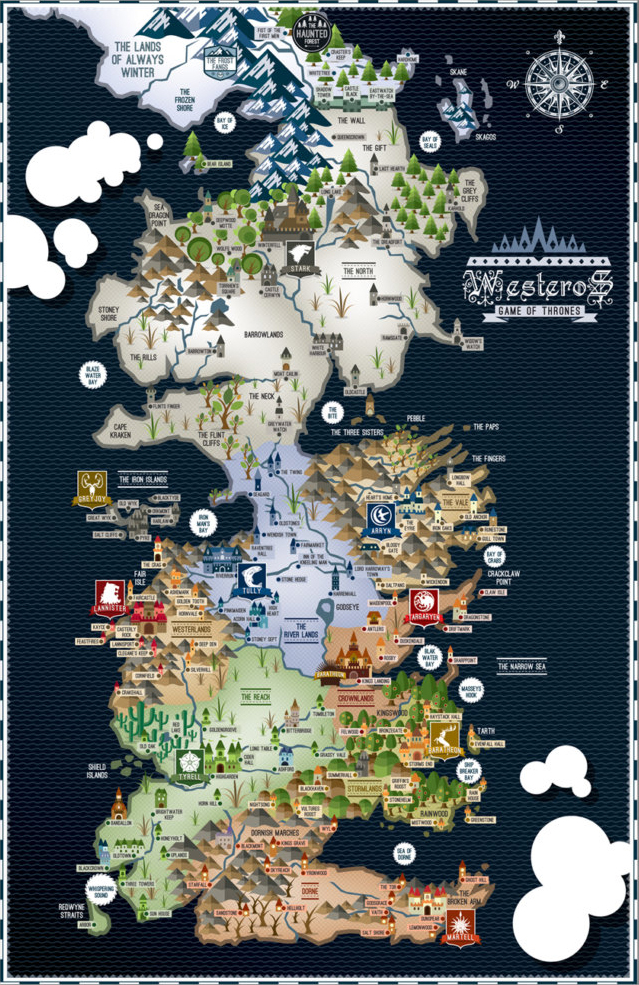
Shakespeare wrote four plays that chronicle a series of civil wars where powerful families battled each other for the crown of England. Like Game of Thrones, the conflict was mainly between the kingdoms in the North and South:

game-of-thrones-westeros-map-17x11-poster1

Shakespeare’s three parts of King Henry VI and Richard III chronicle the real struggle between the Yorkists in the north to take the crown from the Lancastrians in London in the South.

kmmap_final2-toponlyforfeaturedimageweb

Part II: Themes

Power corrupts, especially those who go seeking it.

The death of chivalry and honor in favor of political backstabbing.

King Henry VI has a speech where he watches a great battle while sitting on a molehill, watching the tide turn back and forth between his soldiers and the Yorkists. As with Game Of Thrones, the more blood each side has on its hands, the harder it becomes to decide whom to truly root for. In the end, it doesn’t seem to matter- kingdoms are won and lost as arbitrarily as a game. All it takes is time, and a good player to win.

The silence of the Gods. Shakespeare’s King Lear is constantly making oaths to his gods and asking them to punish his enemies. Likewise, Lear’s friend the Duke Of Gloucester, places his faith in the gods to protect Lear and punish the usurpers Goneril and Regan. Nevertheless, the action of King Lear doesn’t show any kind of divine judgement- Lear is exiled, goes mad, is sent to prison, and finally dies. Gloucester loses his sight, his lands, and dies randomly right after he is re-united with his son Edgar. In both King Lear and Game Of Thrones, there is a persistent question as to the nature of the gods, or even the surety of their existence.

King Lear mourns Cordelia’s death by

James Barry, c. 1786.

No where is this more apparent than at the end of the play King Lear, when, just as it seems that the Duke of Albany is about to reward the good people and punish the wicked, King Lear arrives howling, with the dead Cordelia in his arms. “Is this the promised end?” in horror at the gods’ apparent cruelty. https://youtu.be/7acLWsal1FU

In Game Of Thrones, the good characters pray to their old gods and new, but never seem to hear from them or sense their influence. Osha, the Wildling even suggests that the gods have no power in King’s Landing, where the special God’s Wood trees have been cut down.

Part III: Characters

Below is a list of my favorite GOT characters, with my interpretation of their Shakespearean roots.

Direwolf Logo

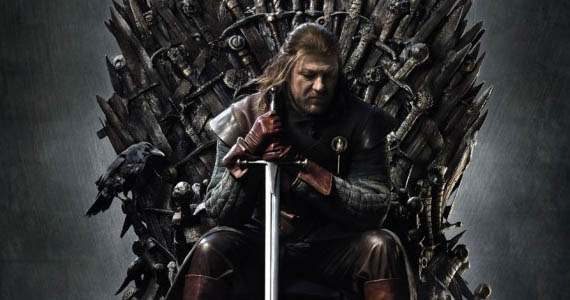
Ned Stark- Humphrey Duke of Gloucester from Henry VI, Part II

Duke Humphrey is a Yorkist from the north of England, just as Ned is Lord of Winterfell, a powerful kingdom in the north of Westeros. King Robert makes Ned Protector Of the Realm when he dies, which makes him king in all but name, and tasked with taking care of Robert’s young son Joffrey until he comes of age.

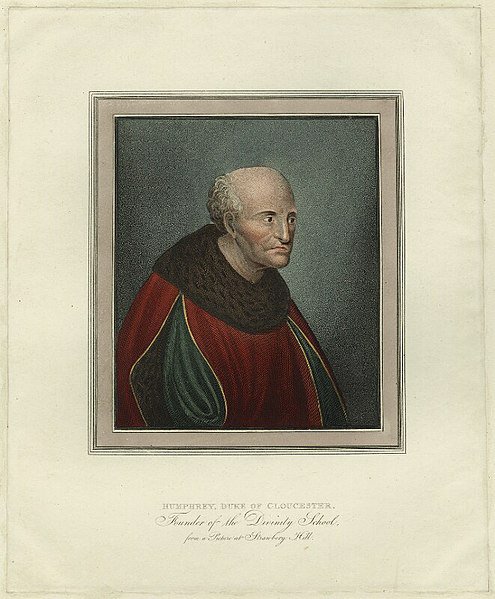
Portrait of the historical Humphrey, Duke of Gloucester from the National Portrait Gallery, artist unknown.

In Shakespeare’s Henry VI trilogy, King Henry the Fifth makes his brother Humphrey Lord Protector before he dies, to take care of England until his infant son Henry VI comes of age to rule. Like Ned, Humphrey is loyal, blunt, and only interested in keeping the realm at peace. In both Westminster and the Red Keep, all the lords are conniving and ambitious, and only interested in advancing themselves politically. These two lord protectors are the only ones with the good of the kingdom in mind.

Both Ned and Humphrey are betrayed and executed by those ambitious lords around them for the same reason; they stand in the way of the lords in their quest for power. In Henry VI, Part II, Henry’s ambitious queen Margaret starts a smear campaign against Humphrey’s wife, then pressures the King to force Gloucester to resign. As if that weren’t enough, Margaret also secretly conspires to murder the noble duke. Similarly, In Game of Thrones (Spoiler Alert), queen Circe puts her son on the throne and proclaims Ned a traitor. In both cases though, once the Lord Protector dies, the whole kingdom erupts in fights and arguments for the crown on all sides.

game-of-thrones

Ned Stark also resembles the heroes of Shakespeare’s Roman plays. He is cold and stoic as Brutus, and a devoted soldier like Titus Andronicus. Ned’s dire wolf is another connection with Shakespeare’s Roman plays; the wolf 🐺 is the symbol of the Roman Empire; packs of cold hunters who depend on each other for the survival of the family.

a213aaaff54aa5c4b2301ae21c4dc0ce

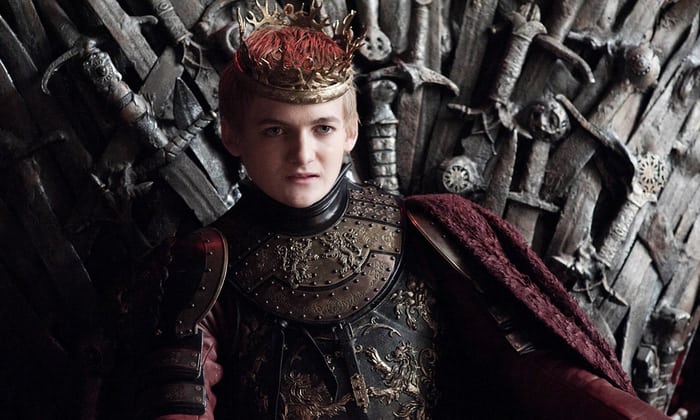
King Joffrey- Saturnine from Titus Andronicus– Joffrey is like the worst kind of tyrant- rash, proud, violent, and cruel. He lacks the maturity to make wise decisions and because of his privileged upbringing, he takes even the tiniest slight against him as an act of treason, and leaves a trail of heads in his wake. Worse still, he is easily manipulated by his mother Circe, who teaches him to act and feel superior to everyone else, and never care for the good of anyone but himself. In that way, he is very much like a Roman Emperor like Nero or Caligula, the real people whom Shakespeare adapted into the character of Emperor Saturnine in his play Titus Andronicus.

Joffrey

When we first meet Saturnine, he leads an angry mob into the streets of Rome, demanding to be made emperor, and threatening all out war if he doesn’t get his way. He also turns on the loyal soldier Titus, (who helped him win a war and win his crown), just because Titus wouldn’t give Saturnine his daughter in marriage. In the clip below from the 1999 movie Titus, Emperor Saturnine (Alan Cummings) is furious just because Titus wrote some mean scrolls about him, after Saturnine killed two of Titus’ sons, and banished a third.

https://www.youtube.com/watch?v=h6DnNHtR0pI

Baratheon Stag

King Robert Baratheon- Edward IV from Richard III.

robert-edward_trans_NvBQzQNjv4Bqeo_i_u9APj8RuoebjoAHt0k9u7HhRJvuo-ZLenGRumA

◦ In the first book of the Game of Thrones series, Robert is the King of the Seven Kingdoms, having won a civil war to take it away from the Mad King Araes Targaryen. Edward in the play Richard III has just won the crown of England after a civil war against the mad King Henry VI. Both men were powerful warriors and used to be strong and handsome. People loved and feared him, but now the pressures of keeping the throne has literally consumed them.

Robert_slays_Rhaegar

P. 53

Next had come King Robert himself, with Lady Stark on his arm. The King was a great disappointment to Jon. His father had talked of him often: the peerless Robert Baratheon, demon of the Trident, the fiercest warrior of the realm, a giant among princes. Jon only saw a fat man, red-faced under his beard, sweating through his silks.

Jon had noticed that too. A bastard had to learn o notice things, to read the truth that people hid behind their eyes. Two seats away, the king had been drinking heavily all night. His broad face was flushed behind his black beard.

In this passage from Thomas More’s History Of Richard III, (Shakespeare’s primary source for the play), More chronicles how Edward went from a handsome young king, loved and feared by all, into a gluttonous, lecherous, sick old man, who was consumed by care.

He was a goodly personage, and very princely to behold: of heart, courageous; politic in counsel; in adversity nothing abashed; in prosperity, rather joyful than proud; in peace, just and merciful; in war, sharp and fierce; in the field, bold and hardy, and nevertheless, no further than wisdom would, adventurous. Whose wars whosoever would well consider, he shall no less commend his wisdom when he withdrew than his manhood when he vanquished. He was of visage lovely, of body mighty, strong, and clean made; however, in his latter days with over-liberal diet [1], he became somewhat corpulent and burly, and nonetheless not uncomely; he was of youth greatly given to fleshly wantonness, from which health of body in great prosperity and fortune, without a special grace, hardly refrains. This fault not greatly grieved the people, for one man’s pleasure could not stretch and extend to the displeasure of very many, and the fault was without violence, and besides that, in his latter days, it lessened and well left.

-Thomas More, History Of Richard III, c. 1513

There are also similarities in how the characters died. King Robert was killed by a wild boar, while King Edward was killed by his brother Richard, whose sign was a white boar. As a bonus, the stag that is the sigil of House Baratheon, is also the seal of King Richard II, the king who, in the Shakespearean tragedy that bears his name, started the civil war when he was murdered in the Tower Of London. Below is a picture of the famous Wilton Diptych, (Richard the Second’s private alter piece), which depicts the king and all the angels in heaven wearing a badge with a white stag on it.

wilton diptych

I’m not actually the first person to mention this connection between Robert Baratheon and Edward IV. In the British newspaper, The Guardian, the author compares several characters from Game Of Thrones, to historical English events: https://www.telegraph.co.uk/tv/0/game-of-thrones-vs-history-which-real-characters-and-events-insp/robert-baratheon-and-edward-iv/

littlefinger

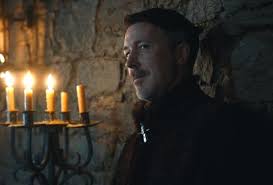
Little Finger -Lucio from Measure For Measure, Iachimo from Cymbeline, Bawd from Pericles, etc. Shakespeare has a host of character like this lord of Westeros, the Master of Coin. He is cowardly and cynical, but he is also very clever and understands people’s weaknesses, especially sex. Like Bawd from Pericles, Little Finger has grown rich off brothels, and like many real life governments, he turns his prostitutes into spies. This gives him not only cash, but dirt on every lord in the 7 kingdoms. He only worries about Ned Stark, (who can’t be bought), and Vares the eunuch, who can’t be seduced. Little Finger is basically an oily politician and exploits the power of lust in the men of King’s Landing.

Direwolf Logo

Jon Snow– Edgar and Edmund in King Lear Philip the Bastard in King John.

◦ Snow is the illegitimate son of Ned Stark. He’s aware of what he is, so he joins thieves and rapers as a knight of the Night Watch to make a life for himself, just as Edgar becomes a mad beggar in King Lear once he is accused of attempted murder. He has few illusions and like all the base-born children in Shakespeare:

775

He was who he was, Jon Snow, bastard oath breaker motherless, friendless, and damned. For the rest of his life, however long that might be- he would be condemned to be an outsider, the silent man standing in the shadows who dares not speak his true name.”

◦ Shakespeare wrote several characters born out of wedlock such as Phillip Falconbridge in King John, and Edmund from King Lear.

Unlike Jon Snow, Edmund in King Lear uses deceitful and cruel cunning in order to advance his position in life. Snow doesn’t try to change the rules, but both of them know that no one is going to give them anything. Early in book one, Jon learns to accept the cruelty of the world, and to accept what he is:

Let me give you some council, bastard, never forget what you are, for surely the world will not. Make it your strength. Then it can never be your weakness. Armor yourself in it, and it will never be used to hurt you.

Song Of Ice And Fire, p. 57.

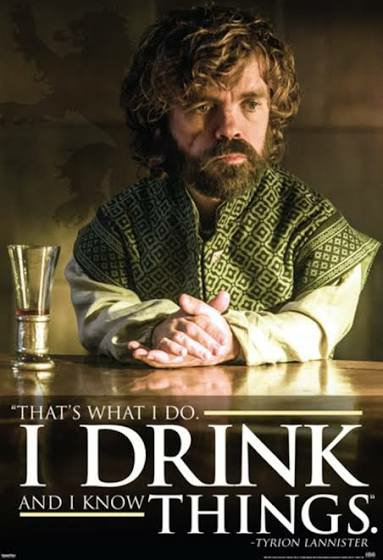
🦁 Tyrian Lannister –

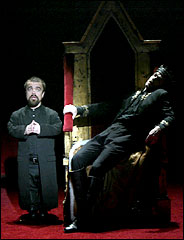
Obviously he shares some parallels with Richard III, with his small size and the fact that he is the most hated member of a powerful family. In fact, Peter Dinklage who plays Tyrion played Richard the Third back in 2004.

12RICH.184

In terms of his personality however, Tyrion has neither the cruelty, nor the bitterness of Richard. For this reason, I would argue that Tyrion more closely resembles Sir John Falstaff.

Tyrion

◦ Like Falstaff, Tyrion laughs at his physical form as a way of disarming his enemies.

◦ Both Characters are famous for talking their way out of anything.

◦ Both characters are down on their luck for most of the books

Both characters are, ahem, fond of drink. Falstaff even has a beer named after him:

◦ Most Of all, Tyrion and Falstaff are survivors – they will do anything to stay alive, good or bad. They are also unapologetic about acting cowardly and deceitfully to avoid death. In Falstaff’s famous ‘Catechism speech,’ he mocks the concept of honor and how it frequently gets men killed.

FALSTAFF

‘Tis not due yet; I would be loath to pay him before
his day. What need I be so forward with him that
calls not on me? Well, ’tis no matter; honour pricks
me on. Yea, but how if honour prick me off when I
come on? how then? Can honour set to a leg? no: or
an arm? no: or take away the grief of a wound? no.
Honour hath no skill in surgery, then? no. What is
honour? a word. What is in that word honour? what
is that honour? air. A trim reckoning! Who hath it?
he that died o’ Wednesday. Doth he feel it? no.
Doth he hear it? no. ‘Tis insensible, then. Yea,
to the dead. But will it not live with the living?
no. Why? detraction will not suffer it. Therefore
I’ll none of it. Honour is a mere scutcheon: and so
ends my catechism.

Now observe this passage where Tyrion reacts to the death of a noble knight who was foolish enough to wear armor while crossing a river on a raft.

“Good my lord,” the messenger said. “Lord Brax was clad in plate-and-mail when his raft overturned. He was so gallant.” “He was a fool,” Tyrion thought, willing his cup and staring down into the wind depths. Crossing a river at night on a crude raft, wearing armor, with an enemy waiting on the other side–if that was gallantry, he would take cowardice every time. Song of Ice and Fire, 765.

My favorite part of the books is the way Martin writes the female characters. All the female characters are dealing with the fact that women have very little power or say in their society and they all use Shakespearean means or methods to get what they want.

🦁 Circe- Tamara and Lady Macbeth

img_7829

Circe

Just as her son Joffrey has the arrogance and sadistic cruelty of a Roman emperor, Circe is a mirror image of the cruel empress Tamara, Queen Of Goths in Titus Andronicus. Both women are attracted to power and motivated by revenge. Tamara wants revenge against General Titus, who executed her son in the war. After seducing and marrying the emperor, she uses her influence to execute two of Titus’ sons. She then uses her lover Aaron the Moor (with Whom she secretly has a child), to concoct a plot to rape and mutilate Titus’ daughter. And if that weren’t enough, she tries to drive him mad by appearing at his home dressed as the Roman goddess Revenge. In short, Tamara is a classic femme fatale, who raises above the social oppression of her sex by seducing powerful men, and stabbing them in the back.

Circe is also a femme fatale, though Martin gives her more time to explain her motivations than Shakespeare gives Tamara. Like the Queen Of Goths, Circe marries King Robert Baratheon, while secretly having a taboo affair, this time with her brother Jamie. The difference is that Circe kills not strictly for vengeance, but mainly to conceal the fact that her son Joffrey is actually the product of her incest in order to protect him and eventually make him king. This is why Circe kills Ned Stark, Jon Aron, and consents to the murder of all or Robert Baratheon’s true born sons.

Circe does desire revenge, but not against anyone in particular. Instead, she wants to repay the patriarchy that keeps her down simply because she is a woman. Quote about Circe when she talks about how jealous she is of Jamie. In that chapter we get a great sense of who Circe really is. Because she’s a twin, she compares herself to her brother, observing how Jamie was given on her glory and respect when he became a knight and a member of the King’s Guard, while she was sold off to king Robert at the age of twelve like a slave or a common whore. Why, Circe asks, if she looks so much like him and acts so much like him, is she treated so differently just because she’s a woman? In a perverse sort of way, her incest might be a misguided attempt to claim part of Jamie’s honor and power through sexual conquest. Both Tamara and Circe show how an oppressive patriarchy can plant truly destructive thorns in the hearts of women, and these two queens reap that bitter harvest by cutting down the men in power one by one.

like camera Circe is driven by her love for her children and her desire and her pride and desire for vengeance. She spends the first half of the place seducing the emperor to gain his favor and then when she is made empress she uses her power to systematically destroy Titus and his family. Similarly, Circe marries king Robert and then when he dies she makes her son she then kills Ned Stark guy in prisons his daughter tries to kill the second of and

Catelyn-

7c6044dd-c49c-4ce8-9188-74d3c4910a9d-2938-00000196573b9688

Hermione From The Winters Tale ❄️ 🐺

◦ Pious

◦ Kindness and mercy are her weapons as well as her will and devotion to her friends and family. Even Tyrion is impressed by her integrity.

🐺 Aria- Imogen from Cymbeline

◦ If it’s a mans world, pretend you are one! She learns to use a sword ⚔️ and uses her small size and gender to sneak away from her enemies.

🐉 Daenerys Targaryen- Cleopatra!

◦ Crafty and beautiful

◦ Uses her sexuality to gain a powerful man’s protection

◦ Her dragons 🐉 make her a goddess, elevating her beyond a woman and even a queen. In a society that opposed and ignored women, female monarchs needed to practically deify themselves in order to get the same respect as their male counterparts.

Just as the real Cleopatra claimed to be a descendant of the goddess Isis and Elizabeth I was part of the cult of the virgin queen, The Mother Of Dragons has a mythic power that commands fear and adoration.

Spoiler Alert

In the final chapter of book one, Daenerys tries to simultaneously say goodbye to her warrior husband Khal Drogo, and to get her few remaining soldiers to swear loyalty to her. She dresses him, she braids his hair, she puts him atop a pyre, and waits for a star to pass overhead to give his funeral a cosmic significance:

“This is a wedding too.”

The pyre shifted and the logs exploded as the fire touched their secret hearts. She could hear the screams of frighten horses and the voices of the Dothraki. “No,” she wanted to shout to him, “No my good knight, do not fear for me. The fire is mine. I am Daenerys Stormborn, daughter of dragons, bride of Dragons, Mother Of Dragons.”

This mirrors how, once Cleopatra loses Antony and knows that the Romans are coming to capture her, she says goodbye to Antony, and asserts herself as queen.
CLEOPATRA

Give me my robe, put on my crown; I have
Immortal longings in me: now no more
The juice of Egypt’s grape shall moist this lip:
Yare, yare, good Iras; quick. Methinks I hear
Antony call; I see him rouse himself
To praise my noble act; I hear him mock
The luck of Caesar, which the gods give men
To excuse their after wrath: husband, I come:
Now to that name my courage prove my title!
I am fire and air; my other elements
I give to baser life.

Have I the aspic in my lips? Dost fall?
If thou and nature can so gently part,
The stroke of death is as a lover’s pinch,
Which hurts, and is desired. Dost thou lie still?
If thus thou vanishest, thou tell’st the world
It is not worth leave-taking. Antony and Cleopatra, Act V, Scene ii.

Dany does the same thing. She lights the pyre to help her husband ascend to the heavens, taking his place among the stars. Then, she sits on top of the pyre along with her three dragon eggs. Miraculously, she survives the fire and the dragons hatch, thus establishing her as the true heir of House Targarean and the Mother Of Dragons.

After witnessing the queen embracing her serpentine children, the blood riders that swore oaths to defend her husband swear again to defend her, promising to help her win the Iron Throne. Her power to command loyalty can win her the throne, and unlike Robert, keep it!

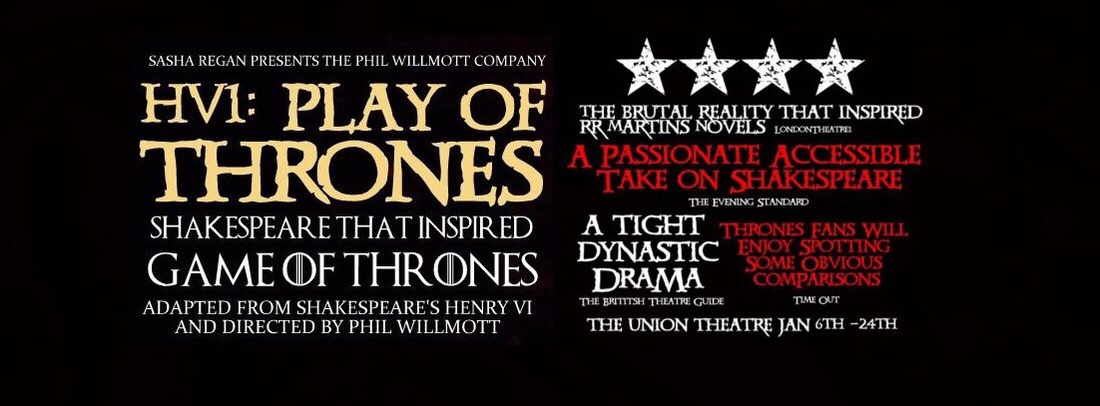
There are enough comparisons between Shakespeare and GOt that one playwright even adapted Shakespeare to resemble a Game Of Thrones story. Below is a poster of

Play Of Thrones, an adaption Of The Henry VI plays that, as I’ve mentioned, are full of characters and scenes similar to Game Of Thrones:

http://philwillmott.org/play-of-thrones-shakespeare-that-inspired-game-of-thrones.html

In conclusion, these two works prove that Shakespeare has a timeless appeal that has inspired countless writers to adapt his stories and characters.

Shakespeare on Ghosts

Since Halloween is right around the corner, and since this is a huge topic in Shakespeare, I would like to talk a little bit about Shakespeare’s treatment of the living impaired, specters, spirits, in a word GHOSTS.

Ghosts appear in five Shakespearean plays: Julius Caesar, Hamlet, Richard the Third, Macbeth and Cymbeline. In all but one of these plays, and in many other Elizabethan and Jacobean dramas, a ghost is a murdered person who needs someone to avenge their deaths. Their function is to warn the hero of the play to revenge their deaths, and/ or to torment their murderers.

Ghosts have been part of western drama almost as long as there have been ghost stories. After all, the Greek and Roman plays that Shakespeare emulated often mention ghosts as warnings from above and below the world is in some kind of chaos. Most of the time, the kind of play in which you see a ghost is a Revenge Tragedy, plays like The Spanish Tragedy, Locrine, Shakespeare’s Hamlet, and even the Disney movie of The Lion King.


The most potent example of a Shakespearean ghost is definitely the ghost of Hamlet’s father. I actually played this role and, rumor has it, so did Shakespeare himself! Hamlet’s father appears as a ghost two months after his death, and soon after his brother Claudius marries his widow Gertrude. The ghost’s purpose in the play is to get his son’s attention so that he can correct the terrible regicide that Claudius committed, allowing the Ghost to Rest In Peace.

Shakespeare describes the ghost as a pale, sorrowful figure, dressed in full armor. The ghost only speaks to his son in the play, and he begins with a strange and terrifying description of the afterlife:

Ghost: I am thy father’s spirit,

Doom’d for a certain term to walk the night,

And for the day confin’d to fast in fires,

Till the foul crimes done in my days of nature

Are burnt and purg’d away. But that I am forbid

To tell the secrets of my prison house,

I could a tale unfold whose lightest word

Would harrow up thy soul, freeze thy young blood,

Make thy two eyes, like stars, start from their spheres,

Thy knotted and combined locks to part,

And each particular hair to stand on end

Like quills upon the fretful porcupine.

But this eternal blazon must not be

To ears of flesh and blood Hamlet Act I, Scene v.

Many scholars believe that the tormenting realm of fire that the ghost describes is actually Purgatory, an old Catholic concept that explains where the souls of the dead go if they are neither evil enough for Hell, or good enough for Heaven. It’s also the place where people go who didn’t confess their sins before death, which was the ghost’s fate since Claudius poisoned him while sleeping.

Though neither Hamlet nor his father explicitly say it, there is a strong implication that Hamlet must avenge his father by killing Claudius, which will presumably release the Ghost from Purgatory allowing it to ascend to Heaven.

Some suggest that the ghost is a manifestation of Hamlet’s superego:

Psychologist Ernest Jones (who studied under Signund Freud) in his book Hamlet And Oedipusbelieved Hamlet had an unresolved Oedipus complex and couldn’t bring himself to revenge because Claudius had achieved the very goals Hamlet himself secretly desires to kill his father and marry his mother

Faced with his guilt and lack of moral integrity Hamlet could have created a supernatural superego to spur him to revenge. As Freud describes it, the superego

The superego is the ethical component of the personality and provides the moral standards by which the ego operates. The superego’s criticisms, prohibitions, and inhibitions form a person’s conscience, and its positive aspirations and ideals represent one’s idealized self-image, or “ego ideal.”

In essence, since (in Jones’ view), Hamlet is too morally corrupt to be an effective avenger for his father, Hamlet imagines the ghost to help justify his revenge to himself. This is of course, only one way of interpreting the ghost and Hamlet as a whole. There is no right or wrong interpretation for any of Shakespeare’s characters, but it is a testament to Shakespeare’s genius that, 400 years after his own death, his ghostly writings helped inspire one the architects of modern psychology.

Ghosts Of Torment

The ghost of Banquo in Macbeth and the ghosts that plague Richard the Third the night before his battle help quicken the murderous kings’ his downward spiral. Macbeth becomes more and more paranoid, and therefore easier for his foes to defeat.

When Julius Caesar’s Ghost appears to Brutus, he does so the night before his final battle- the battle of Philippi, where Brutus was defeated and committed suicide.

When Richard III sees the ghosts of all the people he murdered, it not only terrifies him, it splits his soul in half! According to Sir Thomas More, Richard couldn’t sleep the night before his final battle at Bosworth Field. Shakespeare gives Richard a strange soliloquy where the ghosts awaken his conscience and awaken him from a fearful dream:

[The Ghosts vanish]

[KING RICHARD III starts out of his dream]

Richard III (Duke of Gloucester). Give me another horse: bind up my wounds.

Have mercy, Jesu!—Soft! I did but dream.

O coward conscience, how dost thou afflict me!

The lights burn blue. It is now dead midnight.

Cold fearful drops stand on my trembling flesh.

What do I fear? myself? there’s none else by:

Richard loves Richard; that is, I am I.

Is there a murderer here? No. Yes, I am:

Then fly. What, from myself? Great reason why:

Lest I revenge. What, myself upon myself?

Alack. I love myself. Wherefore? for any good

That I myself have done unto myself?

O, no! alas, I rather hate myself

For hateful deeds committed by myself!

I am a villain: yet I lie. I am not.

Fool, of thyself speak well: fool, do not flatter.

My conscience hath a thousand several tongues,
And every tongue brings in a several tale,

And every tale condemns me for a villain.

Perjury, perjury, in the high’st degree

Murder, stem murder, in the direst degree;

I shall despair. There is no creature loves me;

And if I die, no soul shall pity me:

Nay, wherefore should they, since that I myself

Find in myself no pity to myself? Richard III, Act V, Scene iii.

In these plays, the ghosts are a form of spectral punishment; the punishment of a guilty Conscience.

Shakespearean Friendly Ghosts

The only friendly Shakespearean ghosts appear in Shakespeare’s play Cymbeline and these ghosts appear before the god Jupiter to plead for their descendant, Posthumous Leonidas. They beg Jupiter, the most powerful Roman god, to end Posthumous’ suffering.

Like the witches in Macbeth, ghosts in Shakespeare are mysterious and sometimes frightening – they are sort of a mirror for how we see ourselves, our lives, and our hopes to be remembered after death; the final words Hamlet’s father utters before disappearing into the morning mist are: “Adieu, adieu, remember me.”

Thanks for reading! If you enjoyed this post, please consider signing up for my Outschool class: “Macbeth: An Immersive Horror Experience.” I perform live as the ghost of William Shakespeare and tell the story of Macbeth in an entertaining and spooky way.

For More Information:

https://www.bl.uk/shakespeare/articles/ghosts-in-shakespeare

https://www.bard.org/study-guides/ghosts-witches-and-shakespeare

Animated Richard III, 20:00 the ghosts appear:

References:

Greenblatt, Steven Hamlet In Purgatory 2001. Princeton University Press. Link: file:///Users/jrycik/Downloads/Hamlet-in-Purgatory-Princeton-Classics.pdf

Jones, Earnest, Hamlet and Oedipus.

https://people.ucsc.edu/~vktonay/migrated/psyc179d/HamletOedipus.pdf

Open Source Shakespeare, Cymbeline:

https://www.opensourceshakespeare.org/views/plays/play_view.php?WorkID=cymbeline&Act=5&Scene=4&Scope=scene&LineHighlight=3243#3243

http://www.markedbyteachers.com/gcse/english/which-version-of-the-hamlet-ghost-scene-act-1-scene-5-was-the-most-effective-and-why.html

Pearlman, E. Hamlet: Critical Essays: The Invention Of the Ghost. https://books.google.com/books?id=jdfWAQAAQBAJ&pg=PA71&lpg=PA71&dq=ghost+that+shrieked+hamlet+revenge&source=bl&ots=KY68gIrh2V&sig=MjEr2NxLQ7T4c2xW1QscrmdeMkc&hl=en&sa=X&ved=0ahUKEwiR5o6M4I_XAhUK0oMKHQIJBeAQ6AEIKDAA#v=onepage&q=ghost%20that%20shrieked%20hamlet%20revenge&f=false

https://www.shmoop.com/hamlet/ghost.html

https://www.jstor.org/stable/pdf/456606.pdf?refreqid=excelsior%3A3f62aed88fb9e9b9a8f8e462186ff95c

The Genesis of Romeo and Juliet

Hello loyal subscribers and first-time readers!

If you’ve read any of my last four posts, hopefully I gave you some insight as to the literary sources of Shakespeare’s Romeo and Juliet, and a little bit of what Shakespeare accomplished in writing the play, so now I’d like to focus on what was going on when Shakespeare wrote it; what was going on in his own life and his career. Unfortunately, nobody knows when Shakespeare’s company first performed Romeo and Juliet, but since it was published in 1597, it must have been written sometime between 1593, and 1596.

Above- Video Bio of Shakespeare by me!

  • In 1593, Shakespeare was in a bit of a creative slump; all the London theaters were closed down, thanks to an outbreak of Bubonic Plague Shakespeare knew intimately the pain, fear, and heartbreak that plague could bring- At age 7, he saw his sister Anne die in April 4, 1579. Anne Shakespeare was 8 years old.
  • In addition, Shakespeare had gained success from his four English history plays,, but great tragedy had never been his forte. In fact, although he was a commercial success, Shakespeare wasn’t respected much in his own artistic community. In 1592, Robert Greene, a well-known smarty-pants dramatist in 1593, saw that his plays were getting passed over by theatre goers in favor of Shakespeare, who was an uneducated ACTOR!!! This set Greene’s teeth on edge, and he published an insulting pamphlet which slyly satirizes Shakespeare as:
    • Greene's Essay An upstart Crow, beautified with our feathers, that with his Tygers hart wrapt in a Players hyde, supposes he is as well able to bombast out a blanke verse as the best of you: and being an absolute Iohannes fac totum, is in his owne conceit the onely Shake-scene in a countrey

    -Robert Greene, Greenes, Groats-worth of Witte, Bought With a Nillion Of Repentance (with original spelling) [1592].

More criticism ensued from Shakespeare’s distant relative, a poet and Jesuit missionary named Robert Southwell. Because of his Catholic beliefs, Southwell was an outlaw and a traitor to the Queen, yet he continued to try and convert England back to Catholicism with everything he did and wrote. Somewhere between his secret arrival in England in 1586, and his capture, torture, and execution in 1595, Southwell wrote a dedicatory essay addressed “To my poet cousin, Master W.S,”

the text of the title page is reprinted below:

Worthy Cousin, Poets by abusing their talents and making the follies and fainings of love the subject of their base endeavors, have so discredited this faculty (ability) that a poet, a lover, and a liar are but three words of one signification.

Southwell’s speech strongly echoes the speech Shakespeare gives to Theseus in his play A Midsummer Night’s Dream, especially the comment where Theseus claims “The lunatic, the lover, and the poet are of imagination all compact.” We don’t know how much influence Southwell had on Shakespeare, but in any case, it’s clear that around 1593, Shakespeare was trying to establish himself as a true Renaissance writer, which meant writing great poetry and not just crowd-pleasing histories full of blood and gore.

So Shakespeare had to face two great challenges- to defend his art from his detractors, and to make a living without the theatre in a time of plague. To pay his rent, he took a job writing poetry for the Earl of Southampton, Henry Wriothesley (pronounced “Rizely,” left). By all accounts, the Earl was a spoiled, vain pretty- boy who loved patronizing poets. To please Wriothesley, Shakespeare composed two long epic poems, “Venus and Adonis,” and “The Rape Of Lucrece,” classical stories inspired by Shakespeare’s favorite Roman poet, Ovid.

According to The Poetry Foundation, a lot of the themes and language devices Shakespeare employed in these two poems contributed greatly to Romeo and Juliet. Most notably, Shakespeare’s use of the concept of forbidden love, his creation of strong, tragic heroines who conquer their predicaments in their deaths, Shakespeare’s use of paradox to describe impossible situations, and perhaps, in the case of Adonis, a model for the character of Romeo:

it features an innocent hero, Adonis, who encounters a world in which the precepts he has acquired from his education are tested in the surprising school of experience. His knowledge of love, inevitably, is not firsthand (“I have heard it is a life in death, / That laughs and weeps, and all but with a breath.”

(reprinted 8/30/12 from http://www.poetryfoundation.org/bio/william-shakespeare).

In these two poems Shakespeare was refining his craft, and examining questions about the nature of love. In Venus and Adonis, the title characters explore love as a giddy romp through the forest, but their relationship ends with a tragic accident when a wild boar kills Adonis. In The Rape Of Lucreece, Shakespeare shows the destructive quality of male desire, and the nobility of self-possessed women. I think that Romeo and Juliet would not have existed without Shakespeare making a meditation on his craft, on the nature of love, and the fragility of human life.

Shakespeare’s Romeo and Juliet

As you saw from my post last week, Romeo and Juliet wasn’t a new story- it had appeared as a poem in 1587 and in several versions before that. When Shakespeare adapted the story, he used his new-found powers of poetic language to make the story more alive, more beautiful, and to make the characters more complete.

What Did Shakespeare Do Differently With His Version Of the Story?

              • Plot- Generally, Shakespeare keeps the same plot as the poem version of the play, but compresses characters, times, and speeds the action along faster.
                • Shakespeare compresses the story to 5 days, making the love affair even more passionate and volatile.
                • He changes the Capulet’s feast from a Christmas celebration to a summer’s feast, making the time of year hot and dangerous.
                • He makes Juliet 13 instead of 16 as she was in the poem.
                • He makes Peter Capulet’s servant, instead of Romeo’s.
                        • Themes- Shakespeare, more than most poets who have interpreted this story, refuses to put the blame squarely on Romeo and Juliet, which is why he invents thematic devices to put the blame on chance, fate, or possibly an angry God.
                                    • Plague Themes– In the 16th century, plagues were viewed as a consequence of angering God. The fact that Mercutio curses the two warring families with “A plague on both your houses,” suggests that the lover’s deaths was a just punishment from God, or at least a horrible instance of random chance.

                                    Importance of Fate- Romeo and Juliet are first described as “Star-crossed lovers,” which means their destinies are intertwined, and determined by an unlucky star, (like being crossed by a black cat). In addition, Medieval and renaissance poets often invoked the goddess Fortuna, who guides people’s destinies and controls whether they have good fortune or bad fortune. Some said this destiny was written in the stars, as Romeo angrily denounces after he hears of Juliet’s death:

                                    “Is it even so? Then I DEFY you stars!”

                                    Shakespeare uses these thematic devices to make the fates of Romeo and Juliet less clear and more open to interpretation. Without a clear-cut moral, Shakespeare’s audiences could make up their own minds.

                                    The Language Of Romeo and Juliet

                                    • Steven Greenblatt, editor of the Norton Anthology of Shakespeare’s plays, points out the amazing variety of wordplay and language devices in Romeo and Juliet, which Shakespeare employs to allow characters to insult each other (like verbal artillery), to curse, to mock, to impress, and in the case of Romeo and Juliet themselves, “To create a new Heaven and a new Earth” (Norton, 889). Romeo and Juliet are unable to be together due to their feuding families, so through poetic imagery they turn their situation into paradise and turn each other into gods. Romeo turns Juliet into the Sun, the force that sustains all life on Earth, and Juliet asks God to:

                                    Take him and cut him out in little stars,

                                    And he will make the face of heaven so fine

                                    That all the world will be in love with night

                                    And pay no worship to the garish sun (R&J III.i).

                                    • Antithesis-To characterize the powerful and contradictory forces at work in the hearts of the characters, Shakespeare frequently has them speak using antithesis- putting two opposite terms next to each other, such as in the phrase,“Why then, O brawling love, O loving hate, O anything of nothing first create” (R&J, I. i).

                                                • One big way Shakespeare uses antithesis is the repeated imagery of night and day. Night stands for beauty, danger, love, and hidden love, as in the example from Act III above, and from the phrase: “I have night’s cloak to hide them from my eyes,” from the Balcony Scene. Day on the other hand, is associated with fighting, unpleasantness, and rudeness, like in the example above, where Juliet describes the Sun as “garish” or rude. In fact, the first time the word “day” is used in the play, Shakespeare follows it with the rhyme, “fray,” which immediately sets up how the day means hotblooded violence.
                                                  • One final example occurs in Act IV, Scene v, where Romeo has slipped into Juliet’s bedroom during the night, where Romeo laments how, as it comes closer to day time, the time for him to leave draws near:
                                                  • JULIET: O, now be gone; more light and light it grows.
                                                    ROMEO More light and light; more dark and dark our woes!
                                                  • I could go on talking about Shakespeare’s literary devices, but the important thing is that, to establish himself as a great Rennaisance poet, Shakespeare put his love of language in this play more than he had ever done before, and it shows in every line.

                                                What was the first performance like?

                                                • Above is the trailer for a production of Romeo and Juliet at the re-built Globe Theatre in 1999, which illustrates how this production relied thoroughly on the imagination of the audience.
                                                • Just like us at Open Air Shakespeare NRV, the first production of Romeo and Juliet was outdoors during the afternoon, (we know from the records of the time that plays took place about 2PM most of the time).
                                                • There were minimal props and scenery, no lighting and few sound effects, and the actors were able to talk directly to the audience.

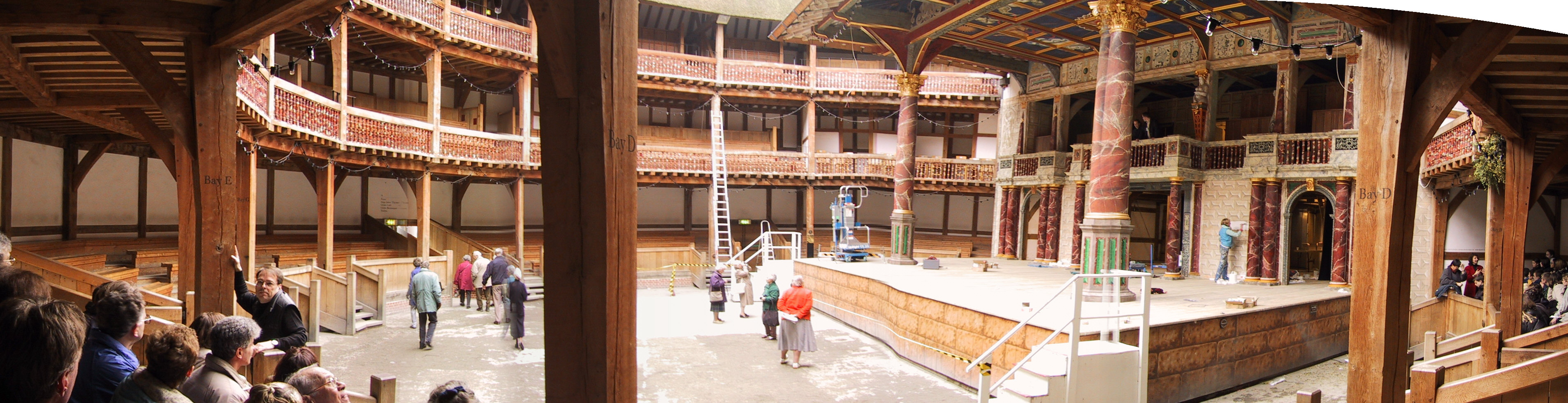
                                                The Globe Theatre Panorama

                                                • Another important thing about Elizabethan performance is the multiple levels of the audience. As you can see, audience members can stand on a semi-circle around the stage. These audience members were called “groundlings,” and they paid a penny to stand through the show. For another penny, audience members sat on wooden planks like the people in the foregrounds. The upper galleries were a little less expensive, since they were further away from the stage, and the most expensive seats of all were The Lord’s Rooms (far right just below the roof of the stage). The Lord’s Rooms allowed wealthy patrons to be seen by everyone in the house, showing off their aristocratic status. The Lord’s Rooms also doubled as a musicians gallery, and also as Juliet’s balcony, as you can see in this video
                                                • The backstage facade area that the actors went through for costume changes was called the Tiring House, where at the end of the play, they would push out Juliet on a stone slab, to represent her tomb.
                                                • Since the Globe Theatre wasn’t built until 1599, Romeo and Juliet was not originally performed there. You can see a contemporary sketch of The Swan, Shakespeare’s first theatre, by clicking here: http://internetshakespeare.uvic.ca/Library/SLT/stage/public%20theater/sources.html

                                                Success for Shakespeare

                                                • Without question, Romeo and Juliet was popular in Shakespeare’s lifetime;
                                                • It was printed in 1597, two more times during Shakespeare’s lifetime, then it was printed four more times between 1622, and 1637. It would probably have continued printing continuously till this day, if not for the Puritans abolishing theater in 1642.
                                                • The same year Shakespeare first performed the play, we know he became a shareholder in the Chamberlain’s Men, which meant he not only got a salary for writing and performing, he also got a share in the profits.
                                                • Critics praised Shakespeare’s poetry, calling him “The poet of the heart-robbing line.”

                                                So, to sum up, Shakespeare composed this masterpiece during a very turbulent time- he was unable to act, the theaters were closed. He was no doubt afraid of being killed by the plague, and all the while he was being plagued by critics. When he wrote the play, he expanded his art and craft to a new and unheard of degree, ensuring his place in history as the finest dramatist in the English-speaking world. It was truly a labor of love.
                                                – Shakespearean Student

                                                Where Did This Play Come From?

                                                Poster for a production of “Romeo and Juliet,” that I worked on in 2012.

                                                When I say that the story of Romeo and Juliet is timeless, I mean that the story’s roots go back almost to the beginnings of time. According to Sigmund Freud in Beyond the Pleasure Principle, the desire for love is inexplicably tied to the desires for creation, and destruction. These contradictory forces live deep in the human psyche, which explains why stories of doomed love have been re-interpreted throughout history. What follows is a short history of the stories that inspired Shakespeare, so you can see how this archetypal story has evolved into the one we still read today.

                                                Ancient Sources

                                                When Shakespeare was going to school in the late 1560s, Elizabethan boys were expected to read ancient Greek and Roman writers, who wrote many of the classical love stories listed below. We know that Shakespeare remembered of all these stories because he gives a brief homage to them in Ac II, Scene iv of Romeo and Juliet:

                                                MERCUTIO

                                                Now is he [Romeo] for the numbers
                                                that Petrarch flowed in: Laura to his lady was but a
                                                kitchen-wench; marry, she had a better love to
                                                be-rhyme her; Dido a dowdy; Cleopatra a gipsy;
                                                Helen and Hero hildings and harlots; Thisbe a grey
                                                eye or so, but not to the purpose.

                                                Mercutio’s opinion of these old love stories is that they are based on a false concept of true love, when in fact, love for Mercutio is merely lust and obsession.

                                                Hero and Leander

                                                Leander swimming across the Hellespont. Detail from a painting by Bernard Picart.

                                                        • Author– Unknown (traditional Greek Myth)
                                                        • Date Of Composition 1400- 300 BC (approx)
                                                        • Plot– Hero, a prophetess of Aphrodite loves Leander, a young man from the other side of her temple across a river called the Hellespond. As a priestess, Hero is supposed to remain a virgin, but Leander convinces her to make love to him, and visits her several times by swimming across the Hellespond. Their affair comes to a tragic end when on one stormy night, Leander is overcome by the waves and drowns on his journey to be with his beloved Hero. Consumed with grief, Hero throws herself off the temple tower to be with him.
                                                        • Moral– love (or at least lust), destroys and kills.

                                                The Iliad

                                                      • Author– Homer
                                                      • Date Of Composition 800 BC (approx)
                                                      • Plot– Paris, the prince of Troy abducts and ravishes Helen, the queen of Sparta in Greece, leading to a 10 year war between the Greeks and the Trojans. This war divides everyone in both countries, even the gods, leading to the question of whether love is more important to loyalty to one’s country or family.
                                                      • Moral– Ambiguous- The Greeks fight the Trojans bravely, but only to destroy Troy. Whereas the Trojans are often more sympathetic than the Greeks, but their decision to protect Paris and Helen’s adulterous affair is very unwise. The characters in this story strive to answer the question of what is the most important thing in life- desire for power, fame, to protect one’s home, or love?

                                                Tristan and Isolde

                                                      • Authors– Various, including the French bards Thomas and Beroul
                                                      • Date of Composition– somewhere around the 12th century AD.
                                                      • Plot– Similar to the Trojan War story, but in a medieval context: a young English knight named Tristan meets the heroine, a princess from Ireland, who is engaged to his country’s king. Their passion is instant and fiery, (sometimes it is the result of a love potion they accidentally drank), but it also forces them to make a terrible choice- If Tristan carries off Isolde, he will be disobeying his king, destroying a peaceful alliance, and forcing England and Ireland to go to war. However, it is clear from the beginning that Isolde does not love the one-eyed English king, and  if she marries him, Isolde will be miserable her whole life. Tristan fights gallantly to protect both Isolde and her honor and it puts Tristan, the king, and Isolde into a torturous love triangle, which usually ends with Tristan and the king fighting to the death.
                                                      • Morals
                                                        1. Arranged marriages ruin everything,
                                                        2. love is like a drug,
                                                        3. “Bros before, [you know-what].”
                                                      • Note– This story was also the root of the story of Lancelot in the Arthur myths. In the version created by Thomas Mallory in the 15th century, Lancelot falls in love with Queen Guineveere, and betrays King Arthur, whom he loves like a father. Lancelot’s adultery eventually destroys the fellowship of the Round Table, and allows Arthur’s wicked bastard son Mordred to kill Arthur and ruin Camelot.

                                                Renaissance Sources

                                                Here is a brief timeline of the narrative sources dating from 1530-1580 that Shakespeare used to create his own masterpiece. As you can see, they differ considerably from the ancient sources in plot, and overall morals.

                                                Timeline Of the Narrative Sources of Romeo and Juliet:

                                                Romeo and Giulietta

                                                Da Porto's Novel "Newly found story of two noble lovers"-1530

                                                      • Author– Luigi Da Porto in his novel Historia novellamente ritrovata di due nobili amanti (“Newly found story of two noble lovers”
                                                      • Date of Composition- 1530
                                                      • Background– Da Porto was a soldier and a brilliant story writer. Some claim that he based his tale on an earlier story, while some claim he based it on his falling in love with a girl at a masked ball. In any case, Da Porto was the first to set the story in Verona, created the characters of Mercutio and Benvolio, and also the first author to change the context of the story into two warring households, rather than great empires or kingdoms. This small change helps the audience sympathize with the lovers more, since they are not guilty of treason or adultery.
                                                      • Plot– Two noble houses, the Montecchi and the Cappelletti are at war. The hero  Romeo meets Giulietta at a Carnival ball, which makes him forget about an unrequited love he has for an unnamed girl (the name Rosalind is Shakespeare’s invention).  The two lovers have several liasons over a much longer period than in Shakespeare’s play at Guilietta’s chamber window. Also, although they are married in secret and Romeo is banished just as in Shakespeare’s version, the character he kills is not related to Guilietta. However, the plot device of the sleeping potion and  Romeo’s suicide is also consistent with Shakespeare’s version of the story.

                                                Romeus and Juliet

                                                Arthur Brooke's Romeus and Juliet

                                                      • Author– Matteo Bandello’s in his story Novelle,
                                                        (translated into English) by Arthur Brooke in 1587.
                                                      • Date of Composition– 1554, (translated in 1562, re-printed 1587)
                                                      • Background– Bandello adapted Da Porto’s version of the story and developed the supporting characters, adding The Nurse, the Friar and the Apothecary, and developing Benvolio (without giving him a name).
                                                      • Plot– This plot is almost exactly the same as Shakespeare’s play,but it does reveal some narrative details that Shakespeare omits. Bandello’s poem reveals the origin of the Capulet/ Monegue feud, as well as the ultimate fates of the surviving characters.
                                                      • Moral– Like many other interpretations, the author (or at least the translator) seem to be struggling with the Christian taboo of premarital sex, which to some extent condemns the protagonists. In the English translation by Arthur Brooke, the Preface makes it very clear that Brooke is not condoning Romeus’ premarital sex or his blatant disregard for his parents’ authority. Brooke claims that the story is intended to show the actions of bad people being punished for their actions:

                                                The good man’s example biddeth men to be good, and the evil man’s mischief warneth men not to be evil. To this good end serve all ill ends of ill beginnings. And to this end, good Reader, is this tragical matter written, to describe unto thee a couple of unfortunate lovers, thralling themselves to unhonest desire; neglecting the authority and advice of parents and friends; conferring their principal counsels with drunken gossips and superstitious friars (the naturally fit instruments of unchastity); attempting all adventures of peril for th’ attaining of their wished lust – (Brooke, Romeus and Juliet )

                                                  • On the other hand, at the end of the poem, Bandello describes Romeus and Juliet’s love (or at least Brooke’s translation), as: “so perfect, sound, and so approvéd love,” which suggests that the author at least approve of the lover’s actions. One can almost imagine Italian passion fighting with English morality in the dueling pens of Brooke and Bandello. It was up to Shakespeare to try and resolve this conflict in his own version.

                                                Romeo and Juliet

                                                Romeo and Juliet 1st Quarto.

                                                    • Author– William Shakespeare
                                                    • Date of Composition 1593 (approximately)
                                                    • Plot– One of the most interesting things about Shakespeare’s play is that he develops the characters of Mercutio, the Nurse, and Friar Lawrence, but deliberately omits certain plot elements such as why the feud began between the Capulets and Montegues, and what happened to The Apothecary, Nurse, and Friar Lawrence after the Prince found out about the lovers’ suicides. This effectively makes the Capulet/Montegue feud seem pointless, which allows the audience to focus more on the lovers. On the other hand, Shakespeare also compresses the time Romeo and Juliet know each other from 9 months as in Brooke’s version to 5 days, making the love affair seem even more rash. These changes in plot make the story much less a morality tale about morally wrong love, and more about the war between creative and destructive love that play in the human psyche.
                                                      • Moral– As we’ve seen, most interpretations of the story condemn the lovers as rash, foolish, and adulterous. Shakespeare refuses to condemn or condone. That is Shakespeare’s great gift for storytelling- he doesn’t give us clear answers because he knows life is more complicated than that. He merely provides two sides of an issue and lets the reader sort it out for themselves.

                                                How did Shakespeare get away with ripping off material this old? You’d think that, since every English schoolboy knew this story for over 1000 years, nobody would see this play since there would be no surprises. The answer is that Shakespeare writes primarily for characters, not plot. He infuses old characters like Romeo and Juliet with a new language that makes them more complete, more modern, and more timeless. That’s why stories like R&J, which was already known to Shakespeare’s audiences, are still entertaining and compelling, even after you read it 100 times, and see hundreds of different productions.

                                                I hope this short history of the sources of Romeo and Juliet allows you to ponder the complex theories behind love and lust that authors have struggled to explain in the history of this story. Each age debates the values of love and whether it’s worth fighting or dying or killing for. Perhaps the best thing about Shakespeare’s version is that it tries to provide the most complete summary of the question, without giving us an answer, allowing us to marvel at how complex it is.

                                                Thanks For Reading!

                                                Shakespearean Student