How “Hamilton” is like a Shakespearean History Play

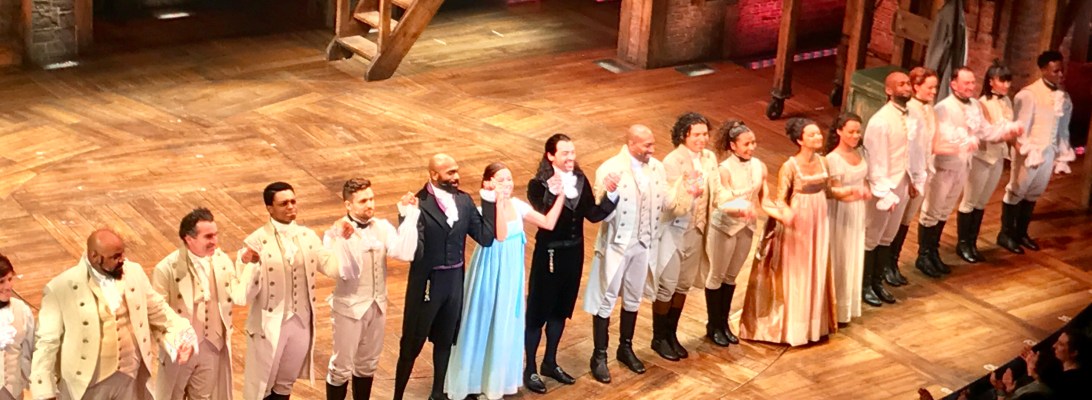
If you have two ears, you’re probably familiar with the Broadway Musical Hamilton. It swept the Tonys, has opened up touring productions across the country, and there’s already talk of a movie.

This historic American musical was the brainchild of writer Lin Manuel Miranda, who also originated the role of Alexander Hamilton.

The show is incredibly smart, creative, and delves into the seminal moments of American history.

What’s really exciting to me is that Hamilton also has a depth and complexity that mirrors some of Shakespeare’s greatest plays, specifically the history plays.

Between about 1590 and 1613, Shakespeare wrote 10 plays about the lives of English kings, from the vain Richard the Second to the heroic Henry the Fifth, to the diabolical Richard the Third. Here is a list of Shakespearean history plays, with links to online study guides, listed in chronological order by reign, not publication date.

  1. King John
  2. Richard the Second
  3. Henry the Fourth, Part I
  4. Henry the Fourth, Part II
  5. Henry the Fifth
  6. Henry the Sixth , Part I
  7. Henry the Sixth , Part II
  8. Henry the Sixth , Part III
  9. Richard the Third
  10. Henry the Eighth

Are these Shakespearean history plays historically accurate by our standards? No, not by a long shot, though Shakespeare is only partially to blame for that. While Lin Manuel-Miranda had Hamilton’s own essays, his letters from friends and loved ones, and of course, every American history book at his disposal, Shakespeare’s sources were few, and mostly propaganda. They were, (to paraphrase Napoleon and Benjamin Franklin), “A series of lies, composed by winners, to excuse their hanging of the losers.”
Shakespeare’s genius however, was to turn these two-dimensional propaganda stories into three dimensional characters with which we can all identify. Miranda did the same thing in reverse- distilling his wealth of historical information into a universal story of a man’s quest for the American Dream. Hamilton went from being an immigrant, to a soldier, to a pioneer in American law, government, and finance and the musical reflects his struggle to achieve his dreams through each stage of his life. It is also a love song from America to a man who dreamed of a future for America, one not dissimilar to the ode Shakespeare wrote to his “Star of England,” Henry the Fifth. The greatest compliment I can give Miranda is to say that he created an American musical, with the scale and breadth of Shakespeare.

Part I: War and Peace

In Shakespeare’s histories, particularly the first tetracycle of plays that include Richard the Second, the three parts of Henry VI, and Richard, III, there is a constant shift between war and peace, as scholar Robert Hunter observes. These plays cover the 200 year period of Wars of the Roses, and the end of the Hundred Years War. In all of these plays there are some very violent and very opportunistic young men who see war as an opportunity to rise above their stations. In war, they win glory in death, honor, respect, and status in life. However, in peacetime, they have “no delight to pass away the time,” as Richard III observes, and they struggle to survive in the political landscape of peace.

Hamilton is a man of this same mold: When we first meet him, he is a poor immigrant from the West Indies with no title or money to improve his status. He spends the first third of the musical wishing he could become a commander in the Revolutionary War, especially in the song: “My Shot”


Once Hamilton joins the revolution, his fortunes start to improve; he becomes George Washington’s aide-de-camp, then becomes a war hero in the Battle of Yorktown, and marries Eliza Schyler, daughter of one of the wealthiest men in America.

Hamilton in war bears similarities to Shakespearean characters like Hotspur, Richard Duke of York, and even Richard III; people who see war as a chance to either die in glory, or become honored, wealthy, and powerful.

Unfortunately for Hamilton, he fares less well once the war ends. Even though he becomes Washington’s first Secretary Of the Treasury, his success and closeness to now-President Washington makes him a walking target to his political adversaries. Even worse, his ambition and inability to compromise makes Hamilton equally vulnerable to people who see him as a loudmouth, an elitist, and a would-be demagogue who wants to control America’s finances and live like a king, similar to the way the British Prime Minister controls England’s finances.

The character Hamilton resembles most in peacetime is Cardinal Wolsey in Shakespeare’s Henry VIII.
I happen to know a lot about this character since I played him back in 2008. Wolsey controlled Henry VIII’s finances and was hated by most of Henry’s court because he was the son of a poor butcher in Essex, and became the king’s right-hand man. Throughout Shakespeare’s play, the lords of court are whispering about how Wolsey really controls the government; they even call him the ‘king cardinal’!

The real life Wolsey appears to have been hated just as much by Henry’s lords. Just look at the faces of the people of the court in this painting of the king and Wolsey by Laslett John Pott; the lords on the right are clearly jealous of Wolsey’s closeness to the king.
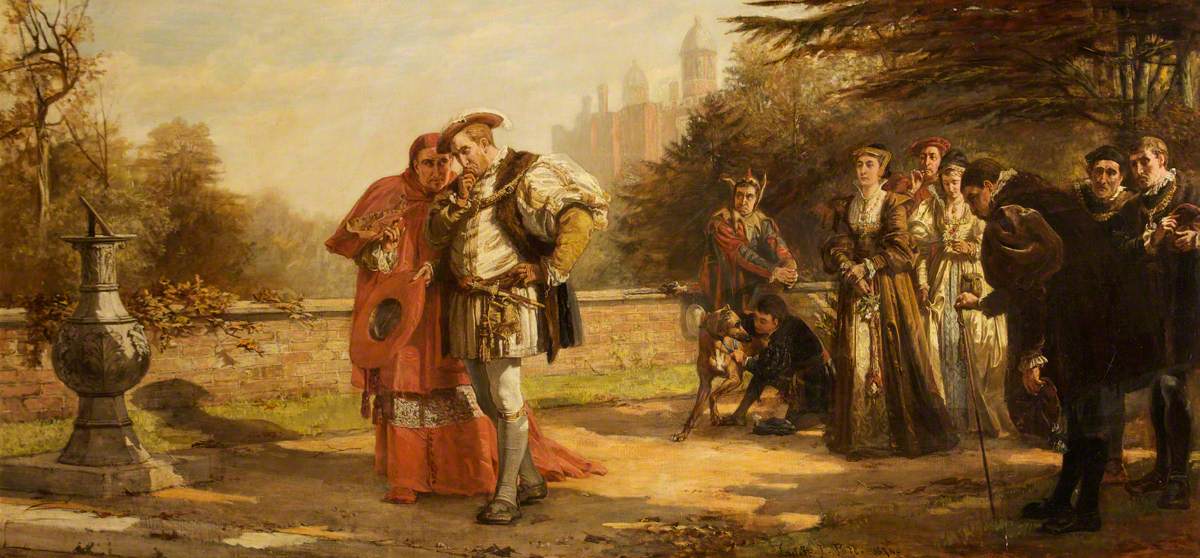
Potter, Laslett John, 1837-1880; The Dismissal of Cardinal Wolsey
Laslett John Pott, The Dismissal of Cardinal Wolsey, 1874

In both plays, Washington and King Henry are treated like gods- invulnerable, aloof, and completely above reproach.

Whenever anything bad happens in the play or musical, the legislature blames Wolsey and Hamilton, not the King or the President. Also, in both plays each one falls from grace and is destroyed by his enemies when the king and president no longer supports their right-hand-men.

Wolsey and Hamilton both fall because of their position as the financial advisor, which makes them a target to their enemies. Both are accused of using their country’s finances to enhance their personal wealth, which leads him to scandal and disgrace.

In Henry the Eighth , Wolsey is certainly guilty of conspiring to use his country’s wealth to line his own pockets- he pays the cardinals in Rome to influence their vote in the hopes that he will become the next Pope!
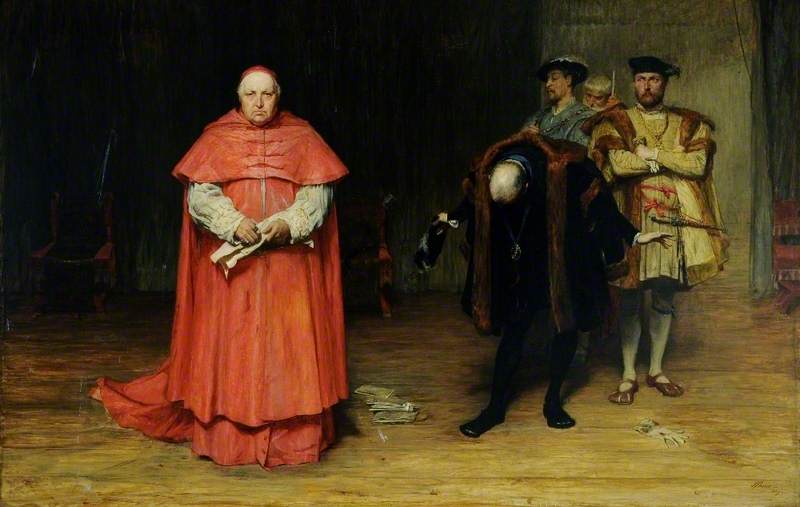
Pettie, John, 1839-1893; The Disgrace of Cardinal Wolsey
John Pettie: The Disgrace of Cardinal Wolsey, 1869

CARDINAL WOLSEY

What should this mean?
What sudden anger’s this? how have I reap’d it?
He parted frowning from me, as if ruin
Leap’d from his eyes: so looks the chafed lion
Upon the daring huntsman that has gall’d him
Then makes him nothing. I must read this paper;
I fear, the story of his anger. ‘Tis so;
This paper has undone me: ’tis the account
Of all that world of wealth I have drawn together
For mine own ends; indeed, to gain the popedom,
And fee my friends in Rome. O negligence!
Fit for a fool to fall by: what cross devil
Made me put this main secret in the packet
I sent the king? Is there no way to cure this?
No new device to beat this from his brains?
I know ’twill stir him strongly; yet I know
A way, if it take right, in spite of fortune
Will bring me off again. What’s this? ‘To the Pope!’
The letter, as I live, with all the business
I writ to’s holiness. Nay then, farewell!
I have touch’d the highest point of all my greatness;
And, from that full meridian of my glory,
I haste now to my setting: I shall fall

Like a bright exhalation in the evening,
And no man see me more. Henry the Eighth Act III, Scene ii.

Again, though Wolsey is guilty, like Hamilton he also used his financial genius to bring England into a new age of prosperity after centuries of war. The Tudors were some of the richest and most powerful monarchs in British history, and Wolsey helped establish their dynasty, but thanks to his enemies, he is turned out of court in disgrace:

O Cromwell, Cromwell!
Had I but served my God with half the zeal
I served my king, he would not in mine age
Have left me naked to mine enemies. Henry VIII, Act III, Scene ii.

Hamilton is also accused of embezzling his wealth by his enemies, including James Madison, and Thomas Jefferson


Hamilton’s enemies argue that his banking system benefits New York, where Hamilton was part of the House Of Representatives, as well as the Constitutional Convention. The main difference between Wolsey and Hamilton is that he didn’t embezzle America’s money, he is actually guilty of a far worse sin- adultery. Hamilton is accused of having an affair, and embezzling funds to keep it quiet, which he denies in a spectacular fashion:

In both plays, the moment where the main character begins to fall is dramatized in a stirring, metaphor-rich soliloquy. Wolsey compares himself to the Sun, who, once he reaches the zenith of the sky, has nowhere to go but down to the west, and set into night.
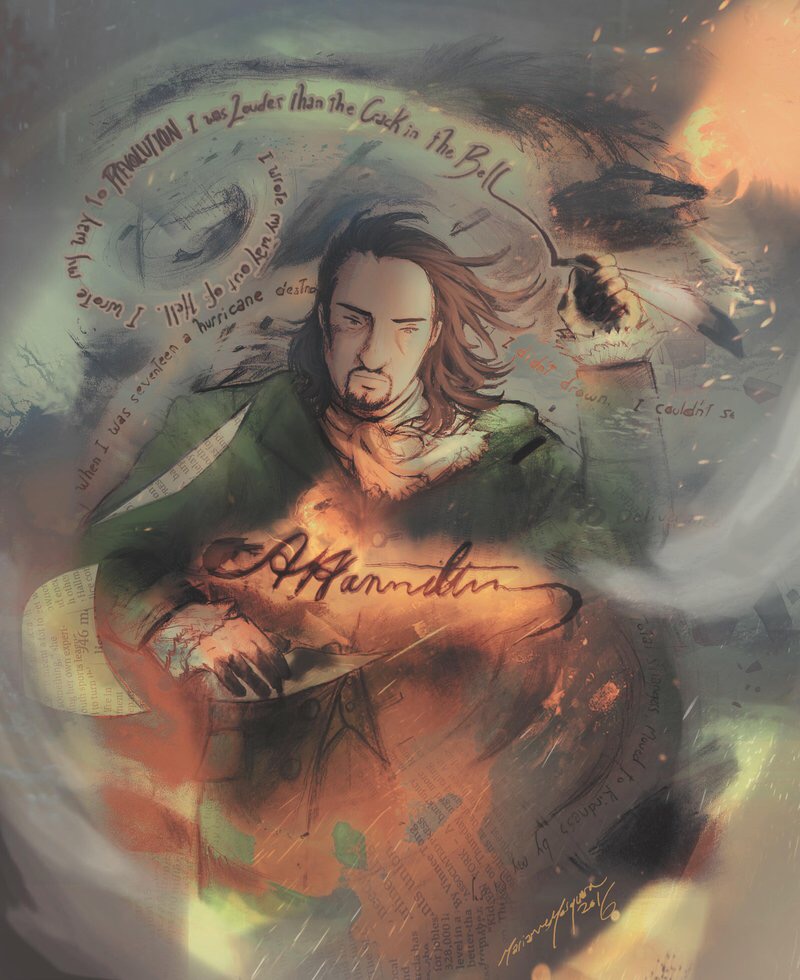
Hurricane, From Hamilton: An American Musical. Reprinted from DeviantArt.com

Hurricane From “Hamilton: An American Musical. Reposted from Deviant Art.com

Hamilton compares his situation to being in the eye of a hurricane, a particularly apt metaphor, since the real Alexander Hamilton’s house was destroyed by a hurricane in 1772. In addition, Lin Manuel Miranda‘s parents come from Puerto Rico an island that has, (and continues to be,) ravaged by hurricanes.

In the song, “Hurricane,” Hamilton remembers that when he lost everything as a boy in 1772, he beat the hurricane by writing a letter which was published in the newspaper, and inspired so much pity that the residents of the island raised enough money to send Alexander to America.


Later in the song, Hamilton decides to try to soothe the political hurricane that has engulfed him by writing a pamphlet, admitting the affair, but denying any embezzlement. Eventually the scandal destroys Hamilton’s career, but it doesn’t destroy his life; for that we have to look at the Shakespearean rivalry between Hamilton and Aaron Burr.

Part II- The Duel: Hamilton and Burr V Henry and Hotspur.
Aaron Burr and Hamilton keep meeting at important moments in the show, as if their fates are intertwined like gods in some kind of Greek tragedy.

Hamilton and Burr appear as polar opposites in the musical. Hamilton is fiery, opinionated, uncompromising, and highly principled. He ruffles feathers, but his supporters know where he stands. Burr is the opposite. He keeps his views to himself, and waits for the most opportune time to act on anything. Throughout the play, Hamilton and Burr hate and admire different things about each other. Hamilton admits that Burr’s cool practicality helps him to practice the law and succeed in politics, while Burr admires Hamilton’s energy and his ability to work and write as if his life depends on it, especially in the song “The Room Where It Happens.”


After Hamilton endorses Jefferson in the election of 1800, Burr loses the race, and the job of Vice President. In the musical, he blames Hamilton, and their grievance grows into a deadly conflict.


The rivalry between Hamilton and Aaron Burr mirrors many characters in Shakespeare, but the two I want to focus on here are Hotspur and Prince Hal from Henry the Fourth Part One

As this video from the Royal Shakespeare Company shows, these two combatants meet only once in the play, but they are constantly compared to each other by the other characters, who talk about them as if they were twins, (they even have the same first name)! Even the king remarks that his son could have been switched at birth with Hotspur.

Prince Henry (known as Hal in the play), is the heir to the throne. Like Burr in Hamilton, Hal is methodical, cool, keeps his feelings to himself, and is known by some as a Machiavellian politician. Hotspur, (or Henry Percy), is his opposite. Like Hamilton he is fiery, eloquent, and not afraid to die for his cause, which in Hotspur’s case is to supplant the royal family and correct what he believes is an unjust usurpation by Hal’s father, King Henry the Fourth.
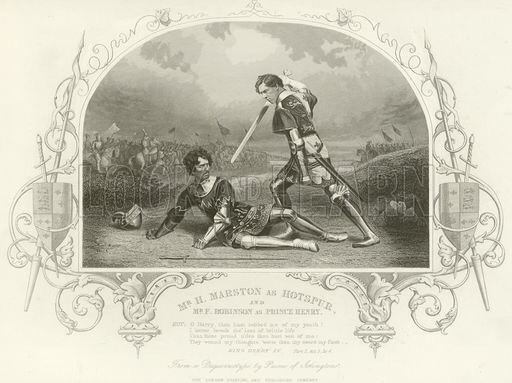
In the scene below, the two men seem hungry to not only kill one another, but to win honor and fame as the man who killed the valiant Henry. Whether it’s Henry Percy, or Prince Henry who will die, is something they can only find out by dueling to the death.

HOTSPUR

If I mistake not, thou art Harry Monmouth.

PRINCE HENRY

Thou speak’st as if I would deny my name.

HOTSPUR

My name is Harry Percy.

PRINCE HENRY

Why, then I see
A very valiant rebel of the name.
I am the Prince of Wales; and think not, Percy,
To share with me in glory any more:
Two stars keep not their motion in one sphere;
Nor can one England brook a double reign,
Of Harry Percy and the Prince of Wales.

HOTSPUR

Nor shall it, Harry; for the hour is come
To end the one of us; and would to God
Thy name in arms were now as great as mine!

PRINCE HENRY

I’ll make it greater ere I part from thee;
And all the budding honours on thy crest
I’ll crop, to make a garland for my head.

HOTSPUR

I can no longer brook thy vanities.

They fight, HOTSPUR is wounded, and falls

HOTSPUR

O, Harry, thou hast robb’d me of my youth!
I better brook the loss of brittle life
Than those proud titles thou hast won of me;
They wound my thoughts worse than sword my flesh:
But thought’s the slave of life, and life time’s fool;
And time, that takes survey of all the world,
Must have a stop. O, I could prophesy,
But that the earthy and cold hand of death
Lies on my tongue: no, Percy, thou art dust
And food for– Dies.

Hamilton’s duel is also a matter of honor; Alexander wants to defend his statements against Burr, while Burr wants to stop Hamilton from frustrating his political career. Here is how their duel plays out in the musical Hamilton:


Just like Burr, Prince Hal feels remorse after killing his worthy adversary.

PRINCE HENRY

For worms, brave Percy: fare thee well, great heart!
Ill-weaved ambition, how much art thou shrunk!
When that this body did contain a spirit,
A kingdom for it was too small a bound;
But now two paces of the vilest earth
Is room enough: this earth that bears thee dead
Bears not alive so stout a gentleman.
If thou wert sensible of courtesy,
I should not make so dear a show of zeal:
But let my favours hide thy mangled face;
And, even in thy behalf, I’ll thank myself
For doing these fair rites of tenderness.
Adieu, and take thy praise with thee to heaven!
Thy ignominy sleep with thee in the grave. Henry IV, Part I, Act V, Scene iv.

III. The Times
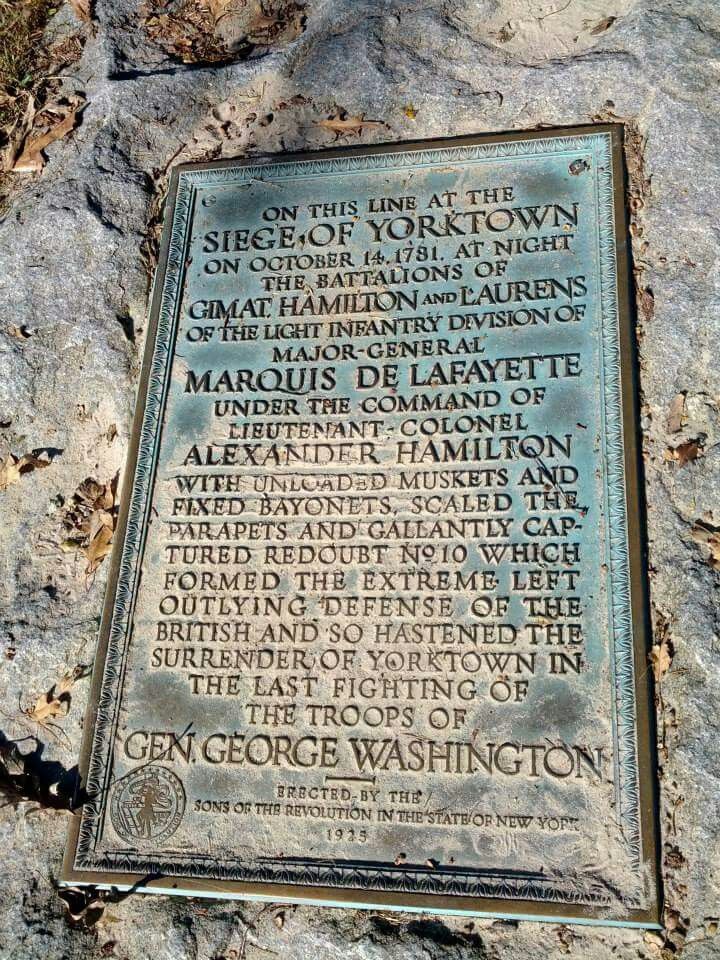
Yorktown battlefield plaque

In both Hamilton and all of Shakespeare’s history plays, the characters know that they are living during important events and their actions will become part of the history of their country, and none more than Washington. In the song, “History has its eyes on you,” he warns Hamilton that, try as one might, a man’s history and destiny is to some extent, out of his control, which echoes one of King Henry the Fourth’s most bleak realizations:

Henry IV. O God! that one might read the book of fate,
And see the revolution of the times
And changes fill the cup of alteration
With divers liquors! O, if this were seen,
The happiest youth, viewing his progress through,
What perils past, what crosses to ensue,
Would shut the book and sit him down and die. Henry IV, Part II, Act III, Scene i.

Washington is keenly aware of his legacy and does his best to protect it. In Shakespeare’s Henry IV,the king also lies awake trying to figure out how to deal with the problems of his kingdom, which is why Shakespeare gives him the famous line “Uneasy lies the head that wears the crown.” Likewise, Richard II, makes a famous speech where he mentions how many kings have a gruesome legacy of dying violently:

As we see the whole story of Hamilton’s life, his fate changes constantly and his legacy shifts in every scene of the show: immigrant, war-hero, celebrated writer, Secretary of the Treasury, but then, once he published The Reynolds Pamphlet, Hamilton went from famous to infamous. After After Burr murdered him in the duel, Hamilton might have been utterly forgotten, in spite of all his great accomplishments. This is a key theme in all history and tragedies; the desire of every man to create a lasting legacy for himself, and thus transcend mortality.

The women who tell the story


Fortunately for Hamilton, the women of his story also help to preserve it. Historically, most of Hamilton’s archives were preserved by his wife Eliza Schyler, and she and her sisters help shape the story from the beginning to the end of the show. Hamilton’s sister in law Angelica sets up this theme by literally rewinding the scene of her first meeting with Alexander, and then retelling how she and Hamilton met from her own point of view.

Once her sister marries Hamilton, Eliza Schuyler asks to “be part of the narrative.” She knows she married a important man and that his life will someday become part of American history. Eliza wants to be a part of that historic narrative.

When Hamilton commits adultery and writes the Reynolds pamphlet though, Eliza is so hurt and scandalized that she rescinds her requests. In the song “Burn,” she destroys her love letters from before the affair, and all correspondence she had with Alexander when he revealed it. Lin Manuel Miranda explained that he wrote the song this way because no records during this period survived, so he invents the notion of Eliza destroying them as a dramatic device, to heighten her estrangement from her husband. Though this is a contrivance, it does re-enforce how, when part of the story is lost, it twists and destroys part of our impression of a person. Shakespeare knew this too; Henry Tudor went to great lengths to destroy the legacy of his predecessor Richard the Third, and literally repainted him as a deformed tyrant. Shakespeare couldn’t escape the narrative of Richard as a monster when he wrote his history play and sadly helped to perpetuate it to this day.


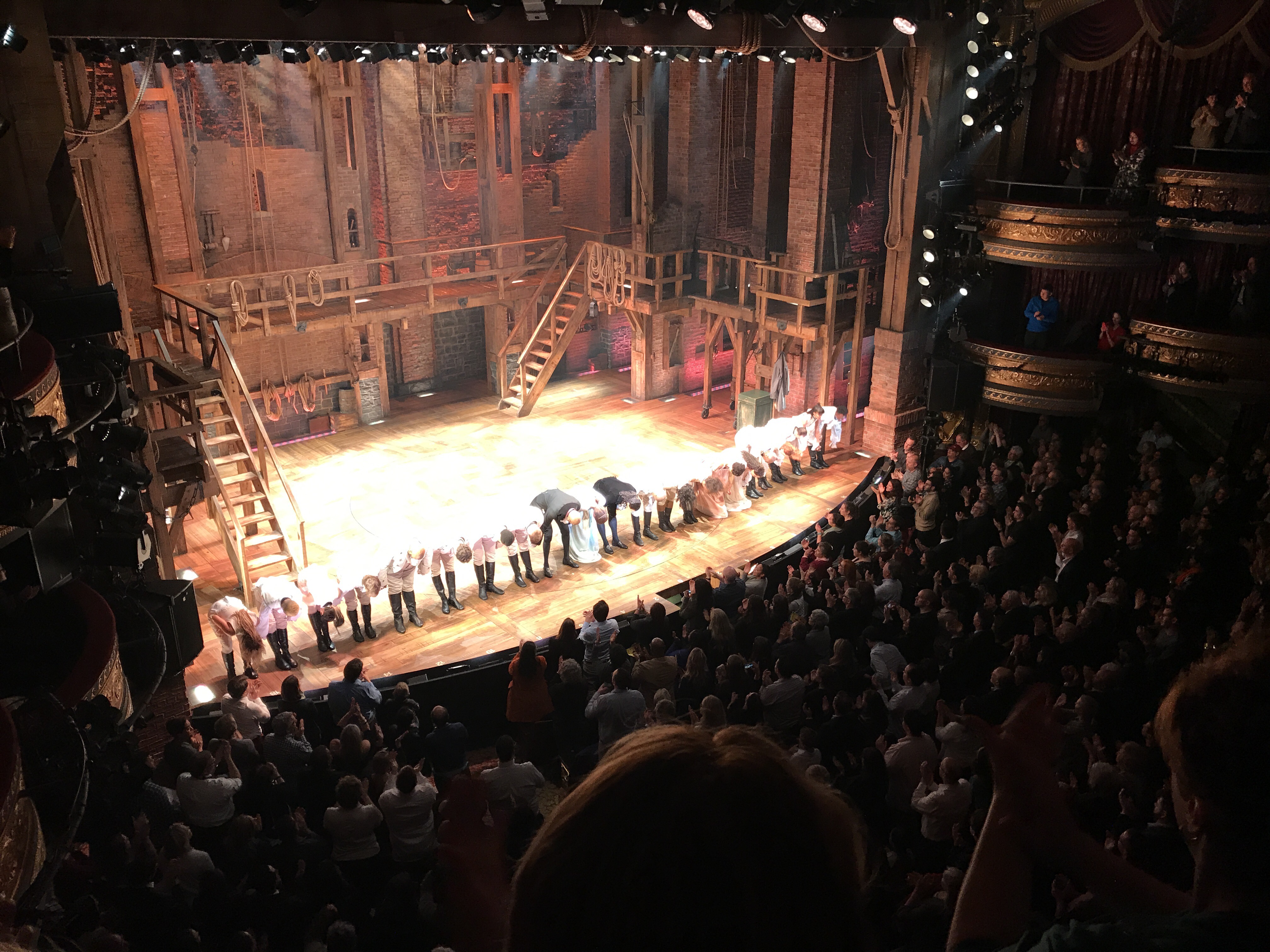
At the end of the play though, Eliza changes her mind yet again, as the final song I placed earlier shows, Eliza spends the last 50 years of her life to preserving and protecting her husband’s name, as well as Washington, all the founding fathers, and children who can grow up knowing that story at her orphanage. This song illustrates clearly that in the end, a man’s story is defined by the people who tell it, and Hamilton is fortunate to have such a creative, energetic and talented writer/ actor in Lin Manuel Miranda, and the cast of Hamilton, to preserve the story in such a Shakespearean way.

Bravo.
img_4003

Educational links related to Hamilton:

Books

download

Hamilton: The Revolution by Lin-Manuel Miranda, Jeremy McCarter. A complete libretto of the show, with notes on its creative conception. download (1)

download (2)

Alexander Hamilton by Ron Chernow. This is the book that inspired Lin Manuel Miranda to create the show. It is a stirring, well-researched historical biography.

TV:

“Hamilton’s America” PBS Program. Originally Aired 2016. Official Webpage: http://www.pbs.org/wnet/gperf/episodes/hamiltons-america/ You can watch the full documentary here: http://www.tpt.org/hamiltons-america/

Web:
Biography. Com- Alexander Hamilton:https://www.google.com/amp/s/www.biography.com/.amp/people/alexander-hamilton-9326481

Founders Online: The Papers of Alexander Hamilton: Columbia University, accessed 11/12/17 from https://founders.archives.gov/about/Hamilton

House Of Representatives Biography: Alexander Hamilton- IIhttp://history.house.gov/People/Listing/H/HAMILTON,-Alexander-(H000101)/

Resources on Shakespeare’s History Plays:

Books

  1. Shakespeare English Kings by Peter Saccio. Published Apr. 2000. Preview available: https://books.google.com/books?id=ATHBz3aaGn4C
  2. Shakespeare, Our Contemporary by Jan Kott. Available online at https://books.google.com/books/about/Shakespeare_Our_Contemporary.html?id=QIrdQfCMnfQC
  3. The Essential Shakespeare Handbook
  4. The Essential Shakespeare Handbook
  5. The Essential Shakespeare Handbook by
  6. Leslie Dunton-Downer and Alan Riding Published: 16 Jan 2013.
    77ace26dfdee4259bf48d6eed1a59d57

  7. Will In the World
  8. Will In the World by Robert Greenblatt
  9. Will In the World by Prof. Steven Greenblatt, Harvard University. September 17, 2004. Preview available https://www.amazon.com/Will-World-How-Shakespeare-Became/dp/1847922961

henries.HP_.CarouselScreens-480x270

TV:Shakespeare Uncovered: Henry the Fourth. Originally Aired February 1, 2013. Available at http://www.pbs.org/wnet/shakespeare-uncovered/episodes/

Websites

Shakespeare on Ghosts

Since Halloween is right around the corner, and since this is a huge topic in Shakespeare, I would like to talk a little bit about Shakespeare’s treatment of the living impaired, specters, spirits, in a word GHOSTS.

Ghosts appear in five Shakespearean plays: Julius Caesar, Hamlet, Richard the Third, Macbeth and Cymbeline. In all but one of these plays, and in many other Elizabethan and Jacobean dramas, a ghost is a murdered person who needs someone to avenge their deaths. Their function is to warn the hero of the play to revenge their deaths, and/ or to torment their murderers.

Ghosts have been part of western drama almost as long as there have been ghost stories. After all, the Greek and Roman plays that Shakespeare emulated often mention ghosts as warnings from above and below the world is in some kind of chaos. Most of the time, the kind of play in which you see a ghost is a Revenge Tragedy, plays like The Spanish Tragedy, Locrine, Shakespeare’s Hamlet, and even the Disney movie of The Lion King.


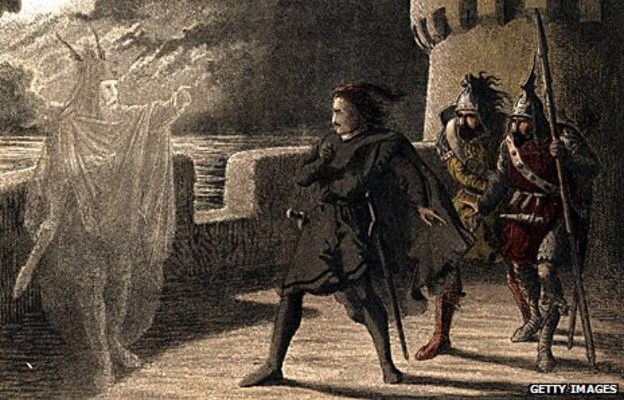
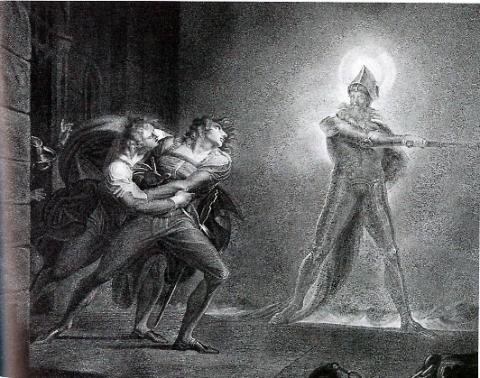
The most potent example of a Shakespearean ghost is definitely the ghost of Hamlet’s father. I actually played this role and, rumor has it, so did Shakespeare himself! Hamlet’s father appears as a ghost two months after his death, and soon after his brother Claudius marries his widow Gertrude. The ghost’s purpose in the play is to get his son’s attention so that he can correct the terrible regicide that Claudius committed, allowing the Ghost to Rest In Peace.

Shakespeare describes the ghost as a pale, sorrowful figure, dressed in full armor. The ghost only speaks to his son in the play, and he begins with a strange and terrifying description of the afterlife:

Ghost: I am thy father’s spirit,

Doom’d for a certain term to walk the night,

And for the day confin’d to fast in fires,

Till the foul crimes done in my days of nature

Are burnt and purg’d away. But that I am forbid

To tell the secrets of my prison house,

I could a tale unfold whose lightest word

Would harrow up thy soul, freeze thy young blood,

Make thy two eyes, like stars, start from their spheres,

Thy knotted and combined locks to part,

And each particular hair to stand on end

Like quills upon the fretful porcupine.

But this eternal blazon must not be

To ears of flesh and blood Hamlet Act I, Scene v.

Many scholars believe that the tormenting realm of fire that the ghost describes is actually Purgatory, an old Catholic concept that explains where the souls of the dead go if they are neither evil enough for Hell, or good enough for Heaven. It’s also the place where people go who didn’t confess their sins before death, which was the ghost’s fate since Claudius poisoned him while sleeping.

Though neither Hamlet nor his father explicitly say it, there is a strong implication that Hamlet must avenge his father by killing Claudius, which will presumably release the Ghost from Purgatory allowing it to ascend to Heaven.

Some suggest that the ghost is a manifestation of Hamlet’s superego:

Psychologist Ernest Jones (who studied under Signund Freud) in his book Hamlet And Oedipusbelieved Hamlet had an unresolved Oedipus complex and couldn’t bring himself to revenge because Claudius had achieved the very goals Hamlet himself secretly desires to kill his father and marry his mother

Faced with his guilt and lack of moral integrity Hamlet could have created a supernatural superego to spur him to revenge. As Freud describes it, the superego

The superego is the ethical component of the personality and provides the moral standards by which the ego operates. The superego’s criticisms, prohibitions, and inhibitions form a person’s conscience, and its positive aspirations and ideals represent one’s idealized self-image, or “ego ideal.”

In essence, since (in Jones’ view), Hamlet is too morally corrupt to be an effective avenger for his father, Hamlet imagines the ghost to help justify his revenge to himself. This is of course, only one way of interpreting the ghost and Hamlet as a whole. There is no right or wrong interpretation for any of Shakespeare’s characters, but it is a testament to Shakespeare’s genius that, 400 years after his own death, his ghostly writings helped inspire one the architects of modern psychology.

Ghosts Of Torment

The ghost of Banquo in Macbeth and the ghosts that plague Richard the Third the night before his battle help quicken the murderous kings’ his downward spiral. Macbeth becomes more and more paranoid, and therefore easier for his foes to defeat.

When Julius Caesar’s Ghost appears to Brutus, he does so the night before his final battle- the battle of Philippi, where Brutus was defeated and committed suicide.

When Richard III sees the ghosts of all the people he murdered, it not only terrifies him, it splits his soul in half! According to Sir Thomas More, Richard couldn’t sleep the night before his final battle at Bosworth Field. Shakespeare gives Richard a strange soliloquy where the ghosts awaken his conscience and awaken him from a fearful dream:

[The Ghosts vanish]

[KING RICHARD III starts out of his dream]

Richard III (Duke of Gloucester). Give me another horse: bind up my wounds.

Have mercy, Jesu!—Soft! I did but dream.

O coward conscience, how dost thou afflict me!

The lights burn blue. It is now dead midnight.

Cold fearful drops stand on my trembling flesh.

What do I fear? myself? there’s none else by:

Richard loves Richard; that is, I am I.

Is there a murderer here? No. Yes, I am:

Then fly. What, from myself? Great reason why:

Lest I revenge. What, myself upon myself?

Alack. I love myself. Wherefore? for any good

That I myself have done unto myself?

O, no! alas, I rather hate myself

For hateful deeds committed by myself!

I am a villain: yet I lie. I am not.

Fool, of thyself speak well: fool, do not flatter.

My conscience hath a thousand several tongues,
And every tongue brings in a several tale,

And every tale condemns me for a villain.

Perjury, perjury, in the high’st degree

Murder, stem murder, in the direst degree;

I shall despair. There is no creature loves me;

And if I die, no soul shall pity me:

Nay, wherefore should they, since that I myself

Find in myself no pity to myself? Richard III, Act V, Scene iii.

In these plays, the ghosts are a form of spectral punishment; the punishment of a guilty Conscience.

Shakespearean Friendly Ghosts

The only friendly Shakespearean ghosts appear in Shakespeare’s play Cymbeline and these ghosts appear before the god Jupiter to plead for their descendant, Posthumous Leonidas. They beg Jupiter, the most powerful Roman god, to end Posthumous’ suffering.

Like the witches in Macbeth, ghosts in Shakespeare are mysterious and sometimes frightening – they are sort of a mirror for how we see ourselves, our lives, and our hopes to be remembered after death; the final words Hamlet’s father utters before disappearing into the morning mist are: “Adieu, adieu, remember me.”

Thanks for reading! If you enjoyed this post, please consider signing up for my Outschool class: “Macbeth: An Immersive Horror Experience.” I perform live as the ghost of William Shakespeare and tell the story of Macbeth in an entertaining and spooky way.

For More Information:

https://www.bl.uk/shakespeare/articles/ghosts-in-shakespeare

https://www.bard.org/study-guides/ghosts-witches-and-shakespeare

Animated Richard III, 20:00 the ghosts appear:

References:

Greenblatt, Steven Hamlet In Purgatory 2001. Princeton University Press. Link: file:///Users/jrycik/Downloads/Hamlet-in-Purgatory-Princeton-Classics.pdf

Jones, Earnest, Hamlet and Oedipus.

https://people.ucsc.edu/~vktonay/migrated/psyc179d/HamletOedipus.pdf

Open Source Shakespeare, Cymbeline:

https://www.opensourceshakespeare.org/views/plays/play_view.php?WorkID=cymbeline&Act=5&Scene=4&Scope=scene&LineHighlight=3243#3243

http://www.markedbyteachers.com/gcse/english/which-version-of-the-hamlet-ghost-scene-act-1-scene-5-was-the-most-effective-and-why.html

Pearlman, E. Hamlet: Critical Essays: The Invention Of the Ghost. https://books.google.com/books?id=jdfWAQAAQBAJ&pg=PA71&lpg=PA71&dq=ghost+that+shrieked+hamlet+revenge&source=bl&ots=KY68gIrh2V&sig=MjEr2NxLQ7T4c2xW1QscrmdeMkc&hl=en&sa=X&ved=0ahUKEwiR5o6M4I_XAhUK0oMKHQIJBeAQ6AEIKDAA#v=onepage&q=ghost%20that%20shrieked%20hamlet%20revenge&f=false

https://www.shmoop.com/hamlet/ghost.html

https://www.jstor.org/stable/pdf/456606.pdf?refreqid=excelsior%3A3f62aed88fb9e9b9a8f8e462186ff95c

Creating A Character: Richard III

In 2011, I wrote a graduate thesis about some of the challenges of playing Shakespeare’s Richard III, specifically those related to playing his deformity. What follows in this post is an adaptation of the presentation I gave at the American Shakespeare Center’s Blackfriars Playhouse, in Staunton Virginia. I gave this presentation with the help of my actors, Matt Carter, Jemma Levy, Amanda Noel Allen, and David Santangello. I also interviewed live onstage, one of the ASC’s greatest actors John Harrell and his director Thadd McQuade, about a unique production of Richard that he performed for the company back in 2002. What follows is the script I wrote for the presentation, as well as the video and Powepoint slides I projected for the audience, to help you see my work in performance. You can also consult a website I designed for the ASC’s production of Henry VI, Part III, where Richard was played by actor Ben Curns.


PRESENTATION SCRIPT

MATT CARTER:

Now is the winter of our discontent
Made glorious summer by this sun of York;
And all the clouds that lour’d upon our house
In the deep bosom of the ocean buried.
But I, that am not shaped for sportive tricks,
Nor made to court an amorous looking-glass;
I, that am curtail’d of this fair proportion,
Cheated of feature by dissembling nature,
Deformed, unfinish’d, sent before my time
Into this breathing world, scarce half made up,

And that so lamely and unfashionable
That dogs bark at me as I halt by them.

Why, I, in this weak piping time of peace,
Have no delight to pass away the time,
Unless to spy my shadow in the sun
And descant on mine own deformity: Applause, he sits on one of the gallant stools.

Section 1: Introduction

Slide01

PAUL:

Many of you recognize those famous lines from the opening soliloquy of Richard III, ably delivered by Matt Carter. Did you notice the ways Matt was moving and the qualities of his voice? Tonight, my actors and I will show you some of the choices actors have made in playing the deformity of Richard III. Deformity and Richard are so closely linked that I would argue that it is the central driving force of the character. The different performances we will discuss show changes in views on deformity, as well as changing theories on the actor’s craft.

Every actor is interested in the human body, every actor is interested in how the mind and body work together, and most importantly, how to present the mind and body of a character to an audience in a clear and articulate way. No matter how the actor decides to represent it, Richard’s deformity of mind and body are essential to the understanding of the character. In his first soliloquy, in the play Henry the Sixth, Part III, he expresses a deep pain, sorrow and bitterness at being denied a normal body. As Jemma delivers this speech, ask yourself- do you pity him? Does this man have a reason to be angry?

JEMMA LEVY:

Why, love forswore me in my mother’s womb:
And, for I should not deal in her soft laws,
She did corrupt frail nature with some bribe,
To shrink mine arm up like a wither’d shrub;
To make an enviousmountain on my back,
Where sits deformity to mock my body;
To shape my legs of an unequal size;
To disproportion me in every part,
And am I then a man to be beloved?
O monstrous fault, to harbour such a thought!

Henry VI, Part III, Act III, Scene i.

PAUL:

In this speech, like the previous one, Richard expresses the belief that his deformity was a curse, laid on by his mother. During the Renaissance, people believed that deformity was a mark of evil and a sign of being cursed by God. Like the Mark of Cain in the Bible, Richard’s deformity signifies that he was “determined,” (presumably by God), to prove a villain.” The deformity also gives Richard psychological motivation. Lacking a normal body, Richard is hungry for revenge, and in search of something to elevate himself above more fortunate people- power.

Section 2: Burbage

PAUL: The first Richard was almost certainly Richard Burbage, Shakespeare’s star actor. Burbage was associated with the role long after his death.

DAVID SANTAGELLO:

A funerall Elegy on the death of the famous Actor Richard Burbage:

Who died on Saturday in Lent, the 13th of March 1618′

No more young Hamlet though but scant of breath

Shall cry revenge for his dear father’s death:

Edward shall lack a representative,

And Crookback, as befits, shall cease to live.”

PAUL:

Unfortunately, we have no information on how Burbage played the deformity, but we have one clue as to how his performance might have been received, in the form of an apocryphal story from the diary of law student John Manningham, on 13 March 1602:

AMANDA:

Upon a time when [Richard] Burbage played Richard III,

There was a citizen grew so far in liking with him that before she went from the play,

She appointed him to come that night unto her by the name of Richard III.

Shakespeare, overhearing their conclusion, went before, was entertained, and at his game ere Burbage came.

The message being brought that Richard III was at the door,

Shakespeare caused return to be made that ‘William the Conqueror was before Richard III.’

Slide02

PAUL:

Although this story is apocryphal, it does hit upon other features of Richard’s deformity- his supreme confidence, and his beast-like sexuality. Scholars have pointed out that Richard’s lack of scruples, (the result of being born deformed), makes him completely focused and confident. Likewise, his non-conformity to traditional standards of beauty could also be seen as a rebellion against societal norms, and thus, a strange aphrodisiac. This dark creature, without a recognizable human shape, manages to exert a dark pull on the audience.

Section 3: Cibber

Slide03

Surprisingly, for nearly 300 years, portrayals of Richard III have been heavily influenced by an obscure author who was not even Shakespeare’s contemporary

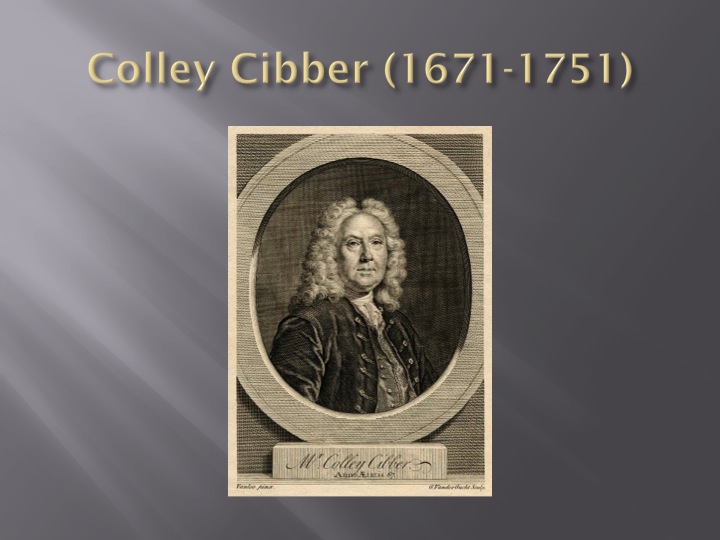
During the Restoration of theater in the 17th century Shakespeare’s plays were largely out of fashion, condemned by critics as “too vulgar for this refined age,” and playwrights began to rewrite and adapt them. The most successful adaptation of Richard the Third, came from poet-laureate Colley Cibber in 1671. Cibber’s text interpreted the story as one man’s evil rise to the crown, not the culminating story of the Wars of The Roses. Cibber cut most of the history involved. He condensed scenes, omitted others, and gave Richard 10% more of the dialogue, then Shakespeare. Cibber’s text also re-emphasizes the importance of deformity to Richard’s character- adding 8 more uses of the words “deformed,” or “ugly.” To further the point, Cibber inserted text from other Shakespeare plays that speak about Richard’s deformity, such as the Henry VI speech spoken earlier. Cibber freely cut-and pasted from Shakespeare’s histories, which can be demonstrated in this speech where the Lady Anne mourns for the death of Henry the Sixth, using lines written by Shakespeare for the funeral of King Henry the Fifth:

AMANDA:

Hung be the heavens with black, yield day to night!
Comets, importing change of times and states,
Brandish your firey tresses in the sky,
And with them scourge the bad revolting stars
That have consented unto Henry’s death!

O be accursed, the hand that shed his blood

Accursed the head that had the heart to do it!
If ever he have wife, let her be made
More miserable by the life of him
As I am made by Edward’s death and thine!

PAUL:

Cibber also wrote his own speeches for Richard, such as this one where Richard resolves to woo Lady Anne in spite of his deformity:

JOHN HARRELL:

But see! My love appears. Look where she shines

Through her dark veil of rainy sorrows

Tis true, my form perhaps may little move her;

But I’ve a tongue shall wheedle with the devil.

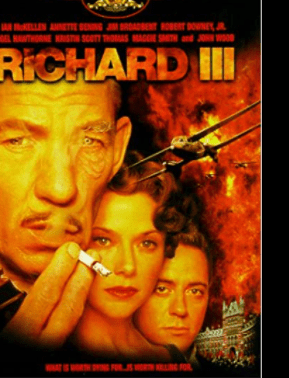
PAUL: Cibber’s text was extremely popular with actors because it raised Richard’s importance to a star role. Actors such as David Garrick made their debut as Cibber’s Richard, and some of Cibber’s editorital choices still survive in the two movie versions of Richard by Ian McKellen and Laurence Olivier.

13188-15979

IanMcKellen

Section 4: Olivier

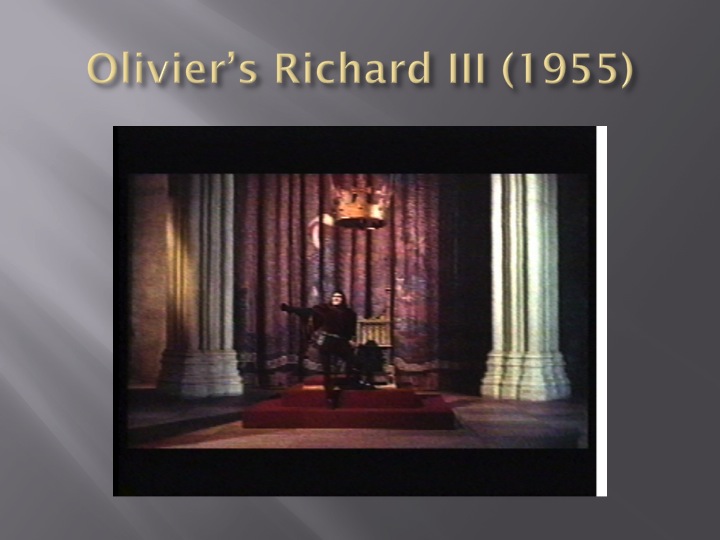
Olivier, in the 20th century was considered the definitive Richard. In his film version he emphasizes Richard’s evil and deceptive nature. He uses the character’s physical disabilities (as well as various cinematic techniques) to reveal his moral depravity.

Slide04

  • The Crown of England- the tremolos and the large crown that appears in the beginning, middle, and end of the film. Homage to Cibber.
  • CINEMATIC USE OF DEFORMITY
  • Long camera angles as he limps away, exposing hump and limp
  • Shadowy silhouette
  • In this shot, Richard slinks away from the camera, leaving his bizarre silhouette to unfurl like a snakeSlide06
  • In this shot, Richard bends over to whisper evil thoughts into the king’s ear.
  • Finally, in this shot, we see the shadow of Richard’s head, as he stares into the cell of his brother Clarence, as he plans his murder. We see through this shot, Richard looms as a great evil presence.

Section 5: Sher

Slide07

After Olivier, actors abandoned the approach of making Richard into a monster, and favored a more human, natural approach.

The role of Richard III however, presents unique challenges for actors attempting to do this; they are attempting to do something un-natural by playing a deformity that they do not actually have. Thus they are attempting to play something “un-natural” within the precepts of naturalistic acting.. Antony Sher’s massive preparation for the role, using Method acting techniques, included both a thorough research into the physical effects of real disability, and a deep examination of its psychological effects.

Slide08

  • Used Method acting techniques to create the role:
    • Real-life experience- Crutches came from his own real injury.
    • Research into physical deformity.
    • Textual Research
    • Image Research. He used Margaret’s text to create a visual design for his character, a bottled spider.
    • Psychoanalysis- brought Shakespeare’s text to a real psychiatrist to “put Richard on the couch.”
  • Sher’s technique led him to go into a deep, psychological probing of Richard’s mind. He viewed the deformity as a source of deep pain, through which we can identify with Richard as a human being.
  • Listen to how David, applying Method-inspired text analysis, conveys Richard’s human emotions.

DAVID:

But I, that am not shaped for sportive tricks,
Nor made to court an amorous looking-glass;
I, that am rudely stamp’d, and want love’s majesty
To strut before a wanton ambling nymph;
I, that am curtail’d of this fair proportion,
Cheated of feature by dissembling nature,
Deformed, unfinish’d, sent before my time
Into this breathing world, scarce half made up,
And that so lamely and unfashionable
That dogs bark at me as I halt by them;

PAUL: Sher’s massive preparation for the role represent the limits that an able bodied actor could go to portray a disability he himself did not have.

Section 6: From Sher to Harrell

Slide09

  • Sher’s Richard created an unexpected backlash from disabled community.
  • One response to this: a number of Richards played by disabled actors.
  • Henry Holden in 2007. Like Sher, on crutches, only he needed them.
  • Peter Dinklage played the role with none of the traditional deformities.
  • His size was a kind of disability, as it literally hindered him from taking the crown
    • He was tangled in his robes,
    • Couldn’t reach the throne.
  • Critics writing about the performance claimed watching him was more real. You weren’t watching a performance, you watched a real man, with a real struggle.
  • Another response is approaching the deformity from a more stylized perspective.
  • This was the approach favored by Thadd McQuade.Slide11
  • The essence of this performance was watching a man struggle through life trying to overcome obstacles and find a place for himself in the world, a struggle that is the essence of all tragedy.

Section 7: 10 minute interview with Thadd and John.

Slide12

Both– Explain the way you chose to represent deformity (bowling ball) and why.

  • John- I got an email from actor JP Schiedler, (who was in the production) who said “ As I recall John was very interested in working inside of some form of restriction which forced his body to adapt, struggle and physically change how he could deal with the world around him which the ball did.” If this is true, I’d like you to talk about this idea- why was it important for you to have something that restricted you? I want to get an idea of how you saw the physicality of Richard and how it is important to the character.
  • Thadd, when I interviewed you, you mentioned that doing the play naturalistically can actually be off-putting because an able-bodied actor will never completely pull off the deformity. I want you to repeat some of that to explain the virtues of a more presentational Richard.
  • Both- How did your techniques contribute to a better understanding of the play for the audience?

Conclusion: Richard’s deformities and disabilities are both physical and psychological. They are the driving force in his life. Portraying Richard’s deformity is a microcosm of the challenges that face all actors: making choices of how to explore the mind and body of a character. Watching an actor take on the challenge of portraying this man’s struggles. This struggle is the essence of tragedy and watching an actor take on the challenge of creates powerful and poignant theatre.

Useful Richard III Website, starring Ian McKellen!

Here’s a lovely website designed to help you learn about Richard’s first soliloquy by interacting with Sir Ian McKellen himself!

First, a video to see it in action:


And here’s the final website: http://www.stageworkmckellen.com/

As a bonus, here’s a review of Sir Ian’s new app, Heuristic Shakespeare:


http://www.avclub.com/article/ian-mckellen-launches-app-make-shakespeare-easier–236049

This app looks incredible, listen to this satisfied customer:

So far, the only play on the app is “The Tempest,” but hopefully if enough people buy it, it’ll expand and encompass all the plays. I hope you’ll check it out!
 

Watch The Hollow Crown: Richard III

This amazing BBC series does all of Shakespeare’s histories, and for Richard III, they cast one of the greatest young Shakespearean actors: Benedick Cumberbatch!

The Hollow Crown: Richard III

As a bonus, here is an interview with the star, explaining why the play is still relevant today:

Intro to Richard III

Hi everyone,

Introducing our new Play of the Month: Shakespeare’s dark history play about murder and corruption, Richard III. First, a short presentation I made that introduces the characters and themes of the play.


Second, a quick, funny summary of the play from the Reduced Shakespeare Company


And finally, this incredible animated version of the play, which looks like a stained-glass window come to life!

Shakespeare’s only All Soul’s Day Speech

Today (Monday) is All Souls Day, AKA  “Dia DeLos Muertos.”  Shakespeare writes an incredible speech for a character when he realizes it’s all soul’s day, but i couldn’t find a version of it online. That’s why I decided to do it myself! This is a speech that comes from Shakespeare’s bloody history play, “Richard the Third.”

The ending shot of the BBC's 1978 TV version of "Richard III."
The ending shot of the BBC’s 1978 TV version of “Richard III.”

To set the scene, the character Buckingham has worked as a vile two-faced politician working for Richard Gloucester, Shakespeare’s most evil and tyrannical king. To support Richard’s quest for the throne, Buckingham has arranged the murders of kings, princes, lords, ladies, and basically anyone who got in their way. All the while, he has acted like a nice and loyal Yorkist nobleman, and even swears to protect and serve them.

BUCKINGHAM

Whenever Buckingham doth turn his hate
On you or yours, To the Queen

but with all duteous love
Doth cherish you and yours, God punish me
With hate in those where I expect most love!
When I have most need to employ a friend,
And most assured that he is a friend
Deep, hollow, treacherous, and full of guile,
Be he unto me! this do I beg of God,
When I am cold in zeal to yours (Richard III, Act II, Scene ii).

After Richard becomes king, he slights Buckingham, who then gets bitter and joins Richard’s  enemies. Richard then captures the duke, and sentences him to death by beheading. The day he is to be executed is, you guessed it, All Soul’s Day, which forces Buckingham to confront all the souls Buckingham is directly or indirectly responsible for taking. I hope you enjoy my interpretation!


Here’s the text of the speech here:

BUCKINGHAM

Why, then All-Souls’ day is my body’s doomsday.
This is the day that, in King Edward’s time,
I wish’t might fall on me, when I was found
False to his children or his wife’s allies
This is the day wherein I wish’d to fall
By the false faith of him I trusted most;
This, this All-Souls’ day to my fearful soul
Is the determined respite of my wrongs:
That high All-Seer that I dallied with
Hath turn’d my feigned prayer on my head
And given in earnest what I begg’d in jest.
Thus doth he force the swords of wicked men
To turn their own points on their masters’ bosoms:
Now Margaret’s curse is fallen upon my head;
‘When he,’ quoth she, ‘shall split thy heart with sorrow,
Remember Margaret was a prophetess.’
Come, sirs, convey me to the block of shame;
Wrong hath but wrong, and blame the due of blame.

Play Review: “William Shakespeare’s Star Wars”

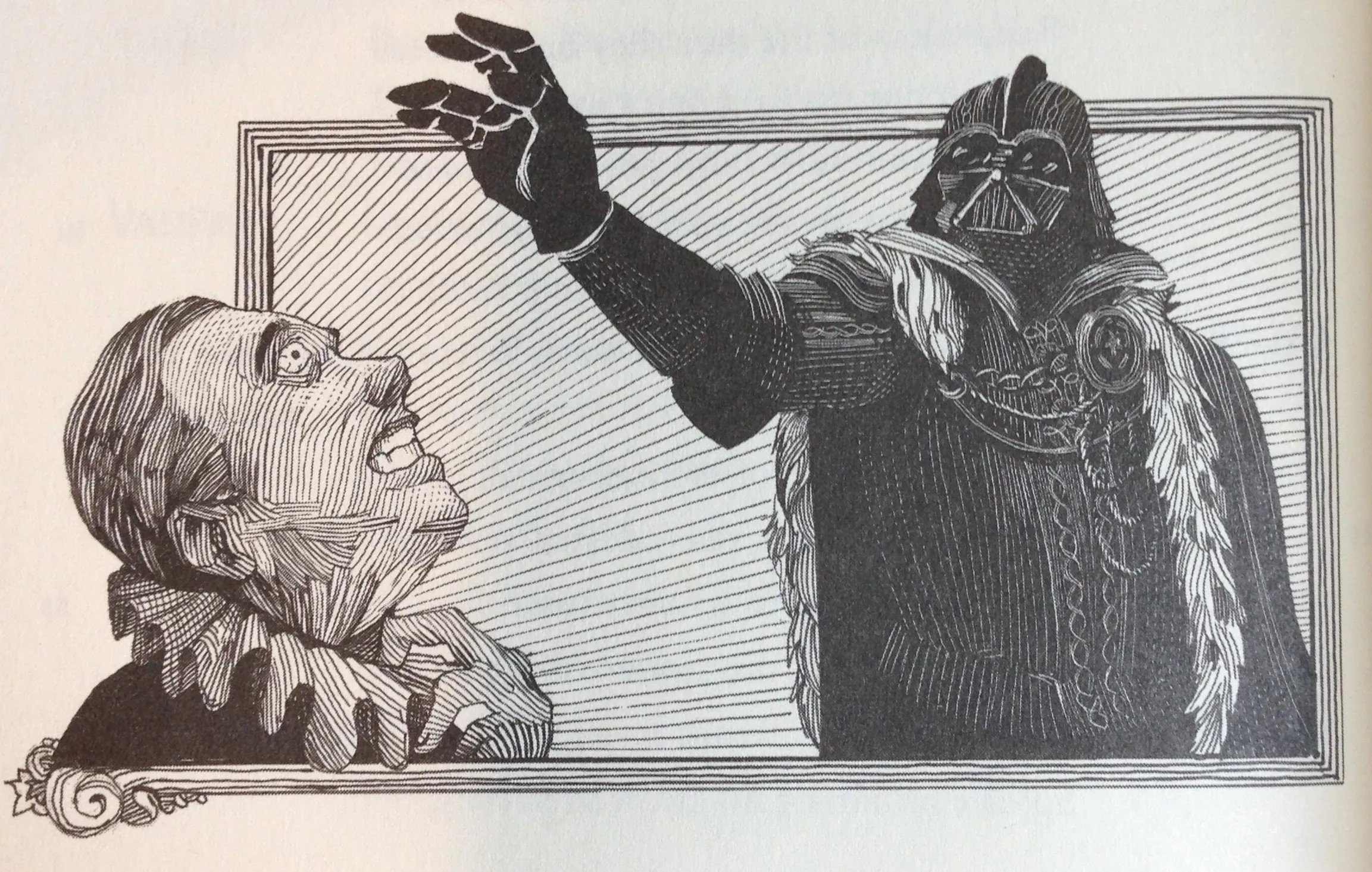
Illustration from William Shakespeare's Star Wars
Illustration from “William Shakespeare’s Star Wars”

Play review: William Shakespeare’s Star Wars

Since Monday was May the Fourth, and since I got some encouraging comments about the previous post, I’m happy to review one of the most interesting Shakespeare spin-offs I’ve ever encountered: William Shakespeare’s Star Wars by Ian Doescher. For those of you who haven’t heard of this play, it’s basically the script of Star Wars put into Shakespearean verse. The writer clearly loves both Shakespeare and Star Wars, and puts lots of cheeky Shakespearean references in the text, such as Luke Skywalker parodying Hamlet as he steals a Stormtrooper’s uniform and Yorrick-like, holds up the helmet to his face:

“Alas poor Stormtrooper, I knew ye not,” (Doescher IV, vi, 1) The play lends itself perfectly for performance in an Elizabethan playhouse with its sparse stage directions and an Elizabethan chorus that comments on the action and tells the audience whenever action occurs offstage, such as when the Death Star gunners prepare their mighty laser to destroy the planet Alderon. I certainly got a kick out of reading this play since I too am a huge Shakespeare/ Star Wars fan. However, since this blog is meant to help us learn and appreciate Shakespeare, the question is, does this play have any value to Shakespearean students? At first I wasn’t sure, but now I say yes!

Before I read the play, I was a little apprehensive as I’ve seen Shakespearean gimmicks fall flat before; I once saw a dreadful production of Macbeth where the whole cast was made up to look like zombies for absolutely no purpose except to cash in on the zombie fad. So at first, I wondered, “Why bother translate Star Wars into Shakespearean language”? As I read on though, I realized what the author had done was give readers a rare glimpse into how Shakespeare himself wrote.

This helps prove one thing I’ve always felt about teaching Shakespeare- parody and gentle satire are a great way to deconstruct his plays into something a little easier to grasp. As I said before, Doescher’s play is full of tiny bite-size portions of real Shakespearean dialogue that allow you to digest some of The Bard’s most famous lines. Also, he’s following the same ‘recipe’ Shakespeare used in his plays and speeches, so I’m going to deconstruct some of the Shakespearean elements that Doescher employed to concoct this Shakespeare/Sci-fi classic hybrid. I’ll focus on the first play in the series: Verily A New Hope, but you can find these components in all of the plays in the Star Wars Saga.

  1. Iambic pentameter- the most obvious difference between the original Star wars is that Doescher took the dialogue and put it into the same poetic meter Shakespeare used. For those who don’t know, Iambic pentameter is a kind of unrhymed poetry with 10 syllables per line. Each line also has 5 stressed beats that strike like a heart beat- Da DUM Da DUM Da DUM Da DUM Da DUM. To keep the emphasis on the right syllables, sometimes the writer has to shift the syntax or add and subtract words to get them to fit. This is why instead of the famous: “A long time ago, in a galaxy far, far away,” the Prologue at the beginning says:

“ In time so long ago begins our play,

In star-crossed galaxy far, far away.”

Doescher’s time-consuming process of translating a prose movie script into blank verse poetry is exactly Shakespeare did when he wrote his plays, only instead of movie scripts, he took the chronicles of English history to become Hamlet, Macbeth, Lear, and many others. With all the work involved in crafting poetry like this, it’s no wonder he didn’t have time to think up an original story!

  1. Telling the audience what you’re doing- As I said last week, one thing to keep in mind when you read Shakespeare is that his plays were performed outdoors with no microphones, in an audience of nearly 3,000 people! It must have been extremely hard to see or hear the action onstage. Shakespeare tried to solve this problem by having characters announce what they’re doing, which would be tedious, if he didn’t also know how to spice up the dialogue with lines that reveal the character’s emotional state, like when Lord Capulet says: “My fingers itch,” to warn his daughter he’s about to hit her. Doescher captures this extremely well in the speech where Vader lifts up the Rebel Leader and begins to choke him to death:

I turn to thee, thou rebel. Aye, I lift

Thy head above my own. Thou canst now choose

To keep thy secrets lock’d safe in that head

Or else to keep thy head, and thus thy life (Doescher I, ii 6-10).

This passage explains to the reader or playgoer that Vader has lifted the man over his head, (demonstrating his cruelty and his strength), and subtly plays on the fact that Vader is looking at his head, wants the knowledge in his head, and will crush his head if the Rebel doesn’t cooperate. Shakespeare’s Richard III makes a similar threat: “Villain, set down the corpse, or by St. Paul, I’ll make a corpse of him that disobeys!”

  1. The Aside One thing Shakespeare does that few modern writers ever do is have characters talk directly to the audience; thus establishing an intimate relationship between you and a person who is confiding their secrets in you. The most striking example of this in Shakespeare’s Star Wars is R2D2, who in the movie never spoke at all, but made cute little electronic beeps and whirrs. Having R2 speak gives the reader an unexpected closeness because R2 never speaks to anyone else.
  2. Personification Shakespeare is really good at finding a clever visual metaphor for an abstract idea, and will write speeches or dialogue where characters explore the nature of that idea, a meditation if you will. One of my favorite examples from Shakespeare’s Star Wars is the scene in which Luke and his uncle debate about whether Luke will stay on the farm. Luke compares himself to a bird that’s trying to fly away, while his uncle uses farm metaphors to try and keep him to stay:

OWEN: Wilt thou here in the desert yet desert? Tis only one more season.

LUKE: Now cracks a hopeful heart, when by the land,

A man’s ambitions firmly grounded are:

So shall a bird ne’er learn to fly or soar

When wings are clipp’d by crops and roots and soil.

It’s really very clever the way Doescher mimicks Shakespeare’s wordplay here. Luke is like a bird because he’s a pilot and longs to fly. Owen is a farmer on a desert and is worried about Luke deserting him. We get a clear picture of their relationship from this scene.

  1. Chorus Shakespeare sometimes uses a Chorus to tell us what is going on in plays where the location shifts from place to place- it’s a time honored device in epic storytelling. Nowadays we use a Chorus too, we just call it a Narrator. The difference is that a Chorus also can explain the tone and the mood of the action onstage, so that you can imagine it in your own mind. Take a look at this passage where the chorus describes the famous Star Wars Cantina:

Now mark thee well, good viewer, what you see,

The creatures gather round the central bar

While hammerheads and hornéd monsters talk.

A band composed of aliens bizarre:

This is the great cantina- thou may’st gawk! (III, I, 45-49).

You can see how, unlike a narrator who would just tell you there are a bunch of aliens here, the Chorus describes the sights and sounds of the bar so you can imagine it yourself. The Chorus in Shakespeare’s Henry the Fifth explicitly states that the audience needs to use their imagination to fill out the story of Henry’s conquest of France.

  1. The soliloquy A soliloquy is a speech spoken by a character alone on stage. It often has to do with a complex dilemma such as Hamlet’s “To Be Or Not To Be.”
1307_SBR_STARWARS_ILLO.jpg.CROP.article568-large

In Shakespeare’s Star Wars, Luke and Vader have the most soliloquis and with good reason- they have the most complicated emotional journeys- Luke goes from a simple farmboy from Tatooine to a Jedi Knight, while Vader goes from a Jedi to a Sith to a father. Shakespeare’s greatest power is his ability to put complex emotional journeys like these into speeches that the characters share right with us. I loved both these speeches too much to choose, so I’m going to talk about of both. The first is a soliloquy Vader speaks after he kills the Rebel leader:

And so another dies by my own hand,

This hand, which now encas’d in blackness is

O that the fingers of this wretched hand

Had not the pain of suffring ever known. Droescher I.ii, 27-30

This speech reminds me very much of Richard III, one of Shakespeare’s greatest villains. Richard, like Vader, has his life story told in 6 installments where he slowly becomes an evil mastermind. The images of this speech conjure up parts of Vader’s life story: how he lost his hand in Episode II and now has a robotic hand in a black glove. The speech also conjures the fact that his master the Emperor is able to shoot lightning from his hands, and of course, how Vader himself is able to kill by merely gesturing with his hand. Richard has a speech where he talks about all the people he’s killed to become king, and how he now has to kill even more to stay king:

I must be married to my brother’s daughter,
Or else my kingdom stands on brittle glass.
Murder her brothers, and then marry her!
Uncertain way of gain! But I am in
So far in blood that sin will pluck on sin:
Tear-falling pity dwells not in this eye (Richard III, Act IV, Scene i)

Luke has another speech where he talks about his destiny staring at the twin suns of Tatooine, but I won’t spoil that one for you! Needless to say, it’s awesome. I bring it up because In the movie, it was John Williams’ job to literally underscore Luke’s emotions as the music swelled. Shakespeare’s gift on the other hand was to put powerful emotions and thoughts into carefully composed soliloquys that sound like music when spoken well.

So as you can see, the author’s loving parody of Shakespeare allows us a rare glimpse of how the Bard wrote; his cleverness at adapting stories, his use of verse, wordplay, metaphor, personification, choruses, and his unique ability to write characters that talk to us as if we were in on their deepest secrets.

By the way, if you’re still unconvinced on this play’s educational value, check out this link to their educational website: http://www.iandoescher.com/wp-content/uploads/2013/08/ShakespeareStarWars_EducatorsGuide.pdf