
https://www.pbs.org/wnet/gperf/blog/black-history-month-on-great-performances/
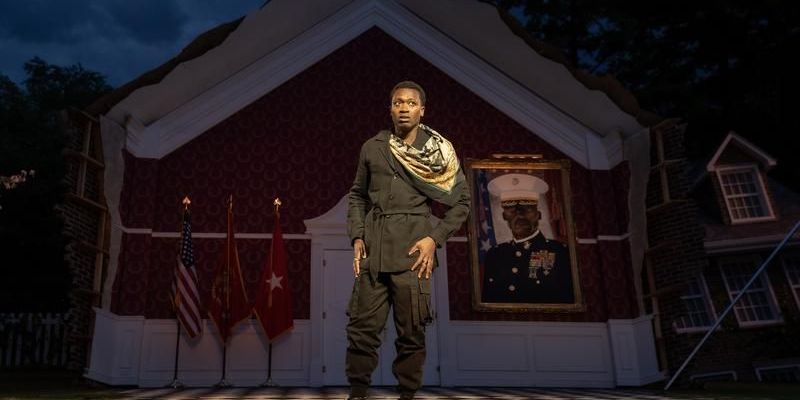
- Richard III, starring Danai Gurira
- Black Lucy and the Bard- a retelling of the life of the fictional Dark Lady
- Hamlet, starring Ato Blankson-Wood


https://www.pbs.org/wnet/gperf/blog/black-history-month-on-great-performances/

Parent Description- A fully online, fully interactive course into Shakespeare’s histories taught by a professional text coach and actor.
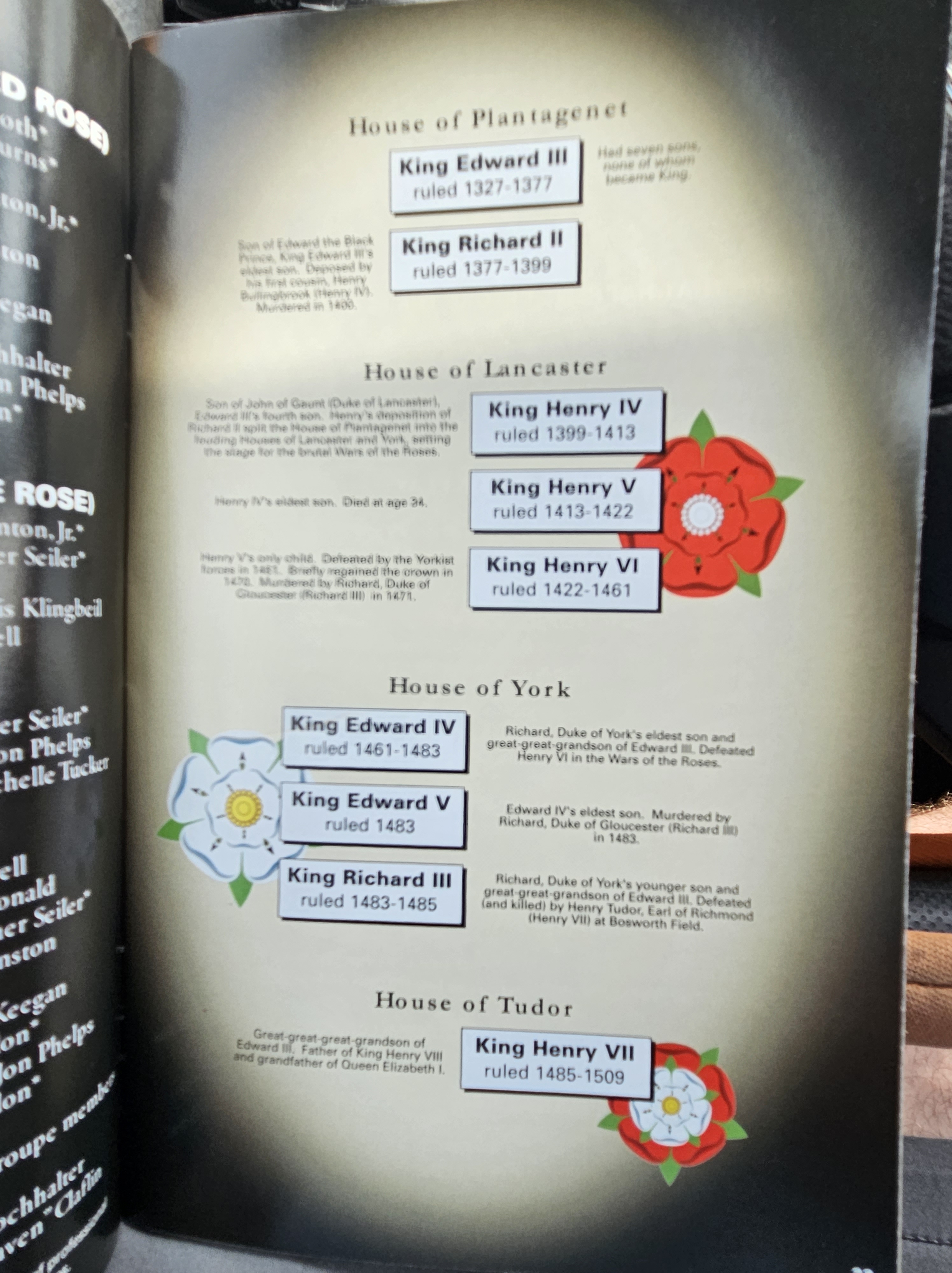
Students- Uncover the scandalous and gory history behind Shakespeare’s most action-packed plays! Shakespeare’s histories have inspired such works as “Empire,” “Game of Thrones,” “Hamilton” and even the “Star Wars” trilogy. This class will unlock for you why these stories of power and betrayal have been so popular for 400 years.
Format:
0. The class will have a Nearpod with slides, activities, and links to my other resources. The class will be a combination of slides, activities, and videos. Each class will have






-Concept- what if the play was a Hockey movie?




Tonight is the Chinese New Year, beginning the Year of the Dragon. I’ve talked before about the fascinating relationship between Shakespeare and China, and I thought I’d illustrate it here by talking about a shared cultural mythology- the concept of dragons. Both Western and Eastern cultures use dragons in their myths, but as you’ll see, they have very different cultural meanings.
Before thee stands this fair Hesperides,
Antiocus, Pericles
With golden fruit, but dangerous to be touch’d;
For death-like dragons here affright thee hard:
Sometimes we see a cloud that’s dragonish;
Antony and Cleopatra
A vapour sometime like a bear or lion,
A tower’d citadel, a pendent rock,
A forked mountain, or blue promontory
In Western myths, dragons are symbols of wrath and fierceness. In ancient Greek and Viking myths, dragons are often guards of treasure, (and sometimes in modern stories like Harry Potter). In the myth of Hercules, a multi-headed dragon guarded the golden apples of the Hesperides, (the apples that kept the gods young and immortal). King Antiochus wants to scare Pericles by comparing his daughter to the apples; if he fails to win her love, he’ll be devoured as Hercules almost was.
His CORIOLANUS is grown
Coriolanus
from man to dragon: he has wings; he’s more than a
creeping thing.
Shakespeare’s Roman general Coriolanus is frequently compared to a dragon in Shakespeare’s play. According to Dr. Peter Saccio of Dartmouth College, this is because the general is unable to relate to other humans- he is solitary, violent, jealous of his power and wealth, and prefers to strike first, then retreat from other people when the battle is won. This is why he utterly fails to get the Roman people to elect him consul in this scene from Ralph Fiennes’ movie. I find it ironic that Fiennes has played not only this character, (who is associated with dragons), but with Lord Voldemort, (who controls several large serpents), and also Francis Dollarhyde in the film Red Dragon:
Swift, swift, you dragons of the night, that dawning
Cymbeline
May bare the raven’s eye! I lodge in fear;
Though this a heavenly angel, hell is here.
Sometime he angers me
Hotspur, Henry IV, Part I
With telling me of the mouldwarp and the ant,
Of the dreamer Merlin and his prophecies,
And of a dragon and a finless fish,
A clip-wing’d griffin and a moulten raven,
A couching lion and a ramping cat,
And such a deal of skimble-skamble stuff
As puts me from my faith.
A thousand hearts are great within my bosom;
Advance our standards, set upon our foes
Our ancient word of “courage,” fair Saint George,
Inspire us with the spleen of fiery dragons!
Richard III
In the medieval story of St. George, the titular knight defeats a dragon, which is basically a stand-in for Satan. George was seen as the ideal knight- virtuous, devoted to his cause, strong, and patriotic. His defeat of the dragon was an allegory for how knights should devote themselves to protecting their lords, ladies, and the innocent against evil. Therefore, it’s intentionally unsettling that Shakespeare has Richard III telling his soldiers to act not like the virtuous St. George, but like the cruel and violent dragon. Richard is Shakespeare’s most villainous king, so it makes sense in context that he would side with the dragon, and thus his defeat would seem even more like a triumph of good over evil. In addition, the real King Richard flew this flag with a dragon on it during the actual Battle of Bosworth Field.

Peace, Kent!
King Lear
Come not between the dragon and his wrath.
None of the animals is so wise as the dragon. His blessing power is not a false one. He can be smaller than small, bigger than big, higher than high, and lower than low.”
–Chinese scholar Lu Dian (AD 1042-1102)
Dragons didn’t have the negative connotations of Western myths. In China, they were symbols of good luck, strength, and success. They were also known to be proud and temperamental-sometimes kind but sometimes vengeful to people who didn’t show them proper respect. In a sense, the dragon was like the ancient Greek gods- they should be viewed with respect and gratitude as well as fear.
The Chinese calendar goes by a cycle of years, not months. It has 12 animals that represent various qualities and those qualities will characterize the coming year. So hopefully a year of a dragon will be a year marked with courage, good fortune, and justice.
IV. What would a Chinese Lear look like?
Looking at the quotes I showed you earlier, it’s interesting that King Lear calls himself a dragon, and it made me think- Lear is a powerful warlord who demands absolute loyalty from his children. Would a Chinese version of King Lear work?
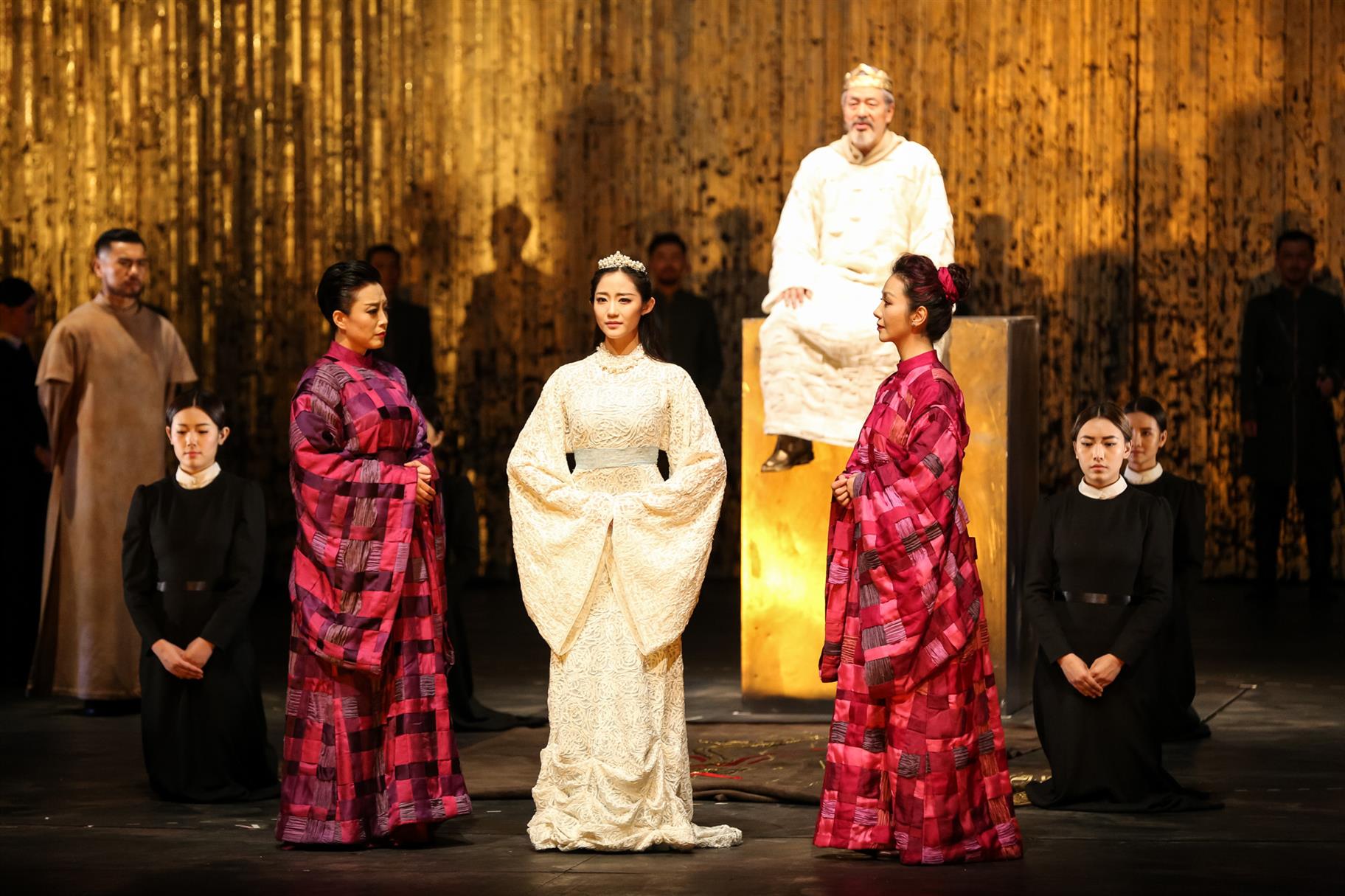
There was a Chinese production of King Lear back in 2017, where the translator and director traveled to the Royal Shakespeare Company in England and worked with the actors and directors of a London production to make their production gain insight into the characters’ motivations. However, I wonder how successfully they translated the Western ideas and values of the play for a Chinese audience. One of the reviews from China Daily.com describes the play like this:
Originating from old British legend, King Lear is one of Shakespeare’s four most famous tragedies. Through the internal disorder of the royal family, the rise and fall of King Lear’s fate and the final punishment of evil powers, Shakespeare expresses his optimistic views in the future of society, thereby adding the glory of strong idealism into his work.
ChinaDaily.com
The last word I would use to describe King Lear is “optimistic”. It is the only tragedy where not only does everyone die, but the entire future of the monarchy is in question. Nevertheless, reading about this production makes me interested in imagining my own version of King Lear, one that emphasizes Chinese values, but also questions them.
Many Chinese stories stress family loyalty, communalism, and respect for elders. You could portray King Lear as a story about the disastrous consequences of self-interest. After all, Regan and Goneril cast their father out and dismissed his followers, and it led their kingdom into civil war. In that version, Lear is like the Dragon King, who in Chinese folklore, was a powerful ruler of the seas, (giving new meaning to the lines “Blow winds, and crack your cheeks”). As a bonus, historically, many imperial Chinese rulers decorated their palaces with images of dragons, and the emperors themselves were associated with the creature, (especially during the Han Dynasty), so when Lear says “Come not between the dragon and his wrath,” In his mind, he literally is a dragon.
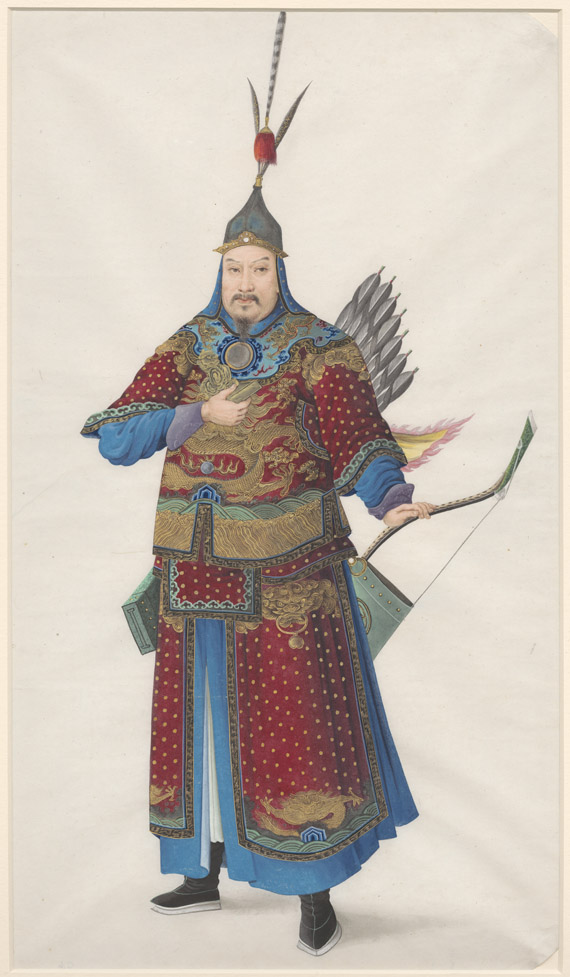
In 1736, Jean-Baptiste Du Halde wrote about the Emperor: “His clothing is embroidered with dragons: they are his emblem, and only He can wear dragons with five claws – any infringement to this rule is punished severely.”
Cornell University: Emblems and Mascots of Rulers:
Chinese Imperial Dragons
That said, some dragons were associated with bad luck and ill omens. I’ve said before that Lear’s biggest flaw is that he fails to take time to examine himself or think about the consequences of his actions until it is too late. Maybe Lear thinks of himself as a benevolent dragon, but really is a bad man cursed with bad luck; he is not a dragon, he just has one on his back. So, in short, a Chinese re-imagining of King Lear could be a fascinating look at Chinese culture and give a fresh re-imagining of Shakespeare’s tragic story.
I hope you enjoyed this look into dragons in Shakespeare and Chinese culture. Joseph Campbell said that all cultures share and interpret archetypes to understand their own culture, but also to grasp what makes us all human. For whatever reason, every culture on Earth has some kind of large serpent- Chinese dragons, European dragons, The Aztec god Quetzalcoatl, the Viking Yormungand, even the Piasa of the native tribes of the Mississippi. and they can mean many different things to many different people, which means that we as humans are in some way tied to gether through all these dragon tales (no pun intended).

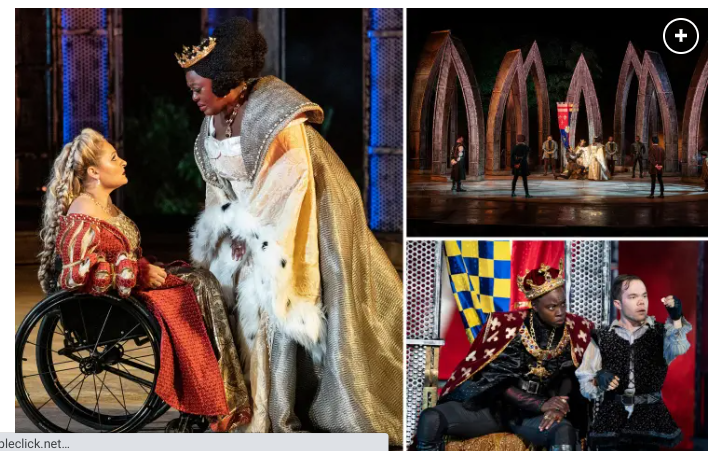
This past month, there was a free production of Richard III in New York’s Shakespeare In the Park, starring Danai Gurira as the title character. I have not seen this production, though I wish I had. I enjoyed the actress Ms. Gurrira in such films as “Black Panther,” and would love to see her do Shakespeare. What is more, the concept intrigues me. This project explores themes of toxic masculinity, racial identity, inferiority, and misogyny.

https://www.npr.org/2022/07/10/1110359040/why-it-matters-that-danai-gurira-is-taking-on-richard-iii
Unsurprisingly, with so many heady topics in the production, this Richard III is still somewhat controversial. Some right-wing critics dismissed the whole production as a piece of ‘woke propaganda,’ but I feel this is unfair.
When Danai Gurira of Marvel’s “Black Panther” first takes the stage in the title role, the actress has no perceivable hunchback or arm trouble. And yet the dialogue suggesting Richard suffers from a lifelong physical issue (“rudely stamped”) has been kept in. Perhaps we are to use our imaginations. Who knows? We are certainly tempted to close our eyes.
By Johnny Oleksinski
I will not judge this production based on the acting because I haven’t been able to see it. What I will do is take a stance on the validity of the concept. Specifically, I want to ask if this play is a good examination of toxic masculinity and if it would it be worthwhile to see it portrayed by a black woman, as opposed to a white man. The short answer is an emphatical “Yes.”
Richard III is definately an example of toxic masculinity. He is violent, full of hatred, vengeance, and mysogeny. He is constantly insulting women from Lady Anne, Jane Shore, Queen Elizabeth, and even his own mother. In fact, the source of Richard’s toxic attitude is that he blames his mother for his disability and deformity:
Well, say there is no kingdom then for Richard;1635
What other pleasure can the world afford?
I'll make my heaven in a lady's lap,
And deck my body in gay ornaments,
And witch sweet ladies with my words and looks.
O miserable thought! and more unlikely1640
Than to accomplish twenty golden crowns!
Why, love forswore me in my mother's womb:
And, for I should not deal in her soft laws,
She did corrupt frail nature with some bribe,
To shrink mine arm up like a wither'd shrub;1645
To make an envious mountain on my back,
Where sits deformity to mock my body;
To shape my legs of an unequal size;
To disproportion me in every part,
Like to a chaos, or an unlick'd bear-whelp1650
That carries no impression like the dam.
And am I then a man to be beloved?
O monstrous fault, to harbour such a thought!. 3H6, Act III, Scene i, lines 1635-1653.
Now I should clarify the difference between deformity and disability, which are characteristics that Richard III has as part of his character makeup. According to the Americans With Disabilities Act, a disability is defined as: “A physical or mental impairment that substantially limits one or more major life activities.” This could include paralysis, autism, or any number of congenital or acquired conditions. Richard’s disability is primarily his limp (caused by his unequally shaped limbs), and his withered arm. What’s interesting in this production is that while the title role is played by an able-bodied woman, most of the rest of the cast have actual disabilites. Watch this clip of the famous courtship scene between Richard and Lady Anne, who plays her role in a wheel-chair.
While a disability is a legal term that is recognized by lawyers and governments alike, the term “deformity” is more subjective; it generally refers to any kind of cosmetic imperfection. In Richard III, this applies to Richard’s hump and withered arm.
The Elizabethans thought that deformity was a sign of disfavor from God, and that deformed people were constantly at odds with God and nature, as Francis Bacon puts it in his essay, “On Deformity.”
As deformed people are physically impaired by nature; they, in turn, devoid themselves of ‘natural affection’ by being unmerciful and lacking emotions for others. By doing so, they get their revenge on nature and hence achieve stability.
Richard III has this drive for revenge in spades and I believe it manifests itself as a particularly terrible form of toxic masculinity. Richard definitely wants the crown to make up for his lack of ‘natural affection,’ but he is also especially malevolent towards women.
I, that am rudely stamp’d, and want love’s majesty
To strut before a wanton ambling nymph;
And therefore, since I cannot prove a lover,
To entertain these fair well-spoken days,
I am determined to prove a villain
And hate the idle pleasures of these days
Seeing a woman play this kind of misogynist dialogue forces the audience to take it out of context and question Richard’s point of view. We see casual misogyny every day, and seeing a woman deliver it is quite illuminating.
Another provocative choice by Danai Gurira’s portrayal of Richard is the fact that she plays the role of Richard without the hump or withered arm. She herself explains that for her production, Richard’s perceived deformity, is actually represented by her being a black woman:
He’s dealing with the otherness compared to his family, in terms of not being Caucasian and fair like them.” The word ‘fair’, is used a lot in the play.
Danai Gurira’s
Shakespeare writes Richard as constantly striving to compensate for his deformities by being clever, violent, and eventually, by becoming king. As I wrote before in my review of Othello, for centuries black people have been portrayed as inferior; aberrations of the ‘ideal fair-skinned form’. So, to the Elizabethans, blackness itself was a form of deformity, and the rawness of addressing this uncomfortable fact in this production should be commended.
English people are already trained—and we have scholars like Anthony Barthelemy has talked about this in his book Black Face, Maligned Race, where the image of blackness, as associated with sin, with the devil, all of these things, makes it quite easy to map onto then Black people these kinds of characteristics. Then, those kinds of characteristics allow for the argument that these people are fit to be enslaved. – Dr. Ambereen Dadabhoy, Race and Blackness in Elizabethan England Shakespeare Unlimited: Episode 168
https://www.folger.edu/shakespeare-unlimited/elizabethan-race-blackness-dadabhoy
So while I can’t speak to the production’s acting or staging, I will emphatically defend the notion that this production’s concept is valid. Richard III is an example of toxic masculinity through his self-hatred, violence, misogyny, and narcissism. In addition, as I’ve written before, in the Early Modern Period, blackness was considered an aberration or deformity, and seeing it in the person of Richard, with the implicit understanding that black people still face this kind of prejudice today, opens a much-needed dialogue that any production of Shakespeare shouldn’t be afraid to open.
In short, by re-contextualizing Richard’s deformity and disabilities, this production gets to the heart of the play’s moral for our times. The early modern period’s toxic attitudes towards deformity and disability created the Renaissance monster of Richard III. We in the 21st century must examine our own societal prejudices and toxic attitudes so this monster does not come to haunt us in real life.

The global phenomenon “Five Nights At Freddie’s” (FNAF) has spawned 11 major games, spinoff games, 19 books, countless comics, and a big Hollywood movie premiering this week:
One other thing this franchise has spawned is ENDLESS FAN THEORIES. I admit, when I first heard of this jump-scare-based game with haunted animatronics, I viewed it as a silly novelty- a clever way to create cheap horror using monsters who jump out at you in a dark room… then I saw this:
The YouTube channel Game Theory, which has been analyzing and dissecting the games for the last 8 years finally created a complete chronology of the games’ lore. Like a lot of the best horror stories like Dracula and “Sleep No More,” the game scatters a lot of its lore throughout the game in the form of mini-games, security guard notebooks, newspaper clippings, and of course, the iconic, nervous late-night phone calls that your character (a nameless night watchman) receives from a mysterious character known only as THE PHONE GUY.
This story is truly the stuff of nightmares- serial killers, murdered children, ghosts, possessed robots, broken families, and unending quests for revenge from beyond the grave. Of course, a few of these tropes Mr. Shakespeare would be very familiar with, so I thought I’d delve into some of the themes, tropes, and ideas that link these two franchises. My goal is to get fans of the video game to understand that, since Shakespeare and Scott Cawthorne (the creator of the game) use a lot of the same horror plots and ideas, that, if you can understand FNAF you can understand Shakespeare!
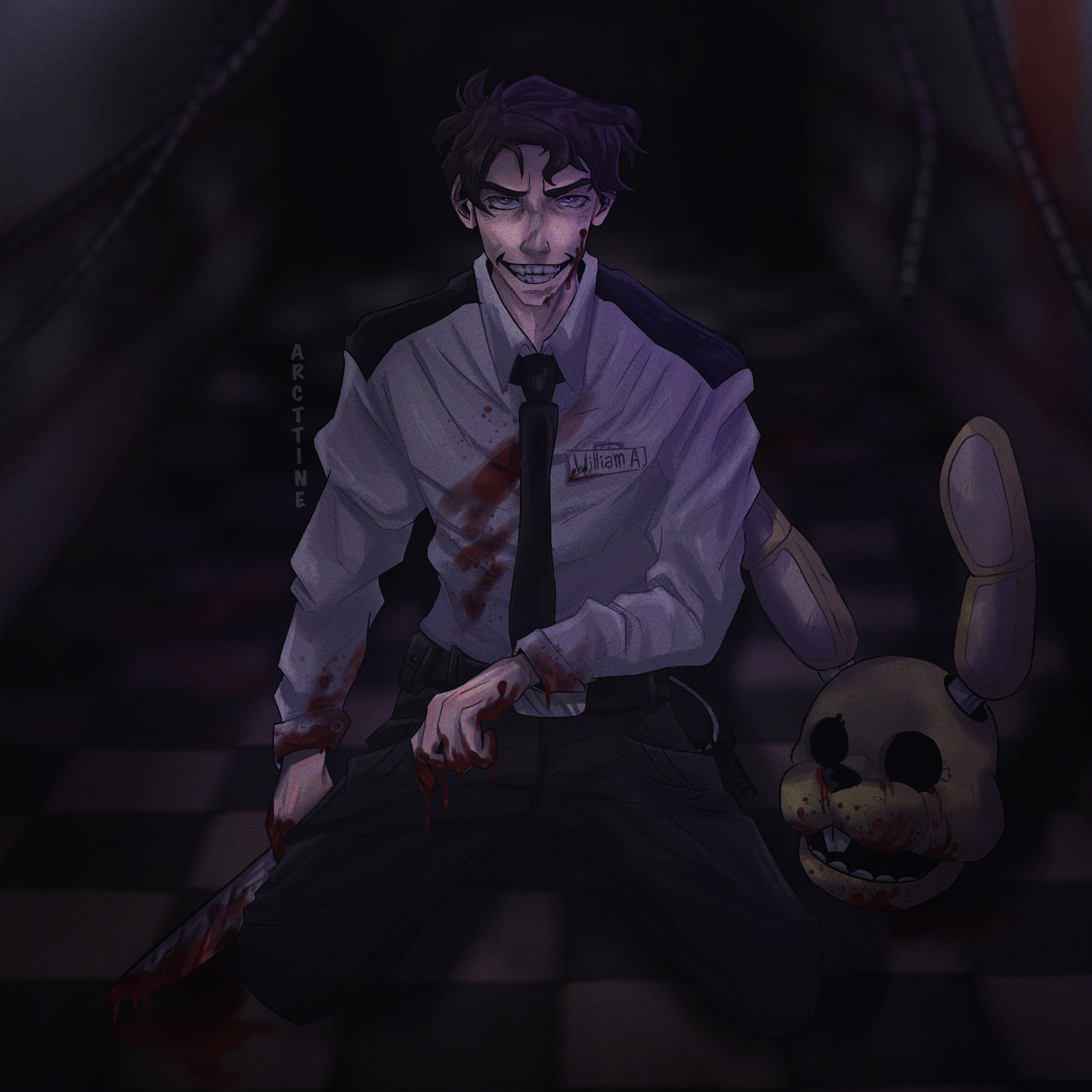
The story of Five Nights At Freddie’s revolves around its main antagonist- a genius roboticist-turned-serial killer named William Afton, who starts out as a successful businessman and children’s entertainer obsessed with bringing his creations to life. Any horror fan will tell you that this is an automatic sign of a villain because he is trying to master the skill that only God possesses- the ability to create life.
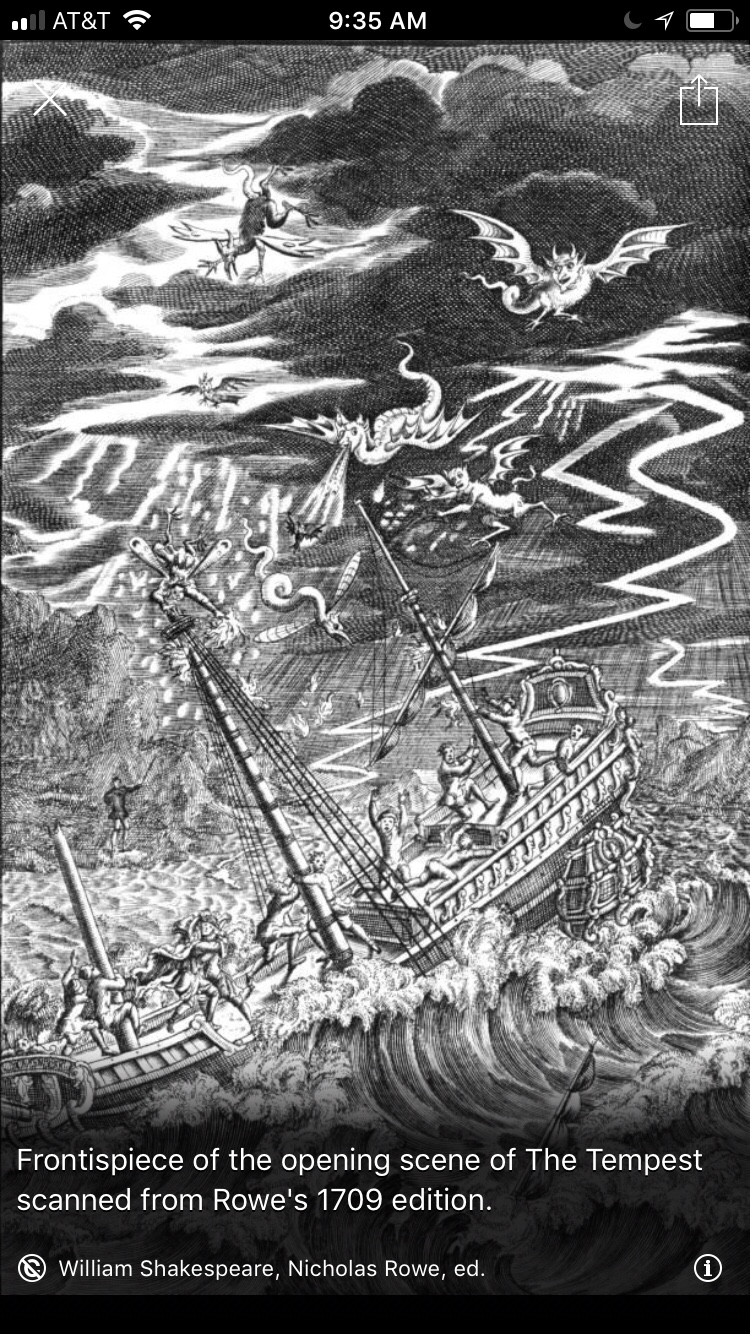
In Shakespeare’s final play, The Tempest, the hero is a brilliant magician who, after his brother exiles him to a desert island, masters many crafts considered unnatural for the 1600s:
I have bedimm'd
The noontide sun, call'd forth the mutinous winds,
And 'twixt the green sea and the azured vault
Set roaring war: to the dread rattling thunder
Have I given fire and rifted Jove's stout oak
With his own bolt; the strong-based promontory
Have I made shake and by the spurs pluck'd up
The pine and cedar: graves at my command
Have waked their sleepers, oped, and let 'em forth
By my so potent art.
The Tempest, Act V, Scene i, Lines 2063-
Like I discussed in my post on Shakespeare and Star Trek, Prospero’s magic is both benevolent and terrifying. He uses it to rescue himself and his daughter Miranda from the island, and he creates beautiful visions of gods and angelic music for Miranda and her young lover Sebastian, but he also creates nightmarish visions to torment his enemies:
Both Afton and Prospero are motivated by revenge against the men who betrayed them. In Afton’s case it’s his rival/ partner Henry Emily who bankrupted his business and later got him fired from his own company. Afton torments Henry by murdering his daughter and ruining his business by luring kids to their death inside the pizzeria, disguised as one of the animatronic characters. Afton also figures out how to torment people using sound alone, like Prospero does to his slave Caliban:
Caliban. All the infections that the sun sucks up
From bogs, fens, flats, on Prosper fall and make him
By inch-meal a disease! His spirits hear me
And yet I needs must curse.
For every trifle are they set upon me;
Sometime like apes that mow and chatter at me
And after bite me, then like hedgehogs which
Lie tumbling in my barefoot way and mount
Their pricks at my footfall; sometime am I
All wound with adders who with cloven tongues
Do hiss me into madness.
Here comes a spirit of his, and to torment me! The Tempest, Act II, Scene ii.
Prospero isn’t a killer, but like Afton, he has learned the secret to life after death, which makes him powerful and dangerous. Even more unsettling, both men are on an endless quest for revenge and torment men whom they saw as brothers. Other Shakespearean characters take their lust for revenge to the same dark place Afton did- the murder of children.

https://mriquestions.com/why-are-veins-blue.html
For the first four games, Afton isn’t directly part of the game- he’s merely mentioned in pieces of the lore. Frequently we see 8- bit re-enactments of his crimes in a series of mini-games, where he appears as a faceless, purple killer.
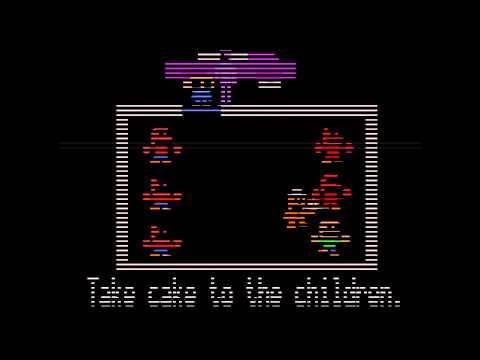
Why purple though? It’s true that purple is associated with royalty, and sometimes associated with villainy, (since it isn’t a color found much in nature). I think though, there might be a deeper, more macabre meaning to this color associated with this killer: It is a scientific fact that human blood, when it is shed and deprived of oxygen, actually turns purple:

The colors of arterial and venous blood are different. Oxygenated (arterial) blood is bright red, while dexoygenated (venous) blood is dark reddish-purple
https://mriquestions.com/why-are-veins-blue.html

Shakespeare was very aware of this medical fact. He lived in an age where traitors’ heads were placed on spikes on London Bridge, and people would pay to watch wild dogs attack bears (the FNAF of his time). Shakespeare makes many gory references to murderers watching red blood turn purple:
I make as good use of it as many
Henry IV, Part I, Act III, Scene iii.
a man doth of a Death’s-head or a memento mori: I
never see thy face but I think upon hell-fire and
Dives that lived in purple;
Woe above woe! grief more than common grief!
Henry VI, Part III, Act II, Scene v.
O that my death would stay these ruthful deeds!
O pity, pity, gentle heaven, pity!
The red rose and the white are on his face,
The fatal colours of our striving houses:
The one his purple blood right well resembles;
Now, whilst your purpled hands do reek and smoke,
Julius Caesar Act III, Scene i.
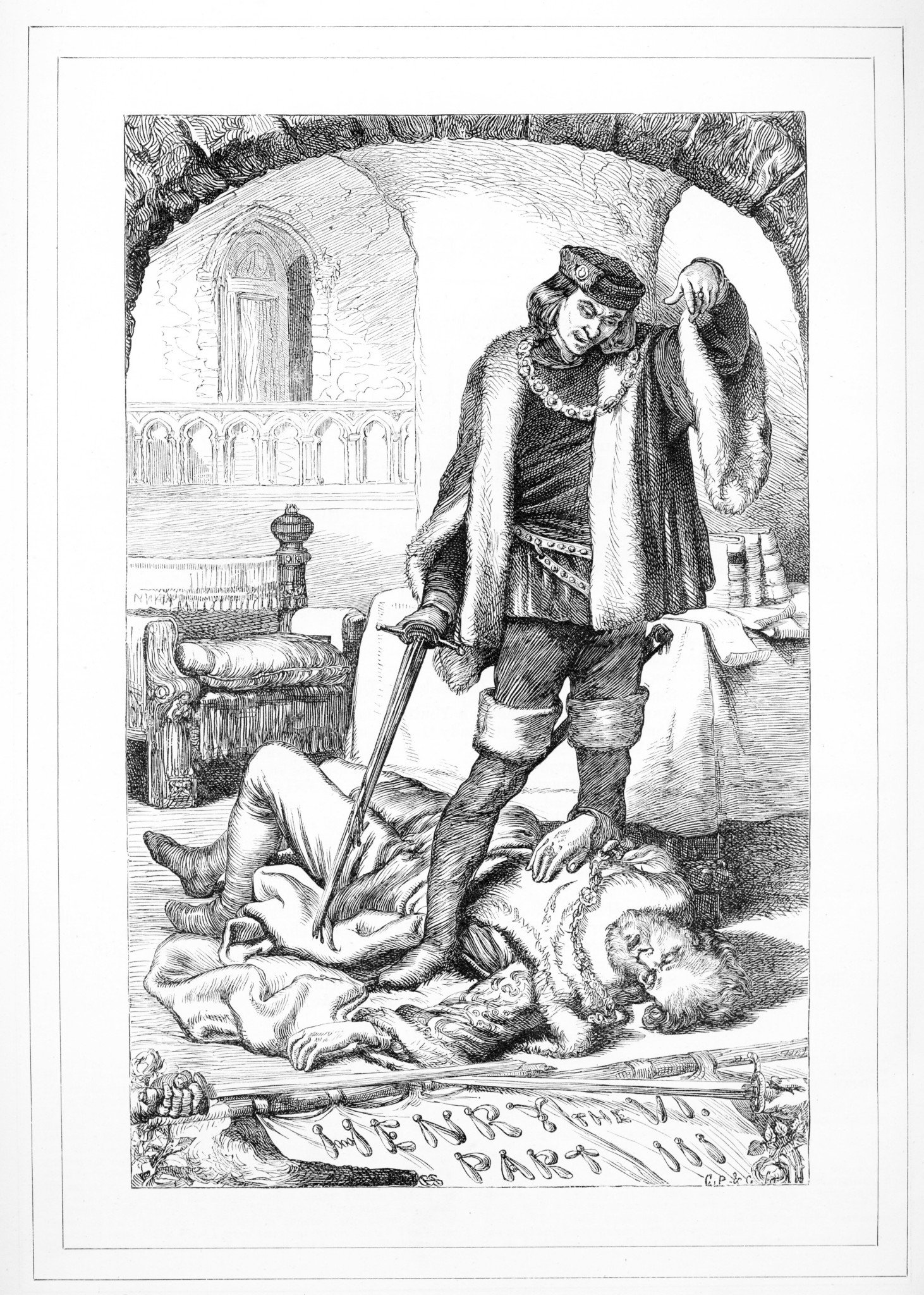
With purple falchion, painted to the hilt
Henry VI, Part III, Act II, Scene v (Richard of Gloucester)
In blood of those that had encounter’d him:
This last quote is spoken by Richard of Gloucester, who, in the play that bears his name, becomes King Richard III, Shakespeare’s most irredeemable villain. Just like William Afton, he kills without remorse and dispatches anyone who gets in his way on the path to the crown. In addition, like many of Shakespeare’s villains, his turn to pure evil occurs right after he does the unthinkable- when he murders children.
Throughout the rest of the play, Richard kills a lot of his political and personal enemies and we go along with them because he’s the protagonist. But once he murders the princes, who have done nothing to harm him or anyone else, Richard crosses the line from anti-hero to monstrous villain. It is also at this part of the play when his victims begin to take their revenge… FROM BEYOND THE GRAVE!
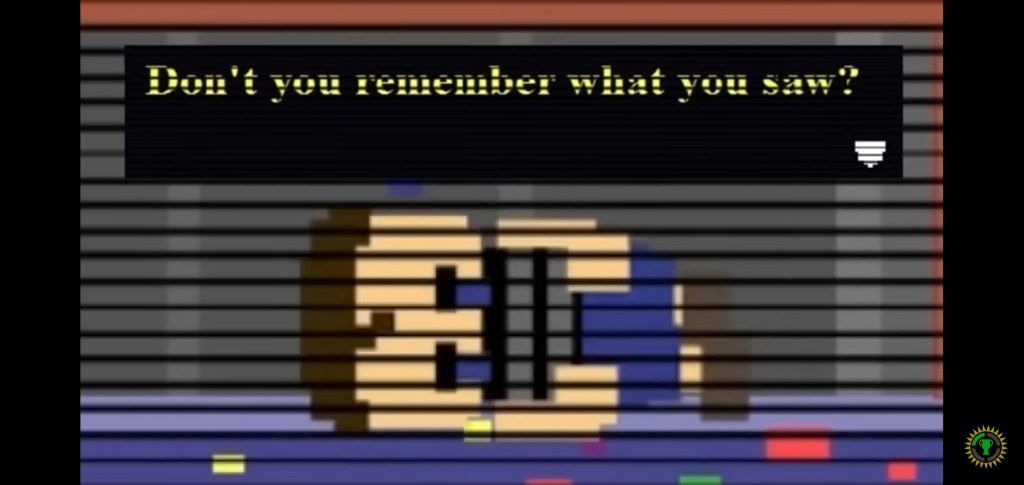
I’ve written before that in Shakespeare, ghosts are usually murder victims either out for revenge, or trying to convince a living person to avenge their death. Likewise, in the subsequent games, Affton’s victims possess the animatronics, seeking to kill their murderer!

One of the creepiest scenes in Shakespeare comes when Richard III is visited the night before his final battle by the ghosts of all the people he’s killed:
Similarly, when Macbeth murders his friend Banquo (and attempts to murder his young son Fleance), he is visited by Banquo’s ghost, during a party, no less! Even more ironic, look at the language Macbeth uses when he sees the ghost:
Approach thou like the rugged Russian bear,
The arm’d rhinoceros, or the Hyrcan tiger;
Take any shape but that, and my firm nerves
Shall never tremble: or be alive again.
It’s truly ironic that, while in FNAF, the ghosts of Afton’s slaughtered children appear in the forms of angry animatronics, shaped like fearsome animals, Macbeth would rather see the fearsome animal, than the ghost of the man he murdered! Though Macbeth himself doesn’t fear bears, in both FNAF and Shakespeare, bears and other animals have long had a symbolism associated with wrath, anger, and taking bitter vengeance on the wicked.

Even the animals in FNAF have some significance that Shakespeare has touched on in some of his plays, especially bears. In many renaissance and medieval sources, bears are symbols of wrath, revenge, and fierce protectors of children. Both Shakespeare and FNAF exploit this symbolism, and both the game and Shakespearean plays create horrifying beastly images in stories of revenge.
Just like the Fredbear singin’ show, Elizabethans liked to watch real bears perform onstage, sometimes as dancers, but also IN BLOODY FIGHTS TO THE DEATH. In the 1590s, there was a popular sport called “Bear baiting,” where bears would be chained, sometimes to a pole, and set on by vicious dogs. The ‘sport’ was watching to see who would prevail- the fierce and free dogs, or the powerful, bound bear.
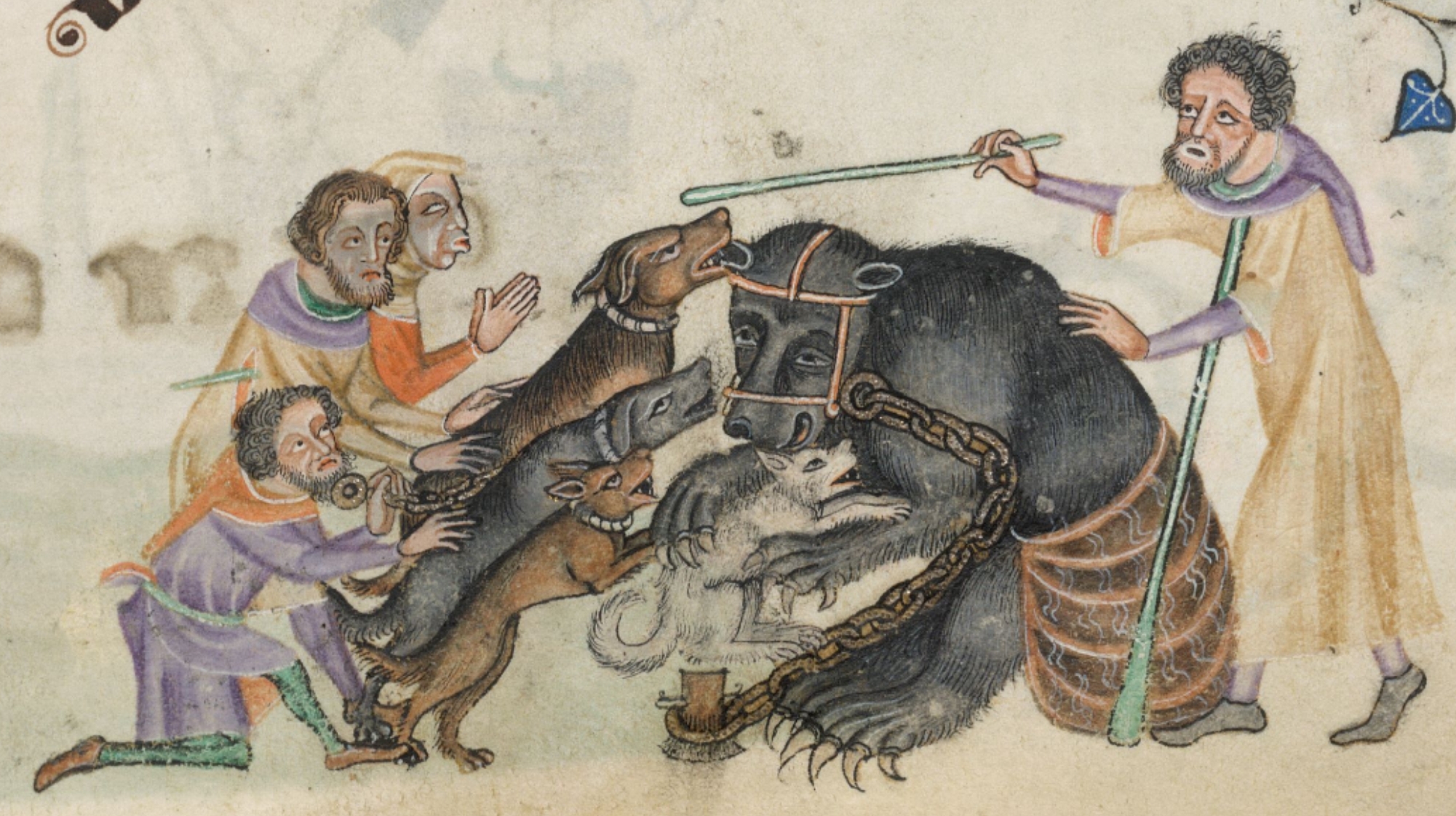

As you can see from this close-up of Wenceslaus Hollar’s famous Panorama Of London (1647), we know that Shakespeare had to pass bear beating pits on his way to the Globe all the time, (you can see ‘Beer bayting’ or bear beating, written on the playhouse on the left, and Shakespeare’s Globe Theater on the right). Not only that, Shakespeare writes about the bloody sport frequently in his plays. When Macbeth knows he’s losing the battle with Malcolm, he compares himself to a bear, tied to a stake, forced to fight until his last breath. It calls to mind the moment in the game when the ghosts shed their animatronic skins and attack William directly, while he’s trapped in the Springtrap suit.

It’s worth noting that when the ghosts kill Afton, he’s wearing his Golden Bonnie suit. As Mat Pat mentioned, yes it is the disguise he wore to commit his crimes, but it is also symbolic of who Afton has become- a beastly, inhuman creature who looks friendly on the outside, but inside is cold and robotic on the inside. This also calls to mind the beast symbolism in the aforementioned ghost scene from Richard III. The real King Richard III used a boar as his royal sigil, and Shakespeare exploits that beast imagery by comparing Richard to a bloody, rooting hog, grown fat on the blood of his victims. Richard doesn’t wear a pig suit, but he does wear his cruelty and bloodlust literally as a badge of honor!
In both the games and the plays, the ghosts become a manifestation of the murderer’s guilty conscience, and beast-like imagery is used to convey how cruel and beast-like the murderer has become. Macbeth and Richard don’t dress like beasts, but they do kill like them.
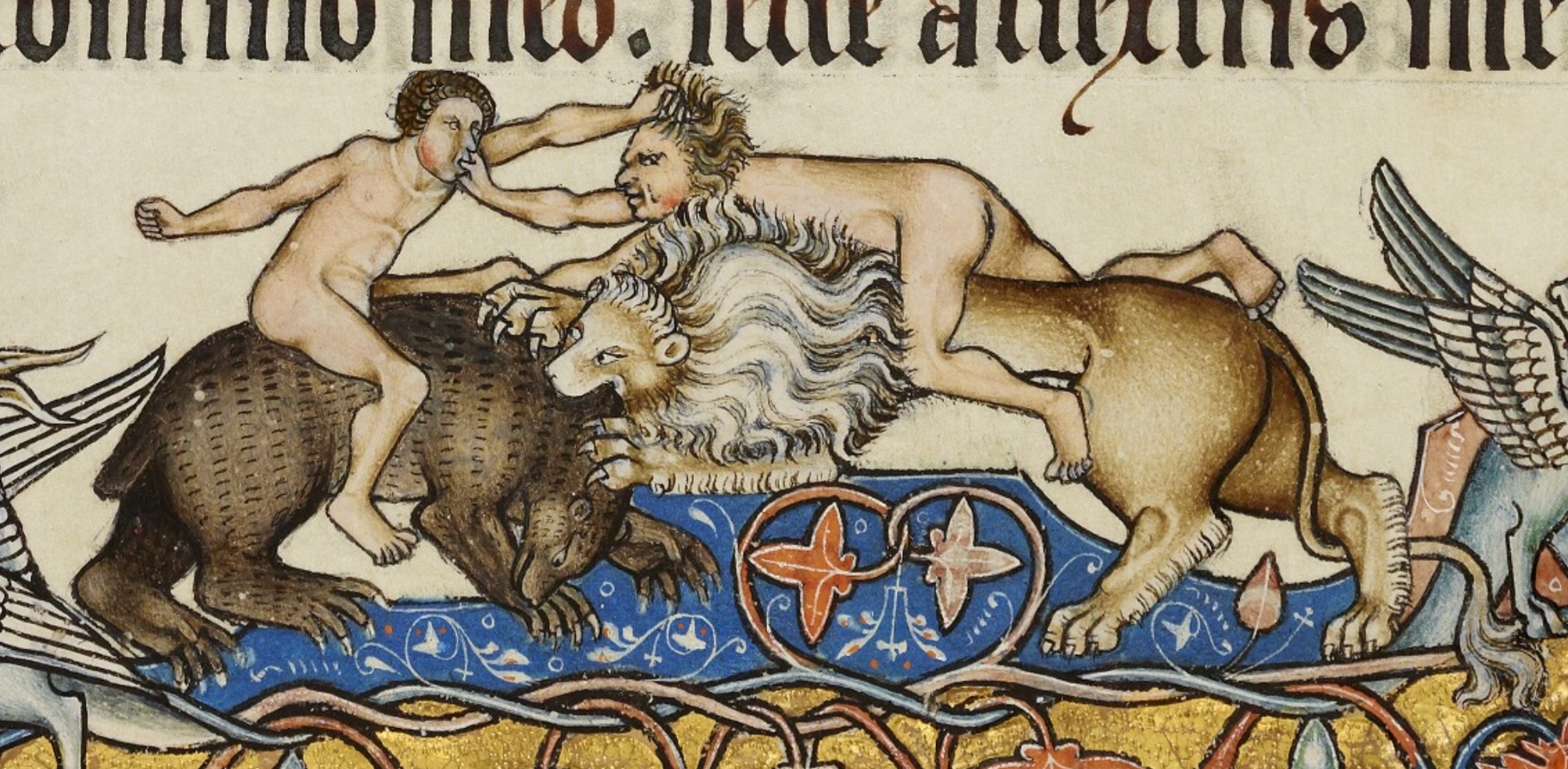
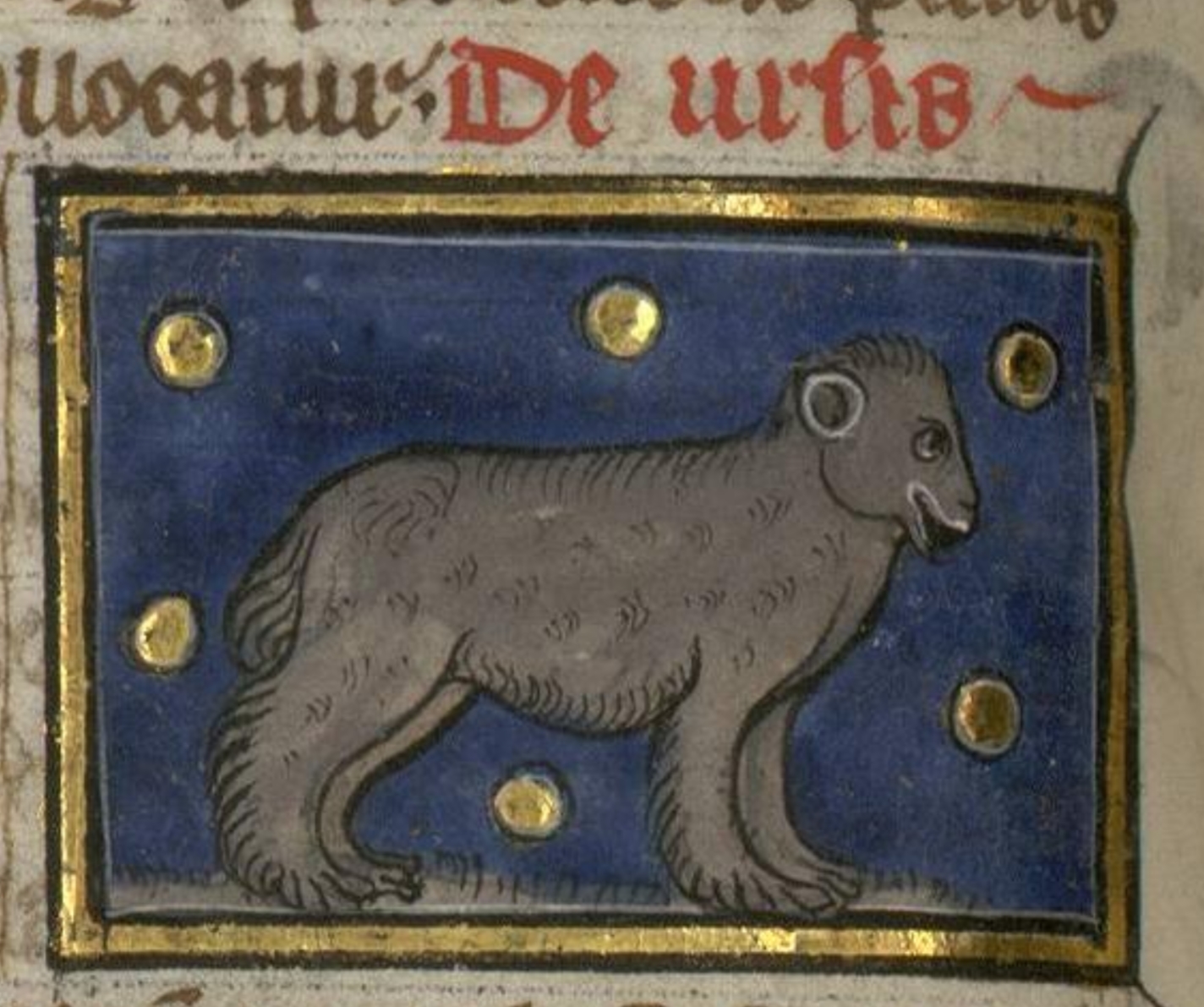
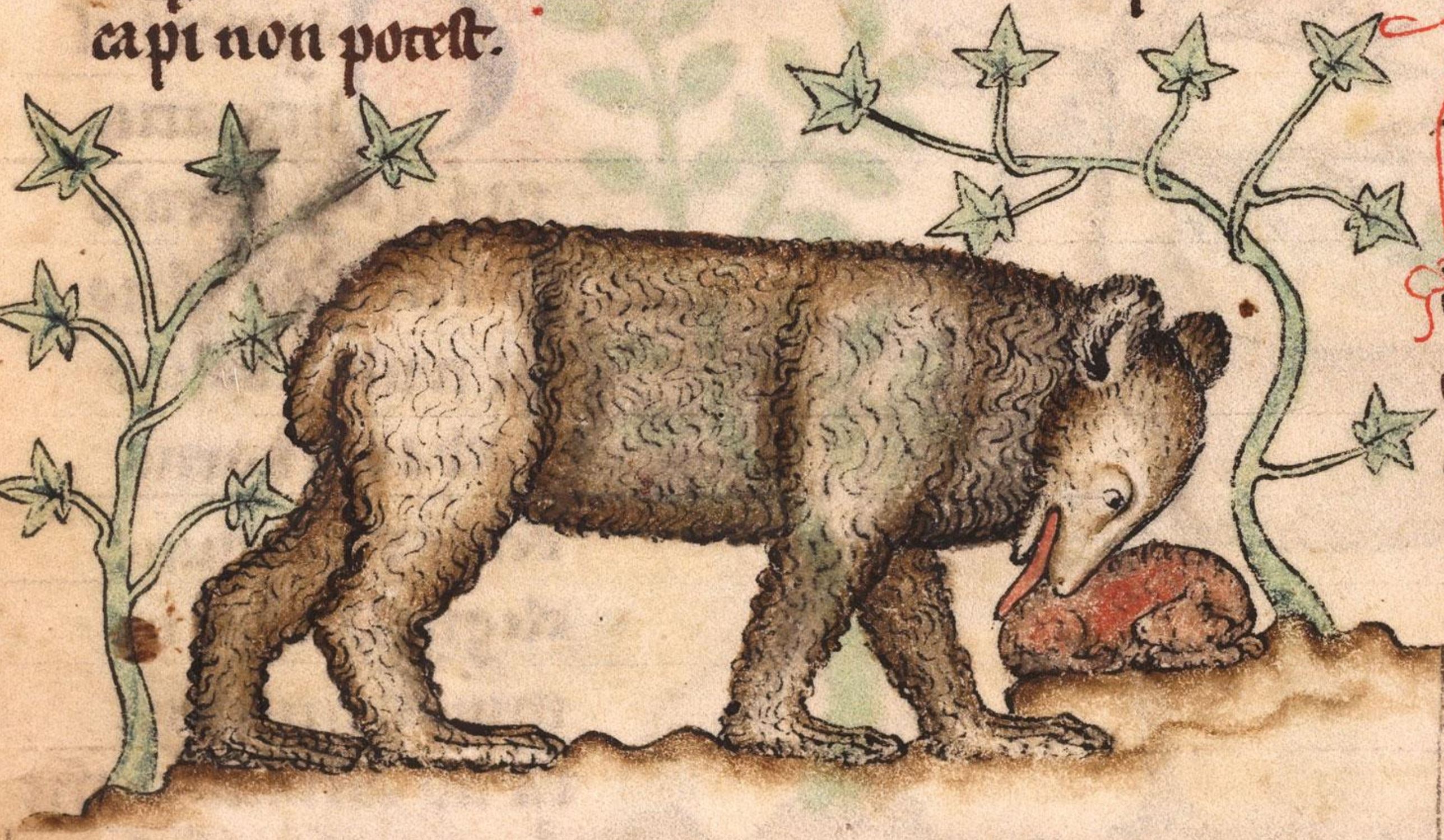

The beast imagery also extends to the concept of revenge. One big theme in Five Nights At Freddie’s is the concept that revenge, (whether justified or not), is blind and indiscriminately destructive. Even though the five ghosts that possess the animatronics are justifiably angry for being murdered, they don’t just try to kill Afton- they attack any poor soul who sticks around the pizzeria at night. Like Hamlet, who wants to avenge his father’s murder, but kills the wrong people, the five souls trapped in their metal cages have a noble goal- protect the children in the pizzeria, and destroy Afton, but they are full of beastlike rage and are unable to see friends from foes. This kind of blind rage reminds me of how real bears will fight off anyone whom they perceive as a threat. In medieval manuscripts, bears are tender to their cubs and literally form them out of little hairy lumps by licking them into shape. At the same time, they are powerful, deadly, and violent to anyone that threatens the cubs.
This kind of blind violence is something Shakespeare explores a lot in his history plays and his tragedies. Every time he talks about a society going wrong, he describes it as if it were populated with beasts, not humans. In Timon of Athens, the titular character, having left Athens to go live in the woods, laments to his frenemy, the cynical philosopher Apemantus, how his city has become like a collection of beasts:
In short, the history of horror, which Shakespeare helped shape in plays like Macbeth, Richard III, Hamlet, and others, has a lot of classic tropes and the Five Nights At Freddie’s games exploit them quite well; tropes like supernatural vengeance, the death of innocents, beast-like killers, and unquiet ghosts. What works the best about this franchise is that it tells its lore like a mystery, slowly revealing Afton’s gruesome crimes over multiple installments. I wonder if someone has ever applied this to Shakespeare…

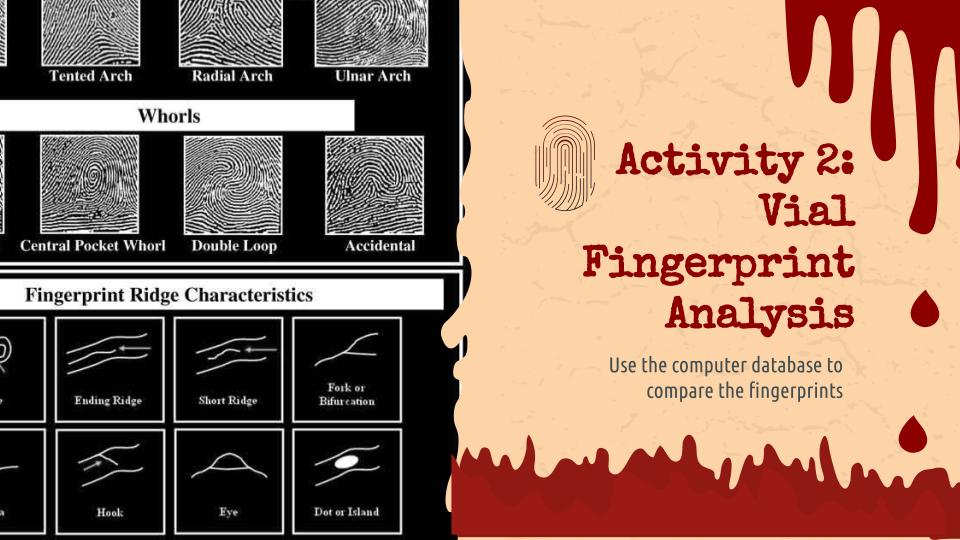
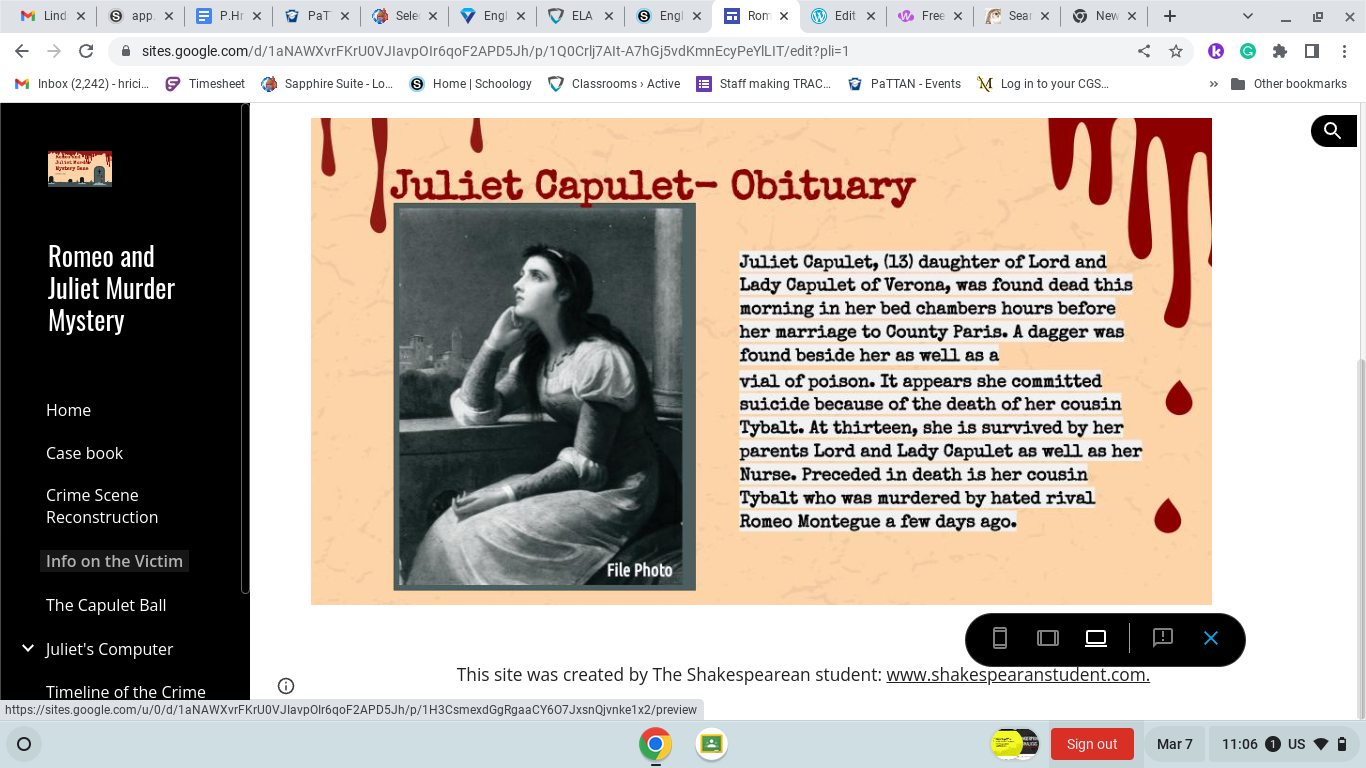


I’m proud to announce that I’ve just been approved to present a fully online, fully immersive murder mystery-style game, where you play as a detective trying to solve the mysterious death of Juliet Capulet! This is a really cool mixture of Shakespeare and forensics science as you examine crime scenes, look for clues, interrogate suspects, and untangle the story of Romeo and Juliet, and it even takes place over the course of five nights! Classes start March 17th. Register now at www.outschool.com!
Would Shakespeare enjoy playing FNAF well, who knows, but I do like to think he would appreciate the lore, if not the jump scares……

https://www.google.com/amp/s/www.history.com/.amp/news/7-early-robots-and-automatons

This is a 30 minute cartoon version of Macbeth originally produced for the BBC in 1992. It features Brian Cox as the voice of Macbeth (before he was the voice of McDonald’s), and Zoë Wanamaker as Lady Macbeth (before she was a witch who teaches at Hogwarts).
I like the way it portrays the horror imagery of the play in sort of a European-manga animation hybrid. Admittedly, there are better ones in the series, but this one is still pretty neat.
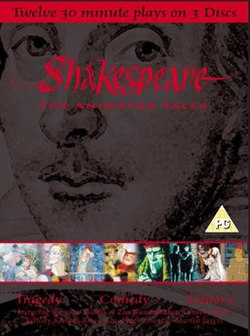
To check out other episodes in the series, view this playlist:

Today I pay tribute to a remarkable book written by a great actor, who has inspired me and countless others.


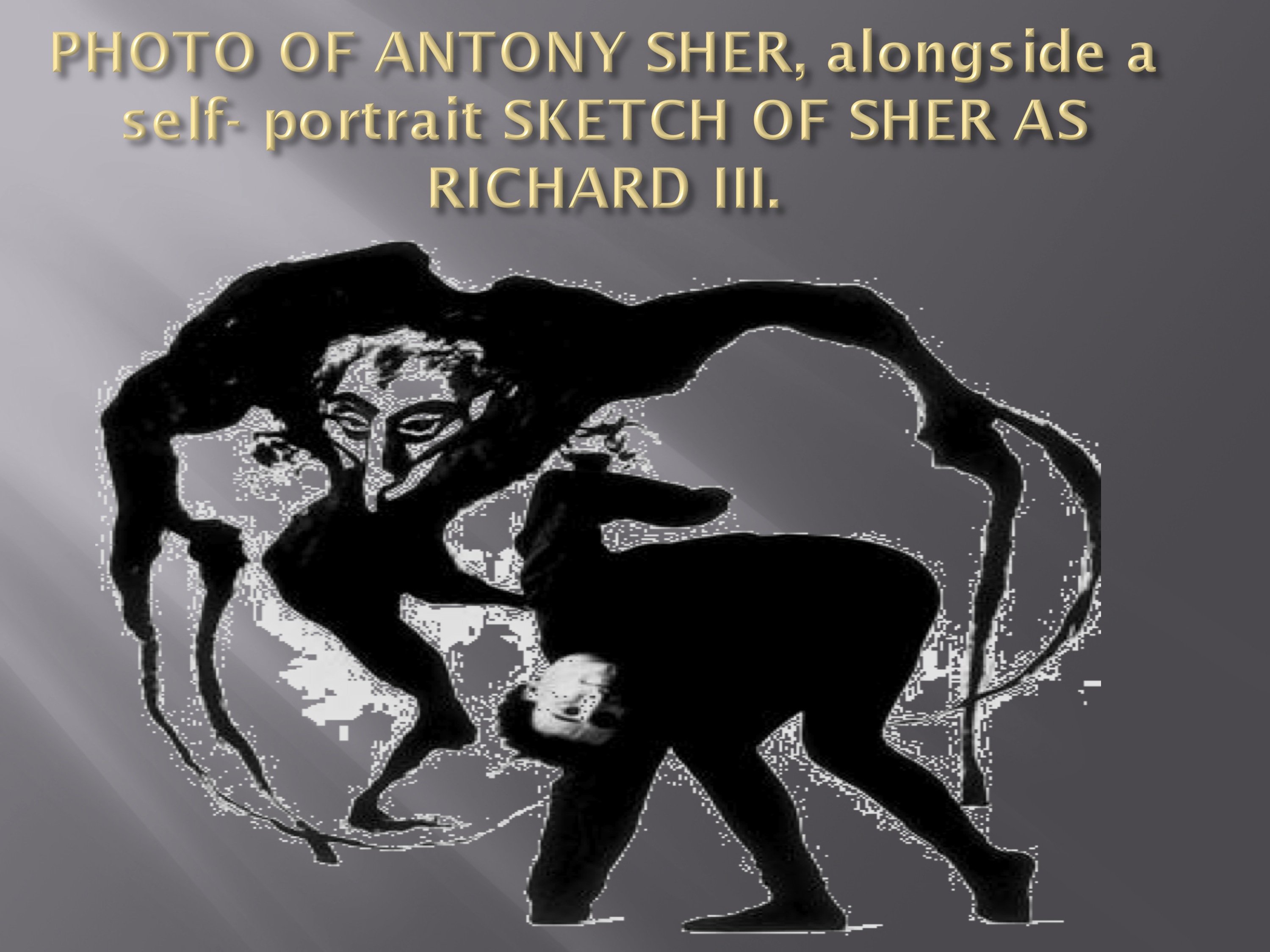


I was privileged back in 2011 to see Anthony Sher on stage playing is playing Edmund Kean in John Paul Sartre’s pastiche of Shakespeare entitled “Kean.” It was a very good casting because this actor very clearly had a lot of raw energy and at the same time charisma and wit. But at the same time, he also seemed to have tenderness, sadness, and insecurity behind his eyes. I didn’t realize it but this actor, Sir Antony Sher, who sadly passed away just last year, would change my life.
When I was still in college I knew that I was going to go to grad school, and I wanted to write a graduate thesis on Richard III. Through my research, I came to realize that this same actor produced what is still regarded it as one most acclaimed and influential productions of the play ever. In 1984, Sir Antony played an iconic Richard III at the Royal Shakespeare Company which was revolutionary for its raw energy, tragic emotions, and creative physicality. Mr. Sher played the role on crutches and was able to scuttle around the stage like a spider.

I feel very therefore very privileged that I was able to see him perform live and to research his performance for my thesis.
One of my greatest aids for this was Sir Antony’s own book about the process of writing Richard that he wrote while in the process of doing Richard, “A Year Of the King. It’s organized in the form of a diary and a lot of the pages are available for free on Google Books. I strongly recommend it. In this review, I’m going to praise his massive preparations for the role and talk about the effects of the production going forward in future productions of Richard III.
In 1982, Sir Antony was playing the Fool in a production of King Lear with Michael Gambon, (the future Dumbledore from Harry Potter). During the performance, Sher suffered a leg injury that required him to be on crutches for several months. In his diary, Sher records how angry being perceived as disabled made him feel. His physical therapy took place at the Remedial Dance Clinic, Harley St.
Six months later in August of 1983 Sher was cast in Tartuffe with Bill Alexander as director, (who would later direct him again in Richard III). A chance meeting with Trevor Nunn, (who was the Artistic director at the time), put the idea of Sher playing Richard into Alexander’s head. After another meeting with Terry Hands, Sher was offered the role.
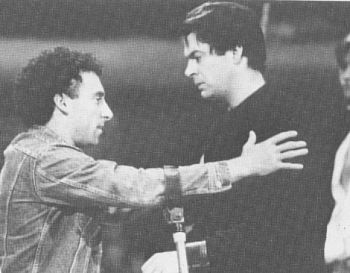
“The truth of the matter was I was terrified of the verse, ashamed of my inexperience with it and nursing a fear that I was trespassing anyway. Wasn’t classical theatre the territory of handsome, rich-voiced Brittish giants like Gielgud and Oliver, and out of bounds for little Cape Town newbies like me?”
Sher, Year Of the King, page 9
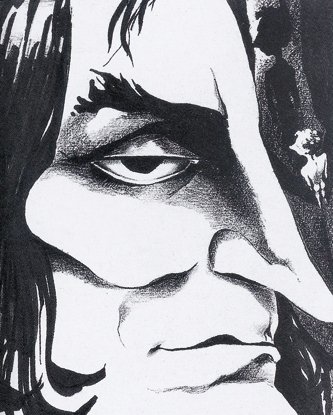
When Antony Sher approached the role of Richard in his 1984 RSC production, his first intention was to make his portrayal of Richard’s deformity and disability different from Laurence Olivier’s. Sher and Olivier believed Richard is both physically and mentally deformed, therefore, Sher’s massive preparation for the role included thorough research into the physical effects of real disability and a deep examination of its psychological effects.
Unlike Olivier, Mr. Sher believed that Richard’s deformity was the key to understanding his character and that every aspect of Sher’s characterization stemmed from his interpretation of that deformity. This work produced a captivating physical characterization and a startlingly human re-conception of Richard’s mind.
Sher’s characterization of Richard’s body resulted in an image, which he referred to as “The Bottled Spider.” Richard had a massive hump in the center of his back, massive arms, and two crutches that fitted onto Sher’s forearms, allowing him to scuttle across the stage, giving the impression of a poisonous spider. Sher created this iconic physical characterization through a combination of textual research, sketches, medical research into real deformities, image research, and real-life experience. The guiding principles that Sher used in creating Richard’s deformity were creating a severely deformed character that the audience would identify with. At the same time, Sher attempted to create a physicality that he could sustain through the run of the show without major injuries (21 &30). According to Sher, the role of Richard III is notorious for crippling actors who sustain severe damage to their backs and shoulders (39). Thus Antony Sher’s Richard was physically designed to be both functional for the actor, as well as realistic and remarkable for the audience.
The first step towards Sher’s physical characterization of Richard was going through the text for clues. Sher found several references to what Richard’s deformity looks like in the speeches of Queen Margaret. Margaret refers to Richard repeatedly as various beasts, alternating between boars, hounds, and the bottled spider that would become so important to the final characterization. Before Sher settled on a spider as the animal Richard most resembles, he experimented with several others, including boars, apes and bulls. Sher did several sketches of bulls, which he saw in a BBC TV program. Sher was attracted to bulls and their raw power and massive shoulders. Sher wanted an animal that was threatening and powerful to give his portrayal a ‘tragic dimension’ (64).
Having to say ‘I was born in South Africa’ stuck in my throat like a confession of guilt.’
Sher, p. 25
Another image from the text that Sher thought about repeatedly was the image of Richard’s hump as a mountain. When Richard refers to his hump as “an envious mountain on my back,” Sher thought back to the Lion’s Head mountain in Kingstown South Africa. Sher grew up in South Africa and visited there during apartheid. The mountain spoke to Sher’s notion of Richard’s raw, tragic power. Sher sketched the mountain several times, and combined it with other images of bulls and spiders and this became the overall concept for Richard’s hump- an image of thick power that simultaneously weighs down the figure of Richard, and gives him his strength.
I feel he should be severely deformed, not just politely crippled as he’s often played. Bill says one should identify with him: a man looking in from the outside and thinking, ‘I’ll have some of that.’
November 7, 1983
The most memorable part of Sher’s physical performance as Richard was the way he manipulated the two arm crutches that he wore for the first half of the performance. Sher’s Bottled Spider image mainly depended on his ability to manipulate the crutches. The crutches became part of Richard’s body (Cerasano 621) and, far from making Sher’s movements clumsy or stiff, they gave him the ability to transform himself into a strange four-legged creature that would move around the stage incredibly fast.
Director Bill Alexander told Sher during rehearsals that he intended to use the crutches in as many ways as possible. For example, the crutches also served as a weapon because of Sher’s ability to swing them around like clubs. One chilling moment of the performance occurred when Sher’s Richard entraps lord Hastings (Brian Blessed) by folding his crutch-arm across Hasting’s neck; foreshadowing Richard’s later decision to chop off Hastings’ head (Cerasano 621).
The problem in playing him extremely deformed is to devise a position that would be 100 per-cent safe to sustain over three hours, and for a run that could last for two years. Play him on crutches perhaps? They would take a lot of the strain off the danger areas: lower back, pelvis and legs. And my arms are quite strong after months at the gym. Also I was on crutches for months after the operation so they have a personal association for me of being disabled. They could be permanently part of Richard tied to his arms. The line, ‘Behold mine arm is like a blasted sapling wither’d up,’ could refer to one of them literally. The crutches idea is attractive, too attractive at this early stage. Must keep an open mind on the subject.
Sunday Nov, 19, 1983
Physical therapist Charlette Arnold, helped Sher get into clinics for people with real disabilities. She also provided Sher with books on back disorders, which led Sher to choose the disorder Kyphosis as the model for Richard’s hump. Kyphosis causes a large central hump in the back, which Sher immediately adopted because it resembled the mountain image of his sketches. Also, the central hump was different from Olivier’s side hump.
Sher’s research on back disorders was of great use in the coronation scene in which he and Lady Anne appear with bare backs. Bill Alexander hired makeup artist Christopher Tucker to create a lifelike prosthetic for Richard’s back. The audience was thus forced to see Richard as a naked, deformed man, contrasted next to the beautiful bare back of his wife, creating a powerful moment that re-enforced Richard’s humanity. Sher would also use a humanistic approach to his portrayal of Richard’s mind, which, like Richard’s body, he developed through extensive research.

“In several copies I’ve looked at it’s called The Tragedy of King Richard the Third. Yet a tradition has evolved of playing it as black comedy. I’ve never seen anyone play Richard’s pain, his anger, his bitterness, all of which is abundant in the text. It seems to me that Richard’s personality has been deeply and dangerously affected by his deformity, and that one has to show this connection.
November 19, 1983 p. 30
In his research, Sher made the link between deformity and psychopathology. Unlike Oliver, who played Richard as a paranoic, Sher played Richard as a psychopath. In his research into psychopaths, Sher uncovered the idea that psychopaths often suffer childhood traumas. The text of Richard suggests that Richard’s mother hated him, and such a lack of affection could realistically change a boy into a psychopath. Through this probing of the text and research into psychology, Sher concluded that Richard’s deformity is a realistic source of desire for revenge.
Sher talked to his own psychiatrist, Monty Berman who provided him with insight into Richard’s mind. Monty helped Sher dispel the idea that Richard is a superhuman fiend. On the contrary, Richard’s persona is very similar to real live psychopaths. Berman theorized that the pain at being deformed, coupled with the violent upbringing Richard living through in the Wars of the Roses, could transform him into a remorseless killer.
Sher: “How do you explain Richard the Third then?”
Monty: “Well, how did you feel when you were on crutches last year?”
Sher: “I hated people staring at me.”
Monty: “What did you want to say to them?”
Sher: “F#$% off! What are you staring at?”
Monty: “Precisely. Anger. Richard is revenging himself on the whole world, destroying a world he sees as hating him.”
Monty: “We treat the disabled appallingly. They come up against dreadful prejudice. The disabled person experiences frustration and if given the chance, will lash out.”
Sher: “So are you saying Richard’s behavior is normal?”
Monty: “Under the circumstances, absolutely normal.”
Sher and Berman also believe Richard has the humor of a psychopath- a sardonic wit that has no regard for the feelings of his audience. Sher looked at the parallels between Richard III, and serial killer David Nilsen, who would invite people over for tea and strangle them, and boil their heads on his stove. Nilsen once told police with Richard-like humor that; “Having corpses was better than going back to an empty house.” One could easily hear the same sort of gruesome wit in the phrase: “I do love thee so, that I shall shortly send thy soul to heaven,” (R3 I,i).
A psychopath like Richard kills in order to try and feel emotion; “Each murder is an attempt to release anger, an attempt at catharsis, and each time it is unrelieved. It’s like promiscuous sex without love. Each climax is less and less fulfilling so the appetite grows until it is insatiable.” Thus Berman allowed Sher to break with the tradition of playing Richard as an inhuman monster, and play him as a very real, very tortured, human soul.
Although Antony Sher attempted to play Richard as a psychopath, his portrayal of Richard’s pain could become sympathetic. His observation of people in clinics and his own personal experience of being on crutches taught him about the cruelty that the disabled suffer. However, although he did great work to try and understand the condition of being deformed and disabled, his portrayal was still an affected disability; an act. In the book “Framed: Interpreting Disability in Today’s Media,” the author speaks about how watching an able bodied actor play disability can actually alienate the audience from the character he is portraying. The performance is seen as an act, a novelty, not an honest representation of real people. One way to eliminate this barrier between character and actor is to cast a Richard who really does suffer from a disability or deformity. I’ve talked in previous posts about how last month’s Public Theater performance was a deliberate attempt to move away from theatrical illusion and re-contextualize Richard’s deformity in the form of race, and contextualize disability by letting actors with disabilities play the heroic parts, while only Richard was able-bodied.
In a way, like Olivier, Sher’s performance is a new monolith that actors must work hard to distinguish themselves from. He spent an entire year building his Richard from the ground up, experimenting with new ways to portray his deformities, his disability, his psychology, and of course, how he looks and moves onstage. Reading this book, an actor gets a great appreciation for all the work Sir Antony Sher included in this wonderful performance, and hopefully, the book will inspire new and creative ways to portray this character in the future.
Thank you for reading. If you want to see some of Sher’s physical and psychological techniques in practice, please watch the thesis presentation that I did at the Blackfriars playhouse below. If you are interested in signing up for one of my acting courses, click here. Thank you!
 The Shakespearean Student