New Class: Shakespeare and Star Wars!

Using self-paced online activities, your child(ren) will compare the plot and characters of Star Wars to Shakespeare’s plays. We will also discuss  Shakespeare writing by looking at “William Shakespeare’s Star Wars” by Ian Doescher.

Course Description

  1. Concept: To compare and contrast the plot, characters, themes, and language of Shakespeare’s plays with Star Wars
  2. Student Description:
    1. Epic battles, quests for revenge, pirates, funny characters, powerful warriors swinging swords. Star Wars has something for everyone. But did you know that in many ways, Star Wars is based on the ideas and writings of William Shakespeare? In this course we’ll peer beneath the veil of Shakespeare and Star Wars to find the universal stories of love, revenge, power, and growing up, using games, artwork, and dramatic readings by professional actors!
    2. Did you know that Star Wars is based on the ideas and writings of William Shakespeare? This class will teach you about writing and characters though games, interactive activities and dramatic readings of both Star Wars and Shakespeare!
  3. Course organization (the class is divided into 6 parts that students can complete at their own pace over a week-long period.

Outline

Unit 1: How Is Shakespeare Like Star Wars?

Class I- Setting the Scene

  1. That is the Question:
    1. What is Star Wars about?
    2. What parts of the Star Wars story are like Shakespeare’s plays?
    3. Are Shakespeare and the Star Wars movies saying anything similar about war? Families? Growing up?
  2. Lesson Objectives
    1. To teach about the characters and plot of Star Wars by comparing them to Star Wars
    2. To introduce the concept of archetypes, tropes, 
  3. Set the Scene
    1. Star Wars is about an evil empire trying to take over the galaxy. They have more ships, more soldiers, and a fearsome weapon that can blow up planets. The rebels on the other hand, though fewer in number, are faster, smarter, and have the advantage of fighting for a good cause. 
    2. In addition, the story is about growing up- Luke becomes a Jedi Knight. He takes revenge on the man who destroyed his father.
  4. The Players (slides)
    1. Luke
    2. Obi Wan/ Yoda
    3. Vader
    4. Leia
    5. Han
    6. R2D2 and C3PO
    7. The Emperor
  5. Words Words Words
    1. Epic
    2. Parody
    3. Theme
    4. Plot
    5. Archetype
    6. Character 
    7. Trope
    8. Theme

Class 2: The Journey of Han and Leia

  • Han and Leia vs. Beatrice and Benedick
    1. Show videos of Han before Leia
    2. Plot summary of Much Ado
    3. Clips of the bickering of Benedick and Beatrice
    4. Read blog and look at the writing.
    5. Activity- how would you write a love letter to Han or Leia?
    6. Play the scene from Jedi

Unit 2- The Prequels and Shakespeare’s Histories

  1. A Crash Course in Shakespeare’s Histories
  2. The Rise of Palpatine/ Richard III
    1. Emperor Palpatine in Star Wars rises to power through a combination of manipulation, intimidation, and by killing his opponents. 
    2. Bio of Richard III
    3. Slide- Richard’s rise to power
    4. Slide- Palpatine’s rise to power
  3. Quizlet

Unit 3- The Verse of William Shakespeare’s Star Wars by Ian Doescher

  1. What is William Shakespeare’s Star Wars
    1. Introduce the plays
    2. Explain how Shakespeare’s verse works
    3. Look at the common verse elements
      1. Sonnets
        1. Show the chorus of “Verily a New Hope”
          1.  It is a period of civil war. The spaceships of the rebels, striking swift From base unseen, have gain’d a vict’ry o’er The cruel Galactic Empire, now adrift. Amidst the battle, rebel spies prevail’d And stole the plans to a space station vast,Whose pow’rful beams will later be unveil’d And crush a planet: ’tis the DEATH STAR blast. Pursu’d by agents sinister and cold,Now Princess Leia to her home doth flee, Deliv’ring plans and a new hope they hold:Of bringing freedom to the galaxy .In time so long ago begins our play,In star-crossed galaxy far, far away
          2. Stychomichia
          3. Half lines
          4. Enjambment
          5. Title Crawl (make a gif via Canva)
  2. Side By Side Comparisons
    1. Read/ watch segments of the play
      1. To Be Or Not To Be
      2. All the World’s a Stage
      3. St. Crispin’s Day Speech
    2. Try to turn a Star Wars line into verse, and then look at the reveal.

Unit 4- Literary Devices of William Shakespeare’s Star Wars

  1. Using the educational guide, we’ll learn about the following literary devices:
    • Extended Metaphors (Luke’s green lightsaber)
    • Anaphora (Luke’s call to action in Jedi)
    • Premonatory Dreams (Calpurnia)
    • Stichomythia Richard III vs. Han and Leia

Unit5- The Hero’s Journey of Luke Skywalker

Class 1: What is a Hero’s Journey (Slides)

  1. Learn a little about Joseph Campbell’s monomyth. using the Percy Jackson post, Crash course video about monomyth
  2. Chart Luke’s monomyth journey
  3. Activity- Mad libs- write a star wars movie!
  4.  Quiz on plot elements from the monomyth (Quizzes or Quizlet)

Class 2 :  Hamlet and Luke Skywalker

  1. Plot comparison
    • (use infographic)
    • Quote from Doescher:
      • Hamlet The Tragedy of Hamlet, Prince of Denmark is Shakespeare’s most famous play. It’s also the play I make the most references to in William Shakespeare’s Star Wars.
  2. To Be Or Not to Be
  • Use my video about the speech to explain the structure
  • Note how Doescher repurpuses every line in the Star Wars Trilogy:
    • Sometimes it expresses fear: 
    • Sometimes concern: 
    • Frustration: “The whips and scorns of time”
    • Hope: “The undiscovered galaxy” “Tis a consummation devoutly to be wished.”
    • Activity: write your own paraphrase of Hamlet’s speech, using the 6 beats I provided.

Unit 6- Become a Bard Warrior (Slides and Sites)

Notes

Resources:

Web: https://americanshakespearecenter.com/2011/05/in-the-force-of-his-will-shakespeare-and-star-wars/

Close Reading: Shakespeare’s Star Wars (Empire Scene) https://shakespeareanstudent.com/2024/04/17/close-reading-william-shakespeares-star-wars/ 

The Journey of Han and Leia: https://shakespeareanstudent.com/2023/06/16/new-podcast-william-shakespeares-star-wars-part-ii-the-journey-of-han-and-leia/ 

Review of Jedi:

Video

  1. William Shakespeare’s Star Wars and the Power of Iambic Pentameter – Summer of Shakespeare the First
  2. The Wampa From “William Shakespeare’s Star Wars”
  3. Han Solo Does Shakespeare
  4. Emperor Shakespeare
  5. Darth Vader does Shakespeare
  6. Dagobah Cave Vision: https://www.youtube.com/watch?v=0otvBA0iAA0 
  7. Duel between Luke and Vader: William Shakespeare’s Star Wars excerpt: the Duel from “The Empire Striketh Back.”
  8. Comparison:
    1. 1st 10 minutes of Jedi: Star Wars Episode VI Return Of The Jedi Opening Scene HD720p
    2. Doescher’s version: Darth Vader Reads Star Wars Shakespear The Jedi Doth Return Vader Reviews

Podcast:

  1. https://open.spotify.com/episode/5BJ6TuhFO699OxWRLZNL2U?si=_cRGo7FzQjakUuZuPT0KwA 
  2. https://open.spotify.com/episode/1E3Eh9OpcR7lpMHI8edU4o?si=p-PrlRzQStqwGnoz4Y88pA 
  3. https://open.spotify.com/episode/5SFDcMAfF14ANVIki6xxr8?si=0YWtFyWoQE2CtG8fAEK22A 

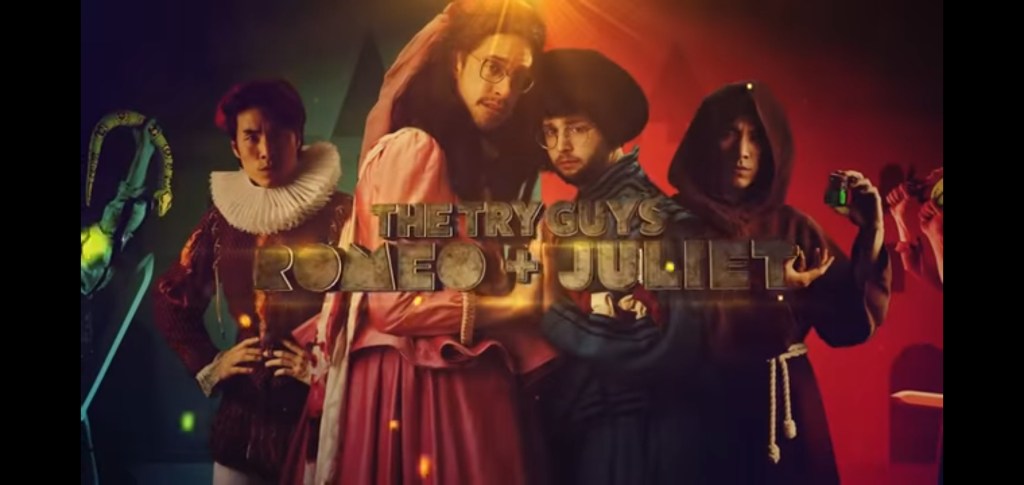
Review: Ye Try Guys Try Romeo and Juliet

I was excited from the beginning to hear that the Try guys were going to bring Shakespeare to YouTube in a way that was fun and accessible. My expectations were that they would make fun of the play with care; I was hoping that they wouldn’t mock Shakespeare, (or mock people who like Shakespeare). I was also hoping that they would critique the characters without outright mocking them and find ways to make the play connect to modern audiences. I think they achieved all those things and more!

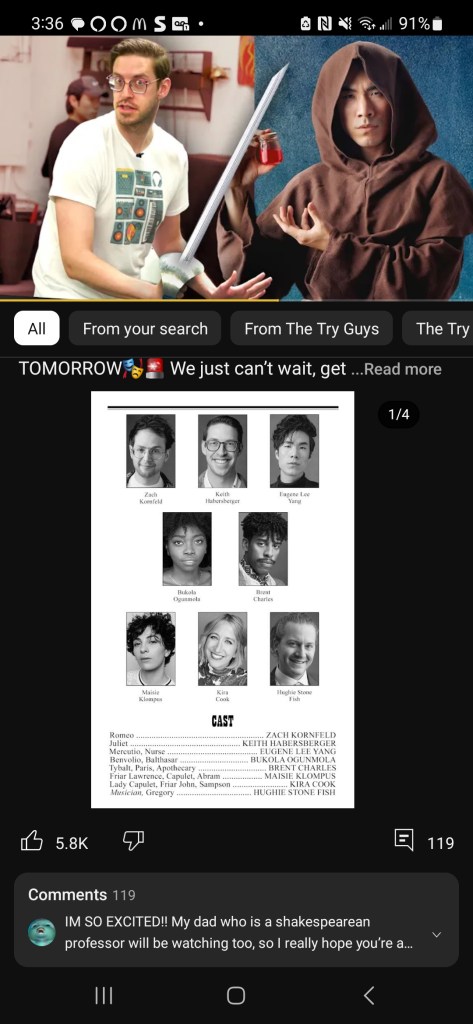
Zach Kornfield, Eugene Yang, and Keith Habersberger known collectively as “The Try Guys” are a group of friends who seek out new experiences and share them with the world. They thrive on taking themselves out of their comfort zone and learning about the world through experiencing it firsthand in a funny, lighthearted way. As I said before, what could be more adventurous, daring, informative, and out of YouTube’s comfort zone than doing Shakespeare?

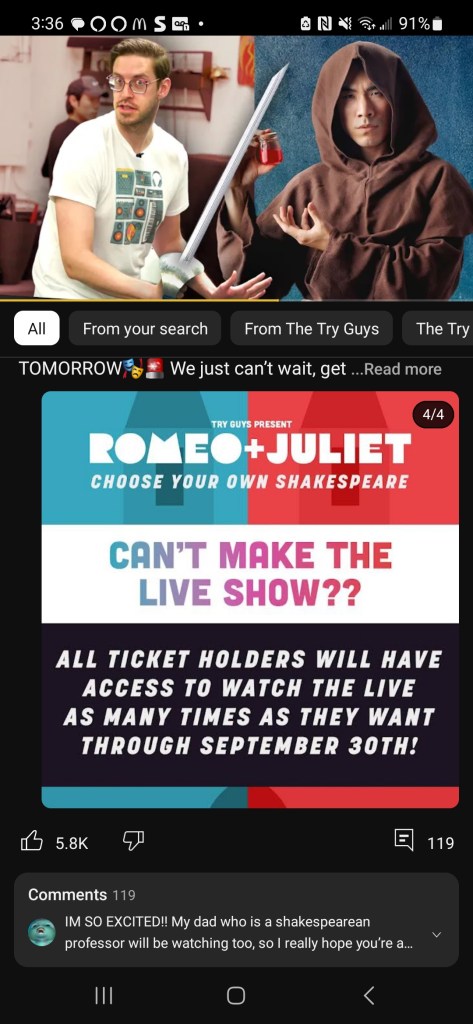
In a series of videos they explored Elizabethan clothing, stage combat, learning how to speak Shakespearean verse, and finally on August 10th, 2023, they performed “Romeo and Juliet” live on Youtube, with suggestions from the audience! With this post, I will discuss the evolution from these three videos, to the final show, which I got to see live on YouTube. I will discuss what I think worked, what didn’t, and how this production might influence future Shakespeare productions going forward!

Podcast About the SHow:

My Top Ten Moments:

Background on the Show

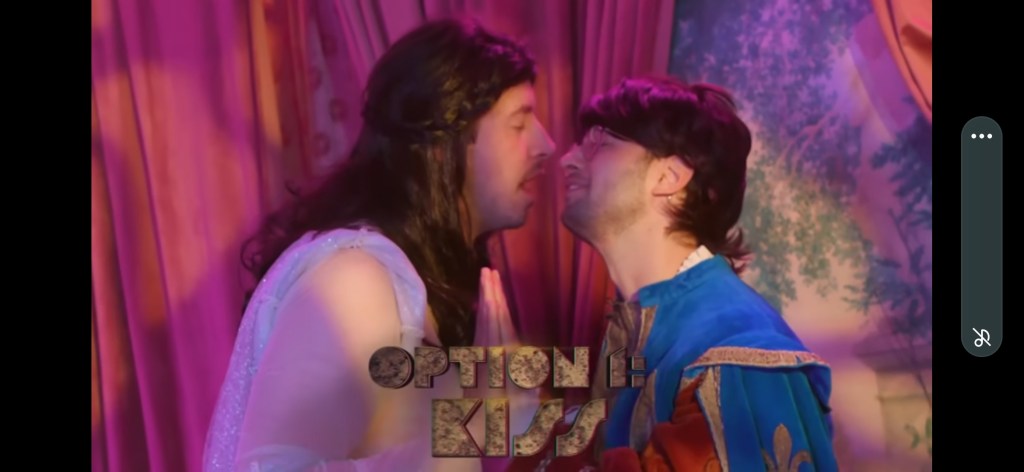
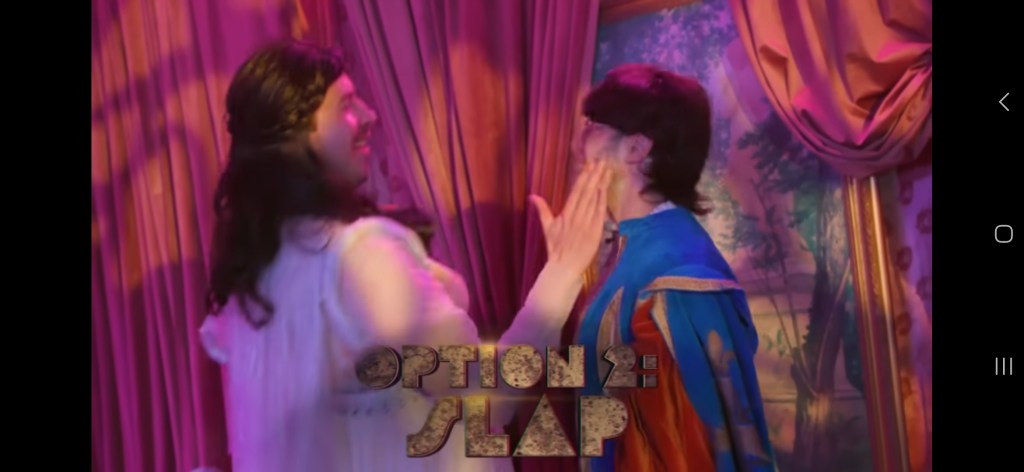
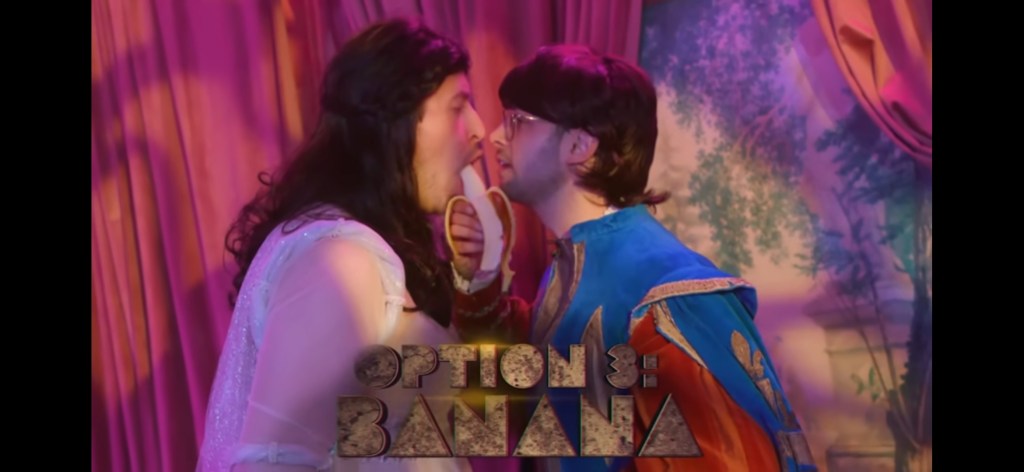
The original pitch for the play made it sound like a live YouTube event, but they made it even better by including a voting option where viewers could change some of the action and chose for instance, if they fought with swords or some other object, thus engaging the audience the whole time. This is what made this experience unique, (perhaps more than any other production), and I think in many ways this production could be an inspiration to educators and theater practitioners! My main critcism of the show is that, though it can be enjoyed by almost anybody, it is definitely not suitable for children, and nobody could get away with showing it in a classroom environment.

Costumes and Sets

The set for “Romeo and Juliet,” seems like an ordinary YouTube TV studio, in that it’s fairly small and it does not suggest any particular period. It kind of suggests somewhat of a dream-like environment; there are cardboard cut outs with some clouds, the lighting is warm with a few pink colors . Most of all it reminds me of a fractured fairytale more than classic tragedy, (which I suppose is clever in itself because it sets up that the Try Guys are going to fracture Shakespeare the same way people like the Muppets fractured fairy tales.

The costumes don’t seem as elaborate or historically accurate as the ones in the previous video, which is a shame because it would’ve been really nice to see the Try Guys walk, fight, and dance in the same costumes that they experimented with in the previous video. That said, the costumes certainly are functional within the story. Eugene as Mercutio has a stylish striking black outfit that certainly suggests somebody you don’t want to mess with. Zach as Romeo has an amusing long wig (romantically disheveled of course) and a blue doublet (though I miss the pumpkin pants in the previous video). As in other productions, the Montegues wear blue and the Capulets mostly wear red. I would be surprised if the director had seen the famous Franco Zephirelli film (or at least Gnomio and Juliet).

The director Keith Habersberger also keeps the best costumes for himself both as the Prince and Juliet; he’s wearing a beautiful ordinate gold costume as the Prince and Juliet herself has lovely rose-colored gowns. Even her shift in Act Four is it’s tasteful. I’ll talk more about Keith’s portrayal of Juliet later, but let’s just say that the clothes do not make him look like a man in women’s garb, they make him look like Juliet.

Stage Combat

The stage combat episode is great, and as a Stage Combat junkie myself, I watch a lot of channels like Skalgrim, Forged In Fire, HEMA videos, and of course my own stage combat videos. Consuming this combat content, I know that there are lots of avenues for education and for entertainment watching these 3 guys who have never done sage combat before, try out swords. I was very delighted to see them putter around with swords and then learn a short stage combat scene in which they then put on put their own spin on by improvising a scene where Romeo & Juliet sword fight with a guy who cut the cut in front of them while they were trying to get ice Cream. The video is fun, ludicrous, but also it’s just as informative as videos from the Folger Shakespeare Library.
Unfortunately, The Try Guys didn’t make much use of the swordplay they learned in this video during the final performance. Imagine my disappointment when, during the climactic duel between Tybalt and Mercutio, the audience voted to replace the swords with…something that was definitely NSFW. I’ll discuss this choice in depth later on my podcast but let’s just say it made the training they did in the previous episode seem like a waste of time.

The Cameos

Did you hear about this guy Romeo? He’s the talk of the town

Link Neal from Good Mythical Morning

One aspect of the production that I deeply loved was that instead of doing the whole play, The Try Guys did a 90-minute abridged version using multiple narrators to fill in with bits of exposition and commentary. The Reduced Shakespeare Company did this before in their show, but since The Try Guys are very popular in the YouTube Community, they got a bunch of their fellow Youtubers to be their narrators like Rhett and Link, Smosh Games, Rosario Pansino from Nerdy Nummies, and Mat Pat from Game Theory. It was absolutely delightful to hear more of my favorite YouTubers talk about my favorite writer, each one telling the story with their own brand of humor!

Romeo runs to Friar Laurence, mascara all smeared!

Manny Mua

The Performances:

Finally, let’s talk about the acting in the final performance and how the Try Guys succeded in bringing Shakespeare to You Tube.

Keith Habensburger as Juliet

Keith carries the show as Juliet. As he mentions in the video above, he has performed in Shakespeare before, and his passion for performing shines. It’s actually a bit shocking to see him drop his usual persona as an easy-going funny guy and become a tragic heroine! In addition, he has a clear vision for the character- I suspected that he would probably exploit the comedy of him being a man playing a woman and being taller than Zach and he does in the earlier scenes, but once Tybalt dies, Keith plays Juliet absolutely straight- he is absolutely committed to playing Juliet’s anguish and desperation and it’s really moving to watch!

Eugene As The Nurse/ Mercutio

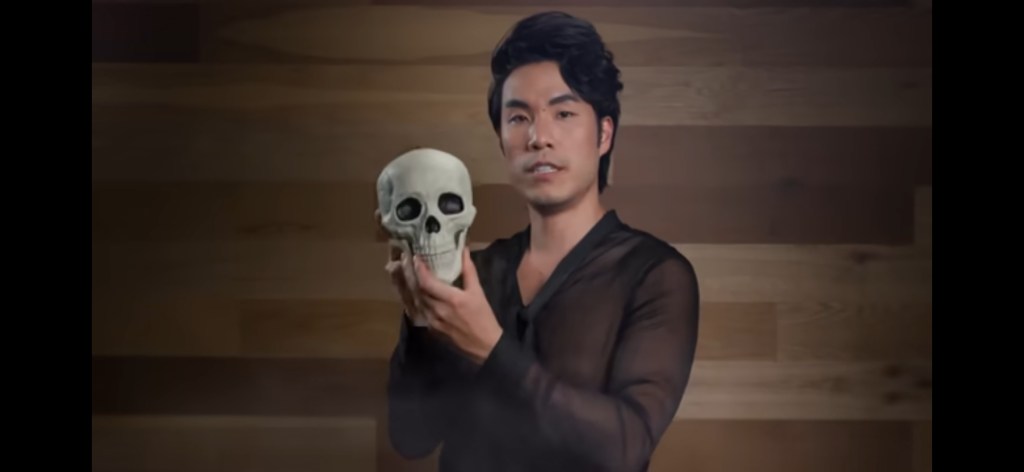
Eugene was a natural choice for Mercutio- his Try Guys persona is very much the wild card, sometimes friendly and sometimes fierce and he clearly loves Shakespearean language as you can see in the earlier video where he plays Edmund from “King Lear.” Honestly, though, I think his performances in the final play are a bit under-dramatized- I don’t quite know what he was going for as either The Nurse or Mercutio, which might be a result of limited time or lack of direction. That said, he does a good job for having never done Shakespeare professionally before.

Zach as Romeo or “A Bro wearing Hose”

Zach admits in the Shakespeare Acadamy video that he doesn’t “get Shakespeare,” and I get the sense that he doesn’t really like Romeo, so his performance seems like an intentional parody of romantic leading men. Honestly, this is fine. Romeo isn’t my favorite Shakespearean character either, and yes, The Try Guys are treating this as a real show, but at the same time it is still an experiment; they are trying something they wouldn’t normally do, so Zach is dealing with the awkwardness of playing Romeo with the same self-deprecating sense of humor that he uses when baking without a recipe or trying ballet. He knows that he would never get cast as Romeo in real life, so he’s having a laugh while he does it onstage, all the while being the best Romeo he can be.

The Format

One of the biggest challenges any Shakespeare practitioner has to face with a modern audience is the problem of engagement. The age of social media has changed how we consume content- we don’t passively watch anymore, we engage with it, comment on it, share it, and sometimes even manipulate it for ourselves. In Shakespeare’s day, there was no division between actors and audiences so in a way, his plays work well for this kind of live choose-the-outcome YouTube Event and I’m interested to see if it influences future performances going forward. In any case, I’m grateful that I was able to see this fun-frenetic, once-in-a-lifetime evening of live theater!

If you would like to learn Shakespeare like the Try Guys, I have a series of online clases in acting, stage combat, Shakespearean comedies, tragedies, and of course, “Romeo and Juliet.” You can enroll in one of these classes now or schedule one with me by visiting my Outschool.com page:

New Outschool Class: Shakespeare- The Lost Play

This is an interactive game that teaches the craft of Shakespeare’s writing and stagecraft in the form of an Elizabethan escape room. You must find the lost play of William Shakespeare before a mystery thief destroys it! Solve the clues and learn about Shakespeare’s writing and theater to uncover a historical mystery!

Course Description

In this fully online, fully interactive game, you play as a member of Shakespeare’s company. You’ve just discovered that someone has stolen Shakespeare’s new play “Love’s Labors Won,” and you need to find it before the show tonight! In the course of the game, you search the Globe Theater and Shakespeare’s study. Then a mysterious note reveals that someone has stolen the play! You must figure out who it is, and find the play before the thief burns it! Through the course of the game, you will learn about Shakespeare’s theater, the secrets of how he wrote some of his great plays and beautiful poetry, and the work of his contemporaries in a fun, interactive way.

The class is organized into four parts, based on four locations where you will search for the missing play:

Part I- Search the Theater

Part I- Search the theater (website/ Slides/ Jamboard)
You learn the basic parts of an Elizabethan stage (Google slides)
You label the parts of the theater (Google Forms)
You do a virtual tour of the theater (via Globe Theater.com)
Web quest- answer 3 questions about Shakespeare’s Globe: https://www.shakespearesglobe.com/ (handout)
You search the tiring house (the backstage area of the Globe), and find the letter from the thief (Sites).

Part II- THe Crime


A video plays where the thief declares that he’s stolen Shakespeare’s play for money and revenge.
After the video, you will learn about plays, printing, and theft in Shakespeare’s day through a series of Google Slides
Activity- make a folio, quarto, and octavio with just a piece of paper (handout)
Web Quest- answer 3 questions about how Shakespeare’s plays were printed and the first folio (Slides)
Activity 2: make an actors’ scroll or roll the way that Elizabethans might use (video)
Easter egg- find a pair of gloves in the print shop and answer questions.

https://www.shakespeare.org.uk/explore-shakespeare/blogs/shakespeare-100-objects-pair-gloves/

Part III: Write a New Play

You’ll gain new understanding of the types of plays Shakespeare wrote and their basic plot structure via Google Slides. You’ll then take a short quiz to confirm what you learned.

-Plot Structure
You’ll learn about the basic structure of Elizabethan plays via Google Slides.
A second set of slides will demonstrate the plot structure of Romeo &Juliet
You’ll mix and match a series of plot elements to create your own Elizabethan play via Jamboard

Tragedy:

  • A hero is given some unwelcome news
  • He feels betrayed by those close to him
  • He agonizes about the ethics of killing someone close to him.
  • He kills someone (or banishes an honest man) and immediately falls into a downward spiral.
  • The hero does (this will be a mandatory choice)

Comedy:

  • The heroine disguises herself as a boy
  • A hero or heroine swears (s)he will never fall in love and immediately falls in love
  • The heroine pretends not to be interested in the hero, (but secretly loves him).
  • A loyal best friend is captured, sent to prison, or bewitched
  • The hero and heroine hate each other due to a series of misunderstandings.
  • The hero and heroine get married (this will be a mandatory choice).

History:

  • An ambitious young man arises to challenge the king for the throne.
  • The old king dies, (or is murdered)
  • A new king becomes king
  • Duels and or battles
  • Someone dies in battle
  • Someone is murdered, assassinated, or sentenced to death.
  • New King gets married
  • King and Queen reign peacefully (at least for now)

Romance ( if students pick this option, they can mix and match everything (except the main character dying)

Verse practice-
You’ll learn about the verse Shakespeare wrote, through a series of slides and a jam board.
Activity- You will be given a series of famous lines from plays and movies, (such as a quote from a Disney Movie, a Star Wars film, or a song). You will then determine if it is an iambic pentameter line (Google Slides).
Easter egg- you find a second note from the thief (Google Sites).

Part IV- THe Tavern

You will look at a series of pictures and videos about Shakespeare’s contemporaries and try to figure out which of them stole the play. Through the handout, you will conclude who the thief is.
You find a dagger in the tavern and take it. Outside the tavern, you will fight the thief in a short animation. GAME OVER.

THe FIrst Class starts April 28th, 2023. CLick here to register!

Shakespeare Week Is Coming at Outschool.com

Outschool.com will be honoring the contributions of Shakespeare during the very first Shakespeare Week on March 21-27th.

I’m honored to take part in this celebration, and I’m offering several aclasses which relate to Shakespeare in an engaging way. Here’s the schedule below:

If you want to sign up for one of my classes, please visit my Outschool page:

https://outschool.com/teachers/The-Shakespearean-Student

https://outschool.com/teachers/The-Shakespearean-Student

Hope to see you during Shakespeare Week!

Denzel Washington talks Shakespeare. Mourns the loss of Sidney Poitier

If you’re like me, you are probably saddened by the loss of the great American actor, Sidney Poitier. He was part of the original cast of the great American play A Raisin In the Sun, and earned countless accolades for his roles on stage and screen like In the Heat Of the Night, Porgey and Bess, Guess Who’s Coming To Dinner? and The Greatest Story Ever Told.

In this interview, Poitier’s friend Denzel Washington talks about how Poitier was a beacon, not just for black actors but a gold standard for all actors.

Washington also discusses his role in the film Macbeth, in which he plays the title role. As I mentioned in my Much Ado About Nothing review, Denzel is a consummate performer of Shakespeare and I for one can’t wait to see him as Macbeth. This is nor just because he was an absolute joy in Much Ado, but because Denzel is famous for playing characters that start out as good men become violent and evil in films like Training Day, American Gangster, and Flight. I have high hopes that Denzel’s Macbeth will rank among his greatest performances.

Macbeth is now playing at selected theaters and streaming online on Apple+. I plan to see it and hope that you will too.

New OUtschool Class: Love Poetry, Shakespeare Style

Your child will learn how to write poetry like Shakespeare himself, through a mix of presentations, a printable guideline, and some fun quizzes to test your knowledge of Shakespeare’s sonnets! Designed for ages 13-18.

Class Description:

We will cover what a sonnet is, namely a type of poetry Shakespeare wrote in iambic pentameter with a particular rhyme scheme. Using a combination of Prezi video presentation and Google Slides, I will go in-depth to explain how he organized his poetic ideas into a very compact form. 
Using primarily Google slides, we will then analyze Shakespeare's sonnets for their themes, literary devices, and the way he uses the poetry to enhance and heighten emotion and ideas. I will focus mainly on Sonnet 18, "Shall I compare thee to a summer's day?" I will cover Shakespeare's use of such literary devices as:
- Metaphor
- Simile
- Personification
- Rhetorical Question
- Irony
- Paranomasia
Analyzing this sonnet will allow the class to grasp the basics of how a sonnet is constructed, and begin to prepare to write their own. While the presentation is in play, students will be given an access code to an optional Nearpod presentation, that will allow them to construct an iambic pentameter line, quiz themselves on the vocabulary I cover, and provide visual aides to better understand Shakespeare's sonnets.

In the next part of the course, We will engage in a group brainstorming session. I will provide the students with potential topics (assuming they don't have one of their own), and then we will construct a short story using madlibs around that topic that will later be condensed into a sonnet. I will demonstrate to the students how to use imagery and poetic language to enhance the ideas and feelings in the poem. After this, I will use the nearpod and Google slide presentations to guide the students how to tell their own story using such devices as metaphor, personification, allusion, and sensory details. They can jot their ideas down on the provided handout to help organize their thoughts. In addition, the optional handout will have useful brainstorming activities such as a web link to websites like Rhymezone.com, (which helps poets find rhymes to words), and imagery boards that will allow the students to think of sensory details to include in the sonnet . The class will draw attention to the handout activities, and pause briefly to allow the students to do them.


In the last part of the class, I will give the students step-by-step instructions on how to transform their brainstorming ideas into a sonnet. I will begin by showing them how to construct an iambic pentameter line. I will engage the students by clapping out the beats for this line and allow them time to do the same, so they may internalize the rhythm. This will be accomplished via a Google Slides screen.
The final page of the handout has a page to write a draft of their final sonnet, with the line numbers conveniently provided. I will go over every section of the worksheet so the students know how to utilize it effectively.

After all this practice and training, the students will be able to create a basic 14 line sonnet which will give them practice not only writing poetry but also using and recognizing literary devices. It is my hope that this course will not only help the student(s) gain an appreciation for Shakespeare's poetry but also develop their own ability to speak and write eloquently and persuasively.

Special Discounts on my Outschool Classes!

I'm teaching two great classes today. Spaces are available!

From now to January 13th, I’m offering a $5 discount for any class that is $10 or more! You can take my Shakespeare classes for as little as $4! Go to my Outschool.com class and enter the coupon code: HTHESNIF6B5 at checkout!

https://outschool.com/teachers/c9bc565b-71e9-44c9-894a-921c472f4a37#usMaRDyJ13

If you’re new to Outschool, use the referral code below when you sign up. You’ll automatically get $20 USD off  as a thank you to use on future classes! My referral code is: MaRDyJ13

Hope to see you on my Outschool page!