
How President Trump Is Like Richard III

  • Happy President’s Day Everyone!
  • Since it’s now two years into the Trump presidency I thought I would follow up on my post I wrote when he was a candidate, and focus instead on his actions as president. Shakespeare’s Richard changes almost immediately once the crown is set on his head in the middle of the play, and the rest of his short reign is plagued with the exhaustive process of keeping it on his head, (and by extension, keeping his head on his shoulders). My main argument is that Trump’s presidency has steadily skirted more and more towards authoritarianism through his actions and his rhetoric, much the same way Richard became more like a dictator as soon as he became king. Moreover, Trump, Shakespeare’s Richard and even the historical king Richard have been distorted beyond recognition because of fake news, but not the kind you might expect.
  • Part I Before the Throne

    As I have written before, Richard claims the throne by manipulating everyone in the British political machine- stoking hatred among the nobles, while trying to appear as a pious, humble man to the common people. Because of his years on reality television and experience as a businessman, even I must admit Trump has a gift at manipulating people’s perceptions and playing the part of a man of the people:

    • https://m.youtube.com/watch?v=cpxCl8ylJgE
      If you watch Trump in interviews, he often closes his remarks with “believe me,” Richard also understands the power of oaths and pretends to speak like a plain blunt man, claiming that the British nobles hate him because he ‘tells it like it is’:
  • Cannot a plain man live and think no harm? But his simple truth must be abused by silken, sly, insinuating jacks!- Richard III, Act I, Scene iii

    As for Trump, even though he is a privileged billionaire with inherited wealth, he pretends to be an unpretentious, unapologetic common man, abused by the ‘mainstream media’ and his political opponents.

    Richard is also a fan of the moral equivalence argument, (also known as whataboutism). He tries to offset his own murders by mentioning other people and their misdeeds during the Wars Of The Roses, making them seem as bad or worse than Richard:

    https://youtu.be/c0gGWAo0JIU

  • Let me put in your mind if you forget what you have been ere this and what you are, withal what I have been and what I am. RIII Act I, Scene iii.
  • Many have pointed out that both Trump and Fox News frequently use Whatsboutism to discredit their opponents and to shrug off their own guilt. It is also a tactic frequently used in former Soviet Union propaganda: https://youtu.be/PpVzHpgYuSc
  • My final comparison of the rhetoric between Trump and Shakespeare’s Richard is that both men are actors, players, or if you like, hypocrites. Trump actually tweeted how he sees each speech he makes as a tailor-made performance, while Richard praises his own ability to dissemble and equivocate to the skies: https://youtu.be/v6ji07tsI2M
  • Part II: The descent

  • Richard the third starts out the play as a evil underdog. Yes he kills people to gain the throne, but his deformity makes him seem sympathetic, and the fact that his victims have already killed plenty of people in the Wars of the Roses, gets him on our side. Once he’s crowned however, Richard step by step becomes more and more like an authoritarian dictator
  • Authoritarianism https://m.youtube.com/watch?v=5YU9djt_CQM
  • https://m.youtube.com/watch?v=mQP5FHq7hqs

    What is an authoritarian? Basically an authoritarian regime concentrates power into the hands of one person, and tries to hold onto power by:

    1. Projecting strength.

    2. Demonizing opponents, both real and imagined.

    3. Destroying institutions.

    From the moment the crown is placed on his head, Richard starts to see threats to his power, and uses all his newfound resources to destroy every each and every threat. First he kills his nephews, (the legitimate heirs to the throne), then he kills his wife, so that he can remarry a princess to try and consolidate his power. And finally, when he faces his greatest threat the armies of Henry tutor Earl of Richmond, Richard goes full on dictator, calling himself a tower of strength, demonizing Richmond as a foreigner, and claiming that his soldiers will rape the English wives and daughters.
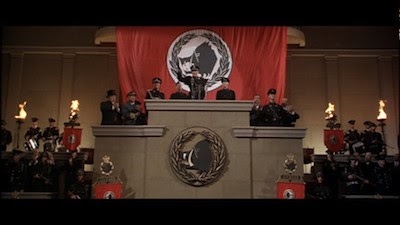
    Still from Ian McKellen’s film version of Richard III, 1995

    Trump is guilty of every one of these authoritarian strongman habits. He tries to convince people he is strong both physically and politically by having photo ops with doctors who claim that he is “the healthiest president ever”. He also attempted to project strength by misrepresenting the size of the crowds at his inauguration (which was a flat out lie), Furthermore, Trump demanded a military parade to emulate autocratic governments like North Korea. Then there’s his ultimate misguided show of American strength: the wall, which even Fox News has calculated will cost $25 billion dollars at least, and will do little to nothing to stop the flow of drugs and illegal immigration.

    Trump also has from the beginning waged war on the Internet against any and all who oppose him. Let us not forget that Fox News is a 24 hour a day propaganda machine that exists almost entirely to condemn anyone who opposes the president and his agendas. And in terms of destroying institutions, his constant claims of “fake news“ seeks to destabilize the Free Press. America’s finding fathers guaranteed free press with the knowledge that if the government is corrupt, the only way the public can fight back is through the knowledge provided by a free and Independent press. But if the media is the enemy, we have no one to listen to except Trump himself.
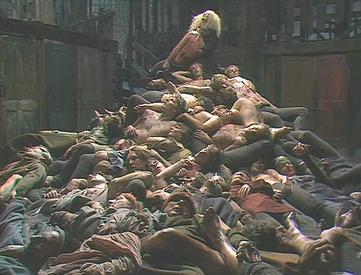
  • Another authoritarian habit shared by Trump and Richard is by firing (or murdering anyone who gets in his way. Trump’s reckless behavior appointing and then firing people to his cabinet is such a joke, that the Washington Post has compiled a list of everyone that Trump has fired, so far: https://www.google.com/amp/s/www.washingtonpost.com/amphtml/news/the-fix/wp/2017/07/25/heres-a-list-of-people-trump-has-fired-or-threatened-to-fire/
  • Richard is even more comically trigger happy than Trump. Look at this scene where in less than 10 minutes, he sends a murderer to kill his nephews, plots to murder his wife and marry his niece, and completely throws off the Duke of Buckingham, his only supporter on his way to the crown!

    https://m.youtube.com/watch?v=gD5afYxDc6g

    Richard’s authoritarian tactics actually spring from one of the best political theorists of the renaissance, unfortunately it was Machiavelli. Niccolo Machiavelli saw how the crown heads of Italy consolidated power through violence and intimidation, and he came to realize that the power behind the throne is much less to do with divine right or royal bloodline, and more with who can play the game and project power and strength. In Shakespeare’s Henry the Sixth Part III, Richard brags that in his quest to the good for the crown he will send Machiavelli to school: https://m.youtube.com/watch?v=v6ji07tsI2M
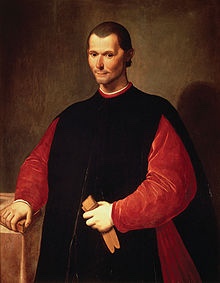
    Portrait of Machiavelli by Sandi DiTito, c. 1650

    I unfortunately don’t have enough time to get into the connections between Machiavelli, Richard, and Trump. Suffice it to say that all three advocate rule by fear and have no interest in preserving democracy. Below are some quotes and articles that I have collected about Machiavelli and his connection to Shakespeare and Trump:

    http://insights.som.yale.edu/insights/what-can-you-learn-machiavelli

    https://www.google.com/amp/s/www.theatlantic.com/amp/article/354672/

    https://www.bl.uk/shakespeare/articles/richard-iii-and-machiavelli

    https://www.google.com/amp/s/murreyandblue.wordpress.com/2015/01/31/richard-iii-the-murderous-machiavel-2/amp/

    Part III: Who Lives, Who Dies, Who Tells Your Story

    Sadly, the ultimate similarity between Shakespeare’s Richard III, the real King Richard, and Trump is that the actual human has been swallowed up by a narrative. Even though most of what Trump says is a lie, to his supporters he is the one person who ‘tells it like it is,’ not because they believe him, but because they want to believe in the narrative he constructs.

    Not only are his lies compelling, Trump himself has become a powerful symbol to the disenfranchised that the system is broken and corrupt, so why not vote for someone like him? He brands himself as a ‘plain blunt man’ who isn’t afraid to offend or criticize people in power, even though he is much worse than they are at running the government. According to the testimony of his former lawyer Michael Cohen, Trump described his own campaign as the ” The greatest infomercial in political history.” His campaign was from the start, a scam, where the ultimate con man told people he was going to fix healthcare, fix the immigrants coming into the country, and fix everything they didn’t like about America.

    Trump and Richard exploit what you and I want to believe. A New York Times article from 2016 made an interesting comparison between Trump’s odious political persona and that of one of the “heels” or bad guys in professional wrestling. These characters are unrepentantly evil, and love to stir up anger in the crowd, and everyone knows that their every word and action is fake, but they buy into the story. This kind of suspension of disbelief is of course, the central guiding principle of theater itself, and arguably Shakespeare created a villain who would make a very effective wrestling heel.

    The real Richard’s devolution from a historical king into a villainous archetype is more tragic, but just as powerful. The lies that the Tudor chronicles told about him were more compelling and politically convenient than the truth, and Shakespeare’s genius just further distanced us from caring what the real man was like. In essence, Shakespeare was inventing fake news far before Trump was railing about it. Just as we as an audience are complicit in the pretend crimes of a fake king when we watch the play, we are also complicit in perpetuating a comfortable simplistic story of the 15th century War of the Roses king Richard Plantagenet.

    Trump and Richard show that history can be distorted when we focus less on what is really happening and more on what we want to see. More people wanted to believe his lies than Hillary Clinton’s facts, the same way people were forced to believe the Tudor lies instead of the real truth of what happened from 1483-1485. Likewise Shakespeare’s Richard exploits people’s fear, greed, and gullibility to gain power for himself, but this is his only talent; eventually his supporters lose faith in him, his enemies mobilize, and he is taken from power.
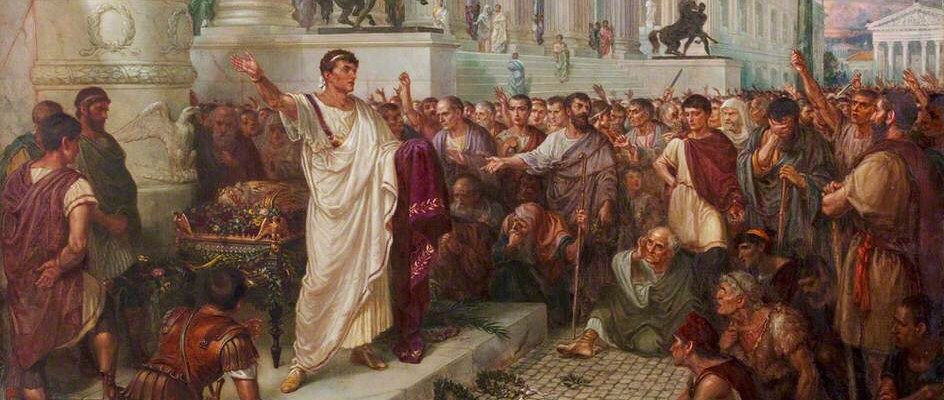
    Close Reading: Friends, Romans, Countrymen

    Today I’m going to do an analysis of one of the most famous speeches in all of Shakespeare: Antony’s Funeral Speech in Act III, Scene ii of Julius Caesar, commonly known as the “Friends, Romans, Countrymen” speech.

    I. Given Circumstances

    Antony is already in a very precarious position. His best friend Julius Caesar was murdered by the senators of Rome. Antony wants vengeance, but he can’t do so by himself. He’s also surrounded by a mob, and Brutus just got them on his side with a very convincing speech. They already hate Antony and Caesar. His goal- win them back. Here is a clip of Brutus (James Mason) speaking to the crowd from the Joseph Mankewitz movie version of Julius Caesar:

    So the stakes are very high for Antony: If he succeeds, the crowd will avenge Caesar, and Antony will take control of Rome. If he fails, he will be lynched by an angry mob.

    II. Textual Clues

    If you notice in the text of the speech below, Antony never overtly says: “Brutus was a liar and a traitor, and Caesar must be avenged,” but that is exactly what he gets the crowd to do. So how does he get them to do so, right after Brutus got them on his side?

    Antony. You gentle Romans,— 1615

    Citizens. Peace, ho! let us hear him.

    Antony. Friends, Romans, countrymen, lend me your ears;

    I come to bury Caesar, not to praise him.

    The evil that men do lives after them;

    The good is oft interred with their bones; 1620

    So let it be with Caesar. The noble Brutus

    Hath told you Caesar was ambitious:

    If it were so, it was a grievous fault,

    And grievously hath Caesar answer’d it.

    Here, under leave of Brutus and the rest— 1625

    For Brutus is an honourable man;

    So are they all, all honourable men—

    Come I to speak in Caesar’s funeral.

    He was my friend, faithful and just to me:

    But Brutus says he was ambitious; 1630

    And Brutus is an honourable man.

    He hath brought many captives home to Rome

    Whose ransoms did the general coffers fill:

    Did this in Caesar seem ambitious?

    When that the poor have cried, Caesar hath wept: 1635

    Ambition should be made of sterner stuff:

    Yet Brutus says he was ambitious;

    And Brutus is an honourable man.

    You all did see that on the Lupercal

    I thrice presented him a kingly crown, 1640

    Which he did thrice refuse: was this ambition?

    Yet Brutus says he was ambitious;

    And, sure, he is an honourable man.

    I speak not to disprove what Brutus spoke,

    But here I am to speak what I do know. 1645

    You all did love him once, not without cause:

    What cause withholds you then, to mourn for him?

    O judgment! thou art fled to brutish beasts,

    And men have lost their reason. Bear with me;

    My heart is in the coffin there with Caesar, 1650

    And I must pause till it come back to me.

    First Citizen. Methinks there is much reason in his sayings. Julius Caesar Act III, Scene ii.

    The two main methods Shakespeare uses to infuse Antony’s speech with powerful persuasive energy are the way he writes the verse, and his command of rhetoric.

    A. Verse

    The greatest gift Shakespeare ever gave his actors was to write his plays in blank verse. It not only tells you which words are important to stress, it gives you clues about the character’s emotional journey; just as a person’s heartbeat can indicate their changes in mood, a subtle change in verse often betrays the character’s pulse and state of mind. Antony uses his own emotions and his powers of persuasion to manipulate the crowd, so his verse helps show how he changes the pulse of the Roman mob.

    I could write a whole post on the verse in this page, which I don’t need to do, since The Shakespeare Resource Center did it for me: http://www.bardweb.net/content/readings/caesar/lines.html What I will do is draw attention to some major changes in the verse and put my own interpretations on how Antony is using the verse to persuade the crowd:

    1. The first line of the speech grabs your attention. It is not a standard iambic pentameter line, which makes it rhythmically more interesting. In the movie version, Marlin Brando as Antony shouts each word to demand the crowd to just lend him their attention for a little while. He uses the verse to emphasize Antony’s frustration.
    2. “The Evil that men do, lives after them”- Notice that the words evil and men are in the stressed position. Antony might be making a subconscious attempt to say Brutus and the other evil men who took the life of Caesar are living, when they deserve to die.
    3. If it were so..” Again, Antony might be making a subtle jab at the conspirators. Brutus said Caesar was ambitious and Antony agrees that ambition is worthy of death, but he also adds an If, to plant the seeds of doubt in the crowd’s minds. To drive it home, the word if is in the stressed position, making it impossible for the crowd to not consider the possibility that Caesar wasn’t ambitious, and thus, didn’t deserve to be murdered.

    B. Rhetoric

    One reason why this speech is so famous is its clever use of rhetoric, the art of persuasive speaking. Back in ancient Rome, aristocrats like Antony were groomed since birth in the art of persuasive speech. Shakespeare himself studied rhetoric at school, so he knew how to write powerful persuasive speeches. Here’s a basic breakdown of the tactics Antony and Shakespeare use in the speech:

    Ethos, Pathos, and Logos

    The three basic ingredients of any persuasive speech are Ethos, Pathos, and Logos. Ethos is an appeal to the audience based on the speaker’s authority. Pathos is an appeal to the emotions of the crowd, and Logos is an appeal to facts and or reason. Both Brutus and Antony employ these three rhetorical tactics, but Antony doesn’t just appeal to his audience, he manipulates them to commit mutiny and mob rule.

    Logos Antony has very few facts or logical information in his speech. His major argument is that again, since Caesar wasn’t ambitious, (which is very hard to prove), his death was a crime. Antony cites as proof the time Cæsar refused a crown at the Lupercal, but since that was a public performance, it’s hardly a reliable indication of Caesar’s true feelings.

    You see logos as a rhetorical technique all the time whenever you watch a commercial citing leading medical studies, or a political debate where one person uses facts to justify his or her position. If you look at Hillary Clinton during the 2016 Presidental Debate, she frequently cited statistics to back up her political positions

    Ethos-

    Ethos is an argument based on the speaker’s authority. Brutus’ main tactic in his speech is to establish himself as Caesar’s friend and Rome’s. He says that he didn’t kill Caesar out of malice, but because he cared more about the people of Rome.

    BRUTUS: If there be any in this assembly, any dear friend of Caesar’s, to him I say, that Brutus’ love to Caesar was no less than his. If then that friend demand why Brutus rose against Caesar, this is my answer:

    –Not that I loved Caesar less, but that I loved Rome more. JC, III.ii.

    Antony employs the exact same tactics, establishing himself as Caesar’s friend and telling the crowd that, as Caesar’s friend, Antony believes that Caesar did not deserve his murder. His use of Ethos therefore, helps Antony refute Brutus’ main claim.

    Again, the 2016 debate is another excellent way of showing ethos in action. Hillary Clinton and Brutus frequently cited their political experience and their strength of character to justify their views. There’s an excellent article that examines Hillary’s use of Ethos in her political rhetoric: https://eidolon.pub/hillary-clintons-rhetorical-persona-9af06a3c4b03

    Pathos

    Pathos is the most frequently used rhetorical tactic: the appeal to emotion. Donald Trump uses this constantly, as you can see in this clip from the 2016 debate:

    https://youtu.be/wMuyBOeSQVs

    Pathos is bit more of a dirty trick than Ethos and Logos, which is why Brutus doesn’t use it much. As scholar Andy Gurr writes:

    Brutus is a stern philosopher and thinker. His faith in reason fails to secure the crowd from Antony’s disingenuous appeal to their affections, which uses sharp sarcasm and some twisted facts.

    Antony’s major appeals to emotion:

    • His grief over losing Caesar
    • His painting of Cæsar as a generous, faithful friend
    • Shaming the crowd for not mourning Caesar’s death
    • Appeal to piety by showing the body funeral reverence.
    • His use of Caesar’s bloody body and mantle to provoke outrage from the citizens.
    • His use of Caesar’s will to make the crowd grateful to Caesar, and furious at Brutus.

    Rhetorical Devices

    If Ethos, Pathos, and Logos are the strategies of rhetorical arguments, rhetorical devices are the artillery. If you check out the website Silva Rhetoricae, (The Forest Of Rhetoric), you can read about the hundreds of individual rhetorical devices that politicians have used in speeches and debates since ancient history. I will summarize here the main ones Antony uses over and over again in “Friends, Romans, Countrymen.” For another more compete analysis, click here: https://eavice.wordpress.com/2011/02/05/jv-rhetorical-devices-in-antonys-funerary-speech-from-shakespeares-julius-caesar/

    • Irony The way Antony keeps repeating “Brutus is an honorable man,” is a particularly sinister form of irony, which here means to imply the opposite of what you have said to mock or discredit your opponent. The irony is that the more Antony repeats this idea that Brutus is honorable, the more the crowd will question it. If Brutus were truly honorable, he would not need Antony to remind them. Of course, Brutus can still be honorable whether Anthony mentions it or not, but this repetition, coupled with Antony’s subtle rebuttals Of Brutus’ arguments, manages to shatter both Brutus’ motives, and his good name, at least in the eyes of his countrymen.
    • Antimetabole is the clever use of the same word in two different ways. Antony manages to work it in twice in this speech:
    • “If it were so, it was a grievous fault,
    • And grievously hath Caesar answer’d it.”
    • “You all did love him once, not without cause: What cause withholds you then, to mourn for him?”
    • Rhetorical question This is the most famous rhetorical device which by the way in Antony’s day would have been known as Erotema. Antony asks a series of questions designed to refute the notion that Caesar was ambitious, from his mercy to his captives, to Caesar’s tenderness to the poor, and of course his refusal to take the crown during the Lupercal. Each question calls Brutus’ claims into question and seeds doubt in the crowd.

    Performance Notes with link to Globe performance

    https://youtu.be/1RL8Wg-b8k

    Unlike most Shakespearean plays, with Julius Caesar, we have an eyewitness account of how the play was originally performed. Swiss student Thomas Platter wrote a long description of watching the play at the original Globe Theatre in 1599. This is a translation that I found on The Shakespeare Blog:

    On September 21st after lunch, about two o’clock, I and my party crossed the water, and there in the house with the thatched roof witnessed an excellent performance of the tragedy of the first Emperor Julius Caesar, with a cast of some fifteen people; when the play was over they danced very marvellously and gracefully together as is their wont, two dressed as men and two as women…

    Thus daily at two in the afternoon, London has sometimes three plays running in different places, competing with each other, and those which play best obtain most spectators.

    The playhouses are so constructed that they play on a raised platform, so that everyone has a good view. There are different galleries and places, however, where the seating is better and more comfortable and therefore more expensive. For whoever cares to stand below only pays one English penny, but if he wishes to sit he enters by another door, and pays another penny, while if he desires to sit in the most comfortable seats which are cushioned, where he not only sees everything well, but can also be seen, then he pays yet another English penny at another door. And during the performance food and drink are carried round the audience, so that for what one cares to pay one may also have refreshment.

    The actors are most expensively costumed for it is the English usage for eminent Lords or Knights at their decease to bequeath and leave almost the best of their clothes to their serving men, which it is unseemly for the latter to wear, so that they offer them for sale for a small sum of money to the actors.

    Thomas Platter, 1599, reprinted from: http://theshakespeareblog.com/2012/09/thomas-platters-visit-to-shakespeares-theatre/

    So the conclusions we can draw based on Platter’s account include that Antony was standing on a mostly bare stage with a thatched roof, raised slightly off the ground. We can also guess that, since the merchants were selling beer, fruits, and ale, that the audience might have been drunk or throwing things at the actors.

    As Platter notes, and this page from Shakespeare’s First Folio confirms, there were only 15 actors in the original cast, so Shakespeare’s company didn’t have a huge cast to play the gigantic crowd in the Roman street. In all probability, the audience is the mob, and Antony is talking right to them when he calls them “Friends, Romans, Countrymen.” I believe that the audience was probably encouraged to shout, chant, boo, cheer, and become a part of the performance which is important to emphasize when talking about how to portray this scene onstage. A director can choose whether or not to make the audience part of the action in a production of Julius Caesar, which can allow the audience to get a visceral understanding of the persuasive power of politicians like Brutus and Antony. Alternatively, the director can choose instead to have actors play the crowd, and allow the audience to scrutinize the crowd as well as the politicians.

    In conclusion, the reason this speech is famous is Shakespeare did an excellent job of encapsulating the power of persuassive speech that the real Antony must have had, as he in no small way used that power to spur the Roman crowd to mutiny and vengeance, and began to turn his country from a dying republic into a mighty empire.

    If you liked this post, please consider signing up for my online class where I cover the rhetorical devices in Julius Caesar and compare them with several other famous speeches. Register now at http://www.outschool.com

    For a fascinating look at how a modern cast of actors helps to create this scene, check out this documentary: Unlocking the Scene from the Royal Shakespeare Company’s production in 2012, with Patterson Joseph as Brutus, and Ray Fearon as Antony:

    ◦ Interview with Patterson Joseph and Ray Fearon RSC: https://youtu.be/v5UTRSzuajo

    And here is a clip of the final scene as it was performed at the Royal Shakespeare Company:

    References

    1. Annotated Julius Caesar: https://sites.google.com/site/annotatedjuliuscaesar/act-3/3-2-57-109

    2. Folger Shakespeare Library: Julius Caesar Lesson Plan: https://teachingshakespeareblog.folger.edu/2014/04/29/friends-romans-teachers-send-me-your-speeches/

    3. Silva Rhetoric http://rhetoric.byu.edu/

    3. Rhetoric in Marc Antony Speech

    https://www.google.com/amp/s/eavice.wordpress.com/2011/02/05/jv-rhetorical-devices-in-antonys-funerary-speech-from-shakespeares-julius-caesar/amp/

    4. Shakespeare Resource Center: http://www.bardweb.net/content/readings/caesar/lines.html

    Sleep No More Review

    This was without a doubt, the most incredible theater experience I’ve ever had. It was scary, interactive, exciting, clever, sexy, and even a little disturbing, but without a doubt it was incredible, original, and true Shakespearean theater.

    Before you read the review though, a word of caution-

    WARNING: this is a production where, the less you know about it, the better your experience will be. I will provide a basic outline of the production, and give you an insight into what I experienced, but I would urge you to see the show yourself without any preconceptions, so if you want to keep the mystery going that surrounds this production, I suggest you stop reading…

    RIGHT

    NOW.

    Alright, if you’ve chosen to keep reading, that means you want to know more, so more I shall give you. Going from the general to the specific, I’m going to talk a bit about what the show is, then describe the experience a bit, and then offer some tips for people who have never gone before.

    url-2

    Sleep No More is not the traditional kind of theater- there is no proscenium, no stage, no seats, and only one platform. It’s what theater teachers like my wife call “Experiential Theater.” The way she explains it, it’s theater that exists as an event. Rather than sitting and watching, you actively follow the action and you can get so close to the actors you can, (and sometimes will), touch them.

    The play was conceived by an English company called Punchdrunk Theater Company, who took over an old 6 story warehouse on West 27th Street in New York City, and turned it into a fictional hotel/bar called the “McKittrick Hotel.” The play, (which is done entirely without dialogue), is a re-imagination of both Macbeth, and the novel Rebecca by Daphne Du Maurier, set in the 1930s. The audience is admitted on the ground floor and are permitted to go freely through the 6 floor set and watch the actors perform. Different actors perform on different floors and interact with other actors at different times, and the audience may watch any scene or actor they wish.

    The title of the play comes from this passage from Macbeth:

    imgres-3

    The Experience

    As I said before, this a very freeing and very active kind of theater. The only division between you and the actors is that you will wear a face mask. Your role is basically to be an anonymous spectator at an event that unfolds before you, an event full of madness, sex, murder, and mayhem. I would describe it as sort of like living in the strange orgy scene in Eyes Wide Shut, or that scene in The Shining where Shelly Duvall runs through rooms of the hotel and keeps seeing bizarre sights.

    From the moment you enter the incredibly detailed hotel, you know you are in a place that was dangerous, dark, and chaotic. You wonder if the people are crazy, or if the building itself is crazy.

    As an audience member, you set the pace of your experience as you wonder through the hotels’ infirmary, library, parlor, bath, ballroom, balcony, patio, and dark forest (masterfully designed by Alexandria Challer). Eventually the actors will find you and you choose whether to follow them or wait for something else to come along. When I first entered the hotel, I spent a few minutes looking at the set- reading a hotel guest list, or examining a jar in the pantry, or staring at animal carcasses in the trophy room.  Eventually  though, I found a story unfold before me, and I rushed to follow it.

    Because none of the actors talk, this play is not Macbeth, unless you want it to be, it is not Rebecca by Daphne Du Maurier, unless you want it to be. YOU determine what your experience is. The great, (and famously crazy) theater theorist Antonin Artaud once said, “Text is a prison.” If that’s true, then Sleep No More has set its actors free: their movements convey the story through mime, ballet, gestures, and occasional words. This freedom from the restrictions of text means that it’s up to you to truly piece a story together, and you will find that story can alter, change, and sometimes disappear into mist.

    How is This Story Macbeth? (Spoilers Ahead)

    One of the most common complaints I read online from people who saw the show is that they didn’t understand the connection between Sleep No More and Macbeth. I don’t want to give too much away because I feel that part of the fun in this production is trying to figure out the connection yourself, but I will provide you with a few scenes to look for, to give you some clues on how to connect this physical theater piece with Shakespeare’s play:

    Scenes to look for:

    1. In the bedchamber on the 3rd floor, there is a bathtub on a small platform. On the steps leading up to the tub I saw a letter that contains this text from Shakespeare:

    They met me in the day of success: and I have
    learned by the perfectest report, they have more in
    them than mortal knowledge. When I burned in desire
    to question them further, they made themselves air,
    into which they vanished. Whiles I stood rapt in
    the wonder of it, came missives from the king, who
    all-hailed me ‘Thane of Cawdor;’ by which title,
    before, these weird sisters saluted me, and referred
    me to the coming on of time, with ‘Hail, king that
    shalt be!’ This have I thought good to deliver
    thee, my dearest partner of greatness, that thou
    mightst not lose the dues of rejoicing, by being
    ignorant of what greatness is promised thee. Lay it
    to thy heart, and farewell.

    Macbeth

    This was the first definite evidence I had that the performance was inspired by Shakespeare besides the title of the play. A woman in a beautiful ball gown entered and read the note, pacing the whole time. Suddenly a handsome, red headed man came in. Like the Macbeths in Shakespeare, the body language between these two was hot and fierce; at times passionate and sexual, at times violent and animalistic. Lady Macbeth uses her body and her caresses to tempt her husband to murder, as the one in Shakespeare seduces him with her words. He trembles, turns away, brushes her off. Then, when she persists they struggle- clawing and slapping, even throwing each other across the bed, but in the end, exhausted, he slumps. She, victorious, leaves the room, looking like a queen already.

    2. Alone in his room, Macbeth contemplates his dire murder. He leaves the warmth of the bedchamber and enters a dark, moon-lit forrest with a few gravestones. I followed him out into the forrest, knowing that what he does now will probably be an interpretation of Macbeth’s two most famous soliloquies: “If It Were Done When Tis Done” (Act I, Scene vii), and the famous Dagger Speech from Act II, Scene ii. Since the actor didn’t talk, he had to convey Macbeth’s inner torture with his body. I saw him going up to a statue of the Virgin Mary, beating his fists and chest against the hard stone. It was clear to me that this symbolized Macbeth’s struggle between morality and desire. He staggered away from the statue and stopped at a stone pathway that led back to the bedroom. Macbeth then put his hands on the stones, lifted his body up pull-up like, and kicked his legs in a futile attempt of motion. I immediately thought of Macbeth’s line:

    I have no spur
    To prick the sides of my intent, but only
    Vaulting ambition, which o’erleaps itself
    And falls on the other (Macbeth I,vii).

    It was clear that the actor was showing how Macbeth cannot bring himself to kill, yet is too ambitious to let go of the desire to kill and this is what manifested in his tortured body. He then turned toward me and the other audience members and I saw his expression change. He looked around, worried, even frightened, as if he saw something he couldn’t believe. It wasn’t clear to me at first, but now I’m pretty sure that he was looking at the dagger from his famous soliloquy, and it was US. He ran from the forrest, and we charged after him like a swarm of angry bees! We found him in a corridor on the 2nd floor, where he again hoisted his body up against an old fireplace, inverting himself with his legs sticking up, and his head below, like an upside down cross. He then stretched his hands out and waved them frantically. Two frightened audience members took them and helped him hoist himself down. When Macbeth got to his feet, he proceeded to a darkly lit chamber where another man lay sleeping…

    3. In a small bar on the 1st floor, I saw Macbeth with two women and one man. They all wore black lipstick and had crazed and hungry looks in their eyes. The music sped up to a crazed pace and the movements erupted into a terrifying orgy of sights and sounds. A strobe light pulsed showing me glimpses of the frightening spectacle, which included the two women stripping their clothes, the man putting on the head of a goat, and one of the women pulling out an infant covered with blood, and holding it in triumph over Macbeth’s head. At this moment I realized that these gruesome creatures must be the witches, and that they were foretelling Macbeth’s destiny as they do in Act IV. They also brought out a tree, which signified the prophesy that Macbeth will never be vanquished until Birnam Wood walks to Dunsinane Hill. To be honest, I don’t remember much after that, I was probably still in shock!

    4. Back in the forrest, I encountered a small brick structure that looked like a tower, with a woman looking out of it expectantly. She beckoned me to come inside. When I did, I saw that she was dressed in a nurses’ uniform, and she was looking at a doctor with concern. Inside the tower was a small operating room with a circular table in the center, and two rows of seats above it. The doctor was injecting some kind of drug into his arm, which made it twitch in spasms. The two of them walked into the forrest and through a door into a room that looked like a small train station with platforms and travel posters on the walls. Lady Macbeth was there, wondering aimlessly. I instantly identified this moment as the famous sleepwalking scene, where Lady Macbeth contemplates the crimes to which she has become accessory. Usually the actress conveys her guilt by washing imaginary blood off her hands, but in this case she chose to interact with people, specifically, ME. She held out her hands to me, I took them. She looked into my eyes with a haunted look on her face. Then she whispered in my ear: “The thane of Fife had a wife, and she was beautiful.” I could see that this woman felt alone and afraid, with no one to talk to. She was no longer the powerful figure throwing her husband across the bed. This was what had driven her mad, and her madness allowed her to see me and the rest of us in the audience. She looked upon us with looks of disgust and terror, as if we were the ghosts of the people she killed, and ran away somewhere we couldn’t follow. We never saw her again (until the ghostly finale).

    Those were just a few pieces that I witnessed. I won’t give away how it ended, but I will tell you that the show ended in a dining room on a tableau that reminded me of a cross between Da Vinci’s The Last Supper, and the banquet scene of Macbeth. 

    When I talked to my wife, (who also came to the show, but was in a different audience group from me), she told me that there were many other scenes that were clearly inspired by Rebecca; she encountered a woman that she figured out was the ghoulish housekeeper Ms Danvers. She also had an intense meeting with the long-suffering Mrs. DeWinter, who gave her a locket and told her to keep it always. Finally, my wife revealed to me the startling fact that (Spoiler Alert), the same woman who plays the infamous Rebecca, dressed in a red flowing gown, also becomes Hecate, the goddess of black magic in Macbeth!

    These performances are athletic, well thought-out, and incredibly nuanced. If you take some time to familiarize yourself with the stories of Macbeth and Rebecca, you can understand how the actors are interpreting the stories through dance, mime, and interactions with the set, props, and occasionally, the audience themselves.

    I’d now like to conclude this review with my own pieces of advice for those of you who choose to see the show:

    1. Yes, wear comfy shoes. Almost everyone will tell you to bring comfortable shoes and they’re right- if you don’t want to lose the thread of a story, you have to be quick. Macbeth in particular is fast and nimble as a tiger, and you have to run fast to keep up with him.
    2. Find a person that interests you. I think some people make the mistake of staying in one place too long and ignoring the actors. This is physical theater, so try to find an actor to follow.
    3. Pretend you are a ghost if it helps Remember, murder and insanity are here, and you have a chance to see what it looks like and how it moves. Look right into the actor’s eyes and embrace your power to haunt these lost souls. Don’t be afraid to get close to them, and stay there as long as possible.
    4. If you do read Macbeth or Rebecca beforehand, it can be useful to memorize a few lines or moments and look for them in the performance. I can tell you for a fact that these actors meticulously planned their performances to give physical life to these two great works of literature. Look for a gesture, a glance, or a prop that jogs your memory and puts you into this hybrid world of Shakespeare and Du Maurier.
    5. The actors can sense if you are interested in interacting with them. If you seem scared or apprehensive, they will respect your space and not get close to you, but if you show them you are brave enough, they will extend a hand, or come toward you and give you a theater experience you will never forget.
    6. Leave your loved ones behind. Nothing was more fun to me than talking about my experience with my wife after the show and piecing our nights together. Even though the same show was going on the whole time, we saw different people, to different rooms, and had very different reactions.
    7. If an actor disappears, don’t wait for them. Sometimes you’ll follow an actorrl and they’ll duck into a corridor, or go behind a locked door, or a sentinel in a black mask will block your path. Now the story is over, and you are alone. Now you must choose again where to go, and try and uncover the sense of this horror.
    8. If you get to go to the 6th floor, consider yourself very lucky. Only a few people get to see it. My wife said she saw one person go up there. He was on an elevator with a small group. As they reached the top floor, a hotel porter let him off, then extended an arm, to indicate no one else would be admitted. Even the man’s girlfriend was blocked by the porter, who then explained, “This experience is best undertaken, alone.”

    Well, I hope this whetted your appetite somewhat. Like I said this show is incredible, and very different from the kind of theater we generally think of, and that’s what makes it engaging and exciting. However, there is violence, nudity, and gruesome imagery onstage so it is definitely not for children. If you are interested in learning more, you can visit the Sleep No More website: www.sleepnomore.com/

    Until next time,

    Sleep Well.

    “Something Rotten” Review

    https://www.youtube.com/watch?v=-SXqs0TDEfo&list=PLOdRUUA2P9epAHoFuCRdu59ABiOmznT_b

    As promised, here is my review of the hot new Broadway musical “Something Rotten.”

    Me posing in front of a colorful banner for
    Me posing in front of a colorful banner for “Something Rotten”

    My reaction: I went into this show with the hope that it would be a witty, whimsical, musical salute to both Shakespeare and musicals, and it certainly was , but to my mind as a Shakespearean fan, I felt like it didn’t quite live up to its full potential. Yes it’s entertaining, yes it has some great acting and great performances, yes it boasts some glistening songs and scores of jokes, but the plot is a little recycled, the characters are hard to like at times, and the balance of Shakespeare and musicals is pretty tipped to one side.

    imgres

    The Theater

    Something Rotten is entertaining from the moment you walk up to the door of the St. James Theater: I was greeted by colorful Elizabethan cartoon figures who voiced their take on the show via speech bubbles: “Song and dance at the same time? Blasphemous!” As I walked up the stairs to my seat in the Mezannine, I saw all kinds of Shakespearean merchandise in the lobby from magnets to T-Shirts, to signature candy bars and drinks, including one called “The Bloody Bard.” This raised my hopes that this show would show some love to Shakespeare in addition to musicals.

    View from the audience of the curtain for
    View from the audience of the curtain for “Something Rotten.”

    As I took my seat, I gasped at the enormity before me: a huge Greek proscenium opening on a Pantheon like dome, complete with two painted muses on the ceiling, and three chandeliers that would tempt any Phantom of the Opera to deploy upon the audience. Below the dome was the set; an impressive recreation of an Elizabethan playhouse with its thatched roof, wooden galleries, and the banners that announce the start of the show. Once the lights dimmed, the orchestra began with trumpet and the ping of an old fashioned Tambor drum, which slowly evolved into the raucous jazzy tune “Welcome To the Renaissance.” The show had begun, and I was smiling already.

    The Plot

    As I’ve stated before, the premise is pretty simple. Two brothers, Nick and Nigel Bottom, (Brian D’Arcy James and John Cariani respectively), are struggling writers who are trying to make it in theater in London, constantly out classed by Shakespeare (Christian Borle), who used to be an actor in their company. Nick angrily curses out Shakespeare in song in the hilarious number: “God I Hate Shakespeare.”

    Shakespeare is a flamboyant and stupendously successful writer with a leather doublet, killer abs, and a cocky smile. He knows he’s the best there is, and shows off by giving extravagant parties and poetry readings, complete with colored lights and pyrotechnics! Shakespeare also has an annoying habit of stealing lines and ideas from other writers; the second he looks at Portia he says, “Good name,” hinting at his use of her name for the heroine of The Merchant Of Venice. Borle is fantastic in his Shakespeare strut, and plays the Shakespeare rockstar persona to the hilt.

    Both the Bottom brothers secretly envy Shakespeare; Nick for his money and success, Nigel for his skill at writing beautiful poetry. Nick worries how to make a living as a playwright, especially since he is also supporting his brother and his wife Beatrice (played excellently by Heidi Blickenstaff). Bea urges him not to worry and assures him that she is strong enough to get a job and help ease the burden of supporting his family in the song: “Right Hand Man,” (a wonderful satire of contemporary gender politics). “It’s 1595, we have a woman on the throne,” Beatrice tells her husband, “By 1600 a woman will be exactly as equal as a man.”

    Nick doesn’t want his wife to have to work for him, but he can’t get out from under Shakespeare’s shadow. Desperate to turn his luck around, Nick pays a soothsayer (Brad Oscar) to tell him the future of musical theater. Oscar goes into a raucous musical number, “A Musical,” that “invents,” and parodies almost every musical of the last 50 years from A Chorus Line, to Rent, complete with an upbeat tune and kick-lines!

    Bottom becomes convinced that he will create the great new musical that will rival Shakespeare’s plays in popularity, and he gets his brother and the Soothsayer to write it. He now imagines that for once, “Bottom’s Gonna Be On Top!”

    Nigel Bottom, Nick’s brother, is an aspiring poet who dreams of creating a play that will show beauty and truth. Nigel’s poems put love in the heart of Portia, who adores both his poems, and Nigel himself. The only problem is her father Brother Jeremiah (Brooks Ashmanskas), is a Puritan, (as well as a closet homosexual). Jeremiah despises theater, and by extension, Nigel. The pair secretly meet to allow their love, and their love of poetry to blossom. They also have a wonderful duet, “We See The Light,” where they imagine getting Brother Jeremiah to believe in their love, which turns from tender Elizabethan ballad into a catchy Gospel tune.

    I don’t want to give too much away but, in the end, the Bottom family and Shakespeare strike a deal- Shakespeare will still rule theater in England while the Bottoms get to be on top at last in America, where their new musicals will become the theater of the future.

    If you already have seen the show, here are some Shakespeare jokes you might have missed:

    1. The title “Something Rotten,” refers to a line from Hamlet where the guard Marcellus declares: “Something is rotten in the state of Denmark.”
    2. The name Nick Bottom comes from one of Shakespeare’s characters; in A Midsummer Night’s Dream, he is an actor in an amateur theater troupe, who is magically transformed into a man with the head of a donkey. Through the play and the musical there are jokes about what an ass Bottom is both literally and figuratively.
    3. The two female characters are also named after Shakespearean heroines: Beatrice, Bottom’s strong-willed wife is from Much Ado About Nothing, while Nigel’s sweetheart Portia appears in The Merchant of Venice, as does the Jewish moneylender Shylock.
    4. In many of Shakespeare’s comedies women dress up as men to take on their jobs, just as Beatrice does for her husband Nick.
    5. The villainous puritans who try to shut down Nick and Nigel’s musical are based on a real life religious group who did eventually pull down all the playhouses in London, and ban theater altogether. Fortunately for Shakespeare, they didn’t succeed in destroying the theater until 30 years after he was dead.
    6. The brothers’ home land of Cornwall probably echoes that of the brothers Edmund and Edgar in Shakespeare’s tragedy of King Lear.
    7. Many people have accused Shakespeare of stealing his work from other people over the years, and of course, this musical makes it one of his defining characteristics. I’ve written about this in the past, but to sum up my arguments- Shakespeare adapted, he didn’t steal.
    8. The beautiful song: “To Thine Own Self Be True,” is a direct quote from Shakespeare’s play Hamlet; a bit of fatherly advice from Lord Polonius to Leartes.
    9. (Spoiler Alert) Toby Belch, Shakespeare’s non-de-plume as he spies on Nick Bottom, is named after another of the real Shakespeare’s characters- a fat drunken knight from the play Twelfth Night.
    10. The line “Son of York,” comes from Shakespeare’s Richard III.
    11. (Spoiler alert) Ironically, in Shakespeare’s play of Merchant it is Portia, not Beatrice who disguises herself as a male lawyer and saves the heroes from death in the courtroom with her famous “The Quality Of Mercy Is Not Strained” speech, though Beatrice does so in Something Rotten.
    12. (Spoiler Alert) The judge in the courtroom whom Shakespeare promises not to make fun of is named Falstaff, named after Shakespeare’s most celebrated comic character- another fat, drunken knight who has no moral code whatsoever!
    13. (Spoiler alert) When the brothers are banished and sent to America with Shylock, this parodies a historical event in 1751, where a troupe of actors mounted one of the first ever theatrical productions in America, which happened to be Shakespeare’s Merchant of Venice.

    This musical is a wonderful and entertaining show, but as I said before, I feel that some of it didn’t quite live up to my own expectations. I’ve decided to list my criticisms as a list so that you can choose to read or ignore it. After all, this is only my opinion, and I want you to make up your own mind.

    1. I would argue that plot-wise, Something Rotten is basically The Producers set in 1595. The Bottom brothers who struggle to produce a play are quite obviously lifted from Mel Brooks’ Bialistock and Blume, and the fact that Brad Oscar, (who was in that musical), has such a big part in Something Rotten, is a dead giveaway. Plus the final scene that culminates in a courtroom is very derivative of the climax of The Producers. I feel that for a musical that bills itself as “A Very New Musical,” the creators belie this statement by ripping off one of the most popular musical of this century.
    2. This is a small point, but I believe that there are far more musical jokes in Something Rotten than Shakespeare jokes. This could just have been my own experience, (surrounded as I was by high-school aged musical theater geeks), but I thought that the torrent of musical theater puns and quotes was simply too much. The audience ate it up and laughed so fast that I couldn’t hear a lot of the other jokes. I wish that the jokes were a little more spaced out, and that the balance was a little more toward Shakespeare instead of musicals.
    3. The roles for women are small and the roles for minorities are nearly nonexistent- the only black actor is a minstrel (played superbly by Michael James Scott), who only gets one song, “Welcome To the Renaissance,” and doesn’t have any influence on the plot whatsoever. In Shakespeare’s plays, fools and minstrels were essential to understanding the plot and often helped comment on the action, so I thought not using his talent more was a huge missed opportunity. Likewise, Bea and Portia are great characters, but I wanted to see more of them in the play, and it would have been nice if they got a scene together.
    4. Although Shakespeare is the antagonist, I found his scenes were the best, which arguably caused sort of a problem. I feel the writers couldn’t really pick a lane in terms of making it clear whom to root for- Bottom or Shakespeare. In many ways Nick Bottom is a jerk- he ignores his wife, he ridicules his brother, and his jealousy to Shakespeare (though understandable) is highly unappealing. By contrast, Shakespeare might be an egomaniac and a thief, but as he says in “It’s Hard to Be the Bard,” he’s just trying to live up to the adoration that his fans demand of him. The Bard is arguably more sympathetic because he is constantly trying to live up to his image as a genius. Like a lot of artists from Mozart to Bob Dylan, to Picasso, to George Lucas, Borle’s Shakespeare worries that he’s piqued too soon, and has nothing more to offer his public. Bottom never offers to help Shakespeare or ask him for advice on how to become a better writer, he just tries to steal Shakespeare’s success and justifies it with his insatiable jealousy. At least Max Bialistock was nice to Leo Bloom and encouraged him to follow his heart’s desire of being a producer, but Nick never even does that for Nigel. In short, I found it hard to enjoy the character of Nick Bottom, (who was supposed to be the hero), when he is never given an opportunity to be likable. Once again, Bottom is overshadowed by the Bard, but this time it’s his own fault.

    Although I was a little disappointed with these issues, the show is incredibly entertaining, well-acted, and has great catchy songs. I certainly would recommend it to any musical theater fan with at least a touch of Shakespeare in their soul!

    Stay tuned for a review of one of the greatest Shakespeare adaptations I’ve ever seen, the experiential theater piece, “Sleep No More.”

    Announcing my epic theater review weekend

    image

    Hi folks!

    I know I haven’t posted in a while,  but I have some good news: in the next few days I will post my reviews for two of the hottest Shakespeare inspired shows in New York- “Something Rotten” and “Sleep No More.” These are some of the best shows I’ve ever seen and I hope you enjoy reading about them. I will also finally finish my posts on Much Ado About Nothing,  and announce our new play of the month. 

    Hope that piques your interest and thanks for your patience!