The Witches Of Macbeth

Happy Halloween everybody!

Tonight I’d like to discuss some of the spookiest, most enigmatic, and above all WEIRDEST characters in Shakespeare: the Three Weird Sisters in Macbeth.

1. Who are they?

Every production has to answer who the witches are, and many have very different answers. Are they temptress? Are they evil agents controlling Macbeth?Furies trying to destroy Macbeth?

I would argue in their basic form the witches are harbingers of change. Their very name “Wyrd Sisters” refers to an old Anglo Saxon concept of fate or destiny. Whether or not they have any effect on Macbeth mind or soul, they point the finger at him and say “things are going to change for you.” Then, he either makes the choices that determine his fate, or they change his fate for him.
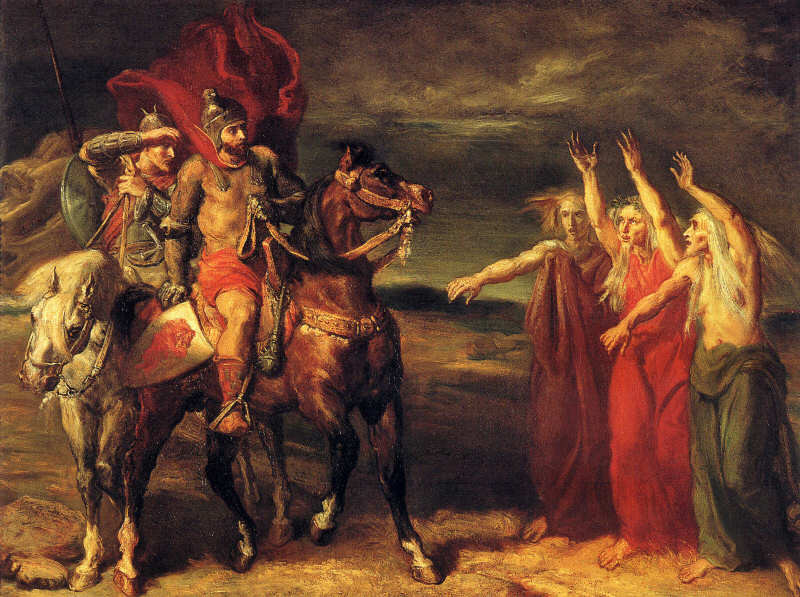
“Macbeth and Banquo First Encounter the Witches,” Théodore Chassériau, 1854.

Macbeth meets the witches on a heath, which means land that is literally out of bounds– the wild, untamed wilderness, which the old Anglo Saxons believed was the lair of many cursed spirits and monsters. This could symbolize Macbeth’ sin or transgressions, slowly turning into a murderer, usurper, and a tyrant. It could also symbolize the chaos in Macbeth’s life.

What Do They Look Like?

Shakespeare’s descriptions of the witches are highly contradictory- they seem to be floating, yet on the ground, they seem to be women, but they have beards! They don’t look Earthly, but here they are on the Earth. This gives them an other worldly quality that keeps us guessing as to who they are, and helps them tempt Macbeth more easily.

BANQUO
What are these
So wither’d and so wild in their attire,
That look not like the inhabitants o’ the earth,
And yet are on’t? Live you? or are you aught
That man may question? You seem to understand me,
By each at once her chappy finger laying
Upon her skinny lips: you should be women,
And yet your beards forbid me to interpret
That you are so.

MACBETH
Speak, if you can: what are you? (Act I, Scene iii).

The Witches’ Language:
You know from my earlier posts that the norm for Shakespearean characters is to speak in iambic pentameter- 10 syllable lines of unrhymed poetry that sounds like a normal heartbeat. The witches break these norms- they generally speak in Trochaic Tetrameter- 8 syllable lines with the off beat emphasized. The witches are literally offbeat, and that’s why their speeches are unsettling. Look at the contrast between a normal iambic line like:

“In sooth I know not why I am so sad.” (Merchant Of Venice I,i).

and

Dou-ble Dou-ble, Toil and Tro-ble.

Fire burn and Caul-dren Bu-ble. (Macbeth, Act IV, Scene i).

For more info on the verse forms of the Witches, click here:

The witches also speak their prophesies in a vague, ambiguous manner They like to play with obscuring their prophesies with lines that make Macbeth think one thing, but the opposite is true. The famous example here is when they claim Macbeth will never be vanquished “until Birnam Wood comes to Dunsinane Hill.” Macbeth assumes this means he’s invincible, but it actually means that the enemy carry wood from the forrest. This is called Equivocation.

Witches and mythology

Illustration from William Blake's
Illustration from William Blake’s “Europe a Prophecy,” 1794.

1. During the reign of King James, the modern witch hunt began; the king was fascinated with witches and even wrote a book called Daemonology on how to identify and destroy them. This was the era where people believed that witchcraft, rather than a pagan religious practice, was a forbidden craft that could only come from a pact with the devil. However, Shakespeare borrows from both Satanic and early pagan ritual in the characters of his witches.

2. Shakespeare took a couple of details about witchcraft from ancient Celtic and Greek mythology. First of all, the use of a cauldron. In Celtic myth, a cauldron is a symbol of rebirth and was sometimes used to resurrect the dead, just as the witches do in IV i. Of course, the ideal time for raising the spirits was on the feast of the pagan god Samhain, at the point where the veil between the living and dead was the thinnest. The feast took place on October 31st, our modern day Halloween!

Illustration of witches and their familiar spirits, 1647.

3. Familiar spirits In Act I, the witches speak to animal spirits called familiar spirits, which call to them and tell them where to go. King James himself wrote about how the witches found and communicated with these spirits.

Hecate.
In Act IV, Hecate, Ancient Greek goddess of magic appears. She is clearly the lord of all the witches, and is very displeased that they are riddling with Macbeth. Maybe not all witches believe in giving out prophesies that can destroy the Scottish monarchy. Hecate was always enigmatic in myths- she was born one of the Titans who opposed the gods, but frequently changed sides. More then being two faced, she was often portrayed as having three faces! Shakespeare refers to her frequently as “Triple Hecate.”

“The Triple Hecate,” by William Blake, 1794.

For more information on this mysterious goddess, consult the video below, (WARNING, ADULT-ONLY CONTENT).

In conclusion, the witches are meant to be ambiguous because the play examines the source of evil- whether it is inspired by other people, or if it comes from one’s own heart. The witches can be either or both, depending on how you want to tell the story, which is why they act and speak in contradictory ways.

Thanks for reading! If you enjoyed this posting, please consider signing up for my online class, “Macbeth: An Immersive Horror Experience.” I tell you the story of Macbeth and you get to play through an escape room, where you must solve the witches’ puzzles or be added to their Cauldron!
Happy St. Crispin’s Day/ Battle of Agincourt Day

Good evening everyone!

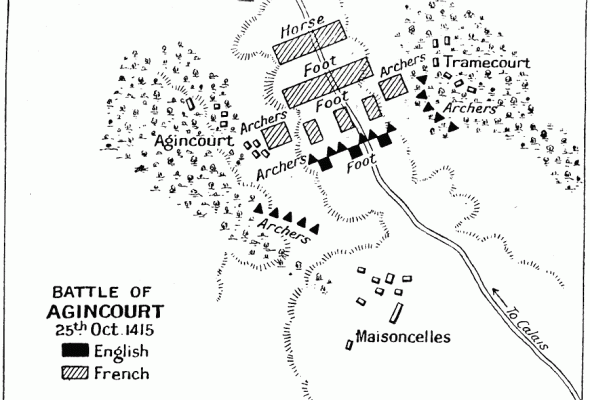
Today is the 600th anniversary of the Battle of Agincourt, one of the greatest victories in English history, where King Henry the Fifth and his 5,000 troops, fought and won against the French, who outnumbered them 5 to 1! Why is this important? Well, in Shakespeare’s history play Henry the Fifth, he gives the king the greatest pep-talk speech of ALL TIME!

This speech is so awesome, it’s cool even when a 5-year old does it!

So you may be wondering, what is Agincourt, and what is St. Crsipin’s Day?

Well Agincourt is a castle in France where on October 25th, 1415, King Henry fought a decisive battle that helped him conquer all of France. For more info on the battle, click here to read this article from the Telegraph.

Contemporary drawing of the Battle of Agincourt.

As for St. Crispin, I wrote about him before when I was working on a high-school production of “Henry the Fifth,” which you can read about here. Long story short- he was the patron saint of SHOEMAKERS!

And finally, a funny take on the battle from my favorite kid’s show, “Horrible Histories.”

See you tomorrow!

Paul

O Fortuna!

Today, June 24rth, is the ancient Roman festival of Fortuna, the goddess of luck and worldly fortunes. I’ve chosen to use this opportunity to explain a little bit about the concept of Fortune, which Shakespeare uses frequently in his tragedies. But first, a short musical interlude:

Does this song sound familiar? You’ve probably heard it underscored in hundreds of commercials, TV shows, maybe even in concerts, it’s a song composed by composer Carl Orff called “O Fortuna.”

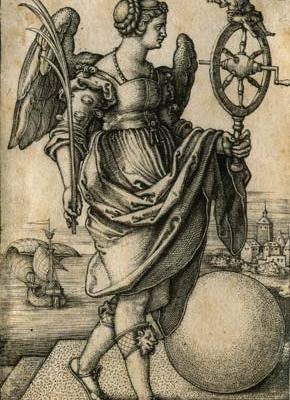
The Roman goddess Fortuna
The Roman goddess Fortuna with her wheel and orb.

In Roman mythology, Fortuna was the goddess of luck, wealth, and fertility. If you listen to the lyrics of the song above, you can see that for centuries, people chose to represent Fortune as a fickle, changeable, and irresponsible goddess. Unfortunately, one of the reasons she’s personified as a woman is the long-held prejudice that women are weak, have frequent changes of mind and mood, and can’t commit to one person, (a view of women that I and Shakespeare believe to not be true). However, based on his writing he does seem to think Fortune fits these characteristics:

“I am Fortune’s fool” –Romeo and Juliet

O fortune, fortune! all men call thee fickle:                If thou art fickle, what dost thou with him.   That is renown’d for faith? Be fickle, fortune; For then, I hope, thou wilt not keep him long, But send him back. –Romeo and Juliet

“When Fortune means to men most good,           She looks upon them with a threatening eye.” King John

Out, out, thou strumpet, Fortune! All you gods,       

In general synod ‘take away her power;       

Break all the spokes and fellies from her wheel,           

And bowl the round nave down the hill of heaven,        

As low as to the fiends! -Hamlet

In Dante’s Inferno, Fortuna lives in the Underworld with Plutus the god of gold, helping to distribute the god’s wealth to people above ground. In the Middle ages she was an explanation for why some people have good luck, some have bad, and why luck frequently changes.

The Wheel of Fortune. 

Fortuna’s most recognizable symbol is her wheel; the symbol of how luck can change; just when you think your life is perfect, the wheel turns and you find yourself on the bottom. Frequently in tragedy when things go wrong, the characters blame Fortune, such as when the Lord of Kent finds himself put in the stocks like a common thief and gripes: “Fortune good night, smile once more, turn thy wheel,” King Lear, Act II, Scene ii. And yes, the real game show was partially inspired by the goddess’ most famous symbol.

Fortuna In Tragedies

Shakespeare mentions fortune over 500 times in his plays and frequently in his tragedies. Characters in Shakespearean tragedy frequently single out Fortuna as the cause of their unhappiness and curse her as a liar and a strumpet. In a Christian society, it was a lot more appealing to blame a pagan goddess than a loving, Christian god, (which would probably be considered blasphemous). Now you see why she has become a popular scapegoat for misfortune in tragedy. At the same time, all tragedy raises questions about the nature of free will; how much of bad fortune is the result of fate, and how much is a direct result of the character’s bad choices? Edmund in King Lear laughs at the notion of any kind of fate, and accuses all of humanity of shirking responsibility in this speech:

EDMUND

This is the excellent foppery of the world, that,
when we are sick in fortune,–often the surfeit
of our own behavior,–we make guilty of our
disasters the sun, the moon, and the stars: as
if we were villains by necessity; fools by
heavenly compulsion; knaves, thieves, and
treachers, by spherical predominance; drunkards,
liars, and adulterers, by an enforced obedience of
planetary influence; and all that we are evil in,
by a divine thrusting on: an admirable evasion
of whoremaster man, to lay his goatish
disposition to the charge of a star! (King Lear, Act I, Scene ii).

At the same time, the audience also knows that Edmund was cursed by Fortune from the beginning, since he is the illegitimate child of the Duke of Gloucester, which might prove exactly the opposite point of his speech. He may act like he is absolute in his free will, but his behavior and his violent end suggests otherwise. So when characters curse Fortune or Fortuna in Shakespeare’s plays, take a look at the language they use to characterize this abstract concept. The way we think about luck or fate helps shape our perspective of our own lives, and therefore how playwrights depict this mysterious goddess helps us see the possibilities of human choice, and maybe help us make better choices than the tragic men who slander her in these plays!

For more insight into this topic: Click here to listen to my podcast about this week’s post:
https://www.buzzsprout.com/45002/284936-the-shakespearean-student-episode-6-o-fortuna

For Further Reading:

  1. Brittanica.com: Fortuna: http://www.britannica.com/topic/Fortuna-Roman-goddess
  2. Internet Shakespeare Editions: Fortuna in Medieval Drama: http://internetshakespeare.uvic.ca/Library/SLT/drama/early%20tragedies/medievaltragedy.html#boethius 
  3. Encyclopedia Mythica: Fortune: http://pantheon.org/areas/mythology/europe/roman/articles.html
  4. The Obscure Goddess Online Dictionary: http://www.thaliatook.com/OGOD/fortuna.html