Shakespeare On Dragons

Tonight is the Chinese New Year, beginning the Year of the Dragon. I’ve talked before about the fascinating relationship between Shakespeare and China, and I thought I’d illustrate it here by talking about a shared cultural mythology- the concept of dragons. Both Western and Eastern cultures use dragons in their myths, but as you’ll see, they have very different cultural meanings.

Quotes from Shakespeare About Dragons

Before thee stands this fair Hesperides,
With golden fruit, but dangerous to be touch’d;
For death-like dragons here affright thee hard:

Antiocus, Pericles

Sometimes we see a cloud that’s dragonish;
A vapour sometime like a bear or lion,
A tower’d citadel, a pendent rock,
A forked mountain, or blue promontory

Antony and Cleopatra

In Western myths, dragons are symbols of wrath and fierceness. In ancient Greek and Viking myths, dragons are often guards of treasure, (and sometimes in modern stories like Harry Potter). In the myth of Hercules, a multi-headed dragon guarded the golden apples of the Hesperides, (the apples that kept the gods young and immortal). King Antiochus wants to scare Pericles by comparing his daughter to the apples; if he fails to win her love, he’ll be devoured as Hercules almost was.

Coriolanus and Dragons

His CORIOLANUS is grown
from man to dragon: he has wings; he’s more than a
creeping thing.

Coriolanus

Shakespeare’s Roman general Coriolanus is frequently compared to a dragon in Shakespeare’s play. According to Dr. Peter Saccio of Dartmouth College, this is because the general is unable to relate to other humans- he is solitary, violent, jealous of his power and wealth, and prefers to strike first, then retreat from other people when the battle is won. This is why he utterly fails to get the Roman people to elect him consul in this scene from Ralph Fiennes’ movie. I find it ironic that Fiennes has played not only this character, (who is associated with dragons), but with Lord Voldemort, (who controls several large serpents), and also Francis Dollarhyde in the film Red Dragon:

Swift, swift, you dragons of the night, that dawning
May bare the raven’s eye! I lodge in fear;
Though this a heavenly angel, hell is here.

Cymbeline

Sometime he angers me
With telling me of the mouldwarp and the ant,
Of the dreamer Merlin and his prophecies,
And of a dragon and a finless fish,
A clip-wing’d griffin and a moulten raven,
A couching lion and a ramping cat,
And such a deal of skimble-skamble stuff
As puts me from my faith. 

Hotspur, Henry IV, Part I

A thousand hearts are great within my bosom;

Advance our standards, set upon our foes

Our ancient word of “courage,” fair Saint George,

Inspire us with the spleen of fiery dragons!

Richard III

St. George and the Dragon

In the medieval story of St. George, the titular knight defeats a dragon, which is basically a stand-in for Satan. George was seen as the ideal knight- virtuous, devoted to his cause, strong, and patriotic. His defeat of the dragon was an allegory for how knights should devote themselves to protecting their lords, ladies, and the innocent against evil. Therefore, it’s intentionally unsettling that Shakespeare has Richard III telling his soldiers to act not like the virtuous St. George, but like the cruel and violent dragon. Richard is Shakespeare’s most villainous king, so it makes sense in context that he would side with the dragon, and thus his defeat would seem even more like a triumph of good over evil. In addition, the real King Richard flew this flag with a dragon on it during the actual Battle of Bosworth Field.

Royal standard of Richard III, using the dragon of St. George

Peace, Kent!
Come not between the dragon and his wrath.

King Lear

Dragons and Chinese Culture

None of the animals is so wise as the dragon. His blessing power is not a false one. He can be smaller than small, bigger than big, higher than high, and lower than low.”

–Chinese scholar Lu Dian (AD 1042-1102)

Qualities of Dragons

Dragons didn’t have the negative connotations of Western myths. In China, they were symbols of good luck, strength, and success. They were also known to be proud and temperamental-sometimes kind but sometimes vengeful to people who didn’t show them proper respect. In a sense, the dragon was like the ancient Greek gods- they should be viewed with respect and gratitude as well as fear.

Zodiac

The Chinese calendar goes by a cycle of years, not months. It has 12 animals that represent various qualities and those qualities will characterize the coming year. So hopefully a year of a dragon will be a year marked with courage, good fortune, and justice.

IV. What would a Chinese Lear look like?

Looking at the quotes I showed you earlier, it’s interesting that King Lear calls himself a dragon, and it made me think- Lear is a powerful warlord who demands absolute loyalty from his children. Would a Chinese version of King Lear work?
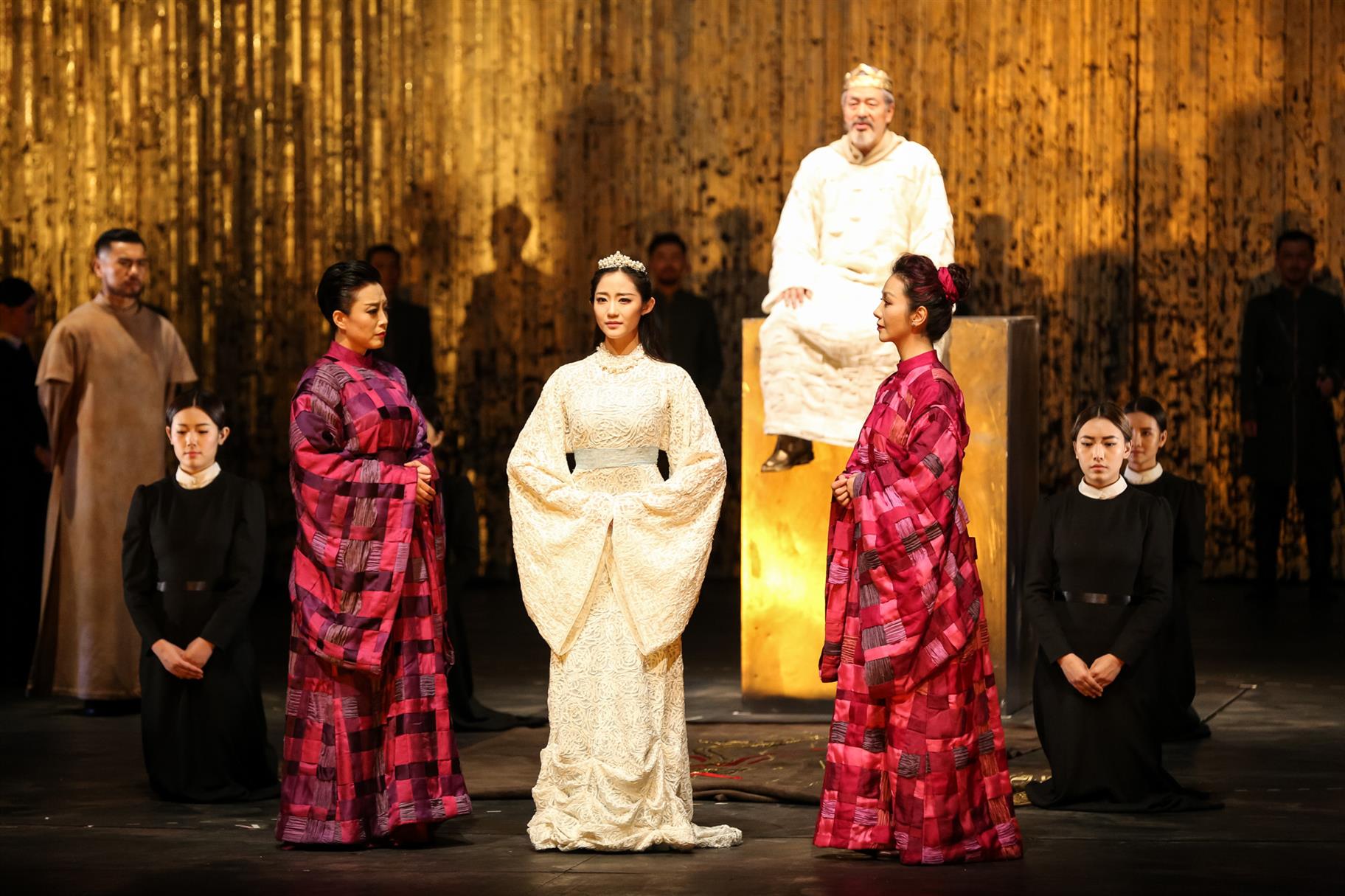
2017 Chinese Language production of “King Lear” at the Royal Shakespeare Company.

There was a Chinese production of King Lear back in 2017, where the translator and director traveled to the Royal Shakespeare Company in England and worked with the actors and directors of a London production to make their production gain insight into the characters’ motivations. However, I wonder how successfully they translated the Western ideas and values of the play for a Chinese audience. One of the reviews from China Daily.com describes the play like this:

Originating from old British legend, King Lear is one of Shakespeare’s four most famous tragedies. Through the internal disorder of the royal family, the rise and fall of King Lear’s fate and the final punishment of evil powers, Shakespeare expresses his optimistic views in the future of society, thereby adding the glory of strong idealism into his work.

ChinaDaily.com

The last word I would use to describe King Lear is “optimistic”. It is the only tragedy where not only does everyone die, but the entire future of the monarchy is in question. Nevertheless, reading about this production makes me interested in imagining my own version of King Lear, one that emphasizes Chinese values, but also questions them.

Many Chinese stories stress family loyalty, communalism, and respect for elders. You could portray King Lear as a story about the disastrous consequences of self-interest. After all, Regan and Goneril cast their father out and dismissed his followers, and it led their kingdom into civil war. In that version, Lear is like the Dragon King, who in Chinese folklore, was a powerful ruler of the seas, (giving new meaning to the lines “Blow winds, and crack your cheeks”). As a bonus, historically, many imperial Chinese rulers decorated their palaces with images of dragons, and the emperors themselves were associated with the creature, (especially during the Han Dynasty), so when Lear says “Come not between the dragon and his wrath,” In his mind, he literally is a dragon.
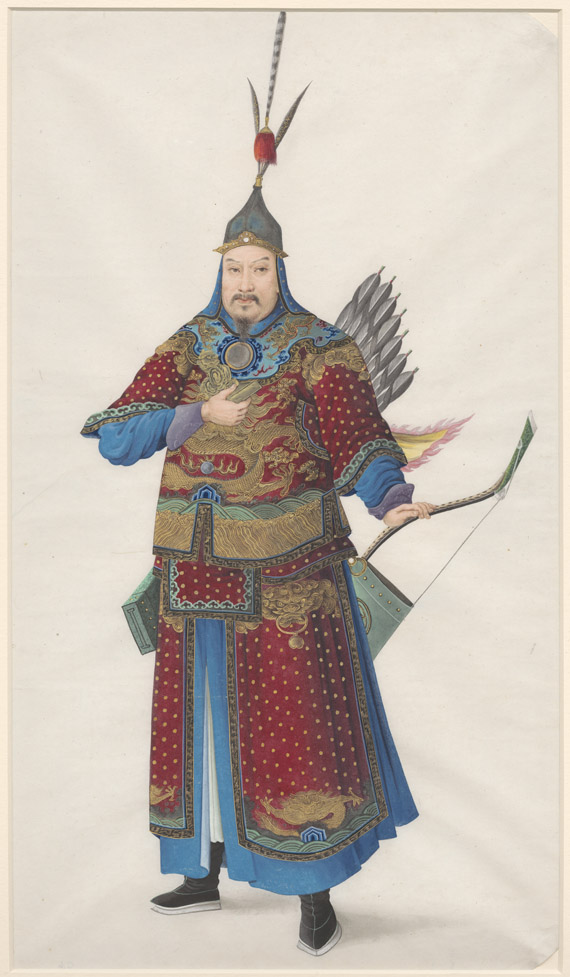
Han Dynasty watercolor print of a Han warrior whose clothing is embroidered with dragons.

In 1736, Jean-Baptiste Du Halde wrote about the Emperor: “His clothing is embroidered with dragons: they are his emblem, and only He can wear dragons with five claws – any infringement to this rule is punished severely.”

Cornell University: Emblems and Mascots of Rulers:
Chinese Imperial Dragon
s

That said, some dragons were associated with bad luck and ill omens. I’ve said before that Lear’s biggest flaw is that he fails to take time to examine himself or think about the consequences of his actions until it is too late. Maybe Lear thinks of himself as a benevolent dragon, but really is a bad man cursed with bad luck; he is not a dragon, he just has one on his back. So, in short, a Chinese re-imagining of King Lear could be a fascinating look at Chinese culture and give a fresh re-imagining of Shakespeare’s tragic story.

I hope you enjoyed this look into dragons in Shakespeare and Chinese culture. Joseph Campbell said that all cultures share and interpret archetypes to understand their own culture, but also to grasp what makes us all human. For whatever reason, every culture on Earth has some kind of large serpent- Chinese dragons, European dragons, The Aztec god Quetzalcoatl, the Viking Yormungand, even the Piasa of the native tribes of the Mississippi. and they can mean many different things to many different people, which means that we as humans are in some way tied to gether through all these dragon tales (no pun intended).
V. Sources

  1. https://www.kennedy-center.org/whats-on/explore-by-genre/young-audiences/2023-2024/dragon-kings-daughter/#:~:text=Chinese%20dragon%20mythology%2C%20martial%20arts,inspiring%20songs%20by%20Marcus%20Yi.
  2. https://www.historyskills.com/classroom/year-7/chinese-dragons/#:~:text=Another%20well%2Dknown%20legend%20involves,benevolent%2C%20divine%20force%20in%20nature.
  3. https://www.amnh.org/exhibitions/mythic-creatures/dragons/asian-dragons
  4. https://www.topchinatravel.com/china-guide/chinese-dragon-language.htm
  5. https://studycli.org/chinese-culture/chinese-dragons
  6. https://rmc.library.cornell.edu/AnimalLegends/exhibition/emblems/dragons.html#:~:text=Already%20a%20royal%20symbol%20in,and%20his%20brother%20Yan%20Di.
My Visit to a Twelfth Night Party!

I can think of no better wrapup to my play of the month “Twelfth Night,” than by reporting on my visit to an actual Twelfth night Party, presented by the Society For Creative Anachronism.

What’s a Twelfth Night Party?

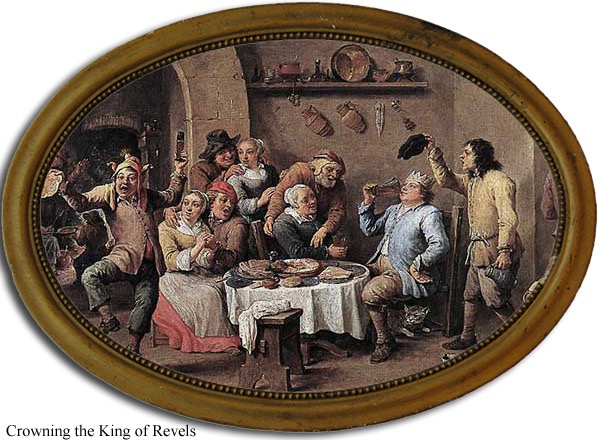
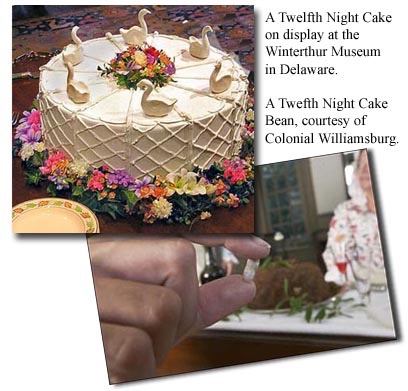
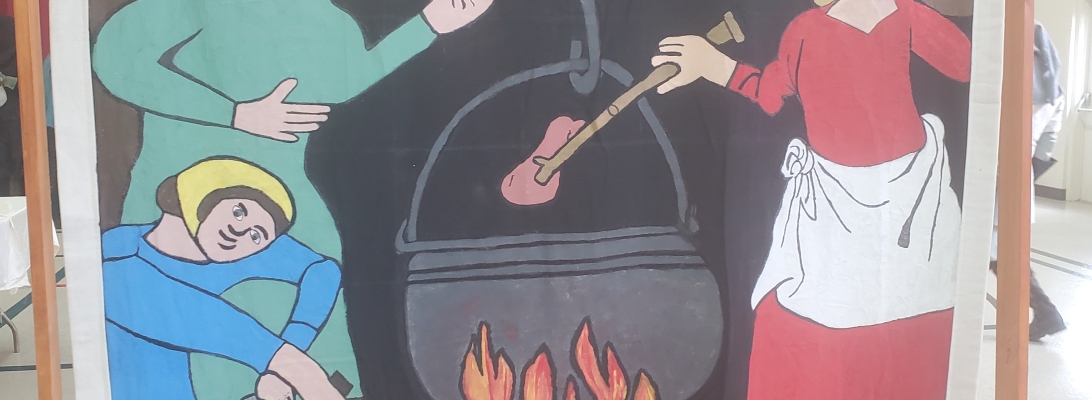
If you took my class on Shakespearean Christmas traditions or read my blog posts, you know that, back in Shakespeare’s day, Twelfth Night was a party to end the Christmas season. It was presided over by a Lord of Misrule, who would lead people in games and songs. The party would also have a Twelfth Night Cake with a bean in the center. If you found the bean, you’d have good luck for the year! So I was pleased to come to a real-life Twelfth Night party and see these traditions come to life!

What is the society for Creative anachronism?

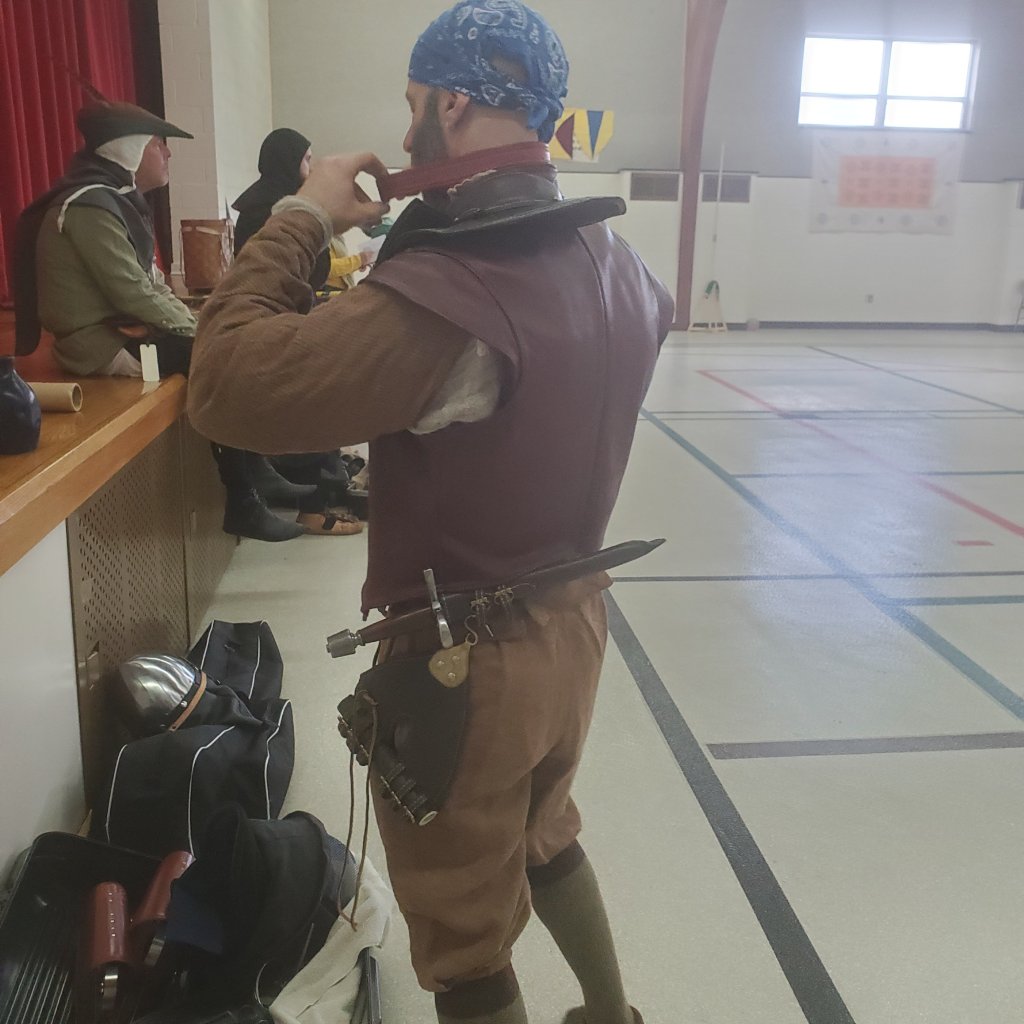
The short answer is- it’s LARPING for history nerds. Rather than creating a D&D persona and then getting arms and armor to play-fight in the backyard, SCA members create personas based on real medieval history, make or buy real historical arms and armor, (or arts and crafts as the case may be) and spend years of their lives studying and perfecting their immersion in that character’s life. SCA-ers learn how to fight with swords, daggers, spears, etc, how to sing medieval songs, medieval dances, and many other medieval ‘mysteries,’ which in this case means arts, crafts, and professions.

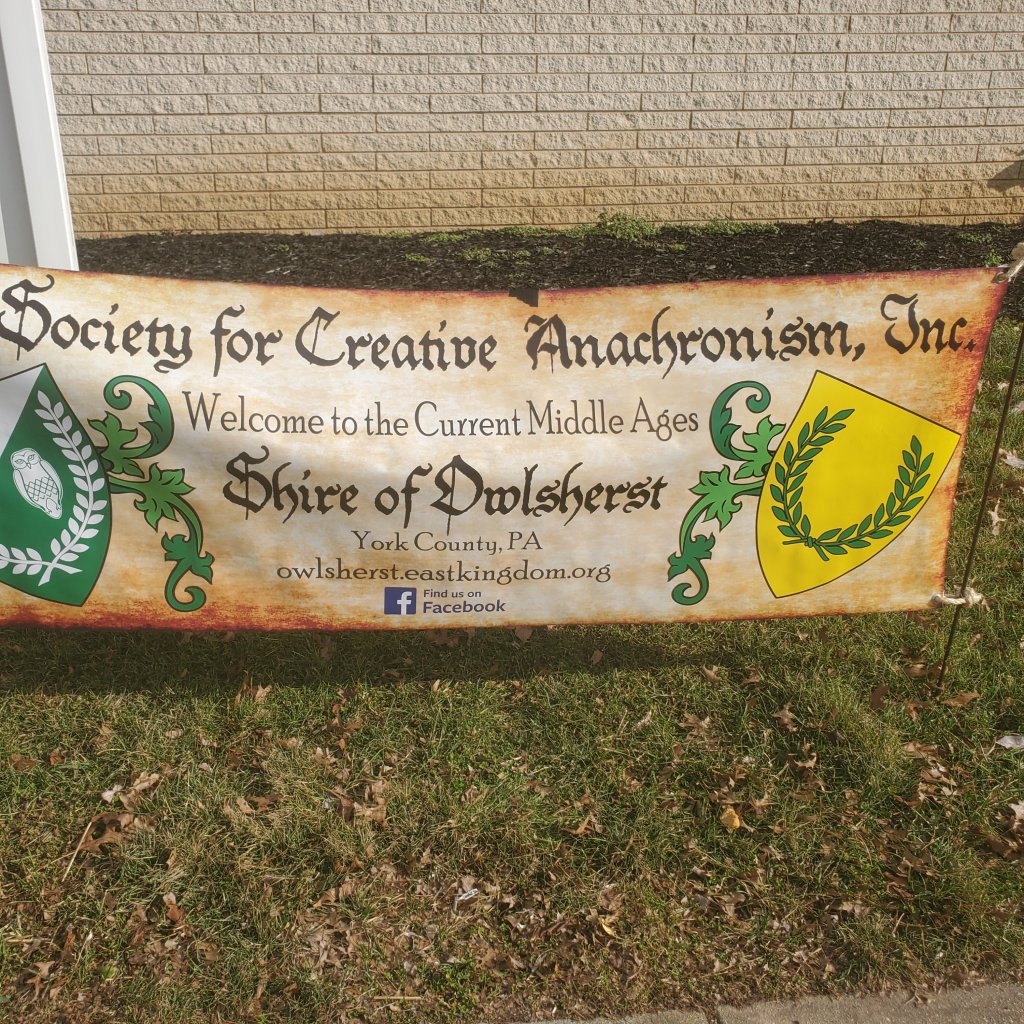
The Shire of Owlsherst

Owlsherst is the SCA’s local chapter in York PA. They have a number of dedicated members who specialize in textiles to rapier-dagger fighting. I’ve posted some videos of their fighting demonstrations on Youtube and Tiktok and their archery master has his own Tiktok channel. They hosted this year’s Twelfth Nigh party and have many other events throughout the year. For more information on this chapter, go to https://owlsherst.eastkingdom.org/

My reaction

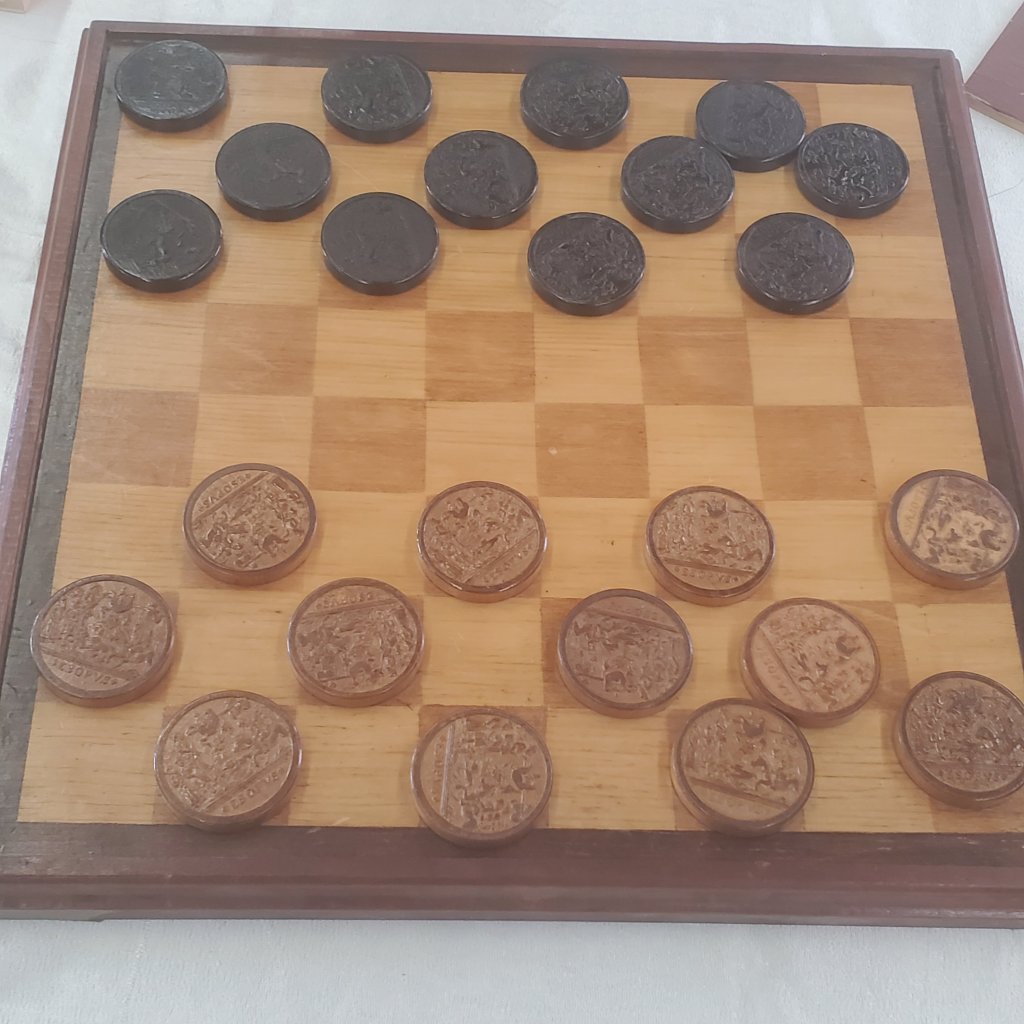
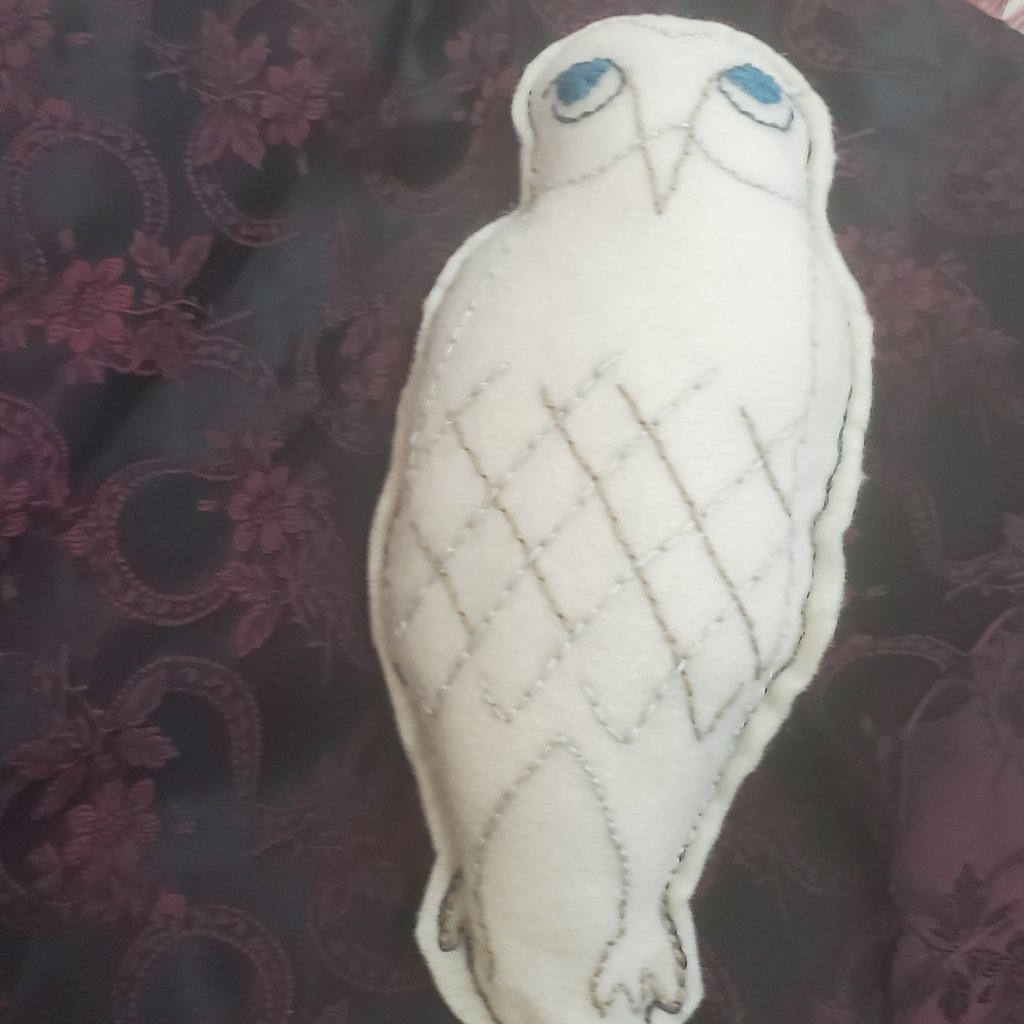
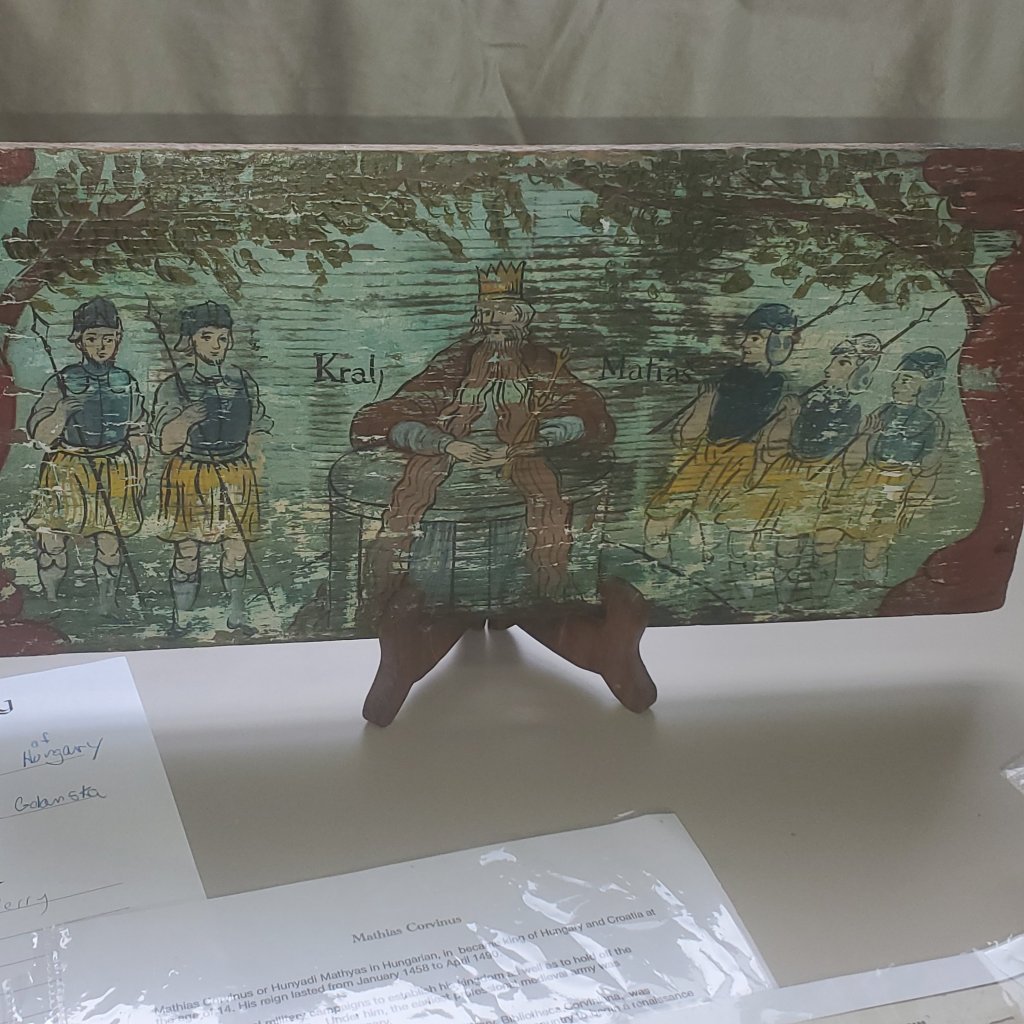
Every SCA event is a great way to celebrate people who are passionate about history and have talents for arts and crafts. Everything from the tapestries to the to the food, to the adorable owl toys, was made by hand by these dedicated people (most of whom brought their own medieval costumes). More members were doing live demonstrations of rapier/ dagger fights, binding books in cow leather, and singing medieval Christmas songs. I was inspired by everyone’s dedication and hard work to put this together. I also wonder if this is how Shakespeare himself felt when, as a child, he went to sheep shearing fairs and saw his friends and fellow artisans put on amateur bible plays on medieval pageant wagons.

That said…

I should warn you that, like a lot of historical reenacting societies like Civil War reenactors, etc, this society is more aimed at hardcore history nerds, than anyone else. This isn’t Medieval Times or a big-budget renaissance fair which is aimed at children and casual fun seekers. As such, it wasn’t really family-friendly. There aren’t many activities for kids and many of the arts and crafts are too delicate for toddlers and young kids. Also, this event isn’t particularly immersive or organized. People mostly just mingled, ate, and watched the various demonstrations. Keep in mind, this is just one chapter and just one event, which means your experience may vary. Nevertheless, because of the organization’s amateur historical nature, I would caution you to manage your expectations. Like I said before, this isn’t some big-budget Disney theme-park ride, but it is a chance for hardcore history nerds to get together, share their knowledge, and celebrate the traditions of a bygone era. If that’s your thing, I highly recommend it!

The Lion In Winter On Discord

Please join me and the Shakespeare Online Repertory Company on Discord.com at 1PM. We’ll be reading “The Lion In Winter” by James Goldman, which, you may remember was made into an Oscar-winning film in 1968:

Original 1968 trailer for the film, “The Lion In Winter,” starring Timothy Dalton, Anthony Hopkins, Katharine Hepburn, and Peter O’Toole.

As many of you know, I’ve been in two plays with the Shakespeare Online Rep before, and like the production of “Lear” I did last month, this play is about a king, (the historical King Henry II played by Peter O’Toole), and his three children, who ruins his kingdom through his selfishness and inability to connect with his children. In addition, his wife Elenor De’Aquitaine (Hepburn) is powerful, cunning, and ruthless and will stop at nothing to get power away from Henry. She even manipulates her own children against Henry; John (the infamous king of the Robin Hood Legend), Richard (known later as Richard the Lionheart), and Jeffrey.

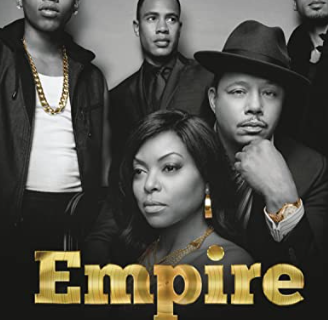
The acclaimed TV show “Empire” owes a lot to “King Lear,” but as you can see, it owes a lot more to “The Lion In Winter.” The character Lucius Lyon is much more based on King Henry, with his violent past, his mistresses, and his powerful wife Cookie, who is clearly an African American Elenor De’Aquitaine. Furthermore, the children are even more clearly derived from the three Plantagenet children: Hakeem, the spoiled, foolish philanderer played by Bryshere Gray, definitely has echoes of Kanye West, but Prince John is definitely in his DNA. Similarly, the talented Jamal, who is loved by his mother and hated by his homophobic father could definitely swap stories over dinner with Richard the Lionhearted, (though I doubt Jamal ever went on crusades). And lastly, the emotionally damaged Andre does have some Macbeth-like traits with his vaulting ambition and his brilliant, cunning wife Rhonda. But unlike Macbeth, Andre uses his business-savvy mind and his ability to manipulate his brothers to take power away from his father, which is exactly what Jeffrey does in “The Lion In Winter.”

Will our production be as cool as Empire, or as star-studded as the movie? Honestly, no. But I will say that after working with these actors before on multiple projects, this production should be fun, exciting, and moving, and definitely worth the hearing.

The Fashion Is the Fashion 4: The Journey of Romeo and Juliet

I’ve seen four live productions of Romeo and Juliet, (5 if you include West Side Story). I’ve also watched four films (6 if you include West Side Story and Gnomio and Juliet) and one thing that I’ve noticed again and again, and again is that you can tell the whole story of the play with clothing. This is a story about families who are part of opposite factions whose children secretly meet, marry, die, and fuse the families into one, and their clothes can show each step of that journey.

The feud
Nearly every story about a conflict or war uses contrasting colors to show the different factions. Sometimes even real wars become famous for the clothes of the opposing armies. The Revolutionary War between the redcoats and the blue and gold Continentals, the American Civil War between the Rebel Grays and the Yankee Bluebellies. In almost every production I’ve ever seen, the feud in Romeo and Juliet is also demonstrated by the opposing factions wearing distinctive clothing.

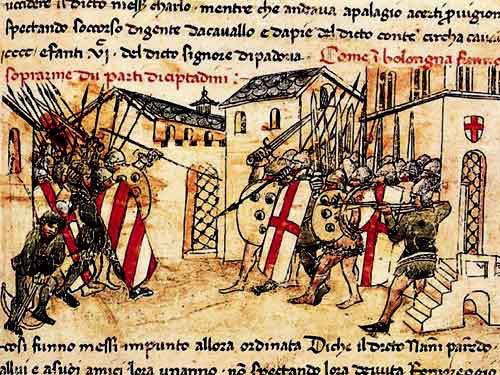
Guelphs and Ghibellines - Wikipedia


Historically, warring factions in Itally during the period the original Romeo and Juliet is set, wore distinctive clothes and banners as well. . In this medieval drawing, you can see Italians in the Ghibelline faction, who were loyal to the Holy Roman Empire, fighting the Guelph faction (red cross), who supported the Pope. Powerful families were constantly fighting and taking sides in the Guelf vs. ghibelines conflict in Verona, which might have inspired the Capulet Montegue feud in Romeo and Juliet.


Even the servants of the nobles got roped into these conflicts, and they literally wore their loyalties on their sleeves. The servants wore a kind of uniform or livery to show what household they belonged to. The servants Gregory and Sampson owe their jobs to Lord Capulet, and are willing to fight to protect his honor. Perhaps Shakespeare started the play with these servants to make this distinction very obvious. Here’s a short overview on Italian Liveries from the Metropolitan Museum of Art:

https://www.metmuseum.org/art/collection/search/86582


In 1966, director Franco Zepherelli set a trend with his iconic use of color in his movie. He chose to make the Capulets wear warm tones while the Montegues wore blue and silver. Juliet (Olivia Hussey) wore a gorgeous red dress that made her look youthful, passionate, and lovely, while Tybalt (Michael York), wore red, orange, and black to emphasize his anger, and jealousy (which has been associated for centuries with the color orange). By contrast, the Montagues like Romeo (Leonard Whiting) wore blue, making him look peaceful and cool. These color choices not only clearly indicate who belongs to which contrasting factions, but also help telegraph the character’s personalities. Look at the way these costumes make the two lovers stand out even when they’re surrounded by people at the Capulet ball:

Dance scene from the iconic 1968 film of Romeo and Juliet, directed by Franco Zeffirelli.
Gnomeo & Juliet - Wikipedia
Poster for “Gnomio and Juliet, 2011


Zepherilli’s color choices were most blatantly exploited in the kids film Gnomio and Juliet, where they did away with the names Capulet and Montegue altogether, and just called the two groups of gnomes the Reds and the Blues.

The Dance


To get Romeo and Juliet to meet and fall in love, Shakespeare gives them a dance scene for them to meet and fall in love. He further makes it clear that when they first meet, Romeo is in disguise. The original source Shakespeare used made the dance a carnival ball, (which even today is celebrated in Italy with masks). Most productions today have Romeo wearing a mask or some other costume so that he is not easily recognizable as a Montague. Masks are a big part of Italian culture, especially in Venice during Carnival:


In the 1996 movie, Baz Luhrman creates a bacchanal costume party, where nobody wears masks but the costumes help telegraph important character points. Mercutio is dressed in drag, which not only displays his vibrant personality but also conveniently distracts everyone from the fact that Romeo is at the Capulet party with no mask on.


Capulet is dressed like a Roman emperor, which emphasizes his role as the patriarch of the Capulet family. Juliet (Claire Danes) is dressed as an angel, to emphasize the celestial imagery Shakespeare uses to describe her. Finally, Romeo (Leonardo DiCaprio) is dressed as a crusader knight because of the dialogue in the play when he first meets Juliet:

Romeo. [To JULIET] If I profane with my unworthiest hand
This holy shrine, the gentle fine is this:720
My lips, two blushing pilgrims, ready stand
To smooth that rough touch with a tender kiss.
Juliet. Good pilgrim, you do wrong your hand too much,
Which mannerly devotion shows in this;
For saints have hands that pilgrims' hands do touch,725
And palm to palm is holy palmers' kiss.
Romeo. Have not saints lips, and holy palmers too?
Juliet. Ay, pilgrim, lips that they must use in prayer.
Romeo. O, then, dear saint, let lips do what hands do;
They pray, grant thou, lest faith turn to despair.730
Juliet. Saints do not move, though grant for prayers' sake.
Romeo. Then move not, while my prayer's effect I take.
Thus from my lips, by yours, my sin is purged.
Juliet. Then have my lips the sin that they have took.
Romeo. Sin from thy lips? O trespass sweetly urged!735
Give me my sin again.
Juliet. You kiss by the book. Romeo and Juliet, Act I, Scene V, Lines 719-737.

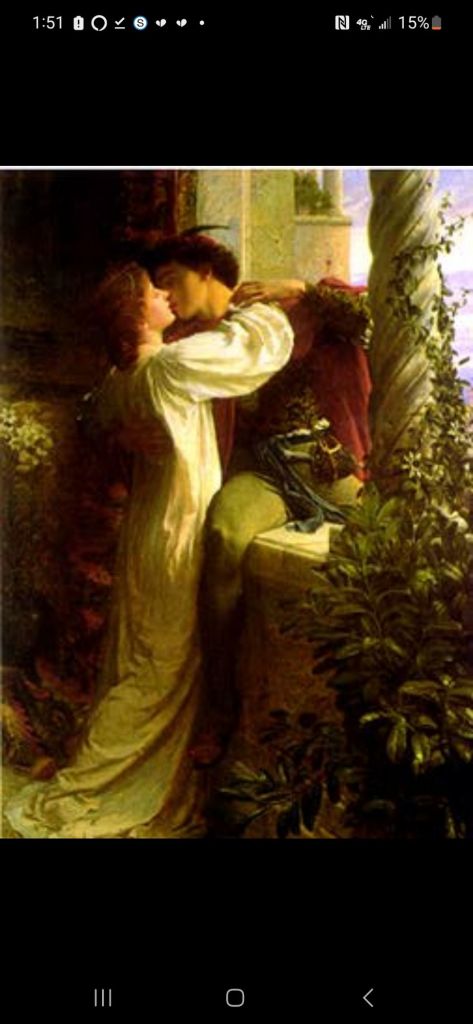
Notice that Romeo calls Juliet a saint, and later an angel in the famous balcony scene, which explains her costume at the ball. Juliet refers to Romoe as a Pilgrim, which is a cheeky comment on his crusader knight costume. In the Crusades, crusader knights made pilgrimages to the holy land, with the hope that God (and presumably, his angels) would forgive their sins. Romeo’s name even means “Pilgrim.” Luhrman makes clever nods to Shakespeare’s text by dressing Romeo and Juliet in this way, and gives the dialogue a bit of a playful roleplay as the characters make jokes about each other’s costumes- Romeo hopes that he will go on a pilgrimage and that this angel will take his sin with a kiss.


In Gnomio and Juliet, the titular characters meet in a different kind of disguise. Rather than going to a dance with their family, they are both simultaneously trying to sneak into a garden and steal a flower, so they are both wearing black, ninja-inspired outfits. Their black clothing helps them meet and interact without fear of retribution from their parents (since they do not yet know that they are supposed to be enemies. The ninja clothes also establishes that for these two gnomes, love of adventure unites them. Alas though, it doesn’t last; Juliet finds out that Gnomio is a Blue, when they both accidentally fall in a pool, stripping their warpaint off and revealing who they are.

Trailer for “West Side Story,” (2021) directed by Steven Spielberg.


Sometimes the dance shows a fundamental difference between the lovers and the feuding factions. West Side Story is a 20th-century musical that re-imagines the feuding families as juvenile street gangs, who like their Veronese counterparts, wear contrasting colors. The Jets (who represent the Montagues) wear Blue and yellow, while the Sharks (Capulets), wear red and black. The gang members continue wearing these colors on the night of the high school dance, except for Tony and Maria (the Romeo and Juliet analogs). In most productions I’ve seen, (including the 2021 movie), these young lovers wear white throughout the majority of the play, to emphasize the purity of their feelings, and their rejection of violence. Thus, unlike Shakespeare’s version of the story, West Side Story makes the lovers unquestionably purer are more peaceful than Shakespeare’s Romeo and Juliet, and their clothing makes this clear.

Romeo (John Warren), meets Juliet (Alesia Lawson) in the 2010 Ashland University production of “Romeo and Juliet,” directed by Ric Goodwin.

The Merging of the family
(8:30-11:00)


Costume Designer Charlene in the 2006 AU production deliberately had the characters change clothes when they get married. Juliet was wearing the same iconic red dress as Olivia Hussey for the first two acts of the play but then changed into a pale blue gown that matches Romeo. The clothes re-enforce the idea that the marriage represents Romeo and Juliet abandoning their family’s conflicts, and simply showing their true colors.

Two sets of costumes for Juliet in the 2006 Ashland University Production. Pull the slider bar left to see how Juliet’s costume changes from the start of the show to the end.


Another way of getting everyone in the family to subconsciously unite in grief would be to costume everyone wearing black except Romeo and Juliet. At the end of the play, The Capulets are already mourning Juliet, (because she faked her death in Act IV), and the Montegues are already mourning Lady Montegue (who died offstage). Just by these circumstances, everyone could come onstage wearing black, uniting in their grief, which is further solidified when they see their children dead onstage.

Not all productions choose to costume the characters like warring factions, but nevertheless, any theatrical production’s costumes must telegraph something about the characters. In these production slides for a production I worked on in 2012, the costumes reflect the distinct personality of each character and show a class difference between the Montagues and the Capulets.


The 2013 Film: Costumes Done Badly


The 2013 movie is more concerned with showing off the beauty of the actor’s faces, and the literal jewels than the clothes:

Most of the actors and costumes are literally in the dark for most of the film, probably because the film was financed by the Swarofski Crystal company, who literally wanted the film to sparkle. Ultimately, like most jewelry, I thought the film was pretty to look at, but the costumes and cinematography had little utilitarian value. The costumes and visual didn’t tell the story efficiently, but mainly was designed to distract the audience with the beauty of the sets, costumes and the attractive young actors. The only thing I liked was a subtle choice to make Juliet’s mask reminiscent of Medusa, the monster in Greek Myth, who could turn people to stone with a look. I liked that the film was subtly implying that love, at first sight, can be lethal.

Denzel Washington talks Shakespeare. Mourns the loss of Sidney Poitier

If you’re like me, you are probably saddened by the loss of the great American actor, Sidney Poitier. He was part of the original cast of the great American play A Raisin In the Sun, and earned countless accolades for his roles on stage and screen like In the Heat Of the Night, Porgey and Bess, Guess Who’s Coming To Dinner? and The Greatest Story Ever Told.

In this interview, Poitier’s friend Denzel Washington talks about how Poitier was a beacon, not just for black actors but a gold standard for all actors.

Washington also discusses his role in the film Macbeth, in which he plays the title role. As I mentioned in my Much Ado About Nothing review, Denzel is a consummate performer of Shakespeare and I for one can’t wait to see him as Macbeth. This is nor just because he was an absolute joy in Much Ado, but because Denzel is famous for playing characters that start out as good men become violent and evil in films like Training Day, American Gangster, and Flight. I have high hopes that Denzel’s Macbeth will rank among his greatest performances.

Macbeth is now playing at selected theaters and streaming online on Apple+. I plan to see it and hope that you will too.