Movie Review: Disney’s “Encanto”- “King Lear” with a happy ending. 


If you read my blog for an extended period of time, or if you listen to my podcasts, or if you’ve taken any of my classes online, then  I probably  told you the notion that I believe that you could find Shakespearean roots in just about every single work of Western and quite a few of Eastern literature. Shakespeare is ingrained in our culture and therefore a lot of his influence can be felt in almost every bit of media we take in.  One of my favorite ways to illustrate this, is by looking at Disney movies, trying to prove that every Disney story is at least a little bit inspired by a Shakespeare play as you’ve seen from my comedy series if Shakespeare wrote for Disney:

I had an enormous challenge on my hands when Disney came out with the new film Encanto. Previously I’ve found it very easy to deconstruct Disney film plots and spot their Shakespearean roots: Pocahontas is Romeo and Juliet by Disney’s own admission, Aladdin is basically the Tempest, Mulan is Twelfth Night, and the Lion King is Hamlet, (as many people have pointed out).

Encanto was really really hard because it is such a fresh and original story. It is deeply rooted in Columbian culture, so trying to defend the notion that it has anything in common with the works of a 400-year-old English male playwright is a tough claim. I don’t mean to suggest that this movie is a deliberate reinterpretation of Shakespeare. That would be insulting and limiting to the breadth of the story. My main purpose with this post is to show how universal and powerful these two stories are- to pay Encanto the compliment that, like Shakespeare, the story transcends cultural and historical boundaries and tells a story we can all relate to, and this is why I am making this bold claim, that Encanto resembles King Lear, albeit with a happy ending.

Mirabelle- the Cordelia of “Encanto”

It was hard for me to realize that  Encanto resembles  Lear because the Lear character is not the focus of the movie; the focus of the movie is the Cordelia character, Mirabelle. If you’ve read King Lear , then you know that Cordelia is vital to the first 2 scenes of the play, and then goes offstage until Act 4 when where she is reunited with her father in prison, then cures his madness just long enough for her to be hanged. Her death is the darkest, grimmest, bleakest moment that  Shakespeare ever wrote. She is the heart of the play and Lear’s failure to listen to her forms the heart of the play’s message;  when an older generation clings to power and power or money or status or anything else besides their family, ultimately they suffer tremendously.

  In his first line, King Lear says that he wants to give up his kingdom, conferring it to his daughters and their husbands, but what he is really trying to do is to get his daughters to say they love him and to give them the kingdom as a reward.

This deal also has more strings attached;   Lear basically says: “Now that I’ve given you my kingdom, you have to house me in your castle with a retinue of 100 knights.” And the only child who really loves Lear and has his best interest in heart is Cordelia, and Lear violently renounces his parental claims on her and banishes her from the kingdom along with her husband the king of France.

The Lear of “Encanto”

Abuela Alma Madrigal, from Disney’s Encanto.

So who is the King Lear figure in Encanto? Abuela Alma! Think about it, she is an older person who is spending the whole play clinging and holding on to the power that the Magic Candle gives to her. She spends the whole movie trying to protect the Encanto, and when she mistakenly believes that Mirabelle is a threat, she pushes her away. She rules her other children Papa, Julietta, and Brunowith an iron fist, and she flies into panics and rages whenever anything seems to threaten the safety of the candle. For example, when Bruno gets the magic prophecy that Mirabelle might destroy the house and destroy the Encanto,  Abuela refuses to let Mirabelle talk to anybody ever and generally acts in a cruel controlling way.

Look at this passage when Lear rejects his loving daughter Cordelia. Given what I’ve mentioned- the fists of rage, the clinging to supernatural powers, and the controlling demands for loyalty and obedience from his children, whom does King Lear sound like?

Lear: 
For, by the sacred radiance of the sun,
The mysteries of Hecate and the night;
By all the operation of the orbs115
From whom we do exist and cease to be;
Here I disclaim all my paternal care,
Propinquity and property of blood,
And as a stranger to my heart and me
Hold thee from this for ever. The barbarous Scythian,120
Or he that makes his generation messes
To gorge his appetite, shall to my bosom
Be as well neighbour'd, pitied, and reliev'd,
As thou my sometime daughter. King Lear, Act I, Scene i.

As Ian McKellen explains in this interview, like Abuella, Lear clings to power, which he derives from supernatural forces, ignores people who care about him, and believes that his authority is absolute:

Trauma and Violence in Encanto and King Lear

Marxist critics believe that Lear’s power is based on violence, (like most medieval kings), and violence is actually connected to Abuela as well. Let’s not forget that the candle was forged after the faceless men with machetes attempted to murder Abuela and her whole village. The candle is Abuela’s power, but it is also a constant reminder of the violence that she escaped. It is also therefore a symbol of her trauma. Perhaps these characters became so controlling, distant, and cold because of the trauma they endured. Lear is supposed to be a king of Britain back in the pre-Christian era of the Anglo-Saxons so he must have seen countless invasions:

The former king says himself that he’s fought in wars with his “Good biting falchion” (a kind of sword). Whether they’ve seen falchions or machetes, these characters have seen violence and want to protect themselves against seeing the pain of it again, and ultimately it is their children that suffer because of it.

In King Lear, the kingdom is ripped apart between the three daughters, and in Encanto, the house is literally ripped apart by the rift between the family and Abuela. Lear foolishly tries to bribe his daughters into flattering him; promising them the kingdom if they demonstrate how much they love him. Therefore Lear demands obedience and love and expects his family to fawn on him as if they were his subjects, not his family.

Lear’s favorite daughter Cordelia refuses to take the bribe, so she says nothing. Lear is enraged and treats this small disobedience like an act of treason:

Act 1 Scene ii: Lear disowns Cordelia

Arguably Abuella makes the same mistake. She treats her children like her subjects too and exploits their gifts in order to keep the community happy. Her fear of losing her home is the reason she pushes the Madrigals to be indispensable to the community. Think of the psychological and physical pressure Louisa mentions in her song:

As you can see in this video, Lin Manuel Miranda, who wrote the music for Encanto, was actually inspired by Shakespearean verse for the lyrics and rhythms in her song “Surface Pressure.” Whether or not he or the screenwriters were inspired by “Lear,” the fact remains that Mirabelle suffers much like Cordellia. She also can’t stand to see her sister Louisa in pain like this, so she sets out to save her family, which forces her to confront Alma. Much like Lear and Cordelia, Mirabelle and Abuela argue about how her clinging to the past is hurting her family and how the pressure she puts on them is literally ripping their home and family apart:

Sight and Sightlessness in “Encanto” and “King Lear”

Perhaps the biggest connective motif between Encanto and King Lear is the motif of sight and sightlessness. Both Lear and Lord Gloucester are blind to the danger that they’re in and blind to who their real friends and enemies are. Lear trusts his two elder daughters because they flatter him, he trusts his drunken knights who only succeed in getting him forced out of the cold. Conversely, Lear ignores Cordelia. who really loves him, as well as  Kent, who is a loyal nobleman to the very end, and he ignores the Fool because he’s a fool.  If he had heeded any of their advice he would not have died alone and powerless. Therefore his sightlessness is a deadly weakness.

Gloucester, the other old man character in Lear has another problem with sightlessness and is punished for it figuratively and literally.  Gloucester’s bastard son Edmond deceives him into thinking that his legitimate son Edgar is plotting to kill him. The old man sends Edgar away, makes Edmund his heir, and then Edmond betrays him and gets him arrested for treason.

In the play’s most savage scene, Gloucester is tortured and his eyes are literally pulled out of his head.  From this moment  Gloucester finally sees Edmond’s treachery, and he laments that he “Stumbled when he saw”. Gloucester feels like he is finally able to see clearly now that he is blind, not unlike the ancient Greek tragedy Oedipus Rex. Of course,  nothing this gruesome can be shown in a Disney movie but the image of sight is constantly referenced in Encanto visually, and also through the lyrics of the songs. Even the name of the character; Mirabelle comes from the Spanish word ‘mira’ which means “to look”, and the first thing one might notice about her is her brightly painted green glasses, which constantly draw attention to her ability to see.

Mirabelle, like Cordelia, is able to see that her family is in pain, she sees that her family, the Encanto, and the house is in danger, while Abuela is constantly deluding herself and everybody else in thinking that nothing is wrong.

Through the course of the movie, Mirabelle is able to fix the various problems she sees. For instance, she sees that her sister Louisa is taking on too many responsibilities and refusing to admit that she is tired and feels weak. She realizes that her sister Isabella is tired of being the perfect golden child, that her  Uncle Bruno is not the monster that the family declares him to be, (however catchy their song about him is).

Through her sight and her perceptiveness, Mirabelle is able to heal the wounds in her family, The last wounds that she heals are the cracks on her house, and her own Abuella’s wounds, the wounds that went deep through her and even deep through her house; she mends the problems that happened the instant that the candle came into being:

Once Mirabelle and Alma reconcile, they set about rebuilding the house in this song. Notice how many times the words “look,” and “see” are mentioned in the lyrics. Mirabelle re-iterates how each person in her family is more than their gifts, more than just the roles Abuella put them in, and they respond by telling her to look at her own gifts and be proud of who she is. She heals them by seeing them as they are, and they heal her by seeing her too.

It was when I realized this that I understood that this movie is what would have happened if King Lear had only listened to the people who really cared about him, and did not succumb to idle flattery. If only he did not let his pain and his trauma dictate the rest of his life. There’s a wonderful hopeful message here that family wounds can be healed if we take the time to see and address them. If you read King Lear and then see Encanto you can see both how these family wounds can be healed, and the tragic consequences if they are not.

I hope that this little post has helped you appreciate both works because they are both magnificent and they are both carefully constructed and they both tell a very simple lesson for all families. As families, we need to recognize our faults, forgive faults in others, and work together to mend the pain and suffering that we experience in our lives. Mirabelle and Cordelia show that we can all be heroes if we see the truth, and speak what they feel not what they ought to say.

FMI

https://www.rsc.org.uk/shakespeare-learning-zone/king-lear/character/analysis#king-lear

Gloucester and His Sons, PBS Learning Media: Shakespeare Uncovered: witf.pbslearningmedia.org/resource/shak15.ela.lit.gloucester/gloucester-and-his-sons-king-lears-subplot-shakespeare-uncovered/?student=true
James Earl Jones in King LEar at Shakespeare In the Park, 1974. In my opinion, this is the BEST version of “King Lear” on film.

Denzel Washington talks Shakespeare. Mourns the loss of Sidney Poitier

If you’re like me, you are probably saddened by the loss of the great American actor, Sidney Poitier. He was part of the original cast of the great American play A Raisin In the Sun, and earned countless accolades for his roles on stage and screen like In the Heat Of the Night, Porgey and Bess, Guess Who’s Coming To Dinner? and The Greatest Story Ever Told.

In this interview, Poitier’s friend Denzel Washington talks about how Poitier was a beacon, not just for black actors but a gold standard for all actors.

Washington also discusses his role in the film Macbeth, in which he plays the title role. As I mentioned in my Much Ado About Nothing review, Denzel is a consummate performer of Shakespeare and I for one can’t wait to see him as Macbeth. This is nor just because he was an absolute joy in Much Ado, but because Denzel is famous for playing characters that start out as good men become violent and evil in films like Training Day, American Gangster, and Flight. I have high hopes that Denzel’s Macbeth will rank among his greatest performances.

Macbeth is now playing at selected theaters and streaming online on Apple+. I plan to see it and hope that you will too.

Review: A Midsummer Night’s Dream, (2021)

Trailer for Globe Theater’s 2021 production of A Midsummer Night’s Dream

What do you think of when you think of “Shakespeare?” What do you think of when you think of “A Midsummer Night’s Dream?” 

    Ruffs and Tights?

    Mostly white dudes?

    Elizabethan music?

    Dark night and moon?

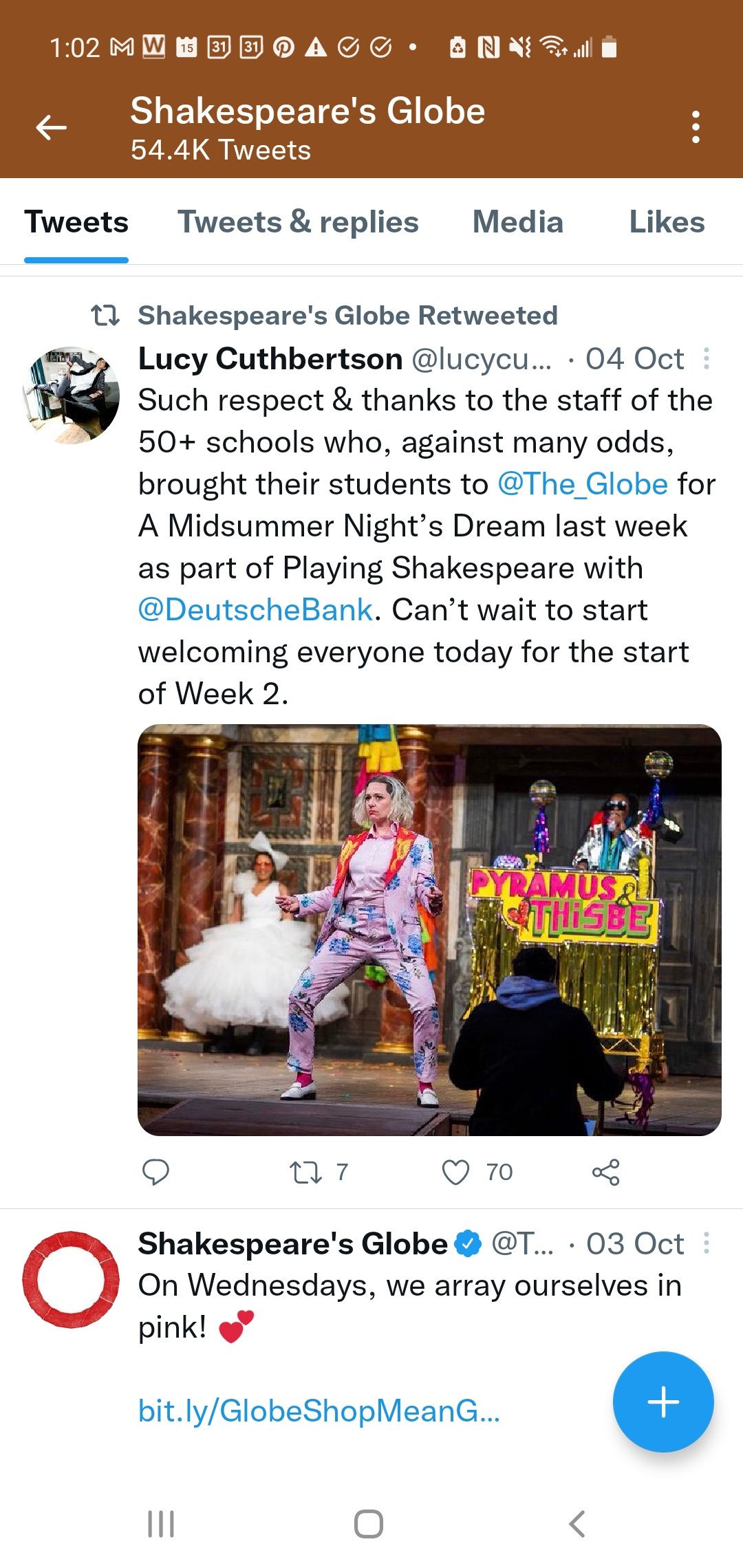
This production, directed by Michelle Terry, is gleefully throwing out every preconceived notion of what A Midsummer Night’s Dream can or should be. In terms of design, casting, music, and interpretation, it breaks all the rules, while still remaining true to the text. This allows the production to appeal to not only hard-core Shakespeare fans, but first time audiences and children too!

I got to see this production thanks to the Globe’s online streaming library. My mother kindly shared me a link to this recording from the summer of 2021. You can watch it yourself on: https://www.shakespearesglobe.com/watch/#full-length-productions

I would describe the concept behind the show as “Suggestive,” that is, it doesn’t belong to a literal time and place. Even though the play is set in Ancient Greece, the play refuses to be constrained by historical accuracy, which arguably, fits nicely with Shakespeare in particular, and the Globe itself; a modern building in a modern city, based on a 400-year-old building.

The music and costumes evoke a New Orleans Mardis Gras, a Pride parade, or a Spanish pinata with its bright colors, heavy use of fringes, and bright, energetic jazz music. The only people who don’t wear bright colors are the four lovers, which reflects their continuous frustration with being unable to marry the person they really want.

The show is also Color blind and gender blind, with women playing men’s parts and a cast with black, white, and mixed race actors. Terry’s direction also calls attention to the patriarchial, racist, and sexist elements of Athens which are often overlooked in other interpretations of Dream that I’ve seen or read about. Rather than being a hero, Theseus is a horny old man in a ludicrous pink uniform, looking like a cross between M. Bison and a Christmas nutcracker. To reinforce this point, the actor chose to perform one of Theseus’ most patriarchial speeches as a joke:

Theseus. What say you, Hermia? be advised fair maid:50
To you your father should be as a god;
One that composed your beauties, yea, and one
To whom you are but as a form in wax
By him imprinted and within his power
To leave the figure or disfigure it. -Midsummer Night's Dream, Act I, Scene i.

I’ve seen this speech heavily cut and played seriously, but never till now did I see it played to ridicule the ludicrous notion that women are in any way bound to worship their fathers.

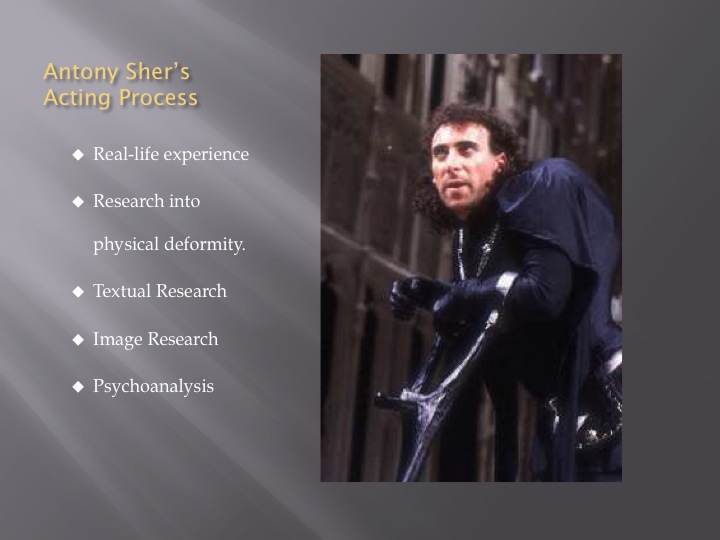
In another nod to contemporary gender politics, the actress who plays Hippolyta and Titania chose to perform her role on crutches. As far as I can tell, this was a deliberate choice and not a result of real injury. There is a precedent for this: In 1984, Sir Antony Sher performed Richard iii on crutches because it highlighted the cruelty people with disabilities often suffer.

I could be wrong, but I think that the reason the actress was on crutches was a symbolic way of confronting the way gender politics can cripple women.

Many scholars have pointed out how Hippolyta rarely speaks despite the fact that she is supposed to be the powerful Queen of the Amazons, and Theseus’ fiance besides. Shakespeare makes it clear that their marriage was arranged as a political alliance after the Amazons lost to Athens in a war:

Hippolyta, I woo'd thee with my sword,
And won thy love, doing thee injuries;20
But I will wed thee in another key,
With pomp, with triumph and with revelling.

With this in mind, it makes sense to have Hippolyta on crutches as a result of her injuries. Those injuries might also explain her silence; she has lost her agency now that she is essentially Theseus’ prisoner. One might think of any number of war atrocious where women have been sold to powerful men over the centuries. In short, by putting Hippolyta on crutches, we see a glimpse into her tragic story that most productions just gloss over- that she has lost a war, been separated from her people, and is now her enemies’ prisoner through marriage.

I’ve come to expect high quality acting from The Globe Theater Company and this cast did not disappoint. As we watched it together, my family concluded that this was one of the best acted productions of Dream that we’ve ever seen, which between us has to be over 30 plus productions.

The delivery is crisp and fast paced. Every actor has taken these words and made them their own. They speak them as if they were written yesterday. One thing I love about the Globe is that the directors encourage this kind of fast paced delivery; with no distracting special effects or sets, the actors have to captivate the audience with their delivery of Shakespeare’s text, without being melodramatic or self-indulgent. I’m pleased to say that this cast does a fantastic job of telling this magical story in a compelling and very modern way.

I’ve shown my recording to kids, teens, adults, and my family, and everyone has a different reaction to the show. Maybe this isn’t quite your cup of tea, but the concept is sound, the acting is high caliber, and it utilizes the Globe’s unique qualities extremely well. 


I personally didn’t care for Bottom just because I felt the actress was playing a very energetic part with too much sarcasm and tongue in cheek, but that’s mostly personal preference. I did however love Peter Quince, Snout, Snug, and the rest of the Mechanicals. Peter Quince is a rather thankless part but it’s great to see someone balance being a straight man trying to reign in Bottom’s antics. and an idiot who has no idea how to direct a company of actors, which the actress playing Quince did very well.

New Outschool Course: Macbeth

Just in time for October, I’m offering an online class for kids ages 13-18 about Shakespeare’s most spooky and cursed play:

If you follow this blog you know I’ve written a lot about this play before. Though this class will be more like a game where I teach the class using multimedia, games, and a digital escape room!

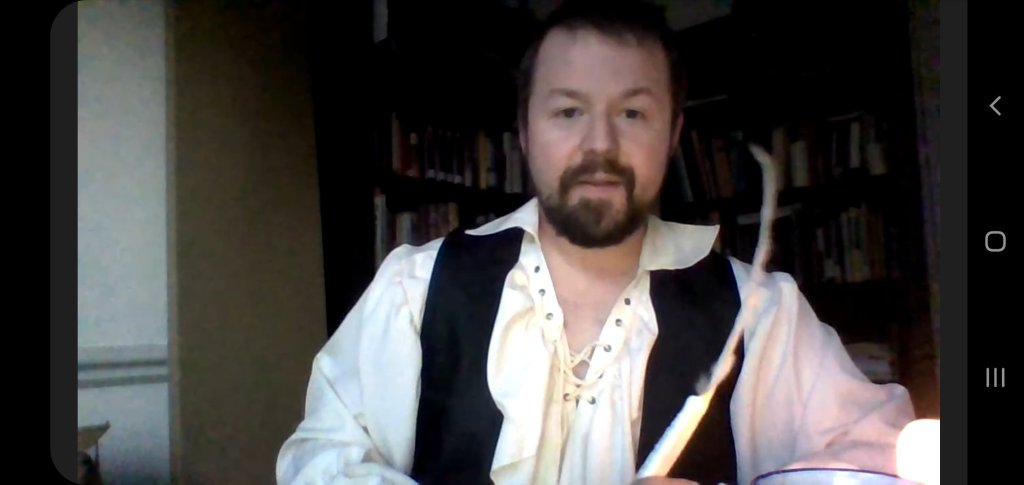
Me in my Shakespeare gatb

I’ll start by speaking to the students in character as Shakespeare, and tell them the story of Macbeth using a multimedia presentation.

I will then test the students’ knowledge with a fun quiz that was inspired by the popular mobile game Among Us. As you know, the game is similar to a scene from the play, so I thought it would be an appropriate way to test the kids’ knowledge.

Screenshot from the Gimkit game “Trust No One.” Like Among Us, players need to figure out who the Imposter is, but they greatly increase the chances of surviving if they answer the quiz questions correctly.

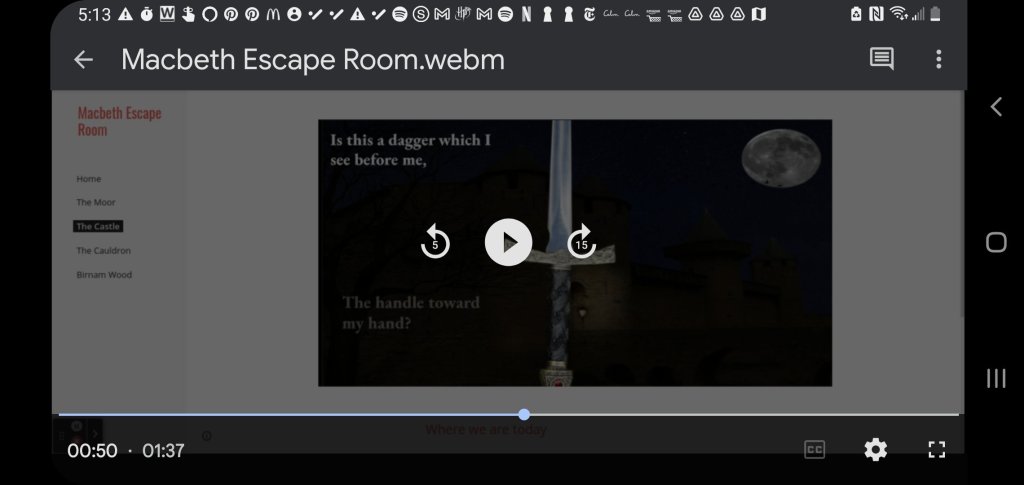
The final part of the class is a digital escape room I’ve created. I don’t want to give too much away, and you can’t play it unless you sign up for the class, but let’s just say it’s fun, spooky, educational, and challenging!

Screenshot from my Macbeth Escape Room.

If you want to sign up now, the course is available every weekend in October, and then by request after that. Register now at Outschool.com. if you take the course, please leave me a good review.

Hope to see you soon!

Shakespeare’s Roman Women

Since it’s Women’s History Month, and we just had the Ides of March last week, I thought it might be a good idea to analyze some of Shakespeare’s  female characters in his Roman plays. I’ve talked a lot about the men in Julius Caesar, Titus, Andronicus, and Coriolanus, but haven’t examined the female characters much, so that’s what I’m going do discuss today.

Examining these characters is important because many are based on real Roman women, and Shakespeare’s sources reveal what Roman culture thought about women’s roles. This is particularly relevant to those of you reading this in the west because Roman culture influenced the Elizabethans and they set the foundation for our culture today. Feminist criticism has been much maligned, (and I’m certainly not an expert on feminism), but I do know this: it exists to question the values and conventions of our culture, so we can identify what works and what needs to change to build a more egalitarian society.

When it comes to Shakespeare female characters in general, he challenges the status quo, but also reinforces it: There’s always a character who challenges traditional gender roles like Katherine and Beatrice, but, (with the exception of Twelfth Night), for every one of these there’s also a Bianca or a Hero; characters who embody traditional famine roles and virtues of chastity, meekness, and yes, marriage and childbirth.

Nowhere is this more apparent than in Shakespeare’s Roman plays where there are always two female characters and they usually embody opposite views of women’s roles and a woman’s duty to her country and the men in their lives

1. Tamara from Titus Andronicus

Titus was Shakespeare’s first tragedy and his first Roman play. As we shall see, as Shakespeare went through his career we see a more nuanced view of women’s roles and a greater appreciation for women who disdain or challenge patriarchal society. The characters Lavinia and Tamara are perfect examples and counterexamples respectively of traditional feminine roles.

When we first meet her, Tamara is the queen of the Goths- an enemy tribe that Rome has just conquered. Everything about Tamara from her foreign upbringing, to her personality, is a counter-example of what Romans prize in women. She is portrayed as savage and bloodthirsty, motivated by revenge against Titus, (who in the first scene of the play, kills her eldest son. Tamara responds by masterminding the murder of all of Titus’ children. She is also sexually liberated and uses her sexuality to further her revenge. Tamara seduces the Emperor to get him on her side, and gets the Emperor to condemn Titus’ sons to death. Her adultery with Aaron is another way she uses her sexuality to get revenge; she brings ruin the monarchy by cuckolding the Emperor. Thus Tamara’s sexuality and bold personality is framed in the play as an existential threat to Rome itself.

Tamara’s chief and only virtue is her love for her children, as you can plainly see in this scene from the play. Her love for her son Alarbus is why she begs Titus for his life, and afterwards, when he sacrifices Alarbus, Tamara’s love for her son turns into deadly hate to Titus. It is her motherly devotion that makes Tamara simultaneously human, and inhuman. As the play progresses however, Tamara is referred to in increasingly inhuman and savage terms. She dresses up as the goddess Revenge to torment Titus, and after she dies, Lucius, the new Emperor (and Titus’ only surviving son), calls her a “ravenous tiger,” and calls for her body to be thrown to beasts, since “Her life was beast-like.” Tamara is unquestionably the villain- a femme-fatale and a threat to all the Roman characters, but especially Titus’ daughter Lavinia.

2. Lavinia from Titus Andronicus

For the entire play, Lavinia embodies  traditional Roman female virtues, in that she is defined by the men in her life, and her chastity. The Romans actually invented the term castitas to refer to the female virtues of modesty and chastity, that is, only having sex with the man you are married to. Lavinia fits this mold perfectly. She’s a devoted daughter, wife, and sister. When we first meet her, she is a model of duty- greeting her father and asking for his blessing when he returns to Rome, and shedding tears for her brothers that were slain in the war:

In the cruelest and most barbaric scene in all of Shakespeare, Lavinia is raped by Tamara’s sons. Then, to keep her from identifying her attackers, they cut out her tongue and cut off her hands. The mutilation is grotesque, but for Titus, the Romans, and for the Elizabethans Shakespeare was writing for, the cruelest loss for Lavinia was the loss of her chastity. Now that she isn’t a virgin, Lavinia is marked with the opposite of chastity, incestum, or infamy. Even though the rape was not her fault, Lavinia is marked with shame. The Romans took unchastity extremely seriously; they used to punish it by throwing the adulteress to her death off the Tarpeian Rock. As you can see in this video, when a woman who was supposed to live chaste is even suspected of adultery, her very life is now in jeopardy:


When she loses her virginity, Lavinia becomes a silent creature of sadness. She is no longer a person, but a motivation for Titus’ revenge. Even if she hadn’t lost her tongue, she would still have little agency in the plot. This is why Titus kills her; to remove her incestum, and end her suffering.  Lavinia embodies the the cruel truth that women had to face in ancient Rome- once they lose their virginity, they are already dead in the eyes of most of Roman society.

Lavinia’s death scene from Titus, 1999, directed by Julie Taymor.

3. Portia (Julius Caesar)
If Shakespeare only wrote these two  female characters, you might rightly assume that he was a vile sexist, who defines a women’s usefulness simply by her chastity or lack thereof, and who thinks the proper function of a woman is to be quiet, demure, chaste, and obedient. Thankfully Shakespeare created Portia in Julius Caesar, and she defies many of the stereotypes associated with women in Ancient Rome.

Portia marks a turning point in Shakespeare’s Roman female characters as we we go from more ‘traditional’ female characters, to ones who exemplify masculine virtues. Instead of women being subordinates to men’s affairs and keeping out of religion, politics, and the affairs of Roman society, Portia is a character who demands respect, and to share her husband’s dangers. Some ancient sources suggested possibly Portia might have been the one who inspired Brutus to kill Caesar, (more on that later), but in any case Portia is not a character who is subordinate to men, but who demands to be treated as a Roman citizen.

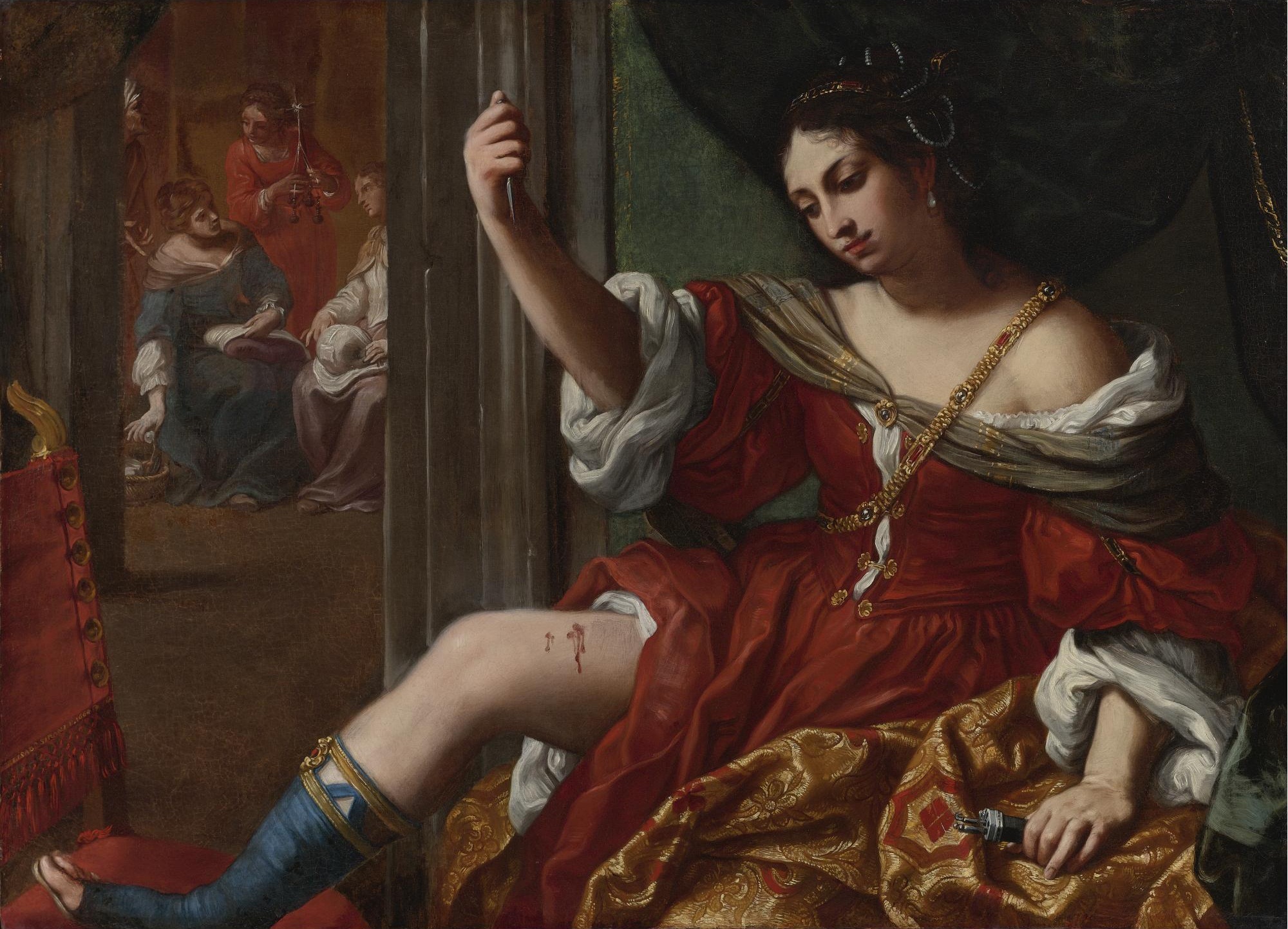
In one of the strangest passages of the play, Portia reveals that she has willingly injured herself by stabbing herself in the thigh. She does this as a way of establishing her tolerance for pain and her desire to be taken seriously by her husband:

Brutus. You are my true and honourable wife,
As dear to me as are the ruddy drops
That visit my sad heart
Portia. If this were true, then should I know this secret.
I grant I am a woman; but withal920
A woman that Lord Brutus took to wife:
I grant I am a woman; but withal
A woman well-reputed, Cato's daughter.
Think you I am no stronger than my sex,
Being so father'd and so husbanded?925
Tell me your counsels, I will not disclose 'em:
I have made strong proof of my constancy,
Giving myself a voluntary wound
Here, in the thigh: can I bear that with patience.
And not my husband's secrets?930
Brutus. O ye gods,
Render me worthy of this noble wife!

Romans have always had a connection with blood. Blood is a connection to duty; we owe our lives and our blood to Rome; the Gladiator whose blood honours the dead, the sacrifice of the enemy soldiers in Titus Andronicus, and the blood of the Roman soldier shed in service of the country. Rome is almost a culture that is built on blood. Portia in this gesture makes it clear that she is willing to shed blood just as much as her husband, who of course, will shed blood, (just not his own). In a way, Portia’s wound makes her more heroic than Brutus, because she is willing to suffer for the good of Rome, while Brutus kills for the good of Rome.

Shakespeare’s Roman characters, (male and female), extol the questionable virtue of the noble death. Historically when a Roman conspiracy failed, the conspirators had a choice; they could be paraded back to Rome humiliated and disgraced, or they could kill themselves and show defiance in the face of their conquerors. In some cases suicide was actually encouraged by the conquerors, as it meant that the threat was neutralized. In response, the conquerors would go easy on the wife and children.

Portia kills herself after Brutus is on the run. There could be two equally important reasons why she does this. First, she might be attempting to gain favor with the triumvirate by killing herself, (since she is complicit in the assassination), in the hopes that Anthony and a and Octavian will take pity on a Brutus’ children. It’s also possible that Portia kills herself because with the tide of battle turning, she might be next. Portia might be showing the same sort of resolve their husband later shows when he commits suicide to appease Caesar’s ghost and to defy his enemies the honor of capturing him.

Since Portia has a lot of her husband’s same virtues, the inevitable question I come to is to wonder what if; what if  Shakespeare’s Brutus had a listened to Portia more,what might he have done?

The Lictors Bring to Brutus the Bodies of His Sons, Jacques Louis David, 1789.

This painting by Jacques Louis David depicts Brutus’ ancestor Junius Brutus. We see that he is utterly removed and stoic him in the face of death. He has ordered the execution of his own sons for trying to bring back the monarchy. In the background, Brutus’s wife and daughters are mourning the death of their son and brothers. Men like Brutus, with their Republican ideals, take little stock in the consequence of their actions.

One can only wonder if Brutus had had confided in Portia, would she have condemned his actions, or could she have led him to a more constructive path, that might have a prevented Brutus’ death, and maybe even stopped the coming days of the Empire?

Valumnia (Coriolanus)
In Shakespeare’s later Roman tragedy Coriolanus, we again see a young, chaste woman and an older mother figure, but unlike in Titus, the older Volumnia is much more heroic than the young maid Virgilia. Both show loyalty to Rome and devotion to Coriolanus, but Volumnia is not only a hero, she is in many ways a complete inversion of the Roman mother trope.


Volumnia is fanatically devoted to Rome and its army and like her son. She finds war more beautiful than symbols of peace, especially those associated with motherhood. In Act I, Scene iii, she says that the breasts of the Trojan Queen Hecuba were not as lovely as her son’s forehead when it spit blood in battle. She is an inversion of the traditional motherly character; because of her devotion to Rome and  her son,
she is more outspoken than other women and not afraid to talk back to anyone who questions Rome. In a way she is more of Coriolanus’ general or his father than a traditional mother. Her love of Rome is inextricably tied to her love of her son. She raises her son to be a warrior for the Senate and the people of Rome, exhorting him to either return in glory, or die. Observe this passage where she tells Coriolanus’ wife that she was never proudest than when she sent her son off to war:

Volumnia: I pray you, daughter, sing; or express yourself in a
more comfortable sort: if my son were my husband, I
should freelier rejoice in that absence wherein he
won honour than in the embracements of his bed where
he would show most love. When yet he was but
tender-bodied and the only son of my womb, when
youth with comeliness plucked all gaze his way, when
for a day of kings' entreaties a mother should not
sell him an hour from her beholding, I, considering
how honour would become such a person. that it was
no better than picture-like to hang by the wall, if
renown made it not stir, was pleased to let him seek
danger where he was like to find fame. To a cruel
war I sent him; from whence he returned, his brows
bound with oak. I tell thee, daughter, I sprang not
more in joy at first hearing he was a man-child
than now in first seeing he had proved himself a
man.

Although Virgilia fits the bill of the modest, chaste, and loyal Roman housewife, Volumnia is framed as much more heroic. She even uses her mighty stoicism to save Rome! After Coriolanus rebels against Rome and joins the Volscis, Volumnia gets him to agree to make peace with Rome. She does this by kneeling before her own son; humiliating herself for the good of Rome. This act of self-humiliation changes Coriolanus’ mind. Observe how shocked Coriolanus (Ralph Fiennes) is when his mother (Vanessa Redgrave) kneels in this scene from the movie Coriolanus (directed by Ralph Fiennes in 2011).

4. Julia (Antony and Cleopatra) and with Cleopatra

With these final two examples, I’ve chosen two character who, (at face value), resemble Lavinia and Tamara. One is a dutiful, chaste Roman wife, related by blood to the Imperial family. Octavia was beloved throughout Rome for her chastity and kindness, and the citizens were outraged when her husband Marc Antony, abandoned her for Cleopatra, who was seen by many as a murderous, barbarous, lustful and an evil sorceress. However, Shakespeare paints a much more complex picture of Cleopatra, and though Octavia retains her chastity and is praised for her virtue, Cleopatra is unquestionably the star of the show, and ultimately commands more respect, awe, and even sympathy from the audience.

In Shakespeare’s play (and in real life), Cleopatra used her beauty as a propaganda tool. As I mentioned the Game of Thrones post, she deified herself in order to be taken seriously. In the 1st century AD, the system was very much rigged against female authority and so women had to resort to terrible measures in order to secure power for themselves.

If you look at the play again especially near the end, Cleopatra doesn’t come across as a femme fatale, she comes across as a woman who is trying to keep her Kingdom and her son Cesarian safe, and she will do anything to protect him. As the name suggests, Cesarean was Cleopatra’s love child of Julius Caesar, so the entire Roman world wanted him dead, because he was a threat to Octavian’s claim to the throne. To keep her son safe, Cleopatra seduces Marc Antony, hoping a powerful Roman alliance will keep her crown safe, and her son alive. Sadly for her, Octavian would stop at nothing to bring down all threats to his power, including Cesarian and Marc Antony. Arguably, the only reason he married Marc Antony to Octavia in the first place, was that he knew if Antony committed adultery, it would give Octavian the perfect excuse to raise an army and destroy Antony. Cleopatra got caught up in the political machinations of the most powerful and cunning man in the ancient world, and held him off as best she could.

Cleopatra struggles through the whole play to keep Antony, her people, and the situation in Rome under control. Antony never respects her as a queen and treats her like a jealous boyfriend, which is why they frequently get into fights.

However, after Antony’s suicide, the audience sees that Cleopatra also genuinely loved him back, and weeps for him as a wife, not an ally. Yet, quickly she regains her royal composure once Octavian threatens to take her back to Rome in chains. She decides to simultaneously deny Octavian the satisfaction, protect her son, and join her husband in the afterlife with her regal suicide:

Cleopatra: Give me my robe, put on my crown; I have
Immortal longings in me: now no more
The juice of Egypt's grape shall moist this lip:
Yare, yare, good Iras; quick. Methinks I hear
Antony call; I see him rouse himself
To praise my noble act; I hear him mock
The luck of Caesar, which the gods give men
To excuse their after wrath: husband, I come:
Now to that name my courage prove my title!
I am fire and air; my other elements
I give to baser life. So; have you done?
Come then, and take the last warmth of my lips.
Farewell, kind Charmian; Iras, long farewell.
[Kisses them. IRAS falls and dies]
Have I the aspic in my lips? Dost fall?
If thou and nature can so gently part,
The stroke of death is as a lover's pinch,
Which hurts, and is desired. Dost thou lie still?
If thus thou vanishest, thou tell'st the world
It is not worth leave-taking.

In conclusion, Shakespeare couldn’t go too far against the grain with challenging traditional patriarchal views of women, but in his Roman plays, we see characters who are simultaneously mothers and murderers, chaste and intelligent, citizens and devoted wives. I’m not trying to say that Shakespeare invented feminism, but I do believe his characters remind us that it is folly to try to box either gender into such stale old Roman categories as masculine or feminine. Perhaps we should all aspire to be like Cleopatra, whose infinite variety allowed her to succeed in a man’s world, while still being a wife, a mother, a lover, and a queen.

Shakespeare on Ghosts

Since Halloween is right around the corner, and since this is a huge topic in Shakespeare, I would like to talk a little bit about Shakespeare’s treatment of the living impaired, specters, spirits, in a word GHOSTS.

Ghosts appear in five Shakespearean plays: Julius Caesar, Hamlet, Richard the Third, Macbeth and Cymbeline. In all but one of these plays, and in many other Elizabethan and Jacobean dramas, a ghost is a murdered person who needs someone to avenge their deaths. Their function is to warn the hero of the play to revenge their deaths, and/ or to torment their murderers.

Ghosts have been part of western drama almost as long as there have been ghost stories. After all, the Greek and Roman plays that Shakespeare emulated often mention ghosts as warnings from above and below the world is in some kind of chaos. Most of the time, the kind of play in which you see a ghost is a Revenge Tragedy, plays like The Spanish Tragedy, Locrine, Shakespeare’s Hamlet, and even the Disney movie of The Lion King.


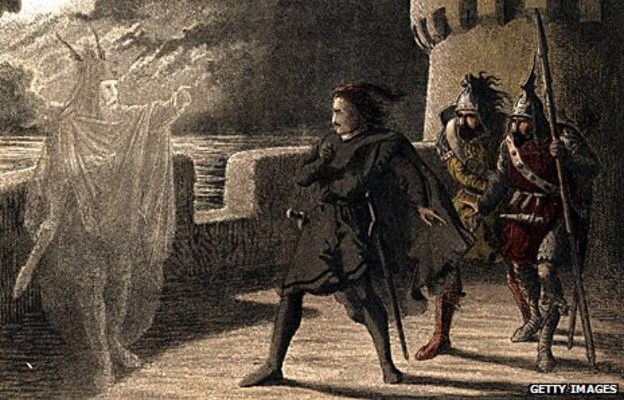
The most potent example of a Shakespearean ghost is definitely the ghost of Hamlet’s father. I actually played this role and, rumor has it, so did Shakespeare himself! Hamlet’s father appears as a ghost two months after his death, and soon after his brother Claudius marries his widow Gertrude. The ghost’s purpose in the play is to get his son’s attention so that he can correct the terrible regicide that Claudius committed, allowing the Ghost to Rest In Peace.

Shakespeare describes the ghost as a pale, sorrowful figure, dressed in full armor. The ghost only speaks to his son in the play, and he begins with a strange and terrifying description of the afterlife:

Ghost: I am thy father’s spirit,

Doom’d for a certain term to walk the night,

And for the day confin’d to fast in fires,

Till the foul crimes done in my days of nature

Are burnt and purg’d away. But that I am forbid

To tell the secrets of my prison house,

I could a tale unfold whose lightest word

Would harrow up thy soul, freeze thy young blood,

Make thy two eyes, like stars, start from their spheres,

Thy knotted and combined locks to part,

And each particular hair to stand on end

Like quills upon the fretful porcupine.

But this eternal blazon must not be

To ears of flesh and blood Hamlet Act I, Scene v.

Many scholars believe that the tormenting realm of fire that the ghost describes is actually Purgatory, an old Catholic concept that explains where the souls of the dead go if they are neither evil enough for Hell, or good enough for Heaven. It’s also the place where people go who didn’t confess their sins before death, which was the ghost’s fate since Claudius poisoned him while sleeping.

Though neither Hamlet nor his father explicitly say it, there is a strong implication that Hamlet must avenge his father by killing Claudius, which will presumably release the Ghost from Purgatory allowing it to ascend to Heaven.

Some suggest that the ghost is a manifestation of Hamlet’s superego:

Psychologist Ernest Jones (who studied under Signund Freud) in his book Hamlet And Oedipusbelieved Hamlet had an unresolved Oedipus complex and couldn’t bring himself to revenge because Claudius had achieved the very goals Hamlet himself secretly desires to kill his father and marry his mother

Faced with his guilt and lack of moral integrity Hamlet could have created a supernatural superego to spur him to revenge. As Freud describes it, the superego

The superego is the ethical component of the personality and provides the moral standards by which the ego operates. The superego’s criticisms, prohibitions, and inhibitions form a person’s conscience, and its positive aspirations and ideals represent one’s idealized self-image, or “ego ideal.”

In essence, since (in Jones’ view), Hamlet is too morally corrupt to be an effective avenger for his father, Hamlet imagines the ghost to help justify his revenge to himself. This is of course, only one way of interpreting the ghost and Hamlet as a whole. There is no right or wrong interpretation for any of Shakespeare’s characters, but it is a testament to Shakespeare’s genius that, 400 years after his own death, his ghostly writings helped inspire one the architects of modern psychology.

Ghosts Of Torment

The ghost of Banquo in Macbeth and the ghosts that plague Richard the Third the night before his battle help quicken the murderous kings’ his downward spiral. Macbeth becomes more and more paranoid, and therefore easier for his foes to defeat.

When Julius Caesar’s Ghost appears to Brutus, he does so the night before his final battle- the battle of Philippi, where Brutus was defeated and committed suicide.

When Richard III sees the ghosts of all the people he murdered, it not only terrifies him, it splits his soul in half! According to Sir Thomas More, Richard couldn’t sleep the night before his final battle at Bosworth Field. Shakespeare gives Richard a strange soliloquy where the ghosts awaken his conscience and awaken him from a fearful dream:

[The Ghosts vanish]

[KING RICHARD III starts out of his dream]

Richard III (Duke of Gloucester). Give me another horse: bind up my wounds.

Have mercy, Jesu!—Soft! I did but dream.

O coward conscience, how dost thou afflict me!

The lights burn blue. It is now dead midnight.

Cold fearful drops stand on my trembling flesh.

What do I fear? myself? there’s none else by:

Richard loves Richard; that is, I am I.

Is there a murderer here? No. Yes, I am:

Then fly. What, from myself? Great reason why:

Lest I revenge. What, myself upon myself?

Alack. I love myself. Wherefore? for any good

That I myself have done unto myself?

O, no! alas, I rather hate myself

For hateful deeds committed by myself!

I am a villain: yet I lie. I am not.

Fool, of thyself speak well: fool, do not flatter.

My conscience hath a thousand several tongues,
And every tongue brings in a several tale,

And every tale condemns me for a villain.

Perjury, perjury, in the high’st degree

Murder, stem murder, in the direst degree;

I shall despair. There is no creature loves me;

And if I die, no soul shall pity me:

Nay, wherefore should they, since that I myself

Find in myself no pity to myself? Richard III, Act V, Scene iii.

In these plays, the ghosts are a form of spectral punishment; the punishment of a guilty Conscience.

Shakespearean Friendly Ghosts

The only friendly Shakespearean ghosts appear in Shakespeare’s play Cymbeline and these ghosts appear before the god Jupiter to plead for their descendant, Posthumous Leonidas. They beg Jupiter, the most powerful Roman god, to end Posthumous’ suffering.

Like the witches in Macbeth, ghosts in Shakespeare are mysterious and sometimes frightening – they are sort of a mirror for how we see ourselves, our lives, and our hopes to be remembered after death; the final words Hamlet’s father utters before disappearing into the morning mist are: “Adieu, adieu, remember me.”

Thanks for reading! If you enjoyed this post, please consider signing up for my Outschool class: “Macbeth: An Immersive Horror Experience.” I perform live as the ghost of William Shakespeare and tell the story of Macbeth in an entertaining and spooky way.

For More Information:

https://www.bl.uk/shakespeare/articles/ghosts-in-shakespeare

https://www.bard.org/study-guides/ghosts-witches-and-shakespeare

Animated Richard III, 20:00 the ghosts appear:

References:

Greenblatt, Steven Hamlet In Purgatory 2001. Princeton University Press. Link: file:///Users/jrycik/Downloads/Hamlet-in-Purgatory-Princeton-Classics.pdf

Jones, Earnest, Hamlet and Oedipus.

https://people.ucsc.edu/~vktonay/migrated/psyc179d/HamletOedipus.pdf

Open Source Shakespeare, Cymbeline:

https://www.opensourceshakespeare.org/views/plays/play_view.php?WorkID=cymbeline&Act=5&Scene=4&Scope=scene&LineHighlight=3243#3243

http://www.markedbyteachers.com/gcse/english/which-version-of-the-hamlet-ghost-scene-act-1-scene-5-was-the-most-effective-and-why.html

Pearlman, E. Hamlet: Critical Essays: The Invention Of the Ghost. https://books.google.com/books?id=jdfWAQAAQBAJ&pg=PA71&lpg=PA71&dq=ghost+that+shrieked+hamlet+revenge&source=bl&ots=KY68gIrh2V&sig=MjEr2NxLQ7T4c2xW1QscrmdeMkc&hl=en&sa=X&ved=0ahUKEwiR5o6M4I_XAhUK0oMKHQIJBeAQ6AEIKDAA#v=onepage&q=ghost%20that%20shrieked%20hamlet%20revenge&f=false

https://www.shmoop.com/hamlet/ghost.html

https://www.jstor.org/stable/pdf/456606.pdf?refreqid=excelsior%3A3f62aed88fb9e9b9a8f8e462186ff95c

Shakespeare Spooky Story #3: The Witch’s Sabbath!

This story is my own invention, but it is based on historical fact and some ideas that could be inferred from Shakespeare’s life and career, composed for Friday the 13th, 2015. I hope you enjoy it.

November, 1603.

url-4

The bell tolled in St. Paul’s Churchyard, stopping the bustling crowd in their tracks. A solemn wind blew through the crowd, like there was some dark magic in the air. Though the old queen had died months ago, all god-fearing Englishmen were still in mourning for her death, and spared a thought for the virgin queen as they passed out the long nave of the church into the yard. William Shakespeare was in mourning as well, but  not for the queen; he was worried about the future of his company; without the queen’s sanction and protection, the theaters might be closed for good this time, (not one of these Newsmongers who gossiped at Paul’s Walk seemed to know how the young King James would take to plays and theater. The young man had had a life more dramatic than anything Will hat put to parchment- mother executed, father murdered, fighting off plots and murder attempts his whole life. “They say his mother’s head whispered a prayer when it was cut off” one of the gossips had told Will. “I heard talk his father was killed by cannon,” another whispered.” Shakespeare began to think of his old play Henry the Fourth, where he himself played the character of Rumor, who spoke with a million tongues, and not one of them true. Suddenly, from over the Bard’s left shoulder, came a slow deep voice that overpowered all the rest: “I heard t’other day the king fears being killed by witchcraft.” The voice came from one of the booksellers in the square.

Woodcut from the witch trial of 1597, in which witches supposedly tried to drown King James I.

As a writer, Shakespeare often came to St. Paul’s to buy books from the stalls at Paul’s Churchyard. He knew many of the booksellers by name, but he’d never seen this one before. His chest and arms were big as an ale barrow and his beard was grizzled and split into two forks, but what the poet marked in the man most was his piercing eyes- ones that stared at him like fire from an oily taper- quick and dancing, with an excitement as fiery as his own. “Tis true, the king were nearly shipwrecked  as a boy by a coven of witches. 13 there were, always 13. They gathered on Fridays for their cursed Witches’ Sabbaths, and summoned up storms to sink the royal barge. The elder witch spoke to the King at Holy Rood house and told his majesty prophesies. She knew all the privy conversations he had with his wife, though she’d never seen him before! His majesty gasped in wonder and had her hanged and burned.” “Fine tale, said the playwright.” “Aye,” said the fire-eyed seller, but the king fears most of all the Wyrd Sisters, who foretold the deaths of his ancestors at the hands of King Macbeth.”

Shakespeare began to smell a devise- to appease the king, he would write a play honoring James’ noble ancestors and condemning this Macbeth as a villain. Shakespeare knew this kind of historical flattery would work; his tragedy of King Richard III had been a great success and the old queen had made him a courtier soon afterwards. Now he just needed to get his hands on some Scottish history to concoct a new play for the King. “Have you a copy of the Chronicles of England and Scotland?” “Nay, me press be not ready yet for the latest edition. But the best story of King Macbeth is an ancient tome written by the Elder Witch herself. Few have seen it, and fewer live to tell its secrets. If ye travel to Scotland, look for the book in the hands of a woman with hair red as flame, and eyes sea-storm blue.” Shakespeare thanked the man, wrapped himself in his cloak, and left the shop in a huff. The bookseller pondered the poet and smiled: “Wicked flame from wicked smoke. Envy burns black beneath thy cloak.”

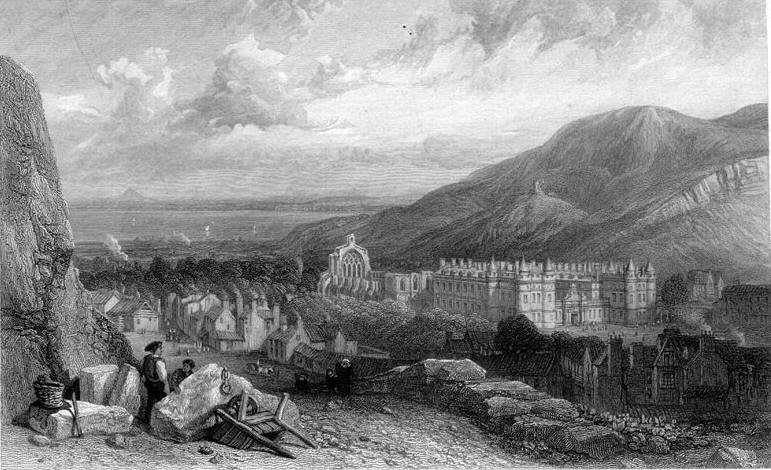
Holyrood House or "Holy Cross Palace" as it looked in Shakespeare's day from Calton Hill in Edinburgh.
Holyrood House or “Holy Cross Palace” as it looked in Shakespeare’s day from Calton Hill in Edinburgh.

Over the Christmas holiday, Shakespeare’s company received a summons to court to perform some entertainments before the new King! The Chamberlain’s Men were delighted and Will was quite relieved. The King ordered the players to perform at Holy Rood house in Edinburgh, as his court was still in procession from Scotland to England. “Masters,” Will shouted, “Let us give the new king a taste of our quality, and may he pay handsomely for it!” Will and the other shareholders in the company decided on a series of plays to perform for the king, and began the journey to the wilds of Scotland. On Christmas morning they set up their temporary Tiring house within the great banquet hall for the performance, placing props and costumes behind a series of tapestries.

At suppertime the chamberlain gave word to light the candles within the hall, and signal the actors to perform the play, which Will had selected as King Henry the Fourth; a clever choice by Will since it depicted an old king passing the crown to a young and energetic monarch. As the king and courtiers processed, Will spied through the tapestry a haunted looking young woman at King James’ elbow, dressed in courtly gowns with a green veil on her head. The chamberlain directed everyone to their seats and announced the start of the play. To Will’s annoyance, he addressed the company “Mr. Shaxberd and company,” but there was no time to be annoyed or intrigued. “The play’s the thing,” Will muttered, and took his place backstage.

End of Part I.

Part II

The performance was a terrific success! The king himself applauded and promised to patronize the entire company. All of Will’s dreams seemed to be coming true! That night, as he and the other players were packing their belongings into a wagon and preparing to leave the castle in search of a nice, cheap inn for the night, a pale breathless messenger arrived and informed Will that the King wished to meet with him to commission work for their next court performance. Will dutifully walked back up the battlements and entered the castle.

"The Murder of David Rizzio" by William Allen, 1883.
“The Murder of David Rizzio” by William Allen, 1883.

The servant directed him, not back into the ante-chamber of the Great Hall, but up one of the staircases on the North East tower. This tower housed the royal bed chambers! What on Earth was a mere poet from Stratford doing up here? The servant’s candle cast strange shapes upon the walls and the flame blazed upward like some bronze blade. Shakespeare knew from the gossips that the King’s mother had watched her lover David Rizzio be murdered in this very tower- he was stabbed 56 times by jealous Scottish nobles who wished to marry the queen and take the throne. Gruesome images flickered in the poet’s mind. At last, they came to an archway with four adjacent chambers. Three were heavily guarded by English soldiers with halberds but the fourth was unprotected. Slowly, ever so slowly Shakespeare nodded to the servant, and stalked along the pathway. Before he could nock, the door swung open. Pausing a little, The Bard stepped inside.

v0_master

The room looked like a mix between a library and a crypt with a cold stone wall, a small altarpiece that looked barely used, and several oak bookcases piled high to the ceiling. Once the playwright entered the room, the door shut without warning. He couldn’t see who shut it and the shock put something cold in his blood. Shakespeare’s eyes adjusted to the darkness of the room.Moonlight gave the place a silvery glow, until a shadow came out of the darkness and revealed itself as a woman’s face. Shakespeare could barely make out her features but it was clearly the woman he’d seen in the procession. The Moon made her red tresses shimmer and gleam, as if she were a fairy from one of the dark pools of legend. “I am Princess Elizabeth,” she replied in a voice that seemed more solemn than proud of her royal title. Recovering from his initial shock, the poet bowed low and counterfited his best courtier’s smile. “I am Master Will Shakespeare, at your service.”

“I know who you are. They call you the Bard of Avon. You’ve written sad stories of the deaths of kings, and woven yarns of the fairy queen,” the princess said in a hollow voice that chilled the poet to the core. “When I was little,” said the princess warming slightly, “My mother spoke of how Irish Bards could change their forms, and speak with the spirits of the dead. Sometimes they even outmatched witches who danced with the devil on Friday nights. You seek my family’s patronage?” “Yes”, said Shakespeare tentatively, “And may I prove worthy of such an honor.” “Beware your ambitions,” Elizabeth went on.

“My family has been torn apart by ambitious men. You know I take it that the chamber we stand in was where my grandmother watched her servant die. She lost the crown, and never saw her son again. Death stalks ambition in Scotland. Some say the Devil tempts men to dance with him on nights like this, and signs their name in his book. My ancestor Malcolm fought armies from Hell to keep his crown.” “From King Macbeth,” replied Shakespeare, (his breath finally returned). “I am the keeper of a history of that damned king, but I will not share it with anyone. He sold his soul to a witch to get the crown, and his book is full of spells that curse the reader. I brought you here so that you can lift our family’s curse with your writing. When you get my father’s patronage, do not feed his fears with stories of witches and prophesies or the curse will envelop the throne. Heed my warning, and do not look for the story of King Macbeth.”

As mysteriously as it had closed, the door opened again. The Bard bowed politely and left the chamber. As he left, he saw the Princess kneeling at the shrine at the corner of the room, eyes closed and meloncholy.

End of Part II.

Stay tuned for the final chapter tonight.

Happy Friday the 13th!