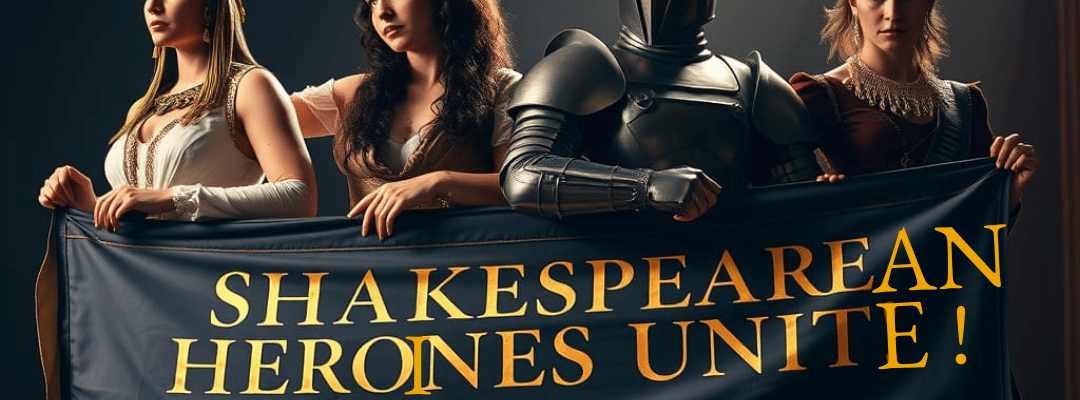
Every Year around this time, I like to draw attention to Shakespeare’s greatest heroines. You might have read my top 10 Shakespearean mother characters, or my post from last year, where I talked about some of Shakespeare’s best childless characters.This year, I’m putting together a squad of women you don’t want to mess with. So please enjoy (in no particular order because I refuse to rank women), – the best female fighters in all of Shakespeare:
Queen Margaret of Anjou
She defeats the York Army multiple times in the Wars Of The Roses, even killing the Duke of York himself. She was a powerful force on the battlefield and in the court.
Joan of Arc
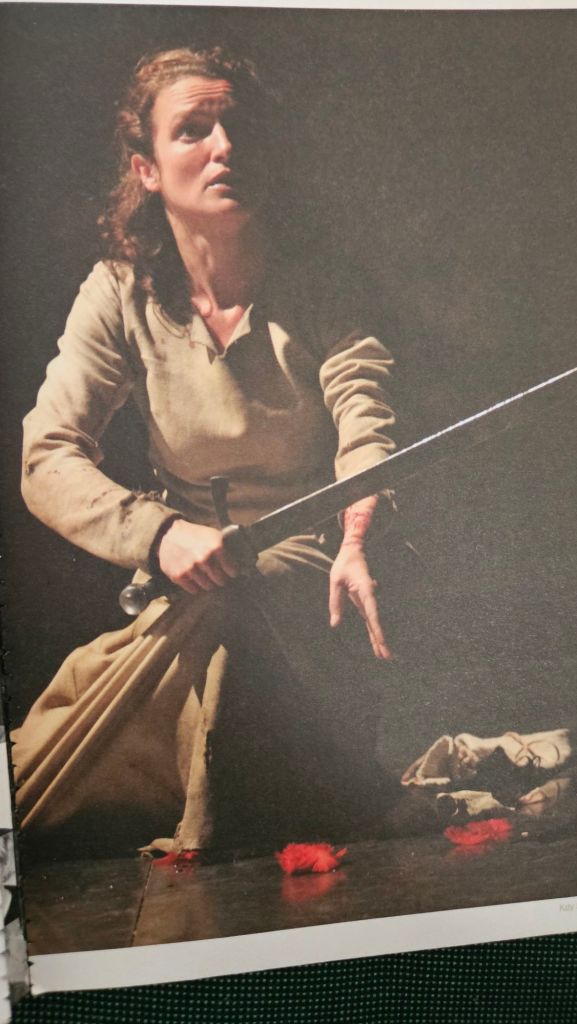
Joan la Pucelle from Henry VI, Part 1: (RSC, 2006)
I am prepared: here is my keen-edged sword, Deck’d with five flower-de-luces on each side; The which at Touraine, in Saint Katharine’s churchyard, Out of a great deal of old iron I chose forth.
And while I live, I’ll ne’er fly from a man.
The iconic female warrior who helped end English occupation of France. In Shakespeare’s play, she fights the French prince to prove her prowess in battle, then she retakes the towns of Orleans and Rouen from the English, and keeps fighting until the
Portia Catonis
Portia preparing to “Swallow fire”
True, she doesn’t have much fighting experience, but clearly she can tolerate pain, has accute powers of perception, and is related to a long line of political and military patriarchs.
Volunnia
Valumnia comforts Coriolanus’ wife (AI art)
Dr Peter Saccio of Dartmouth College once said that this Roman matron talks to her son Caius Martias as if she’s his general, not his mother. She is totally devoted to Rome and she has trained her son since birth to fight for it.
Cordelia
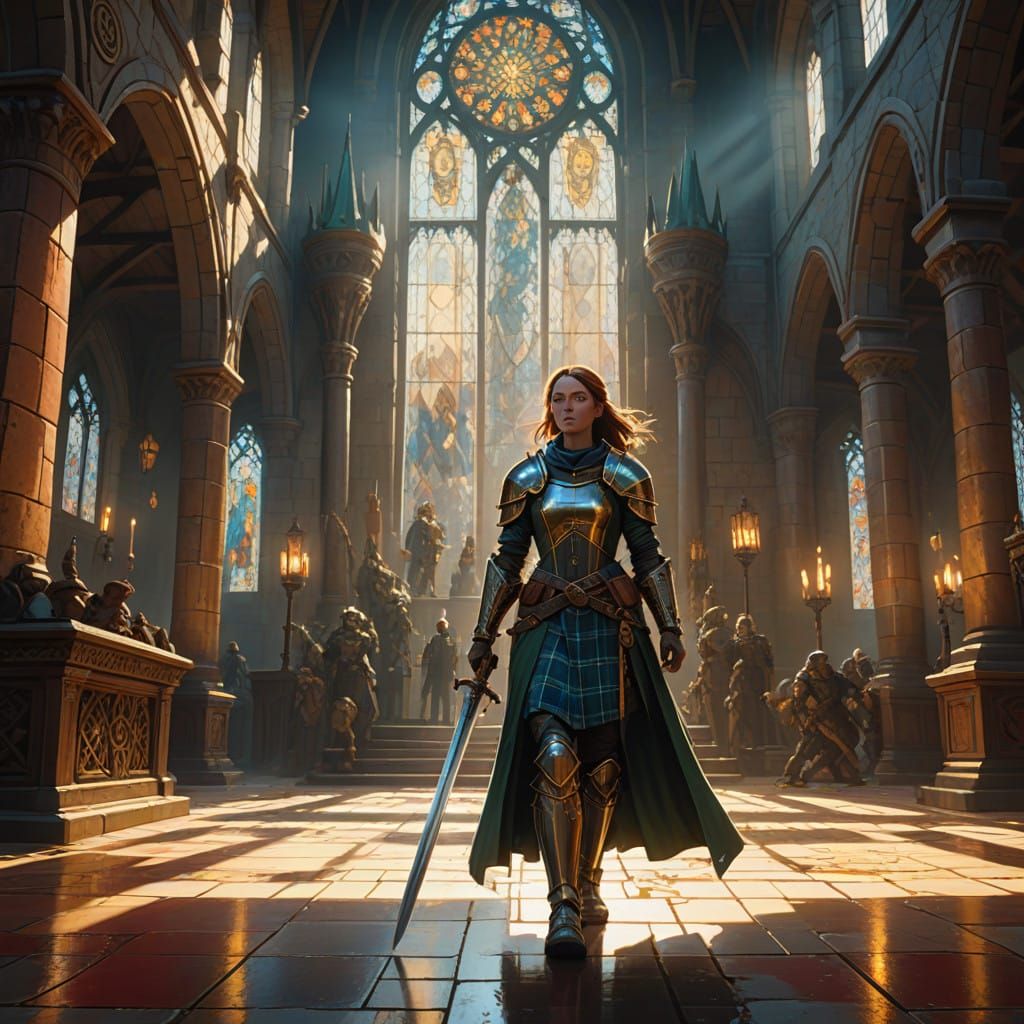
AI artwork I created of Cordelia storming Goneril’s castle
Our preparation stands
In expectation of them. O dear father,
It is thy business that I go about.
Therefore great France
My mourning and important tears hath pitied.
No blown ambition doth our arms incite,
But love, dear love, and our ag'd father's right!
Cordelia shows her strength not through words, but through deeds- massing an army and invading England to put her father back on the throne, as the passage above shows. It’s true she didn’t succeed in saving the kingdom, but she did save her father through her love and bravery.
Tonight is the Chinese New Year, beginning the Year of the Dragon. I’ve talked before about the fascinating relationship between Shakespeare and China, and I thought I’d illustrate it here by talking about a shared cultural mythology- the concept of dragons. Both Western and Eastern cultures use dragons in their myths, but as you’ll see, they have very different cultural meanings.
Quotes from Shakespeare About Dragons
Before thee stands this fair Hesperides, With golden fruit, but dangerous to be touch’d; For death-like dragons here affright thee hard:
Antiocus, Pericles
Sometimes we see a cloud that’s dragonish; A vapour sometime like a bear or lion, A tower’d citadel, a pendent rock, A forked mountain, or blue promontory
Antony and Cleopatra
In Western myths, dragons are symbols of wrath and fierceness. In ancient Greek and Viking myths, dragons are often guards of treasure, (and sometimes in modern stories like Harry Potter). In the myth of Hercules, a multi-headed dragon guarded the golden apples of the Hesperides, (the apples that kept the gods young and immortal). King Antiochus wants to scare Pericles by comparing his daughter to the apples; if he fails to win her love, he’ll be devoured as Hercules almost was.
Coriolanus and Dragons
His CORIOLANUS is grown from man to dragon: he has wings; he’s more than a creeping thing.
Coriolanus
Shakespeare’s Roman general Coriolanus is frequently compared to a dragon in Shakespeare’s play. According to Dr. Peter Saccio of Dartmouth College, this is because the general is unable to relate to other humans- he is solitary, violent, jealous of his power and wealth, and prefers to strike first, then retreat from other people when the battle is won. This is why he utterly fails to get the Roman people to elect him consul in this scene from Ralph Fiennes’ movie. I find it ironic that Fiennes has played not only this character, (who is associated with dragons), but with Lord Voldemort, (who controls several large serpents), and also Francis Dollarhyde in the film Red Dragon:
Swift, swift, you dragons of the night, that dawning May bare the raven’s eye! I lodge in fear; Though this a heavenly angel, hell is here.
Cymbeline
Sometime he angers me With telling me of the mouldwarp and the ant, Of the dreamer Merlin and his prophecies, And of a dragon and a finless fish, A clip-wing’d griffin and a moulten raven, A couching lion and a ramping cat, And such a deal of skimble-skamble stuff As puts me from my faith.
Hotspur, Henry IV, Part I
A thousand hearts are great within my bosom;
Advance our standards, set upon our foes
Our ancient word of “courage,” fair Saint George,
Inspire us with the spleen of fiery dragons!
Richard III
St. George and the Dragon
In the medieval story of St. George, the titular knight defeats a dragon, which is basically a stand-in for Satan. George was seen as the ideal knight- virtuous, devoted to his cause, strong, and patriotic. His defeat of the dragon was an allegory for how knights should devote themselves to protecting their lords, ladies, and the innocent against evil. Therefore, it’s intentionally unsettling that Shakespeare has Richard III telling his soldiers to act not like the virtuous St. George, but like the cruel and violent dragon. Richard is Shakespeare’s most villainous king, so it makes sense in context that he would side with the dragon, and thus his defeat would seem even more like a triumph of good over evil. In addition, the real King Richard flew this flag with a dragon on it during the actual Battle of Bosworth Field.
Royal standard of Richard III, using the dragon of St. George
Peace, Kent! Come not between the dragon and his wrath.
King Lear
Dragons and Chinese Culture
None of the animals is so wise as the dragon. His blessing power is not a false one. He can be smaller than small, bigger than big, higher than high, and lower than low.”
–Chinese scholar Lu Dian (AD 1042-1102)
Qualities of Dragons
Dragons didn’t have the negative connotations of Western myths. In China, they were symbols of good luck, strength, and success. They were also known to be proud and temperamental-sometimes kind but sometimes vengeful to people who didn’t show them proper respect. In a sense, the dragon was like the ancient Greek gods- they should be viewed with respect and gratitude as well as fear.
The Chinese calendar goes by a cycle of years, not months. It has 12 animals that represent various qualities and those qualities will characterize the coming year. So hopefully a year of a dragon will be a year marked with courage, good fortune, and justice.
IV. What would a Chinese Lear look like?
Looking at the quotes I showed you earlier, it’s interesting that King Lear calls himself a dragon, and it made me think- Lear is a powerful warlord who demands absolute loyalty from his children. Would a Chinese version of King Lear work?
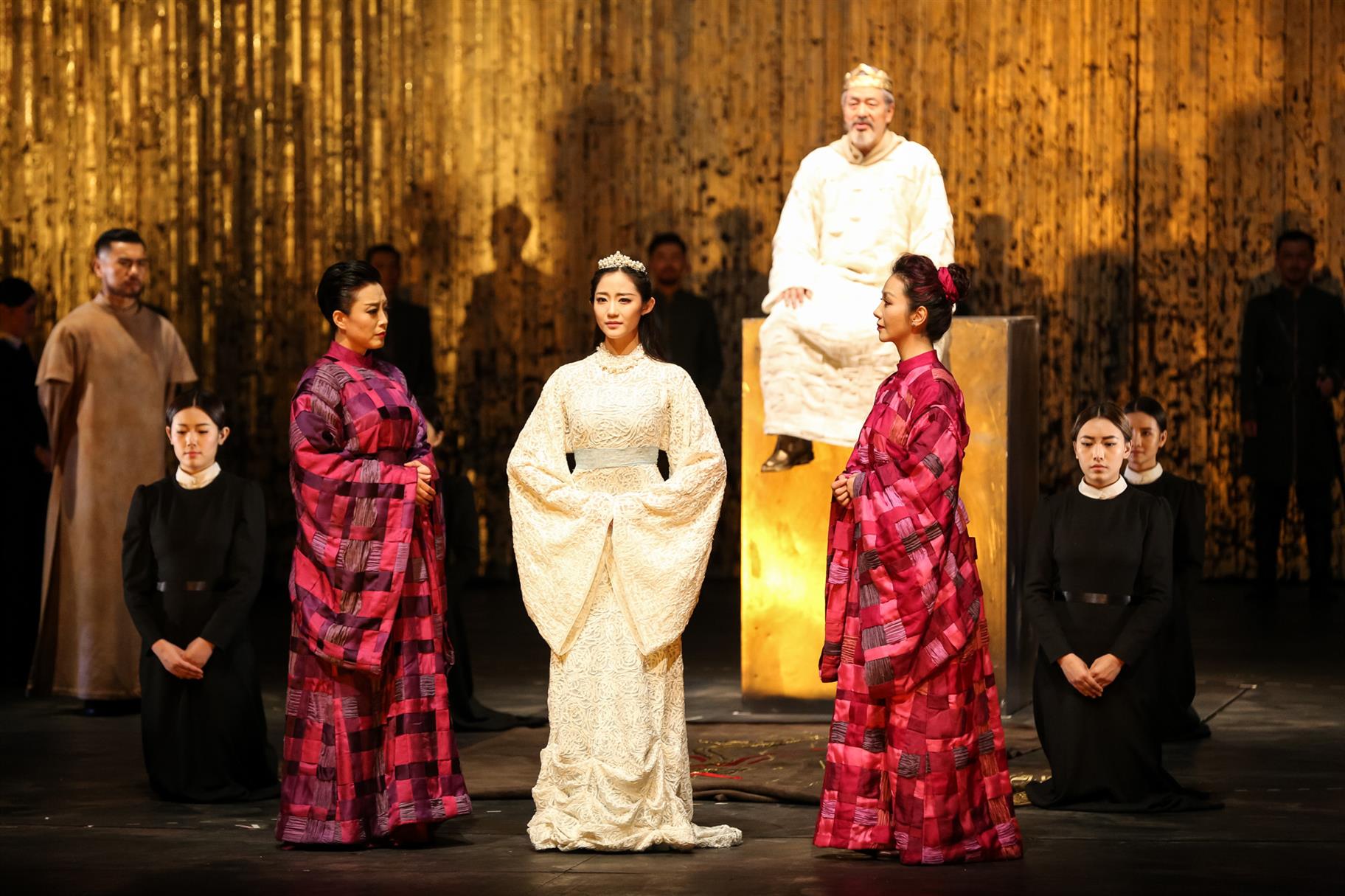
There was a Chinese production of King Lear back in 2017, where the translator and director traveled to the Royal Shakespeare Company in England and worked with the actors and directors of a London production to make their production gain insight into the characters’ motivations. However, I wonder how successfully they translated the Western ideas and values of the play for a Chinese audience. One of the reviews from China Daily.com describes the play like this:
Originating from old British legend, King Lear is one of Shakespeare’s four most famous tragedies. Through the internal disorder of the royal family, the rise and fall of King Lear’s fate and the final punishment of evil powers, Shakespeare expresses his optimistic views in the future of society, thereby adding the glory of strong idealism into his work.
The last word I would use to describe King Lear is “optimistic”. It is the only tragedy where not only does everyone die, but the entire future of the monarchy is in question. Nevertheless, reading about this production makes me interested in imagining my own version of King Lear, one that emphasizes Chinese values, but also questions them.
Many Chinese stories stress family loyalty, communalism, and respect for elders. You could portray King Lear as a story about the disastrous consequences of self-interest. After all, Regan and Goneril cast their father out and dismissed his followers, and it led their kingdom into civil war. In that version, Lear is like the Dragon King, who in Chinese folklore, was a powerful ruler of the seas, (giving new meaning to the lines “Blow winds, and crack your cheeks”). As a bonus, historically, many imperial Chinese rulers decorated their palaces with images of dragons, and the emperors themselves were associated with the creature, (especially during the Han Dynasty), so when Lear says “Come not between the dragon and his wrath,” In his mind, he literally is a dragon.
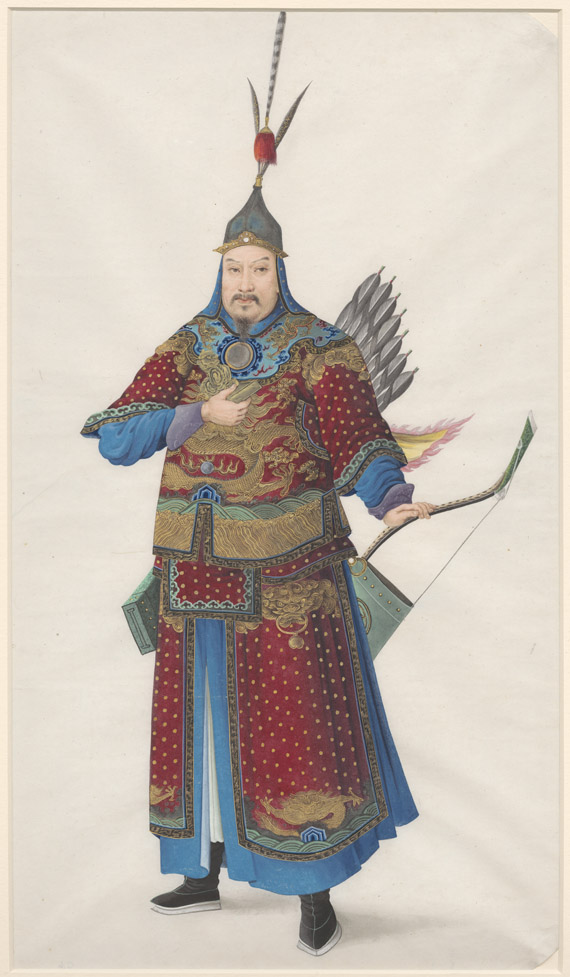
Han Dynasty watercolor print of a Han warrior whose clothing is embroidered with dragons.
In 1736, Jean-Baptiste Du Halde wrote about the Emperor: “His clothing is embroidered with dragons: they are his emblem, and only He can wear dragons with five claws – any infringement to this rule is punished severely.”
That said, some dragons were associated with bad luck and ill omens. I’ve said before that Lear’s biggest flaw is that he fails to take time to examine himself or think about the consequences of his actions until it is too late. Maybe Lear thinks of himself as a benevolent dragon, but really is a bad man cursed with bad luck; he is not a dragon, he just has one on his back. So, in short, a Chinese re-imagining of King Lear could be a fascinating look at Chinese culture and give a fresh re-imagining of Shakespeare’s tragic story.
I hope you enjoyed this look into dragons in Shakespeare and Chinese culture. Joseph Campbell said that all cultures share and interpret archetypes to understand their own culture, but also to grasp what makes us all human. For whatever reason, every culture on Earth has some kind of large serpent- Chinese dragons, European dragons, The Aztec god Quetzalcoatl, the Viking Yormungand, even the Piasa of the native tribes of the Mississippi. and they can mean many different things to many different people, which means that we as humans are in some way tied to gether through all these dragon tales (no pun intended).
It’s a moment of tragic irony, worthy of King Lear himself that the actor who played Snape died before the actor who played Dumbledore, but here we are. I’m saddened to say that we’ve lost another beloved Shakespeare and Harry Potter actors.
Michael Gambon (
Gambon was born in Ireland in 1940. His first Shakespeare role was in a production of “Othello” at the Gates Theater in Dublin Ireland. He went on to win an Olivier Award, a BAFTA, several SAG awards, and was knighted in 1988.
Sir Michael became accomplished both on TV, in movies, and on stage. He played many of Shakespeare’s greatest roles, including a famous performance as King Lear with Antony Sher at the Royal Shakespeare Company. Here are some highlights of his stage work:
Now before I go on, I’d like to address the elephant in the room, or rather the MEME in the room:
I’ve never understood the animosity that Gambon got for changing the interpretation of this line, and no one seems to have a real explanation for why he changed it from the book. So this is all speculative, but as a Shakespeare actor myself, I want to provide some rational explanations that while you might not like his choice, you hopefully won’t come to the conclusion that it was the “Worst mistake ever.”
1. If You Don’t Change Something, You’re Not Doing Your JOb
“Upon Such Sacrifices: King Lear and the Binding of Isaac”
I’ve compared King Learto a fairy tale in the past, but i haven’t compared it to a story from the King James Bible, even though Shakespeare, in all likelihood wrote and performed it for James himself. This article form the Jewish Review of Books is a comparison between Lear and the Old Testament Bible. First, the author has a tantalizing historical tidbit that might explain why Shakespeare chose to write Lear for King James:
Before ascending to the English throne, James VI of Scotland wrote a political guide, Basilikon Doron, for his eldest son advising him never to divide his kingdom (as Lear does) but “make your eldest son Isaac, leaving him all your kingdoms.”
Noah Millman.
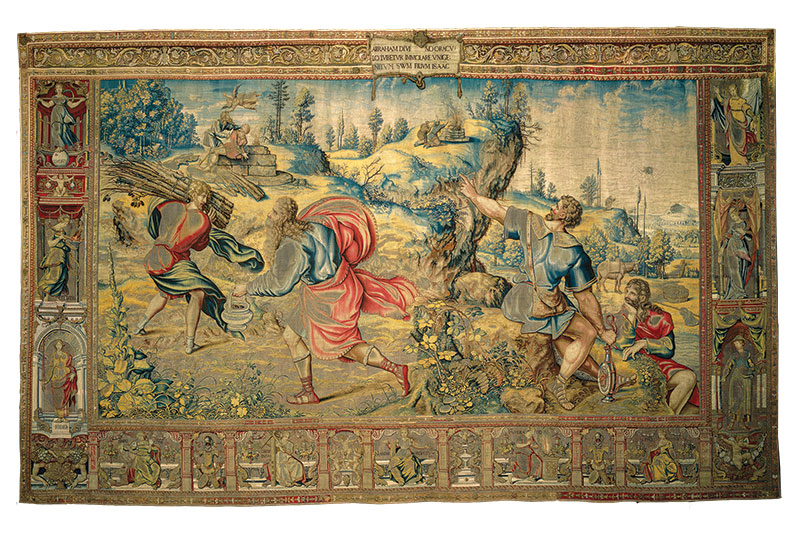
The article also draws some fascinating parallels between Lear and other Biblical patriarchs especially the sacrifice of Isaac, which takes place in Genesis 22, or as it’s known in Jewish tradition, the akeda.
The akedah prompts different questions than King Lear does, not of how so much tragedy could have sprung from a foolish love test, but how the God of all creation could have put his faithful servant to such an unconscionable test in the first place. And so there is a long interpretive tradition that labors to elide that fact in increasingly creative ways. Surely God never intended Isaac to be a sacrifice—the boy was merely to be present at the sacrifice! How could Abraham have thought otherwise, when God had already sworn that it was through Isaac that his promise to Abraham would be fulfilled? Or, alternatively, surely Abraham never doubted that God was merely testing him—after all, Abraham tells Isaac himself that God would provide a lamb to substitute!
It’s interesting to see the parallels between Lear and an Old Testament patriarch. He constantly asks his gods for help and swears by them when he pronounces his doom, yet arguably he has no real faith in his gods or his daughters, which is why his foolish love test in Act I, serves as the catalyst that corrodes and destroys his kingdom and his life. However, maybe Lear sees himself this way, as a king appointed by God, with the authority to test his daughters’ love as God tested Abraham. Ian McKellen seems to share this view and sees Lear as a priest who is unwilling to give up his “special relationship with his gods.”
The actor playing Lear can benefit from studying the sort of old-fashioned patriarchs presented in the Bible because they help shape his worldview. In addition, the concept of faith and how it is tested is another big theme in Lear and contrasting how men in the Bible keep their faith while Lear loses it is an illuminating way to contextualize both works. Was Shakespeare trying to write a parable for kings? Perhaps, but he certainly encapsulates very well the struggles and anxieties of keeping power, and the desire for divine intervention when a kingdom bleeds.
James Earl Jones as King Lear at the Public Theater (1974)
This is my absolute favorite of all the King Lears I’ve seen. Jones nails the blind rage and puffed-up pride of Lear, while also being absolutely clear in his delivery. Unlike a lot of other Lears I’ve seen, you get the sense that, although this man is a bad dad and probably a bad king, he wasn’t always like this, that he was very respected and magnanimous.
In addition, the supporting cast is incredible- Raul Julia (famous for playing M. Bison and Gomez Adams), brings a delicious slimy charm as Edmund and Rene Aberjounois as Edgar brings every bit of his chameleon-like acting to Edgar, Poor Tom, the guy on the cliff, and the guy who fights Oswald. It’s simply astonishing to see Rene play so many different characters and do so many different voices in one performance.
The cast’s excellence doesn’t stop there- Rosalind Cash, Ellen Holly and Lee Chamberlain are all excellent as Lear’s daughters. Cash in particular has the bearing of a queen, and she isn’t afraid to go toe-to-toe with her father, even though he’s played with such might by Jones. Holly plays Regan as sort of a sniveling middle child, which I didn’t enjoy as much, but I think it’s a legitimate interpretation. And of course, Lee Chamberlain does a great job capturing the gentleness and grace of Cordelia, truly a “Kind and dear princess.”
Douglas Watson 1921-1989
Jones will always be my favorite performer in this version, but I have to give a special shout-out to Douglas Watson as The Earl of Kent. I’ll be honest, he really helped me understand the character, and I put elements of his portrayal into my own. First off, even with the elaborate verse that Kent has to deliver, Watson makes it sound like it was written yesterday. In addition, he does a great job of playing the ‘plain knave’ aspect of Kent. He’s gruff and loud, especially with Oswald, whom Kent can’t stand because of his simpering sycophantic ways. I hope I remain true to the spirit of the character, while, also giving it my own spin.
Hopefully watching all these great performances will get you interested to watch the humble little radio play, (though please don’t measure our performance against these masterpieces). Hope to see you tomorrow to watch the show!
Shakespeare’s King Lear is an age old tale. Like Cinderella it has been reinterpreted throughout time and in many different cultures. Here are a few interesting highlights in the old legend and how it got to Shakespeare in the 1600s.
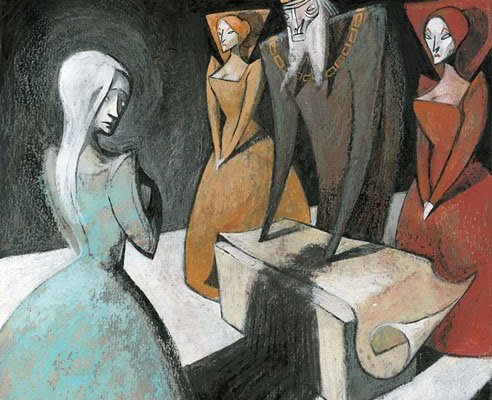
The Princess Who Loved Her Father More Than Salt
This is an old folktale from my favorite podcast, Journey With Story, which starts with the Cordelia/ Lear plot of a foolish king who banishes his honest daughter. Then through extraordinary circumstances it becomes a Cinderella story. I think at some point these two stories were one and the same until they diverged and one became a story about an absent father and a wicked stepmother, while the other became about a wicked father and a dead mother.
The ancient ballad of King Leir, which helped inspire Shakespeare. It serves as a cautionary tale against flattery, and it places equal blame on Lear and his daughters:
And calling to remembrance then
His youngest daughters words,
That said the duty of a child
Was all that love affords:
But doubting to repair to her,
Whom he had banish'd so,
Grew frantick mad; for in his mind
He bore the wounds of woe:

Which made him rend his milk-white locks,
And tresses from his head,
And all with blood bestain his cheeks,
With age and honour spread.
To hills and woods and watry founts
He made his hourly moan,
Till hills and woods and sensless things,
Did seem to sigh and groan.

Even thus possest with discontents,
He passed o're to France,
In hopes from fair Cordelia there,
To find some gentler chance;
Most virtuous dame! which when she heard,
Of this her father's grief,
As duty bound, she quickly sent
Him comfort and relief
The characters of Gloucester and his children, Kent, and the Fool are absent in this ballad, but unlike the fairy tale above, both Lear and Cordelia die in each other’s arms.
The Annonymous History of King Leir, (first published c. 1594)
The anonymous history of King Lear, written shortly before Shakespeare
This play was written for Shakespeare’s rival acting company The Queen’s Men around 1590). Since the Queen was patronizing the company, most of their plays were government-funded propeganda. For instance, it was the Queen’s men who first did a tragedy of the wicked King Richard III.
Michael Wood. In Search Of Shakespeare, 2002.
If you watch the first 20 minutes of the documentary above, you will see that Wood and many other scholars believe Shakespeare must have worked for the Queen’s men, or at least performed their scripts, since they did their own versions of King Lear, Richard III, King John, and Henry V.
However Shakespeare got a hold of The Queen’s Men’s scripts, he didn’t adhere to them rigidly. Their King Lear follows the fairy-tale / history format of having Cordelia be banished, disguise herself as a peasant (like Cap ‘O Rushes in the earlier version), and eventually she is restored to her rightful place. Shakespeare’s version must have been a MASSIVE shock to anyone who read these old tales and ballads. In Shakespeare’s version, everyone dies and there is no guarantee that the kingdom will survive. Every other tragedy ends with a new king or emperor to take over the kingdom but Lear leaves the audience with a sense of apocolypse; that Lear’s madness and Edmund’s machinations have doomed England and all these characters’ lives will be erased by Time.
As pessimistic as Shakespeare’s Lear is, it does seem more true to life than the previous versions. Perhaps this is because of a legal case from 1603 that might have inspired Shakespear to adapt the story: In 1603, two daughters tried to have their father declared insane. By an astonishing coincidence, the third daughter, who protested, happened to be named Cordelia! Perhaps Shakespeare, (who had three children and was preparing to retire), might have been inspired by this case and worried he might suffer the same fate.














 The Shakespearean Student