How Accurate Is Medieval Times?

In many ways, Medieval Times is a campy, theme park-esque place. Done’t get me wrong, I love this place and puppet Shakespeare and I enjoyed it immensely, but from a historical perspective, Medieval Times has more in common with Disney Land than British history. That said, it still contains a nod to this ancient culture that praised and highly ritualized the concept of judicial combat.


The Court

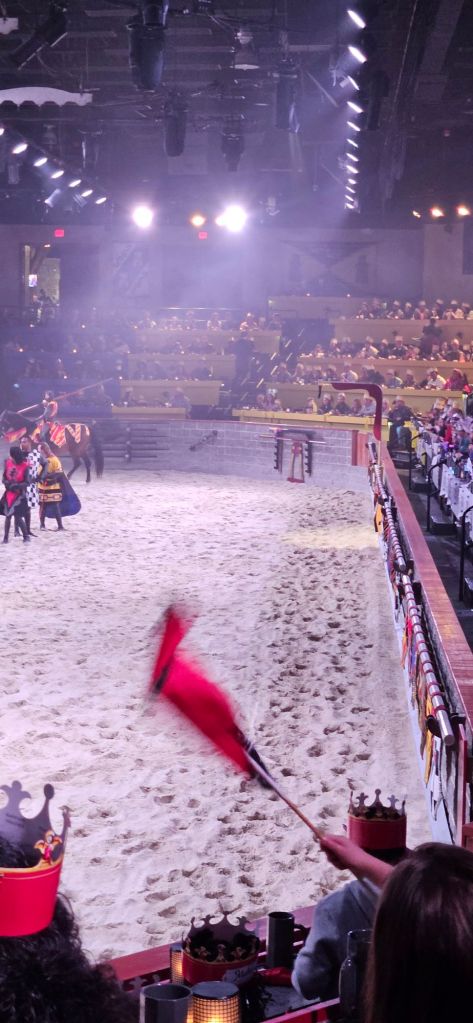
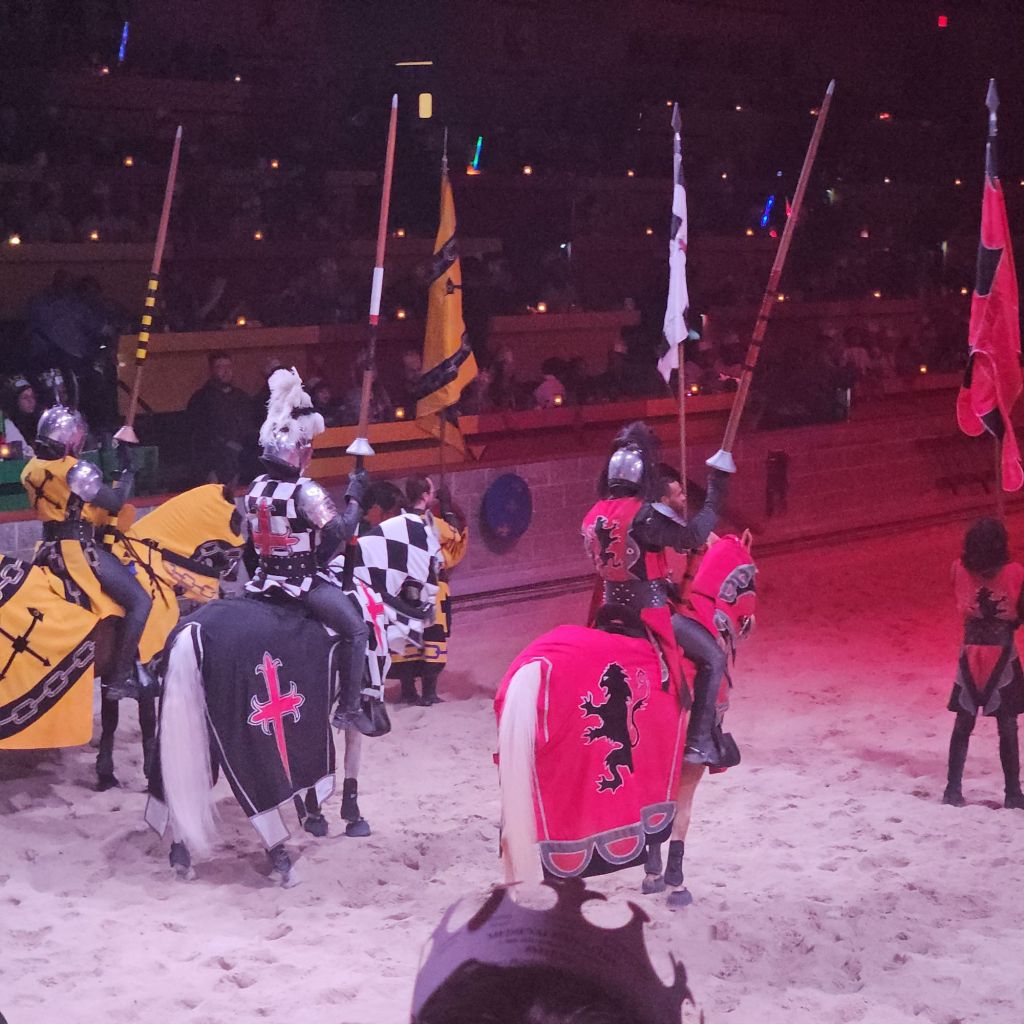
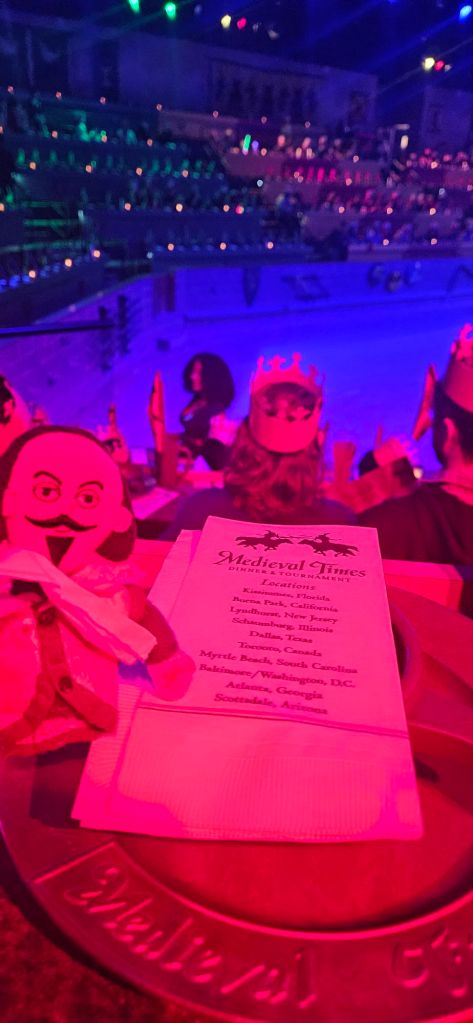
You are cast as a lord or lady, representing a fantasy kingdom (which corresponds to the color of the crown you wear). I was fortunate to get the Red crown for Valentines Day, and was seated right next to the King and Queen (more on that later). The hall was decorated with colored banners and each kingdom was introduced with trumpets and flags. The feast was a celebration of the uniting of all the surrounding kingdoms under the King and Queen. As the king and queen came out, everyone cheered and the royals toasted each kingdom and praised and thanked them all for their service to the crown. The monarchs then promised each lord and lady there a greater reward with sports, games, spectacles, and of course, the feast itself.

Feudalism

Map of the kingdoms in England during the Wars of the Roses

As I mentioned in my Game of Thrones post, a king’s main job was to unite all the lords in the land and get them swear fealty to him, binding the whole country under the crown. It was King Henry VI’s failure to keep the lords in line that resulted in the civil war known as the Wars of the Roses. Feasts like the one in Medieval Times, were essentially propaganda to keep the lords allied with the king. They demonstrated the power of the king and communicated loudly and clearly that the lands would be stronger together, as opposed to endless war. So, this kind of pageantry was political as well as entertaining, and the king and queen’s dialogue preserves the purpose of this kind of feast, which as a history nerd, I deeply appreciated.

Court Sport
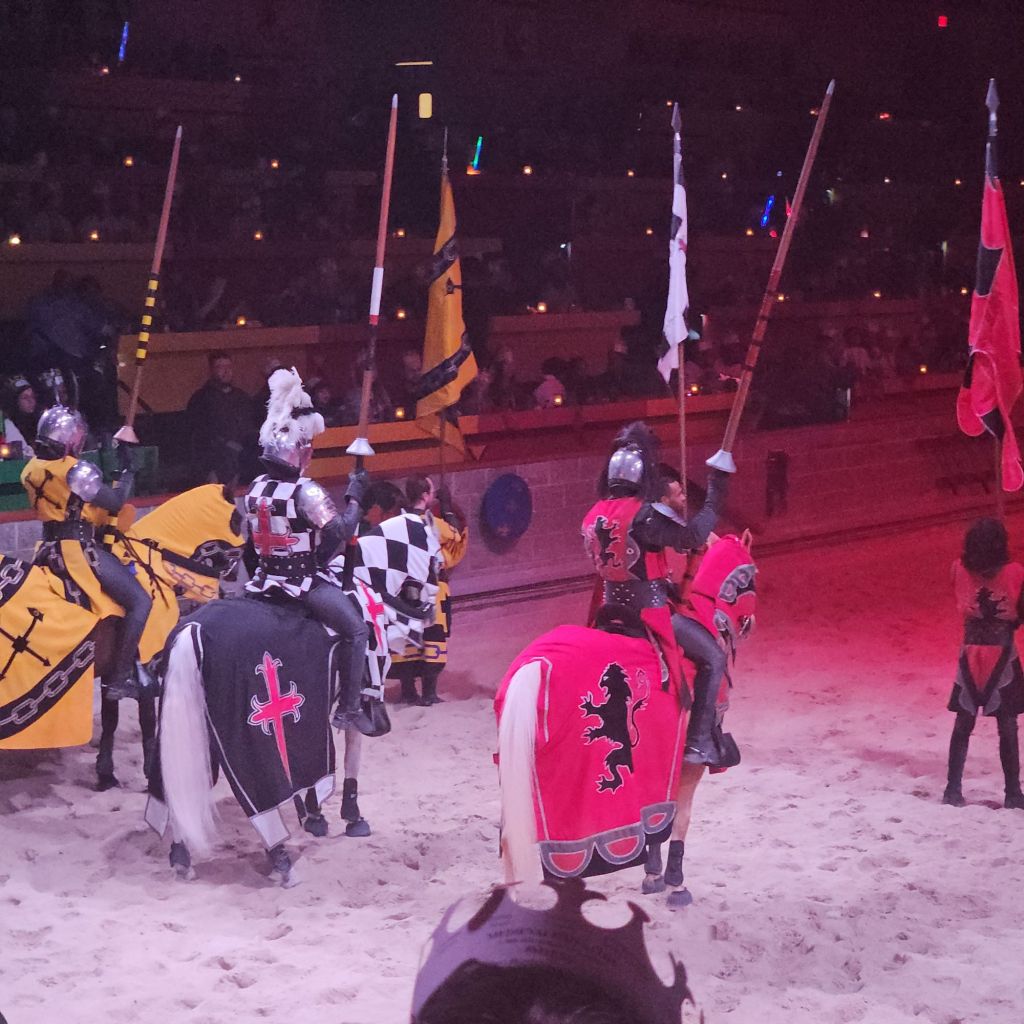

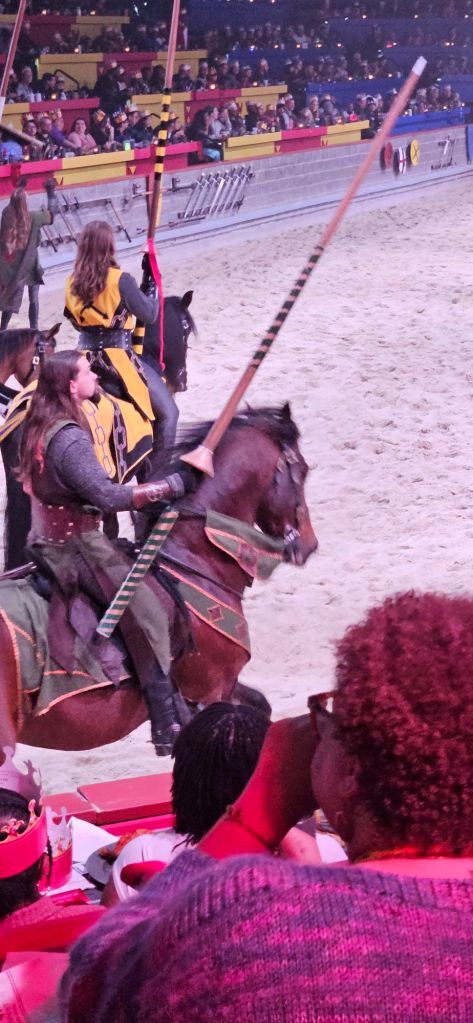
While we waited for the feast, the knights entertained the court with displays of their skills and strength. They rode towards the quintain and hit it with their lances, threw spears at a target, and even their horses got a chance to trot without riders, showing how well trained they were.
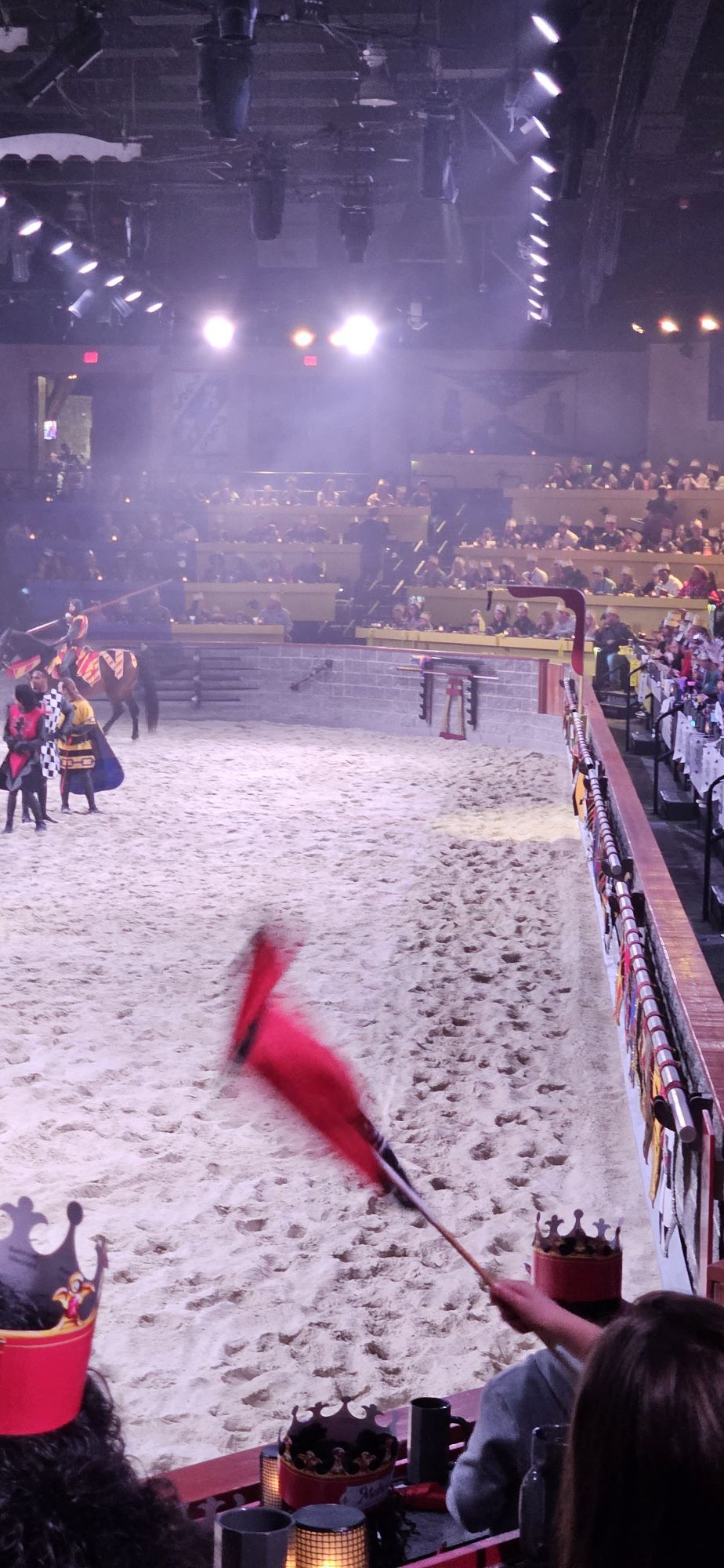
The knights practice throwing spears at the target

The Joust

Shakespeare’s Pericles, Prince Of Tyre has a very elaborate and detailed depiction of how jousts worked in the Medieval and Renaissance eras. Shakespeare knew that the joust was the ultimate display of skill, chivarly, and the ideals of courtly love. Knights were portrayed as romantic heroes who fought for a simple favor from a lady such as a rose or handkerchief and each one defined himself by his strict code of honor and virtue. All these traditions are hightlighted in the scene where Pericles fights in a tournament to gain the love of the princess Taisa:

Enter A pavilion for the [p]reception of King, Princess, Lords, &c.

[Enter SIMONIDES, THAISA, Lords, and Attendants]

Simonides. Are the knights ready to begin the triumph?
First Lord. They are, my liege;750
And stay your coming to present themselves.
Simonides. Return them, we are ready; and our daughter,
In honour of whose birth these triumphs are,
Sits here, like beauty's child, whom nature gat
For men to see, and seeing wonder at.755
[Exit a Lord]

Thaisa. It pleaseth you, my royal father, to express
My commendations great, whose merit's less.
Simonides. It's fit it should be so; for princes are
A model which heaven makes like to itself:760
As jewels lose their glory if neglected,
So princes their renowns if not respected.
'Tis now your honour, daughter, to explain
The labour of each knight in his device.
Thaisa. Which, to preserve mine honour, I'll perform.765
[Enter a Knight; he passes over, and his Squire]
presents his shield to the Princess]
Simonides. Who is the first that doth prefer himself?
Thaisa. A knight of Sparta, my renowned father;
And the device he bears upon his shield770
Is a black Ethiope reaching at the sun
The word, 'Lux tua vita mihi.'
Simonides. He loves you well that holds his life of you.
[The Second Knight passes over]

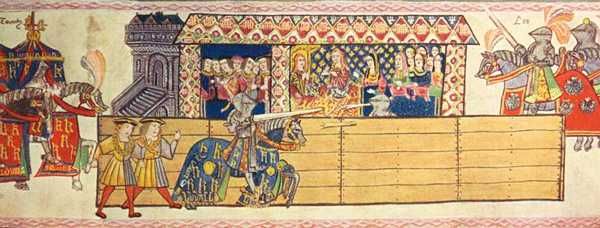
Chivalric ideals aside, the joust also had a practical purpose- it was a way for knights to train for war, an a way for them to win fame, money, and good reputations at court. As you can see in the photos above, the knights were separated by a wooden barrier called “the tilt wall.” Each knight was identified by the colorful designs on their banners, shields, and the blanket draped over the horse. Once the king or marshal threw down the warder, the knights charged headfirst at their opponents, armed with shields, lances, and full armor. Knights scored points for breaking lances and shields or by knocking other knights off their horses. Naturally, to create the most impressive display possible, all the knights at Medieval Times fell off their horses and no lances broke.


First, and most important, was the Joust Royal, or "tilting," in which mounted knights armed with lances charged at their opponents across a barrier.
This was followed by a "tourney" in which mounted knights ran at each other without a tilt barrier (as pictured here).>
Combatants armed with spears and swords also fought on foot over a barrier
Best, Michael. "Chivalry and Duels." Internet Shakespeare Editions, University of Victoria, 28 Sept. 2016, ise.uvic.ca/Foyer/citing. Accessed 30 Sept. 2016.
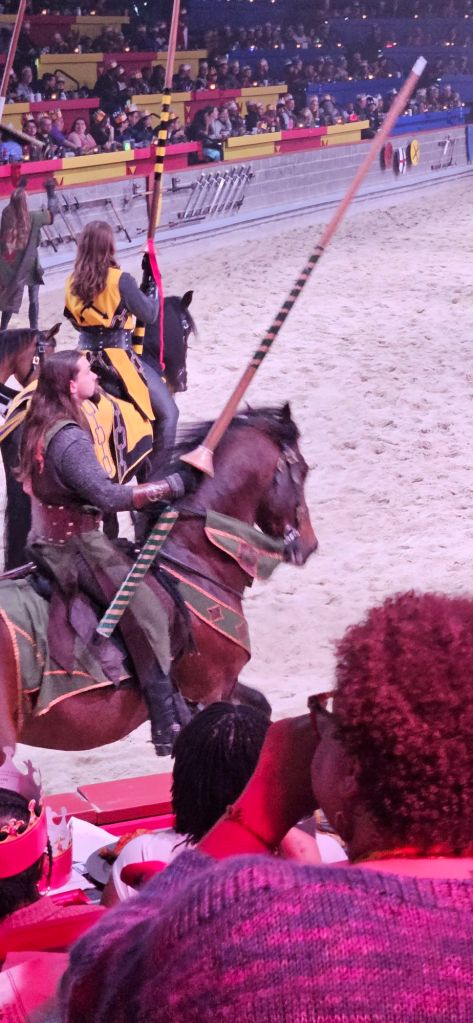
The Lance

The video above is from Weapons That Made Brittain, in which historian and reinactor Mike Loads, explains with vivid details, how Knights learned how to master the art of the Lance, and how the Lance became one of the most important weapons of the knight.

Duels
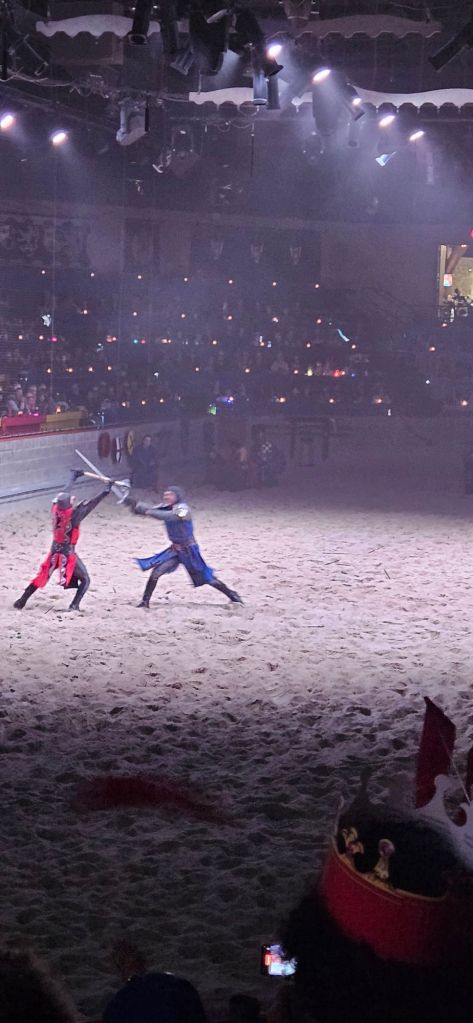
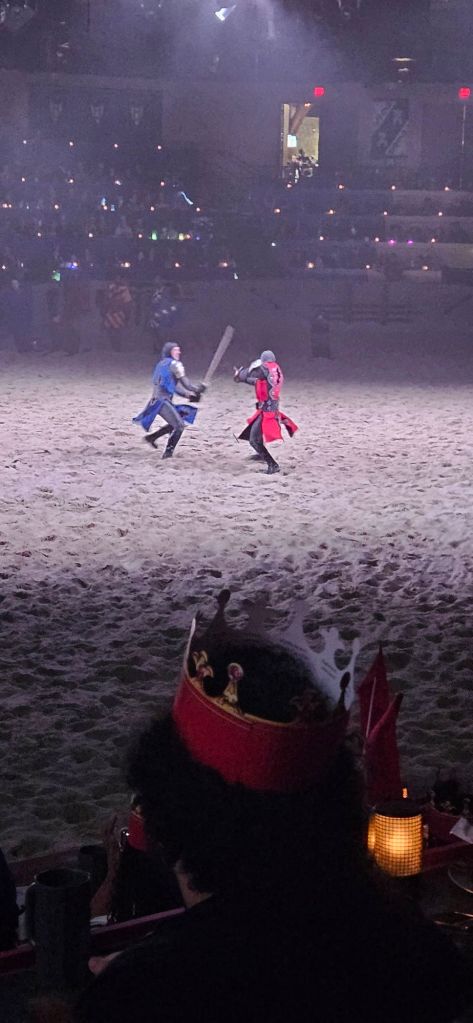
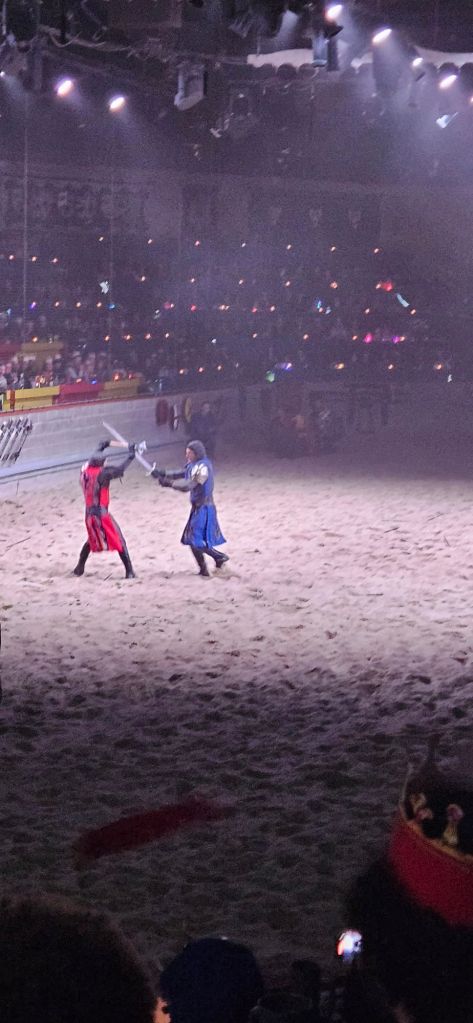
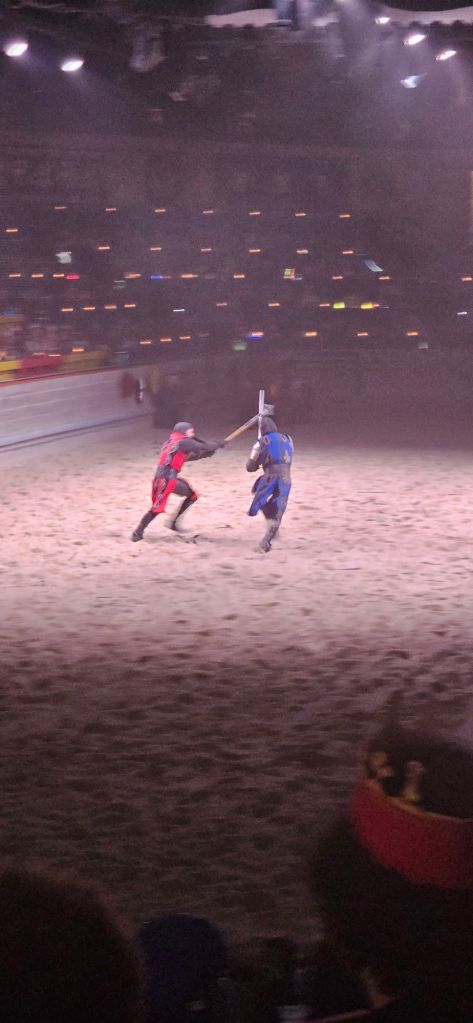
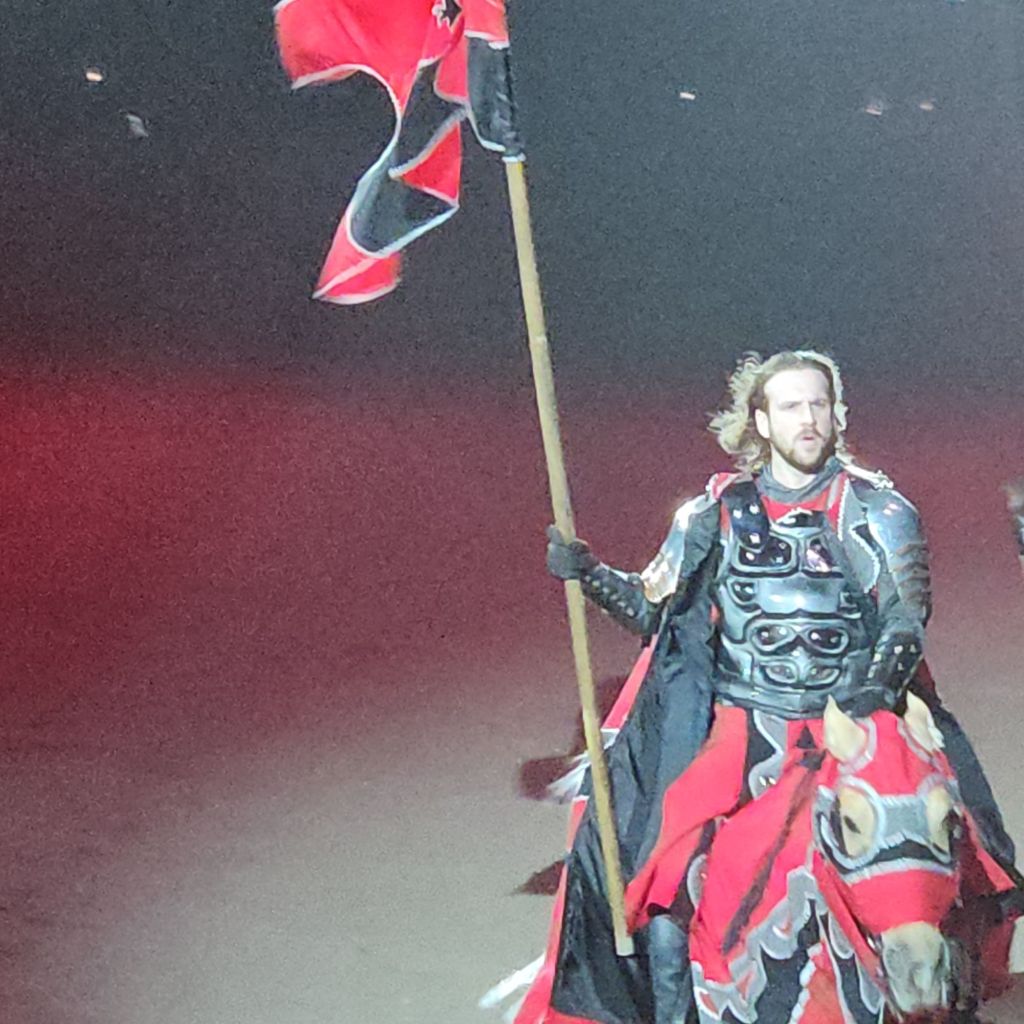
In the climax of the evening, the knights stopped fighting for sport, and started fighting for power! The Green Knight (as green with envy as his armor and horse), suddenly refused to dismount from his horse and began striking knights left and right. He then challenged the leadership of the king, threatening to rebel from the kingdom, along with his fellow knights! The king then decided to choose a champion to fight the Green Knight to the death! The Red Knight, (who as I mentioned before, represented my kingdom, and threw a rose as a favor to my family), picked up the glove of the envious Green Knight, thus signifying that he would be the champion, and fight for the fate of the kingdom!

Why the Green Knight?
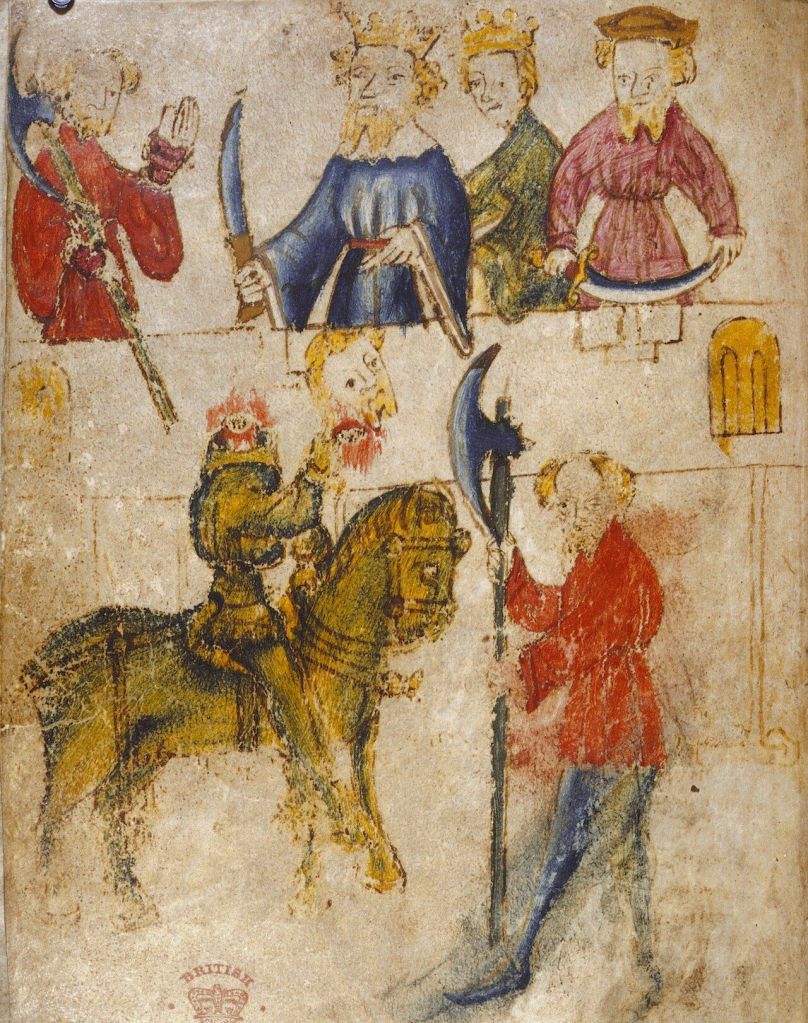
Illustration from Sir Gawain and the Green Knight, 14th century.

At the hall door comes a frightening figure,
He must have been taller than anyone in the world:
From the neck to the waist so huge and thick,
And his loins and limbs so long and massive,
That I would say he was half a giant on earth.
But more than anything
His color amazed them:
A bold knight riding,
The whole of him bright green. Sir Gawain and the Green Knight

In most (but not all) interviews and clips I’ve seen, the Green Knight is the bad guy- the one Knight whom almost everyone is supposed to root against. When I got home, I wondered why this was. After all, isn’t the black knight usually associated with villainy? My personal theory is that this is a subtle reference to the classic medieval story, Sir Gawain and the Green Knight. The eponymous Knight is supernaturally strong and able to even survive decapitation! He serves in the story, as the ultimate test for our young hero, Sir Gawain. I think the writers of Medieval Times definitely did their homework, making this Knight the antagonist.

The duel began on horses, but quickly changed to single combat on foot. They fought with axes, maces, and of course swords.

Even though dueling was a bloody and dangerous pastime, it has a long history that even kings couldn’t erase. Back in Anglo-Saxon times, private disputes, (such as the murder of one’s father) could be settled through means of a duel. In this period, England was occupied by the Danes, (which we would now call Vikings), and several Viking practices of judicial combat survive. For example, the Hólmgangan, an elaborate duel between two people who fight within the perimeter of a cloak. These kinds of fights continued throughout medieval Europe and, like Medieval Times Shakespeare knew their devastating dramatic potential.

At the end of Shakespeare’s Hamlet, the revenge cycle between Hamlet, Leartes, and Fortinbras, comes to a close using a duel. Hamlet has murdered Leartes’ father but Hamlet did not intentionally kill him. This kind of legal dispute would certainly have been settled with a duel in Saxon times. This is one reason why Leartes scorns Hamlet’s offer of forgiveness at the beginning of the scene, and instead trusts in the outcome of the fight to prove his cause. Hamlet and Leartes begin fighting officially under the terms of a friendly fencing match, but it becomes clear early on that at least in the mind of Leartes, this is actually a blood-combat. Laertes is demanding blood for the death of his father, and like the Green Knight, his fight will decide the fate of the Danish throne.

  • HamletCome for the third, Laertes! You but dally.
    Pray you pass with your best violence;
    I am afeard you make a wanton of me.
  • LaertesSay you so? Come on. Play.
  • OsricNothing neither way.
  • LaertesHave at you now!

[Laertes wounds Hamlet; then] in scuffling, they change rapiers, [and Hamlet wounds Laertes].

[Laertes falls.]

By the Renaissance, dueling was highly controlled by traditions of honor and fair play. As Laertes admits, poisoning Hamlet and fighting him to the death without his knowledge would be considered treason, and highly dishonorable. The Green Knight does every possible thing to make the audience see him as the villain with his lack of courtesy, dirty tricks, and disdain for the king and queen. He is so dishonorable that, even Americans, who have nothing but disdain for monarchy and in real life, value independence and self-sovereignty, would rather take the side of the monarch and his stooge the Red Knight over the Green Knight, just because he refuses to play fair.

The Weapons

What Would I Do Differently?

Sources:

Sources-

  1. Ur- Hamlet
  2. Lear source- Hollinshed’s Chronicles
  3. Tony Robinson’s Crime and Punishment: http://www.youtube.com/watch?v=2yz9VLkNHJU&feature=youtu.be
  4. Truth Of the Swordhttps://www.youtube.com/watch?v=vFL2ghH0RLs
  5. Secrets Of the VIking Sword http://youtu.be/nXbLyVpWsVM
  6. Ancient Inventions- War and Conflict http://youtu.be/IuyztjReB6A
  7. Terry Jones- Barbarians (the Savage Celts) https://www.youtube.com/watch?v=PSuizSkHpxI
  8.  Joe Martinez book

If you enjoyed this post, and would like to do some stage combat of your own, sign up for one of my history and stage combat classes on Outschool.com!

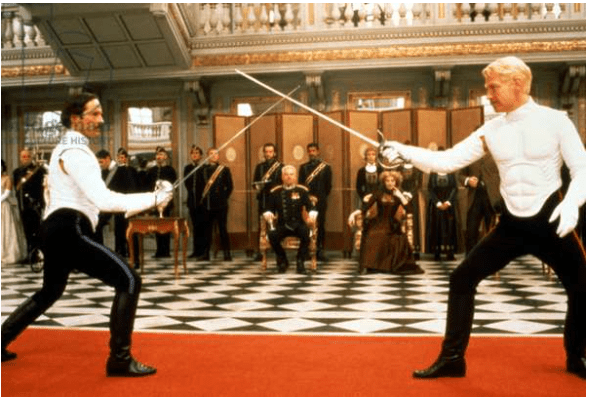
Title image for my Stage Combat Course

Duels in Hamlet

Hamlet Duel (1996)

Though Shakespeare’s Hamlet is very much the story of a renaissance prince, it’s important to remember that the play’s sources date back to the Dark Ages. The anonymous “UR-Hamlet,” (later published in the early 1590s ), is based on an ancient legend about a prince who fights to the death to revenge his father’s murder. Shakespeare’s adaptation still contains a nod to this ancient culture that praised and highly ritualized the concept of judicial combat.


Back in Anglo-Saxon times, private disputes, (such as the murder of one’s father) could be settled through means of a duel. In this period, England was occupied by the Danes, (which we would now call Vikings), and several Viking practices of judicial combat survive. For example, the Hólmgangan, an elaborate duel between two people who fight within the perimeter of a cloak.

At the end of Shakespeare’s Hamlet, the revenge cycle between Hamlet, Leartes, and Fortinbras, comes to a close using a duel. Hamlet has murdered Leartes’ father but Hamlet did not intentionally kill him. This kind of legal dispute would certainly have been settled with a duel in Saxon times. This is one reason why Leartes scorns Hamlet’s offer of forgiveness at the beginning of the scene, and instead trusts in the outcome of the fight to prove his cause. Hamlet and Leartes begin fighting officially under the terms of a friendly fencing match, but it becomes clear early on that at least in the mind of Leartes, this is actually a blood-combat. He is demanding blood for the death of his father, as the Danes would have done during the Anglo Saxon times when Shakespeare’s source play of Hamlet was written.

What happens in the fight

Olivier’s Sword Fight in Act V, Scene iii (1948).

The sword fight at the end of Hamlet is surprising in many ways. First of all, it is much more choreographed than many of Shakespeare’s other fights which are usually dramatized on the page very simply with two words: “They fight.” In Hamlet by contrast, Shakespeare has a series of important and descriptive stage directions. Furthermore, the fight is divided into three distinct bouts or phrases, or if you like “mini fights.” Below is the full text of the fight. I shall then explain what happens in each phrase.

PHrase One


Shakespeare it very clear that Hamlet gets a normal fencing rapier, while Leartes gets a sharp one, they fight one fencing bout where Hamlet scores a point. This is the most “sportsman like” part of the fight:

Enter King, Queen, Laertes, Osric, and Lords, with other

Attendants with foils and gauntlets.

A table and flagons of wine on it.

Claudius. Come, Hamlet, come, and take this hand from me.
[The King puts Laertes' hand into Hamlet's.]

Hamlet. Give me your pardon, sir. I have done you wrong;
But pardon't, as you are a gentleman.
Laertes. I am satisfied in nature,
Whose motive in this case should stir me most
To my revenge. But till that time
I do receive your offer'd love like love,
And will not wrong it.3890
Hamlet. I embrace it freely,
And will this brother's wager frankly play.
Give us the foils. Come on.
Laertes. Come, one for me.
Hamlet. I'll be your foil, Laertes. In mine ignorance3895
Your skill shall, like a star i' th' darkest night,
Stick fiery off indeed.
Laertes. You mock me, sir.
Hamlet. No, by this hand.
Claudius. Give them the foils, young Osric. Cousin Hamlet,3900
You know the wager?
Hamlet. Very well, my lord.
Your Grace has laid the odds o' th' weaker side.
Claudius. I do not fear it, I have seen you both;
But since he is better'd, we have therefore odds.3905
Laertes. This is too heavy; let me see another.
Hamlet. This likes me well. These foils have all a length?
They Prepare to play.

Osric. Ay, my good lord.
Claudius. Set me the stoups of wine upon that table.3910
If Hamlet give the first or second hit,
Or quit in answer of the third exchange,
Let all the battlements their ordnance fire;
The King shall drink to Hamlet's better breath,
And in the cup an union shall he throw3915
Richer than that which four successive kings
In Denmark's crown have worn. Give me the cups;
And let the kettle to the trumpet speak,
The trumpet to the cannoneer without,
The cannons to the heavens, the heaven to earth,3920
'Now the King drinks to Hamlet.' Come, begin.
And you the judges, bear a wary eye.
Hamlet. Come on, sir.
Laertes. Come, my lord. They play.
Hamlet. One.3925
Laertes. No.
Hamlet. Judgment!
Osric. A hit, a very palpable hit.
Laertes. Well, again!
Claudius. Stay, give me drink. Hamlet, this pearl is thine;3930
Here's to thy health.
[Drum; trumpets sound; a piece goes off [within].]
Give him the cup.
Hamlet. I'll play this bout first; set it by awhile.

Phrase Two

Mel Gibson in “Hamlet” (1990)
  • Claudius. Come. [They play.] Another hit. What say you?3935
  • LaertesA touch, a touch; I do confess’t.
  • ClaudiusOur son shall win.
  • GertrudeHe’s fat, and scant of breath.
    Here, Hamlet, take my napkin, rub thy brows.
    The Queen carouses to thy fortune, Hamlet.3940
  • HamletGood madam!
  • ClaudiusGertrude, do not drink.
  • GertrudeI will, my lord; I pray you pardon me. Drinks.
  • Claudius[aside] It is the poison’d cup; it is too late.
  • HamletI dare not drink yet, madam; by-and-by.3945
  • GertrudeCome, let me wipe thy face.
  • LaertesMy lord, I’ll hit him now.
  • ClaudiusI do not think’t.
  • Laertes[aside] And yet it is almost against my conscience.

Again, Hamlet gets the upper hand and scores a point. While his mother is celebrating his victory, she accidently drinks the poisoned cup that Claudius meant for Hamlet. Now Claudius is enraged, Laertes is angry because of losing the first two bouts, and Hamlet is blissfully unaware that he is in mortal danger.

Phrase Three

When Hamlet isn’t expecting it, Leartes wounds him with the poisoned sword. From there, the fight degenerates into a violent, bloody mess where Hamlet disarms Laertes, then stabs Leartes. After this, the Queen dies, and Hamlet kills Claudius:

  • HamletCome for the third, Laertes! You but dally.3950
    Pray you pass with your best violence;
    I am afeard you make a wanton of me.
  • LaertesSay you so? Come on. Play.
  • OsricNothing neither way.
  • LaertesHave at you now!3955

[Laertes wounds Hamlet; then] in scuffling, they change rapiers, [and Hamlet wounds Laertes].

  • ClaudiusPart them! They are incens’d.
  • HamletNay come! again! The Queen falls.
  • OsricLook to the Queen there, ho!
  • HoratioThey bleed on both sides. How is it, my lord?3960
  • OsricHow is’t, Laertes?
  • LaertesWhy, as a woodcock to mine own springe, Osric.I am justly kill’d with mine own treachery.
  • HamletHow does the Queen?
  • ClaudiusShe sounds to see them bleed.
  • GertrudeNo, no! the drink, the drink! O my dear Hamlet!3965
    The drink, the drink! I am poison’d. [Dies.]
  • HamletO villany! Ho! let the door be lock’d.
    Treachery! Seek it out.

[Laertes falls.]

  • LaertesIt is here, Hamlet. Hamlet, thou art slain;3970
    No medicine in the world can do thee good.
    In thee there is not half an hour of life.
    The treacherous instrument is in thy hand,
    Unbated and envenom’d. The foul practice
    Hath turn’d itself on me. Lo, here I lie,3975
    Never to rise again. Thy mother’s poison’d.
    I can no more. The King, the King’s to blame.
  • HamletThe point envenom’d too?
    Then, venom, to thy work. Hurts the King.
  • AllTreason! treason!3980
  • ClaudiusO, yet defend me, friends! I am but hurt.
  • HamletHere, thou incestuous, murd’rous, damned Dane,
    Drink off this potion! Is thy union here?
    Follow my mother. King dies.

God’s providence in Hamlet (or lack therEof)

It is telling that everyone dies in this scene, which indicates that the concept of providence seems somewhat ambiguous in this scene- yes, Claudius dies but so does Hamlet. In addition, Leartes dies justly for his own treachery as he claims, but he also tries to avoid damnation. Leartes is guilty of treason for killing Hamlet, but Hamlet is guilty of killing an old man and a young maid, so Leartes asks God to forgive Hamlet for two murders, while he has only committed one. Providence doesn’t seem clear which crimes are worse. Further, Providence fails to reveal the guilt or innocence of Queen Gertrude- did she know her second husband murdered her first? Did she support Hamlet’s banishment? Did she know the cup was poisoned, and is therefore guilty of suicide, or was she ignorant and punished by fate for her adultery and incest? Knowing the conventions of judicial combat help the reader understand the compex world of Hamlet, a world devoid of easy answers.

How Would I Stage the Fight?

Phrase 1
I want the two combatants to start en guarde, their blades touching, then there will be a series of attacks on the blade.
Hamlet will advance and attack the low line of Leartes’ sword
Hamlet will advance and attack the high line of Leartes’ sword
Leartes will advance and beat attack the high line of Hamlet’s sword
Leartes will advance and attack the low line of Hamlet’s sword

Hamlet performs a bind on Leartes’ sword, sending it off on a diagonal high line.
Hamlet attacks Leartes leg and Leartes will react in mild pain.

Phrase 2
Leartes is no longer fighting in polite manner, so this will be the real fight where he’s actually going for targets
Hamlet and Leartes come together and bow,
Both go into en guarde and Osric signals the start of the fight.
Hamlet attacks Leartes’ blade high
Leartes attacks Hamlet’s blade low
Leartes suddenly does a moulinet and attacks Hamlet’s right arm. Hamlet does a pass back and parries 3
Leartes attacks Hamlet’s Left Arm. Hamlet does another pass back and parries 4
Leartes cuts for Hamlet’s head. Hamlet passes back and does a hanging parry 6, which causes the sword to slide off.
Hamlet ripostes, slips around Leartes’ ________side, and thrusts offline in suppination. He then flicks the sword, hiting the back of Leartes’ knee.
Phrase 3
Concern- you need to have enough space for Hamlet to chase Leartes DS, and for Leartes to slice Hamlet with the forte of his sword.
Before the bout is supposed to start, Hamlet walks toward the sword, point down to Leartes US L or USR
“I am afeard you make a wanton of me”
Leartes: “You mock me sir!”
Hamlet: “No, by this hand”
Hamlet presents his hand. Leartes places his sword on it, and slices it
Leartes gives Hamlet a stomach punch
Hamlet falls to his knees dropping the sword. If necessary, Hamlet can pull out a blood pack to put on his hand.

Leartes points his blade above Hamlet’s head, then brings it back, preparing to strike off Hamlet’s head.
Leartes: “Have at you now”
Hamlet ducks to the right, with his leg extended.
Leartes Passes forward, trips on Hamlet’s leg. Hamlet does a slip and goes behind Leartes’ back.
Hamlet rabbit punches Leartes on the back, picks up Leartes’ sword, noticing the blood on it
Leartes slowly rises, then notices Hamlet with his sword, he quickly grabs Hamlet’s weapon
Hamlet shoves Leartes DS into a corp a corp, then traps Leartes’ blade
The two push each other for a while

Osric: “Nothing Neither way”
Hamlet pushes Leartes downstage, then slices him across the back.
Leartes stops DS, and falls to the ground

Murder of Claudius
If Claudius is standing, we can have Horatio grab the king around the neck, Hamlet places the sword across Claudius’ stomach, and slices him.
If Claudius is seated, Hamlet picks up the goblet with one hand, slices the king’s leg, then, (after establishing a good distance), Hamlet points the blade off line, just left of Claudius’ neck. Hamlet is giving Claudius a choice- drink or be stabbed. When Claudius chooses to drink, either Hamlet or Horatio can give him the cup. If Horatio gives it to Claudius, it might give him the idea to die later.

Sources:

Sources-

  1. Ur- Hamlet
  2. Lear source- Hollinshed’s Chronicles
  3. Holm ganner
  4. JSTOR
  5. Dr. Cole
  6. Bf paper on duels
  7. Tony Robinson’s Crime and Punishment: http://www.youtube.com/watch?v=2yz9VLkNHJU&feature=youtu.be
  8. Truth Of the Swordhttps://www.youtube.com/watch?v=vFL2ghH0RLs
  9. Secrets Of the VIking Sword http://youtu.be/nXbLyVpWsVM
  10. Ancient Inventions- War and Conflict http://youtu.be/IuyztjReB6A
  11. Terry Jones- Barbarians (the Savage Celts) https://www.youtube.com/watch?v=PSuizSkHpxI
  12.  Joe Martinez book

If you enjoyed this post, and would like to do some stage combat of your own, sign up for one of my stage combat classes on Outschool.com!

Title image for my Stage Combat Course