Trailer for Globe Theater’s 2021 production of A Midsummer Night’s Dream
What do you think of when you think of “Shakespeare?” What do you think of when you think of “A Midsummer Night’s Dream?”
Ruffs and Tights?
Mostly white dudes?
Elizabethan music?
Dark night and moon?
This production, directed by Michelle Terry, is gleefully throwing out every preconceived notion of what A Midsummer Night’s Dream can or should be. In terms of design, casting, music, and interpretation, it breaks all the rules, while still remaining true to the text. This allows the production to appeal to not only hard-core Shakespeare fans, but first time audiences and children too!
I would describe the concept behind the show as “Suggestive,” that is, it doesn’t belong to a literal time and place. Even though the play is set in Ancient Greece, the play refuses to be constrained by historical accuracy, which arguably, fits nicely with Shakespeare in particular, and the Globe itself; a modern building in a modern city, based on a 400-year-old building.
The music and costumes evoke a New Orleans Mardis Gras, a Pride parade, or a Spanish pinata with its bright colors, heavy use of fringes, and bright, energetic jazz music. The only people who don’t wear bright colors are the four lovers, which reflects their continuous frustration with being unable to marry the person they really want.
The show is also Color blind and gender blind, with women playing men’s parts and a cast with black, white, and mixed race actors. Terry’s direction also calls attention to the patriarchial, racist, and sexist elements of Athens which are often overlooked in other interpretations of Dream that I’ve seen or read about. Rather than being a hero, Theseus is a horny old man in a ludicrous pink uniform, looking like a cross between M. Bison and a Christmas nutcracker. To reinforce this point, the actor chose to perform one of Theseus’ most patriarchial speeches as a joke:
Theseus. What say you, Hermia? be advised fair maid:50
To you your father should be as a god;
One that composed your beauties, yea, and one
To whom you are but as a form in wax
By him imprinted and within his power
To leave the figure or disfigure it. -Midsummer Night's Dream, Act I, Scene i.
I’ve seen this speech heavily cut and played seriously, but never till now did I see it played to ridicule the ludicrous notion that women are in any way bound to worship their fathers.
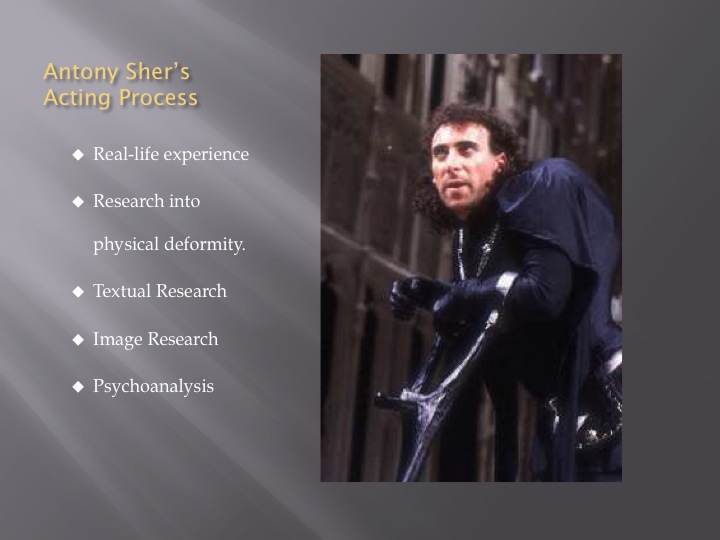
In another nod to contemporary gender politics, the actress who plays Hippolyta and Titania chose to perform her role on crutches. As far as I can tell, this was a deliberate choice and not a result of real injury. There is a precedent for this: In 1984, Sir Antony Sher performed Richard iii on crutches because it highlighted the cruelty people with disabilities often suffer.
I could be wrong, but I think that the reason the actress was on crutches was a symbolic way of confronting the way gender politics can cripple women.
Many scholars have pointed out how Hippolyta rarely speaks despite the fact that she is supposed to be the powerful Queen of the Amazons, and Theseus’ fiance besides. Shakespeare makes it clear that their marriage was arranged as a political alliance after the Amazons lost to Athens in a war:
Hippolyta, I woo'd thee with my sword,
And won thy love, doing thee injuries;20
But I will wed thee in another key,
With pomp, with triumph and with revelling.
With this in mind, it makes sense to have Hippolyta on crutches as a result of her injuries. Those injuries might also explain her silence; she has lost her agency now that she is essentially Theseus’ prisoner. One might think of any number of war atrocious where women have been sold to powerful men over the centuries. In short, by putting Hippolyta on crutches, we see a glimpse into her tragic story that most productions just gloss over- that she has lost a war, been separated from her people, and is now her enemies’ prisoner through marriage.
I’ve come to expect high quality acting from The Globe Theater Company and this cast did not disappoint. As we watched it together, my family concluded that this was one of the best acted productions of Dream that we’ve ever seen, which between us has to be over 30 plus productions.
The delivery is crisp and fast paced. Every actor has taken these words and made them their own. They speak them as if they were written yesterday. One thing I love about the Globe is that the directors encourage this kind of fast paced delivery; with no distracting special effects or sets, the actors have to captivate the audience with their delivery of Shakespeare’s text, without being melodramatic or self-indulgent. I’m pleased to say that this cast does a fantastic job of telling this magical story in a compelling and very modern way.
I’ve shown my recording to kids, teens, adults, and my family, and everyone has a different reaction to the show. Maybe this isn’t quite your cup of tea, but the concept is sound, the acting is high caliber, and it utilizes the Globe’s unique qualities extremely well.
I personally didn’t care for Bottom just because I felt the actress was playing a very energetic part with too much sarcasm and tongue in cheek, but that’s mostly personal preference. I did however love Peter Quince, Snout, Snug, and the rest of the Mechanicals. Peter Quince is a rather thankless part but it’s great to see someone balance being a straight man trying to reign in Bottom’s antics. and an idiot who has no idea how to direct a company of actors, which the actress playing Quince did very well.
Steve Bannon, the man I’ve described in the past as Buckingham to Trump’s Richard III, is once again in the news. He’s been charged with criminal contempt for refusing to cooperate with the Senate with the January 6th commission.
Bannon, the former head of Breitbart news, and Former President Trump’s former chief strategist, has long been a controversial figure with his extreme right wing views on immigration, race, and politics in general.
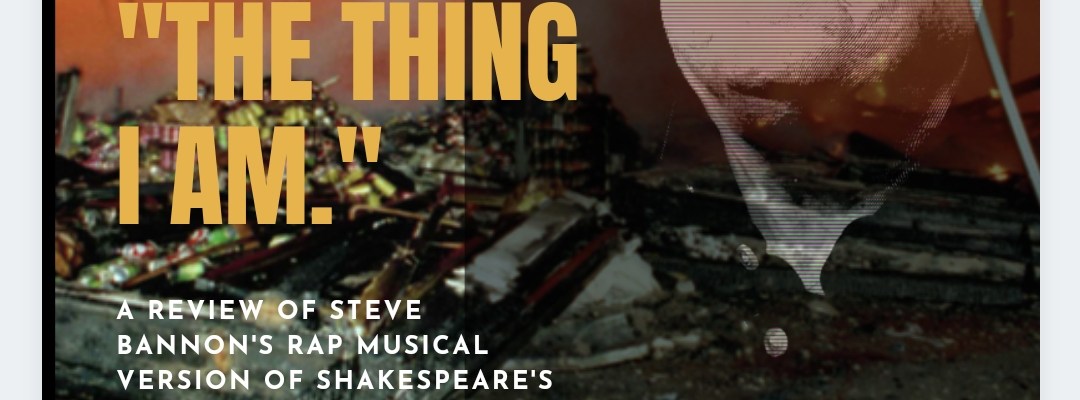
One thing many people might not know about Bannon though, is that before he was a publisher and a politician, he was an aspiring writer in Hollywood, and in the late 1990s, Bannon wrote, “The Thing I Am,” a rap-musical version of Shakespeare’s Roman tragedy “Coriolanus.”
What Is Coriolanus?
Coriolanus is one of Shakespeare’s most obscure tragedies, but arguably, one of his most fascinating ones. It’s the only play set in republican Rome, so it’s the only Shakespeare play that deals with issues of democracy. The play starts with a riot where poor Romans are complaining about grain shortages, loudly condemning rich landowners who are hoarding grain while they starve. Ironically, Shakespeare wrote this at the same time when he himself was guilty of hoarding grain during a shortage, and tensions were so high that some farmers called for people like him to be “hanged on their own gibbit.”
The play has been called fascist, communist, democratic, republican, and monarchist. It’s main character is a Roman general who wants to be consul, (a high governmental position in the Senate), despite the fact that he hates the common people. Like Julius Caesar, it raises interesting questions about who should be in charge of our society, without prescribing an answer, (which would have been impossible for Shakespeare living in Jacobean England). In the play’s most famous scene, Coriolanus finally bursts out and rails against the commoners for their ignorance and their distrust of other would-be millitary dictators:
A review of Bannon’s Show:
Bannon updated the text and set it in Los Angelos during the riots of 1992, which if you remember, were protests to the earlier police brutality trial over the death of Rodney King.
The show was never produced, though a staged reading of the text was held in 2016. I was unable to find it on Youtube, but I did find a link to a video on Facebook under Now This Politics. The full reading is here:
They say! F#$% they! They hang out shooting pool and think they know what’s going down – who’s up, who’s out, who bounds, and if there’s crack enough. If I had my way, I’d make a quarry of these slaves.”
Whoever deserves greatness, wants their hate. Peep game, boy. To count on them for favors is to swim with fins of lead.”
“So f#$% you! Trust you? Ha! With each passing minute, you change your common mind. You call him noble that was once your enemy, then dis your king. You cry against the “other” – crackers, Blood, Crip, popo, Pol, the rich – it don’t matter, n!@$; awe keeps you feeding each another.”
I never knew the ‘racist Steve’ that’s being reported now,” Jones told The Daily Beast last year. “I never heard him make any racist jokes, and his best friend was an African-American who went to [college] with him… I never saw even a hint of racism.
“But I did see this elitism… He would always look down on poor people of any color. At one point, he told me that only people who own property should vote. -Julia Jones (Bannon’s Co writer)
The Cast included Rob Corddrey, Kate Berlant, Jordan Black, and Cedric Yarborough.
The subject matter is poorly handled and the way it treats the LA riots is at best, a historically inaccurate attempt for Bannon to play ‘white savior’ to a group he considers inferior, and at worst, a call to action for racists to imprison and oppress the black residents of LA.
The riots were not a war, they were a result of a protest. Instead of addressing the Rodney King trial which was the cause of the riots, Bannon focuses on the ‘war’ between the Crips and the Bloods, saying the riot was a result of this war.
If you read Breitbarts article about the riot, (and I don’t recommend it), it is described like a war. It’s the same war conservative pundits are continually trying to convince us is coming- a race war between ‘gangs’, ‘immigrants,’ and the politicians who enable them, who don’t want you to defend yourself.
The opinion piece I read found it ironic that Bannon makes Coriolanus the leader of the Crips, but if you look at his politics, It’s clear why- Bannon is attracted to masculine violence and his base of violent, predominantly white males see modern life as a culture war between them and the rest of the world. His Coriolanus is a BAMF who defends himself with his gun . A politician or a policeman ♂️ would have someone to answer to (more like Shakespeare’s Coriolanus,) but Bannon’s Martus has no restaint and can indulge his violent tendencies in the lawless hellscape of LA.
It should be noted that Bannon is clearly not speaking from experience or research, merely his ugly stereotypes of black gang members that he got from reading his biased Brietbart articles. Though the hero is black, the dog whistle racism is still there- these people are out to get you, and even though they have guts, they are a threat to “civilization.”
This video is part of my Outschool course “Macbeth: An Immersive Horror Experience.” I use it to explain the plot of the play before playing a game and an escape room to test the student’s knowledge. Let me know in the comments what you think of it, and if you like it, please consider signing up for the course on Outschool.com
Just in time for October, I’m offering an online class for kids ages 13-18 about Shakespeare’s most spooky and cursed play:
If you follow this blog you know I’ve written a lot about this play before. Though this class will be more like a game where I teach the class using multimedia, games, and a digital escape room!
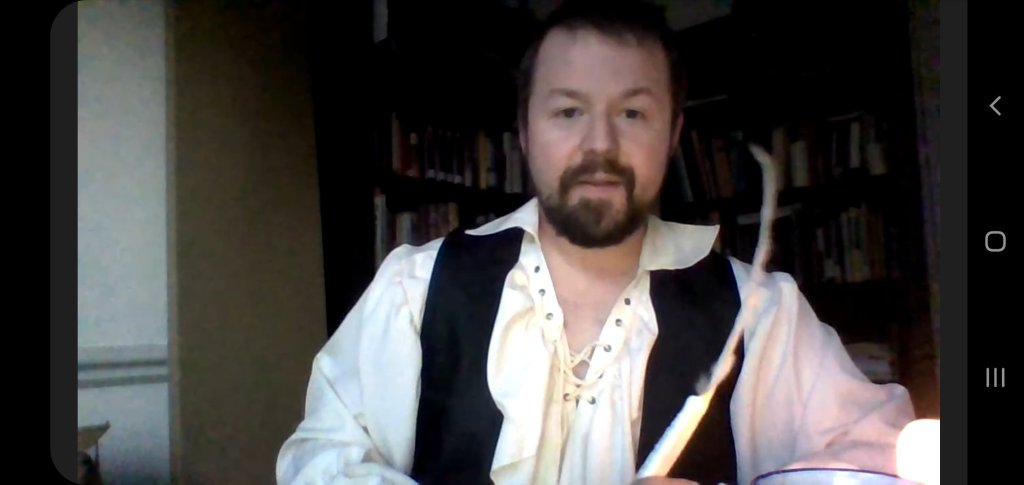
Me in my Shakespeare gatb
I’ll start by speaking to the students in character as Shakespeare, and tell them the story of Macbeth using a multimedia presentation.
I will then test the students’ knowledge with a fun quiz that was inspired by the popular mobile game Among Us. As you know, the game is similar to a scene from the play, so I thought it would be an appropriate way to test the kids’ knowledge.
Screenshot from the Gimkit game “Trust No One.” Like Among Us, players need to figure out who the Imposter is, but they greatly increase the chances of surviving if they answer the quiz questions correctly.
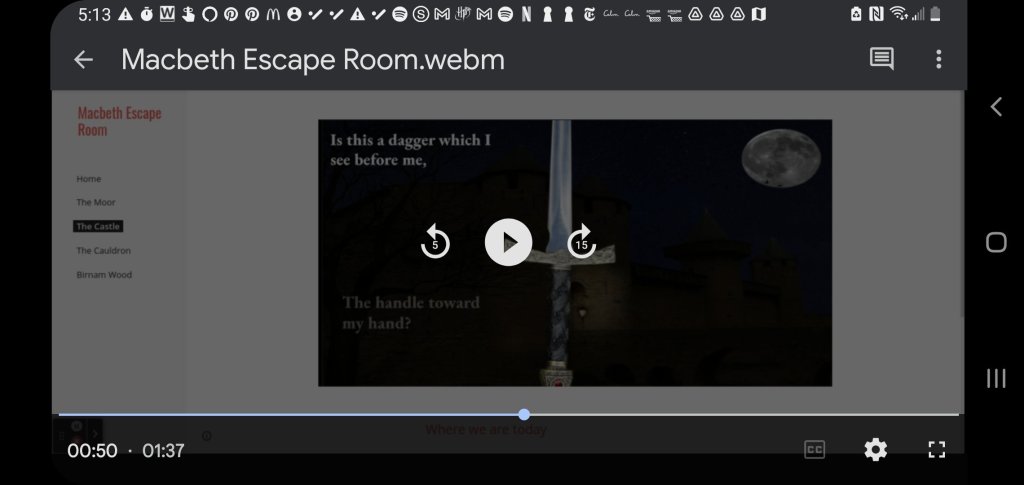
The final part of the class is a digital escape room I’ve created. I don’t want to give too much away, and you can’t play it unless you sign up for the class, but let’s just say it’s fun, spooky, educational, and challenging!
Screenshot from my Macbeth Escape Room.
If you want to sign up now, the course is available every weekend in October, and then by request after that. Register now at Outschool.com. if you take the course, please leave me a good review.
Trailer for my 2021 Acting course via Outschool.com
I’ve been working on a remote learning class for Outschool.com where I take some of the audition advice I wrote in Creating A Character: Macbeth, and some of the other acting posts I’ve published over the years. This will be a weekly virtual acting course for kids ages 13-18, starting September 12th at 10AM EST.
This class will outline the tools and techniques of Shakespearean acting such as projection, articulation, and imagination. Each We’ll also go over Shakespeare’s own advice on acting in his play “Hamlet: Prince of Denmark.” The course will culminate with the students choosing their own Shakespearean monologues and scenes, which they can use going forward in auditions, school plays, and classes.
The best thing about the course is that each week builds on the previous week’s experience, but you don’t need to go to all of them. I’ll be flexible and work with the student’s schedule so everyone gets as much out of the class as possible.
If you’re interested in signing up, go to Outschool.com. If you have any questions, email me by clicking here:
If you’re a teacher and your students are reading Romeoand Juliet, one question that your students might innevitably ask is, who’s to blame? The play ends with The Prince and the Watch trying to ascertain what happened over the past 5 days to Romeo and Juliet. He seems to place blame loosely on everyone, but it does make one wonder- will anyone face consequences for the numerous deaths, damages, anguish, and broken promises that resulted from the double suicides?
In 2021, I decided to create an activity that would allow the students in the English class I worked in to decide who is to blame for the deaths of Romeo and Juliet. I developed the project with the help of an English teacher and a real judge. We designed the project so it would test the kids’ knowledge of the play, and their persuassive speaking abilities (which we worked on in a previous unit).
I would like to share the journey of this project, which I think is a lovely way to get kids to engage with English Literature, as well as touching on other topics in high school English courses like persuassive writing, critical thinking, and research.
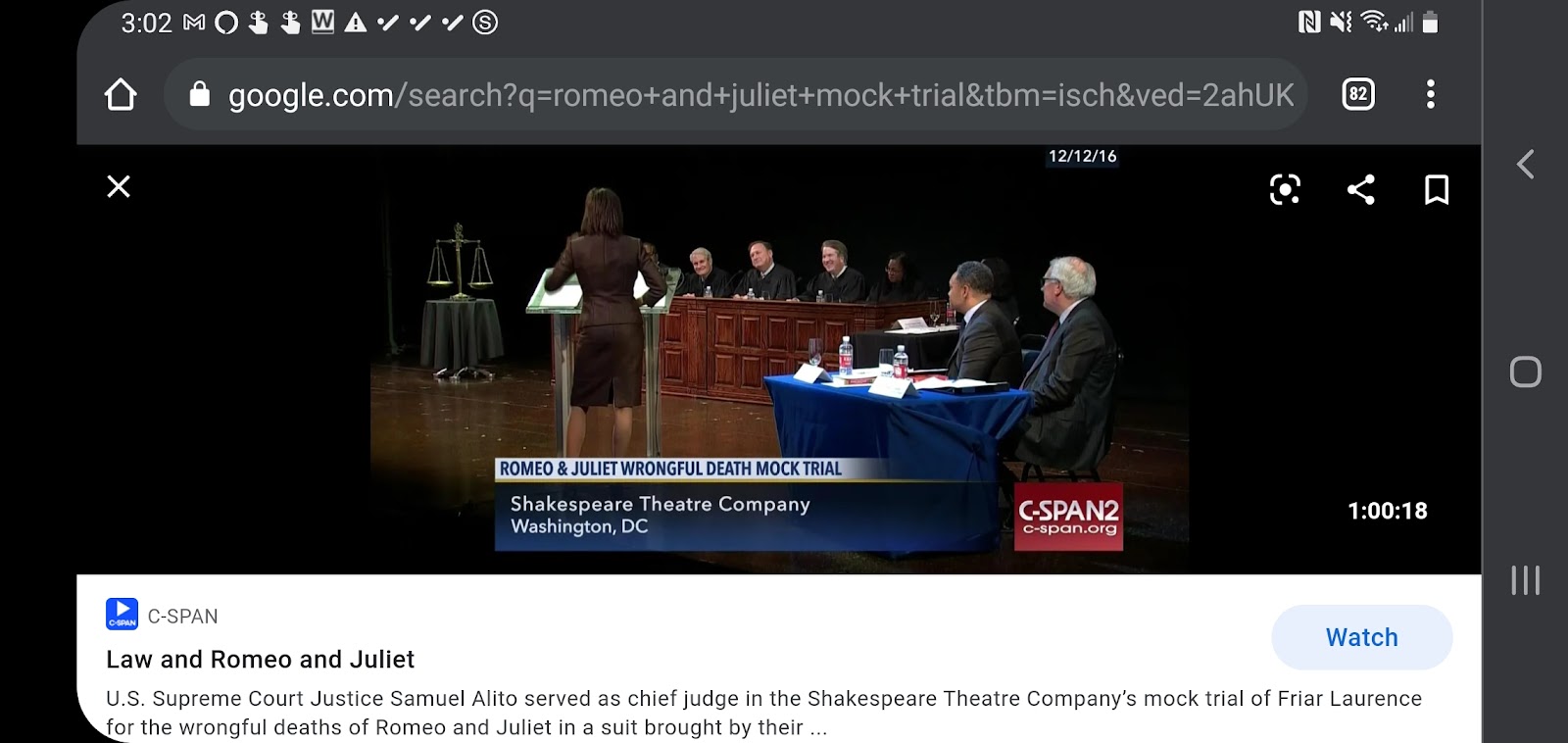
My original idea was to put Friar Laurence on trial for criminal negligence and/ or conspiracy to assist a suicide, There’s been plenty of classrooms, comedy sketches, and even some juries that blame Friar Laurence for the deaths of Romeo and Juliet, including the US Supreme Court, who put him in the dock as part of a mock trial at the Shakespeare Theater in Washington DC bac in 2016. If you go to C-Span’s website, you can watch the full trial itself: https://www.c-span.org/video/?419930-1/federal-judges-discuss-romeo-juliet
Though mock trials have tried Friar Laurence for murder in the past, the teacher I worked with decided we wanted to be sensitive to the issue of suicide and not place the blame for suicide on anyone other than Romeo and Juliet. This is a valid concern- since teenagers do occassionaly encounter suicide, we didn’t want to suggest that anyone could be held responsible for someone else’s suicide. However, if you decide to have a criminal murder or manslaughter trial, you can do so.
Our trial chose to focus on a different sort of negligence: we noted that, although Friar Laurence arguably isn’t guilty of murder, he certainly did perform the wedding of two minors without parental consent, a wedding that their parents absolutely didn’t apprve of, and that arguably caused irreperable financial damages to the houses of Capulet and Montegue. I therefore went about consstructing a criminal trial based on this perceived negligence.
TheCRIMINAL PROHIBITIONS ON THE MARRIAGE OF MINORS ACT
In most states in the United states, parental consent is required to marry a minor, so in reality, Friar Laurence would almost certainly be found guilty of illegal marriage. The judge I worked with wanted to give the case a fighting chance, so she created a fae law that is just for our class called the CRIMINAL PROHIBITIONS ON THE MARRIAGE OF MINORS ACT, which you can read below. This law is designed to provide a loophole for Friar Laurence that allows a clergyman to perform a minor wedding without parental consent if the parents are themselves creating an unsafe and dangerous home. Our teacher liked this aspect of the case, becasue it allows the class to consider the partriarchial values of Lord Capulet, who for most of the play, treats his daugher like a piece of property, and threatens her with dire consequences if she chooses her own husband. This is the central argument of the trial- Was Friar Laurence negligent and irresponsible in marrying Romeo and Juliet, or was he respecting Juliet’s autonomy and trying to free her from an abusive household? Below is a complete description of the project, a presentation I created for the class, and some downloadable materials to get you started. If you have questions or suggestions for other projects, let me know!
Overview
A mock trial is an excellent way to engage a student’s critical thinking skills, persuasive writing skills, and challenge their knowledge of a sequence of events. In Shakespeare’s Romeo and Juliet, several violent deaths occur and at then end of the play it’s ambiguous who will be punished and how. Therefore, to engage students in the play, they can play judge, jury, and lawyers in a trial to answer the question: was Friar Laurence guilty of performing an illegal marriage?
Goals
Test the student’s knowledge of the plot of the play
Get them to make persuasive arguments defending and prosecuting the character of Friar Lawrence.
Come to conclusions
Get the Jury to look at the rhetoric of the prosecution and defense.
Structure
Quiz on the play to help assign roles- The highest scorers get to be lawyers and prosecutor, the next highest get to be witnesses, and the lowest scorers get to be the jury.
Mock trial where the students take on the roles of witnesses, judge, lawyer, prosecutor, and jury
The Jury delivers a verdict
Class discussion.
Before the Trial
Only people who know the plot of the play should be allowed to be the lawyers, so I propose that before the trial starts, each student should be quizzed on the plot of the play. The students who score the highest should be allowed to play the prosecutor and defense lawyer. The third, fourth, and fifth highest scoring students can be The Judge and the two witnesses. Everyone else can be the jury. I would propose that the teacher or teaching assistant play the part of Friar Lawrence, as he/she will have to answer the toughest questions and know the most about the play. Of course, if you have a student with real acting talent, he or she can play Friar Lawrence.
The Trial will take place over at least two days- one day for constructing legal arguments, and one day for the trial itself.
When the trial begins, each person will get a character sheet that details who they are, what their role is, in the trial, and what they know about the deaths of Romeo and Juliet. Unlike other mock trials, this will not be scripted. Think of it more like a D&D character sheet or murder mystery game; the characters are given information but not told what to say. Below is a sample character sheet I made for the Prosecuting Attorney.
The Prosecutor intends to prove that Friar Lawrence performed an illegal marriage because he married two minors without their parent’s consent. The Defense intends to prove that the marriage was legal under the CRIMINAL PROHIBITIONS ON THE MARRIAGE OF MINORS ACT (a fake law made up for our class).
Jury Instructions- The Judge
Opening Statements- Prosecutor and Defense Lawyer
Witness For the Prosecution- Lord Capulet
Cross-Examination- Lord Capulet
Witness For the Defense- Ghost Juliet
Witness For the Prosecution- The Nurse
Cross-Examination- The Nurse
Defendant’s Testimony- Friar Lawrence
Cross-Examination- Friar Lawrence
Witness For the Prosecution- Lady Capulet
Cross-Examination- Lady Capulet
Closing Statements- Prosecutor and Defense Lawyer
Post Trial Instructions- Judge
The Verdict- Jury
Weighing In- Judge
Worksheet content-
All characters will have a packet explaining who they are, their goal for the trial, and what their character knows about the alleged crime. They also have a copy of the structure of the trial, so they know when to speak. During the pre-trial prep day, the lawyers will decide on questions to ask the witnesses and construct arguments based on their knowledge of the law and the play.
-Friar Lawrence
-The Nurse
-Lord Capulet
-Prosecutor
-Defense Lawyer
-Jury
-Judge
Everyone will receive a copy of the CRIMINAL PROHIBITIONS ON THE MARRIAGE OF MINORS so the prosecution and jury can construct their arguments, and the Jury can judge the effectiveness of those arguments.
CRIMINAL PROHIBITIONS ON THE MARRIAGE OF MINORS ACT
Purpose
The purpose of this act is to protect the integrity of the family and the independent rights of minor children.
Prohibitions:
No officiant shall perform the marriage of a minor child without the consent of the child’s parent, unless such minor child has first been determined to be emancipated and such determination was in the minor’s best interest.
Definitions:
Officiant means a person authorized to perform weddings, including but not limited to a priest, minister, friar or pastor.
Minor child means a person 14 years but under the age of 18 years.
The parent of a minor child shall mean the biological father of said child.
The factors used in the determination of emancipation shall include the following;
The demonstrated ability and capacity to manage his/her own affairs,
The demonstrated ability and capacity to live independently,
The wishes of the minor child,
The wishes of the parent,
Any other factors including compensation which could influence the officiant.
7) The factors used in the determination of the best interest of the minor child shall include the following:
The age of the minor child,
The home environment of the minor child, especially if there is a risk of violence or harm to the minor child,
Whether the marriage of the child promotes a union that is beneficial to society,
Whether the minor child can manage his/her own finances.
Whether the minor child has demonstrated other characteristics of maturity
8) An emancipated child shall be entitled to enter into contracts, marry and enjoy the legal rights of an adult without the permission of his/her parent.
9) Whoever violates this law shall be guilty of a misdemeanor of the first degree, which is punishable by up to 6 months in jail and/or a $1,000 fine.
Jury instructions (to be handed out ot the jury)
The jury need not be given a passive role- they can write down reactions on how effective the lawyers wer in presenting their arguments, which witness gave the best testimony, etc. In most jury trials, judges instruct the jury on how to put aside their personal biases when listening to the evidence, which I’ve written into some instructions below, based on instructions that Judge Taylor gave me.
So, that is my version of the Romeo and Juliet mock trial that you can freely use in your classroom. If you want to use it, please just give me credit. If you want to collaborate with me on your version, send me an email. I hope this project can be a widespread activity that will help students hone their persuasion, analysis, research, and of course, their interpretation of literature in a realistic context.
You can download the entire project for free on my TeachersPayTeachers page:
“She’s got…it, hasn’t she? The pestilence?” (O’Farrell, 105). As this quote, (and the subtitle) suggests, Maggie O’Farrell’s novel Hamnet: A Novel About the Plague, focuses on the terror surrounding the plague and its devastating consequences on families. I really respect this book for its historical authenticity, it’s clever prose, and O’Farrell’s command of style, but I should warn you that this novel is definitely not for breezy summer reading.
If you are looking for a novel about William Shakespeare, this isn’t it; the Bard only appears in flashbacks. The action mainly concerns his wife and children. While Will was living and working in London for most of the year, his family lived in Stratford Upon Avon, along with the playwright’s mother and father. The novel has follows the characters across two times: 1582, when Shakespeare and his wife first met, courted and married, and around 1595, during an outbreak of plague that would (Spoiler Alert) eventually claim the life of Shakespeare’s son, Hamnet.
Drawing of Shakespeare and his family. Hamlet and Judith are on his right, his other daughter Susanna and his wife Anne are on his left.
The novel has a very dour tone, but that is by design. The author herself writes that the premise of the book was to create a realistic (albeit fictional) account of the Shakespeare family as their only son fell sick and died.
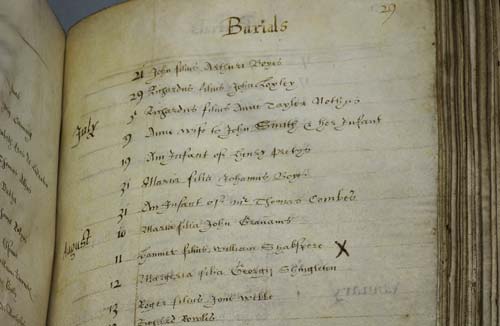
Burial records for the town of Stratford Upon Avon for 1596. On August 11, it records the death of Hamnet Shakespeare, William’s only son
The premise is intriguing from a historical point of view. We have no diaries or correspondence that express how the Shakespeares dealt with this catastrophic loss, but many scholars believe that Shakespeare’s play Hamlet was a direct homage to his son, since in Elizabethan England the names Hamlet and Hamnet were used interchangeably. Still, it must have effected Will in other ways, and it had to have had an effect on Hamnet’s mother and sisters, and that was O’Farrell’s focus when adapting this story as a novel.
I would describe the novel’s tone as ‘haunting,’ which is appropriate since it’s based around how a child’s death effected his family. It reminds me of a passage Shakespeare himself wrote about the death of a young boy in his play King John:
Grief fills the room up of my absent child,
Lies in his bed, walks up and down with me,
Puts on his pretty looks, repeats his words,
Remembers me of all his gracious parts,
Stuffs out his vacant garments with his form;
Then, have I reason to be fond of grief?
Fare you well: had you such a loss as I,
I could give better comfort than you do.
I will not keep this form upon my head,
When there is such disorder in my wit.
O Lord! my boy, my Arthur, my fair son!
My life, my joy, my food, my all the world!
My widow-comfort, and my sorrows' cure! King John Act III, Scene iv.
Like Constance in the quote above,, All the characters in Hamnet are haunted. [Hamnet is pursued by plague. Will Shakespeare and Anne Hathaway are haunted by their abusive parents. Will’s father John by the loss of his business and social standing, and of course, everyone is haunted by Hamnet’s death.
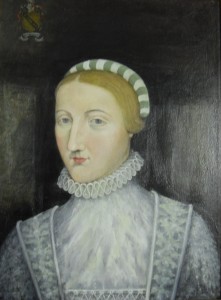
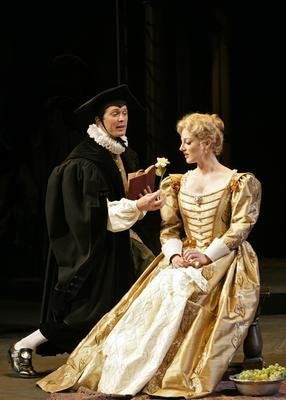
Artist’s restored version of a Elizabethan woman, believed to be Anne Hathaway.Lucentio and Bianca (The Taming of the Shrew, Oregon Shakespeare Festival, 2007)
Although the novel is mainly about Hamnet’s decline and death, my favorite parts of the book are flashbacks to the courtship and marriage of Will Shakespeare and Anne Hathaway. We know nothing about their real courtship, so O’Farrell borrows the plot from Shakespeare’s Taming Of the Shrew. Like Lucentio in Shrew, The 18 year old William Shakespeare is a Latin tutor, (having not yet become a writer), who woos a misunderstood woman whom the town calls a shrew. In the book, Anne Hathaway is known as Agnes and (like many unmarried women of the period), is looked on as odd and somewhat wild. Many single women of this period would likely face discrimination, and sometimes. In this video, you can see how cunning women like Anne had an uneasy relationship with the local community; some saw them as an asset to the community, but others believed their abilities came from The Devil. For more information on Anne’s life, click here.
The History Guy- Witch Trials in the 16th and 17th centuries.
Anne is further isolated because of her strange abilities- in the book she owns a falcon, not a ladylike hobby for 1580s England. She is also skilled with medicinal plants and knows how to read palms. In essence, though the town ostracizes Anne, Shakespeare admires her cleverness, and the book implies that Shakespeare would later use her skills in characters like Kate from Shrew, Friar Lawrence (the skilled potion master), and maybe even the witches from Macbeth.
The reusing of Shakespeare’s plots doesn’t stop there- Before Anne and Will get married they are handfasted- that is they make a mutual promise to get married in front of witnesses. Anne knows that her family will not consent to their marriage given Shakespeare’s low economic prospects, so she convinces Will to get her pregnant. This mirrors Claudio and Juliet in Shakespeare’s Measure For Measure, who are publicly shamed and arrested for fornication, even though their only crime was not waiting until they had given a dowry to the groom’s parents before consumating the marriage.
One final master stroke of O’Farrel’s historical fictive tapestry is how she engineers the father son conflict between Will Shakespeare and his father John. Shakespeare loves to explore the power dynamic between boys on the cusp of manhood, and their already powerful fathers. In the case of John Shakespeare, O’ Farrell depicts him as a man who has worked, schemed, scammed, and clawed his way to the highest wealth his birth can allow him, but is now falling from grace, who has nothing but contempt for his son who seems like a worthless dreamer, incapable of hard work. This most closely echoes Shakespeare’s Prince Hal and King Henry, a son who must prove his fitness to be king to his father and to his nation. Watch this exchange from “The Hollow Crown” where the sick and aging John of Gaunt (Patrick Stuart), chastises his weak, effeminate nephew, King Richard II:
Historical Notes:
Infant mortality in Elizabethan England:
Even before Hamnet is born, his mother and mother in law are painfully aware that he might die young. Sadly this is very historically accurate. Infant mortality rates were high in Elizabethan England. According to Ian Mortimer in his book The Time Traveler’s Guide To Elizabethan England, mothers had to keep their children at arms length and not get too attached. Being a mother in this time meant dealing with the constant knowledge that your child might not survive:
In Stratford in the 1560s, there are on average, sixty-three children baptized every year- and forty-three children buried.
Mortimer, 27.
John Shakespeare’s fall John Shakespeare was more than a glover- he held a position in the Stratford Guild Hall- basically a city council position. He was in charge of hiring constables, keeping the peace, overseeing the brewing of ale, and approving theatrical entertainments for civic events. Probably John got his son interested in theater by letting him tag along to the sort of private performances he would have watched to determine whether a play or troupe was good enough for, for instance, the visit of a peer. However, by the 1580s, John was losing his business and selling off his land assets. Scholars suspect that either John was a closet Catholic, forced to pay fines every time he failed to attend protestant church, or he was avoiding church and his alderman council meetings because he knew his creditors would be there. In any case, O Farell takes this historical tidbit and turns John Shakespeare into a bitter, broken, abusive man whom Shakespeare can’t wait to get away from. Shakespeare and his wife bond over their abusive parents and dream of succeeding financially so they can get away from their parent’s influence. Malt and wool The novel hints at John Shakespeare’s secret side business selling wool and malt, but never explicitly states that this practice was illegal. All wool was controlled by the Elizabethan government so it was illegal to sell it without special permission, and in 1570, John Shakespeare was caught selling wool illegally. He was also found guilty of money-lending, hoarding grain, and selling malt. This is why he tells his son to forget the wool he saw in the attic.
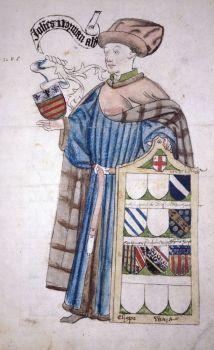
An Alderman in his official robe, the same kind John Shakespeare would have worn.
Historical Events Mentioned in Hamnet
1556 Anne Hathaway born. She’s referred to as Agnes in other court documents. Her father Richard owned a sheep farm in Hewland. At some point, her mother died and her father Richard married a woman named Joan, whom the novel portays as a bitter, controlling witch.
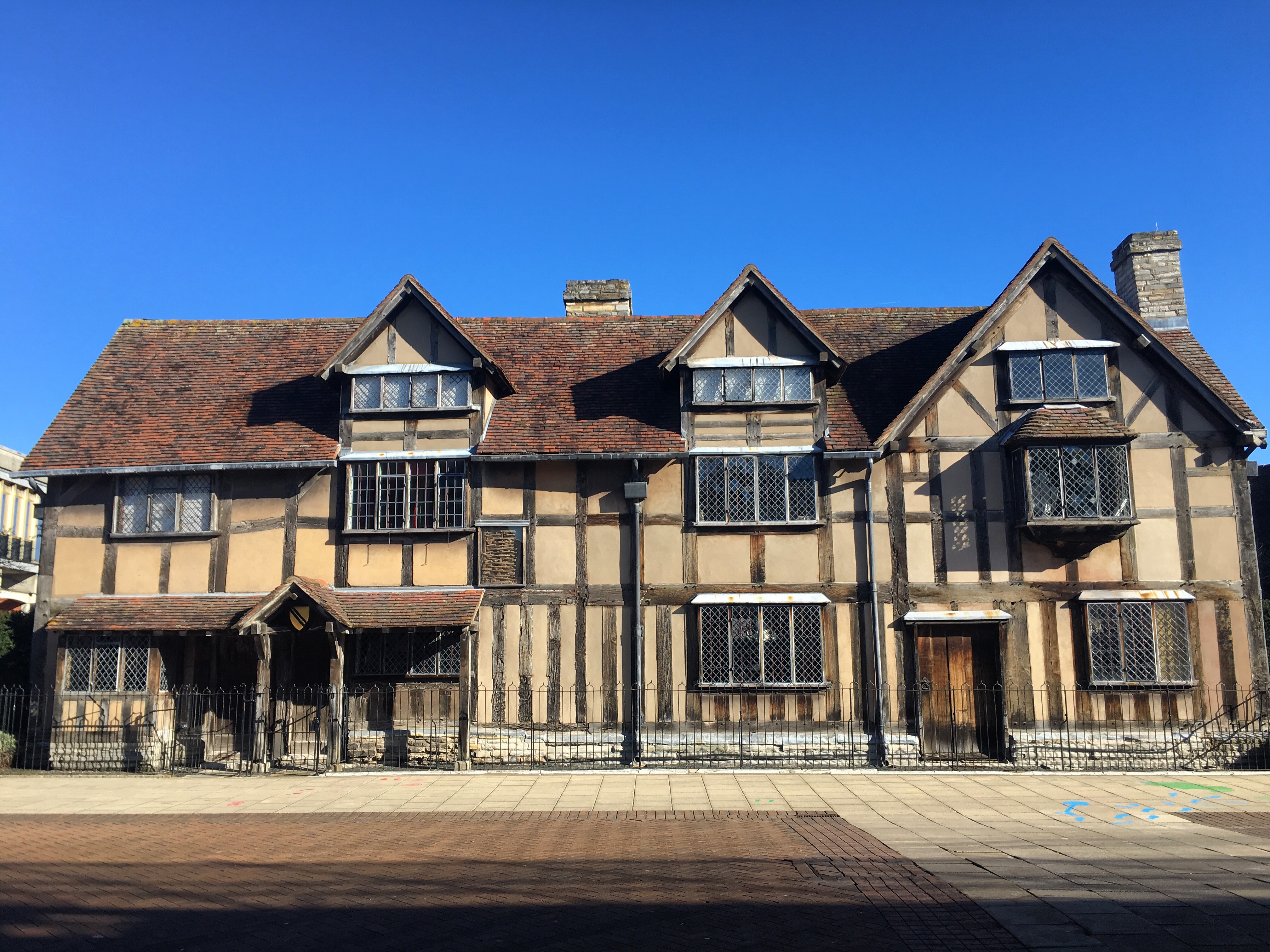
1564– Will Shakespeare born, third of 8 children. His father started out as a local glover, who quickly rose through the ranks of local government to become the mayor of the town. They owned a house in Henley street, which also doubled as the glove workshop. For more informaition on this fascinating building, visit the Shakespeare Birthplace trust: https://www.shakespeare.org.uk/visit/shakespeares-birthplace/
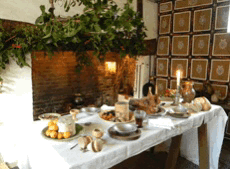
The Shakespeare’s house on Henley Street in Stratford Upon Avon, where Will, his wife, children, and parents lived until 1597.Recreation of the Shakespeare’s dinner table.
1581– Anne’s father Richard dies, bequeathing her “£6 13s 4d ‘atte the day of her maryage’.” Richard Hathaway owned a farmhouse in Shottery that still stands today! For more info, please visit the Shakespeare Birthplace Trust: https://www.shakespeare.org.uk/visit/shakespeares-birthplace/
Anne Hathaway’s Cottage and Gardens, Stratford-upon-Avon, UK. June 2014.Interior and exterior images of Ann Hathaways cottage, Shottery, Stratford upon Avon, Warwickshire.
1582– On November 27th, 1582, William married Anne Hathaway. He was 18, she was 26. It must have been a hasty and stressful situation. Shakespeare had no job, and based on the timeline, Anne was already pregnant with their daughter Susanna. For more information on marriage in the period, please visit my website on Elizabethan society:
The Shakespeares were granted a marriage licence by the Bishop of Worcester. They were married at Temple Grafton, a village approximately five miles (8 km) from Stratford.
Notes On Shakespeare’s Wedding Day:
We know that Anne’s family paid a dowry to Shakespeare’s family, which annoys Shakespeare in the book. He feels furious that his father uses the marriage to help his business interests.
According to Michael Wood, the priest left out the reading of the banns, and suspected the marriage was intentionally catholic. The book also makes it clear that this was a catholic ceremony, deep into the reign of the Protestant Queen Elizabeth I.
May 26, 1583– Susanna Shakespeare is baptized, which means she was probably born three days earlier.
February 2nd, 1585– Hamnet and Judith are baptized.The twins were named after two very close friends of William and Anne, the baker Hamnet Sadler and his wife, Judith. The Sadlers became the godparents of the twins and, in 1589, they in turn named their own son William.
1586– John Shakespeare is booted off the Stratford board of Aldermen for not attending meetings. Michael Wood suggests that John might have been avoiding the meetings because he was in debt, and the creditors knew where to find him. The novel seems to agree with this theory- the first time that we meet John Shakespeare, he is on the verge of beating his own grandson for sneaking up on him. If he was hiding from his creditors, he’d have a reason to be jumpy. 1592 – Shakespeare makes it in London? 1593 Outbreak of Bubonic Plague- 15,000 people died in London alone. O Farrell does a great job of portraying the visceral terror people must have felt during an outbreak, the same terrified panic that gripped our world in 2020. As I’ve written before, not only did the disease itself instill fear, but also the Draconian measures of quarantines, and the grotesque and ineffective methods for treating the plague. To see how you might be treated for plague in the 1590s, take my quiz: https://sites.google.com/d/1iLSGjbllxU-ZwyrUya_xHtjojSCg9pd6/p/1xzNm37sGbHsQJgsnx4irZHJVp9YscVVJ/edit?authuser=2
Because of the contagious nature of the disease, the theatres were closed, which forced Shakespeare to write poems instead of plays. Around this time he also probably wrote Romeo and Juliet, Richard III, and A Midsummer Night’s Dream. Shakespeare published Venus and Adonis
1596 Hamnet dies
C. 1599– William Shakespeare writes Hamlet, his longest play, widely regarded as the greatest play ever written in the English language.
I hope this post helped increase your understanding and enjoyment of the book, and Elizabethan History in general.
For a fascinating look at the life of an Elizabethan woman, check out this documentary about Shakespeare’s mother Mary Arden, created by scholar Michael Wood:
I’m teaching a series of online summer classes and I am very excited about this one in particular. I will teach a short class for kids ages 10-18, about duelling and swords. I will then explain basic stage combat moves, and finally choreograph a short fight for the students to do at home!
Registration starts now! Space is limited so go to Outschool.com, ASAP. Cost is $5 per child.















 The Shakespearean Student