Close Reading: Juliet’s Soliloquy: “My dismal Scene I needs Must Act Alone.”

The Text

LADY CAPULET  Good night.
Get thee to bed and rest, for thou hast need.
Lady Capulet and the Nurse exit.
JULIET
Farewell.—God knows when we shall meet again.
I have a faint cold fear thrills through my veins
That almost freezes up the heat of life.
I’ll call them back again to comfort me.—
Nurse!—What should she do here?
My dismal scene I needs must act alone.
Come, vial. She takes out the vial.
What if this mixture do not work at all?
Shall I be married then tomorrow morning?
She takes out her knife
and puts it down beside her.
No, no, this shall forbid it. Lie thou there.
What if it be a poison which the Friar
Subtly hath ministered to have me dead,
Lest in this marriage he should be dishonored
Because he married me before to Romeo?
I fear it is. And yet methinks it should not,
For he hath still been tried a holy man.
How if, when I am laid into the tomb,
I wake before the time that Romeo
Come to redeem me? There’s a fearful point.
Shall I not then be stifled in the vault,
To whose foul mouth no healthsome air breathes in,
And there die strangled ere my Romeo comes?
Or, if I live, is it not very like
The horrible conceit of death and night,
Together with the terror of the place—
As in a vault, an ancient receptacle
Where for this many hundred years the bones
Of all my buried ancestors are packed;
Where bloody Tybalt, yet but green in earth,
Lies fest’ring in his shroud; where, as they say,
At some hours in the night spirits resort—
Alack, alack, is it not like that I,
So early waking, what with loathsome smells,
And shrieks like mandrakes torn out of the earth,
That living mortals, hearing them, run mad—
O, if I wake, shall I not be distraught,
Environèd with all these hideous fears,
And madly play with my forefathers’ joints,
And pluck the mangled Tybalt from his shroud,
And, in this rage, with some great kinsman’s bone,
As with a club, dash out my desp’rate brains?
O look, methinks I see my cousin’s ghost
Seeking out Romeo that did spit his body
Upon a rapier’s point! Stay, Tybalt, stay!
Romeo, Romeo, Romeo! Here’s drink. I drink to
thee.
She drinks and falls upon her bed
within the curtains.

The Given Circumstances

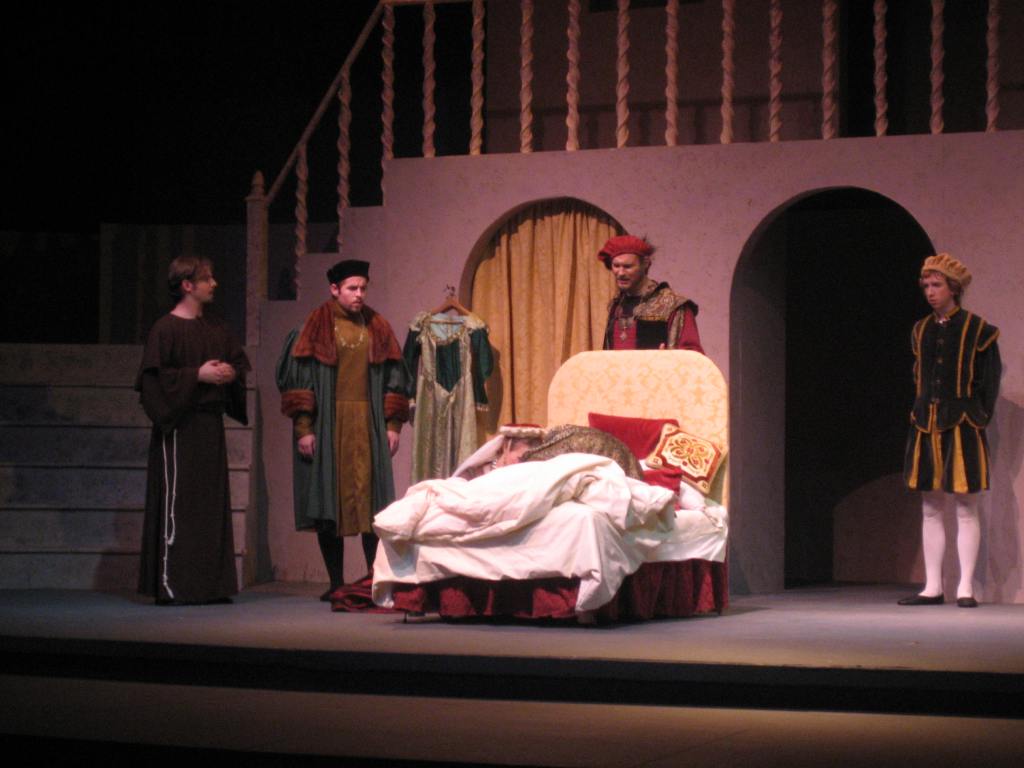
This famous soliloquy comes from Act IV, Scene iii. In this speech, Juliet grapples with her fears and anxieties about taking the Friar’s sleeping potion.
Traditional Interpretations

Ellen Terry (Vinal Record Recording, C. 1911)

Ms. Terry, like her famous grandson John Gielgud, is more interested in delivering the text clearly, beautifully, and strongly than getting Juliet’s character across. Consequently, by our standards, her reading of the speech is slow, declamatory, and maybe a bit over-the-top. However, this kind of delivery really brings out the rhythm of the verse, the beauty of the individual words, and the structure of the speech itself, so I recommend actors listen to it as a jumping off point. In my opinion, having a good technical grasp of the speech will keep an actor from going too far with the emotion, (making it hard for the audience to hear and understand them). This is why there’s still value in these dusty old recordings.

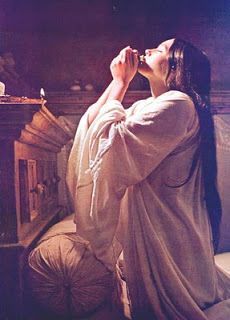
Olivia Hussey (Romeo and Juliet directed by Franco Zephirelli, 1966)

Zephirelli was very sparing with the dialogue- choosing to condense this entire speech to one line “Love, give me strength.” Hussey has a great deal of passion in the speech, as if she is absolutely certain that taking the potion will re-unite her with Romeo.

Claire Danes (Romeo +Juliet, 1996)

Claire Danes contemplating the vial in Romeo + Juliet

Danes has a sense of almost macabe trance-like energy when she delivers the speech. Like all the edged weapons in the movie, the dagger is replaced by a gun. Most of the speech is cut because Luhrman wanted to emphasize the character’s obsession with violence, rather than fears about ghosts and arranged marriages. Consequently, Danes does little other than put the gun under her pillow, take out the vial, and drink it.

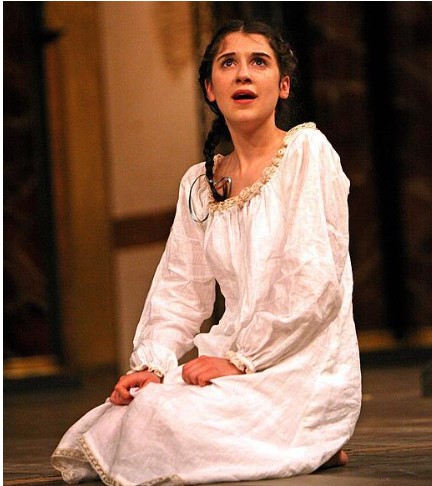
Ellie Kendrick (Globe Theater, 2009)

Ms. Kendrick is one of my favorite Juliets ever! She is a wonderful blend of sweetness and naivety, tempered with anxiety and practical thinking. She delivers the whole speech to different parts of the audience and makes sure every idea and every horrible thought of Juliet lands. Furthermore, her fast pacing around the stage helps her not only connect with the audience, but to use the Globe theater to make them imagine the Capulet vault.
Verse
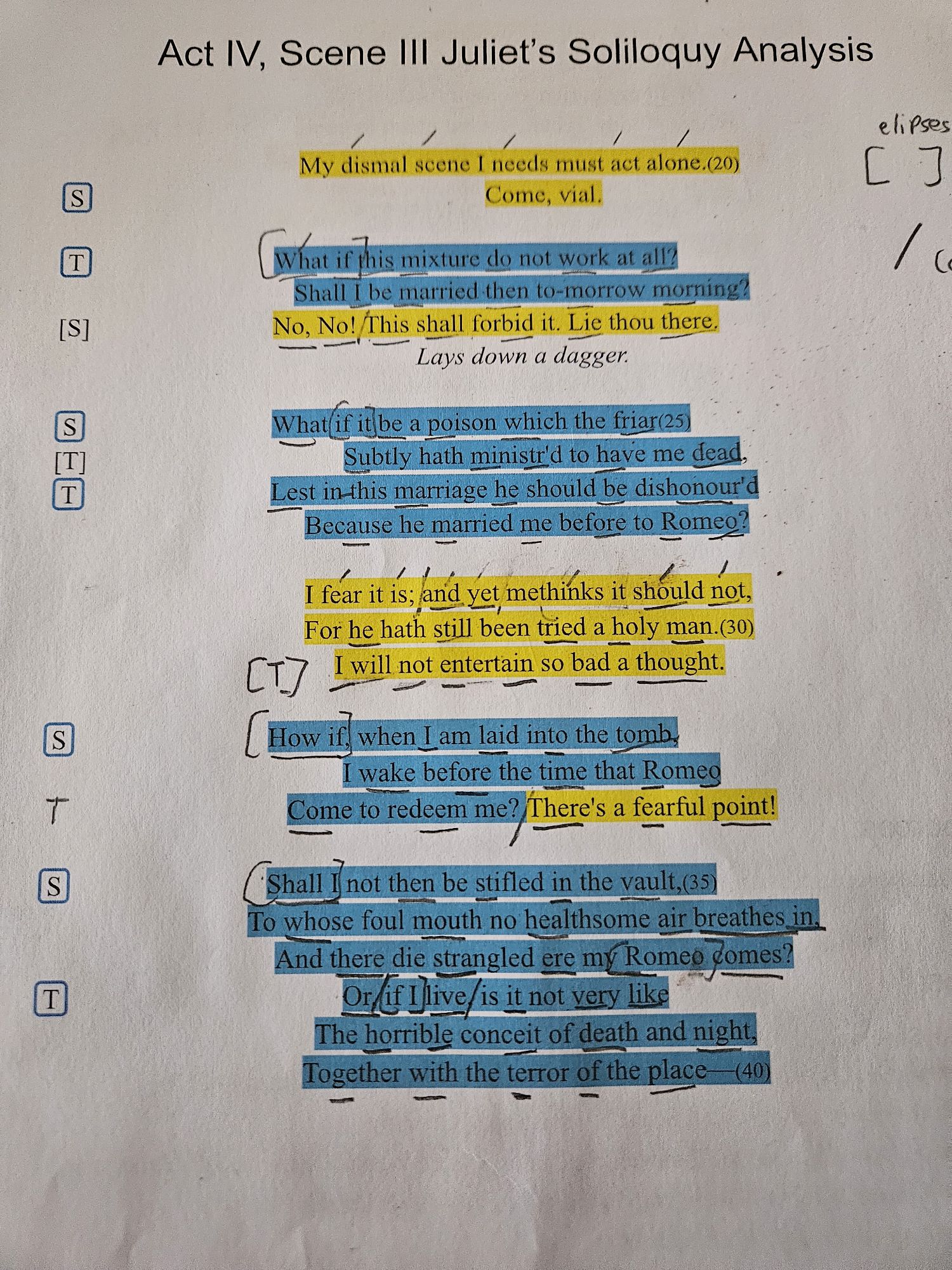
As I always say, verse is the heartbeat of a character, and based on this, Juliet’s heart is beating a mile a minute. You’ll notice that five of these lines start with a trochee (T), and five of them have trochees. This means Juliet is unsettled, she’s literally off-beat. In addition, there are frequently pauses in the middle of the lines called cesuras, which might indicate that either Juliet is trying to answer her own questions, or that she is so worried, that she’s gasping for breath.
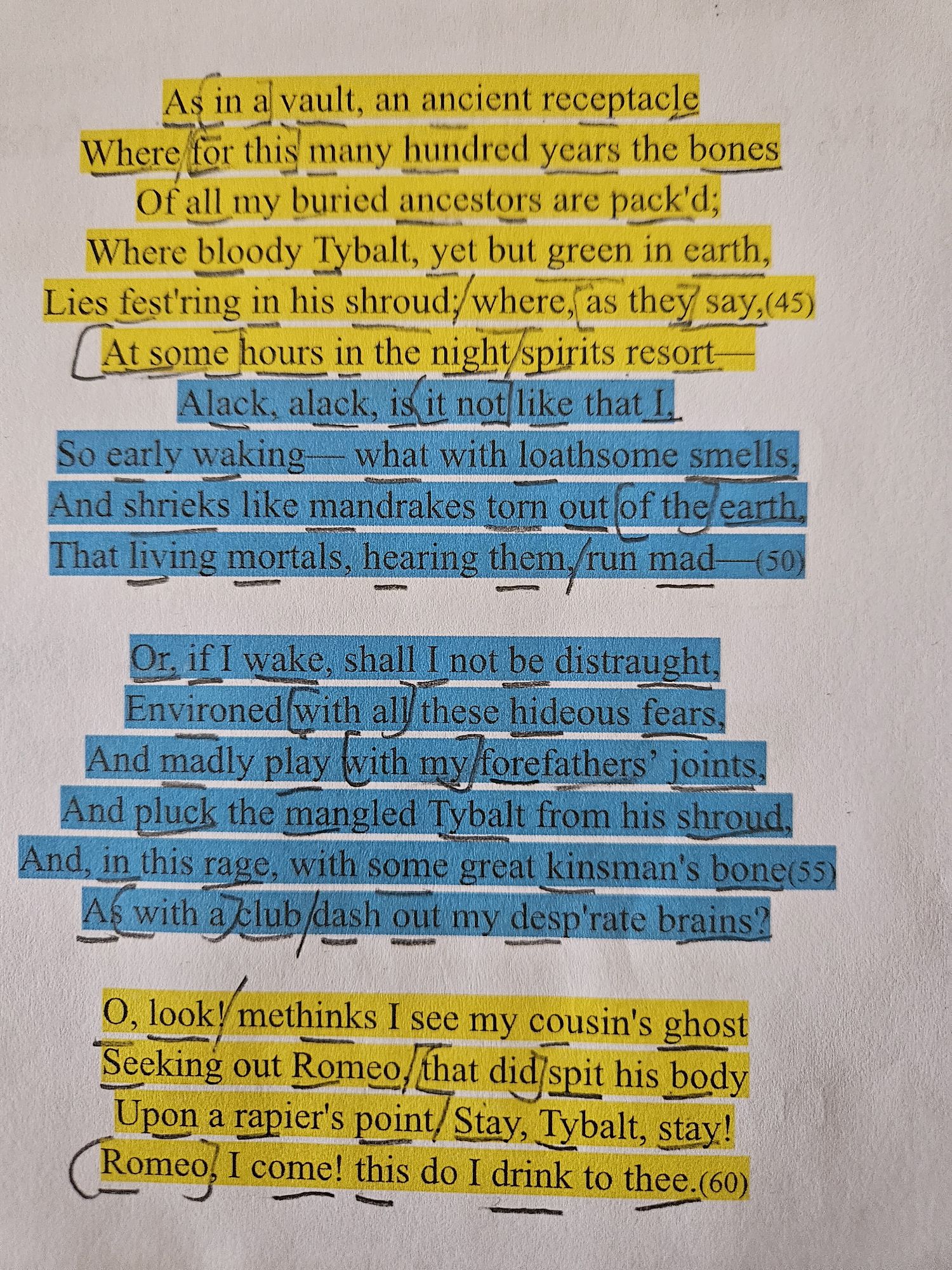
In this second part of the speech, the lines start running together. Juliet’s pace is quickening and she breathes every 2-3 lines instead of at the end of each line.

Structure

The speech is organized as a series of questions:

“What if…”

“What if…”

“How if…”

“Or if I live…”

“O, if I wake, shall I not…”

and then the terrifying statement: “O look…”

So, with this in mind, the actress needs to convey Juliet’s overactive imagination, her fears, and her ability to answer these fears with inner calm and inner strength.

Imagery

It’s a horrific idea being shut up alive with the dead. Shakespeare gives us the sights and smells and the grim reality of feeling “stifled” in a vault. I created this image to demonstrate the smells, the fear, and the claustrophobic nature of the vault.


I chose to have the vault lit with candles, and to use green smoke to represent decay and possibly noxious gas, like the nitre that sometimes dips from walls of tombs. I also added some stone faces of ancestors to stare down at Juliet.

Historical Research
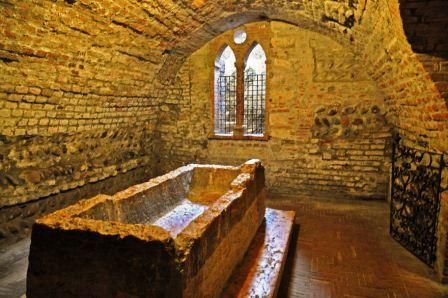
Sarcophagus in church of San Francesco al Corso, an old Franciscan monastery in Verona.

The plain stone sarcophagus above has become a tourist attraction as the traditional ‘resting place’ of Juliet. As I mentioned in my Friar Lawrence post, the Friar who marries Juliet is a Franciscan, which is probably why they chose this church in Verona as the ‘site’ for Juliet’s grave.

It is a plain, open, and partly decayed sarcophagus, in a wild and desolate conventual garden once a cemetery now ruined to the very graves. The situation struck me as very appropriate to the legend, being blighted as their love.

– Lord Byron, Letters and Journals Vol. III

Since Italy is a small, hot country, bodies in the 16th century were buried almost immediately. First, the body would be wrapped up in a shroud or winding sheet, as Juliet mentions at the end. The corpses might be decorated with Rosemary or other sweet-smelling herbs.
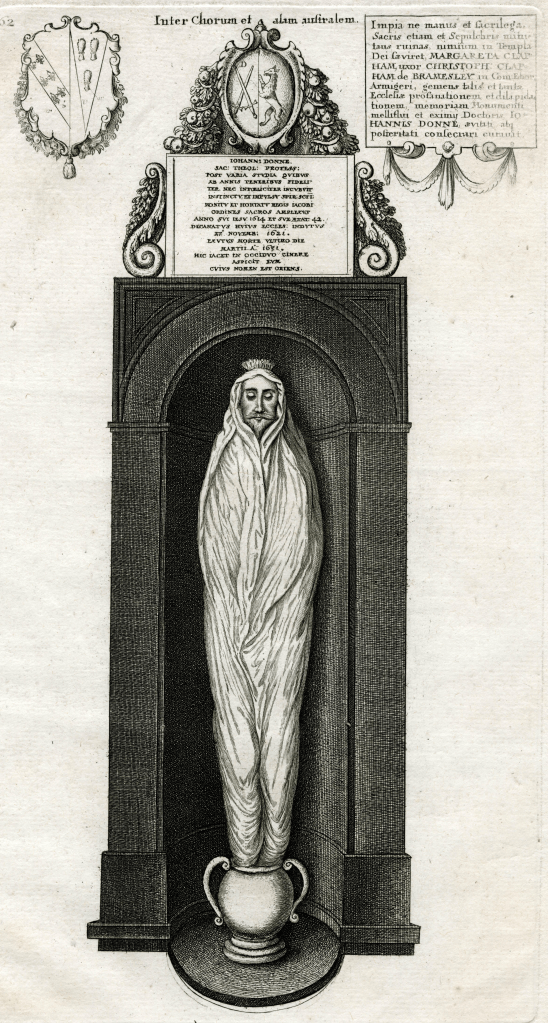
A winding sheet for a corpse

Wealthy families like the Capulets or the church, would store all the bodies of their ancestors in burial vaults or crypts. Some bodies would be anointed with oil or preserved with vinegar.

Literary Inspiration: The Cask of Amontillado

Montressor and Fortunato move through the burial crypt in “The Cask of Amontillado”

When I think of the dark, macabre atmosphere of a family tomb, I think of The Cask of Amontillado, a short story by Edgar Allen Poe where the anti-hero Montressor, tricks his enemy Fortunato into going into his family crypt and buries him alive! There are some interesting parallels between Montressor and Tybalt from Romeo and Juliet- both men belong to ancient families, both men are violent, and both refuse to let any kind of insult stand. I think Juliet sees the vault as a hostile place, where her ancestors are angry at her for “betraying the Capulet name,” after marrying a Montague.

Image Research 4: Tybalt’s Angry Ghost

AI image of Tybalt’s Ghost

Like Montressor in The Cask of Amontillado, Tybalt embodies the Capulet feud, and it makes sense that Juliet would see him when she thinks of being shut up in the vault. The real question is, what does seeing him do to her? Is she terrified? Is she remorseful? Is she moved to protect Romeo? How does seeing Tybalt’s ghost motivate her to take the potion?

Other Questions to consider

  1. Why is Juliet so nervous?
  2. How does Juliet feel about running away from home?
  3. Do the ghosts represent something? Guilt? Judgement? Some kind of ticking clock?
  4. What does she see Tybalt’s ghost doing?
  5. How does Juliet pull it together at the end?

Emotional

Not only is Juiet worried about her health, (mental and physical), I get a sense that she might also be experiencing guilt. The notion of her being tormented by spirits that shriek like mandrakes, suggests that maybe the ancient Capulets aren’t very pleased with Juliet. This makes sense because she married a Montegue. I get the sense that maybe, for the first time, Juliet actually feels guilty, as if she’s failed her ancestors. However, for whatever reason, she definitely re-focuses and thinks about Romeo. Either she rejects her ancestors and Tybalt, or maybe she sees the potion as a way of protecting Romeo, or possibly Juliet just wants these fears and anxieties to end, and takes the potion as a release. My actor and I will no doubt try these ideas out and figure out what works within the structure and within her interpretation of the character.

Our Interpretation

Again, it’s a little too early for me to tell you our interpretation yet, but I’ll post it later.

Resources:

  1. Myshakespeare.com. This website will allow you to look up unfamilliar words, download pictures and videos of the scene, and even watch an ‘interview’ with Juliet, where, just as in this speech, she becomes more and more anxious and fearful until the very end.
  2. https://www.open.ac.uk/blogs/literarytourist/?p=49

If you enjoyed this analysis, please consider signing up for one of my online classes! Link below:

Playlist of my Outschool Classes

Click here to get an exclusive discount for all my online classes:

USING AI TO VISUALIZE POETRY

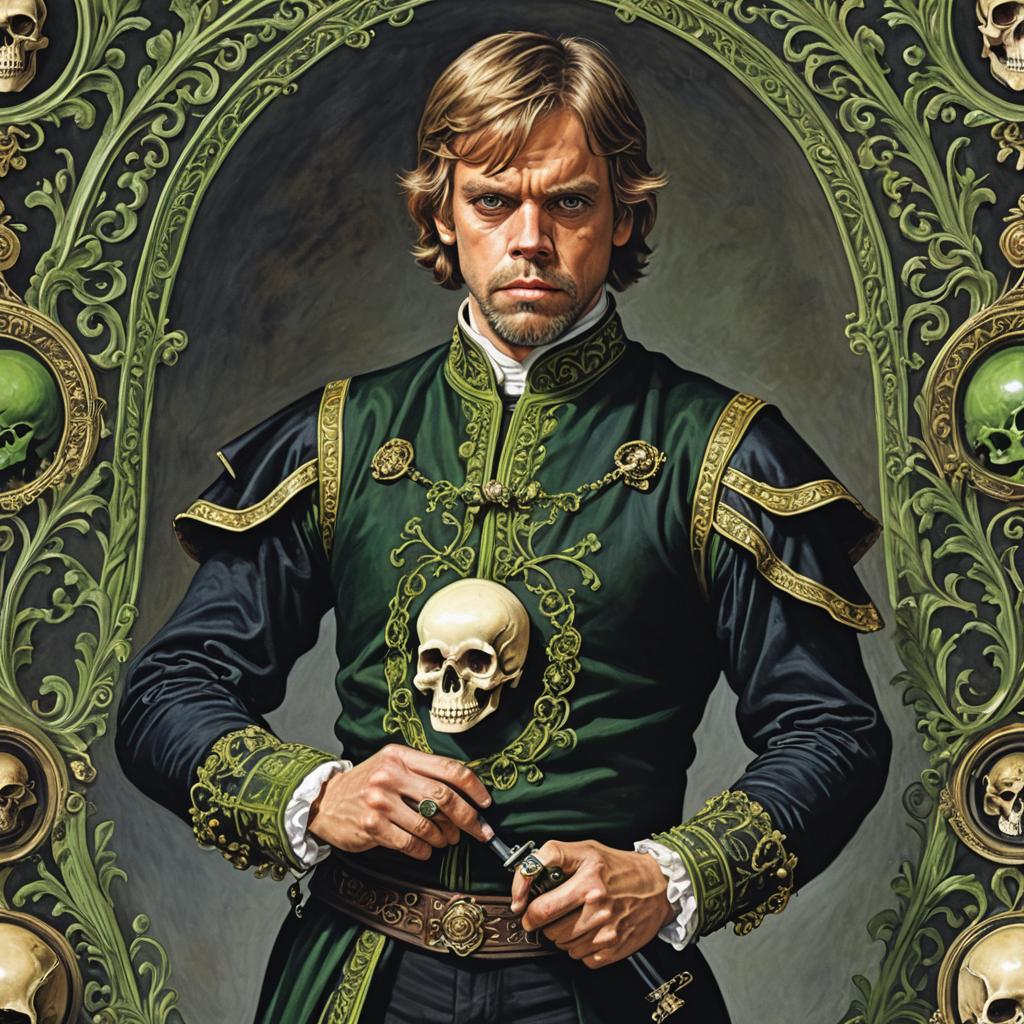
As a creative person who can’t draw, I can’t always depict the gorgeous imagery that Shakespeare uses in his poems and plays, so I often resort to AI artwork to do it for me. If you’ve been here a while, you know I’ve used NightCafe to imagine Shakespeare characters as, Harry Potter, Disney Princesses, Star Wars, and others.

https://dosinga.medium.com/visualizing-poetry-using-dall-e-ff3a901a0d4e

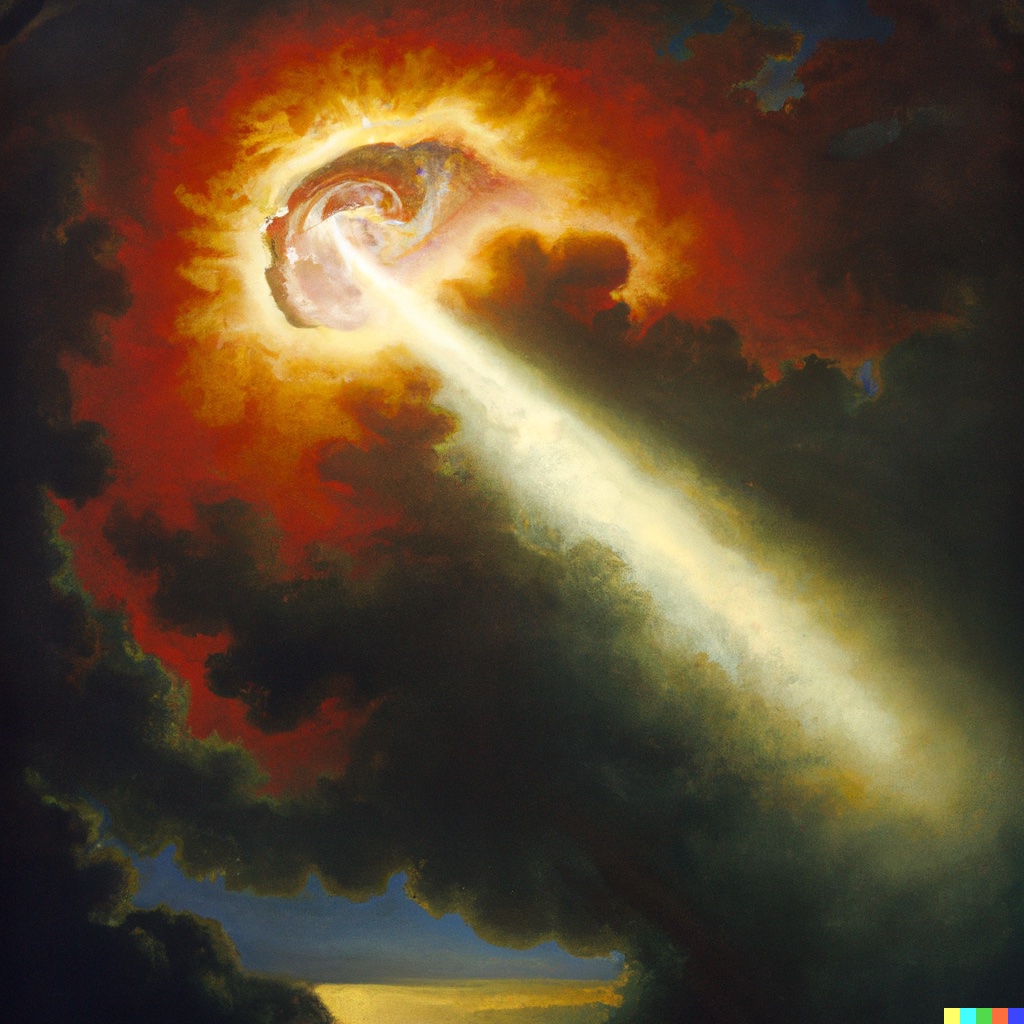
I love to use AI to put pop cultural characters in a Shakespearean context, but until today, I never thought of using AI to interpret Shakespeare directly, until I read this article from Medium.com. The author, Douwe Osinga, has used the AI website DALL-E to create text-to-image artwork in order to show the viewer the imagery that various poets use in their poems. Here’s what he did for Shakespeare’s famous sonnet 118.

https://douwe.com/projects/the_ai_not_taken?selected=Shall_I_compare_thee_to_a_summers_day

poem

Here’s some art that I created through AI based on Sonnet 55:

Not marble nor the gilded monuments
Of princes shall outlive this powerful rhyme,
But you shall shine more bright in these contents
Than unswept stone besmeared with sluttish time.
When wasteful war shall statues overturn,
And broils root out the work of masonry,
Nor Mars his sword nor war’s quick fire shall burn
The living record of your memory.
’Gainst death and all-oblivious enmity
Shall you pace forth; your praise shall still find room
Even in the eyes of all posterity
That wear this world out to the ending doom.
    So, till the Judgement that yourself arise,
 
    You live in this, and dwell in lovers’ eyes.

I didn’t tell the NightCafe software what to draw; I just put the text of the sonnet. What I find interesting is that the AI assumed I was writing a poem to a beautiful woman, and chose to represent the first line of the poem by placing her in a graveyard. I also love the withered branch, prominently placed over the moon. It reminds me of a scythe- the symbol of decay and death.

I wish the AI had chosen to represent Mars or the flaming sword mentioned in the poem, but it does get some of the central images right.

Using AI to visualize poetry is a useful exercise when you’re teaching Shakespeare because it demonstrates how poets can use multiple allusions, personifications, and many other literary devices.

Activities For Teachers and Students: Shakespeare Gingerbread Men (and Women)

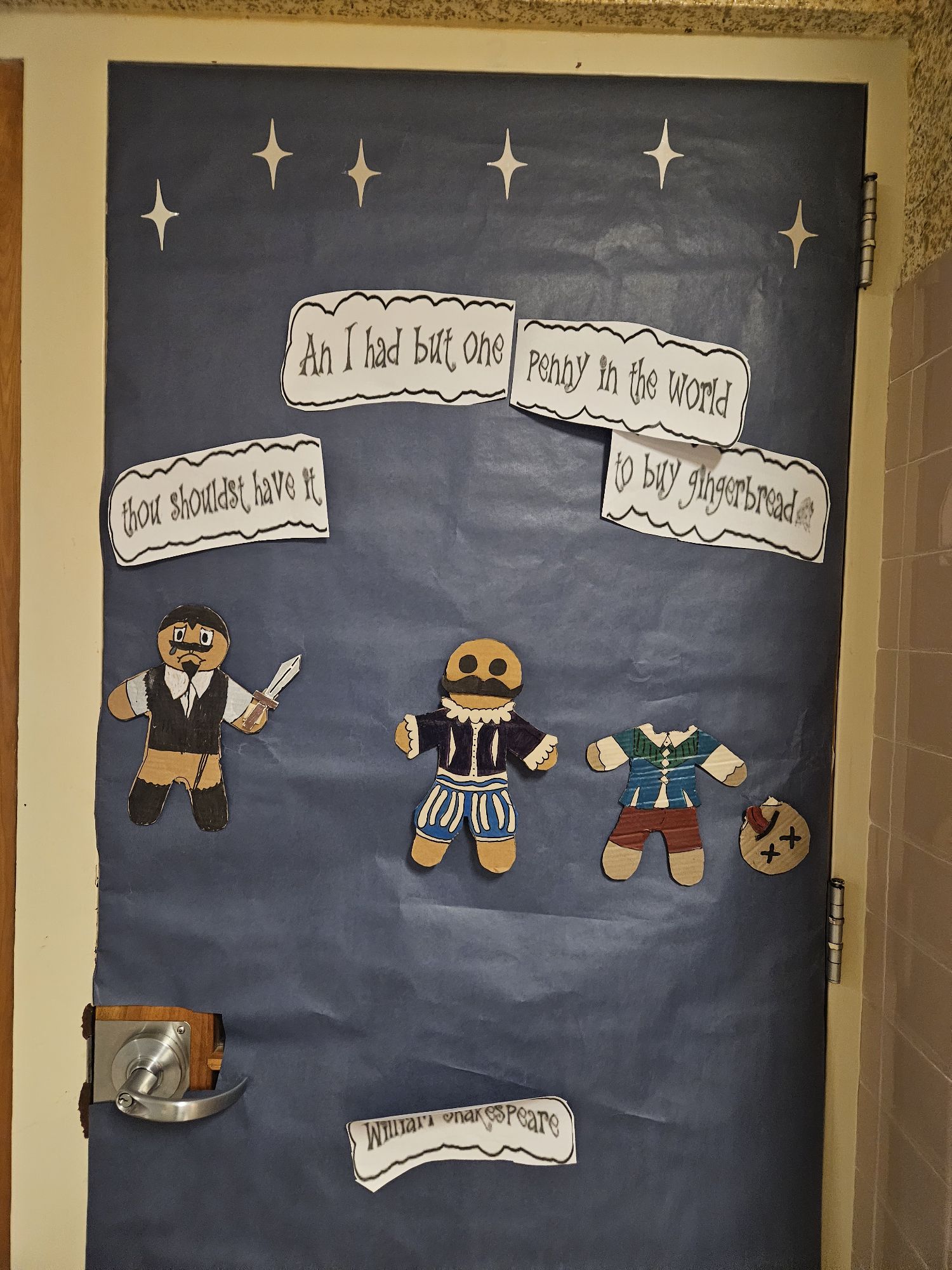
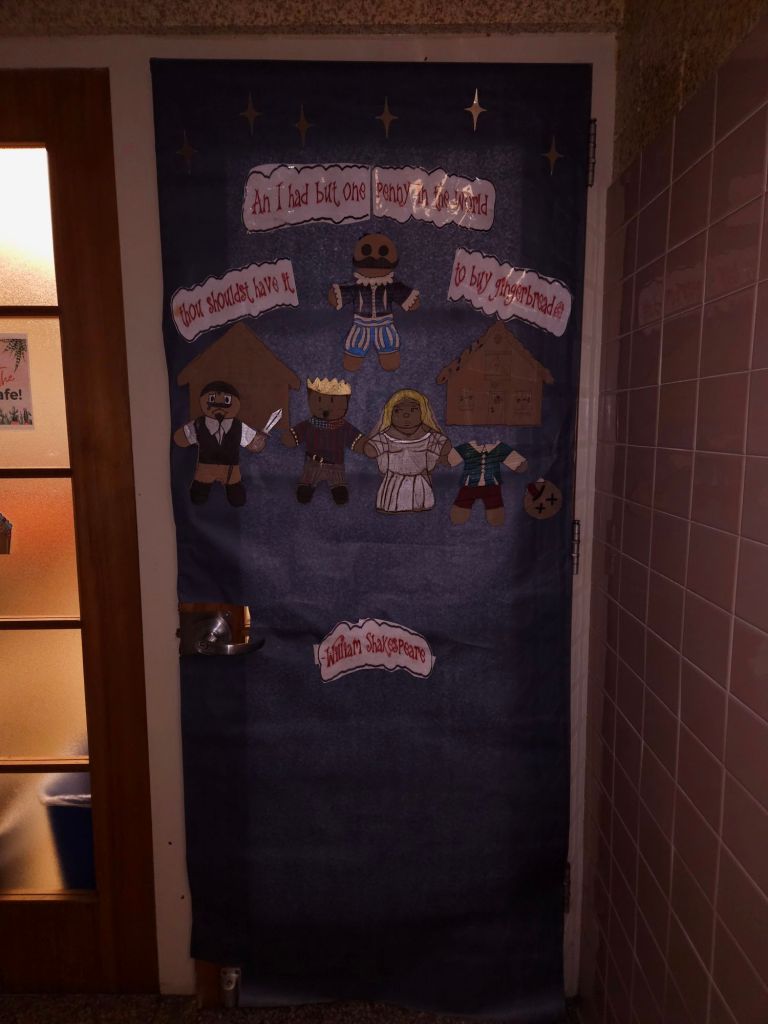
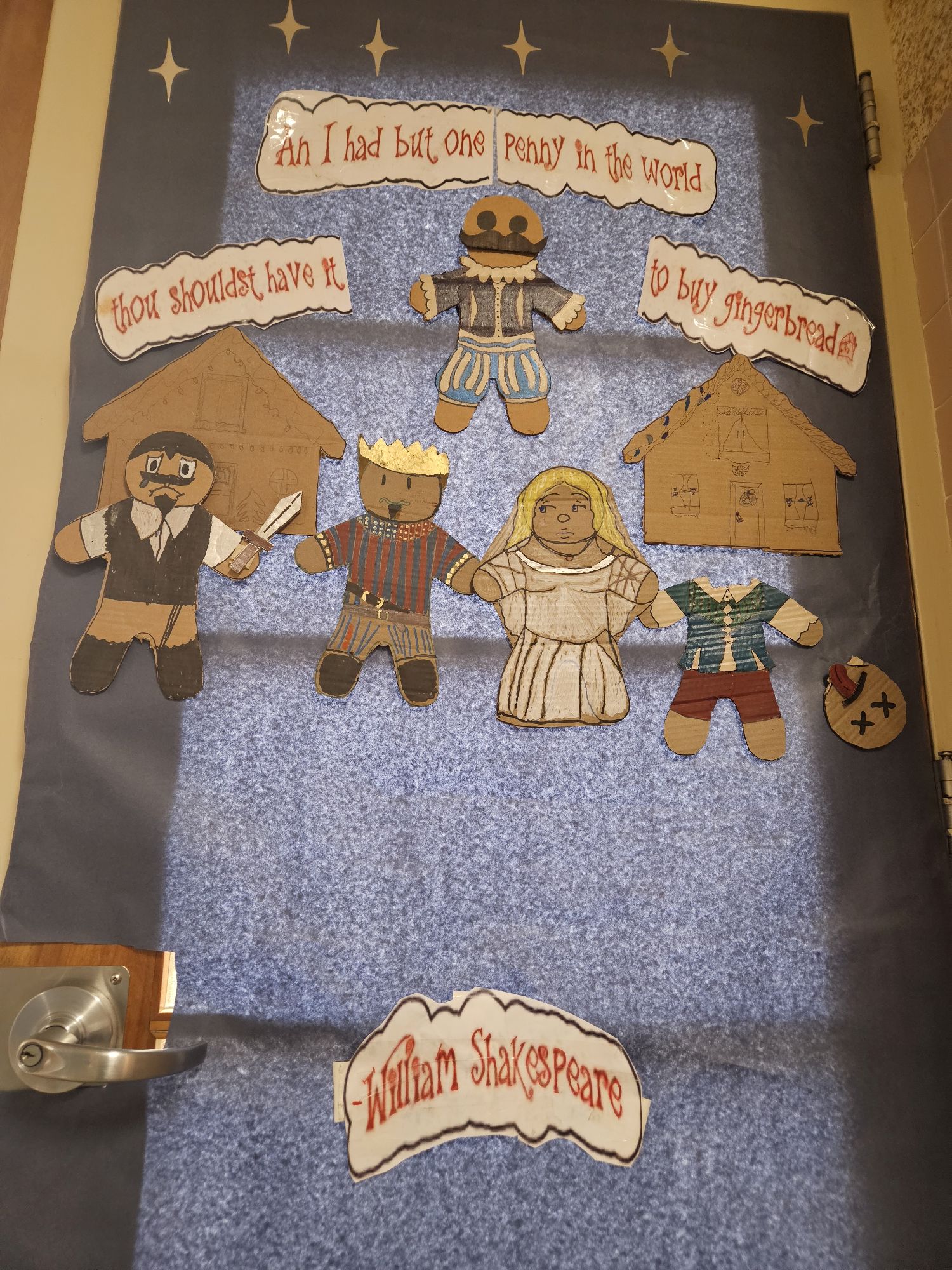
Every holiday season, my school likes to decorate the classroom doors in a festive way. I wanted to celebrate my Shakespeare Club and also teach the club members about Shakespearean fashion, Shakespearean characters, and maybe a little bit about engineering too. I’m very proud of the results, and I wanted to share this idea with you to maybe inspire you next holiday season!

The Concept

Hath I but one penny in the world, thou should’st have it to buy gingerbread. – Love’s Labors Lost

Since the theme had to be holiday-related, I looked at the above quote and decided to make Shakespearean gingerbread men! I knew I wanted to make the kids design a bunch of gingerbread men that would look like Shakespearean characters. While we were at it, I wanted gingerbread houses and maybe even a 3D element to go along with it. I knew it wouldn’t be easy, but I also knew my group was up to the task!

The plan

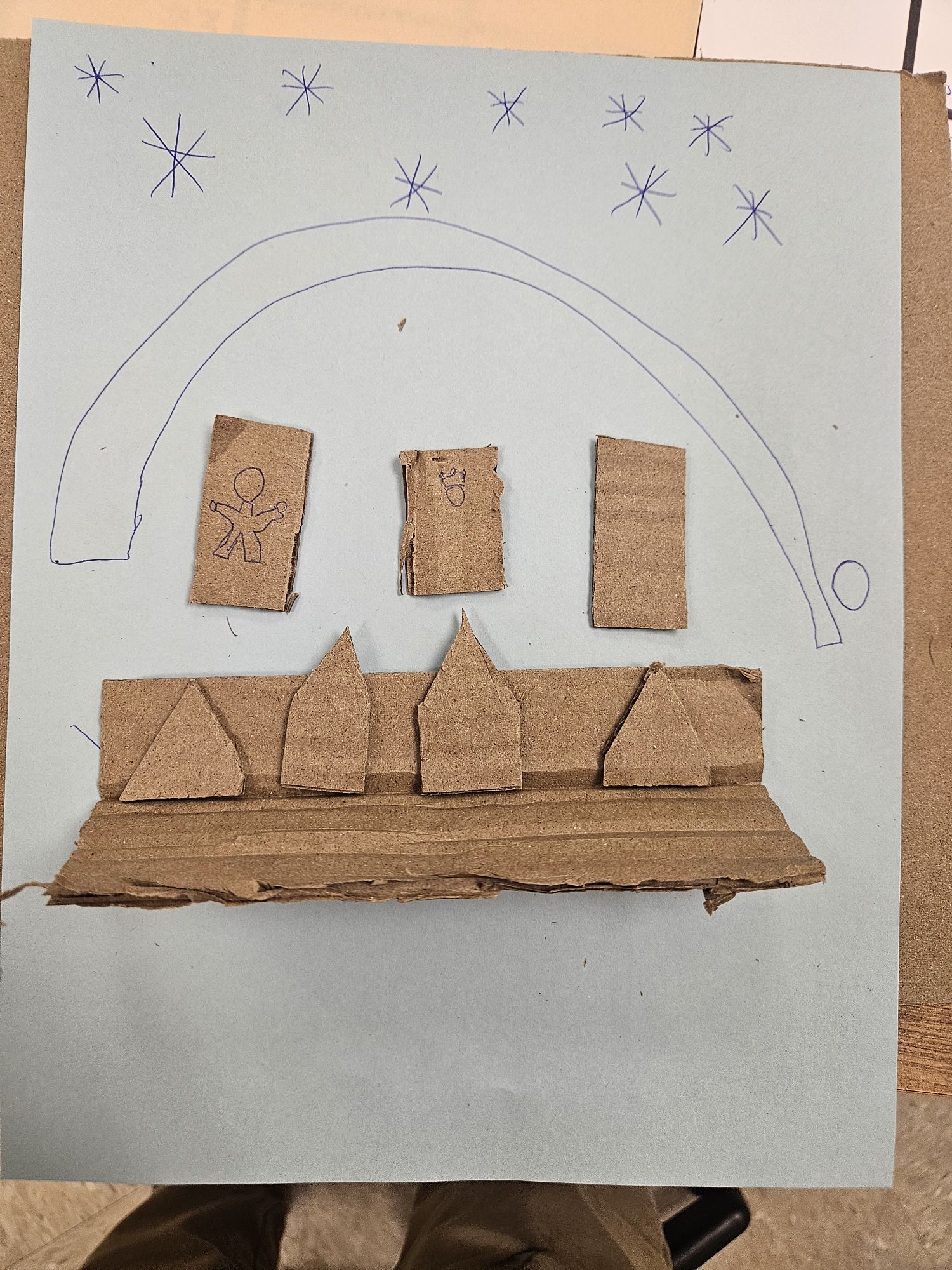
My concept drawing of how the door should look

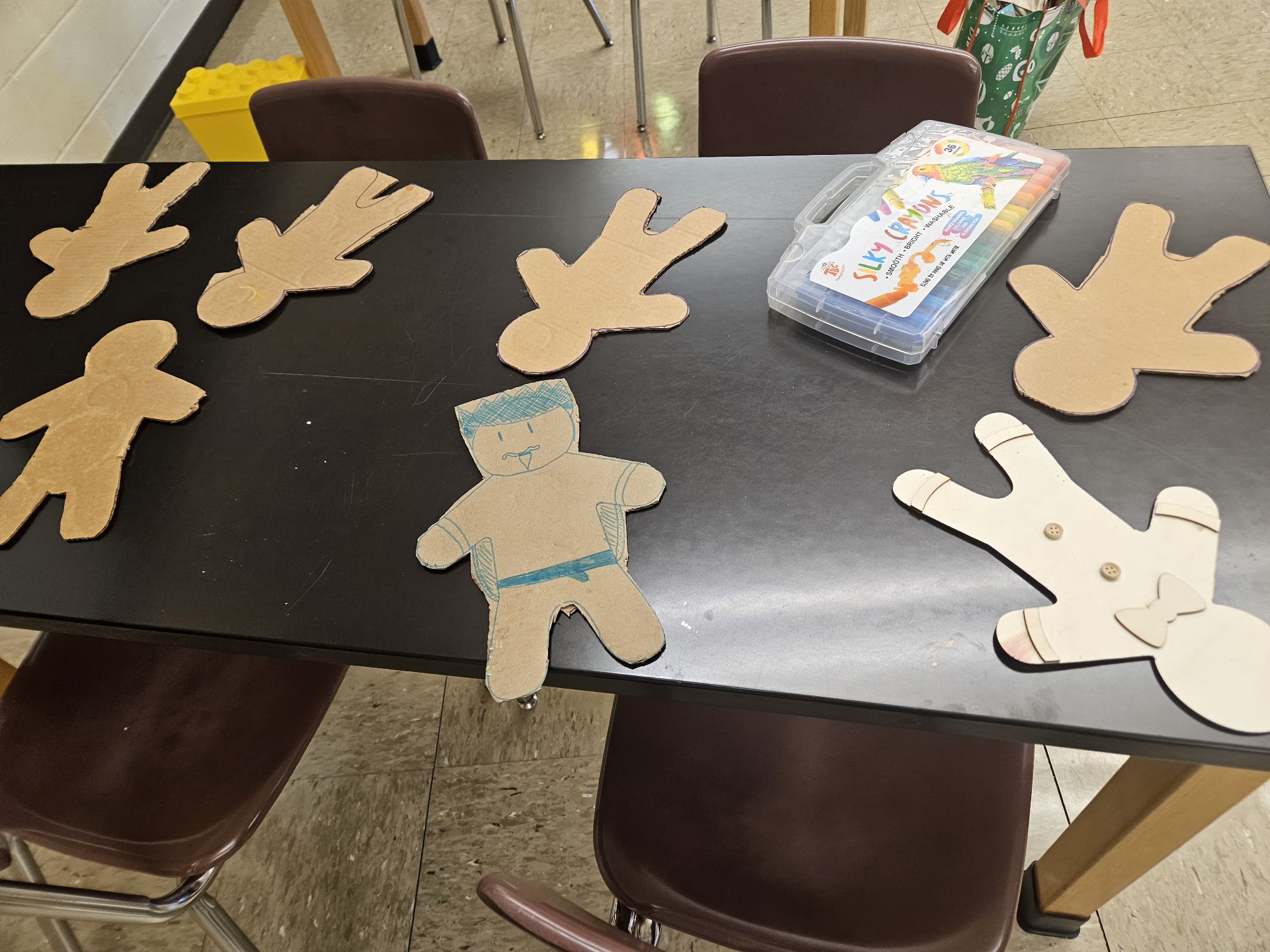
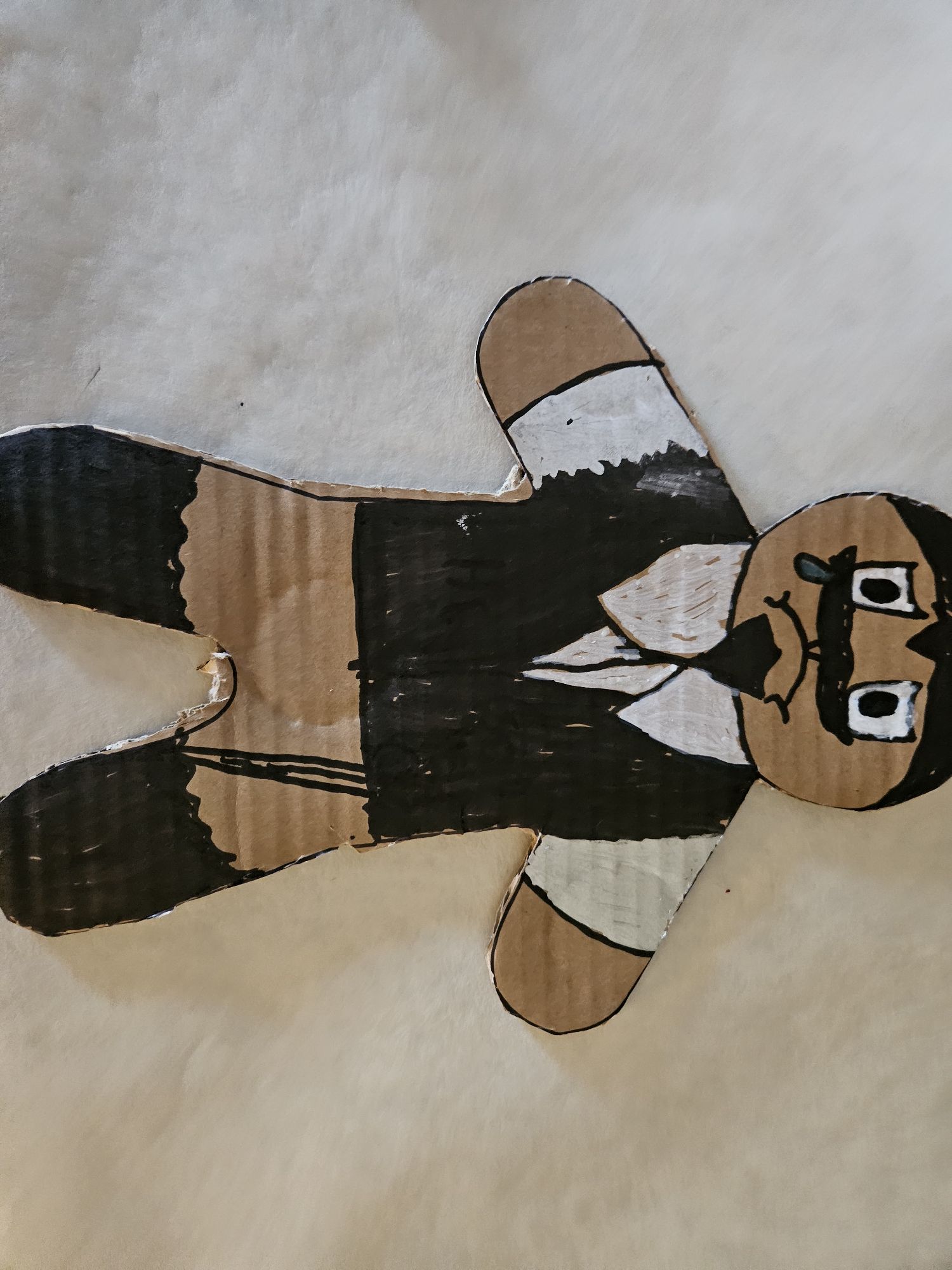
I knew I couldn’t use real gingerbread, so I chose the next best thing- cardboard! I made a cardboard plan of the door to show to my group. I then found a wooden gingerbread man at the local dollar store and used that as a template for the cardboard characters. Finally, I explained the concept to the group, and divided my group up into teams- one group would draw and color the gingerbread houses, one group would color the gingerbread men based on pictures of Shakespearean characters:

Gingerbread Hamlet
Gingerbread Henry V
Gingerbread Juliet

My final group created a 3D gingerbread house with a light in it to make the gingerbread village come to life. They even put my little puppet Shakespeare pal in there (I guess it’s his winter home).

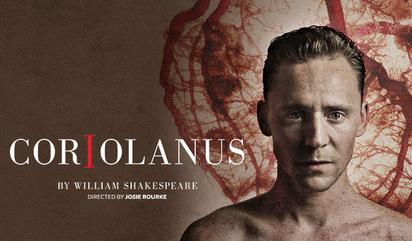
Intro to Coriolanus


Why no Coriolanus?? David Oyelowo is playing him at the National Theatre and it’s the one analysis of Shakespeare you don’t have! Please hurry! I’m seeing it on Friday!

User Noittickles, sent to me today

Well, with a request like that, how can I refuse!

Coriolanus is the only Shakespearean story about Republican Rome, which is to say, before Julius Caesar turned Rome into a dictatorship. The play has been called pro-democracy, pro-monarchy, fascist, Marxist, and many other things. In some ways, the play is rather simple and its verse isn’t much fun to read, but the questions it poses, and the way Coriolanus shows the clash between power and common people, makes it fascinating to think about.

The play’s title character is also the most opaque one Shakespeare ever wrote. Some say he is a war hero, undone by the mob. Some say he is a want-to-be dictator who hates the common people and wants to keep power among the military elite. Unlike Hamlet, Macbeth, or any of Shakespeare’s other tragic heroes, we never get a sense of his true intent, or his actual feelings on anything. 

To illustrate this, let’s look at two very different interpretations of the same speech. In Act III, Scene iii, the tribunes (representatives of the commons in the Senate), have organized a smear campaign to prevent Coriolanus from becoming Consul, (the highest rank a Roman aristocrat could achieve before Emperor Augustus). Coriolanus is furious at the Tribunes, and vows to leave Rome to take his revenge on the city. Here’s the text of the speech:

Coriolanus. You common cry of curs! whose breath I hate
As reek o' the rotten fens, whose loves I prize
As the dead carcasses of unburied men
That do corrupt my air, I banish you;
And here remain with your uncertainty!
Let every feeble rumour shake your hearts!
Your enemies, with nodding of their plumes,
Fan you into despair! Have the power still
To banish your defenders; till at length
Your ignorance, which finds not till it feels,
Making not reservation of yourselves,
Still your own foes, deliver you as most
Abated captives to some nation
That won you without blows! Despising,
For you, the city, thus I turn my back:
There is a world elsewhere.
[Exeunt CORIOLANUS, COMINIUS, MENENIUS, Senators,]
and Patricians]
Aedile. The people's enemy is gone, is gone!
Citizens. Our enemy is banish'd! he is gone! Hoo! hoo!

In the first speech, Tom Huddleston plays Coriolanus as a heroic soldier, disgusted and hurt by the lies of the scheming  Tribunes:

Hiddleston chose to play Coriolanus not as a villain but as a frustrated demagogue- someone who wants to lead his people to greatness, whether they like it or not. Whether you approve of his methods, Hiddleston’s Caius Martius does care about the good of Rome. You can almost see the tears in his eyes as he leaves the city he loves, the city he bled for, and that has now betrayed him.

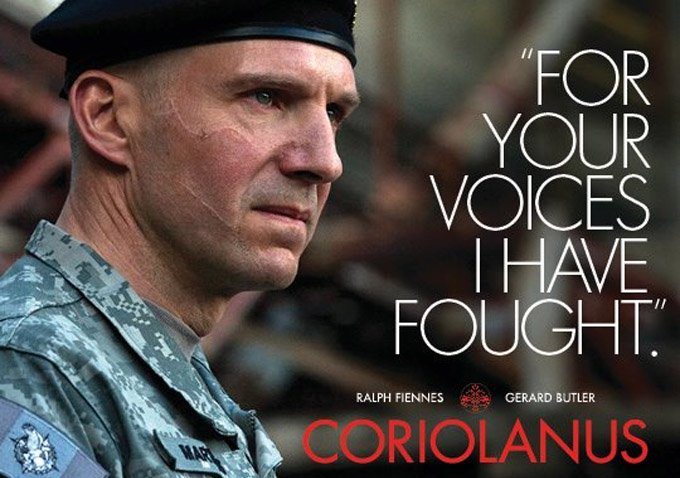
By Contrast, Ralph Fiennes takes a much more authoritarian and cruel route in the film Coriolanus, which Fiennes also directed:

Youtube critic Kyle Kallgren made the excellent case that Fiennes’ Coriolanus is first and foremost, a soldier. You could argue that perhaps Coriolanus has no political ambition whatsoever; he merely wants to keep fighting because war is all he knows. Maybe he purposefully sabotaged himself during his campaign for Consul, because all he wishes to rule is the battlefield:

Kalgren also highlights the “proto fascist” parts of Fiennes’ performance, since Fiennes himself has played Nazis, serial killers, and of course, Lord Voldemort, who is essentially a fascist dictator. Like Merchant of Venice, the Nazi party used Coriolanus as a propaganda tool, claiming that Caius’ fall from grace showed the failure of a weak democracy:

The poet deals with the problem of the people and its leader, he depicts the true nature of the leader in contrast to the aimless masses; he shows a people led in a false manner, a false democracy, whose exponents yield to the wishes of the people for egotistical reasons. Above these weaklings towers the figure of the true hero and leader, Coriolanus, who would like to guide the deceived people to its health in the same way as, in our days, Adolf Hitler would do with our beloved German Fatherland.

Martin Brunkhorst, “Shakespeare’s Coriolanus in Deutscher Bearbeitung. Quoted from Weida

It makes sense that fascists would gravitate towards a play about a seemingly virtuous Roman military leader. After all, the word “fascism” is an Italian word, coined by Benito Mussolini, to evoke the glory days of the Roman Empire- days when Roman society was based on military conquest under a strong leader. What these fascists fail to recognize is that Coriolanus is not a strong leader- he hates politics and is unable to gain any support from the people or from the elites in power. His inability to “play the game” of Roman politics, does make him appealing to some, but on the whole, his career is a disaster.

Some have chosen to interpret the story of Coriolanus as a sort of action-movie wish fulfillment- a man in a lawless society who uses his fists rather than words. Back in the 1990s, Steve Bannon (former advisor to President Donald Trump), wrote a hip-hop musical called: The Thing I Am, which re-interpreted the story of Coriolanus as a police captain who is trying to clean up downtown LA, which is embroiled in gang warfare. I find this interpretation paper-thin and not at all conducive to the spirit of the original play. It also has very racist and paternalistic undertones. You can read my review of it here:

Coriolanus Today

https://www.nationaltheatre.org.uk/productions/coriolanus/

Shakespeare refuses to be prescriptive on political or social issues. He tries to represent all sides of an issue and let the audience decide. With the rise of neo-fascist movements, sectarian violence, and the persistent questions surrounding police and military forces, Coriolanus is more relevant than ever. I haven’t seen this production at the National Theater, but I hope it calls attention to the various angles and points of view of the play- Coriolanus the war hero, Coriolanus the traitor, Coriolanus the soldier, Coriolanus the would-be-dictator. David Oyelowo is a fantastic Shakespearean actor, so I’m sure he can bring a great deal of complexity and nuance to this complicated man.

What I find interesting is that the trailer chooses to use this speech, when Coriolanus has defected to Rome’s enemies, the Volskies. He seems sorrowful, desperate, and afraid of what the Volskies will do to him, now that he is in their camp. One line that Oyelowo delivered exceptionally well was the line “Only the name remains.” I haven’t seen the whole play, but it seems THIS Coriolanus is concerned with the glory of his name living after him. The final question this play asks is, for such a complicated man, how will Coriolanus be remembered?

Well, there you go, Stopittickles! Hope you enjoyed this overview of the play Coriolanus. If you like this review, you might like to sign up for my online class on Julius Caesar via outschool.com:

Click here to sign up and get a $5 discount: https://outschool.com/teachers/The-Shakespearean-Student

Great Classes for the Month of June!

Scan the QR code to see my list of classes.

Great online classes in Shakespeare and science are available for students all this month at Outschool.com.

Special Promo: LIMITED TIME ONLY!

From now until June 1st, you can get a $20 discount with referral code PAULHT20. Share the joy with other curious minds in the family too! Spread the word and let’s ignite the passion for learning together!

Class Descriptions

Live Classes

For these classes you meet with me live over Zoom:

Introduction to Shakespeare- Tuesdays 9-9:30AM (EST)

This is my 30 minute short and sweet intro to Shakespeare’s life, his plays, and why his work still matters to us today!

Intro To STage Combat (With SwordS)- Tuesdays 9:30-10AM (EST)-

Like the Intro to Shakespeare class above, this is an intro to the basic footwork, attacks, and defensive parries of swordplays for someone just begeinning to learn about swords.

Title image for my online course on “Romeo and Juliet.”

An Immersive Guide To “Romeo and Juliet- Tuesdays from 10-11AM (EST)

This multi-week course delves into the plot, characters and themes of “Romeo and Juliet,” while also providing interactive activities, virtual tours, and webquests.

Stage Combat Course (Multi Week Course) Saturdays 3-4PM (EST)

Shakespeare’s History Plays- SaturdAYs 8:30 AM IST

This is a new course I’m working on to cover all of Shakespeare’s History plays including Henry V, Richard II, and Richard III. More info as it becomes available.

Asynchronous Classes

These classes are Flex Schedule, which means the teacher prepares the activities in advance and allows you to do them at your own pace without direct consultation.

  1. An Interactive Guide To: “Macbeth”

2. An Immersive Guide to Shakespeare’s London: A virtual tour of Shakespeare’s London will get kids to interact with the culture of Elizabethan England. https://outschool.com/classes/an-interactive-guide-to-shakespeares-london-E6KqeBQQ?usid=MaRDyJ13&signup=true&utm_campaign=share_activity_link

3. The Violent Rhetoric of “Julius Caesar”

Delve into the passionate speeches of Brutus and Antony in Shakespeare’s Julius Caesar, which led a whole country to revolution.

4. Gravity Falls: Defeat the Cypher

https://outschool.com/classes/gravity-falls-inspired-game-crack-the-codes-and-beat-the-cypher-IvpT5sea

Title of my Outschool murder mystery game

5. Romeo and Juliet Murder Mystery

A flexible schedule class that teaches kids the plot and characters of “Romeo and Juliet,” in the context of a detective story where you solve the mystery of the young lovers’ deaths.

6. Shakespeare and Star Wars:
Did you know that Star Wars is based on the ideas and writings of William Shakespeare? This class will teach you about writing and characters though games, interactive activities and dramatic readings of both Star Wars and Shakespeare!

BUT WAIT! There’s MORE

Get $10 off my multi-week classes, including “An Interactive Guide to Shakespeare’s “Macbeth” ” with coupon code HTHES3HDTO10 until Aug 4, 2024. Get started at https://outschool.com/classes/an-interactive-guide-to-shakespeares-macbeth-jp7TIh9B and enter the coupon code at checkout.

Click the link below to get started:

New Class: The Violent Rhetoric Of “Julius Caesar” (Flex Schedule Edition)

Course Description

  1. Concept: To explore the plot, characters, and themes of Shakespeare’s Julius Caesar while also gaining an insight into Ancient Roman history and culture.
  2. Student Description: Delve into the passionate speeches of Brutus and Antony in Shakespeare’s Julius Caesar, which led a whole country to revolution.
  3. Parent Description  Using self-paced online activities, and a helpful handout, your child(ren) will analyze the rhetoric and persuasive power in two speeches from Shakespeare’s “Julius Caesar.” The course will also cover the culture of Ancient Rome, and the circumstances that led to Julius Caesar’s assasination, which inadvertently led to the birth of the Roman Empire.
  4. Course Organizaiton (the class is divided into 4 parts that students can complete at their own pace over a week-long period
    1. Each lesson will have:
      1. “That Is the Question” (Essential Question)
      2. Lesson Objectives
      3. Set the Scene (Background and context)- 1-3 slides
      4. The Players (biography) 1-3 slides
      5. Go Deeper (Webquest)
        1. Explore military life and the lives of women in Rome using my blog and other websites as a guide.
        2. Post 3 things you learned to the Outschool page or send a photo of your completed handout.
      6. Words, Words Words (Vocabulary, famous lines) 
      7. A Taste of Your Quality (Independant Project)
      8. Show us your mettle (Test)
    2. So each class should be 14-15 slides long.

Outline

Class I- Background on Caesar and Roman Culture

  1. That is the Question: 
    1. Why did Brutus feel Julius Caesar had to die?
    2. What was the aftermath?
    3. Can one person’s speech effect an entire nation?
  2. Lesson Objectives
    1. To provide historical and political context to explain why Julius Caesar was assassinated, and how his death inadvertantly created the Roman Empire.
    2. To explain the Rhetorical Triangle, the building blocks of persuasive speech.
    3. To go through the story of Julius Caesar focusing on the effect of the speeches.
    4. To study the  famous “Friends, Romans Countrymen” speech.
    5. To contrast this speech with some more recent political speeches and you think critically about:
      1. What does the speaker want?
      2. What tactics does he use?
      3. How effective is it?
  3. Set the Scene
    1. History
      1. Government
        1. Horrible History
      2. Military
        1. https://www.livescience.com/ancient-roman-spike-defenses-made-famous-by-julius-caesar-found-in-germany 
        2. Caesar Cipher
        3. https://kids.kiddle.co/Julian_calendar 
    2. Culture
      1. Fashion: https://shakespeareanstudent.com/2022/03/11/the-fashion-is-the-fashion-ancient-roman-fashion-and-beauty/ 
      2. Role of Women: https://shakespeareanstudent.com/2021/03/29/i-lift-the-veil-on-shakespeares-celebrated-roman-female-characters-and-discuss-the-social-norms-they-embodied-and-challenged/ 
      3. The Lupercal- https://wordpress.com/post/shakespeareanstudent.com/4545 
  4. The Players (slides)
    1. Julius Caesar Julius Caesar – Greatest Conqueror Ever?
    2. Cassius Longinus
    3. Marcus Brutus
    4. Marc Antony
  5. Go Deeper- 
    1. Go to Google Arts and Culture and find 3 facts and 3 pictures of Caesar
    2. Answer the following Questions:
      1. Name 3 jobs Caesar had in the Roman Republic
      2. Was Caesar Deaf? Was he epileptic? 
      3. Name 3 things Caesar accomplished during his career.

Go to opensourceshakespeare.com and look at Caesar’s lines- how does Caesar view himself? Write 3 examples.

  1. Words Words Words
    1. Republic
    2. Dictator
    3. Lupercal
    4. Assassinate
    5. Senate
  2. A Taste Of Your Quality
    1. Make a news headline about Caesar’s triumph. How would you report on it? Would you be allowed to say anything bad about Caesar?
  3. Show Us Your Mettle
    1. Quizlet for the terms

Class 2- Cassius Manipulates Brutus

HC Selous Illustration, "Brutus and Cassius" 1830

That Is the Question- 

How does Cassius convince his brother-in-law Brutus to betray and assassinate Caesar, his friend and colleague?

Learning Objectives-

  1. To give historical context as to why the Senate in general, (and Cassius in particular), feared and hated Caesar.
  2. To examine Brutus’ character
  3. To demonstrate how Cassius uses persuasive speech 

Setting the Scene- The Plot

The Players-

Cassius- slide/ https://www.rsc.org.uk/shakespeare-learning-zone/julius-caesar/character/whos-who 

Write 3 facts we learn about Cassius at the start of the play:

Brutus:  

https://www.rsc.org.uk/shakespeare-learning-zone/julius-caesar/character/whos-who

Go Deeper- 

Brutus- Podcast episode. I posit in this episode that Brutus is 

Words, Words, Words- 

  1. Traitor
  2. Republic
  3. Dictator
  4. Revolution
  5. Ethos
  6. Pathos
  7. Logos
  8. Rhetoric
  9. Colossus
  10.  Aeneus

A Taste Of Your Quality: 

(Independent work): We’ll examine a painting of Brutus’ ancestor Lucius and learn why Brutus values Rome more than even family.

Show Us Your Mettle: 

Quizzes on Brutus

Class 3- Antony and Brutus’ Dueling Speeches

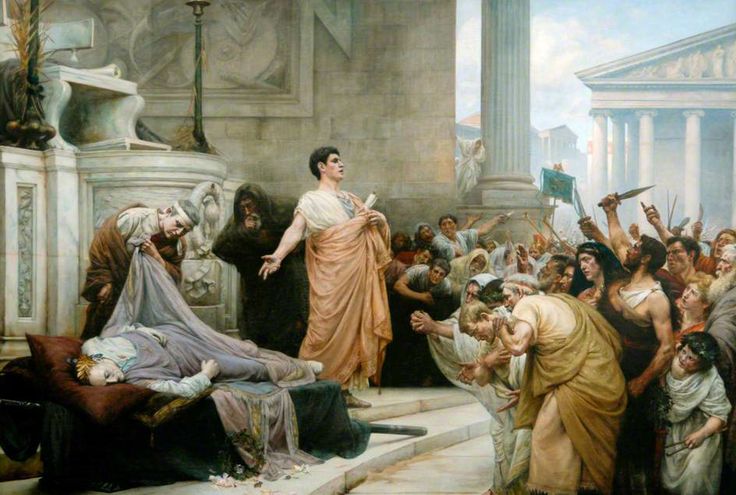
George Ed Robertson Antony
(c) Hartlepool Museums and Heritage Service; Supplied by The Public Catalogue Foundation

That Is the Question

  1. After Caesar’s Death, his friend Marc Antony held a funeral for him where he gives the famous “Friends, Romans, Countrymen” speech. How did Antony’s speech affect the crowd?
  2. Brutus has a speech where he explains why he killed Caesar. What does he say, and how effectively does he say it?
  3. Antony was secretly plotting to take power for himself, and get Brutus and Cassius killed. How did he do it?
  4. Do speeches have the power to change a nation?

Learning Objectives

  1. To explain the Rhetorical Triangle, the building blocks of persuasive speech.
  2. To study the famous “Friends, Romans Countrymen” speech, as well 
  3. To look at these speeches and get you to think critically about:
    1. What does the speaker want?
    2. What tactics does he use?
    3. How effective is it?

Setting the Scene

RSC Learning Zone- Act III, Scene 2 https://www.rsc.org.uk/shakespeare-learning-zone/julius-caesar/story/scene-by-scene

The Players (use the videos from the RSC)

Brutus- Man of Honour VS Man of Action | Julius Caesar | Royal Shakespeare Company

Antony Julius Caesar, Act 3 Scene 2 | 2012 | Royal Shakespeare Company

Go Deeper

Words, Words, Words

  • Irony
  • Antimetabole
  • Rhetoric
  • Countrymen
  • Lend
  • Interred
  • Noble
  • Hath
  • Grievous
  • Coffer
  • Honorable
  • Lupercal
  • Cause
  • Mourn

A Taste Of Your Quality

  • Watch the video of Antony’s speech:

Quizzes

Class 4- After Caesar-

We’ll talk about the consequences of violent revolutions and how Julius Caesar has inspired some of the greatest speeches in political history.

-Patrick Henry

– Gettysburg Address

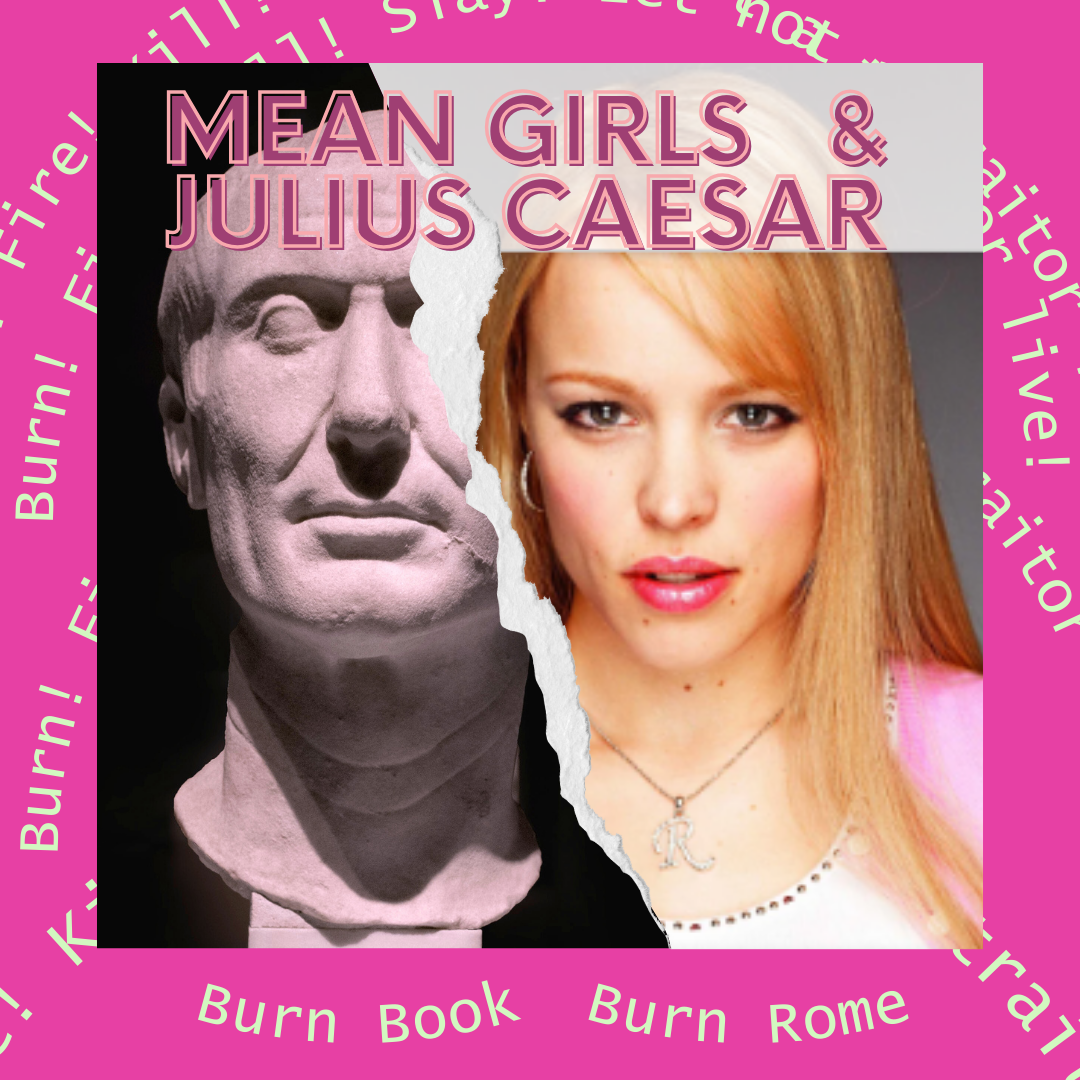
– Mean Girls

That Is the Question

  1. How have people interpreted the play “Julius Caesar” in America?
  2. Does this play promote violence?
  3. What kind of violent speech do we deal with in politics today?

Learning Objectives

  1. To show the link between American History and Julius Caesar
  2. To address the controversy and the misconception that the play promotes violent assassination.
  3. To end on a cautionary note people must think critically about what they hear in politics and not make rash decisions based on appeals to fear.

Setting the Scene- US History

  • America was founded using the principles of republican government that Ancient Rome used- with a senate, and a series of checks and balances to ensure no one has too much power.
  • America was founded in a violent revolution, and some of our country’s early leaders used Brutus as an inspiration- to overcome a tyrannical king.
  • In later years, however, some people have forgotten what happened to Brutus
  •  Today, we are often bombarded with speech that encourages fear and anger and we must think critically when we hear such speech in whatever forum- Roman, or Reddit.

The Players (use my JC lecture?)

  • Patrick Henry
  • Abraham Lincoln
  • John Wilkes Booth
  • Donald Trump

Go Deeper

-Watch the Caesar Video

– How does the play promote nonviolence?

– How did Brutus’ assassination fail to save the Roman Republic?

Words, Words, Words

Four-score

Dedicate

proposition

Civil War

Endure

Consecrate

Devotion

A Taste Of Your Quality (Night Cafe)

  • Use AI to create your own image for Julius Caesar
    • What time and place would you set the play in?
    • how do you see him- is he a hero, or a tyrant? 

https://outschool.com/classes/the-violent-rhetoric-of-julius-caesar-flex-schedule-edition-fwB3cwQM?refuid=MaRDyJ13

Six: Teen Edition

Last weekend I saw a wonderful production of “Six” The Musical at the Cab Calloway School Of the Arts in Wilmington DE. After seeing the professional production, I was worried that I wouldn’t enjoy these student performers but it was incredible! The young performers were all terrific and the director managed to use inventive, creative, and entertaining setpieces to both capture the essence of the Broadway show, and also make a version that is distinct and its own with student performers!

The Direction

DIRECTOR’S NOTE
I thought original I’d never Broadway get a show chance only to has direct six it at actors Cab. in AS the luck cast, would so/
have it, the teen edition came out this past summer, which allows
the addition of a singing and dancing ensemble. I immediately
applied for the rights and we were one of the lucky schools to
get them. This new teen edition is the perfect fit for our school
community and it highlights the talents of studentsfrom every
arts area.
I wanted to create a Beyoncé or Taylor Swift concert-type at-
mosphere, and I think we have achieved that with our show.
The fabulous lighting, the beautiful costumes and make-up, the
rocking pit band, the fabulous cast and crew and especially the
epic choreography have culminated into quite a spectacle! It has
always been a joy to work with my colleagues on these projects.
and I want to give a particular shout-out to my team of choreog-
raphers. They have taken my vision and turned it into something
amazing. The creativity in this team is fierce, and if ever there was
a group that fed off of each other’s ideas, it’s this one. We’ve had
a blast collaborating on this production
Also, I would like to acknowledge Brian Touchette, Peter Kuo and
Jared DeStafney for their tireless work on this production. With-
out them, this show would not be possible.

Marjorie Eldreth

As the director notes in the program, the challenge with doing a musical like “Six” at a high school or community setting is that there are only six major roles, which means it would be hard to find ways for the whole student body to participate. What I loved about this version is that, by utilizing dance, pantomime, and choruses, the director has found ways to not only involve more people, but help use the additional cast to tell the story in ways that the professional touring production I saw earlier didn’t!

My Favorite Moments

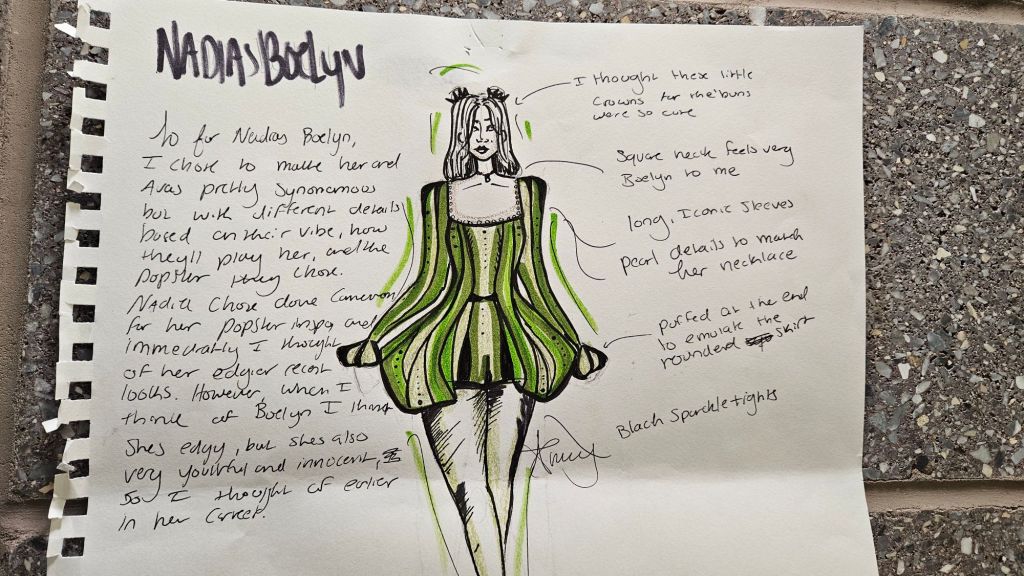
Normally I hate dance numbers in musicals. Don’t get me wrong, I admire the skill and athleticism that dancers have, but when I see a play or musical, I come for the story and the songs. Dance always seems like the black sheep in the musical theater trifecta to me. Not so with this production of “Six.” The dance numbers help tell the story in clever and moving ways! For instance, during Anne Boleyn’s “Don’t Lose Your Head,” a team of dancers with green sticks accompanied her. Their movements were cheeky and brash, which helps encapsulate her bubbly yet tart personality. During the choruses, the dancers and Anne rested their hands on the sticks, drawing attention to their heads moving back and forth, which reinforced both the title, and Anne’s air-headedness. Then, at the end of the number, the dancers got into a circle and pointed their sticks at Anne’s neck- pantomiming how she would eventually be beheaded! Thus, the dancers complimented Anne’s song perfectly, in a way that was not originally part of the show!

“My Heart Of Stone”

The most moving moment of dance was during Jane Seymore’s song “My Heart Of Stone.” When I saw this number in Hershey, it was by far my least favorite. I thought the lyrics were generic, that the song itself was bland, and that gave little depth to Jane character. All that changed this time around. While Jane belted her heart out about the son she never got to raise and the husband who mistreated her, we got to see elegant ballet dancers perform those moments for us. I particularly liked that the male dancers had red hair, (much like the real Henry VIII and his son). The dance actually helped me see Jane’s conflicting feelings for Henry- how she feels genuine love and affection one minute, and terror the next. How she and her son are both ghosts, now that they were denied the chance to live together on Earth. I don’t wish to diminish the wonderful singing and acting of the Hershey production, but Six: Teen Edition did a masterful job of showing, in addition to telling Jane’s story.

THe Cast

The Cab Calloway School of the Arts boasts some of the top young actors in the country, and all of them have tremendous chops as actors, dancers, and singers. Some of them already have professional acting credits. So it should come as no surprise that all the performances were incredible. It was very exciting, however to see a real 19-year-old play Catherine Howard, (since that was the real age she was when she died).

This production also took the bold leap of casting two men in the show. In one cast Anne of Cleaves was played by a man, and in the other (the one I watched), Katherine of Aragon was played by a man. I have no problem with this choice, (after all boys have been playing Katherine ever since Shakespeare’s Day), but I was a little disappointed that the actor had to modify the song to fit his range- I was looking forward to the extravagantly high Shakira and Beyonce inspired vocals that I’ve come to expect from the part. Nevertheless, the actor I saw was incredibly talented and his acting and dancing were completely appropriate for the part.

THe Dramaturg

For those of you who don’t know, a dramaturg’s responsibility is to help the actors, director, and production designer by doing research into the play’s historical or political context. It’s a role that is very important in period plays like Shakespeare. I’ve worked as a dramaturg myself and, though the work one does as a dramaturg is mostly unnoticed by the audience, the dramaturg can greatly contribute to the way the actors understand the text and give the director tools and ideas with which to explore themes and ideas present in it. I don’t know what the dramaturg did for this production, but I could tell based on the performances that every cast member was fully committed to their character. Each actor was able to clearly articulate their character’s emotional journey and that meant they must have learned the history and context of the Tudor period. Again, I don’t know if the dramaturg had any effect on this, but I’m going to assume they did a terrific job, because their end goal was accomplished- the actors and director gave a coherent and well thought out performance that captures the spirit of the Tudor period, so great job!

Brava/ Bravo

Happy International Women’s Day

Happy International Women’s Day! I would like to dedicate my posts today to my daughter, a wonderful strong girl, a Shakespeare fan, and a lifelong lover of the musical “Six”.

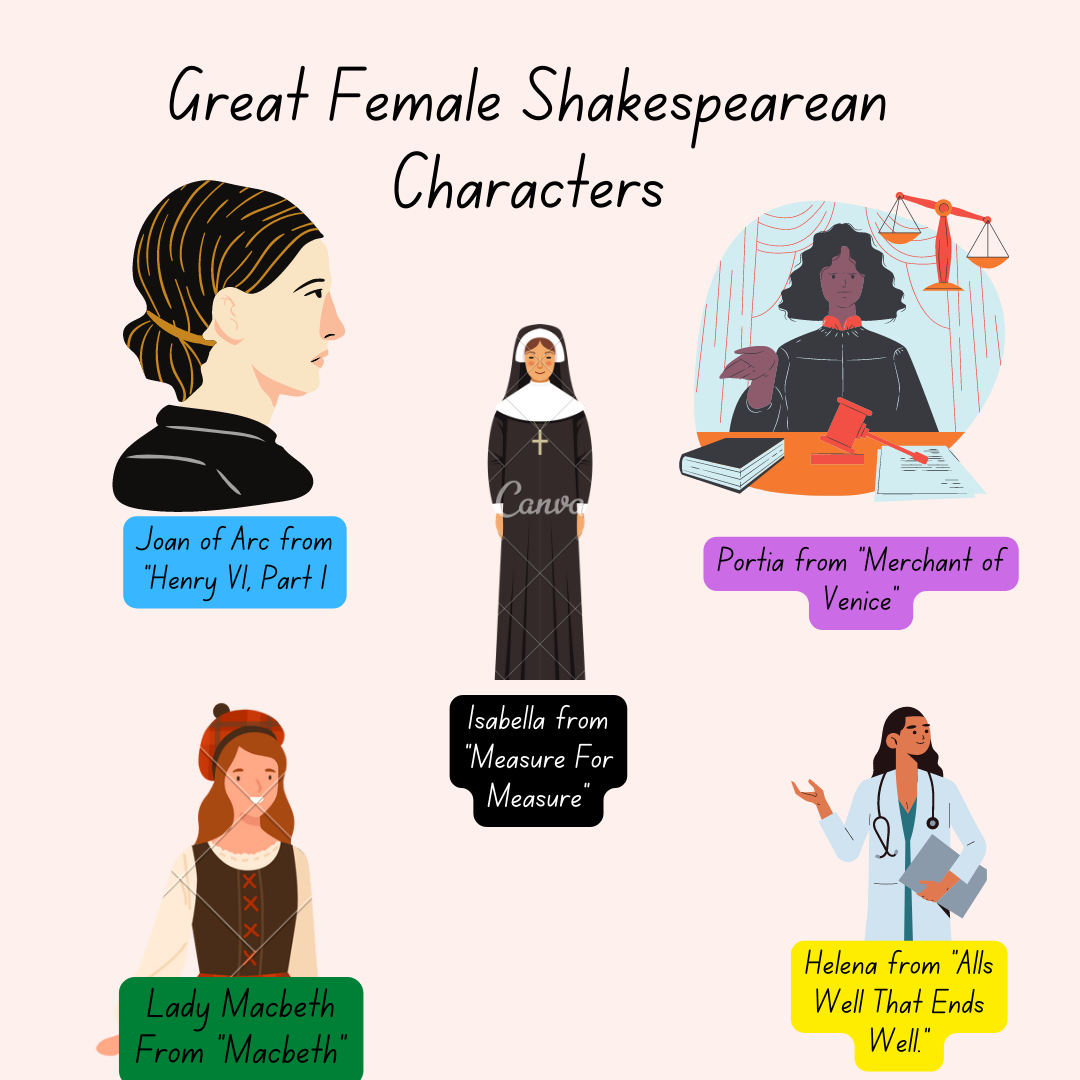
Some of Shakespeare’s Best Female Characters

I’ve discussed Shakespeare’s best Mother characters before, and his Roman characters as well, but I thought I should include some of the ones who are not mothers and/or unmarried (at least for most of the play). I don’t want to rank these characters since I detest ranking women in general, so here are some of Shakespeare’s best characters, and some of their immortal speeches:

CleoPatra

Katherine Of Aragon

Even though “Henry the Eighth” is my least favorite Shakespeare play, I love how strong Katherine is and how well she fights against the machinations of Cardinal Woosey and her husband. She is a courageous, virtuous, and strong-minded woman, who when Henry demands that she consent to a divorce, Katherine simply says: “No Way!”

Lady Macbeth

A fascinating and electrifying character. She seduces her husband and makes him fully commit to murdering the king. If you look at the post above, you can see the multiple potential readings for why she courts evil spirits to convince her husband to murder the king. Her strength and energy is highly attractive and it was easy for me to see how a man might do anything to make her happy.

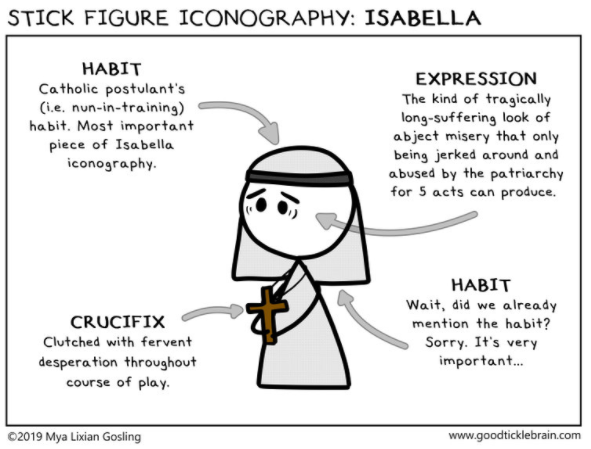
Isabella From “Measure For Measure”

I think Elizabethans would have seen the connection between the Virgin Queen who fought off assassination from the Pope, and Isabella, a virgin who fights off the advances of Angello, who seems pious, but who secretly is degenerate and cruel. Isabella even becomes a princess at the end of the play, (assuming she marries the Duke), which means she could literally become a Queen Elizabeth to English eyes.

https://www.rsc.org.uk/shakespeare-learning-zone/measure-for-measure/character/analysis

Stick figure version of Isabella from “Peace Good Tickle Brain.”

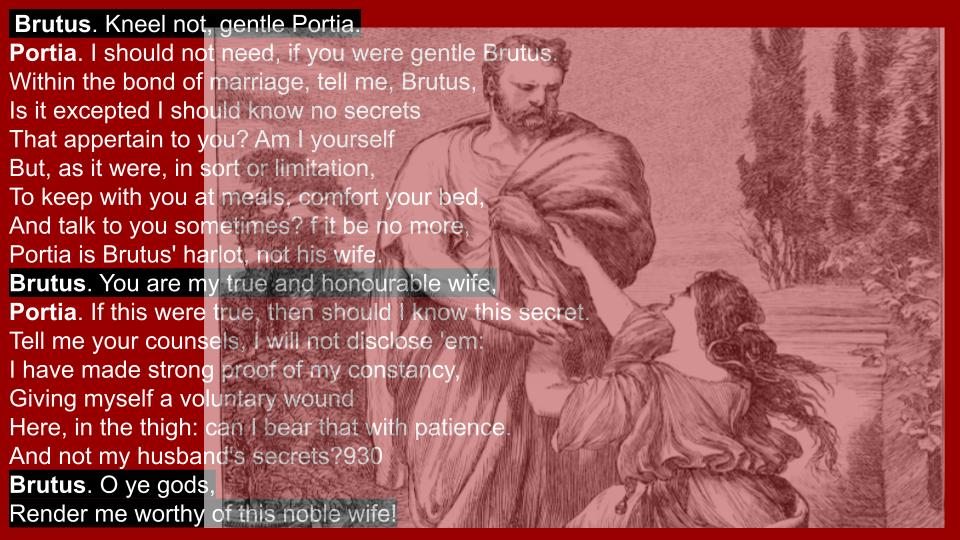
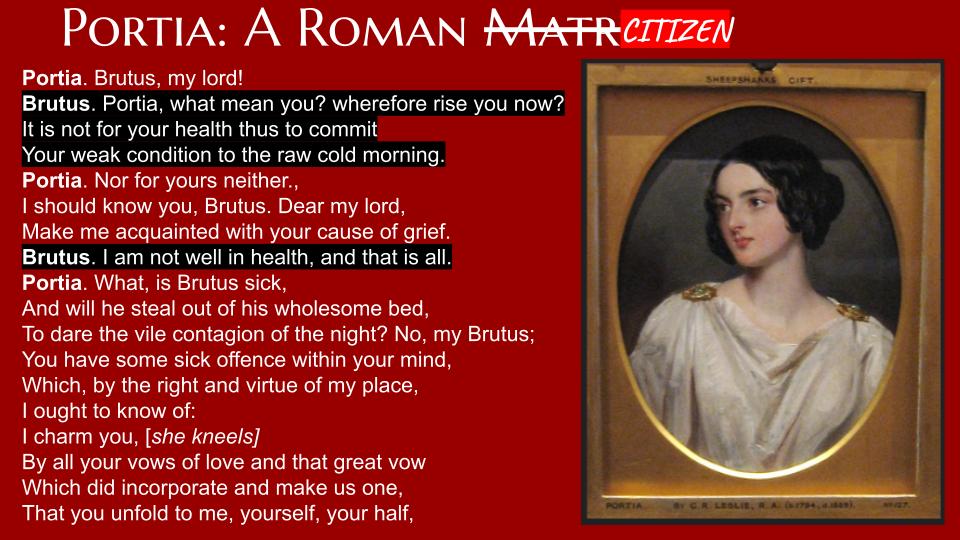
Portia Catonis (Wife of Brutus)

One of the best female characters in the Roman plays, Portia demands to be taken seriously as a wife and as a Roman citizen. In her one great scene we see her demand that Brutus tell her why he has been so distant and cold:

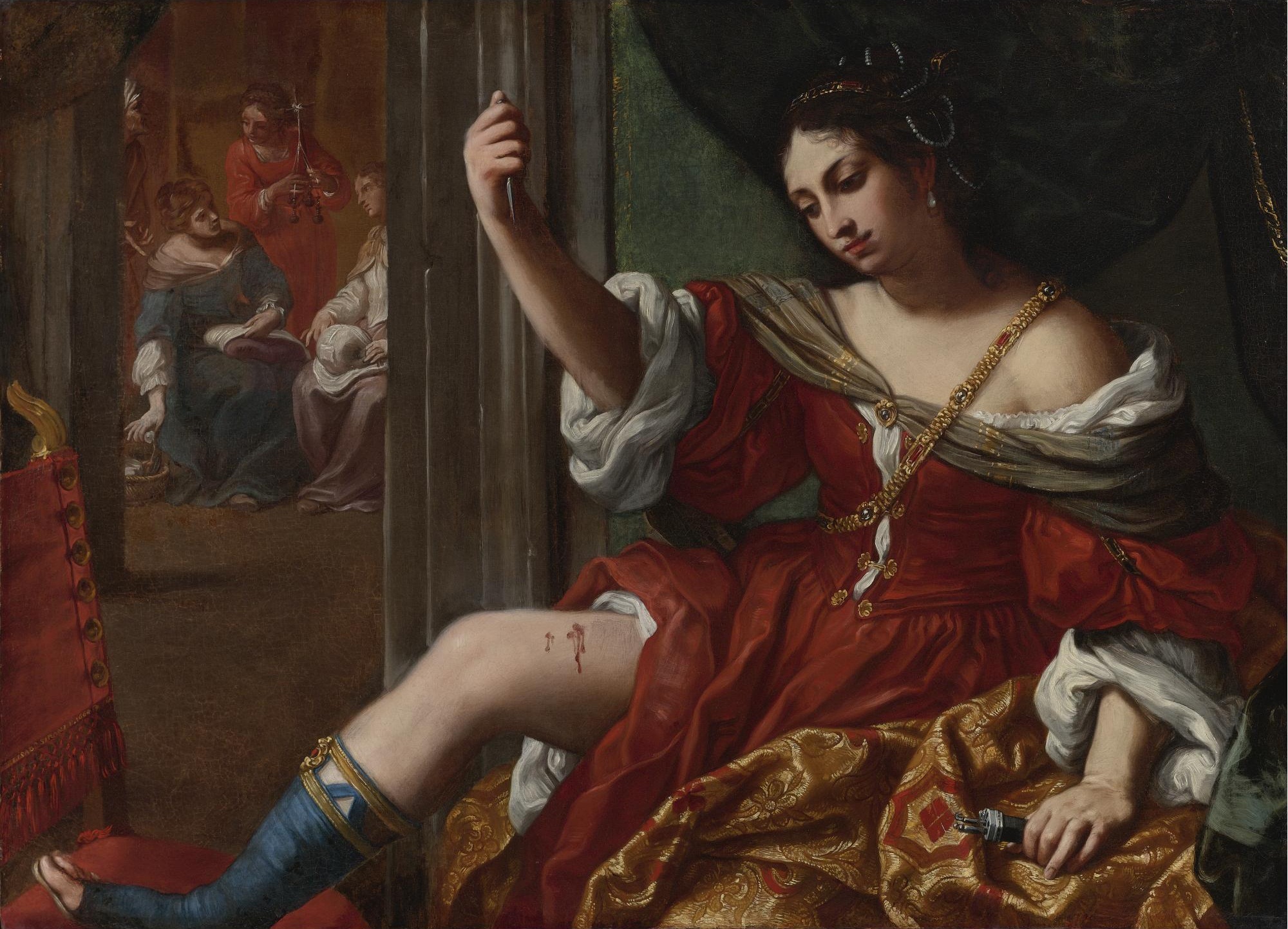
Elisabetta Sirani, Portia Wounding her Thigh, 1664, oil on canvas, 101 x 138 cm (Collezioni d’Arte e di Storia della Fondazione della Cassa di Risparmio, Bologna)
Some have speculated that in real life Portia helped Brutus with the conspiracy to assassinate Caesar, after all, she was the daughter of Caesar's great rival senator Cato, who was willing to die when he realized the Roman republic was finished.
Not only was the real Portia a great woman, she also inspired some great art. Below is the great masterpiece: Portia Wounding her Thigh, by Elisabetta Sirani (1664). According to Dr. DR. MAURA GLEESON, the painting was commissioned by a fabric merchant, which explains Portia's sumptuous outfit. Portia remains totally calm, yet focused and determined as the other women in the background idly spin clothes in the background. For more information on this masterpiece, click the link below:

If you’d like to learn more about Portia and Julius Caesar, sign up for my online class on the play via Outschool.com. Get a $5 discout with coupon code HTHES6Q5XA5 until Apr 2, 2024. Get started at https://outschool.com/classes/the-violent-rhetoric-of-julius-caesar-flex-schedule-edition-fwB3cwQM and enter the coupon code at checkout.


So happy International Women’s Day ladies! Hope you get some of the love and appreciation you deserve today! More posts coming soon!

Roman Women Week!

Since International Women’s Day is Friday, I’m devoting the following week to talking about the awesome female characters in Shakespeare’s Roman plays: Titus, Andronicus, Julius Caesar, Antony and Cleopatra, and Coriolanus

First, here’s my post and an accompanying podcast on Roman women, which includes an analysis of Lavinia, Portia, Valumnia, and Cleopatra:

Here’s a fascinating video about the lives of Roman girls:

And here’s a special section about Cleopatra:

Comedy sketches about Cleopatra from “Horrible Histories” BBC, 2015.
cleopatra facts infographics in 2021 | Cleopatra facts, Ancient history  facts, Cleopatra history
A Lady-Gaga-esque song about Cleopatra from “Horrible Histories,” 2014
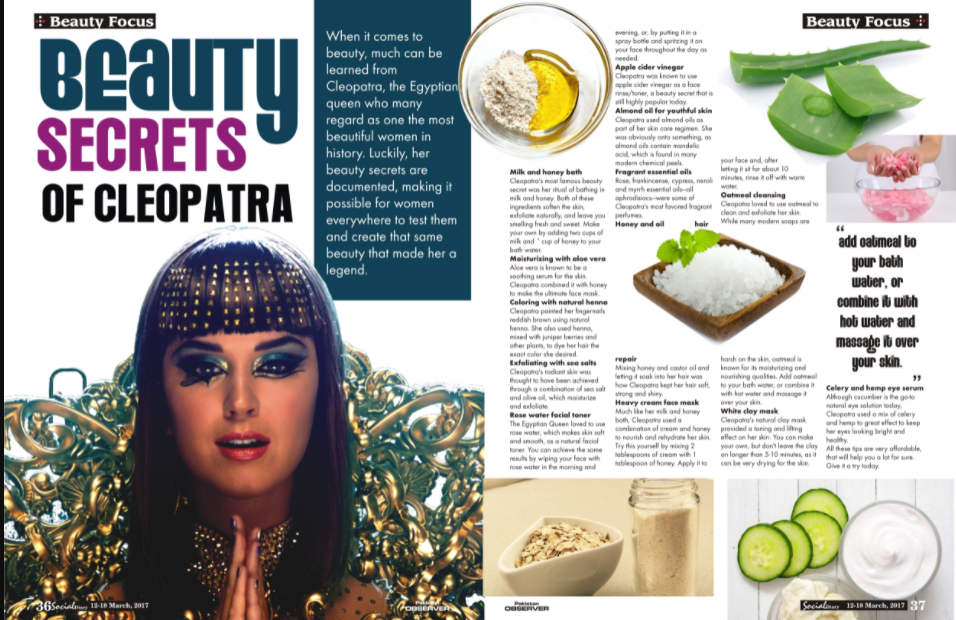
Infographic from an article about Cleopatra’s beauty regimen. Source: http://socialdiary.pk/

http://socialdiary.pk/beauty-secrets-of-cleopatra