New Class: Shakespeare and Star Wars!

Using self-paced online activities, your child(ren) will compare the plot and characters of Star Wars to Shakespeare’s plays. We will also discuss  Shakespeare writing by looking at “William Shakespeare’s Star Wars” by Ian Doescher.

Course Description

  1. Concept: To compare and contrast the plot, characters, themes, and language of Shakespeare’s plays with Star Wars
  2. Student Description:
    1. Epic battles, quests for revenge, pirates, funny characters, powerful warriors swinging swords. Star Wars has something for everyone. But did you know that in many ways, Star Wars is based on the ideas and writings of William Shakespeare? In this course we’ll peer beneath the veil of Shakespeare and Star Wars to find the universal stories of love, revenge, power, and growing up, using games, artwork, and dramatic readings by professional actors!
    2. Did you know that Star Wars is based on the ideas and writings of William Shakespeare? This class will teach you about writing and characters though games, interactive activities and dramatic readings of both Star Wars and Shakespeare!
  3. Course organization (the class is divided into 6 parts that students can complete at their own pace over a week-long period.

Outline

Unit 1: How Is Shakespeare Like Star Wars?

Class I- Setting the Scene

  1. That is the Question:
    1. What is Star Wars about?
    2. What parts of the Star Wars story are like Shakespeare’s plays?
    3. Are Shakespeare and the Star Wars movies saying anything similar about war? Families? Growing up?
  2. Lesson Objectives
    1. To teach about the characters and plot of Star Wars by comparing them to Star Wars
    2. To introduce the concept of archetypes, tropes, 
  3. Set the Scene
    1. Star Wars is about an evil empire trying to take over the galaxy. They have more ships, more soldiers, and a fearsome weapon that can blow up planets. The rebels on the other hand, though fewer in number, are faster, smarter, and have the advantage of fighting for a good cause. 
    2. In addition, the story is about growing up- Luke becomes a Jedi Knight. He takes revenge on the man who destroyed his father.
  4. The Players (slides)
    1. Luke
    2. Obi Wan/ Yoda
    3. Vader
    4. Leia
    5. Han
    6. R2D2 and C3PO
    7. The Emperor
  5. Words Words Words
    1. Epic
    2. Parody
    3. Theme
    4. Plot
    5. Archetype
    6. Character 
    7. Trope
    8. Theme

Class 2: The Journey of Han and Leia

  • Han and Leia vs. Beatrice and Benedick
    1. Show videos of Han before Leia
    2. Plot summary of Much Ado
    3. Clips of the bickering of Benedick and Beatrice
    4. Read blog and look at the writing.
    5. Activity- how would you write a love letter to Han or Leia?
    6. Play the scene from Jedi

Unit 2- The Prequels and Shakespeare’s Histories

  1. A Crash Course in Shakespeare’s Histories
  2. The Rise of Palpatine/ Richard III
    1. Emperor Palpatine in Star Wars rises to power through a combination of manipulation, intimidation, and by killing his opponents. 
    2. Bio of Richard III
    3. Slide- Richard’s rise to power
    4. Slide- Palpatine’s rise to power
  3. Quizlet

Unit 3- The Verse of William Shakespeare’s Star Wars by Ian Doescher

  1. What is William Shakespeare’s Star Wars
    1. Introduce the plays
    2. Explain how Shakespeare’s verse works
    3. Look at the common verse elements
      1. Sonnets
        1. Show the chorus of “Verily a New Hope”
          1.  It is a period of civil war. The spaceships of the rebels, striking swift From base unseen, have gain’d a vict’ry o’er The cruel Galactic Empire, now adrift. Amidst the battle, rebel spies prevail’d And stole the plans to a space station vast,Whose pow’rful beams will later be unveil’d And crush a planet: ’tis the DEATH STAR blast. Pursu’d by agents sinister and cold,Now Princess Leia to her home doth flee, Deliv’ring plans and a new hope they hold:Of bringing freedom to the galaxy .In time so long ago begins our play,In star-crossed galaxy far, far away
          2. Stychomichia
          3. Half lines
          4. Enjambment
          5. Title Crawl (make a gif via Canva)
  2. Side By Side Comparisons
    1. Read/ watch segments of the play
      1. To Be Or Not To Be
      2. All the World’s a Stage
      3. St. Crispin’s Day Speech
    2. Try to turn a Star Wars line into verse, and then look at the reveal.

Unit 4- Literary Devices of William Shakespeare’s Star Wars

  1. Using the educational guide, we’ll learn about the following literary devices:
    • Extended Metaphors (Luke’s green lightsaber)
    • Anaphora (Luke’s call to action in Jedi)
    • Premonatory Dreams (Calpurnia)
    • Stichomythia Richard III vs. Han and Leia

Unit5- The Hero’s Journey of Luke Skywalker

Class 1: What is a Hero’s Journey (Slides)

  1. Learn a little about Joseph Campbell’s monomyth. using the Percy Jackson post, Crash course video about monomyth
  2. Chart Luke’s monomyth journey
  3. Activity- Mad libs- write a star wars movie!
  4.  Quiz on plot elements from the monomyth (Quizzes or Quizlet)

Class 2 :  Hamlet and Luke Skywalker

  1. Plot comparison
    • (use infographic)
    • Quote from Doescher:
      • Hamlet The Tragedy of Hamlet, Prince of Denmark is Shakespeare’s most famous play. It’s also the play I make the most references to in William Shakespeare’s Star Wars.
  2. To Be Or Not to Be
  • Use my video about the speech to explain the structure
  • Note how Doescher repurpuses every line in the Star Wars Trilogy:
    • Sometimes it expresses fear: 
    • Sometimes concern: 
    • Frustration: “The whips and scorns of time”
    • Hope: “The undiscovered galaxy” “Tis a consummation devoutly to be wished.”
    • Activity: write your own paraphrase of Hamlet’s speech, using the 6 beats I provided.

Unit 6- Become a Bard Warrior (Slides and Sites)

Notes

Resources:

Web: https://americanshakespearecenter.com/2011/05/in-the-force-of-his-will-shakespeare-and-star-wars/

Close Reading: Shakespeare’s Star Wars (Empire Scene) https://shakespeareanstudent.com/2024/04/17/close-reading-william-shakespeares-star-wars/ 

The Journey of Han and Leia: https://shakespeareanstudent.com/2023/06/16/new-podcast-william-shakespeares-star-wars-part-ii-the-journey-of-han-and-leia/ 

Review of Jedi:

Video

  1. William Shakespeare’s Star Wars and the Power of Iambic Pentameter – Summer of Shakespeare the First
  2. The Wampa From “William Shakespeare’s Star Wars”
  3. Han Solo Does Shakespeare
  4. Emperor Shakespeare
  5. Darth Vader does Shakespeare
  6. Dagobah Cave Vision: https://www.youtube.com/watch?v=0otvBA0iAA0 
  7. Duel between Luke and Vader: William Shakespeare’s Star Wars excerpt: the Duel from “The Empire Striketh Back.”
  8. Comparison:
    1. 1st 10 minutes of Jedi: Star Wars Episode VI Return Of The Jedi Opening Scene HD720p
    2. Doescher’s version: Darth Vader Reads Star Wars Shakespear The Jedi Doth Return Vader Reviews

Podcast:

  1. https://open.spotify.com/episode/5BJ6TuhFO699OxWRLZNL2U?si=_cRGo7FzQjakUuZuPT0KwA 
  2. https://open.spotify.com/episode/1E3Eh9OpcR7lpMHI8edU4o?si=p-PrlRzQStqwGnoz4Y88pA 
  3. https://open.spotify.com/episode/5SFDcMAfF14ANVIki6xxr8?si=0YWtFyWoQE2CtG8fAEK22A 
Close Reading: Viola’s “I Left No Ring With Her” Soliloquy

For my Shakespeare club, I’m coaching two young actors on Viola’s celebrated soliloquy in Act II, Scene ii.I thought I’d share some of that work with you. In this speech, Viola has an epiphany; the lady she was sent to woo on her master Orsino’s behalf LOVES HER!

The Text

VIOLA

I left no ring with her: what means this lady?
Fortune forbid my outside have not charm’d her!
She made good view of me; indeed, so much,
That sure methought her eyes had lost her tongue,
For she did speak in starts distractedly.
She loves me, sure; the cunning of her passion
Invites me in this churlish messenger.
None of my lord’s ring! why, he sent her none.
I am the man: if it be so, as ’tis,
Poor lady, she were better love a dream.
Disguise, I see, thou art a wickedness,
Wherein the pregnant enemy does much.
How easy is it for the proper-false
In women’s waxen hearts to set their forms!
Alas, our frailty is the cause, not we!
For such as we are made of, such we be.
How will this fadge? my master loves her dearly;
And I, poor monster, fond as much on him;
And she, mistaken, seems to dote on me.
What will become of this? As I am man,
My state is desperate for my master’s love;
As I am woman,–now alas the day!–
What thriftless sighs shall poor Olivia breathe!
O time! thou must untangle this, not I;
It is too hard a knot for me to untie!

Exit

Twelfth Night, Act II, Scene ii, lines 648-672.

The Given Circumstances

Viola has spent an unspecified amount of time disguised as a man. She has just tried (unsuccessfully) to woo Countess Olivia on behalf of her employer, Duke Orsino. Olivia seemed intrigued by her in her disguise as “Cesario,” and refused to hear any more words about Orsino, but asked Viola to come see her again. The Countess then sent her messenger Malvolio to give Viola a ring, which he claims she tried to give to Olivia as a gift. At first, Viola is confused and upset by the accusation, but slowly realizes that the ring is actually a gift for her; in fact, it’s a love token.

Traditional Interpretations

I think the comedy depends on how Viola reacts to the realization that Olivia loves her. I’ve seen some Violas that are embarrassed, some that are a little frightened (after all, hell hath no fury like a woman scorned), and others with sad sympathy. Viola is a good person, so she can’t laugh at the lovesick countess, but she can have a wry laugh at herself and how her disguise has caused all this trouble; making her unable to confess her love to him, while at the same time making Olivia think she is a handsome young man.

Michelle Terry In the Globe Theater (2021)

Michelle Terry as Viola in the 2021 production of “Twelfth Night”

Michelle Terry is very matter-of-fact in her portrayal. She doesn’t pause, she doesn’t drag out the lines. In fact, she seems more annoyed and scandalized than anything else. The comedy comes mainly from her gestures and movements as she talks to the audience as if they were one of her gal-pals- venting her frustration with this ridiculous situation.

 Michelle Terry excels as Viola, straight-faced, tormented, only occasionally raising a conspiratorial eyebrow at the audience. 

https://www.theguardian.com/stage/2021/aug/08/twelfth-night-review-shakespeares-globe-theatre

Judy Dench in the RSC TV show “Playing Shakespeare” is very sympathetic to “Poor Olivia, ” and plays the speech with a romantic sentimentality. She’s focused on Olivia, and feels awful for the false hope she’s given her.

Both these interpretations are valid, and they’re a good baseline for two sides of Viola’s personality- the sensitive genteel duke’s daughter who is sympathetic to Olivia, and the down-to-earth funny one who is willing to disguise herself as a boy to survive.

Literary Devices

Imagery

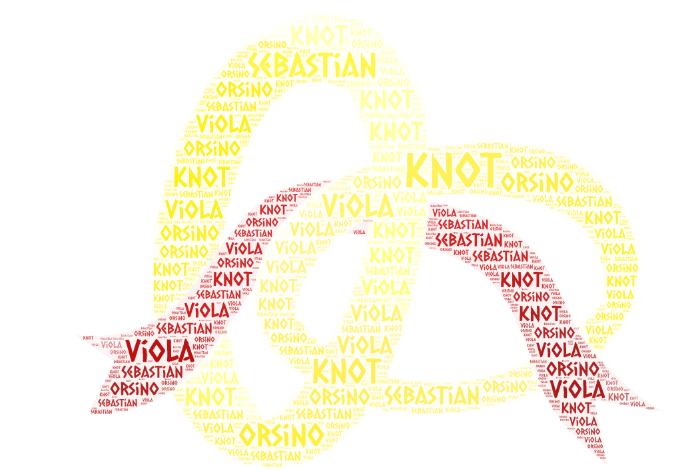
The main image here is the image of the knot- a central image of how convoluted this love triangle is.

Verse

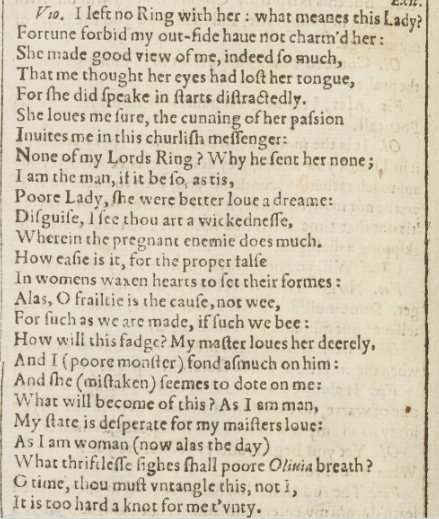
First Folio Reprint from The Boldlien Library.
I left no Ring with her: what meanes this Lady?
Fortune forbid my out‑side haue not charm'd her:
[650]
She made good view of me, indeed so much,
That me thought her eyes had lost her tongue,
For she did speake in starts distractedly.
She loues me sure, the cunning of her passion
Inuites me in this churlish messenger:
[655]
None of my Lords Ring? Why he sent her none;
I am the man, if it be so, as tis,
Poore Lady, she were better loue a dreame:
Disguise, I see thou art a wickednesse,
Wherein the pregnant enemie does much.
[660]
How easie is it, for the proper false
In womens waxen hearts to set their formes:
Alas, O frailtie is the cause, not wee,
For such as we are made, if such we bee:
How will this fadge? My master loues her deerely,
[665]
And I (poore monster) fond asmuch on him:
And she (mistaken) seemes to dote on me:
What will become of this? As I am man,
My state is desperate for my maisters loue:
As I am woman (now alas the day)
[670]
What thriftlesse sighes shall poore Oliuia breath?
O time, thou must vntangle this, not I,
It is too hard a knot for me t'vnty.

It’s interesting to note that (in the First Folio text), the verse alternates between being regular, and using a run-on technique called enjabment, where the thoughts continue after the end of the lines, starting with lines three and four. Ironically, when Viola says that Olivia was distracted and confused when she visited her, her own thoughts are disjointed and fragmentary as she reaches the inevitable conclusion that Olivia is infatuated with Viola in her disguise.

Viola’s Emotional Journey

In the book “Shakespeare’s First Texts” by Neil Freeman he describes how the Folio prints the speech in four distinct sections. Freeman hypothesizes that Shakespeare organized this speech into four phrases that chart the stages of emotions Viola goes through:

Each stage has its own easily identifiable quality, reflecting the growing steps of Viola’s journey in what for her is a huge struggle not only to comprehend, but also to deal with the enormous complications of the dreadful love triangle- the potential results of which are now becomming only too clear.

Freeman, 175.

Stage 1: Introduction

In the first three and a half sentences, Viola goes through the facts- she gave no ring to Olivia, Olivia was eying her, and half paying attention to what Viola was saying. The phrase ends with Viola’s conclusion that Olivia must be in love with her.

Stage 2: Complications

The sentences are of very irregular length- sometimes six words per line, sometimes a few as four. According to Freeman, the irregularity of the verse shows how Viola’s emotions are getting the better of her. Viola could be gasping with remorse over the pain she’s caused Olivia, or shocked at how easily she was taken in by Viola’s disguise.

Stage 3: Crisis/ Catharsis

Each line of this section mentions the people in this love triagle: “My master,” “And I,” “And She,” etc. Viola might be thinking about the possible outcomes to this situation- getting fired, getting discovered, getting married, etc.

Stage 4: Summary: “O Time, Thou Must Untangle This, Not I.”

Like Hamlet before her and Macbeth after her, Viola ends her soliloquy by saying she has no conclusion. She has no idea how to solve this problem, but can only hope that Time will provide a solution.

Audience Interaction

As I said, this is a soliloquy, which is to say, a speech where the character is solo or alone onstage. Some people think this means that the characters are talking to themselves, but I firmly disagree with this notion. One reason why Shakespeare writes soliloquies is because they allow a character to share their thoughts and feelings with the audience. They are the ancestors of every aria or solo in opera and musical theater, and every Disney Princess/ Villain song. I’ve even said before that there are some similarities between Viola and a famous Disney Princess:

Resources:

Illustrations