I’ve been reading this wonderful picture book about the history of the color blue- a color that evokes deep emotions and has a rich and sometimes tragic history. Here’s a video of the book being read:
Blue: A History of the Color As Deep As the Sea and Wide As the Sky by Nana Ekua Brew-Hammond
In identifying an “outstanding” book for children, the committee members will consider the following:
• Accuracy of presentation in both text and illustrative material, as well as appropriate documentation, avoidance of anthropomorphism and teleology, distinction between fact and theory, and balanced treatment. • Organization of material (e.g., general to specific; specific to general) that contributes to clarity and accessibility. • Style of writing that is engaging and distinctive in its use of language. • Style of illustration that is engaging, informative, and complementary to the text. • Appropriateness of book design based on the topic or subject and with respect to the different age groups for which the topic or subject may be appropriate. • Potential contribution to the K-8 curriculum.
National Council of Teachers of English Website: Orbis Pictus Website.
As I mentioned in my Coronation post, the colors blue and purple have been associated with power (earthly or heavenly) because for centuries they have been hard to produce, and the book tells that history extremely well while highlighting the people and cultures that created those dyes by harvesting shellfish and collecting indigo plants:
A few good reasons to appreciate the color blue. Throughout history, humans have captured, cultivated, and coaxed the color blue out of everything from mollusks to rocks to plants. In this fascinating exploration of our relationship to this once-precious color, Brew-Hammond begins by discussing its elusive nature: Seawater is blue, but the color disappears when water is cupped in ones hand; similarly, crushing iris petals yields blue, but the hue quickly dissipates when soaked in water. Readers learn that the earliest known use of blue dates back to about 4500 B.C.E. in Afghanistans Sar-e-Sang Valley and that ancient Egyptians used it, too. But blue has been found worldwide. It was extracted from the bellies of particular shellfish in coastal Japan, Central America, the Mediterranean, and Mexico and harvested from plants in Africa, Asia, the Caribbean, and the Americas. Because of its rarity, blue has been considered a royal color reserved for use by the wealthy and privileged. Laced with insights, Brew-Hammonds meditative verse covers a wide range of cultures, time periods, and geographical locations, while Minters mesmerizing images highlight the significance of blue to diverse groups of people through culturally specific visuals such as hairstyles and clothing design. The highly textured backgrounds add life and movement to the focal images in the foreground. (This book was reviewed digitally.)Stunning and informativeand as profoundly rich as the color blue. (authors note, facts about blue, selected sources)
Kirkus Reviws
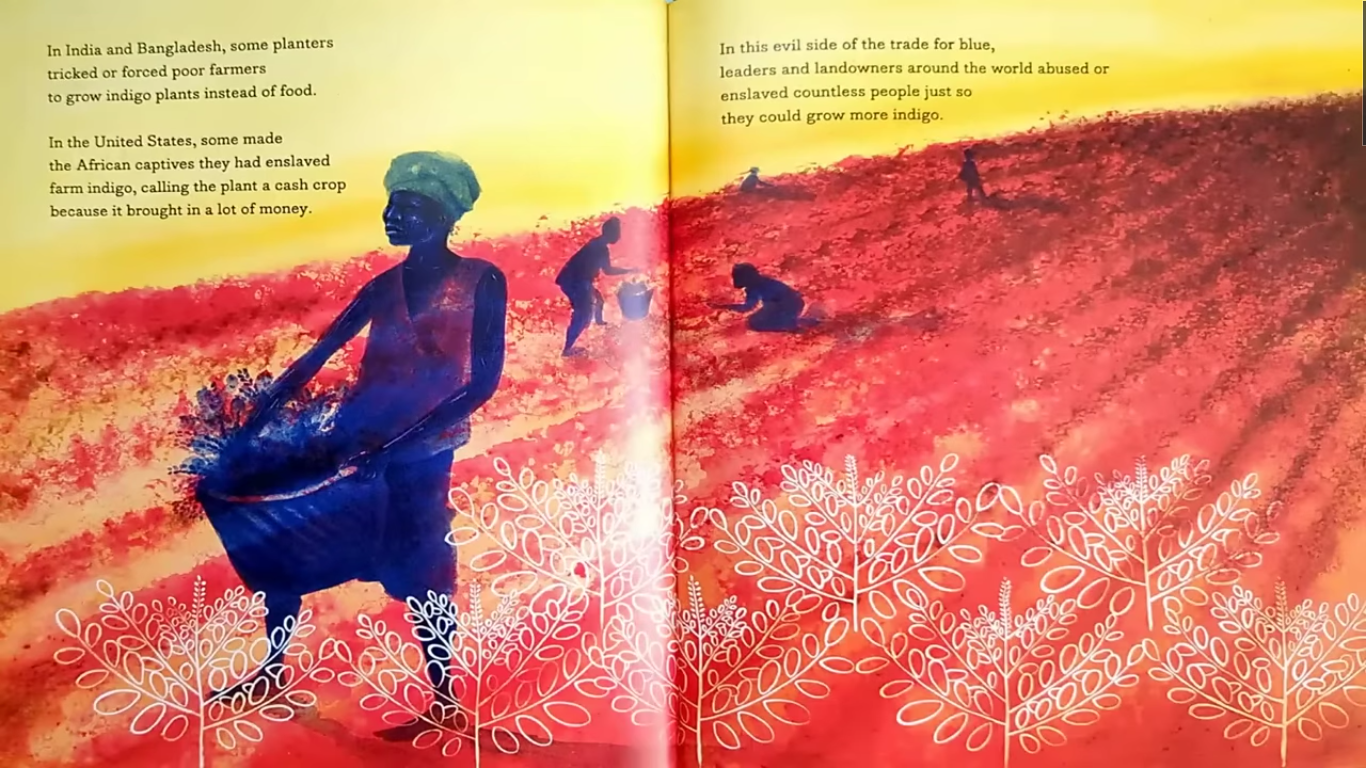
As the review above shows, the book doesn’t focus on European royals or colonialist countries that bought and wore blue clothing, it focuses on the countries that make blue in places like Africa, Asia, and Central or South America. It also doesn’t disguise the fact that the slave trade in America was partially used to gather indigo plants, which the illustrator poignantly represents on the page where slaves are painted with blue dye- they lived and died for the color of their skin, and for the color they were forced to cultivate.
Fortunately, the book doesn’t end on the exploitation of people for the sake of a color, it also celebrates the triumph of science as chemist Adolph Von Baeyer labors to develop an artificial dye- one that would make such backbreaking labor unnecessary. Von Baeyer began working in 1865, the same year the American Civil War ended.
So what does this have to do with Shakespeare?
Brew-Hammond explores the history and culture surrounding blue powders and dyes, a rare and prized commodity until recently. She details how the ancient Egyptians ground lapis lazuli rocks from Afghanistan to make blue pigment for royals; later, sea snails were used by dyers until the indigo plant became a more practical solution for large quantities; and finally, Adolf von Baeyer created chemical blue, which led to widespread availability of this color. She also touches on some concepts and emotions associated with this hue: feeling blue (sad), blues music, out of the blue (unexpected), royal blue, and blue ribbons (extraordinary). Minter’s acrylic-wash illustrations depict predominantly Black figures, a nod to the key role played by West African dyers in developing these tinctures, and the importance of enslaved Africans whose toil made possible the North American indigo industry. Blue tints appear in every spread, but often as a spotlight color; reds, yellows, and greens do the heavy lifting, allowing the blue tones to stand out. A fascinating look at an underreported topic.
What’s really wonderful about this book is that it doesn’t just detail the history of the color blue, it also delves into its poetic history- the way we use blue as an adjective, in expressions, and many other daily occurrences. Terms like ‘feeling blue,’ or ‘blue blood,’ and the connotations of the sky and ocean make blue a color that is grand and vast, but hard to catch. This quality of tantalizing beauty has inspired many poets, including Shakespeare:
CLEOPATRA: Here My bluest veins to kiss; a hand that kings Have lipp’d, and trembled kissing.
Antony and Cleopatra
Rosalind. There is none of my uncle’s marks upon you; he taught me how to know a man in love; in which cage of rushes I am sure you are not prisoner.1455
Rosalind. A lean cheek, which you have not; a blue eye and sunken, which you have not;
As You Like It
Under these windows, white and azure laced With blue of heaven’s own tinct.
Cymbeline
Now pile your dust upon the quick and dead Till of this flat a mountain you have made T’ o’ertop old Pelion or the skyish head Of blue Olympus.
Hamlet
Also, apparently, there is a shade of blue CALLED “SHAKESPEARE!”
So, I hope you enjoyed this look into the complex history and mystery of the color blue. Like Shakespeare, blue is mysterious but pervasive- hard to pin down in history books, but admired and celebrated to this very day.
I am just ecstatic to talk about this year’s hit Broadway Musical Six. It swept the Tonys, and has opened up touring productions across the country, and I JUST GOT TO SEE IT!
This vibrant, clever retelling of Tudor her-story was created by TOBY MARLOW & LUCY MOSS in association with the Chicago Shakespeare Festival. The show is incredibly smart, and creative, and delves into the lives of some fascinating women, re-told as a singing contest with the characters singing their lives for you to judge what it was like being the queen of England and living with the turbulent and fickle Henry VIII.
What really appeals to me in this show is that like Hamilton, the musical takes these six semi-mythical women and tells their story in a way that is fresh and exciting. It bridges the gap between Tudor History and the modern-day by equating being a queen with being a celebrity, with all the drama of ambitious parents, romantic drama, public opinion, and even being exploited and sexualized by a male-dominated society. This comes across in the music, the costumes, the lyrics, and even the lighting!
Why “Six” Slaps
The costumes are brilliant and iconic. Catherine Of Aragon is like a cross between Beyonce, a saint, and a medieval knight. The lighting is incredible! You could tell the whole story using the lighting design as it pulsates, dances, changes into different colors, turns into different shapes, and finally flashes the name of the show in triumphant gold letters.
One particularly brilliant way the music works in “Six” is the fact that it uses the song “Greensleeves” as a motif both musically and thematically. One big theme of the show is how, unlike Henry VIII, most of the history of his six queens is lost and replaced by legends and even songs. The first line of the show is the famous rhyme about their fates: “Divorced. Beheaded. Died. Divorced. Beheaded. Survived.” As the video above helps illustrate, Marlowe and Moss know that most people only know the rhyme about their deaths and the myth that Henry wrote a song about one of them; that their lives are overshadowed by their deaths and the misconceptions that people have written over the years. Howard Ho points out how the song musically forces itself into the first number, “Ex Wives,” but by the end of the show, the six queens break free from these musical bars! You can hear the change of key and notes during this performance at the Tonys, which puts the opening number and closing reprise together.
The Cast of “Six” perform live at the 2021 Tony Awards.
But how do the queens go from “one word in a stupid rhyme,” to a group of powerful, individual queens singing in harmony, without the man who made them famous? That’s what the solo numbers in “Six” do so incredibly well- tell each queen’s solo stories as rocking ballads, hilarious dis-tracks, soulful love songs, and… well stay tuned.
Part II: The Women and Their Queenspirations
1. Catherine of Aragon
Catherine of Aragon was Henry’s first wife and is still universally beloved, even though Henry decided to divorce her. As the epitome of a stand-alone power queen, it makes sense that Six modeled her character, costume, and songs after Beyonce, with a Shakira-inspired Spanish beat for good measure:
My favorite thing about her solo, “No Way” is how the writers paraphrase her real-life speech during the divorce trial in 1529. Below are the lyrics and the real speech:
Alas, Sir, where have I offended you? Or what occasion have you of displeasure, that you intend to put me from you? I take God and all the world to witness that I have been to you a true, humble and obedient wife, ever conformable to your will and pleasure. This twenty years and more I have been your true wife, and whether it be true or no, I put it to your conscience.
— Katherine of Aragon, 1529
2. Anne Boleyn
In some ways, the version of Anne Boleyn in “Six” is less a pop version of the real queen and more of a commentary on the nature of celebrity. If you watch the video, you can see how in life she was admired for her beauty and fashion but hated for her comments on Queen Katherine, her scandalous love affairs, and her brash nature. This explains the spiky pop-punk princess look they gave her, (which evidently resonates with many audiences since I saw at least two girls cosplaying as Anne in the audience). Sort of like a celebrity who gets canceled on Twitter or Princess Diana, Anne shows how a person can be undone when they dare challenge an established order, especially the Royal Family.
After the show, I found it a bit weird that they portrayed Anne Boleyn as a jetsetting airhead, but then again she is one of the best-known queens in history, so they can get away with it. In reality, Anne Boleyn was highly educated and a member of an ambitious and social climbing family who basically pushed her to woo Henry. As you can see in this clip from “Anne Of A Thousand Days,” Henry and Anne’s family bullied her constantly to become the King’s mistress after HE ALREADY GOT HER SISTER PREGNANT, so Anne knew that the only way to keep Henry from ruining her life was to convince him to divorce Katherine of Aragon and marry her.
Of course, this strategy didn’t save Anne in the end, which says more about how cruel Henry VIII was, chewing up women and spitting them out in his ravenous quest for a son. So is this an accurate portrayal of Anne’s life? No. Is it fun, ABSOLUTELY!
III. Jane Seymore
I’m more than I seem, or am I?
“Six” The Musical.
This version of Jane Seymore was inspired by Adele, so appropriately, she has a heart-wrenching power ballad about her turbulent relationship with Henry. Sadly, we don’t know much about Jane’s real life, so the song takes some liberties. If you go to the Hampton Court Website, you can actually vote as to whether Jane was a devoted wife or a social climbing gold-digger. Probably the real woman was something even more complicated, though we’ll never know for sure.
IV. Anne of Cleaves
Anne of Cleaves is the funniest part of the show! Many of us have heard the story that Henry divorced Anne after he found her ‘ugly.’ What “Six The Musical” does is amend the story, by pointing out that after he divorced her, Henry gave her a castle and a huge retainer, allowing her to live like a queen, without being married to a king! Accordingly, her song is a Rhianna-style dis track that shows off her awesome lifestyle, and spits in Henry’s stupid face!
As fun as this, rags-to-riches story is, the truth is less fun- Anne was the sister of a German duke, so Henry’s lord Chancellor Thomas Cromwell probably forced Henry to marry her for diplomatic reasons (source: Hampton Court: “Anne of Cleaves”). Naturally, Henry didn’t like being told what to do- I suspect he resented Anne before even meeting her because he didn’t get to pick her himself.
As for whether Anne was actually ugly, the truth is really surprising- Henry actually disguised himself as a peasant during a masked ball when he first courted Anne, and she foundhim repulsive. At the time, Henry was 49 years old, and in very poor health. As such, he was intermittently impotent and blamed his inability to conceive a child with her on her supposed ugliness to save face.
Even though Anne in the show hates Henry, in reality, once the marriage was annulled, Anne and Henry remained good friends for years! She attended his next wedding to Katherine Howard, and, just like in the show, Henry treated her much better after the divorce:
‘YOU SHALL FIND US A PERFECT FRIEND, CONTENT TO REPUTE YOU AS OUR DEAREST SISTER. WE SHALL, WITHIN FIVE OR SIX DAYS …DETERMINE YOUR STATE MINDING TO ENDOW YOU WITH £4000 OF YEARLY REVENUE…YOUR LOVING BROTHER AND FRIEND.’
Henry VIII, 1548, six months after their wedding, when the annullment went through.
V. Katherine Howard
Without question, Katherine Howard is portrayed as the most tragic of Henry’s six wives and her song is a huge sucker punch. The writers never let you forget that Katherine’s first affair was when she was 13, and she died at age 19. Like Anne Boleyn and Jane Seymore, Henry picked Katherine for his queen among his ladies in waiting and her song “All You Wanna Do” satirizes his and many other men’s lustful appetites. The song begins as a raunchy, sexy pop ballad in the vein of Britney Spears’ “Toxic” and “Womanizer” about Katherine Howard’s love affairs, but then devolves into a cry for help, as Katherine confesses how she was abused, used, and manipulated by the men in her life, (including her own cousin Thomas Culpepper) until she was beheaded in 1542. It masterfully satires both Henry’s cruelty and the hypersexualization of teenage pop stars which certainly took its toll on Britney Spears and Ariana Grande, Katherine’s major ‘Queenspirations.’
VI. Katherine Parr
Historically, Katherine Parr had to turn away her fiancee Thomas Seymore (just like Anne Boleyn was previously engaged to Henry Percy) once the king set his eyes on her for his wife, so her song is a sad, soulful Alicia Keys-inspired bittersweet song where she tearfully says goodbye to Thomas to spare his feelings and probably his life.
Not only does this song once again show how Henry’s selfishness and his lust ruined the lives of the women he married, (as well as the men who already wanted to marry them), but it also sets up the main idea of the show:
His-Story overthrown
In the final number, the wives turn the tables on Henry- they have spent centuries being defined by him, but in reality, he is just as much defined by them! Going forward, history should not define these great women as just, “The Six Wives of Henry the Eighth,” but to celebrate their individual lives and contributions to history. Katherine Parr mentions this when she points out that in life, she fought to allow women to be educated, she wrote books, and was a scholar of theology. Historically, Henry and Katherine would argue about religion and he nearly executed her after she disagreed on points of theology, but Katherine kept her life by claiming she was “Not disagreeing with [him], but simply learning from [him].”
I Don’t Need Your Love is sung by Catherine Parr in SIX: The Musical. The first part of the song refers to her love of Thomas Seymour, whom she probably wanted to marry rather than Henry (and did marry after Henry’s death). However, the song also protests at the fact that women are often defined by their relationship with men, rather than as people in their own right. Catherine wants to be remembered for what she did, rather than the men she married or loved.
Katherine Parr, Six.
The final number completes the idea of the ‘historemix’ by having the Six queens/pop stars come up with a re-imagined happy ending for themselves, one that doesn’t include the pain that Henry inflicted on them: Katherine A becomes a singing nun, (like Whoopi Goldberg in Sister Act), while Anne Boleyn starts writing lyrics for Shakespeare (which is a fun idea since he does mention “Greensleeves” twice). Jane Seymore forms a band with her many surviving children, Katherine Howard goes solo, and Katherine Parr joins the other queens in a supergroup. It’s not at all historical, but it is a fun and sweet way to put an epilogue on these (mostly) tragic lives.
It’s odd, however, that the show invents an epilogue instead of talking about the six queen’s greatest legacy- Queens Elizabeth and MaryI. For a show that wants to highlight the often-forgotten legacy of these queens, it is an odd oversight. Remember Catherine and Anne gave birth to queens who eventually ruled England without a king. Jane Seymore gave birth to a king, and Catherine Parr helped raise them and restored them to the line of succession- She’s the reason her stepdaughters were able to become queens in the first place.
My issues with the epilogue aside, it is great to see history be recontextualized and shared in such an accessible way. We all know that European history is dominated by the names of white guys- king whoever, duke what’s-his name. To see important women in history be given a voice by a multi-ethnic cast is a great way to make it resonate, and using the metaphor of pop stars works extremely well in this context- these women mostly didn’t choose stardom, but they deserve it for what they went through.
Brava.
Educational links related to the six wives of Henry VIII:
I’m so excited! One of my favorite Youtube channels is doing a series of videos where they try Shakespeare for the first time! Zach Kornfield, Eugene Yang, and Keith Habersberger known collectively as “The Try Guys” are a group of friends who seek out new experiences and share them with the world. They thrive on taking themselves out of their comfort zone and learning about the world through experiencing it firsthand in a funny, lighthearted way.
So, what could be more adventurous, daring, informative, and out of YouTube’s comfort zone than doing Shakespeare? So in a series of videos they are going to explore Elizabethan clothing, stage combat, learning how to speak Shakespearean verse, and finally on August 10th, 2023, they will perform “Romeo and Juliet” live on Youtube, with suggestions from the audience!
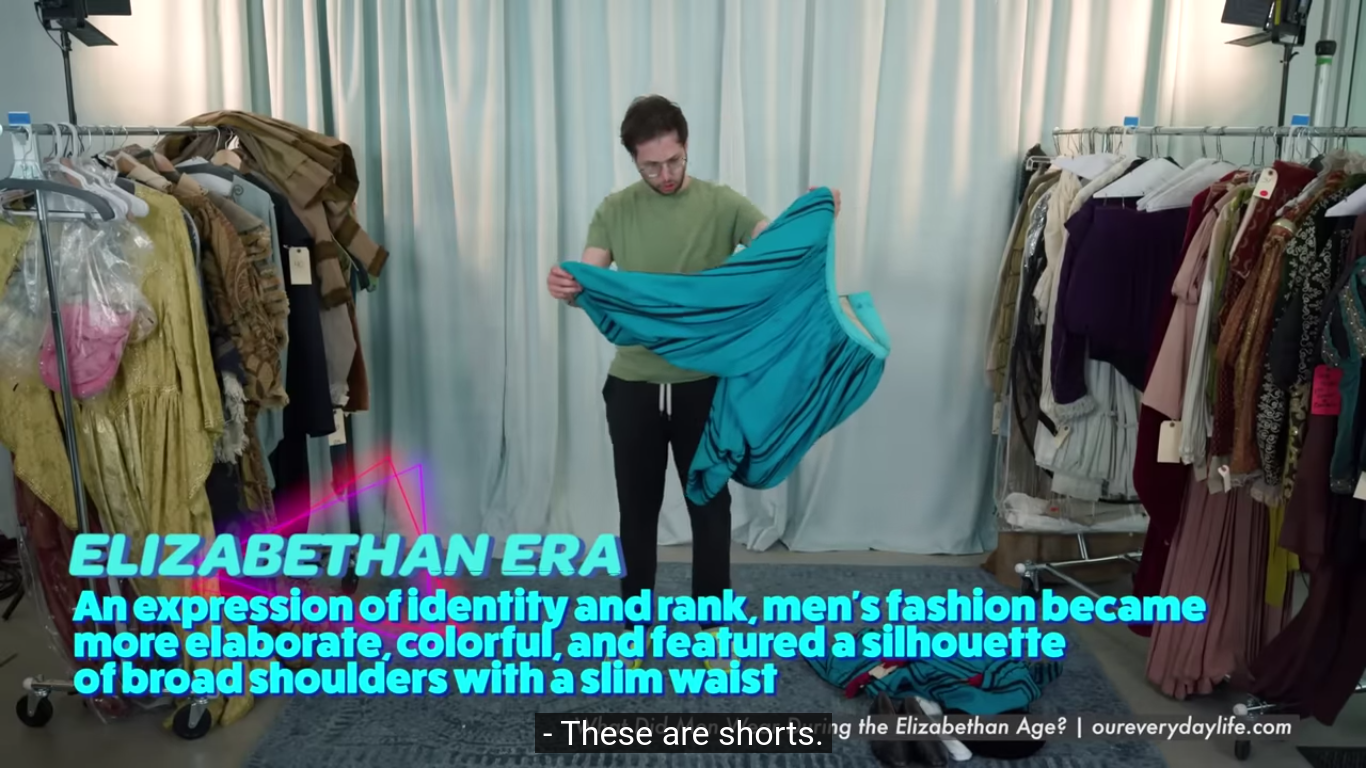
This post will be a reaction to the humor and information on Elizabethan clothing from part one of the series with my notes on Elizabethan fashion, and the costumes worn by Shakespeare’s company
Background on Elizabethan Clothing
I’ve written a series of posts about Elizabethan fashions. If you’re unfamiliar with the period, Queen Elizabeth reigned from 1558 to 1603. This was one of the most prosperous and cosmopolitan times in English history and the fashions of the time reflected this.
Report of fashions in proud Italy, Whose manners still our tardy apish nation Limps after in base imitation.
Richard II, Act II, Scene i
Clothing of this period was very hierarchical- if you were lower class, the garments had drab colors, were functional rather than fashionable, and were not tailored for individual people. On the other hand, upper-class people literally wore their wealth and status on their sleeves- clothes were tailor-made, colors were bright and hard to produce, and fashion styles represented the far reach and sophistication of the English court. One way the court proclaimed this was by importing fashions from Italy, as the quote above indicates. This might be one reason why so many of Shakespeare’s plays are set in Italy; the public wanted to see the exotic upper-class fashions in this play set in romantic, sophisticated Italy. In a way, Shakespearean plays were sort of a fashion show in the 16th century.
If they [Elizabethans] saw a onesie, their heads would explode!
Keith
Keith’s remark is referencing the fact that nowadays our clothes are stitched together on the spot by machines. If you buy pants or a shirt, it comes as one complete garment, but this is a luxury the Elizabethans did not have. Costumes came in pieces like ruffled collars, sleeves, skirts, kirtles, foreskirts, etc. All these pieces would need to be assembled by a patient lady or gentleman in waiting, which is why Elizabethan nobles couldn’t get dressed by themselves, as you can see in this graduate thesis video by my friend Anna Gonzales:
Keith Habensburger as Juliet
One of the best parts of the video is Keith trying on various upper-class Elizabethan ladies’ garments from dresses to skirts. The Try Guys have a long history of trying on female garments so in a way, they’re perfectly suited to try Shakespearean costumes.
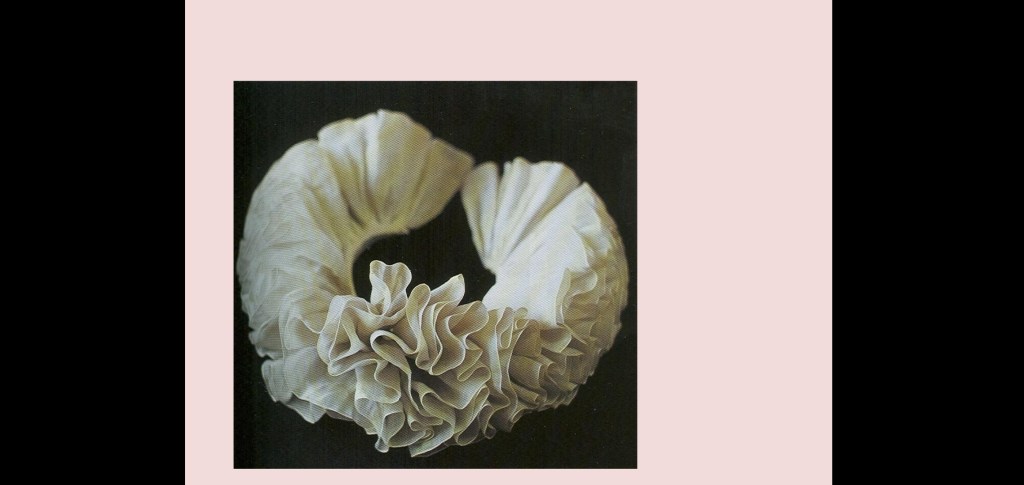
Keith’s favorite Elizabethan costume piece is the famous neck ruff- a piece of rolled linen that goes around the neck worn by men and women. Ruffs were very popular in the Tudor court, so it became a symbol of Elizabethan fashion.
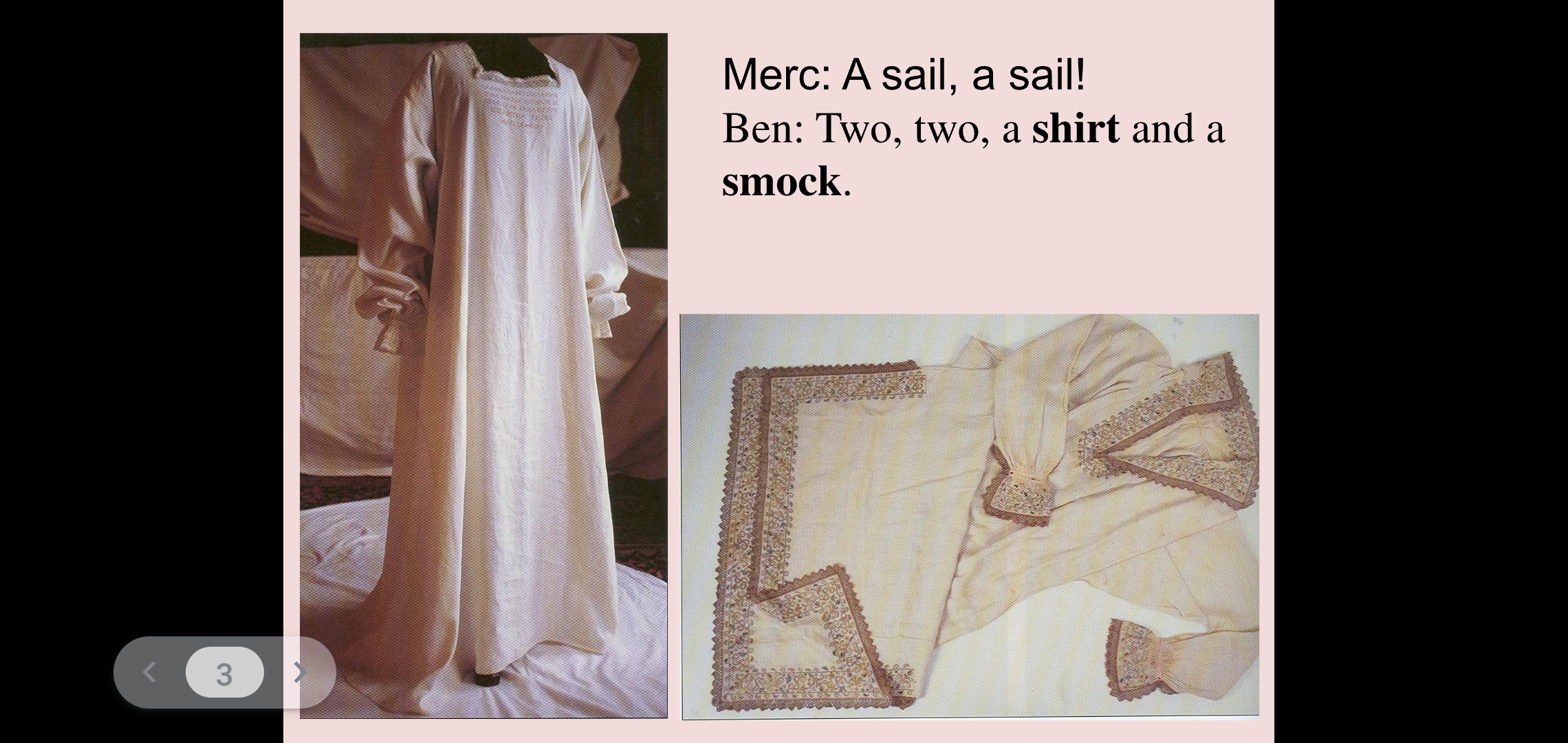
“A Shirt and a Smock”
In Anna’s thesis, she points out how Elizabethan undergarments came in the form of long shirts for men and a long linen one called a smock for women. In the video, Keith is puzzled by the garments and wonders if it would be at all erotic to see an Elizabethan in their not-at-all revealing shirts or smocks. As Anna points out in her thesis, these garments were worn close to the body, coming into contact with all the sweat and grime of daily life. So NO Keith, it wasn’t sexy to see an Elizabethan in his or her shirt or smock.
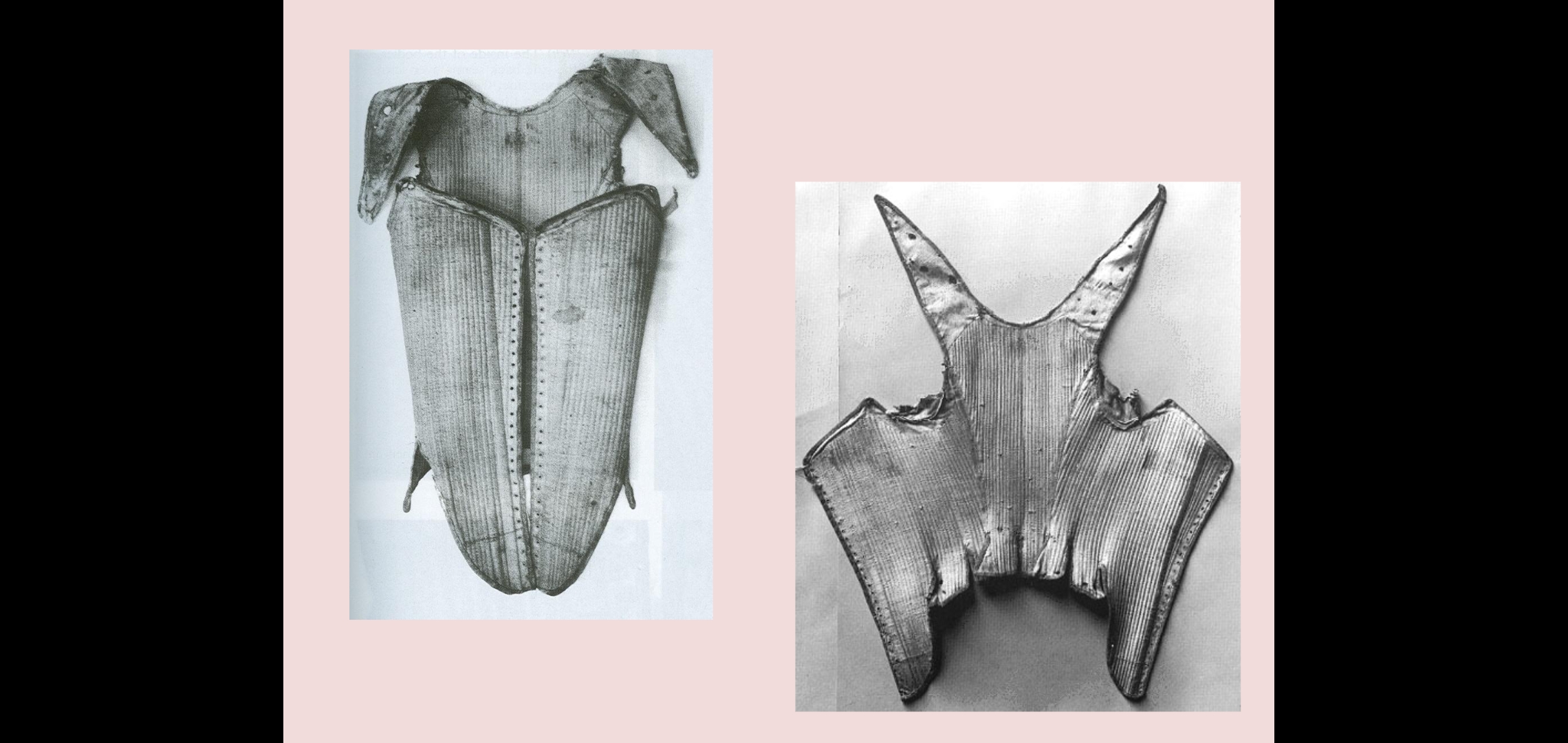
“THe Devil Himself Could Invent such stuff”- Elizabethan Corsets.
Every age has a new definition of the ‘ideal silhouette,’ that is, the figure that is most appealing in women that the clothes either create or accentuate. Elizabethan women were expected to have slim waists, small chests and wide hips. This look was accomplished through the use of a corset, which tightened the waist and compressed the chest.
Under the Hood- Farthingale, bum rolls, and petticoats
To create the wider hip look of Elizabethan women, bum rolls tied around the waist, and wooden farthingales created a bell shape for the hips and skirt. On top of that went the petticoat, kirtle, and skirt.
Eugene wears a petticoat on top of his corset and bum roll that is done up with red bows. Zach wears a lace collar that partly covers his head. Eugene’s sleeves were added separately.
Eugene As THe Nurse
Eugene’s clothing as The Nurse, reflects the fact that lower-class people had fewer and fewer fancy options in terms of fabrics, styles, and colors. The costume is a simple linen shirt, a basic corset, and grey clothes. I suspect that The Nurse was also helping Juliet get dressed, like the ladies in this video:
Men’s fashion- Zach as Romeo or “Bros wearing Hose”
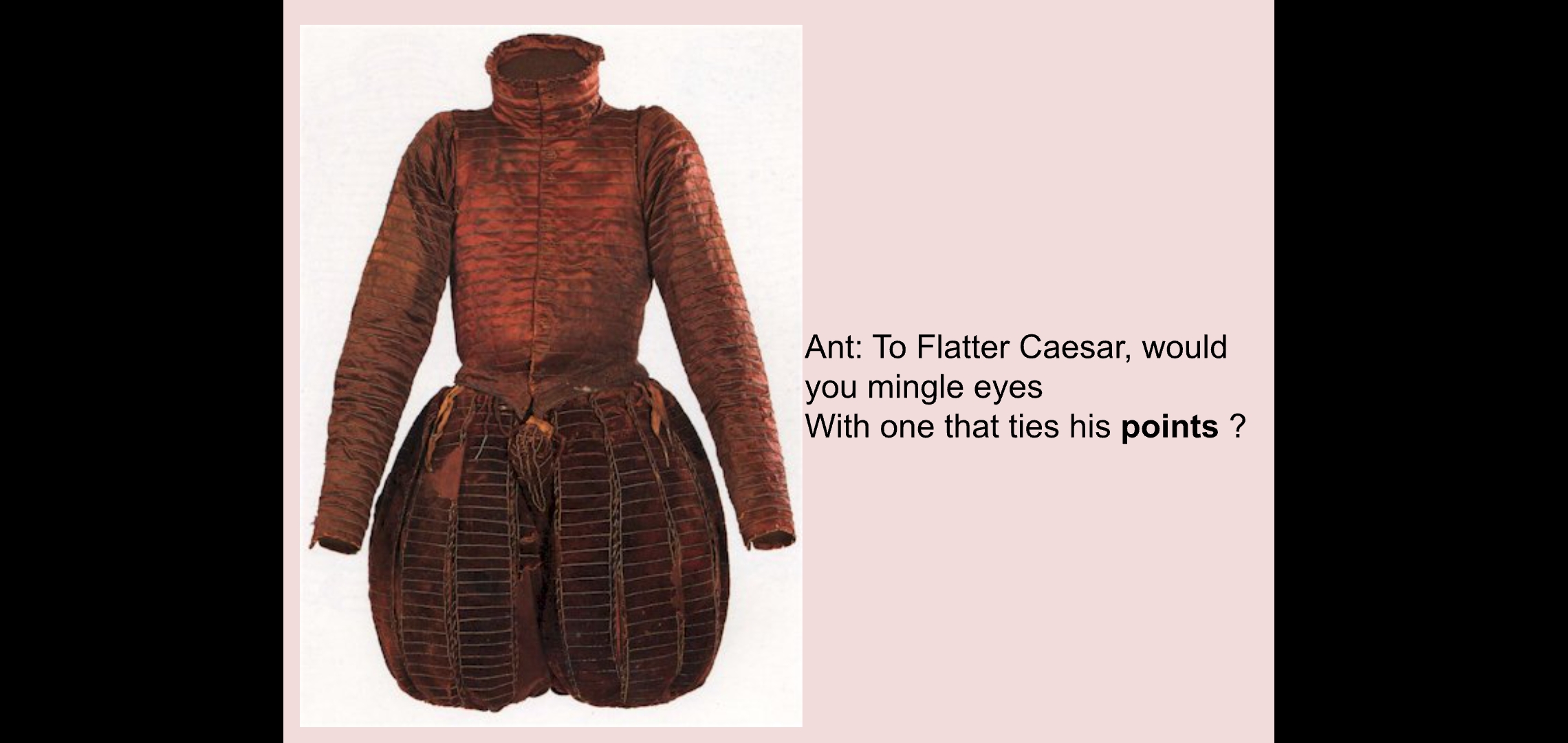
Men in this period also wore custom garments- the sleeves were added separately and the pants had to be attached at the points. Unlike women, young men didn’t cover their stockings (hose) and enjoyed showing off the shape of their legs. Stockings were often brightly colored and sometimes padded to make the man wearing it look more muscular.
One really fun thing I like to see each Thanksgiving is the live previews of some of Broadway’s hottest shows. You may remember that I first became acquainted with the musical “Something Rotten,” after seeing a live performance at the Macy’s Day Parade. I am just ecstatic to see and talk about this year’s hit Broadway Musical Six. It swept the Tonys, and has opened up touring productions across the country.
The Cast of “Six” perform live at the 2021 Tony Awards.
This vibrant, clever retelling of Tudor her-story was created by TOBY MARLOW & LUCY MOSS in association with the Chicago Shakespeare Festival.
The show is incredibly smart, and creative, and delves into the lives of some fascinating women, re-told as a singing contest with the characters singing their lives for you to judge what it was like being the queen of England, and living with the turbulent and fickle Henry VIII. What really appeals to me in this show is that like Hamilton, the musical takes these six semi-mythical women and tells their story in a way that is fresh and exciting.
Part I: Shakespeare’s “Henry VIII:” How NOT to tell a queen’s story
Around 1613, Shakespeare wrote his final play- his 10th history play which loosely told the life of English king Henry the Eighth.
I happen to know a lot about this play since I was in it back in 2008, as you can see in the slideshow above. As you might notice, this play doesn’t tell the story of all of Henry’s wives. We only see the last few years of Catherine of Aragon’s life, and the beginning of Henry’s marriage to Anne Boleyn. Most of the drama actually centers around Henry and his scheming advisor, Cardinal Wolsey. Maybe I’m biased because I played this role, but frankly, Woolsey is treated in the play as a stereotypical Machiavellian villain, who conveniently leads the king astray so he can be the hero of the play. Woolsey does all of Henry’s dirty work; taking over his government, spearheading his divorce to Catherine, and trying to dissuade the king from listening to Anne Boleyn’s Protestant ideas, dismissing her as a “spleeny Lutheran.” Shakespeare leaves it ambiguous as to whether Henry actually told Woolsey to do any of these things so the audience will blame Woosey, instead of the king.
I’ll be blunt, aside from the courtroom scene at Blackfriars, where Katherine pleads for Henry not to dissolve their marriage, and the fun dances and costumes in the scene where Anne flirts with Henry, the play is really quite boring. though I blame Jacobean censors more than Shakespeare for this. Even after the entire Tudor dynasty was dead and buried, powerful people in the English government controlled what Shakespeare could say about them.
Part II: The women take wing
During Shakespeare’s life time, the wives of Henry VIII were bit players at best. With the exception of Katherine of Aragon and Anne Boleyn (who in most narratives have often been cast as either virgins or whores), the lives of Jane Seymore, Anne of Cleaves, Catherine Howard and Catherine Parr were barely told until the 20th century, where new feminist scholarship sparked renewed interest in these women and how they lived.
TV series like The Tudors, movies like The Other Boleyn Girl, and of course books and documentaries by
Well, I can’t yet give an objective view of the plot and characters of “Six,” because I haven’t seen it…(yet). But until then, let’s just say that like “Hamilton,” it is great to see history be recontextualized and shared in such an accessible way. We all know that European history is dominated by the names of white guys- king whoever, duke what’s-his name. To see important women in history be given a voice by a multi-ethnic cast is a great way to make it acessible.
Bravo.
Educational links related to the six wives of Henry VIII:
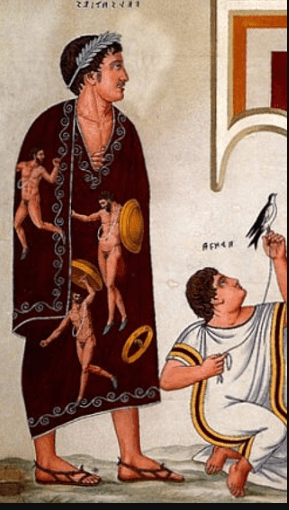
Myth 1: Everyone wore togas! The toga was a formal garment that was worn by male citizens, usually on business, therefore women and slaves couldn’t wear them. Basically, think of a toga as like a 3 piece suit, (which is probably how it felt to those men in the hot Mediterranean sun). Togas were very hot because they were made of wool. As the video below shows, many Romans couldn’t wait to get out of their togas and wear a simple tunic.
Myth 2: All Togas were white
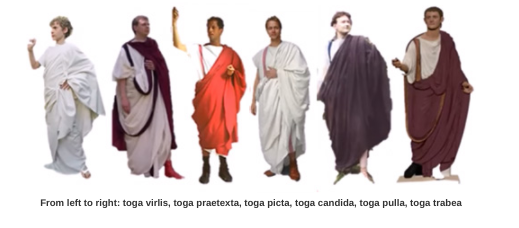
In most movies, and pictures set in Rome, we see rooms full of men wearing white togas, especially in the Senate. However, togas gradually evolved into a variety of styles and colors and helped indicate a Roman man’s status and maturity.
Mosaic of Virgil
Types of Togas and how to wear them:
Shakespeare makes reference to a specific type of toga called a Toga candida: "Bright toga"; a toga rubbed with white chalk to make it appear bright white. In Titus Andronicus, the title character is offered a toga candida by his brother Marcus, when the Senate nominates him for emperor:

Marcus: Titus Andronicus, the people of Rome,
Whose friend in justice thou hast ever been,
Send thee by me, their tribune and their trust,
This palliament of white and spotless hue;
And name thee in election for the empire,
With these our late-deceased emperor's sons:
Be candidatus then, and put it on- Titus Andronicus, Act I, Scene i.

There were many other types of togas for different occasions:
- Dark colors were for funerals
- Red and purple sleeves were for magistrates and senators
- Purple togas with gold embroidery were for victorious generals, and later emperors
Manly garb: Toga virillis
A Toga virilis ("toga of manhood") also known as toga alba or toga pura was A plain white toga, worn on formal occasions by adult male commoners, and by senators not having a curule magistracy. It was a right of passage for young men to put on their toga virilis and assume adult male citizenship and its attendant rights, freedoms and responsibilities.
Women’s fashion
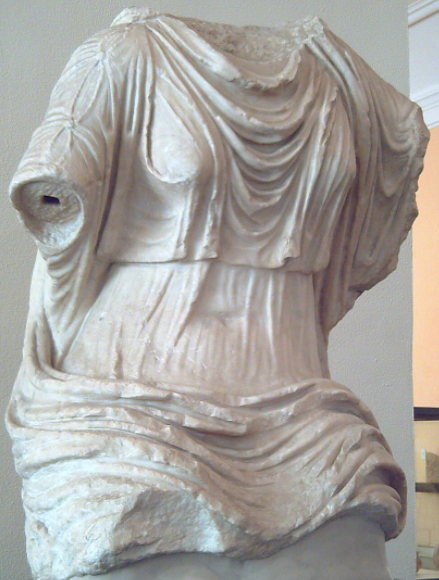
Like men, women most commonly wore tunics, especially when they were unmarried. When women married, they would don a long, elaborate garment called a Stola . The stola was a long dress held on by belts. Sometimes women decorated their Stolas with ribbons and they came in many colors. In the statue below, note how the belts below the breast drape the fabric into elaborate folds, and how the sleeves are slightly slashed on this sumptuous 1st century stola.
Torso of a Roman woman wearing a Stoa (1st century)
Women’s Beauty Regimen
Since Roman women were not legally citizens and couldn’t hold employment, their hair, dress, and makeup were in a way, a celebration of idleness, especially in the case of upper-class women. Aristocratic Roman women had their hair done in elaborate shapes like the Flavian hairstyle and wore elaborate Stoas to indicate how they didn’t have to work or labor in the fields.
In a production of Julius Caesar or Coriolanus, the director could exploit this concept of idleness by giving the more passive characters like Calpurnia or Fulvia more elaborate hairdos and elaborate brightly colored Stolas, while the more active characters like Portia or Valumnia could have a more austere or less fussy hairstyle and dress to show that they are more interested in engaging in politics or the military than sitting around and looking pretty.
Juliet (Hailey Steinfield) marries Romeo in the 2013 movie version of “Romeo and Juliet.”
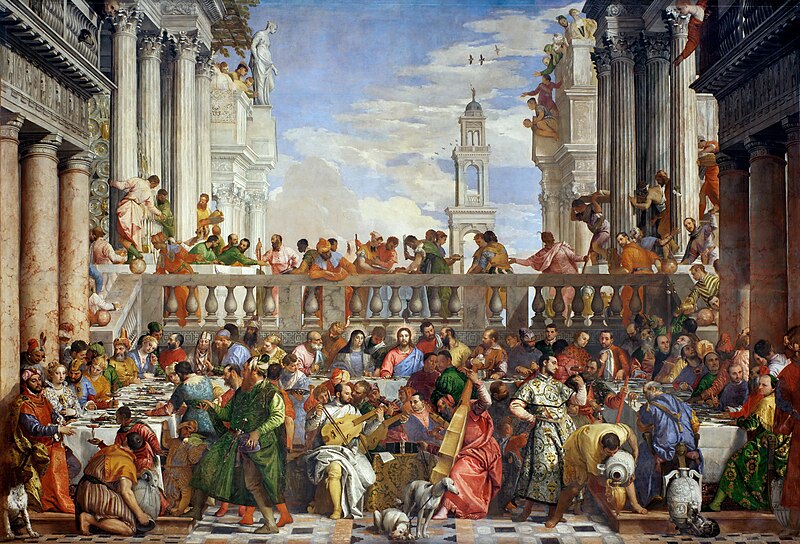
We all know that Romeo and Juliet married in secret because their feuding families made it impossible for them to publicly profess their love, but would it have been like if they were able to have a proper Italian Renaissance Wedding? As opposed to the small, intimate wedding that you see in the 2013 clip above, a wedding in 1590s Italy was a much more involved, lavish, and expensive affair.
During the Renaissance period marriages, (which were also mergers), were potentially explosive moments, and lavish festivities may have diffused some of the tensions that might arise between families over dowry arrangements and other touchy subjects. The bridal procession might even face dangers from hostile mobs or individuals, as suggested by a Florentine statute from 1415, which forbade the throwing of stones or garbage at the home of the couple. Wedding processions were often compared to ancient triumphal processions. The idea of the wedding as a triumph is reflected in the imagery on cassoni (marriage chests) panels such as Apollonio di Giovanni’s Triumph of Scipio Africanus, known in several versions.
Deborah L. Krohn The Bard Graduate Center November 2008
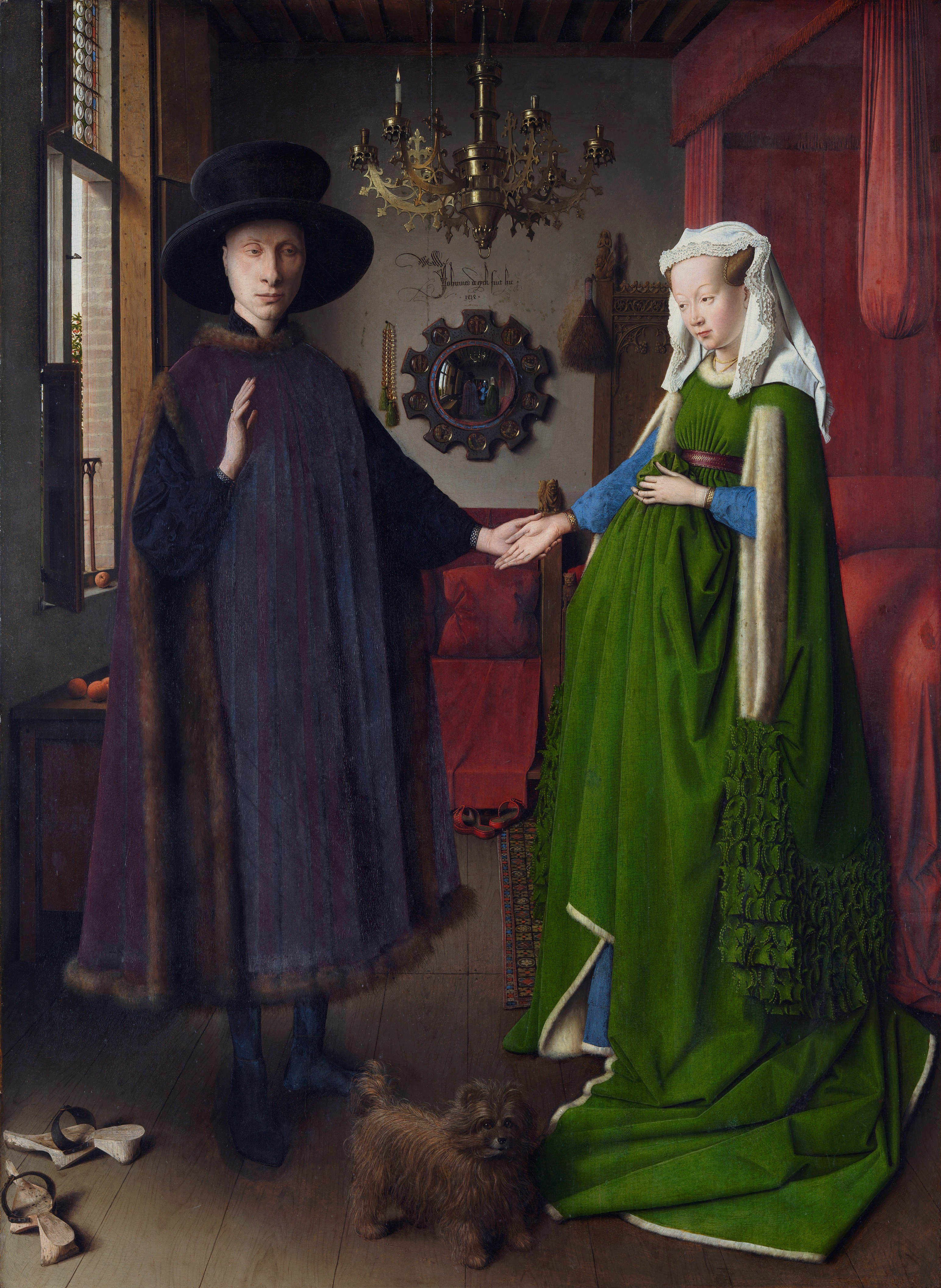
An Italian wedding had four rituals that were highly elaborate and each required a lot of food, drink, special clothes, and music. Part of the reason for this verbose process was the belief that marriage was simultaneously an economic arrangement, a formal promise of fidelity and affection, and a sacrament blessed by the church. In the article, “The Arnolfini Betrothal,” from the University of California, Hall traces the evolution of these ideas from pre-Christian Roman marriage traditions, and 17th century, Roman-catholic Italian tradition:
European ideas about marriage were profoundly influenced by ancient Roman precedent. Because intent was the most basic principle of Roman law, the great jurisconsults of the second and third centuries logically held that marriage was concluded by the consent of the parties, and Ulpian’s concise expression of this view, “Not cohabitation but consent makes a marriage,” came to be included among the legal maxims of the final section of the Digest in Justinian’s codification of the Roman law.[2] Roman lawyers termed this matrimonial consent affectio maritalis, or “conjugal affection,” by which they meant, not some momentary expression of assent as part of a marriage rite, but rather a continuing mental state, shared by the partners. From a juridical point of view, this permanent emotive condition constituted the marriage. The Digest also envisioned marriage in ideal terms as a lifelong association of husband and wife for the procreation of legitimate children. But if affectio maritalis ceased to exist, the requisite legal consent no longer prevailed, and a divorce could easily be arranged.[3]
The
The Impalmamento– The joining of hands, a sort of ritual engagement
The Sponsalia- The formal betrothal ceremony (a promise of marriage)
The Matrimonium– The wedding contract and procession
The Nozze- The church ceremony and feast!
The Cassone
One of the best ways I can illustrate that a wedding in Italian Renaissance Italy was essentially a socio-economic merging of families is to look at the custom of the cassone- an ornately carved box that the groom gave to the bride to keep her needlework and other possessions. It symbolized the transition from living in her parent’s house to her new husband’s house, and how essentially, she was a possession that was bought by the groom and taken to his home. To see more examples of a cassone, visit this website:
If Juliet had chosen to marry Paris instead of Romeo, the cassone would’ve made it abundantly clear to her that, just as Paris says: “Thy face is mine,” he feels he has bought her, money, body, and soul, and taken her and this elaborate casket to his home, till death do they part.
Impalmamemnto
The verb impalmare is equivalent to pledging one’s troth and originates from an old custom according to which the groom, as a confirmatory token of his marriage promise, grasped, touched, or poked the right hand or palm
of his future wife. Impalmamento signifies an engagement, a promise of marriage, specifically, as a confirmation of prior agreements, it signifies the early phase of the
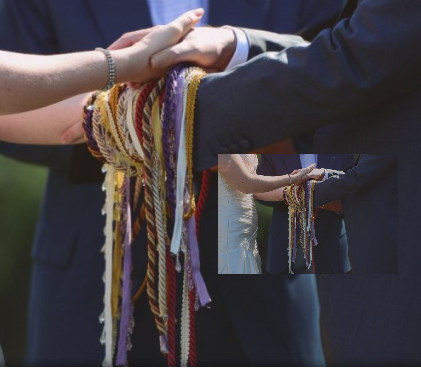
Much like how in Britain, handfasting rituals served as a serious promise or engagement of marriage, the Sponsalia was a formal promise of marriage before the actual ceremony. Incidently, according to “A History Of Matrimonial Institutions by George Elliott Howard, Romeo and Juliet’s marriage went this far, but no farther. This kind of promise of marriage had legal authority but was not recognized officially by the church. It also didn’t require witnesses or parental consent (Howard 339). A Sponsalia marriage could also only be dissolved if the bride or groom became a priest or nun, which is exactly what Friar Laurence offers to do for Juliet once Romeo dies:
Come, I’ll dispose of thee Among a sisterhood of holy nuns: Stay not to question, for the watch is coming; Come, go, good Juliet, [Noise again] I dare no longer stay.
— Romeo and Juliet, Act V, Scene 3
Friar Laurence (Paul Rycik) tries to save Juliet (Alesia Lawson) after she finds Romeo dead. (Ashland University 2007).
Today, this would be the equivalent of getting a marriage license at city hall, rather than having a marriage ceremony.
matrimonium
Li emergenti bisogni matrimoniali – namely, the urgent necessity at the outset of marriage to adorn brides with extravagant clothing and jewelry, to decorate the nuptial chamber, and to arrange wedding festivities – entailed sizable expenditures of capital on the part of new husbands and their kin in Renaissance Florence. In a legal opinion written in 1400, the Florentine jurist Philippus de Corsinis observed that “even before sexual intercourse, it is necessary for the husband to shoulder the expenses for his wife’s clothing and other accessories, as well as other expenses related to the wedding.”2 In another opinion, Paulus de Castro, who taught and practiced law in early-fifteenth-century Florence, emphasized that in both Florence and Bologna the outfitting of the bride and expenses for the wed-ding consumed the whole dowry even before the couple had exchanged marriage vows and rings.-
Source: Kirshner, Julius. “2. Li Emergenti Bisogni Matrimoniali In Renaissance Florence”. Marriage, Dowry, and Citizenship in Late Medieval and Renaissance Italy, Toronto: University of Toronto Press, 2018, pp. 55-73. https://doi.org/10.3138/9781442664517-005
Wedding dress and bridegroom dress
Nozze
The wedding feast
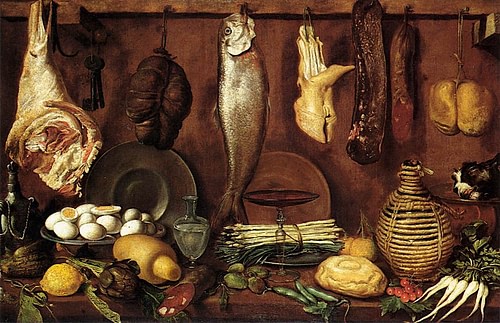
16th century still life.
Since marriages were affairs for two families, their friends, etc. A wedding feast was a very involved and elaborate affair. On the Dutch Cooking site, ” Coquinaria” I found a reproduction of a summer wedding feast from 1546:
The menu for Wednesday 18 August 1546, on a meat day during Summer
Antipasti – Melloni (watermelons), cascio vecchio Parmigiano (old Parmesan cheese), quaglie arroste (grilled quails), vua moscatella (muscadines), crostate di piccioni (pie with pigeons), capretto (kid), limoni trinciati (cut lemons). Alesso – Anadrine (duck?), capretto (again kid, or a mistake), pollastri stuffati con presciutto (stuffed chicken with ham), agresto (verjuice), sauor di verzure(sauce with greens?).
Frutte – Visciole con le suppe (morellos in soup -with bread), cascio marzolino (cheese from March?), pere (pears), persiche in vino (peaches in wine), nocchie (hazelnuts), finocchio (fennel).
Below is a recipe card I made with one of the recipes I found on the site:
3. Krohn, Deborah L. “Weddings in the Italian Renaissance.” In Heilbrunn Timeline of Art History. New York: The Metropolitan Museum of Art, 2000–. http://www.metmuseum.org/toah/hd/wedd/hd_wedd.htm (November 2008)
4. Hall, Edwin. The Arnolfini Betrothal: Medieval Marriage and the Enigma of Van Eyck’s Double Portrait. Berkeley: University of California Press, c1994 1994. http://ark.cdlib.org/ark:/13030/ft1d5nb0d9/
6. Kirshner, Julius. “2. Li Emergenti Bisogni Matrimoniali In Renaissance Florence”. Marriage, Dowry, and Citizenship in Late Medieval and Renaissance Italy, Toronto: University of Toronto Press, 2018, pp. 55-73. https://doi.org/10.3138/9781442664517-005
7. Muusers, Christianne: A Recipe for Italian Crostini from the 16th Century: . Published online January 28th, 2005. https://coquinaria.nl/en/panunto/
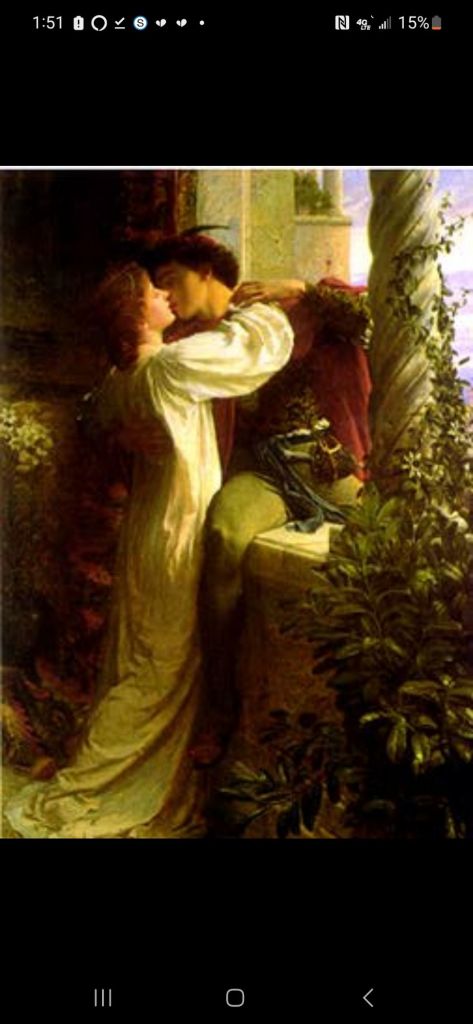
Costumes from thr 1968 Romeo and Juliet FilmOlivia Hussey as Juliet, 1968.“Romeo and Juliet” by Francis Dicksee, 1884.Juliet- Glibe Theater 2007
I’ve seen four live productions of Romeo and Juliet, (5 if you include West Side Story). I’ve also watched four films (6 if you include West Side Story and Gnomio and Juliet) and one thing that I’ve noticed again and again, and again is that you can tell the whole story of the play with clothing. This is a story about families who are part of opposite factions whose children secretly meet, marry, die, and fuse the families into one, and their clothes can show each step of that journey.
The feud Nearly every story about a conflict or war uses contrasting colors to show the different factions. Sometimes even real wars become famous for the clothes of the opposing armies. The Revolutionary War between the redcoats and the blue and gold Continentals, the American Civil War between the Rebel Grays and the Yankee Bluebellies. In almost every production I’ve ever seen, the feud in Romeo and Juliet is also demonstrated by the opposing factions wearing distinctive clothing.
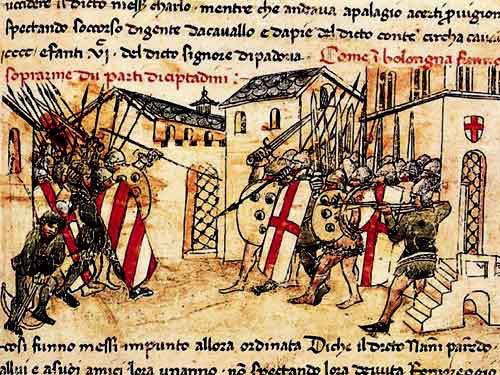
Historically, warring factions in Itally during the period the original Romeo and Juliet is set, wore distinctive clothes and banners as well. . In this medieval drawing, you can see Italians in the Ghibelline faction, who were loyal to the Holy Roman Empire, fighting the Guelph faction (red cross), who supported the Pope. Powerful families were constantly fighting and taking sides in the Guelf vs. ghibelines conflict in Verona, which might have inspired the Capulet Montegue feud in Romeo and Juliet.
Even the servants of the nobles got roped into these conflicts, and they literally wore their loyalties on their sleeves. The servants wore a kind of uniform or livery to show what household they belonged to. The servants Gregory and Sampson owe their jobs to Lord Capulet, and are willing to fight to protect his honor. Perhaps Shakespeare started the play with these servants to make this distinction very obvious. Here’s a short overview on Italian Liveries from the Metropolitan Museum of Art:
In 1966, director Franco Zepherelli set a trend with his iconic use of color in his movie. He chose to make the Capulets wear warm tones while the Montegues wore blue and silver. Juliet (Olivia Hussey) wore a gorgeous red dress that made her look youthful, passionate, and lovely, while Tybalt (Michael York), wore red, orange, and black to emphasize his anger, and jealousy (which has been associated for centuries with the color orange). By contrast, the Montagues like Romeo (Leonard Whiting) wore blue, making him look peaceful and cool. These color choices not only clearly indicate who belongs to which contrasting factions, but also help telegraph the character’s personalities. Look at the way these costumes make the two lovers stand out even when they’re surrounded by people at the Capulet ball:
Dance scene from the iconic 1968 film of Romeo and Juliet, directed by Franco Zeffirelli.Poster for “Gnomio and Juliet, 2011
Zepherilli’s color choices were most blatantly exploited in the kids film Gnomio and Juliet, where they did away with the names Capulet and Montegue altogether, and just called the two groups of gnomes the Reds and the Blues.
The Dance
To get Romeo and Juliet to meet and fall in love, Shakespeare gives them a dance scene for them to meet and fall in love. He further makes it clear that when they first meet, Romeo is in disguise. The original source Shakespeare used made the dance a carnival ball, (which even today is celebrated in Italy with masks). Most productions today have Romeo wearing a mask or some other costume so that he is not easily recognizable as a Montague. Masks are a big part of Italian culture, especially in Venice during Carnival:
In the 1996 movie, Baz Luhrman creates a bacchanal costume party, where nobody wears masks but the costumes help telegraph important character points. Mercutio is dressed in drag, which not only displays his vibrant personality but also conveniently distracts everyone from the fact that Romeo is at the Capulet party with no mask on.
Capulet is dressed like a Roman emperor, which emphasizes his role as the patriarch of the Capulet family. Juliet (Claire Danes) is dressed as an angel, to emphasize the celestial imagery Shakespeare uses to describe her. Finally, Romeo (Leonardo DiCaprio) is dressed as a crusader knight because of the dialogue in the play when he first meets Juliet:
Romeo. [To JULIET] If I profane with my unworthiest hand
This holy shrine, the gentle fine is this:720
My lips, two blushing pilgrims, ready stand
To smooth that rough touch with a tender kiss.
Juliet. Good pilgrim, you do wrong your hand too much,
Which mannerly devotion shows in this;
For saints have hands that pilgrims' hands do touch,725
And palm to palm is holy palmers' kiss.
Romeo. Have not saints lips, and holy palmers too?
Juliet. Ay, pilgrim, lips that they must use in prayer.
Romeo. O, then, dear saint, let lips do what hands do;
They pray, grant thou, lest faith turn to despair.730
Juliet. Saints do not move, though grant for prayers' sake.
Romeo. Then move not, while my prayer's effect I take.
Thus from my lips, by yours, my sin is purged.
Juliet. Then have my lips the sin that they have took.
Romeo. Sin from thy lips? O trespass sweetly urged!735
Give me my sin again.
Juliet. You kiss by the book. Romeo and Juliet, Act I, Scene V, Lines 719-737.
Notice that Romeo calls Juliet a saint, and later an angel in the famous balcony scene, which explains her costume at the ball. Juliet refers to Romoe as a Pilgrim, which is a cheeky comment on his crusader knight costume. In the Crusades, crusader knights made pilgrimages to the holy land, with the hope that God (and presumably, his angels) would forgive their sins. Romeo’s name even means “Pilgrim.” Luhrman makes clever nods to Shakespeare’s text by dressing Romeo and Juliet in this way, and gives the dialogue a bit of a playful roleplay as the characters make jokes about each other’s costumes- Romeo hopes that he will go on a pilgrimage and that this angel will take his sin with a kiss.
In Gnomio and Juliet, the titular characters meet in a different kind of disguise. Rather than going to a dance with their family, they are both simultaneously trying to sneak into a garden and steal a flower, so they are both wearing black, ninja-inspired outfits. Their black clothing helps them meet and interact without fear of retribution from their parents (since they do not yet know that they are supposed to be enemies. The ninja clothes also establishes that for these two gnomes, love of adventure unites them. Alas though, it doesn’t last; Juliet finds out that Gnomio is a Blue, when they both accidentally fall in a pool, stripping their warpaint off and revealing who they are.
Trailer for “West Side Story,” (2021) directed by Steven Spielberg.
Sometimes the dance shows a fundamental difference between the lovers and the feuding factions. West Side Story is a 20th-century musical that re-imagines the feuding families as juvenile street gangs, who like their Veronese counterparts, wear contrasting colors. The Jets (who represent the Montagues) wear Blue and yellow, while the Sharks (Capulets), wear red and black. The gang members continue wearing these colors on the night of the high school dance, except for Tony and Maria (the Romeo and Juliet analogs). In most productions I’ve seen, (including the 2021 movie), these young lovers wear white throughout the majority of the play, to emphasize the purity of their feelings, and their rejection of violence. Thus, unlike Shakespeare’s version of the story, West Side Story makes the lovers unquestionably purer are more peaceful than Shakespeare’s Romeo and Juliet, and their clothing makes this clear.
Romeo (John Warren), meets Juliet (Alesia Lawson) in the 2010 Ashland University production of “Romeo and Juliet,” directed by Ric Goodwin.
The Merging of the family (8:30-11:00)
Costume Designer Charlene in the 2006 AU production deliberately had the characters change clothes when they get married. Juliet was wearing the same iconic red dress as Olivia Hussey for the first two acts of the play but then changed into a pale blue gown that matches Romeo. The clothes re-enforce the idea that the marriage represents Romeo and Juliet abandoning their family’s conflicts, and simply showing their true colors.
Two sets of costumes for Juliet in the 2006 Ashland University Production. Pull the slider bar left to see how Juliet’s costume changes from the start of the show to the end.
Another way of getting everyone in the family to subconsciously unite in grief would be to costume everyone wearing black except Romeo and Juliet. At the end of the play, The Capulets are already mourning Juliet, (because she faked her death in Act IV), and the Montegues are already mourning Lady Montegue (who died offstage). Just by these circumstances, everyone could come onstage wearing black, uniting in their grief, which is further solidified when they see their children dead onstage.
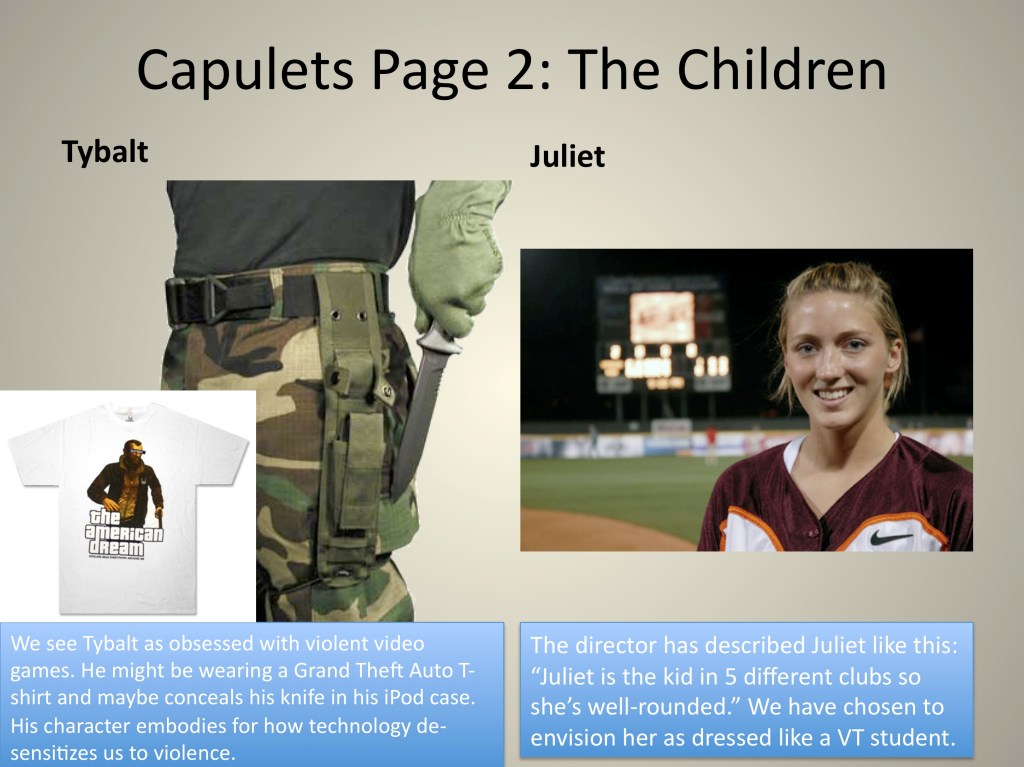
Not all productions choose to costume the characters like warring factions, but nevertheless, any theatrical production’s costumes must telegraph something about the characters. In these production slides for a production I worked on in 2012, the costumes reflect the distinct personality of each character and show a class difference between the Montagues and the Capulets.
The 2013 Film: Costumes Done Badly
The 2013 movie is more concerned with showing off the beauty of the actor’s faces, and the literal jewels than the clothes:
Most of the actors and costumes are literally in the dark for most of the film, probably because the film was financed by the Swarofski Crystal company, who literally wanted the film to sparkle. Ultimately, like most jewelry, I thought the film was pretty to look at, but the costumes and cinematography had little utilitarian value. The costumes and visual didn’t tell the story efficiently, but mainly was designed to distract the audience with the beauty of the sets, costumes and the attractive young actors. The only thing I liked was a subtle choice to make Juliet’s mask reminiscent of Medusa, the monster in Greek Myth, who could turn people to stone with a look. I liked that the film was subtly implying that love, at first sight, can be lethal.















































 The Shakespearean Student