








Hi everyone,
I know I haven’t posted in a while. I’ve been working on my education certification so I’ve been pretty busy. My last project was about using theater as an educational tool, so I thought I’d reprint it here. I’ll add some notes later on to show how this can be adapted to Shakespeare, but for now, hopefully, this can be an interesting look at theater as a way for children to cope with trauma, etc.
INTRODUCTION
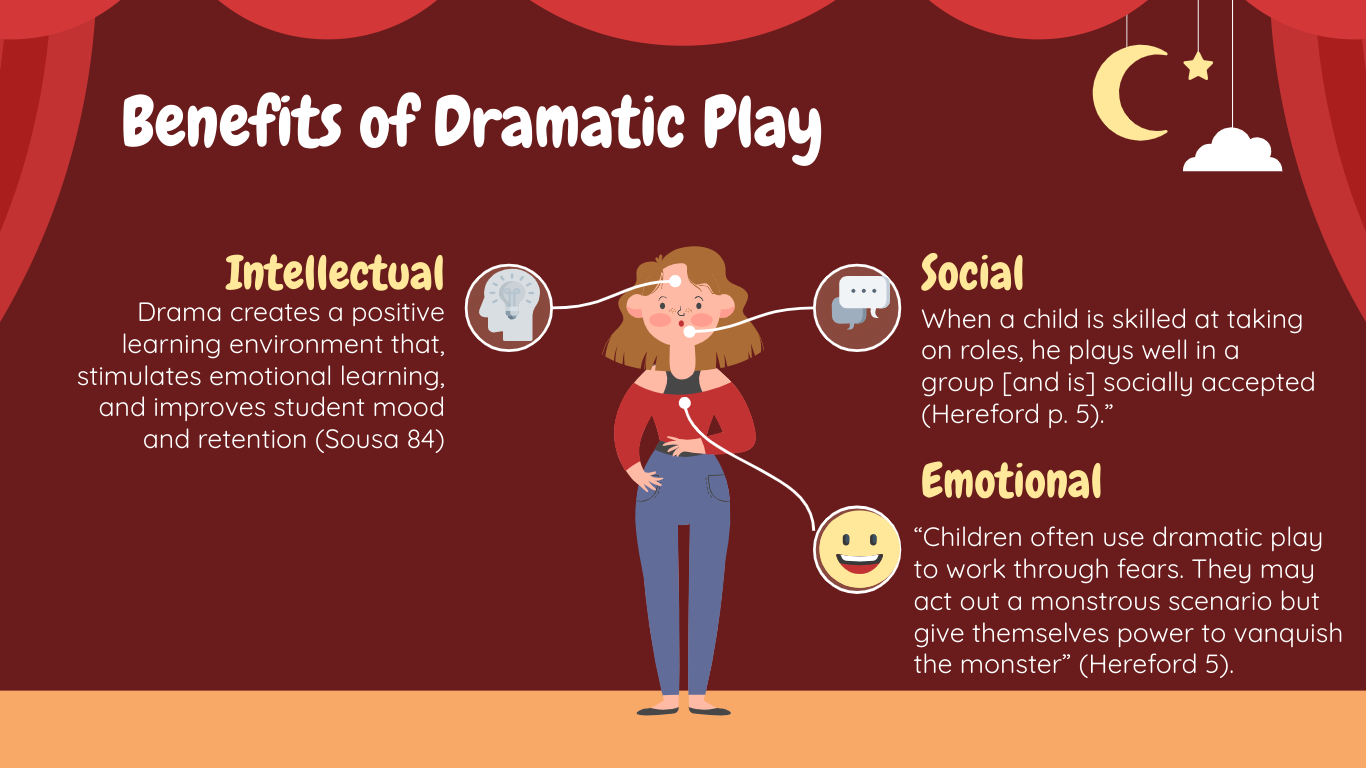
Numerous studies from educators, neuroscientists, and nonprofit organizations have demonstrated that children’s brains benefit from the arts. According to David A. Sousa in his book How the Brain Learns, human beings have used art forms as teaching from the very beginning of civilization, and every child’s early development can benefit from the kind of imaginative play that children naturally engage in:
Much of what young children do as play- singing, drawing, dancing…engages all the senses and helps wire the brain for successful learning. When children enter school, these art activities need to be continued and enhanced. The cognitive areas are developed as the child learns songs and rhymes. The dancing and movements during play develop gross motor skills, and the sum of these activities enhances emotional well-being.
(Sousa 215)
One method to continue this kind of artistic learning in a classroom is dramatic play or drama therapy: using theatrical games and techniques as a teaching tool. This paper will demonstrate how educators have used dramatic play to improve socio/emotional learning, as well as cognitive development. In particular, the studies and books cited in this paper will argue that a dramatic play intervention in schools would be beneficial to students who are facing challenges due to emotional disorders.
After reviewing case studies in drama therapy and reading literature on dramatic play, the author of this paper is convinced that a dramatic therapy intervention could and should be available to children with emotional disorders. The goal of the intervention is to help students with emotional disorders through creative play, dramatic exploration, textual analysis, and roleplay-based problem-solving. The suggested intervention would help students confront their problems in a safe way and help them develop problem-solving strategies over the course of a few weeks.
WHAT IS DRAMATIC PLAY?
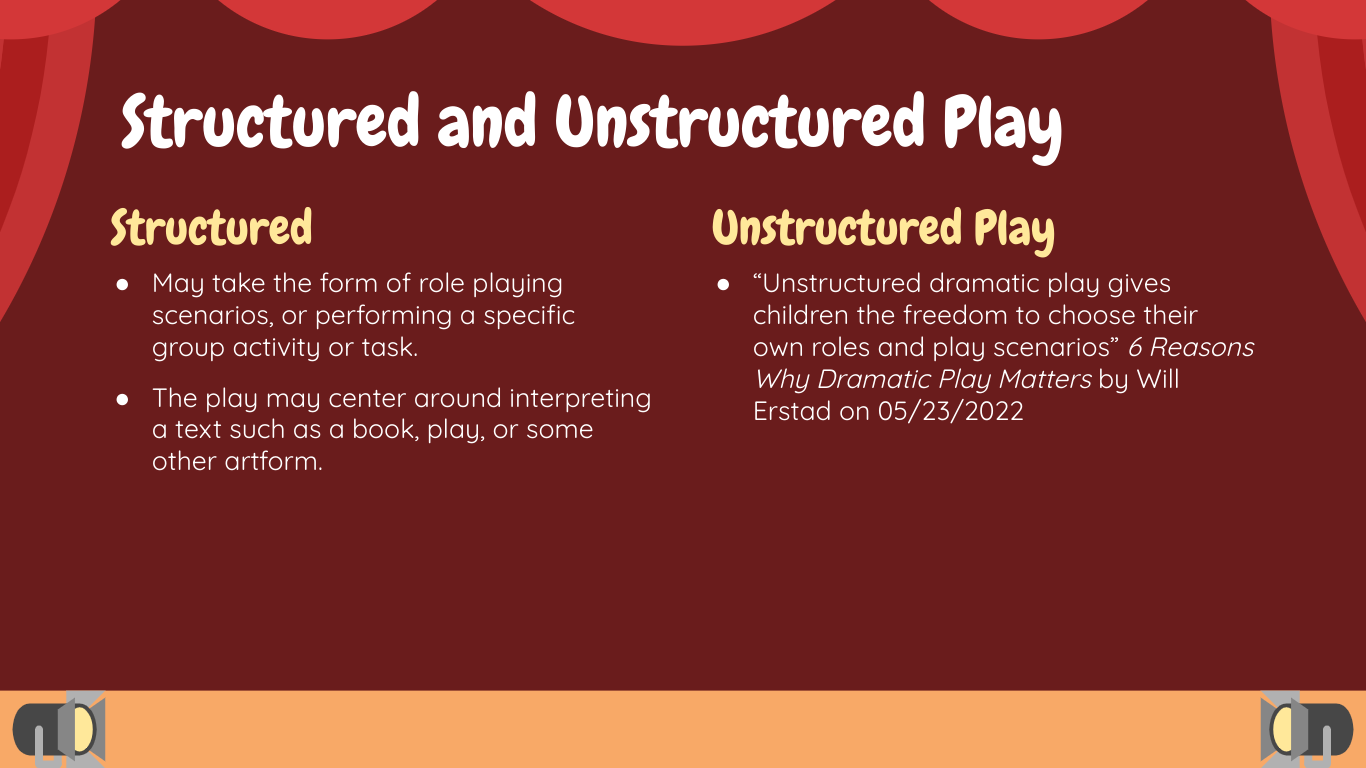
According to West Governor’s University, dramatic play involves students taking on roles and acting them out to explore themselves and their surroundings. WGU’s website identifies two basic types of dramatic play- structured and unstructured. In the case of structured play, it may take the form of roleplaying scenarios, or performing a specific group activity or task. Finally, the play may center around interpreting a text such as a book, play, or some other artform. The roles the students play need not be a pre-written story. When students take on these roles to play, they may better understand their real-life roles and how to perform them in real life.
In her 2015 article, Analysis of Three Approaches in Dramatherapy, Ivana Lessner Listiakova compares and contrasts three approaches of drama therapy: Role Theory, Psychodrama, and Developmental Transformation. In all three approaches, participants may gain a new understanding of themselves and a healthy way of processing their emotions. Within Role Theory, participants examine Jungian archetypal roles and counter roles within themselves by embodying them. In Psychodrama, participants enact moments from their own lives and have emotional and mental epiphanies by looking at those moments with a critical eye. Finally, in Developmental Transformation, participants arrive at roles and stories organically through a sort of “improvised series of encounters,” rather than a set story that is agreed upon beforehand. Listiakova emphasizes that these approaches work within psychotherapy because rather than the direct uncomfortable confrontations found in traditional therapy, dramatherapy uses the theater’s distance from the client and the metaphorical nature of storytelling to allow clients to see the issues and emotions that they face in their lives in a new light.
HOW DRAMATIC PLAY BENEFITS CHILDREN WITH EMOTIONAL DISORDERS.
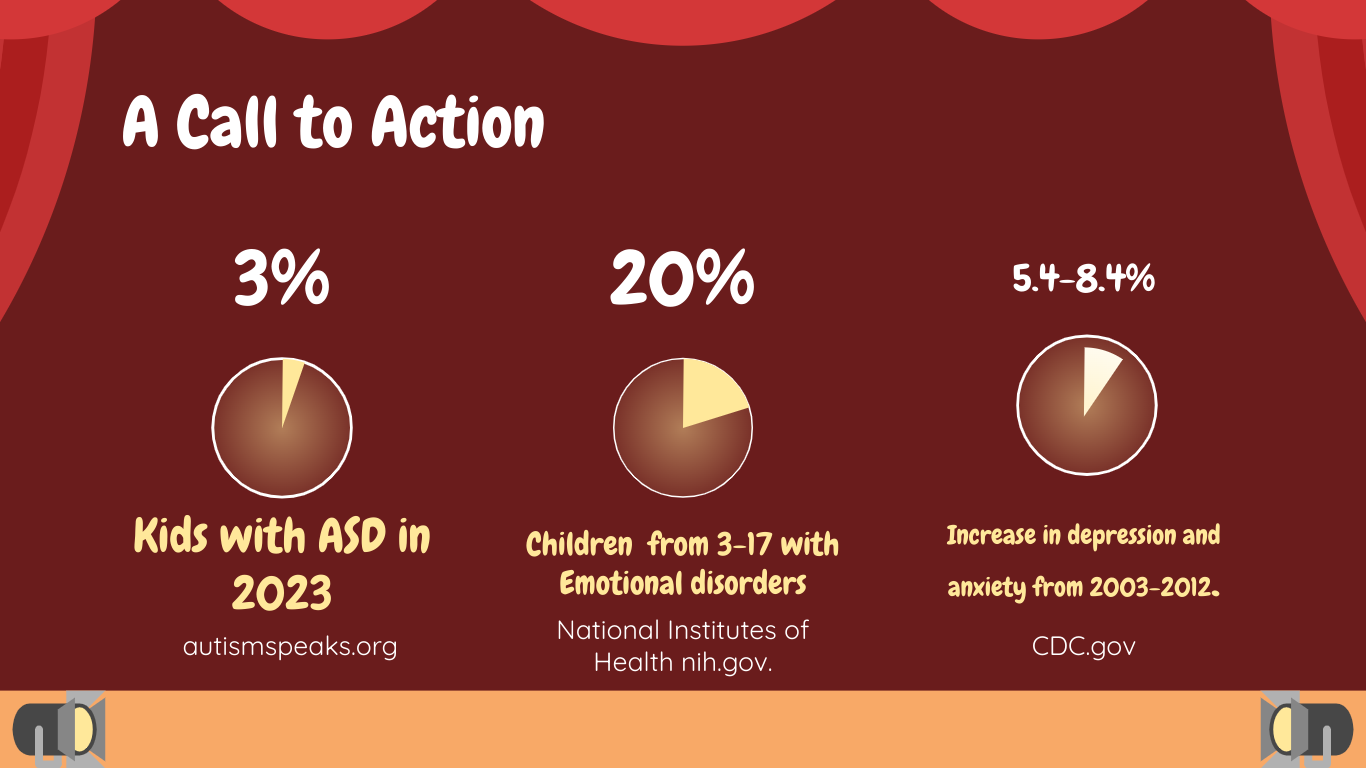
A study by Roundabout Dramatherapy in 2013 in the journal Dramatherapy (Godfrey 20-28), demonstrates how drama therapy can specifically benefit developmental disorders like Autistic Spectrum Disorders (ASD). Roundabout is a London-based charity aimed at improving the lives of children on the Autism Spectrum. Through a collaboration with Emma Godfrey, (a psychotherapist and drama therapist), this article chronicled the success of its drama therapy sessions over three primary schools and five secondary schools. Before and after each program of drama therapy, teachers, parents, and students submitted evaluations and questionnaires to Roundabout.
The students showed marked improvement in the following specific areas: [processing}f, working with peers, social skills, structure, and anxiety. Most children on the Autism spectrum struggle with these very skills, therefore this kind of play was incredibly useful for these students. The activities encouraged at Roundabout developed specific life skills such as saying hello and goodbye and relaxation techniques to quell anxiety:
Dramatherapy is particularly appropriate for this client group as it develops social skills and supports the expression of feelings through structured work that helps reduce anxiety. The dramatherapist can model clear, expressive communication, as well as facilitate the development of relationships with others, which gives participants numerous opportunities to rehearse and replay social skills until they are learned and integrated into behavior. (Godfrey 21)
Godfrey’s study showed that students with ASD benefited from modeled play, in which the teachers rehearsed and practiced important life skills in class that taught the students how to compensate for their inability to intuit social cues. As this quote from a parent whose child was part of the study illustrates, dramatherapy can help ASD students gain a better understanding of themselves, how to interact with people, and help them develop tools to engage with others and control their anxiety and other forms of emotional stress:
It has really helped him to understand his emotions and friendships more. At times he has found it challenging but it’s been great for him to do that in a safe and caring environment where the people running it understand his issues (Godfrey 25).
The sources cited above confirm that students with emotional disorders can benefit from different forms of dramatic play and develop coping mechanisms and skills to help enrich and improve their lives.
DISCUSSION AND RECOMMENDATION
As the literature previously demonstrates, dramatic play is an excellent educational tool to help students process their emotions and prevent anxiety through role-playing while promoting social, emotional, and physical health. The author’s suggested interventions, like the study by Roundabout, would carefully monitor child development as students engaged in formal and informal activities to help develop social skills, reduce anxiety, and develop emotional coping skills.
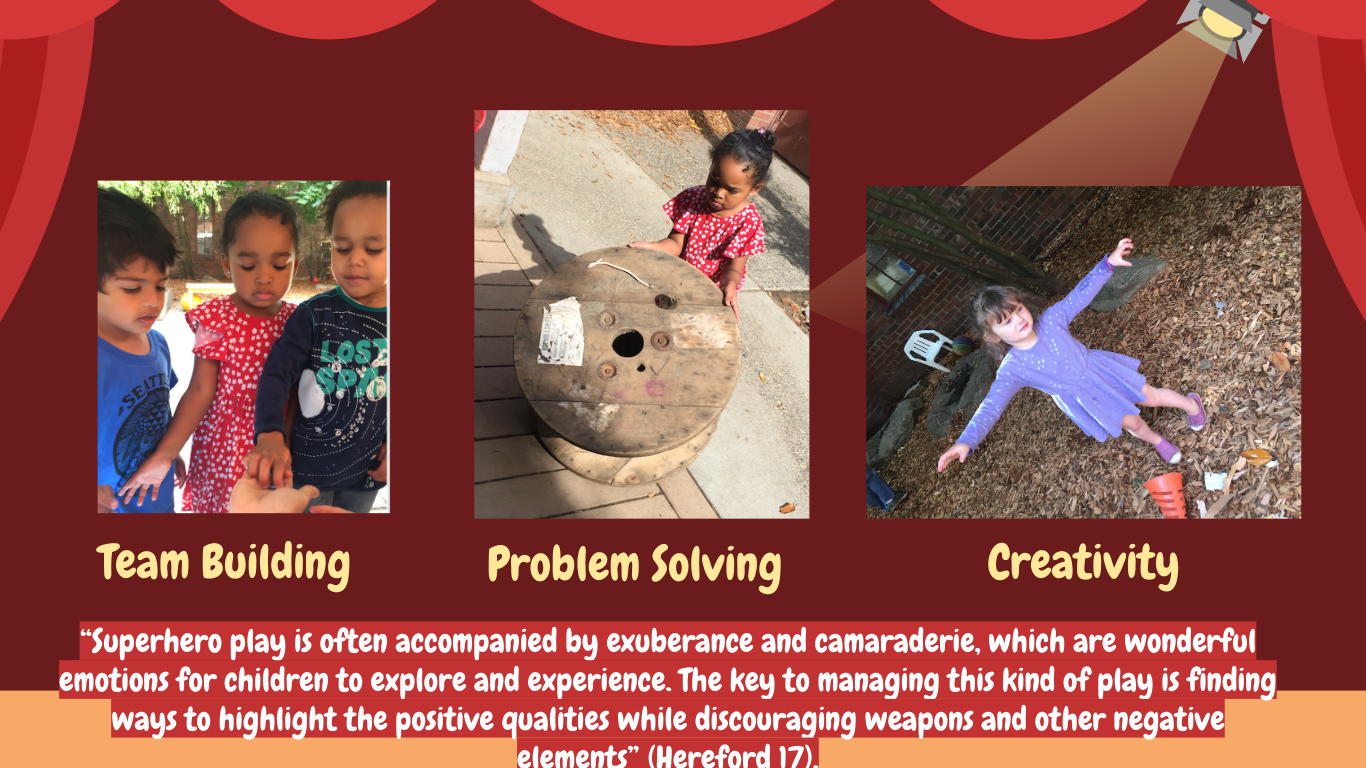
A potential format for the intervention would be to start with unstructured drama games designed to engage the children’s imagination, and promote positive emotion. The teacher would then move into a check-in-check-out therapy to guide the students into thinking about their feelings and social situations that the therapy would address. The class could then turn to role-play and role theory, where students would explore sources of stress, anxiety, or difficulty in a safe roleplay-based setting. The session might then conclude with a creative group project such as superhero play, or reading and acting out a storybook or text, (with emphasis on books that promote healthy social and emotional behavior).
The work of Sousa, Godfrey, Hereford, and others indicates that dramatic play can be a powerful method to improve the lives of children with emotional disorders, and their techniques would translate well to children with anxiety, Autism Spectrum Disorders, or depression. The potential intervention described in this paper would use these techniques effectively to benefit children with these and other emotional disorders. Since the onset of COVID-19 in 2020, mental health has been a big concern in schools, and cases of ASD have been increasing over the last few decades (Godfrey 21). There has never been a greater need for mental health interventions in classrooms, and dramatic play is a particularly effective method to help the growing number of children who require intervention.
Works Cited
Brooks, A. (2015). 5 Reasons Dramatic Play Matters for Child Development | Rasmussen College. Rasmussen.edu. https://www.rasmussen.edu/degrees/education/blog/why-dramatic-play-matters/
Dramatic Play: What It Is and Why It’s Important. (2021, November 5). Western Governors University. https://www.wgu.edu/blog/dramatic-play-what-is-why-important2111.html#close
Godfrey, E., & Haythorne, D. (2013). Benefits of Dramatherapy for Autism Spectrum Disorder: A Qualitative Analysis of Feedback from Parents and Teachers of Clients Attending Roundabout Dramatherapy Sessions in Schools. Dramatherapy, 35(1), 20–28. https://doi.org/10.1080/02630672.2013.773131
Kissinger, K. (2017). Anti-bias education in the early childhood classroom : hand in hand, step by step. Routledge.
Laurence, M., & Curtis, D. (2019, December 1). Look, Listen, Learn. “We Are Power Rangers!” Learning from Children’s Dramatic Play | NAEYC. Www.naeyc.org. https://www.naeyc.org/resources/pubs/tyc/dec2019/childrens-dramatic-play
Nancy Jo Hereford, & Schall, J. (1991). Learning Through Play. Scholastic Inc.
Sousa, D. A. (2017). How the Brain Learns (5th ed.). Corwin, A Sage Publishing Company.
 The Shakespearean Student