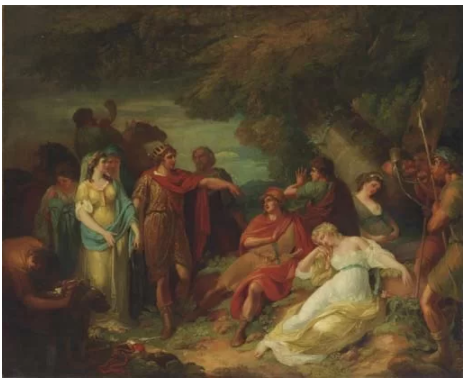
For my Shakespeare club, I’m coaching two young actors on Viola’s celebrated soliloquy in Act II, Scene ii.I thought I’d share some of that work with you. In this speech, Viola has an epiphany; the lady she was sent to woo on her master Orsino’s behalf LOVES HER!
Viola has spent an unspecified amount of time disguised as a man. She has just tried (unsuccessfully) to woo Countess Olivia on behalf of her employer, Duke Orsino. Olivia seemed intrigued by her in her disguise as “Cesario,” and refused to hear any more words about Orsino, but asked Viola to come see her again. The Countess then sent her messenger Malvolio to give Viola a ring, which he claims she tried to give to Olivia as a gift. At first, Viola is confused and upset by the accusation, but slowly realizes that the ring is actually a gift for her; in fact, it’s a love token.
Traditional Interpretations
I think the comedy depends on how Viola reacts to the realization that Olivia loves her. I’ve seen some Violas that are embarrassed, some that are a little frightened (after all, hell hath no fury like a woman scorned), and others with sad sympathy. Viola is a good person, so she can’t laugh at the lovesick countess, but she can have a wry laugh at herself and how her disguise has caused all this trouble; making her unable to confess her love to him, while at the same time making Olivia think she is a handsome young man.
Michelle Terry In the Globe Theater (2021)
Michelle Terry as Viola in the 2021 production of “Twelfth Night”
Michelle Terry is very matter-of-fact in her portrayal. She doesn’t pause, she doesn’t drag out the lines. In fact, she seems more annoyed and scandalized than anything else. The comedy comes mainly from her gestures and movements as she talks to the audience as if they were one of her gal-pals- venting her frustration with this ridiculous situation.
Michelle Terry excels as Viola, straight-faced, tormented, only occasionally raising a conspiratorial eyebrow at the audience.
Judy Dench in the RSC TV show “Playing Shakespeare” is very sympathetic to “Poor Olivia, ” and plays the speech with a romantic sentimentality. She’s focused on Olivia, and feels awful for the false hope she’s given her.
Both these interpretations are valid, and they’re a good baseline for two sides of Viola’s personality- the sensitive genteel duke’s daughter who is sympathetic to Olivia, and the down-to-earth funny one who is willing to disguise herself as a boy to survive.
Literary Devices
Imagery
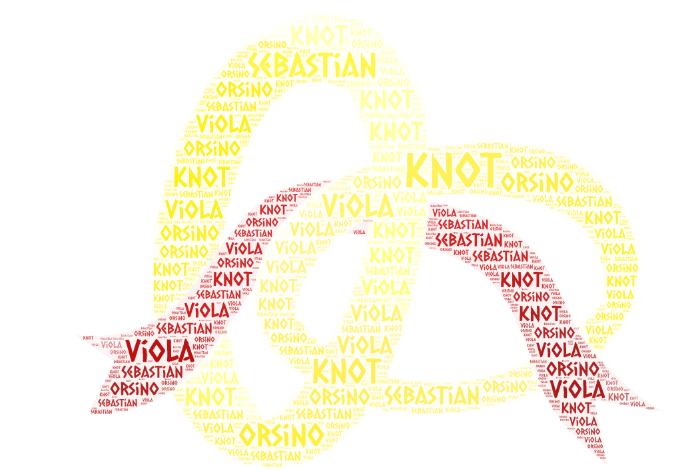
The main image here is the image of the knot- a central image of how convoluted this love triangle is.
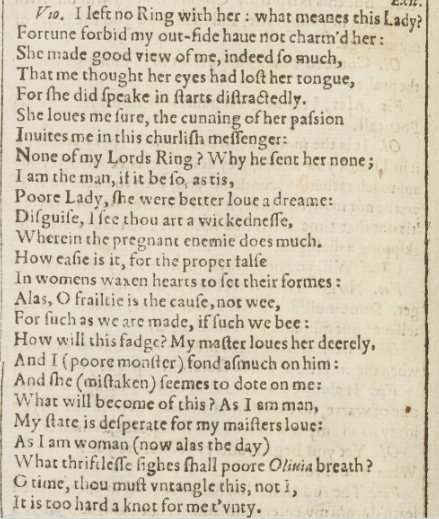
I left no Ring with her: what meanes this Lady?
Fortune forbid my out‑side haue not charm'd her:
[650]
She made good view of me, indeed so much,
That me thought her eyes had lost her tongue,
For she did speake in starts distractedly.
She loues me sure, the cunning of her passion
Inuites me in this churlish messenger:
[655]
None of my Lords Ring? Why he sent her none;
I am the man, if it be so, as tis,
Poore Lady, she were better loue a dreame:
Disguise, I see thou art a wickednesse,
Wherein the pregnant enemie does much.
[660]
How easie is it, for the proper false
In womens waxen hearts to set their formes:
Alas, O frailtie is the cause, not wee,
For such as we are made, if such we bee:
How will this fadge? My master loues her deerely,
[665]
And I (poore monster) fond asmuch on him:
And she (mistaken) seemes to dote on me:
What will become of this? As I am man,
My state is desperate for my maisters loue:
As I am woman (now alas the day)
[670]
What thriftlesse sighes shall poore Oliuia breath?
O time, thou must vntangle this, not I,
It is too hard a knot for me t'vnty.
It’s interesting to note that (in the First Folio text), the verse alternates between being regular, and using a run-on technique called enjabment, where the thoughts continue after the end of the lines, starting with lines three and four. Ironically, when Viola says that Olivia was distracted and confused when she visited her, her own thoughts are disjointed and fragmentary as she reaches the inevitable conclusion that Olivia is infatuated with Viola in her disguise.
Viola’s Emotional Journey
In the book “Shakespeare’s First Texts” by Neil Freeman he describes how the Folio prints the speech in four distinct sections. Freeman hypothesizes that Shakespeare organized this speech into four phrases that chart the stages of emotions Viola goes through:
Each stage has its own easily identifiable quality, reflecting the growing steps of Viola’s journey in what for her is a huge struggle not only to comprehend, but also to deal with the enormous complications of the dreadful love triangle- the potential results of which are now becomming only too clear.
Freeman, 175.
Stage 1: Introduction
In the first three and a half sentences, Viola goes through the facts- she gave no ring to Olivia, Olivia was eying her, and half paying attention to what Viola was saying. The phrase ends with Viola’s conclusion that Olivia must be in love with her.
Stage 2: Complications
The sentences are of very irregular length- sometimes six words per line, sometimes a few as four. According to Freeman, the irregularity of the verse shows how Viola’s emotions are getting the better of her. Viola could be gasping with remorse over the pain she’s caused Olivia, or shocked at how easily she was taken in by Viola’s disguise.
Stage 3: Crisis/ Catharsis
Each line of this section mentions the people in this love triagle: “My master,” “And I,” “And She,” etc. Viola might be thinking about the possible outcomes to this situation- getting fired, getting discovered, getting married, etc.
Stage 4: Summary: “O Time, Thou Must Untangle This, Not I.”
Like Hamlet before her and Macbeth after her, Viola ends her soliloquy by saying she has no conclusion. She has no idea how to solve this problem, but can only hope that Time will provide a solution.
Audience Interaction
As I said, this is a soliloquy, which is to say, a speech where the character is solo or alone onstage. Some people think this means that the characters are talking to themselves, but I firmly disagree with this notion. One reason why Shakespeare writes soliloquies is because they allow a character to share their thoughts and feelings with the audience. They are the ancestors of every aria or solo in opera and musical theater, and every Disney Princess/ Villain song. I’ve even said before that there are some similarities between Viola and a famous Disney Princess:
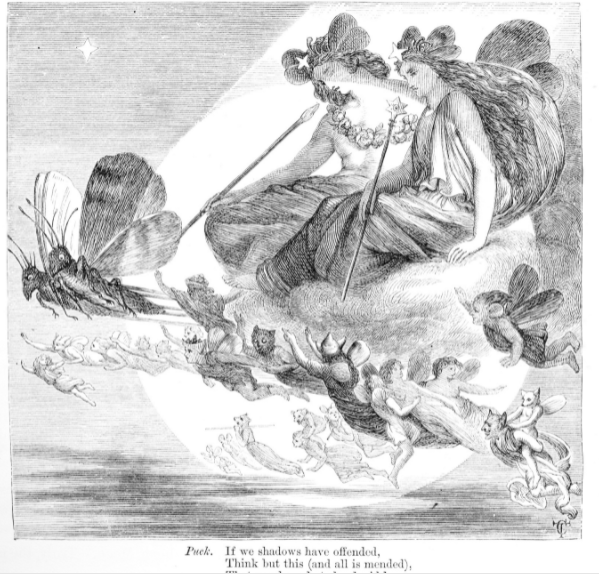
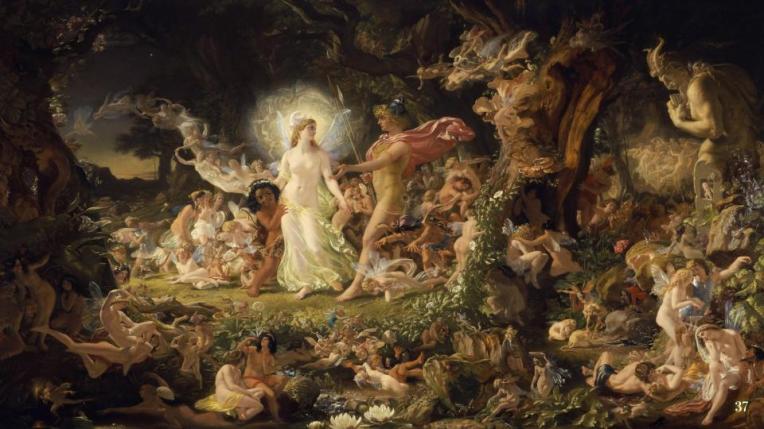
“Welcome Spirit, How Camest Thou hither?” The sources for Puck
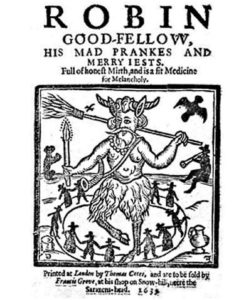
Puck, in medieval English folklore, a malicious fairy or demon. In Old and Middle English the word meant simply “demon.” In Elizabethan lore he was a mischievous, brownielike fairy also called Robin Goodfellow, or Hobgoblin. As one of the leading characters in William Shakespeare’s Midsummer Night’s Dream, Puck boasts of his pranks of changing shapes, misleading travelers at night, spoiling milk, frightening young girls, and tripping venerable old dames. The Irish pooka, or púca, and the Welsh pwcca are similar household spirits.
Shakespeare also took inspiration from English poet Edmund Spencer, who visited Ireland in the 1590s and adapted the folklore he picked up into his opera The Fairy Queen, which Shakespeare adapted into A Midsummer Night’s Dream
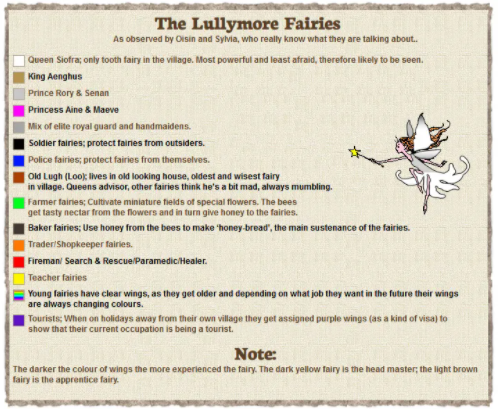
Types of fairies you can “spot” at the Lullymore Park in Ireland:
Puck/Robin’s Dual Nature
The old stories tell that Fairies are magical creatures who live in hollow places in the earth. Some are benevolent and help give rain and pleasant weather to the Earth, Like the king and Queen of the fairies, Oberon and Titania:
And the mazed world, By their [the tides] increase, now knows not which is which: And this same progeny of evils comes From our debate, from our dissension; We are their parents and original.
— Titania, (Queen of the Faries), A Midsummer Night’s Dream Act II, Scene i.
Titania in this speech shows great concern for nature, humanity, and the planet. She believes it is the responsibility of fairies, particularly herself and her husband Oberon, to control the elements and keep humans and fairies safe. Some fairies, however, are cruel and enjoy playing tricks on mortals, just like Puck in A Midsummer Night’s Dream, or Queen Mab in Romeo and Juliet.
Close reading of Puck’s speech (MND II, i)
Close reading of Puck’s speech (MND II, i)
Close reading of Puck’s speech (MND II, i)
Close reading of Puck’s speech (MND II, i)
Close reading of Puck’s speech (MND II, i)
.
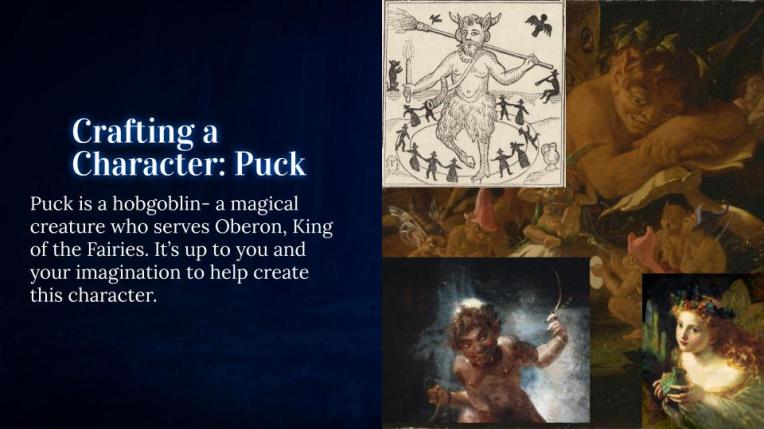
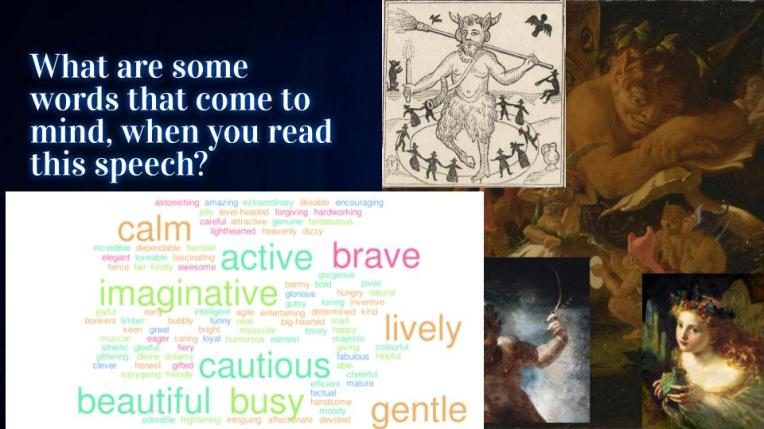
This is a short analysis I created of the tricks Puck plays on people in A Midsummer Night’s Dream, as part of my acting course on Ouschool.com. Note the different ways Puck is portrayed in photos as a satyr, a rotund elf, and sometimes as an almost- demon like figure.
Punishments or contracts with fairies formed a significant part of Goodfellow’s purpose on earth. While he could issue good fortune and support, this was always at the cost of those involved. As Reginald Scot commented, Goodfellow had a ‘standing fee’ of a ‘mess of white bread and milk’, which he expected after supporting housewives with their chores. If his payment was forgotten, Goodfellow was believed to steal from the home that owed him, often stealing grain and milk from the dairy.
Abigail Sparkes, Historic UK.com
Performing Puck
Because Puck is not human, and somewhat ambiguous in the text, an actor can play Puck in many different ways. Generally speaking, actors tend to explore Puck’s attitude toward humans, their love of mischief, and how to translate that physically and vocally
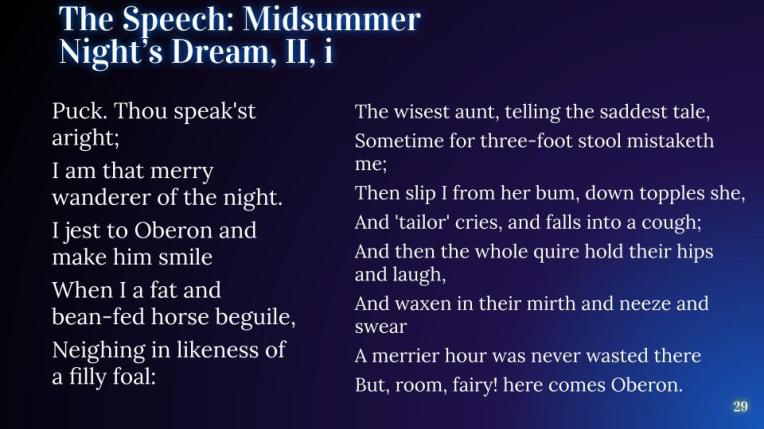
Puck. My mistress with a monster is in love. Near to her close and consecrated bower, While she was in her dull and sleeping hour, A crew of patches, rude mechanicals, Were met together to rehearse a play The shallowest thick-skin of that barren sort, Who Pyramus presented, in their sport Forsook his scene and enter’d in a brake When I did him at this advantage take, An ass’s nole I fixed on his head:
Anon his Thisbe must be answered, And forth my mimic comes. So, at his sight, away his fellows fly; And, at our stamp, here o’er and o’er one falls; He murder cries and help from Athens calls. I led them on in this distracted fear, And left sweet Pyramus translated there: When in that moment, so it came to pass, Titania waked and straightway loved an ass!
I am just ecstatic to talk about this year’s hit Broadway Musical Six. It swept the Tonys, and has opened up touring productions across the country, and I JUST GOT TO SEE IT!
This vibrant, clever retelling of Tudor her-story was created by TOBY MARLOW & LUCY MOSS in association with the Chicago Shakespeare Festival. The show is incredibly smart, and creative, and delves into the lives of some fascinating women, re-told as a singing contest with the characters singing their lives for you to judge what it was like being the queen of England and living with the turbulent and fickle Henry VIII.
What really appeals to me in this show is that like Hamilton, the musical takes these six semi-mythical women and tells their story in a way that is fresh and exciting. It bridges the gap between Tudor History and the modern-day by equating being a queen with being a celebrity, with all the drama of ambitious parents, romantic drama, public opinion, and even being exploited and sexualized by a male-dominated society. This comes across in the music, the costumes, the lyrics, and even the lighting!
Why “Six” Slaps
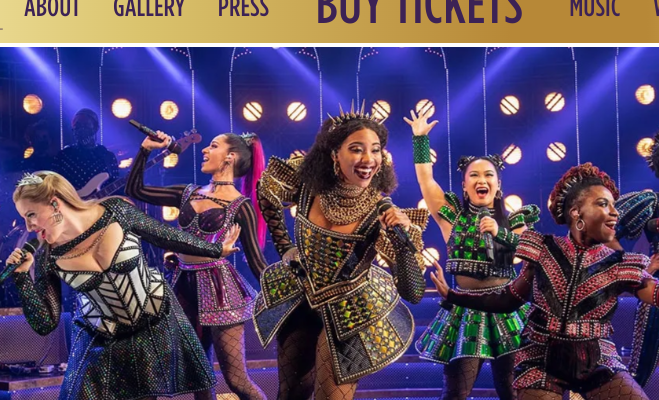
The costumes are brilliant and iconic. Catherine Of Aragon is like a cross between Beyonce, a saint, and a medieval knight. The lighting is incredible! You could tell the whole story using the lighting design as it pulsates, dances, changes into different colors, turns into different shapes, and finally flashes the name of the show in triumphant gold letters.
One particularly brilliant way the music works in “Six” is the fact that it uses the song “Greensleeves” as a motif both musically and thematically. One big theme of the show is how, unlike Henry VIII, most of the history of his six queens is lost and replaced by legends and even songs. The first line of the show is the famous rhyme about their fates: “Divorced. Beheaded. Died. Divorced. Beheaded. Survived.” As the video above helps illustrate, Marlowe and Moss know that most people only know the rhyme about their deaths and the myth that Henry wrote a song about one of them; that their lives are overshadowed by their deaths and the misconceptions that people have written over the years. Howard Ho points out how the song musically forces itself into the first number, “Ex Wives,” but by the end of the show, the six queens break free from these musical bars! You can hear the change of key and notes during this performance at the Tonys, which puts the opening number and closing reprise together.
The Cast of “Six” perform live at the 2021 Tony Awards.
But how do the queens go from “one word in a stupid rhyme,” to a group of powerful, individual queens singing in harmony, without the man who made them famous? That’s what the solo numbers in “Six” do so incredibly well- tell each queen’s solo stories as rocking ballads, hilarious dis-tracks, soulful love songs, and… well stay tuned.
Part II: The Women and Their Queenspirations
1. Catherine of Aragon
Catherine of Aragon was Henry’s first wife and is still universally beloved, even though Henry decided to divorce her. As the epitome of a stand-alone power queen, it makes sense that Six modeled her character, costume, and songs after Beyonce, with a Shakira-inspired Spanish beat for good measure:
My favorite thing about her solo, “No Way” is how the writers paraphrase her real-life speech during the divorce trial in 1529. Below are the lyrics and the real speech:
Alas, Sir, where have I offended you? Or what occasion have you of displeasure, that you intend to put me from you? I take God and all the world to witness that I have been to you a true, humble and obedient wife, ever conformable to your will and pleasure. This twenty years and more I have been your true wife, and whether it be true or no, I put it to your conscience.
— Katherine of Aragon, 1529
2. Anne Boleyn
In some ways, the version of Anne Boleyn in “Six” is less a pop version of the real queen and more of a commentary on the nature of celebrity. If you watch the video, you can see how in life she was admired for her beauty and fashion but hated for her comments on Queen Katherine, her scandalous love affairs, and her brash nature. This explains the spiky pop-punk princess look they gave her, (which evidently resonates with many audiences since I saw at least two girls cosplaying as Anne in the audience). Sort of like a celebrity who gets canceled on Twitter or Princess Diana, Anne shows how a person can be undone when they dare challenge an established order, especially the Royal Family.
After the show, I found it a bit weird that they portrayed Anne Boleyn as a jetsetting airhead, but then again she is one of the best-known queens in history, so they can get away with it. In reality, Anne Boleyn was highly educated and a member of an ambitious and social climbing family who basically pushed her to woo Henry. As you can see in this clip from “Anne Of A Thousand Days,” Henry and Anne’s family bullied her constantly to become the King’s mistress after HE ALREADY GOT HER SISTER PREGNANT, so Anne knew that the only way to keep Henry from ruining her life was to convince him to divorce Katherine of Aragon and marry her.
Of course, this strategy didn’t save Anne in the end, which says more about how cruel Henry VIII was, chewing up women and spitting them out in his ravenous quest for a son. So is this an accurate portrayal of Anne’s life? No. Is it fun, ABSOLUTELY!
III. Jane Seymore
I’m more than I seem, or am I?
“Six” The Musical.
This version of Jane Seymore was inspired by Adele, so appropriately, she has a heart-wrenching power ballad about her turbulent relationship with Henry. Sadly, we don’t know much about Jane’s real life, so the song takes some liberties. If you go to the Hampton Court Website, you can actually vote as to whether Jane was a devoted wife or a social climbing gold-digger. Probably the real woman was something even more complicated, though we’ll never know for sure.
IV. Anne of Cleaves
Anne of Cleaves is the funniest part of the show! Many of us have heard the story that Henry divorced Anne after he found her ‘ugly.’ What “Six The Musical” does is amend the story, by pointing out that after he divorced her, Henry gave her a castle and a huge retainer, allowing her to live like a queen, without being married to a king! Accordingly, her song is a Rhianna-style dis track that shows off her awesome lifestyle, and spits in Henry’s stupid face!
As fun as this, rags-to-riches story is, the truth is less fun- Anne was the sister of a German duke, so Henry’s lord Chancellor Thomas Cromwell probably forced Henry to marry her for diplomatic reasons (source: Hampton Court: “Anne of Cleaves”). Naturally, Henry didn’t like being told what to do- I suspect he resented Anne before even meeting her because he didn’t get to pick her himself.
As for whether Anne was actually ugly, the truth is really surprising- Henry actually disguised himself as a peasant during a masked ball when he first courted Anne, and she foundhim repulsive. At the time, Henry was 49 years old, and in very poor health. As such, he was intermittently impotent and blamed his inability to conceive a child with her on her supposed ugliness to save face.
Even though Anne in the show hates Henry, in reality, once the marriage was annulled, Anne and Henry remained good friends for years! She attended his next wedding to Katherine Howard, and, just like in the show, Henry treated her much better after the divorce:
‘YOU SHALL FIND US A PERFECT FRIEND, CONTENT TO REPUTE YOU AS OUR DEAREST SISTER. WE SHALL, WITHIN FIVE OR SIX DAYS …DETERMINE YOUR STATE MINDING TO ENDOW YOU WITH £4000 OF YEARLY REVENUE…YOUR LOVING BROTHER AND FRIEND.’
Henry VIII, 1548, six months after their wedding, when the annullment went through.
V. Katherine Howard
Without question, Katherine Howard is portrayed as the most tragic of Henry’s six wives and her song is a huge sucker punch. The writers never let you forget that Katherine’s first affair was when she was 13, and she died at age 19. Like Anne Boleyn and Jane Seymore, Henry picked Katherine for his queen among his ladies in waiting and her song “All You Wanna Do” satirizes his and many other men’s lustful appetites. The song begins as a raunchy, sexy pop ballad in the vein of Britney Spears’ “Toxic” and “Womanizer” about Katherine Howard’s love affairs, but then devolves into a cry for help, as Katherine confesses how she was abused, used, and manipulated by the men in her life, (including her own cousin Thomas Culpepper) until she was beheaded in 1542. It masterfully satires both Henry’s cruelty and the hypersexualization of teenage pop stars which certainly took its toll on Britney Spears and Ariana Grande, Katherine’s major ‘Queenspirations.’
VI. Katherine Parr
Historically, Katherine Parr had to turn away her fiancee Thomas Seymore (just like Anne Boleyn was previously engaged to Henry Percy) once the king set his eyes on her for his wife, so her song is a sad, soulful Alicia Keys-inspired bittersweet song where she tearfully says goodbye to Thomas to spare his feelings and probably his life.
Not only does this song once again show how Henry’s selfishness and his lust ruined the lives of the women he married, (as well as the men who already wanted to marry them), but it also sets up the main idea of the show:
His-Story overthrown
In the final number, the wives turn the tables on Henry- they have spent centuries being defined by him, but in reality, he is just as much defined by them! Going forward, history should not define these great women as just, “The Six Wives of Henry the Eighth,” but to celebrate their individual lives and contributions to history. Katherine Parr mentions this when she points out that in life, she fought to allow women to be educated, she wrote books, and was a scholar of theology. Historically, Henry and Katherine would argue about religion and he nearly executed her after she disagreed on points of theology, but Katherine kept her life by claiming she was “Not disagreeing with [him], but simply learning from [him].”
I Don’t Need Your Love is sung by Catherine Parr in SIX: The Musical. The first part of the song refers to her love of Thomas Seymour, whom she probably wanted to marry rather than Henry (and did marry after Henry’s death). However, the song also protests at the fact that women are often defined by their relationship with men, rather than as people in their own right. Catherine wants to be remembered for what she did, rather than the men she married or loved.
Katherine Parr, Six.
The final number completes the idea of the ‘historemix’ by having the Six queens/pop stars come up with a re-imagined happy ending for themselves, one that doesn’t include the pain that Henry inflicted on them: Katherine A becomes a singing nun, (like Whoopi Goldberg in Sister Act), while Anne Boleyn starts writing lyrics for Shakespeare (which is a fun idea since he does mention “Greensleeves” twice). Jane Seymore forms a band with her many surviving children, Katherine Howard goes solo, and Katherine Parr joins the other queens in a supergroup. It’s not at all historical, but it is a fun and sweet way to put an epilogue on these (mostly) tragic lives.
It’s odd, however, that the show invents an epilogue instead of talking about the six queen’s greatest legacy- Queens Elizabeth and MaryI. For a show that wants to highlight the often-forgotten legacy of these queens, it is an odd oversight. Remember Catherine and Anne gave birth to queens who eventually ruled England without a king. Jane Seymore gave birth to a king, and Catherine Parr helped raise them and restored them to the line of succession- She’s the reason her stepdaughters were able to become queens in the first place.
My issues with the epilogue aside, it is great to see history be recontextualized and shared in such an accessible way. We all know that European history is dominated by the names of white guys- king whoever, duke what’s-his name. To see important women in history be given a voice by a multi-ethnic cast is a great way to make it resonate, and using the metaphor of pop stars works extremely well in this context- these women mostly didn’t choose stardom, but they deserve it for what they went through.
Brava.
Educational links related to the six wives of Henry VIII:
Hello everyone! I’m back from break and happy to celebrate one of my favorite holidays with you- the one that gave its name to one of Shakespeare’s greatest comedies- Twelfth Night
I’ve been in this play three times and I’m continually struck by how fun, romantic, and progressive it is. It raises questions about gender roles, social norms, bullying, and even catfishing and heteronormativity! It’s a fascinating and thought-provoking play and it’s my favorite of Shakespeare’s comedies!
Shakespeare’s early comedies are about young love, infatuation, and being ‘madly in love’ (sometimes literally). His middle plays are about mature relationships between men and women and the need for commitment. I would argue that Twelfth Night, (and possibly Much Ado About Nothing), are the best examples of Shakespeare telling meaningful stories about romantic relationships.
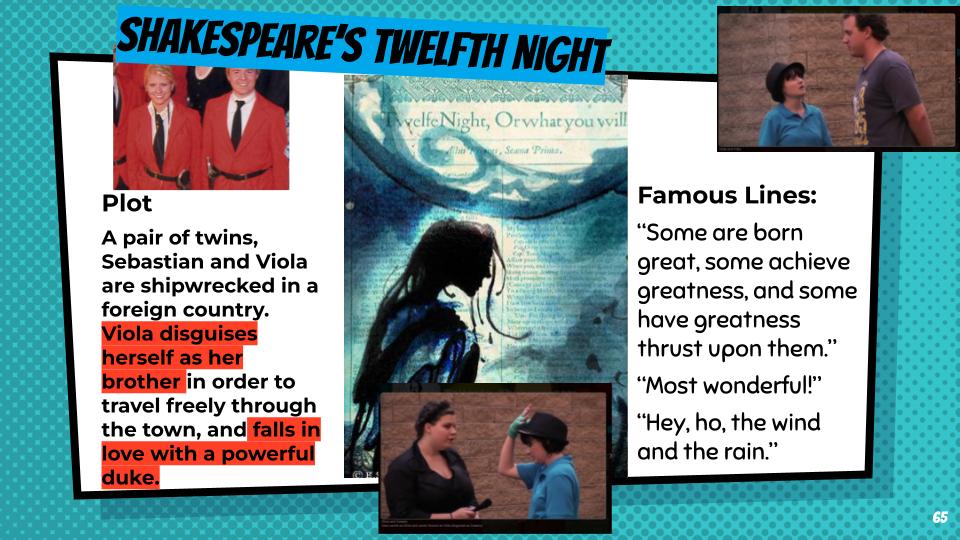
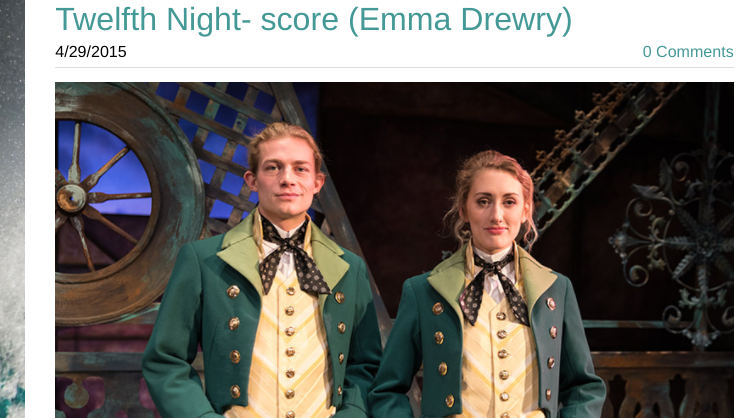
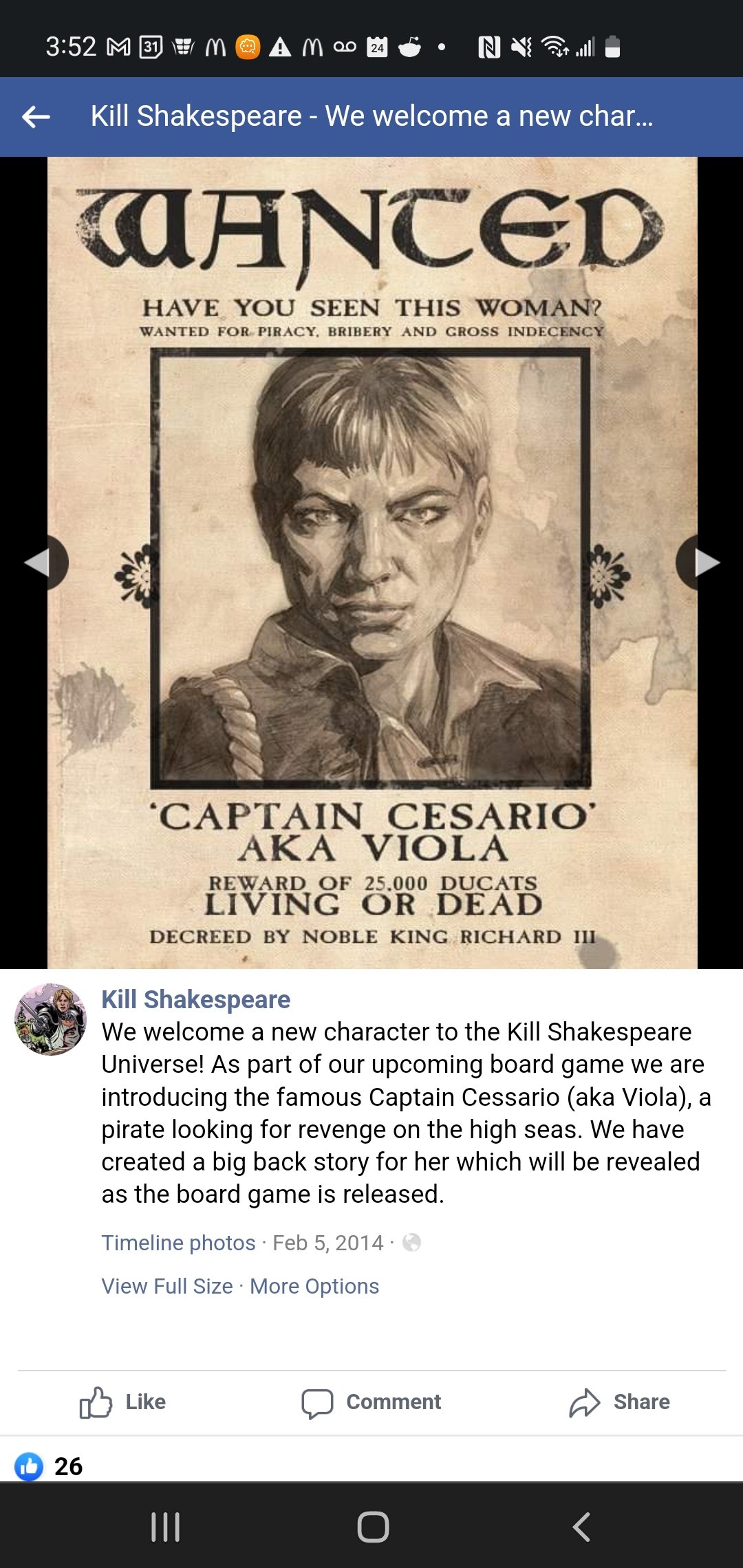
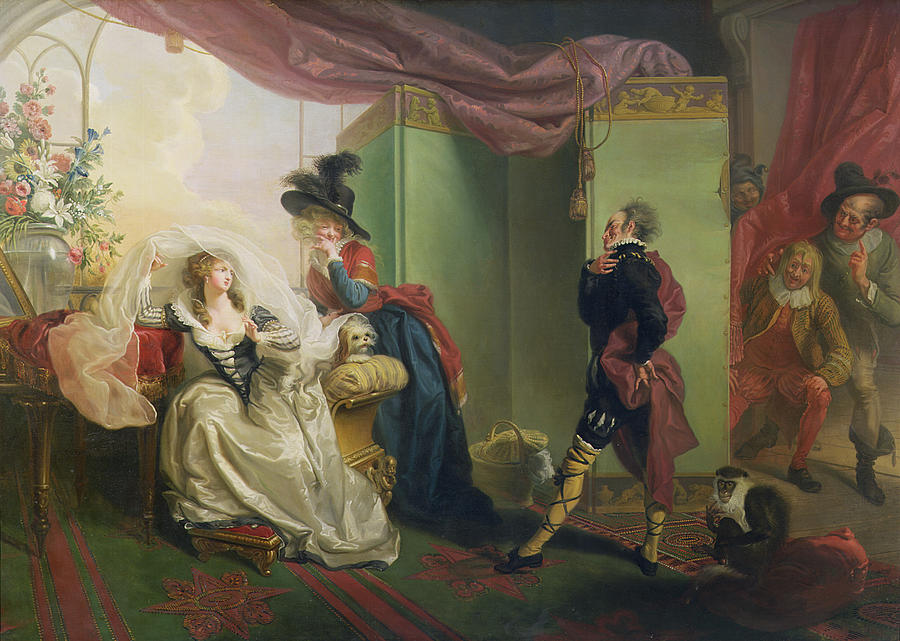
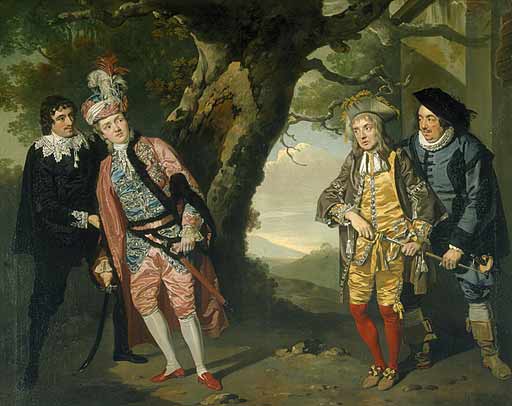
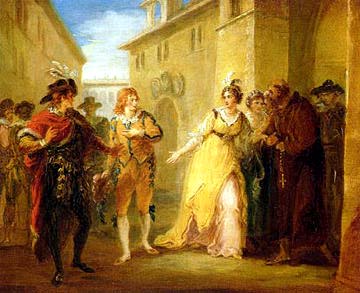
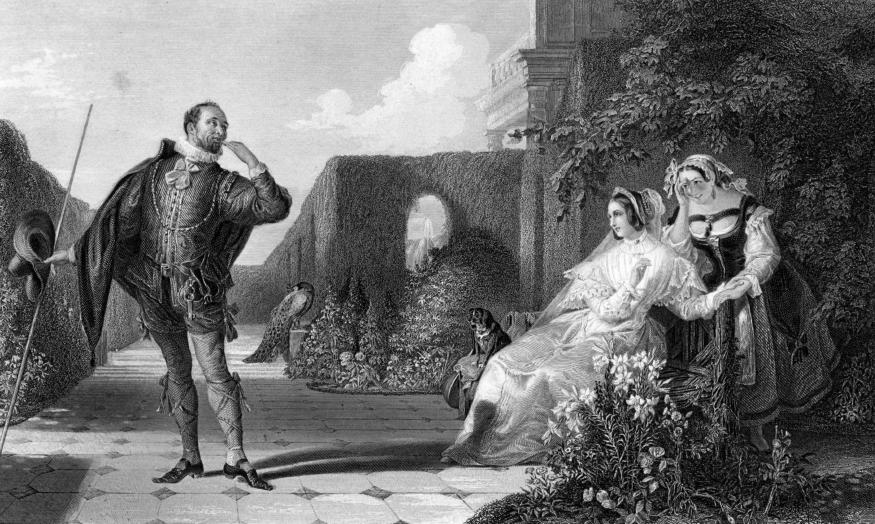
Images from various productions and paintings of “Twelfth Night.”
In honor of “Twelfth Night,” I’ve created a coupon for my course on Shakespeare’s comedies from now till January 31st: Get $10 off my class “Shakespeare’s Comic Plays” with coupon code HTHESYTIT110 until Jan 31, 2023. Get started at https://outschool.com/classes/shakespeares-comic-plays-868BR5hg and enter the coupon code at checkout.
To finish I wanted to give you a complete production of Twelfth Night for your viewing pleasure, but I can’t decide which one, so I will post a bunch today!
1. 1996 TV movie starring Geoffrey Rush (Pirates of the Caribbean)
One really fun thing I like to see each Thanksgiving is the live previews of some of Broadway’s hottest shows. You may remember that I first became acquainted with the musical “Something Rotten,” after seeing a live performance at the Macy’s Day Parade. I am just ecstatic to see and talk about this year’s hit Broadway Musical Six. It swept the Tonys, and has opened up touring productions across the country.
The Cast of “Six” perform live at the 2021 Tony Awards.
This vibrant, clever retelling of Tudor her-story was created by TOBY MARLOW & LUCY MOSS in association with the Chicago Shakespeare Festival.
The show is incredibly smart, and creative, and delves into the lives of some fascinating women, re-told as a singing contest with the characters singing their lives for you to judge what it was like being the queen of England, and living with the turbulent and fickle Henry VIII. What really appeals to me in this show is that like Hamilton, the musical takes these six semi-mythical women and tells their story in a way that is fresh and exciting.
Part I: Shakespeare’s “Henry VIII:” How NOT to tell a queen’s story
Around 1613, Shakespeare wrote his final play- his 10th history play which loosely told the life of English king Henry the Eighth.
I happen to know a lot about this play since I was in it back in 2008, as you can see in the slideshow above. As you might notice, this play doesn’t tell the story of all of Henry’s wives. We only see the last few years of Catherine of Aragon’s life, and the beginning of Henry’s marriage to Anne Boleyn. Most of the drama actually centers around Henry and his scheming advisor, Cardinal Wolsey. Maybe I’m biased because I played this role, but frankly, Woolsey is treated in the play as a stereotypical Machiavellian villain, who conveniently leads the king astray so he can be the hero of the play. Woolsey does all of Henry’s dirty work; taking over his government, spearheading his divorce to Catherine, and trying to dissuade the king from listening to Anne Boleyn’s Protestant ideas, dismissing her as a “spleeny Lutheran.” Shakespeare leaves it ambiguous as to whether Henry actually told Woolsey to do any of these things so the audience will blame Woosey, instead of the king.
I’ll be blunt, aside from the courtroom scene at Blackfriars, where Katherine pleads for Henry not to dissolve their marriage, and the fun dances and costumes in the scene where Anne flirts with Henry, the play is really quite boring. though I blame Jacobean censors more than Shakespeare for this. Even after the entire Tudor dynasty was dead and buried, powerful people in the English government controlled what Shakespeare could say about them.
Part II: The women take wing
During Shakespeare’s life time, the wives of Henry VIII were bit players at best. With the exception of Katherine of Aragon and Anne Boleyn (who in most narratives have often been cast as either virgins or whores), the lives of Jane Seymore, Anne of Cleaves, Catherine Howard and Catherine Parr were barely told until the 20th century, where new feminist scholarship sparked renewed interest in these women and how they lived.
TV series like The Tudors, movies like The Other Boleyn Girl, and of course books and documentaries by
Well, I can’t yet give an objective view of the plot and characters of “Six,” because I haven’t seen it…(yet). But until then, let’s just say that like “Hamilton,” it is great to see history be recontextualized and shared in such an accessible way. We all know that European history is dominated by the names of white guys- king whoever, duke what’s-his name. To see important women in history be given a voice by a multi-ethnic cast is a great way to make it acessible.
Bravo.
Educational links related to the six wives of Henry VIII:
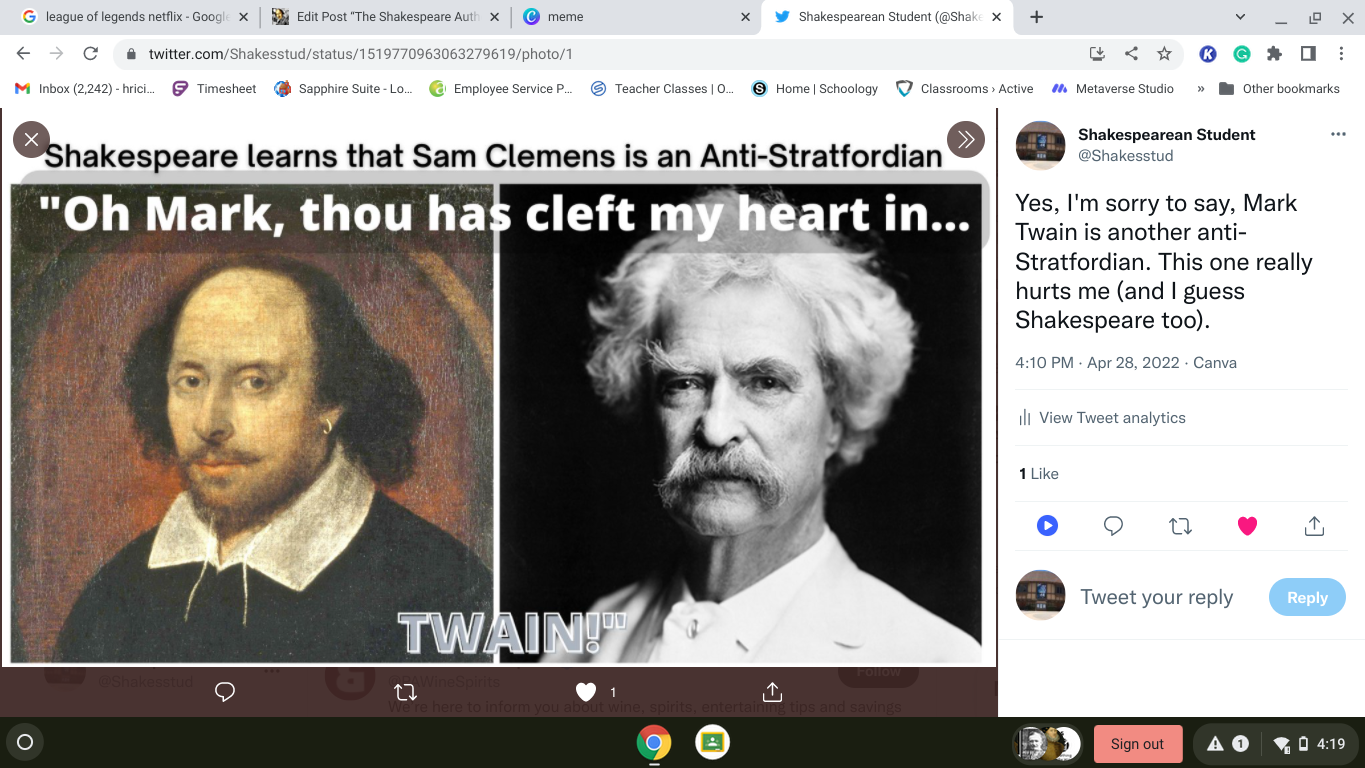
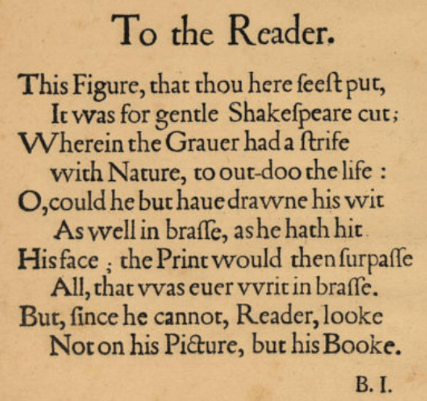
“There is a tendency for us to view Shakespeare as this unquestionable monolithic genius. But there is also in us all that iconoclast that wants to tear him off his pillar or plinth.”
–Dr. Katrina Marchant
There are few things that will drive a Shaespeaeran scholar more skull-shatteringly livid than when someone asks them if Shakespeare wrote the plays attributed to him. There are dozens of YouTube rants, bile-dripping academic papers, tinfoil-hat Tweets, and of course, centuries of anti-academic book bashing and counter-bashing research on the subject. So I won’t try to settle this debate, but I think the debate itself is worth looking at.
The authorship controversy is essentially a conspiracy theory- Was some unknown writer sending scripts to Shakespeare’s company and using the actor from Stratford as a patsy, or a pen name? Is there a massive cover-up to disguise the author of the most celebrated works in the English language? If so, why? How? and what else are they hiding?
The Malleus Malefecarum, “The Witch’s Hammer,” a 15th century book that posits that there is a vast conspiracy of witches living among us.
Now if there’s one thing I’ve learned over the past four years is that it’s extremely rare to change anyone’s mind about any kind of conspiracy theory, and there are hundreds! Ancient Aliens, Bill Gates, Covid vaccine microchips, Elvis isn’t dead, The Illuminati, Kennedy Assassination, Pizzagate, Q-Anon, Trump’s Russia connections, the list goes on. Several recent studies show that the majority of Americans have heard at least one conspiracy theory, and many of us believe these theories to varying degrees. Sadly, the internet, which was designed to share information, is extremely good at sending misinformation as well.
So as an en educator and a father, I want to focus on the Shakespeare conspiracy not just because it gets my dander up, but also because, compared to these other theories, it is actually one of the least harmful. Conspiracies like the Plandemic hoax are extremely dangerous because they dissuade people from getting a life-saving treatment, and allow this pandemic to continue. By contrast, ultimately it doesn’t really matter who wrote Shakespeare’s plays, so I think this kind of exercise is useful for educators to challenge students to think critically about this low-stakes theory, and then applying the same skill to others to become better-informed thinkers.
How to break down the Shakespeare conspiracy theory
First, let’s summarize the most compelling points of the theory that Shakespeare didn’t write his plays. This is a video by director Roland Emmerich, which he made to help promote his film “Anonymous.” Emmerich dramatizes the controversy by portraying the Earl of Oxford writing the plays of Shakespeare anonymously, and sending them to Shakespeare’s company, giving the man from Stratford credit for writing them.
There’s an old saying in science that “Extraordinary claims require extraordinary proof,” and, aside from the fact that the Earl of Oxford wrote poems, there is no evidence that Oxford ever even spoke to Shakespeare’s company. In fact, almost none of this video is supported by any historical evidence. Now it would be a lot of work to refute each argument of this video point by point right? And surely I have better things to do than do a point-by-point refutation, but…
A Point-by Point refutation of the Roland Emmerich video:
– Shakespeare did leave evidence of his handwriting, just not evidence of his dramatic writing. The fact that his correspondence didn’t survive doesn’t mean there wasn’t any. The kind of cheap parchment that writers of the period used dissolved very easily, especially when they used ink with high iron content. The examples we have of Shakespeare’s writing are mainly legal records and books that were designed to last. In short, there’s no conspiracy to hide Shakespeare’s manuscripts, they simply didn’t survive.
The dedication page of the 1623 First Folio.
– We don’t know for sure that his parents were illiterate, or that his daughters were. That is based on an urban legend, not actual proof. Also, plays were not written to be read, that’s why TV viewers are viewers and the grounding are called an audience.
A. Shakespeare wrote about aristocratic people because they were paying his rent. His company was literally named “The Lord Chamberlain’s Men.” One reason why Shakespeare was more successful than Ben Johnson was that he was deferential and obsequious to the English aristocracy; he had to sing their praises to stay in business.
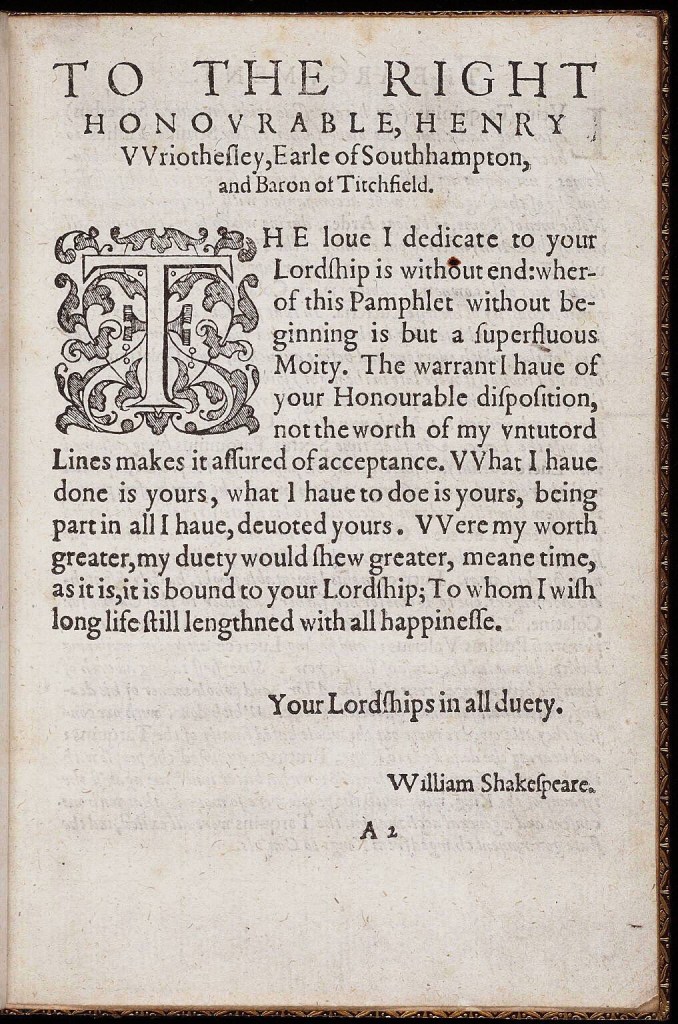
Dedication page of Venus and Adonis, which Shakespeare wrote to the Earl Of Southampton.
B. Every character that Emmerich mentions is not an aristocrat- Bottom is a lower-class weaver, Mistress Overdon is an inn-keeper. The only aristocrats Shakespeare ever insults are Polonius (who isn’t real), and Sir John Oldcastle in the early draft of King Henry IV, which he immediately changed to Sir John Falstaff once Oldcastle’s family members complained about it to Shakespeare’s company. Emmerich is flat-out lying when he says Shakespeare mocks the English upper class like an equal.
C. There’s a very simple explanation of how Shakespeare was able to write about the manners and lives of the English aristocratic class: he didn’t. All of Shakespeare’s comedies (except for Merry Wives which has the aforementioned Falstaff as a character), and tragedies take place in other countries like Italy, France, Sicily, or Greece. His History plays are set in England, but they dramatize events that happened 100-200 years before Shakespeare was born, meaning that he didn’t need to know too much about contemporary court politics. Furthermore, the majority of the plots he used were recycled from history books, poems, and prose romances.
It’s useful to think of Shakespeare not as a novelist like Dickens or Tolstoy and more like a TV or film screenwriter like George Lucas or Aaron Sorkin. He didn’t write based on real-life experiences or conjure new ideas out of thin air. He was a popular dramatist who adapted existing works of literature to be dramatized onstage. This is why I created my YouTube comedy series “If Shakespeare worked for Disney.” Emmerich, like many Anti-Stratfordians, is assuming that Shakespeare couldn’t have written plays about the nobility without being one himself, but that’s not what Elizabethan dramatists did- they adapted pre-existing work to fit on the public stage, which means anyone with a good education and knowledge of the theater could have written them, regardless of his or her upbringing.
If you are wondering how I could possibly know Shakespeare’s writing process,, the answer is simple: All of Shakespeare’s sources have survived, which means that I can prove that his plays are adaptations. This is a common problem with most conspiracy theories- they never take the straightforward way to explain something. Instead, they take a theory and twist facts to suit that theory. In this case, they twisted the facts about the Earl of Oxford’s life to make him look like Hamlet and based on that, they made him look like the true author of Shakespeare.
D. Honestly the handwriting is the weakest point- yes Shakespeare spelled his name differently in documents but this was before standard English spelling. The first English dictionary was at least 100 years after Shakespeare’s death. This point is clearly designed to discredit Shakespeare and make him seem uneducated. But again, this point is irrelevant when you consider that Shakespeare wrote for theater, where standard spelling is completely unnecessary.
By the way, Ben Johnson spelled his name differently in his manuscripts.
The Debate- Feelings vs. Facts. Modern vs. early modern
When I was in high school, taking my first class on Shakespeare, I watched this documentary which almost convinced me that Oxford was the true author of Shakespeare. The researcher they interviewed seemed so passionate and I wanted to believe what he said was true. But that was before I started reading about Shakespeare’s life for myself, and looked at the evidence myself.
The common traits of Conspiracy Theories from the Conspiracy Theory Handbook
If you look at many different conspiracy theories, they often exist in a form outside of normal reality, to the point where the believers have no interest in any kind of contrary evidence, logic, or any person who even questions it. Essentially the conspiracy becomes their identity, and they will virulently defend this conspiracy from anyone and anything that opposes it. Below is an explanation of the basic parts of a Conspiracy theory, with some points on how they all apply to the Shakespeare Authorship Controversy
Contradictory Beliefs:
Believers in conspiracies are motivated by feelings, not facts, and they don’t care how inconsistent those theories are. For example, the same people who believe Joe Biden lost the presidential election, also believe that the president (Joe Biden) is also being played by an actor. This might explain why many people believe that people like Christopher Marlowe wrote the works of Shakespeare, despite the fact that he died 9 years before Shakespeare started writing.
Overriding suspicion:
Again, since the believer is motivated by feelings, they are naturally suspicious of any contrary evidence and just assume anyone who contradicts them is in on the conspiracy. This is called self-sealing the conspiracy.
Nefarious intent:
One question that inevitably comes up with the Shakespeare Authorship debate is: “Who cares?” Usually, this means “Does it really matter who wrote the plays?” However, I want to use this question in this context: “Why go through the trouble to conceal who wrote these plays?” As I mentioned earlier, though Shakespeare is very famous and culturally important now, he certainly wasn’t back in his lifetime. Playwriting was not a venerated profession, and socioeconomically, Shakespeare was little better than a tailor. Why would it be worth it to conceal who wrote a few, fairly popular plays in 1616?
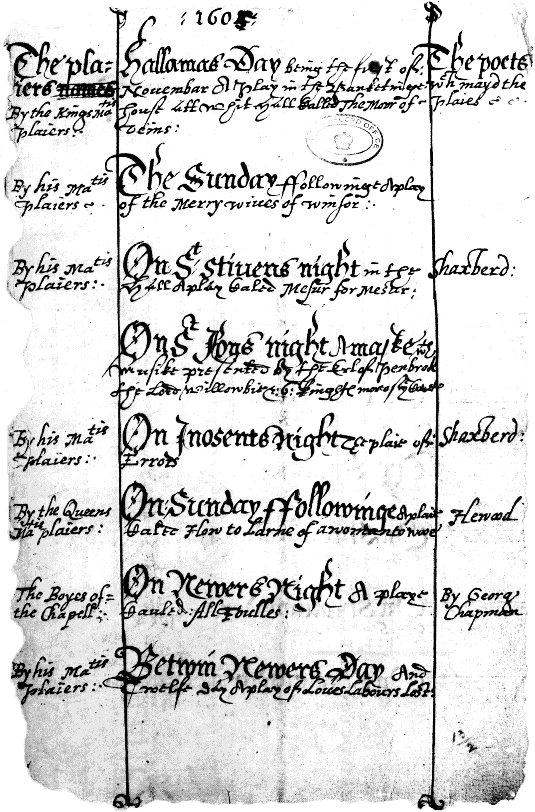
It would take an enormous amount of effort to conceal who wrote these plays for 400 years- you’d have to pay off publishers, fake court records (like the one I showed you above), keep an entire court quiet, and make sure nobody ever wrote down the truth for 400 years. Why would it be worth it? This kind of logic is why the Moon Landing and the Flat Earth conspiracies don’t hold up to rational thought- there’s simply no reason to go through the effort of concealing the alleged truth. The truth itself is just easier to defend.
Something Must be wrong:
As the name implies, Anti-Stratfordians don’t so much believe in Bacon, Pembroke, Oxford, etc, so much as they actively choose not to believe in William Shakespeare of Stratford. This means they will use every bit of their energy trying to prove that theory, and won’t stop until they find something, no matter how nonsensical, to prove their Shakespeare is the real Shakespeare.
Persecuted victim:
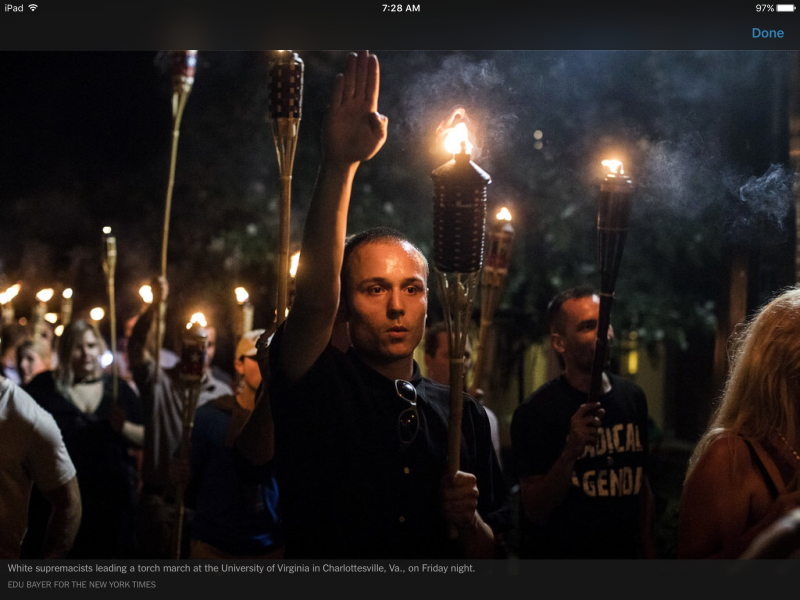
Let me be blunt- a conspiracy is very simmilar to a delusion, and any attempt to shatter that delusion is a form of persecution for the conspiracist. The most infamous example of how conspiracy theorists can feel persecuted and empowered at the same time is the way it permeated Nazi Germany and neo-Nazi units. Hitler came to power by spreading the theory that the Jews were secretly controlling the world and Germany was persecuted, while at the same time, Germany was destined to control the world in the eyes of the Nazis. I mention this not because I think Anti-Stratfordians are Nazis (how could I watch I Claudius otherwise?), but that conspiracy theories are potentially very dangerous because they foster a self-serving victim mentality where people are constantly looking for someone to blame for their problems and they will sometimes become violent against anyone who challenges them.
Immune to Evidence
One of the most important concepts in law is the notion that someone is ixznnocent until proven guilty. Along those lines, the prima facie, the accepted truth is accepted as truth, until new evidence contradicts it. If you look at the Supreme Court mock trial for the Authorship question back in 1987, that was the conclusion they came to in the end. Though little historical evidence for Shakespeare has survived, there is NO PHYSICAL evidence that contradicts it, so in the interest of prima facie evidence, they ruled for Shakespeare.
Now real conspiracy believers never believe in the merits of contrary evidence. They will just assume it is manufactured or faulty; part of the attempts of those nefarious truth concealers to pull the wool over their eyes.
Re-Interpreting Randomness
I’ve seen many people claim that the evidence for conspiracies is not found in documents or in scientific explanation, it’s in some kind of code or cipher or series of clues that only the believers understand. As you’ll see below, some of the most famous Anti-Stratfordians claimed to find hidden codes and ciphers in Shakespeare’s plays that prove that he was concealing his true identity. They will also cite coincidental details like the fact that the crest of Edward DeVere was an eagle shaking a spear, and claim this proves his identity as the true author of the plays. When you see a theory like like this, remember, correlation is not causation. Just because a few bad things happened when a few people said “Macbeth,” does not mean Macbeth is cursed. Some things actually are coincidences and not everything has a dramatic or sinister cause. This brings me to my next point:
The real enemy of conspiracies: Disappointing facts (Spoilers ahead for the movie “Coco”)
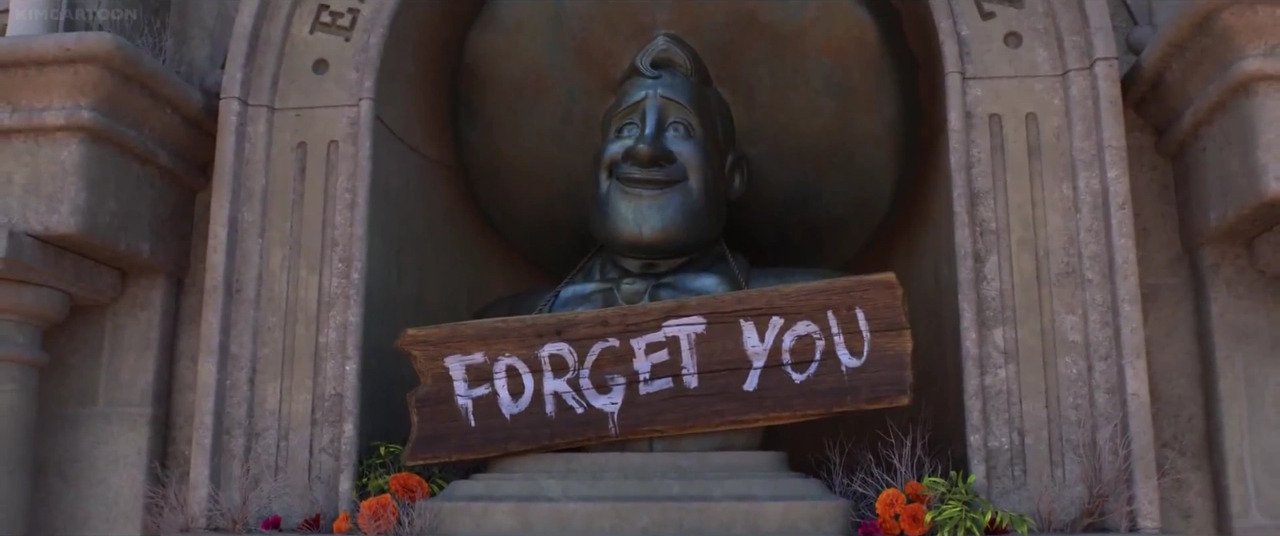
Let’s do a little thought experiment: Let’s imagine that you were Miguel from Disney’s Coco, and you discovered that your hero Ernesto Dela Cruz murdered your grandfather Hector, but (unlike in the movie), he actually DID write the songs he said he did. How would you feel about Hector? Would you hope and pray that Ernesto lied and your virtuous grandfather was the real author? Might you even concoct a conspiracy theory to rewrite Ernesto’s history and get Hector celebrated as the real author of “Remember Me?”
I’m not suggesting that Shakespeare is guilty of murder, or any other crime (apart from usury, hoarding grain, and a few minor tax violations). What I’m trying to do is to draw parallels between two men who are icons that are beloved by their hometowns, who created work that resonates with a lot of people.
We all have a tendency to take people we admire and put them on pedestals, (like the quote at the beginning mentions), and many people try to identify with their heroes. This is really easy with Shakespeare because most of the personal details of his life have vanished, so we can imbue him with our own sensibilities. Case in point- when Mya Angelou read Shakespeare’s sonnets as a little girl, she initially thought that he was a black girl. Likewise, Eugene O’Neill and other Irish and Irish American writers have thought he might be been Irish.
Some of the most outrageous anti-Stratfordians clearly have an axe to grind because they have a family connection (real or imagined) to the man they believe to be Shakespeare. In the 19th century, Delia Bacon wanted to prove that the real author of Shakespeare’s plays was the 17th-century poet, philosopher, and essayist, SIR FRANCIS BACON. Ms. Bacon hated Shakespeare because she thought he was an illiterate sheep-poaching commoner. She, therefore, used her theory to hoist Shakespeare off his literary pedestal, and therefore elevate herself because she believed she was descended from Sir Francis (though in reality, she wasn’t).
Rather than using any kind of historical evidence to prove her theory, Ms. Bacon claimed there was an elaborate code hidden in the iambic pentameter. Subsequent literary pseudo-scholars have attempted to hack the code and prove that they can prove that Sir Francis was the real author of the plays. In the late 1800s, American politician and author Ignatius Donnelly appropriated Ms. Bacon’s theory and claimed he had found the code, which rested on the pagination of the First Folio.
Donnelly had a knack for spreading conspiracy theories; as the title page of his book shows, he also authored a book where he claimed he correctly identified the location of the lost city of Atlantis. He also hated Shakespeare because Donnelly believed he was nothing more than a businessman, exploiting the talent of others, so like Bacon, he cooked up these ‘facts’ to suit his theory in order to take Shakespeare down.
Like many conspiracy theories, Anti-Stratfordians don’t have any factual basis for the ideas they hold, they are responding to an emotional need or desire. Donnelly and Bacon wanted fame, recognition, and revenge against a man they hated. J. Thomas Looney, who proposed that the Earl of Oxford wrote Shakespeare, wanted a ‘fairy prince’ that is, a semi-mythical Bard who would lead England into a golden age. All these people were dissatisfied with the man from Stratford, so they created a Shakespeare of their own, and tried to justify his existence.
Title page of the 1623 Folio, the first complete edition of Shakespeare’s plays.
To briefly sum up why the Bacon/ Donnelly theory is false, it hinges on the page numbers of the Folio, but Shakespeare didn’t print the first Folio. If you look at the title page, it was assembled by two actors from Shakespeare’s company- Henry Condell and John Hemmings, and it was printed by Isaac Jaggard, the same man who printed Shakespeare’s Sonnets in 1609. Writers had no say in how their work was printed and in fact Jaggard actually printed the sonnets without Shakespeare’s permission! The notion that Jaggard had any interest in properly printing a secret code in the pages of his posthumous book seems to me, incredibly unlikely at best.
I’ve adapted a lesson plan about conspiracy theories to include a discussion of the Shakespeare authorship question. I’ll also include a worksheet that you can use in your classroom to distribute among your students if you choose to use it as well. I think it’s a good way to foster critical thinking, scientific reasoning, and historical curiosity, and if it prevents more people from joining Q-Anon, so much the better!
This lesson plan makes use of the Conspiracy Theory Handbook, and it has great, easy to read activities about how to spot a conspiracy theory, how to talk to a conspiracy theorist, and how to avoid being taken in by a conspiracy.
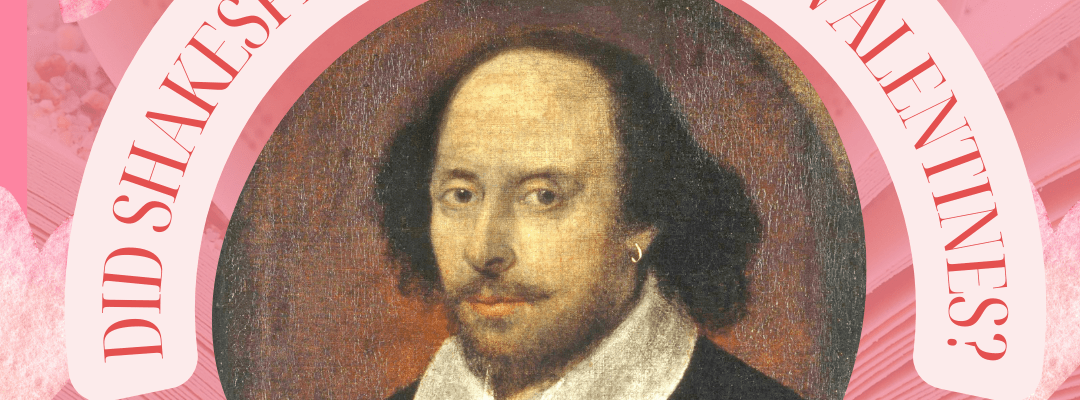
You probably know that I love to speculate and do a little historical detective work and find out whether Elizabethans like Shakespeare celebrated our modern holidays and then compare and contrast how they celebrated them back then versus how we do today. Valentine’s Day is a day we associate with love and poetry, so of course, I wondered if the most celebrated poet of the Renaissance celebrated it himself!
Based on my findings, if Shakespeare celebrated Valentine’s Day, he probably did mainly what we did- writing letters and poems to his beloved and maybe sending a trinket of love. It’s unlikely he celebrated it like modern Catholics do to honor the martyrdom of a Catholic saint. In my research, I was surprised to learn that Valentine’s Day has been celebrated for hundreds of years and has its roots in a holiday that Shakespeare describes in one of his most famous plays.
Part I: The Feast of Lupercal: Valentine’s Day’s Dark Ancestor
According to NPR’s podcast: “The Dark Origins of Valentine’s Day”, like Christmas, Halloween, and many other holidays, the Christian holiday of St. Valentine’s day was designed to replace the pagan holiday of Lupercal, which was a Roman fertility festival where men engaged in basically what we’d now call- swingers’ parties or key parties where they’d draw a woman’s name from a lottery and… couple for the night.
The Lupercal was also synonymous with the founding of Rome. Lupa is the name of the wolf that saved the infants Romulus and Remus, who would become the first kings of Rome. If you click here, you can read an article about a recent archeological discovery; a cave found under Rome that was once revered as the place where Romulus and Remus lived with Lupa:
Shakespeare actually starts his play of Julius Caesar on the Lupercal, and makes reference to its status as a fertility festival. In Act I, Caesar is watching Antony run a race and tells him to be sure to touch Calpurnia, owing to the superstition that if a man touches a barren woman on Lupercal, it will make her capable of bearing children:
Caesar. Calpurnia!
Calpurnia. Here, my lord. 85
Caesar. Stand you directly in Antonius' way,
When he doth run his course. Antonius!
Antony. Caesar, my lord?
Caesar. Forget not, in your speed, Antonius,
To touch Calpurnia; for our elders say, 90

The barren, touched in this holy chase,
Shake off their sterile curse.
Antony. I shall remember:
When Caesar says 'do this,' it is perform'd.
Caesar. Set on; and leave no ceremony out. Julius Caesar, Act I, Scene ii, Lines 84-95
Shakespeare leaves out that, according to tradition, Antony should be naked and anointed with goat’s blood and slap Calpurnia with a goatskin thong, but that was part of the Roman Lupercal festival.
St. Valentine was either a Catholic priest or bishop who was martyred in the 3rd century AD (Source History.com). According to tradition, he conducted Christian marriages in defiance of Roman law, and rejected the concept of Lupercalian coupling, which is why Emperor Claudius murdered him. Thus, the holiday is intentionally meant to replace Lupercalia, and celebrate monogamous relationships under the Christian God. The popular story is that before his death, he sent a letter to the young daughter of a family he converted to Christianity and signed it: “Your Valentine,” thus starting the tradition of signing cards in this manner. In the 5th century, Pope Gelasius made Valentine’s day an official Catholic feast day to replace Lupercal once and for all.
Part III: The oldest surviving Valentines
Evidence is sketchy on how the traditions of Valentine’s Day evolved, in the Middle Ages, but in Catholic Europe, the concept of celebrating married love on Valentine’s Day spread, and poets like Chaucer and Shakespeare helped popularize it.
Geoffrey Chaucer wrote in the 14th century of how birds would choose their mates on Valentine’s Day:
For this was sent on Seynt Valentyne's day
Whan every foul cometh ther to choose his mate.
According to History.com, there’s a possibility that Chaucer invented the idea of a St. Valentine’s feast, and forever linked it with the celebration of love:
The medieval English poet Geoffrey Chaucer often took liberties with history, placing his poetic characters into fictitious historical contexts that he represented as real. No record exists of romantic celebrations on Valentine’s Day prior to a poem Chaucer wrote around 1375. In his work “Parliament of Foules,” he links a tradition of courtly love with the celebration of St. Valentine’s feast day–an association that didn’t exist until after his poem received widespread attention. The poem refers to February 14 as the day birds (and humans) come together to find a mate.
This theme has been repeated in other pieces of literature. In John Lydgate’s 15th-century poem, “A Valentine to Her that Excelleth All”, he writes of how it was the custom on Valentine’s Day for people to choose their love:
To look and search Cupid’s Calendar and choose their choose by great affection.
John Ludgate: “”A Valentine to her that Excelleth All”
The Paston’s oldest surviving valentines
In the 1470s in a series of correspondence, from Margery Brews to her husband John Paston refers to the latter as “My right well-beloved Valentine, John Paston, Esquire.”
Margery also wrote adoring letters to John, who was probably away frequently, fighting in the Hundred Years War, and advising Margary’s kinsman, John Fastolfe, (whom Shakespeare mentions in Henry VI, Part I. Her poetry is very tender and must have comforted her husband much:
And if ye command me to keep me true wherever I go,
I wis I will de all my might you to love, and never no mo(re).
And if my friends say, that I do amiss,
They shall not me let so for to do,
Mine heart me bids ever more to love you
Truly over all earthly thing,
And if they be never so wrath
I trust it shall be better in time coming.
Margery’s letters are some of the earliest surviving Valentine’s poetry. Her letters prove that the tradition of giving poetry to one’s beloved during February was around in the 15th century, and probably while Shakespeare was a child in the 16th.
Shakespeare’s contributions to Valentine’s Day
Shakespeare mentions Saint Valentine’s Day twice in his works. In A Midsummer Night’s Dream, (a play that is set in Ancient Greece and has connections to Lupercal), he builds on Chaucer’s claim that Valentine’s Day is the day that birds couple for the night. Duke Theseus and Aegeus discover the four lovers asleep. They are surprised that they are sharing the same ground, since Lysander and Demetrius (as far as the old men know), are rivals for Hermia’s affection.
Good morrow, friends. Saint Valentine is past: Begin these wood-birds but to couple now?
— A Midsummer Night Dream, Act IV, Scene ii.
Egeus. My lord, this is my daughter here asleep; And this, Lysander; this Demetrius is; This Helena, old Nedar’s Helena:1685 I wonder of their being here together. Theseus. No doubt they rose up early to observe The rite of May, and hearing our intent, Came here in grace our solemnity. But speak, Egeus; is not this the day1690 That Hermia should give answer of her choice? Egeus. It is, my lord. Theseus. Go, bid the huntsmen wake them with their horns. [Horns and shout within. LYSANDER, DEMETRIUS,] HELENA, and HERMIA wake and start up]1695 Good morrow, friends. Saint Valentine is past: Begin these wood-birds but to couple now?
Shakespeare has a much darker reference to Valentine’s Day in Hamlet:
Ophelia has gone mad with the loss of her brother, her father, and Hamlet breaking her heart. She starts wandering the castle and can only communicate through songs. She sings a very melancholy song that alludes to the superstition that if two single people meet on the morning of Saint Valentine’s Day they will likely get married: Tomorrow is Saint Valentine’s Day, All in the morning betime, And I a maid at your window, To be your Valentine. Then up he rose And donned his clothes And dupped the chamber door Let in a maid then out a maid Never departed more.
Ophelia seems to be darkly admitting that she and Hamlet have had pre-marital intimate relations and she is no longer a virgin, The song implies that Ophelia entered Hamlet’s chamber a maid (that is, an unmarried virgin), but is let out a maid (unmarried), while the Hamlet very clearly has taken her virginity. Hamlet re-enforces this suspicion by commanding her to go to a nunnery, one of the only recourse for single mothers. It is reasonable to assume that Shakespeare is implying that Ophelia is in fact pregnant, and is driven mad with sorrow that she now has to deliver her baby without any form of support from her father (who is dead), from her brother (who is in France), or her baby’s father, who wants her to leave and never return. Ophelia’s song is a lament that she wishes the superstition were true, and Hamlet had indeed married her.
It’s unlikely that Shakespeare celebrated Valentine’s Day as a religious holiday, after all, Queen Elizabeth had made England a Protestant country. Celebrating a saint day could have been seen as idolatrous in Protestant England. Nevertheless, Shakespeare and other romantic writers helped transform Valentine’s Day into less of a religious holiday, and more as a secular celebration of love and monogamy, very different from its bloody, promiscuous roots.
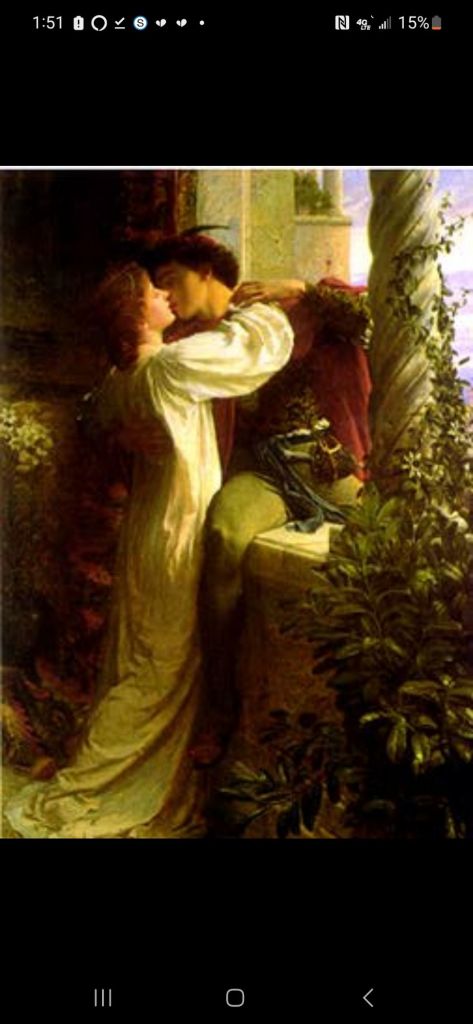
Costumes from thr 1968 Romeo and Juliet FilmOlivia Hussey as Juliet, 1968.“Romeo and Juliet” by Francis Dicksee, 1884.Juliet- Glibe Theater 2007
I’ve seen four live productions of Romeo and Juliet, (5 if you include West Side Story). I’ve also watched four films (6 if you include West Side Story and Gnomio and Juliet) and one thing that I’ve noticed again and again, and again is that you can tell the whole story of the play with clothing. This is a story about families who are part of opposite factions whose children secretly meet, marry, die, and fuse the families into one, and their clothes can show each step of that journey.
The feud Nearly every story about a conflict or war uses contrasting colors to show the different factions. Sometimes even real wars become famous for the clothes of the opposing armies. The Revolutionary War between the redcoats and the blue and gold Continentals, the American Civil War between the Rebel Grays and the Yankee Bluebellies. In almost every production I’ve ever seen, the feud in Romeo and Juliet is also demonstrated by the opposing factions wearing distinctive clothing.
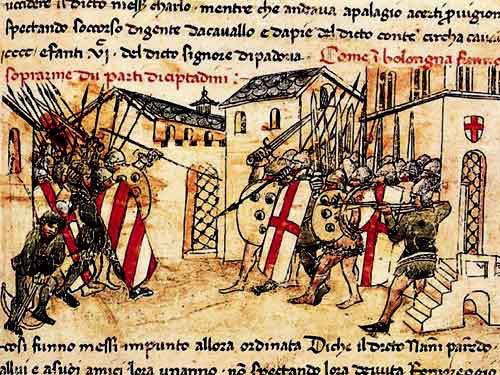
Historically, warring factions in Itally during the period the original Romeo and Juliet is set, wore distinctive clothes and banners as well. . In this medieval drawing, you can see Italians in the Ghibelline faction, who were loyal to the Holy Roman Empire, fighting the Guelph faction (red cross), who supported the Pope. Powerful families were constantly fighting and taking sides in the Guelf vs. ghibelines conflict in Verona, which might have inspired the Capulet Montegue feud in Romeo and Juliet.
Even the servants of the nobles got roped into these conflicts, and they literally wore their loyalties on their sleeves. The servants wore a kind of uniform or livery to show what household they belonged to. The servants Gregory and Sampson owe their jobs to Lord Capulet, and are willing to fight to protect his honor. Perhaps Shakespeare started the play with these servants to make this distinction very obvious. Here’s a short overview on Italian Liveries from the Metropolitan Museum of Art:
In 1966, director Franco Zepherelli set a trend with his iconic use of color in his movie. He chose to make the Capulets wear warm tones while the Montegues wore blue and silver. Juliet (Olivia Hussey) wore a gorgeous red dress that made her look youthful, passionate, and lovely, while Tybalt (Michael York), wore red, orange, and black to emphasize his anger, and jealousy (which has been associated for centuries with the color orange). By contrast, the Montagues like Romeo (Leonard Whiting) wore blue, making him look peaceful and cool. These color choices not only clearly indicate who belongs to which contrasting factions, but also help telegraph the character’s personalities. Look at the way these costumes make the two lovers stand out even when they’re surrounded by people at the Capulet ball:
Dance scene from the iconic 1968 film of Romeo and Juliet, directed by Franco Zeffirelli.Poster for “Gnomio and Juliet, 2011
Zepherilli’s color choices were most blatantly exploited in the kids film Gnomio and Juliet, where they did away with the names Capulet and Montegue altogether, and just called the two groups of gnomes the Reds and the Blues.
The Dance
To get Romeo and Juliet to meet and fall in love, Shakespeare gives them a dance scene for them to meet and fall in love. He further makes it clear that when they first meet, Romeo is in disguise. The original source Shakespeare used made the dance a carnival ball, (which even today is celebrated in Italy with masks). Most productions today have Romeo wearing a mask or some other costume so that he is not easily recognizable as a Montague. Masks are a big part of Italian culture, especially in Venice during Carnival:
In the 1996 movie, Baz Luhrman creates a bacchanal costume party, where nobody wears masks but the costumes help telegraph important character points. Mercutio is dressed in drag, which not only displays his vibrant personality but also conveniently distracts everyone from the fact that Romeo is at the Capulet party with no mask on.
Capulet is dressed like a Roman emperor, which emphasizes his role as the patriarch of the Capulet family. Juliet (Claire Danes) is dressed as an angel, to emphasize the celestial imagery Shakespeare uses to describe her. Finally, Romeo (Leonardo DiCaprio) is dressed as a crusader knight because of the dialogue in the play when he first meets Juliet:
Romeo. [To JULIET] If I profane with my unworthiest hand
This holy shrine, the gentle fine is this:720
My lips, two blushing pilgrims, ready stand
To smooth that rough touch with a tender kiss.
Juliet. Good pilgrim, you do wrong your hand too much,
Which mannerly devotion shows in this;
For saints have hands that pilgrims' hands do touch,725
And palm to palm is holy palmers' kiss.
Romeo. Have not saints lips, and holy palmers too?
Juliet. Ay, pilgrim, lips that they must use in prayer.
Romeo. O, then, dear saint, let lips do what hands do;
They pray, grant thou, lest faith turn to despair.730
Juliet. Saints do not move, though grant for prayers' sake.
Romeo. Then move not, while my prayer's effect I take.
Thus from my lips, by yours, my sin is purged.
Juliet. Then have my lips the sin that they have took.
Romeo. Sin from thy lips? O trespass sweetly urged!735
Give me my sin again.
Juliet. You kiss by the book. Romeo and Juliet, Act I, Scene V, Lines 719-737.
Notice that Romeo calls Juliet a saint, and later an angel in the famous balcony scene, which explains her costume at the ball. Juliet refers to Romoe as a Pilgrim, which is a cheeky comment on his crusader knight costume. In the Crusades, crusader knights made pilgrimages to the holy land, with the hope that God (and presumably, his angels) would forgive their sins. Romeo’s name even means “Pilgrim.” Luhrman makes clever nods to Shakespeare’s text by dressing Romeo and Juliet in this way, and gives the dialogue a bit of a playful roleplay as the characters make jokes about each other’s costumes- Romeo hopes that he will go on a pilgrimage and that this angel will take his sin with a kiss.
In Gnomio and Juliet, the titular characters meet in a different kind of disguise. Rather than going to a dance with their family, they are both simultaneously trying to sneak into a garden and steal a flower, so they are both wearing black, ninja-inspired outfits. Their black clothing helps them meet and interact without fear of retribution from their parents (since they do not yet know that they are supposed to be enemies. The ninja clothes also establishes that for these two gnomes, love of adventure unites them. Alas though, it doesn’t last; Juliet finds out that Gnomio is a Blue, when they both accidentally fall in a pool, stripping their warpaint off and revealing who they are.
Trailer for “West Side Story,” (2021) directed by Steven Spielberg.
Sometimes the dance shows a fundamental difference between the lovers and the feuding factions. West Side Story is a 20th-century musical that re-imagines the feuding families as juvenile street gangs, who like their Veronese counterparts, wear contrasting colors. The Jets (who represent the Montagues) wear Blue and yellow, while the Sharks (Capulets), wear red and black. The gang members continue wearing these colors on the night of the high school dance, except for Tony and Maria (the Romeo and Juliet analogs). In most productions I’ve seen, (including the 2021 movie), these young lovers wear white throughout the majority of the play, to emphasize the purity of their feelings, and their rejection of violence. Thus, unlike Shakespeare’s version of the story, West Side Story makes the lovers unquestionably purer are more peaceful than Shakespeare’s Romeo and Juliet, and their clothing makes this clear.
Romeo (John Warren), meets Juliet (Alesia Lawson) in the 2010 Ashland University production of “Romeo and Juliet,” directed by Ric Goodwin.
The Merging of the family (8:30-11:00)
Costume Designer Charlene in the 2006 AU production deliberately had the characters change clothes when they get married. Juliet was wearing the same iconic red dress as Olivia Hussey for the first two acts of the play but then changed into a pale blue gown that matches Romeo. The clothes re-enforce the idea that the marriage represents Romeo and Juliet abandoning their family’s conflicts, and simply showing their true colors.
Two sets of costumes for Juliet in the 2006 Ashland University Production. Pull the slider bar left to see how Juliet’s costume changes from the start of the show to the end.
Another way of getting everyone in the family to subconsciously unite in grief would be to costume everyone wearing black except Romeo and Juliet. At the end of the play, The Capulets are already mourning Juliet, (because she faked her death in Act IV), and the Montegues are already mourning Lady Montegue (who died offstage). Just by these circumstances, everyone could come onstage wearing black, uniting in their grief, which is further solidified when they see their children dead onstage.
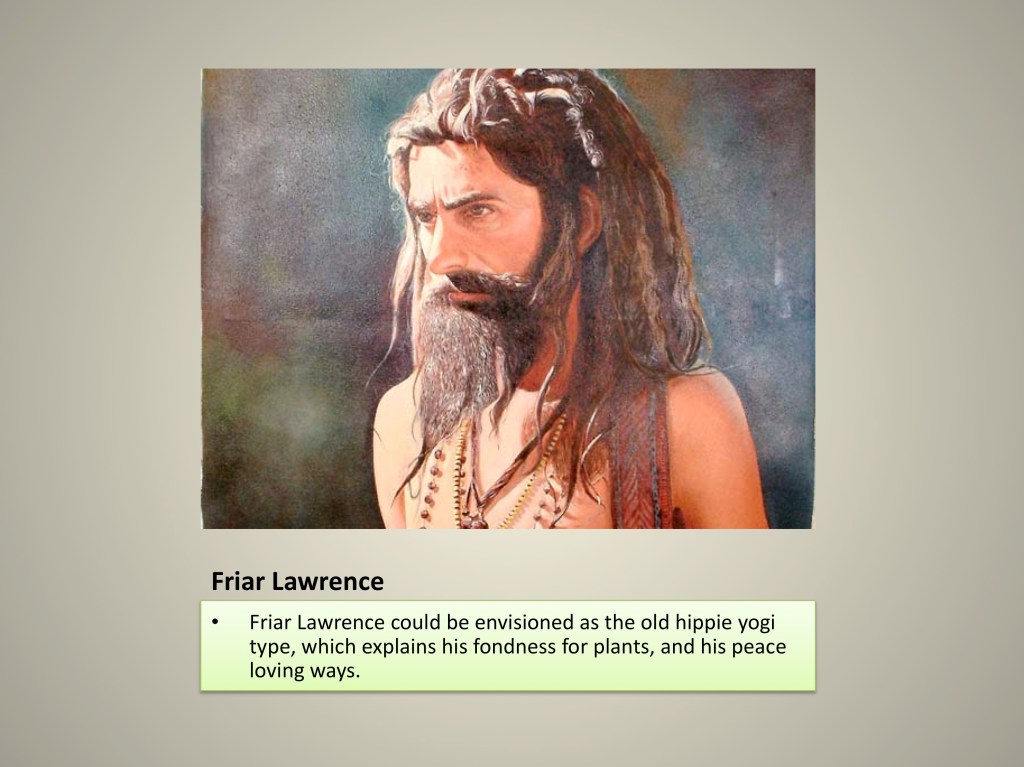
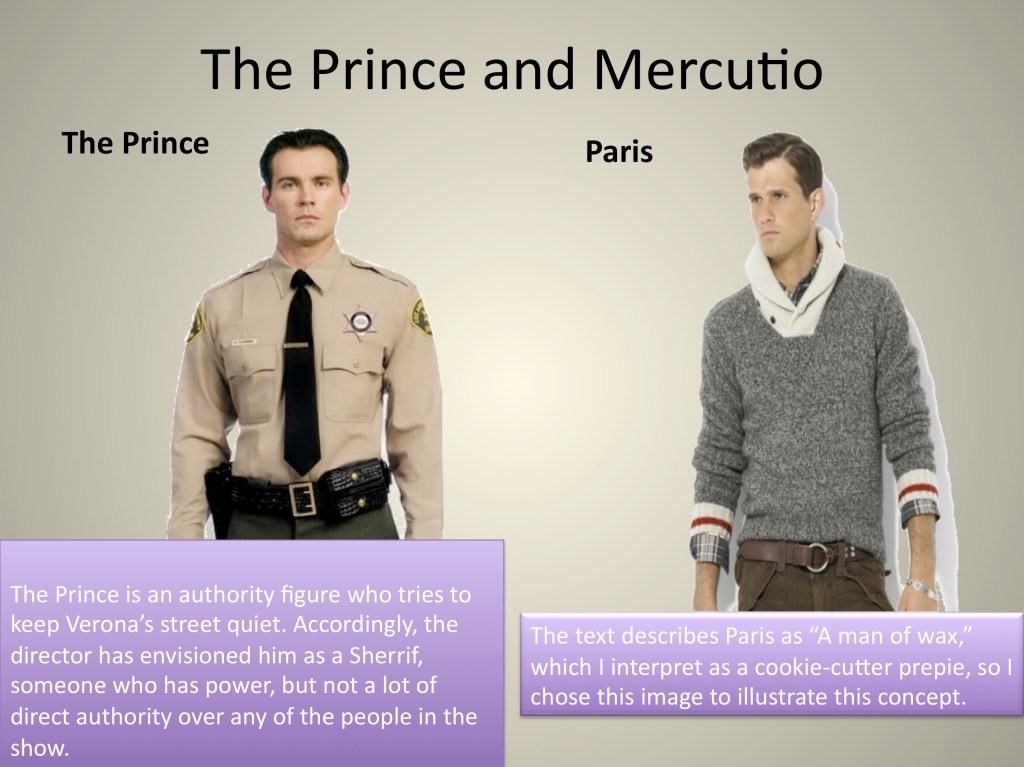
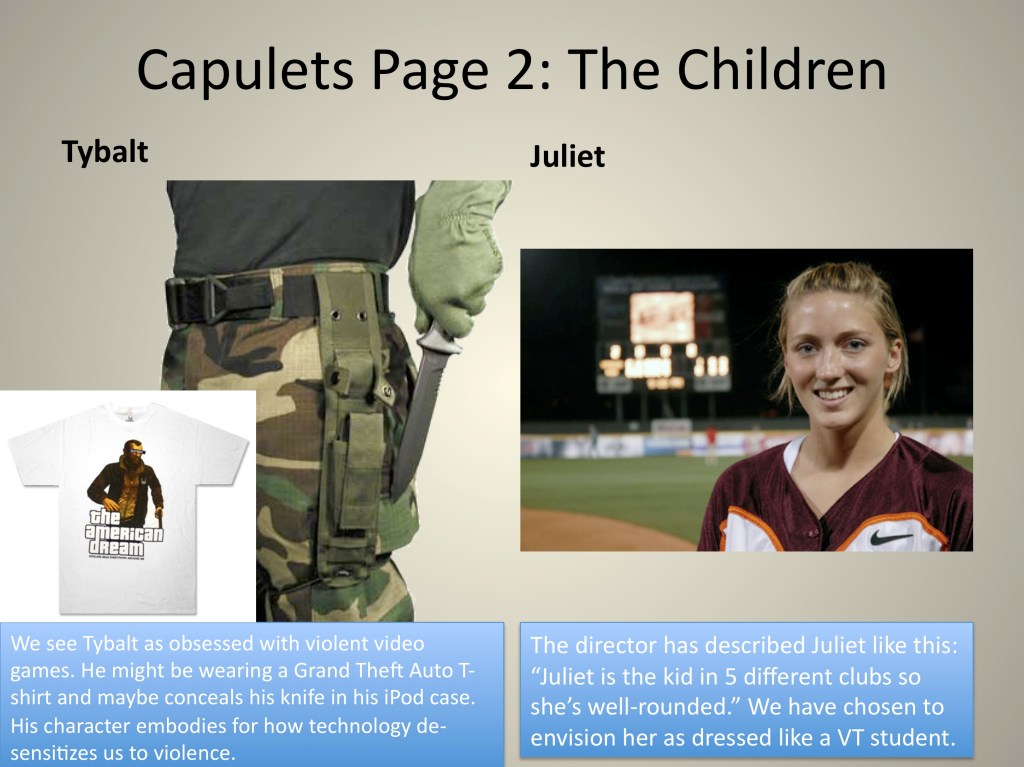
Not all productions choose to costume the characters like warring factions, but nevertheless, any theatrical production’s costumes must telegraph something about the characters. In these production slides for a production I worked on in 2012, the costumes reflect the distinct personality of each character and show a class difference between the Montagues and the Capulets.
The 2013 Film: Costumes Done Badly
The 2013 movie is more concerned with showing off the beauty of the actor’s faces, and the literal jewels than the clothes:
Most of the actors and costumes are literally in the dark for most of the film, probably because the film was financed by the Swarofski Crystal company, who literally wanted the film to sparkle. Ultimately, like most jewelry, I thought the film was pretty to look at, but the costumes and cinematography had little utilitarian value. The costumes and visual didn’t tell the story efficiently, but mainly was designed to distract the audience with the beauty of the sets, costumes and the attractive young actors. The only thing I liked was a subtle choice to make Juliet’s mask reminiscent of Medusa, the monster in Greek Myth, who could turn people to stone with a look. I liked that the film was subtly implying that love, at first sight, can be lethal.






























 The Shakespearean Student