Close Reading: Friends, Romans, Countrymen

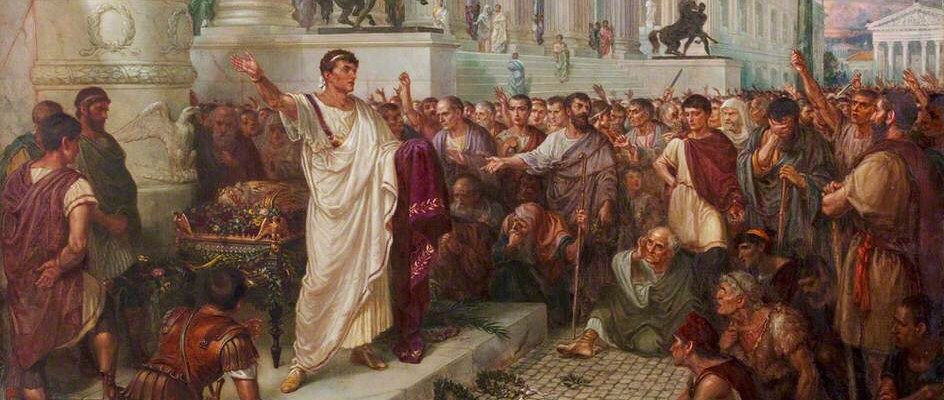
Today I’m going to do an analysis of one of the most famous speeches in all of Shakespeare: Antony’s Funeral Speech in Act III, Scene ii of Julius Caesar, commonly known as the “Friends, Romans, Countrymen” speech.

I. Given Circumstances

Antony is already in a very precarious position. His best friend Julius Caesar was murdered by the senators of Rome. Antony wants vengeance, but he can’t do so by himself. He’s also surrounded by a mob, and Brutus just got them on his side with a very convincing speech. They already hate Antony and Caesar. His goal- win them back. Here is a clip of Brutus (James Mason) speaking to the crowd from the Joseph Mankewitz movie version of Julius Caesar:

So the stakes are very high for Antony: If he succeeds, the crowd will avenge Caesar, and Antony will take control of Rome. If he fails, he will be lynched by an angry mob.

II. Textual Clues

If you notice in the text of the speech below, Antony never overtly says: “Brutus was a liar and a traitor, and Caesar must be avenged,” but that is exactly what he gets the crowd to do. So how does he get them to do so, right after Brutus got them on his side?

Antony. You gentle Romans,— 1615

Citizens. Peace, ho! let us hear him.

Antony. Friends, Romans, countrymen, lend me your ears;

I come to bury Caesar, not to praise him.

The evil that men do lives after them;

The good is oft interred with their bones; 1620

So let it be with Caesar. The noble Brutus

Hath told you Caesar was ambitious:

If it were so, it was a grievous fault,

And grievously hath Caesar answer’d it.

Here, under leave of Brutus and the rest— 1625

For Brutus is an honourable man;

So are they all, all honourable men—

Come I to speak in Caesar’s funeral.

He was my friend, faithful and just to me:

But Brutus says he was ambitious; 1630

And Brutus is an honourable man.

He hath brought many captives home to Rome

Whose ransoms did the general coffers fill:

Did this in Caesar seem ambitious?

When that the poor have cried, Caesar hath wept: 1635

Ambition should be made of sterner stuff:

Yet Brutus says he was ambitious;

And Brutus is an honourable man.

You all did see that on the Lupercal

I thrice presented him a kingly crown, 1640

Which he did thrice refuse: was this ambition?

Yet Brutus says he was ambitious;

And, sure, he is an honourable man.

I speak not to disprove what Brutus spoke,

But here I am to speak what I do know. 1645

You all did love him once, not without cause:

What cause withholds you then, to mourn for him?

O judgment! thou art fled to brutish beasts,

And men have lost their reason. Bear with me;

My heart is in the coffin there with Caesar, 1650

And I must pause till it come back to me.

First Citizen. Methinks there is much reason in his sayings. Julius Caesar Act III, Scene ii.

The two main methods Shakespeare uses to infuse Antony’s speech with powerful persuasive energy are the way he writes the verse, and his command of rhetoric.

A. Verse

The greatest gift Shakespeare ever gave his actors was to write his plays in blank verse. It not only tells you which words are important to stress, it gives you clues about the character’s emotional journey; just as a person’s heartbeat can indicate their changes in mood, a subtle change in verse often betrays the character’s pulse and state of mind. Antony uses his own emotions and his powers of persuasion to manipulate the crowd, so his verse helps show how he changes the pulse of the Roman mob.

I could write a whole post on the verse in this page, which I don’t need to do, since The Shakespeare Resource Center did it for me: http://www.bardweb.net/content/readings/caesar/lines.html What I will do is draw attention to some major changes in the verse and put my own interpretations on how Antony is using the verse to persuade the crowd:

  1. The first line of the speech grabs your attention. It is not a standard iambic pentameter line, which makes it rhythmically more interesting. In the movie version, Marlin Brando as Antony shouts each word to demand the crowd to just lend him their attention for a little while. He uses the verse to emphasize Antony’s frustration.
  2. “The Evil that men do, lives after them”- Notice that the words evil and men are in the stressed position. Antony might be making a subconscious attempt to say Brutus and the other evil men who took the life of Caesar are living, when they deserve to die.
  3. If it were so..” Again, Antony might be making a subtle jab at the conspirators. Brutus said Caesar was ambitious and Antony agrees that ambition is worthy of death, but he also adds an If, to plant the seeds of doubt in the crowd’s minds. To drive it home, the word if is in the stressed position, making it impossible for the crowd to not consider the possibility that Caesar wasn’t ambitious, and thus, didn’t deserve to be murdered.

B. Rhetoric

One reason why this speech is so famous is its clever use of rhetoric, the art of persuasive speaking. Back in ancient Rome, aristocrats like Antony were groomed since birth in the art of persuasive speech. Shakespeare himself studied rhetoric at school, so he knew how to write powerful persuasive speeches. Here’s a basic breakdown of the tactics Antony and Shakespeare use in the speech:

Ethos, Pathos, and Logos

The three basic ingredients of any persuasive speech are Ethos, Pathos, and Logos. Ethos is an appeal to the audience based on the speaker’s authority. Pathos is an appeal to the emotions of the crowd, and Logos is an appeal to facts and or reason. Both Brutus and Antony employ these three rhetorical tactics, but Antony doesn’t just appeal to his audience, he manipulates them to commit mutiny and mob rule.

Logos Antony has very few facts or logical information in his speech. His major argument is that again, since Caesar wasn’t ambitious, (which is very hard to prove), his death was a crime. Antony cites as proof the time Cæsar refused a crown at the Lupercal, but since that was a public performance, it’s hardly a reliable indication of Caesar’s true feelings.

You see logos as a rhetorical technique all the time whenever you watch a commercial citing leading medical studies, or a political debate where one person uses facts to justify his or her position. If you look at Hillary Clinton during the 2016 Presidental Debate, she frequently cited statistics to back up her political positions

Ethos-

Ethos is an argument based on the speaker’s authority. Brutus’ main tactic in his speech is to establish himself as Caesar’s friend and Rome’s. He says that he didn’t kill Caesar out of malice, but because he cared more about the people of Rome.

BRUTUS: If there be any in this assembly, any dear friend of Caesar’s, to him I say, that Brutus’ love to Caesar was no less than his. If then that friend demand why Brutus rose against Caesar, this is my answer:

–Not that I loved Caesar less, but that I loved Rome more. JC, III.ii.

Antony employs the exact same tactics, establishing himself as Caesar’s friend and telling the crowd that, as Caesar’s friend, Antony believes that Caesar did not deserve his murder. His use of Ethos therefore, helps Antony refute Brutus’ main claim.

Again, the 2016 debate is another excellent way of showing ethos in action. Hillary Clinton and Brutus frequently cited their political experience and their strength of character to justify their views. There’s an excellent article that examines Hillary’s use of Ethos in her political rhetoric: https://eidolon.pub/hillary-clintons-rhetorical-persona-9af06a3c4b03

Pathos

Pathos is the most frequently used rhetorical tactic: the appeal to emotion. Donald Trump uses this constantly, as you can see in this clip from the 2016 debate:

https://youtu.be/wMuyBOeSQVs

Pathos is bit more of a dirty trick than Ethos and Logos, which is why Brutus doesn’t use it much. As scholar Andy Gurr writes:

Brutus is a stern philosopher and thinker. His faith in reason fails to secure the crowd from Antony’s disingenuous appeal to their affections, which uses sharp sarcasm and some twisted facts.

Antony’s major appeals to emotion:

  • His grief over losing Caesar
  • His painting of Cæsar as a generous, faithful friend
  • Shaming the crowd for not mourning Caesar’s death
  • Appeal to piety by showing the body funeral reverence.
  • His use of Caesar’s bloody body and mantle to provoke outrage from the citizens.
  • His use of Caesar’s will to make the crowd grateful to Caesar, and furious at Brutus.

Rhetorical Devices

If Ethos, Pathos, and Logos are the strategies of rhetorical arguments, rhetorical devices are the artillery. If you check out the website Silva Rhetoricae, (The Forest Of Rhetoric), you can read about the hundreds of individual rhetorical devices that politicians have used in speeches and debates since ancient history. I will summarize here the main ones Antony uses over and over again in “Friends, Romans, Countrymen.” For another more compete analysis, click here: https://eavice.wordpress.com/2011/02/05/jv-rhetorical-devices-in-antonys-funerary-speech-from-shakespeares-julius-caesar/

  • Irony The way Antony keeps repeating “Brutus is an honorable man,” is a particularly sinister form of irony, which here means to imply the opposite of what you have said to mock or discredit your opponent. The irony is that the more Antony repeats this idea that Brutus is honorable, the more the crowd will question it. If Brutus were truly honorable, he would not need Antony to remind them. Of course, Brutus can still be honorable whether Anthony mentions it or not, but this repetition, coupled with Antony’s subtle rebuttals Of Brutus’ arguments, manages to shatter both Brutus’ motives, and his good name, at least in the eyes of his countrymen.
  • Antimetabole is the clever use of the same word in two different ways. Antony manages to work it in twice in this speech:
  • “If it were so, it was a grievous fault,
  • And grievously hath Caesar answer’d it.”
  • “You all did love him once, not without cause: What cause withholds you then, to mourn for him?”
  • Rhetorical question This is the most famous rhetorical device which by the way in Antony’s day would have been known as Erotema. Antony asks a series of questions designed to refute the notion that Caesar was ambitious, from his mercy to his captives, to Caesar’s tenderness to the poor, and of course his refusal to take the crown during the Lupercal. Each question calls Brutus’ claims into question and seeds doubt in the crowd.

Performance Notes with link to Globe performance

https://youtu.be/1RL8Wg-b8k

Unlike most Shakespearean plays, with Julius Caesar, we have an eyewitness account of how the play was originally performed. Swiss student Thomas Platter wrote a long description of watching the play at the original Globe Theatre in 1599. This is a translation that I found on The Shakespeare Blog:

On September 21st after lunch, about two o’clock, I and my party crossed the water, and there in the house with the thatched roof witnessed an excellent performance of the tragedy of the first Emperor Julius Caesar, with a cast of some fifteen people; when the play was over they danced very marvellously and gracefully together as is their wont, two dressed as men and two as women…

Thus daily at two in the afternoon, London has sometimes three plays running in different places, competing with each other, and those which play best obtain most spectators.

The playhouses are so constructed that they play on a raised platform, so that everyone has a good view. There are different galleries and places, however, where the seating is better and more comfortable and therefore more expensive. For whoever cares to stand below only pays one English penny, but if he wishes to sit he enters by another door, and pays another penny, while if he desires to sit in the most comfortable seats which are cushioned, where he not only sees everything well, but can also be seen, then he pays yet another English penny at another door. And during the performance food and drink are carried round the audience, so that for what one cares to pay one may also have refreshment.

The actors are most expensively costumed for it is the English usage for eminent Lords or Knights at their decease to bequeath and leave almost the best of their clothes to their serving men, which it is unseemly for the latter to wear, so that they offer them for sale for a small sum of money to the actors.

Thomas Platter, 1599, reprinted from: http://theshakespeareblog.com/2012/09/thomas-platters-visit-to-shakespeares-theatre/

So the conclusions we can draw based on Platter’s account include that Antony was standing on a mostly bare stage with a thatched roof, raised slightly off the ground. We can also guess that, since the merchants were selling beer, fruits, and ale, that the audience might have been drunk or throwing things at the actors.

As Platter notes, and this page from Shakespeare’s First Folio confirms, there were only 15 actors in the original cast, so Shakespeare’s company didn’t have a huge cast to play the gigantic crowd in the Roman street. In all probability, the audience is the mob, and Antony is talking right to them when he calls them “Friends, Romans, Countrymen.” I believe that the audience was probably encouraged to shout, chant, boo, cheer, and become a part of the performance which is important to emphasize when talking about how to portray this scene onstage. A director can choose whether or not to make the audience part of the action in a production of Julius Caesar, which can allow the audience to get a visceral understanding of the persuasive power of politicians like Brutus and Antony. Alternatively, the director can choose instead to have actors play the crowd, and allow the audience to scrutinize the crowd as well as the politicians.

In conclusion, the reason this speech is famous is Shakespeare did an excellent job of encapsulating the power of persuassive speech that the real Antony must have had, as he in no small way used that power to spur the Roman crowd to mutiny and vengeance, and began to turn his country from a dying republic into a mighty empire.

If you liked this post, please consider signing up for my online class where I cover the rhetorical devices in Julius Caesar and compare them with several other famous speeches. Register now at http://www.outschool.com

For a fascinating look at how a modern cast of actors helps to create this scene, check out this documentary: Unlocking the Scene from the Royal Shakespeare Company’s production in 2012, with Patterson Joseph as Brutus, and Ray Fearon as Antony:

◦ Interview with Patterson Joseph and Ray Fearon RSC: https://youtu.be/v5UTRSzuajo

And here is a clip of the final scene as it was performed at the Royal Shakespeare Company:

References

1. Annotated Julius Caesar: https://sites.google.com/site/annotatedjuliuscaesar/act-3/3-2-57-109

2. Folger Shakespeare Library: Julius Caesar Lesson Plan: https://teachingshakespeareblog.folger.edu/2014/04/29/friends-romans-teachers-send-me-your-speeches/

3. Silva Rhetoric http://rhetoric.byu.edu/

3. Rhetoric in Marc Antony Speech

https://www.google.com/amp/s/eavice.wordpress.com/2011/02/05/jv-rhetorical-devices-in-antonys-funerary-speech-from-shakespeares-julius-caesar/amp/

4. Shakespeare Resource Center: http://www.bardweb.net/content/readings/caesar/lines.html

How To Write Romantic Poetry Like Shakespeare 

Since this is national poetry month, I thought I’d talk a little bit about Shakespeare’s poetry.  Shakespeare wrote 154 short love poems called sonnets. What follows is kind of a do-it-yourself poetry manual that would be great if you want to write a poem for a spouse or a loved one for Valentine’s Day, Christmas, Mother’s Day or any other time, to show that you care. Sonnet writing has been a time honored tradition for showing the people we care about just how much they mean to us.
If you’ve never written a sonnet , don’t worry, the kind of sonnet Shakespeare wrote is pretty easy to write, and it follows just a few simple rules. I don’t want to lie; it takes a lot of patience and thought to craft a sonnet, but the rules are easy to follow. So let’s get to it!


analyzing-sonnet-011.jpgWhat Is A Sonnet? A sonnet is a short poem that’s only 14 lines long, written in what is called Iambic Pentameter, Shakespeare’s preferred form of poetry. I’ve written before about Iambic Pentameter, but just to be clear it’s a 10 syllable line that goes da-Dum- daDum-da-Dum-daDum-daDum. So all you need is 14 lines that follow a particular rhyme scheme. You’ll notice that in the sonnet above, every other line rhymes except the end. This is called an ABAB rhyme pattern, and it is the trickiest thing about writing a sonnet. One reason Shakespeare has this rhyme pattern is to draw your attention to the last two lines, then draw the sonnet to a close with the simpler rhyme of the couplet.
Sonnet Form A sonnet’s 14 lines are arranged into three short groups or quatrains which are four lines long. Usually around line 9, there is a kind of “turn” or change in the direction of the argument, like at line 9 in Sonnet 8 above, where Shakespeare stops talking about summer, and starts talking about the person to whom he’s writing. If it helps, you can think of this as the “But…” part of the sonnet, because it’s the part where he changes the argument using the word “but,” (and what a but it is). The sonnet then concludes with two rhymed lines of Iambic called a rhymed couplet. These last two lines are a way of wrapping up the main idea of the poem in a short, catchy way.

Step by step Tips and Tricks:

  1. Start by planning out your sonnet.

It’s often useful to consider your sonnet like a speech or a short argument. The three quatrains give you a chance to come up with an idea, then develop the idea, and then come to a conclusion, much like any other form of persuasive writing that you might’ve had to do for English class. For example, Sonnet 8 pictured above, (one of Shakespeare’s most famous sonnets), begins with the question: “Shall I compare the to a summers day?” He then goes to flatter the person he’s writing about by talking about how much better they are than a summers day, saying that actual summers are too windy and too hot, and the flowers of the summer are all too brief. By contrast, Shakespeare argues that the  subject of the sonnet has beauty that will last forever, particularly if that person goes on to have children. This is the form that Shakespeare sonnets often take and I would advise you to try and make your sonnet into a clear argument.

Example Of Sonnet Writing:  Since Mother’s Day is coming up, if you wanted to write about the mother of your child, and thank her for her for being there for your child, you might want to structure your sonnet by using the three stanzas to express three simple ideas like:

1. Thank you for being the mother of our child(ren) 

2. A specific time she did something awesome for your child (give examples!)

3. Thank you from you, me, and our child(ren).

Tip 2: Plan Out The Rhyming Couplet: As I mentioned before, the last two lines of every sonnet are called a rhyming couplet; two lines of iambic pentameter that rhyme together and help conclude the sonnet. Just like a English paper, a good conclusion is very important, which is why it’s it’s often useful to work on this these two lines first before you get into writing the meat of your sonnet. For example, here’s a couplet I wrote about preparing breakfast in bed and doing chores for one’s wife on Mother’s Day.

All chores this day will I do in thy stead

Commence I shall with breakfast in thy bed!

Tip 3: Writing Poetry  Now that you have the ideas you want to express now comes the hard part: putting them into poetry. I often find it helps to just get a piece of paper, write as much as possible to express the three ideas in your sonnet in prose, then get down to translating your ideas into iambic pentameter.

Quick Tips to help you along:

  1. Make sure the important words are on the right beats. Remember, in a normal Iambic line, every other beat (2, 4, 6, 8, and 10) are emphasized. This means the important words/ sylables need to be on those beats. You might have to invert the order of a word or two to keep those beats clear. like I did in my couplet when I wrote “will I do” instead of “I will do”
  2. You don’t have to use iambic in every line. Shakespeare was never a slave to a particular verse form, and a whole poem in iambic pentameter can sound a little dull sometimes. This is why, if you really want to, you can change a line or two to emphasize different beats
    • Trochees A clever way to wake up your audience is to start off with a few regular iambic pentameter lines, and then change it to a line where the first beat is the one that’s important. Like a dance or song that suddenly changes tempo, this creates a sense of excitement in the reader.
    • Spondees Sometimes you can emphasize two syllables at the same time, as Shakespeare does in lines 1 and 3 of Sonnet 8. You wouldn’t pronounce “Shall I” as “SHALL I or shall I,” and the phrase “rough winds” demands that both words are important, so Shakespeare is clearly changing the verse a little just to make the poetry more interesting.
    • For More information on other types of Meter, read Sam Rame’s Literary Analysis Blog: http://samrames.blogspot.com/2013/03/william-shakespeares-sonnet-60-like-as.html

Tip 4: Use Literary Devices: I find Shakespeare very often tried to express an idea by using metaphor and allusion to create images in the listeners mind. Sonnet 8 which we’ve been discussing, is structured around creating a contrast between the speaker and a pretty day in summer. You can do this kind of flattering comparison yourself, but, as we’ve seen, it’s often useful to put a “but” in the argument around line 9, to make it clear that you love the person more than for example a warm summer day. Imagine getting a sonnet that claims that someone loves you more than ice cream!

Sometimes Shakespeare uses contradictory images in his poetry for dramatic effect. Romeo often and talks about “Oh brawling love, O loving hate”. He uses this to express the wildness of his passion. This is called antithesis, and it’s very useful when you want to add a little spice to your poetry. Try comparing your beloved to both ice and fire!
Alliteration and assonance: Remember, Shakespeare wrote for the theater not for people reading in the book this is why he often plays with words that sound a particular way and worked very hard to come up with sounds that would grab a listeners attention rather than readers. When a word when several words start the same letter it creates a sense of order and gets the readers attention. Assonance is when consonants are repeated within the middle of a line.

Useful Websites when you’re working

  • Rhymezone.com– a convenient online rhyming dictionary
  • Thesaurus.com– useful if you need another word that fits into iambic better.
  • Kotsheet.com- a website for teachers with lots of useful worksheets to help you organize your sonnet. Useful for writing or teaching sonnets!

I hope this post was helpful. If you have any questions, please comment, or email me in the “Ask the Shakespeare Guru” page. If you write any sonnets yourself and wish to share them on this site, let me know and I’ll gladly re-post them!

Till Next Time,

-The Shakespearean Student.

References

  1. The Sonnets Edited by Rex Gibson. Cambridge University Press, 1997.
  2. Shakespeare’s Wordcraft  by Scott Kaiser. Limelight Editions, 2007. Free preview here: https://books.google.com/books/about/Shakespeare_s_Wordcraft.html?id=IdVuj0IY2ekC&printsec=frontcover&source=kp_read_button&hl=en#v=onepage&q&f=false 
  3. Literary Devices.net: https://literarydevices.net/
  4. Cummings Study Guide: https://cummingsstudyguides.net/xSonnets.html

Some thoughts on the Innauguation, or “Whom Would Shakespeare vote for?”

Well, it happened. A man whom I have described as a villain of Shakespearean proportions is now the president. You might have read in my Richard III post that I had hoped that the election would play out like the history play about a deformed tyrannical king with bad hair. What I forgot when I made that prediction was that the king in question, Richard III, does become king for a little while.

Here’s another way of putting it. I found it on the Facebook page of a friend of mine, Austin Tichnor of The Reduced Shakespeare Company:

https://www.youtube.com/watch?v=BChFmHTIH2A&sns=em

I don’t want to talk too much about devisive politics because I feel that the country and the world is hurting too much because of people who want to reduce the world into “my party,” “my country,” and turn everything and everyone else into “the other.”

What I want to talk about in this post, is what I hope for our new president, some words of wisdom from The Bard, and maybe some words of healing for those people who feel like “the other,” starting with some of the people I might have offended with my earlier posts.

Why Donald Trump is like Henry V, (we hope).

A lot of people are full of anxiety right now because nobody is really sure what kind of president Trump will be; will he follow through with his campaign promises? Will he take power from those in Washington and give it to the people, as he said in his inaugural address? How much will his past life as a real-estate tycoon influence his work as president? This uncertain climate reminds me very much of the end of Shakespeare’s Henry IV, Part II, where the old king dies leaving the kingdom to his son. Thus far, the prince, (known as Hal to his friends), has been wasting his time drinking in a bar in Eastcheap with his disreputable friend, Sir John Falstaff. Watch this scene where he and Falstaff mock the king and trade insults with each other:

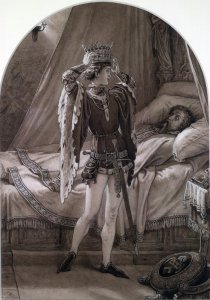
But, on his deathbed the real king summons his son and knocks some sense into him, demanding that he take the job of running the country seriously. In Act IV, Scene v, the prince, (thinking his father is dead) tries on his father’s crown right before King Henry wakes up and curses his son with a long and terrible speech.   Below is King Henry’s deep rebuke of his son Hal, detailing his fears of what will happen  when the prince becomes king.

henry-iv-part-ii-act-iv-scene-v-prince-hal-tries-on-his-fathers-crown
Prince Hal tries on his father’s crown. Henry IV, Part II. Act IV, Scene v.

KING HENRY:

What! canst thou not forbear me half an hour?
Then get thee gone and dig my grave thyself,
And bid the merry bells ring to thine ear
That thou art crowned, not that I am dead.
Pluck down my officers, break my decrees;
For now a time is come to mock at form:
Harry the Fifth is crown’d: up, vanity!
Down, royal state! all you sage counsellors, hence!
And to the English court assemble now,
From every region, apes of idleness!
Now, neighbour confines, purge you of your scum:
Have you a ruffian that will swear, drink, dance,
Revel the night, rob, murder, and commit
The oldest sins the newest kind of ways?
Be happy, he will trouble you no more;
England shall double gild his treble guilt,
England shall give him office, honour, might;
For the fifth Harry from curb’d licence plucks
The muzzle of restraint, and the wild dog
Shall flesh his tooth on every innocent.
O my poor kingdom, sick with civil blows!
When that my care could not withhold thy riots,
What wilt thou do when riot is thy care?
O, thou wilt be a wilderness again,
Peopled with wolves, thy old inhabitants! King Henry IV, Part II, Act IV Scene v.

I have to wonder if Obama feels a little like King Henry, since Trump has promised to repeal Obamacare, reverse many of his executive orders, and put his own “Mad Dog” ruffians in charge of the country. I also find it ironic that King Henry is worried about foreign ruffians becoming part of English society, while Trump is worried about keeping them out of America.

The good news is that Prince Hal eventually became a wise and effective ruler. In the play that bears his name, King Henry V united his country, and achieved a famous victory over the French. Everyone in the play was shocked and amazed by how he transformed himself from a drunk into an effective king. Trump has that same opportunity; although his poll numbers are low right now, he can prove his commitment to the job and amaze the country.

This is what I’m sure all of America hopes Trump will do for the country, although I have trouble believing that it will actually happen. It seems more likely to me that he will exploit his position to help his businesses, just as he has done his entire career, and he already shows signs of doing now. It seems unlikely that he will achieve anything that will protect the dignity of Americans, or achieve prosperity for anyone but himself.

 I believe that the best we can hope for with Trump is a presidency that mirrors one of Shakespeare’s most mediocre kings. Richard II, who stole land away from his nobles because he believed being king gave him God’s permission to do whatever he wants.  Trump was practically quoting Richard, when people wondered about his many potential conflicts of interests between the presidency and his business empire. Moments like this make me and many others like me curse the way businessmen-turned-politicians can give away America’s dignity dollar by dollar, as John of Gaunt famously cursed in Richard II:

JOHN OF GAUNT

Methinks I am a prophet new inspired
And thus expiring do foretell of him:
His rash fierce blaze of riot cannot last,
For violent fires soon burn out themselves;
Small showers last long, but sudden storms are short;
He tires betimes that spurs too fast betimes;
With eager feeding food doth choke the feeder:
Light vanity, insatiate cormorant,
Consuming means, soon preys upon itself.
This royal throne of kings, this scepter’d isle,
This earth of majesty, this seat of Mars,
This other Eden, demi-paradise,
This fortress built by Nature for herself
Against infection and the hand of war,
This happy breed of men, this little world,
This precious stone set in the silver sea,
Which serves it in the office of a wall,
Or as a moat defensive to a house,
Against the envy of less happier lands,
This blessed plot, this earth, this realm, this England,
This nurse, this teeming womb of royal kings,
This land of such dear souls, this dear dear land,
Dear for her reputation through the world,
Is now leased out, I die pronouncing it,
Like to a tenement or pelting farm:
England, bound in with the triumphant sea
Whose rocky shore beats back the envious siege
Of watery Neptune, is now bound in with shame,
With inky blots and rotten parchment bonds:
That England, that was wont to conquer others,
Hath made a shameful conquest of itself.
Ah, would the scandal vanish with my life,
How happy then were my ensuing death! Richard II, Act II, Scene i.

If you’re like me and millions of other people around the country who don’t have a lot of faith in this new government, the question becomes, “What do we do now?”

I believe that once again, Shakespeare can offer words of wisdom and comfort in this moment of doubt and uncertainty. One quote I keep coming back to is from a play you’ve likely never heard of- The History Of Sir Thomas More. You won’t see this text in any collected edition of Shakespeare, because the play is actually unfinished. Only a tiny portion of it survives, and it was never published. It has the incredible distinction to be one of the only surviving play manuscripts from Shakespeare’s day, and if he did write it (which no one can definitively prove), it is the only play written in his own handwriting. Even if Shakespeare did not have a hand in writing it, it is one of the most poignant speeches I’ve ever read, and it has an incredible message for our nation and for the entire world.

more-meeting-with-daughter-640x353
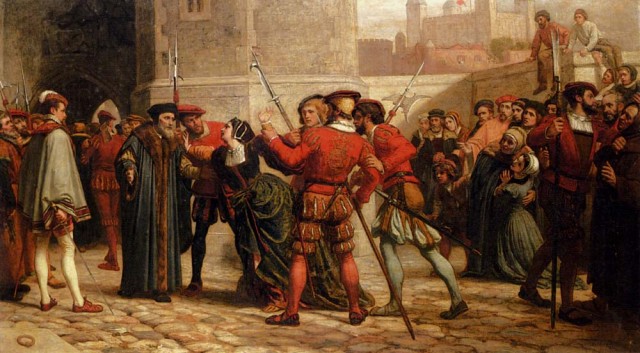
Sir Thomas More (left in the gown), attempting to control a riot.

First, a little background. Sir Thomas More was a real man who worked as Chancellor of England under Henry VIII. He was famously executed for refusing to support the king’s divorce of Queen Katherine Of Aragon because of his devout Catholic beliefs, and for that reason he is still considered a man of great principle and honor. The scene which Shakespeare allegedly helped  write however, takes place earlier, when More was just a sheriff of London. 

In the speech below, More is trying to break up a riot where a mob of people are trying to murder a group of immigrants from the country, accusing them of stealing jobs from Englishmen, (sound familiar)? More pleads with them to show compassion and to be open to other points of view. Here is More’s speech, performed by Sir Ian McKellen.

Here’s the text of the speech:

Imagine that you see the wretched strangers,
Their babies at their backs and their poor luggage,
Plodding to the ports and coasts for transportation,
And that you sit as kings in your desires,
Authority quite silent by your brawl,
And you in ruff of your opinions clothed;
What had you got? I’ll tell you: you had taught
How insolence and strong hand should prevail,
How order should be quelled; and by this pattern
Not one of you should live an aged man,
For other ruffians, as their fancies wrought,
With self same hand, self reasons, and self right,
Would shark on you, and men like ravenous fishes
Would feed on one another….
Say now the king
Should so much come too short of your great trespass
As but to banish you, whether would you go?
What country, by the nature of your error,
Should give you harbour? go you to France or Flanders,
To any German province, to Spain or Portugal,
Nay, any where that not adheres to England,
Why, you must needs be strangers: would you be pleased
To find a nation of such barbarous temper,
That, breaking out in hideous violence,
Would not afford you an abode on earth,
Whet their detested knives against your throats,
Spurn you like dogs, and like as if that God
Owed not nor made not you, nor that the claimants
Were not all appropriate to your comforts,
But chartered unto them, what would you think
To be thus used? this is the strangers case;
And this your mountainish inhumanity. 

Sir Thomas More, Act II, Scene 4.

Finally, here’s a link to view the original manuscript, which is on display in the British Library in London.

The obvious condemnation of xenophobia and hatred of immigrants in More’s speech is obvious, so I won’t belabor it, but it’s worth noting that this problem has been going on for over 400 years. What I’d like to focus on is what More says at the end: when a nation erupts into violence against immigrants it cheapens itself and the world takes notice. Also, it is the job of those in authority to protect, not stay silent when such attacks take place. This is why we need to think carefully about Trump’s proposals regarding immigrants, Muslims , and other such “strangers.”

In a more general sense, I feel that in our divided nation, we all are feeling like strangers. Whether you’re a man or a woman, Democrat or Republican, Caucasian or Non-Caucasian, many thousands of people in this nation all seem to feel that someone is treating them like “strangers,” and our task, all of us, as Americans and human beings, is to “take the stranger’s case,” by looking at other people’s points of view with compassion and an open mind. That, by the way was made Shakespeare a great writer; his own ability to see into the minds of kings and peasants, women and warriors, ghosts and gods.

So here’s the big question: whom would Shakespeare vote for? I believe he would vote for whomever would try to learn from the lives of these strangers, and use his or her authority to protect their right to speak their minds. Deciding who that person is, is a task I leave to you.

The Witches Of Macbeth

Happy Halloween everybody!

Tonight I’d like to discuss some of the spookiest, most enigmatic, and above all WEIRDEST characters in Shakespeare: the Three Weird Sisters in Macbeth.

1. Who are they?

Every production has to answer who the witches are, and many have very different answers. Are they temptress? Are they evil agents controlling Macbeth?Furies trying to destroy Macbeth?

I would argue in their basic form the witches are harbingers of change. Their very name “Wyrd Sisters” refers to an old Anglo Saxon concept of fate or destiny. Whether or not they have any effect on Macbeth mind or soul, they point the finger at him and say “things are going to change for you.” Then, he either makes the choices that determine his fate, or they change his fate for him.

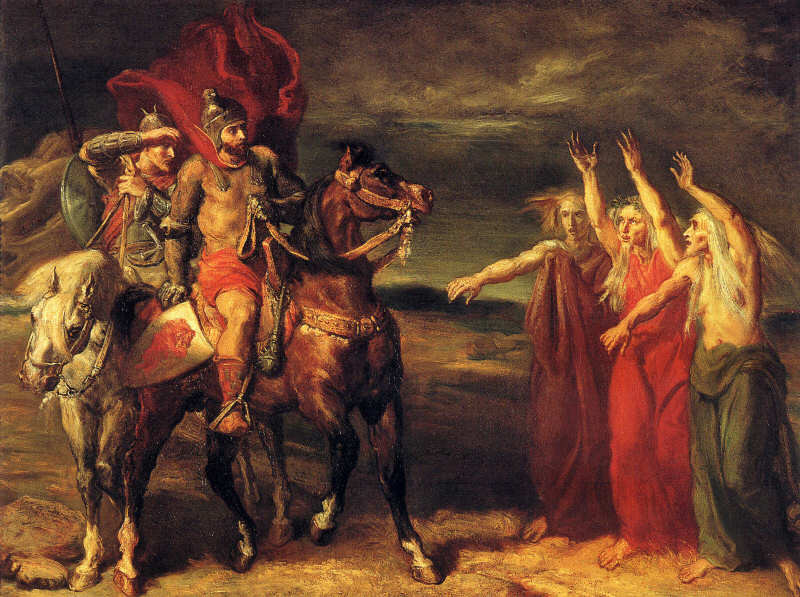
“Macbeth and Banquo First Encounter the Witches,” Théodore Chassériau, 1854.

Macbeth meets the witches on a heath, which means land that is literally out of bounds– the wild, untamed wilderness, which the old Anglo Saxons believed was the lair of many cursed spirits and monsters. This could symbolize Macbeth’ sin or transgressions, slowly turning into a murderer, usurper, and a tyrant. It could also symbolize the chaos in Macbeth’s life.

What Do They Look Like?

Shakespeare’s descriptions of the witches are highly contradictory- they seem to be floating, yet on the ground, they seem to be women, but they have beards! They don’t look Earthly, but here they are on the Earth. This gives them an other worldly quality that keeps us guessing as to who they are, and helps them tempt Macbeth more easily.

BANQUO
What are these
So wither’d and so wild in their attire,
That look not like the inhabitants o’ the earth,
And yet are on’t? Live you? or are you aught
That man may question? You seem to understand me,
By each at once her chappy finger laying
Upon her skinny lips: you should be women,
And yet your beards forbid me to interpret
That you are so.

MACBETH
Speak, if you can: what are you? (Act I, Scene iii).

The Witches’ Language:
You know from my earlier posts that the norm for Shakespearean characters is to speak in iambic pentameter- 10 syllable lines of unrhymed poetry that sounds like a normal heartbeat. The witches break these norms- they generally speak in Trochaic Tetrameter- 8 syllable lines with the off beat emphasized. The witches are literally offbeat, and that’s why their speeches are unsettling. Look at the contrast between a normal iambic line like:

“In sooth I know not why I am so sad.” (Merchant Of Venice I,i).

and

Dou-ble Dou-ble, Toil and Tro-ble.

Fire burn and Caul-dren Bu-ble. (Macbeth, Act IV, Scene i).

For more info on the verse forms of the Witches, click here:

The witches also speak their prophesies in a vague, ambiguous manner They like to play with obscuring their prophesies with lines that make Macbeth think one thing, but the opposite is true. The famous example here is when they claim Macbeth will never be vanquished “until Birnam Wood comes to Dunsinane Hill.” Macbeth assumes this means he’s invincible, but it actually means that the enemy carry wood from the forrest. This is called Equivocation.

Witches and mythology

Illustration from William Blake's
Illustration from William Blake’s “Europe a Prophecy,” 1794.

1. During the reign of King James, the modern witch hunt began; the king was fascinated with witches and even wrote a book called Daemonology on how to identify and destroy them. This was the era where people believed that witchcraft, rather than a pagan religious practice, was a forbidden craft that could only come from a pact with the devil. However, Shakespeare borrows from both Satanic and early pagan ritual in the characters of his witches.

2. Shakespeare took a couple of details about witchcraft from ancient Celtic and Greek mythology. First of all, the use of a cauldron. In Celtic myth, a cauldron is a symbol of rebirth and was sometimes used to resurrect the dead, just as the witches do in IV i. Of course, the ideal time for raising the spirits was on the feast of the pagan god Samhain, at the point where the veil between the living and dead was the thinnest. The feast took place on October 31st, our modern day Halloween!

Illustration of witches and their familiar spirits, 1647.

3. Familiar spirits In Act I, the witches speak to animal spirits called familiar spirits, which call to them and tell them where to go. King James himself wrote about how the witches found and communicated with these spirits.

Hecate.
In Act IV, Hecate, Ancient Greek goddess of magic appears. She is clearly the lord of all the witches, and is very displeased that they are riddling with Macbeth. Maybe not all witches believe in giving out prophesies that can destroy the Scottish monarchy. Hecate was always enigmatic in myths- she was born one of the Titans who opposed the gods, but frequently changed sides. More then being two faced, she was often portrayed as having three faces! Shakespeare refers to her frequently as “Triple Hecate.”

“The Triple Hecate,” by William Blake, 1794.

For more information on this mysterious goddess, consult the video below, (WARNING, ADULT-ONLY CONTENT).

In conclusion, the witches are meant to be ambiguous because the play examines the source of evil- whether it is inspired by other people, or if it comes from one’s own heart. The witches can be either or both, depending on how you want to tell the story, which is why they act and speak in contradictory ways.

Thanks for reading! If you enjoyed this posting, please consider signing up for my online class, “Macbeth: An Immersive Horror Experience.” I tell you the story of Macbeth and you get to play through an escape room, where you must solve the witches’ puzzles or be added to their Cauldron!

Ira Glass Backtracks From “Shakespeare Sucks” Tweet.

I just saw on the “Tonight Show” a clip where Ira Glass from NPR retracts his statement on Twitter a week ago that “Shakespeare sucks,” after seeing a production of Shakespeare In the Park. Glass said to Jimmy Fallon that he immediately caught heat on the internet “Apparently Shakespeare has a huge internet presence.” To that i say, “Good job Shakespeare nerds!” As Fallon pointed out, Shakespeare is a rallying symbol to all smart people, and that’s why we need to defend him.

Enjoy this video, and enjoy watching Ira squirm.

By the way, if you’re interested in seeing John Lithgow in King Lear, here’s the official website: http://www.publictheater.org/en/Tickets/Calendar/PlayDetailsCollection/SITP/King-Lear/

Romeo and Juliet: “Why Do We Read This Play?” (Part II of 3)

Romeo and Juliet: “Why Do We Read This Play?” (Part II of 3)

Posted on August 23, 2012 by Open Air Shakespeare NRV

Hello loyal subscribers and first time readers!

On Tuesday I posted an article about why schools are required to read “Romeo and Juliet.” I’d like to continue with another answer that is not quite as good, but has shaped the course of the play’s history.

Romeo and Juliet: Why Do We Have To Read This Play?

Answer # 2: We still read it because at one time, Romeo and Juliet was considered to be good for ‘moral instruction.’

In the 1770s, Shakespeare’s plays were read aloud, not as dramatic literature, but moral lectures to teach people about jealousy or love or ambition (Source: This American Life). Shakespeare was considered by many to be “The best judge of human nature,” as the dedication page says on the 1753 edition of Romeo and Juliet. This 18th century concept continued into the 19th, as evidenced in this painting, The Reconciliation Of the Capulets and Montegues, 1854.

“The Reconciliation of the Capulets and Montegues ” by Frederick Leighton, 1856.

Notice how in this picture, we see Romeo and Juliet as the lightest objects in the play, while their parents are directly center, holding hands. The “glooming peace” starts with the window, reflects off the dead lovers, and inspires the parents.

To readers and playgoers in the genteel age of the 18th and 19th centuries, Romeo and Juliet seem to champion love and peaceful co-existence, making the play seems to be a good play to teach young people. There is evidence in the play that supports this idea that Shakespeare was judging the youthful Romeo and Juliet to be morally superior to their parents. Shakespeare describes their parent’s hate as a canker or a parasite, sucking the life out of a flower, the feud has infected so much of Romeo and Juliet’s world, that it makes it impossible for their love to take root. In response, the young fight with their peaceful love to save the destructive world that their parents have created, and die as a sacrifice to true love. Looking at it this way, Romeo and Juliet take on a Christ-like status, dying to redeem their parent’s sins, which certainly would have appealed to the predominantly Christian audiences of the 18th and 19th centuries.

This approach does have its problems though:

  • Problem #2: The Language is FILTHY! When people like David Garrick adapted Romeo and Juliet, he cut all of Sampson and Gregory’s dirty jokes, and most of Mercutio’s. Even audiences today might be shocked to learn that one passage in Romeo and Juliet is still considered by modern standards to be PG-13:Problem #1: Although he dies nobly, Romeo also engages in many immoral behaviors, including his attempts to seduce Rosalind at the start of the play, his hot-blooded murder of Tybalt, and his purchase of illegal drugs from the Apothecary.
  • Mercutio:
    • Now will he sit under a medlar tree,
      And wish his mistress were that kind of fruit
      As maids call medlars, when they laugh alone.
      Romeo, that she were, O, that she were
      An open a**, thou a poperin pear!

Romeo and Juliet, Act II, Scene ii

I won’t go into what Mercutio is actually talking about when he mentions the pear-like medlars, which women used to joke about when they were alone. Suffice it to say that if you ever believed that Shakespeare ennobles us because he only speaks in proper, age-appropriate language, I can only say that you are:

  • Problem #3: Nobody ever thinks in this play!
Claire Danes from “Romeo and Juliet” (1996) holds a gun to her head, and threatens suicide rather than marrying Paris.
    •  Even though their parent’s feud is morally wrong, neither Romeo nor Juliet try to deal with it in a lasting, practical way, but instead try to run away from the problem. As Peter Saccio says in his lecture on Shakespearean tragedy, this approach is highly flawed: “Romeo and Juliet cannot live outside the social strata that their parents have created,” which means that they can’t run away forever or their lives will literally waste away. However lovely Romeo and Juliet’s  love is, it blinds their judgement too.
    • Even Friar Lawrence acts rashly as this wonderful video demonstrates:
  • Problem #4: The parents, (especially Lord Capulet), are also terrible moral figures-
  • As you can see in this lovely video from the BBC, Capulet attempts to fix his daughter up with an arranged marriage to manipulate the Prince to favor the Capulets. When Juliet refuses, Capulet reacts violently and threatens to disown her and hit her. Hardly an example of proper fatherly devotion.

Looking at all these examples, one could make the argument that Romeo and Juliet is a better example of immoral behavior. One could even argue that the tragic death of the two lovers was just the natural consequence of  their hasty, overly passionate affair.

As dubious as the morals in this play are, they can and have been used to construct several moral arguments, such as arguments against  pre-marrital sex,  or  arguments to pursue peace, or arguments for young people to be wiser in relationships. Each one is legitimate and Shakespeare gives each one its time to shine.

Thanks for reading, and stay tuned for Part III!

-Shakespeare Guru

Play Review: “William Shakespeare’s Star Wars”

Illustration from William Shakespeare's Star Wars
Illustration from “William Shakespeare’s Star Wars”

Play review: William Shakespeare’s Star Wars

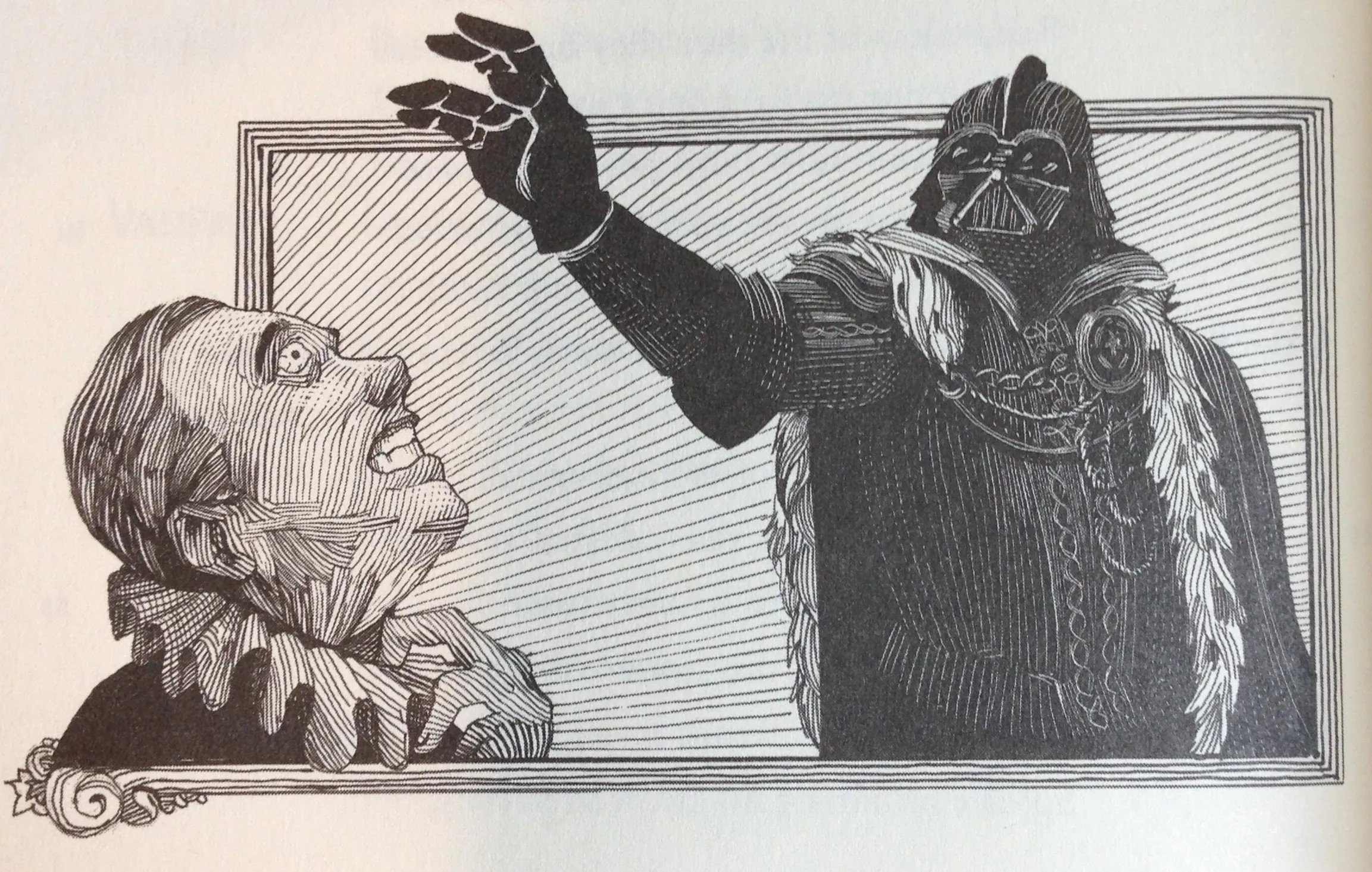
Since Monday was May the Fourth, and since I got some encouraging comments about the previous post, I’m happy to review one of the most interesting Shakespeare spin-offs I’ve ever encountered: William Shakespeare’s Star Wars by Ian Doescher. For those of you who haven’t heard of this play, it’s basically the script of Star Wars put into Shakespearean verse. The writer clearly loves both Shakespeare and Star Wars, and puts lots of cheeky Shakespearean references in the text, such as Luke Skywalker parodying Hamlet as he steals a Stormtrooper’s uniform and Yorrick-like, holds up the helmet to his face:

“Alas poor Stormtrooper, I knew ye not,” (Doescher IV, vi, 1) The play lends itself perfectly for performance in an Elizabethan playhouse with its sparse stage directions and an Elizabethan chorus that comments on the action and tells the audience whenever action occurs offstage, such as when the Death Star gunners prepare their mighty laser to destroy the planet Alderon. I certainly got a kick out of reading this play since I too am a huge Shakespeare/ Star Wars fan. However, since this blog is meant to help us learn and appreciate Shakespeare, the question is, does this play have any value to Shakespearean students? At first I wasn’t sure, but now I say yes!

Before I read the play, I was a little apprehensive as I’ve seen Shakespearean gimmicks fall flat before; I once saw a dreadful production of Macbeth where the whole cast was made up to look like zombies for absolutely no purpose except to cash in on the zombie fad. So at first, I wondered, “Why bother translate Star Wars into Shakespearean language”? As I read on though, I realized what the author had done was give readers a rare glimpse into how Shakespeare himself wrote.

This helps prove one thing I’ve always felt about teaching Shakespeare- parody and gentle satire are a great way to deconstruct his plays into something a little easier to grasp. As I said before, Doescher’s play is full of tiny bite-size portions of real Shakespearean dialogue that allow you to digest some of The Bard’s most famous lines. Also, he’s following the same ‘recipe’ Shakespeare used in his plays and speeches, so I’m going to deconstruct some of the Shakespearean elements that Doescher employed to concoct this Shakespeare/Sci-fi classic hybrid. I’ll focus on the first play in the series: Verily A New Hope, but you can find these components in all of the plays in the Star Wars Saga.

  1. Iambic pentameter- the most obvious difference between the original Star wars is that Doescher took the dialogue and put it into the same poetic meter Shakespeare used. For those who don’t know, Iambic pentameter is a kind of unrhymed poetry with 10 syllables per line. Each line also has 5 stressed beats that strike like a heart beat- Da DUM Da DUM Da DUM Da DUM Da DUM. To keep the emphasis on the right syllables, sometimes the writer has to shift the syntax or add and subtract words to get them to fit. This is why instead of the famous: “A long time ago, in a galaxy far, far away,” the Prologue at the beginning says:

“ In time so long ago begins our play,

In star-crossed galaxy far, far away.”

Doescher’s time-consuming process of translating a prose movie script into blank verse poetry is exactly Shakespeare did when he wrote his plays, only instead of movie scripts, he took the chronicles of English history to become Hamlet, Macbeth, Lear, and many others. With all the work involved in crafting poetry like this, it’s no wonder he didn’t have time to think up an original story!

  1. Telling the audience what you’re doing- As I said last week, one thing to keep in mind when you read Shakespeare is that his plays were performed outdoors with no microphones, in an audience of nearly 3,000 people! It must have been extremely hard to see or hear the action onstage. Shakespeare tried to solve this problem by having characters announce what they’re doing, which would be tedious, if he didn’t also know how to spice up the dialogue with lines that reveal the character’s emotional state, like when Lord Capulet says: “My fingers itch,” to warn his daughter he’s about to hit her. Doescher captures this extremely well in the speech where Vader lifts up the Rebel Leader and begins to choke him to death:

I turn to thee, thou rebel. Aye, I lift

Thy head above my own. Thou canst now choose

To keep thy secrets lock’d safe in that head

Or else to keep thy head, and thus thy life (Doescher I, ii 6-10).

This passage explains to the reader or playgoer that Vader has lifted the man over his head, (demonstrating his cruelty and his strength), and subtly plays on the fact that Vader is looking at his head, wants the knowledge in his head, and will crush his head if the Rebel doesn’t cooperate. Shakespeare’s Richard III makes a similar threat: “Villain, set down the corpse, or by St. Paul, I’ll make a corpse of him that disobeys!”

  1. The Aside One thing Shakespeare does that few modern writers ever do is have characters talk directly to the audience; thus establishing an intimate relationship between you and a person who is confiding their secrets in you. The most striking example of this in Shakespeare’s Star Wars is R2D2, who in the movie never spoke at all, but made cute little electronic beeps and whirrs. Having R2 speak gives the reader an unexpected closeness because R2 never speaks to anyone else.
  2. Personification Shakespeare is really good at finding a clever visual metaphor for an abstract idea, and will write speeches or dialogue where characters explore the nature of that idea, a meditation if you will. One of my favorite examples from Shakespeare’s Star Wars is the scene in which Luke and his uncle debate about whether Luke will stay on the farm. Luke compares himself to a bird that’s trying to fly away, while his uncle uses farm metaphors to try and keep him to stay:

OWEN: Wilt thou here in the desert yet desert? Tis only one more season.

LUKE: Now cracks a hopeful heart, when by the land,

A man’s ambitions firmly grounded are:

So shall a bird ne’er learn to fly or soar

When wings are clipp’d by crops and roots and soil.

It’s really very clever the way Doescher mimicks Shakespeare’s wordplay here. Luke is like a bird because he’s a pilot and longs to fly. Owen is a farmer on a desert and is worried about Luke deserting him. We get a clear picture of their relationship from this scene.

  1. Chorus Shakespeare sometimes uses a Chorus to tell us what is going on in plays where the location shifts from place to place- it’s a time honored device in epic storytelling. Nowadays we use a Chorus too, we just call it a Narrator. The difference is that a Chorus also can explain the tone and the mood of the action onstage, so that you can imagine it in your own mind. Take a look at this passage where the chorus describes the famous Star Wars Cantina:

Now mark thee well, good viewer, what you see,

The creatures gather round the central bar

While hammerheads and hornéd monsters talk.

A band composed of aliens bizarre:

This is the great cantina- thou may’st gawk! (III, I, 45-49).

You can see how, unlike a narrator who would just tell you there are a bunch of aliens here, the Chorus describes the sights and sounds of the bar so you can imagine it yourself. The Chorus in Shakespeare’s Henry the Fifth explicitly states that the audience needs to use their imagination to fill out the story of Henry’s conquest of France.

  1. The soliloquy A soliloquy is a speech spoken by a character alone on stage. It often has to do with a complex dilemma such as Hamlet’s “To Be Or Not To Be.”
1307_SBR_STARWARS_ILLO.jpg.CROP.article568-large

In Shakespeare’s Star Wars, Luke and Vader have the most soliloquis and with good reason- they have the most complicated emotional journeys- Luke goes from a simple farmboy from Tatooine to a Jedi Knight, while Vader goes from a Jedi to a Sith to a father. Shakespeare’s greatest power is his ability to put complex emotional journeys like these into speeches that the characters share right with us. I loved both these speeches too much to choose, so I’m going to talk about of both. The first is a soliloquy Vader speaks after he kills the Rebel leader:

And so another dies by my own hand,

This hand, which now encas’d in blackness is

O that the fingers of this wretched hand

Had not the pain of suffring ever known. Droescher I.ii, 27-30

This speech reminds me very much of Richard III, one of Shakespeare’s greatest villains. Richard, like Vader, has his life story told in 6 installments where he slowly becomes an evil mastermind. The images of this speech conjure up parts of Vader’s life story: how he lost his hand in Episode II and now has a robotic hand in a black glove. The speech also conjures the fact that his master the Emperor is able to shoot lightning from his hands, and of course, how Vader himself is able to kill by merely gesturing with his hand. Richard has a speech where he talks about all the people he’s killed to become king, and how he now has to kill even more to stay king:

I must be married to my brother’s daughter,
Or else my kingdom stands on brittle glass.
Murder her brothers, and then marry her!
Uncertain way of gain! But I am in
So far in blood that sin will pluck on sin:
Tear-falling pity dwells not in this eye (Richard III, Act IV, Scene i)

Luke has another speech where he talks about his destiny staring at the twin suns of Tatooine, but I won’t spoil that one for you! Needless to say, it’s awesome. I bring it up because In the movie, it was John Williams’ job to literally underscore Luke’s emotions as the music swelled. Shakespeare’s gift on the other hand was to put powerful emotions and thoughts into carefully composed soliloquys that sound like music when spoken well.

So as you can see, the author’s loving parody of Shakespeare allows us a rare glimpse of how the Bard wrote; his cleverness at adapting stories, his use of verse, wordplay, metaphor, personification, choruses, and his unique ability to write characters that talk to us as if we were in on their deepest secrets.

By the way, if you’re still unconvinced on this play’s educational value, check out this link to their educational website: http://www.iandoescher.com/wp-content/uploads/2013/08/ShakespeareStarWars_EducatorsGuide.pdf