Where Did This Play Come From?

Poster for a production of “Romeo and Juliet,” that I worked on in 2012.

When I say that the story of Romeo and Juliet is timeless, I mean that the story’s roots go back almost to the beginnings of time. According to Sigmund Freud in Beyond the Pleasure Principle, the desire for love is inexplicably tied to the desires for creation, and destruction. These contradictory forces live deep in the human psyche, which explains why stories of doomed love have been re-interpreted throughout history. What follows is a short history of the stories that inspired Shakespeare, so you can see how this archetypal story has evolved into the one we still read today.

Ancient Sources

When Shakespeare was going to school in the late 1560s, Elizabethan boys were expected to read ancient Greek and Roman writers, who wrote many of the classical love stories listed below. We know that Shakespeare remembered of all these stories because he gives a brief homage to them in Ac II, Scene iv of Romeo and Juliet:

MERCUTIO

Now is he [Romeo] for the numbers
that Petrarch flowed in: Laura to his lady was but a
kitchen-wench; marry, she had a better love to
be-rhyme her; Dido a dowdy; Cleopatra a gipsy;
Helen and Hero hildings and harlots; Thisbe a grey
eye or so, but not to the purpose.

Mercutio’s opinion of these old love stories is that they are based on a false concept of true love, when in fact, love for Mercutio is merely lust and obsession.

Hero and Leander

Leander swimming across the Hellespont. Detail from a painting by Bernard Picart.

          • Author– Unknown (traditional Greek Myth)
          • Date Of Composition 1400- 300 BC (approx)
          • Plot– Hero, a prophetess of Aphrodite loves Leander, a young man from the other side of her temple across a river called the Hellespond. As a priestess, Hero is supposed to remain a virgin, but Leander convinces her to make love to him, and visits her several times by swimming across the Hellespond. Their affair comes to a tragic end when on one stormy night, Leander is overcome by the waves and drowns on his journey to be with his beloved Hero. Consumed with grief, Hero throws herself off the temple tower to be with him.
          • Moral– love (or at least lust), destroys and kills.

The Iliad

        • Author– Homer
        • Date Of Composition 800 BC (approx)
        • Plot– Paris, the prince of Troy abducts and ravishes Helen, the queen of Sparta in Greece, leading to a 10 year war between the Greeks and the Trojans. This war divides everyone in both countries, even the gods, leading to the question of whether love is more important to loyalty to one’s country or family.
        • Moral– Ambiguous- The Greeks fight the Trojans bravely, but only to destroy Troy. Whereas the Trojans are often more sympathetic than the Greeks, but their decision to protect Paris and Helen’s adulterous affair is very unwise. The characters in this story strive to answer the question of what is the most important thing in life- desire for power, fame, to protect one’s home, or love?

Tristan and Isolde

        • Authors– Various, including the French bards Thomas and Beroul
        • Date of Composition– somewhere around the 12th century AD.
        • Plot– Similar to the Trojan War story, but in a medieval context: a young English knight named Tristan meets the heroine, a princess from Ireland, who is engaged to his country’s king. Their passion is instant and fiery, (sometimes it is the result of a love potion they accidentally drank), but it also forces them to make a terrible choice- If Tristan carries off Isolde, he will be disobeying his king, destroying a peaceful alliance, and forcing England and Ireland to go to war. However, it is clear from the beginning that Isolde does not love the one-eyed English king, and  if she marries him, Isolde will be miserable her whole life. Tristan fights gallantly to protect both Isolde and her honor and it puts Tristan, the king, and Isolde into a torturous love triangle, which usually ends with Tristan and the king fighting to the death.
        • Morals
          1. Arranged marriages ruin everything,
          2. love is like a drug,
          3. “Bros before, [you know-what].”
        • Note– This story was also the root of the story of Lancelot in the Arthur myths. In the version created by Thomas Mallory in the 15th century, Lancelot falls in love with Queen Guineveere, and betrays King Arthur, whom he loves like a father. Lancelot’s adultery eventually destroys the fellowship of the Round Table, and allows Arthur’s wicked bastard son Mordred to kill Arthur and ruin Camelot.

Renaissance Sources

Here is a brief timeline of the narrative sources dating from 1530-1580 that Shakespeare used to create his own masterpiece. As you can see, they differ considerably from the ancient sources in plot, and overall morals.

Timeline Of the Narrative Sources of Romeo and Juliet:

Romeo and Giulietta

Da Porto's Novel "Newly found story of two noble lovers"-1530

        • Author– Luigi Da Porto in his novel Historia novellamente ritrovata di due nobili amanti (“Newly found story of two noble lovers”
        • Date of Composition- 1530
        • Background– Da Porto was a soldier and a brilliant story writer. Some claim that he based his tale on an earlier story, while some claim he based it on his falling in love with a girl at a masked ball. In any case, Da Porto was the first to set the story in Verona, created the characters of Mercutio and Benvolio, and also the first author to change the context of the story into two warring households, rather than great empires or kingdoms. This small change helps the audience sympathize with the lovers more, since they are not guilty of treason or adultery.
        • Plot– Two noble houses, the Montecchi and the Cappelletti are at war. The hero  Romeo meets Giulietta at a Carnival ball, which makes him forget about an unrequited love he has for an unnamed girl (the name Rosalind is Shakespeare’s invention).  The two lovers have several liasons over a much longer period than in Shakespeare’s play at Guilietta’s chamber window. Also, although they are married in secret and Romeo is banished just as in Shakespeare’s version, the character he kills is not related to Guilietta. However, the plot device of the sleeping potion and  Romeo’s suicide is also consistent with Shakespeare’s version of the story.

Romeus and Juliet

Arthur Brooke's Romeus and Juliet

        • Author– Matteo Bandello’s in his story Novelle,
          (translated into English) by Arthur Brooke in 1587.
        • Date of Composition– 1554, (translated in 1562, re-printed 1587)
        • Background– Bandello adapted Da Porto’s version of the story and developed the supporting characters, adding The Nurse, the Friar and the Apothecary, and developing Benvolio (without giving him a name).
        • Plot– This plot is almost exactly the same as Shakespeare’s play,but it does reveal some narrative details that Shakespeare omits. Bandello’s poem reveals the origin of the Capulet/ Monegue feud, as well as the ultimate fates of the surviving characters.
        • Moral– Like many other interpretations, the author (or at least the translator) seem to be struggling with the Christian taboo of premarital sex, which to some extent condemns the protagonists. In the English translation by Arthur Brooke, the Preface makes it very clear that Brooke is not condoning Romeus’ premarital sex or his blatant disregard for his parents’ authority. Brooke claims that the story is intended to show the actions of bad people being punished for their actions:

The good man’s example biddeth men to be good, and the evil man’s mischief warneth men not to be evil. To this good end serve all ill ends of ill beginnings. And to this end, good Reader, is this tragical matter written, to describe unto thee a couple of unfortunate lovers, thralling themselves to unhonest desire; neglecting the authority and advice of parents and friends; conferring their principal counsels with drunken gossips and superstitious friars (the naturally fit instruments of unchastity); attempting all adventures of peril for th’ attaining of their wished lust – (Brooke, Romeus and Juliet )

    • On the other hand, at the end of the poem, Bandello describes Romeus and Juliet’s love (or at least Brooke’s translation), as: “so perfect, sound, and so approvéd love,” which suggests that the author at least approve of the lover’s actions. One can almost imagine Italian passion fighting with English morality in the dueling pens of Brooke and Bandello. It was up to Shakespeare to try and resolve this conflict in his own version.

Romeo and Juliet

Romeo and Juliet 1st Quarto.

      • Author– William Shakespeare
      • Date of Composition 1593 (approximately)
      • Plot– One of the most interesting things about Shakespeare’s play is that he develops the characters of Mercutio, the Nurse, and Friar Lawrence, but deliberately omits certain plot elements such as why the feud began between the Capulets and Montegues, and what happened to The Apothecary, Nurse, and Friar Lawrence after the Prince found out about the lovers’ suicides. This effectively makes the Capulet/Montegue feud seem pointless, which allows the audience to focus more on the lovers. On the other hand, Shakespeare also compresses the time Romeo and Juliet know each other from 9 months as in Brooke’s version to 5 days, making the love affair seem even more rash. These changes in plot make the story much less a morality tale about morally wrong love, and more about the war between creative and destructive love that play in the human psyche.
        • Moral– As we’ve seen, most interpretations of the story condemn the lovers as rash, foolish, and adulterous. Shakespeare refuses to condemn or condone. That is Shakespeare’s great gift for storytelling- he doesn’t give us clear answers because he knows life is more complicated than that. He merely provides two sides of an issue and lets the reader sort it out for themselves.

How did Shakespeare get away with ripping off material this old? You’d think that, since every English schoolboy knew this story for over 1000 years, nobody would see this play since there would be no surprises. The answer is that Shakespeare writes primarily for characters, not plot. He infuses old characters like Romeo and Juliet with a new language that makes them more complete, more modern, and more timeless. That’s why stories like R&J, which was already known to Shakespeare’s audiences, are still entertaining and compelling, even after you read it 100 times, and see hundreds of different productions.

I hope this short history of the sources of Romeo and Juliet allows you to ponder the complex theories behind love and lust that authors have struggled to explain in the history of this story. Each age debates the values of love and whether it’s worth fighting or dying or killing for. Perhaps the best thing about Shakespeare’s version is that it tries to provide the most complete summary of the question, without giving us an answer, allowing us to marvel at how complex it is.

Thanks For Reading!

Shakespearean Student

Fun Posts about Friar Lawrence from our Friends at “Zounds, Alack, and By My Troth.”

I love it every time I come across some Shakespearean humor. One of the ideas I keep coming back to in “Romeo and Juliet,” is how close the play comes to being a comedy- it has two lovers, a funny nurse, a wisecracking friend, if people didn’t die it could be a sitcom. Even more ridiculous is the clichéd comic device of having people fake their own deaths, which Shakespeare does again in his comedy Much Ado About Nothing. So here is a humorous take on the old friar, and his go-to advice:

Web comic strip from “Zounds, Alack and By My Troth,” Used with permission.

https://zoundsalackandbymytroth.wordpress.com/comic/friar/

Romeo and Juliet: “Why Do We Have To Read This Play” Part III

Here is the last post on my series of 3 which examines the importance question of why should we read or see this play? In the last post I argued that, although the play is sometimes billed as a moral story, the characters engage in really reprehensible behavior- premarital sex, muder, and whining about their teenage problems. So the question is, if the play isn’t a moral parable, what can we gain from reading it?

Reason # 3- The Play Shows Truths About

the Human Condition.

  • Richard Dadd, Sketch for the Passions. Love (1853)

    Even though the play’s characters frequently do rash and sometimes foolish things, this only serves to make them more complex and realistic. The truth is, we all do foolish things when in love, and they all dramatically effect our lives, (sometimes for better or for worse).

The point is that the qualities we demonstrate when we’re in love, reveal who we truly are. Romeo is foolish, obsessed with his lover, sometimes selfish, and hot-blooded. He is also tender, caring, utterly without deceit or pretense, and committed to his beloved at any cost.

  • I believe this is why we really need to keep reading and watching this play. As Judy Dench said in the film “Shakespeare In Love,” the play shows the very truth and nature of love, not just the budding romances or passionate affairs, but dark obsessions, painful separations, family bonds, and even, “glooming peace,” as the Prince says at the end of the play. Shakespeare shows them all, not judging one to be better or worse, but demonstrating the feelings and the actions that arise in reaction to the powerful force of love.

Frank Dicksee, Romeo and Juliet (1884)

So when you read this play, try to look beyond the peculiar language, the old-fashioned type and the flowery poetry. Inside you might see a reflection of yourself, what Shakespeare called, “the mirror up to nature.”

Thanks for Reading,

-Shakespearean Student

Romeo and Juliet: “Why Do We Read This Play?” (Part II of 3)

Romeo and Juliet: “Why Do We Read This Play?” (Part II of 3)

Posted on August 23, 2012 by Open Air Shakespeare NRV

Hello loyal subscribers and first time readers!

On Tuesday I posted an article about why schools are required to read “Romeo and Juliet.” I’d like to continue with another answer that is not quite as good, but has shaped the course of the play’s history.

Romeo and Juliet: Why Do We Have To Read This Play?

Answer # 2: We still read it because at one time, Romeo and Juliet was considered to be good for ‘moral instruction.’

In the 1770s, Shakespeare’s plays were read aloud, not as dramatic literature, but moral lectures to teach people about jealousy or love or ambition (Source: This American Life). Shakespeare was considered by many to be “The best judge of human nature,” as the dedication page says on the 1753 edition of Romeo and Juliet. This 18th century concept continued into the 19th, as evidenced in this painting, The Reconciliation Of the Capulets and Montegues, 1854.

“The Reconciliation of the Capulets and Montegues ” by Frederick Leighton, 1856.

Notice how in this picture, we see Romeo and Juliet as the lightest objects in the play, while their parents are directly center, holding hands. The “glooming peace” starts with the window, reflects off the dead lovers, and inspires the parents.

To readers and playgoers in the genteel age of the 18th and 19th centuries, Romeo and Juliet seem to champion love and peaceful co-existence, making the play seems to be a good play to teach young people. There is evidence in the play that supports this idea that Shakespeare was judging the youthful Romeo and Juliet to be morally superior to their parents. Shakespeare describes their parent’s hate as a canker or a parasite, sucking the life out of a flower, the feud has infected so much of Romeo and Juliet’s world, that it makes it impossible for their love to take root. In response, the young fight with their peaceful love to save the destructive world that their parents have created, and die as a sacrifice to true love. Looking at it this way, Romeo and Juliet take on a Christ-like status, dying to redeem their parent’s sins, which certainly would have appealed to the predominantly Christian audiences of the 18th and 19th centuries.

This approach does have its problems though:

  • Problem #2: The Language is FILTHY! When people like David Garrick adapted Romeo and Juliet, he cut all of Sampson and Gregory’s dirty jokes, and most of Mercutio’s. Even audiences today might be shocked to learn that one passage in Romeo and Juliet is still considered by modern standards to be PG-13:Problem #1: Although he dies nobly, Romeo also engages in many immoral behaviors, including his attempts to seduce Rosalind at the start of the play, his hot-blooded murder of Tybalt, and his purchase of illegal drugs from the Apothecary.
  • Mercutio:
    • Now will he sit under a medlar tree,
      And wish his mistress were that kind of fruit
      As maids call medlars, when they laugh alone.
      Romeo, that she were, O, that she were
      An open a**, thou a poperin pear!

Romeo and Juliet, Act II, Scene ii

I won’t go into what Mercutio is actually talking about when he mentions the pear-like medlars, which women used to joke about when they were alone. Suffice it to say that if you ever believed that Shakespeare ennobles us because he only speaks in proper, age-appropriate language, I can only say that you are:

  • Problem #3: Nobody ever thinks in this play!
Claire Danes from “Romeo and Juliet” (1996) holds a gun to her head, and threatens suicide rather than marrying Paris.
    •  Even though their parent’s feud is morally wrong, neither Romeo nor Juliet try to deal with it in a lasting, practical way, but instead try to run away from the problem. As Peter Saccio says in his lecture on Shakespearean tragedy, this approach is highly flawed: “Romeo and Juliet cannot live outside the social strata that their parents have created,” which means that they can’t run away forever or their lives will literally waste away. However lovely Romeo and Juliet’s  love is, it blinds their judgement too.
    • Even Friar Lawrence acts rashly as this wonderful video demonstrates:
  • Problem #4: The parents, (especially Lord Capulet), are also terrible moral figures-
  • As you can see in this lovely video from the BBC, Capulet attempts to fix his daughter up with an arranged marriage to manipulate the Prince to favor the Capulets. When Juliet refuses, Capulet reacts violently and threatens to disown her and hit her. Hardly an example of proper fatherly devotion.

Looking at all these examples, one could make the argument that Romeo and Juliet is a better example of immoral behavior. One could even argue that the tragic death of the two lovers was just the natural consequence of  their hasty, overly passionate affair.

As dubious as the morals in this play are, they can and have been used to construct several moral arguments, such as arguments against  pre-marrital sex,  or  arguments to pursue peace, or arguments for young people to be wiser in relationships. Each one is legitimate and Shakespeare gives each one its time to shine.

Thanks for reading, and stay tuned for Part III!

-Shakespeare Guru

Romeo and Juliet: Why Do We Have To Read This Play? (Part I of 3)

Most schools in the US and the UK study Romeo and Juliet at one time or another, so for this blog entry, I wanted to ask the question you might have asked at some point in your life:

“WHY DO WE HAVE TO READ THIS PLAY?”

I will answer this question in three posts, with three different responses, to try and make my answers as complete, and yet concise as possible:
Reason #1: Shakespeare Himself Is Part Of the Educational Establishment.

From the beginning of American education, Shakespeare has influenced education. What follows is a brief history that hopefully helps explain why, even though he was born in England, Shakespeare is as American as it gets.

Prologue: Life Imitates Art

The first settlements in Virginia occurred in Shakespeare’s lifetime. After all, Virginia was named after Shakespeare’s ruler, the virgin queen Elizabeth. In 1609, a voyage to repopulate the Jamestown Settlement in Virginia hit a terrible storm and was shipwrecked in an island in the Bermudas. The survivors wrote down their story in  a book called A Discovery of the Bermudas, Otherwise Called the Isle Of Devils in 1610, which could have inspired Shakespeare to write The Tempest. Shakespeare wasn’t ignorant of the New World; he references America in The Comedy Of Errors, so it’s not impossible that Shakespeare based his last great play on this “Brave New World.”

The Beginning Of Shakespeare In American Education

In England during the 18th and 19th centuries, Shakespeare was considered a way of educating people in the Greco-Roman tradition, since his plays were based on such Roman authors as Plautus, Seneca, Plutarch, and Ovid (Saccio). Romeo & Juliet is a perfect example of Shakespeare borrowing from the older western traditions- he took the plot and characters from an Italian Renaissance story recorded in Mateo Bandello’s Novelle (1554). The concept of forbidden love though, is much older. Like many Renaissance stories, Romeo and Juliet has roots that go all the way back to the Trojan war, which according to Greek mythology, started with a man from Troy who dared to love a woman from his city’s mortal enemy. Our founding fathers were schooled in this tradition and they helped transplant Shakespeare to the new world.

Shakespeare Comes to America:

Picture of the first ever edition of Shakespeare printed in America, the 1795 Hopkinson Edition by Bioren and Madan

Our country’s early settlers were Puritans and Quakers, who disapproved of theatre in general and tried to have it banned. Nevertheless, many of the founding fathers loved Shakespeare and enjoyed reading his plays ; John Adams and Thomas Jefferson took a pilgrimage to Shakespeare’s birthplace, and George Washington even staged some of his plays (Behn). Even though he was an English playwright, most early Americans were quick to adopt Shakespeare as their own .

Shakespeare In the Classroom

In the 1830s, Shakespeare first appeared in American textbooks as something called “The McGuffey Reader,” a book that contained short snippets of text ranging from old nursery rhymes, to passages from Nathanial Hawthorne. In this sample, you can see that there is one passage from Shakespeare called: “Shylock: the pound of flesh” listed in the table of contents.

At the same time, going to Shakespearean plays and owning copies of Shakespeare’s works became more and more popular in the post Civil War period. As Mark Twain mentions in The Adventures of Huckelberry Finn, productions of Shakespeare were common to early settlers, which is why Twain writes the So-called Duke and Dauphin characters, who pose as actors and perform a perfectly awful rendition of a soliloquy:

To be, or not to be; that is the bare bodkin That makes calamity of so long life; For who would fardels bear, till Birnam Wood do come to Dunsinane, But that the fear of something after death Murders the innocent sleep, Great nature’s second course, And makes us rather sling arrows of outrageous fortune Than fly to others that we know not of . . . (The Adventures of Huckleberry Finn by Mark Twain).

As this passage indicates, even people in rural towns on the Mississippi knew the basics of Shakespeare. In fact, by the mid-19thcentury, you were more likely to see a Bible and a copy of Shakespeare’s works in an American home, than any other book (Source: Lawrence Levine, “Shakespeare In America”). For another funny example of Shakespeare in this period, check out this clip from the film My Darling Clementine, where an old English Shakespearean actor performs for cowboys, which was a common practice during the gold rush.

Shakespeare Goes to Harvard

In the 1870s and 80s, Shakespeare became part of the curriculum of many colleges and universities like Harvard, since studying Shakespeare taught undergraduates the critical thinking skills they would use if they chose to study law or psychology. After the universities let Shakespeare in, high schools integrated Shakespeare into the curriculum to prepare students for college. This is why we study Shakespeare in most high schools today; according to a recent study, about 84% of American high schools are required to read Romeo and Juliet (Source: Hoffman, Jeremy The Western Canon In Today’s High Schools).

To sum up, the first reason we read this play is because it helps us broaden our minds and connect to the wisdom of the past. Also, a huge amount of our culture is inexplicably tied to Shakespeare.

Sources:

  1. Behn, Richard J: “America’s Founding Dramas” (online article) Retrieved 8/1/15 from http://lehrmaninstitute.org/history/essays15.html. 
  2. Levine, Lawrence:”William Shakespeare in America”
    from Highbrow/Lowbrow: The Emergence of Cultural Hierarchy in America, Harvard University Press, 1998.
  3. Saccio, Peter. Lecture 1: “Shakespeare Then and Now.” Shakespeare: Comedies, Histories and Tragedies. The Teaching Company, 2001. CD. Dartmouth College.
  4. Waterson, Sam (Narrator) et. all. “The Father of the Man in America: Shakespeare in Civic life and Education.” Shakespeare in American Life, (radio documentary). Produced by Richard Paul. Originally airing on Public Radio International (PRI) stations April 2007.Retrieved 21st of August, 2012 from http://www.shakespeareinamericanlife.org/education/episode.cfm
That’s all for now, stay tuned for later posts this week!
-Shakespeare Guru

Happy Birthday Juliet!

Hi Folks,

Not only is it the first day of this month, it’s also a Shakespearean holiday! According to this passage from “Romeo and Juliet,” today is Juliet’s Birthday!

NURSE: Even or odd, of all days in the year,
Come Lammas Eve at night shall she be fourteen.
Romeo and Juliet, Act I, Scene ii.
Lammas Eve, is a pagan holiday, also known as Lughnasa, a Celtic holiday traditionally held on August 1st, or the midway point between the summer solstice and the Equinox. It was a day celebrating harvests and the beginning of fall, and was celebrated through eating wheat, drinking wine and burning a giant wicker man in effigy, (the inspiration of the film of the same name, and the festival of Burning Man). By the way, not everyone appreciates this holiday, click here to see what I mean.
There is also another significance to Juliet’s birthday. It makes her a Leo, a star sign traditionally associated with the Sun. So, when Romeo calls her “The Sun,” there is a literal connection to her birth. Shakespeare makes many allusions to astrology in Romeo and Juliet, as a metaphor for fate.
In the next few days I’ll be talking about what these allusions mean and how they help people understand the play.
Enjoy Juliet’s Birthday everyone!
By the way, here’s a link to a fun website: Juliet’s Blog: http://julietisthesun.blogspot.com/

Wrap Up On “Much Ado About Nothing”

Hello everyone!

Well, today is the last day of July, so I wanted to go out with a bang!

First of all I finally finished my Play of the Month Page for Much Ado About Nothing, so that’s up for you. Also, I’m going to post three reviews of Shakespearean movies. So enjoy this last look at Much Ado, while I prepare for my new play of the month!

  1. Review: Kenneth Branaugh’s “Much Ado About Nothing.”
  2. Review: Joss Whedon’s “Much Ado About Nothing.”
  3. Review: Shakespeare Retold: “Much Ado About Nothing.”
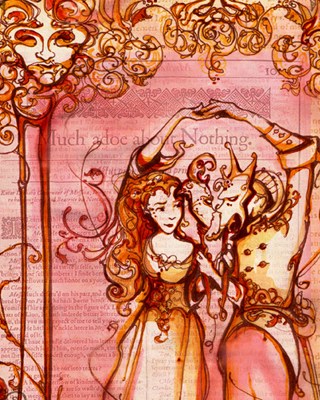
Artwork for “Much Ado About Nothing” by Elizabeth Schuch, reproduced with permission.

Review of Globe Theater Production of “Much Ado About Nothing”!

Hi Folks,

I was doing a little web searching today and came across this incredible link: You can read a review of the Globe Theater’s production of “Much Ado About Nothing,” and you can stream it online, (very useful for those of us who don’t live in London)! I’ve provided the link below:

https://players-shakespeare.com/globe-production-of-much-ado-about-nothing-to-be-reviewed/

While I’m at it, I would also like to mention that as July winds down, I’ll be giving you reviews of some of my favorite Shakespeare on film productions of Much Ado in the next two days, including the new movie version directed by Joss Whedon!

Stay tuned!

-Shakespeare Guru

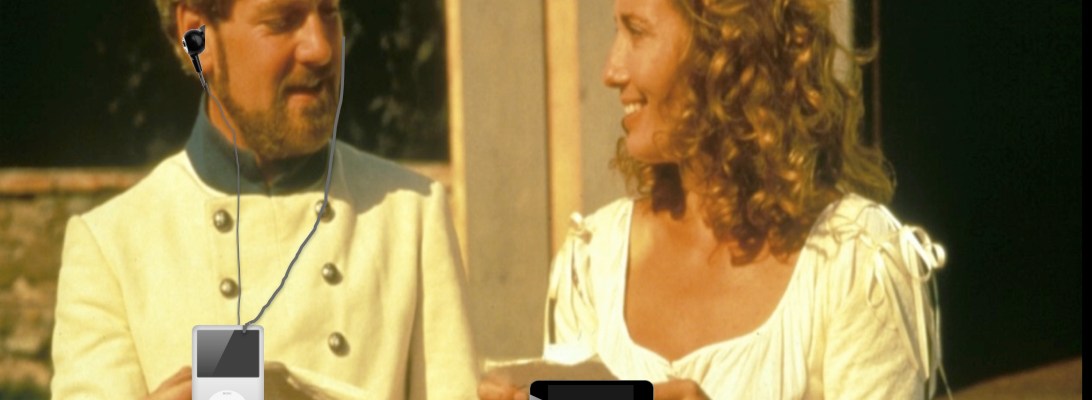
Benedick and Beatrice’s Infinite Playlist, Part 2

Posted on May 8, 2012

Hello loyal subscribers and first time visitors!

If you missed my earlier post, this week I’ve created a little game for you to play at home: you try to match up the songs that express a fictional character’s personality with the events that happen to him/her through the course of play. Yesterday I posted a playlist for Benedick from Shakespeare’s Much Ado About Nothing, and today I’m going to post one for Beatrice. Your mission is to read the events that happen to Beatrice below, and figure out which songs on the playlist below correspond to these events. If you want to suggest more songs, please leave a comment below and I’ll create an extended playlist for the end of the week!  I’ll also post the correct results so you can see how well you did. Enjoy the game and, as Shakespeare said: “Play on!”

Paul Rycik 5/9/12

Events For Beatrice (Match these with the songs from the playlist below)

  1. Benedick and Beatrice have a brief fling and break up before the play begins

  2. Beatrice sees Benedick again at Leonato’s house and blows a flurry of words at him.

  3. Beatrice advises Hero not to worry about her wedding, but instead tells her to “Dance out your answer.”

  4. Beatrice dances with Benedick and pretends not to recognize him.

  5. Beatrice overhears Margaret, Hero, and Ursula ‘secretly confessing’ Benedick’s love for Beatrice.

  6. Beatrice is thunderstruck to discover that not only does Benedick love her, she loves him.

  7. Beatrice is furious at Claudio’s treatment of Hero, and the way men in general treat women.

  8. Beatrice challenges Benedick to prove his love to her by killing Claudio

  9. After soul searching and after Benedick challenges Claudio, Beatrice is on the mend.

  10. Having proved his worthiness to her like a chivalric soldier, Beatrice marries Benedick.