
If you’re as excited about this adaptation as I am, consider signing up for my “Macbeth” class this weekend on Outschool.com. I’ve got slots available for Saturday, January 22nd, at 1PM EST. For details, click here:


If you’re as excited about this adaptation as I am, consider signing up for my “Macbeth” class this weekend on Outschool.com. I’ve got slots available for Saturday, January 22nd, at 1PM EST. For details, click here:
🤓🤪😁😄😀
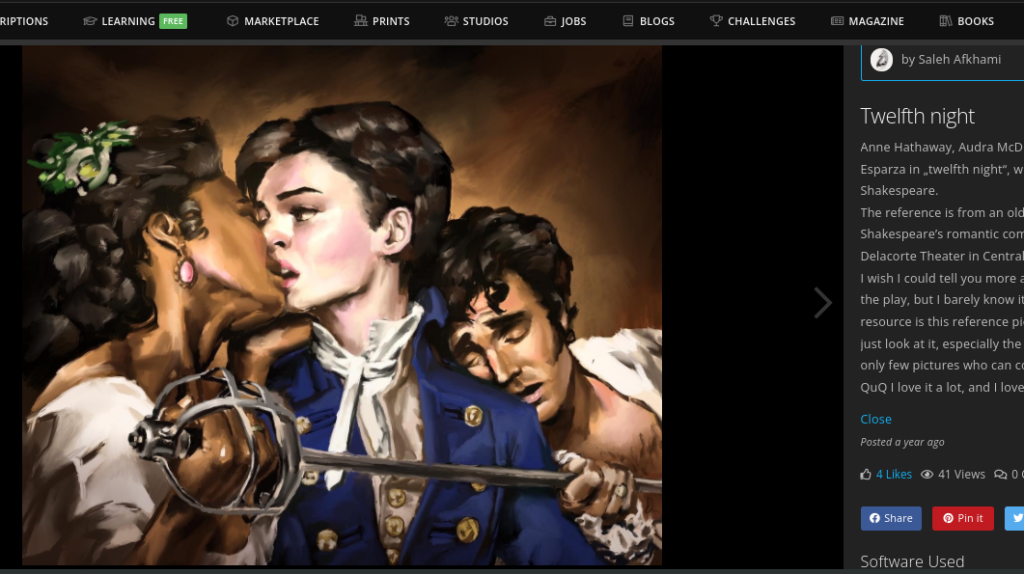
I want to give a shout-out to artist Maike Edling, who painted this beautiful rendition of Anne Hathaway (the actress, not Shakespeare’s wife), playing Viola in Twelfth Night at the Delacorte Theater in Central Park. The colors and the long brush strokes remind me of Cezanne and other early impressionists and give a kind of chaotic feel (appropriate for such a chaotic love triangle). Also, the choice to show Olivia kissing Viola while Orsino looks sadly on is not only passionate and vibrant, it sums up in one image the central conflict of the play: how will Viola deal with the fact that she loves a man, but is pursued by a woman?
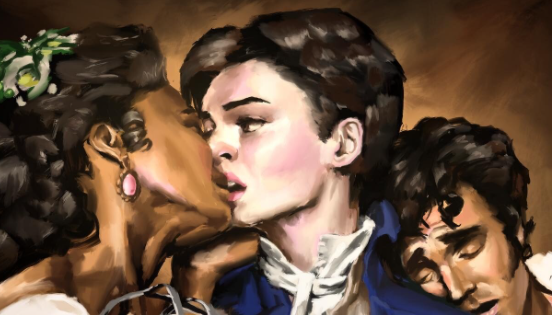
I also love the ambiguity of Viola’s expression. She’s looking at Olivia, but her lips don’t quite touch, as if she’s thinking, “This feels weird, but…” It highlights the flirtation with gender norms and questioning heteronormativity that every production of “Twelfth Night” must address. All in all, I think it is an excellent depiction of the characters, themes and ideas of “Twelfth Night,” and if you can, you should patronize her work. I found this painting at https://www.artstation.com/artwork/ELEEAv, and I think it should get more views.
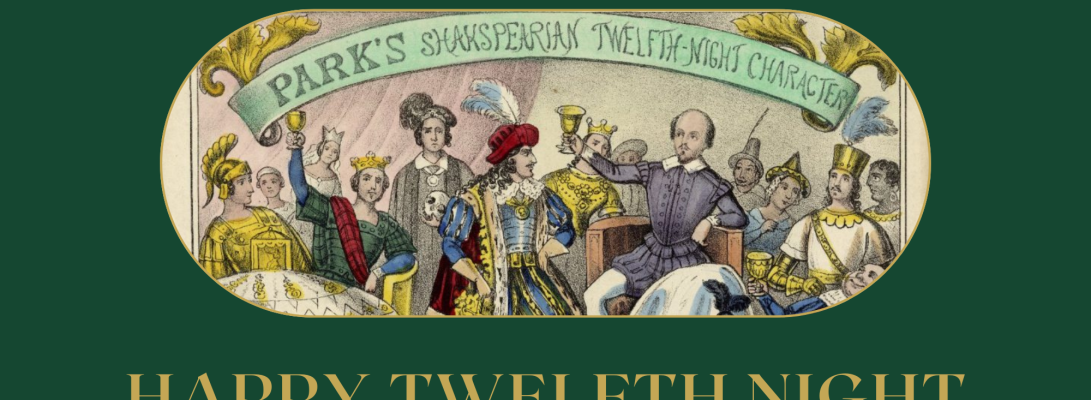
Happy Twelfth Night and farewell to the Christmas season!

This weekend I am offering a special discount on my class on Shakespeare’s Twelfth Night! You can take the course at a $5 discount with coupon code HTHESNIF6B5 until Jan 13, 2022. Go to https://outschool.com/classes/what-was-christmas-like-for-william-shakespeare-BwVLyBPp?usid=MaRDyJ13&signup=true&utm_campaign=share_activity_link and enter the coupon code at checkout.
Finally, here’s a short musical interlude from the movie version of Twelfth Night: Ben Kingsley singing “O Mistress Mine,” from Twelfth Night:
Happy Twelfth Night, and enjoy your cakes and ale responsibly!
More Twelfth Night Posts:
1. Play of the Month: Twelfth Night
2. Creating a Character: Malvolio
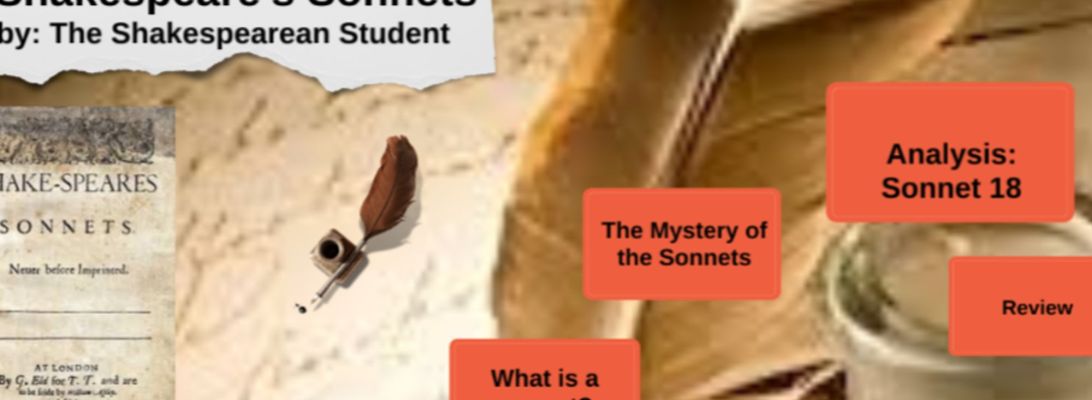
Your child will learn how to write poetry like Shakespeare himself, through a mix of presentations, a printable guideline, and some fun quizzes to test your knowledge of Shakespeare’s sonnets! Designed for ages 13-18.
We will cover what a sonnet is, namely a type of poetry Shakespeare wrote in iambic pentameter with a particular rhyme scheme. Using a combination of Prezi video presentation and Google Slides, I will go in-depth to explain how he organized his poetic ideas into a very compact form.
Using primarily Google slides, we will then analyze Shakespeare's sonnets for their themes, literary devices, and the way he uses the poetry to enhance and heighten emotion and ideas. I will focus mainly on Sonnet 18, "Shall I compare thee to a summer's day?" I will cover Shakespeare's use of such literary devices as:
- Metaphor
- Simile
- Personification
- Rhetorical Question
- Irony
- Paranomasia
Analyzing this sonnet will allow the class to grasp the basics of how a sonnet is constructed, and begin to prepare to write their own. While the presentation is in play, students will be given an access code to an optional Nearpod presentation, that will allow them to construct an iambic pentameter line, quiz themselves on the vocabulary I cover, and provide visual aides to better understand Shakespeare's sonnets.

In the next part of the course, We will engage in a group brainstorming session. I will provide the students with potential topics (assuming they don't have one of their own), and then we will construct a short story using madlibs around that topic that will later be condensed into a sonnet. I will demonstrate to the students how to use imagery and poetic language to enhance the ideas and feelings in the poem. After this, I will use the nearpod and Google slide presentations to guide the students how to tell their own story using such devices as metaphor, personification, allusion, and sensory details. They can jot their ideas down on the provided handout to help organize their thoughts. In addition, the optional handout will have useful brainstorming activities such as a web link to websites like Rhymezone.com, (which helps poets find rhymes to words), and imagery boards that will allow the students to think of sensory details to include in the sonnet . The class will draw attention to the handout activities, and pause briefly to allow the students to do them.


In the last part of the class, I will give the students step-by-step instructions on how to transform their brainstorming ideas into a sonnet. I will begin by showing them how to construct an iambic pentameter line. I will engage the students by clapping out the beats for this line and allow them time to do the same, so they may internalize the rhythm. This will be accomplished via a Google Slides screen.
The final page of the handout has a page to write a draft of their final sonnet, with the line numbers conveniently provided. I will go over every section of the worksheet so the students know how to utilize it effectively.

After all this practice and training, the students will be able to create a basic 14 line sonnet which will give them practice not only writing poetry but also using and recognizing literary devices. It is my hope that this course will not only help the student(s) gain an appreciation for Shakespeare's poetry but also develop their own ability to speak and write eloquently and persuasively.
Happy Veterans Day Everyone,
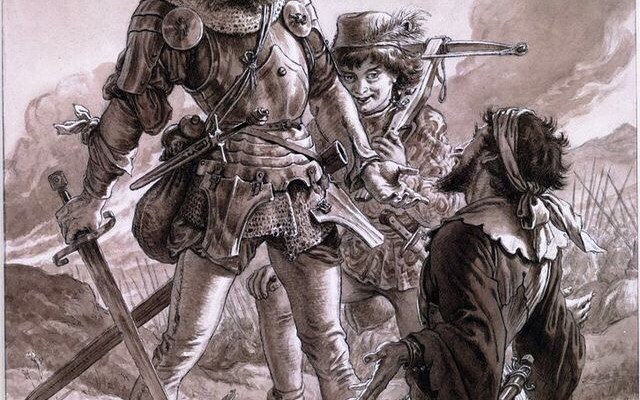
War and soldiers come up a lot in Shakespearean plays. After all, he wrote six plays about the Wars Of The Roses. Though most of his work is about the decisions about war made by powerful monarchs, occasionally he gives us some insight into the lives of common soldiers.
We don’t know if he ever fought, but warfare was very much on his mind at the beginning of his career, with good reason. In 1586 The Spanish armada attacked. Was Shakespeare enlisted? We don’t know.
His early plays are generally positive toward soldiers and it’s easy to see why. The growing nationalism in England resulting from the Tudor control over religion and language —was a direct and defensive reaction to the ex-communication of the Tudor monarchs (particularly Henry VIII and Queen Elizabeth. Shakespeare probably saw himself —
. He no doubt saw his role as building the epic sagas of England to remind his countrymen of England’s past victories, especially during the Spanish Armada and the later Irish Rebellion of 1599.
Shakespeare cashed in with 9 plays on English history that mainly take place on the battlefield. His plays were met with praise by audiences and critics:
“How would it have joyed brave Talbot (the terror of the French),” he wrote, “to think that after he had lain two hundred years in his tomb, he should triumph again on the stage and have his bones new embalmed with the tears of ten thousand spectators at least (at several times).” -Thomas Nashe, c. 1590.
In the first tetralogy, common soldiers don’t have any voice. Probably they were played by apprentices, and fencing masters. They were mainly set dressing. Shakespeare mainly focuses on the pivotal importance of leadership and his portrayal f leadership; he understood the consequences of the choices kings make during the war and its effect on millions of common people: like Talbott and King Henry the Fifth.
I want to analyze a short selection from Henry the Fifth, Act IV, Scene I. In this scene, the king is disguised as a commoner the night before a battle to see what his soldiers really think about him, and the impending fight with the French. An outspoken soldier named Williams tells him that if the fighting is wrong, the king is responsible for his soldiers’ deaths, and has to answer for the atrocities that happen during the war:
methinks I could not die any where so
contented as in the king’s company; his cause being
just and his quarrel honourable.
Ay, or more than we should seek after; for we know
enough, if we know we are the kings subjects: if
his cause be wrong, our obedience to the king wipes
the crime of it out of us.
But if the cause be not good, the king himself hath a heavy reckoning to make, when all those legs and arms and heads, chopped off in battle, shall join
together at the latter day and cry all ‘We died at such a place;’ some swearing, some crying for a
surgeon, some upon their wives left poor behind them, some upon the debts they owe, some upon their children rawly left. I am afeard there are few die
well that die in a battle; for how can they charitably dispose of any thing, when blood is their argument? Now, if these men do not die well, it will be a black matter for the king that led them to it. King Henry V, Act IV Scene I.
Many productions of Henry the Fifth interpret this speech as Shakespeare’s attitude towards war, (a tempting prospect, since the soldiers’ name is William), but in the very next speech King Henry completely changes Williams’ mind! Here’s the full scene from Kenneth Branaugh’s 1989 movie version of the play, which he directed and starred as King Henry:
https://m.youtube.com/watch?v=rv7NsGCDVDs
Next, here’s a fascinating article by psychotherapist Anthony King that attempts to diagnose one of Shakespeare’s most diabolical soldiers, Macbeth: https://warontherocks.com/2015/10/macbeth-as-a-ptsd-victim/
Evidence that Macbeth has PTSD:
Every generation recreates the Shakespeare it needs.” -Anthony King
Macbeth is a veteran dealing with atrocious behavior, his own, and those he’s privy to.
Found on AdAA.org
• Re-experiencing the trauma through intrusive distressing recollections of the event, flashbacks, and nightmares.
◦ Sees daggers 🗡, ghosts, and obsessed over infants 👶
• Emotional numbness and avoidance of places, people, and activities that are reminders of the trauma.
◦ Ignores people and isolated himself in the castle 🏰
• Increased arousal such as difficulty sleeping and concentrating, feeling jumpy, and being easily irritated and angered.
◦ “Macbeth shall sleep 😴 no more”
◦ the murder- in Macbett by Sartre, the soldier actually questions whether the man whom he swore to protect is really worth defending.
 The Shakespearean Student