

I was going to review this movie, but I’m quite impressed by Mr. Galgren of Channel Awesome’s take on it. I think this review is a great summary of how this movie cleverly adapts Shakespeare’s play in a 20th century context, and how incredible Sir Ian’s performance is! Enjoy the review, and see the movie if you get the chance!
Uncategorized
Useful Richard III Website, starring Ian McKellen!

Here’s a lovely website designed to help you learn about Richard’s first soliloquy by interacting with Sir Ian McKellen himself!
First, a video to see it in action:
And here’s the final website: http://www.stageworkmckellen.com/
As a bonus, here’s a review of Sir Ian’s new app, Heuristic Shakespeare:

http://www.avclub.com/article/ian-mckellen-launches-app-make-shakespeare-easier–236049
This app looks incredible, listen to this satisfied customer:
So far, the only play on the app is “The Tempest,” but hopefully if enough people buy it, it’ll expand and encompass all the plays. I hope you’ll check it out!
Watch The Hollow Crown: Richard III

This amazing BBC series does all of Shakespeare’s histories, and for Richard III, they cast one of the greatest young Shakespearean actors: Benedick Cumberbatch!
The Hollow Crown: Richard III
As a bonus, here is an interview with the star, explaining why the play is still relevant today:
The Elephant In the Room: The Real Richard III

Before we continue our exploration of Shakespeare’s “Richard the Third,” I would be remiss if I didn’t spend a little time talking a little about the real Richard Plantagenet, Duke Of Gloucester and king of England from 1483-1485. I have to get this out of the way first and foremost: although “Richard III” is classified as a history play, most of the facts in it are untrue, or severely exaggerated. In this post I will try to separate the character from the man to try and make clear what Shakespeare changed from history and why.
First, a video bio I created:
The facts are these:
-He was a real English monarch who reigned 1483-1485.
– Richard was the younger brother of King Edward IV, and helped his brother take the crown away from King Henry VI, in a series of battles known as The Wars Of the Roses.
– The battles got their name because Richard’s family (the House Of York), used a white rose as its symbol, while King Henry’s faction used a red rose.
– Like Ned Stark in Game of Thrones, Richard was the undesputed “Warden Of the North,” in charge of crushing a potential Scottish invasion.
– In April of 1483, Richard’s brother King Edward IV died. As Lord Protector of England, Richard was entrusted to take care of the country, and Edward’s two sons (the new heirs to the throne). In late May, Richard arrested three lords on suspicion of treason while he guided the two princes to London. Within one month, the two princes were publicly declared illegitimate by the Archbishop, thus making Richard the new king.
– Sometime during Richard’s two year reign, Edward’s sons disappeared. Many believe they were murdered and Shakespeare’s sources named James Tyrrell and Michael Forrest as the murderers, acting under King Richard’s orders. In 1674, the skeletons of two boys believed to be the princes were discovered in the Tower Of London. The remains were interred by King Charles II. So far, nobody has confirmed if the remains belong to the princes or what happened to the young boys.
-Richard was defeated and murdered by Henry Tudor, Earl of Richmond at the Battle Of Bosworth Field on August 22, 1485. His successor founded the House Of Tudor which included Henry VIII, Mary I, Edward VI, and Queen Elizabeth I.
-in 2015, historian Phillipa Langley discovered King Richard’s remains in a parking lot in Leicester
Few contemporary sources survive from Richard’s day, so it’s unknown whether Richard did kill the princes. Even more mysterious, although he did work to depose a king, oppress the Scots, and take the throne from Edward’s kids, some sources claim Richard was actually a just and good king. In the lack of facts, Richard’s legend continues to grow
Reality check
 -After finding his skeleton, scientists discovered that Richard was not deformed, although he did have scoliosis. Thomas Moore added the hump, while Shakespeare added the withered arm.
– There is no physical evidence that Richard killed the two princes, and many others wanted them dead, including Henry Tudor himself!
-Richard also probably was a good king according to some contemporary accounts, as you can see in this video with Monty Python’s Terry Jones:
Why were the facts twisted?
– Remember, Richard was defeated by Henry Tudor, Queen Elizabeth’s grandfather, so there was no way Shakespeare or anyone else in Elizabethan England could get away with portraying him as a good king.
– Shakespeare’s main source was a history by Sir Thomas More, who was 12 at the time of Richard’s reign. More was Henry VIII’s royal chancellor, so he couldn’t afford to be nice to Richard either. More’s history set the groundwork for Shakespeare’s portrayal of Richard as a deformed monster.
The point is, people have known for centuries that Shakespeare’s Richard is no more true than the myth of Robin Hood. Even Laurence Olivier admits before his film even starts that this story has been “scorned in proof thousands of times.” Nevertheless, like Robin Hood, this story is part of the fabric of English society, and it still has value as a cautionary tale about corrupt governments, and how one man may lose his soul (and a horse) in pursuit of power and revenge.
Even today, people continue to gain power by manipulating fear, hatred, and religion, which is why we as a society need Shakespeare’s Richard. The play is so universal it was re interpreted in 2007 as “Richard III: an Arab tragedy.” Shakespeare’s Richard is so close to today’s dirty politicians that we have TV shows on both sides of the Atlantic inspired by him, (more on that later). And Richard himself is so compelling a character that centuries of great actors, cartoon characters, and even occasional rock stars have wanted to emulate him.
The lesson of the story is that a single demagogue can gain control of a corrupt system if we let him. Hitler, Saddam, Trump. It’s no accident that Olivier chose to play Richard right as the war was ending in Europe, and his popularity in that role rose exponentially after post war Britain saw the parallels between the “honey words” of Richard, which captivated England, to Hitler’s fiery rhetoric, which nearly destroyed it. The larger point through all four plays of Shakespeare’s history cycle, (not just “Richard III,”) is that greed and cruelty within one family can lead to chaos on a large scale, especially when it’s the royal family.
For more information:
Books:
- The Daughter Of Time by Josephine Tey, 1951: This is the most famous book that sets down the case that Richard’s reign was maligned by history. In addition to having excellent research, it is also a compelling novel.
- Shakespeare’s English Kings by Peter Saccio. To help students of Shakespeare separate fact from fiction, and get a sense of the lives of the men whose lives shaped Shakespeare’s history plays, Professor Saccio of Dartmouth College created a short, easy to read biography of all 10 of Shakespeare’s monarchs.
Websites:
The Richard III Society: Official website of the society dedicated to preserving the memory of Richard III.
Historic UK: Short biographies of English Monarchs
Leicester Cathedral’s Richard III Page: http://kingrichardinleicester.com See pictures and read about Richard’s final resting place, and how his remains were found, and re-interred.
Westminster Abbey- The tomb of most English kings and queens for over 1,000 years:
http://www.westminster-abbey.org/our-history/royals?start_rank=1
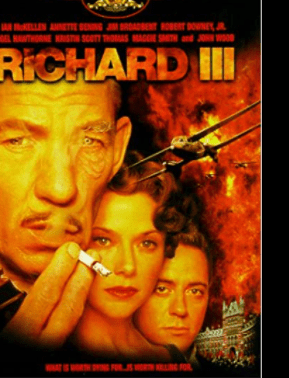
Intro to Richard III
Hi everyone,
Introducing our new Play of the Month: Shakespeare’s dark history play about murder and corruption, Richard III. First, a short presentation I made that introduces the characters and themes of the play.
Second, a quick, funny summary of the play from the Reduced Shakespeare Company
And finally, this incredible animated version of the play, which looks like a stained-glass window come to life!
I’m Back!
Hello everyone,
I’ve chosen to return to the blogosphere, now that my daughter is a little older. Still, I am still a dad, so I won’t be able to post as frequently as before. That said, August will be a HUGE month for this blog, since I have tons of material for our next Play Of the Month, RICHARD III!
For those of you unfamiliar with this truly excellent play, it’s the semi-true story of the infamous English king, who reportedly had a hump, a limp, and a withered arm, and chose to compensate for this by slaughtering his way to the throne!
Also, look forward to more educational content, more reviews, and hopefully a few podcasts as well.
Well, I gotta get back to work, so see you soon!
Quick Plug For A Great Show
Hi everyone!
If you need something fun to do this weekend, and you live in southern Pennsylvania, come out to Orange Mite Studio’s production of “Julius Caesar,” I was very impressed by all the performances, and would recommend it to anyone!

On Hiatus
Dear readers.
To help my raise my little daughter, I need to take a break from blogging. Don’t worry, I already have plans for the coming months and I will have plenty of content coming up. I just ask for your patience and in the meantime, please peruse my previous posts.
Till I return!
The Shakespearean Student
RIP Alan Rickman

Hung be the heavens with black, yield day to night! – William Shakespeare
One of the greatest classical actors of our time has gone to his great reward, which I hope includes a “good show” from Shakespeare himself. Most people know Alan Rickman as the slimy Professor Snape, or the evil Hans Gruber, or the cheating husband from “Love Actually,” but a generation ago he was a Shakespearean acting phenomenon at the Royal Shakespeare Company, playing such roles as Jaques, Hamlet, and Achilles. As much as I love Harry Potter, I think it’s wrong to remember such a versatile actor for only one role, so here’s a retrospective of his work that I found this morning. Guardian Tribute to Alan Rickman
“Good night sweet prince, and flights of angels sing thee to thy rest.”
 The Shakespearean Student