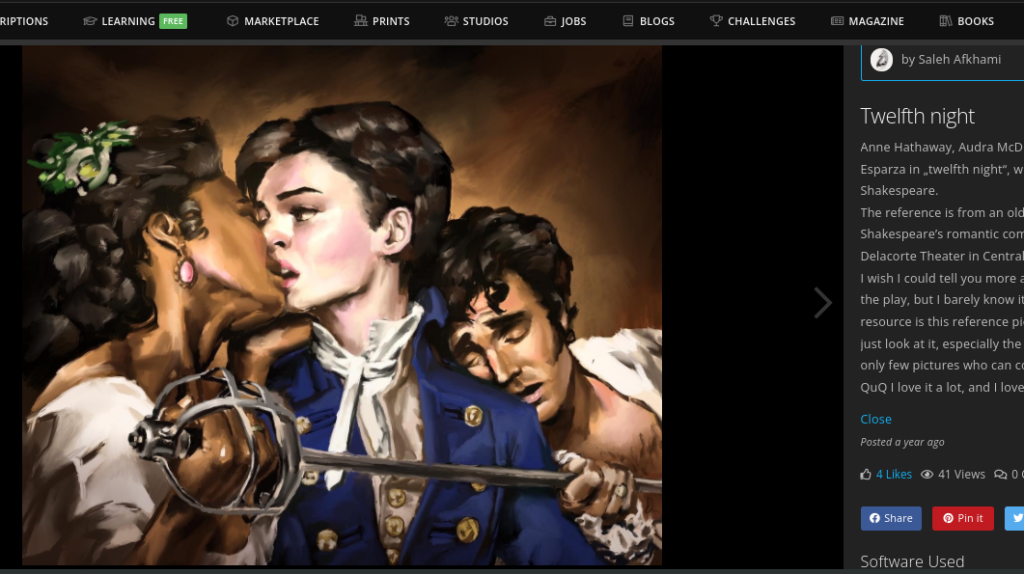
“Twelfth Night” painting by Maike Edling, from ArtStation.com
I want to give a shout-out to artist Maike Edling, who painted this beautiful rendition of Anne Hathaway (the actress, not Shakespeare’s wife), playing Viola in Twelfth Night at the Delacorte Theater in Central Park. The colors and the long brush strokes remind me of Cezanne and other early impressionists and give a kind of chaotic feel (appropriate for such a chaotic love triangle). Also, the choice to show Olivia kissing Viola while Orsino looks sadly on is not only passionate and vibrant, it sums up in one image the central conflict of the play: how will Viola deal with the fact that she loves a man, but is pursued by a woman?
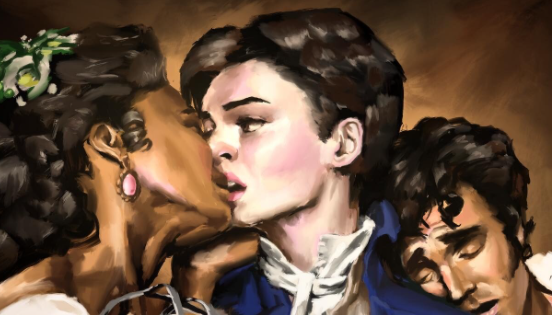
Close up of the painting.
I also love the ambiguity of Viola’s expression. She’s looking at Olivia, but her lips don’t quite touch, as if she’s thinking, “This feels weird, but…” It highlights the flirtation with gender norms and questioning heteronormativity that every production of “Twelfth Night” must address. All in all, I think it is an excellent depiction of the characters, themes and ideas of “Twelfth Night,” and if you can, you should patronize her work. I found this painting at https://www.artstation.com/artwork/ELEEAv, and I think it should get more views.
Your child will learn how to write poetry like Shakespeare himself, through a mix of presentations, a printable guideline, and some fun quizzes to test your knowledge of Shakespeare’s sonnets! Designed for ages 13-18.
Class Description:
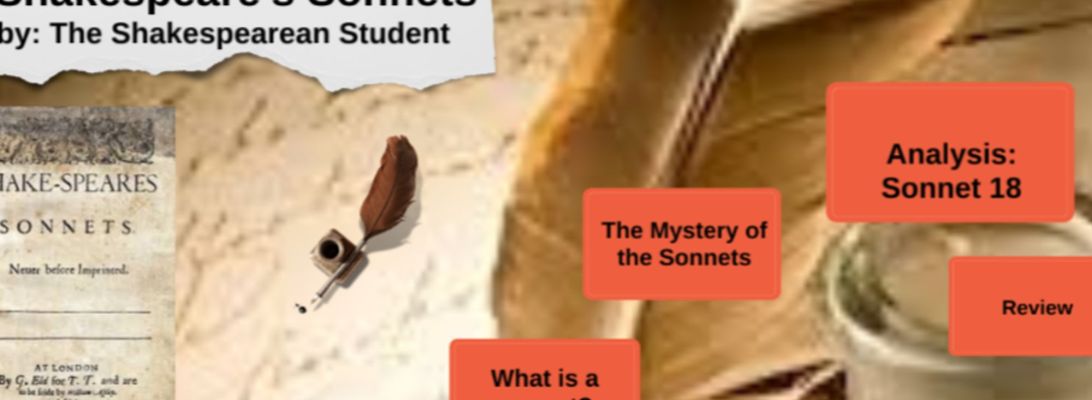
We will cover what a sonnet is, namely a type of poetry Shakespeare wrote in iambic pentameter with a particular rhyme scheme. Using a combination of Prezi video presentation and Google Slides, I will go in-depth to explain how he organized his poetic ideas into a very compact form.
Using primarily Google slides, we will then analyze Shakespeare's sonnets for their themes, literary devices, and the way he uses the poetry to enhance and heighten emotion and ideas. I will focus mainly on Sonnet 18, "Shall I compare thee to a summer's day?" I will cover Shakespeare's use of such literary devices as:
- Metaphor
- Simile
- Personification
- Rhetorical Question
- Irony
- Paranomasia
Analyzing this sonnet will allow the class to grasp the basics of how a sonnet is constructed, and begin to prepare to write their own. While the presentation is in play, students will be given an access code to an optional Nearpod presentation, that will allow them to construct an iambic pentameter line, quiz themselves on the vocabulary I cover, and provide visual aides to better understand Shakespeare's sonnets.

In the next part of the course, We will engage in a group brainstorming session. I will provide the students with potential topics (assuming they don't have one of their own), and then we will construct a short story using madlibs around that topic that will later be condensed into a sonnet. I will demonstrate to the students how to use imagery and poetic language to enhance the ideas and feelings in the poem. After this, I will use the nearpod and Google slide presentations to guide the students how to tell their own story using such devices as metaphor, personification, allusion, and sensory details. They can jot their ideas down on the provided handout to help organize their thoughts. In addition, the optional handout will have useful brainstorming activities such as a web link to websites like Rhymezone.com, (which helps poets find rhymes to words), and imagery boards that will allow the students to think of sensory details to include in the sonnet . The class will draw attention to the handout activities, and pause briefly to allow the students to do them.


In the last part of the class, I will give the students step-by-step instructions on how to transform their brainstorming ideas into a sonnet. I will begin by showing them how to construct an iambic pentameter line. I will engage the students by clapping out the beats for this line and allow them time to do the same, so they may internalize the rhythm. This will be accomplished via a Google Slides screen.
The final page of the handout has a page to write a draft of their final sonnet, with the line numbers conveniently provided. I will go over every section of the worksheet so the students know how to utilize it effectively.

After all this practice and training, the students will be able to create a basic 14 line sonnet which will give them practice not only writing poetry but also using and recognizing literary devices. It is my hope that this course will not only help the student(s) gain an appreciation for Shakespeare's poetry but also develop their own ability to speak and write eloquently and persuasively.
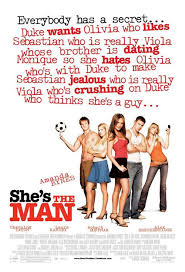
Since Twelfth Night is coming up, I’m going to review a blast from the past, the Amanda Bynes teen comedy remake of Twelfth Night called “She’s The Man”.
Poster for “She’s The Man”
Some of you might remember that the late 90s and early 2000s were the heyday of Hollywood remakes of Shakespeare: Romeo + Juliet directed by Baz Luhrman, 10 Things I Hate About You, (The Taming Of the Shrew) “O” (Othello), and even “Get Over It” (“A Midsummer Night’s Dream”). Shakespeare was actually hot for a few years and many writers were riding his doublet.
Sadly, not all Shakespeare remakes are created equal. Most of them were created with care to try and either show love for the text (as in Romeo and ‘O’) or to improve or contemporize the text like in ‘O‘ and “10 Things I Hate About You,” (which interestingly, both starred Julia Styles). “She’s The Man” doesn’t feel like a faithful retelling of “Twelfth NIght” despite the fact that it keeps most of the characters and the central conceit of the story- a girl disguising herself as her twin brother, going to a new place called Ilyria and inspiring love in both a powerful man and a beautiful woman.
Original Tailer for 2006’s “She’s The Man”
Amanda Bynes as Sebastian is a characature of 90’s bro culture and rarely ever plays her male role straight or convincingly. Nobody would be fooled into thinking this girl is a boy.
Bynes’ Viola rarely challenges anything or does a good job playing soccer until the end of the movie. Her main reason for her masquerade is that her brother forced to do it, so he can run away to become a musician.
I also don’t like that Sebastian never seems to impress or endeer the coach. If her goal was to prove that girls are just as good as guys, he should be her focus, but they rarely evershare the screen.
This Viola also never challengers Duke (her love interest played by Channing Tatum). One of the best parts of Shakespeare’s version is that Duke Orsino is a mopey would-be incel who puts women on a pedestal one minute, and condemns them the next. One of the best things about his relationship with Viola is that it makes him better able to appreciate women, but his counterpart in She’s All That has no such epithany.
I do want to give a shoutout to Laura Ramsey as Olivia . She frankly is a better actress then Bynes and plays Olivia’s unrequited love for Viola very well. Initially, she gets a copy of Sebastian’s song lyrics and she’s smitten by Sebastian’s words, rather than his looks. This makes you hope the real Sebastian will return.
Below is a montage of the jokes in the film. I hope you notice that most of them are very lowbrow and pretty cliche, even for teen movies. At 5:20 is the only really good part of the movie- it explains why Olivia’s love for Viola is funny and tragic. Guys are taught never to open up to women, but women want emotional connections. Men are taught women aren’t equal, but women yearn for acceptance. Viola in disguise has no concept of these unspoken ‘rules’ of male behavior, so she seems like the perfect man to Olivia- someone who treats her like an equal, isn’t afraid to open up, and is also male. The fact that she’s actually developing feelings for a woman is what makes it funny and tragic.
In conclusion, I’m kind of glad this Shakespeare rom-com is slinking into obscurity since it adds nothing and waters down the original to oceanic degrees. Frankly, I think there was a much better adaptation of Twelfth Night that, although it changed the names, location, and text, was a more thought-provoking and insightful rendition of the story- the 1996 animated film, Mulan.
If you liked this podcast, please consider signing up for my new online class “What Was Christmas Like For William Shakespeare?” There will be games, recipes, and a few more insights into the play “Twelfth Night.”





 The Shakespearean Student