https://open.spotify.com/episode/2OqXVM4452ovzFYeiJJn5q?si=tn8wMzLlS7ew646N-w-XQQ
I’ve created a close read of three of Hamlet’s soliloquies for your listening pleasure. Let me know which is your favorite soliloquy!
https://open.spotify.com/episode/2OqXVM4452ovzFYeiJJn5q?si=tn8wMzLlS7ew646N-w-XQQ
I’ve created a close read of three of Hamlet’s soliloquies for your listening pleasure. Let me know which is your favorite soliloquy!

In 2008, I was in grad school studying Shakespeare. My roommate Robbie invited me to watch this show on DVD. I loved the show at the first watch and bought my own copy soon after. I also shared watching them with the woman who would later become my wife. Watching this show was our unofficial first date!
So as you can see, I clearly have a bias and a nostalgic connection to this show, but I think it has garnered enough praise that I can justify my admiration of it. The creators are Tony award-winning writers. The actors are acclaimed stars on stage and screen, all of whom have experience with Shakespeare, musicals, improv-comedy, or all three! So we have a comedy written by talented theater practitioners, acted by professional Shakespearean actors, and half the dialogue is Shakespeare? Was this show made specifically for me?
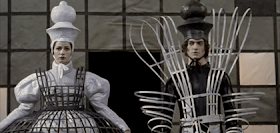
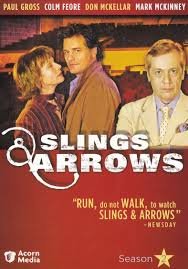
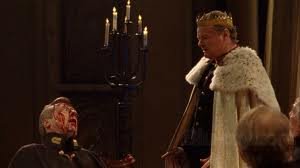
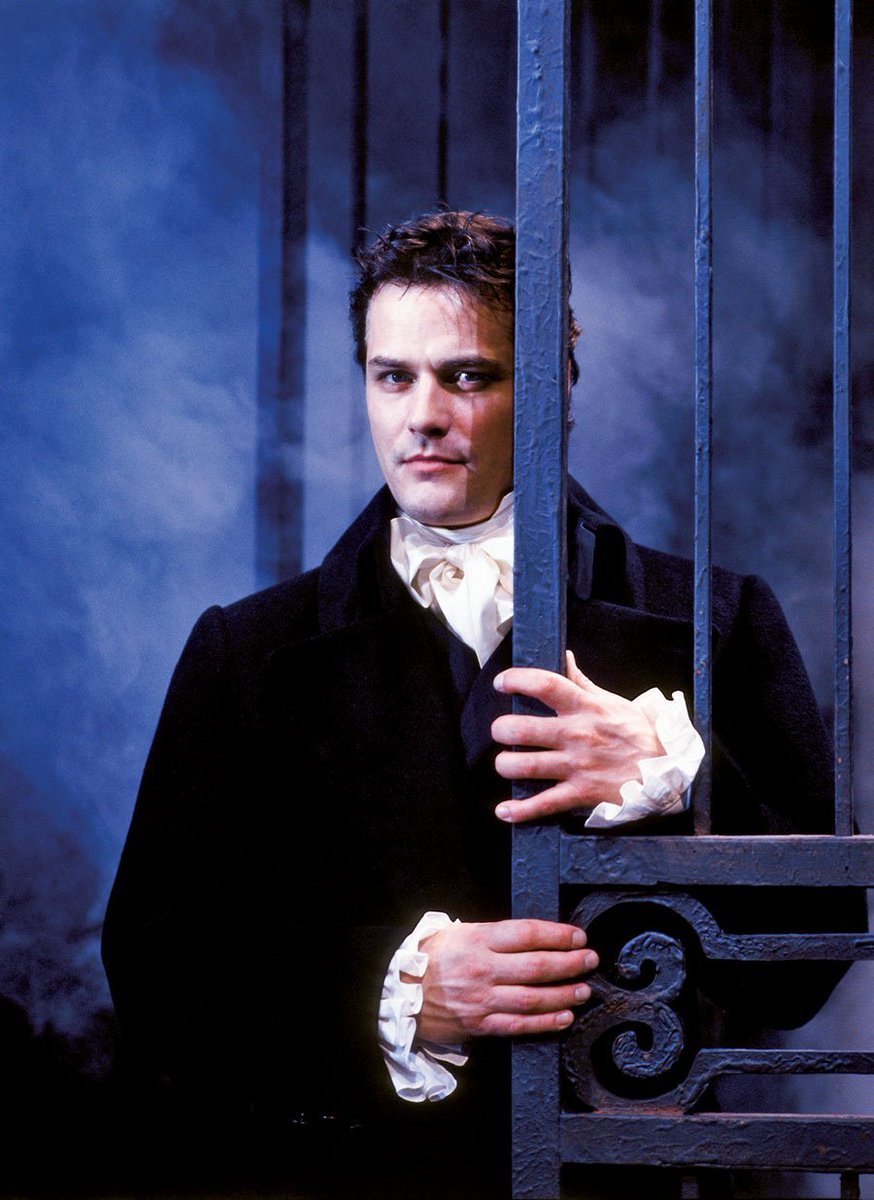
Something is rotten at the New Burbage Shakespeare Festival- a fictional Canadian Shakespeare company that is loosely based on the Stratford Shakespeare festival. The Artistic Director, Oliver Wells has died in suspicious circumstances, right before he was to start rehearsing “Hamlet.” Wells’ successor is a volatile actor-manager named Geoffry Tennet, who, in addition to dealing with the work-a-day demands of running a theater, the backstage drama of directing a play, his own romantic feelings for lead actress Ellen, is also having ghostly visits from his old mentor, Olliver! What follows is a funny, tragic, bittersweet comedy about drama. It’s The Office for Shakespeare Nerds!
The drama centers around the actors and actresses in the New Burbage Festival as they rehearse a Shakespeare play; Hamlet in Season 1, Macbeth in Season 2, and King Lear in Season 3. The subplots are more often than not workplace drama. Ironically, though the main cast parallels hamlet, the management team of Richard St-John (with a hyphen, played by Mark McKinney) and Holly Day (Jennifer Irwin), are unknowingly playing Lord and Lady Macbeth. The two of them plan to sabotage the production and eventually replace all Shakespeare shows with a more profitable musical-theatre-centered festival. It’s deliciously ironic that McKinney plays the scheming musical-loving Richard, since he himself is one of the Tony-award-winning writers of the Drowsy Chaperone.
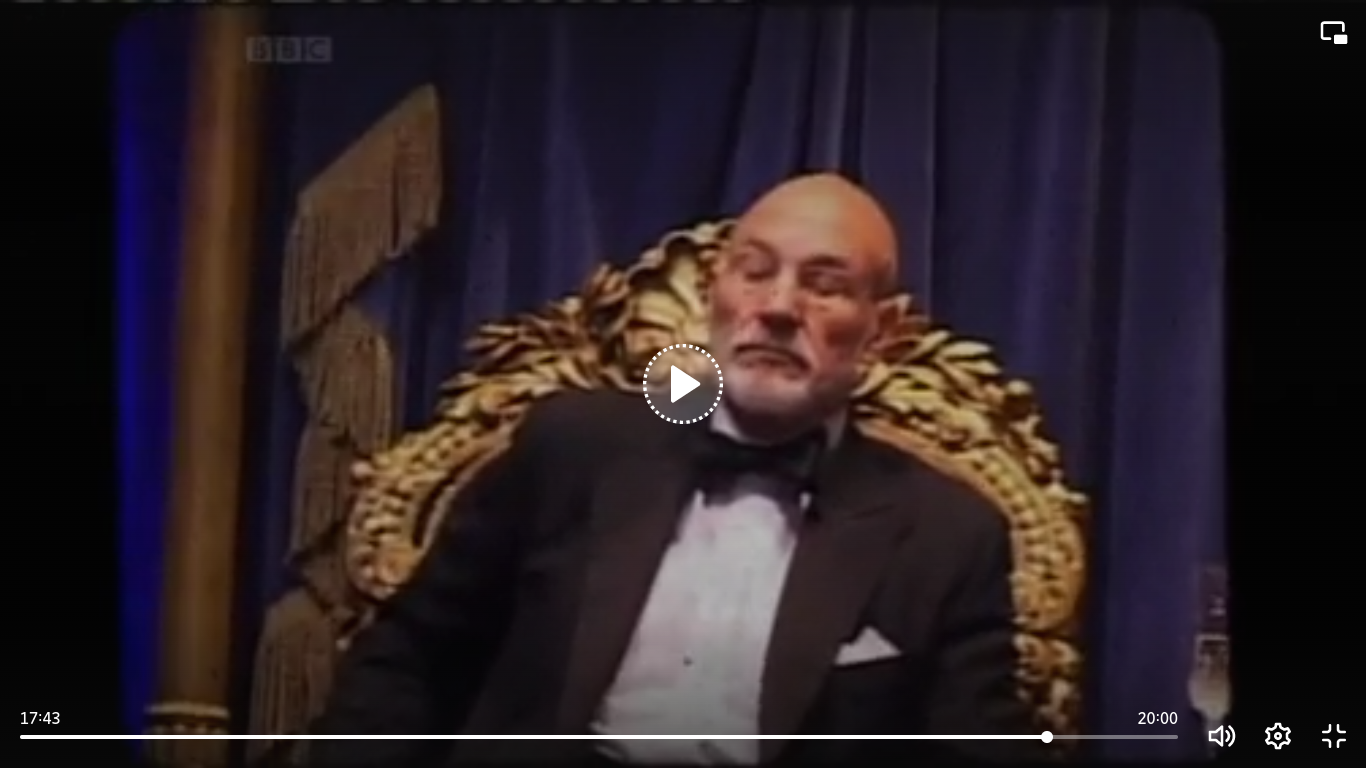
I’ve said before that Gorss gives a kind of animal intensity as Hamlet and Geoffrey, and this is especially true in Season 1. When we first meet him, Geoffrey lost his girlfriend, his sanity, and his career as a respected actor. Then he has to return to the theatre where the man who betrayed him works, and is forced to take over this same theater as Artistic Director.
If you’ve never seen the show before, I should warn you, GEOFFREY IS AN ABSOLUTE JERK in the first few episodes. Like I said, he starts out hating his job and pushing away everyone who comes in contact with him. However, little by little, he re-discovers why he loves theater, Shakespeare, and his friends and colleagues. Look at how he goes from a sarcastic pedant to a real director as he teaches these businesspeople how to act!

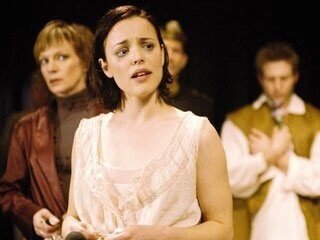
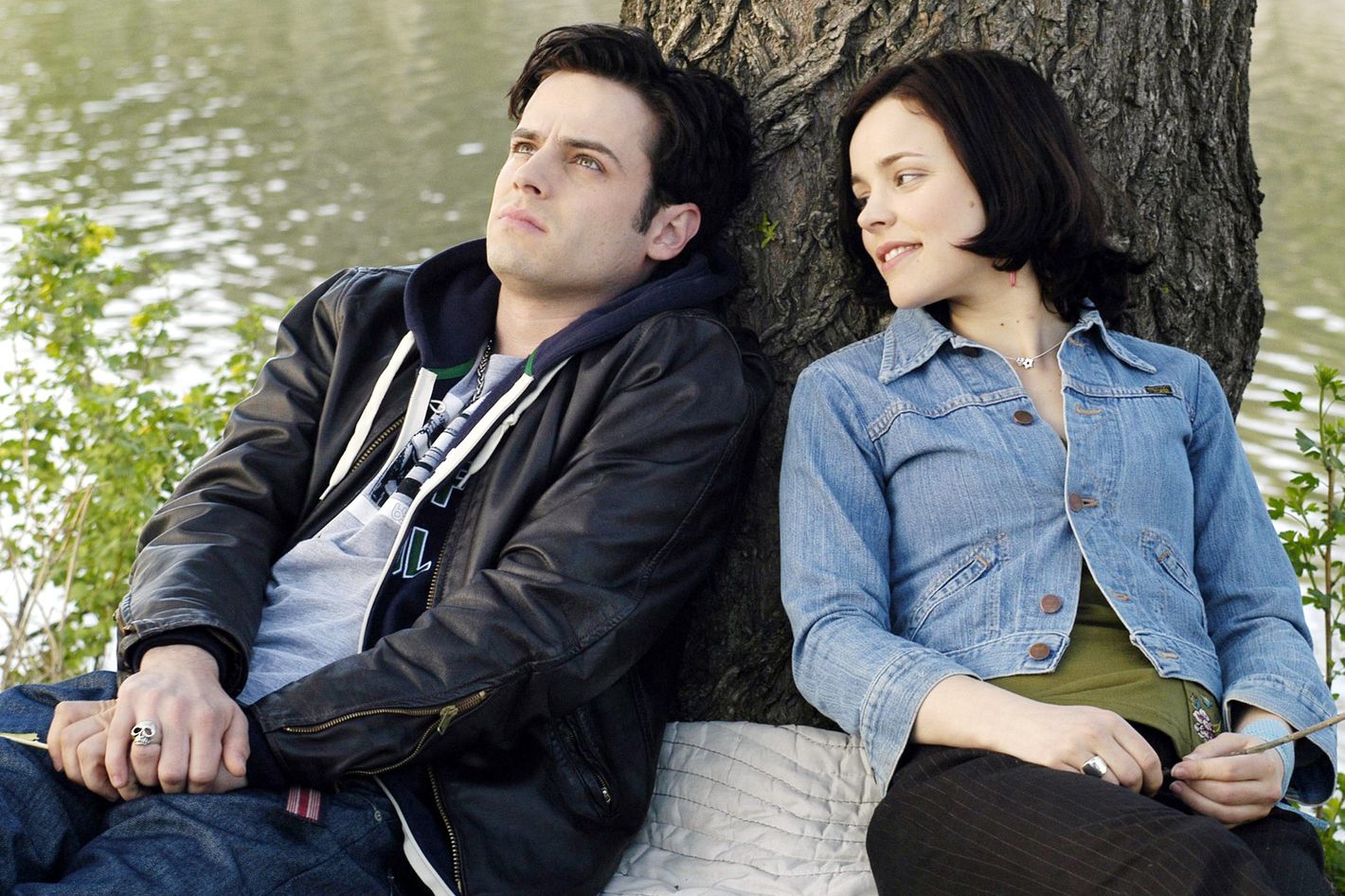
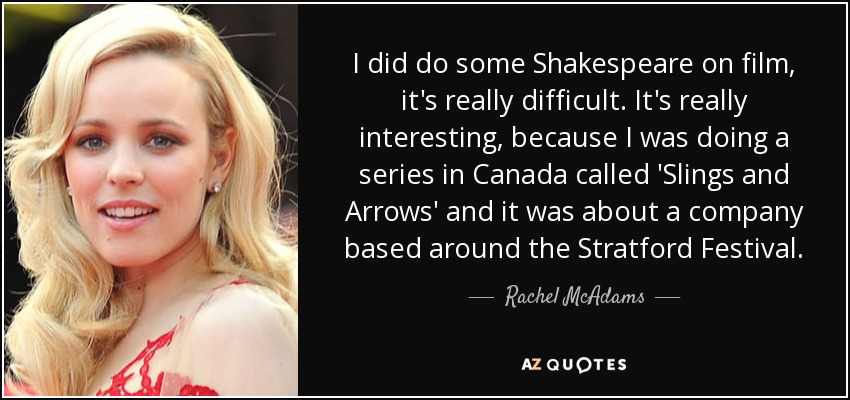
The most truly lovely thing about season 1 in particular, is watching Rachel McAdams’ charming and heartfelt performance as Kate. She plays a struggling actor who deeply loves the theater and dreams of becoming a respected actress. Her dreams are tested however when she falls in love with one of her co-stars and is accused of sleeping her way into a better role.

McAdams is the perfect ingenue in this show: She is naive, charming, Ernest, and kind. You watch Kate struggle and desperately want her luck to turn around and then rejoice when she gets to fulfill her dreams.
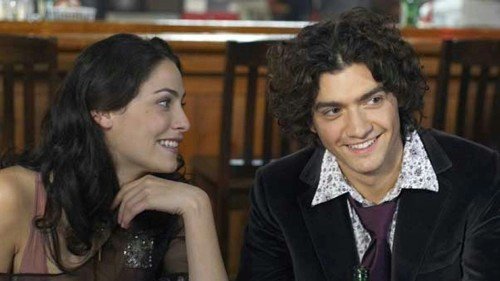
As Kate on Slings, she’s the understudy who knows better — happy to be cast, sad that she’s not really cast, and trying not to be bitter that the actual Ophelia is such a wreck. Her smarts and capability of course find her pairing off with Jake (Kirby), who’s more famous but less theatrical.
Slings and Arrows Is the Show Rachel McAdams (and All of Us) Deserved
By Margaret Lyons. Vulture Magazine, Aug, 2015.
Then you remember… she was Regina George! It’s easy to overlook how good an actor Ms. McAdams is since she frequently is overshadowed by her co-stars. Much like Ophelia herself, people heap all the praise on Hamlet and forget Ophelia. When I keep in mind the breadth of emotions Ms. McAdams has to portray, and how incredibly different this role is from her role in Mean Girls, I feel compelled to say her acting rivals Paul Gross as Geoffrey Tennet
Geoffrey: “Are you dead, or am I insane?
Oliver’s ghost: “I don’t see how those things are mutually exclusive.”
S&A Episode 3
I recommend watching all six episodes of Season 1 consecutively, but I can’t deny, some episodes are better than others, especially in Season 1. The first three episodes mainly focus on Oliver’s death and the tragedy of the falling out between Geoffrey, Oliver, and Ellen. This is important for backstory purposes, but it’s a little uncomfortable and sad to watch. My favorite episodes are episodes 4,5 and 6. Here’s why:
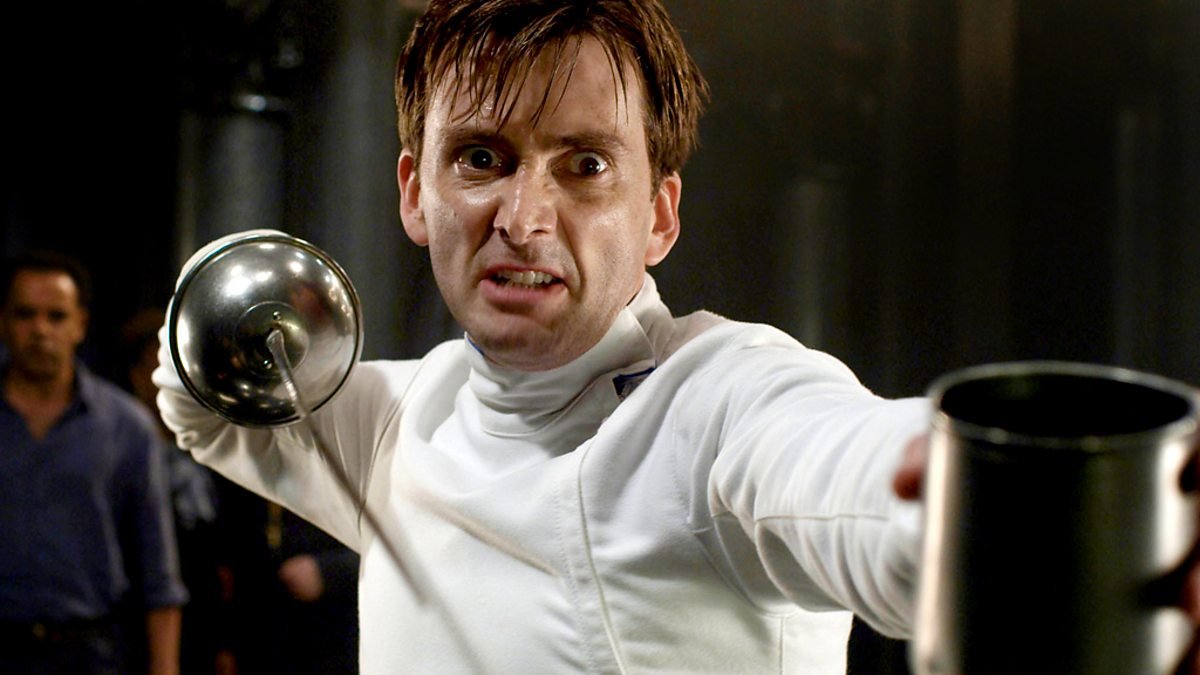
After a drunken sword fight at his ex-girlfriend’s house, Geoffrey winds up in jail. This is his rock bottom. He even paraphrases Hamlet’s most famous speech as he contemplates ending it all in his cell. Thankfully, Oliver’s Ghost talks him out of it. Once he’s released, Geoffrey is re-energized and has a new purpose in life- directing Hamlet. Again, after three episodes of Geoffrey hurting, irritating, and sometimes even stabbing people, it’s nice to see our hero do what he was put here to do.
Geoffrey is finally fully committed to making the best Hamlet he can be, but he’s having problems with his Ophelia.
Geoffrey’s star is missing! With the production stalled, Geoffrey and Ellen finally have it out, and finally, share their tragic past with each other. Now the race is on to, “Repent what’s past, avoid what is to come, and fulfill their promise to Oliver.
So I hope I’ve articulated why I love this show and its characters. Just like anyone who’s ever had a boring office job loves and recognizes the characters from “The Office,” those of us in the theater recognize the crazy directors, the hopeful understudies, the divas, and the money-grubbing management. These characters feel like our friends and colleagues and they care so much about the universal dogma of “The show must go on,” no matter what kind of agonizing problems slow it down. Whether it be death, dementia, or a dislocated knee caused by a chameleon. the show within-this incredibly clever comedy about drama will catch your conscience… and your heart.
Play ME OUT CYRILL!
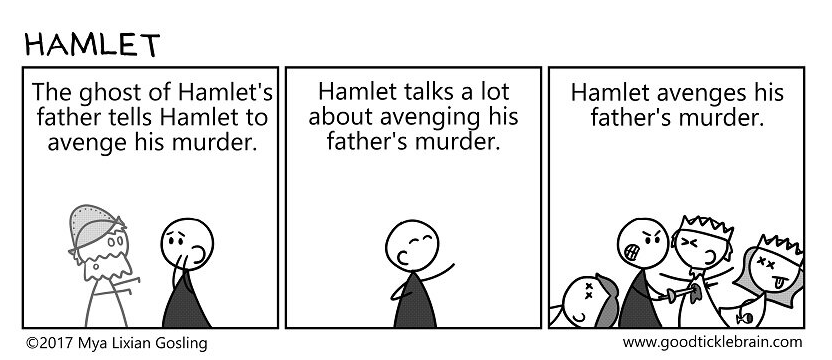
I was saddened to hear of the recent passing of actor Kevin Conroy, world-renowned as the voice of Batman and Bruce Wayne on Batman The Animated Series, the Arkham Asylum games, and many others. Conroy is definitely my favorite Batman, and as I and many others have said before, there are Shakespearean tropes in the Caped Crusader. From the very beginning, Conroy drew inspiration from a particular Shakespearean play, the melancholy prince, dressed in black, who seeks to revenge his father’s murder: Hamlet, Prince of Denmark:
I did a cold audition, I had never done an animated voice before. I said the only exposure I’ve had is the Adam West show from the 60’s and they said “NO! NO! NO! That’s not it.” I said ZIP POW POP and they said “NO! It’s, think film noir, think the 40’s New York. Think dark, think a kid who just watched his parents get murdered and spends his life avenging their deaths and he lives in the shadows. He’s got this dual personality and he’s never resolved this torture of his youth. I said you are telling the Hamlet story, this is heavy stuff. And he said yeah, no one has ever said that before, but yeah I guess it is. This is like a classic archetypal, Shakespearian tragedy. So I just used my theater training and put myself into that head (Batman voice) And I got into this very dark place and came up with this voice. (Regular Voice) And as I did it I saw them all running around in the booth. And I thought well either I did something really bad or something really good because I hit a nerve, I know I hit a nerve. And they came out and they said well we’ve seen about over 600 people and how would you like to do the part?
Kevin Conroy
It makes sense that Conroy would use Shakespeare to flesh out Batman. He was a veteran of the Old Globe Theater in San Diego, and performed in Hamlet several times. He even played the prince himself for the New York Shakespeare Festival in 1984. Yet I don’t think Conroy’s decision to make Batman a sort of modern-day Hamlet was entirely based on just his past experiences with Hamlet.
“Batman is basically the American version of Hamlet,” Affleck said. “We accept that he’s played by actors with different interpretations.”
Ben Afleck, Entertainment Weekly, 2015.
Batman and Hamlet are basically Revenge Tragedies; age-old stories that began with Oedipus Rex and the Orestia in ancient Greek plays, where a hero must lift a plague on his society by avenging the death of a parent (usually the father). This kind of play was very popular in Shakespeare’s day and included a host of others such as Shakespeare’s Titus Andronicus, The Spanish Tragedy, Locrine, The Dutchess of Malfi, and later The Revenger’s Tragedy.
But Hamlet, like Batman, is an avenger. He didn’t make Denmark rotten. That was Claudius, and if Claudius self-punished like Oedipus, Claudius would be a tragic hero too. But Claudius is just a garden-variety villain, and so Denmark needs a hero to set things right. Enter Hamlet. He’s “tragic” only in the sense that he dies, and since he dies after completing his heroic mission, he dies triumphant. But unlike the deaths of Claudius, Oedipus, and Macbeth, his death isn’t necessary to restore order. It’s just an epilogue.
Chris Gavaler, The Patron Saint Of Superheroes. “Something is Rotten In the State Of Gotham.”
As this clip above indicates Hamlet is unique among revengers because his conflict doesn’t come from the machinations of his villain; he’s stopped by his own internal conflicts. Batman is more active than Hamlet, but he also wrestles with internal conflicts and Conroy plays these conflicts with a lot of subtlety and nuance. To illustrate this conflict, let’s look at some great clips from the series!
In this episode, Dr. Strange (not the Marvel Superhero), uses a dream-reading machine to try and blackmail Bruce Wayne, and inadvertently discovers his secret identity. Not only does this episode dramatize Wayne’s literal worst nightmare, (someone figuring out who he is), it also touches on the pain of his past and how even though now Batman is a deputized agent of the law who never kills, he began as an angry, vengeful vigilante, like Hamlet:
I am myself indifferent honest, but yet I could accuse
Hamlet, Act III, Scene i.
me of such things that it were better my mother had not borne me.
I am very proud, revengeful, ambitious; with more offences at my
beck than I have thoughts to put them in, imagination to give
them shape, or time to act them in.
In this clip from the animated movie Mask Of the Phantasm (1993), a pre-Batman Bruce Wayne feels a conflict between his obligation to avenge his parent’s death, and his budding romance with Ms. Andrea Beaumont:
One can almost sense an Ophelia- Hamlet-like conflict where Bruce knows his quest to avenge will consume him, and leave no time to pursue romance. In all revenge tragedies, the hero has to avenge alone, or at least without the support of a spouse or partner. Hamlet also makes the choice to cut Ophelia out of his life, though it’s not clear why. It could be he’s worried that Claudius will harm her, it could be he’s worried she’s compromised since her father tried to spy on him, or it could simply be that he doesn’t trust her. It’s up to the actor and director to “Pluck the heart of Hamlet’s mystery.”
Eventually though, the choice is made for him, and Bruce Wayne completely commits to his quest to battle the crime in Gotham, as this epic scene from “Mask of The Phantasm” shows:
Haste me to know’t, that I, with wings as swift
Hamlet, Act I, Scene v.
As meditation or the thoughts of love,
May sweep to my revenge.
The spirit that I have seen
Hamlet, Act II, Scene ii.
May be a devil; and the devil hath power
T’ assume a pleasing shape; yea, and perhaps
Out of my weakness and my melancholy,
As he is very potent with such spirits,
Abuses me to damn me.
What’s truly unique about the animated version of Batman is that it’s the only one that takes time to show Batman’s complex relationship with the ghosts of his parents. As previously discussed, Bruce Wayne’s desire to revenge their death and to punish the wickedness of Gotham is what spurs him to keep fighting as Batman, but he also wonders many times if he’s doing more harm than good. He’s also tempted to forget them and try to lead a normal life, like in the episode “Perchance to Dream,” (which itself is a quote from Hamlet). Above all, the animated show knows that, since children are watching this show, they will connect with Batman’s fear of not living up to his parent’s expectations, a fear to which every child can relate.
In the first season episode “Nothing To Fear,” the villainous Scarecrow exploits Batman’s fear of disappointing his parents by drugging him with a fear toxin, causing Bruce to hallucinate that his father is berating him and calling him a failure. Hamlet gets a similar ghostly chewing out in The Closet Scene:
Father’s Ghost. Do not forget. This visitation
Hamlet, Act III, Scene iv
Is but to whet thy almost blunted purpose.
While The Ghost of Hamlet’s Father is mostly supportive in this scene, Hamlet worries many times in the play if Claudius is in fact innocent, and the Ghost is a demon sent by the Devil to get him to kill an innocent man, and thus damn him for eternity. This uncertainty is the same that Batman wrestles with, as he confronts his own demon-like apparition. Batman then defiantly responds to this fiendish hallucination with one of the most iconic lines in the series:
Only a consummate professional like Conroy with his grounding in Shakespeare in general and Hamlet in particular could portray such an iconic character. Many fans of Batman like me believe that Conroy’s portrayal was the peak of the franchise, and I feel fortunate that it came out when I was a child. I mourn Conroy’s loss, yet as Mr. Affleck mentioned in the quote above, like Hamlet, the character of Batman has many possible interpretations, and though Conroy will always be my favorite, I hope new and exciting interpretations will arise from the shadows in time, bringing this complex, Shakespearean character to a new audience.

“Good Night, Sweet Prince and flights of bat wings fly thee to thy rest.”
https://gizmodo.com/the-batman-hamlet-crossover-that-never-was-5876735
https://www.theguardian.com/film/filmblog/2008/jul/23/thedarkknightbatmanisaha
https://bleedingcool.com/movies/batman-as-hamlet-with-kevin-conroy-and-loren-lester/#google_vignette
I’ve talked about some great Hamlets and some awful Hamlets. Now I want to talk about one that I find very much a mixed bag. The direction is incredible, for the most part it’s very well cast, and it has some truly memorable visuals, even though they’re very much rooted in the world-weary pre-9/11 New York of Y2K.
The mid 90s were the golden age for teenage Shakespeare adaptations with films like “Romeo+Juliet,” “10 Things I Hate About You,” and “O.” All of these films chose to do Shakespeare in modern day, and use youthful actors in the main parts. Since many teen novels and stories feature a brooding young protagonist dealing with the loss of a parent, while trying to find his/her place in the world, it makes sense Hollywood would continue this trend with Hamlet.
The trailer markets this as a sort of “cool Hamlet,” which is more about drama and exciting visuals then long-winded speeches. Director / screenwriter Michael Almereyda has a lot of interesting experience that translates well in this film., in addition to making films he also makes documentaries and short films. I think he wanted to tell this story like a documentary of a high-profile murder case, one where one of the victims happens to be an amateur short-film maker
I actually really liked Ethan Hawke as Hamlet. He has a real effortless delivery of Shakespeare and he plays Hamlet as a troubled art-student type of kid who wants to see life through a film lens instead of dealing with the chaos of real life. The film also has some creative staging choices for Hake’s soliloquies. Look at how they staged “To Be Or Not To Be,” in a way that though dated, is a clever way of establishing Hamlet’s worldview. This Hamlet wants to be an action hero like Schwartzenegger, but is cursed with a conscience, anxiety, and fear of the unknown:
Before he was a movie star, Ethan Hawke was an accomplished stage actor appearing frequently in the gritty western-inspired dramas of playwright Sam Shepherd. It seems appropriate that for Hamlet, the ghost of his father was played by one of Hawke’s theatrical mentors, plus as I said in my post on ghosts, it’s very true to form having the ghost played by a playwright
Shepherd is my favorite incarnation of The Ghost. He’s simultaneously fatherly and terrifying, he’s mournful and hopeful. He doesn’t have any special effects to detract from his performance, nor is he just a disembodied voice. The understated nature of Shepherd’s performance works perfectly for film!
I have to give special mention to Julia Styles (Ophelia), Liev Schrieber (Laertes), and Bill Murray (Polonius). All their scenes are great and they play off each other very well. You really feel bad for this family which winds up broken by Hamlet and the king, even though they did nothing wrong.
I particularly love this staging of Act I, Scene iii, where Laertes gives his sister Ophelia some advice before leaving for France. Their father Polonius in turn, gives Laertes some fatherly advice, concluding in the famous line: “This above all, to thine own self be true.”
Liev Schrieber as Laertes Shrieber was a great choice for a more movie -like American Laertes. He has a distinguished way of talking and a no-nonsense air about him that works well for the son of a corporate executive like Murray’s Polonius. At the same time, you can sense his boiling hatred of Hamlet, even in this first scene. He’s a great antagonist and plays well with Murray and Hawke.
Bill Murray As Polonius If you read my review of Branaugh’s Hamlet, you noticed I said that I thought his casting was terrific with two exceptions. One of which was casting Richard Briars as Polonius. Branaugh, (and Derek Jacobi in the stage production that inspired the movie), chose to direct Polonius as having no humor whatsoever- to play him as Claudius’ right-hand man. A controlling and micromanaging father who is obsessed with keeping up appearances. While Briars is a fantastic actor, you lose a lot of Polonius without giving him at least a little comic pedantry.
Bill Murry has no problem balancing the funny and business-like aspects of Polonius’ character. Like Peter Venkmen in Ghostbusters, he takes himself too seriously and loves to hear himself talk, and lke his character in Lost In Translation, he has a great deal of fatherly tenderness with Julia Styles. I also love the bit where he puts some extra money in Laertes’ backpack. This Polonius isn’t a fool, but he’s also a bit of a worry wart- and his fretting over his kids blinds him to what Hamlet is really up to.
Julia Styles as Ophelia As I mentioned, Ms. Styles did a number of great Shakespeare movies in the mid 90s, including her iconic portrayal of Kat Stratford in “10 Things I hate About You.” Sadly, the director didn’t give her much to do in the fisrt half of this movie. Her Ophelia mostly looks pretty and does as little as possible. The only moment that stood out to me was the look of guilt on her face after Hamlet discovers she’s wearing a wire in the “Get Thee To A Nunnery” scene.
Styles shines however in The Mad scene. I think her strong personality clashed in the first half of the film with the rather weak and docile Ophelia they were going for. Thankfully, during the Mad Scene, she screams, gets in people’s faces, and has a lot of fury towards the men in the scene. Also, putting the scene in the famous Guggenheim Art Museum works very well- it’s a public place, so anything Ophelia says makes Claudius look bad. Also, the spiral design of the museum feeds into the disorientation Ophelia feels without her father. Finally, the art itself calls back her love of photography and Hamlet’s love of film.
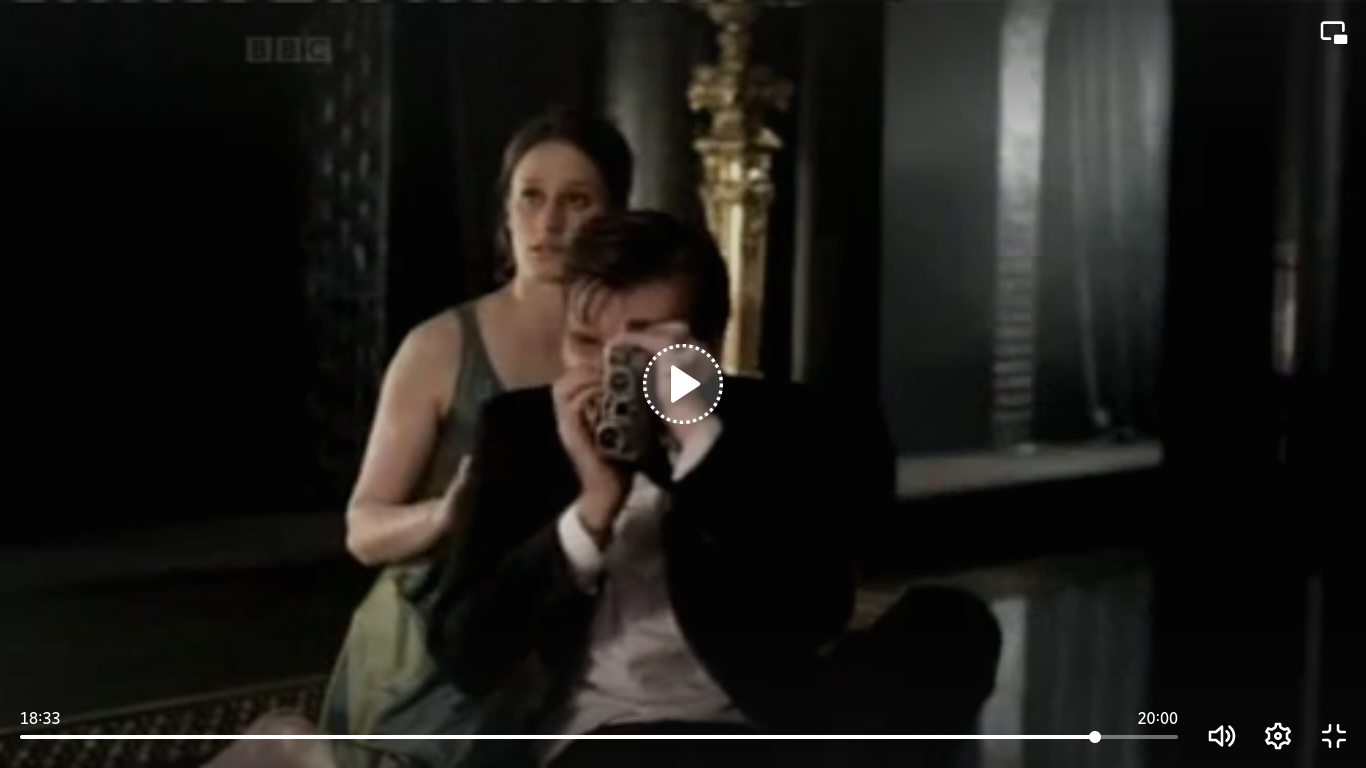
A lot of the scenes and soliloquies of this film are very hit-and-miss, but the one moment of the play Almereyda absolutely nails is the play-within-a-play in Act III, Scene i. First of all, the director cuts all the intentionally bad dialogue and turns the play into a silent film-within-a-film, with lots of homemade charm and disturbing imagery. Mr. Almereyda carefully adapted the often-cut dumb show that happens before the play, and used that to fashion Hamlet’s short film:
Not only does this film fulfill its dramatic function, (making Claudius betray his guilt), but we also get a window into Hamlet’s mind. We see how he sees his father, his mother, and his life before his father’s death. As an added bonus, the film is subtle enough that Claudius would’ t be able to make sense of it unless he had actually murdered Hamlet’s father.
Like I said, my problem isn’t with Hawke. My problem is the rest of the film. Some actors just mumble their lines. Sometimes the director wastes time with pointless film clips which only seem to exist to remind you that “This Hamlet is artsy.” But my biggest problem with the film is the pace. Almereyda does a great job paring down Hamlet to its core drama- Hamlet vs Claudius and the poor people who get caught in the crossfire. Though he is sparing with dialogue, he wastes time with silence. A lot of the film is the characters sitting around watching TVs, looking at photos, sleeping, or just staring off into space. In addiiton, the delivery is very mixed. Like I said, Hawke’s quiet, understated delivery works very well, but not for every character. To varying degrees, everyone in the film is guilty of what I call “movie Shakespeare acting,” which is to say, being so afraid of sounding like Oliver and Branaugh, that they mumble their lines, slow the pace down, and turn the emotion down to nearly zero, because they don’t want their performances to appear over-the-top. The thing is, Hamlet is a tragedy about people who are fighting for their lives and souls. A little quiet introspection is important, but too much of it drags the play or the movie down.
As you read in my post on the duel in Hamlet, Shakespeare’s play, ends in a fencing match where Laertes betrays Hamlet by fighting with a poisoned sword, which Hamlet eventually uses to kill Laertes and Claudius. It’s a powerful moment of poetic justice. In Almereyda’s version, LAERTES JUST SHOOTS HAMLET.
To be fair, the whole scene doesn’t work well in a 21st-century context. Laertes just told Hamlet to literally “Go to Hell,” but then in the very next scene Hamlet agrees to play against him in a friendly fencing match? Only a complete idiot wouldn’t know that something suspicious is up. In every good production I’ve seen, Hamlet knows this is a trap, but he does it anyway. I think he intends to let God decide their quarrel like in old-fashioned judicial combat.
Since dueling isn’t practiced anymore (except in episodes of The Office), it seems bizarre that Hawke’s Hamlet would agree to be in the same room with Laertes, let alone fight with him. I wish the director had done something, anything to justify Hamlet’s choice to fence with Laertes, or just do away with the fencing entirely and have them fight over Ophelia’s grave.
The other thing I hate about this scene is that it isn’t a fight; it’s a murder and a very stupid one. Laertes shoots Hamlet but instead of shooting him at a distance, he walks right over and shoots Hamlet, close enough for Hamlet to turn the gun on Laertes. This makes Shreiber’s character seem incredibly stupid and completely unsympathetic. Not only is it stupid, but it’s also cowardly. Hamlet is unarmed, and can’t defend himself against a bullet. If Laertes had a knife, Hamlet would’ve at least have had a fighting chance. As it is, we get a pointless, bloody end to a great character, and Laertes does it in a cowardly ignoble way.
Whether or not you’ve seen and liked this film, it definitely influenced one of the most well-received Hamlets of recent memory.The Royal Shakespeare Company’s 2009 TV movie of Hamlet takes a lot of cues from Michael Almereyda’s film.


So, to be brief, this version isn’t the best, but it has plenty of clever set pieces, good performances, and early 2000s angst to trigger any millennial’s nostalgia goggles. More than that, I think later productions are indebted to this little movie for paving the way to bring Hamlet into the 21st century.

https://goodticklebrain.com/shakespearean-what-ifs-hamlet
https://goodticklebrain.com/home/2015/7/29/the-hamlet-death-clock


I’m delighted to share with you my recommendations for the best Hamlets committed to film! I was pretty strict with my criteria which left a few Hamlets out, so if I missed yours, let me know in the comments.
In order to make this list:
By the way, if you’re a teacher, I’ll be sure to mention which productions work for classes, and which, for whatever reason, do not. I also can recommend Common Sense Media to give you a good idea what age group this film works best for:
So, without any further adieu (get it?):
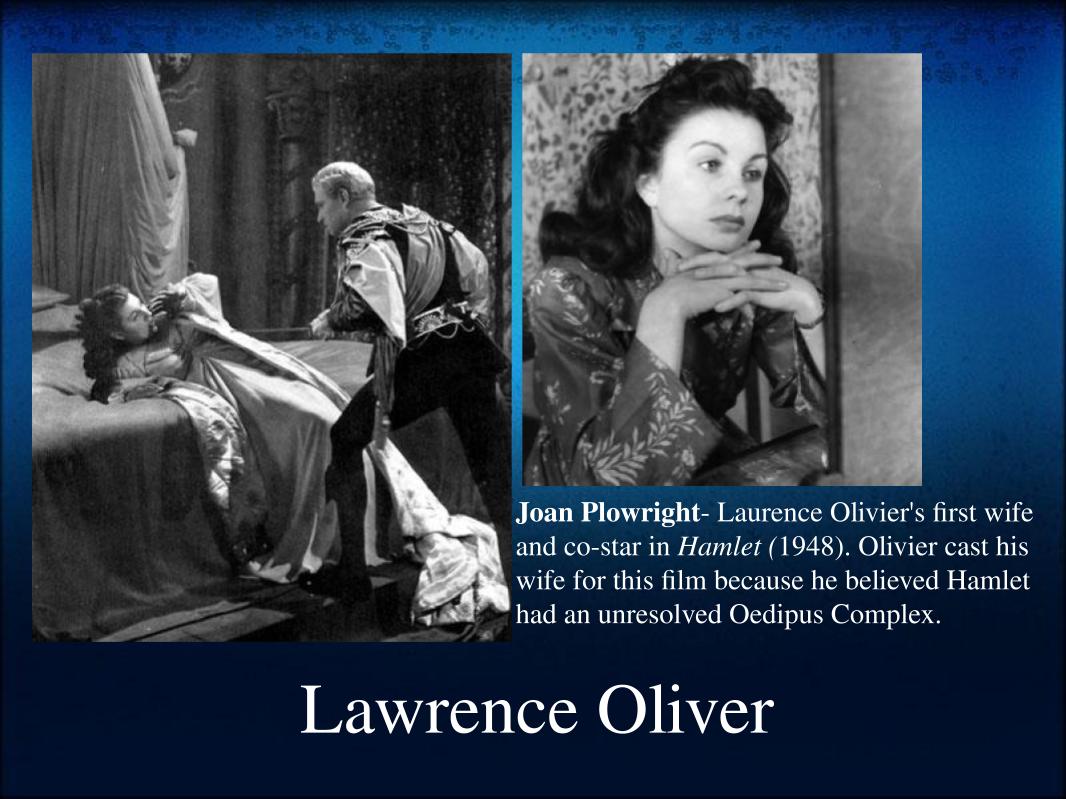
I would love to do a full review of this movie. When it works, it is actually a thoughtful deconstruction of the action movie genre, and as this clip shows, the movie concedes that Hamlet was actually the first great action hero. Schwarzenegger is really funny as an action movie parody of “Hamlet,” and everything he does is pretty cathartic for bored school boys who have to read the play in class. Plus, as a funny easter egg, the teacher in the scene who is showing Olivier’s Hamlet on the screen is played by Joan Plowright, who played Gertrude IN THAT FILM, and was married to Olivier in real life!
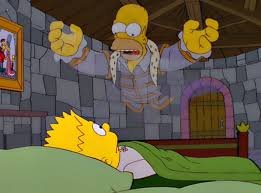
It’s absolutely astonishing how many Shakespeare easter eggs are in this little episode! How they make fun of medieval history, (the Danes were in fact Vikings in the early middle ages), Elizabethan theater, (when Bart does a soliloquy and is surprised that Claudius can hear him), and the way they compress Shakespeare’s longest play into a five minute episode is masterful satire.
In addition, the cast is perfectly chosen among the Simpsons’ core cast. Long-time viewers know that Moe has wanted to sleep with Homer’s wife for years, so making him Claudius is a brilliant choice. Plus, Dan Castellaneta steals the show with his over-the-top performance as the ghost, which actually reminds me of a 1589 review of Hamlet by Thomas Lodge:
“[He] walks for the most part in black under cover of gravity, and looks as pale as the vizard [mask] of the ghost who cried so miserably at the Theatre like an oyster-wife, Hamlet, revenge!”
THOMAS NASHE, “PREFACE” TO ROBERT GREENE, MENAPHON, (1589)
In any case, this clip is a great way to introduce anyone to Hamlet and I highly recommend it.
This show is very special to me- in around 1997 my parents went to England and brought home a copy of The Complete Works of Shakespeare (Abridged). I’d only read “Romeo and Juliet” previously and through this show, I gained an appreciation for all of Shakespeare’s plays. Seeing the plays through parody made them seem less lofty and stuffy, and made me want to see and read the original works. This is especially true for “Hamlet,” which occupies the second half of the show, where Hamlet is portrayed by Austin Tichenor.

Tichenor wins my award for “Hammiest Hamlet,” which is just delightful to watch. He clearly takes the part WAAAY too seriously, as evidenced by how emphatically he demands solemn silence from the audience while he attempts to do “To Be Or Not To Be.” Tichenor also serves as the pedantic straight man who tries to keep the show moving and academic, while mediating between his bickering co-stars Adam and Reed. This wonderful Three-stooges dynamic makes every minute of the show fun and frenetic. However, the cast makes it very clear that they are making fun of Shakespeare with love; they never mock the play, they inform as well as entertain, and occasionally they even move the audience as Adam does at the end. In short, this show helped me form my approach to Shakespeare, and it’s largely through Tichenor that I read Hamlet at all, so he’s to blame for this website.
With the advent of TV and film making theater seem obsolete, directors knew they had to do something drastic in order to get people to come to the playhouses. Enter John Gielgud, one of the greatest Hamlets of the early 20th century, who directed Richard Burton in a highly-acclaimed production with minimum sets and with actors wearing rehearsal clothes. The idea was to let Shakespeare’s words and the actors’ performances be the focus, and save spectacle for film and TV. This approach has been adopted by many theater companies since, including a few I’ve been a pat of.
Burton has a lot of energy and manic physicality in his portrayal and it makes his Hamlet engaging to watch. Plus Gielgud himself as the ghost is almost operatic to hear. I highly recommend any theater fan to watch it, though it might not translate in a classroom much.
I have my issues with Olivier as an actor and apparently I’m not alone:
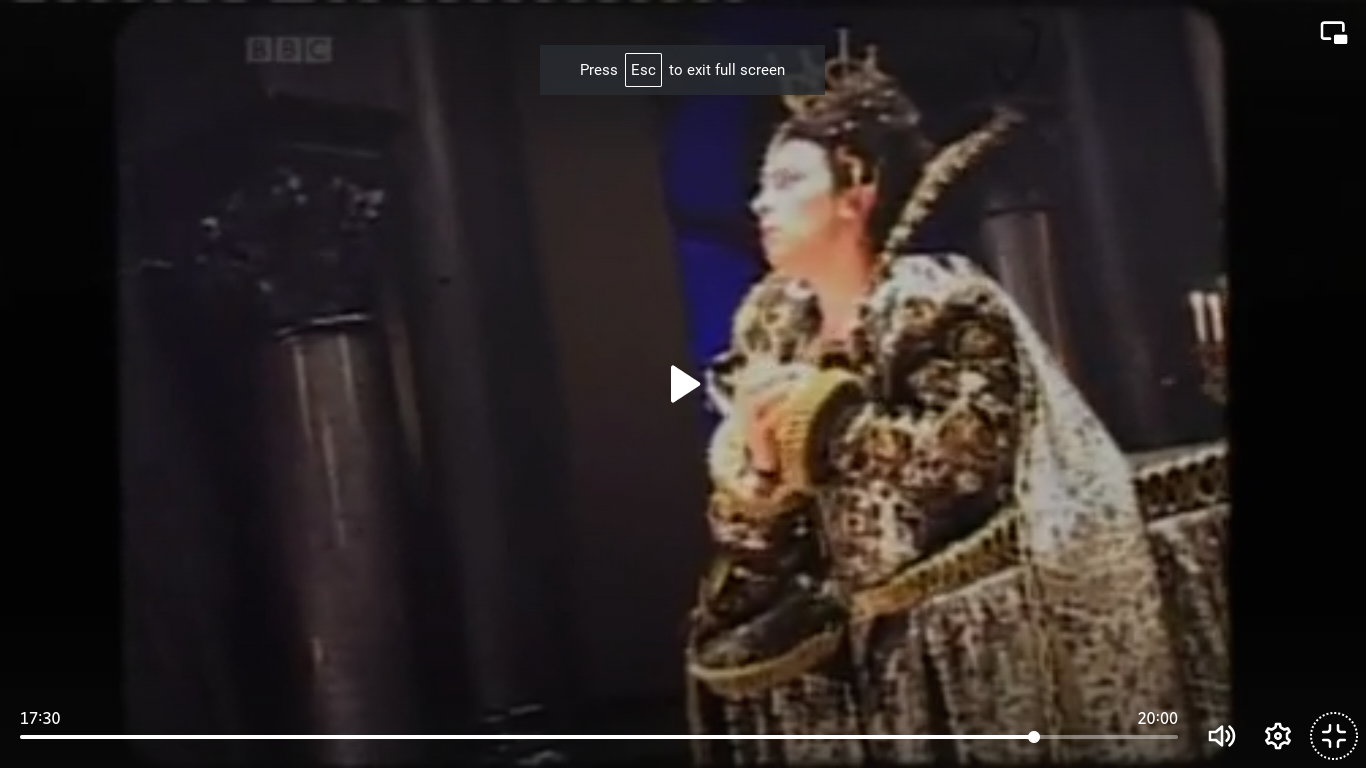
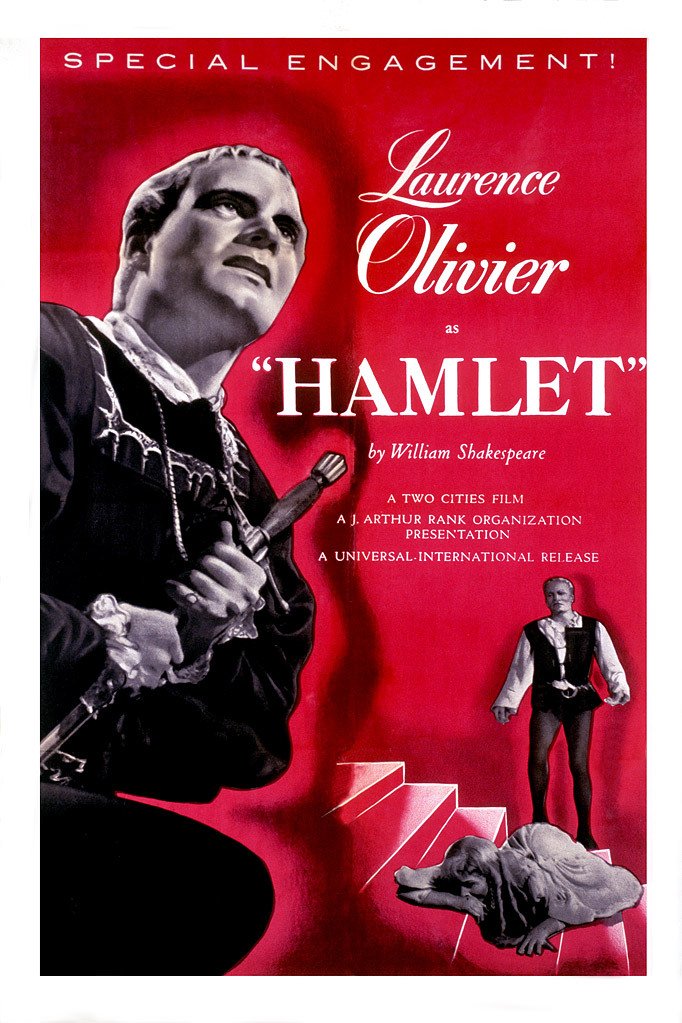
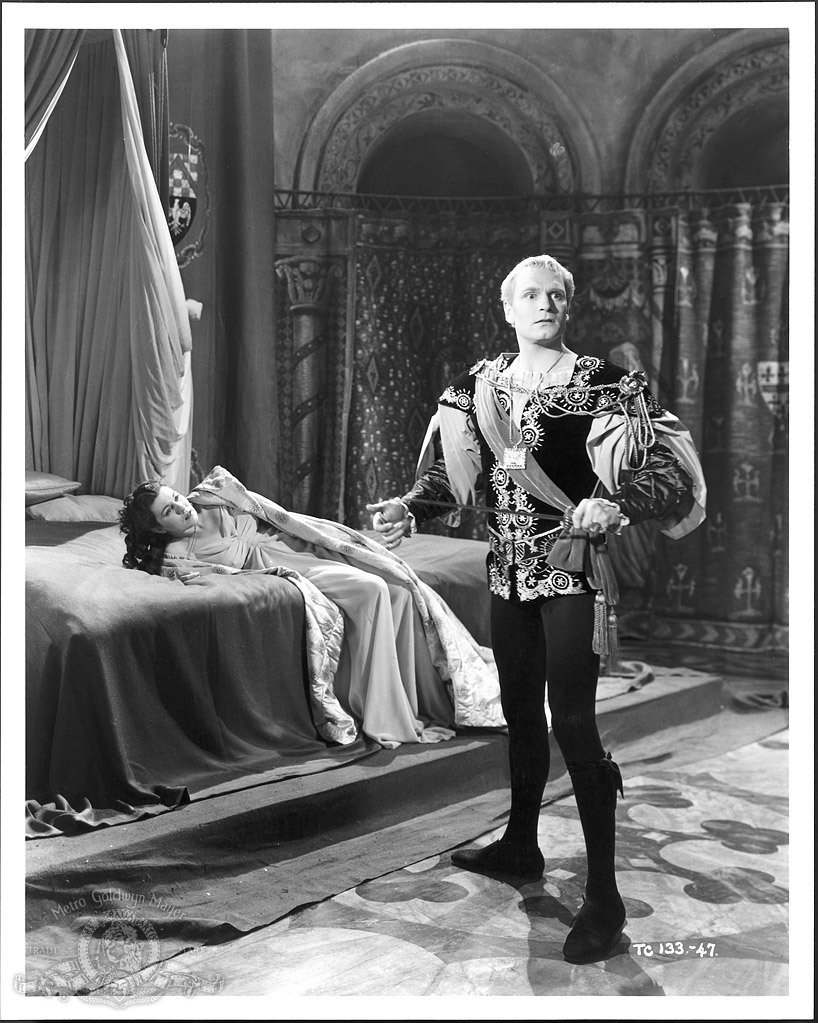
I find Olivier’s acting over-the-top, lacking in emotion and subtlety, and I think his directing is generally self-centered. He rarely deigns to give close-ups to anyone but himself and a lot of the scenes he directs are filmed like stage plays. That said, Olivier’s Hamlet is really good. SIr Laurence talked to Ernest Jones about the theory that Hamlet might have had an Oedipus Complex and created a unique and well-thought-out interpretation for his Hamlet. First off, casting his real-life wife Joan Plowright as Gertrude, fills the Closet scene with uncomfortable tension. He also did a great job making the ghost seem as imposing and accusatory as possible, as well as making Claudius as disgusting as possible.

You get the idea that this film is how Hamlet sees the world with its dark and shadowy towers, representing Hamlet’s melancholic mind, his imprisoned spirit, and his dark desires. Also as many people have pointed out, Gertrude’s bed chamber looks like a female organ, making the Oedipus theory even more explicit.

Even I have to admit that Olivier nailed the “To Be Or Not To Be,” Speech. He squirms at his own Oedipal fantasies, and contemplates jumping off the battlements in a captivating and subtle way. The performance and cinematography is iconic, and it makes me grudgingly admit Olivier, for all his faults, is still one of the best Hamlets of all time.
I would recommend this film to every Shakespeare film fan and any hardcore Shakespeare scholars. I would caution against showing the whole thing in a class however, since it’s black and white, and again, I find Oliver’s delivery very old-fashioned.
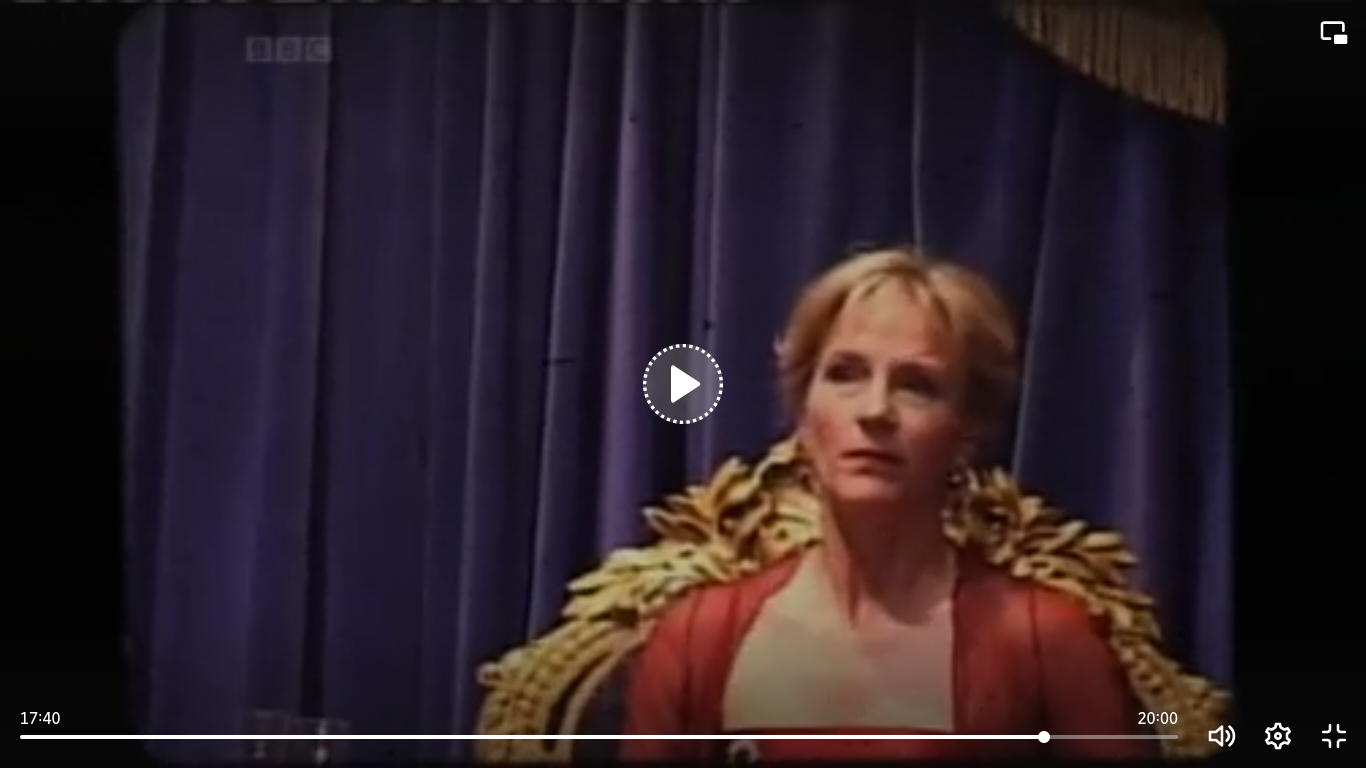
Thus far, I’ve mainly reviewed British and American Hamlets. Paul Gross is one of Canada’s most celebrated actors who gained fame as one of the best Hamlets at Toronto’s Stratford Festival. Unlike most Hamlets who go for the humanistic prince version of Hamlet, Gross plays him with sort of an animal intensity, like a wounded bear who will growl at you if you get in his way.
I have to admit I broke my own rule with this one- I haven’t really seen Gross’ portrayal, but I believe I saw it well-represented in his role as Geoffery Tennent, the Shakespearean Actor-turned madman-turned director in the Canadian TV show “Slings and Arrows.” This amazing dark comedy portrays the ins and outs of a Shakespeare Company from the normal problems of mounting a play to backstage drama, even the funding and marketing gets focus! Basically, the show is The Office for Shakespeare nerds, except for one ghostly cast member (no spoilers).
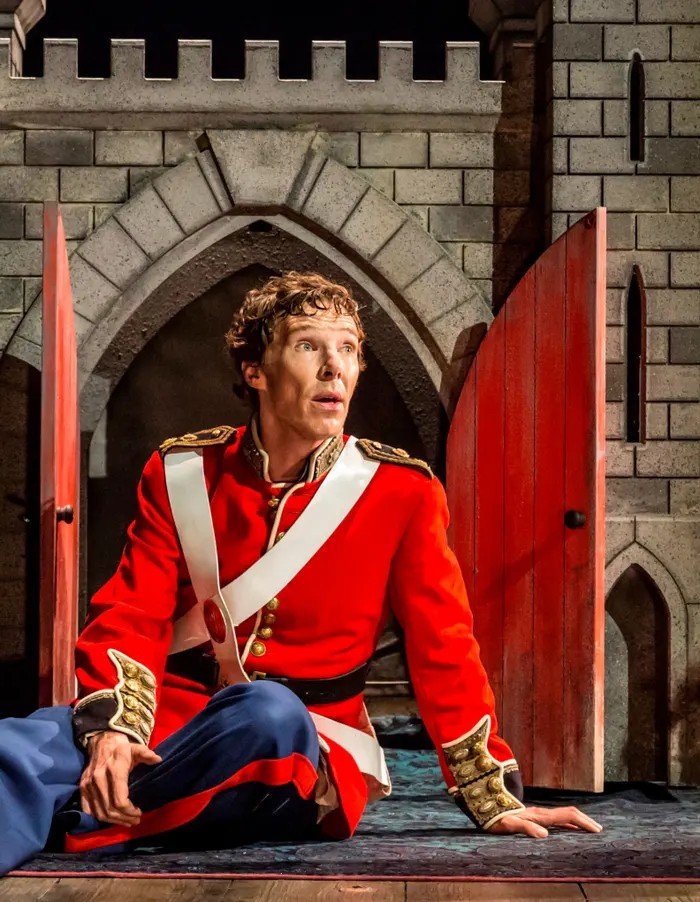
I couldn’t make up my mind between these two Hamlets, so I’m listing them together (guess that makes me Hamlet too). One is one of the most accomplished Shakespearean actor in recent memory, an RSC alumn, and a Hollywood star to boot, Benedick Cumberbatch.


Both these actors have similar strengths- they’re both tall and imposing with aquiline features. They are also highly physical performers. I talked in my lecture on Richard III about how Harrell performed the role of Gloucester with his legs tied together and a bowling ball strapped to his hand. Appearance-wise- Harrell and Cumberbatch are so similar, that it’s actually a joke at the ASC that they must be long-lost twins.
That said, when it comes to their approach to Hamlet, these two actors couldn’t be more different. Cumberbatch focused on Hamlet’s emotional turmoil- he was tortured and angry, full of youthful angst and volatility. This particular production is sort of an anachronistic mash-up of modern and period, which gives it a sort of dream-like quality that I really enjoy. Like Richard Burton, the director knows how to stage a play differently from a movie or TV show, which is especially important with this actor, since we can see him on all those platforms.
Nor should they have. Full of scenic spectacle and conceptual tweaks and quirks, this “Hamlet” is never boring. It is also never emotionally moving — except on those occasions when Mr. Cumberbatch’s Hamlet is alone with his thoughts, trying to make sense of a loud, importunate world that demands so much of him.
By Ben Brantley
New York Times, Aug. 25, 2015
John Harrell on the other hand is a more mature and subtle Hamlet, more interested in saving his hide than contemplating his navel. This Hamlet masks pain with humor and sardonic wit and it translates to all his relationships with the King, Queen, and courtiers.

Rather than a sour, dour, morose, obtuse, naval-gazing Hamlet, this prince was cunning, cynical, devious, sarcastic, and very much enjoying his feigned madness, his chess game with the king, and his fencing bout with Laertes.
Eric Minton
https://www.shakespeareances.com/willpower/onstage/Hamlet-11-ASC11.html
OK, I have to admit that I didn’t see this whole production either, but it’s so cool and the acting is so good I wish I had! Papaa Essiedu is an electrifying blend of wit, sadness, manic excitement, and rage. His fresh take on a role that can be rather dour is why even the little I’ve seen of his performance makes it one of my favorites!


Tennet does an incredible job of encapsulating Hamlet’s quick wit, giddy excitement, frailty, fury, and frustration, especially with himself. I love the fact that he does “To Be Or Not To Be” in a superhero T-Shirt. In a way, this Hamlet is constantly wishing he was more of the action-movie type that Schwartzenegger parodies at the top of this list. Like Harrell, Tennent’s Hamlet masks his pain with humor, but you can see him struggle with it and try to pull himself out of despair. All these Hamlets find a way to nail at least one aspect of the character, but Tennet in his short 3 hours on the stage, manages to highlight all of them.
I recommend this version for any viewer in any classroom. It’s beautifully shot, extremely well acted, fast-paced, funny, and exciting. I cannot recommend it highly enough.


I haven’t seen any of these Hamlets and have been unable to locate any clips, but I have the deepest respect for all of these actors, so I thought I’d highlight them here.
I’d also like to give special mention to Michelle Terry. Gender-blind productions of Shakespeare get a lot of flack that is undeserved, and there’s nothing wrong with a female Hamlet. To quote Geoffrey Tennet in Slings and Arrows: “Shakespeare didn’t care about anachronism, and neither should we.”
I didn’t include Ms. Terry in this list, simply because I wasn’t able to get to the Globe, and I wanted to focus on productions that people can watch for free. If you wish, you can watch her 2018 performance on the Globe Theater’s steaming website:
https://player.shakespearesglobe.com/productions/hamlet-2018/


You probably saw this coming. I’ve made it clear in other posts that I absolutely love Branaugh’s Hamlet, after all his film was one of the first Shakespeare movies I ever saw and the first one I really enjoyed. I discuss in detail why I love this movie the best in my review of the film, but to summarize, I think the direction is incredible, the music is excellent, the cast is nearly perfect, and Branaugh himself puts a huge amount of love, craft, skill, experience, and maybe a little madness into his portrayal of the character. I know Branaugh isn’t everyone’s cup of tea; other Hamlets on this list might be more enjoyable, fun, or subtle, for you. But for me, Branaugh’s will always be my favorite.
It’s hard for me to be objective about this film. I watched it when I was 16, and it started my lifelong love affair with Shakespeare. For the vast majority of people, I feel this movie will not appeal- it’s Shakespeare, it’s set in the past, and it’s FOUR HOURS LONG! That said, I ADORE this movie, and I probably always will.
There is a long tradition of actors directing and starring in Hamlet from Irving to Garrick to Olivier and Guilgud. It’s very much an actor’s play and since the lead part also orchestrates much of the action, it’s understandable that he or she would also want to direct.
Once Kenneth Branaugh started filming this film, he had already played the part onstage and as a radio play. Branaugh’s director, Derek Jacobi, was himself a celebrated and acclaimed Hamlet of the 1970s, and Branaugh would later cast him as Claudius in the film. So, once he approached making the film, Branaugh had lots of experience behind him.
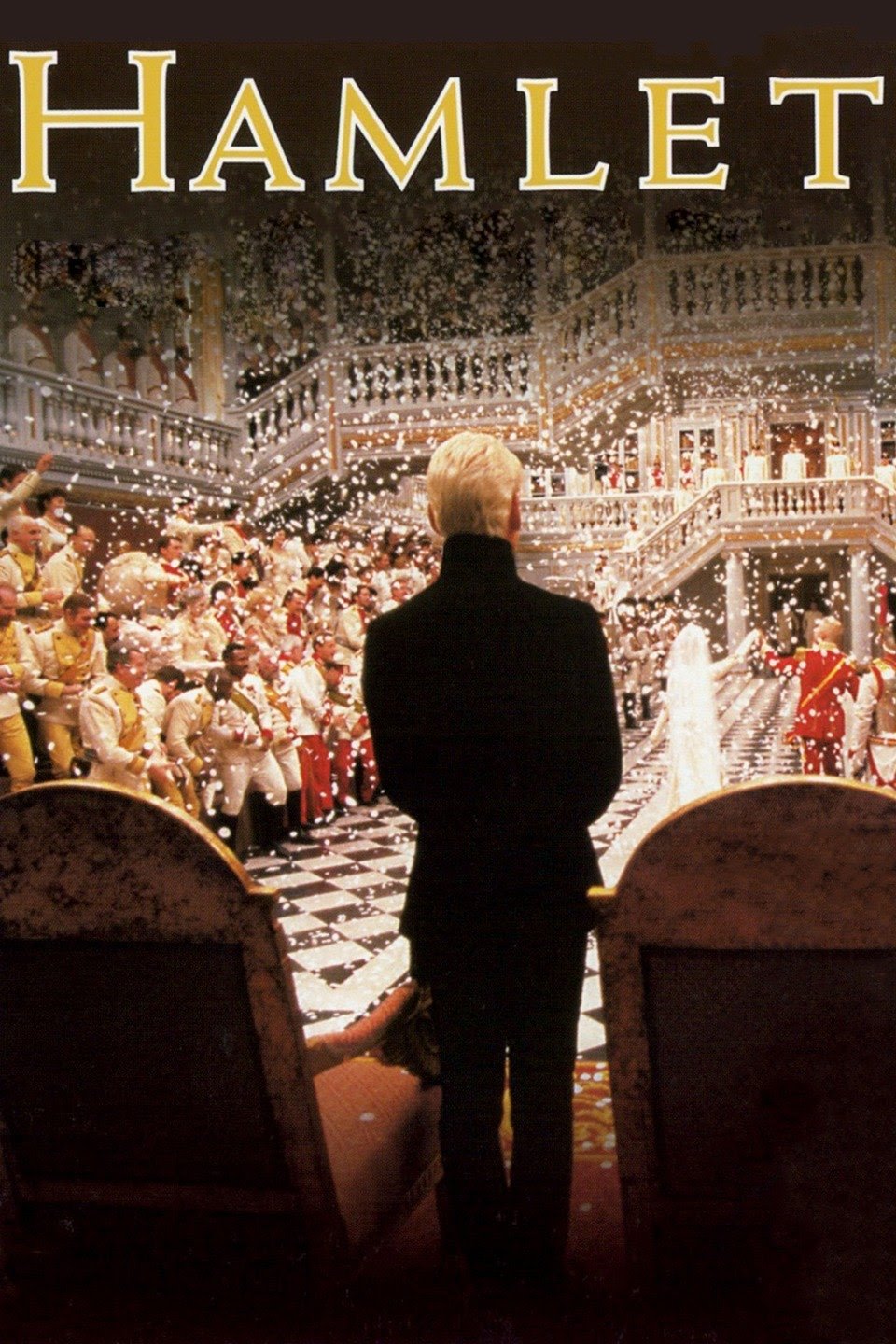
Much like Antony Sher, Branaugh was aware that any film he made, would probably be compared to Laurence Olivier’s 1948 film. Sir Laurence’s film was dark, gothic, focused on dark, Freudian psychological disorders, and was mostly a star vehicle for Olivier himself.
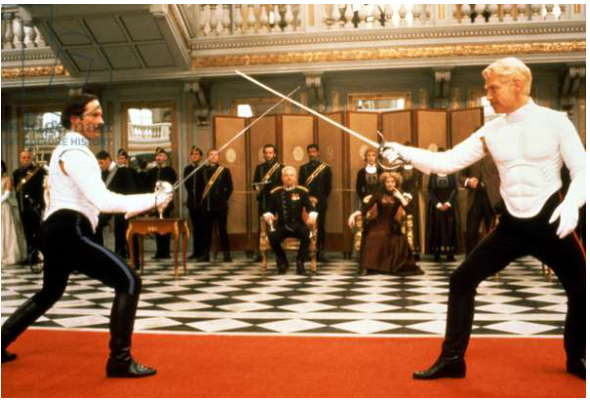
Branaugh’s concept was to do an inverse of Olivier- his castle Elsinore is bright, more modern, set in a sort of Napoleonic era, with cannons, muskets, and soldiers with mutton chops. While Oliver’s film was a contemplative look at the protagonist’s mind, Branaugh’s film focuses on intrigue and court drama. One of my favorite features of the film is Branaugh’s use of a hall of doors that contain two-way mirrors. In this castle, you never know who’s watching you.
While most of the castle was shot at Shepperdon Studious in England, Branaugh filmed most of the exterior shots at Blenheim Palace, the home of the Duke of Marlborough, and Sir Winston Churchill:
https://virtual.blenheimpalace.com/

https://study.com/academy/lesson/shakespeares-hamlet-character-analysis-description.html
Unlike every other Shakespeare movie, Branaugh chose not to cut a single line of Hamlet, which is why his version is four hours long. He chose to use the text of the second Quarto of 1603, the longest edition of the play.
https://www.bl.uk/treasures/shakespeare/playhamlet.html
I am deeply conflicted about this choice. On the one hand, the long run time makes it nearly impossible to show the whole movie in a classroom or a theater. On the other time, like Gone With the Wind or Dr. Zhivago, what Branaugh has done is created an epic full of lush settings, gorgeous music, and incredible performances that will at least always be remembered as an incredible artistic achievement.

Hamlet is Shakespeare’s longest part and has 40% of the dialogue, which means Branaugh has the majority of the screen time. Yet, Branaugh isn’t the biggest star in the film. His casting choices emphasize the notion that, since anyone can enjoy Shakespeare, anyone can perform it too. With only two exceptions, I love every performance in the film. Here are some of my favorites:

Horatio is a rather thankless part, since mostly what he does is give Hamlet someone to talk to. In one production I saw, they did away with the part entirely and made the audience Horatio. That said, Farell does a beautiful job portraying Horatio’s patience, boundless empathy, and his slow discovery of these “carnal, bloody, and unnatural acts.” Just watch how heartbroken he is as he watches Hamlet slowly die:

As I said in my review of “Henry V,” Branaugh usually assigns the core of his cast to his Renaissance Acting Troupe. Accordingly, Branagh cast Brian Blessed as the Ghost of Hamlet’s Father. Brian already is a physically imposing man (he’s actually climbed Mount Everest), and we see through flashbacks that when he was alive, the former king was a powerful, warlike ruler, yet tender to his wife and son.
As the ghost, however, Blessed seems shaken to his core, which might be due to the pain he suffered as a result of the murder, or (as I mentioned in my Shakespeare On Ghosts Post), he might also suffer in the afterlife because Claudius killed him while he was sleeping. Seeing such a powerful man worn to a whisper and full of pain and fear, is a great way to spur Hamlet to his revenge.
When the company of players arrive in the middle of Act II, Scene ii, Hamlet is filled with joy and treats the Player King like an old friend and surrogate father. I’ve seen productions where the same actor plays the Ghost and the Player King, which helps drive this point home.
In the play, the Player King inspires Hamlet with a passionate speech. Hamlet muses how, while the Player is able to conjure emotion and tears when talking about the fictional Queen Hecuba, Hamlet has done nothing yet to revenge the Ghost. Then, thinking about the Player’s performance gives Hamlet the idea to stage a play-within-a-play, to test whether or not Claudius is guilty:
About, my brain! Hum, I have heard
That guilty creatures, sitting at a play,
Have by the very cunning of the scene1665
Been struck so to the soul that presently
They have proclaim'd their malefactions;
For murther, though it have no tongue, will speak
With most miraculous organ, I'll have these Players
Play something like the murther of my father1670
Before mine uncle. I'll observe his looks;
I'll tent him to the quick. If he but blench,
I know my course. Act II, Scene ii, lines 1663-1674
With all this in mind, The Player King is very important to Hamlet’s journey and Heston’s mighty delivery is inspiring and full of passion.

It seems like an insane idea; cast a stand-up comedian in a Shakespeare movie? Yet, in fact, the late Robin Williams was a classically-trained actor and studied at New York’s Julliard academy, so he must have done Shakespeare in the past.
Branaugh clearly loved working with Williams. Not only did he keep all of Osric’s lines (like all the other lines in the play), Branaugh gave Williams more to do, making him basically a second Horatio who cares for Laertes in the final act of the play.
Usually Osric is played as a classist-joke. He’s a sychophant, a social climber who, because he wasn’t born a noble, the nobles treat him as a suck-up and a fool. Williams gives Osric much more warmth and depth, in addition to his manic charm. Branaugh even gives him a tragic death, to make him stand out even more!
I summarize Ms. Winslet’s performance in one word: Heartbreaking. In Oliver’s version, she seems like an airhead, and Helena Bonham Carter plays the part as sort of a rebellious teenager. Winslet’s performance is just as if not even more tragic than Branaugh’s and it is truly heartbreaking to see her journey.
In the 1990 stage production of Hamlet, Jacobi decided to turn “To Be Or Not To Be” from a soliloquy into a speech that Hamlet says to Ophelia, which then plants into her mind the ideas of madness and suicide that she herself follows to their tragic conclusion. In Branaugh’s film, it seems very clear that he gave Winslet that same direction, (even though the speech is filmed like a soliloquy). Before “To Be” and the subsequent “Get Thee to A Nunnery” scene, Winslet’s Ophelia is happy, sweet, obedient to the men in her life, but still her own person. We see in flashbacks her sneaking off to be with Hamlet and she seems to enjoy her secret romance. Probably Branaugh pulled some ideas from her role in Titanic too. But Polonius and Laertes shut her down at every turn and keep her from being with Hamlet. Winslet shows beautifully Ophelia’s struggle to be an obedient daughter and Hamlet’s girlfriend.
In the “Get Thee To a Nunnery Scene,” it’s not clear whether Hamlet knows he’s being watched (at first), so when he speaks to her gently, he might be trying to get her to leave to protect her. But once Polonius audibly closes a door, Hamlet is full of mysogynistic fury. Again, he might be playing mad in order to deceive Claudius and Polonius, or he might be genuinely mad at Ophelia for going along with this attempt to spy on him, but in any case, It certainly breaks her heart, and Winslet plays that heartbreak with a great deal of skill and passion.

Again, it seems bizarre to cast an American comedian as a Shakespearean character, but Crystal did a great job making this 400 year old comic bit seem like he wrote it himself! Plus, Crystal listens very quietly and attentively during the “Alas Poor Yorrick” speech, and doesn’t pull focus.
Even though this was a four-hour Shakespeare movie of a play I had not yet read, at 16 I was hooked by Branaugh’s performance. Like Olivier before him, Branaugh knows Shakespeare’s reputation as being boring and out-of-touch, so his film is full of violence, sex, and manic energy. This also comes across in his own performance. Branaugh lost weight and dyed his hair to appear younger and attractive (since he knows Hamlet is supposed to be just out of college). He fills the mad scenes with a dark and silly sense of humor, and he plays the angst of Hamlet in Act One very much like a grieving teenager, lashing out at his stepfather and his mother.
That said, Branaugh is also capable of great depth and gravitas in the soliloquies. I particularly love his delivery of “How All Occasions Do Inform Against Me…” soliloquy in Act IV.
The long tracking shot makes it look like Hamlet is expanding his worldview as he contemplates his role in the play, after failing to avenge his father’s death. It’s almost like this young man is growing up in the course of the movie; from a confused and angsty little rich kid, to a man who would make a good king if his life wasn’t tragically cut short.
For a more sober audience, Branaugh’s energy could probably be seen as annoying and lacking subtlety, but for 16 year old me- I ate it right up.
2. Kate Winslet In “The Mad Scene” Just as “To Be Or Not To Be” is the test for any Hamlet, Ophelia’s greatest challenge is the Mad Scene, Act IV, Scene v. After her brother leaves, and her boyfriend is banished for murdering her father, Ophelia has nothing left to lose, except her mind. Many actresses play the mad scene as a chance for Ophelia to let loose, and explode with all the pent-up emotions she’s been repressing- rage, sexual desire, grief, etc. Winslet plays all of them and is very distinct when and why they hit. She refuses to let the men in the court touch her, except for Laertes, and seems disgusted by Claudius. With her brother, she seems to regress into a childlike state, pretending to hold flowers to give to him. The only lucid moment she has is when she quotes songs (simmilar to the Fool in King Lear), where she expresses sorrow that Hamlet abandoned her, grief for her father, and a nihilistic sadness that her life no longer matters, much like the frustration Hamlet expresses in “To Be Or Not to Be.”
3. All of Act II, Scene ii. I found myself rewatching this scene, the longest scene in the play. It’s the scene where Polonius claims Hamlet is mad for Ophelia’s love, where Rosencrantz and Guildenstern spy on Hamlet, the Player King delivers his aforementioned speech, and Hamlet has his “O what a rogue and peasant slave am I” soliloquy.
Every performance is fast-paced and entertaining. Even Don Warrington, as the often-cut character of Voltimand, who only gives one long speech about how Fortinbras is totally NOT GOING TO INVADE DENMARK, captivated my ear with his beautiful voice. The drama keeps coming as new characters keep coming in and interacting with Hamlet, and his mood changes drastically throughout the scene; he’s silly and condescending to Polonius, jovial to the players, guarded and brooding to Rosencrantz and Guildenstern, and tortured and full of grief and remorse once he’s finally alone.
Branaugh actually starts the soliloquy with Hamlet taking a series of huge, heaving breaths as if performing for all of these people is truly exhausting. It’s almost like a movie within a movie, and everyone is wonderful in it.
4. The Duel As I detailed in my post on the duel at the end of Hamlet, there are three separate bouts which each have a different feeling- ranging from a sporting fencing match to a deadly blood combat. Branaugh shows the character shift of the duel incredibly well, with his use of music, choreography, and costume. First, the combatants meet before the king, dressed in their white fencing uniforms. Their fight is quick and agressive, but not yet tense or lethal. Then, once Gertrude takes the poisoned cup, the action stops. Claudius is frozen and his voice is only a whisper. Laertes starts to ramp up the tension as he prepares to really attack Hamlet, which he does by slashing his uncovered shoulder!
From this moment in the duel, all Hell brakes loose. Branaugh chases Michael Maloney all around the castle, not stopping until he grabs Laertes’ sword. Meanwhile, Osric shouts for help as Gertrude is dying near the throne. A string quartet ramps the music up up to a wild, whilrling low-pitched tremulo, with the violins playing pizzicato on top. Plucking their strings like the lethal poison that plucks all the characters’ lives.
Even though this film is long, I adore every scene. Branaugh’s boundless energy and endless love of Shakespeare translate through his direction and performance. At the same time, he lets the other actors shine and takes to heart the lessons of Olivier, Gielgud, Jakobi, and others to create a Hamlet that is epic in scale, beautiful to the eye, and timeless in its handling of the material. Clearly, Branaugh wanted this film to be his masterpiece, and whether you like it or not, it certainly is that.
My advice is If you choose to watch it yourself, read a summary of the play first, then watch the film. Also, take some breaks in between the scenes and watch it in chunks. I actually taped it off of live TV so I could watch it in segments.
If you like this analysis, you might be interested in signing up for my Outschool Course on Shakespeare’s Tragedies. I also have a class on Shakespeare’s writing where I analyze “To Be Or Not to Be:”

Though Shakespeare’s Hamlet is very much the story of a renaissance prince, it’s important to remember that the play’s sources date back to the Dark Ages. The anonymous “UR-Hamlet,” (later published in the early 1590s ), is based on an ancient legend about a prince who fights to the death to revenge his father’s murder. Shakespeare’s adaptation still contains a nod to this ancient culture that praised and highly ritualized the concept of judicial combat.
Back in Anglo-Saxon times, private disputes, (such as the murder of one’s father) could be settled through means of a duel. In this period, England was occupied by the Danes, (which we would now call Vikings), and several Viking practices of judicial combat survive. For example, the Hólmgangan, an elaborate duel between two people who fight within the perimeter of a cloak.
At the end of Shakespeare’s Hamlet, the revenge cycle between Hamlet, Leartes, and Fortinbras, comes to a close using a duel. Hamlet has murdered Leartes’ father but Hamlet did not intentionally kill him. This kind of legal dispute would certainly have been settled with a duel in Saxon times. This is one reason why Leartes scorns Hamlet’s offer of forgiveness at the beginning of the scene, and instead trusts in the outcome of the fight to prove his cause. Hamlet and Leartes begin fighting officially under the terms of a friendly fencing match, but it becomes clear early on that at least in the mind of Leartes, this is actually a blood-combat. He is demanding blood for the death of his father, as the Danes would have done during the Anglo Saxon times when Shakespeare’s source play of Hamlet was written.
The sword fight at the end of Hamlet is surprising in many ways. First of all, it is much more choreographed than many of Shakespeare’s other fights which are usually dramatized on the page very simply with two words: “They fight.” In Hamlet by contrast, Shakespeare has a series of important and descriptive stage directions. Furthermore, the fight is divided into three distinct bouts or phrases, or if you like “mini fights.” Below is the full text of the fight. I shall then explain what happens in each phrase.
Shakespeare it very clear that Hamlet gets a normal fencing rapier, while Leartes gets a sharp one, they fight one fencing bout where Hamlet scores a point. This is the most “sportsman like” part of the fight:
Enter King, Queen, Laertes, Osric, and Lords, with other Attendants with foils and gauntlets. A table and flagons of wine on it. Claudius. Come, Hamlet, come, and take this hand from me. [The King puts Laertes' hand into Hamlet's.] Hamlet. Give me your pardon, sir. I have done you wrong; But pardon't, as you are a gentleman. Laertes. I am satisfied in nature, Whose motive in this case should stir me most To my revenge. But till that time I do receive your offer'd love like love, And will not wrong it.3890 Hamlet. I embrace it freely, And will this brother's wager frankly play. Give us the foils. Come on. Laertes. Come, one for me. Hamlet. I'll be your foil, Laertes. In mine ignorance3895 Your skill shall, like a star i' th' darkest night, Stick fiery off indeed. Laertes. You mock me, sir. Hamlet. No, by this hand. Claudius. Give them the foils, young Osric. Cousin Hamlet,3900 You know the wager? Hamlet. Very well, my lord. Your Grace has laid the odds o' th' weaker side. Claudius. I do not fear it, I have seen you both; But since he is better'd, we have therefore odds.3905 Laertes. This is too heavy; let me see another. Hamlet. This likes me well. These foils have all a length? They Prepare to play. Osric. Ay, my good lord. Claudius. Set me the stoups of wine upon that table.3910 If Hamlet give the first or second hit, Or quit in answer of the third exchange, Let all the battlements their ordnance fire; The King shall drink to Hamlet's better breath, And in the cup an union shall he throw3915 Richer than that which four successive kings In Denmark's crown have worn. Give me the cups; And let the kettle to the trumpet speak, The trumpet to the cannoneer without, The cannons to the heavens, the heaven to earth,3920 'Now the King drinks to Hamlet.' Come, begin. And you the judges, bear a wary eye. Hamlet. Come on, sir. Laertes. Come, my lord. They play. Hamlet. One.3925 Laertes. No. Hamlet. Judgment! Osric. A hit, a very palpable hit. Laertes. Well, again! Claudius. Stay, give me drink. Hamlet, this pearl is thine;3930 Here's to thy health. [Drum; trumpets sound; a piece goes off [within].] Give him the cup. Hamlet. I'll play this bout first; set it by awhile.
Again, Hamlet gets the upper hand and scores a point. While his mother is celebrating his victory, she accidently drinks the poisoned cup that Claudius meant for Hamlet. Now Claudius is enraged, Laertes is angry because of losing the first two bouts, and Hamlet is blissfully unaware that he is in mortal danger.
When Hamlet isn’t expecting it, Leartes wounds him with the poisoned sword. From there, the fight degenerates into a violent, bloody mess where Hamlet disarms Laertes, then stabs Leartes. After this, the Queen dies, and Hamlet kills Claudius:
[Laertes wounds Hamlet; then] in scuffling, they change rapiers, [and Hamlet wounds Laertes].
It is telling that everyone dies in this scene, which indicates that the concept of providence seems somewhat ambiguous in this scene- yes, Claudius dies but so does Hamlet. In addition, Leartes dies justly for his own treachery as he claims, but he also tries to avoid damnation. Leartes is guilty of treason for killing Hamlet, but Hamlet is guilty of killing an old man and a young maid, so Leartes asks God to forgive Hamlet for two murders, while he has only committed one. Providence doesn’t seem clear which crimes are worse. Further, Providence fails to reveal the guilt or innocence of Queen Gertrude- did she know her second husband murdered her first? Did she support Hamlet’s banishment? Did she know the cup was poisoned, and is therefore guilty of suicide, or was she ignorant and punished by fate for her adultery and incest? Knowing the conventions of judicial combat help the reader understand the compex world of Hamlet, a world devoid of easy answers.
Phrase 1
I want the two combatants to start en guarde, their blades touching, then there will be a series of attacks on the blade.
Hamlet will advance and attack the low line of Leartes’ sword
Hamlet will advance and attack the high line of Leartes’ sword
Leartes will advance and beat attack the high line of Hamlet’s sword
Leartes will advance and attack the low line of Hamlet’s sword
Hamlet performs a bind on Leartes’ sword, sending it off on a diagonal high line.
Hamlet attacks Leartes leg and Leartes will react in mild pain.
Phrase 2
Leartes is no longer fighting in polite manner, so this will be the real fight where he’s actually going for targets
Hamlet and Leartes come together and bow,
Both go into en guarde and Osric signals the start of the fight.
Hamlet attacks Leartes’ blade high
Leartes attacks Hamlet’s blade low
Leartes suddenly does a moulinet and attacks Hamlet’s right arm. Hamlet does a pass back and parries 3
Leartes attacks Hamlet’s Left Arm. Hamlet does another pass back and parries 4
Leartes cuts for Hamlet’s head. Hamlet passes back and does a hanging parry 6, which causes the sword to slide off.
Hamlet ripostes, slips around Leartes’ ________side, and thrusts offline in suppination. He then flicks the sword, hiting the back of Leartes’ knee.
Phrase 3
Concern- you need to have enough space for Hamlet to chase Leartes DS, and for Leartes to slice Hamlet with the forte of his sword.
Before the bout is supposed to start, Hamlet walks toward the sword, point down to Leartes US L or USR
“I am afeard you make a wanton of me”
Leartes: “You mock me sir!”
Hamlet: “No, by this hand”
Hamlet presents his hand. Leartes places his sword on it, and slices it
Leartes gives Hamlet a stomach punch
Hamlet falls to his knees dropping the sword. If necessary, Hamlet can pull out a blood pack to put on his hand.
Leartes points his blade above Hamlet’s head, then brings it back, preparing to strike off Hamlet’s head.
Leartes: “Have at you now”
Hamlet ducks to the right, with his leg extended.
Leartes Passes forward, trips on Hamlet’s leg. Hamlet does a slip and goes behind Leartes’ back.
Hamlet rabbit punches Leartes on the back, picks up Leartes’ sword, noticing the blood on it
Leartes slowly rises, then notices Hamlet with his sword, he quickly grabs Hamlet’s weapon
Hamlet shoves Leartes DS into a corp a corp, then traps Leartes’ blade
The two push each other for a while
Osric: “Nothing Neither way”
Hamlet pushes Leartes downstage, then slices him across the back.
Leartes stops DS, and falls to the ground
Murder of Claudius
If Claudius is standing, we can have Horatio grab the king around the neck, Hamlet places the sword across Claudius’ stomach, and slices him.
If Claudius is seated, Hamlet picks up the goblet with one hand, slices the king’s leg, then, (after establishing a good distance), Hamlet points the blade off line, just left of Claudius’ neck. Hamlet is giving Claudius a choice- drink or be stabbed. When Claudius chooses to drink, either Hamlet or Horatio can give him the cup. If Horatio gives it to Claudius, it might give him the idea to die later.
Sources-
If you enjoyed this post, and would like to do some stage combat of your own, sign up for one of my stage combat classes on Outschool.com!