It’s always a great privilege to play a Shakespearean character, but especially to play one of Shakespeare’s villains. Playing Don John in this production is a great deal of fun, especially creating a character from the ground up. What follows is a short account of my process of creating this character, which, as I always do no matter what character I’m creating, begins with the text.
Don John only really talks about himself in one scene, Act I, Scene iii. This is the only scene in which Don John hints at the reason why he is so unhappy:
DON JOHN
“I cannot hide what I am:
I must be sad when I have cause and smile
at no man’s jests, eat when I have stomach and wait
for no man’s leisure, sleep when I am drowsy and
tend on no man’s business, laugh when I am merry and
claw no man in his humour.”
— Much Ado About Nothing, Act I, Scene iii
Looking at the speech, the first thing I noticed is that it is all in prose, which is usually an indicator that the character is not speaking from his heart. Instead of making a confession of his true emotions, Don John tends to dominate the conversation and hit his listener over the head with his argument. Benedick and Beatrice also speak in prose when they are making fun of each other, but this kind of prose is much more terse and cynical.
Looking closer at the language of the speech, I also noticed the repeated usage of the word ‘no.’ In this speech Don John refuses to accommodate anybody, he reserves the right to ignore anyone, take from anyone, and irritate anyone he wishes without a thought for anyone’s feelings. Essentially, in this speech, he is refusing any kind of social grace or social interaction. Two kinds of people exhibit this kind of pattern; petulant children, and sociopaths.
Since Don John is an illegitimate child, he has probably been denied a normal, loving childhood, which can stunt his emotional growth. Like Edmund in King Lear, I decided that Don John doesn’t believe in any kind of love, except love for himself. Without the love of others, he refuses to give or show any himself, and only seeks to enhance his own ego, which explains Don John’s pointless war against his brother to improve his political status. This lust for power became my overall objective for the character which manifests itself in Don John’s utter contempt for everyone but himself, and the cruelty he shows to Claudio and the other people in the play.
However, I also made a decision that, unlike Keanu Reeves’ portrayal of Don John in the film version of Much Ado, I didn’t want him to just be a repellant psychopath that would be unpleasant to watch. I decided early on that I wanted to find a way to insert some comedy into the role. This is why I decided that when Don John complains about his melancholy and his unfulfilled desires, he pouts like a young child. I then summarized my concept for the role in four distinguishing characteristics:
Egotistical
Petulant
Cruel
Childish
Having established my character’s motivation and his overall personality traits, I concentrated on developing a voice and physicality. I thought to myself, “What person or character has these characters?” Then I saw this:
Meme about Barney Stinson in “How I Met Your Mother,” as portrayed by Neil Patrick Harris
Neil Patrick’s character Barney Stinson on How I Met Your Mother, matched these characteristics perfectly. He is a self-obsessed low level sociopath who sleeps with lots of women without loving any of them. He is also an illegitimate child who never knew his father, just like Don John. I therefore decided to borrow some mannerisms from Barney.
After watching a few episodes of the show, I noticed a few interesting details in the way Barney acts that I wished to replicate:
Posture- Barney’s posture is absolutely straight. He gives the impression of growing straight up out of the ground, which gives the impression of supreme confidence and arrogance. To keep my posture straight, I did yoga every day to keep my back and legs strong. I used a straight posture whenever Don John is in public but when he is alone and pouting, I let my shoulders hunch like Richard Nixon to give the impression that Don John, (like most bullies), suffers from extremely poor self-esteem, and his displays of ego are merely a front.
Facial quirks
Eyebrows: As you can see in the photo above, Neil Patrick Harris can move his eyebrows independently, which allows him to appear incredulous or mischievous with a sly move of the eyebrow. It just so happens that I can move my eyebrows independently as well, so I use this in moment
The Chin: A lot of NPH’s acting comes from his chin. When he’s feeling very proud of himself, he thrusts his chin in the air like a lightning rod, absorbing mystical energy from the heavens. When he is feeling wicked, he chocks his head to the side and pops his chin out. I adopted these motions for moments in which Don John is plotting something.
Gestures
Rehearsal footage of Act I, Scene iii.
Since Don John is upper class, he doesn’t need big gestures; the more upper class someone is the less they need to work to get people’s attention. However being the selfish brat that he is, his gestures are very flashy. I adopted subtle, fluid gestures that come from the wrist and only used full body gestures when the character is angry, or when he is playing up his own ego. In the video on the left, there’s a short rehearsal of a scene I did with Amanda Cash Snediker. At one point, when I want Tiarra Hairston to light Amanda’s cigarette, all I do is snap my fingers.
Voice
The iconic voice of a 1920s announcer is a reedy-voiced tenor with a slight slur in his words with a slight smile to his mouth. This kind of world-weary, loud-mouthed voice is exactly what I wanted to convey in Don John’s voice.
Costume “Let’s Suit up”
Just like Barney, I believe Don John is obsessed with his appearance. I looked up male fashions in the 1920s. Looking at this picture of Edward Beale McLean, (head of the Washington Post from 1916-1933), I saw a suit worth replicating. I found a great black pinstripe suit.
Paul Rycik as Don Jon, 2012. (Photo by Darren Van Dyke)
I also looked for a uniform that I thought would seem menacing and appropriately gawdy.
For More Info On Male Fashion from the 1920s, click on this link:
This week I’ll be celebrating Hanukkah with a series of posts and podcasts about Shakespeare’s only play to feature Jewish characters The Merchant Of Venice. I’ll have a new post about the play this week, and hopefully a podcast episode, but in the meantime, here are some of the post’s I’ve written in the past about the Merchant Of Venice.
PBS is going to show (and hopefully stream), the National Theater’s production of Romeo and Juliet Friday, to help celebrate William Shakespeare’s birthday.
The production stars Jessie Buckley as Juliet, and Josh O’Connor as Romeo, who recently won a Golden Globe for his portrayal of the young Prince Charles
After playing another doomed lover whose family won’t allow him to be with the woman he wants, I look forward to seeing him bring his passion and skill to Shakespeare.
Jessie Buckley as Juliet, and Josh O’Connor as Romeo. National Theater, 2021
Happy St. Patrick’s Day! The Emerald Isle has long been a source of illumination for poet’s pens and Shakespeare was no exception. The Bard of Avon is indebted to Mother Ireland not only for the inspiration he took, but sadly for the pain he gave her back.
None of Shakespeare’s plays are set in Ireland, but he freely adapted elements from Irish folklore. English poet Edmund Spencer visited Ireland in the 1590s and adapted the folklore he picked up into his opera The Fairy Queen, which Shakespeare adapted into A Midsummer Night’s Dream
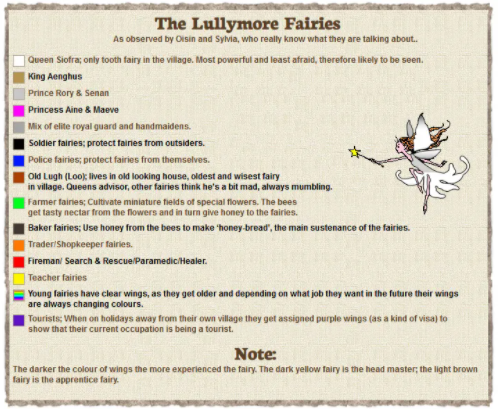
The Irish created and continue to tell many of the fairy legends and stories that we retell and adapt today. If you go to Lullymore park in Ireland, you can see a place that is essentially a “Fairy preserve.”
Types of fairies you can “spot” at the Lullymore Park in Ireland:
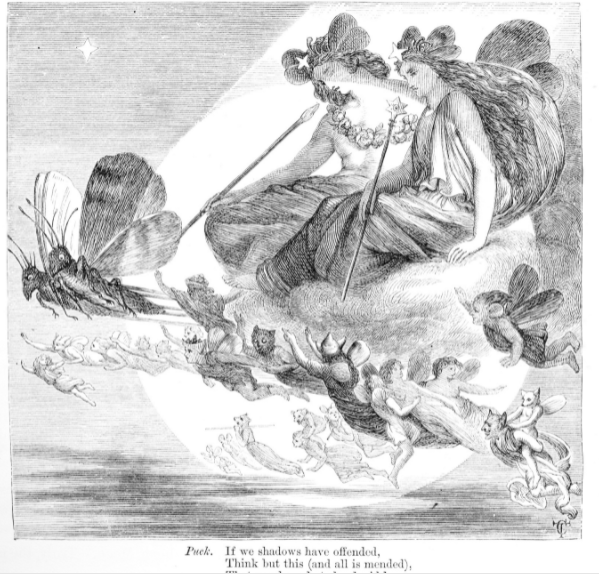
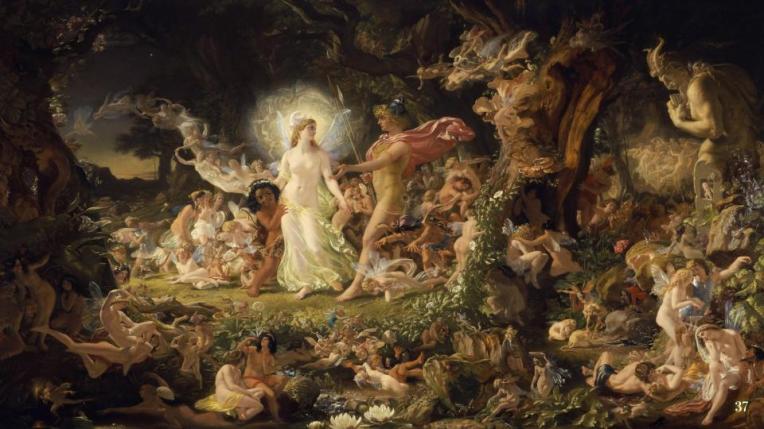
The old stories tell that Fairies are magical creatures who live in hollow places in the earth. Some are benevolent and help give rain and pleasant weather to the Earth, Like the king and Queen of the fairies, Oberon and Titania:
And the mazed world, By their [the tides] increase, now knows not which is which: And this same progeny of evils comes From our debate, from our dissension; We are their parents and original.
— Titania, (Queen of the Faries), A Midsummer Night’s Dream Act II, Scene i.
Titania in this speech shows great concern for nature, humanity, and the planet. She believes it is the responsibility of fairies, particularly herself and her husband Oberon, to control the elements and keep humans and fairies safe. Some fairies, however, are cruel and enjoy playing tricks on mortals, just like Puck in A Midsummer Night’s Dream, or Queen Mab in Romeo and Juliet.
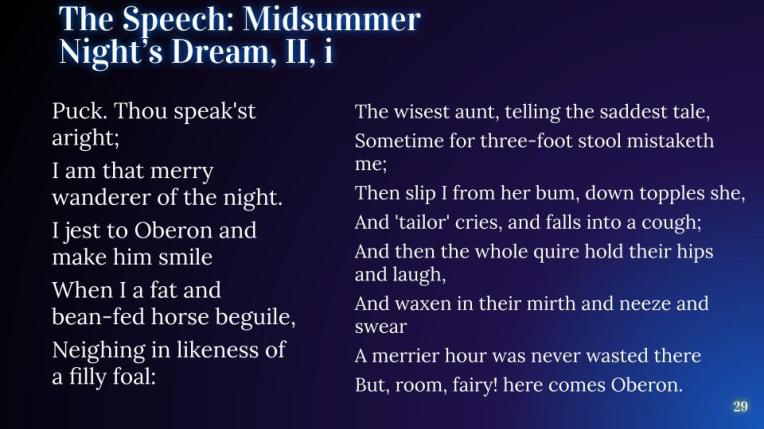
Close reading of Puck’s speech (MND II, i)
Close reading of Puck’s speech (MND II, i)
Close reading of Puck’s speech (MND II, i)
Close reading of Puck’s speech (MND II, i)
Close reading of Puck’s speech (MND II, i)
.
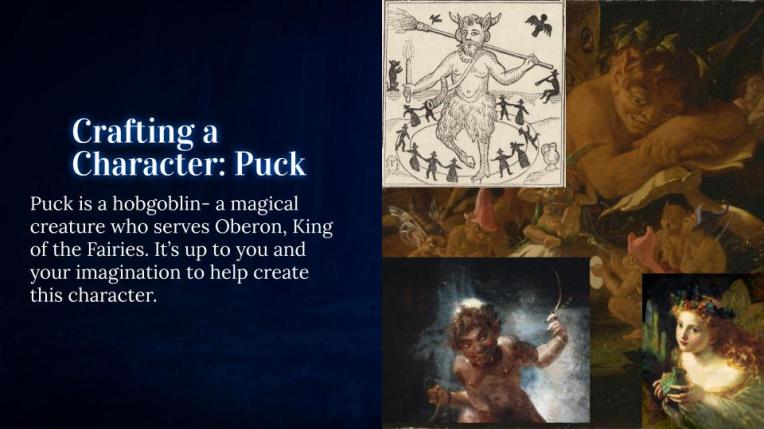
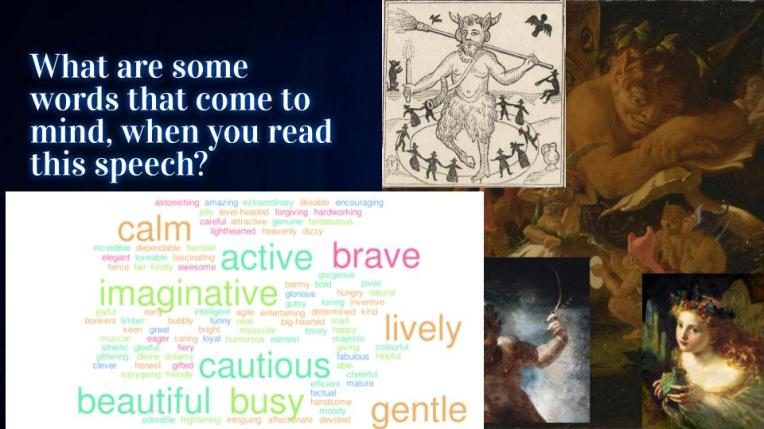
This is a short analysis I created of the tricks Puck plays on people in A Midsummer Night’s Dream, as part of my acting course on Ouschool.com. Note the different ways Puck is portrayed in photos as a satyr, a rotund elf, and sometimes as an almost- demon like figure.
Cringe-worthy Shakespeare: Shakespeare’s only Irish character, captain mcmorris in “Henry V”
When Shakespeare is racially insensitive towards people of color, the cringe-worthy writing is mercifully few and far between. With the exception of Aaron the Moor and Don Armada, there are only a few sporadic derogatory references to non-White Anglo-Saxon Protestants. Sadly though, Shakespeare might have permanently harmed the Irish through his character the Irish captain Macmorris in Henry the Fifth, his only Irish character.
According to The Irish Times, there is a longstanding stereotype that still exists in the British Isles that Irish people are violent, short-tempered, and essentially savages and Shakespeare might have invented this stereotype (or at least popularized it) when he wrote this scene from Henry the Fifth, Act III, Scene ii:
FLUELLEN
 To the mines! tell you the duke, it is not so good
 to come to the mines; for, look you, the mines is
 not according to the disciplines of the war: the
 concavities of it is not sufficient; for, look you,
 the athversary, you may discuss unto the duke, look
 you, is digt himself four yard under the
 countermines: by Cheshu, I think a' will plough up
 all, if there is not better directions.
 GOWER
 The Duke of Gloucester, to whom the order of the
 siege is given, is altogether directed by an
 Irishman, a very valiant gentleman, i' faith.
 FLUELLEN
 It is Captain Macmorris, is it not?
 GOWER
 I think it be.
 FLUELLEN
 By Cheshu, he is an ass, as in the world: I will
 verify as much in his beard: be has no more
 directions in the true disciplines of the wars, look
 you, of the Roman disciplines, than is a puppy-dog.
 Enter MACMORRIS and Captain JAMY
 GOWER
 Here a' comes; and the Scots captain, Captain Jamy, with him.
 FLUELLEN
 Captain Jamy is a marvellous falourous gentleman,
 that is certain; and of great expedition and
 knowledge in th' aunchient wars, upon my particular
 knowledge of his directions: by Cheshu, he will
 maintain his argument as well as any military man in
 the world, in the disciplines of the pristine wars
 of the Romans.
 JAMY
 I say gud-day, Captain Fluellen.
 FLUELLEN
 God-den to your worship, good Captain James.
 GOWER
 How now, Captain Macmorris! have you quit the
 mines? have the pioneers given o'er?
 MACMORRIS
 By Chrish, la! tish ill done: the work ish give
 over, the trompet sound the retreat. By my hand, I
 swear, and my father's soul, the work ish ill done;
 it ish give over: I would have blowed up the town, so
 Chrish save me, la! in an hour: O, tish ill done,
 tish ill done; by my hand, tish ill done!
 FLUELLEN
 Captain Macmorris, I beseech you now, will you
 voutsafe me, look you, a few disputations with you,
 as partly touching or concerning the disciplines of
 the war, the Roman wars, in the way of argument,
 look you, and friendly communication; partly to
 satisfy my opinion, and partly for the satisfaction,
 look you, of my mind, as touching the direction of
 the military discipline; that is the point.
 JAMY
 It sall be vary gud, gud feith, gud captains bath:
 and I sall quit you with gud leve, as I may pick
 occasion; that sall I, marry.
 MACMORRIS
 It is no time to discourse, so Chrish save me: the
 day is hot, and the weather, and the wars, and the
 king, and the dukes: it is no time to discourse. The
 town is beseeched, and the trumpet call us to the
 breach; and we talk, and, be Chrish, do nothing:
 'tis shame for us all: so God sa' me, 'tis shame to
 stand still; it is shame, by my hand: and there is
 throats to be cut, and works to be done; and there
 ish nothing done, so Chrish sa' me, la!
 JAMY
 By the mess, ere theise eyes of mine take themselves
 to slomber, ay'll de gud service, or ay'll lig i'
 the grund for it; ay, or go to death; and ay'll pay
 't as valourously as I may, that sall I suerly do,
 that is the breff and the long. Marry, I wad full
 fain hear some question 'tween you tway.
 FLUELLEN
 Captain Macmorris, I think, look you, under your
 correction, there is not many of your nation--
 MACMORRIS
 Of my nation! What ish my nation? Ish a villain,
 and a bastard, and a knave, and a rascal. What ish
 my nation? Who talks of my nation?
 FLUELLEN
 Look you, if you take the matter otherwise than is
 meant, Captain Macmorris, peradventure I shall think
 you do not use me with that affability as in
 discretion you ought to use me, look you: being as
 good a man as yourself, both in the disciplines of
 war, and in the derivation of my birth, and in
 other particularities.
 MACMORRIS
 I do not know you so good a man as myself: so
 Chrish save me, I will cut off your head.
 GOWER
 Gentlemen both, you will mistake each other.
 JAMY
 A! that's a foul fault.
 A parley sounded
 GOWER
 The town sounds a parley.
 FLUELLEN
 Captain Macmorris, when there is more better
 opportunity to be required, look you, I will be so
 bold as to tell you I know the disciplines of war;
 and there is an end.
 Exeunt
Irish History and Shakespeare: The tempestous relationship between england and Ireland
The mayor and all his brethren in best sort, Like to the senators of the antique Rome, With the plebeians swarming at their heels, Go forth and fetch their conquering Caesar in: As, by a lower but loving likelihood, Were now the general of our gracious empress, As in good time he may, from Ireland coming, Bringing rebellion broached on his sword,
Henry V, Act V Chorus
Robert Devereax, 2nd Earl of Essex (National Portrait Gallery)Hugh, O’Neill, Earl of Tyronne
James Shapiro in his excellent book, A Year In The Life Of William Shakespeare, 1599, posits that contemporary affairs in Ireland might have inspired some of Shakespeare’s greatest plays in including Richard II, Henry V, and Julius Caesar. In 1594 the Earl of Tyrone began a rebellion in Ireland against the English, and in 1599, Queen Elizabeth dispatched the ambitious and chivalrous Earl of Essex to quell it. As you can see in the quote above, Shakespeare mentions Essex’s fight in his play of Henry V, which probably premiered at around the same time Essex was in Ireland.
The audience may have been watching Henry conquer France, but many would have been thinking about Elizabeth’s struggle to conquer Ireland.
BBC Radio 4 Extra – Shakespeare’s Restless World, Ireland: Failures in the Present – Transcript – Shakespeare’s Restless World – Programme 7
Though King Henry successfully conquered and united England and France, Essex failed spectacularly, and Elizabeth was deeply embarrassed by the whole scenario. She was also deeply alarmed by the popularity of Shakespeare’s tragedy Richard II, which shows onstage the deposing and killing of a king who had no children and failed to quell a rebellion in Ireland.
Elizabeth was worried about her subjects but she was also very worried about Essex overseas. Everyone, (including Shakespeare), remembered that 2,000 years ago, Julius Caesar went from him the Senate’s Consul General to dictator by amassing an army, then threatening to invade Rome under the pretense of helping to quell a foreign invasion. Caesar made his name by subjugating tribes in Gaul (modern-day France), and the Senate was worried that he would come home and use his army for a military coup. Look at the expressions on the faces of Cicero and Brutus when they see Caesar coming home in triumph in this scene from the HBO series Rome.
Elizabeth repeatedly attempted to curb Essex’s power while he was fighting in Ireland; she refused to give the Earl more troops for fear that he might be staging a potential coup. Her fears would later be proven right when in 1602, Essex attempted to head a rebellion and take the Crown for himself, but not before one of Essex’s friends commissioned Shakespeare’s company to portray the deposing and killing of King Richard II. Essex was trying to turn himself from a failed Henry V to a victorious Henry IV, and his queen into Richard II.
Left- deposition form the interrogation of Augustine Phillips, one of the actors in Shakespeare’s company about his company’s potential involvement with the Essex rebellion. Right- the hanging of Cinna the poet from Julius Caesar.
Shakespeare might have been inspired to write Julius Caesar after being an unwitting pawn in the political drama between Essex and the queen, and might have even created the character of Cinna the Poet as an analog for Shakespeare himself. In the play, Cinna the poet is mistaken for one of the conspirators by an angry mob and is murdered in the street. Perhaps Shakespeare created Cinna the Poet as a way of coping with the fear he must have had that people might mistake him for a radical, after his play Richard II briefly made him a walking target for those opposed to Essex’s rebellion. In any case, Julius Caesar eloquently documents the kind of anxiety of not knowing who could be trusted when it comes to politics, whether it be a populist warrior like Julius Caesar or Essex, or the Queen, privy council, or indeed Roman senate, and the whole thing started from a failed attempt to quell a rebellion in Ireland.
In summation, even though Shakespeare sets no plays in Ireland, Irish history and Irish culture are everywhere in his plays. England and Ireland are I are indeed separate islands but the cultural exchange between England and Ireland has inspired Shakespeare and many other great writers for centuries. After all Shakespeare’s most famous honorific, ‘the Bard of Avon’ comes from an ancient Irish tradition of semi-mystical poets, who in Irish folklore, were able to see the future and glimpse worlds that are unseen to ordinary mortals. What Shakespeare really felt about Ireland we don’t know but we do him but he does owe the Irish people a lot of thanks, and on this Saint Patrick’s day, I honor their contribution to him and to him all the world
References:
Shapiro, James. A Year In the Life Of William Shakespeare, 1599. Chapter 6: Things Dying and Things Reborn.
My purpose with this post is to provide some hope and comfort by showing how Shakespeare and other Elizabethans dealt with epidemics and survived. The thing to remember is, although we are dealing with a pandemic, we are still far better prepared for it than any time in history. Furthermore, I want to draw on lessons from the past to offer hope and wisdom for people going through an epidemic.
Side note: Shakespeare refers to several diseases in his plays including “The plague,” (Bubonic Plague), “The Pox,” (syphilis), “Dropsy,” (edema), and “Falling sickness,” (epilepsy). I will mainly focus on the plague because of its strong connection to both Shakespeare’s life and career, as well as the continuing anxiety it causes to this day. I am also focusing on the plague to try and make parallels with Covid 19, a disease that, while less lethal and harder to detect, is still a pandemic that like the plague has transformed much of daily life since its inception, and could continue to grow, abate, and revive if we as a society aren’t careful.
Shakespeare’s plays also frequently allude to plagues and plague imagery, especially his most famous play, Romeo and Juliet.
First of all plague is an important plot element; an outbreak of plague prevents Romeo from getting the message that Juliet is alive, so plague inadvertently kills them both.
Plague also serves as a motif for the destructive forces that lead to the play’s tragic conclusion. After Mercutio curses “A plague on both your houses,” his death sets the events in motion that kills most of the principal the characters, as if his curse somehow infected all of them with a deadly virus.
Immortal Longings Artwork for “Romeo and Juliet” by Elizabeth Schuh, used with permission.
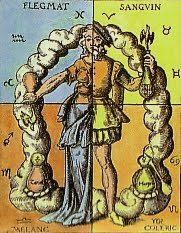
Shakespeare exploited a unique cultural knowledge of plagues to help his audience engage with Romeo and Juliet. If you click on the link to my presentation above, you’ll see that Elizabethans believed that four liquids called humors controlled health and behavior. A humorous man was someone who was out of ballance with the humours and thus was ridiculous for failing to control his emotions. The humor choler was associated with anger and in dangerous imbalances was thought to cause terrible fevers and even plague. Hence, when characters like Romeo and Tybalt get angry, his audience knew that one way or another, that anger will kill them.
Medieval illustration of the four humours. Top left to bottom right; Phlegm, Blood (Sanguine), Melancholy, (black bile), and choler (yellow bile).
Shakespeare also uses plague as a metaphor for the hate of the two families that infects and kills the young lovers, as well as Tybalt, Paris, and Mercutio.
The play was first published in 1595, two years after a plague outbreak so bad that the theaters were all closed, so Shakespeare’s audience had a visceral reaction to this plague imagery when they saw it in the theater, especially after a year of being quarantined away from the theaters because of that exact same disease!
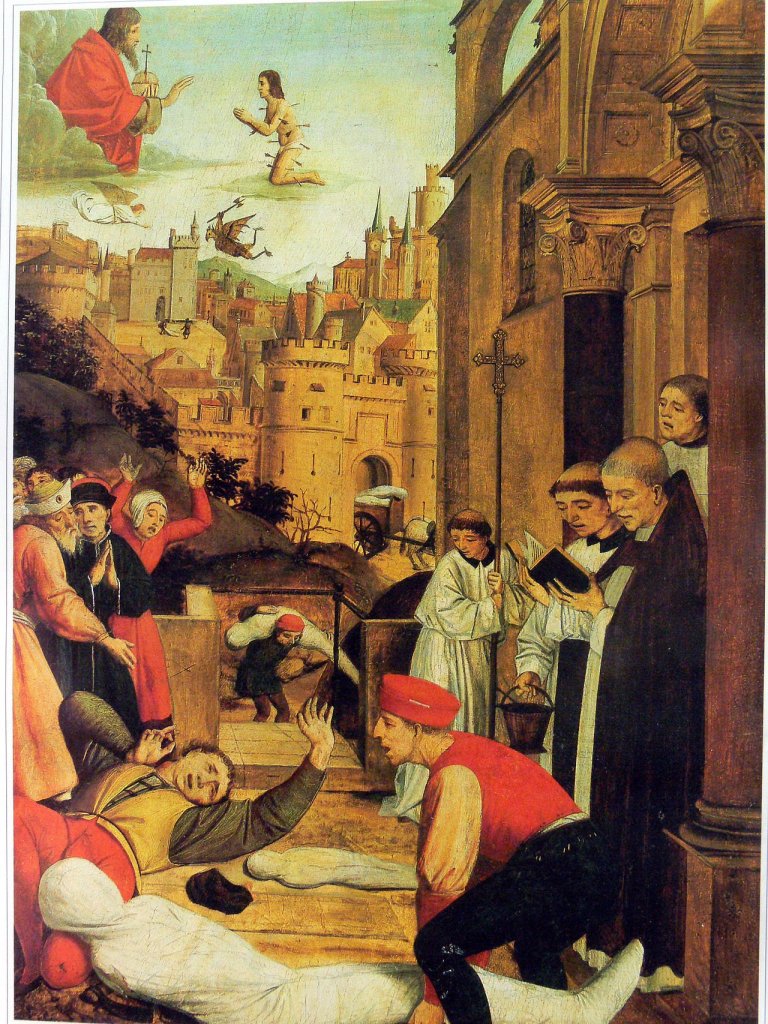
Saint Sebastian pleads with Jesus for the life of a gravedigger afflicted by plague during the Plague of Justinian. (Josse Lieferinxe, c. 1497–1499)
“Scourge and Minister”
Some of Shakespeare’s plays mention plague indirectly in relation to its perceived nature as a divine punishment. Since the very beginning of the plague,, writers, clergy, and many others perceived the plague as a divine punishment, designed to destroy the wicked, like the 10th plague in the Bible that decimated the enslaving Egyptians.
To “scourge oneself” is also a verb for whipping. In the 14th century, a group a people called the flaggelants, who voluntarily scourged themselves in the hope that God would end the disease as a result of their suffering.
Shakespeare uses both meanings of scourge in many of his plays. In Henry IV, the king is filled with remorse for usurping the throne from King Richard, and worries that his future progeny will become a scourge upon him:
I know not whether God will have it so,
For some displeasing service I have done,
That, in his secret doom, out of my blood
He’ll breed revengement and a scourge for me;
King Henry IV, Part I, Act III, Scene ii.
Sometimes a scourge is a person sent to destroy a sinful person or group of people. Shakespeare refers to the character of Richard III several times as a scourge upon the families who fought in the Wars Of The Roses.
In Shakespeare’s first cycle of four history plays, we see the families of York and Lancaster take turns usurping the throne, and committing numerous acts of murder, treason, and blasphemy. In the play that bears his name, Richard III kills the Yorkist royal family and then is murdered himself by Henry Tudor, systematically destroying the families of York and Lancaster. Thus, in Shakespeare’s propaganda version of history, he depicts Richard as a scourge who purges the throne of usurper and traitors, paving the way for the “virtuous,” Henry Tudor and his dynasty.
The ending shot of the BBC’s 1978 TV version of “Richard III.”
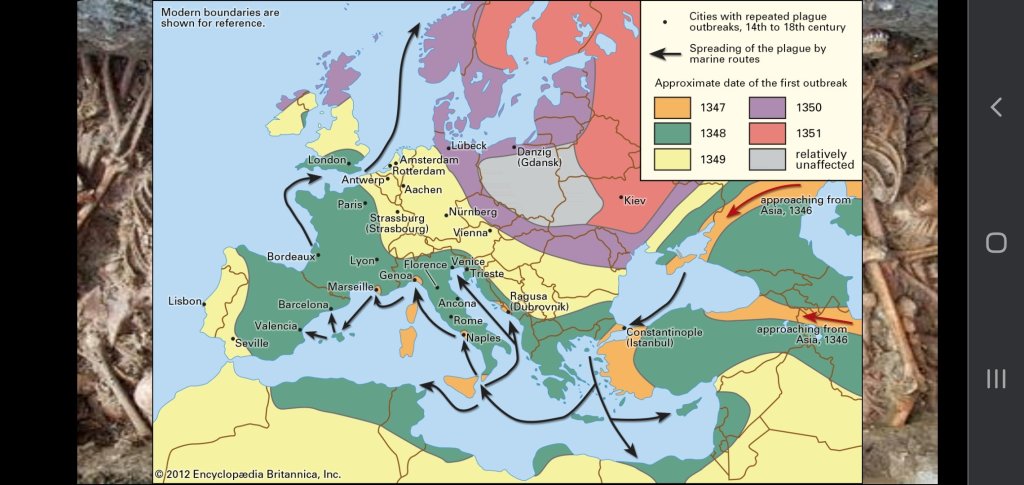
The Real Plague The black death, also known as Bubonic Plague, was first documented in 1347. Like Covid 19 it was first discovered in China, though it might not have originated there. Some historians argue that the Huns might have carried the plague into China and trade routes from the East carried it into Europe. By 1349 it reached England.
Everyone knew what to look for from those infected with the plague: first came fevers and chills. The next stage was the appearance of small red boils on the neck, in the armpit or groin. These lumps, were called buboes, (hence the term Bubonic Plague)
The buboes grew larger and darker in colour as the disease grew worse. From there the victim would begin to spit blood, which also contaminated with plague germs, making anyone able to spread the disease by coughing. The final stage of the illness was small, red spots on the stomach and other parts of the body caused by internal bleeding, and finally death.
We see death coming into our midst like black smoke, a plague which cuts off the young, a rootless phantom which has no mercy or fair countenance. Woe is me for the shilling in the armpit. . . It is an ugly eruption that comes with unseemly haste. It is a grievous ornament that breaks out in a rash. The early ornaments of black death.-Jevan Gethin, poet who died from plague in 1349.
Detail from The Temptation of St Anthony, 1512. Note the swollen buboes on the stomach, arms, and legs.
John Flynn, an Irish Friar described the plague in apocalyptic terms, writing a journal for posterity, but expressed doubt that ” Any of the race of Adam would even survive.” With the horrifying spread of the epidemic, it is not hard to understand why Flynn felt that way: In 1348, there were 100,000 people living in London, but after the plague spread, the city lost 300 people every day!
Quarentines: The word quarantine is Italian for 40 days. It refers to the Venetian practice of taking suspected plague victims to an island for 40 days before allowing them to enter Venice or other populated areas. The rationale was that in the Bible, the number 40 occurs many times when a person or group of people require some form of purification; the 40 days of flooding in Genesis, the 40 years that the Jews journey to the promised land, and the 40 days of fasting Christ endured before he began his ministry to name a few examples. Bubonic plague has an incubation period of less than 40 days so the quarantine actually worked- people would go to the island, then the disease would run its course and not spread out as long as it was contained. The problem was that these quarantines were also essentially leper colonies and without treatment, the infected were basically sent to die.
Social distancing in Elizabethan England–
By 1564, the year Shakespeare was born, there had been several outbreaks, but also a system designated to contain the disease. The rich went to the country. Plague bodies were burned. Theaters were closed to keep the disease from spreading. There were also body inspectors, (similar to coroner’s or death investigators today,) who inspected the bodies to look for the cause, then burned them and the clothes. Funerals for plague victims were held at night, to discourage crowds from attending, similar to our own practice of encouraging people to shop and go outside during non-peak hours.
“Treating” it: The biggest comfort I can give here is to remind people that although like the plague, we are dealing with a disease with no known cure, we still have a much better understanding of how to treat viruses than our Elizabethan forebears. Some of the “cures,” from Shakespeare’s day are downright silly, when they aren’t expensive, dangerous, and above all, ineffective.
Real plague “cures” • Kill cats and dogs • A poultice made of Marigold flowers and eggs • Arsenic powder (which is highly toxic) • Crushed emerald powder. • Pluck a chicken and place its rear end on the patient’s buboes, known as the Vicary Method.
To bring the aftermath of the plague into a modern context, I’d like to allude to some comments from the news. Recently a few Republicans have alluded that the cost of people staying home from work would cause irreparable harm to the American economy, and alluded to the notion that a few deaths might actually benefit the economy as a whole, including Texas Lieutenant Governor Dan Patrick and Republican pundit Glenn Beck. Now at first glance these comments are gruesome and heartless, but they have a veneer of historical precedent: some people did prosper because of the black death. Laborers could charge more from their landlords simply because most of them had died, and some younger men managed to skirt the laws of primogeniture and inherit their families’ wealth because of the death of their oldest siblings. Shakespeare himself was the third child of Mary and John Shakespeare, but his elder siblings both perished due to plague. Again, to be fair to these Republicans, there is a historical facet to their arguments, however this is a very narrow and very incomplete version of history.
https://youtu.be/QNo-r20wqqg Looking forward from the first century after the Black Death, the loss of life and resources was devastating for the workforce and caused a series of catastrophes for centuries to come. Though some peasants benefited from the lack of serfs, the depleted workforce meant work became harder and more expensive, and the coming centuries were plagued again by revolts, wars, and famine.
Wat Tyler, leader of the Peasants Revolt, rides out to negotiate with King Richard’s army.
Just 30 years after the first outbreak of plague in England, the peasants rose in revolt against their lords for the first time in 300 years, in no small part, due to the hardships caused by the plague.
Portrait of King Richard the Second
The king who punished the peasants was Richard Richard the Second, whom Shakespeare famously dramatized as an arrogant, egomaniacal, incompetent man-child who was eventually deposed and executed in the Tower of London. I think certain people who are tempted to “make sacrifices,” to protect the American economy would do well to look at this historical tragedy and avoid the political consequences of this kind of thinking.
In conclusion, though we are dealing with a frightening pandemic that we currently don’t know how to treat, we can take comfort from the fact that our forebears faced far worse diseases and survived. History has shown that social distancing works and that basic sanitation and the tireless work of healers and scientists can slow a disease, cause it to ebb, and eventually irradicate it. But until science discovers a treatment for Covid-19, it is up to all of us to flatten the curve for the sake of our country, world, and our future.
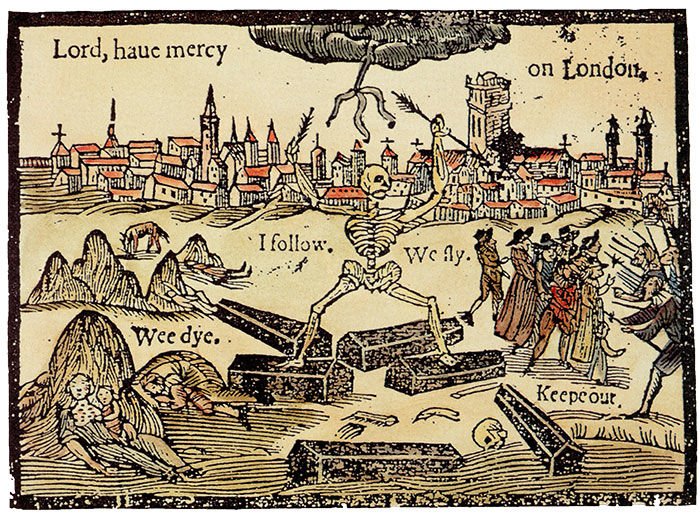
Plague woodcut. Note the wealthy people on the right who fled the plague, and the poor families dying on the left.
Like I have said, the working poor as a whole, suffered greatly because of the plague, especially since they were denied the means to avoid it. They lived in tightly packed, unsanitary environments and were unable to leave them without their lord’s permission, whereas we have a choice. This why it is crucial that we all do our part by staying away from crowds, observing proper hygiene, and offering support to our healthcare workers who are on the front lines of this war against coronavirus, and for whom we all pray for to stay healthy in turn.
As you probably know if you subscribe to this blog, I love to review adaptations of Shakespeare, so imagine my delight when I realized that the classic teen comedy Mean Girls from 2004, (and the current Broadway show of the same name), is based on Julius Caesar! This movie doesn’t have Shakespearean dialogue or the names or locations, but the essence of the play is the same, albeit with a more modern ending.
In Shakespeare’s play and Tina Fey’s script, the main antagonist is popular, and dangerous, and inspires fear and envy from everyone. Regina George and Caesar both rule their empires through their armies, intimidation, their wealth, and their supreme self-confidence. In addition, both names are associated with royalty- Regina in Latin means queen.
I didn’t realize that the movie has its roots in Julius Caesar until I saw this video from the YouTube channel The Take: https://youtu.be/FRfoEzZbK_Y. It was when I watched this video, that I realized Mean Girls character Janis was an analog for Shakespeare’s character Cassius, the man who sets the plot in motion to assassinate Caesar.
In the movie, Janis meets a well meaning girl and manipulates her into betraying Regina. Look at this clip where after Cady feels betrayed by Regina, Janis outlines her conspiracy, with a Roman sword in her hand! https://youtu.be/D0JMoa4QfA0
Like Cassius, Janis claims that once Regina is destroyed, the social order of the high school will change from a dictatorship to a democracy, but what she really wants is to supplant and replace Regina and make herself the new queen Bee. Even her name is a clue to her malevolent nature, she is named after the Roman god with two faces!
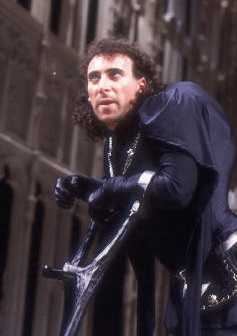
Sir Patrick Stewart as Cassius in the 1972 RSC production of Caesar
Similarly in Julius Caesar, Cassius convinces Brutus that once Caesar dies, Rome will be a republic again. In real life, Brutus was Caesar’s close friend, so Brutus agonizes over whether he is doing the right thing and whether he owes more loyalty to Rome, or his friend Caesar: https://youtu.be/IoDwXjKIenI
If Janis is Cassius, what about Brutus?
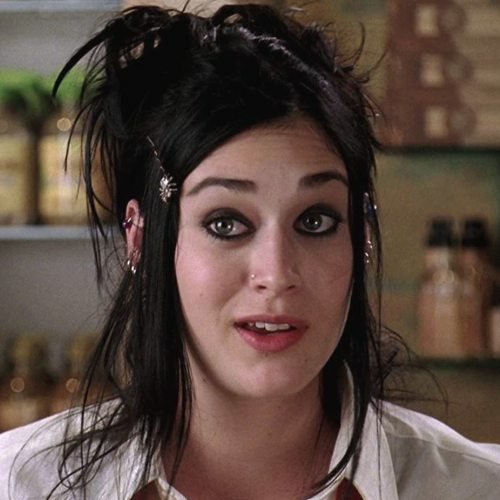
Cady Heron (played in the movie by Lindsay Lohan), is naive but intelligent. Like Brutus, she is manipulated and carefully chosen to betray the king. Janis chooses Cady because she’s pretty enough to get close to Regina, her looks are like social currency. Brutus’ social currency was his family: he was descended from the founder of the republic so he lent credibility to the conspiracy. He was also close in family to Caesar and Cassius.
In both stories once the monarch is destroyed, the power vacuum immediately starts to close; rather than change the social order, a new monarch arises. In Caesar, the second triumvirate takes over for the first, and Caesar’s nephew Augustus eventually becomes the supreme ruler of the Roman empire.
In Mean Girls, once Regina loses her social cache, Cady takes her place.
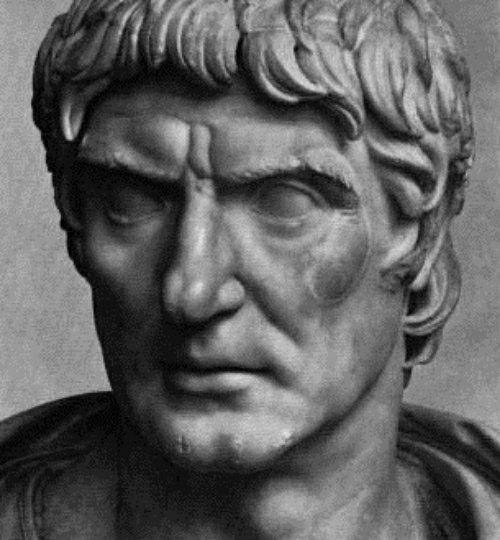
Then when Janis exposes Cady and Regina, she briefly basks in becoming a new Queen Bee- her revolution to overthrow a tyrant has paid off, bit now she is the tyrant herself. This actually mirrors the real Julius Caesar, who took power from the feared dictator Lucius Cornelius Sulla.
Bust of Sulla
Like Regina and her Burn Book, Sulla kept a list of people he saw as threats called the Proscriptions, only Sulla used it to execute the people on the list and seize their property. Caesar started his career as a populist soldier working for the Senate against Sulla and for the people, but became a dictator himself, the very thing he was sworn to oppose!
The movie does end on an encouraging note when the adults finally step up and address the terrible things that their students are doing, which has important lessons about bullying that every young person should see.
Tina Fey actually admitted that she herself was a Mean Girl in high school, so there’s a great deal of honesty when her character confronts the kids about the consequences of bullying each other.
Though the movie ends happily, the Cesarian parallels are not over; even though this high school has been democratized, the problems that created this Mean Girls autocracy remains. As you can see in the final minutes of the movie, a new crop of Plastics arrive just as the old group disbanded.https://youtu.be/LshX2God-wkIn four years when the regime changes again, will there be a new Caesar?
After rewatching clips from the movie, I realized that Tina Fey actually made a Caesar reference right there in the movie!
In this clip, Gretchen is in English class, perfectly paraphrasing Cassius’ speech in Act I, Scene ii, even the part about Caesar being a colossus:
Cassius. Why, man, he doth bestride the narrow world
Like a Colossus, and we petty men
Walk under his huge legs and peep about
To find ourselves dishonourable graves.
Brutus and Caesar: what should be in that ‘Caesar’?
Why should that name be sounded more than yours?
Write them together, yours is as fair a name;
Sound them, it doth become the mouth as well;
Weigh them, it is as heavy; conjure with ’em,
Brutus will start a spirit as soon as Caesar.
Now, in the names of all the gods at once,
Upon what meat doth this our Caesar feed,
That he is grown so great? Age, thou art shamed!
Rome, thou hast lost the breed of noble bloods!
When went there by an age, since the great flood,
But it was famed with more than with one man?
When could they say till now, that talk’d of Rome,
That her wide walls encompass’d but one man?
Now is it Rome indeed and room enough,
When there is in it but one only man.
O, you and I have heard our fathers say,
There was a Brutus once that would have brook’d
The eternal devil to keep his state in Rome
As easily as a king. I.ii. 226-252.
Now I know Mean Girls is based more on a book and by Tina Fey’s own experiences than Shakespeare, but the point is that the next time you are bored and angry about having to read a play based on a guy who’s been dead for over 2,000 years, take a look at the lunch table next to you and you’ll see that things haven’t changed that much.
The class breaks down some of the most famous speeches in Julius Caesar and gives you some tips and tricks on how to write persuasive speeches like Antony’s “Friends, Romans, Countrymen,” speech. Use these powers for good though, not to turn your school into a Mean Girls dictatorship! https://outschool.com/classes/84ee847d-19f3-45f8-9f25-81e688b8497d
There’s also a fully asynchronous version that you can do on your own time whenever you want:
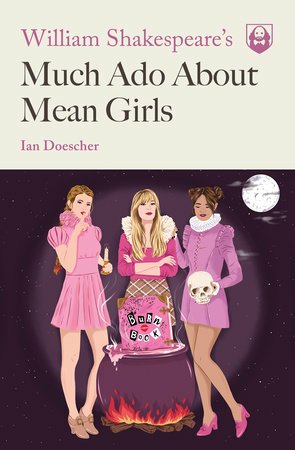
Finally, if you love Mean Girls and Shakespeare, check out Much Ado About Mean Girls by Ian Doescher, author of the William Shakespeare’s Star Wars trilogy.
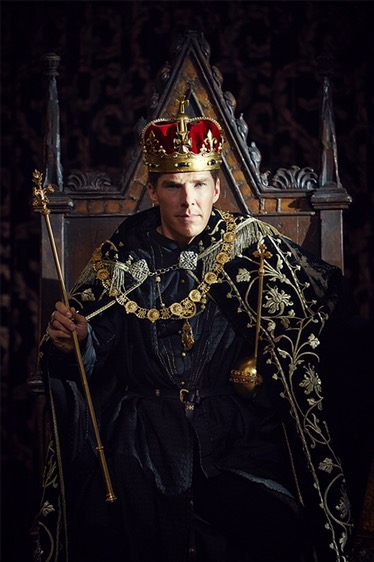
Since it’s now two years into the Trump presidency I thought I would follow up on my post I wrote when he was a candidate, and focus instead on his actions as president. Shakespeare’s Richard changes almost immediately once the crown is set on his head in the middle of the play, and the rest of his short reign is plagued with the exhaustive process of keeping it on his head, (and by extension, keeping his head on his shoulders). My main argument is that Trump’s presidency has steadily skirted more and more towards authoritarianism through his actions and his rhetoric, much the same way Richard became more like a dictator as soon as he became king. Moreover, Trump, Shakespeare’s Richard and even the historical king Richard have been distorted beyond recognition because of fake news, but not the kind you might expect.
Part I Before the Throne
As I have written before, Richard claims the throne by manipulating everyone in the British political machine- stoking hatred among the nobles, while trying to appear as a pious, humble man to the common people. Because of his years on reality television and experience as a businessman, even I must admit Trump has a gift at manipulating people’s perceptions and playing the part of a man of the people:
https://m.youtube.com/watch?v=cpxCl8ylJgE
If you watch Trump in interviews, he often closes his remarks with “believe me,” Richard also understands the power of oaths and pretends to speak like a plain blunt man, claiming that the British nobles hate him because he ‘tells it like it is’:
Cannot a plain man live and think no harm?But his simple truth must be abused by silken, sly, insinuating jacks!-Richard III, Act I, Scene iii
As for Trump, even though he is a privileged billionaire with inherited wealth, he pretends to be an unpretentious, unapologetic common man, abused by the ‘mainstream media’ and his political opponents.
Richard is also a fan of the moral equivalence argument, (also known as whataboutism). He tries to offset his own murders by mentioning other people and their misdeeds during the Wars Of The Roses, making them seem as bad or worse than Richard:
Let me put in your mind if you forget what you have been ere this and what you are, withal what I have been and what I am. RIII Act I, Scene iii.
Many have pointed out that both Trump and Fox News frequently use Whatsboutism to discredit their opponents and to shrug off their own guilt. It is also a tactic frequently used in former Soviet Union propaganda: https://youtu.be/PpVzHpgYuSc
My final comparison of the rhetoric between Trump and Shakespeare’s Richard is that both men are actors, players, or if you like, hypocrites. Trump actually tweeted how he sees each speech he makes as a tailor-made performance, while Richard praises his own ability to dissemble and equivocate to the skies: https://youtu.be/v6ji07tsI2M
Part II: The descent
Richard the third starts out the play as a evil underdog. Yes he kills people to gain the throne, but his deformity makes him seem sympathetic, and the fact that his victims have already killed plenty of people in the Wars of the Roses, gets him on our side. Once he’s crowned however, Richard step by step becomes more and more like an authoritarian dictator
What is an authoritarian? Basically an authoritarian regime concentrates power into the hands of one person, and tries to hold onto power by:
1. Projecting strength.
2. Demonizing opponents, both real and imagined.
3. Destroying institutions.
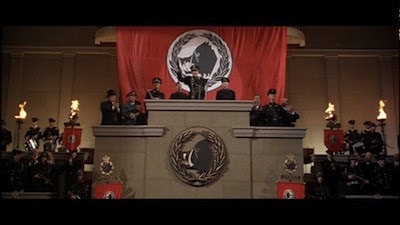
From the moment the crown is placed on his head, Richard starts to see threats to his power, and uses all his newfound resources to destroy every each and every threat. First he kills his nephews, (the legitimate heirs to the throne), then he kills his wife, so that he can remarry a princess to try and consolidate his power. And finally, when he faces his greatest threat the armies of Henry tutor Earl of Richmond, Richard goes full on dictator, calling himself a tower of strength, demonizing Richmond as a foreigner, and claiming that his soldiers will rape the English wives and daughters.
Still from Ian McKellen’s film version of Richard III, 1995
Trump is guilty of every one of these authoritarian strongman habits. He tries to convince people he is strong both physically and politically by having photo ops with doctors who claim that he is “the healthiest president ever”. He also attempted to project strength by misrepresenting the size of the crowds at his inauguration (which was a flat out lie), Furthermore, Trump demanded a military parade to emulate autocratic governments like North Korea. Then there’s his ultimate misguided show of American strength: the wall, which even Fox News has calculated will cost $25 billion dollars at least, and will do little to nothing to stop the flow of drugs and illegal immigration.
Trump also has from the beginning waged war on the Internet against any and all who oppose him. Let us not forget that Fox News is a 24 hour a day propaganda machine that exists almost entirely to condemn anyone who opposes the president and his agendas. And in terms of destroying institutions, his constant claims of “fake news“ seeks to destabilize the Free Press. America’s finding fathers guaranteed free press with the knowledge that if the government is corrupt, the only way the public can fight back is through the knowledge provided by a free and Independent press. But if the media is the enemy, we have no one to listen to except Trump himself.
Richard is even more comically trigger happy than Trump. Look at this scene where in less than 10 minutes, he sends a murderer to kill his nephews, plots to murder his wife and marry his niece, and completely throws off the Duke of Buckingham, his only supporter on his way to the crown!
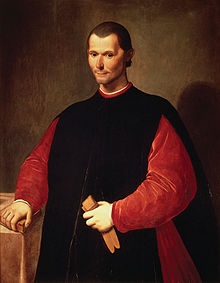
Richard’s authoritarian tactics actually spring from one of the best political theorists of the renaissance, unfortunately it was Machiavelli. Niccolo Machiavelli saw how the crown heads of Italy consolidated power through violence and intimidation, and he came to realize that the power behind the throne is much less to do with divine right or royal bloodline, and more with who can play the game and project power and strength. In Shakespeare’s Henry the Sixth Part III, Richard brags that in his quest to the good for the crown he will send Machiavelli to school: https://m.youtube.com/watch?v=v6ji07tsI2M
Portrait of Machiavelli by Sandi DiTito, c. 1650
I unfortunately don’t have enough time to get into the connections between Machiavelli, Richard, and Trump. Suffice it to say that all three advocate rule by fear and have no interest in preserving democracy. Below are some quotes and articles that I have collected about Machiavelli and his connection to Shakespeare and Trump:
Sadly, the ultimate similarity between Shakespeare’s Richard III, the real King Richard, and Trump is that the actual human has been swallowed up by a narrative. Even though most of what Trump says is a lie, to his supporters he is the one person who ‘tells it like it is,’ not because they believe him, but because they want to believe in the narrative he constructs.
These Ohio Voters Made Trump President. They’re Still With Him – TIME
Not only are his lies compelling, Trump himself has become a powerful symbol to the disenfranchised that the system is broken and corrupt, so why not vote for someone like him? He brands himself as a ‘plain blunt man’ who isn’t afraid to offend or criticize people in power, even though he is much worse than they are at running the government. According to the testimony of his former lawyer Michael Cohen, Trump described his own campaign as the ” The greatest infomercial in political history.” His campaign was from the start, a scam, where the ultimate con man told people he was going to fix healthcare, fix the immigrants coming into the country, and fix everything they didn’t like about America.
Trump and Richard exploit what you and I want to believe. A New York Times article from 2016 made an interesting comparison between Trump’s odious political persona and that of one of the “heels” or bad guys in professional wrestling. These characters are unrepentantly evil, and love to stir up anger in the crowd, and everyone knows that their every word and action is fake, but they buy into the story. This kind of suspension of disbelief is of course, the central guiding principle of theater itself, and arguably Shakespeare created a villain who would make a very effective wrestling heel.
The real Richard’s devolution from a historical king into a villainous archetype is more tragic, but just as powerful. The lies that the Tudor chronicles told about him were more compelling and politically convenient than the truth, and Shakespeare’s genius just further distanced us from caring what the real man was like. In essence, Shakespeare was inventing fake news far before Trump was railing about it. Just as we as an audience are complicit in the pretend crimes of a fake king when we watch the play, we are also complicit in perpetuating a comfortable simplistic story of the 15th century War of the Roses king Richard Plantagenet.
Trump and Richard show that history can be distorted when we focus less on what is really happening and more on what we want to see. More people wanted to believe his lies than Hillary Clinton’s facts, the same way people were forced to believe the Tudor lies instead of the real truth of what happened from 1483-1485. Likewise Shakespeare’s Richard exploits people’s fear, greed, and gullibility to gain power for himself, but this is his only talent; eventually his supporters lose faith in him, his enemies mobilize, and he is taken from power.
War and soldiers come up a lot in Shakespearean plays. After all, he wrote six plays about the Wars Of The Roses. Though most of his work is about the decisions about war made by powerful monarchs, occasionally he gives us some insight into the lives of common soldiers.
We don’t know if he ever fought, but warfare was very much on his mind at the beginning of his career, with good reason. In 1586 The Spanish armada attacked. Was Shakespeare enlisted? We don’t know.
His early plays are generally positive toward soldiers and it’s easy to see why. The growing nationalism in England resulting from the Tudor control over religion and language —was a direct and defensive reaction to the ex-communication of the Tudor monarchs (particularly Henry VIII and Queen Elizabeth. Shakespeare probably saw himself —
. He no doubt saw his role as building the epic sagas of England to remind his countrymen of England’s past victories, especially during the Spanish Armada and the later Irish Rebellion of 1599.
Shakespeare cashed in with 9 plays on English history that mainly take place on the battlefield. His plays were met with praise by audiences and critics:
“How would it have joyed brave Talbot (the terror of the French),” he wrote, “to think that after he had lain two hundred years in his tomb, he should triumph again on the stage and have his bones new embalmed with the tears of ten thousand spectators at least (at several times).” -Thomas Nashe, c. 1590.
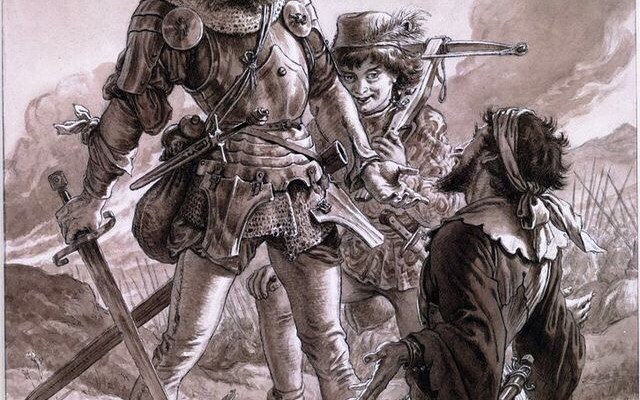
In the first tetralogy, common soldiers don’t have any voice. Probably they were played by apprentices, and fencing masters. They were mainly set dressing. Shakespeare mainly focuses on the pivotal importance of leadership and his portrayal f leadership; he understood the consequences of the choices kings make during the war and its effect on millions of common people: like Talbott and King Henry the Fifth.
I want to analyze a short selection from Henry the Fifth, Act IV, Scene I. In this scene, the king is disguised as a commoner the night before a battle to see what his soldiers really think about him, and the impending fight with the French. An outspoken soldier named Williams tells him that if the fighting is wrong, the king is responsible for his soldiers’ deaths, and has to answer for the atrocities that happen during the war:
KING HENRY V
methinks I could not die any where so contented as in the king’s company; his cause being just and his quarrel honourable.
WILLIAMS
That’s more than we know.
BATES
Ay, or more than we should seek after; for we know enough, if we know we are the kings subjects: if his cause be wrong, our obedience to the king wipes the crime of it out of us.
WILLIAMS
But if the cause be not good, the king himself hath a heavy reckoning to make, when all those legs and arms and heads, chopped off in battle, shall join together at the latter day and cry all ‘We died at such a place;’ some swearing, some crying for a surgeon, some upon their wives left poor behind them, some upon the debts they owe, some upon their children rawly left. I am afeard there are few die well that die in a battle; for how can they charitably dispose of any thing, when blood is their argument? Now, if these men do not die well, it will be a black matter for the king that led them to it. King Henry V, Act IV Scene I.
Many productions of Henry the Fifth interpret this speech as Shakespeare’s attitude towards war, (a tempting prospect, since the soldiers’ name is William), but in the very next speech King Henry completely changes Williams’ mind! Here’s the full scene from Kenneth Branaugh’s 1989 movie version of the play, which he directed and starred as King Henry:
For my upcoming play Of the Month page I am examining the influence of Shakespeare’s Macbeth in popular culture. Many people have compared the play to Breaking Bad, so I was delighted when I found this trailer on YouTube that perfectly illustrates the common threads in these two works.












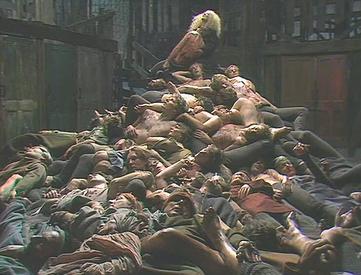



 • Plague carts like in Monty Python (Dreary) carried plague bodies out of the city and burned them.











 As I have written before, Richard claims the throne by manipulating everyone in the British political machine- stoking hatred among the nobles, while trying to appear as a pious, humble man to the common people. Because of his years on reality television and experience as a businessman, even I must admit Trump has a gift at manipulating people’s perceptions and playing the part of a man of the people:




 For my upcoming play Of the Month page I am examining the influence of Shakespeare’s Macbeth in popular culture. Many people have compared the play to Breaking Bad, so I was delighted when I found this trailer on YouTube that perfectly illustrates the common threads in these two works.
 The Shakespearean Student
