
Watch “OMkara and the Indian Shakespeare” on Youtube


HAPPY MOTHER’S DAY!
Ever wonder what it was like to be a woman and a mother in Tudor Times? Watch this excellent documentary by Michael Wood

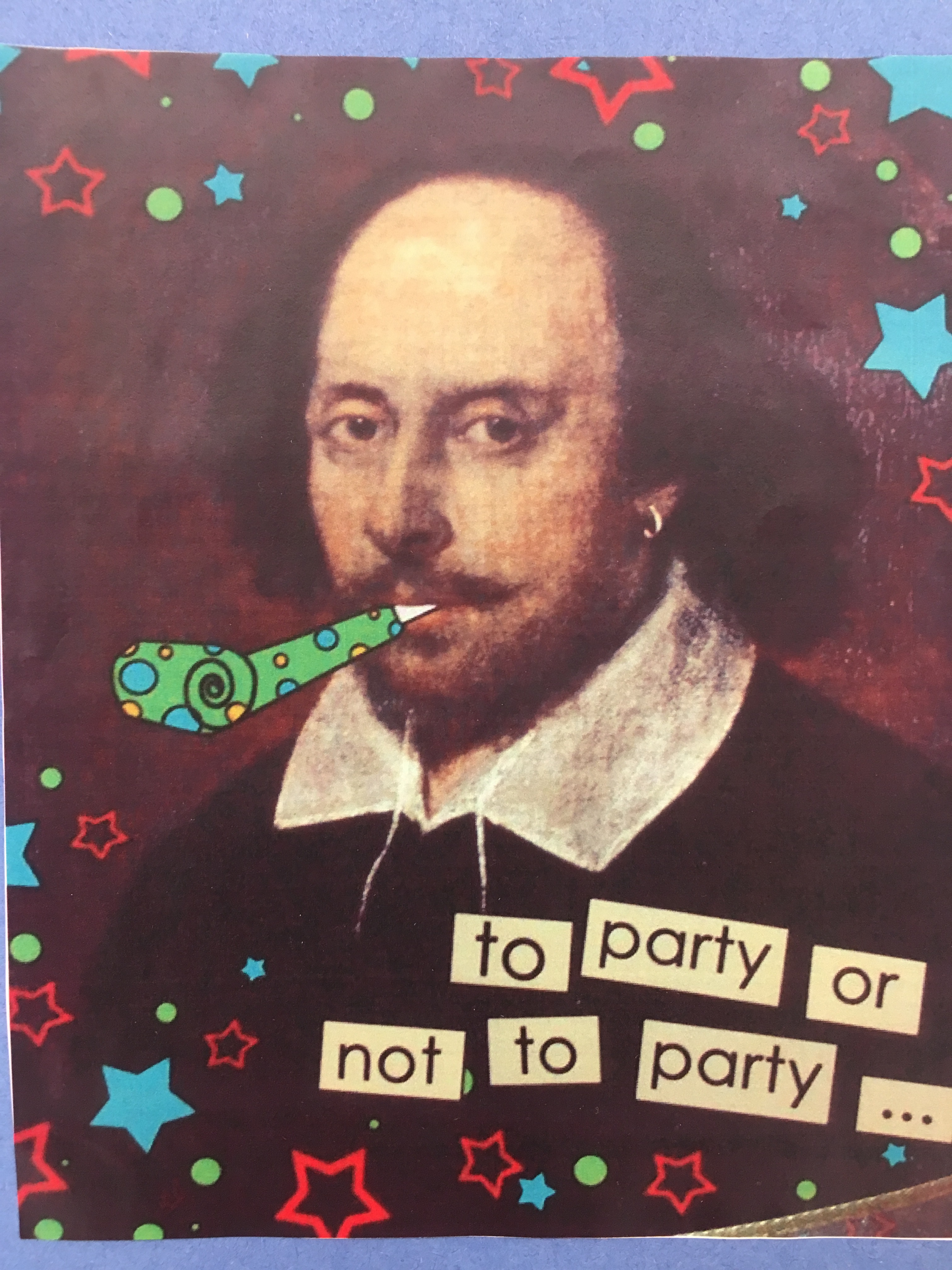
Happy Birthday Shakespeare!
With Shakespeare’s birthday coming up, I got to wondering if Shakespeare and other Elizabethans celebrated birthdays, and if so, did they use birthday cakes covered with lit candles?
Shakespeare’s plays make it clear that they did at least mark birthdays- Cassius in Julius Caesar and Cleopatra in Antony and Cleopatra do mention birthdays and several other plays mention cake.
One passage from Troilus and Cressida, (a comedy set in Ancient Greece) is practically a recipe for an Elizabethan cake:
Pandarus. Well, I have told you enough of this: for my part,
I'll not meddle nor make no further. He that will
have a cake out of the wheat must needs tarry the grinding.
Troilus: Have I not tarried?
Pandarus. Ay, the grinding; but you must tarry
the bolting.
Troilus. Have I not tarried?
Pandarus. Ay, the bolting, but you must tarry the leavening.
Troilus. Still have I tarried.
Pandarus. Ay, to the leavening; but here's yet in the word
'hereafter' the kneading, the making of the cake, the
heating of the oven and the baking; nay, you must
stay the cooling too, or you may chance to burn your lips.
You might think Shakespeare is being anachronistic, but according to Food and Wine Magazine, the Ancient Greeks invented the practice of putting candles on cake, because Greek cakes were offerings to the Moon goddess Artemis, and the pious worshippers wanted their cakes to shine like the Moon!
There are also stories from Greco-Roman myths about a special honey cake that was so good, it even appeased Cerberus, the three-headed dog of the underworld!
It was the Romans who had the first birthday parties with cake, though their parties were strictly for the aristocracy, not common people. The first children’s birthday cakes with candles came to be in Germany in the 18th century.
So we know birthday cakes were a thing in Shakespeare’s Day, and that he was aware of them. The question is whether Christian Elizabethans chose to continue the practice of birthday cakes, and if common men like Shakespeare partook in them.
Sadly, the research I’ve gathered suggests that common men like Shakespeare probably didn’t eat cakes to celebrate their birthdays, (though, as I have discussed in other posts, Shakespeare might have eaten cakes at Halloween, Christmas, and Twelfth Night).

Although the concept of a birthday cake with frosting and candles wasn’t really a thing in Shakespeare’s Day and not available to people of his social class, we can still celebrate his birthday in plenty of fun and delicious ways! Below is a video from the Utah Shakespeare festival that features a young girl making an Elizabethan cake from The Complete Cook in Shakespeare’s honor, in front of a special guest!
You’ll notice that the recipe doesn’t have leavening agents like baking powder except for yeast, so like Pandarus warns Troilus, an Elizabethan cake requires kneading, more time, and will produce a smaller and less fluffy result, (much like Troilus’ relationship with Cressida, but I will get into that later). I encourage you to try this and other Shakespearean recipes and stay tuned to my blog, YouTube page, etc, for lots of fun posts in honor of Shakespeare’s Birthday!

https://www.bigsmall.in/blogs/unique-gifts/the-history-behind-cutting-a-birthday-cake


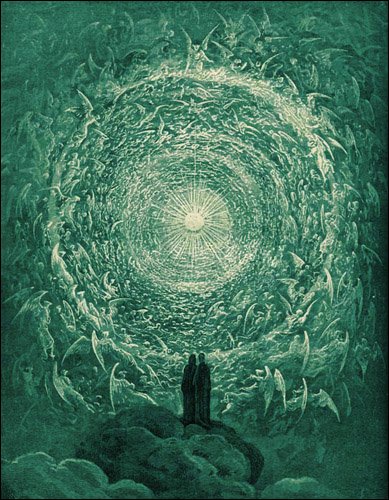


Since Easter and Passover are coming up, (and we are already in the middle of Rhamadan), I thought I’d examine Shakespeare’s depiction of other worlds both celestial and infernal. As the quote above says, philosophers and poets often wonder what greets us in the hereafter, so let me be your guide through Shakespeare’s poetic renderings of heaven and he’ll, accompanied by some gorgeous artwork from HC Selous, William Blake, and others.
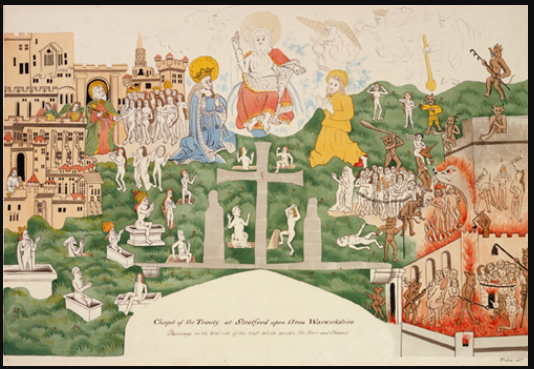
Shakespeare was no doubt interested in religion. He quotes from and alludes to the Bible many times in his plays. More importantly, he lived in a time when the national religion changed three times in just 4 years! When Henry VIII changed England to a protestant country, the religious identity of England completely changed:
This change was not just felt in monasteries, but in all English churches. King Henry decreed that certain Catholic traditions like Purgatory, indulgences, and praying to saints were idolatrous, and were therefore banned in the Church of England. So, when Shakespeare’s father was called to destroy the “idolatrous” images of the Last Judgement in the Guild Chapel of Stratford’s Holy Trinity Church, he had no choice but to comply. If you click on the link below, you can see a detailed description of the images that Shakespeare no doubt knew well in his family’s church, until his father was forced to literally whitewash them.
Like the images on the Stratford Guild chapel, the ideas of Catholic England didn’t disappear, they were merely hidden from view. Shakespeare refers to these Catholic ideas many times in his plays, especially in Hamlet, a play where a young scholar, who goes to the same school as Martin Luther, is wrestling with the idea of whether the ghost he has seen is a real ghost from purgatory, or a demon from hell, (as protestant churches preached in Shakespeare’s life).
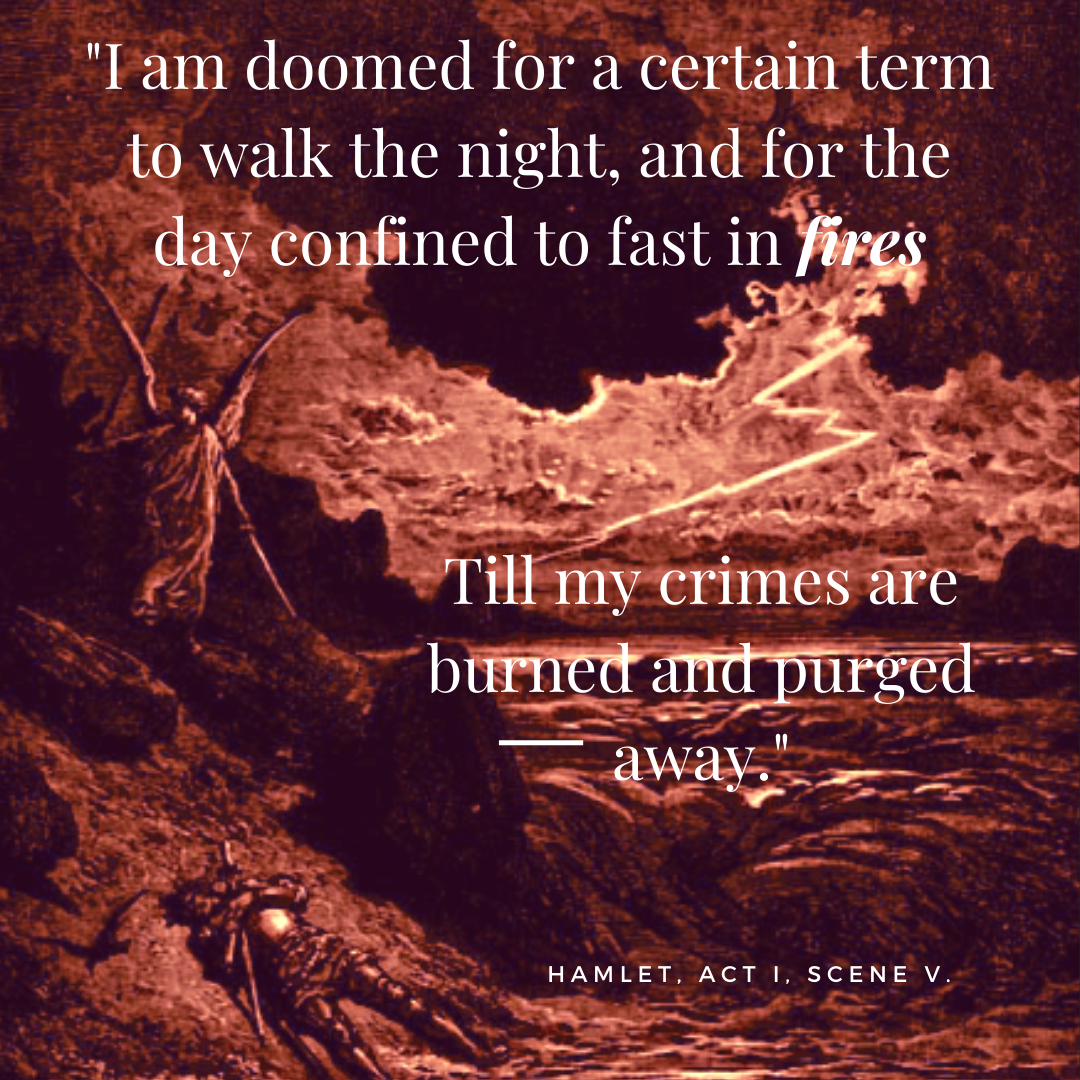
I’ve written before that the ghost of Hamlet’s father teases us with the possibility that he might be a soul in purgatory, the Catholic afterlife realm for those not evil enough for Hell, nor good enough for Heaven. At the height of their powers, monks and bishops sold prayers called indulgences that supposedly allowed a soul’s loved ones to buy them time out of purgatory, thus making them able to ascend to Heaven quicker. The image above is an illustration from Purgatorio, part of Dante’s Divine Comedy, where he visits the soul of
Buonconte da Montefeltro, who is languishing because he doesn’t yet have the strength to get out of purgatory and enter Heaven.
Of course, the Tudor monarchs Henry VIII and Elizabeth I abolished indulgences and proclaimed that purgatory itself didn’t exist, but ideas can’t die, and I feel that Shakespeare was at least inspired by the notion of purgatory, even if he didn’t believe in it himself.

(Horatio) Hamlet, Act I, Scene i.
As a young boy, William Shakespeare was entertained by medieval Mystery plays; amateur theater pieces performed by local artisans that dramatized great stories from the Bible. We know this because he refers to many of the characters in these mystery plays in his own work, especially the villains. King Herod is mentioned in Hamlet and many other plays in and many of Shakespeare’s villains seem to be inspired by the biblical Lucifer, as portrayed in Medieval Mystery Plays.
In this short video of the Yorkshire Mystery play “The Rise and Fall of Lucifer,” we see God (voiced by Sir Patrick Stewart), creating Lucifer as a beautiful angel, who then, dissatisfied with his place in God’s kingdom, is transformed into an ugly devil. At first, Lucifer mourns losing his place in Paradise, but then finds comfort by becomming God’s great antagonist.
Compare this character arc with Shakespeare’s Richard of Gloucester, who also blames his unhappiness on God, (since he feels his disability and deformity are a result of God’s curse). Richard is angry with God, nature, and society, so he wages against them all to become king.
“Then since the heavens hath shaped my body so, let Hell make crook’d my mind to answer it.”
Richard of Gloucester, Henry VI, Part III, Act III, Scene i.

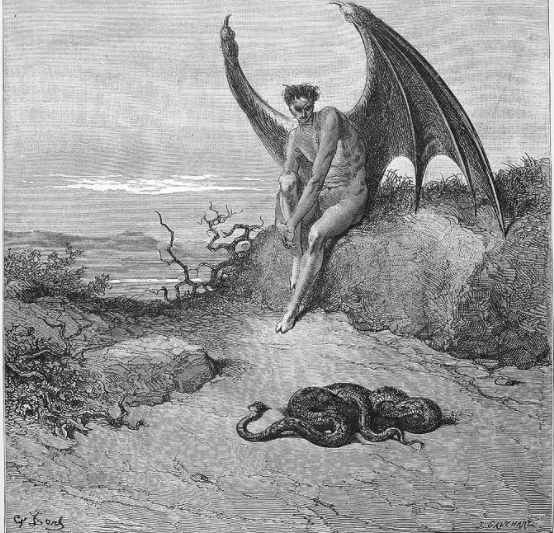
“All is not lost, the unconquerable will, and study of revenge, immortal hate, and the courage never to submit or yield.”
Lucifer― John Milton, Paradise Lost
Claudio. Ay, but to die, and go we know not where;
To lie in cold obstruction and to rot;
This sensible warm motion to become
A kneaded clod; and the delighted spirit
To bathe in fiery floods, or to reside
In thrilling region of thick-ribbed ice;
To be imprison’d in the viewless winds,
And blown with restless violence round about
The pendent world; or to be worse than worst
Of those that lawless and incertain thought Imagine howling: ’tis too horrible!
—Measure For Measure, Act III, Scene i
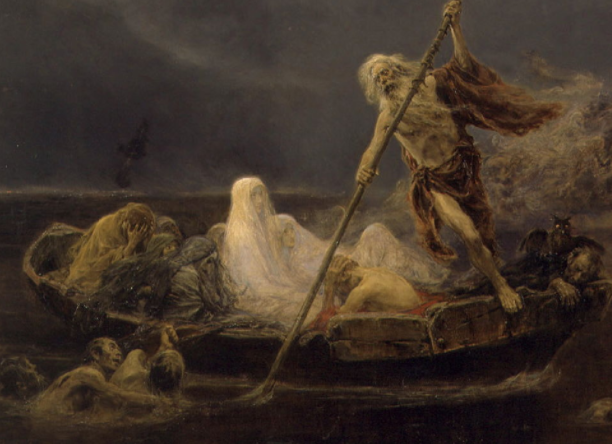
“Methought I crossed the meloncholy flood with that grim ferryman the poets write of, into the kingdom of perpetual night.”
— Richard III, Act I, Scene iv.

The heavens themselves, the planets and this centre
Observe degree, priority and place,
Insisture, course, proportion, season, form,
Office and custom, in all line of order;
And therefore is the glorious planet Sol
In noble eminence enthroned and sphered
Amidst the other; whose medicinable eye
Corrects the ill aspects of planets evil,
And posts, like the commandment of a king,
Sans cheque to good and bad: but when the planets
In evil mixture to disorder wander,
What plagues and what portents! what mutiny!
What raging of the sea! shaking of earth! Commotion in the winds! frights, changes, horrors,
Divert and crack, rend and deracinate
The unity and married calm of states
Quite from their fixure! O, when degree is shaked,
Which is the ladder to all high designs,
Then enterprise is sick!      - Troilus and Cressida, Act I, Scene iii.
https://folgerpedia.folger.edu/Idolatry:_Icons_and_Iconoclasm

I just got approved by Outschool.com to teach a multi-week course on Shakespeare’s comedies!
Get $10 off my class “Shakespeare’s Comic Plays” with coupon code HTHESEJEL310 until May 1, 2022. Get started at https://outschool.com/classes/shakespeares-comic-plays-868BR5hg and enter the coupon code at checkout.

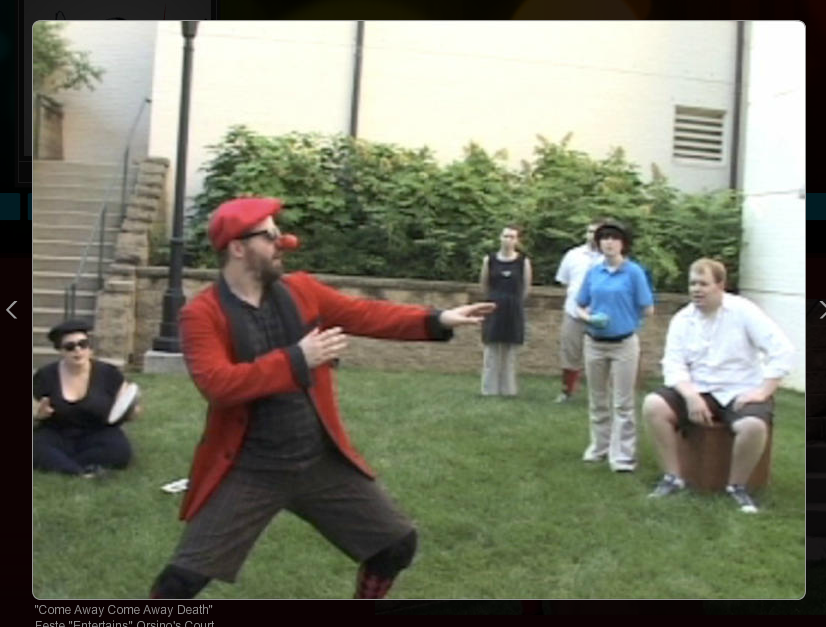


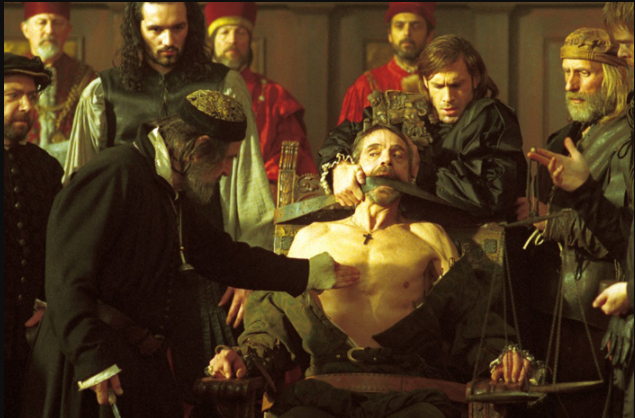


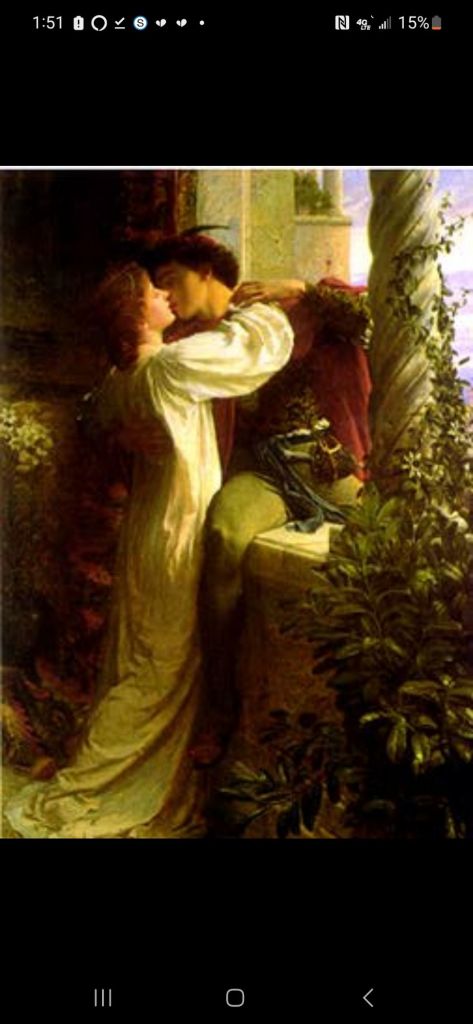

I’ve seen four live productions of Romeo and Juliet, (5 if you include West Side Story). I’ve also watched four films (6 if you include West Side Story and Gnomio and Juliet) and one thing that I’ve noticed again and again, and again is that you can tell the whole story of the play with clothing. This is a story about families who are part of opposite factions whose children secretly meet, marry, die, and fuse the families into one, and their clothes can show each step of that journey.
The feud
Nearly every story about a conflict or war uses contrasting colors to show the different factions. Sometimes even real wars become famous for the clothes of the opposing armies. The Revolutionary War between the redcoats and the blue and gold Continentals, the American Civil War between the Rebel Grays and the Yankee Bluebellies. In almost every production I’ve ever seen, the feud in Romeo and Juliet is also demonstrated by the opposing factions wearing distinctive clothing.
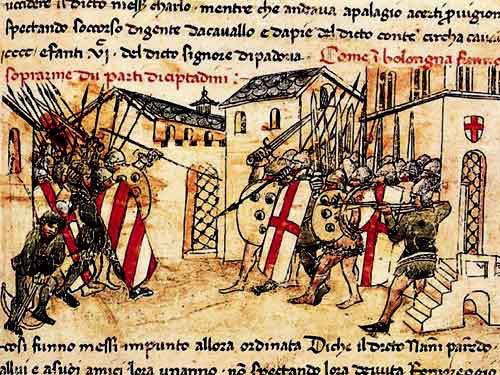
Historically, warring factions in Itally during the period the original Romeo and Juliet is set, wore distinctive clothes and banners as well. . In this medieval drawing, you can see Italians in the Ghibelline faction, who were loyal to the Holy Roman Empire, fighting the Guelph faction (red cross), who supported the Pope. Powerful families were constantly fighting and taking sides in the Guelf vs. ghibelines conflict in Verona, which might have inspired the Capulet Montegue feud in Romeo and Juliet.
Even the servants of the nobles got roped into these conflicts, and they literally wore their loyalties on their sleeves. The servants wore a kind of uniform or livery to show what household they belonged to. The servants Gregory and Sampson owe their jobs to Lord Capulet, and are willing to fight to protect his honor. Perhaps Shakespeare started the play with these servants to make this distinction very obvious. Here’s a short overview on Italian Liveries from the Metropolitan Museum of Art:
https://www.metmuseum.org/art/collection/search/86582
In 1966, director Franco Zepherelli set a trend with his iconic use of color in his movie. He chose to make the Capulets wear warm tones while the Montegues wore blue and silver. Juliet (Olivia Hussey) wore a gorgeous red dress that made her look youthful, passionate, and lovely, while Tybalt (Michael York), wore red, orange, and black to emphasize his anger, and jealousy (which has been associated for centuries with the color orange). By contrast, the Montagues like Romeo (Leonard Whiting) wore blue, making him look peaceful and cool. These color choices not only clearly indicate who belongs to which contrasting factions, but also help telegraph the character’s personalities. Look at the way these costumes make the two lovers stand out even when they’re surrounded by people at the Capulet ball:

Zepherilli’s color choices were most blatantly exploited in the kids film Gnomio and Juliet, where they did away with the names Capulet and Montegue altogether, and just called the two groups of gnomes the Reds and the Blues.
The Dance
To get Romeo and Juliet to meet and fall in love, Shakespeare gives them a dance scene for them to meet and fall in love. He further makes it clear that when they first meet, Romeo is in disguise. The original source Shakespeare used made the dance a carnival ball, (which even today is celebrated in Italy with masks). Most productions today have Romeo wearing a mask or some other costume so that he is not easily recognizable as a Montague. Masks are a big part of Italian culture, especially in Venice during Carnival:
In the 1996 movie, Baz Luhrman creates a bacchanal costume party, where nobody wears masks but the costumes help telegraph important character points. Mercutio is dressed in drag, which not only displays his vibrant personality but also conveniently distracts everyone from the fact that Romeo is at the Capulet party with no mask on.
Capulet is dressed like a Roman emperor, which emphasizes his role as the patriarch of the Capulet family. Juliet (Claire Danes) is dressed as an angel, to emphasize the celestial imagery Shakespeare uses to describe her. Finally, Romeo (Leonardo DiCaprio) is dressed as a crusader knight because of the dialogue in the play when he first meets Juliet:
Romeo. [To JULIET] If I profane with my unworthiest hand
This holy shrine, the gentle fine is this:720
My lips, two blushing pilgrims, ready stand
To smooth that rough touch with a tender kiss.
Juliet. Good pilgrim, you do wrong your hand too much,
Which mannerly devotion shows in this;
For saints have hands that pilgrims' hands do touch,725
And palm to palm is holy palmers' kiss.
Romeo. Have not saints lips, and holy palmers too?
Juliet. Ay, pilgrim, lips that they must use in prayer.
Romeo. O, then, dear saint, let lips do what hands do;
They pray, grant thou, lest faith turn to despair.730
Juliet. Saints do not move, though grant for prayers' sake.
Romeo. Then move not, while my prayer's effect I take.
Thus from my lips, by yours, my sin is purged.
Juliet. Then have my lips the sin that they have took.
Romeo. Sin from thy lips? O trespass sweetly urged!735
Give me my sin again.
Juliet. You kiss by the book. Romeo and Juliet, Act I, Scene V, Lines 719-737.
Notice that Romeo calls Juliet a saint, and later an angel in the famous balcony scene, which explains her costume at the ball. Juliet refers to Romoe as a Pilgrim, which is a cheeky comment on his crusader knight costume. In the Crusades, crusader knights made pilgrimages to the holy land, with the hope that God (and presumably, his angels) would forgive their sins. Romeo’s name even means “Pilgrim.” Luhrman makes clever nods to Shakespeare’s text by dressing Romeo and Juliet in this way, and gives the dialogue a bit of a playful roleplay as the characters make jokes about each other’s costumes- Romeo hopes that he will go on a pilgrimage and that this angel will take his sin with a kiss.
In Gnomio and Juliet, the titular characters meet in a different kind of disguise. Rather than going to a dance with their family, they are both simultaneously trying to sneak into a garden and steal a flower, so they are both wearing black, ninja-inspired outfits. Their black clothing helps them meet and interact without fear of retribution from their parents (since they do not yet know that they are supposed to be enemies. The ninja clothes also establishes that for these two gnomes, love of adventure unites them. Alas though, it doesn’t last; Juliet finds out that Gnomio is a Blue, when they both accidentally fall in a pool, stripping their warpaint off and revealing who they are.
Sometimes the dance shows a fundamental difference between the lovers and the feuding factions. West Side Story is a 20th-century musical that re-imagines the feuding families as juvenile street gangs, who like their Veronese counterparts, wear contrasting colors. The Jets (who represent the Montagues) wear Blue and yellow, while the Sharks (Capulets), wear red and black. The gang members continue wearing these colors on the night of the high school dance, except for Tony and Maria (the Romeo and Juliet analogs). In most productions I’ve seen, (including the 2021 movie), these young lovers wear white throughout the majority of the play, to emphasize the purity of their feelings, and their rejection of violence. Thus, unlike Shakespeare’s version of the story, West Side Story makes the lovers unquestionably purer are more peaceful than Shakespeare’s Romeo and Juliet, and their clothing makes this clear.

The Merging of the family
(8:30-11:00)
Costume Designer Charlene in the 2006 AU production deliberately had the characters change clothes when they get married. Juliet was wearing the same iconic red dress as Olivia Hussey for the first two acts of the play but then changed into a pale blue gown that matches Romeo. The clothes re-enforce the idea that the marriage represents Romeo and Juliet abandoning their family’s conflicts, and simply showing their true colors.


Another way of getting everyone in the family to subconsciously unite in grief would be to costume everyone wearing black except Romeo and Juliet. At the end of the play, The Capulets are already mourning Juliet, (because she faked her death in Act IV), and the Montegues are already mourning Lady Montegue (who died offstage). Just by these circumstances, everyone could come onstage wearing black, uniting in their grief, which is further solidified when they see their children dead onstage.
Not all productions choose to costume the characters like warring factions, but nevertheless, any theatrical production’s costumes must telegraph something about the characters. In these production slides for a production I worked on in 2012, the costumes reflect the distinct personality of each character and show a class difference between the Montagues and the Capulets.
The 2013 Film: Costumes Done Badly
The 2013 movie is more concerned with showing off the beauty of the actor’s faces, and the literal jewels than the clothes:
Most of the actors and costumes are literally in the dark for most of the film, probably because the film was financed by the Swarofski Crystal company, who literally wanted the film to sparkle. Ultimately, like most jewelry, I thought the film was pretty to look at, but the costumes and cinematography had little utilitarian value. The costumes and visual didn’t tell the story efficiently, but mainly was designed to distract the audience with the beauty of the sets, costumes and the attractive young actors. The only thing I liked was a subtle choice to make Juliet’s mask reminiscent of Medusa, the monster in Greek Myth, who could turn people to stone with a look. I liked that the film was subtly implying that love, at first sight, can be lethal.

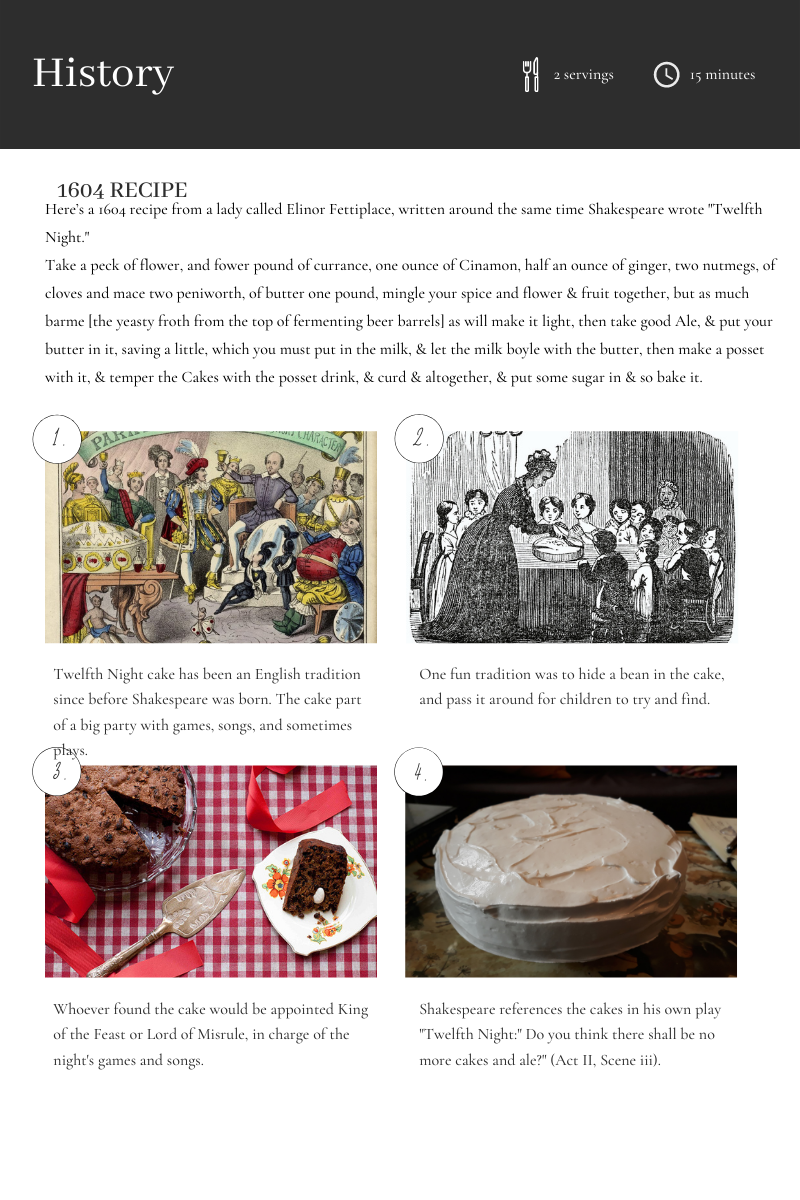
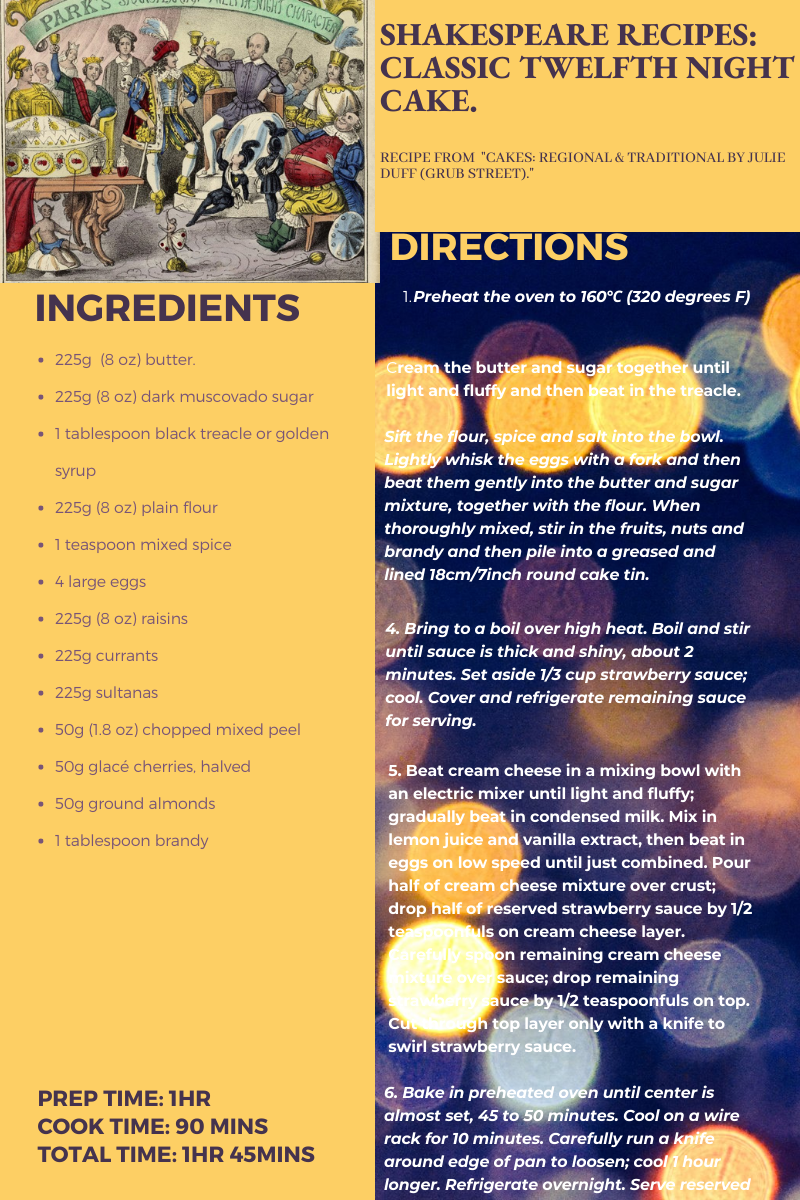
If you’re pressed for time for your annual Twelfth Night party, I’ve got this quick and easy recipe card about how to make a Twelfth Night cake! I have three recipes in these cards- one 1604 recipe, which might have been used by Shakespeare himself, another Twelfth Night cake recipe, with modernized ingredients, and a more contemporary Christmas cake, (just in case you need a more kid-friendly recipe).

Finally, here’s a video about the most celebrated traditions surrounding Twelfth Night cake- the bean and coin in the cake!.






 The Shakespearean Student