
Background Presentation About Othello


In doing my research for Twelfth Night, I came across a fantastic production from Shakespeare’s Globe in 2002. It used what is known as “original practices,” meaning that the actors tried to replicate everything we know about the way Shakespeare’s actors performed.

The play was performed in the great Globe Theater, which is itself a replica of Shakespeare’s original playhouse, which means that it was outdoors, using mostly natural lighting, and minimal sets. https://youtu.be/qtoUeVjP_rs
In addition, all the women’s roles were played by men, and the actors played multiple parts, which were all accurate stage practices from Shakespeare’s era. Most exciting of all, the actors all wore authentic 17th century costumes designed by veteran costume designer, Jenny Tiramani:
/https://prezi.com/m/zef_cpurcfsl/jenny-tiramani/
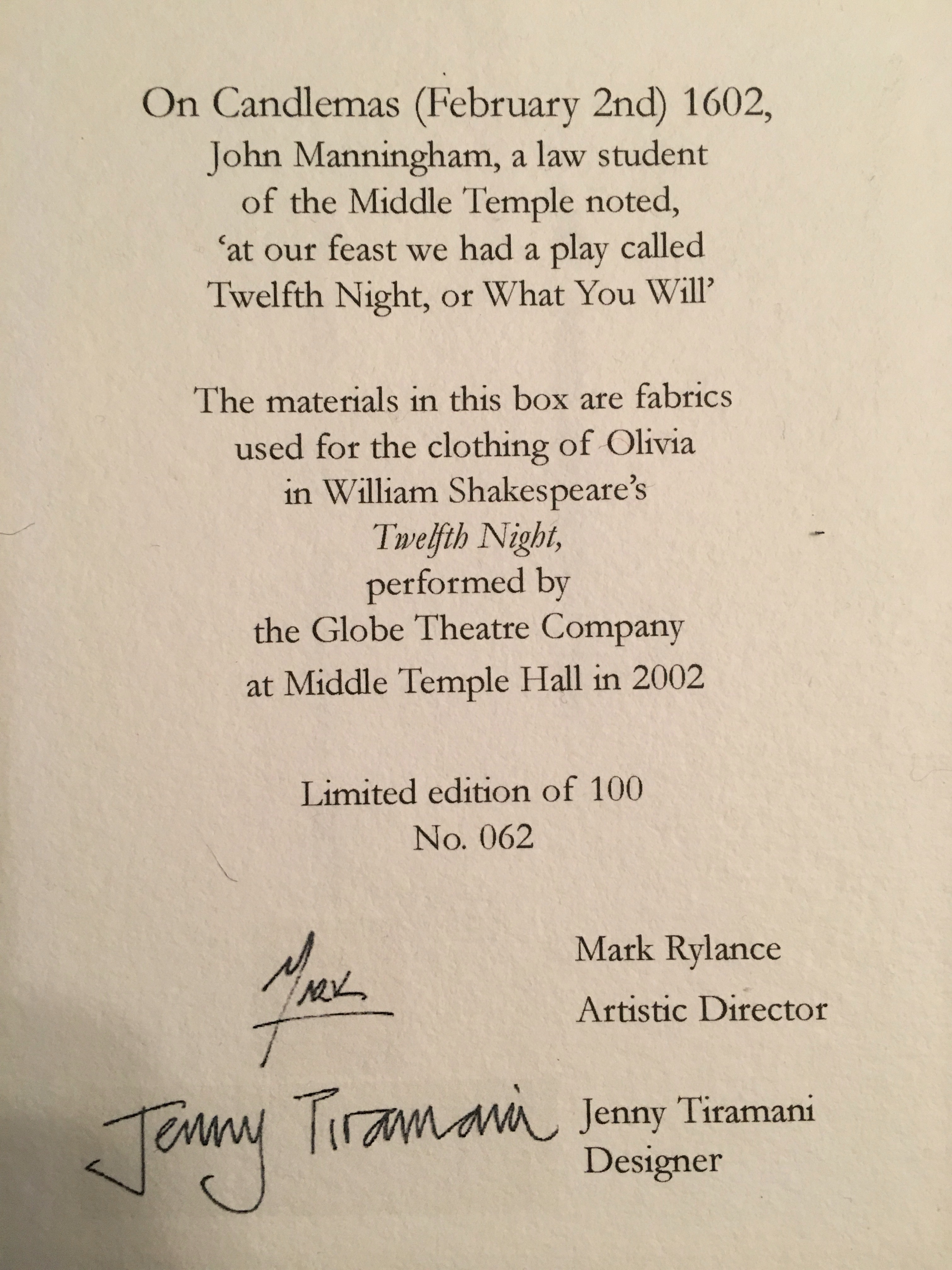
Few things determine how an actor moves or looks more than the clothes he or she wears, and watching these actors wear doublet and hose and real Jacobean dresses really fires up my imagine and makes me feel that I’ve truly been transported through time. The production is available on DVD, as well as several clips on YouTube, and I urge you to take a look at it. In the meantime, I’d like to comment a little on how the costumes from this production inform the audience about the characters that wear them.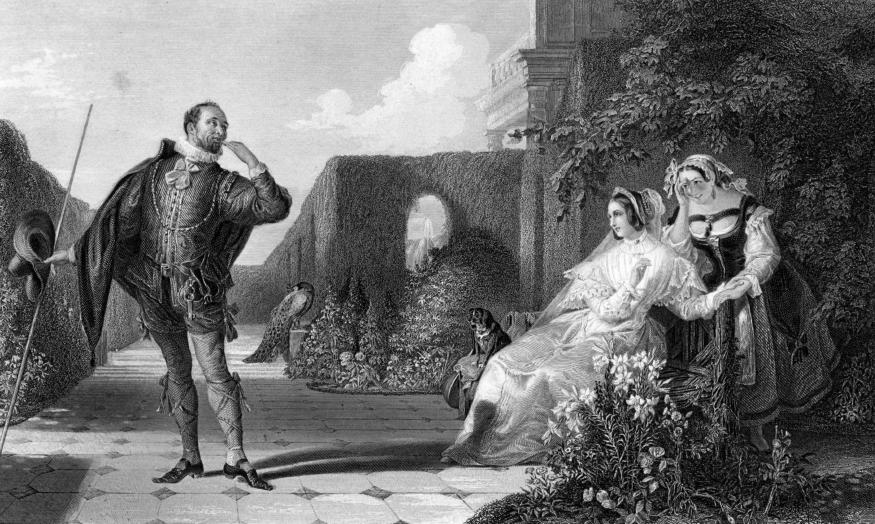
Some Info On 17th century fashion
* Men
* Women
Longer skirts, often embroidered with elaborate patterns
* Servants- Servants like Cesario (who is actually the Duke’s daughter Viola in disguise), would typically wear matching uniforms called liveries, a sign of who they worked for and their master’s trust in their abilities. People judged the aristocracy by how well they trained and controlled their servants, so wearing your master’s livery meant he trusted you to represent his house.
 In her first scene as Cesario, a servant named Curio remarks to her that Orsino has shown favor to “him” from the very beginning. This might explain the rich garments that Viola wears in this production, which resemble a noble gentleman more than a servant.
 A higher ranking servant like Malvolio would be able to wear a higher status garment, which is why you see Steven Fry as Malvolio dressed in a handsome doublet.
3. Character notes:
* What are they wearing?
* Why are they wearing it?
* How do the clothes inform the movement?
1. Viola (Eddie Redmane)  Viola, the star of the show, begins the show as the daughter of a duke, who has just been shipwrecked in a foreign country, so her clothes must look bedraggled and worn, yet appropriate to her status. As I said before though, for the majority of the play, Viola is disguised as the servant Cesario
2. Malvolio (Steven Fry)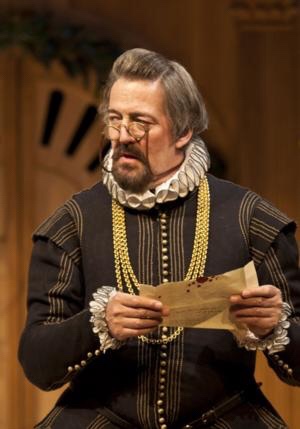
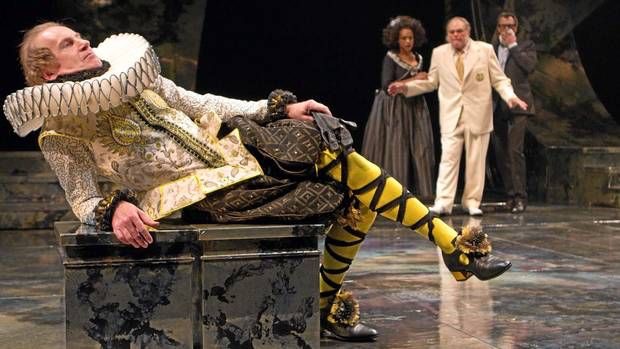
3. Maria the Countess Olivia’s maid, (who has an appetite for tricks and pranks), Maria’s job is to dress and help Olivia with her daily routine. This might include tying up her corset, putting on her makeup, and helping her with the elaborate gowns that nobles wore during this period. In the video below, you can watch a dresser help get an actress into an elaborate costume for another Globe theatre production. Just think of the amount of time and hard work it would take for a servant like Maria to dress Olivia every day!
In the play, Viola momentarily mistakes Maria for her mistress because she wears a veil. This also suggests that, rather than wearing a livery like Cesario, maybe Olivia let Maria wear some of her older clothes, which was a common practice for high level servants. A lot of the costumes Shakespeare’s company wore were probably hand me downs from their aristocratic patrons.
4. Olivia (Mark Rylance) 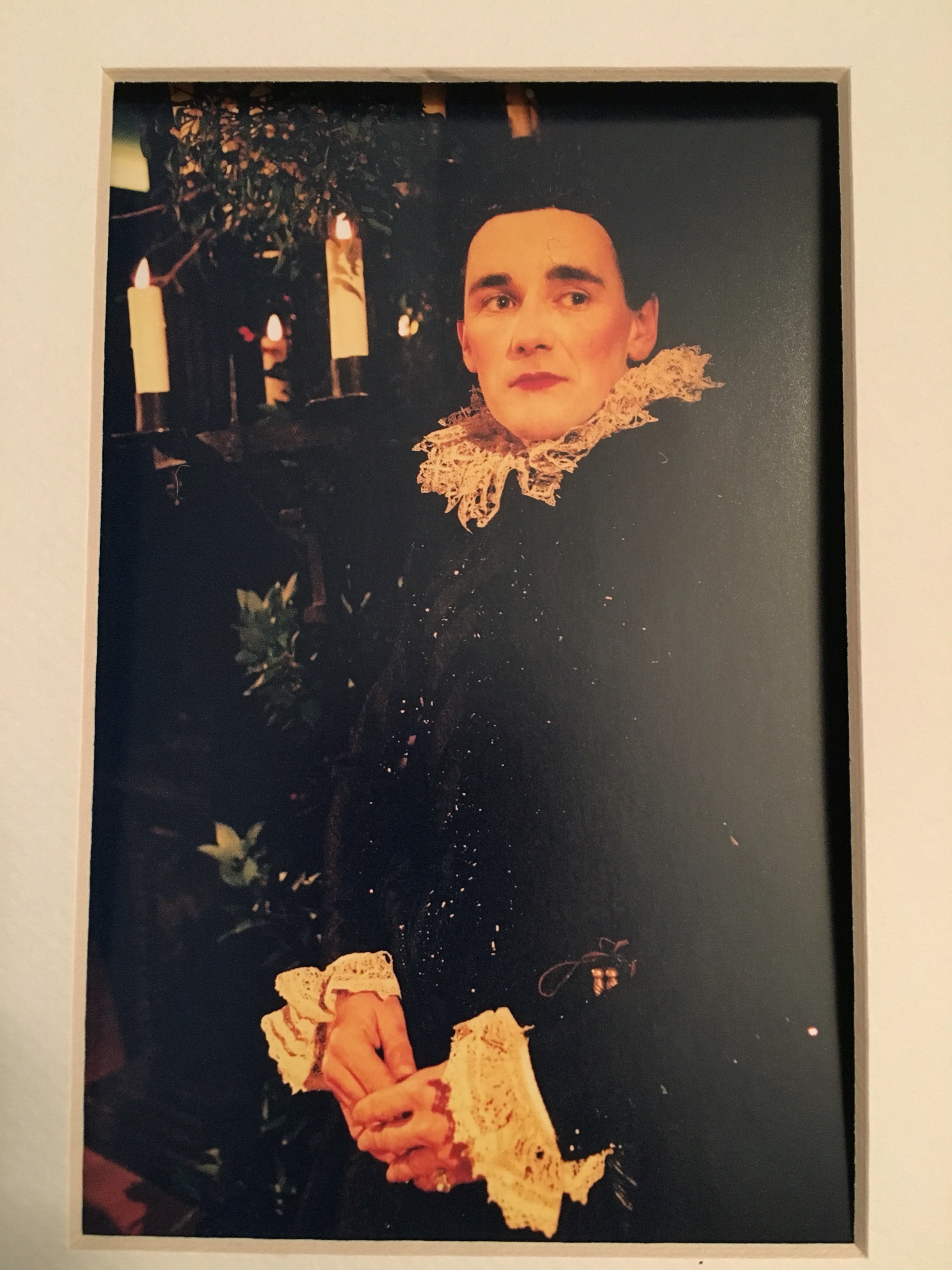
In this production, the countess and all the female roles were performed by men, just as they were in Shakespeare’s Day. Mark Rylance, who played Olivia, was also the Artistic Director of the Globe Theatre.


Costumes like these offer a tantalizing glimpse into history. Just as Shakespeare’s words help an actor bring to life the thoughts and feelings of his age, The type of clothes his company wore helps the actor embody the moiré’s and desires of Shakespeare’s society, whether a mournful countess, a dazzling gentleman, or a reserved Puritan.
References
Feldman, Adam
“Q&A: Mark Rylance on Shakespeare, Twelfth Night and Richard III” Time Out Magazine. Posted: Tuesday November 12 2013
Retrieved online from https://www.timeout.com/newyork/theater/q-a-mark-rylance-on-shakespeare-twelfth-night-and-richard-iii
Minton, Eric. Twelfth Night: What Achieved Greatness was Born Great.
Posted May 22, 2014 to http://shakespeareances.com/willpower/onscreen/12th_Night-Globe13.html.
If you liked this post, please consider signing up for my online course “Christmas For Shakespeare,” which will talk about the costumes, characters, and themes of Shakespeare’s play Twelfth Night, as well as Christmas traditions from Shakespeare’s day: https://outschool.com/classes/what-was-christmas-like-for-william-shakespeare-BwVLyBPp?sectionUid=75ee7895-c8ac-437c-9ef7-05cf8e3bf114&usid=MaRDyJ13&signup=true&utm_campaign=share_activity_link
Since Halloween is right around the corner, and since this is a huge topic in Shakespeare, I would like to talk a little bit about Shakespeare’s treatment of the living impaired, specters, spirits, in a word GHOSTS.
Ghosts appear in five Shakespearean plays: Julius Caesar, Hamlet, Richard the Third, Macbeth and Cymbeline. In all but one of these plays, and in many other Elizabethan and Jacobean dramas, a ghost is a murdered person who needs someone to avenge their deaths. Their function is to warn the hero of the play to revenge their deaths, and/ or to torment their murderers.
Ghosts have been part of western drama almost as long as there have been ghost stories. After all, the Greek and Roman plays that Shakespeare emulated often mention ghosts as warnings from above and below the world is in some kind of chaos. Most of the time, the kind of play in which you see a ghost is a Revenge Tragedy, plays like The Spanish Tragedy, Locrine, Shakespeare’s Hamlet, and even the Disney movie of The Lion King.

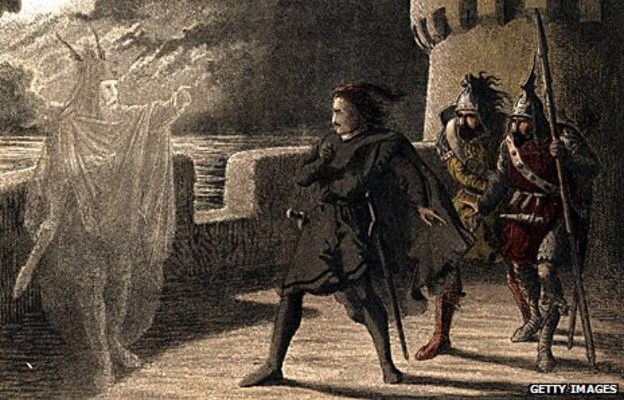
Shakespeare describes the ghost as a pale, sorrowful figure, dressed in full armor. The ghost only speaks to his son in the play, and he begins with a strange and terrifying description of the afterlife:
Ghost: I am thy father’s spirit,
Doom’d for a certain term to walk the night,
And for the day confin’d to fast in fires,
Till the foul crimes done in my days of nature
Are burnt and purg’d away. But that I am forbid
To tell the secrets of my prison house,
I could a tale unfold whose lightest word
Would harrow up thy soul, freeze thy young blood,
Make thy two eyes, like stars, start from their spheres,
Thy knotted and combined locks to part,
And each particular hair to stand on end
Like quills upon the fretful porcupine.
But this eternal blazon must not be
To ears of flesh and blood Hamlet Act I, Scene v.
Many scholars believe that the tormenting realm of fire that the ghost describes is actually Purgatory, an old Catholic concept that explains where the souls of the dead go if they are neither evil enough for Hell, or good enough for Heaven. It’s also the place where people go who didn’t confess their sins before death, which was the ghost’s fate since Claudius poisoned him while sleeping.
Though neither Hamlet nor his father explicitly say it, there is a strong implication that Hamlet must avenge his father by killing Claudius, which will presumably release the Ghost from Purgatory allowing it to ascend to Heaven.
Some suggest that the ghost is a manifestation of Hamlet’s superego:
Psychologist Ernest Jones (who studied under Signund Freud) in his book Hamlet And Oedipusbelieved Hamlet had an unresolved Oedipus complex and couldn’t bring himself to revenge because Claudius had achieved the very goals Hamlet himself secretly desires to kill his father and marry his mother
Faced with his guilt and lack of moral integrity Hamlet could have created a supernatural superego to spur him to revenge. As Freud describes it, the superego
The superego is the ethical component of the personality and provides the moral standards by which the ego operates. The superego’s criticisms, prohibitions, and inhibitions form a person’s conscience, and its positive aspirations and ideals represent one’s idealized self-image, or “ego ideal.”
In essence, since (in Jones’ view), Hamlet is too morally corrupt to be an effective avenger for his father, Hamlet imagines the ghost to help justify his revenge to himself. This is of course, only one way of interpreting the ghost and Hamlet as a whole. There is no right or wrong interpretation for any of Shakespeare’s characters, but it is a testament to Shakespeare’s genius that, 400 years after his own death, his ghostly writings helped inspire one the architects of modern psychology.
Ghosts Of Torment
The ghost of Banquo in Macbeth and the ghosts that plague Richard the Third the night before his battle help quicken the murderous kings’ his downward spiral. Macbeth becomes more and more paranoid, and therefore easier for his foes to defeat.
When Julius Caesar’s Ghost appears to Brutus, he does so the night before his final battle- the battle of Philippi, where Brutus was defeated and committed suicide.

When Richard III sees the ghosts of all the people he murdered, it not only terrifies him, it splits his soul in half! According to Sir Thomas More, Richard couldn’t sleep the night before his final battle at Bosworth Field. Shakespeare gives Richard a strange soliloquy where the ghosts awaken his conscience and awaken him from a fearful dream:
[The Ghosts vanish]
[KING RICHARD III starts out of his dream]
▪Richard III (Duke of Gloucester). Give me another horse: bind up my wounds.
Have mercy, Jesu!—Soft! I did but dream.
O coward conscience, how dost thou afflict me!
The lights burn blue. It is now dead midnight.
Cold fearful drops stand on my trembling flesh.
What do I fear? myself? there’s none else by:
Richard loves Richard; that is, I am I.
Is there a murderer here? No. Yes, I am:
Then fly. What, from myself? Great reason why:
Lest I revenge. What, myself upon myself?
Alack. I love myself. Wherefore? for any good
That I myself have done unto myself?
O, no! alas, I rather hate myself
For hateful deeds committed by myself!
I am a villain: yet I lie. I am not.
Fool, of thyself speak well: fool, do not flatter.
My conscience hath a thousand several tongues,
And every tongue brings in a several tale,And every tale condemns me for a villain.
Perjury, perjury, in the high’st degree
Murder, stem murder, in the direst degree;
I shall despair. There is no creature loves me;
And if I die, no soul shall pity me:
Nay, wherefore should they, since that I myself
Find in myself no pity to myself? Richard III, Act V, Scene iii.
In these plays, the ghosts are a form of spectral punishment; the punishment of a guilty Conscience.
Shakespearean Friendly Ghosts
The only friendly Shakespearean ghosts appear in Shakespeare’s play Cymbeline and these ghosts appear before the god Jupiter to plead for their descendant, Posthumous Leonidas. They beg Jupiter, the most powerful Roman god, to end Posthumous’ suffering.
Like the witches in Macbeth, ghosts in Shakespeare are mysterious and sometimes frightening – they are sort of a mirror for how we see ourselves, our lives, and our hopes to be remembered after death; the final words Hamlet’s father utters before disappearing into the morning mist are: “Adieu, adieu, remember me.”
Thanks for reading! If you enjoyed this post, please consider signing up for my Outschool class: “Macbeth: An Immersive Horror Experience.” I perform live as the ghost of William Shakespeare and tell the story of Macbeth in an entertaining and spooky way.

For More Information:
https://www.bl.uk/shakespeare/articles/ghosts-in-shakespeare
https://www.bard.org/study-guides/ghosts-witches-and-shakespeare
Animated Richard III, 20:00 the ghosts appear:
References:
Greenblatt, Steven Hamlet In Purgatory 2001. Princeton University Press. Link: file:///Users/jrycik/Downloads/Hamlet-in-Purgatory-Princeton-Classics.pdf
Jones, Earnest, Hamlet and Oedipus.
https://people.ucsc.edu/~vktonay/migrated/psyc179d/HamletOedipus.pdf
Open Source Shakespeare, Cymbeline:
Pearlman, E. Hamlet: Critical Essays: The Invention Of the Ghost. https://books.google.com/books?id=jdfWAQAAQBAJ&pg=PA71&lpg=PA71&dq=ghost+that+shrieked+hamlet+revenge&source=bl&ots=KY68gIrh2V&sig=MjEr2NxLQ7T4c2xW1QscrmdeMkc&hl=en&sa=X&ved=0ahUKEwiR5o6M4I_XAhUK0oMKHQIJBeAQ6AEIKDAA#v=onepage&q=ghost%20that%20shrieked%20hamlet%20revenge&f=false
https://www.shmoop.com/hamlet/ghost.html
https://www.jstor.org/stable/pdf/456606.pdf?refreqid=excelsior%3A3f62aed88fb9e9b9a8f8e462186ff95c

Ghostly greetings everyone!
Since it’s the month of all things spooky, and we have a rare Friday the 13th today, I thought I would share some of Shakespeare’s scariest lines!
First, from the tragedy of Macbeth, the famous Dagger Speech:
Is this a dagger which I see before me,
The handle toward my hand? Come, let me clutch thee.
I have thee not, and yet I see thee still.
Art thou not, fatal vision, sensible
615
To feeling as to sight? or art thou but
A dagger of the mind, a false creation,
Proceeding from the heat-oppressed brain?
I see thee yet, in form as palpable
As this which now I draw.
620
Thou marshall’st me the way that I was going;
And such an instrument I was to use.
Mine eyes are made the fools o’ the other senses,
Or else worth all the rest; I see thee still,
And on thy blade and dudgeon gouts of blood,
625
Which was not so before. There’s no such thing:
It is the bloody business which informs
Thus to mine eyes. Now o’er the one halfworld
Nature seems dead, and wicked dreams abuse
The curtain’d sleep; witchcraft celebrates
630
Pale Hecate’s offerings, and wither’d murder,
Alarum’d by his sentinel, the wolf,
Whose howl’s his watch, thus with his stealthy pace.
With Tarquin’s ravishing strides, towards his design
Moves like a ghost. Thou sure and firm-set earth,
635
Hear not my steps, which way they walk, for fear
Thy very stones prate of my whereabout,
And take the present horror from the time,
Which now suits with it. Whiles I threat, he lives:
Words to the heat of deeds too cold breath gives.
640
[A bell rings]
I go, and it is done; the bell invites me.
Hear it not, Duncan; for it is a knell
That summons thee to heaven or to hell. Act II, Scene I.
Hamlet. Angels and ministers of grace defend us!
Be thou a spirit of health or goblin damn’d,
Bring with thee airs from heaven or blasts from hell,
What may this mean
680
That thou, dead corse, again in complete steel,
Revisits thus the glimpses of the moon,
Making night hideous, and we fools of nature
So horridly to shake our disposition
With thoughts beyond the reaches of our souls?
685
Say, why is this? wherefore? What should we do? Hamlet, Act I, Scene v.
Puck. Now the hungry lion roars, 2220
And the wolf behowls the moon;
Whilst the heavy ploughman snores,
All with weary task fordone.
Now the wasted brands do glow,
Whilst the screech-owl, screeching loud, 2225
Puts the wretch that lies in woe
In remembrance of a shroud.
Now it is the time of night
That the graves all gaping wide,
Every one lets forth his sprite, 2230
In the church-way paths to glide:
And we fairies, that do run
By the triple Hecate’s team,
From the presence of the sun,
Following darkness like a dream, 2235
A Midsummer Night’s Dream, Act V, Scene I.

I am disgusted by the recent violence in Charlottesville VA. The fact that in 2017, White supremacists threatened, hurt, and killed innocent Americans is despicable and truly disheartening. I won’t go into my political views here since this tragedy transcends politics and forces everyone in this country to re-examine who we are and what we stand for as a people, and do our part to help prevent this kind of mindless hatred.
I’m not a politician, I’m not a policeman. My area of expertise is Shakespeare, so I am going to try to make a case for why the study of Shakespeare can help people, (especially young people), learn about the world, examine new points of view, and try to improve the world. I will then add a list of resources for teachers and students to deepen your understanding of the play.
My first argument for the play is that Merchant has two of the best speeches about intolerance ever written.
Hath not a Jew eyes? hath not a Jew hands, organs,
dimensions, senses, affections, passions? fed with
the same food, hurt with the same weapons, subject
to the same diseases, healed by the same means,
warmed and cooled by the same winter and summer, as
a Christian is? If you prick us, do we not bleed?
if you tickle us, do we not laugh? if you poison
us, do we not die? and if you wrong us, shall we not
revenge? If we are like you in the rest, we will
resemble you in that. If a Jew wrong a Christian,
what is his humility? Revenge. If a Christian
wrong a Jew, what should his sufferance be by
Christian example? Why, revenge. The villany you
teach me, I will execute, and it shall go hard but I
will better the instruction. Merchant, Act III, Scene i.

Al Pacino when he did this speech said that it has the eloquence and power of Dr. Martin Luther King. Patrick Stewart initially had the same reaction, but later realized that Shylock turns midway through and the speech becomes a justification for revenge. What’s clever here is that Shakespeare manages to give Shylock two good arguments against bigotry; by emphasizing how Jews are no different than any other racial or religious group, and also warning that oppressing a people will only result in more retribution and pain on both sides. This is what he means when he says: “The villainy you teach me, I will execute.” We’re seeing this sort of reaction right now with the recent surge of violence by both white supremacists and the Antifa; without tolerance and common decency, chaos and bloodshed reins.
Another speech, much less well-known, is this speech of the Prince Of Morocco, one of Shakespeare’s only black characters. The speech below is the first time he speaks while attempting to woo the heroine Portia:
Prince of Morocco. Mislike me not for my complexion,
The shadow’d livery of the burnish’d sun,
To whom I am a neighbour and near bred.
Bring me the fairest creature northward born,
Where Phoebus’ fire scarce thaws the icicles,
And let us make incision for your love,
To prove whose blood is reddest, his or mine.
I tell thee, lady, this aspect of mine
Hath fear’d the valiant: by my love I swear
The best-regarded virgins of our clime
Have loved it too: I would not change this hue,
Except to steal your thoughts, my gentle queen. Merchant Of Venice, Act II, Scene i.
People often forget that this speech condemns pre-judging a person based on the color of their skin. Morocco tells Portia, (who in all probability has never seen a black man before), to not judge him by his appearance. His tone is gentle, but it is not apologetic. He says he won’t change his skin color for anything, (except maybe if it would win her heart). The Prince is a dignified and proud representative of his country and his race.
My second argument for reading or teaching this play is that it reveals how bigotry and racism is usually tied to money and profit. In Act IV, Scene i, Shylock points out the hypocrisy of his Christian brethren in keeping slaves, which they justify by saying that they are not people, but property:
Shylock. You have among you many a purchased slave, Which, like your asses and your dogs and mules, You use in abject and in slavish parts, Because you bought them: shall I say to you, Let them be free, marry them to your heirs? Why sweat they under burthens? let their beds Be made as soft as yours and let their palates Be season’d with such viands? You will answer ‘The slaves are ours:’ so do I answer you: The pound of flesh, which I demand of him, Is dearly bought; ’tis mine and I will have it. If you deny me, fie upon your law! There is no force in the decrees of Venice. I stand for judgment: answer; shall I have it? Merchant, Act IV, Scene i.
Shylock turns this hypocrisy back on the Christians by saying basically, “How can you call me inhuman when you debase and subjugate your fellow creatures?” The answer to both questions of course, is that it is economically convenient. Shylock earns his money by lending money at interest, and threatens dear penalties if not repaid on time. Similarly, the Christians need Shylock because their religious practices forbid them from lending money, so they have to go to him instead of other Christians. We see echoes of this unfortunate tendency today: the white supremacists in Charlottesville were chanting: “Jews will not replace us,” which clearly exposes their fear of losing political and economic influence to minorities. In addition, our country has refused countless immigrants from poor, war-torn countries which we justify to ourselves by saying the cost of letting them in is too great.
The play’s comic sub-plot also has many lessons for today’s world. The hero Bassanio undergoes dramatic transformation from a spoiled prodigal son to enlightened married man. At the play’s beginning, he has a close friendship with the merchant Antonio, that might be played as a one sided homosexual relationship. Antonio is very affectionate to Bassanio, and lends him a large amount of money without any expectation of repayment, which has sometimes been interpreted as a hinting of Antonio’s unrequited love for Bassanio. Though Basanio doesn’t reciprocate any romantic feelings, he eventually saves Antonio’s life, and at least tries to repay him for his kindness.
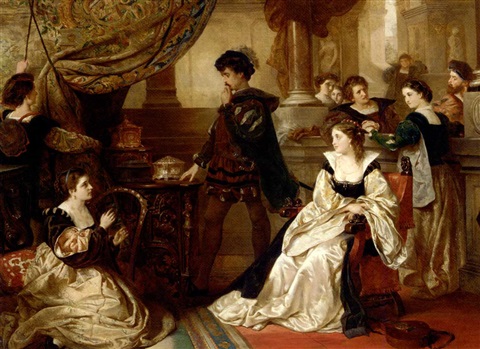
Bassanio also takes a very feminist attitude towards the play’s heroine Portia- he understands that being married means making your spouse a partner, and giving her an equal say. At the beginning of the play, he sails to an island called Belmont, to try to win Portia’s hand, by correctly solving a riddle. You may have heard of the three caskets, gold, silver, and lead. If Bassanio guesses right, he wins Portia and her fortune. Bassanio chooses the correct casket, but halts afterwards, and does something unexpected; he asks Portia herself if she wants to marry him. He doesn’t treat her as his prize, and throughout the play asks her opinion, and her permission before he acts, just as a good husband should.
Fair lady, by your leave;
I come by note, to give and to receive.
Like one of two contending in a prize,
That thinks he hath done well in people’s eyes,
Hearing applause and universal shout,
Giddy in spirit, still gazing in a doubt
Whether these pearls of praise be his or no;
So, thrice fair lady, stand I, even so;
As doubtful whether what I see be true,
Until confirm’d, sign’d, ratified by you. Merchant Of Venice, Act III, Scene ii
I would argue that, although Portia is a far more important character, Bassanio is the moral center of the play. He is the only person who treats Shylock like a human being, by trying to reason with him and pay Antonio’s debt, instead of spitting in Shylock’s face like Antonio, or forcing him to convert like the characters at the end of the play. Bassanio also is one of the only characters who call Shylock by name, everyone else just calls him “Jew.” Thus, audiences and students can learn from this kind of person; the kind of person Christ said could be saved and become a true Christian, because he acknowledges his sins and tries to correct them. Bassanio is the prodigal son in this play, and we benefit from the parable of his life.
By contrast, some of the other characters, Christian and Jewish, are examples of the kind of morality that we all wish to discourage in our children, and society in general. Though they are outwardly pious, the Christians like Antonio and Portia, are capable of vindictive, cruel, and definitely impious behavior. Portia, (probably due to her sheltered life on Belmont), can be deeply racist and prejudicial. She is prejudiced against the Prince of Morocco because of his race, hoping that “All of his complexion,” will fail to win her love. In addition, when she poses as a judge presiding over the court case between Antonio and Shylock, she throws vengeance at Shylock, even though she barely knows either of them. She strips Shylock of his property and nearly gets him sentenced to death, even though she preaches mercy to him in her most famous speech. If you look at the contrast between her words and actions, she is a deeply hypocritical person. Shakespeare shows how toxic it can be to raise a child in an isolated environment. Portia’s isolation makes it harder for Portia to relate to and understand different types of people, and it planted her predjudices within her heart.
Antonio for his part, seems to define himself by how “un-Jewish” he is, believing that generosity and mercy are anathema to all Jews, particularly when Shylock confronts Antonio in the courtroom:
I pray you, think you question with the Jew:
You may as well go stand upon the beach
And bid the main flood bate his usual height;
You may as well use question with the wolf
Why he hath made the ewe bleat for the lamb;
You may as well forbid the mountain pines
To wag their high tops and to make no noise,
When they are fretten with the gusts of heaven;
You may as well do anything most hard,
As seek to soften that—than which what’s harder?—
His Jewish heart: therefore, I do beseech you,
Make no more offers, use no farther means, Merchant, Act IV, Scene i.
Although Jesus preached loving ones neighbor, and being the Good Samaritan to other religions, Antonio seems to think that being a true Christian, means being Anti-Jew. He is a counter example of piety that audiences and students can learn to mollify and avoid within themselves.
My final example of religious counter examples, Shylock himself, shows how prejudice can destroy a man if he lets it. At the beginning of the play, Shylock has had to endure losing his wife, having Antonio spit on him, mock him, encourage his enemies, and call him a host of dehuminizing names. That’s not even taking into account the horrible Venetian ghettos of the 1590s, in which Shylock would have been forced to live were he a real Venetian Jew. One quote that helps explain his behavior comes from Henry Norman Hudson in 1882:
[In Shylock] “we see the remains of a great and noble nature, out of which all the genial sap of humanity has been pressed by accumulated injuries.” – Shakespeare: His Life, Art, and Characters, H. N. Hudson, Ginn and Company, Boston, p. 291. “
Scholars and actors have emphasized ever since the end of the Second World War, that, although Shylock is still guilty of reprehensible acts, his cruelty is a reaction to the cruelty he has had to endure, or as he puts it: “The villainy you teach me, I will execute.
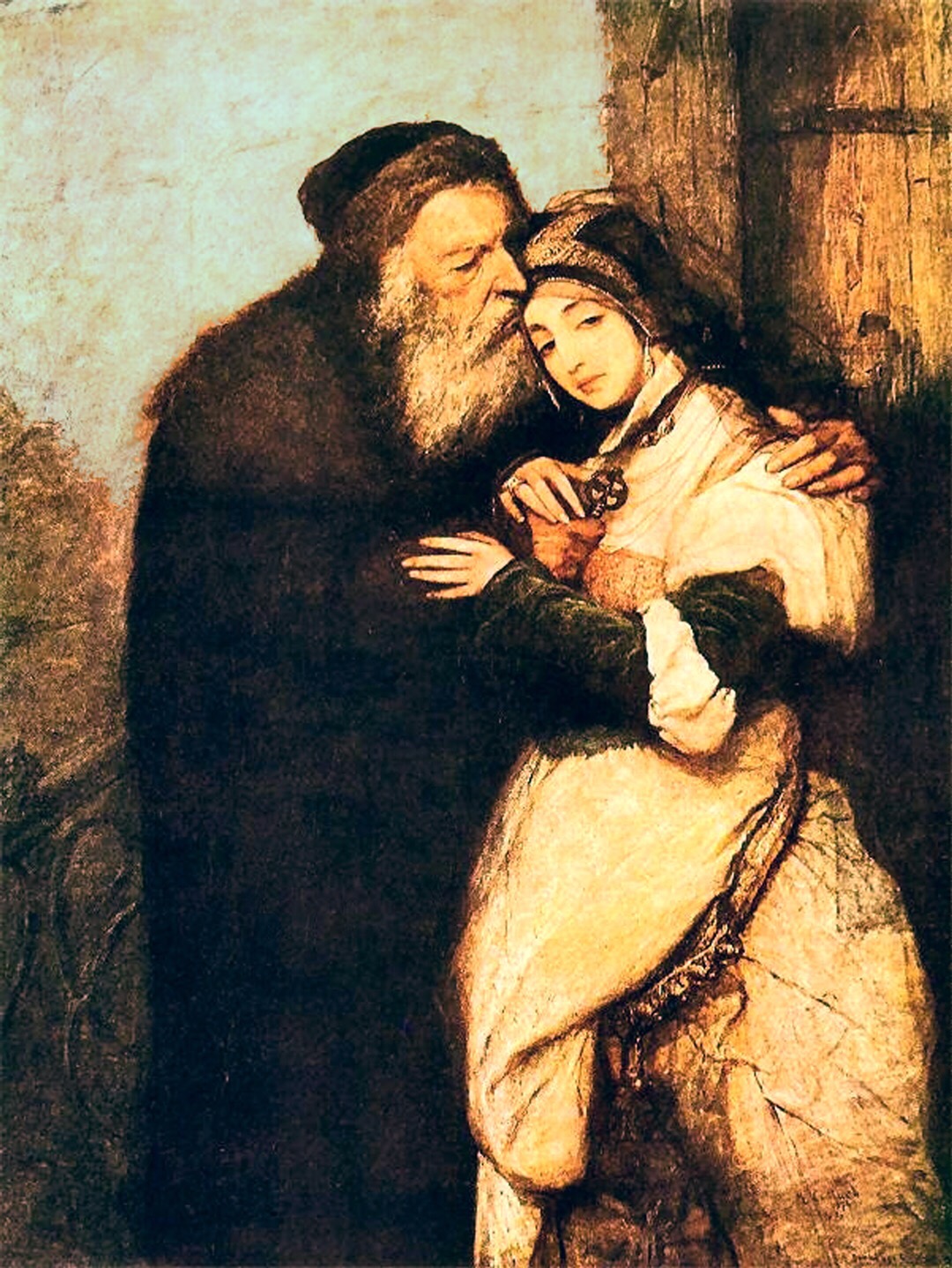
Shylock’s lack of joy and love manifests itself by the way he treats everyone in the play. He keeps his daughter locked away from anyone, which later compels her to run away with the Christian Lorenzo, (while stealing a huge amount of Shylock’s money). Shylock then rages against the citizens of Venice, especially Antonio, whom he blames for his losses, and concocts a plan to kill him by taking a pound of flesh away from his heart.
Shylock’s pain and hardships have turned him into the kind of bloodthirsty Jewish stereotype his enemies have always assumed to be. At the same time, he constantly points out the cruelty and hypocrisy of Christians, calling them no better than himself. In the end though, through Portia and the Duke sentencing Shylock to will his money to Lorenzo, and convert to Christianity, Shylock has to become what he hates, and surround himself with people who will never accept him; an ending that fills the audience with pity and maybe even remorse.
Now, there are compelling arguments that teaching this play can actually encourage stereotypes, which it can, and has in ages past. I read several articles that debate this issue in various ways. I’d like to discuss two articles written within one year of each other that are particularly fascinating. The first one was an article from The New Yorker by Professor Steven Greenblatt, who claimed that Merchant is “Shakespeare’s Cure For Xenophobia.” The other was a Washington Post article that argues that in the interest of keeping negative Jewish stereotypes from perpetuating themselves, this play should be ignored altogether.
On the other hand, as Professor Greenblatt says, the genius of the play is that it shows stereotypes, but it also shows the people under them. If you compare Shylock in The Merchant Of Venice, to other contemporary Jewish characters like Barrabas in Marlowe’s Jew Of Malta, he is a much more compelling, complete, interesting, and at times moving character. Love him or hate him, Shylock inevitably gets under your skin. He’s a man who strips the varnish off our culture and exposes the hypocrisy, greed, and prejudice that lurk just beneath the waters of the Rialto, (as well as the modern Potomac and the Hudson). The saving grace of this play is that it forces us to examine ourselves- how do we treat people, how do we see people who are different than us? What makes our points of view good and bad, and what can we do to heal our misunderstandings? Though this play cannot answer these questions, it encourages us to confront them, to open a dialogue, and hopefully, open avenues for change.
Artwork: For a wonderful selection of pictures of Portia, please visit: http://themerchantofveniceportia.weebly.com/fair-portias-counterfeit.html
 Elizabeth Shuh: “Merchant Of Venice.” Reprinted with permission from Immortal Longings.com

Music: Where is fancy bred?
Resources

Donald Trump Jr tweeted two questions after the Julius Caesar play protest I posted over the weekend:

“When does art become political speech, and does it change things?”
I would like to try to answer these questions and by doing so, see if I can explain this fascinating moment in Shakespearean performance history.
Though this production raised new questions about art, and has raised passion from many people, it is not as radical as the protesters might think. Here is a list of historical points of reference to show you the many similarities between this protest and others throughout the history of Shakespearean performance:
1. This is not the first time a Shakespeare play has been seen as a spur to violence: In February of 1601, The Earl of Essex commissioned Shakespeare’s company to perform a scene of the deposing and killing of King Richard the Second one day before he attempted to overthrow queen Elizabeth, and make himself head of the English government.

Shakespeare’s company was exonerated, but Essex himself was tried convicted, and executed for high treason.

Similarly, when John Wilkes Booth assassinated President Lincoln in 1865, he had previously performed in Julius Caesar, and reportedly complained, (while on the run from the law), that “I am being hunted for what Brutus did so freely”
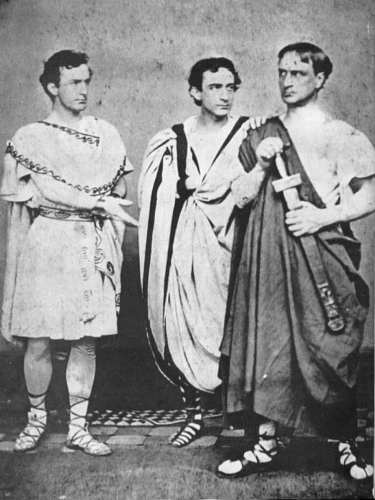
Source: New York Times Review. Now in both cases it is worth noting that Shakespeare’s play was not responsible for the death of a political figure, it was the people who interpreted his work that bear the responsibility themselves.
2. This play is also not the first time a director has portrayed Caesar as a contemporary president-


As many people have pointed out, in 2012 The Acting Company put on a production of Caesar with an Obama-esque version of the title character. No protests came from the left or right, though Caesar died in the exact same way- bloodily stabbed onstage. I would argue that these shows demonstrate that portraying Caesar as a contemporary figure does not itself incite violence. The audience knows that the figure of Caesar is simply meant as a link between Shakespeare and contemporary politics. This is how the director Oskar Eustis of the Shakespeare in the Park production defended himself against criticism of his staging: https://www.google.com/amp/s/mobile.nytimes.com/2017/06/13/theater/donald-trump-julius-caesar-oskar-eustis.amp.html
I frankly also find the disproportionate reaction to these two Caesars rather insulting. When Obama was in office, he got plenty of negative criticism that sometimes extended to threats of violence. If you click here you can see a threat by country music singer Ted Nugent who threatens to shoot the president with a machine gun. The double standard that threatening a president on the left has no consequences, but threatening a Republican president is worthy of scorn, derision, and its backers pulling their support, deeply hypocritical.
3. Thirdly, this is not the first time a Shakespeare play has depicted Trump negatively. If you look at the comments of my Trump villain post, a director mentioned his production of Henry the Sixth Part Two, in which an actor portrayed the character Jack Cade as Trump. Like Caesar, Cade also murdered in the course of the play. Clearly, portraying Donald Trump as a Shakespearean character is not what is unique here.
4. Though it is certainly true that the play depicts violence and the overthrow of a regime, it doesn’t endorse violence, and is not intended to glorify the murder of a president or even a demagogue like Caesar. As I will later discuss, this play can’t be an endorsement of violence, since everyone who commits violence is duly punished.
So why has this particular production, that uses a Caesar that resembles this president, gotten such a big reaction? Part of the issue admittedly is the timing. The protest specifically mentions the attempted murder of a GOP senator, which happened last week. It is only natural that, given this recent threat of violence, some would fear that this production might incite others to violence. Yet, as I said before, a thorough analysis of the play shows that it does not condone violence against a political leader.

Additionally, given today’s divisive political environment, it is understandable why an audience of right wing protesters might be concerned about this scene in which Caesar is murdered on stage. They may vey well think the play is wish fulfillment for those on the left, who might enjoy watching the bloody assassination of someone who is vey unpopular right now. However, let me emphatically point out that first of all, no one on the left has endorsed violence against Trump. If you look at the backlash to Kathy Griffin’s picture of herself holding a bloody makeshift Trump head, you can see that no one left or right has endorsed support for such a treasonous un-American act. Secondly, with regards to Caesar, the play’s message is actually nonviolent. When Brutus and Cassius kill Caesar, it starts a violent uprising that leads to anarchy, precisely the outcome the two Roman senators hoped to avoid. Seeing their designs fail would certainly discourage anyone attempting violence against a sitting authority figure.
Perhaps the best way I can prove this point is to remind everyone that Shakespeare himself lived in a monarchy. His theatre was strictly controlled by the government. If anyone in 1599 believed that Julius Caesar seemed to support the killing of queen Elizabeth, the play would have been burned and Shakespeare and his whole company would have been arrested and hanged.
Also, people have criticized the murder of Caesar as “too realistic,” again believing that the gore is intended to glorify violence. In reality the violence of the murder is intended to incite revulsion and disgust. Look at Mark Antony’s reaction when he shows Caesar’s body to the crowd. https://youtu.be/tRceRJAz6_Q
I frankly think that the main reason why this production is getting bad press is because it’s a portrayal of President Trump, not Obama, not the historical Caesar, not Hitler, not even Trump before he was president, but the current president, that a group of people elected, and who believe that he supports their values.
I believe that the main reason Trump’s supporters are angry at this production is they feel an attack on him is an attack on them. The president’s supporters have shown repeatedly that they are willing to overlook almost anything to show their support of him. I imagine that they have no desire to see him as an autocrat and dictator, let alone entertain the notion that he might ever be taken down by his opponents.
The irony is that the real Caesar was a man of the people who died because his opponents thought he was an autocrat. The real Caesar helped create the modern calendar, gave money to the entire city, and according to Marc Antony, “When the poor hath cried, Caesar hath wept.” Trump is the exact opposite; he is a self-centered con artist who pretends to be a man of the people. As I predicted, after his inauguration, he has vowed to cut taxes on businesses like his own, put his family in positions of power, used diplomatic meetings and press conferences to sell his products, and obstructed justice when his FBI director tried to investigate him. With this in mind, it seems bizarre to claim that this production is designed to ridicule the right, since Trump is neither Julius Caesar, nor is he an embodiment of the political right. He only stands for his own interests. Therefore an attack on Trump is not an attack on conservative values.
So to go back to the beginning point, “When does art become political speech?” I would argue art always becomes political when it comments about our world, and this quality of art is essential for our society to function. We need a healthy dose of satire and critical thinking, and art can provide it to us. However, there is a difference between disagreeing with a play and openly shunning it onstage.
To address Mr. Trump’s second question, art doesn’t change things, people change things, so we need to temper our reactions, especially to art pieces like Julius Caesar. Remember, Caesar only died because people said he wanted to be king. Cinna the poet died because the mob said he should. This play warns us all to be careful and remain critical thinkers, or mob rule will result.
References
What depicting Julius Caesar as Donald Trump really means – CBS News
https://www.google.com/amp/s/www.theatlantic.com/amp/article/530037/
https://apple.news/AW6FmlDY3TEe4C97AG7UI4Q
Ted Nugent once said Obama should ‘suck on my machine gun.’ Now he wants to tone down ‘hateful rhetoric.’ – The Washington Post
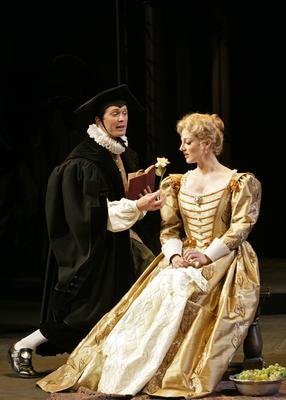

Since this is national poetry month, I thought I’d talk a little bit about Shakespeare’s poetry. Shakespeare wrote 154 short love poems called sonnets. What follows is kind of a do-it-yourself poetry manual that would be great if you want to write a poem for a spouse or a loved one for Valentine’s Day, Christmas, Mother’s Day or any other time, to show that you care. Sonnet writing has been a time honored tradition for showing the people we care about just how much they mean to us.
If you’ve never written a sonnet , don’t worry, the kind of sonnet Shakespeare wrote is pretty easy to write, and it follows just a few simple rules. I don’t want to lie; it takes a lot of patience and thought to craft a sonnet, but the rules are easy to follow. So let’s get to it!
 What Is A Sonnet? A sonnet is a short poem that’s only 14 lines long, written in what is called Iambic Pentameter, Shakespeare’s preferred form of poetry. I’ve written before about Iambic Pentameter, but just to be clear it’s a 10 syllable line that goes da-Dum- daDum-da-Dum-daDum-daDum. So all you need is 14 lines that follow a particular rhyme scheme. You’ll notice that in the sonnet above, every other line rhymes except the end. This is called an ABAB rhyme pattern, and it is the trickiest thing about writing a sonnet. One reason Shakespeare has this rhyme pattern is to draw your attention to the last two lines, then draw the sonnet to a close with the simpler rhyme of the couplet.
Sonnet Form A sonnet’s 14 lines are arranged into three short groups or quatrains which are four lines long. Usually around line 9, there is a kind of “turn” or change in the direction of the argument, like at line 9 in Sonnet 8 above, where Shakespeare stops talking about summer, and starts talking about the person to whom he’s writing. If it helps, you can think of this as the “But…” part of the sonnet, because it’s the part where he changes the argument using the word “but,” (and what a but it is). The sonnet then concludes with two rhymed lines of Iambic called a rhymed couplet. These last two lines are a way of wrapping up the main idea of the poem in a short, catchy way.
Step by step Tips and Tricks:
It’s often useful to consider your sonnet like a speech or a short argument. The three quatrains give you a chance to come up with an idea, then develop the idea, and then come to a conclusion, much like any other form of persuasive writing that you might’ve had to do for English class. For example, Sonnet 8 pictured above, (one of Shakespeare’s most famous sonnets), begins with the question: “Shall I compare the to a summers day?” He then goes to flatter the person he’s writing about by talking about how much better they are than a summers day, saying that actual summers are too windy and too hot, and the flowers of the summer are all too brief. By contrast, Shakespeare argues that the subject of the sonnet has beauty that will last forever, particularly if that person goes on to have children. This is the form that Shakespeare sonnets often take and I would advise you to try and make your sonnet into a clear argument.
Example Of Sonnet Writing: Since Mother’s Day is coming up, if you wanted to write about the mother of your child, and thank her for her for being there for your child, you might want to structure your sonnet by using the three stanzas to express three simple ideas like:
1. Thank you for being the mother of our child(ren)
2. A specific time she did something awesome for your child (give examples!)
3. Thank you from you, me, and our child(ren).
Tip 2: Plan Out The Rhyming Couplet: As I mentioned before, the last two lines of every sonnet are called a rhyming couplet; two lines of iambic pentameter that rhyme together and help conclude the sonnet. Just like a English paper, a good conclusion is very important, which is why it’s it’s often useful to work on this these two lines first before you get into writing the meat of your sonnet. For example, here’s a couplet I wrote about preparing breakfast in bed and doing chores for one’s wife on Mother’s Day.
All chores this day will I do in thy stead
Commence I shall with breakfast in thy bed!
Tip 3: Writing Poetry Now that you have the ideas you want to express now comes the hard part: putting them into poetry. I often find it helps to just get a piece of paper, write as much as possible to express the three ideas in your sonnet in prose, then get down to translating your ideas into iambic pentameter.
Quick Tips to help you along:
Tip 4: Use Literary Devices: I find Shakespeare very often tried to express an idea by using metaphor and allusion to create images in the listeners mind. Sonnet 8 which we’ve been discussing, is structured around creating a contrast between the speaker and a pretty day in summer. You can do this kind of flattering comparison yourself, but, as we’ve seen, it’s often useful to put a “but” in the argument around line 9, to make it clear that you love the person more than for example a warm summer day. Imagine getting a sonnet that claims that someone loves you more than ice cream!
Sometimes Shakespeare uses contradictory images in his poetry for dramatic effect. Romeo often and talks about “Oh brawling love, O loving hate”. He uses this to express the wildness of his passion. This is called antithesis, and it’s very useful when you want to add a little spice to your poetry. Try comparing your beloved to both ice and fire!
Alliteration and assonance: Remember, Shakespeare wrote for the theater not for people reading in the book this is why he often plays with words that sound a particular way and worked very hard to come up with sounds that would grab a listeners attention rather than readers. When a word when several words start the same letter it creates a sense of order and gets the readers attention. Assonance is when consonants are repeated within the middle of a line.
Useful Websites when you’re working
I hope this post was helpful. If you have any questions, please comment, or email me in the “Ask the Shakespeare Guru” page. If you write any sonnets yourself and wish to share them on this site, let me know and I’ll gladly re-post them!
Till Next Time,
-The Shakespearean Student.
References
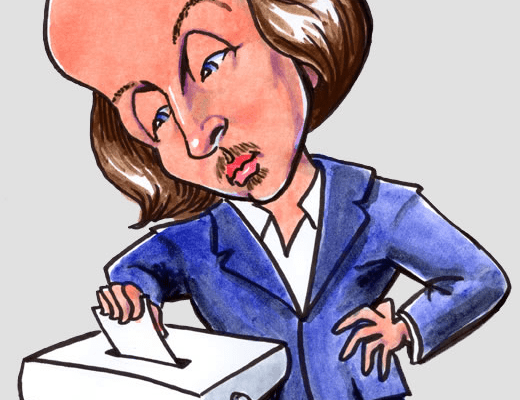
Well, it happened. A man whom I have described as a villain of Shakespearean proportions is now the president. You might have read in my Richard III post that I had hoped that the election would play out like the history play about a deformed tyrannical king with bad hair. What I forgot when I made that prediction was that the king in question, Richard III, does become king for a little while.
Here’s another way of putting it. I found it on the Facebook page of a friend of mine, Austin Tichnor of The Reduced Shakespeare Company:
https://www.youtube.com/watch?v=BChFmHTIH2A&sns=em
I don’t want to talk too much about devisive politics because I feel that the country and the world is hurting too much because of people who want to reduce the world into “my party,” “my country,” and turn everything and everyone else into “the other.”
What I want to talk about in this post, is what I hope for our new president, some words of wisdom from The Bard, and maybe some words of healing for those people who feel like “the other,” starting with some of the people I might have offended with my earlier posts.
Why Donald Trump is like Henry V, (we hope).
A lot of people are full of anxiety right now because nobody is really sure what kind of president Trump will be; will he follow through with his campaign promises? Will he take power from those in Washington and give it to the people, as he said in his inaugural address? How much will his past life as a real-estate tycoon influence his work as president? This uncertain climate reminds me very much of the end of Shakespeare’s Henry IV, Part II, where the old king dies leaving the kingdom to his son. Thus far, the prince, (known as Hal to his friends), has been wasting his time drinking in a bar in Eastcheap with his disreputable friend, Sir John Falstaff. Watch this scene where he and Falstaff mock the king and trade insults with each other:
But, on his deathbed the real king summons his son and knocks some sense into him, demanding that he take the job of running the country seriously. In Act IV, Scene v, the prince, (thinking his father is dead) tries on his father’s crown right before King Henry wakes up and curses his son with a long and terrible speech. Below is King Henry’s deep rebuke of his son Hal, detailing his fears of what will happen when the prince becomes king.

KING HENRY:
What! canst thou not forbear me half an hour?
Then get thee gone and dig my grave thyself,
And bid the merry bells ring to thine ear
That thou art crowned, not that I am dead.
Pluck down my officers, break my decrees;
For now a time is come to mock at form:
Harry the Fifth is crown’d: up, vanity!
Down, royal state! all you sage counsellors, hence!
And to the English court assemble now,
From every region, apes of idleness!
Now, neighbour confines, purge you of your scum:
Have you a ruffian that will swear, drink, dance,
Revel the night, rob, murder, and commit
The oldest sins the newest kind of ways?
Be happy, he will trouble you no more;
England shall double gild his treble guilt,
England shall give him office, honour, might;
For the fifth Harry from curb’d licence plucks
The muzzle of restraint, and the wild dog
Shall flesh his tooth on every innocent.
O my poor kingdom, sick with civil blows!
When that my care could not withhold thy riots,
What wilt thou do when riot is thy care?
O, thou wilt be a wilderness again,
Peopled with wolves, thy old inhabitants! King Henry IV, Part II, Act IV Scene v.
I have to wonder if Obama feels a little like King Henry, since Trump has promised to repeal Obamacare, reverse many of his executive orders, and put his own “Mad Dog” ruffians in charge of the country. I also find it ironic that King Henry is worried about foreign ruffians becoming part of English society, while Trump is worried about keeping them out of America.
The good news is that Prince Hal eventually became a wise and effective ruler. In the play that bears his name, King Henry V united his country, and achieved a famous victory over the French. Everyone in the play was shocked and amazed by how he transformed himself from a drunk into an effective king. Trump has that same opportunity; although his poll numbers are low right now, he can prove his commitment to the job and amaze the country.
This is what I’m sure all of America hopes Trump will do for the country, although I have trouble believing that it will actually happen. It seems more likely to me that he will exploit his position to help his businesses, just as he has done his entire career, and he already shows signs of doing now. It seems unlikely that he will achieve anything that will protect the dignity of Americans, or achieve prosperity for anyone but himself.
I believe that the best we can hope for with Trump is a presidency that mirrors one of Shakespeare’s most mediocre kings. Richard II, who stole land away from his nobles because he believed being king gave him God’s permission to do whatever he wants. Trump was practically quoting Richard, when people wondered about his many potential conflicts of interests between the presidency and his business empire. Moments like this make me and many others like me curse the way businessmen-turned-politicians can give away America’s dignity dollar by dollar, as John of Gaunt famously cursed in Richard II:
JOHN OF GAUNT
Methinks I am a prophet new inspired
And thus expiring do foretell of him:
His rash fierce blaze of riot cannot last,
For violent fires soon burn out themselves;
Small showers last long, but sudden storms are short;
He tires betimes that spurs too fast betimes;
With eager feeding food doth choke the feeder:
Light vanity, insatiate cormorant,
Consuming means, soon preys upon itself.
This royal throne of kings, this scepter’d isle,
This earth of majesty, this seat of Mars,
This other Eden, demi-paradise,
This fortress built by Nature for herself
Against infection and the hand of war,
This happy breed of men, this little world,
This precious stone set in the silver sea,
Which serves it in the office of a wall,
Or as a moat defensive to a house,
Against the envy of less happier lands,
This blessed plot, this earth, this realm, this England,
This nurse, this teeming womb of royal kings,
This land of such dear souls, this dear dear land,
Dear for her reputation through the world,
Is now leased out, I die pronouncing it,
Like to a tenement or pelting farm:
England, bound in with the triumphant sea
Whose rocky shore beats back the envious siege
Of watery Neptune, is now bound in with shame,
With inky blots and rotten parchment bonds:
That England, that was wont to conquer others,
Hath made a shameful conquest of itself.
Ah, would the scandal vanish with my life,
How happy then were my ensuing death! Richard II, Act II, Scene i.
If you’re like me and millions of other people around the country who don’t have a lot of faith in this new government, the question becomes, “What do we do now?”
I believe that once again, Shakespeare can offer words of wisdom and comfort in this moment of doubt and uncertainty. One quote I keep coming back to is from a play you’ve likely never heard of- The History Of Sir Thomas More. You won’t see this text in any collected edition of Shakespeare, because the play is actually unfinished. Only a tiny portion of it survives, and it was never published. It has the incredible distinction to be one of the only surviving play manuscripts from Shakespeare’s day, and if he did write it (which no one can definitively prove), it is the only play written in his own handwriting. Even if Shakespeare did not have a hand in writing it, it is one of the most poignant speeches I’ve ever read, and it has an incredible message for our nation and for the entire world.

First, a little background. Sir Thomas More was a real man who worked as Chancellor of England under Henry VIII. He was famously executed for refusing to support the king’s divorce of Queen Katherine Of Aragon because of his devout Catholic beliefs, and for that reason he is still considered a man of great principle and honor. The scene which Shakespeare allegedly helped write however, takes place earlier, when More was just a sheriff of London.
In the speech below, More is trying to break up a riot where a mob of people are trying to murder a group of immigrants from the country, accusing them of stealing jobs from Englishmen, (sound familiar)? More pleads with them to show compassion and to be open to other points of view. Here is More’s speech, performed by Sir Ian McKellen.
Here’s the text of the speech:
Imagine that you see the wretched strangers,
Their babies at their backs and their poor luggage,
Plodding to the ports and coasts for transportation,
And that you sit as kings in your desires,
Authority quite silent by your brawl,
And you in ruff of your opinions clothed;
What had you got? I’ll tell you: you had taught
How insolence and strong hand should prevail,
How order should be quelled; and by this pattern
Not one of you should live an aged man,
For other ruffians, as their fancies wrought,
With self same hand, self reasons, and self right,
Would shark on you, and men like ravenous fishes
Would feed on one another….
Say now the king
Should so much come too short of your great trespass
As but to banish you, whether would you go?
What country, by the nature of your error,
Should give you harbour? go you to France or Flanders,
To any German province, to Spain or Portugal,
Nay, any where that not adheres to England,
Why, you must needs be strangers: would you be pleased
To find a nation of such barbarous temper,
That, breaking out in hideous violence,
Would not afford you an abode on earth,
Whet their detested knives against your throats,
Spurn you like dogs, and like as if that God
Owed not nor made not you, nor that the claimants
Were not all appropriate to your comforts,
But chartered unto them, what would you think
To be thus used? this is the strangers case;
And this your mountainish inhumanity.
Sir Thomas More, Act II, Scene 4.
Finally, here’s a link to view the original manuscript, which is on display in the British Library in London.
The obvious condemnation of xenophobia and hatred of immigrants in More’s speech is obvious, so I won’t belabor it, but it’s worth noting that this problem has been going on for over 400 years. What I’d like to focus on is what More says at the end: when a nation erupts into violence against immigrants it cheapens itself and the world takes notice. Also, it is the job of those in authority to protect, not stay silent when such attacks take place. This is why we need to think carefully about Trump’s proposals regarding immigrants, Muslims , and other such “strangers.”
In a more general sense, I feel that in our divided nation, we all are feeling like strangers. Whether you’re a man or a woman, Democrat or Republican, Caucasian or Non-Caucasian, many thousands of people in this nation all seem to feel that someone is treating them like “strangers,” and our task, all of us, as Americans and human beings, is to “take the stranger’s case,” by looking at other people’s points of view with compassion and an open mind. That, by the way was made Shakespeare a great writer; his own ability to see into the minds of kings and peasants, women and warriors, ghosts and gods.
So here’s the big question: whom would Shakespeare vote for? I believe he would vote for whomever would try to learn from the lives of these strangers, and use his or her authority to protect their right to speak their minds. Deciding who that person is, is a task I leave to you.
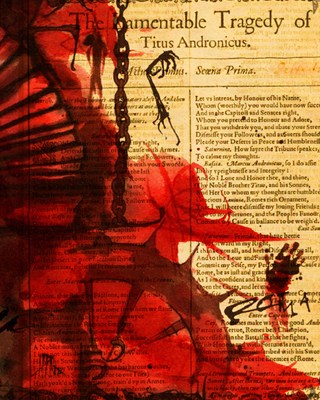
With just a few days left until Halloween, many of us will be anxious to put the candy bowl away, dim the lights, and watch a scary movie. I’d like to recommend my pic for the single best Shakespeare play for Halloween, and you might be surprised to learn which one it is:
It’s not Macbeth, despite its ghosts and witches, it’s not Hamlet, though it has a famous scene in a graveyard. In my opinion, the scariest, most horrific, most disturbing Shakespearean play is the ancient Roman revenge tragedy Titus Andronicus!
Titus Who?
Titus is the most violent, most outrageous play in the Shakespearean cannon and features murder, mutilation, cannibalism, (and even featured the first recorded trick or treating). It was also his first tragedy ever, written around 1590. Back in this period, Shakespeare’s theater was also the site of public executions and blood sports like Bear-baiting, so Shakespeare knew that gore sells. He also knew that people were reading the bloody tragedies of the Roman poet Seneca, so he created a play that out-does the Roman master of bloody violence!
So why have you not heard of it?
Scholars often compare the dark comedy of Titus to the films of Quentin Tarantino, who will murder his characters in grotesque, but funny ways. I won’t even give away the surprise ending where Titus and his daughter gets their revenge, but let’s just say that they would certainly agree with Tarantino that revenge is a dish, best served cold!
AARON
Look by and by to have thy sons with thee.
Aside Their heads, I mean.
O, how this villany
Doth fat me with the very thoughts of it!
Let fools do good, and fair men call for grace.
Aaron will have his soul black like his face (Titus, Act III, Scene 1).
Now the question to ask about Aaron and most of Shakespeare’s villains, is are they bad because they’re different (different race, differently abled, illegitimate birth), or did they become bad from people treating them badly?
Serious note– Even though productions often dramatize the violence and rape in Titus as over-the-top black comedy, this kind of rape and violence happens in real life, every day, particularly violence against women like Lavinia. One reason why this play is gaining popularity is sadly, that this kind of violence is more common in our current society with the shocking number of rapes committed in this country (1 in 5 women, according to the National Sexual Violence Resource Center), and the brutal murders in this play suggest many real-life atrocities such as Abu ghraib,
Plot summary and more at Schmoop.com
More at http://www.gradesaver.com/titus-andronicus/study-guide/summary
Review of Julie Taymor’s Titus
If you can’t get to the theater this Halloween and want to watch a production of Titus, you’re in luck: In 1999, Julie Taymor, famed director of the Broadway production of The Lion King, directed a film adaptation of Titus which I consider the single greatest Shakespearean film of all time. The movie captures the grotesque comedy of the play, while also visually showing the beauty of Shakespeare’s poetry. It also doesn’t get hung up on historical accuracy just because the play is set in Rome. Best of all, the cast in incredible: Anthony Hopkins, Jessica Langue, Alan Cumming, Harry Lennox and more. This cast knows how to do Shakespeare for the movies and their work shows in every scene. Interesting side note: Hopkins actually considered making this movie the last movie of his career, which explains his amazing glee and energy in the role of Titus. Below is a nice in-depth analysis of the film
Another good review comes from the French Shakespeare Society: https://shakespeare.revues.org/1558
And finally, a review from Roger Ebert: http://www.rogerebert.com/reviews/titus-2000
So that’s my two cents on Titus Andronicus. Happy Halloween everybody!
 The Shakespearean Student