The Fashion Is the Fashion 3: The Merchant Of Venice

Thanks for recommending this topic. I really enjoyed researching it. Disclaimer: Although I have a degree in Renaissance literature, I don’t have a degree in world religions. I don’t pretend to be an expert in Judaism and I apologize if I have gotten any cultural details wrong. As I have written before, this play has been used to spread harmful stereotypes and misinformation against Jews and Muslims, and I have no desire to do so. So don’t take this information as a comprehensive guide to the lives of Jews or indeed any 16th century Venetians. What I do intend to do is analyze how costumes from the play can evoke the people and cultures of that time.

1. Background https://youtu.be/BvqZ0JUljfo

Venice in the 16th century was a lot like modern day Manhattan- a multicultural epicenter of trade and commerce. https://youtu.be/FNZa9qazTvc

Many productions have costumes that emphasize the wealth and privilege of the Venetian world, except for Shylock

As this video shows, Jews in 16th century Venice were segregated into separate communities known as ghettos. Although the Jews found ways to survive and thrive in this situation, they faced constant discrimination and harassment.

In a modern productions or a period production the costume has to reflect a single vision for the show. Watch this interview with Globe Costume coordinator Laura Rushton: https://youtu.be/PaZmAuKE-Jg

2. Men’s Fashion- Italian fashion was all the rage in Shakespeare’s day. Gone were the stiff woolen tunics of the Middle ages, in with brightly colored silks and leathers. Young Men wore leather jackets called doublets and tight pants that showed off their legs. In the hot sun of Venice, light linnen undershirts were wore underneath the doublet. Wealthy men would wear fine silks and their jackets had slashed sleeves to show off the fine embroidered silk underneath.

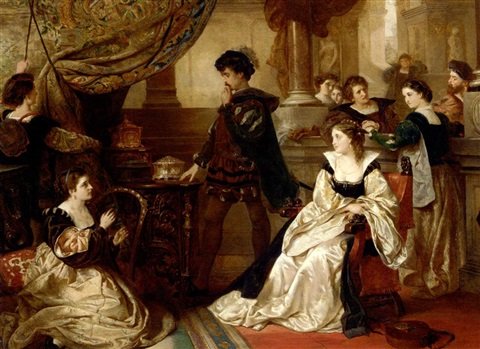
Joseph Fiennes’ costume as Bassanio in The Merchant of Venice

Servants- Servants were given distinctive clothes known as liveries by their masters, which for a man would typically be a distinct colorful jacket. Women like Narissa, who were high-ranking ladies maids, would wear hand me down clothes from their mistresses. So this is why in most productions I have seen, Narissa and Portia wear similar clothing. This also helps show the trust and respect they have for each other.

A Note On Masks:

Act II, Scene 5, takes place during Carnival, one of the most celebrated holidays of Venice, and it’s usually celebrated by people wearing brightly colored masks. This great video below from history YouTuber Metetron shows just a little bit of background on Venetian masks:

3. Women’s Fashion- The women in the play Merchant Of Venice are treated line birds in a cage, especially Portia who literally lives on an island and has to marry the man who wins her at a carnival! With the restrictions of garments like partlets, bodies, or corsets, if you wore the fashions of the period, you would feel like your lungs were birds in a cage!

Although the dress was richer and more ornate (reflecting the relative peace during this period), the clothing was much more physically restrictive than medieval dresses: https://youtu.be/KCeqG47LI1Y
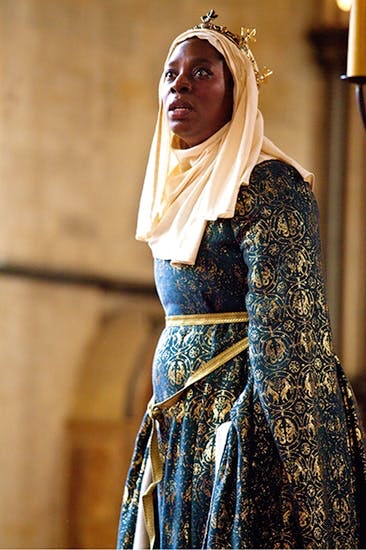
Costume for a production of King John. The fashion is reminiscent of the late 15th century. There is no corset, the dress helps shape the silhouette. Notice also the long sleeves.
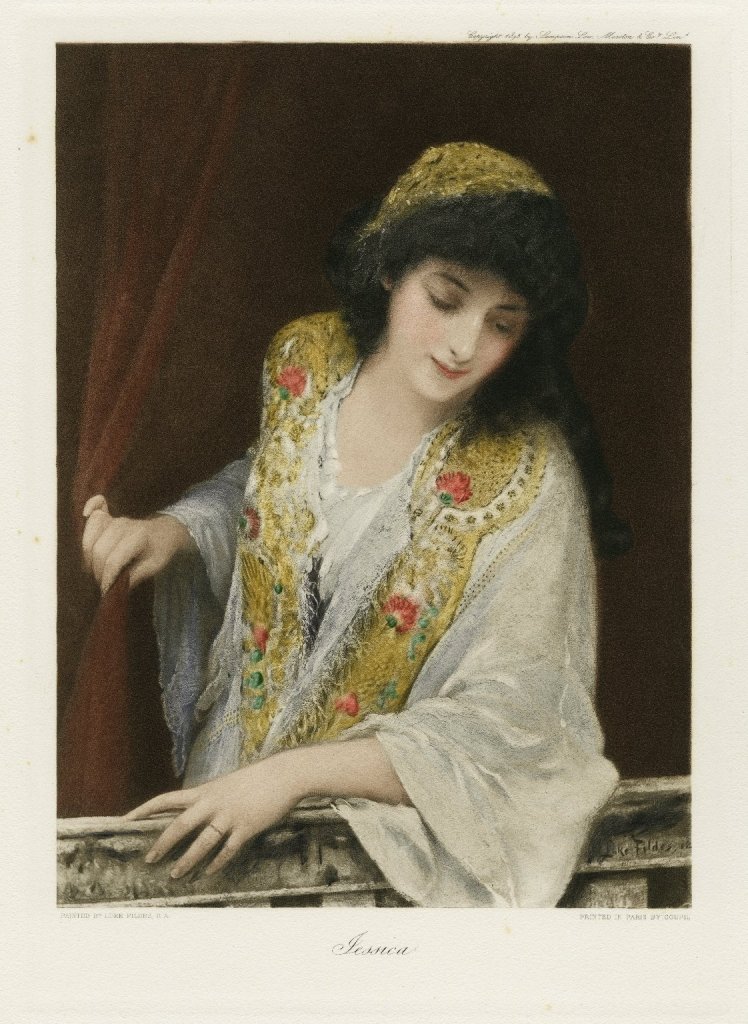
Jessica

Jessica- Though most productions have Shylock’s daughter dressing like the Christian women, there is a long history of distinctive clothing for Jewish women as well as men. Sadly, the only video I could find refers to 14th century clothes, I think this video is very informative and extremely thoughtful

4. Shylock

It’s worth noting that Shylock is not the central character in the story; the titular merchant is Antonio. Probably Shakespeare’s original audience saw him as a one dimensional villain for the audience to boo and hiss, then rejoice when he fails. He probably came onstage in 1596 wearing stereotypical red wig, a long gown, and a grotesquely oversized nose. The costume and performance gave the impression of someone foreign, alien, even demonic. This was one reason why some modern actors have balked at playing Shylock, as Patrick Stewart explains: https://youtu.be/7UOdMHW7J2Q

That said, Shakespeare clearly didn’t write him as one dimensional; he dominates the scenes he’s in and for centuries great actors have yearned to play Shylock over all the other characters. Slowly Shylock has become the focus of the play and the romantic comedy aspect has become less and less important in most modern productions. Like every great part, Shylock’s costume proclaims his social class, his background, and his relationship with other people.

In the play, Shylock only refers to his clothes once, referring to the gown he wears as “My Jewish gaberdine.” A Gaberdine is a long cloak like the one in the painting above, but as you can see, Jews were not the only people wearing them.

Because of rampant antisemitism and fear of the growing influence of the Jewish community in the 16th century, the Senate and local magistrates segregated and kept constant watch on the Jews of Venice, and one way they did that was by forcing Jewish people to wear distinctive clothes.

According to the Online Jewish Museum:

Jews were forced to wear various markings on their clothing to identify themselves as Jews. In 1394 they had to wear a yellow badge, it was changed to a yellow hat in 1496 and to a red hat in 1500.

Charles Keen as Shylock

As Shylock grew in popularity with actors and audiences, actors played him with more nuance. Contrast the foreign looking gown in the previous picture, with Charles Keen in the 19th century.

That is not to say that all productions played Shylock as a fully formed human: in 1934, the Nazi Party sponsored a German production of Merchant with horror actor Werner Krauss, (famous for films like The Cabinet of Dr. Caligari) as Shylock. You’ll notice that the costume again emphasizes otherness, and exaggerates Jewish stereotypes.
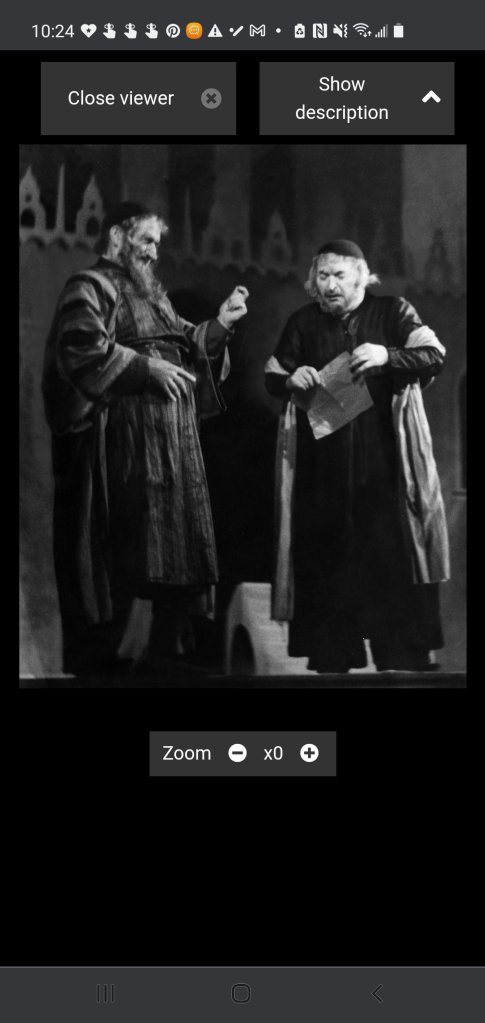
Warner Krauss in the infamous 1934 production of Merchant sponsored by the Nazi party.

Patrick Stewart when he played Shylock in the 1970s, emphasized how Shylock is essentially an immigrant in his own country and played him with tattered clothes, a dirty bushy beard, and with an air of a stray dog. His clothes emphasise both his race’s oppression, while also telegraphing Shylock’s miserly attitude. Sir Patrick emphasized that his Shylock had lost so much in his life that he clings to Earthly wealth to feel in control of his life.

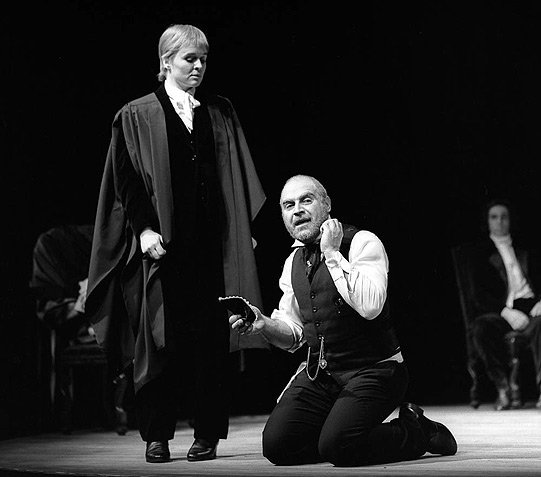
Patrick Stewart as Shylock
David Suchet as Shylock
David Suchet as Shylock, RSC.

By contrast, David Suchet. (famous for his portrayal of detective Hercule Poirot), chose a near polar opposite interpretation of Shylock at about the same time. The main difference between Suchet and Stewart could basically be summed up by this fact, Suchet is actually Jewish, Stewart is not.

Because Stewart was portraying a member of a community to which he didn’t belong, his portrayal downplayed Shylock’s Jewish identity since he didn’t want to make assumptions about what being Jewish is like. This is why Stewart gave his Shylock an over-refined accent and made sure his costume didn’t emphasize any stereotypical Jewish elements.

Since Suchet actually is Jewish, he did not shy away from portraying Shylock’s jewishness. His Shylock is proud of being Jewish but is well aware of how other people see him. He knows that he is othered by the other Venetians, and can use their fear and hatred of him as a weapon against them. Suchet also dressed his Shylock as well to do, but not gawdy to try and command respect from other people, but also carried around a walking stick to use as a weapon.

Ian McKellen
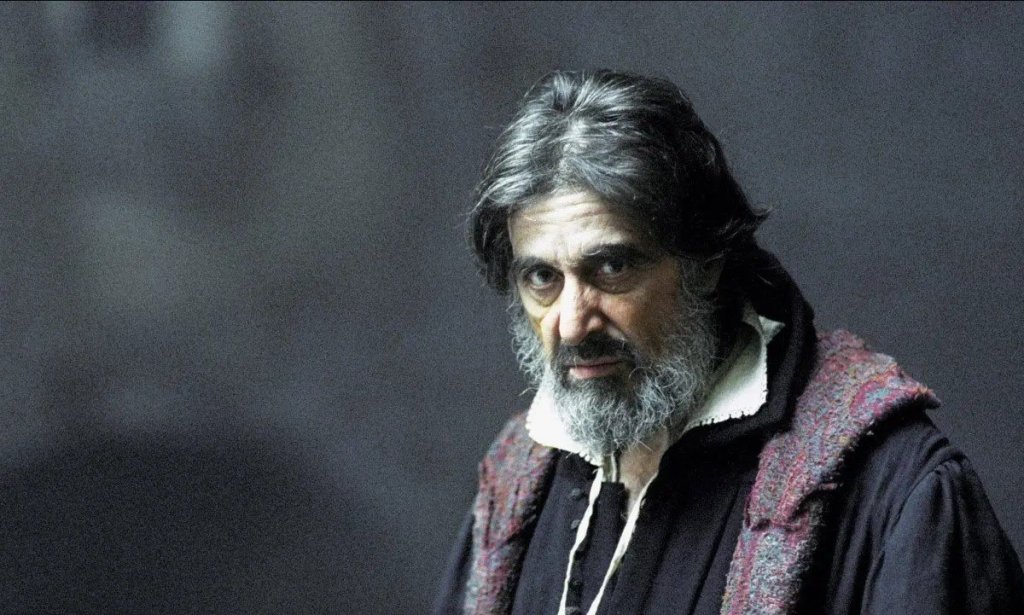
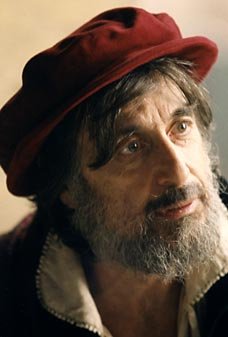
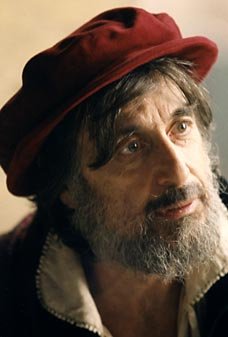
Al Pacino in the 2009 movie of Merchant, wearing the red hat that real Jews were required to wear in the 1590s.

6. Case study: the 2009 movie

The Prince of Morrocco: In Act II, Scene 7, The Princes of Morrocco and Aaragon (A region of Spain), come to Portia’s home on the island of Belmont to try solve the riddle of the three caskets. In order to show the audience that these men are foreigners, their costumes have to be distinct from the Venetians. Take a look at this was accomplished in the 2004 movie:
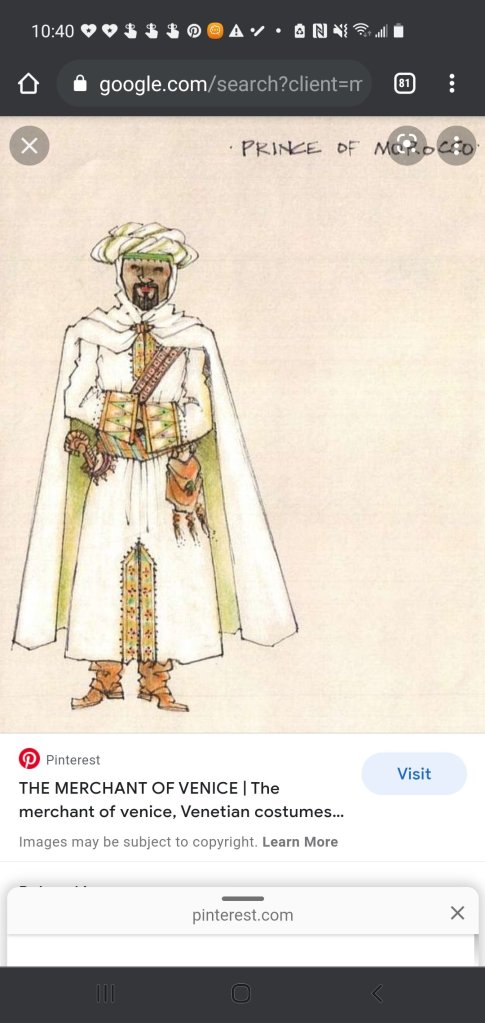
The Prince of Morrocco (David Harewood) tries to guess the casket in the 2004 movie.

Mr. Harewood’s costume was inspired by the real Morroccon ambassador to Queen Elizabeth, Abd el-Ouahed ben Messaoud, who many scholars believe, might have also inspired Shakespeare to write Othello 6 years later.

Abd el-Ouahed ben Messaoud
Al Pacino dons the distinctive red cap that all Venetian Jews were required to wear in the 1590s.
Shylock after he converts to Christianity.

6. Works Cited

https://www.bl.uk/shakespeare/articles/a-jewish-reading-of-the-merchant-of-venice

Venetian Fashion in the 16th Century

https://en.wikipedia.org/wiki/1550%E2%80%931600_in_Western_European_fashion

1590-1599

Shakespearean Tropes In Marvel’s “Black Widow”

I really loved the new “Black Widow,” movie. Like many people, I think it’s long overdue that Natasha Romanov got her own movie, especially since in many ways, she’s the most tragic and dramatic of the avengers.

First of all, the performances are great, the fights are excellent, and the plot hints on many contemporary issues such as abuse, human trafficking, trauma, and PTSD, while not forgetting it’s a Marvel action movie. If you hated the movie, I won’t argue with you, but what I want to do is to point out that each character has inside them an archetype that Shakespeare used in his history plays about soldiers.

The four central characters Alexei Shostakov (David Harbour), Melina Vostokoff (Rachel Weisz). Yelena Belova, and Black Widow herself, Natasha Romanov (Scarlett Johanssen), represent in a sense, the full spectrum of how Shakespeare’s soldier characters cope with the trauma of war, and it’s fascinating to see their journey through the film.

David Harbour as Red Guardian. Black Widow, Disney 2021.
  1. Alexei Shostakov / Red Guardian: Sir John Falstaff. Alexi begins the movie motivated by a desire for glory, and becomes a braggart, a drunk, and overweight. The movie starts out with Alexei going undercover in Ohio as Natasha and Yelena’s father, when in reality he’s a Russian agent who becomes the only Soviet supersoldier. The Red Guardian was supposed to be the equal of Captain America and after (spoiler alert), Alexei is betrayed and sent to prison, he spends over 20 years telling tall tales about his ‘glory days’ and how he nearly defeated Captain America, (despite the fact that Captain America was frozen at the time). This is simmilar to how Shakespeare’s Sir John Falstaff lies about a daring robbery he committed at night, when in reality, he was robbed by his friends Poins and Prince Hal:
Henry V. Pray God you have not murdered some of them.
Falstaff. Nay, that's past praying for: I have peppered two
of them; two I am sure I have paid, two rogues
in buckram suits. I tell thee what, Hal, if I tell1180
thee a lie, spit in my face, call me horse. Thou
knowest my old ward; here I lay and thus I bore my
point. Four rogues in buckram let drive at me—
Henry V. What, four? thou saidst but two even now.
Falstaff. Four, Hal; I told thee four.1185
Edward Poins. Ay, ay, he said four.
Falstaff. These four came all a-front, and mainly thrust at
me. I made me no more ado but took all their seven
points in my target, thus.
Henry V. Seven? why, there were but four even now.1190
Falstaff. In buckram?
Edward Poins. Ay, four, in buckram suits.
Falstaff. Seven, by these hilts, or I am a villain else.
Henry V. Prithee, let him alone; we shall have more anon.
Falstaff. Dost thou hear me, Hal?1195
Henry V. Ay, and mark thee too, Jack.
Falstaff. Do so, for it is worth the listening to. These nine
in buckram that I told thee of—
Henry V. So, two more already.
Falstaff. Their points being broken,—1200
Edward Poins. Down fell their hose.
Falstaff. Began to give me ground: but I followed me close,
came in foot and hand; and with a thought seven of
the eleven I paid.
Henry V. O monstrous! eleven buckram men grown out of two!

Both Alexei and Falstaff fool themselves into thinking they’re still great heroes and manage to charm the other characters into giving them sympathy (to a point). Worst of all, even though he knows about the disgusting deeds of General Dreykov, the man responsible for the way Yelena and Natasha were recruited, brainwashed, forced to kill, and forced to be sterilized, he still defends the actions of Dreykov because Alexei benefited from the supersoldier program.

You both have killed so many people,” Alexei exults, embracing them both. “Your ledgers must be dripping, just gushing red. I couldn’t be more proud of you!”

Alexei

But in the climax of the movie, Alexei abandons his swagger in order to protect Natasha and Yelena; he goes from being a fake father to a real father. He also adopts a more Falstaffian view of ‘honor,’ as a thing not useful in itself:

Falstaff used this ‘catechism to become a thieving, conniving rascal, but the same words could be used to show how Alexei decided that his ‘family’ is more important than his persona as Red Guardian, how he values Natasha and Yelena more than his own glory.

2. Yelena Belova – Hotspur

Both Yelena and Hotspur are great warriors who work for the other side, but aren’t played as villains. Unlike the French in Henry V, the rebels in Henry IV Parts 1&2 are treated with respect by everyone, even the king they fight against! Likewise, even though she works for Dreykov, and was a willing assassin in his army of widows, she isn’t seen as a villain. She’s seen as a woman who had no other choice. She was raised to kill, so she did so, she just had the misfortune of being on the losing side.

Henry Percy is also a warrior fighting for the losing side This is why Hotspur has a lot of bitterness and envy towards Prince Hal- the man who gets to become a hero and king. Meanwhile Yelena is very jealous of Natasha, who not only became a valued assassin for Dreykov, she eventually became an Avenger and is seen as a hero by most people now:

“We’re both killers, but I’m not the one that’s on the cover of a magazine. I’m not the killer that little girls call their hero.”

Yelena- Black Widow.

Though in reality Natasha and Yelena are not sisters, they were raised together, trained together, and form a sister like bond, which makes the jealousy Yelena feels all the more poignant. Likewise, though Henry Plantagenet (Prince Hal) and Henry Percy aren’t brothers, everyone acts as if they were, even the Prince’s father:

 O that it could be proved
That some night-tripping fairy had exchanged
In cradle-clothes our children where they lay,
And call'd mine Percy, his Plantagenet!
Then would I have his Harry, and he mine.
But let him from my thoughts.- Henry IV, Part I, Act I, Scene 1.

In Black Widow, the envy the sisters feel towards each other is the central conflict of the movie, just as it is in Shakespeare’s play. Tragically, both works (spoiler alert), end the same way- with one warrior dying and the other essentially taking his or her place. In Black Widow, Yelena takes up the mantle after her sister sacrifices her life in Avengers Engame, but in Shakespeare’s version, the two Henry’s have a duel to the death:

Yelena represents the trauma that can destroy some soldiers when they don’t have someone to confide in. Everything she was told to believe in wound up being a lie, and everyone she trusted betrayed her. This is why she and her sister cling to the idea of family- the only thing that helps her get through the pain of their past.

Rachel Weisz as Melina Vostokoff. “BLACK Widow.” Disney/ Marvel, 2021.

3. Melina Vostokoff- Lord Northumberland I’ll keep this brief because Melina’s character has some MAJOR SPOILERS attached to her, but let’s just say she is the mother of the family and like Alexei she put her devotion to the Communist Party and to General Dreykov above all else, and failed to support her family, much like how Northumberland failed to support his son Henry Percy and let him get killed in the battle of Shrewsbury. I love Rachel Weisz’s performance in this part where she seems to mourn her lack of courage; she seems to deeply hate herself and what she’s done to her ‘daughters,’ which is painful to watch but very human.

Scarlett Johansen as Natasha Romanov/ Black Widow. “Black Widow.” Marvel/ Disney, 2021.

4. Natasha Romanaov/ Black Widow- King Henry V. Like Yelena, Natasha has to deal with the fact that she is a killer and has been trained to kill men, women, and sometimes even children. What’s fascinating to watch is how, even though she’s an Avenger and therefore one of the “good guys,” she knows that her actions have hurt people. It makes sense that in Age Of Ultron, she forms a close bond with The Hulk, since she probably sees herself as a monster.

For nearly 400 years, King Henry has been portrayed as a great hero on the stage, but ever since the Vietnam War, more recent productions have questioned whether his actions make him more of a hero, or a villain. He conquers France which he believes he legally owns but does that justify the bloodshed he’s committed?

One film that examines the ambiguous nature of Henry’s bloody conquest is Kenneth Branaugh’s 1989 movie, Henry V. Take a look at this clip at the end of the Battle of Agincourt. This was Henry’s greatest victory in the play and in real life, but after the battle, we see Kenneth Branaugh as King Henry slogging through the mud, looking at the bodies of French and English troops, with a look of pain and perhaps remorse on his face:

The Non Nobis number from “Henry V” directed by Kenneth Branaugh, 1989.

In Black Widow, Natasha is on a quest to make up for her past as an assassin and attempt to prevent more women from being recruited in such a dehumanizing way. Her kinship with the other widows, and her desire to help them, reinforces her humanity and makes her more than just a killer. Simillarly, her love for her sister and her love of the Avengers gives Natasha purpose and validation that she isn’t the monster she thinks she is. Finally, when her fake family joins her in the climax to defeat General Dreykov, she feels a strong sense of comraderie. Having her fellow soldiers, fight with her in a righteous cause makes her feel redeemed from her past.

Black Widow and Henry V are examples of how soldiers cannot survive a war alone. Even if they live through the war, the mental and physical scars of war are too much for one person to bear. This is why both films focus on how family is stronger than war, than causes, then pain, if one has the good fortune to have a group of people who love each other like a family, or as King Henry puts it:

We few, we happy few, we band of brothers;

For he to-day that sheds his blood with me

Shall be my brother; be he ne’er so vile,

This day shall gentle his condition:

Henry V, Act IV, Scene iii.

Thanks for reading this post, let me know if you’d like me to analyze any other movies in the comments. I’ll leave you with one more clip where Scar-Jo talks about her career as Black Widow:

Summer Shakespeare Academy!

I’m working this summer with the good people at Outschool, an online learning platform for kids ages 3-18. I’m designing a series of Shakespeare classes that you can sign up for. We’ll be doing acting exercises, reading Shakespeare’s text, and making Shakespeare props Cost is $3 per child.

The course is ala carte, that is, you can sign up for as many courses as you like. Each course builds on the last one, but you don’t have to have taken the previous ones to enjoy any one particular course Let me know in the comments which class(es) you are interested in, and/or what suggestions you might have. I can’t wait to hear what you think about these summer Shakespeare courses, and I hope to see you online soon!

1. Introduction to Shakespeare- (enrollment here: https://outschool.com/classes/introduction-to-shakespeare-or-how-i-learned-to-love-the-bard-UoHH5fes?sectionUid=973060db-f857-461a-a23a-f1476203a544&showDetails=true) We’ll talk about why Shakespeare is so famous and learn about his life and career. Then we’ll do some fun quizzes that you can earn prizes based on how well you pay attention!
2. How to write ✍ like Shakespeare (Enrollment here: https://outschool.com/classes/how-to-write-like-shakespeare-0HuPq1Cg?sectionUid=4243af25-ba41-4724-82a2-61bd7c7d862e&showDetails=true) Have you ever wanted to woo your sweetheart or write the next bestselling play? Well, this course will cover the secrets of Shakespeare’s writing. We’ll cover how to write romantic poems, the structure of Shakespeare’s plays, and you’ll get to write your own Shakespearean speeches!
3. Intro to Shakespearean acting Practical tips and tricks for your next Shakespeare audition.
4. Shakespeare’s villains
We’ll look at the darkest and creepiest Shakespearean characters and see why they still fascinate us today!
5. The Violent Rhetoric Of Shakespeare’s Julius Caesar (Registration Here: https://outschool.com/classes/the-violent-rhetoric-of-julius-caesar-fkMLbAtA?sectionUid=1f9220cd-8c28-438d-9799-8479494353a4&showDetails=true#usMaRDyJ13) In this one-time course, students will analyze the rhetoric and persuasive power in two speeches from Shakespeare’s “Julius Caesar”
6. Intro to Romeo and Juliet – Get a leg up on your next English class with this fun, frenetic look through the characters, themes, and story of Shakespeare’s most popular, and most-taught play.
7. Basics Of Stage Combat (Registration here: https://outschool.com/classes/1120ada2-047d-4b0f-84f6-5eb4b0f7dc66/schedule#usMaRDyJ13 I’ll teach the kids about Elizabethan street fighting, and the basics of stage combat.
8. The Balcony Scene of Romeo and Juliet– It’s been called the greatest love scene of all time, but why? I’ll explain the imagery, the poetic language, and give you a chance to make your own love poetry!
9. Insults and Shakespeare You’ll craft your own Shakespeare insults and engage in a (respectful), beat down with your classmates! Along the way, we’ll talk about how insults escalate to violence in Shakespeare’s Romeo and Juliet.
10. The Iconic imagery of Romeo and Juliet We’ll look at some beautiful paintings, songs, and other works of art that build on Shakespeare’s poetic imagery.
11. Romeo and Juliet and pedagogy Shakespeare is uniquely challenging to get kids to engage with. I’ll give you some of my resources, games, and activities to help you delve into the play in your next class.

If you like these courses, let me know by leaving a comment below. If you’re interested in signing up, visit my teacher profile page: https://outschool.com/teachers/The-Shakespearean-Student. New classes will be added every week, and I’ll work around your schedule when planning the dates and times. Hopefully this will be a great chance for me to share my expertise with a young group of future Shakespearean students!

New TV Adaptation Of Romeo and Juliet

PBS is going to show (and hopefully stream), the National Theater’s production of Romeo and Juliet Friday, to help celebrate William Shakespeare’s birthday.

The production stars Jessie Buckley as Juliet, and Josh O’Connor as Romeo, who recently won a Golden Globe for his portrayal of the young Prince Charles

After playing another doomed lover whose family won’t allow him to be with the woman he wants, I look forward to seeing him bring his passion and skill to Shakespeare.

Jessie Buckley as Juliet, and Josh O’Connor as Romeo. National Theater, 2021

What Does Shakespeare Say About Ireland 🇮🇪?

Happy St. Patrick’s Day! The Emerald Isle has long been a source of illumination for poet’s pens and Shakespeare was no exception. The Bard of Avon is indebted to Mother Ireland not only for the inspiration he took, but sadly for the pain he gave her back.

None of Shakespeare’s plays are set in Ireland, but he freely adapted elements from Irish folklore. English poet Edmund Spencer visited Ireland in the 1590s and adapted the folklore he picked up into his opera The Fairy Queen, which Shakespeare adapted into A Midsummer Night’s Dream

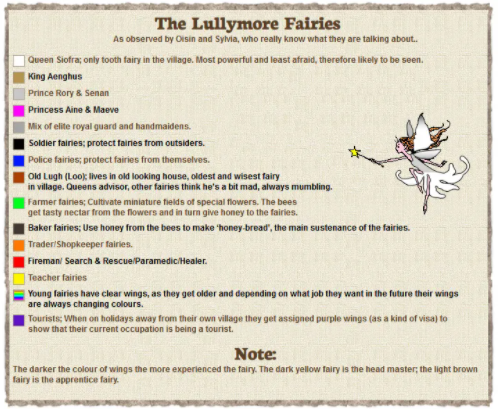
The Irish created and continue to tell many of the fairy legends and stories that we retell and adapt today. If you go to Lullymore park in Ireland, you can see a place that is essentially a “Fairy preserve.”

Types of fairies you can “spot” at the Lullymore Park in Ireland:

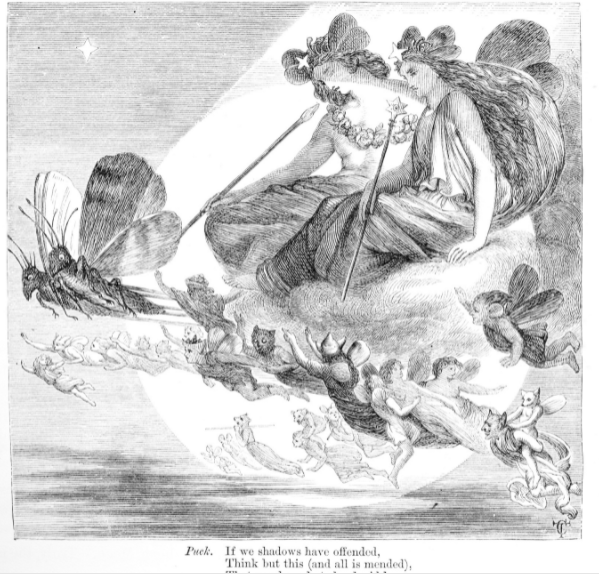
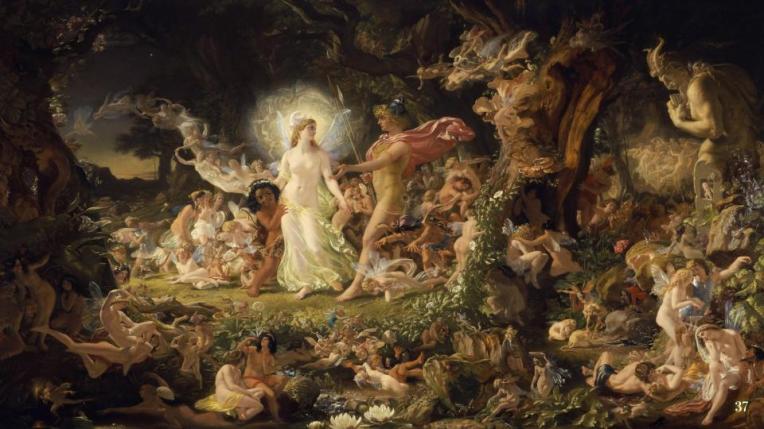
The old stories tell that Fairies are magical creatures who live in hollow places in the earth. Some are benevolent and help give rain and pleasant weather to the Earth, Like the king and Queen of the fairies, Oberon and Titania:

And the mazed world,
By their [the tides] increase, now knows not which is which:
And this same progeny of evils comes
From our debate, from our dissension;
We are their parents and original.

— Titania, (Queen of the Faries), A Midsummer Night’s Dream Act II, Scene i.

Titania in this speech shows great concern for nature, humanity, and the planet. She believes it is the responsibility of fairies, particularly herself and her husband Oberon, to control the elements and keep humans and fairies safe. Some fairies, however, are cruel and enjoy playing tricks on mortals, just like Puck in A Midsummer Night’s Dream, or Queen Mab in Romeo and Juliet.

.

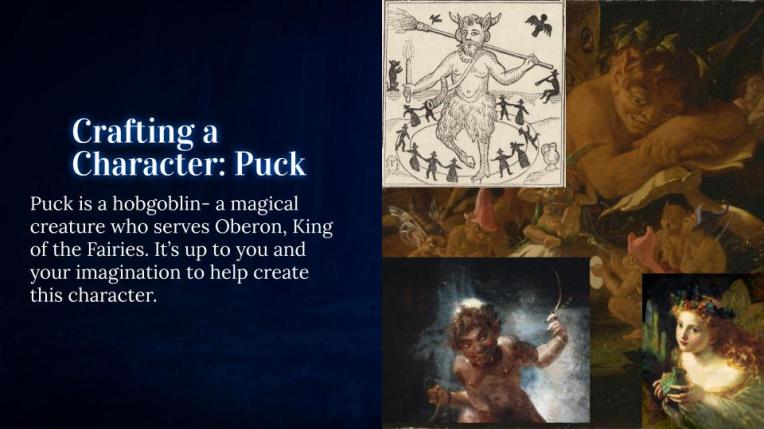
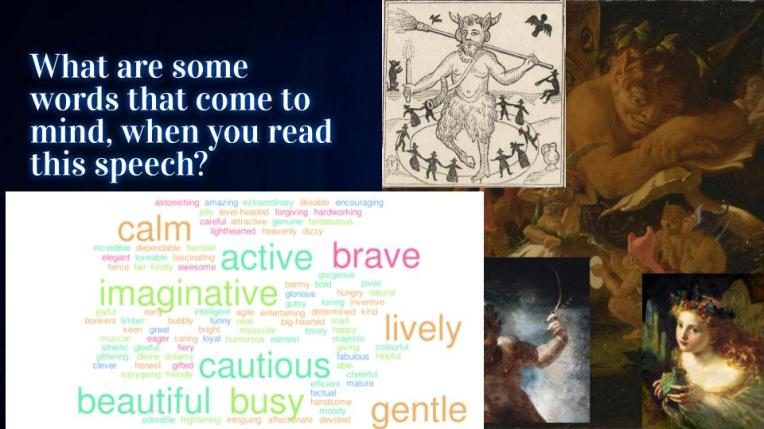
This is a short analysis I created of the tricks Puck plays on people in A Midsummer Night’s Dream, as part of my acting course on Ouschool.com. Note the different ways Puck is portrayed in photos as a satyr, a rotund elf, and sometimes as an almost- demon like figure.

Cringe-worthy Shakespeare: Shakespeare’s only Irish character, captain mcmorris in “Henry V”

When Shakespeare is racially insensitive towards people of color, the cringe-worthy writing is mercifully few and far between. With the exception of Aaron the Moor and Don Armada, there are only a few sporadic derogatory references to non-White Anglo-Saxon Protestants. Sadly though, Shakespeare might have permanently harmed the Irish through his character the Irish captain Macmorris in Henry the Fifth, his only Irish character.

According to The Irish Times, there is a longstanding stereotype that still exists in the British Isles that Irish people are violent, short-tempered, and essentially savages and Shakespeare might have invented this stereotype (or at least popularized it) when he wrote this scene from Henry the Fifth, Act III, Scene ii:

FLUELLEN
To the mines! tell you the duke, it is not so good
to come to the mines; for, look you, the mines is
not according to the disciplines of the war: the
concavities of it is not sufficient; for, look you,
the athversary, you may discuss unto the duke, look
you, is digt himself four yard under the
countermines: by Cheshu, I think a' will plough up
all, if there is not better directions.
GOWER
The Duke of Gloucester, to whom the order of the
siege is given, is altogether directed by an
Irishman, a very valiant gentleman, i' faith.
FLUELLEN
It is Captain Macmorris, is it not?
GOWER
I think it be.
FLUELLEN
By Cheshu, he is an ass, as in the world: I will
verify as much in his beard: be has no more
directions in the true disciplines of the wars, look
you, of the Roman disciplines, than is a puppy-dog.
Enter MACMORRIS and Captain JAMY
GOWER
Here a' comes; and the Scots captain, Captain Jamy, with him.
FLUELLEN
Captain Jamy is a marvellous falourous gentleman,
that is certain; and of great expedition and
knowledge in th' aunchient wars, upon my particular
knowledge of his directions: by Cheshu, he will
maintain his argument as well as any military man in
the world, in the disciplines of the pristine wars
of the Romans.
JAMY
I say gud-day, Captain Fluellen.
FLUELLEN
God-den to your worship, good Captain James.
GOWER
How now, Captain Macmorris! have you quit the
mines? have the pioneers given o'er?
MACMORRIS
By Chrish, la! tish ill done: the work ish give
over, the trompet sound the retreat. By my hand, I
swear, and my father's soul, the work ish ill done;
it ish give over: I would have blowed up the town, so
Chrish save me, la! in an hour: O, tish ill done,
tish ill done; by my hand, tish ill done!
FLUELLEN
Captain Macmorris, I beseech you now, will you
voutsafe me, look you, a few disputations with you,
as partly touching or concerning the disciplines of
the war, the Roman wars, in the way of argument,
look you, and friendly communication; partly to
satisfy my opinion, and partly for the satisfaction,
look you, of my mind, as touching the direction of
the military discipline; that is the point.
JAMY
It sall be vary gud, gud feith, gud captains bath:
and I sall quit you with gud leve, as I may pick
occasion; that sall I, marry.
MACMORRIS
It is no time to discourse, so Chrish save me: the
day is hot, and the weather, and the wars, and the
king, and the dukes: it is no time to discourse. The
town is beseeched, and the trumpet call us to the
breach; and we talk, and, be Chrish, do nothing:
'tis shame for us all: so God sa' me, 'tis shame to
stand still; it is shame, by my hand: and there is
throats to be cut, and works to be done; and there
ish nothing done, so Chrish sa' me, la!
JAMY
By the mess, ere theise eyes of mine take themselves
to slomber, ay'll de gud service, or ay'll lig i'
the grund for it; ay, or go to death; and ay'll pay
't as valourously as I may, that sall I suerly do,
that is the breff and the long. Marry, I wad full
fain hear some question 'tween you tway.
FLUELLEN
Captain Macmorris, I think, look you, under your
correction, there is not many of your nation--
MACMORRIS
Of my nation! What ish my nation? Ish a villain,
and a bastard, and a knave, and a rascal. What ish
my nation? Who talks of my nation?
FLUELLEN
Look you, if you take the matter otherwise than is
meant, Captain Macmorris, peradventure I shall think
you do not use me with that affability as in
discretion you ought to use me, look you: being as
good a man as yourself, both in the disciplines of
war, and in the derivation of my birth, and in
other particularities.
MACMORRIS
I do not know you so good a man as myself: so
Chrish save me, I will cut off your head.
GOWER
Gentlemen both, you will mistake each other.
JAMY
A! that's a foul fault.
A parley sounded
GOWER
The town sounds a parley.
FLUELLEN
Captain Macmorris, when there is more better
opportunity to be required, look you, I will be so
bold as to tell you I know the disciplines of war;
and there is an end.
Exeunt

Irish History and Shakespeare: The tempestous relationship between england and Ireland

The mayor and all his brethren in best sort,
Like to the senators of the antique Rome,
With the plebeians swarming at their heels,
Go forth and fetch their conquering Caesar in:
As, by a lower but loving likelihood,
Were now the general of our gracious empress,
As in good time he may, from Ireland coming,
Bringing rebellion broached on his sword,

Henry V, Act V Chorus

National Portrait Gallery painting of Robert Deveraux, 2nd Earl of Essex. Wikimedia Commons.
Robert Devereax, 2nd Earl of Essex (National Portrait Gallery)
Hugh, O’Neill, Earl of Tyronne

James Shapiro in his excellent book, A Year In The Life Of William Shakespeare, 1599, posits that contemporary affairs in Ireland might have inspired some of Shakespeare’s greatest plays in including Richard II, Henry V, and Julius Caesar. In 1594 the Earl of Tyrone began a rebellion in Ireland against the English, and in 1599, Queen Elizabeth dispatched the ambitious and chivalrous Earl of Essex to quell it. As you can see in the quote above, Shakespeare mentions Essex’s fight in his play of Henry V, which probably premiered at around the same time Essex was in Ireland.

The audience may have been watching Henry conquer France, but many would have been thinking about Elizabeth’s struggle to conquer Ireland.

BBC Radio 4 Extra – Shakespeare’s Restless World, Ireland: Failures in the Present – Transcript – Shakespeare’s Restless World – Programme 7

Though King Henry successfully conquered and united England and France, Essex failed spectacularly, and Elizabeth was deeply embarrassed by the whole scenario. She was also deeply alarmed by the popularity of Shakespeare’s tragedy Richard II, which shows onstage the deposing and killing of a king who had no children and failed to quell a rebellion in Ireland.

Elizabeth was worried about her subjects but she was also very worried about Essex overseas. Everyone, (including Shakespeare), remembered that 2,000 years ago, Julius Caesar went from him the Senate’s Consul General to dictator by amassing an army, then threatening to invade Rome under the pretense of helping to quell a foreign invasion. Caesar made his name by subjugating tribes in Gaul (modern-day France), and the Senate was worried that he would come home and use his army for a military coup. Look at the expressions on the faces of Cicero and Brutus when they see Caesar coming home in triumph in this scene from the HBO series Rome.

Elizabeth repeatedly attempted to curb Essex’s power while he was fighting in Ireland; she refused to give the Earl more troops for fear that he might be staging a potential coup. Her fears would later be proven right when in 1602, Essex attempted to head a rebellion and take the Crown for himself, but not before one of Essex’s friends commissioned Shakespeare’s company to portray the deposing and killing of King Richard II. Essex was trying to turn himself from a failed Henry V to a victorious Henry IV, and his queen into Richard II.

Left- deposition form the interrogation of Augustine Phillips, one of the actors in Shakespeare’s company about his company’s potential involvement with the Essex rebellion. Right- the hanging of Cinna the poet from Julius Caesar.

Shakespeare might have been inspired to write Julius Caesar after being an unwitting pawn in the political drama between Essex and the queen, and might have even created the character of Cinna the Poet as an analog for Shakespeare himself. In the play, Cinna the poet is mistaken for one of the conspirators by an angry mob and is murdered in the street. Perhaps Shakespeare created Cinna the Poet as a way of coping with the fear he must have had that people might mistake him for a radical, after his play Richard II briefly made him a walking target for those opposed to Essex’s rebellion. In any case, Julius Caesar eloquently documents the kind of anxiety of not knowing who could be trusted when it comes to politics, whether it be a populist warrior like Julius Caesar or Essex, or the Queen, privy council, or indeed Roman senate, and the whole thing started from a failed attempt to quell a rebellion in Ireland.

In summation, even though Shakespeare sets no plays in Ireland, Irish history and Irish culture are everywhere in his plays. England and Ireland are I are indeed separate islands but the cultural exchange between England and Ireland has inspired Shakespeare and many other great writers for centuries. After all Shakespeare’s most famous honorific, ‘the Bard of Avon’ comes from an ancient Irish tradition of semi-mystical poets, who in Irish folklore, were able to see the future and glimpse worlds that are unseen to ordinary mortals. What Shakespeare really felt about Ireland we don’t know but we do him but he does owe the Irish people a lot of thanks, and on this  Saint Patrick’s day, I honor their contribution to him and to him all the world

References:

Shapiro, James. A Year In the Life Of William Shakespeare, 1599. Chapter 6: Things Dying and Things Reborn.

https://www.bbc.co.uk/programmes/articles/3fLDRSY7r9rJhrVFWy99Mly/transcript-shakespeares-restless-world-programme-7

https://www.independent.ie/entertainment/theatre-arts/is-shakespeare-responsible-for-the-stage-irishman-34638347.html

https://www.irishtimes.com/culture/stage/what-ish-my-nation-shakespeare-s-irish-connections-1.2619173

Shakespeare on Riots

Today is March 15th, a day that history still bewares, because of the infamous day when armed, violent conspirators went to the Senate and attempted to overthrow elected rulers. For obvious reasons, this put me in mind of the heinous actions of another group of conspirators stormed another Senate and tried, unsuccessfully, to overthrow democracy.

January 6th, 2021 (which, coincidently, was Twelfth Night, one of my favorite Shakespeare-themed holidays), was a tragedy for multiple reasons. The protestors broke windows, destroyed furniture, defaced statues, broke into both chambers of Congress, and probably would have harmed lawmakers, in a violent protest of both the US presidential election and the Senate vote in Georgia that week.


Let me be clear, this was sedition and treason and everyone involved should be prosecuted to the full extent of the law. Anyone who says otherwise is blatantly attacking our cherished democracy, and spitting in the face of the rule of law. Unfortunately, Republicans in both chambers have been unwilling to condemn their actions for fear of alienating their base. If this is what the Republican party has come to, the party doesn’t deserve the name. A republic protects the right of the people to elect its representatives and dedicates itself to the peaceful transition of power. Left unchallenged, groups like this will bring anarchy and tyranny to our country.

How do I know this? Because it happened before. Shakespeare has long dramatized real historic events where people rise up against their governments (for better or worse). In all cases, whether protesting a famine, a war, or a cruel tyrannical usurper, the riots never accomplish anything except bringing chaos and bloodshed. Sometimes these ignorant rioters are goaded by charismatic powerful figures, but these upper-class characters are only exploiting the rioters, using their violence as a way to get power for themselves. So, let’s examine the language, tactics, and effects of rioters in three of Shakespeare’s plays: Julius Caesar, Henry VI Part III, and Sir Thomas More:

Example 1: Julius Caesar

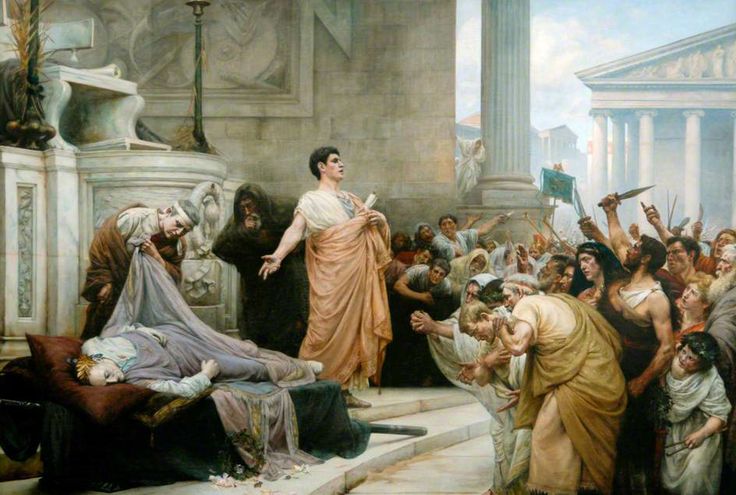
George Ed Robertson Antony
(c) Hartlepool Museums and Heritage Service; Supplied by The Public Catalogue Foundation

As I covered before in my “Friends, Romans, Countrymen,” post, during Antony’s famous funeral speech, he galvanizes the Roman crowd, first to mourn Caesar, then to revenge his death. How do they do this? By burning the houses of the conspirators and rioting in the street. They even kill a man just because he has the same name as one of the conspirators:

https://www.rsc.org.uk/shakespeare-learning-zone/julius-caesar/story/timeline

What does this violence accomplish? Nothing. Caesar is still dead. Brutus is still alive (though on the run). Antony merely wished to punish Brutus, and get the mob to hate him while he secretly cheats them out of their money. In Act Four, Antony becomes the de facto ruler of Rome because he leveraged his performance at the funeral, and uses his newfound powers to take money away from the citizens that Caesar promised to give them in his will. He manipulated them for his own purposes and duped them for political power.

Example 2: Jack Cade in Henry VI, Part ii.

Henry VI is the only king in English history to be crowned twice, deposed twice, and buried twice (Saccio 91). As the play begins, King Henry has already lost France, lost his mind, and lost the respect of his people. Around 1455, John Hardyng wrote a contrast between Henry’s father and himself. He laments that Henry the Fifth died so soon and then exhorts Henry to keep the quarrelsome lords in his government from warring among themselves.

Withstand, good lord, the outbreak of debates.
And chastise well also the rioters
Who in each shire are now confederates
Against your peace, and all their maintainers
For truly else will fall the fairest flowers
Of your great crown and noble monarchy
Which God defend and keep through his mercy.

(Excerpt from Harding’s Chronicle, English Historical Documents, 274).

Henry’s political ineptness was why Richard of York challenged his claim to the throne. Though Richard had little legal claim as king, he believed himself to be better than Henry.

In Shakespeare’s play Henry VI, Part ii, York tries to get the people’s support by engineering a crisis that he can easily solve. York dupes a man named Jack Cade to start a riot in London and demand that the magistrates crown Cade as the true king.

Biography of Richard, Duke of York, who challenged King Henry VI for his right to be king.

York and Cade start a conspiracy theory that Cade is the true heir to the throne and the royal family suppressed his claim and lied about his identity. Cade starts calling himself John Mortimer, a distant uncle of the king whom York himself admits is long dead:

The Royal National Theater’s production of Henry VI, Parts II, and 7. Jack Cade appears at about the 7-minute mark.
And this fell tempest shall not cease to rage
Until the golden circuit on my head,
Like to the glorious sun's transparent beams,
Do calm the fury of this mad-bred flaw.
And, for a minister of my intent,
I have seduced a headstrong Kentishman,
John Cade of Ashford,
To make commotion, as full well he can,
Under the title of John Mortimer.

Just like Cade and his rebels, the January 6th rioters were motivated by lies and conspiracies designed to crush their faith in their legitimate ruler. Even more disturbing, these rioters are pawns in the master plan of a corrupt political group. York doesn’t care that Cade isn’t the real king; he just wants to use Cade’s violence as an excuse to raise an army, one that he can eventually use against King Henry himself.

15th century woodcut from the War Of the Roses.

Similar to York’s lies and conspiracy-mongering, many Republicans have refused to accept the legitimacy of Joe Biden’s election, and some are actual proponents of Q Anon conspiracies!

A lot of Republicans deserve blame for fanning the flames of rebellion on January 6th, but arguably former President Trump deserves most of the blame. Even Rush Limbaugh admitted that Trump spread a huge amount of conspiracy theories without believing in any of them. He does this because he wants Americans to be afraid of imaginary threats that he claims he can solve. What’s easier to solve than a problem that doesn’t exist? Much like York, Trump tried to hold onto power by pressuring his supporters to pressure the Capital, feeding them lies about election fraud, and a secret democratic Satanic cult. Thus radicalized, they resolved to do what Cade’s mob did: “Kill all the lawyers.” Unfortunately, there are a lot of lawyers in the Senate.

As Dick the Butcher points out, most people don’t actually believe Cade is truly John Mortimer, they are just so angry at the king and the oppressive English government, that they are willing to follow him in a violent mob to take their vengeance upon the monarchy. This is why they try Lord Saye and execute him just for the crime of reading and writing! Similarly, the mob attacking the capital was made up of die-hard conspiracy adherents, and people just angry at the Democratic Party.

https://www.washingtonpost.com/technology/2021/01/20/qanon-trump-era-ends/

Like I said before, Cade and his mob is just a pawn in the machinations of York. Eventually the king’s enforcer, Lord Clifford convinces most of them to abandon Cade, and Cade himself dies a humiliating death- on the run from the law and starving, Cade is murdered by a farmer after trying to steal some food. After Joe Biden became the 46th President, many of the conspiracy group Q-Anon, who had many prominent members in the January 6th riot, began to disbelieve and abandon the conspiracies of the group. However, as this news story shows, some Q-Anon supporters are die-hard adherents and will never abandon their conspiracy theories, and some, like York’s supporters, are being recruited by other extreme groups. Sadly, as York shows, sometimes a riot is a rehearsal for another riot. In Shakespeare’s Henry VI, Part III, York finally amasses an army and challenges the Lancastrians in all-out war. Hopefully, the US government will hunt down and arrest these violent insurrectionists before they have the chance to do the same.

Example 3: Sir Thomas More

In the unfinished play “Sir Thomas More, a racist mob again attempts to attack London. This time they have no political pretenses; they want to lynch immigrants who they believe are taking English jobs. As I said in my “Who Would Shakespeare Vote For?” post, More’s speech is a perfect explanation of why this behavior cheapens and denigrated a country’s image, and weakens its ability to command respect from the rest of the world. Last time I posted a video of Sir Ian McKellen speaking this speech, but this time.. well just watch:

Why Among US Is Like “Macbeth,”

Intro game play video from “Among Us”

My family is quickly falling in love with the hugely popular online gaming sensation “Among Us,” which if you don’t know, is a strategy game similar to the game “Werewolf,” where a lone player, (known as The Impostor), tries to ‘kill’ a group of people without arousing suspicion. Just like the kids game in “Among Us,” whenever someone gets murdered, the others try to figure out the identity of the murderer.

The fun and drama of the game definitely comes from the paranoia that the players inevitably experience, not knowing whom to trust. Is the murderer over there? Was she the murderer? Is she lying about where she was just now? And most importantly, who is next?

Shakespeare’s Macbeth taps into the paranoia not just of people afraid of being murdered, but even the paranoia of the murderer himself!

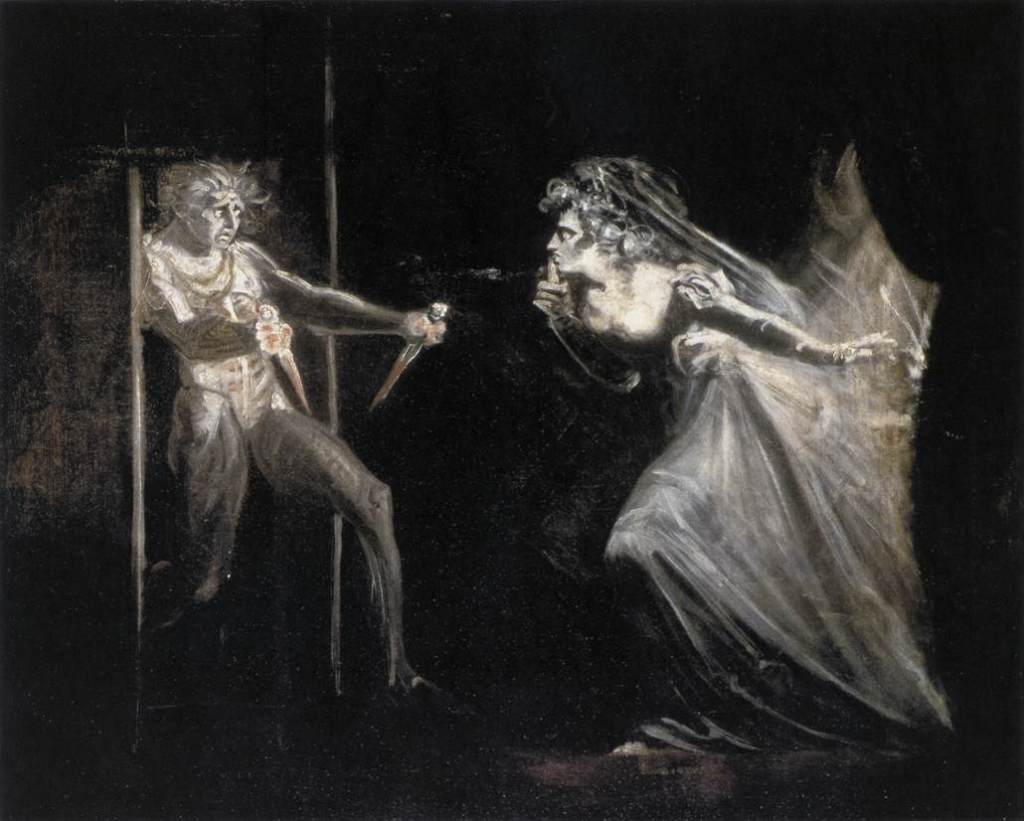
“Lady Macbeth and the Daggers” by Henry Fuseli, 1812.

Analysis of the scene: Act II, Scene iii:https://youtu.be/Pr4KmK9eXO0

Reddit thread comparing Among Us to Macbeth

After Macbeth kills the king and he and his wife cover up the blood, there is a council meeting where Ross, Macduff, Malcom, and Donaldbane try to figure out what happened. Macbeth and Lennox accuse the sleeping guards, but not everyone is sure. Watch this “interview” with the character Malcom, the crown prince, who suspects foul play: https://youtu.be/LIWjh59oBS4

While Malcom is nervous and suspicious, Lady Macbeth is the picture of composure, and grief (at least, while in public): https://youtu.be/yFJ5HYWdeMo

Macbeth’s strategy is pretty clever: blame someone else, then get them killed before anyone can question them. Very similar to the strategy I’ve seen impostors try in the game. In fact, there’s even a player who goes by the username: “King Macbeth.” He then justifies killing the guards by claiming that seeing them there threw him into a murderous rage, and he killed them to avenge Duncan’s death:


Macbeth
O, yet I do repent me of my fury,
That I did kill them.
Macduff
Wherefore did you so?
Macbeth
Who can be wise, amazed, temperate and furious,
Loyal and neutral, in a moment? No man.
The expedition of my violent love

Outran the pauser, reason. Here lay Duncan,
His silver skin laced with his golden blood;
And his gashed stabs looked like a breach in nature
For ruin’s wasteful entrance — there, the murderers,
Steeped in the colors of their trade, their daggers
Unmannerly breeched with gore. Who could refrain
That had a heart to love, and in that heart
Courage to make’s love known?

As a final bonus, here’s the entire play summarized through Among Us gameplay: https://youtu.be/HIp9MI5jpeI

Thanks very much for reading! If you liked this post, please consider signing up for my new “Macbeth” online class via Outschool.com. One really fun part of the class will be a quiz on “Macbeth,” inspired by Among Us!