
I just finished uploading my trailer for my new course on Shakespeare’s tragedies for your viewing pleasure:
The first session is on November 5th (Remember the day)! Hope to see you then.


I just finished uploading my trailer for my new course on Shakespeare’s tragedies for your viewing pleasure:
The first session is on November 5th (Remember the day)! Hope to see you then.

This is a 30 minute cartoon version of Macbeth originally produced for the BBC in 1992. It features Brian Cox as the voice of Macbeth (before he was the voice of McDonald’s), and Zoë Wanamaker as Lady Macbeth (before she was a witch who teaches at Hogwarts).
I like the way it portrays the horror imagery of the play in sort of a European-manga animation hybrid. Admittedly, there are better ones in the series, but this one is still pretty neat.
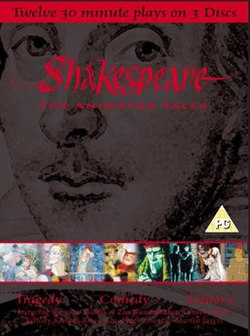
To check out other episodes in the series, view this playlist:


In this 9 week course, students will discover Shakespeare’s greatest characters- Hamlet, Othello, Macbeth and others through games, dramatic readings, and interactive projects! -The class is designed to be ala carte- you can learn about all these plays, choose a specific play to focus on, or do the entire course. Each class will have a game of some kind, an engaging quiz, and a short explanation of the setting, characters, and motifs of one or more plays. Each class will also include a close reading of a famous speech.
I will explain the basic structure of Elizabethan tragedies and the concept of Fortune, which is a motif Shakespeare uses in all of his tragedies. I will also debate the concept of “The Tragic Flaw:” the notion that otherwise good people are brought down by single character flaw. Finally, we will quickly summarize the premise behind all 11 of Shakespeare’s tragedies.
I will summarize Shakespeare’s two tragedies that are set in ancient Greece and provide commentary on their themes and ideas. I will also draw parallels between the Ancient Greek tragedies of Aeschylus and Euripides and Shakespeare, with a particular emphasis on the Greek philosopher Aristotle’s beliefs on the function of tragedy, which influenced every major drama for the last 2,000 years.

We will take a bloody, backstabbing journey to ancient Rome, and discuss how Shakespeare shows through these four plays the dissolution of a republic into an empire. We will discuss the themes of democracy, dictatorship, mob rule, and savagery. Plays covered: Coriolanus, Julius Caesar, Antony and Cleopatra, and Titus Andronicus.
We will explore the universality of this timeless tragedy, and do close readings of his famous soliloquies.
In addition to the character and his speeches, I’ll draw parallels to the history behind the play, including witchcraft in the Jacobean era, and the Gunpowder plot against the king!
I will talk about how Shakespeare dramatizes race and prejudice in the context of Othello’s struggle with prejudice and his own jealousy.
I will discuss the complex plot of Shakespeare’s tragedy about old age, blindness, betrayal, and families ripped apart by greed.
I will teach the students to think like a director and develop a concept for the characters, set, lights, etc. I’ll also briefly take you through famous productions of these great tragedies by the Royal Shakespeare Company and others.
Get $10 off my class “Shakespeare’s Tragedies: The Fates of Men and Nations” with coupon code HTHESG5B2Q10 until Dec 31, 2022. Get started at https://outschool.com/classes/shakespeares-tragedies-the-fates-of-men-and-nations-xKCYUkC9 and enter the coupon code at checkout.


Basics Of Stage Combat: Students will learn the basics of safely enacting a fight onstage, in preparation for a Shakespeare play. We will also learn about the history of sword fighting in the military and the duel.
My daughter really enjoyed taking this class. She was actually able to use her sabre and try out her routine on her father. Paul is quite knowledgeable about Shakespeare and made the class really fun by teaching a fight scene from Romeo and Juliet. It is amazing watching her practice with Paul over Zoom. I hope Paul will have. more combat classes, it is a different way to learn Shakespeare.
IB, Parent
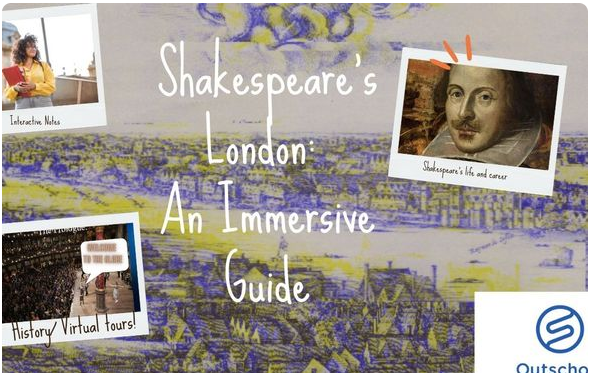
A virtual tour of Shakespeare’s London will get kids to interact with the culture of Elizabethan England.
To teach kids about the Elizabethan era and the background of Romeo and Juliet, The Instructor will interact with the class (via pre-recorded videos), pretending to be Shakespeare. The class, pretending to be actors in Romeo and Juliet, will get a virtual tour of The Globe Theater, Hampton Court Palace, and a virtual visit to an Elizabethan doctor's office. This activity is an immersive way for them to learn about the period, how it relates to the world of the play, and how Shakespeare changed theater.

The class will take the form of a guided WebQuest activity.  First, the students will get a worksheet that has a series of fill-in-the-blanks about Elizabethan society (below). The students will fill out this worksheet based on a Nearpod and in conjunction with a website I’ve made, https://sites.google.com/nebobcats.org/visit-to-elizabethan-london/home?authuser=0
Both the Nearpod and each webpage will have a virtual tour, a video, and text explaining some aspects of Elizabethan life. Before they go to each location, I will give a short introduction via prerecorded video:

In this one-hour course, your child will discover the enchanting world of science through a series of magical experiments. Learn about such topics as Astronomy, Static Electricity, chemistry, and optical illusions.
In this one-hour course, students will learn and play games that will explore the history behind Christmas traditions. We will also discuss the themes, characters, and famous quotes from Shakespeare’s play “Twelfth Night.”

Since “Macbeth” is my Play of the Month, I’m offering a discount for my online class on the play. You can get $5 off my class “Macbeth: An Immersive Learning Experience” with coupon code HTHES6G3YH5 until Nov 4, 2022. Get started at https://outschool.com/classes/macbeth-an-immersive-learning-experience-xGKHeHgH and enter the coupon code at checkout.
To learn more about the class, watch the trailer above, and read my description of the escape room:





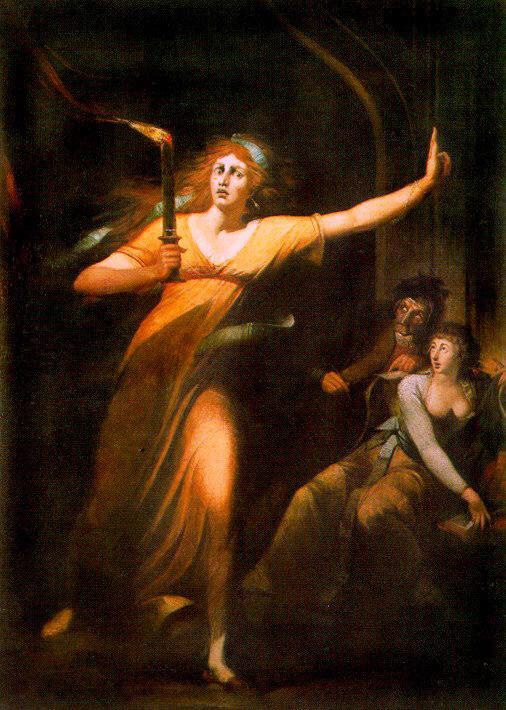


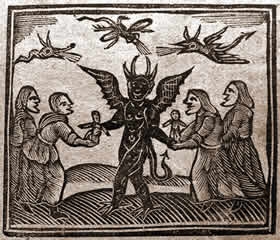

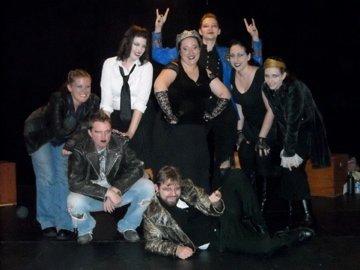


For the spookiest and most cursed month of the year, I’ve chosen Shakespeare’s Macbeth as my play of the Month for October because it’s full of witches, ghosts, and other supernatural creatures. It also shows the terrible effects of fear on people’s minds. Plus, as I explained in my post on Shakespeare and Halloween, most Halloween witches would be all but silent without Macbeth’s witches.

https://open.spotify.com/episode/2OqXVM4452ovzFYeiJJn5q?si=tn8wMzLlS7ew646N-w-XQQ
I’ve created a close read of three of Hamlet’s soliloquies for your listening pleasure. Let me know which is your favorite soliloquy!

I was saddened to hear of the recent passing of actor Kevin Conroy, world-renowned as the voice of Batman and Bruce Wayne on Batman The Animated Series, the Arkham Asylum games, and many others. Conroy is definitely my favorite Batman, and as I and many others have said before, there are Shakespearean tropes in the Caped Crusader. From the very beginning, Conroy drew inspiration from a particular Shakespearean play, the melancholy prince, dressed in black, who seeks to revenge his father’s murder: Hamlet, Prince of Denmark:
I did a cold audition, I had never done an animated voice before. I said the only exposure I’ve had is the Adam West show from the 60’s and they said “NO! NO! NO! That’s not it.” I said ZIP POW POP and they said “NO! It’s, think film noir, think the 40’s New York. Think dark, think a kid who just watched his parents get murdered and spends his life avenging their deaths and he lives in the shadows. He’s got this dual personality and he’s never resolved this torture of his youth. I said you are telling the Hamlet story, this is heavy stuff. And he said yeah, no one has ever said that before, but yeah I guess it is. This is like a classic archetypal, Shakespearian tragedy. So I just used my theater training and put myself into that head (Batman voice) And I got into this very dark place and came up with this voice. (Regular Voice) And as I did it I saw them all running around in the booth. And I thought well either I did something really bad or something really good because I hit a nerve, I know I hit a nerve. And they came out and they said well we’ve seen about over 600 people and how would you like to do the part?
Kevin Conroy
It makes sense that Conroy would use Shakespeare to flesh out Batman. He was a veteran of the Old Globe Theater in San Diego, and performed in Hamlet several times. He even played the prince himself for the New York Shakespeare Festival in 1984. Yet I don’t think Conroy’s decision to make Batman a sort of modern-day Hamlet was entirely based on just his past experiences with Hamlet.
“Batman is basically the American version of Hamlet,” Affleck said. “We accept that he’s played by actors with different interpretations.”
Ben Afleck, Entertainment Weekly, 2015.
Batman and Hamlet are basically Revenge Tragedies; age-old stories that began with Oedipus Rex and the Orestia in ancient Greek plays, where a hero must lift a plague on his society by avenging the death of a parent (usually the father). This kind of play was very popular in Shakespeare’s day and included a host of others such as Shakespeare’s Titus Andronicus, The Spanish Tragedy, Locrine, The Dutchess of Malfi, and later The Revenger’s Tragedy.
But Hamlet, like Batman, is an avenger. He didn’t make Denmark rotten. That was Claudius, and if Claudius self-punished like Oedipus, Claudius would be a tragic hero too. But Claudius is just a garden-variety villain, and so Denmark needs a hero to set things right. Enter Hamlet. He’s “tragic” only in the sense that he dies, and since he dies after completing his heroic mission, he dies triumphant. But unlike the deaths of Claudius, Oedipus, and Macbeth, his death isn’t necessary to restore order. It’s just an epilogue.
Chris Gavaler, The Patron Saint Of Superheroes. “Something is Rotten In the State Of Gotham.”
As this clip above indicates Hamlet is unique among revengers because his conflict doesn’t come from the machinations of his villain; he’s stopped by his own internal conflicts. Batman is more active than Hamlet, but he also wrestles with internal conflicts and Conroy plays these conflicts with a lot of subtlety and nuance. To illustrate this conflict, let’s look at some great clips from the series!
In this episode, Dr. Strange (not the Marvel Superhero), uses a dream-reading machine to try and blackmail Bruce Wayne, and inadvertently discovers his secret identity. Not only does this episode dramatize Wayne’s literal worst nightmare, (someone figuring out who he is), it also touches on the pain of his past and how even though now Batman is a deputized agent of the law who never kills, he began as an angry, vengeful vigilante, like Hamlet:
I am myself indifferent honest, but yet I could accuse
Hamlet, Act III, Scene i.
me of such things that it were better my mother had not borne me.
I am very proud, revengeful, ambitious; with more offences at my
beck than I have thoughts to put them in, imagination to give
them shape, or time to act them in.
In this clip from the animated movie Mask Of the Phantasm (1993), a pre-Batman Bruce Wayne feels a conflict between his obligation to avenge his parent’s death, and his budding romance with Ms. Andrea Beaumont:
One can almost sense an Ophelia- Hamlet-like conflict where Bruce knows his quest to avenge will consume him, and leave no time to pursue romance. In all revenge tragedies, the hero has to avenge alone, or at least without the support of a spouse or partner. Hamlet also makes the choice to cut Ophelia out of his life, though it’s not clear why. It could be he’s worried that Claudius will harm her, it could be he’s worried she’s compromised since her father tried to spy on him, or it could simply be that he doesn’t trust her. It’s up to the actor and director to “Pluck the heart of Hamlet’s mystery.”
Eventually though, the choice is made for him, and Bruce Wayne completely commits to his quest to battle the crime in Gotham, as this epic scene from “Mask of The Phantasm” shows:
Haste me to know’t, that I, with wings as swift
Hamlet, Act I, Scene v.
As meditation or the thoughts of love,
May sweep to my revenge.
The spirit that I have seen
Hamlet, Act II, Scene ii.
May be a devil; and the devil hath power
T’ assume a pleasing shape; yea, and perhaps
Out of my weakness and my melancholy,
As he is very potent with such spirits,
Abuses me to damn me.
What’s truly unique about the animated version of Batman is that it’s the only one that takes time to show Batman’s complex relationship with the ghosts of his parents. As previously discussed, Bruce Wayne’s desire to revenge their death and to punish the wickedness of Gotham is what spurs him to keep fighting as Batman, but he also wonders many times if he’s doing more harm than good. He’s also tempted to forget them and try to lead a normal life, like in the episode “Perchance to Dream,” (which itself is a quote from Hamlet). Above all, the animated show knows that, since children are watching this show, they will connect with Batman’s fear of not living up to his parent’s expectations, a fear to which every child can relate.
In the first season episode “Nothing To Fear,” the villainous Scarecrow exploits Batman’s fear of disappointing his parents by drugging him with a fear toxin, causing Bruce to hallucinate that his father is berating him and calling him a failure. Hamlet gets a similar ghostly chewing out in The Closet Scene:
Father’s Ghost. Do not forget. This visitation
Hamlet, Act III, Scene iv
Is but to whet thy almost blunted purpose.
While The Ghost of Hamlet’s Father is mostly supportive in this scene, Hamlet worries many times in the play if Claudius is in fact innocent, and the Ghost is a demon sent by the Devil to get him to kill an innocent man, and thus damn him for eternity. This uncertainty is the same that Batman wrestles with, as he confronts his own demon-like apparition. Batman then defiantly responds to this fiendish hallucination with one of the most iconic lines in the series:
Only a consummate professional like Conroy with his grounding in Shakespeare in general and Hamlet in particular could portray such an iconic character. Many fans of Batman like me believe that Conroy’s portrayal was the peak of the franchise, and I feel fortunate that it came out when I was a child. I mourn Conroy’s loss, yet as Mr. Affleck mentioned in the quote above, like Hamlet, the character of Batman has many possible interpretations, and though Conroy will always be my favorite, I hope new and exciting interpretations will arise from the shadows in time, bringing this complex, Shakespearean character to a new audience.

“Good Night, Sweet Prince and flights of bat wings fly thee to thy rest.”
https://gizmodo.com/the-batman-hamlet-crossover-that-never-was-5876735
https://www.theguardian.com/film/filmblog/2008/jul/23/thedarkknightbatmanisaha
https://bleedingcool.com/movies/batman-as-hamlet-with-kevin-conroy-and-loren-lester/#google_vignette
This is a video produced by TED-ED. If I have enough time, I’ll expand on it below, but for now, it’s very informative and visually striking.
 The Shakespearean Student