New OUtschool Class: Love Poetry, Shakespeare Style

Your child will learn how to write poetry like Shakespeare himself, through a mix of presentations, a printable guideline, and some fun quizzes to test your knowledge of Shakespeare’s sonnets! Designed for ages 13-18.

Class Description:

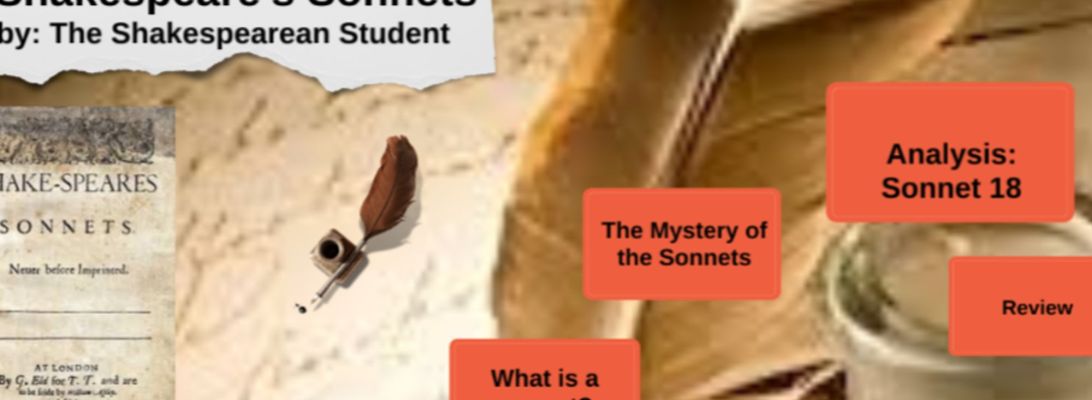
We will cover what a sonnet is, namely a type of poetry Shakespeare wrote in iambic pentameter with a particular rhyme scheme. Using a combination of Prezi video presentation and Google Slides, I will go in-depth to explain how he organized his poetic ideas into a very compact form. 
Using primarily Google slides, we will then analyze Shakespeare's sonnets for their themes, literary devices, and the way he uses the poetry to enhance and heighten emotion and ideas. I will focus mainly on Sonnet 18, "Shall I compare thee to a summer's day?" I will cover Shakespeare's use of such literary devices as:
- Metaphor
- Simile
- Personification
- Rhetorical Question
- Irony
- Paranomasia
Analyzing this sonnet will allow the class to grasp the basics of how a sonnet is constructed, and begin to prepare to write their own. While the presentation is in play, students will be given an access code to an optional Nearpod presentation, that will allow them to construct an iambic pentameter line, quiz themselves on the vocabulary I cover, and provide visual aides to better understand Shakespeare's sonnets.

In the next part of the course, We will engage in a group brainstorming session. I will provide the students with potential topics (assuming they don't have one of their own), and then we will construct a short story using madlibs around that topic that will later be condensed into a sonnet. I will demonstrate to the students how to use imagery and poetic language to enhance the ideas and feelings in the poem. After this, I will use the nearpod and Google slide presentations to guide the students how to tell their own story using such devices as metaphor, personification, allusion, and sensory details. They can jot their ideas down on the provided handout to help organize their thoughts. In addition, the optional handout will have useful brainstorming activities such as a web link to websites like Rhymezone.com, (which helps poets find rhymes to words), and imagery boards that will allow the students to think of sensory details to include in the sonnet . The class will draw attention to the handout activities, and pause briefly to allow the students to do them.


In the last part of the class, I will give the students step-by-step instructions on how to transform their brainstorming ideas into a sonnet. I will begin by showing them how to construct an iambic pentameter line. I will engage the students by clapping out the beats for this line and allow them time to do the same, so they may internalize the rhythm. This will be accomplished via a Google Slides screen.
The final page of the handout has a page to write a draft of their final sonnet, with the line numbers conveniently provided. I will go over every section of the worksheet so the students know how to utilize it effectively.

After all this practice and training, the students will be able to create a basic 14 line sonnet which will give them practice not only writing poetry but also using and recognizing literary devices. It is my hope that this course will not only help the student(s) gain an appreciation for Shakespeare's poetry but also develop their own ability to speak and write eloquently and persuasively.
Short Review: “She’s The Man”

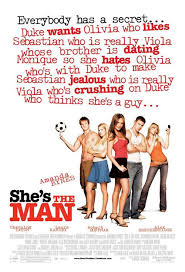
Since Twelfth Night is coming up, I’m going to review a blast from the past, the Amanda Bynes teen comedy remake of Twelfth Night called “She’s The Man”.

Poster for “She’s The Man”

Some of you might remember that the late 90s and early 2000s were the heyday of Hollywood remakes of Shakespeare: Romeo + Juliet directed by Baz Luhrman, 10 Things I Hate About You, (The Taming Of the Shrew) “O” (Othello), and even “Get Over It” (“A Midsummer Night’s Dream”). Shakespeare was actually hot for a few years and many writers were riding his doublet.

Sadly, not all Shakespeare remakes are created equal. Most of them were created with care to try and either show love for the text (as in Romeo and ‘O’) or to improve or contemporize the text like in ‘O‘ and “10 Things I Hate About You,” (which interestingly, both starred Julia Styles). “She’s The Man” doesn’t feel like a faithful retelling of “Twelfth NIght” despite the fact that it keeps most of the characters and the central conceit of the story- a girl disguising herself as her twin brother, going to a new place called Ilyria and inspiring love in both a powerful man and a beautiful woman.

Original Tailer for 2006’s “She’s The Man”
  • Amanda Bynes as Sebastian is a characature of 90’s bro culture and rarely ever plays her male role straight or convincingly. Nobody would be fooled into thinking this girl is a boy.
  • Bynes’ Viola rarely challenges anything or does a good job playing soccer until the end of the movie. Her main reason for her masquerade is that her brother forced to do it, so he can run away to become a musician.
  • I also don’t like that Sebastian never seems to impress or endeer the coach. If her goal was to prove that girls are just as good as guys, he should be her focus, but they rarely evershare the screen.
  • This Viola also never challengers Duke (her love interest played by Channing Tatum). One of the best parts of Shakespeare’s version is that Duke Orsino is a mopey would-be incel who puts women on a pedestal one minute, and condemns them the next. One of the best things about his relationship with Viola is that it makes him better able to appreciate women, but his counterpart in She’s All That has no such epithany.
  • I do want to give a shoutout to Laura Ramsey as Olivia . She frankly is a better actress then Bynes and plays Olivia’s unrequited love for Viola very well. Initially, she gets a copy of Sebastian’s song lyrics and she’s smitten by Sebastian’s words, rather than his looks. This makes you hope the real Sebastian will return.
  • Below is a montage of the jokes in the film. I hope you notice that most of them are very lowbrow and pretty cliche, even for teen movies. At 5:20 is the only really good part of the movie- it explains why Olivia’s love for Viola is funny and tragic. Guys are taught never to open up to women, but women want emotional connections. Men are taught women aren’t equal, but women yearn for acceptance. Viola in disguise has no concept of these unspoken ‘rules’ of male behavior, so she seems like the perfect man to Olivia- someone who treats her like an equal, isn’t afraid to open up, and is also male. The fact that she’s actually developing feelings for a woman is what makes it funny and tragic.

In conclusion, I’m kind of glad this Shakespeare rom-com is slinking into obscurity since it adds nothing and waters down the original to oceanic degrees. Frankly, I think there was a much better adaptation of Twelfth Night that, although it changed the names, location, and text, was a more thought-provoking and insightful rendition of the story- the 1996 animated film, Mulan.

Special Discounts on my Outschool Classes!

I'm teaching two great classes today. Spaces are available!

From now to January 13th, I’m offering a $5 discount for any class that is $10 or more! You can take my Shakespeare classes for as little as $4! Go to my Outschool.com class and enter the coupon code: HTHESNIF6B5 at checkout!

https://outschool.com/teachers/c9bc565b-71e9-44c9-894a-921c472f4a37#usMaRDyJ13

If you’re new to Outschool, use the referral code below when you sign up. You’ll automatically get $20 USD off  as a thank you to use on future classes! My referral code is: MaRDyJ13

Hope to see you on my Outschool page!

Posts 📫 for the first night of Hanukkah 🕎

This week I’ll be celebrating Hanukkah with a series of posts and podcasts about Shakespeare’s only play to feature Jewish characters The Merchant Of Venice. I’ll have a new post about the play this week, and hopefully a podcast episode, but in the meantime, here are some of the post’s I’ve written in the past about the Merchant Of Venice.

1. Play of the Month: Merchant Of Venice

2. What The Merchant Of Venice says about the holidays

3. The Fashion is the Fashion: Merchant Of Venice

New Outschool Course: Christmas For William Shakespeare

Title card for my new online course, What Was Christmas Like For William Shakespeare?
The goal of this class is to learn about both Shakespeare and the Elizabethan period through the lens of Christmas. I will begin by asking the class "What traditions do you think of when you think of Christmas?  We will then contrast the traditions of Christmas from the 17th century and now, including a brief period when Christmas itself was illegal.

 Once I have contextualized this period, we will then go through the plot, characters, and themes of Shakespeare’s most famous Christmas play- “Twelfth Night.”


Slideshare presentation I made about the play Twelfth Night
The class will include videos, multimedia presentations, virtual tours, interactive quizzes, and online activities. The students will play games inspired by real Elizabethan Christmas traditions, get some festive recipes, and learn what it was like to be an actor in Shakespeare's company, when they performed "Twelfth Night" and other plays before Queen Elizabeth and King James.

Activities for Students and Teachers: Macbeth Escape Room

I made a digital escape room for Macbeth, as part of my Outschool.com class, “Macbeth: An Immersive Educational Experience,” which you can register for at a discount this week only. I’m presenting this digital escape room as an activity for teachers to teach their student’s knowledge of the plot of the play and use their observation and research skills to escape from a “cursed castle.”

What Is a digital escape room?

In a normal escape room, you are locked in a room and have to follow clues and solve puzzles in order to find a series of keys, codes, and combinations to unlock the door and get out of the room. In a digital escape room, you solve online puzzles and use passwords and key codes to unlock some kind of digital content.

My escape room is designed to test your knowledge of the play, give you a chance to learn about the history behind it. Most escape rooms use the a variety of locks such as:

  • Standard combination locks
  • Direction locks (where the lock has arrows taht you have to push in the correct direction, in the right order).
  • Color locks (where we put different colors in a sequence.

A digital escape room uses these concepts and adapts them to work within the context of a website or other digital experience. For example, I made a direction lock based on the direction a dagger points and made a short animation of a dagger with the text of Macbeth’s famous dagger speech.

The student has to surf through five webpages to find the answers to the puzzles, then imputs the answer in a Google form. Once he or she unlocks all six puzzles, they are permitted to leave the witches’ castle. Here’s a preview of the puzzles:

Part I: The Gate

There’s a website called Flippity which allows you to make little online puzzles so I embedded it on one page of my website. In this case, it has six locks that you have to unlock by typing answers to trivia questions related to “Macbeth,” such as “What object appeared to Macbeth before he killed the king?” The final lock requires you to read a short article on the curse of Macbeth, so you can enter it on the website.

Part II: The Magic Mirror

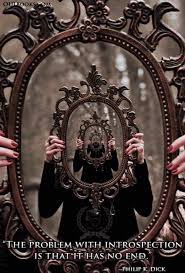
There’s a website called a magic mirror, which if you click on the mirror, it hyperlinks to an image that spells out the next answer for the Google form.

Part III: Birnam Wood

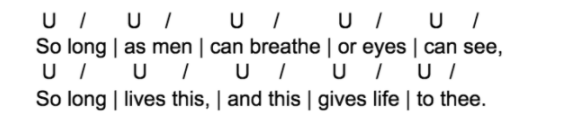
I wanted to teach the students about verse scantion and what an iambic pentamer iine is. I wanted to get the class to learn the pattern of unaccented beats (which Shakespeare scholars mark with a U), and accented beats marked with a /, as in the couplet below:

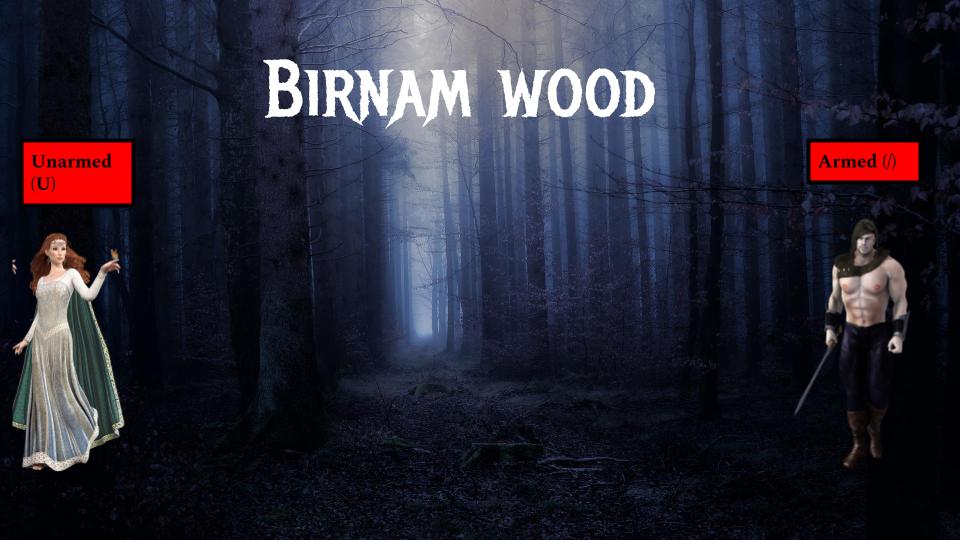
To get the students to practice making an iambic pentameter line, I embedded a Google Slides presentation in the website which has pictures of unarmed and armed soldiers. A key indicates that you are to count the soldiers and input the U/U/ pattern into the Google Form:

Screenshot from my Birnam Wood Activity.

So, there’s a preview of the Digital Escape Room I hope this inspires you to try this type of activity in your class. If you want to use this activity, shoot me an email and I’ll give you a teacher’s guide. Please also consider signing up for my Outschool.com class!

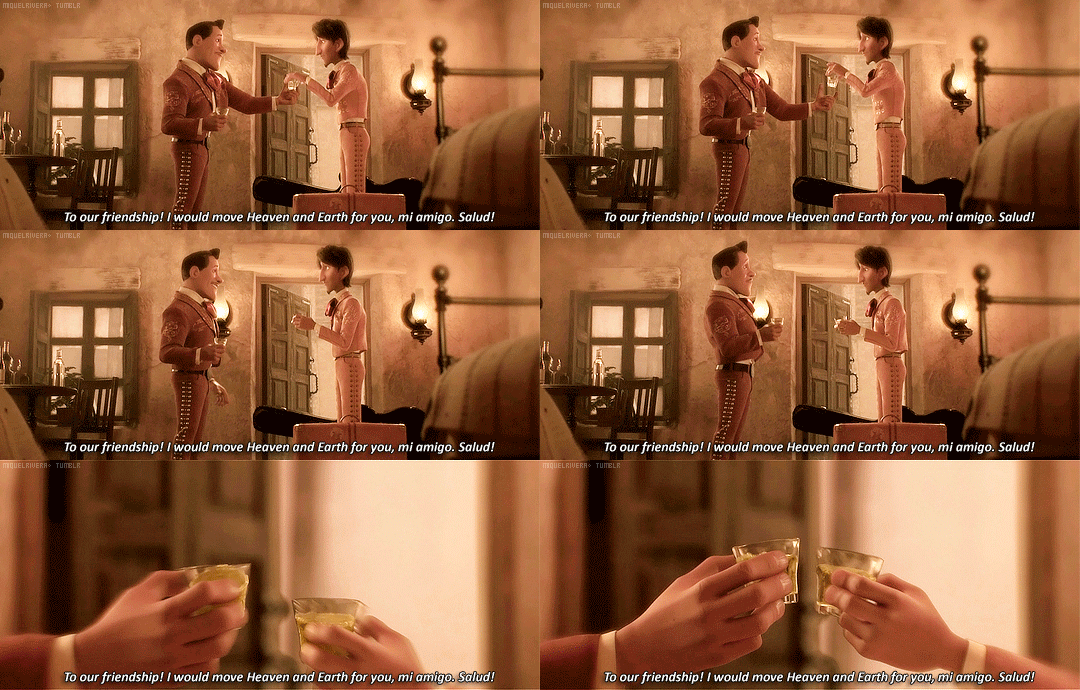
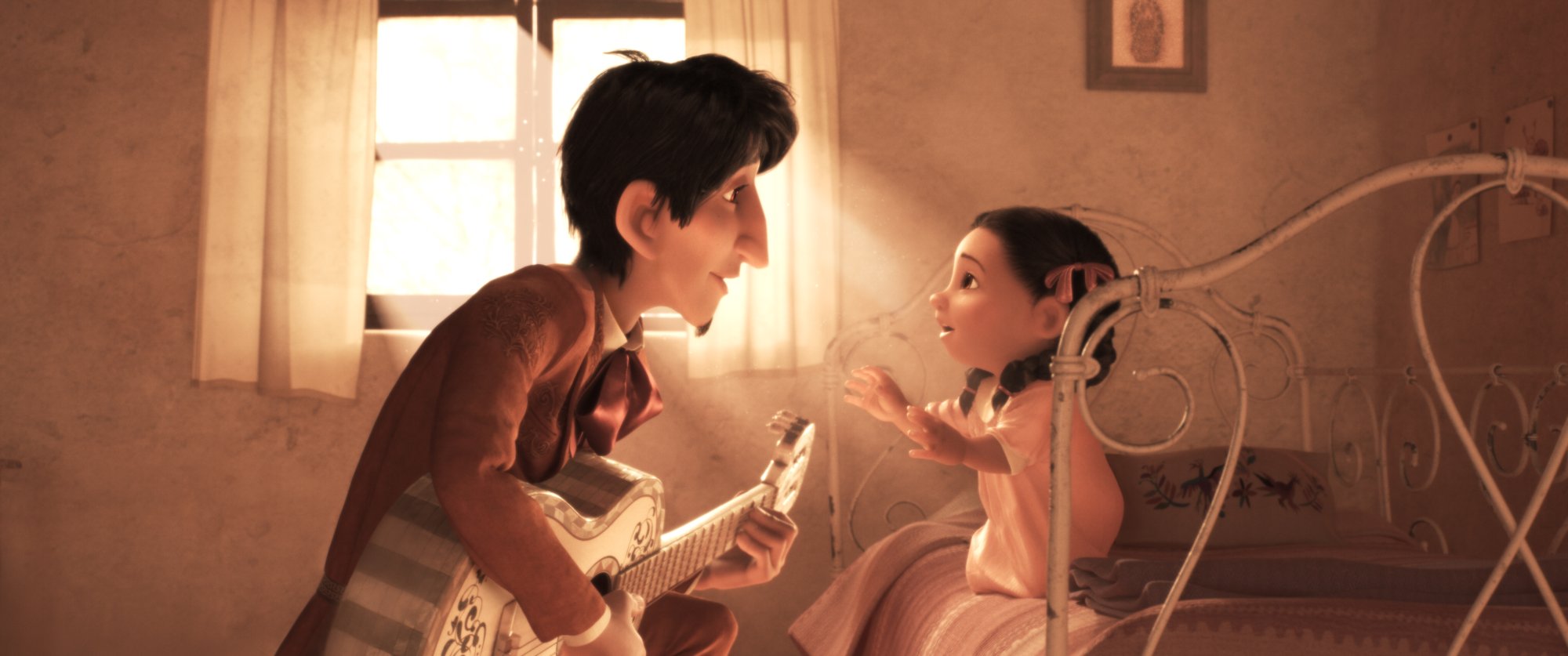
Hamlet, told through images from Disney’s Coco

“Is not this something more than fantasy?”
“O, that this too too solid flesh would melt, thaw, and resolve itself into a dew.”
“Do not forever with thy veiled lids, search for thy noble father in the dust.”
“A combination and a form indeed, where every God did set his seal…”
“Thou knoweth ’tis common, all that lives must die. Passing through nature to eternity.”

So loving.. that he might not not between the winds of heaven, visit her face too roughly.”
“There are more things in heaven and earth than are dreamt of in our philosophy.”
“The Serpent that did sting thy father’s life, now wears his crown.”
“O VILLAIN, SMILING, DAMNED VILLAIN!”
“To Be, Or Not To Be, that is the question.”
“Alas, poor Yorick… quite chop-fallen.”
“O my offense is rank. A brother’s murder!”
“A fellow of infinite jest, of most excellent fancy.”
“There is a special providence in the fall of a sparrow.”
“Thou art slain. In thee there is not half an hour of life.”

“Adieu, Adieu, remember me.”