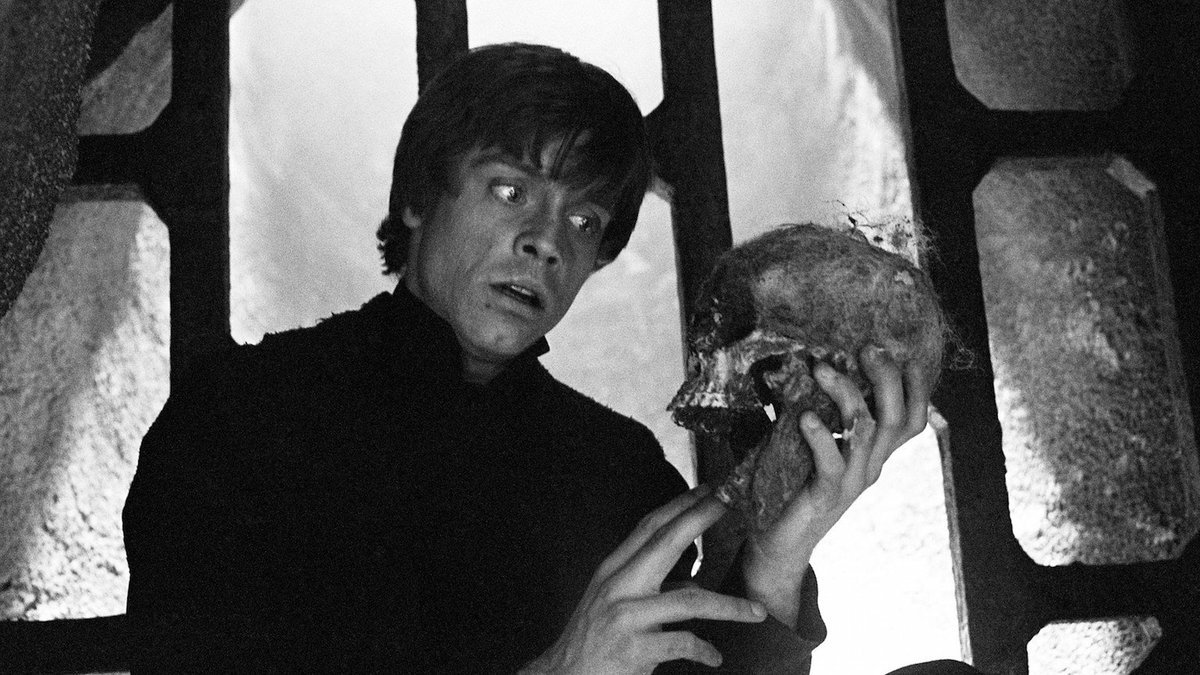
To me, this one’s obvious. Hamlet is a grim, bookish young man who loves complicated plans more than conflict. Also, like Professor Flitwick the head of Ravenclaw, Hamlet loves songs and plays like this one, which incidentally quotes lines from Macbeth:
Coriolanus- Slitherin
Tom Felton as Coriolanus
I go into greater detail in my most recent post, but Coriolanus is a warrior who tries to turn his wealth and military success into political power. He’s also compared to a dragon or serpent, the symbol of Slytherin House. And, as if that weren’t enough, Ralph Fiennes, who starred and directed a movie about Coriolanus, also played the heir of Salazar Slytherin himself, Lord Voldemort.
Ralph Fiennes as Coriolanus
Helena- Hufflepuff
Hermione- Griffindor
No, I am not talking about Harry Potter’s bookish best friend- I’m talking about the brave and virtuous queen Hermione from The Winters Tale. In the trial scene, she has to go against her husband and her Kung and defend herself and her children in court:
Hermione defends herself in court
Henry V- Griffindor or Slytherin?
Good my lords, I am not prone to weeping, as our sex Commonly are; the want of which vain dew Perchance shall dry your pities: but I have That honourable grief lodged here which burns Worse than tears drown: beseech you all, my lords, With thoughts so qualified as your charities Shall best instruct you, measure me; and so The king’s will be perform’d!
Like Harry Potter himself, you could make two equal cases for Harry the King; that he is a great brave warrior worthy of the Griffindor lion, or a Machiavellian, sly, ambitious snake.
As is often the case for me, I like to get at the heart of what makes a piece of pop culture relevant and compare it to Shakespeare. I wish to stress that Shakespeare is not the source of all great art, but at the same time, he knew where to find the source of art, and most great art has some sort of Shakespearean influence.
2. Plot
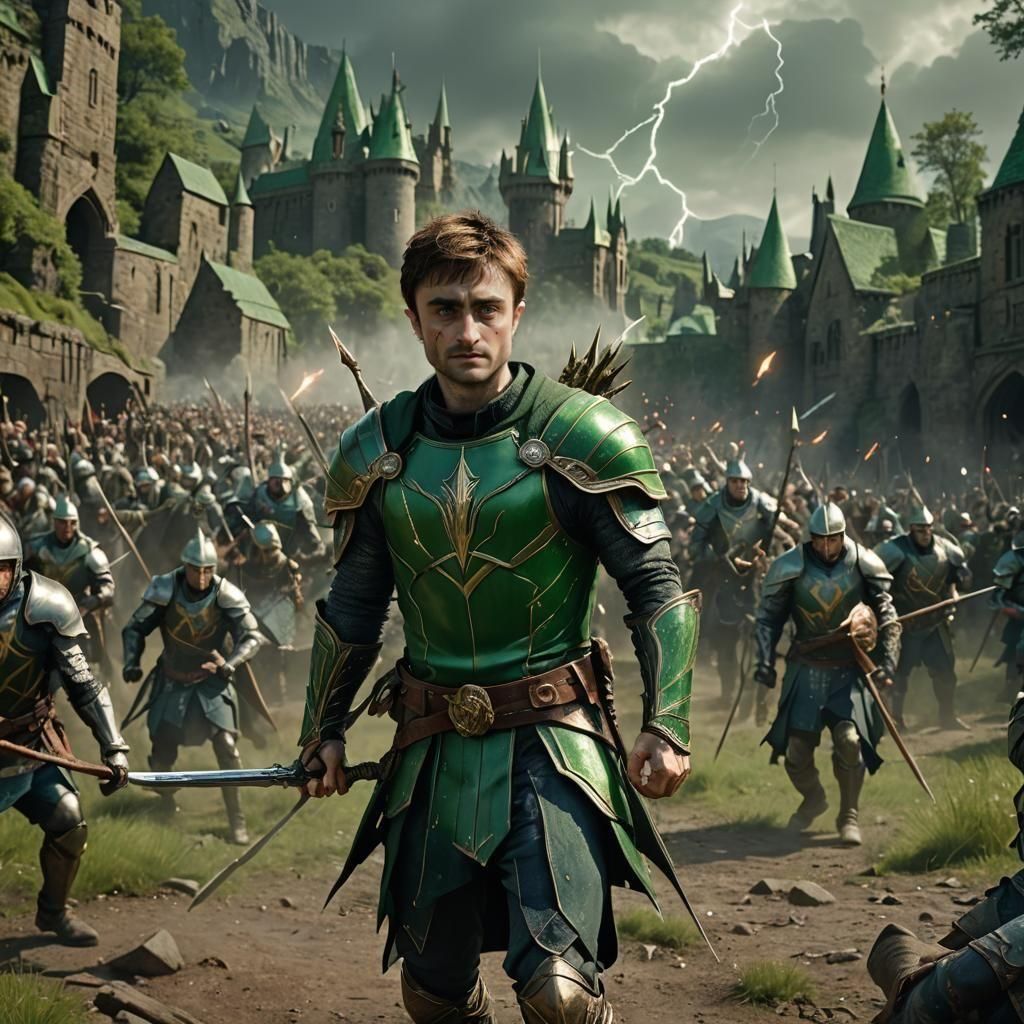
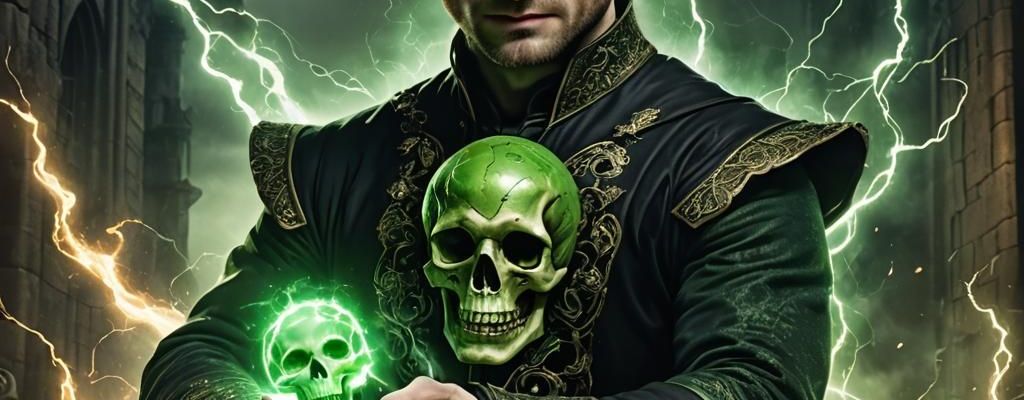
Harry Potter as Hamlet (AI artwork)
In the case of Harry Potter, we have some surface plot similarities to Hamlet: a young man brooding over the loss of his parents, who takes revenge against the man who took them from him. Both stories also have a powerful autocrat who is associated with snakes:
The serpent that did Sting thy father’s life
now wears his crown.
Is Harry hearing voices? Chamber ofSecrets
In both Harry Potter and Hamlet, the hero’s friends worry that he’s losing his mind; in the second book: Harry Potter can hear the basilisk because he speaks the snake language. Nobody else can understand what he’s hearing, and they conclude Harry is hearing voices. Meanwhile, Hamlet is the only one who hears the ghost of his father:
In the fifth book, Harry Potter and the Order of the Phoenix, Harry can hear voices coming from a vale between the land of the living and the land of the dead, because he saw death at a very young age. This isolates Harry from other characters, (who have not suffered loss), and they once again think that he is losing his mind.
Hamlet and Harry have a visceral understanding of grief; they understand that when one is experiencing grief, one sees the world in a way that most other people can not comprehend. In a way, insanity is a metaphor for grief, and both characters (both of whom, by the way, spend most of their time wearing black) personify how this grief changes their worldview.
The fundamental difference between Hamlet and Harry Potter could be summarized like this; Hamlet is devoted to his father, Harry to his mother. The ghost of Hamlet’s Father sets the action of Hamlet into motion, as he demands that his son revenge his murder. By contrast, Harry Potter is constantly inspired by his mother. Although he only sees his mother for a short time, it’s what he learns about her that drives many of Harry’s actions. Even after death, the memory of Lilly’s kindness and love not only inspires Harry, but other characters like Snape, Slughorn, Dumbledore, Sirius, and Lupin. Lilly’s memory rallies all the heroes to unite and defeat Voldemort.
In addition, Harry’s choices emulate his mother’s personality more than his father’s. Harry’s primary concerns are to stop Voldemort from taking over the Wizarding World, to show kindness and respect to everyone, and to guard his friends with his life if necessary, just as his mother did for him. In other words, the matriarchal virtues of love, self-sacrifice, and familial devotion drive Harry, not a patriarchal desire for vengeance which drives Hamlet. Therefore, Harry Potter is a more modern Hamlet, driven by a desire to improve a world and a community, rather than just “The royal bed of Denmark,” which Claudius has defiled.
The Melancholy Dane is driven by anger over his father’s untimely and foul murder and the sadness of losing him. Many actors have chosen to play Hamlet as a man who wants revenge, but one for whom vengeance doesn’t come naturally. Hamlet’s conscience, his scruples, his gentleness, and sometimes his sympathy for Claudius, blocks him from quickly taking revenge. In the clip below, Ethan Hawke is literally watching an avenger in a movie (Brandon Lee in The Crow) on a movie screen. It’s as if Hamlet is looking at a reflection of what he wishes he could be- a decisive, ruthless avenger:
As mentioned before Harry Potter’s ability to command loyalty, friendship, and respect from others allows him to accomplish his goals; he succeeds by rallying everyone, his friends, family and even his enemies to unite and fight. By contrast, Hamlet is a man who cannot trust anybody and therefore must rely on his own cunning (and sometimes ruthlessness), in order to achieve his goals.
Harry’s powers to mobilize the best in people are the powers that the dark Lord did not understand. Like a tyrant, Voldemort keeps all the power to himself; he rules by being more powerful than the people around him and inspiring fear. This makes him vulnerable when his foes band together, and his friends desert him, like when Laertes implicates Claudius for killing Hamlet and finds himself alone, friendless, and ready to taste Hamlet’s revenge:
When Shakespeare sat down to write Hamlet, the Elizabethan age was very cut throat- England had gone through the Civil War, violent factions were springing up at court, and Elizabeth herself suffered multiple assassination attempts. Hamlet is very much a product of a time where everyone is worried about being watched and betrayal can happen at any moment. By contrast, Harry Potter was written at another paranoid time- right after the September 11th attacks where racism, homophobia, and xenophobia were (and to a certain extent, still are), ripping the world apart. For all her faults, JK Rowling created a new kind of Hamlet figure, one who tries to bring people together in times of fear and grief, not one who wishes he could be “bounded in a nutshell” or that his “too too solid flesh”Close Reading: “Oh That This Too Too Solid Flesh” would melt away.
3. A Common Ancestor- Hercules
Like all Renaissance playwrights, Shakespeare took inspiration from ancient Greek and Roman sources. Scholars have seen echoes of Orestes, Perseus, and of course, Oedipus in Hamlet, but one Greek myth that pops up in both Hamlet and Harry Potter is the myth of Hercules. Here’s a short list of commonalities:
1. Both heroes defeat a serpent as a baby and is raised by people who aren’t his parents. Hercules strangles snakes in his cradle, Harry defeats Voldemort, and Hamlet (who is still a child), defeats his uncle who is called a serpent by the Ghost.
2. Cursed by a malevolent creature who hates his mother. Harry gets his scar, Hercules is cursed by Hera (his father’s wife, but not his biological mother). Hamlet
3. Labors involving wild beasts- Nemean Lion (sorting hat), Hydra= basilisk. 3. Captures a stag (Conjures a patronus) 4. Boar= Troll 5. Stables= basilisk in the bathroom 6. Stymphalian birds= golden snitch 7. Girdle of Hipolita= Ravenclaw diadem 8. Cattle of Geryon= other horcruxes 9. Golden Apples= mermaid egg guarded by dragon
10 and most obvious- BOTH OF THEM FACE A THREE HEADED DOG
I bring this up because in many ways, Harry Potter, Hamlet, and Hercules are timeless myths that represent what Joseph Campbell called “The Hero’s Journey”- an eternal story of growth, struggle, death, and rebirth that transcends time, place, and cultures.
Another character that shares a lot of similarities with Hamlet and Harry Potter is Luke Skywalker from Star Wars. If you enjoyed this analysis of Shakespeare and Harry Potter, you might enjoy my course on Shakespeare and Star Wars from Outschool.com:
This two-week course is fully online and fully immersive. You can learn about Shakespeare through the lens of Star Wars, (and like this post), you will learn about characters, plots, and the ideas behind classic stories by comparing them to contemporary pop culture. Click the link below to get started:
Ages: Pre Teen- teen. The story is highly condensed so older readers might want a more in-depth adaptation to understand the themes and ideas of the plot.
Premise: This graphic novel is a good introduction to “A Midsummer Night’s Dream.” It tells the bare minimum of the story with very little dialogue and almost none of the original text. Most of the story is conveyed through the visual medium.
ABOUT THE ILLUSTRATORS (Reprinted from the graphic novel)
https://www.behance.net/berelince?locale=en_US Berenice Muniz is a graphic designer and illustrator from Monterrey, Mexico. In the past, she has done work for publicity agencies, art exhibitions, and she’s even created her own webcomic. These days, Berenice is devoted to illustrating comics as part of the CGraphikslava crew. In her spare time, “Bere” loves to draw, read manga, watch animated movies, play videogames, and kill zombies Fares Maese is a graphic designer and illustrator. He has worked as a colorist for Marvel Comics and as a concept artist for the card and role-playing games Pathfinder and Warhammer. Fares loves spending time playing video games with his Graphikslava comrades, and he’s an awesome drum player: https://faresmaese.artstation.com/
About the Retelling Author
The career path of Nel Yomtov has taken him from the halls of Marvel Comics, as an editor, writer, and colorist, to the world of toy development. He then became editorial and art director at a children’s nonfiction book publisher, and now Nel is a writer and editor of books, websites, and comics for children. A harmonica-honking blues enthusiast, Nel lives in New York with his wife, Nancy. They have a son. Jess.
mY rEACTION
I read this version to my five year old son and he enjoyed the colors and characters, which is why I feel confident recommending this version to younger children. It won’t help you pass a test on Midsummer and you won’t get the whole story. But you might get a tantalizing glimpse of Shakespeare’s world of fairies, lovers, and funny fools and honestly, that’s fine with me. As I’ve stated before, parody and short pop-culture adaptations of Shakespeare are great ways to connect with young people, and I see this book as a tool to do just that.
tECHNICAL eXECUTION
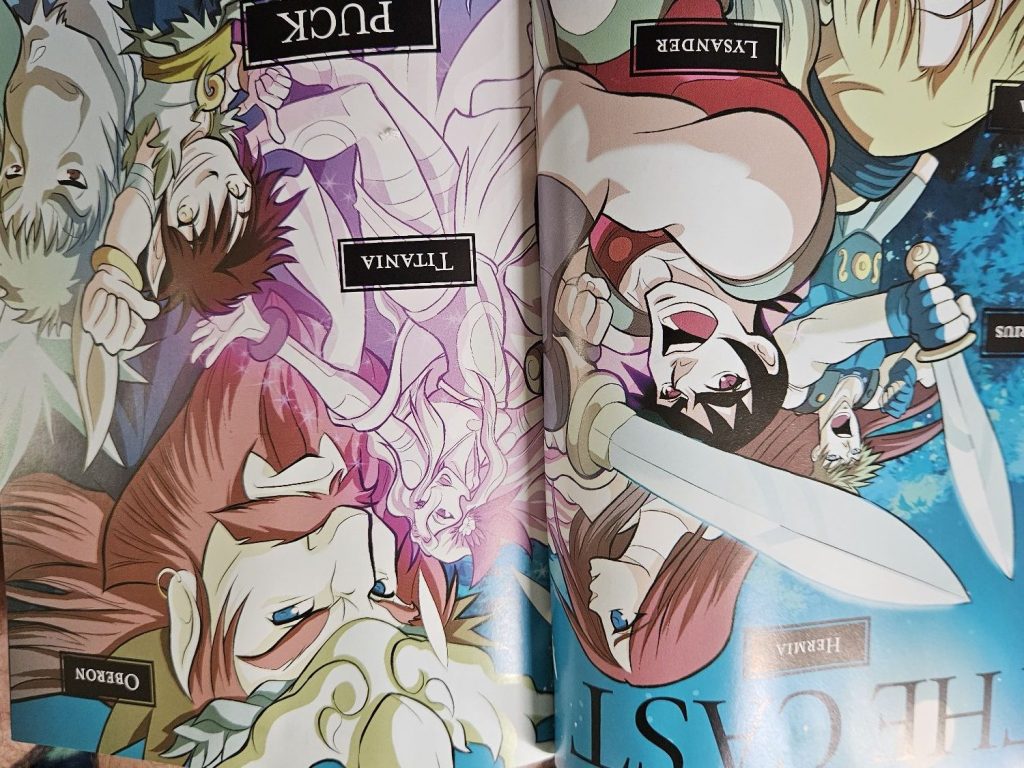
Character Design. It’s interesting to see the difference in style between this version, and the Manga Shakespeare version I previously read. That one was very much inspired by the Shoujo manga style, which emphasizes drama and relationships. This version’s drawings are softer, more cartoonish, and the expressions are less stiff, (except for Oberon, who is drawn very austerely). I particularly like the design for Puck with his big mischievous eyes and squat, childlike shape. I would argue however that the lovers and Mechanicals aren’t distinct enough, which is a problem since they are the most important characters.
The Adaptation
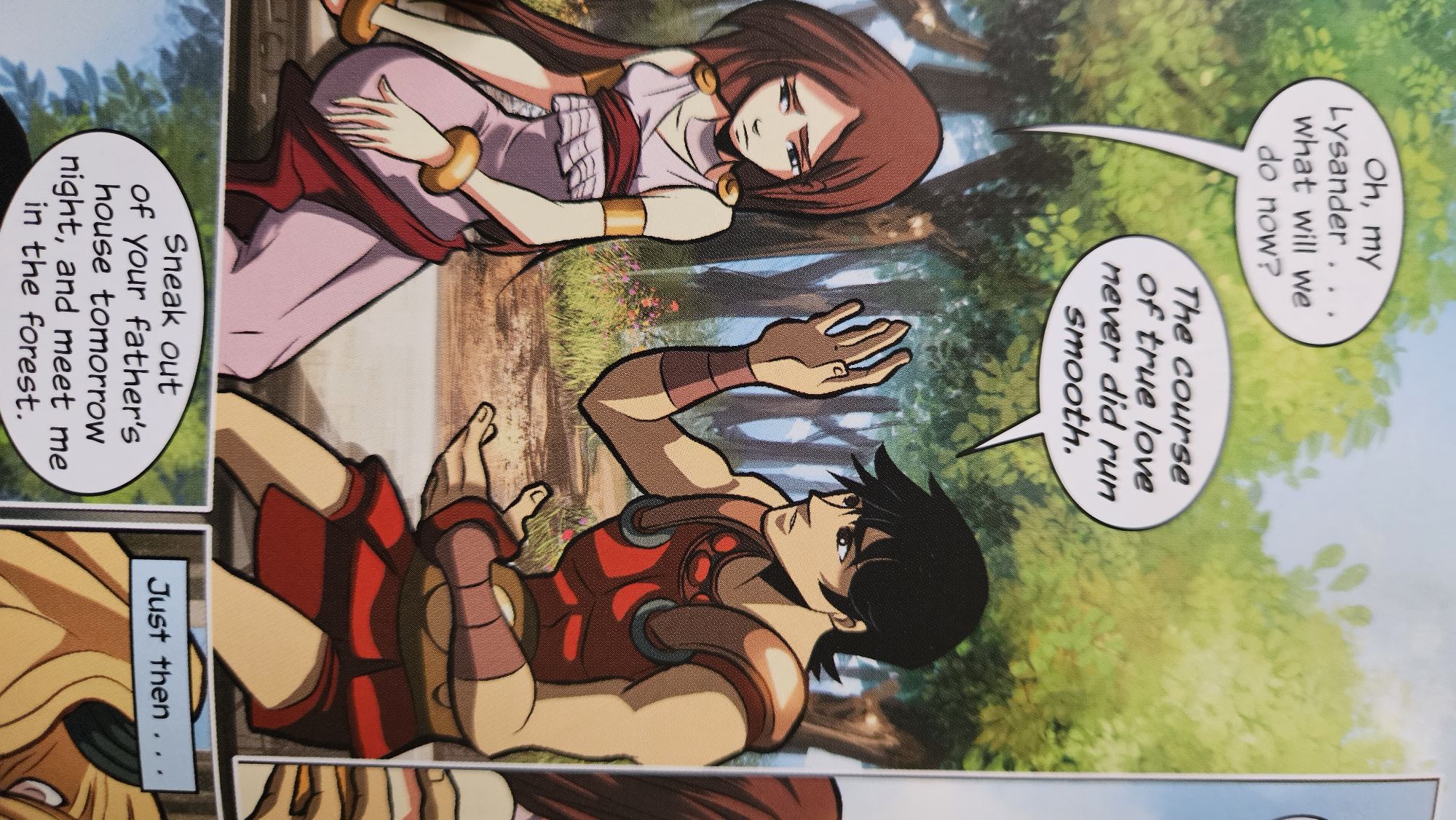
Like I said, this is a bare minimum adaptation of the play. None of Shakespeare’s text is used and the lines and speeches are cut liberally. The entire book is only 77 pages which of course means, that there are a lot of cuts. There’s no mention of the Indian boy, Titania’s tiff with Oberon, Philostrate, the other fairies, and all the great speeches are cut. This version is focused entirely on the plot, and it cuts it quite efficiently. To demonstrate this, below on the left is a panel that shows how Lysander and Hermia express their frustration with not being allowed to marry. On the right is the original text of the scene.
Ay me! for aught that I could ever read, Could ever hear by tale or history, The course of true love never did run smooth; But, either it was different in blood, Lysander. Or else misgraffed in respect of years, Lysander. Or else it stood upon the choice of friends, Or, if there were a sympathy in choice, War, death, or sickness did lay siege to it, Making it momentany as a sound, Swift as a shadow, short as any dream; Brief as the lightning in the collied night, That, in a spleen, unfolds both heaven and earth, And ere a man hath power to say ‘Behold!’ The jaws of darkness do devour it up: So quick bright things come to confusion.
The Colors
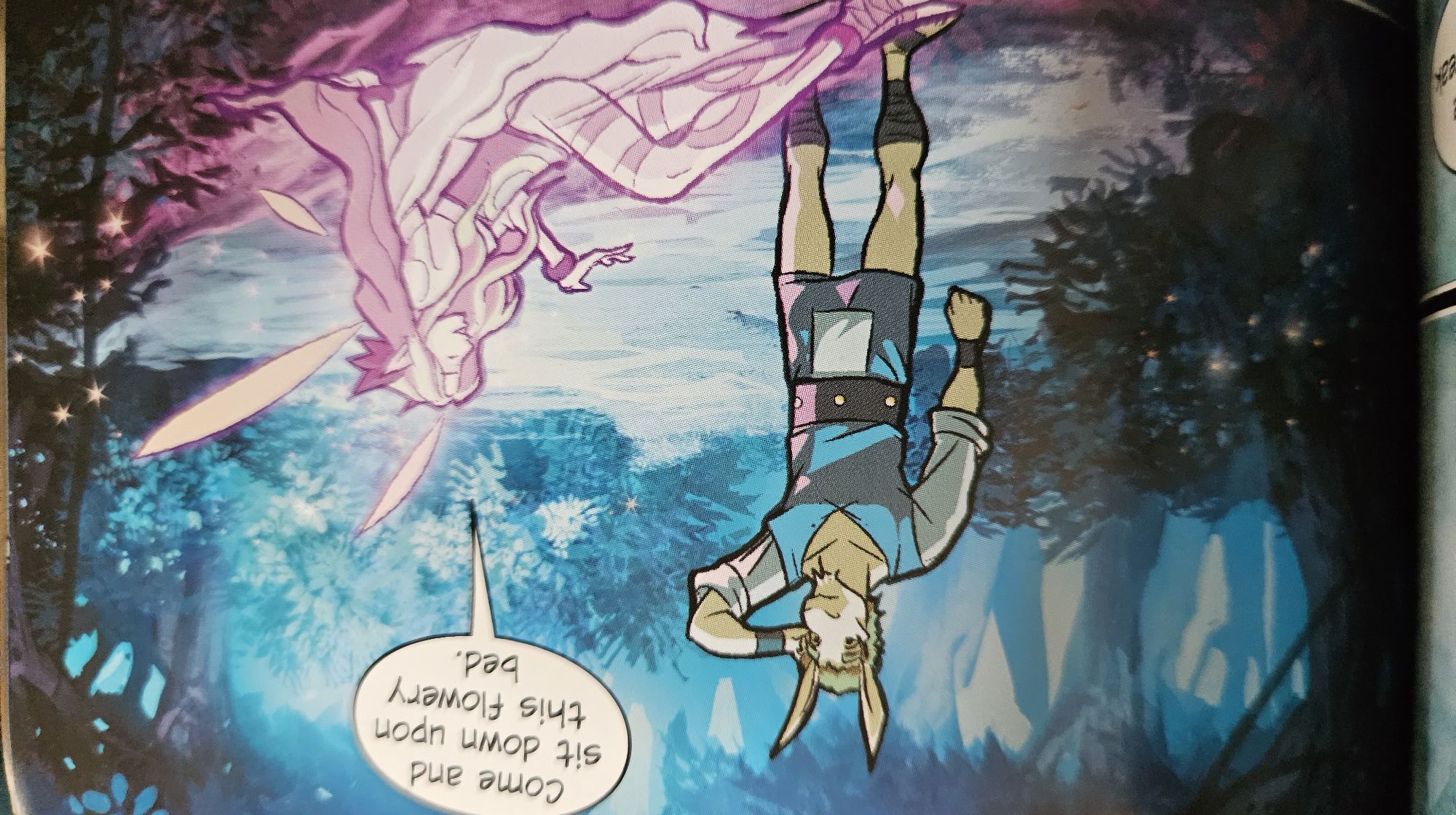
The colors are very beautiful. Other manga stories have colorful title pages but no color in the panels. This comic is alive with color and the colors help tell the story. Athens represents the world of the daytime, so the colors are very warm and vibrant. In the nighttime, the colors are cool and the characters are drawn with very sharp lines to make sure they don’t fade into the background.
IN Conclusion
This version tells l the story quickly and entertainingly with a vibrant and colorful style that was lacking in the Manga version. Granted, the Manga Shakespeare did allow me to focus on the text more, but I think I actually prefer this version, simply because of its beautiful artwork. Check it out if you get a chance!.



































 The Shakespearean Student