My Top 10 Favorite Shakespeare/ Harry Potter Actors

This list is not about skill or the talent of the actor. This is to honor the contributions of Shakespearean actors who also appeared in one of my favorite film and book franchises of all time: Harry Potter. Accordingly, some of the actors who weren’t essential to either Harry Potter or Shakespeare or both are placed lower on the list even if I personally love the actor or the character they portrayed.

#10: Richard Harris- Albus Dumbledore

The Irish-born actor has been a veteran of stage and screen for decades before his death in 2002, after the second Harry Potter film. Here is him on Johnny Carson, telling a funny story about a production of Macbeth he did early in his career:

#9: Kenneth Branaugh- Gilderoy Lockheart

If you visit this website regularly, you know I’m a fan of Kenneth Branaugh– I’ve reviewed three of his Shakespeare movies and he’s my all-time favorite Hamlet. I’m also aware that he has a reputation of being a bit of an egotist and a womanizer, (since he had affairs with two women on this list), so even though he was a bit too old to play the part, it was nice to see him have a laugh at his own expense as the attention-hogging Gilderoy Lockheart. The humbug professor’s name actually Gilderoy (as in a man painted with false gold), gives away the twist that he takes credit for other witches and wizards’ work and Branaugh shamelessly mugs to the camera whenever he’s on screen. My favorite scene of his though, is the one serious scene where he teaches dueling with the help of the much more competent Professor Snape:

Kenneth Branaugh and Alan Rickman in Harry Potter and the Chamber of Secrets, (2002).

If you saw my post on the duel at the end of Hamlet, you can see that the way wizards duel is directly inspired by the way fencers fought in Hamlet, right down to the flashy salute and bow beforehand, and it’s neat to see two legendary Hamlets fight in it.

#8: Jim Broadbent (Horace Slughorn) / Timothy Spall (Peter Pettigrew [aka ‘Wormtail’]

I couldn’t decide between these fabulous actors, so I grouped them together. After seeing Timothy Spall as the cowardly, foolish incompetent spy and traitor Rosencrantz in Hamlet, I knew that the only Harry Potter role for him would be as Lord Voldemort’s toady and pathetic rat, Peter Pettigrew, aka Wormtail.

Broadbent on the other hand, is completely different and unrecognizable during his excellent portrayal of Lord Buckingham in Ian McKellen’s 1995 film version of Shakespeare’s Richard III. Unlike the meek and easily broken Horace Slughorn, Broadbent as Buckingham is an oily politician who very nearly sells his soul to McKellen’s diabolical Richard:

What unites these two portrayals is that both characters are corrupted by a figure of pure evil, but both have a breaking point- Buckingham, (as you see in the clip above), refuses to be a party to child murder, while Slughorn eventually helps Harry Potter destroy Voldemort. In a way, they’re two sides of a very flawed coin.

#7 Michael Gambon (Albus Dumbledore 2)

Like Richard Harris, Michael Gambon, (who passed away in September of 2023) was an accomplished stage and screen actor, famous for playing King Lear multiple times, including a famous performance with Antony Sher at the Royal Shakespeare Company. Here are some highlights of his stage work:

https://www.theguardian.com/stage/gallery/2015/feb/09/michael-gambon-on-stage-from-king-lear-to-krapp-in-pictures

#6: Fiona Shaw (Petunia Dursley)

I feel I have to give Fiona Shaw a good spot on this list, though I think her talent was wasted in the role of Petunia Dursley. She is an icon of British theater and her work in Shakespeare is superb. She famously played Richard II back in 1995, and in the short film below, she talks about her amazing interpretation of Measure For Measure, with fellow Harry Potter alumn, David Tennant.

I’d also like to include the best-deleted scene from Deathly Hallows with Shaw in it, where she admits to Harry for the first time that she misses her sister Lilly.

#5: Ralph Fiennes (Lord Voldemort)

In a way, Lord Voldemort was a role that Fiennes had trained for all his life. He has played smarmy, serpentine characters before in films like Red Dragon and Schindler’s List. But Fiennes’ Shakespeare training allowed him to tap into the evil megalomaniac at the heart of Voldemort when he played roles like Richard III, (another deformed autocrat), and Coriolanus, the Roman general who is himself compared to a dragon. In the video above, YouTube critic Kyle Kalgren analyzes how Fiennes’ past roles and experience with Shakespeare translated well in his performance and his direction of the 2011 film Coriolanus.

#4 Imelda Stanton (Delores Umbridge)

By contrast, I give more credit to Imelda Stanton, who mainly plays sweet mom-like characters (or nurse-like in the case of Shakespeare In Love), for embodying the utterly loathsome Delores Umbridge. Reportedly, the role made Stanton feel physically ill and unlike Richard III, people hate her character with a passion. By contrast, look at her sweet and charming portrayal of Maria in the 1996 film Twelfth Night, (which also starred Helena Bonham Carter):

#3 Helena Bonham Carter (Bellatrix Lestrange)/ Emma Thompson (Sybyl Trelawney)

Again, I had to give credit to both of these women for the startling transformations they did for their Harry Potter characters, as well as their stellar work in Shakespeare. Helena Bonham Carter mainly plays apealing aristocratic characters such as Olivia in Twelfth Night, and Ophelia in Hamlet:

Seeing Ms. Carter as the demented Bellatrix Lestrange was quite a shock for me, yet the performance was no less impressive. I especially love this scene in Deathly Hallows where she has to act like a 17 year old girl, TRYING TO BE BELLATRIX LESTRANGE

#2: Alan Rickman (Severus Snape)

I already wrote a tribute to Alan Rickman after his death in 2016, so I don’t wish to repeat myself. Suffice it to say that Mr. Rickman was always a consummate professional, and his iconic portrayal of Severus Snape was the performance of a lifetime.
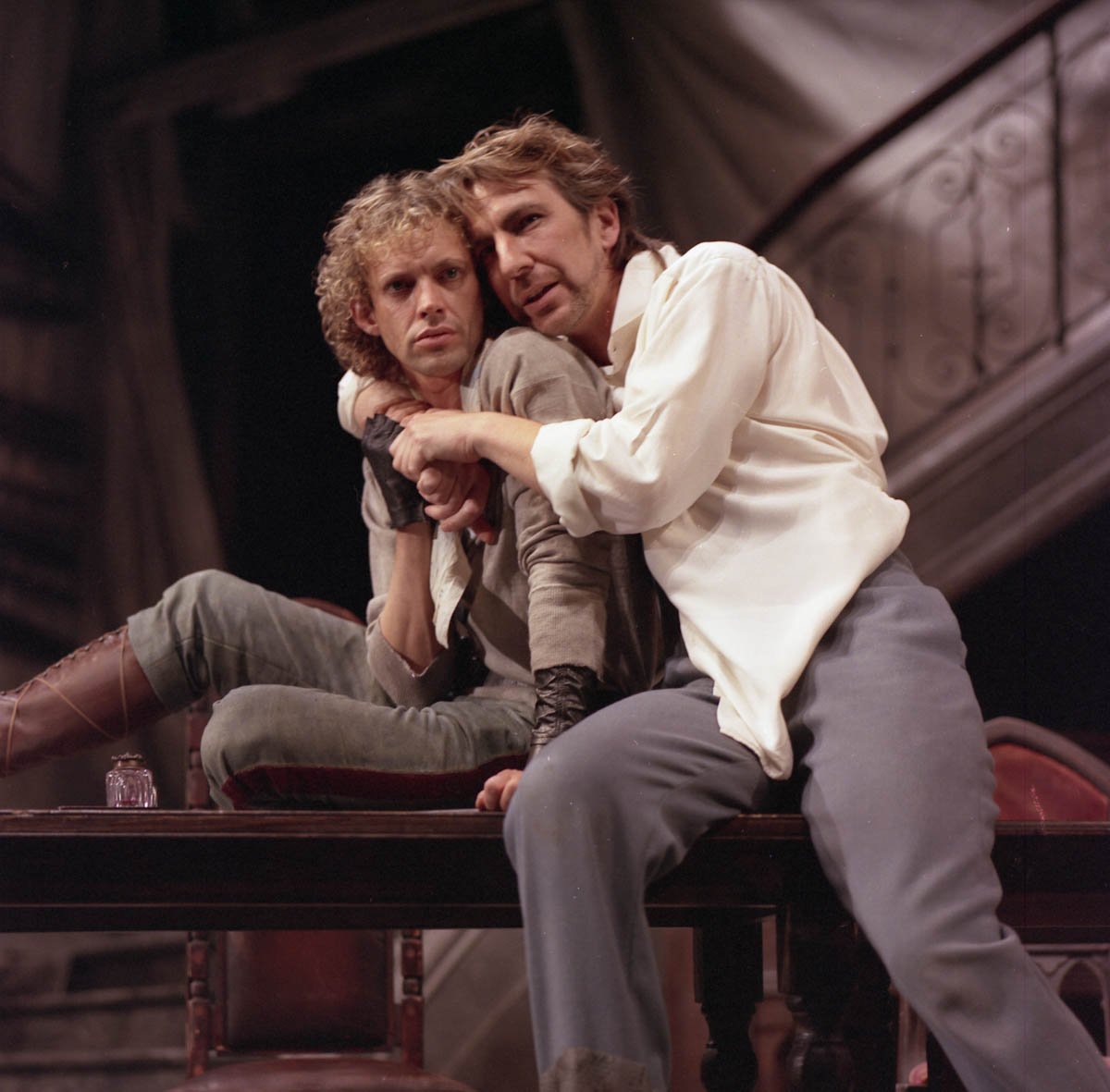
Alan Rickman as Achilles in Troilus and Cressida, Royal Shakespeare Company.

Honorable Mention: David Tennent (Barty Crouch)

To be honest, I thought Tennant was miscast in Harry Potter- he can play villains, (as Good Omens fans know well), but he just isn’t great at being maniacal and evil. That said, Tennant is a rising Shakespearean star and has created many memorable performances from Richard II, to Benedick in Much Ado About Nothing, to Hamlet.

#1: Dame  Maggie Smith (Professor McGonigal)

Say it with me… you probably saw this coming. No one can deny that Dame Maggie’s contributions to Shakespeare, as well as her ubiquitous portrayal of Hogwarts’ current Headmistress Minerva McGonigal, stand the test of time as strongly as the animated chess pieces she placed in the school basement. Let’s look at some of her greatest Shakespearean moments.

Plug for my Acting Class

If you enjoyed this list, you might want to sign up for my Intro to Acting class or my extended acting course, where I delve into Shakespearean acting techniques, and answer the big question, “WHY DO SHAKESPEAREAN ACTORS KEEP GETTING CAST AS WITCHES AND WIZARDS?” To sign up, click the link below: https://outschool.com/classes/609658d1-3f9f-4371-8af2-4fe81ad13d8c

Cover art for my Outschool Beginning Acting Class.

Thanks for reading!

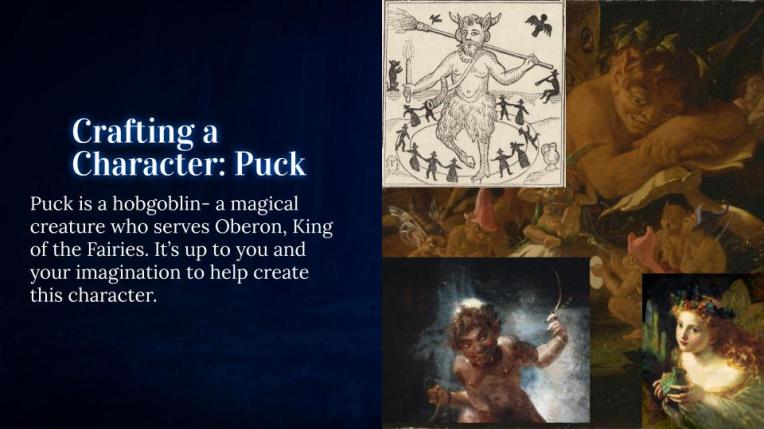
Crafting a Character: Puck

“Welcome Spirit, How Camest Thou hither?” The sources for Puck

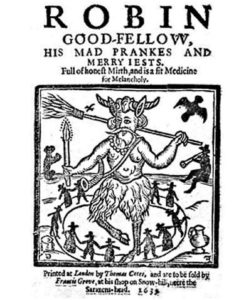
Puck, in medieval English folklore, a malicious fairy or demon. In Old and Middle English the word meant simply “demon.” In Elizabethan lore he was a mischievous, brownielike fairy also called Robin Goodfellow, or Hobgoblin. As one of the leading characters in William Shakespeare’s Midsummer Night’s Dream, Puck boasts of his pranks of changing shapes, misleading travelers at night, spoiling milk, frightening young girls, and tripping venerable old dames. The Irish pooka, or púca, and the Welsh pwcca are similar household spirits.

Britannica, The Editors of Encyclopaedia. “puck”. Encyclopedia Britannica, 21 Apr. 2016, https://www.britannica.com/topic/puck-fairy. Accessed 18 July 2023.

Shakespeare also took inspiration from English poet Edmund Spencer, who visited Ireland in the 1590s and adapted the folklore he picked up into his opera The Fairy Queen, which Shakespeare adapted into A Midsummer Night’s Dream

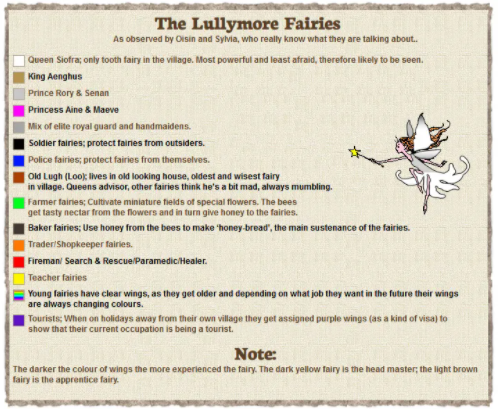
Types of fairies you can “spot” at the Lullymore Park in Ireland:

Puck/Robin’s Dual Nature

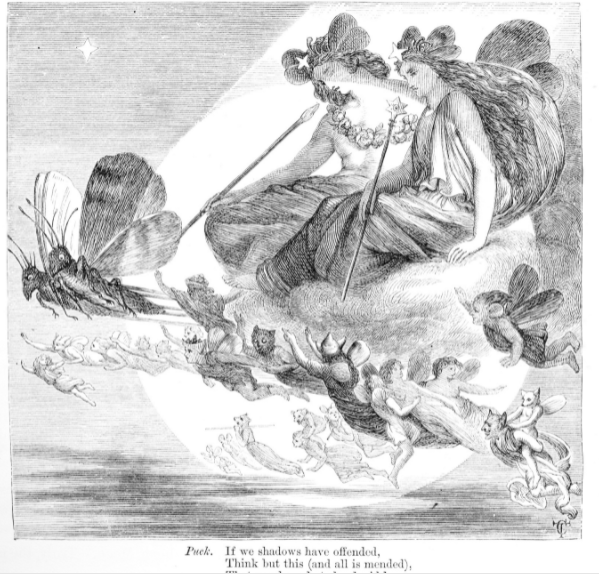
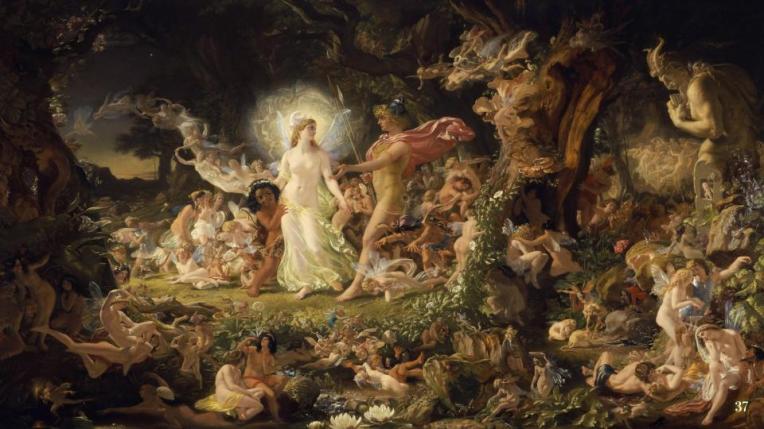
The old stories tell that Fairies are magical creatures who live in hollow places in the earth. Some are benevolent and help give rain and pleasant weather to the Earth, Like the king and Queen of the fairies, Oberon and Titania:

And the mazed world,
By their [the tides] increase, now knows not which is which:
And this same progeny of evils comes
From our debate, from our dissension;
We are their parents and original.

— Titania, (Queen of the Faries), A Midsummer Night’s Dream Act II, Scene i.

Titania in this speech shows great concern for nature, humanity, and the planet. She believes it is the responsibility of fairies, particularly herself and her husband Oberon, to control the elements and keep humans and fairies safe. Some fairies, however, are cruel and enjoy playing tricks on mortals, just like Puck in A Midsummer Night’s Dream, or Queen Mab in Romeo and Juliet.

.

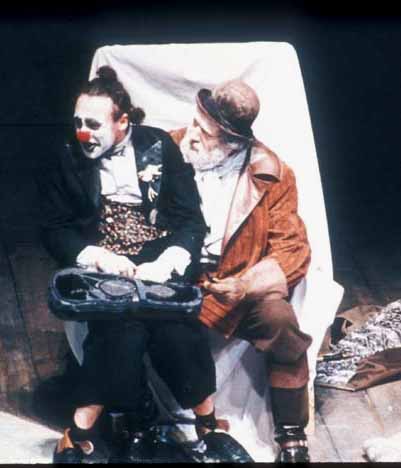
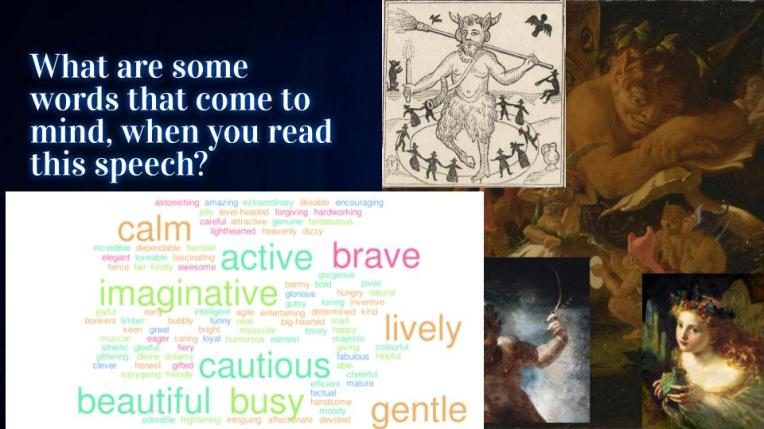
This is a short analysis I created of the tricks Puck plays on people in A Midsummer Night’s Dream, as part of my acting course on Ouschool.com. Note the different ways Puck is portrayed in photos as a satyr, a rotund elf, and sometimes as an almost- demon like figure.

Punishments or contracts with fairies formed a significant part of Goodfellow’s purpose on earth. While he could issue good fortune and support, this was always at the cost of those involved. As Reginald Scot commented, Goodfellow had a ‘standing fee’ of a ‘mess of white bread and milk’, which he expected after supporting housewives with their chores. If his payment was forgotten, Goodfellow was believed to steal from the home that owed him, often stealing grain and milk from the dairy.

Abigail Sparkes, Historic UK.com

Performing Puck

Because Puck is not human, and somewhat ambiguous in the text, an actor can play Puck in many different ways. Generally speaking, actors tend to explore Puck’s attitude toward humans, their love of mischief, and how to translate that physically and vocally

Puck. My mistress with a monster is in love.
Near to her close and consecrated bower,
While she was in her dull and sleeping hour,
A crew of patches, rude mechanicals,
Were met together to rehearse a play
The shallowest thick-skin of that barren sort,
Who Pyramus presented, in their sport
Forsook his scene and enter’d in a brake
When I did him at this advantage take,
An ass’s nole I fixed on his head:

Anon his Thisbe must be answered,
And forth my mimic comes.
So, at his sight, away his fellows fly;
And, at our stamp, here o’er and o’er one falls;
He murder cries and help from Athens calls.
I led them on in this distracted fear,
And left sweet Pyramus translated there:
When in that moment, so it came to pass,
Titania waked and straightway loved an ass!

slideshare id=52829293&doc=randj-150916030030-lva1-app6891]

References:

Shapiro, James. A Year In the Life Of William Shakespeare, 1599. Chapter 6: Things Dying and Things Reborn.

https://www.bbc.co.uk/programmes/articles/3fLDRSY7r9rJhrVFWy99Mly/transcript-shakespeares-restless-world-programme-7

https://www.independent.ie/entertainment/theatre-arts/is-shakespeare-responsible-for-the-stage-irishman-34638347.html

https://www.irishtimes.com/culture/stage/what-ish-my-nation-shakespeare-s-irish-connections-1.2619173

Dramatic PLay In Classes

Hi everyone,

I know I haven’t posted in a while. I’ve been working on my education certification so I’ve been pretty busy. My last project was about using theater as an educational tool, so I thought I’d reprint it here. I’ll add some notes later on to show how this can be adapted to Shakespeare, but for now, hopefully, this can be an interesting look at theater as a way for children to cope with trauma, etc.

INTRODUCTION

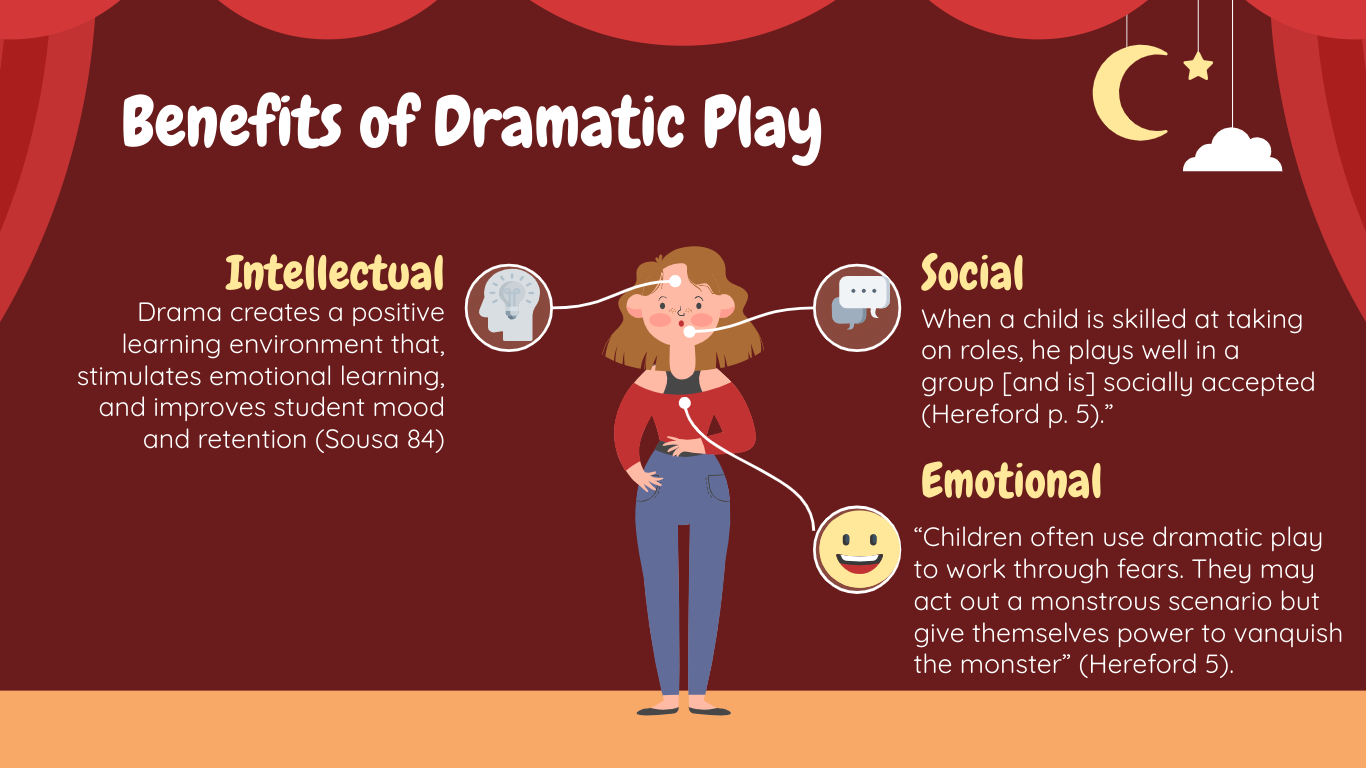
Numerous studies from educators, neuroscientists, and nonprofit organizations have demonstrated that children’s brains benefit from the arts. According to David A. Sousa in his book How the Brain Learns, human beings have used art forms as teaching from the very beginning of civilization, and every child’s early development can benefit from the kind of imaginative play that children naturally engage in:

Much of what young children do as play- singing, drawing, dancing…engages all the senses and helps wire the brain for successful learning. When children enter school, these art activities need to be continued and enhanced. The cognitive areas are developed as the child learns songs and rhymes. The dancing and movements during play develop gross motor skills, and the sum of these activities enhances emotional well-being.

(Sousa 215)

One method to continue this kind of artistic learning in a classroom is dramatic play or drama therapy: using theatrical games and techniques as a teaching tool. This paper will demonstrate how educators have used dramatic play to improve socio/emotional learning, as well as cognitive development. In particular, the studies and books cited in this paper will argue that a dramatic play intervention in schools would be beneficial to students who are facing challenges due to emotional disorders.

After reviewing case studies in drama therapy and reading literature on dramatic play, the author of this paper is convinced that a dramatic therapy intervention could and should be available to children with emotional disorders. The goal of the intervention is to help students with emotional disorders through creative play, dramatic exploration, textual analysis, and roleplay-based problem-solving. The suggested intervention would help students confront their problems in a safe way and help them develop problem-solving strategies over the course of a few weeks.

WHAT IS DRAMATIC PLAY?

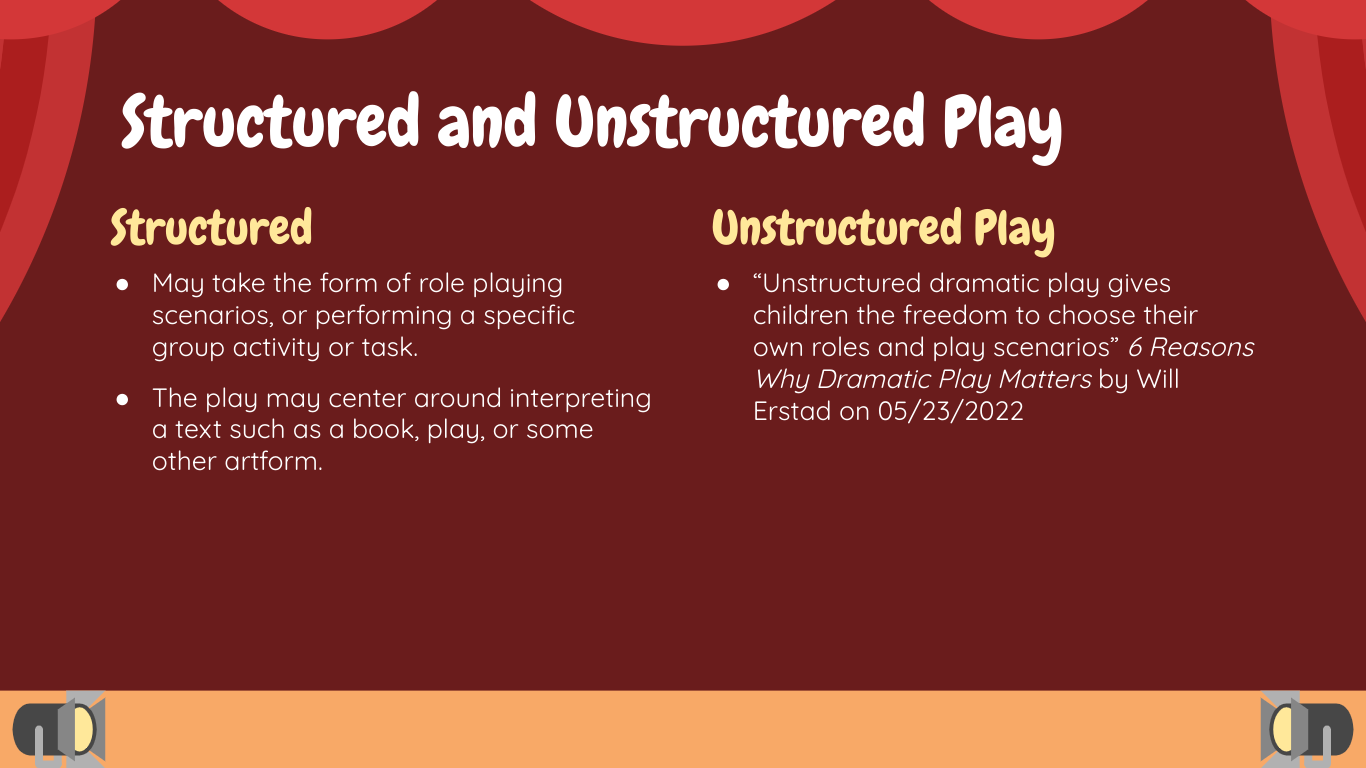
According to West Governor’s University, dramatic play involves students taking on roles and acting them out to explore themselves and their surroundings. WGU’s website identifies two basic types of dramatic play- structured and unstructured. In the case of structured play, it may take the form of roleplaying scenarios, or performing a specific group activity or task. Finally, the play may center around interpreting a text such as a book, play, or some other artform. The roles the students play need not be a pre-written story. When students take on these roles to play, they may better understand their real-life roles and how to perform them in real life.

In her 2015 article, Analysis of Three Approaches in Dramatherapy, Ivana Lessner Listiakova compares and contrasts three approaches of drama therapy: Role Theory, Psychodrama, and Developmental Transformation. In all three approaches, participants may gain a new understanding of themselves and a healthy way of processing their emotions. Within Role Theory, participants examine Jungian archetypal roles and counter roles within themselves by embodying them. In Psychodrama, participants enact moments from their own lives and have emotional and mental epiphanies by looking at those moments with a critical eye. Finally, in Developmental Transformation, participants arrive at roles and stories organically through a sort of “improvised series of encounters,” rather than a set story that is agreed upon beforehand. Listiakova emphasizes that these approaches work within psychotherapy because rather than the direct uncomfortable confrontations found in traditional therapy, dramatherapy uses the theater’s distance from the client and the metaphorical nature of storytelling to allow clients to see the issues and emotions that they face in their lives in a new light.

HOW DRAMATIC PLAY BENEFITS CHILDREN WITH EMOTIONAL DISORDERS.

A study by Roundabout Dramatherapy in 2013 in the journal Dramatherapy (Godfrey 20-28), demonstrates how drama therapy can specifically benefit developmental disorders like Autistic Spectrum Disorders (ASD). Roundabout is a London-based charity aimed at improving the lives of children on the Autism Spectrum. Through a collaboration with Emma Godfrey, (a psychotherapist and drama therapist), this article chronicled the success of its drama therapy sessions over three primary schools and five secondary schools. Before and after each program of drama therapy, teachers, parents, and students submitted evaluations and questionnaires to Roundabout.

The students showed marked improvement in the following specific areas: [processing}f, working with peers, social skills, structure, and anxiety. Most children on the Autism spectrum struggle with these very skills, therefore this kind of play was incredibly useful for these students. The activities encouraged at Roundabout developed specific life skills such as saying hello and goodbye and relaxation techniques to quell anxiety:

Dramatherapy is particularly appropriate for this client group as it develops social skills and supports the expression of feelings through structured work that helps reduce anxiety. The dramatherapist can model clear, expressive communication, as well as facilitate the development of relationships with others, which gives participants numerous opportunities to rehearse and replay social skills until they are learned and integrated into behavior. (Godfrey 21)

Godfrey’s study showed that students with ASD benefited from modeled play, in which the teachers rehearsed and practiced important life skills in class that taught the students how to compensate for their inability to intuit social cues. As this quote from a parent whose child was part of the study illustrates, dramatherapy can help ASD students gain a better understanding of themselves, how to interact with people, and help them develop tools to engage with others and control their anxiety and other forms of emotional stress:

It has really helped him to understand his emotions and friendships more. At times he has found it challenging but it’s been great for him to do that in a safe and caring environment where the people running it understand his issues (Godfrey 25).

The sources cited above confirm that students with emotional disorders can benefit from different forms of dramatic play and develop coping mechanisms and skills to help enrich and improve their lives.

DISCUSSION AND RECOMMENDATION

As the literature previously demonstrates, dramatic play is an excellent educational tool to help students process their emotions and prevent anxiety through role-playing while promoting social, emotional, and physical health. The author’s suggested interventions, like the study by Roundabout, would carefully monitor child development as students engaged in formal and informal activities to help develop social skills, reduce anxiety, and develop emotional coping skills.

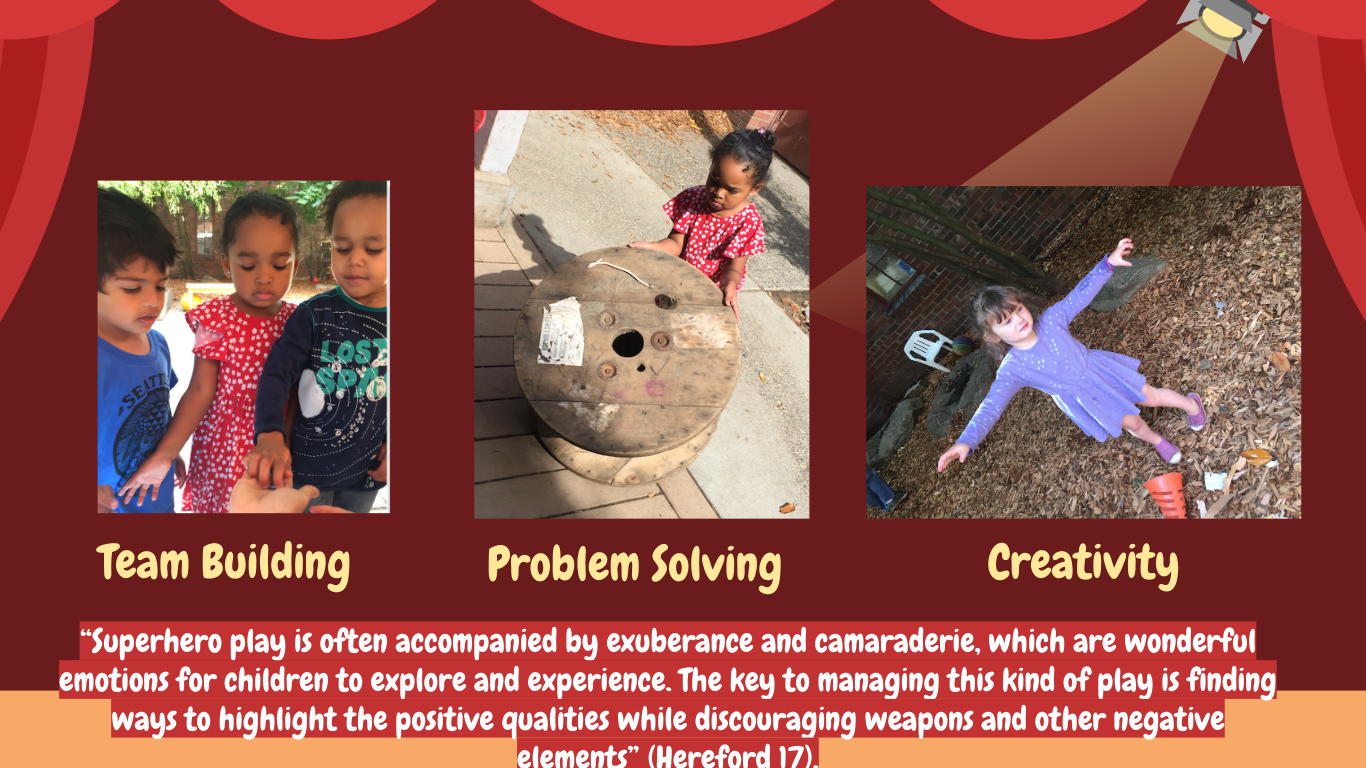
A potential format for the intervention would be to start with unstructured drama games designed to engage the children’s imagination, and promote positive emotion. The teacher would then move into a check-in-check-out therapy to guide the students into thinking about their feelings and social situations that the therapy would address. The class could then turn to role-play and role theory, where students would explore sources of stress, anxiety, or difficulty in a safe roleplay-based setting. The session might then conclude with a creative group project such as superhero play, or reading and acting out a storybook or text, (with emphasis on books that promote healthy social and emotional behavior).

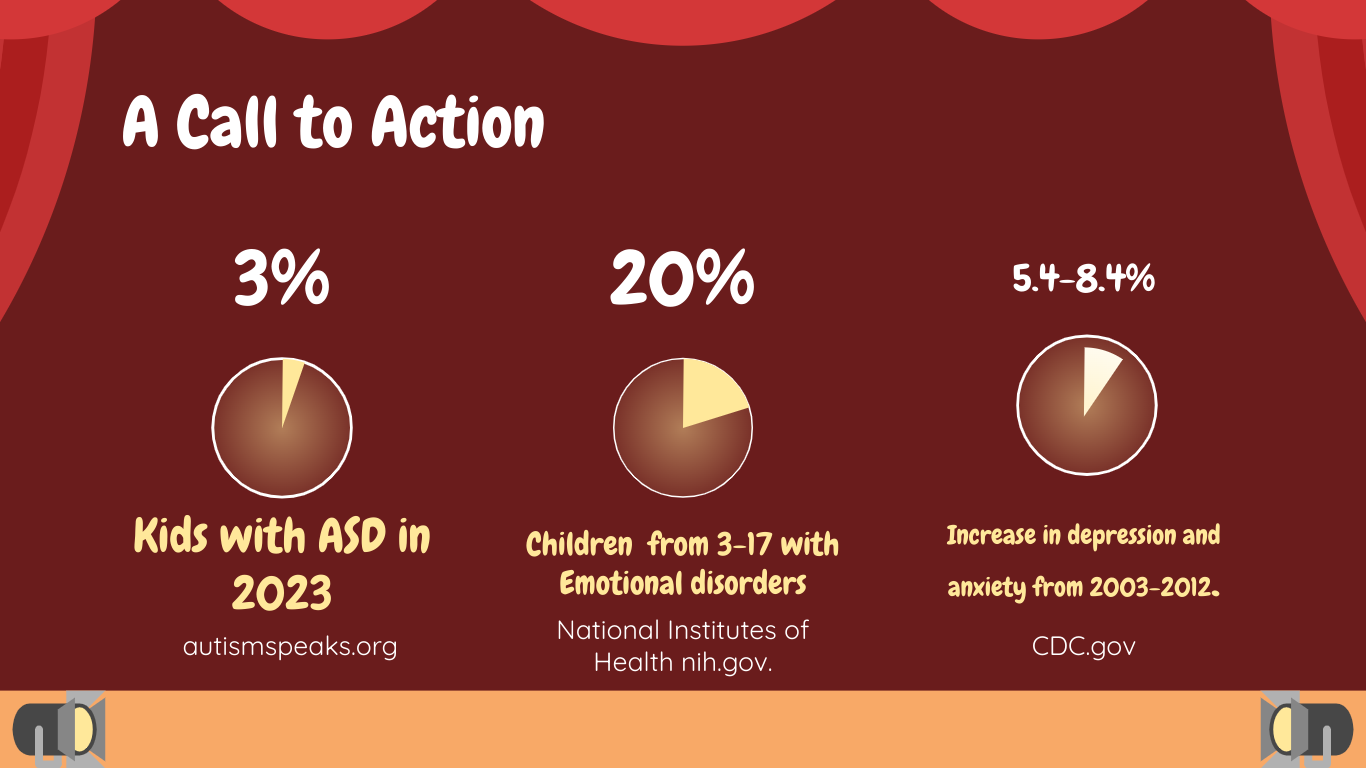
The work of Sousa, Godfrey, Hereford, and others indicates that dramatic play can be a powerful method to improve the lives of children with emotional disorders, and their techniques would translate well to children with anxiety, Autism Spectrum Disorders, or depression. The potential intervention described in this paper would use these techniques effectively to benefit children with these and other emotional disorders. Since the onset of COVID-19 in 2020, mental health has been a big concern in schools, and cases of ASD have been increasing over the last few decades (Godfrey 21). There has never been a greater need for mental health interventions in classrooms, and dramatic play is a particularly effective method to help the growing number of children who require intervention.

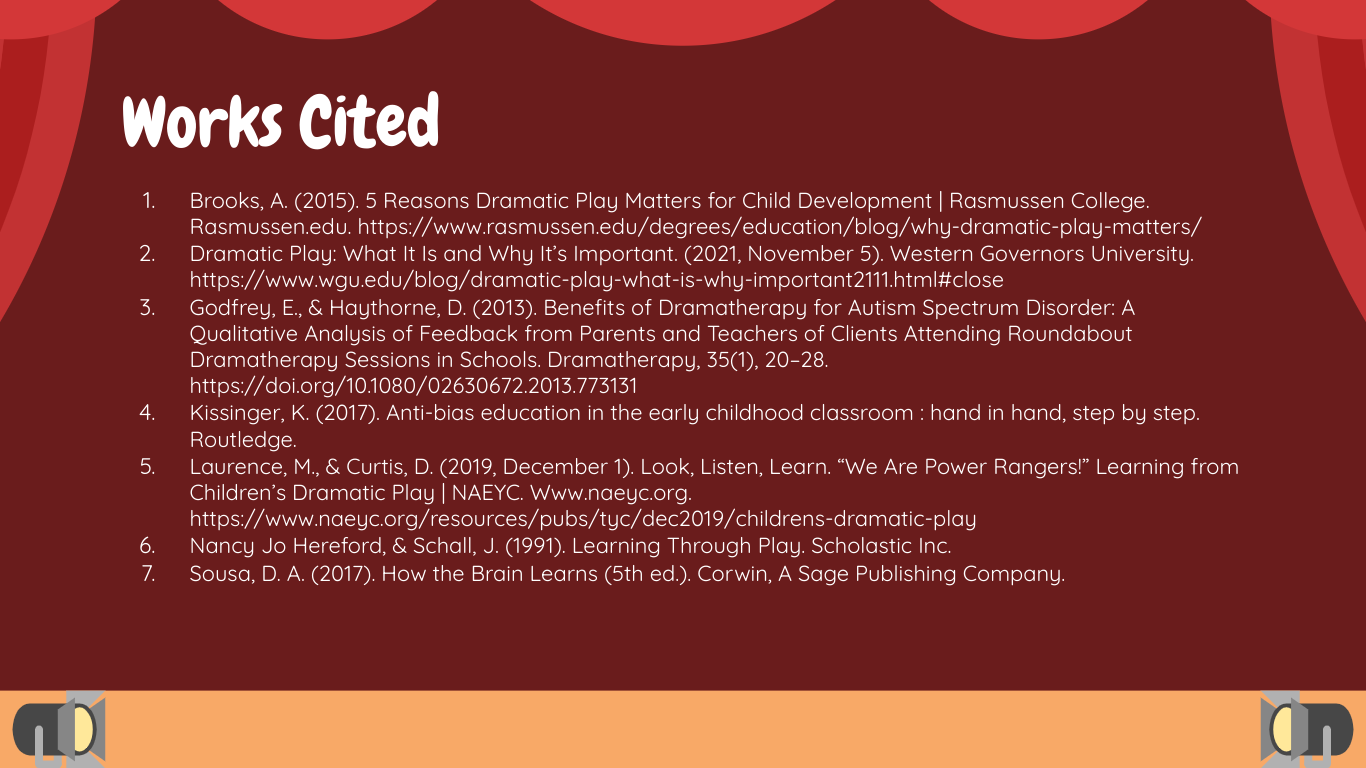
Works Cited

Brooks, A. (2015). 5 Reasons Dramatic Play Matters for Child Development | Rasmussen College. Rasmussen.edu. https://www.rasmussen.edu/degrees/education/blog/why-dramatic-play-matters/

Dramatic Play: What It Is and Why It’s Important. (2021, November 5). Western Governors University. https://www.wgu.edu/blog/dramatic-play-what-is-why-important2111.html#close

Godfrey, E., & Haythorne, D. (2013). Benefits of Dramatherapy for Autism Spectrum Disorder: A Qualitative Analysis of Feedback from Parents and Teachers of Clients Attending Roundabout Dramatherapy Sessions in Schools. Dramatherapy, 35(1), 20–28. https://doi.org/10.1080/02630672.2013.773131

Kissinger, K. (2017). Anti-bias education in the early childhood classroom : hand in hand, step by step. Routledge.

Laurence, M., & Curtis, D. (2019, December 1). Look, Listen, Learn. “We Are Power Rangers!” Learning from Children’s Dramatic Play | NAEYC. Www.naeyc.org. https://www.naeyc.org/resources/pubs/tyc/dec2019/childrens-dramatic-play

Nancy Jo Hereford, & Schall, J. (1991). Learning Through Play. Scholastic Inc.

Sousa, D. A. (2017). How the Brain Learns (5th ed.). Corwin, A Sage Publishing Company.

Richard the Third and Toxic Masculinity

This past month, there was a free production of Richard III in New York’s Shakespeare In the Park, starring Danai Gurira as the title character. I have not seen this production, though I wish I had. I enjoyed the actress Ms. Gurrira in such films as “Black Panther,” and would love to see her do Shakespeare. What is more, the concept intrigues me. This project explores themes of toxic masculinity, racial identity, inferiority, and misogyny.

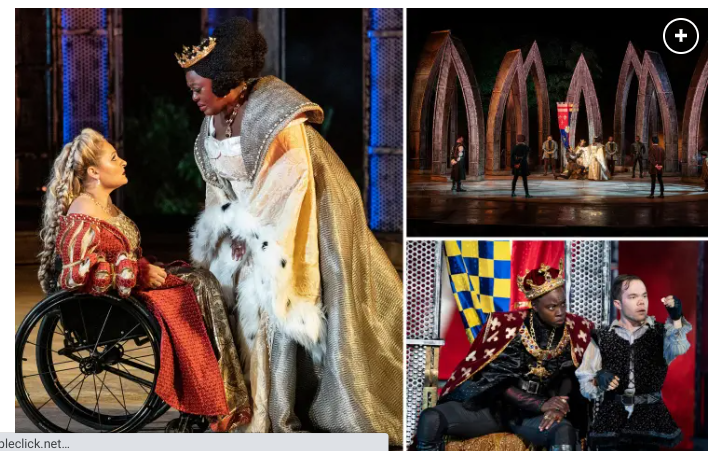
Danai Gurira as Richard III, Shakespeare in the Park, 2024

https://www.npr.org/2022/07/10/1110359040/why-it-matters-that-danai-gurira-is-taking-on-richard-iii

Unsurprisingly, with so many heady topics in the production, this Richard III is still somewhat controversial. Some right-wing critics dismissed the whole production as a piece of ‘woke propaganda,’ but I feel this is unfair.

When Danai Gurira of Marvel’s “Black Panther” first takes the stage in the title role, the actress has no perceivable hunchback or arm trouble. And yet the dialogue suggesting Richard suffers from a lifelong physical issue (“rudely stamped”) has been kept in. Perhaps we are to use our imaginations. Who knows? We are certainly tempted to close our eyes.

By Johnny Oleksinski

I will not judge this production based on the acting because I haven’t been able to see it. What I will do is take a stance on the validity of the concept. Specifically, I want to ask if this play is a good examination of toxic masculinity and if it would it be worthwhile to see it portrayed by a black woman, as opposed to a white man. The short answer is an emphatical “Yes.”

https://variety.com/2022/legit/features/danai-gurira-richard-iii-toxic-masculinity-central-park-1235318196/

Richard’s Toxic Masculity

Richard III is definately an example of toxic masculinity. He is violent, full of hatred, vengeance, and mysogeny. He is constantly insulting women from Lady Anne, Jane Shore, Queen Elizabeth, and even his own mother. In fact, the source of Richard’s toxic attitude is that he blames his mother for his disability and deformity:

Well, say there is no kingdom then for Richard;1635
What other pleasure can the world afford?
I'll make my heaven in a lady's lap,
And deck my body in gay ornaments,
And witch sweet ladies with my words and looks.
O miserable thought! and more unlikely1640
Than to accomplish twenty golden crowns!
Why, love forswore me in my mother's womb:
And, for I should not deal in her soft laws,
She did corrupt frail nature with some bribe,
To shrink mine arm up like a wither'd shrub;1645
To make an envious mountain on my back,
Where sits deformity to mock my body;
To shape my legs of an unequal size;
To disproportion me in every part,
Like to a chaos, or an unlick'd bear-whelp1650
That carries no impression like the dam.
And am I then a man to be beloved?
O monstrous fault, to harbour such a thought!. 3H6, Act III, Scene i, lines 1635-1653.

Now I should clarify the difference between deformity and disability, which are characteristics that Richard III has as part of his character makeup. According to the Americans With Disabilities Act, a disability is defined as: “A physical or mental impairment that substantially limits one or more major life activities.” This could include paralysis, autism, or any number of congenital or acquired conditions. Richard’s disability is primarily his limp (caused by his unequally shaped limbs), and his withered arm. What’s interesting in this production is that while the title role is played by an able-bodied woman, most of the rest of the cast have actual disabilites. Watch this clip of the famous courtship scene between Richard and Lady Anne, who plays her role in a wheel-chair.

While a disability is a legal term that is recognized by lawyers and governments alike, the term “deformity” is more subjective; it generally refers to any kind of cosmetic imperfection. In Richard III, this applies to Richard’s hump and withered arm. 

The Elizabethans thought that deformity was a sign of disfavor from God, and that deformed people were constantly at odds with God and nature, as Francis Bacon puts it in his essay, “On Deformity.”

As deformed people are physically impaired by nature; they, in turn, devoid themselves of ‘natural affection’ by being unmerciful and lacking emotions for others. By doing so, they get their revenge on nature and hence achieve stability.

Richard III has this drive for revenge in spades and I believe it manifests itself as a particularly terrible form of toxic masculinity. Richard definitely wants the crown to make up for his lack of ‘natural affection,’ but he is also especially malevolent towards women.

I, that am rudely stamp’d, and want love’s majesty

To strut before a wanton ambling nymph;

And therefore, since I cannot prove a lover,

To entertain these fair well-spoken days,

I am determined to prove a villain

And hate the idle pleasures of these days

Seeing a woman play this kind of misogynist dialogue forces the audience to take it out of context and question Richard’s point of view. We see casual misogyny every day, and seeing a woman deliver it is quite illuminating.

Richard’s deformity and Blackness

Another provocative choice by Danai Gurira’s portrayal of Richard is the fact that she plays the role of Richard without the hump or withered arm. She herself explains that for her production, Richard’s perceived deformity, is actually represented by her being a black woman:

He’s dealing with the otherness compared to his family, in terms of not being Caucasian and fair like them.” The word ‘fair’, is used a lot in the play.

Danai Gurira’s

Shakespeare writes Richard as constantly striving to compensate for his deformities by being clever, violent, and eventually, by becoming king. As I wrote before in my review of Othello, for centuries black people have been portrayed as inferior; aberrations of the ‘ideal fair-skinned form’. So, to the Elizabethans, blackness itself was a form of deformity, and the rawness of addressing this uncomfortable fact in this production should be commended.

English people are already trained—and we have scholars like Anthony Barthelemy has talked about this in his book Black Face, Maligned Race, where the image of blackness, as associated with sin, with the devil, all of these things, makes it quite easy to map onto then Black people these kinds of characteristics. Then, those kinds of characteristics allow for the argument that these people are fit to be enslaved. – Dr. Ambereen Dadabhoy, Race and Blackness in Elizabethan England Shakespeare Unlimited: Episode 168

https://www.folger.edu/shakespeare-unlimited/elizabethan-race-blackness-dadabhoy

So while I can’t speak to the production’s acting or staging, I will emphatically defend the notion that this production’s concept is valid. Richard III is an example of toxic masculinity through his self-hatred, violence, misogyny, and narcissism. In addition, as I’ve written before, in the Early Modern Period, blackness was considered an aberration or deformity, and seeing it in the person of Richard, with the implicit understanding that black people still face this kind of prejudice today, opens a much-needed dialogue that any production of Shakespeare shouldn’t be afraid to open.

In short, by re-contextualizing Richard’s deformity and disabilities, this production gets to the heart of the play’s moral for our times. The early modern period’s toxic attitudes towards deformity and disability created the Renaissance monster of Richard III. We in the 21st century must examine our own societal prejudices and toxic attitudes so this monster does not come to haunt us in real life.