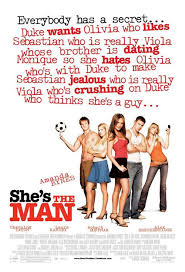
Since Twelfth Night is coming up, I’m going to review a blast from the past, the Amanda Bynes teen comedy remake of Twelfth Night called “She’s The Man”.
Poster for “She’s The Man”
Some of you might remember that the late 90s and early 2000s were the heyday of Hollywood remakes of Shakespeare: Romeo + Juliet directed by Baz Luhrman, 10 Things I Hate About You, (The Taming Of the Shrew) “O” (Othello), and even “Get Over It” (“A Midsummer Night’s Dream”). Shakespeare was actually hot for a few years and many writers were riding his doublet.
Sadly, not all Shakespeare remakes are created equal. Most of them were created with care to try and either show love for the text (as in Romeo and ‘O’) or to improve or contemporize the text like in ‘O‘ and “10 Things I Hate About You,” (which interestingly, both starred Julia Styles). “She’s The Man” doesn’t feel like a faithful retelling of “Twelfth NIght” despite the fact that it keeps most of the characters and the central conceit of the story- a girl disguising herself as her twin brother, going to a new place called Ilyria and inspiring love in both a powerful man and a beautiful woman.
Original Tailer for 2006’s “She’s The Man”
Amanda Bynes as Sebastian is a characature of 90’s bro culture and rarely ever plays her male role straight or convincingly. Nobody would be fooled into thinking this girl is a boy.
Bynes’ Viola rarely challenges anything or does a good job playing soccer until the end of the movie. Her main reason for her masquerade is that her brother forced to do it, so he can run away to become a musician.
I also don’t like that Sebastian never seems to impress or endeer the coach. If her goal was to prove that girls are just as good as guys, he should be her focus, but they rarely evershare the screen.
This Viola also never challengers Duke (her love interest played by Channing Tatum). One of the best parts of Shakespeare’s version is that Duke Orsino is a mopey would-be incel who puts women on a pedestal one minute, and condemns them the next. One of the best things about his relationship with Viola is that it makes him better able to appreciate women, but his counterpart in She’s All That has no such epithany.
I do want to give a shoutout to Laura Ramsey as Olivia . She frankly is a better actress then Bynes and plays Olivia’s unrequited love for Viola very well. Initially, she gets a copy of Sebastian’s song lyrics and she’s smitten by Sebastian’s words, rather than his looks. This makes you hope the real Sebastian will return.
Below is a montage of the jokes in the film. I hope you notice that most of them are very lowbrow and pretty cliche, even for teen movies. At 5:20 is the only really good part of the movie- it explains why Olivia’s love for Viola is funny and tragic. Guys are taught never to open up to women, but women want emotional connections. Men are taught women aren’t equal, but women yearn for acceptance. Viola in disguise has no concept of these unspoken ‘rules’ of male behavior, so she seems like the perfect man to Olivia- someone who treats her like an equal, isn’t afraid to open up, and is also male. The fact that she’s actually developing feelings for a woman is what makes it funny and tragic.
In conclusion, I’m kind of glad this Shakespeare rom-com is slinking into obscurity since it adds nothing and waters down the original to oceanic degrees. Frankly, I think there was a much better adaptation of Twelfth Night that, although it changed the names, location, and text, was a more thought-provoking and insightful rendition of the story- the 1996 animated film, Mulan.
The venerated Shakespearean actor, Sir Antony Sher, once said with frustration while he was acting at the RSC that, “even the best Feste is less funny than the worst Malvolio.” I actually have a rare insight into these two roles since I’ve played them both! So allow me if you will to present you with some insights I’ve gained into these two characters that are very much polar opposites. Although they are as different as night and day, they form the central comic premise of the whole play, and have some truly hilarious moments!
Me. as Malvolio, Wooster. High School 2002
I played Malvolio when I was a senior in high school; he was my first principal Shakespearean role. My director chose to set the play in the 1940s and he re-purposed the kingdom of Illyria as the Hotel Illyria, with Malvolio as the concierge or lead butler in charge of all the hotel maids and other housekeepers. This not only made the play more accessible to a 2002 audience, it also really helped me understand Malvolio’s role: he is first and foremost a snob who is obsessed with efficiency and pleasing his mistress Olivia (in this version the owner of the hotel). I would soon also discover that, although Malvolio is certainly snobby and can be a bit of a killjoy, he also has qualities that make him appealing to everyone who has ever felt put down or bullied, and that’s what makes him a complex and endearing character today.
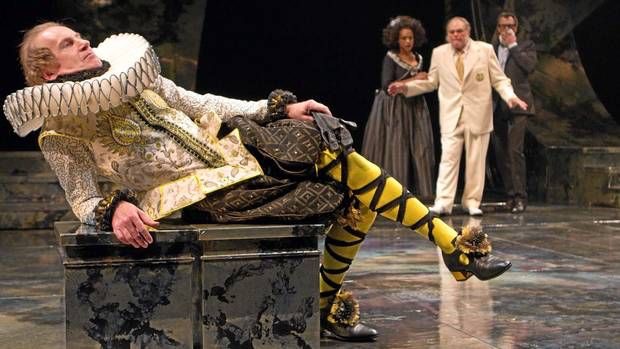
Richard Briars as Malvolio
Some notes on the character: Malvolio’s name means “unsatisfied desire”- somebody who aspires to be what he is not. I find the relationship between Feste and Malvolio interesting because the two are partially defined by how each one is unlike the other. Feste is a clown, hired by the nobles to help them have a good time. He is described as “a merry fellow who cares for nothing.” In other words, Feste never takes anything seriously, except making a living with his jokes and songs. Malvolio is the exact opposite- he is also a servant, but he is a steward, in charge of running the Countess Olivia’s household. As such, he is obsessed with efficiency, commanding respect, and pleasing his mistress through his obsequious manner.
Like the Joker and Batman, both characters live according to an opposing viewpoint; Feste is a chaotic, happy-go-lucky sort, while Malvolio has a strict code of behavior which he expects everyone to follow. Their opposing world views bring them into conflict every time they meet. Plus, in most productions Feste is wearing brightly colored clown apparel or “motley wear,” while Malvolio is dressed in black. I’m not saying Malvolio is anywhere near as cool as Batman, but Malvolio can be just as sanctimonious. His journey is how he goes from being the trusted household servant, to a raving madman, to at last the Spectre at the feast at Olivia’s wedding.
I think the appeal of the character, which balances out the aforementioned snobbery, is that Malvolio is also a nerd: he dreams of becoming a count, he tries to make friends, but he does so by working far too hard at his job and not knowing how to fit in. This is why we inevitably feel sorry for him at the end of the play when he begs to know why his tormentors have locked him in a dark room, treated him like a lunatic, and made him think his lady was in love with him only to utterly destroy his hopes. The balance between the Nerd and the Snob that makes Malvolio a universal and complex part, and that’s why some of history’s greatest actors have played it!
Prepping for the Role: Alec Guinness, Laurence Olivier, Patrick Stewart, Donald Sinden, Nigel Hawthorne, Richard Briars, Steven Fry- these are just some of the names of actors who have played this part over the years. The first actor to play the role was Shakespeare’s leading actor, Richard Burbage, who also played Richard III, Hamlet, and Macbeth. Here’s a sample from Burbage’s famous eulogy, which mentions some of his most famous parts:
A Funeral Elegy On the Death of the Famous Actor, Richard Burbage,
He’s gone, and with him what a world are dead,
Friends, every one, and what a blank instead!
Tyrant Macbeth, with unwash’d, bloody hand,
We vainly now may hope to understand.
Brutus and Marcius henceforth must be dumb,
For ne’er thy like upon the stage shall come,
Vindex is gone, and what a loss was he!
Frankford, Brachiano, and Malevole.
One big decision that every Shakespearean actor needs to make is how to approach their role in a different way. To be honest, I was kind of a thief with my Malvolio- one of the first things I did was read a book by actor Sir Donald Sinden where he talks about how he delivered Malvolio’s first line, which occurs in Act I, Scene iii:
Olivia. What think you of this fool, Malvolio? doth he not mend?
Malvolio. Yes, and shall do till the pangs of death shake him:
infirmity, that decays the wise, doth ever make the 365
better fool (Act I, Scene v).
Sinden described his first line as a snobby “nyess,” as if he were simultaneously bored and embarrassed by Feste’s jokes. The director told me to act around Feste as if I were the villain in a Charlie Chaplin movie- basically to bully Feste and make him feel very small with my lines, in order to justify the revenge Feste innevitably takes on him. Like any character in Shakespeare, this is only one way to play the role, so you don’t have to agree with me.
The Gulling Scene
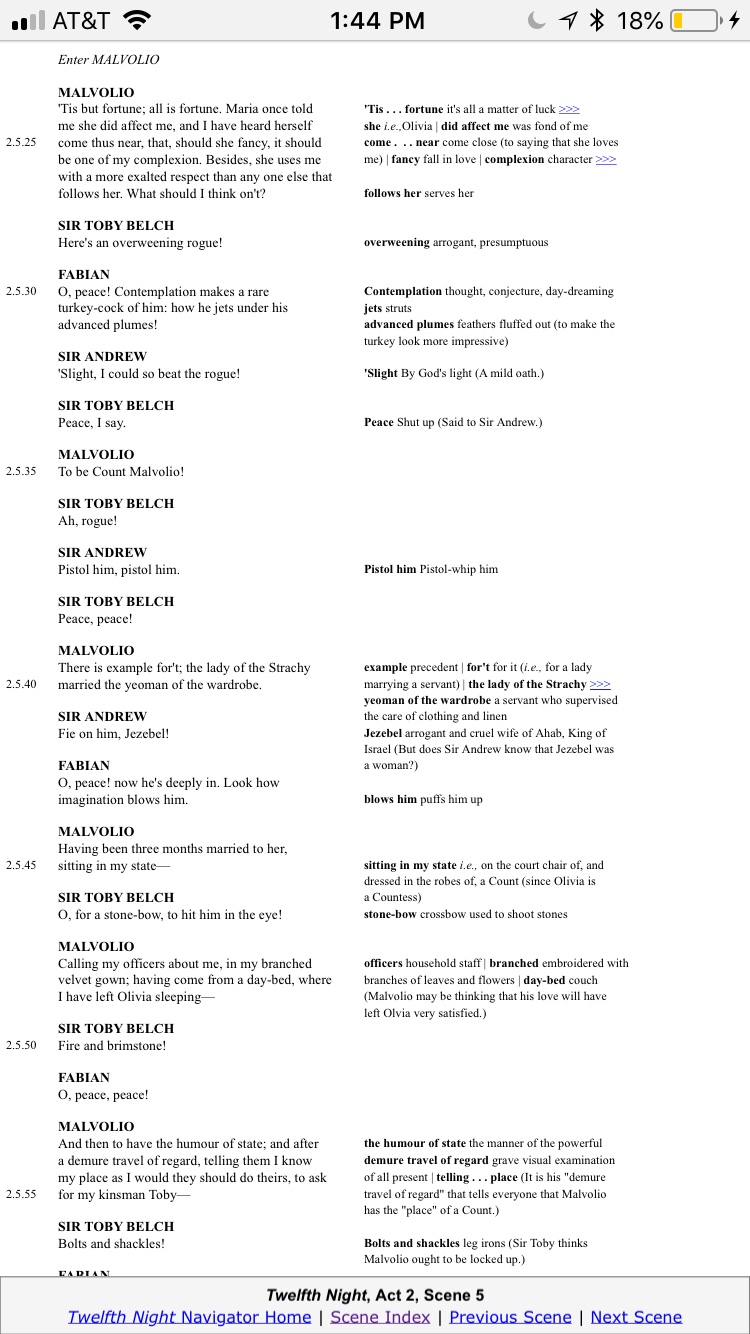
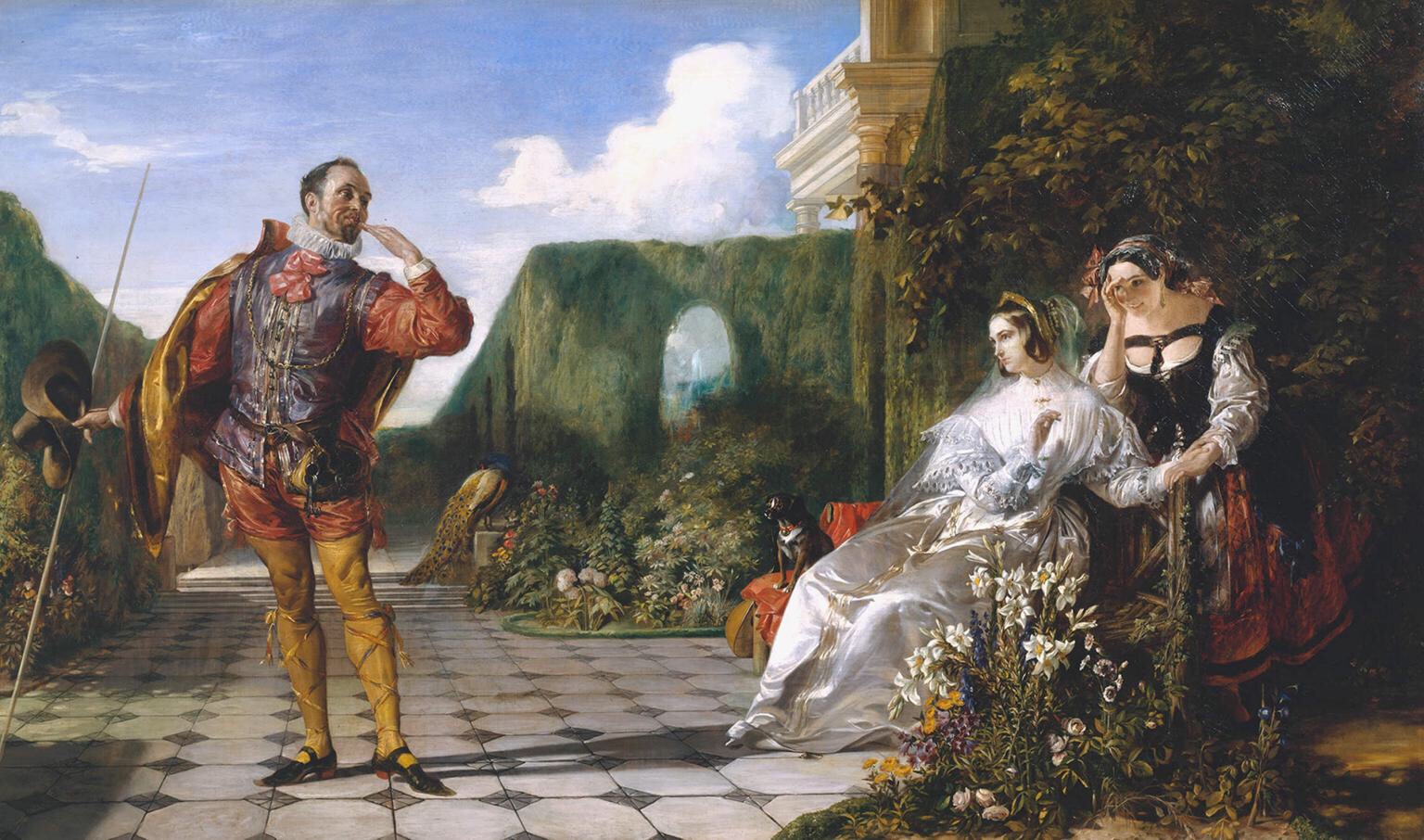
Malvolio’s most famous scene is called “The Gulling Scene,” the scene in which he’s tricked into thinking Olivia is in love with him. This is the moment where Malvolio goes from being a respectable prudish servant, into a raving madman. He enters full of dreams and plans to become “Count Malvolio” and creates an elaborate fantasy of what his life would be like if he married the Countess.
No sooner does Malvolio compete his fantasy of marrying Olivia, when lo and behold, a letter from her suddenly appears! Of course, the audience knows it’s all a trap and even worse, Sir Toby, Sir Andrew, and a boy named Fabian are watching him! It’s a moment of exquisite comedy that’s nearly impossible to get wrong.
One question I had when I did the scene was whether Malvolio really loves Olivia, or just loves her riches and her title. As a high schooler, I chose to believe that he really does have a crush on Olivia, but is too socially awkward to tell her. Having the letter is a chance to make his feelings known, which Malvolio can get very genuinely excited about! On the other hand, as you can see above, Malvolio might just be greedy to make himself even more respected and admired, and to have the power to throw out the likes of Sir Toby, Sir Andrew, and Maria. Malvolio’s revenge fantasy is also fun to watch, since we know he’ll be punished for it later.
Part of the fun involved in the scene is that it’s basically a “play within a play,” a device that Shakespeare used to great effect in Hamlet, A Midsummer Night’s Dream, Love’s Labor’s Lost, and both parts of Henry the Fourth. I think it’s the charm of seeing a character as he really is, Malvolio shows you his fantasies and creates a whole world in the middle of the orchard. Meanwhile, you feel complicit as you watch the people watching him, who could just as easily be part of your audience.Workshop on Twelfth Night and Bullying
On the other hand, the scene has also been called an example of bullying, since Sir Toby and Maria are using the letter to manipulate then humiliate Malvolio. Remember, Malvolio dresses like a fool and act like a fool in front of Olivia in Act III because he believes it will please the Coubtess. Basically Toby and Maria are Catfishing Malvolio, which can seriously hurt psychologically, as anyone who has been deceived over the internet knows. Plus, it ruins Malvolio’s reputation as you can see in this clip:
Again, as a teenager, I could certainly relate to a man making a fool of himself in a vain attempt to impress a girl. Seeing a man lose his head over a girl and then have her break his heart over a prank, is in some ways truly terrible to watch; even Olivia agrees by the end of the play that the joke has gone too far.
Malvolio. Madam, you have done me wrong,
Notorious wrong.
Malvolio. Lady, you have. Pray you, peruse that letter.
You must not now deny it is your hand:
Write from it, if you can, in hand or phrase;
Or say ’tis not your seal, nor your invention:
You can say none of this: well, grant it then
And tell me, in the modesty of honour,
Why you have given me such clear lights of favour,
Bade me come smiling and cross-garter’d to you,
To put on yellow stockings and to frown 2550
Upon Sir Toby and the lighter people;
And, acting this in an obedient hope,
Why have you suffer’d me to be imprison’d,
Kept in a dark house, visited by the priest,
And made the most notorious geck and gull
That e’er invention play’d on? tell me why!
Olivia. Alas, Malvolio, this is not my writing,
Though, I confess, much like the character
But out of question ’tis Maria’s hand.
And now I do bethink me, it was she 2560
First told me thou wast mad; then camest in smiling,
And in such forms which here were presupposed
Upon thee in the letter. Prithee, be content:
This practise hath most shrewdly pass’d upon thee;
But when we know the grounds and authors of it, 2565
Thou shalt be both the plaintiff and the judge
Of thine own cause.
That’s the tragic part of Malvolio’s journey. We’ve all known a Malvolio, and we’ve all been him from time to time. That’s what makes him such an enduring character.






 The Shakespearean Student