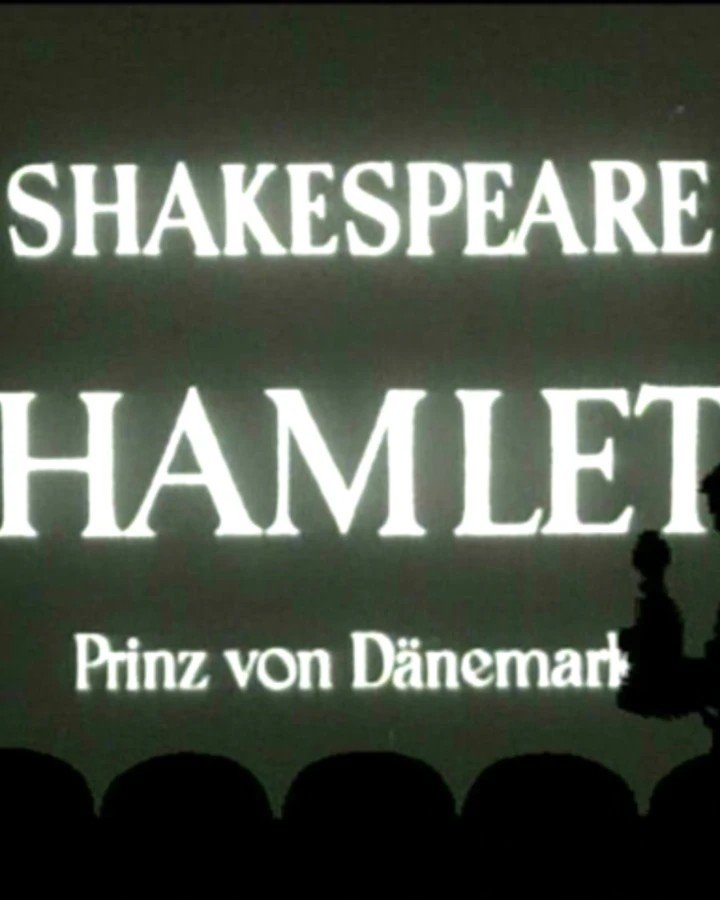
Mystery Science Theatre 3000: Hamlet

If you’ve never seen the show

Mystery Science Theater 3000 has been on the air for over 20 years. The show originally aired in 1988 on KTMA TV in Eden Prairie MN. Since then it’s spawned over 13 seasons, (still going strong on Netflix), a huge cult following, and countless parodies in many versions of pop culture.The premise is that three guys watch bad movies and make sarcastic comments about the acting, sets, costumes, etc. The show thrives on meta-commentary, obscure references, and satirizing anything and anyone.
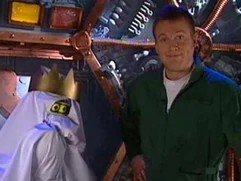
Crow T. Robot (Bill Corbit) trying to play the ghost of Mike’s father (Michael J. Nelson)

Full circle for the show

Kevin Murphy (right), as Fortinbras, who makes a brief appearance at the end of the episode, along with Bill Corbit and Mary Jo Pehl.

Kevin Murphy, one of the show’s creators actually had reservations of even doing the episode, as he is a big Shakespeare fan. This makes sense as I would argue that the very premise of the show lies in Shakespeare, and in particular, Hamlet. As I said in the last paragraph, the show thrives on reference humor, meta-commentary, and satire, and one person who loves that kind of humor is in fact, Shakespeare’s own drama critic- Hamlet, Prince of Denmark.

In Act III, Scene ii of Hamlet, there is a play within a play, where Hamlet sits back and makes sarcastic comments about how bad the production is:

Enter Prologue.

Hamlet. We shall know by this fellow. The players cannot keep counsel;
they’ll tell all.
Ophelia. Will he tell us what this show meant?2035
Hamlet. Ay, or any show that you’ll show him. Be not you asham’d to
show, he’ll not shame to tell you what it means.
Ophelia. You are naught, you are naught! I’ll mark the play.
Pro. For us, and for our tragedy,
Here stooping to your clemency,
We beg your hearing patiently. [Exit.]
Hamlet. Is this a prologue, or the posy of a ring?
Ophelia. ‘Tis brief, my lord.
Hamlet. As woman’s love.

Hamlet, Act III, Scene ii

If Hamlet had two robot companions, he’d essentially be doing an episode of the show!

Begin Murderer! Pox! Leave thy damnable faces and begin!

Hamlet, Act III, Scene ii.

So it’s an interesting kind of irony that after 13 years, MST3K finally got around to review the very source of their humor. Not only is Hamlet highly meta and satirical, Many educators, myself included, say that teaching Shakespeare with a healthy dose of irreverence is a good way to draw in new students and get them interested in the play:

Mystery Science Theater 3000’s “Hamlet ” episode reveals a common reaction to Hamlet that often goes unspoken by high school and college students too afraid to sound anti-intellectual. Despite this irreverent tone, however, this unique appropriation of Shakespeare adds to our understanding of a play that today very few read and even fewer see performed. As an author who reveled in making serious, yet sometimes playful, fun at human weakness, I think this respectful irreverence would have delighted the Bard were able to see it.

Dan Mills. “Mystery Science Theater 3000, Shakespeare, and Postmodern Canonization,” Interdisciplinary Literary Studies, 17.2 (2015): 206-227.

3. Divisive episode
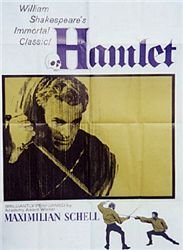
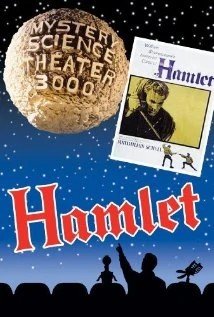
Poster for "Hamlet" 1961, starring Maxamillian Schell.
Original film artwork for “Hamlet”, 1961

This episode is somewhat controversial among the MST3K fandom. While almost everyone agrees it was a good idea for Mike and the bots to do Shakespeare, many fans question the choice to do this Shakespeare. The 1961 film was produced for German TV, and starred Maximillian Schell, (who would later win an Oscar for his performance in “Judgement at Nuremberg).”

First of all, the film is very slow and badly paced with no distinctive production choices. The sets and costumes are generic, (except for the Liberace-looking ghost), and the cinematography is competent but dull. Finally it’s Hamlet; the play that even Mike Nelson called “The greatest work of fiction ever written.” Even with the dreary set, the bad dubbing, and nonexistent pacing, it’s still a good story with magnificent dialogue, and the cast is still pretty good. Perhaps the ultimate backhanded compliment Mike Nelson and company could have handled is that even the worst production of Hamlet is very difficult to riff. Still, when the jokes land, they hit extremely well. Here are some of my favorites:

C’mon, man. We’ve seen like eight ghosts, none of ’em have been even close to my dad.
MIKE NELSON

Rap artist, The Notorious K.I.N.G.”

Hamlet: To die: to sleep.
Crow: Yeah, that’s what we’re doing right now, Bub.

Hamlet: TO BE OR NOT TO BE…. and lose the name of action.

Mike: So I’m a chicken for not stabbing myself—that’s all you needed to say!

[Having stabbed an intruder behind Gertrude’s tapestry, Hamlet discovers it is not the King, but Polonius.]
Hamlet: Thou wretched, rash, intruding fool!
Crow [as Polonius]: Oh, right, it’s my fault you killed me.

My reaction

On the one hand, it’s great to watch the MST3K guys look at a piece of classic theater, especially since the show owes a lot to Shakespeare. That said, they never acknowledge this, not even during the play within a play scene. In addition, the critics are right that the film is so dreary it’s hard to make fun of. I would love to see how the bots and Mike riff on Branaugh or Gibson! Finally, maybe part of the problem was that Hamlet has already been riffed and mocked before. As the clip above from The Reduced Shakespeare Company shows, gently ribbing on the plot and characters of Hamlet has been done before. Once something becomes famous as the best or the worst, it becomes a target for mockery. I was hoping that my favorite riffers would have more fun riffing on the play that helped create their art form. That said, this show is a classic comedy series, and this episode always makes me smile.
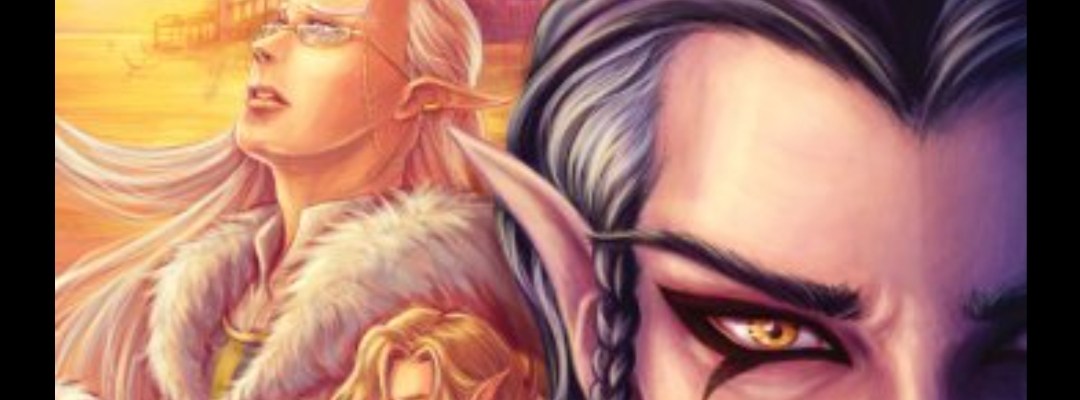
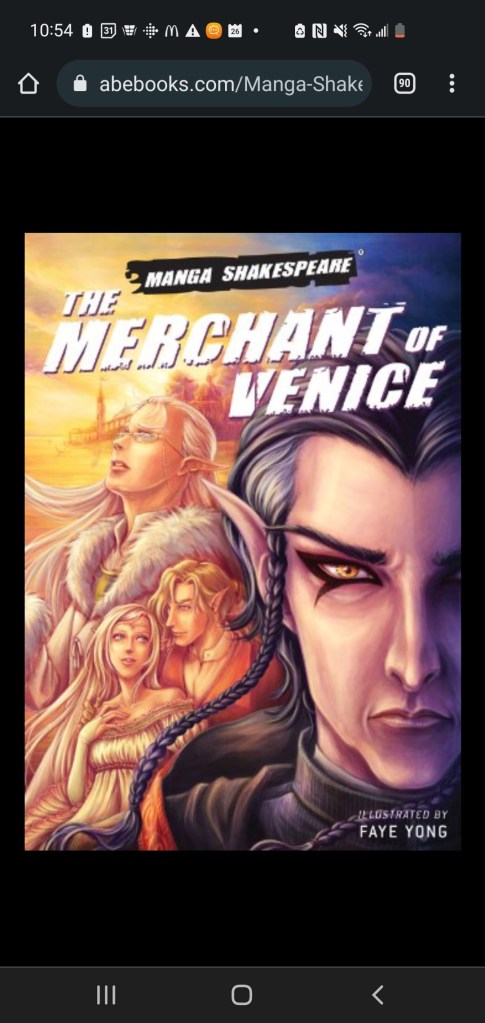
Graphic Novel Review: The Manga Shakespeare: “The Merchant of Venice.”

Shakespeare Review

In this section, I review a Shakespeare book, movie, or TV show that I feel has some kind of value, either as an interpretation of Shakespeare, or a means to learn more about the man and his writing.

  1. Name: The Manga Shakespeare– “Merchant Of Venice,” Illustrated by Faye Yong.
  2. Media: Graphic Novel compilation, with accompanying website https://www.mangashakespeare.com/titles/merchant.html
  3. Ages: Adult/ Teen. There’s some PG-13 language, and the subject matter touches on racism and anti-Semitism, so it shouldn’t be read by really young kids.
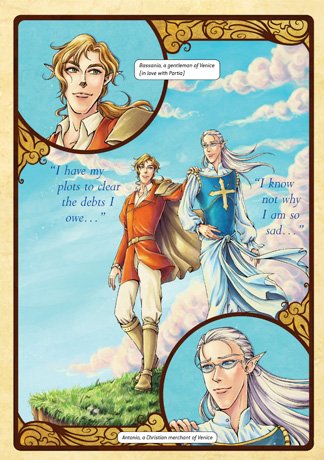
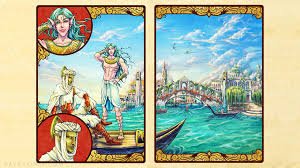
  4. Premise: Like the Midsummer Night’s Dream edition I already reviewed, this is the full play with Manga inspired illustrations. However, unlike Midsummer, this book is more conceptual. It reinterprets all the characters as either fairies, aliens, mermaids or merman, or some other fantasy characters. It is literally a fairy tale, which I find a fascinating concept for a number of reasons. That said, like any interpretation of Merchant, this choice is somewhat controversial for reasons I will get into below.

“A friend of mine said she got married in Venice and described it as like being in an RPG.”

Faye Yong, Illustrator for “The Manga Shakespeare: Merchant Of Venice.”


What Does Role-Playing Game (RPG) Mean?
A role-playing game (RPG) is a genre of video game where the gamer controls a fictional character (or characters) that undertakes a quest in an imaginary world.

Defining RPGs is very challenging due to the range of hybrid genres that have RPG elements.

Traditional role-playing video games shared five basic elements:

The ability to improve your character over the course of the game by increasing his statistics or levels.

A menu-based combat system with several choices of skills, spells, and active powers as well as an active inventory system with wearable equipment such as armors and weapons.

A central quest that runs throughout the game as a storyline and additional (and usually optional) side quests.

The ability to interact with elements of the environment or storyline through additional abilities (e.g. lockpicking, disarming traps, communication skills, etc.)

The existence of certain character classes that define the characteristics, skills, abilities, and spells of a character (e.g. wizard, thief, warrior, etc.)

-“RPG” Technopedia

   My reaction: I honestly don’t know what to think about the way the comic depicts races. In the interview above, illustrator Faye Yong explains how she chose a fantasy aesthetic for the graphic novel.

She read the script and represented the characters like the Prince of Aaragon, the Prince of Morocco, and re-interpreted them as fantasy characters. A good example is the Prince of Aragon. As you can see in this scene from the 2004 movie, Shakespeare portrays Aaragon as a vain, shallow person. Incidently, Aaragon is a province of Spain, over which the English just won a major naval victory, so Shakespeare makes this character a mockable popinjay since the Spanish were still the mortal enemies of the English:

Fay Yong wanted to heighten Aaragon’s vanity, so she made him a beautiful creature with long, flowing hair.

This is telling: Yong immersed herself with Shakespeare’s text, but she didn’t really delve into the real world context. She wasn’t interested in the real cultures of Aaragon, Morrocco, or even Venice, but to take Shakespeare’s impression of these cultures, and use Japanese style animation to tell Shakespeare’s story.
For most of the play, this approach works quite well. After all, Shakespeare depicts Portia and her home in Belmont as an almost ethereal place, where men come from far and wide to see this magical kingdom, and Portias father gets a prophetic vision on his death bed that makes him alter his will so that only someone who can decipher his riddle will get to marry Portia and inherit her estate. Like I said, the scenes in Belmont work very well as a Manga comic, particularly Bassanio’s Zelda-style fetch quest where he has to choose the right casket to marry Portia. I hope someone someday turns this idea into a real game.

Faye Yong (the illustrator of “Merchant,” shows how she designed and drew the character Portia).

However, the scenes in Venice don’t work as well because Shakespeare wrote them with a clear understanding of the real Venice, and the tensions between the Jewish and Christian communities. Details like Antonio’s anti-Semitism, Shylock’s fury at his daughter marrying a Christian, and Portia’s own racism and anti-Semitism is frankly erased when you view it out of the context of the real Venice.

Another example of questionable racial re-interpretation is theThe Prince of Morrocco, who like Aaragon, is a suitor to Portia who likewise fails to choose the proper casket and win Portia.

In Yong’s version, Morocco has green, rather than brown skin now, (sort of like Piccolo from Dragon Ball Z), which is problematic because we associate green with sickliness and that makes this speech of Morocco’s even more problematic:

Mislike me not for my complexion,
The shadow'd livery of the burnish'd sun,
To whom I am a neighbour and near bred.
Bring me the fairest creature northward born,
Where Phoebus' fire scarce thaws the icicles,
And let us make incision for your love,
To prove whose blood is reddest, his or mine

Not surprisingly, the most controversial illustration choices center around Shylock the Jewish moneylender. As I’ve written before, Shylock has always been a controversial figure, and this comic interprets him in a way I find simultaneously simplistic and highly thought-provoking.

Faye Yong has stated that she wanted to make Shylock look the same as the Christian characters, but that his garb would reflect a sort of “dark elf” aesthetic. She describes him as the sort of fantasy character that worships the moon, rather than the sun. On the one hand, I applaud her for not giving into the old Jewish stereotypes like red hair, hook noses, etc. I also have to admit that Shylock is sort of a dark vengeful figure (he is after all, the villain), so making him a dark elf works on the surface.

On the other hand, again, without the context of anti-Semetism, and the complex relationship between Jews and Christians in the 16th century, much of the Shakespearean text is devoid of meaning. Perhaps this is an attempt to make the play more easily accessible to young readers like teenagers, and I applaud that, but as I wrote in my post about why everyone should read or teach this play, learning about the historical context of real Jews is this play’s great gift, and that is lost in this version.

On the other hand, depicting Shylock like some kind of dark elf or warlock actually brings to life a very real aspect of anti-Semetic prejudice that many people overlook today: for most of western history, many of our stereotypes of Jews were interlinked with our stereotypes about witches!

Jewish Stereotypes and the Occult

So, ironically, much the same way Ian McKellen’s Richard III helped modernize the complex medieval politics of the 15th century, seeing Shylock as a semi-mystical, possibly occult figure, actually brings to light some of the prejudices that real Jews in the 16th century faced!

In conclusion, Merchant Of Venice is extremely hard to adapt in a comic book context, and some aspects are a little lost in translation. That said, it is gorgeous to look at, and it has a great visual shorthand that enlivens Shakespeare’s text in a unique and appealing way.

Recommendation: I’d recommend this book to all mature fans of Shakespeare, anime, Manga, D&D, or any kind of nerd stuff!

url
url
url

Grade: 3 Shakespeare globes.

  • Official Website: