Just in time for October, I’m offering an online class for kids ages 13-18 about Shakespeare’s most spooky and cursed play:
If you follow this blog you know I’ve written a lot about this play before. Though this class will be more like a game where I teach the class using multimedia, games, and a digital escape room!
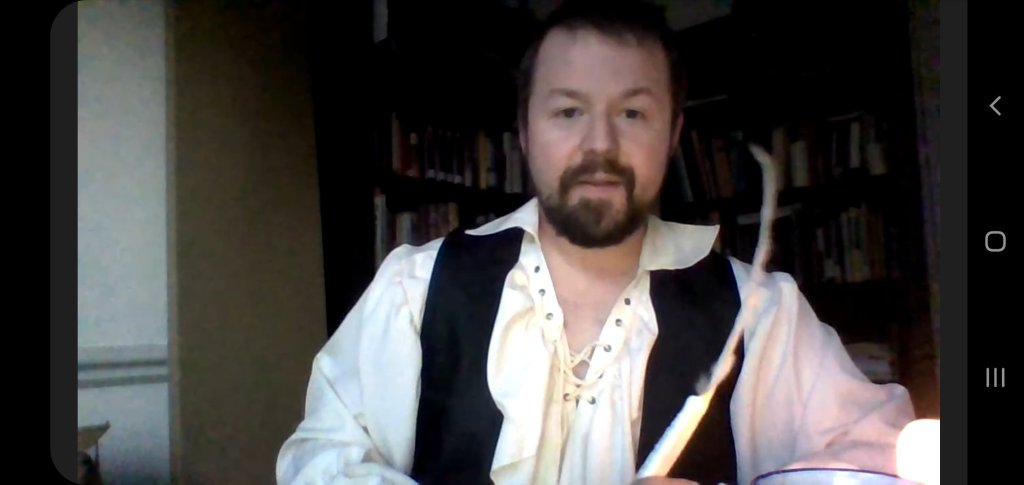
Me in my Shakespeare gatb
I’ll start by speaking to the students in character as Shakespeare, and tell them the story of Macbeth using a multimedia presentation.
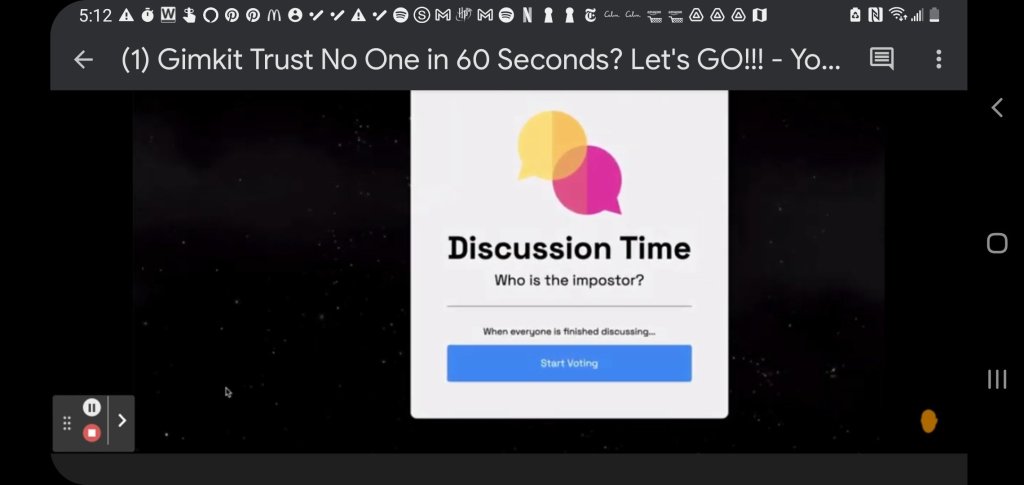
I will then test the students’ knowledge with a fun quiz that was inspired by the popular mobile game Among Us. As you know, the game is similar to a scene from the play, so I thought it would be an appropriate way to test the kids’ knowledge.
Screenshot from the Gimkit game “Trust No One.” Like Among Us, players need to figure out who the Imposter is, but they greatly increase the chances of surviving if they answer the quiz questions correctly.
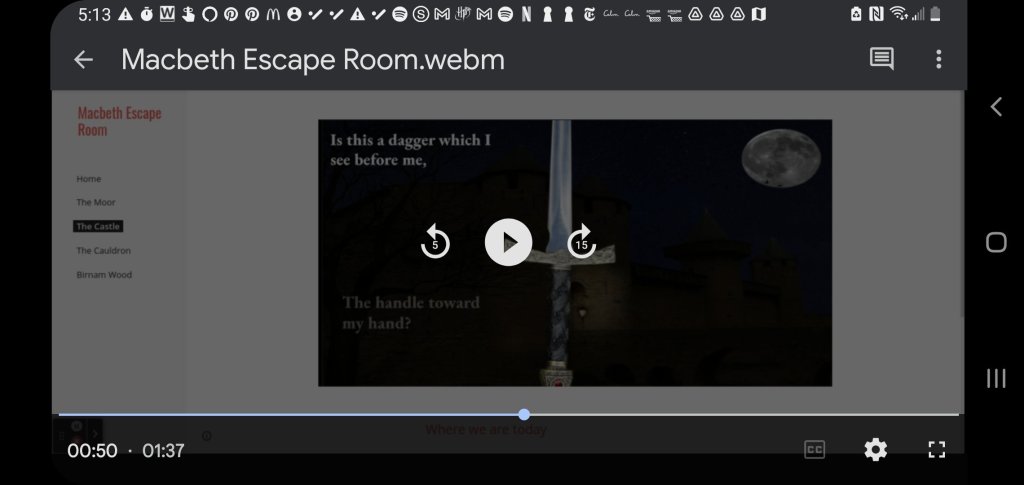
The final part of the class is a digital escape room I’ve created. I don’t want to give too much away, and you can’t play it unless you sign up for the class, but let’s just say it’s fun, spooky, educational, and challenging!
Screenshot from my Macbeth Escape Room.
If you want to sign up now, the course is available every weekend in October, and then by request after that. Register now at Outschool.com. if you take the course, please leave me a good review.
Trailer for my 2021 Acting course via Outschool.com
I’ve been working on a remote learning class for Outschool.com where I take some of the audition advice I wrote in Creating A Character: Macbeth, and some of the other acting posts I’ve published over the years. This will be a weekly virtual acting course for kids ages 13-18, starting September 12th at 10AM EST.
This class will outline the tools and techniques of Shakespearean acting such as projection, articulation, and imagination. Each We’ll also go over Shakespeare’s own advice on acting in his play “Hamlet: Prince of Denmark.” The course will culminate with the students choosing their own Shakespearean monologues and scenes, which they can use going forward in auditions, school plays, and classes.
The best thing about the course is that each week builds on the previous week’s experience, but you don’t need to go to all of them. I’ll be flexible and work with the student’s schedule so everyone gets as much out of the class as possible.
If you’re interested in signing up, go to Outschool.com. If you have any questions, email me by clicking here:
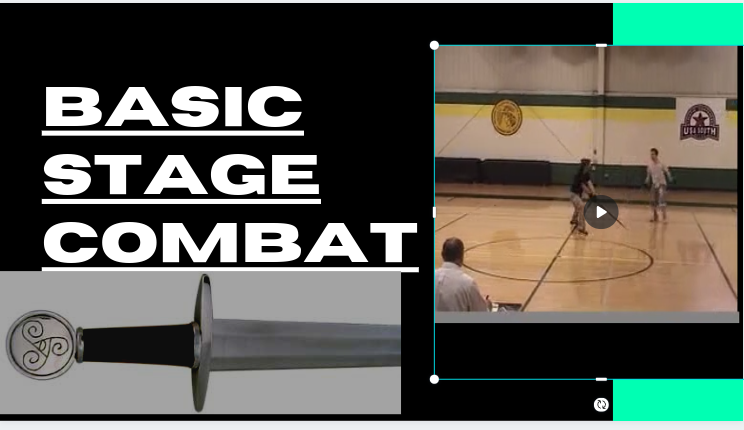
I’m teaching a series of online summer classes and I am very excited about this one in particular. I will teach a short class for kids ages 10-18, about duelling and swords. I will then explain basic stage combat moves, and finally choreograph a short fight for the students to do at home!
Registration starts now! Space is limited so go to Outschool.com, ASAP. Cost is $5 per child.
I’m working this summer with the good people at Outschool, an online learning platform for kids ages 3-18. I’m designing a series of Shakespeare classes that you can sign up for. We’ll be doing acting exercises, reading Shakespeare’s text, and making Shakespeare props Cost is $3 per child.
The course is ala carte, that is, you can sign up for as many courses as you like. Each course builds on the last one, but you don’t have to have taken the previous ones to enjoy any one particular course Let me know in the comments which class(es) you are interested in, and/or what suggestions you might have. I can’t wait to hear what you think about these summer Shakespeare courses, and I hope to see you online soon!
1. Introduction to Shakespeare- (enrollment here: https://outschool.com/classes/introduction-to-shakespeare-or-how-i-learned-to-love-the-bard-UoHH5fes?sectionUid=973060db-f857-461a-a23a-f1476203a544&showDetails=true) We’ll talk about why Shakespeare is so famous and learn about his life and career. Then we’ll do some fun quizzes that you can earn prizes based on how well you pay attention! 2. How to write ✍ like Shakespeare (Enrollment here: https://outschool.com/classes/how-to-write-like-shakespeare-0HuPq1Cg?sectionUid=4243af25-ba41-4724-82a2-61bd7c7d862e&showDetails=true) – Have you ever wanted to woo your sweetheart or write the next bestselling play? Well, this course will cover the secrets of Shakespeare’s writing. We’ll cover how to write romantic poems, the structure of Shakespeare’s plays, and you’ll get to write your own Shakespearean speeches! 3. Intro to Shakespearean acting Practical tips and tricks for your next Shakespeare audition. 4. Shakespeare’s villains We’ll look at the darkest and creepiest Shakespearean characters and see why they still fascinate us today! 5. The Violent Rhetoric Of Shakespeare’s Julius Caesar (Registration Here: https://outschool.com/classes/the-violent-rhetoric-of-julius-caesar-fkMLbAtA?sectionUid=1f9220cd-8c28-438d-9799-8479494353a4&showDetails=true#usMaRDyJ13) In this one-time course, students will analyze the rhetoric and persuasive power in two speeches from Shakespeare’s “Julius Caesar” 6. Intro to Romeo and Juliet – Get a leg up on your next English class with this fun, frenetic look through the characters, themes, and story of Shakespeare’s most popular, and most-taught play. 7. Basics Of Stage Combat (Registration here: https://outschool.com/classes/1120ada2-047d-4b0f-84f6-5eb4b0f7dc66/schedule#usMaRDyJ13– I’ll teach the kids about Elizabethan street fighting, and the basics of stage combat. 8. The Balcony Scene of Romeo and Juliet– It’s been called the greatest love scene of all time, but why? I’ll explain the imagery, the poetic language, and give you a chance to make your own love poetry! 9. Insults and Shakespeare You’ll craft your own Shakespeare insults and engage in a (respectful), beat down with your classmates! Along the way, we’ll talk about how insults escalate to violence in Shakespeare’s Romeo and Juliet. 10. The Iconic imagery of Romeo and Juliet We’ll look at some beautiful paintings, songs, and other works of art that build on Shakespeare’s poetic imagery. 11. Romeo and Juliet and pedagogy Shakespeare is uniquely challenging to get kids to engage with. I’ll give you some of my resources, games, and activities to help you delve into the play in your next class.
If you like these courses, let me know by leaving a comment below. If you’re interested in signing up, visit my teacher profile page: https://outschool.com/teachers/The-Shakespearean-Student. New classes will be added every week, and I’ll work around your schedule when planning the dates and times. Hopefully this will be a great chance for me to share my expertise with a young group of future Shakespearean students!
I played this character back in 2010 as a college production and not to brag, but I want award both for my performance and also my role as dramaturg for that particular production, so I did a lot of research in into the character and I tried to bring my own spin on the part. So unlike my other Crafting a Character posts, I am going approach explaining the character as a series of questions instead of talking about it https://youtu.be/-ocOfP16tdw
Who Is Friar Lawrence?
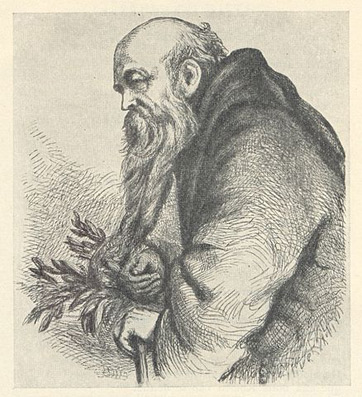
Concept art for Friar Lawrence, including a photo of Pete Postelwhite in the 1996 movie
A friar is a monk who belongs to a local monestary. Francis belongs to the Franciscan orders created by Saint Francis of Assisi. It was known for its naturalist philosophy, and St Francis himself is often depicted in paintings as being friends with birds and rabbits and things like that. He was also a strict vegetarian and believed the spirit of God is in all creatures.
Francis’ work was a reaction to the other orders of Catholic monks who, the Franciscans believed, had gotten corrupt and lustful. So the Franciscans in reaction to that corruption, tried to embrace poverty, plain living, and duty to the poor.
The Franciscans were also famous for not wearing shoes; Shakespeare calls one of them “[our] barefoot brother.” Again, the Franciscans value humility before God, and because of that, they shaved off part of their heads, (known as a tonsure hairstyle); it was way of stating that they were not concerned with their appearance, (so yes, it’s supposed to look stupid).
Why does Romeo hang around him? Friar Lawrence is supposed to be Romeo’s tutor, but really he is in the play because Shakespeare needed a convenient way to get Romeo married to Juliet without his parents finding out. He is also a neutral party who can be sympathetic to both Romeo and Juliet, without being tangled in the politics of the Capulet/ Montegue fued.
Romeo persuades Friar Lawrence to help him marry Juliet in Act II, Scene iii.
Friar Lawrence also acts as a character foil to Romeo. While Romeo is rash, passionate, and impulsive, Friar Lawrence is calm, slow, and contemplative, (appropriate qualities for a monk). During my production of Romeo and Juliet, the director beautifully explained their relationship by having Romeo trip and fall when he is excited about his impending marriage. I as Friar Laurence turned around and said calmly: “Wisely and slow, they stumble that run fast.”
My Interpretation Shakespeare makes references again and again to the character being old, yet the director and I made a conscious choice not to portray him as such. I portrayed him as just a few years older than Romeo, who is supposed to be a teenager. I played him as sort of about 25-26, the same age that I was when I played the part.
We did this because even though Friar Laurence acts as the voice of age and experience, he also seems very naive. He seriously believes that he can singlehandedly stop the feud between the Montegues and Capulets with one marriage. he never consults anybody else, and he leaves Friar John in charge of sending the all important letter to Romeo that Juliet is not dead, and never checks up with him on that.
Rather than being an old priest who is aged and experienced, I portrayed him as a young idealistic priest who doesn’t know better. In some ways, his love of God has blinded him as much as Romeo’s love for Juliet. The Friar thinks that being a peacemaker is something that God wants him to do. He thinks that bringing together souls is part of his heavenly mandate and he doesn’t think about the practical consequences of his religious fervour.
What is his role in the play?
Friar Laurence engineers the plots to get Romeo married to Juliet and hopefully settle the feud. When we first meet him, Romeo convinces Friar Lawrence to perform a secret wedding between Romeo and Juliet (Act II, Scene iii).
“Romeo shall thank thee daughter, for us both,” Romeo and Juliet, Act II, Scene v.
In Act II, Scene vi, Friar Lawrence secretly marries Romeo and Juliet, but first warns them to “Love moderately,” because he believes that an over abundance of passion can have disastrous consequences. He even compares Romeo and Juliet’s love to gunpowder.
In Act IV, Friar Lawrence has two scenes where he stops Romeo and then Juliet from killing themselves. First he stops Romeo, filled, with grief and remorse after murdering Tybalt, and being banished.
“What, rouse thee man, thy Juliet is alive!” “Juliet, I already know thy grief…”“Come you to make confession to this father?” Paris (Matt Bugay) meets Juliet (Alesia Lawson) outside of Friar Lawrence’s cell, Act IV, Scene 1.
In Act IV, Scene iii, Friar Lawrence concocts his plan to give Juliet a secret potion with which to fake her death. Juliet demands that he find a way to prevent her marriage to Paris or she will kill herself.
“The heavens do lour upon you for some ill.”In Act V, Scene ii, Friar Lawrence learns from Friar John that his message that Juliet is alive, never reached Romeo. “A greater power than we can prevent…” Friar Lawrence delivers the bad news that Romeo is dead, Act V, Scene iii.
Is Friar Lawrence To Blame For Romeo and Juliet’s Death?
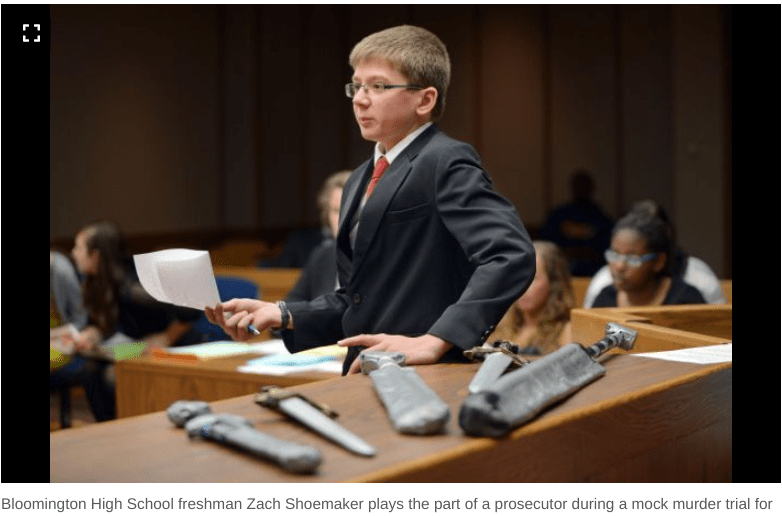
A lot of scholars, teachers, and classrooms have pondered this question. In addition, even the Supreme Court of the United States put Friar Lawrence on trial in 2016 as part of a mock trial sponsored by the Shakespeare Theater in Washington DC. https://www.c-span.org/video/?419930-1/federal-judges-discuss-romeo-juliet
I am actually working on my own mock trial activity which I will share by the end of this month, but for right now I will summarize the major arguments:
The Defendant (Friar Lawrence) tried repeatedly to prevent Juliet and Romeo from committing suicide. In Act III, when Romeo tries to stab himself, Friar Lawrence stops him and convinces him to go to Mantua:
Romeo. O, tell me, friar, tell me,
In what vile part of this anatomy1985
Doth my name lodge? tell me, that I may sack
The hateful mansion.
[Drawing his sword]

Friar Laurence. Hold thy desperate hand:
Art thou a man? thy form cries out thou art:1990
Thy tears are womanish; thy wild acts denote
The unreasonable fury of a beast:
Thou hast amazed me: by my holy order,1995
I thought thy disposition better temper'd.
Hast thou slain Tybalt? wilt thou slay thyself?
And stay thy lady too that lives in thee,
By doing damned hate upon thyself?
Likewise in Act IV, Friar Lawrence stops Juliet from killing herself and gives her the vial of sleeping potion.
“Be not so long to speak, I long to die!” Juliet (Claire Danes), begs Friar Lawrence to divise a plan to prevent her marriage to Paris in the 1996 movie.
Throughout the play, Friar Lawrence attempted to keep Romeo and Juliet alive and together, but was thwarted by what could legally be interpreted as and ‘Act of God’:
Passage from Act V, Scene ii.As this slide shows, the reason Friar John was unable to deliver the message to Romeo is that he was in quarantine. A literal “Plague on both your houses,” has indirectly killed Romeo and Juliet
What the prosecutor might say-
Friar Lawrence performed a marriage illegally, without consulting the parents of two minors. He also harbored a fugitive (Romeo), right after he was found guilty of murder. Finally, he tried to deceive Juliet’s parents by giving her a dangerous drug. On paper, though Friar Lawrence was certainly acting out of compassion for Romeo and Juliet, his actions were highly suspicious and could be considered criminal.
An English class can learn a lot putting Friar Lawrence on trial for his role in Romeo and Juliet’s deaths, as long as they are responsible in the way they portray teenage suicide.
Who Originally Played Friar Laurence?
I don’t have any substantial evidence to prove this but I do of have a theory: some of Shakespeare’s parts require a great amount of stage business; singing, dancing, swordfighting, improvising that kind of thing. Hamlet for example has to sing, dance, sword fight, and remember copious amounts of speeches and dialogue. Will Kempe had to dance and dance and sing. Robert Armin had to improvise and dance with the audience.
My theory is Shakespeare didn’t have time to learn extravagant stage business, since he was also writing the plays and helping with the company’s business dealings. With this in mind, he probably gave himself the parts that had long speeches. That’s why I think that Shakespeare himself might have played friar Laurence.
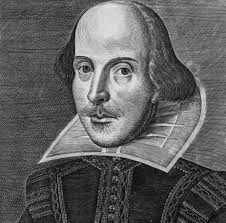
Plus Shakespeare had an edge playing the role over other actors. Since friars are supposed to shave their heads, and since we know that Shakespeare had thinning hair, he could have easily played the part himself.
So those of you who get cast as Friar Laurence and wish that you were cast is somebody young like Romeo or Tybalt, at least your consolation prize is that you might be playing the part that Shakespeare himself once played.
I hope you found this insightful and maybe helpful if you find yourself cast in Romeo and Juliet. I’ll be sure to post about the Friar Lawrence mock trial I’m currently working on. At the very least, I hope this information helps you see Friar Lawrence as more than an old guy who hangs around teenagers.
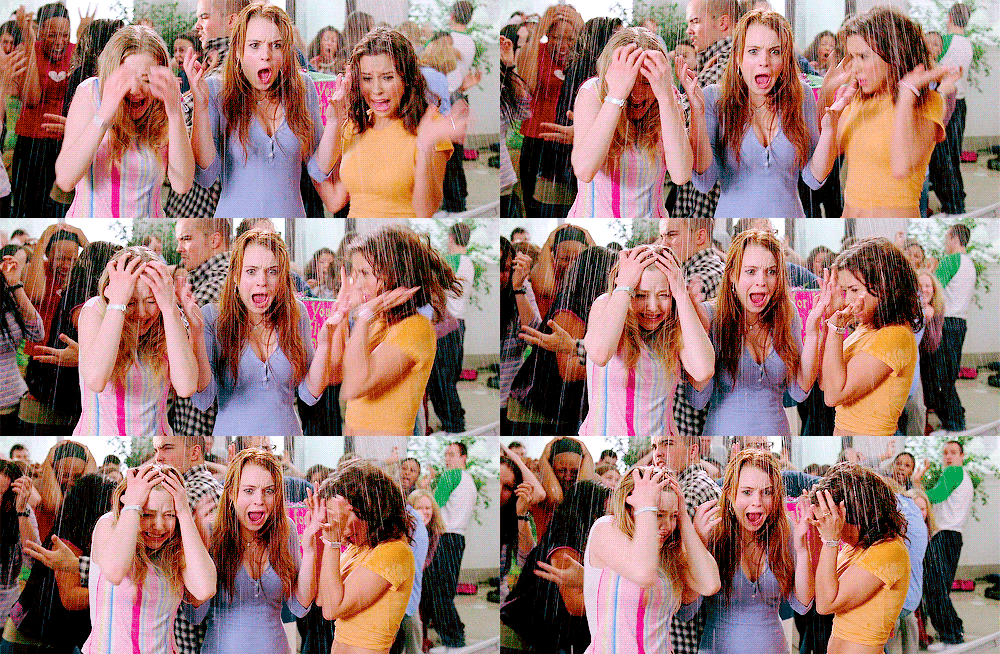
As you probably know if you subscribe to this blog, I love to review adaptations of Shakespeare, so imagine my delight when I realized that the classic teen comedy Mean Girls from 2004, (and the current Broadway show of the same name), is based on Julius Caesar! This movie doesn’t have Shakespearean dialogue or the names or locations, but the essence of the play is the same, albeit with a more modern ending.
In Shakespeare’s play and Tina Fey’s script, the main antagonist is popular, and dangerous, and inspires fear and envy from everyone. Regina George and Caesar both rule their empires through their armies, intimidation, their wealth, and their supreme self-confidence. In addition, both names are associated with royalty- Regina in Latin means queen.
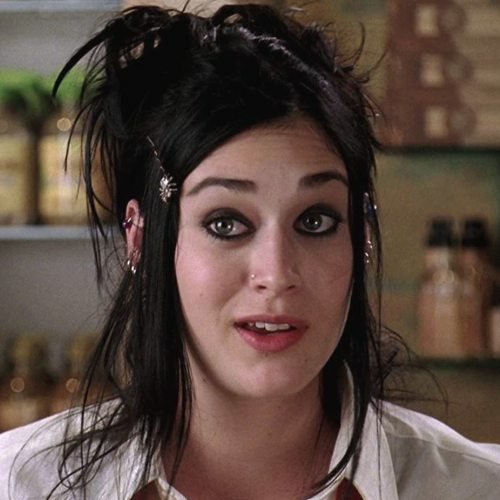
I didn’t realize that the movie has its roots in Julius Caesar until I saw this video from the YouTube channel The Take: https://youtu.be/FRfoEzZbK_Y. It was when I watched this video, that I realized Mean Girls character Janis was an analog for Shakespeare’s character Cassius, the man who sets the plot in motion to assassinate Caesar.
In the movie, Janis meets a well meaning girl and manipulates her into betraying Regina. Look at this clip where after Cady feels betrayed by Regina, Janis outlines her conspiracy, with a Roman sword in her hand! https://youtu.be/D0JMoa4QfA0
Like Cassius, Janis claims that once Regina is destroyed, the social order of the high school will change from a dictatorship to a democracy, but what she really wants is to supplant and replace Regina and make herself the new queen Bee. Even her name is a clue to her malevolent nature, she is named after the Roman god with two faces!
Sir Patrick Stewart as Cassius in the 1972 RSC production of Caesar
Similarly in Julius Caesar, Cassius convinces Brutus that once Caesar dies, Rome will be a republic again. In real life, Brutus was Caesar’s close friend, so Brutus agonizes over whether he is doing the right thing and whether he owes more loyalty to Rome, or his friend Caesar: https://youtu.be/IoDwXjKIenI
If Janis is Cassius, what about Brutus?
Cady Heron (played in the movie by Lindsay Lohan), is naive but intelligent. Like Brutus, she is manipulated and carefully chosen to betray the king. Janis chooses Cady because she’s pretty enough to get close to Regina, her looks are like social currency. Brutus’ social currency was his family: he was descended from the founder of the republic so he lent credibility to the conspiracy. He was also close in family to Caesar and Cassius.
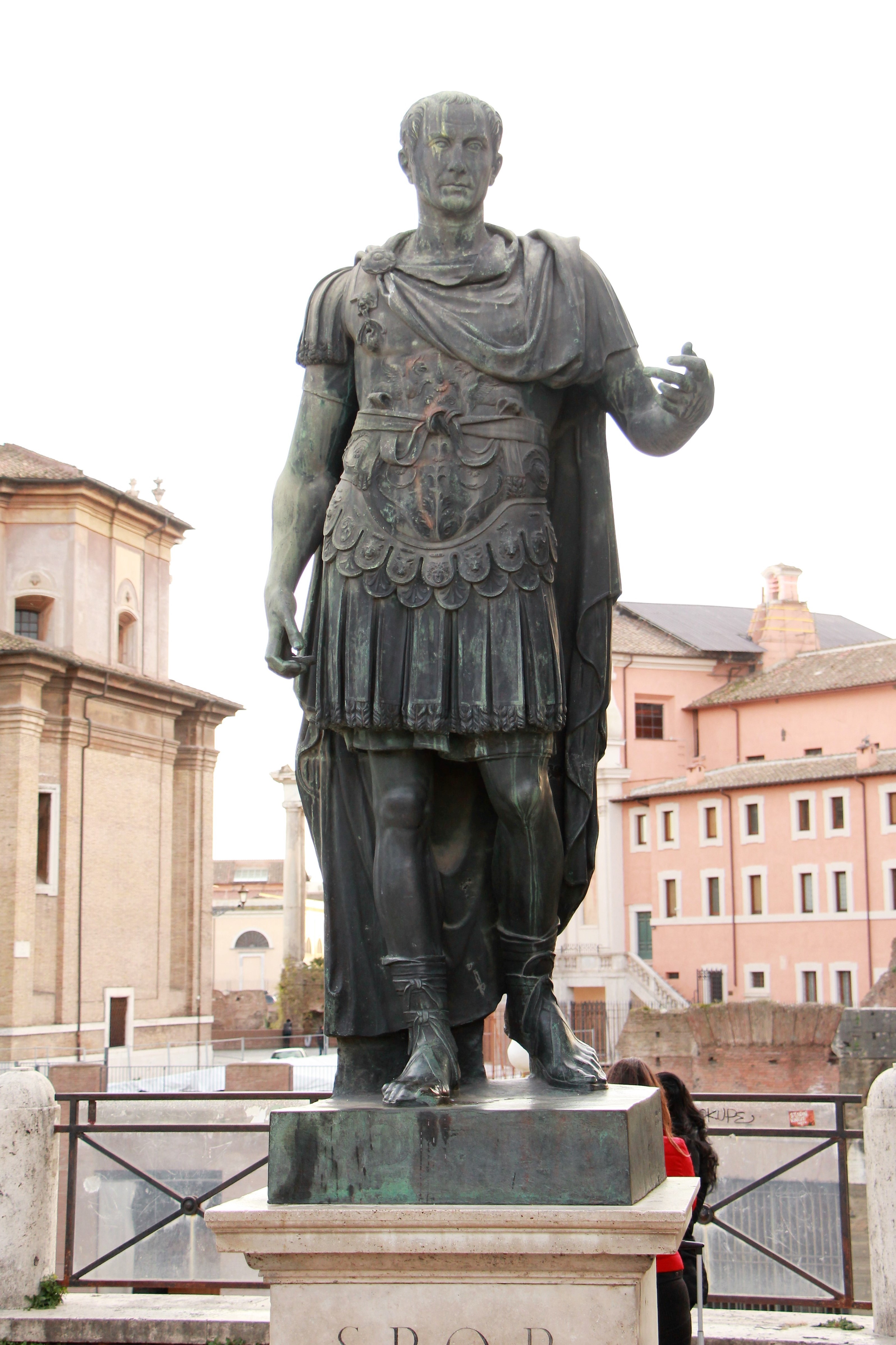
In both stories once the monarch is destroyed, the power vacuum immediately starts to close; rather than change the social order, a new monarch arises. In Caesar, the second triumvirate takes over for the first, and Caesar’s nephew Augustus eventually becomes the supreme ruler of the Roman empire.
In Mean Girls, once Regina loses her social cache, Cady takes her place.
Then when Janis exposes Cady and Regina, she briefly basks in becoming a new Queen Bee- her revolution to overthrow a tyrant has paid off, bit now she is the tyrant herself. This actually mirrors the real Julius Caesar, who took power from the feared dictator Lucius Cornelius Sulla.
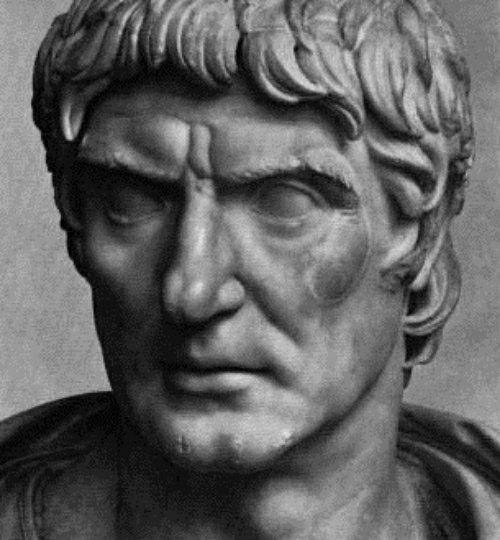
Bust of Sulla
Like Regina and her Burn Book, Sulla kept a list of people he saw as threats called the Proscriptions, only Sulla used it to execute the people on the list and seize their property. Caesar started his career as a populist soldier working for the Senate against Sulla and for the people, but became a dictator himself, the very thing he was sworn to oppose!
The movie does end on an encouraging note when the adults finally step up and address the terrible things that their students are doing, which has important lessons about bullying that every young person should see.
Tina Fey actually admitted that she herself was a Mean Girl in high school, so there’s a great deal of honesty when her character confronts the kids about the consequences of bullying each other.
Though the movie ends happily, the Cesarian parallels are not over; even though this high school has been democratized, the problems that created this Mean Girls autocracy remains. As you can see in the final minutes of the movie, a new crop of Plastics arrive just as the old group disbanded.https://youtu.be/LshX2God-wkIn four years when the regime changes again, will there be a new Caesar?
After rewatching clips from the movie, I realized that Tina Fey actually made a Caesar reference right there in the movie!
In this clip, Gretchen is in English class, perfectly paraphrasing Cassius’ speech in Act I, Scene ii, even the part about Caesar being a colossus:
Cassius. Why, man, he doth bestride the narrow world
Like a Colossus, and we petty men
Walk under his huge legs and peep about
To find ourselves dishonourable graves.
Brutus and Caesar: what should be in that ‘Caesar’?
Why should that name be sounded more than yours?
Write them together, yours is as fair a name;
Sound them, it doth become the mouth as well;
Weigh them, it is as heavy; conjure with ’em,
Brutus will start a spirit as soon as Caesar.
Now, in the names of all the gods at once,
Upon what meat doth this our Caesar feed,
That he is grown so great? Age, thou art shamed!
Rome, thou hast lost the breed of noble bloods!
When went there by an age, since the great flood,
But it was famed with more than with one man?
When could they say till now, that talk’d of Rome,
That her wide walls encompass’d but one man?
Now is it Rome indeed and room enough,
When there is in it but one only man.
O, you and I have heard our fathers say,
There was a Brutus once that would have brook’d
The eternal devil to keep his state in Rome
As easily as a king. I.ii. 226-252.
Now I know Mean Girls is based more on a book and by Tina Fey’s own experiences than Shakespeare, but the point is that the next time you are bored and angry about having to read a play based on a guy who’s been dead for over 2,000 years, take a look at the lunch table next to you and you’ll see that things haven’t changed that much.
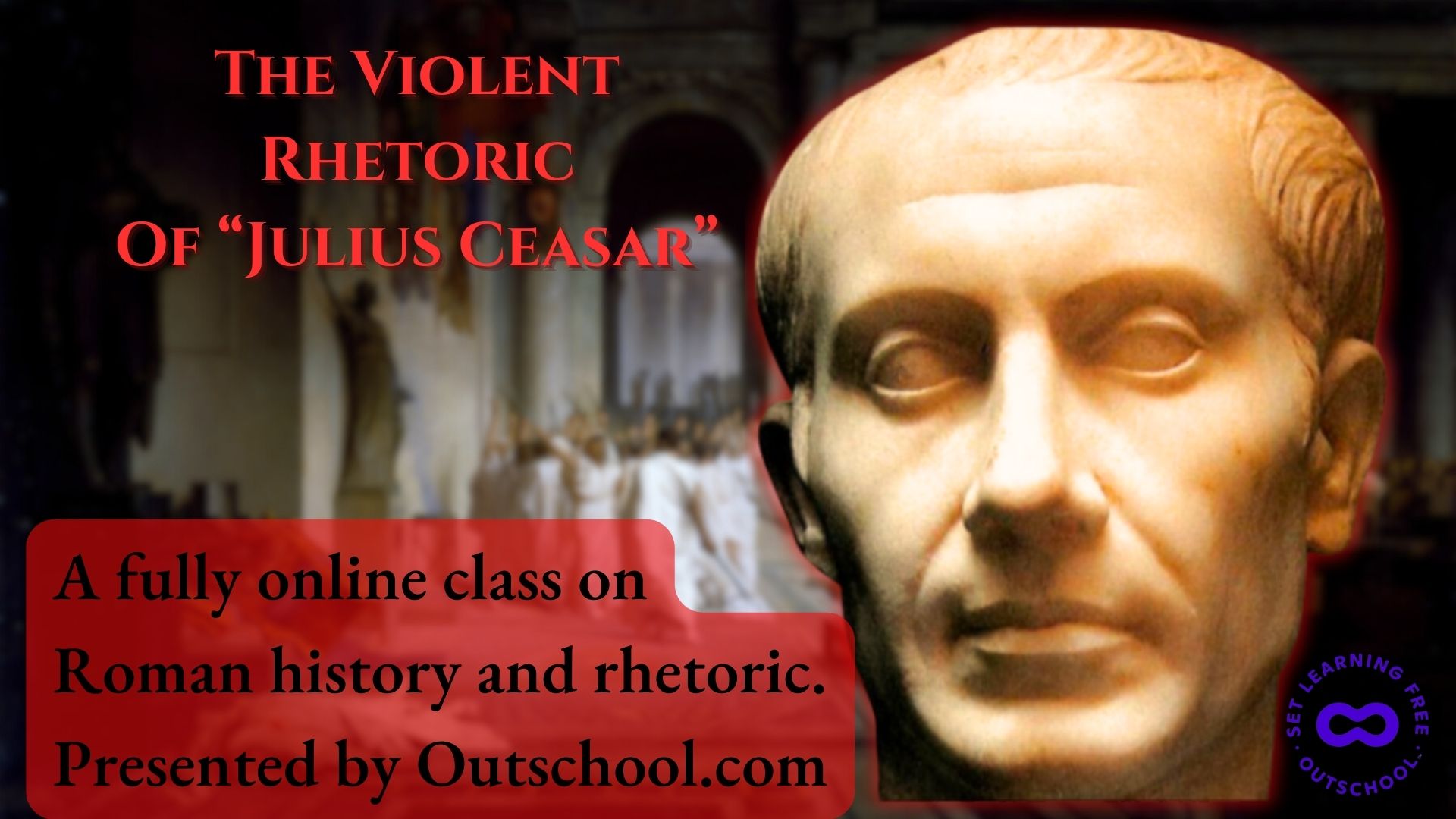
The class breaks down some of the most famous speeches in Julius Caesar and gives you some tips and tricks on how to write persuasive speeches like Antony’s “Friends, Romans, Countrymen,” speech. Use these powers for good though, not to turn your school into a Mean Girls dictatorship! https://outschool.com/classes/84ee847d-19f3-45f8-9f25-81e688b8497d
There’s also a fully asynchronous version that you can do on your own time whenever you want:
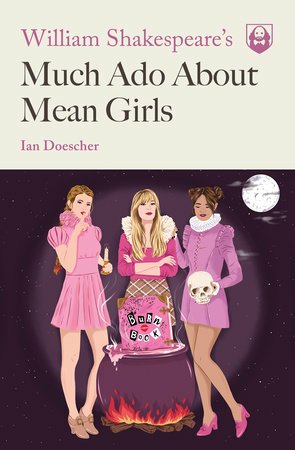
Finally, if you love Mean Girls and Shakespeare, check out Much Ado About Mean Girls by Ian Doescher, author of the William Shakespeare’s Star Wars trilogy.














 The Shakespearean Student