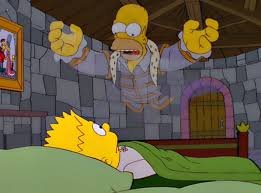
So, why Ghostbusters? Well, as William Shakespeare’s Star Wars has shown, it’s not only fun to adapt popular stories into Shakespearean parodies, it can also be educational. I knew I wanted to do a short play for my school’s fall festival, but I didn’t think to do “Ghostbusters” until I saw the final joke in the Simpson’s parody of Hamlet, where Homer says: “Son, [Hamlet] is not only a great play, but also became a great movie, called Ghostbusters!”
This joke got me thinking- Hamlet has a comic scene where the prince and his two friends are running around the stage away from a ghost, one that refuses to speak to them and then terrifies them. This reminds me of the moment where the ghost of the librarian shushes the heroes, and becomes a hideous creature:
The librarian in Ghostbusters is similar to the Ghost of Hamlet’s Father.
From this realization. I took it as a personal challenge to adapt Ghostbusters into a one-act stage play with as much Shakespearean dialogue as possible.
My Process
Re-writing the script of a movie into a Shakespeare text required me to overhaul the story of Ghostbusters, as well as retrofitting Shakespearean lines and speeches from Hamlet, Macbeth, Henry IV & Henry V. I knew I wanted to freely cut-and-paste from Shakespeare, as if he’d written the original Ghostbusters. The result is a sort of stitched together blanket of Shakespeare lines, lines adapted from Ghostbusters, and some lines I created myself.
The Outline
Like I said, I kept the story limited to how the four Ghostbusters learn that ghosts are real, become professional ghost catchers, and then receive a call from a damsel in distress (Ms. Dana Barrett), who allows them to become heroes by defeating the ghost that has possessed her. I also decided to use the commercial in the movie as a framing device:
In my version, the Ghostbusters start by doing a commercial that then becomes a flashback where the heroes recap everything that has happened to them over the past week. I then ended the play by joking referring to the play as “A very long commercial.”
Scenes I Included/ Scenes I Cut
I only had 30 minutes allocated for my show, so I knew I’d have to pare down the story to its bare bones. This meant I had to eliminate a lot of subplots and characters and condense several scenes. As much as I love Walter Peck, Dean Jaeger, Louis Tully, Janine Melnitz, and the guy who gets electrocuted, they are not absolutely essential to the plot, so I cut them from my version. I also combined the characters of Dana and Gozer, eliminating the two terror dogs and limiting the antagonists to Gozer and the Stay Pufft Marshmallow Man. So I watched the film a few times, and created an outline of just 7 scenes.
Character Models
One thing I’ve said again and again is that Shakespeare’s characters are all based on archetypes that we see everywhere throughout literature, theater, and yes, movies. While I was watching Ghostbusters, I tried to find the Shakespearean archetypes that match the best with the characters in the movie:
Ray Stantz- Hamlet from Hamlet– Ray is a bookish man who is obsessed with death and with the occult, which makes him very much like the scholarly Prince Hamlet. He’s also a man on a mission to try and understand the supernatural and help keep it from destroying our world. Dr. Venkman describes him as “The heart of the Ghostbusters”, and that humorous heart gets him into trouble sometimes.
Egon Spangler- Horatio from Hamlet If Ray is the heart of the team, Egon is the brain. He is the no-nonsense scientist who provides the team with data and equipment to help them fight ghosts effectively, much like how Horatio reports to Hamlet that his father’s ghost has returned from the grave.
Dr. Venkman– Sir John Falstaff/ King Henry V
Dana Barret- Ophelia from Hamlet
Gozer– Hecate from Macbeth
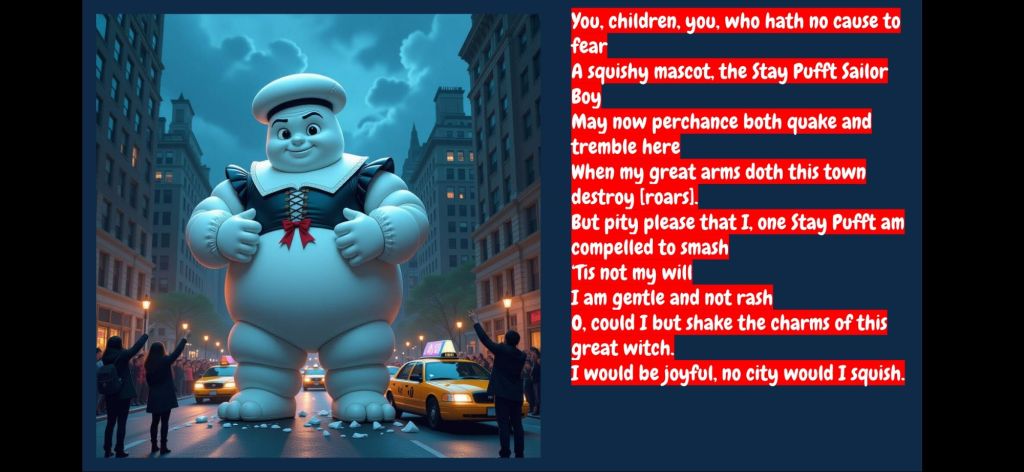
The Stay Pufft Marshmallow Man- Snug the Joiner from A Midsummer Night’s Dream
Sneak Peak
Here’s one of the scenes I wrote, with the original scene for context
[The ghostbusters climb the stairway to the penthouse, where Gozer is sitting in a cloud. They have been going for a while and are clearly tired]. Venkman: Though I have not known fair Dana long, I know she must be a virtuous maid. Ascend this penthouse tower and let’s rescue she! Like to the Knights of ancient chivalry! Egon: These apparitions whizzing in the air Give so much light that I may read by them. [They reach the top and behold Gozer] Ray: I am resolved to speak to Gozer. This is the latest parle we will admit. Gozer: Art thou a god? Ray: Nay. Gozer: Then perish, half-man! Winston: Enough Ray of thy diplomacy! Speak, thou proton pack for me! [He fires, then the rest join in] Gozer disappears Venkman: The sky hath bubbles as the water hath, and she be one of them! Gozer [in Voice Over]: Sub creatures! Hark! Tis time! Pick the Destructor’s form Be it a Goblin damned or angel bright! Tornado or a earthy bright Or greatest Monkey with an appetite! Winson: Our thoughts contain the form that seals our doom? Then make them blank as a new-made room! [They all gesture to their heads as if pushing thoughts out] Gozer: Thy choice is made. Prepare to meet thy doom! Venkman: Nay! I chose nothing Winston: Nor I! Egon: Nor I [Pause] All: Ray? Ray: Twas not my fault! It popped into my mind Venkman: What? What hast popped in? Egon: LOOOK!!!
Stagecraft has a fascinating and interesting history. The way we portray spectacle on stage has changed a lot since the advent of television and movies, which utilize computers and animatronics, etc. to create impossible things that could never be is shown live. In a way, the pre-recorded nature of film and TV gives theater practitioners an advantage because the more clever they are with their stagecraft, the more impressive it is for the simple fact that it is live- happening right now in front of an audience.
What I want to do with this post is to speculate whether, with the technology of the time, if Shakespeare could have used some kind of visual spectacle to portray otherworldly creatures, such as the ghosts in Hamlet and Macbeth
The conventional wisdom
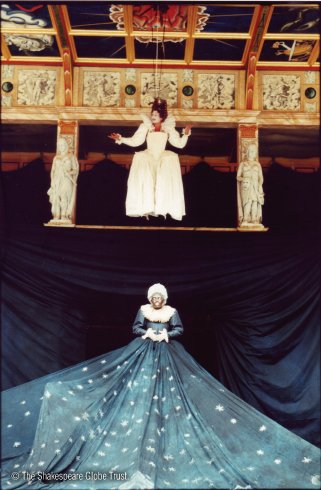
Contemporary accounts of the Globe theater mention two trap doors, one in the ceiling for angels and gods, and one in the floor for ghosts or devils.
Most books I’ve read on Elizabethan stagecraft say that the theaters of this era were very minimalistic in design. They had trap doors, they had galleries, they had a primitive flying rig, and they had music and some simple sound effects, but most of the experience was watching the actors, their costumes, their bodies, and hearing their voices hence ‘audience’- audio, “To hear.”
Professor Stephen Greenblatt of Harvard University explains the way the ghost probably haunted the Globe Theater in 1600.
We are told there wasn’t much visual representation of spectacle and fantasy on Shakespeare’s stage, which which is is odd because there are some pretty fantastical elements in his plays, especially Hamlet and Macbeth, where the former calls for a ghost and the latter calls for a ghost, witches, and a literal goddess to appear on stage. How may one ask, was this achieved back in Shakespeare’s day, the late 1590s and the early 1600s? The conventional wisdom is that the ghosts in Hamlet and the ghost in Macbeth came through a trap door in the stage known as Hell.
If you’re you go to the Globe now you can see this actual trap door being used. It used a primitive pully system to open up in the middle of the floor. The ghost would ascend to the stage through a small step ladder. Hamlet’s father’s ghost is described as wearing a suit of armor and being very pale. Banquo’s ghost is described as having long hair dappled with blood.
Banquo’s ghost appears during a banquet in Macbeth’s honor. Based on this hypothesis it’s likely that a banqueting table was brought out into the middle of a stage to conceal the ghost, to make it more of a surprise when it ascends onstage through the trap door, but the effect to modern taste would be rather dull. However impressive the performance, this cannot stand up to the stunning nature of visual effects using computer technology, motion capture, et cetera. I wanted to see if there are any Elizabethan theatrical illusions that would still have been accessible to Shakespeare back in the 1590s.
Idea #1: A Smoke-monster ghost?
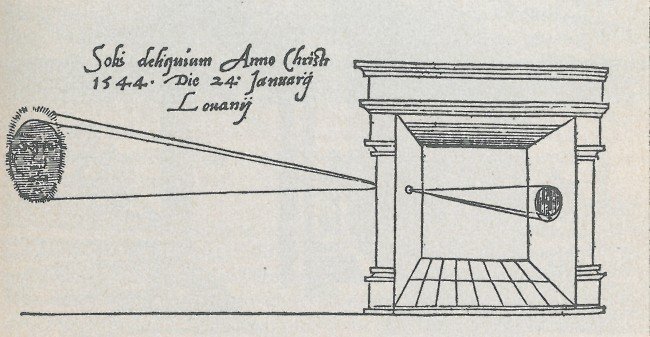
My research began with this video from the YouTube History Channel Atun-Shei Films, where the author traces the history of film, (both as photography and film as a projection). He cites at the start, an incident in 1536 where a supposed necromancer appeared to conjure a ghost for an unsuspecting rube. According to The Lives Of the Necromancers, the solution was achieved by creating huge clouds of smoke within the theater space, (which was the Colosseum) and then using a primitive camera obscure to project a frightening image Into this space.
Sketch for an early camera obscura, dated 1544 by Leonardo Da Vinci.
Camera Obscura is a term is it Latin for dark chamber the principal had been discovered for century had existed for centuries bit is for centuries but only in the 1530s this was the 1st recorded example of it being used to create a theatrical illusion.
The question is, could Shakespeare’s company have performed the same illusion with the technology of the day? Honestly, I find it rather unlikely that Shakespeare’s audience would’ve put up with huge clouds of smoke in a wooden amphitheater. Still, the fact remains that primitive projection technology existed back in Shakespeare’s day, which means a director could reasonably implement it in a production of Hamlet or Macbeth, even under the constraints of Original Practices.
Theoretically, Shakespeare’s company could have crushed this rock into a powder and made it into a paint that glowed onstage. There is precedent for this- in The Hound Of the Baskervilles, Sherlock Holmes discovers that the terrifying ghost-hound is merely a large dog painted with phosphorescent paint:
In mere size and strength it was a terrible creature which was lying stretched before us. It was not a pure bloodhound and it was not a pure mastiff; but it appeared to be a combination of the two–gaunt, savage, and as large as a small lioness. Even now in the stillness of death, the huge jaws seemed to be dripping with a bluish flame and the small, deep-set, cruel eyes were ringed with fire. I placed my hand upon the glowing muzzle, and as I held them up my own fingers smouldered and gleamed in the darkness.
“Phosphorus,” I said.
“A cunning preparation of it,” said Holmes, sniffing at the dead animal.
Doyle, Part IV.
Though this paint would potentially make a terrifying effect, this would be impossible at an outdoor theater during the day. This makes it unlikely that Shakespeare used glow-in-the-dark paint at the Globe, as most of the performances took place in the afternoon. That said, both Hamlet and were written just at the point in which Shakespeare’s company was in the process of acquiring an indoor theater, the Blackfriars.
The Blackfriars and Shakespeare’s stagecraft
Almost all of these ideas would depend on Shakespeare having access to a theatre in which he could control the lighting. As you can see, the Blackfriars was lit with candles and its indoor nature meant that performances weren’t dependent on sunlight. Greg Doran, former director of the Royal Shakespeare Company has theorized in the past that maybe while his company was preparing to move into the Blackfriars, Shakespeare was changing his material to make it both literally and figuratively darker.
In the reconstructed Blackfriars, (where I studied and interned for three years), there is a trap-door and flying rig like the Globe, so the conventional trap-door ghost can and has been utilized there. I would also argue that in the Blackfriars unlike the Globe, there was a chance for more variety of theatrical illusions- perhaps a smoke projection, magic lantern, or even…
Idea 3: A Pepper’s ghost
A Peppers Ghost is a stage illusion that dates back to the 19th century. It uses the principle of refracted light to project the image of a ghost on top of a piece of glass. This image will appear translucent and could be very impressive to an audience at the Blackfriars! As you can see in the diagram below, the actor could be under the stage in the trap door standing in front of a mirror, and the glass sheet could be used to project his image to the audience. The only concern would be that this could limit the blocking of the other actors, and it might not make the ghost visible to the audience members in the upper galleries, but it would still be an impressive visual effect that uses scientific principles known in the 17th century.
Pepper’s ghost diagram.
Pepper’s Ghost illusions are still used frequently in theme parks, trade shows, and concerts where singers interact with “holograms.” As a special Halloween treat, (or trick as the case may be), I’ve included a video that will allow you to make your own Pepper’s ghost at home. If you choose to make one, leave me a comment!
So, in conclusion, though we are taught that Shakespeare’s theater often reveled in simplistic theatrical designs, I personally think that there is more room to explore low-tech theatrical illusions like these, especially at companies like the Globe Theater and the American Shakespeare Company, which pride themselves on using Shakespeare’s original staging practices. Live theater has dodged giving up its ghost for 2,000 years by exploring the limits of live theater through movement, voice, story, music, and yes spectacle. I think theater practitioners, even Original Practitioners should keep innovating new kinds of spectacular means to keep creating fresh interpretations of Shakespeare, that still keep within the spirit of the play’s original time and place.
Bonus: If you want to learn more about the stage illusions of Shakespeare’s company, click here to listen to That Shakespeare Life Podcast with Cassidy Cash. In this episode, she interviews theater professor Frank Mohler, who describes how thunder and flying effects were done in the 17th century, using records of the period, and his own experimentation.
I’m delighted to share with you my recommendations for the best Hamlets committed to film! I was pretty strict with my criteria which left a few Hamlets out, so if I missed yours, let me know in the comments.
In order to make this list:
I have to have seen the whole thing. Sadly that excludes a lot of unfilmed productions or films I haven’t got around to seeing.
The interpretation has to take a unique stance on the play.
The actor has to have a clear grasp of the part.
I personally have to like it. This is subjective, and I will make it clear if something is my opinion, or if I think this interpretation works for classes or private viewing.
By the way, if you’re a teacher, I’ll be sure to mention which productions work for classes, and which, for whatever reason, do not. I also can recommend Common Sense Media to give you a good idea what age group this film works best for:
So, without any further adieu (get it?):
The Good Hamlets
#10: Arnold SChwarzenegger in “Last Action Hero”
I would love to do a full review of this movie. When it works, it is actually a thoughtful deconstruction of the action movie genre, and as this clip shows, the movie concedes that Hamlet was actually the first great action hero. Schwarzenegger is really funny as an action movie parody of “Hamlet,” and everything he does is pretty cathartic for bored school boys who have to read the play in class. Plus, as a funny easter egg, the teacher in the scene who is showing Olivier’s Hamlet on the screen is played by Joan Plowright, who played Gertrude IN THAT FILM, and was married to Olivier in real life!
#9: Bart Simpson in “Tales from the Public Domain”
It’s absolutely astonishing how many Shakespeare easter eggs are in this little episode! How they make fun of medieval history, (the Danes were in fact Vikings in the early middle ages), Elizabethan theater, (when Bart does a soliloquy and is surprised that Claudius can hear him), and the way they compress Shakespeare’s longest play into a five minute episode is masterful satire.
In addition, the cast is perfectly chosen among the Simpsons’ core cast. Long-time viewers know that Moe has wanted to sleep with Homer’s wife for years, so making him Claudius is a brilliant choice. Plus, Dan Castellaneta steals the show with his over-the-top performance as the ghost, which actually reminds me of a 1589 review of Hamlet by Thomas Lodge:
“[He] walks for the most part in black under cover of gravity, and looks as pale as the vizard [mask] of the ghost who cried so miserably at the Theatre like an oyster-wife, Hamlet, revenge!”
THOMAS NASHE, “PREFACE” TO ROBERT GREENE, MENAPHON, (1589)
In any case, this clip is a great way to introduce anyone to Hamlet and I highly recommend it.
#8: Austin Tichenor in “The Complete Works of Shakespeare- Abridged”
Part 1 of a 4 part series of clips from “The Complete Works Of Shakespeare (Abridged)” Starring Austin Tichenor, Reed Martin, and Adam Long.
This show is very special to me- in around 1997 my parents went to England and brought home a copy of The Complete Works of Shakespeare (Abridged). I’d only read “Romeo and Juliet” previously and through this show, I gained an appreciation for all of Shakespeare’s plays. Seeing the plays through parody made them seem less lofty and stuffy, and made me want to see and read the original works. This is especially true for “Hamlet,” which occupies the second half of the show, where Hamlet is portrayed by Austin Tichenor.
Tichenor wins my award for “Hammiest Hamlet,” which is just delightful to watch. He clearly takes the part WAAAY too seriously, as evidenced by how emphatically he demands solemn silence from the audience while he attempts to do “To Be Or Not To Be.” Tichenor also serves as the pedantic straight man who tries to keep the show moving and academic, while mediating between his bickering co-stars Adam and Reed. This wonderful Three-stooges dynamic makes every minute of the show fun and frenetic. However, the cast makes it very clear that they are making fun of Shakespeare with love; they never mock the play, they inform as well as entertain, and occasionally they even move the audience as Adam does at the end. In short, this show helped me form my approach to Shakespeare, and it’s largely through Tichenor that I read Hamlet at all, so he’s to blame for this website.
#7: Richard Burton, 1964 (stage production directed by John Gielgud).
With the advent of TV and film making theater seem obsolete, directors knew they had to do something drastic in order to get people to come to the playhouses. Enter John Gielgud, one of the greatest Hamlets of the early 20th century, who directed Richard Burton in a highly-acclaimed production with minimum sets and with actors wearing rehearsal clothes. The idea was to let Shakespeare’s words and the actors’ performances be the focus, and save spectacle for film and TV. This approach has been adopted by many theater companies since, including a few I’ve been a pat of.
Burton has a lot of energy and manic physicality in his portrayal and it makes his Hamlet engaging to watch. Plus Gielgud himself as the ghost is almost operatic to hear. I highly recommend any theater fan to watch it, though it might not translate in a classroom much.
# 6: Laurence Olivier, (Film 1948)
I have my issues with Olivier as an actor and apparently I’m not alone:
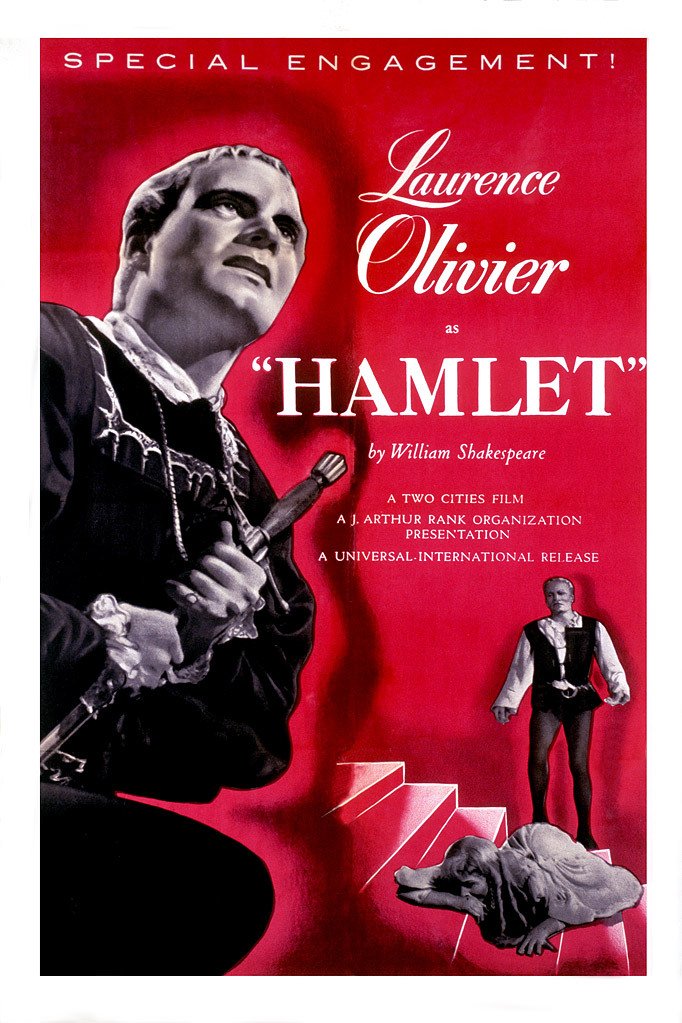
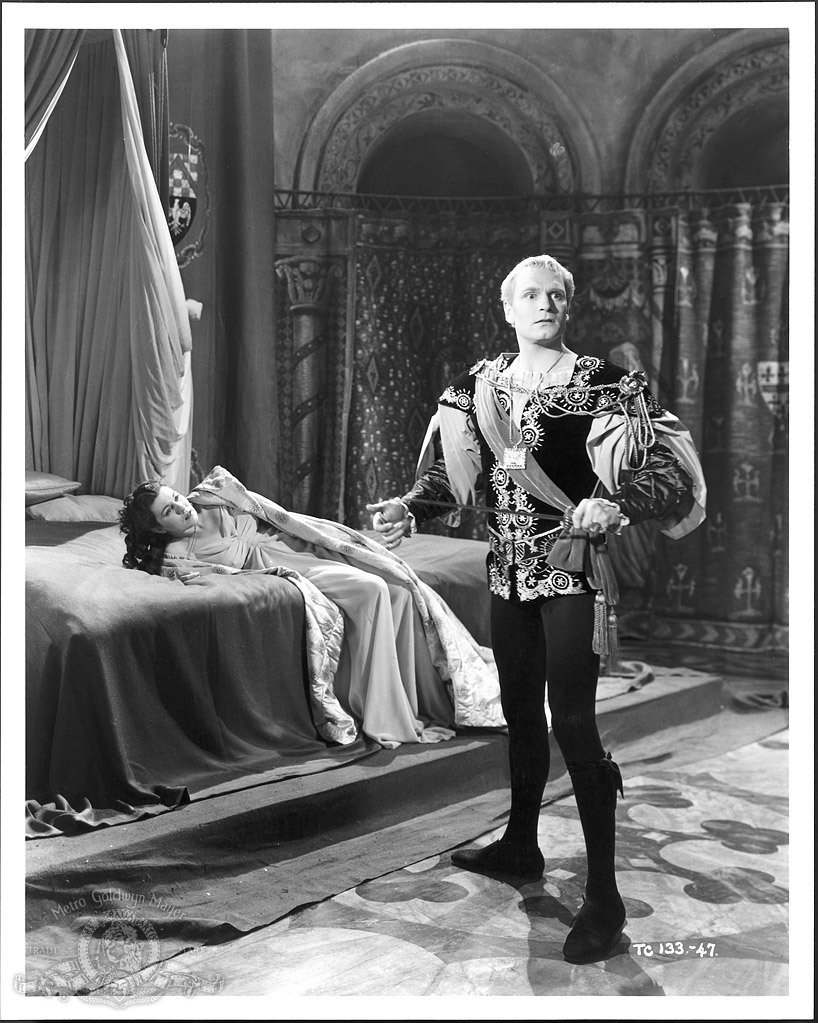
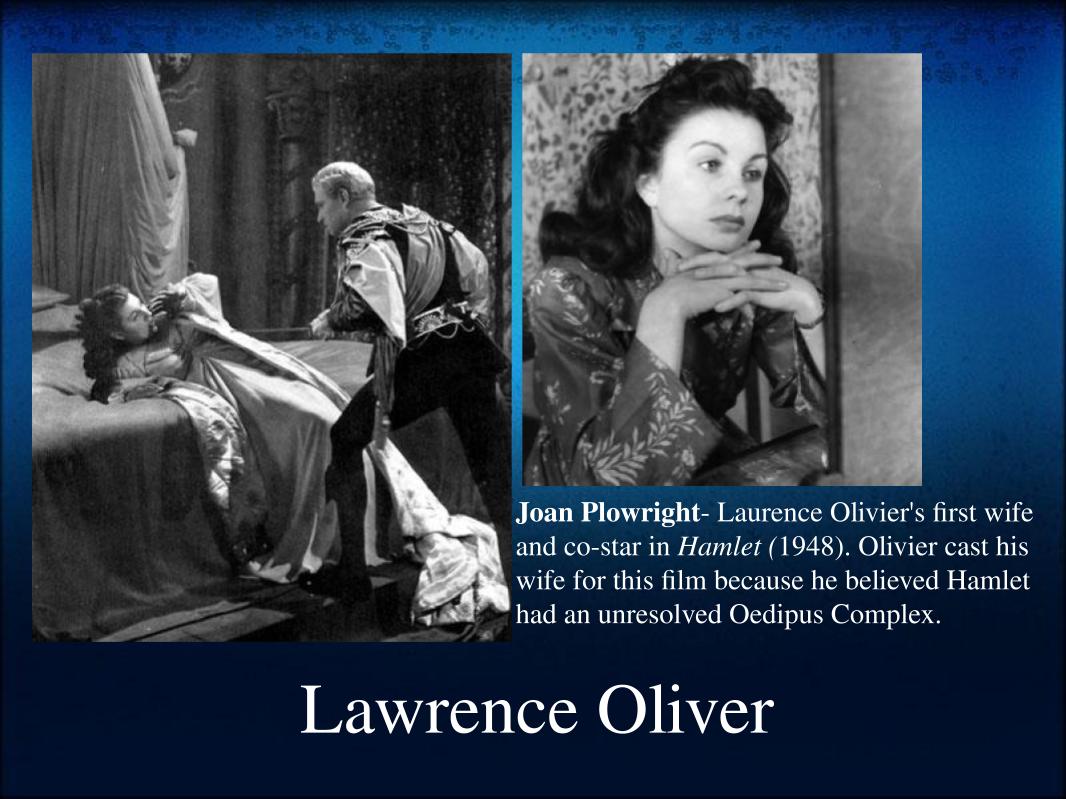
I find Olivier’s acting over-the-top, lacking in emotion and subtlety, and I think his directing is generally self-centered. He rarely deigns to give close-ups to anyone but himself and a lot of the scenes he directs are filmed like stage plays. That said, Olivier’s Hamlet is really good. SIr Laurence talked to Ernest Jones about the theory that Hamlet might have had an Oedipus Complex and created a unique and well-thought-out interpretation for his Hamlet. First off, casting his real-life wife Joan Plowright as Gertrude, fills the Closet scene with uncomfortable tension. He also did a great job making the ghost seem as imposing and accusatory as possible, as well as making Claudius as disgusting as possible.
You get the idea that this film is how Hamlet sees the world with its dark and shadowy towers, representing Hamlet’s melancholic mind, his imprisoned spirit, and his dark desires. Also as many people have pointed out, Gertrude’s bed chamber looks like a female organ, making the Oedipus theory even more explicit.
Even I have to admit that Olivier nailed the “To Be Or Not To Be,” Speech. He squirms at his own Oedipal fantasies, and contemplates jumping off the battlements in a captivating and subtle way. The performance and cinematography is iconic, and it makes me grudgingly admit Olivier, for all his faults, is still one of the best Hamlets of all time.
I would recommend this film to every Shakespeare film fan and any hardcore Shakespeare scholars. I would caution against showing the whole thing in a class however, since it’s black and white, and again, I find Oliver’s delivery very old-fashioned.
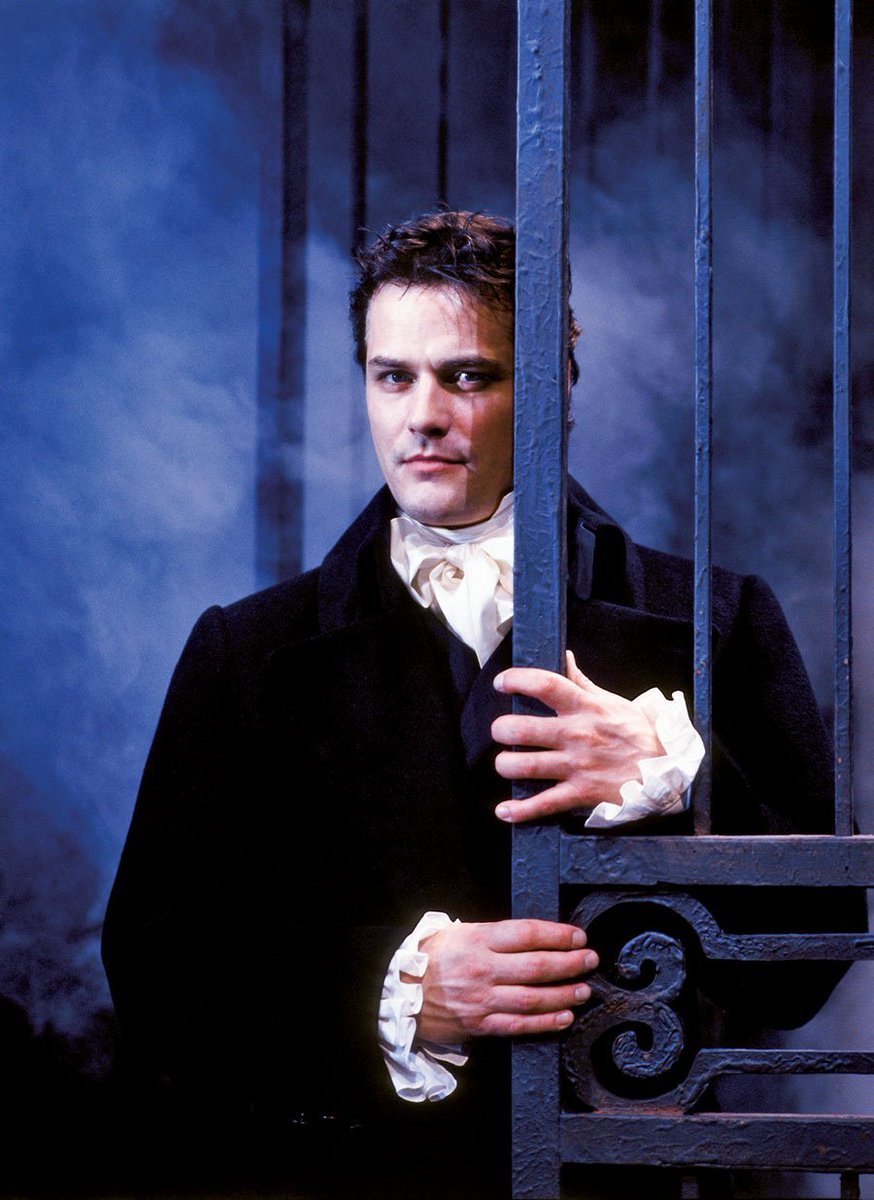
#5: Paul Gross, (StratforD Festival, 2000)
Thus far, I’ve mainly reviewed British and American Hamlets. Paul Gross is one of Canada’s most celebrated actors who gained fame as one of the best Hamlets at Toronto’s Stratford Festival. Unlike most Hamlets who go for the humanistic prince version of Hamlet, Gross plays him with sort of an animal intensity, like a wounded bear who will growl at you if you get in his way.
I have to admit I broke my own rule with this one- I haven’t really seen Gross’ portrayal, but I believe I saw it well-represented in his role as Geoffery Tennent, the Shakespearean Actor-turned madman-turned director in the Canadian TV show “Slings and Arrows.” This amazing dark comedy portrays the ins and outs of a Shakespeare Company from the normal problems of mounting a play to backstage drama, even the funding and marketing gets focus! Basically, the show is The Office for Shakespeare nerds, except for one ghostly cast member (no spoilers).
4. Benedick Cumberbatch / John Harrell
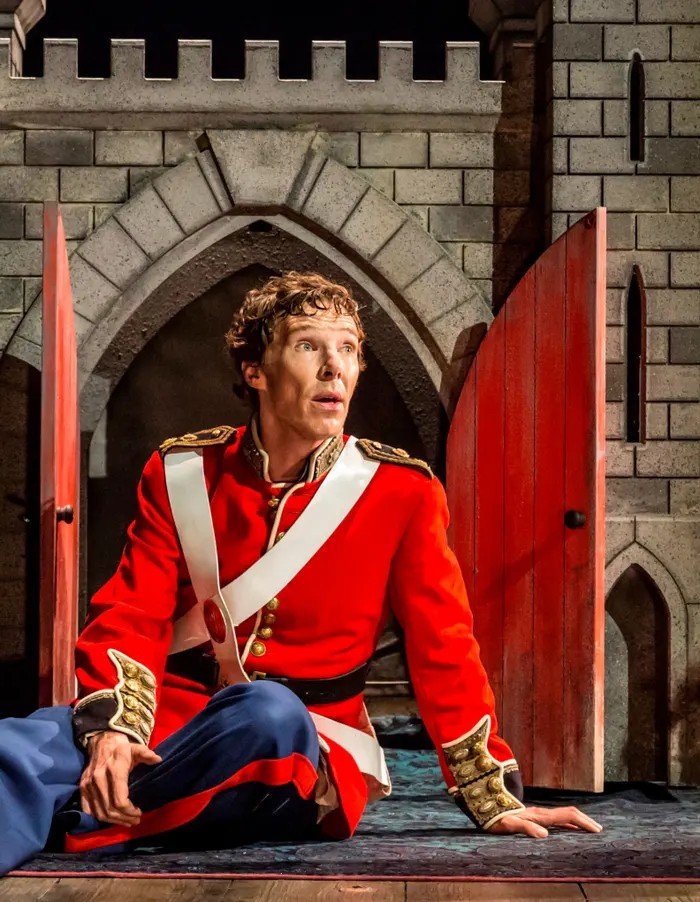
I couldn’t make up my mind between these two Hamlets, so I’m listing them together (guess that makes me Hamlet too). One is one of the most accomplished Shakespearean actor in recent memory, an RSC alumn, and a Hollywood star to boot, Benedick Cumberbatch.
Left- Benedick Cumberbatch as Hamlet, National Theater. Right- John Harrell at the Blackfriars Playhouse, Staunton VA.
Both these actors have similar strengths- they’re both tall and imposing with aquiline features. They are also highly physical performers. I talked in my lecture on Richard III about how Harrell performed the role of Gloucester with his legs tied together and a bowling ball strapped to his hand. Appearance-wise- Harrell and Cumberbatch are so similar, that it’s actually a joke at the ASC that they must be long-lost twins.
That said, when it comes to their approach to Hamlet, these two actors couldn’t be more different. Cumberbatch focused on Hamlet’s emotional turmoil- he was tortured and angry, full of youthful angst and volatility. This particular production is sort of an anachronistic mash-up of modern and period, which gives it a sort of dream-like quality that I really enjoy. Like Richard Burton, the director knows how to stage a play differently from a movie or TV show, which is especially important with this actor, since we can see him on all those platforms.
Nor should they have. Full of scenic spectacle and conceptual tweaks and quirks, this “Hamlet” is never boring. It is also never emotionally moving — except on those occasions when Mr. Cumberbatch’s Hamlet is alone with his thoughts, trying to make sense of a loud, importunate world that demands so much of him.
John Harrell on the other hand is a more mature and subtle Hamlet, more interested in saving his hide than contemplating his navel. This Hamlet masks pain with humor and sardonic wit and it translates to all his relationships with the King, Queen, and courtiers.
John Harrell as Hamlet, American Shakespeare Center, 2011
Rather than a sour, dour, morose, obtuse, naval-gazing Hamlet, this prince was cunning, cynical, devious, sarcastic, and very much enjoying his feigned madness, his chess game with the king, and his fencing bout with Laertes.
OK, I have to admit that I didn’t see this whole production either, but it’s so cool and the acting is so good I wish I had! Papaa Essiedu is an electrifying blend of wit, sadness, manic excitement, and rage. His fresh take on a role that can be rather dour is why even the little I’ve seen of his performance makes it one of my favorites!
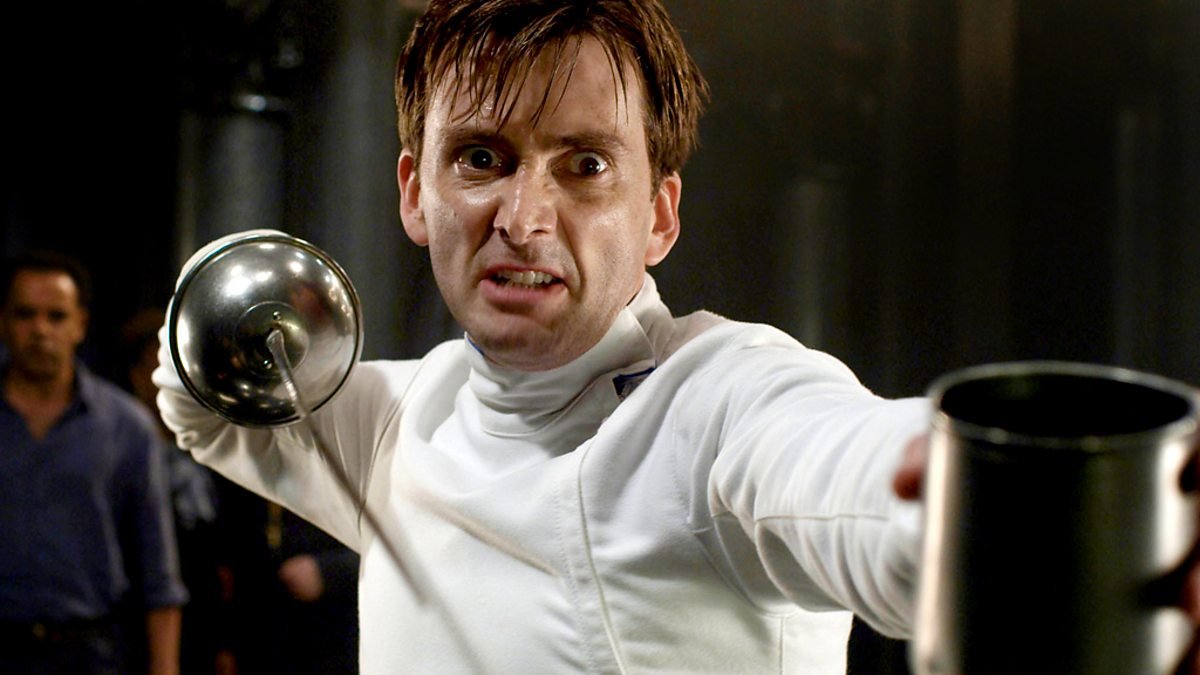
#2: David Tennet, RSC 2009
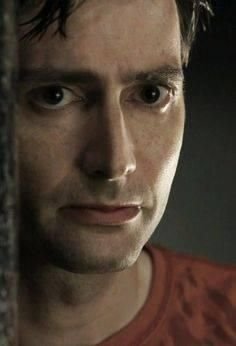
Tennet does an incredible job of encapsulating Hamlet’s quick wit, giddy excitement, frailty, fury, and frustration, especially with himself. I love the fact that he does “To Be Or Not To Be” in a superhero T-Shirt. In a way, this Hamlet is constantly wishing he was more of the action-movie type that Schwartzenegger parodies at the top of this list. Like Harrell, Tennent’s Hamlet masks his pain with humor, but you can see him struggle with it and try to pull himself out of despair. All these Hamlets find a way to nail at least one aspect of the character, but Tennet in his short 3 hours on the stage, manages to highlight all of them.
I recommend this version for any viewer in any classroom. It’s beautifully shot, extremely well acted, fast-paced, funny, and exciting. I cannot recommend it highly enough.
Honorable mentions: Anton Lester, Ian McKellen, MiChelle Terry, and Sir John Gielgud
I haven’t seen any of these Hamlets and have been unable to locate any clips, but I have the deepest respect for all of these actors, so I thought I’d highlight them here.
I’d also like to give special mention to Michelle Terry. Gender-blind productions of Shakespeare get a lot of flack that is undeserved, and there’s nothing wrong with a female Hamlet. To quote Geoffrey Tennet in Slings and Arrows: “Shakespeare didn’t care about anachronism, and neither should we.”
I didn’t include Ms. Terry in this list, simply because I wasn’t able to get to the Globe, and I wanted to focus on productions that people can watch for free. If you wish, you can watch her 2018 performance on the Globe Theater’s steaming website:
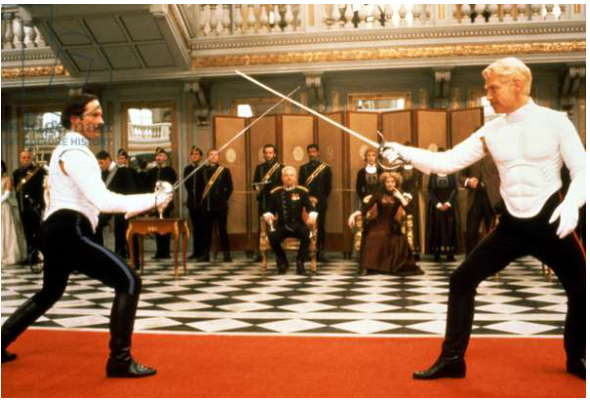
Hamlet (Kenneth Branaugh) duels with Laertes (Michael Maloney) in Branaugh’s 1996 film.Stills from Kenneth Branaugh’s Hamlet (1996).
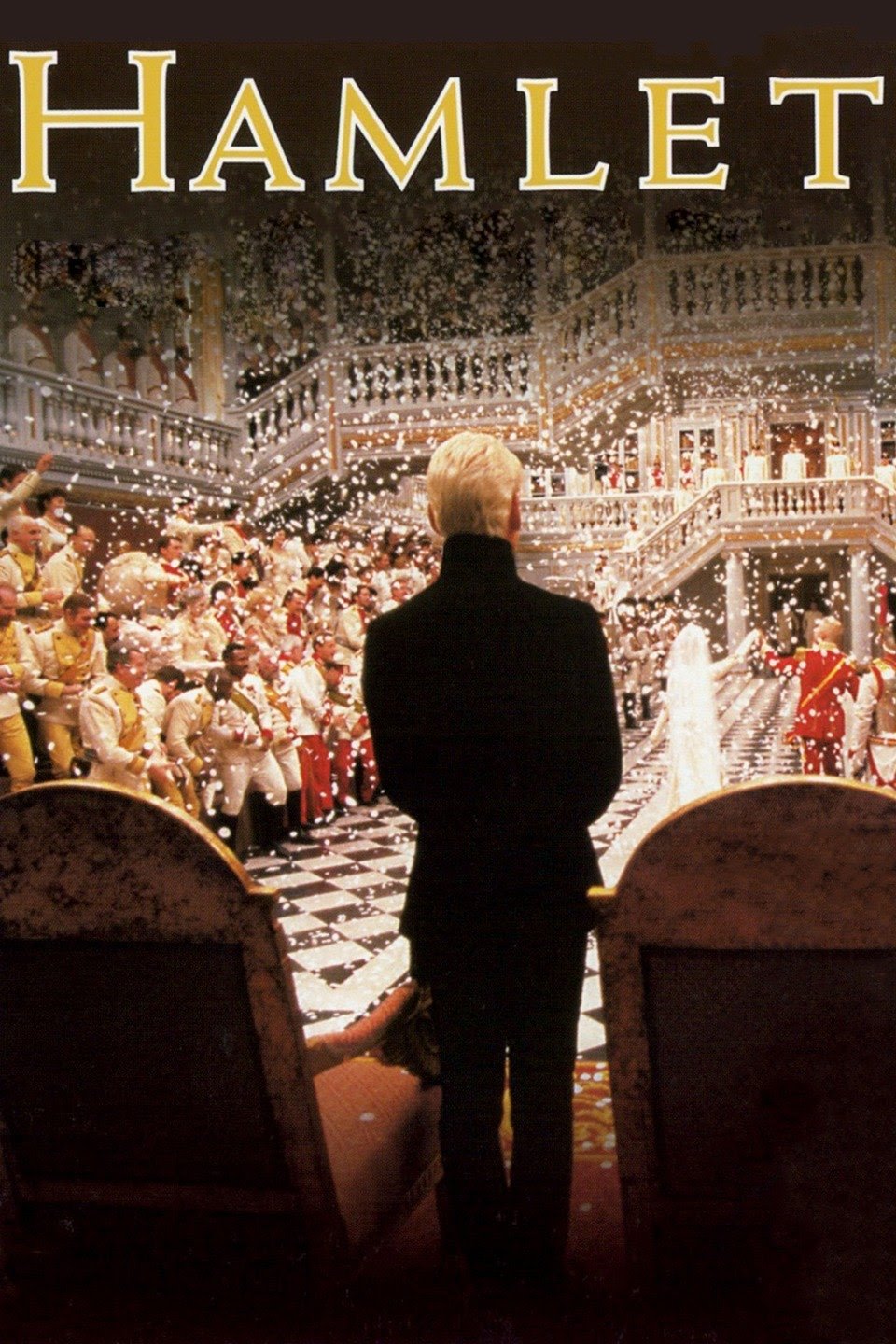
You probably saw this coming. I’ve made it clear in other posts that I absolutely love Branaugh’s Hamlet, after all his film was one of the first Shakespeare movies I ever saw and the first one I really enjoyed. I discuss in detail why I love this movie the best in my review of the film, but to summarize, I think the direction is incredible, the music is excellent, the cast is nearly perfect, and Branaugh himself puts a huge amount of love, craft, skill, experience, and maybe a little madness into his portrayal of the character. I know Branaugh isn’t everyone’s cup of tea; other Hamlets on this list might be more enjoyable, fun, or subtle, for you. But for me, Branaugh’s will always be my favorite.
However, the Romans gave way before the good fortune of the man and accepted the bit, and regarding the monarchy as a respite from the evils of the civil wars, they appointed him dictator for life. This was confessedly a tyranny, since the monarchy, besides the element of irresponsibility, now took on that of permanence
Patrick Stewart (Cassius), convinces Brutus (Ian Richardson), to betray Caesar, RSC, 1970
Under these circumstances the multitude turned their thoughts towards Marcus Brutus, who was thought to be a descendant of the elder Brutus on his father’s side, on his mother’s side belonged to the Servilii, another illustrious house, and was a son-in‑law and nephew of Cato. 2 The desires which Brutus felt to attempt of his own accord the abolition of the monarchy were blunted by the favours and honours that he had received from Caesar. 3 For not only had his life been spared at Pharsalus after Pompey’s flight, and the lives of many of his friends at his entreaty, but also he had great credit with Caesar. 4 He had received the most honourable of the praetorships for the current year, and was to be consul three years later, having been preferred to Cassius, who was a rival candidate. 5 For Caesar, as we are told, said that Cassius urged the juster claims to the office, but that for his own part he could not pass Brutus by.105 6 Once, too, when certain persons were actually accusing Brutus to him, the conspiracy being already on foot, Caesar would not heed them, but laying his hand upon his body said to the accusers: “Brutus will wait for this shrivelled skin,”106 implying that Brutus was worthy to rule because of his virtue, but that for the sake of ruling he would not become a thankless villain. 7 Those, however, who p589 were eager for the change, and fixed their eyes on Brutus alone, or on him first, did not venture to talk with him directly, but by night they covered his praetorial tribune and chair with writings, most of which were of this sort: “Thou art asleep, Brutus,” or, “Thou art not Brutus.”107 8 When Cassius perceived that the ambition of Brutus was somewhat stirred by these things, he was more urgent with him than before, and pricked him on, having himself also some private grounds for hating Caesar;
So far, perhaps, these things may have happened of their own accord; the place, however, which was the scene of that struggle and murder, and in which the senate was then assembled, since it contained a statue of Pompey and had been dedicated by Pompey as an additional ornament to his p597 theatre, made it wholly clear that it was the work of some heavenly power which was calling and guiding the action thither.
Well, then, Antony, who was a friend of Caesar’s and a robust man, was detained outside by Brutus Albinus,110 who purposely engaged him in a lengthy conversation; 5 but Caesar went in, and the senate rose in his honour. Some of the partisans of Brutus took their places round the back of Caesar’s chair, while others went to meet him, as though they would support the petition which Tulliusº Cimber presented to Caesar in behalf of his exiled brother, and they joined their entreaties to his and accompanied Caesar up to his chair. 6 But when, after taking his seat, Caesar continued to repulse their petitions, and, as they pressed upon him with greater importunity, began to show anger towards one and another of them, Tullius seized his toga with both hands and pulled it down from his neck. This was the signal for the assault. 7 It was Casca who gave him the first blow with his dagger, in the neck, not a mortal wound, nor even a deep one, for which he was too much confused, as was natural at the beginning of a deed of great daring; so that Caesar turned about, grasped the knife, and held it fast. p599 8 At almost the same instant both cried out, the smitten man in Latin: “Accursed Casca, what does thou?” and the smiter, in Greek, to his brother: “Brother, help!”
9 So the affair began, and those who were not privy to the plot were filled with consternation and horror at what was going on; they dared not fly, nor go to Caesar’s help, nay, nor even utter a word. 10 But those who had prepared themselves for the murder bared each of them his dagger, and Caesar, hemmed in on all sides, whichever way he turned confronting blows of weapons aimed at his face and eyes, driven hither and thither like a wild beast, was entangled in the hands of all; 11 for all had to take part in the sacrifice and taste of the slaughter. Therefore Brutus also gave him one blow in the groin. 12 And it is said by some writers that although Caesar defended himself against the rest and darted this way and that and cried aloud, when he saw that Brutus had drawn his dagger, he pulled his toga down over his head and sank, either by chance or because pushed there by his murderers, against the pedestal on which the statue of Pompey stood. 13
And the pedestal was drenched with his blood, so that one might have thought that Pompey himself was presiding over this vengeance upon his enemy, who now lay prostrate at his feet, quivering from a multitude of wounds. 14 For it is said that he received twenty-three; and many of the conspirators were wounded by one another, as they struggled to plant all those blows in one body.
-Plutarch’s Life Of Caesar
Artwork
Bust of Caesar Artwork for Julius Caesar. Immoral Longings, 2013.
Video 📹
Commentary
James Shapiro in his book 1599, addresses the common complaint that in the play that bears his name, Julius Caesar dies halfway through the play and has little time onstage to make a connection with the audience. The play is about tyrananicide, what causes it, what it looks like, and especially its aftermath. In a time when Jesuits and Catholic radicals threatened to assassinate Queen Elizabeth, Shakespeare wrote a powerful story about how fragile government systems can be; how striking the head off Rome leads to anarchy and sometimes tyranny.
If you’re like me, you are probably saddened by the loss of the great American actor, Sidney Poitier. He was part of the original cast of the great American play A Raisin In the Sun, and earned countless accolades for his roles on stage and screen like In the Heat Of the Night, Porgey and Bess, Guess Who’s Coming To Dinner? and The Greatest Story Ever Told.
In this interview, Poitier’s friend Denzel Washington talks about how Poitier was a beacon, not just for black actors but a gold standard for all actors.
Washington also discusses his role in the film Macbeth, in which he plays the title role. As I mentioned in my Much Ado About Nothing review, Denzel is a consummate performer of Shakespeare and I for one can’t wait to see him as Macbeth. This is nor just because he was an absolute joy in Much Ado, but because Denzel is famous for playing characters that start out as good men become violent and evil in films like Training Day, American Gangster, and Flight. I have high hopes that Denzel’s Macbeth will rank among his greatest performances.
Macbeth is now playing at selected theaters and streaming online on Apple+. I plan to see it and hope that you will too.
I know Halloween is over, but since I am doing a research project on the Salem Witch Trials, I thought I would trace the history of Witch Hunts from Shakespeare’s day to Salem:
For THIS WEEK ONLY, I’m offering a $5 discount for my “Macbeth” course: Get $5 off my class “Macbeth: An Immersive Learning Experience” with coupon code HTHESUEQUG5 until Nov 5, 2021. Get started at https://outschool.com/classes/macbeth-an-immersive-learning-experience-xGKHeHgH and enter the coupon code at checkout.
Just in time for October, I’m offering an online class for kids ages 13-18 about Shakespeare’s most spooky and cursed play:
If you follow this blog you know I’ve written a lot about this play before. Though this class will be more like a game where I teach the class using multimedia, games, and a digital escape room!
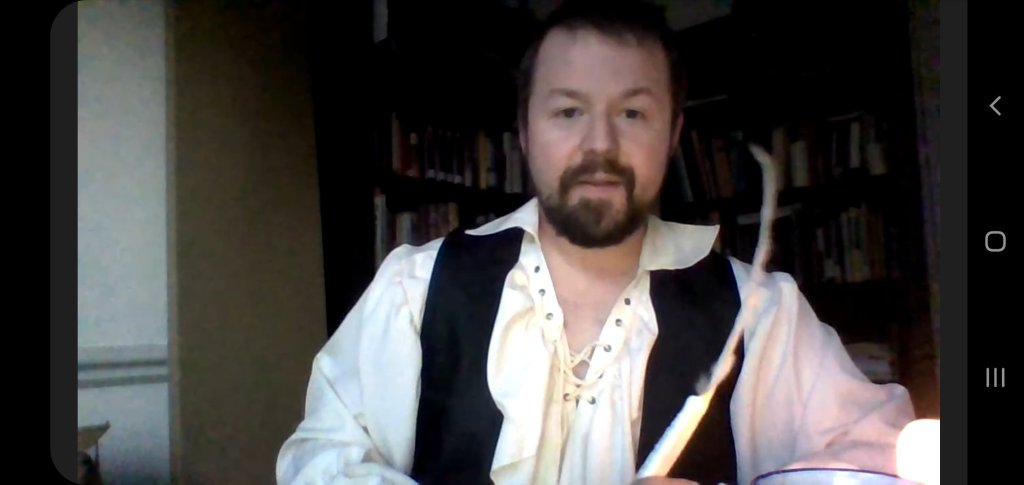
Me in my Shakespeare gatb
I’ll start by speaking to the students in character as Shakespeare, and tell them the story of Macbeth using a multimedia presentation.
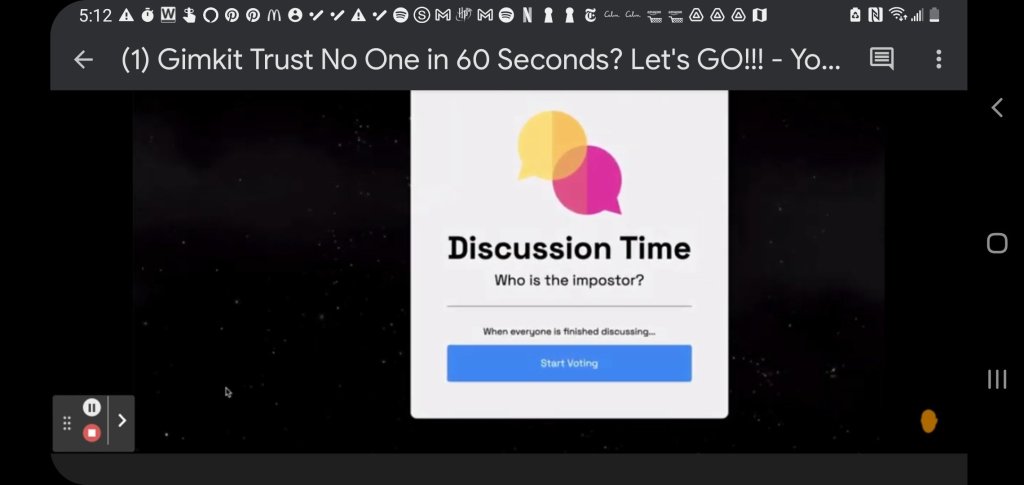
I will then test the students’ knowledge with a fun quiz that was inspired by the popular mobile game Among Us. As you know, the game is similar to a scene from the play, so I thought it would be an appropriate way to test the kids’ knowledge.
Screenshot from the Gimkit game “Trust No One.” Like Among Us, players need to figure out who the Imposter is, but they greatly increase the chances of surviving if they answer the quiz questions correctly.
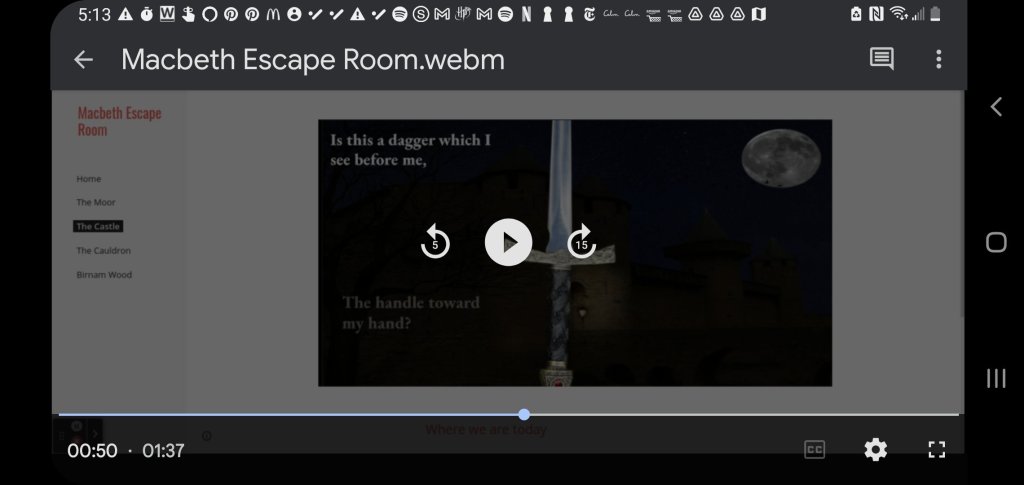
The final part of the class is a digital escape room I’ve created. I don’t want to give too much away, and you can’t play it unless you sign up for the class, but let’s just say it’s fun, spooky, educational, and challenging!
Screenshot from my Macbeth Escape Room.
If you want to sign up now, the course is available every weekend in October, and then by request after that. Register now at Outschool.com. if you take the course, please leave me a good review.
























 The Shakespearean Student