


The Concept
So, why Ghostbusters? Well, as William Shakespeare’s Star Wars has shown, it’s not only fun to adapt popular stories into Shakespearean parodies, it can also be educational. I knew I wanted to do a short play for my school’s fall festival, but I didn’t think to do “Ghostbusters” until I saw the final joke in the Simpson’s parody of Hamlet, where Homer says: “Son, [Hamlet] is not only a great play, but also became a great movie, called Ghostbusters!”
This joke got me thinking- Hamlet has a comic scene where the prince and his two friends are running around the stage away from a ghost, one that refuses to speak to them and then terrifies them. This reminds me of the moment where the ghost of the librarian shushes the heroes, and becomes a hideous creature:
From this realization. I took it as a personal challenge to adapt Ghostbusters into a one-act stage play with as much Shakespearean dialogue as possible.
My Process
Re-writing the script of a movie into a Shakespeare text required me to overhaul the story of Ghostbusters, as well as retrofitting Shakespearean lines and speeches from Hamlet, Macbeth, Henry IV & Henry V. I knew I wanted to freely cut-and-paste from Shakespeare, as if he’d written the original Ghostbusters. The result is a sort of stitched together blanket of Shakespeare lines, lines adapted from Ghostbusters, and some lines I created myself.
The Outline
Like I said, I kept the story limited to how the four Ghostbusters learn that ghosts are real, become professional ghost catchers, and then receive a call from a damsel in distress (Ms. Dana Barrett), who allows them to become heroes by defeating the ghost that has possessed her. I also decided to use the commercial in the movie as a framing device:
In my version, the Ghostbusters start by doing a commercial that then becomes a flashback where the heroes recap everything that has happened to them over the past week. I then ended the play by joking referring to the play as “A very long commercial.”
Scenes I Included/ Scenes I Cut

I only had 30 minutes allocated for my show, so I knew I’d have to pare down the story to its bare bones. This meant I had to eliminate a lot of subplots and characters and condense several scenes. As much as I love Walter Peck, Dean Jaeger, Louis Tully, Janine Melnitz, and the guy who gets electrocuted, they are not absolutely essential to the plot, so I cut them from my version. I also combined the characters of Dana and Gozer, eliminating the two terror dogs and limiting the antagonists to Gozer and the Stay Pufft Marshmallow Man. So I watched the film a few times, and created an outline of just 7 scenes.
Character Models
One thing I’ve said again and again is that Shakespeare’s characters are all based on archetypes that we see everywhere throughout literature, theater, and yes, movies. While I was watching Ghostbusters, I tried to find the Shakespearean archetypes that match the best with the characters in the movie:
Ray Stantz- Hamlet from Hamlet– Ray is a bookish man who is obsessed with death and with the occult, which makes him very much like the scholarly Prince Hamlet. He’s also a man on a mission to try and understand the supernatural and help keep it from destroying our world. Dr. Venkman describes him as “The heart of the Ghostbusters”, and that humorous heart gets him into trouble sometimes.
Egon Spangler- Horatio from Hamlet If Ray is the heart of the team, Egon is the brain. He is the no-nonsense scientist who provides the team with data and equipment to help them fight ghosts effectively, much like how Horatio reports to Hamlet that his father’s ghost has returned from the grave.
Dr. Venkman– Sir John Falstaff/ King Henry V
Dana Barret- Ophelia from Hamlet
Gozer– Hecate from Macbeth
The Stay Pufft Marshmallow Man- Snug the Joiner from A Midsummer Night’s Dream
Sneak Peak
Here’s one of the scenes I wrote, with the original scene for context
[The ghostbusters climb the stairway to the penthouse, where Gozer is sitting in a cloud. They have been going for a while and are clearly tired].
Venkman: Though I have not known fair Dana long, I know she must be a virtuous maid. Ascend this penthouse tower and let’s rescue she!
Like to the Knights of ancient chivalry!
Egon: These apparitions whizzing in the air
Give so much light that I may read by them.
[They reach the top and behold Gozer]
Ray: I am resolved to speak to Gozer. This is the latest parle we will admit.
Gozer: Art thou a god?
Ray: Nay.
Gozer: Then perish, half-man!
Winston: Enough Ray of thy diplomacy!
Speak, thou proton pack for me! [He fires, then the rest join in] Gozer disappears
Venkman: The sky hath bubbles as the water hath, and she be one of them!
Gozer [in Voice Over]: Sub creatures! Hark! Tis time! Pick the Destructor’s form
Be it a Goblin damned or angel bright!
Tornado or a earthy bright
Or greatest Monkey with an appetite!
Winson: Our thoughts contain the form that seals our doom?
Then make them blank as a new-made room! [They all gesture to their heads as if pushing thoughts out]
Gozer: Thy choice is made. Prepare to meet thy doom!
Venkman: Nay! I chose nothing
Winston: Nor I!
Egon: Nor I
[Pause]
All: Ray?
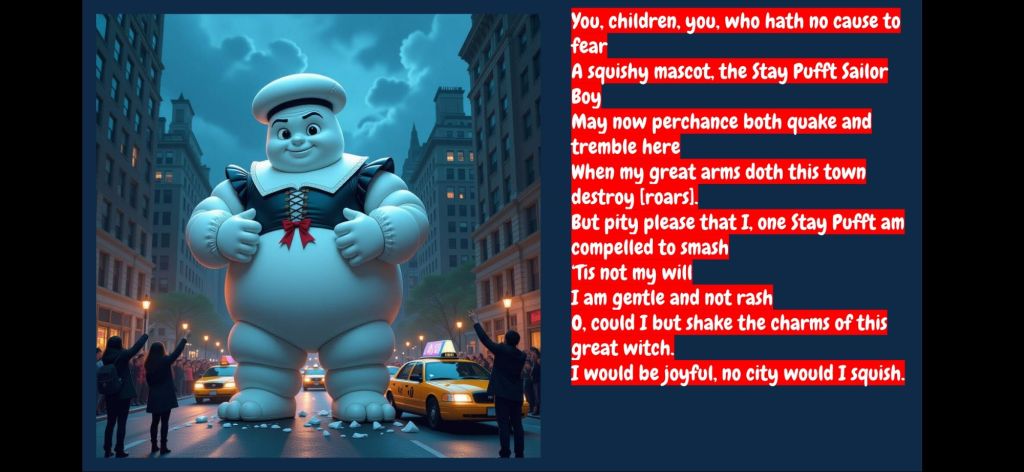
Ray: Twas not my fault! It popped into my mind
Venkman: What? What hast popped in?
Egon: LOOOK!!!


 The Shakespearean Student