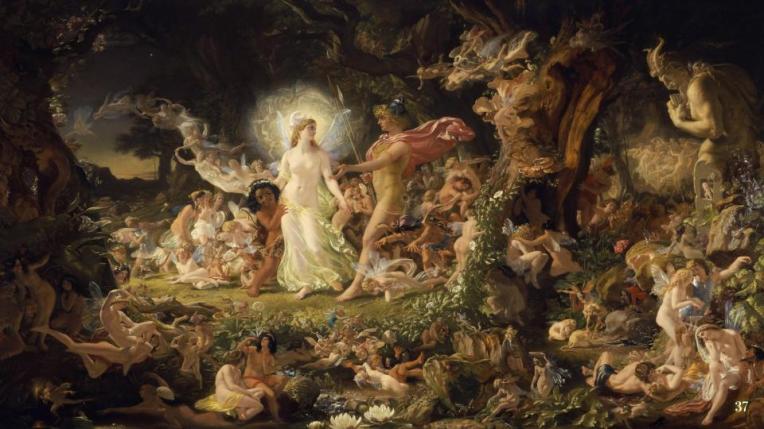
Crafting a Character: Puck

“Welcome Spirit, How Camest Thou hither?” The sources for Puck

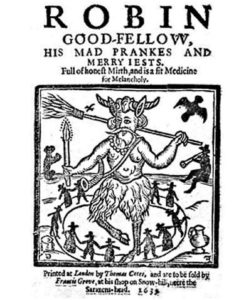
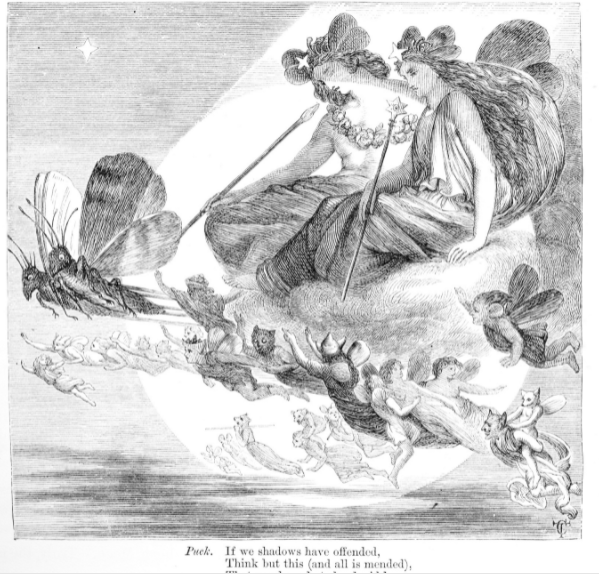
Puck, in medieval English folklore, a malicious fairy or demon. In Old and Middle English the word meant simply “demon.” In Elizabethan lore he was a mischievous, brownielike fairy also called Robin Goodfellow, or Hobgoblin. As one of the leading characters in William Shakespeare’s Midsummer Night’s Dream, Puck boasts of his pranks of changing shapes, misleading travelers at night, spoiling milk, frightening young girls, and tripping venerable old dames. The Irish pooka, or púca, and the Welsh pwcca are similar household spirits.

Britannica, The Editors of Encyclopaedia. “puck”. Encyclopedia Britannica, 21 Apr. 2016, https://www.britannica.com/topic/puck-fairy. Accessed 18 July 2023.

Shakespeare also took inspiration from English poet Edmund Spencer, who visited Ireland in the 1590s and adapted the folklore he picked up into his opera The Fairy Queen, which Shakespeare adapted into A Midsummer Night’s Dream

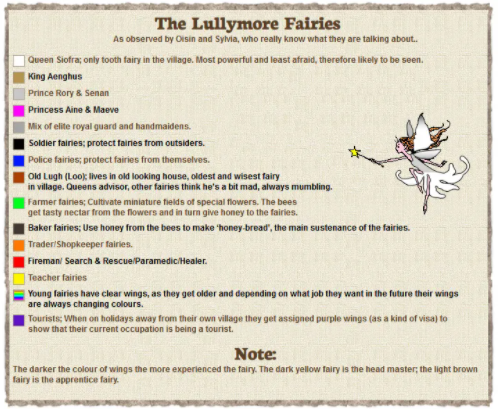
Types of fairies you can “spot” at the Lullymore Park in Ireland:

Puck/Robin’s Dual Nature

The old stories tell that Fairies are magical creatures who live in hollow places in the earth. Some are benevolent and help give rain and pleasant weather to the Earth, Like the king and Queen of the fairies, Oberon and Titania:

And the mazed world,
By their [the tides] increase, now knows not which is which:
And this same progeny of evils comes
From our debate, from our dissension;
We are their parents and original.

— Titania, (Queen of the Faries), A Midsummer Night’s Dream Act II, Scene i.

Titania in this speech shows great concern for nature, humanity, and the planet. She believes it is the responsibility of fairies, particularly herself and her husband Oberon, to control the elements and keep humans and fairies safe. Some fairies, however, are cruel and enjoy playing tricks on mortals, just like Puck in A Midsummer Night’s Dream, or Queen Mab in Romeo and Juliet.

.

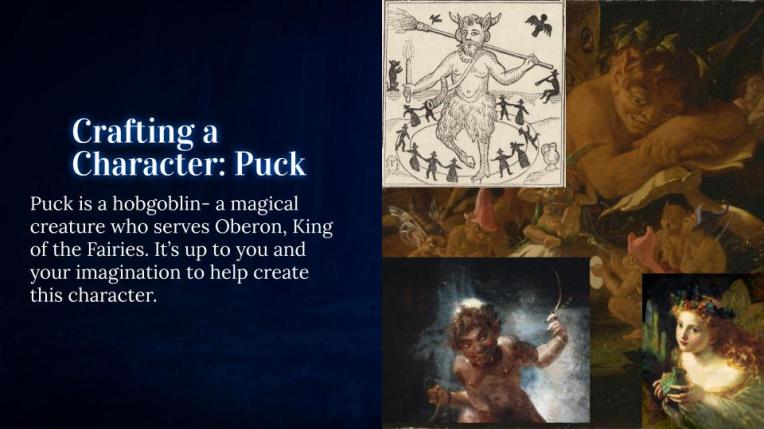
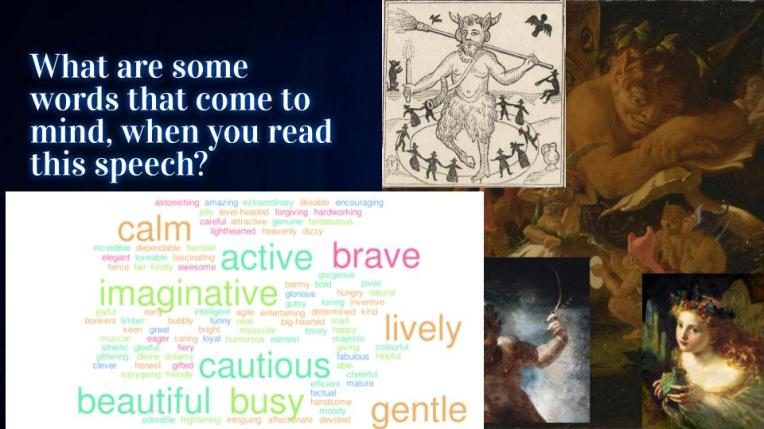
This is a short analysis I created of the tricks Puck plays on people in A Midsummer Night’s Dream, as part of my acting course on Ouschool.com. Note the different ways Puck is portrayed in photos as a satyr, a rotund elf, and sometimes as an almost- demon like figure.

Punishments or contracts with fairies formed a significant part of Goodfellow’s purpose on earth. While he could issue good fortune and support, this was always at the cost of those involved. As Reginald Scot commented, Goodfellow had a ‘standing fee’ of a ‘mess of white bread and milk’, which he expected after supporting housewives with their chores. If his payment was forgotten, Goodfellow was believed to steal from the home that owed him, often stealing grain and milk from the dairy.

Abigail Sparkes, Historic UK.com

Performing Puck

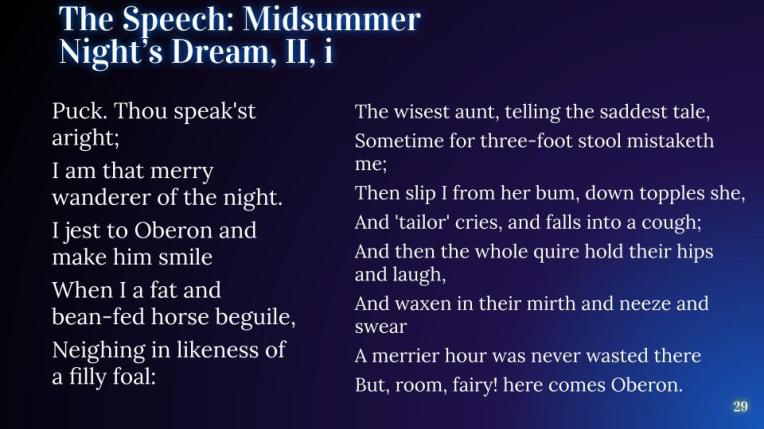
Because Puck is not human, and somewhat ambiguous in the text, an actor can play Puck in many different ways. Generally speaking, actors tend to explore Puck’s attitude toward humans, their love of mischief, and how to translate that physically and vocally

Puck. My mistress with a monster is in love.
Near to her close and consecrated bower,
While she was in her dull and sleeping hour,
A crew of patches, rude mechanicals,
Were met together to rehearse a play
The shallowest thick-skin of that barren sort,
Who Pyramus presented, in their sport
Forsook his scene and enter’d in a brake
When I did him at this advantage take,
An ass’s nole I fixed on his head:

Anon his Thisbe must be answered,
And forth my mimic comes.
So, at his sight, away his fellows fly;
And, at our stamp, here o’er and o’er one falls;
He murder cries and help from Athens calls.
I led them on in this distracted fear,
And left sweet Pyramus translated there:
When in that moment, so it came to pass,
Titania waked and straightway loved an ass!

slideshare id=52829293&doc=randj-150916030030-lva1-app6891]

References:

Shapiro, James. A Year In the Life Of William Shakespeare, 1599. Chapter 6: Things Dying and Things Reborn.

https://www.bbc.co.uk/programmes/articles/3fLDRSY7r9rJhrVFWy99Mly/transcript-shakespeares-restless-world-programme-7

https://www.independent.ie/entertainment/theatre-arts/is-shakespeare-responsible-for-the-stage-irishman-34638347.html

https://www.irishtimes.com/culture/stage/what-ish-my-nation-shakespeare-s-irish-connections-1.2619173

What Does Shakespeare Say About Ireland 🇮🇪?

Happy St. Patrick’s Day! The Emerald Isle has long been a source of illumination for poet’s pens and Shakespeare was no exception. The Bard of Avon is indebted to Mother Ireland not only for the inspiration he took, but sadly for the pain he gave her back.

None of Shakespeare’s plays are set in Ireland, but he freely adapted elements from Irish folklore. English poet Edmund Spencer visited Ireland in the 1590s and adapted the folklore he picked up into his opera The Fairy Queen, which Shakespeare adapted into A Midsummer Night’s Dream

The Irish created and continue to tell many of the fairy legends and stories that we retell and adapt today. If you go to Lullymore park in Ireland, you can see a place that is essentially a “Fairy preserve.”

Types of fairies you can “spot” at the Lullymore Park in Ireland:

The old stories tell that Fairies are magical creatures who live in hollow places in the earth. Some are benevolent and help give rain and pleasant weather to the Earth, Like the king and Queen of the fairies, Oberon and Titania:

And the mazed world,
By their [the tides] increase, now knows not which is which:
And this same progeny of evils comes
From our debate, from our dissension;
We are their parents and original.

— Titania, (Queen of the Faries), A Midsummer Night’s Dream Act II, Scene i.

Titania in this speech shows great concern for nature, humanity, and the planet. She believes it is the responsibility of fairies, particularly herself and her husband Oberon, to control the elements and keep humans and fairies safe. Some fairies, however, are cruel and enjoy playing tricks on mortals, just like Puck in A Midsummer Night’s Dream, or Queen Mab in Romeo and Juliet.

.

This is a short analysis I created of the tricks Puck plays on people in A Midsummer Night’s Dream, as part of my acting course on Ouschool.com. Note the different ways Puck is portrayed in photos as a satyr, a rotund elf, and sometimes as an almost- demon like figure.

Cringe-worthy Shakespeare: Shakespeare’s only Irish character, captain mcmorris in “Henry V”

When Shakespeare is racially insensitive towards people of color, the cringe-worthy writing is mercifully few and far between. With the exception of Aaron the Moor and Don Armada, there are only a few sporadic derogatory references to non-White Anglo-Saxon Protestants. Sadly though, Shakespeare might have permanently harmed the Irish through his character the Irish captain Macmorris in Henry the Fifth, his only Irish character.

According to The Irish Times, there is a longstanding stereotype that still exists in the British Isles that Irish people are violent, short-tempered, and essentially savages and Shakespeare might have invented this stereotype (or at least popularized it) when he wrote this scene from Henry the Fifth, Act III, Scene ii:

FLUELLEN
To the mines! tell you the duke, it is not so good
to come to the mines; for, look you, the mines is
not according to the disciplines of the war: the
concavities of it is not sufficient; for, look you,
the athversary, you may discuss unto the duke, look
you, is digt himself four yard under the
countermines: by Cheshu, I think a' will plough up
all, if there is not better directions.
GOWER
The Duke of Gloucester, to whom the order of the
siege is given, is altogether directed by an
Irishman, a very valiant gentleman, i' faith.
FLUELLEN
It is Captain Macmorris, is it not?
GOWER
I think it be.
FLUELLEN
By Cheshu, he is an ass, as in the world: I will
verify as much in his beard: be has no more
directions in the true disciplines of the wars, look
you, of the Roman disciplines, than is a puppy-dog.
Enter MACMORRIS and Captain JAMY
GOWER
Here a' comes; and the Scots captain, Captain Jamy, with him.
FLUELLEN
Captain Jamy is a marvellous falourous gentleman,
that is certain; and of great expedition and
knowledge in th' aunchient wars, upon my particular
knowledge of his directions: by Cheshu, he will
maintain his argument as well as any military man in
the world, in the disciplines of the pristine wars
of the Romans.
JAMY
I say gud-day, Captain Fluellen.
FLUELLEN
God-den to your worship, good Captain James.
GOWER
How now, Captain Macmorris! have you quit the
mines? have the pioneers given o'er?
MACMORRIS
By Chrish, la! tish ill done: the work ish give
over, the trompet sound the retreat. By my hand, I
swear, and my father's soul, the work ish ill done;
it ish give over: I would have blowed up the town, so
Chrish save me, la! in an hour: O, tish ill done,
tish ill done; by my hand, tish ill done!
FLUELLEN
Captain Macmorris, I beseech you now, will you
voutsafe me, look you, a few disputations with you,
as partly touching or concerning the disciplines of
the war, the Roman wars, in the way of argument,
look you, and friendly communication; partly to
satisfy my opinion, and partly for the satisfaction,
look you, of my mind, as touching the direction of
the military discipline; that is the point.
JAMY
It sall be vary gud, gud feith, gud captains bath:
and I sall quit you with gud leve, as I may pick
occasion; that sall I, marry.
MACMORRIS
It is no time to discourse, so Chrish save me: the
day is hot, and the weather, and the wars, and the
king, and the dukes: it is no time to discourse. The
town is beseeched, and the trumpet call us to the
breach; and we talk, and, be Chrish, do nothing:
'tis shame for us all: so God sa' me, 'tis shame to
stand still; it is shame, by my hand: and there is
throats to be cut, and works to be done; and there
ish nothing done, so Chrish sa' me, la!
JAMY
By the mess, ere theise eyes of mine take themselves
to slomber, ay'll de gud service, or ay'll lig i'
the grund for it; ay, or go to death; and ay'll pay
't as valourously as I may, that sall I suerly do,
that is the breff and the long. Marry, I wad full
fain hear some question 'tween you tway.
FLUELLEN
Captain Macmorris, I think, look you, under your
correction, there is not many of your nation--
MACMORRIS
Of my nation! What ish my nation? Ish a villain,
and a bastard, and a knave, and a rascal. What ish
my nation? Who talks of my nation?
FLUELLEN
Look you, if you take the matter otherwise than is
meant, Captain Macmorris, peradventure I shall think
you do not use me with that affability as in
discretion you ought to use me, look you: being as
good a man as yourself, both in the disciplines of
war, and in the derivation of my birth, and in
other particularities.
MACMORRIS
I do not know you so good a man as myself: so
Chrish save me, I will cut off your head.
GOWER
Gentlemen both, you will mistake each other.
JAMY
A! that's a foul fault.
A parley sounded
GOWER
The town sounds a parley.
FLUELLEN
Captain Macmorris, when there is more better
opportunity to be required, look you, I will be so
bold as to tell you I know the disciplines of war;
and there is an end.
Exeunt

Irish History and Shakespeare: The tempestous relationship between england and Ireland

The mayor and all his brethren in best sort,
Like to the senators of the antique Rome,
With the plebeians swarming at their heels,
Go forth and fetch their conquering Caesar in:
As, by a lower but loving likelihood,
Were now the general of our gracious empress,
As in good time he may, from Ireland coming,
Bringing rebellion broached on his sword,

Henry V, Act V Chorus

National Portrait Gallery painting of Robert Deveraux, 2nd Earl of Essex. Wikimedia Commons.
Robert Devereax, 2nd Earl of Essex (National Portrait Gallery)
Hugh, O’Neill, Earl of Tyronne

James Shapiro in his excellent book, A Year In The Life Of William Shakespeare, 1599, posits that contemporary affairs in Ireland might have inspired some of Shakespeare’s greatest plays in including Richard II, Henry V, and Julius Caesar. In 1594 the Earl of Tyrone began a rebellion in Ireland against the English, and in 1599, Queen Elizabeth dispatched the ambitious and chivalrous Earl of Essex to quell it. As you can see in the quote above, Shakespeare mentions Essex’s fight in his play of Henry V, which probably premiered at around the same time Essex was in Ireland.

The audience may have been watching Henry conquer France, but many would have been thinking about Elizabeth’s struggle to conquer Ireland.

BBC Radio 4 Extra – Shakespeare’s Restless World, Ireland: Failures in the Present – Transcript – Shakespeare’s Restless World – Programme 7

Though King Henry successfully conquered and united England and France, Essex failed spectacularly, and Elizabeth was deeply embarrassed by the whole scenario. She was also deeply alarmed by the popularity of Shakespeare’s tragedy Richard II, which shows onstage the deposing and killing of a king who had no children and failed to quell a rebellion in Ireland.

Elizabeth was worried about her subjects but she was also very worried about Essex overseas. Everyone, (including Shakespeare), remembered that 2,000 years ago, Julius Caesar went from him the Senate’s Consul General to dictator by amassing an army, then threatening to invade Rome under the pretense of helping to quell a foreign invasion. Caesar made his name by subjugating tribes in Gaul (modern-day France), and the Senate was worried that he would come home and use his army for a military coup. Look at the expressions on the faces of Cicero and Brutus when they see Caesar coming home in triumph in this scene from the HBO series Rome.

Elizabeth repeatedly attempted to curb Essex’s power while he was fighting in Ireland; she refused to give the Earl more troops for fear that he might be staging a potential coup. Her fears would later be proven right when in 1602, Essex attempted to head a rebellion and take the Crown for himself, but not before one of Essex’s friends commissioned Shakespeare’s company to portray the deposing and killing of King Richard II. Essex was trying to turn himself from a failed Henry V to a victorious Henry IV, and his queen into Richard II.

Left- deposition form the interrogation of Augustine Phillips, one of the actors in Shakespeare’s company about his company’s potential involvement with the Essex rebellion. Right- the hanging of Cinna the poet from Julius Caesar.

Shakespeare might have been inspired to write Julius Caesar after being an unwitting pawn in the political drama between Essex and the queen, and might have even created the character of Cinna the Poet as an analog for Shakespeare himself. In the play, Cinna the poet is mistaken for one of the conspirators by an angry mob and is murdered in the street. Perhaps Shakespeare created Cinna the Poet as a way of coping with the fear he must have had that people might mistake him for a radical, after his play Richard II briefly made him a walking target for those opposed to Essex’s rebellion. In any case, Julius Caesar eloquently documents the kind of anxiety of not knowing who could be trusted when it comes to politics, whether it be a populist warrior like Julius Caesar or Essex, or the Queen, privy council, or indeed Roman senate, and the whole thing started from a failed attempt to quell a rebellion in Ireland.

In summation, even though Shakespeare sets no plays in Ireland, Irish history and Irish culture are everywhere in his plays. England and Ireland are I are indeed separate islands but the cultural exchange between England and Ireland has inspired Shakespeare and many other great writers for centuries. After all Shakespeare’s most famous honorific, ‘the Bard of Avon’ comes from an ancient Irish tradition of semi-mystical poets, who in Irish folklore, were able to see the future and glimpse worlds that are unseen to ordinary mortals. What Shakespeare really felt about Ireland we don’t know but we do him but he does owe the Irish people a lot of thanks, and on this  Saint Patrick’s day, I honor their contribution to him and to him all the world

References:

Shapiro, James. A Year In the Life Of William Shakespeare, 1599. Chapter 6: Things Dying and Things Reborn.

https://www.bbc.co.uk/programmes/articles/3fLDRSY7r9rJhrVFWy99Mly/transcript-shakespeares-restless-world-programme-7

https://www.independent.ie/entertainment/theatre-arts/is-shakespeare-responsible-for-the-stage-irishman-34638347.html

https://www.irishtimes.com/culture/stage/what-ish-my-nation-shakespeare-s-irish-connections-1.2619173

Was Shakespeare Racist?

Was Shakespeare racist? When reading Othello by William Shakespeare, the only play he wrote where the hero is explicitly black, I truly feel like the Shakespearean student as opposed to the Shakespearean teacher. it’s a play that I find very difficult to get into, and very difficult to understand. Above all, the question I have is whether Othello is a positive or negative portrayal of a black man. So I am going to analyze the play, the prevailing views about race from Shakespeare’s time, and try to draw some conclusions about the play and its creator.

Disclaimer: I don’t advocate trying to speculate about how Shakespeare felt about anything. My real point in this post is to determine if the play Othello and its portrayal of people of color, has merit in today’s society, which is important to establish given the culture in which Shakespeare wrote it.

Part I: Black People And Shakespeare

By our standards, Shakespeare was probably racist. If you look at the ways black people are mentioned in documents of the period, the writers frequently describe black people with an air of otherness and superiority that shows little interest in the humanity of other races. In fact, one reason why the word “moor” is so problematic is that it basically referred to anyone not born in Europe. It could refer to people from Northern Africa, the Middle East, and even parts of Spain. Clearly, Europeans at the time weren’t interested in the particulars of their non-Caucasian neighbors’ culture and herritage.
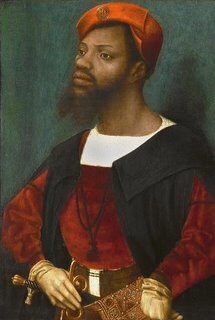
“Portrait Of An African Man,” by Jan Mostaert, c. 1520

This is not to say that Shakespeare never knew any black people. Michael Wood in his book In Search Of Shakespeare estimates that there might have been several thousand black people in London alone. City registers mentions not only black people employed in the city, but even some of the first inter-racial marriages. Therefore, the notion of Othello marrying Desdemona would not have been unheard of even in 1601.

As an important note, the black people living in Europe at the time weren’t slaves. The transatlantic slave trade didn’t really get started in and America until the 1650s, and slavery was illegal in England at the time. Wood mentions that there were black dancers, black servants, and other free black people living in and around London (Wood 25). Dr. Matthieu Chapman wrote an excellent thesis back in 2010 about the possibility that some black people might even have been actors in Shakespeare’s company. Furthermore, scholars have wondered for centuries if the Dark Lady of the sonnets was Shakespeare’snon-Caucasian mistress.

In any case, it is likely based on what we know about the growing multiculturalism of England in the 17th century, that Shakespeare knew some black people, and might have worked along side them. Though Shakespeare probably knew black people though, it is impossible to know if they influenced his play Othello.

https://youtu.be/NsUoW9eNTAw

Though black people were allowed to live and work without bondage, their lives were highly precarious, and far from easy. In 1601, Sir Robert Cecil, Queen Elizabeth’s chief counselor, presented a plan to explel all black people from England (Wood 251). The Cecil Papers at Hatfield House details that:

The queen is discontented at the great numbers of ‘n—‘ and ‘blackamoores’ which are crept into the realm since the troubles between her highness and the King Of Spain, and are fostered here to the annoyance of her own people.

Cecil mentions that a great deal of black people living in London were former slaves freed from captured Spanish ships. Spain of course was Catholic and their king Phillip II had sent a vast armada against the English which helps underscore a major reason for the hostility against these formerly Spanish moors; the fear that, even though these people were baptized English Christians, they might secretly be traitors, sympathetic to the Spanish or to the great numbers of Muslims living in Spain. The English weren’t the only ones concerned. In 1609, the Spanish king expelled the Moors from Spain entirely, probably due to the high levels of Muslims in Spain. With this in mind, you can see how topical Othello was for its time, since it touched on many contemporary issues of race and politics.

One important thing to remember about Othello is that he is not only a black man in a predominantly white country, he is in all probability a converted Muslim who helps the Venetian army fight Muslim Turks. With this in mind, you can imagine how hard it must be for the people of Venice to trust him, and how hard it makes it for Othello to feel like a true Venetian.

A very high profile example of the mixture of admiration and anxiety towards Moors comes from 1600. Ambassador Abdul Guahid from Morocco, (himself a Moor), came to visit London to discuss a military plan to take the East and West Indes away from the Spanish. He stayed at the court for several months during which time, Shakespeare’s company performed for him and the court. To commemorate the visit, a writer called Leo the African presented the ambassador with a book called A Geographical History Of Africa, and he himself posed for a portrait, shown below.

Most scholars cite Guahid as one of the likely inspirations for Othello’s character. Some even suggest that Othello’s original costume and appearance might have been taken from Guahid. Although he was honored publicly, according to the documentary Shakespeare Uncovered, in private, courtiers were whispering about Guahid, hoping that he would leave England soon. Whether Guahid was Shakespeare’s inspiration for Othello, it is worth noting the admiration and anxiety that he put into the hearts of the English courtiers he visited, including probably, Shakespeare.

Account of the plays performed at court in 1605, including Othello

So when Shakespeare wrote Othello, the black population was growing, a noble moor was getting attention at court, and he might have been living and working around black people in his company, so he might have been trying to present a black character in a positive light based on his experiences. So what does the text of Othello say about black people, and what Shakespeare might have thought about them?

The dilemma anyone reading or performing Othello faces is the fact that he is both a noble general who loves his wife, and also a jealous savage murderer. As I have mentioned, Shakespeare might have known black actors and some claim that he had a mistress of color, but that doesn’t guarantee that he was aware of the oppression and degradation of the African people. So why did he choose to make the character black in the first place?

Part II: What does the play say about race?

Shakespeare’s source for Othello was an Italian short story by Giovanni Battista Giraldi. It has some small differences in plot, but Othello’s character is identical to Shakespeare’s, though he is never referred to by name; instead he is only called “The Moor.” Still, Giraldi mentions The Moor’s bravery, skill in battle, and initial reluctance to believe the devilish ensign who deceived him. Therefore Shakespeare emphasized all the positive qualities of his original source.

https://www.bl.uk/collection-items/cinthios-gli-hecatommithi-an-italian-source-for-othello-and-measure-for-measure

Othello is not presented as a savage person; we see him as somebody who comes from somewhere else. It is impossible to pin down exactly where he comes from because his descriptions of his past are very vague and sometimes seemingly contradictory. As Germaine Greer mentioned in the TV documentary Shakespeare Uncovered, what we do know is that he definitely assimilated into Venetian culture, presumably converted to Christianity from whatever religion he had, and rose through the ranks by fighting the Ottoman Turks. This means Othello is waging war against Muslims. What I am trying to construct here is to determine based on what we know about black people from Shakespeare’s time and what we know about stereotypes of foreigners and others and the journey of Othello, is his murderous jealous behavior, as a result of nurture, (which is to say Iago‘s devilish manipulation), or by nature. In other words, did Shakespeare write a racist play that condemns interracial marriages due to the barbarous nature of Moors?

Othello is not the only jealous character in the Shakespearean cannon; Claudio in Much Ado, Postumous in Cymbeline, and Leontes in The Winter’s Tale all accuse their wives of infidelity and all of them threatened to kill those unfortunate (and innocent women). This means that Shakespeare is not implying that jealousy is inherently connected to race. Looking at the text of Othello, one interpretation I can offer is that it is less about black people and more about how white people perceive them. Just like in Shakespeare’s source, very few people in the play call Othello by his name, they call him a term that defines him by his race. In addition, though Othello never talks explicitly about his race and is very cryptic about his life, plenty of characters make assumptions about what being a moor means:

“To the gross clasps of a lascivious Moor” – Iago 1.1.126)

“An extravagant and wheeling stranger / Of here and every where” – Rodrigo 1.1.136-137). [Scene Summary]

[Brabantio speaking to Othello] “To the sooty bosom / Of such a thing as thou — to fear, not to delight” (1.2.70-71).

One reason Iago is able to manipulate the people close to Othello is because he can manipulate the prejudices that they have about black people. He knows that they will believe anything he says, as long as it falls in line with their preconceptions. In addition, since Othello isn’t a native Venetian, Iago can manipulate Othello’s inexperience with Venetian society:

IAGO

197 Look to your wife; observe her well with Cassio;

201 I know our country disposition well;

202 In Venice they do let heaven see the pranks

203 They dare not show their husbands; their best conscience

204 Is not to leave’t undone, but keep’t unknown.

OTHELLO

205 Dost thou say so?

IAGO

206 She did deceive her father, marrying you;

207 And when she seem’d to shake and fear your looks,

208 She loved them most.

OTHELLO

208 And so she did.

IAGO

208. go to: An expression of impatience.

208 Why, go to then;

209. seeming: false appearance.

209 She that, so young, could give out such a seeming,

210. seal: blind. (A term from falconry). oak: A close-grained wood.

210 To seel her father’s eyes up close as oak,

211 He thought ’twas witchcraft—but I am much to blame;

212 I humbly do beseech you of your pardon

213 For too much loving you.

OTHELLO

213. bound: indebted.

213 I am bound to thee for ever.

IAGO

214 I see this hath a little dash’d your spirits. Othello, Act III, Scene iii.

Plenty of actors, scholars, and directors have made the case that Shakespeare’s plays aren’t racist, but they do have racist elements. In Othello’s case, the racism of other people destroys an otherwise honorable man.

https://youtu.be/gMZRP9hrbY4

The Murder: As a counter argument, though Othello is not the only jealous hero in Shakespeare, he is the only black one, and he is the only one who kills his wife onstage. Therefore, even if Othello is a positive black figure at first, his behavior at the end of the play does give an impression of a man who has become a savage murderer, and it is important for the audience to question how watching a white woman being murdered in her bed by a black man makes them feel, especially when everyone else in the play has said he is a barbaric, lustful, foreign beast.

Part III Production History

Although there’s a decent argument that Othello isn’t a racist play, it’s production history has been harrowed with racism. For 250 years the role wasn’t even played by black actors. Even on film, the first black man to play Othello was Laurence Fishburne in 1995.

Going further back, the first genuine black actor to play Othello was Ira Adrige, an African American who moved to England in the mid 1800s. Above is a copy of the playbill for his celebrated touring performance of Othello in 1851, which inspired very powerful and polarized reactions: https://youtu.be/92Z-4eJj7Wo

Audiences have had incredibly powerful reactions to seeing real black actors in the role. Some have expressed disgust and racist hatred, (especially in the scenes with Desdemona), some have expressed praise, sometimes they have ignored the race issues entirely. Reportedly Joseph Stalin loved the play and participated enjoyed Othello’s strength and stoicism (Wood 254). Ultimately the context of a production often determines more of the audience reaction than the actors’ performances.

To end where I began, I’m well aware that it’s impossible to truly tell whether Shakespeare was racist, and it’s equally futile trying to pin down what he was saying about race when he wrote the part of Othello, but it is worth considering how the part is connected to changing views of race and racial relations. Ultimately it is up to the actors and director to decide whether Othello is a good man, a racist stereotype, or anything else. That is the beauty of Shakespeare’s complicated and compelling characters, they can translate beyond time, and maybe even race.

For an excellent discussion of this complex topic, click the link below: https://youtu.be/puMpPNtYxuw

: https://youtu.be/puMpPNtYxuw

◦ Sources:

Books:
TV:Shakespeare Uncovered: Othello
Magazines:

BBC News: Britain’s first black community in Elizabethan London. http://www.bbc.com/news/magazine-18903391

Web:

http://www.blackpast.org/perspectives/black-presence-pre-20th-century-europe-hidden-history

http://www.history.ac.uk/reviews/review/619

https://allpoetry.com/The-Dark-Lady-Sonnets-(127—154)

http://www.telegraph.co.uk/culture/theatre/william-shakespeare/9758184/Has-Shakespeares-dark-lady-finally-been-revealed.html

http://www.peterbassano.com/shakespeare

https://www.matthieuchapman.com/scholarship