Trailer for Globe Theater’s 2021 production of A Midsummer Night’s Dream
What do you think of when you think of “Shakespeare?” What do you think of when you think of “A Midsummer Night’s Dream?”
Ruffs and Tights?
Mostly white dudes?
Elizabethan music?
Dark night and moon?
This production, directed by Michelle Terry, is gleefully throwing out every preconceived notion of what A Midsummer Night’s Dream can or should be. In terms of design, casting, music, and interpretation, it breaks all the rules, while still remaining true to the text. This allows the production to appeal to not only hard-core Shakespeare fans, but first time audiences and children too!
I would describe the concept behind the show as “Suggestive,” that is, it doesn’t belong to a literal time and place. Even though the play is set in Ancient Greece, the play refuses to be constrained by historical accuracy, which arguably, fits nicely with Shakespeare in particular, and the Globe itself; a modern building in a modern city, based on a 400-year-old building.
The music and costumes evoke a New Orleans Mardis Gras, a Pride parade, or a Spanish pinata with its bright colors, heavy use of fringes, and bright, energetic jazz music. The only people who don’t wear bright colors are the four lovers, which reflects their continuous frustration with being unable to marry the person they really want.
The show is also Color blind and gender blind, with women playing men’s parts and a cast with black, white, and mixed race actors. Terry’s direction also calls attention to the patriarchial, racist, and sexist elements of Athens which are often overlooked in other interpretations of Dream that I’ve seen or read about. Rather than being a hero, Theseus is a horny old man in a ludicrous pink uniform, looking like a cross between M. Bison and a Christmas nutcracker. To reinforce this point, the actor chose to perform one of Theseus’ most patriarchial speeches as a joke:
Theseus. What say you, Hermia? be advised fair maid:50
To you your father should be as a god;
One that composed your beauties, yea, and one
To whom you are but as a form in wax
By him imprinted and within his power
To leave the figure or disfigure it. -Midsummer Night's Dream, Act I, Scene i.
I’ve seen this speech heavily cut and played seriously, but never till now did I see it played to ridicule the ludicrous notion that women are in any way bound to worship their fathers.
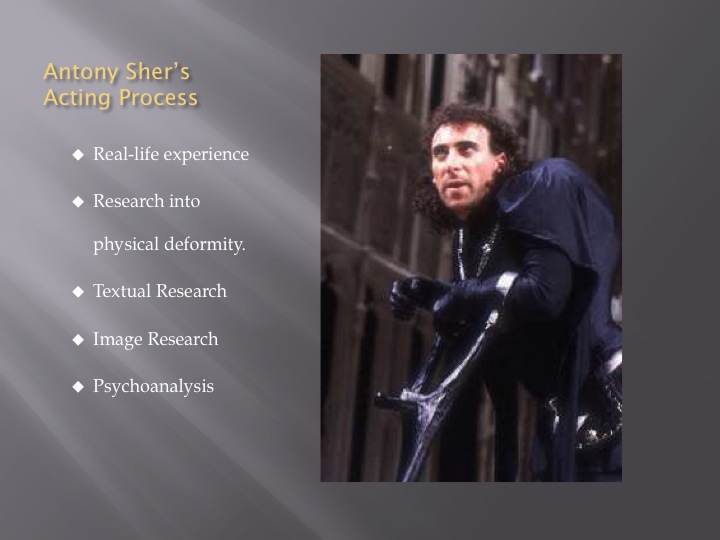
In another nod to contemporary gender politics, the actress who plays Hippolyta and Titania chose to perform her role on crutches. As far as I can tell, this was a deliberate choice and not a result of real injury. There is a precedent for this: In 1984, Sir Antony Sher performed Richard iii on crutches because it highlighted the cruelty people with disabilities often suffer.
I could be wrong, but I think that the reason the actress was on crutches was a symbolic way of confronting the way gender politics can cripple women.
Many scholars have pointed out how Hippolyta rarely speaks despite the fact that she is supposed to be the powerful Queen of the Amazons, and Theseus’ fiance besides. Shakespeare makes it clear that their marriage was arranged as a political alliance after the Amazons lost to Athens in a war:
Hippolyta, I woo'd thee with my sword,
And won thy love, doing thee injuries;20
But I will wed thee in another key,
With pomp, with triumph and with revelling.
With this in mind, it makes sense to have Hippolyta on crutches as a result of her injuries. Those injuries might also explain her silence; she has lost her agency now that she is essentially Theseus’ prisoner. One might think of any number of war atrocious where women have been sold to powerful men over the centuries. In short, by putting Hippolyta on crutches, we see a glimpse into her tragic story that most productions just gloss over- that she has lost a war, been separated from her people, and is now her enemies’ prisoner through marriage.
I’ve come to expect high quality acting from The Globe Theater Company and this cast did not disappoint. As we watched it together, my family concluded that this was one of the best acted productions of Dream that we’ve ever seen, which between us has to be over 30 plus productions.
The delivery is crisp and fast paced. Every actor has taken these words and made them their own. They speak them as if they were written yesterday. One thing I love about the Globe is that the directors encourage this kind of fast paced delivery; with no distracting special effects or sets, the actors have to captivate the audience with their delivery of Shakespeare’s text, without being melodramatic or self-indulgent. I’m pleased to say that this cast does a fantastic job of telling this magical story in a compelling and very modern way.
I’ve shown my recording to kids, teens, adults, and my family, and everyone has a different reaction to the show. Maybe this isn’t quite your cup of tea, but the concept is sound, the acting is high caliber, and it utilizes the Globe’s unique qualities extremely well.
I personally didn’t care for Bottom just because I felt the actress was playing a very energetic part with too much sarcasm and tongue in cheek, but that’s mostly personal preference. I did however love Peter Quince, Snout, Snug, and the rest of the Mechanicals. Peter Quince is a rather thankless part but it’s great to see someone balance being a straight man trying to reign in Bottom’s antics. and an idiot who has no idea how to direct a company of actors, which the actress playing Quince did very well.
In 2011, I wrote a graduate thesis about some of the challenges of playing Shakespeare’s Richard III, specifically those related to playing his deformity. What follows in this post is an adaptation of the presentation I gave at the American Shakespeare Center’s Blackfriars Playhouse, in Staunton Virginia. I gave this presentation with the help of my actors, Matt Carter, Jemma Levy, Amanda Noel Allen, and David Santangello. I also interviewed live onstage, one of the ASC’s greatest actors John Harrell and his director Thadd McQuade, about a unique production of Richard that he performed for the company back in 2002. What follows is the script I wrote for the presentation, as well as the video and Powepoint slides I projected for the audience, to help you see my work in performance. You can also consult a website I designed for the ASC’s production of Henry VI, Part III, where Richard was played by actor Ben Curns.
PRESENTATION SCRIPT
MATT CARTER:
Now is the winter of our discontent Made glorious summer by this sun of York; And all the clouds that lour’d upon our house In the deep bosom of the ocean buried. But I, that am not shaped for sportive tricks, Nor made to court an amorous looking-glass; I, that am curtail’d of this fair proportion, Cheated of feature by dissembling nature, Deformed, unfinish’d, sent before my time Into this breathing world, scarce half made up,
And that so lamely and unfashionable That dogs bark at me as I halt by them.
Why, I, in this weak piping time of peace, Have no delight to pass away the time, Unless to spy my shadow in the sun And descant on mine own deformity: Applause, he sits on one of the gallant stools.
Section 1: Introduction
PAUL:
Many of you recognize those famous lines from the opening soliloquy of Richard III, ably delivered by Matt Carter. Did you notice the ways Matt was moving and the qualities of his voice? Tonight, my actors and I will show you some of the choices actors have made in playing the deformity of Richard III. Deformity and Richard are so closely linked that I would argue that it is the central driving force of the character. The different performances we will discuss show changes in views on deformity, as well as changing theories on the actor’s craft.
Every actor is interested in the human body, every actor is interested in how the mind and body work together, and most importantly, how to present the mind and body of a character to an audience in a clear and articulate way. No matter how the actor decides to represent it, Richard’s deformity of mind and body are essential to the understanding of the character. In his first soliloquy, in the play Henry the Sixth, Part III, he expresses a deep pain, sorrow and bitterness at being denied a normal body. As Jemma delivers this speech, ask yourself- do you pity him? Does this man have a reason to be angry?
JEMMA LEVY:
Why, love forswore me in my mother’s womb: And, for I should not deal in her soft laws, She did corrupt frail nature with some bribe, To shrink mine arm up like a wither’d shrub; To make an enviousmountain on my back, Where sits deformity to mock my body; To shape my legs of an unequal size; To disproportion me in every part, And am I then a man to be beloved? O monstrous fault, to harbour such a thought!
Henry VI, Part III, Act III, Scene i.
PAUL:
In this speech, like the previous one, Richard expresses the belief that his deformity was a curse, laid on by his mother. During the Renaissance, people believed that deformity was a mark of evil and a sign of being cursed by God. Like the Mark of Cain in the Bible, Richard’s deformity signifies that he was “determined,” (presumably by God), to prove a villain.” The deformity also gives Richard psychological motivation. Lacking a normal body, Richard is hungry for revenge, and in search of something to elevate himself above more fortunate people- power.
Section 2: Burbage
PAUL: The first Richard was almost certainly Richard Burbage, Shakespeare’s star actor. Burbage was associated with the role long after his death.
DAVID SANTAGELLO:
‘A funerall Elegy on the death of the famous Actor Richard Burbage:
Who died on Saturday in Lent, the 13th of March 1618′
No more young Hamlet though but scant of breath
Shall cry revenge for his dear father’s death:
Edward shall lack a representative,
And Crookback, as befits, shall cease to live.”
PAUL:
Unfortunately, we have no information on how Burbage played the deformity, but we have one clue as to how his performance might have been received, in the form of an apocryphal story from the diary of law student John Manningham, on 13 March 1602:
AMANDA:
Upon a time when [Richard] Burbage played Richard III,
There was a citizen grew so far in liking with him that before she went from the play,
She appointed him to come that night unto her by the name of Richard III.
Shakespeare, overhearing their conclusion, went before, was entertained, and at his game ere Burbage came.
The message being brought that Richard III was at the door,
Shakespeare caused return to be made that ‘William the Conqueror was before Richard III.’
PAUL:
Although this story is apocryphal, it does hit upon other features of Richard’s deformity- his supreme confidence, and his beast-like sexuality. Scholars have pointed out that Richard’s lack of scruples, (the result of being born deformed), makes him completely focused and confident. Likewise, his non-conformity to traditional standards of beauty could also be seen as a rebellion against societal norms, and thus, a strange aphrodisiac. This dark creature, without a recognizable human shape, manages to exert a dark pull on the audience.
Section 3: Cibber
Surprisingly, for nearly 300 years, portrayals of Richard III have been heavily influenced by an obscure author who was not even Shakespeare’s contemporary
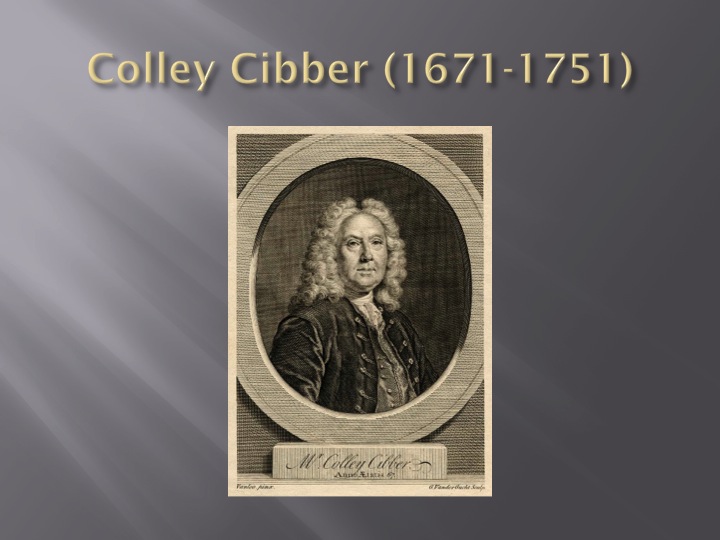
During the Restoration of theater in the 17th century Shakespeare’s plays were largely out of fashion, condemned by critics as “too vulgar for this refined age,” and playwrights began to rewrite and adapt them. The most successful adaptation of Richard the Third, came from poet-laureate Colley Cibber in 1671. Cibber’s text interpreted the story as one man’s evil rise to the crown, not the culminating story of the Wars of The Roses. Cibber cut most of the history involved. He condensed scenes, omitted others, and gave Richard 10% more of the dialogue, then Shakespeare. Cibber’s text also re-emphasizes the importance of deformity to Richard’s character- adding 8 more uses of the words “deformed,” or “ugly.” To further the point, Cibber inserted text from other Shakespeare plays that speak about Richard’s deformity, such as the Henry VI speech spoken earlier. Cibber freely cut-and pasted from Shakespeare’s histories, which can be demonstrated in this speech where the Lady Anne mourns for the death of Henry the Sixth, using lines written by Shakespeare for the funeral of King Henry the Fifth:
AMANDA:
Hung be the heavens with black, yield day to night! Comets, importing change of times and states, Brandish your firey tresses in the sky, And with them scourge the bad revolting stars That have consented unto Henry’s death!
O be accursed, the hand that shed his blood
Accursed the head that had the heart to do it! If ever he have wife, let her be made More miserable by the life of him As I am made by Edward’s death and thine!
PAUL:
Cibber also wrote his own speeches for Richard, such as this one where Richard resolves to woo Lady Anne in spite of his deformity:
JOHN HARRELL:
But see! My love appears. Look where she shines
Through her dark veil of rainy sorrows
Tis true, my form perhaps may little move her;
But I’ve a tongue shall wheedle with the devil.
PAUL: Cibber’s text was extremely popular with actors because it raised Richard’s importance to a star role. Actors such as David Garrick made their debut as Cibber’s Richard, and some of Cibber’s editorital choices still survive in the two movie versions of Richard by Ian McKellen and Laurence Olivier.
Section 4: Olivier
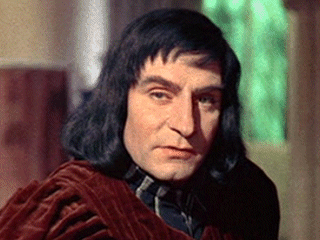
Olivier, in the 20th century was considered the definitive Richard. In his film version he emphasizes Richard’s evil and deceptive nature. He uses the character’s physical disabilities (as well as various cinematic techniques) to reveal his moral depravity.
The Crown of England- the tremolos and the large crown that appears in the beginning, middle, and end of the film. Homage to Cibber.
CINEMATIC USE OF DEFORMITY
Long camera angles as he limps away, exposing hump and limp
Shadowy silhouette
In this shot, Richard slinks away from the camera, leaving his bizarre silhouette to unfurl like a snake
In this shot, Richard bends over to whisper evil thoughts into the king’s ear.
Finally, in this shot, we see the shadow of Richard’s head, as he stares into the cell of his brother Clarence, as he plans his murder. We see through this shot, Richard looms as a great evil presence.
Section 5: Sher
After Olivier, actors abandoned the approach of making Richard into a monster, and favored a more human, natural approach.
The role of Richard III however, presents unique challenges for actors attempting to do this; they are attempting to do something un-natural by playing a deformity that they do not actually have. Thus they are attempting to play something “un-natural” within the precepts of naturalistic acting.. Antony Sher’s massive preparation for the role, using Method acting techniques, included both a thorough research into the physical effects of real disability, and a deep examination of its psychological effects.
Used Method acting techniques to create the role:
Real-life experience- Crutches came from his own real injury.
Research into physical deformity.
Textual Research
Image Research. He used Margaret’s text to create a visual design for his character, a bottled spider.
Psychoanalysis- brought Shakespeare’s text to a real psychiatrist to “put Richard on the couch.”
Sher’s technique led him to go into a deep, psychological probing of Richard’s mind. He viewed the deformity as a source of deep pain, through which we can identify with Richard as a human being.
Listen to how David, applying Method-inspired text analysis, conveys Richard’s human emotions.
DAVID:
But I, that am not shaped for sportive tricks, Nor made to court an amorous looking-glass; I, that am rudely stamp’d, and want love’s majesty To strut before a wanton ambling nymph; I, that am curtail’d of this fair proportion, Cheated of feature by dissembling nature, Deformed, unfinish’d, sent before my time Into this breathing world, scarce half made up, And that so lamely and unfashionable That dogs bark at me as I halt by them;
PAUL: Sher’s massive preparation for the role represent the limits that an able bodied actor could go to portray a disability he himself did not have.
Section 6: From Sher to Harrell
Sher’s Richard created an unexpected backlash from disabled community.
One response to this: a number of Richards played by disabled actors.
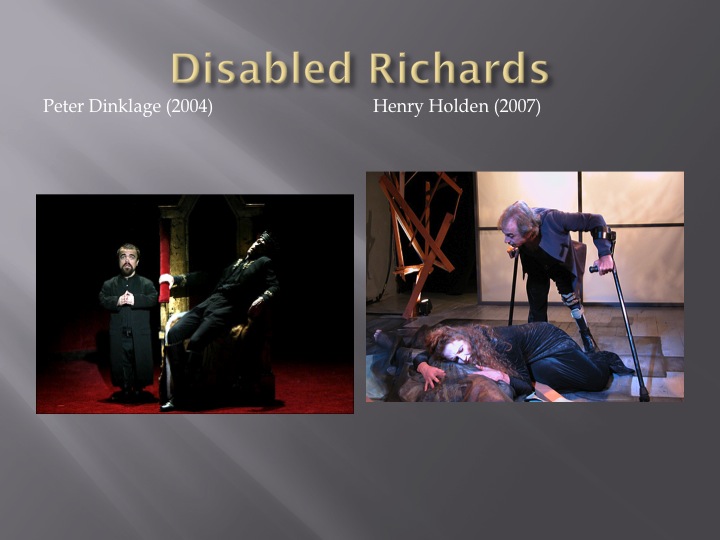
Henry Holden in 2007. Like Sher, on crutches, only he needed them.
Peter Dinklage played the role with none of the traditional deformities.
His size was a kind of disability, as it literally hindered him from taking the crown–
He was tangled in his robes,
Couldn’t reach the throne.
Critics writing about the performance claimed watching him was more real. You weren’t watching a performance, you watched a real man, with a real struggle.
Another response is approaching the deformity from a more stylized perspective.
This was the approach favored by Thadd McQuade.
The essence of this performance was watching a man struggle through life trying to overcome obstacles and find a place for himself in the world, a struggle that is the essence of all tragedy.
Section 7: 10 minute interview with Thadd and John.
Both– Explain the way you chose to represent deformity (bowling ball) and why.
John- I got an email from actor JP Schiedler, (who was in the production) who said “ As I recall John was very interested in working inside of some form of restriction which forced his body to adapt, struggle and physically change how he could deal with the world around him which the ball did.” If this is true, I’d like you to talk about this idea- why was it important for you to have something that restricted you? I want to get an idea of how you saw the physicality of Richard and how it is important to the character.
Thadd, when I interviewed you, you mentioned that doing the play naturalistically can actually be off-putting because an able-bodied actor will never completely pull off the deformity. I want you to repeat some of that to explain the virtues of a more presentational Richard.
Both- How did your techniques contribute to a better understanding of the play for the audience?
Conclusion: Richard’s deformities and disabilities are both physical and psychological. They are the driving force in his life. Portraying Richard’s deformity is a microcosm of the challenges that face all actors: making choices of how to explore the mind and body of a character. Watching an actor take on the challenge of portraying this man’s struggles. This struggle is the essence of tragedy and watching an actor take on the challenge of creates powerful and poignant theatre.









 The Shakespearean Student