Shakespeare on Riots

Today is March 15th, a day that history still bewares, because of the infamous day when armed, violent conspirators went to the Senate and attempted to overthrow elected rulers. For obvious reasons, this put me in mind of the heinous actions of another group of conspirators stormed another Senate and tried, unsuccessfully, to overthrow democracy.

January 6th, 2021 (which, coincidently, was Twelfth Night, one of my favorite Shakespeare-themed holidays), was a tragedy for multiple reasons. The protestors broke windows, destroyed furniture, defaced statues, broke into both chambers of Congress, and probably would have harmed lawmakers, in a violent protest of both the US presidential election and the Senate vote in Georgia that week.


Let me be clear, this was sedition and treason and everyone involved should be prosecuted to the full extent of the law. Anyone who says otherwise is blatantly attacking our cherished democracy, and spitting in the face of the rule of law. Unfortunately, Republicans in both chambers have been unwilling to condemn their actions for fear of alienating their base. If this is what the Republican party has come to, the party doesn’t deserve the name. A republic protects the right of the people to elect its representatives and dedicates itself to the peaceful transition of power. Left unchallenged, groups like this will bring anarchy and tyranny to our country.

How do I know this? Because it happened before. Shakespeare has long dramatized real historic events where people rise up against their governments (for better or worse). In all cases, whether protesting a famine, a war, or a cruel tyrannical usurper, the riots never accomplish anything except bringing chaos and bloodshed. Sometimes these ignorant rioters are goaded by charismatic powerful figures, but these upper-class characters are only exploiting the rioters, using their violence as a way to get power for themselves. So, let’s examine the language, tactics, and effects of rioters in three of Shakespeare’s plays: Julius Caesar, Henry VI Part III, and Sir Thomas More:

Example 1: Julius Caesar
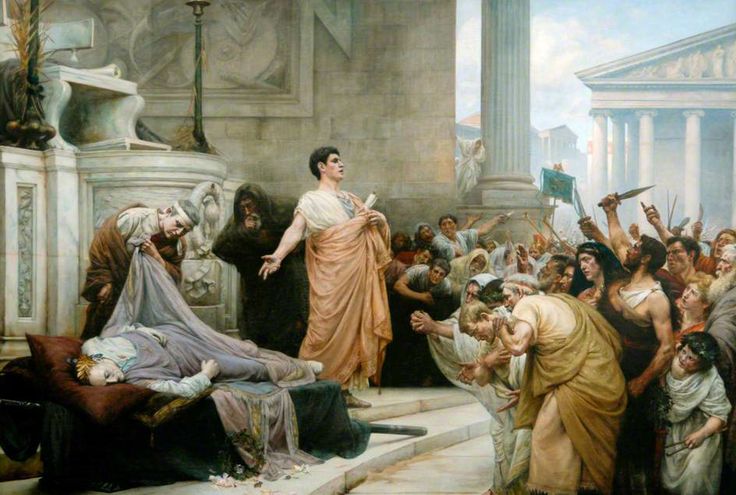
George Ed Robertson Antony
(c) Hartlepool Museums and Heritage Service; Supplied by The Public Catalogue Foundation

As I covered before in my “Friends, Romans, Countrymen,” post, during Antony’s famous funeral speech, he galvanizes the Roman crowd, first to mourn Caesar, then to revenge his death. How do they do this? By burning the houses of the conspirators and rioting in the street. They even kill a man just because he has the same name as one of the conspirators:

https://www.rsc.org.uk/shakespeare-learning-zone/julius-caesar/story/timeline

What does this violence accomplish? Nothing. Caesar is still dead. Brutus is still alive (though on the run). Antony merely wished to punish Brutus, and get the mob to hate him while he secretly cheats them out of their money. In Act Four, Antony becomes the de facto ruler of Rome because he leveraged his performance at the funeral, and uses his newfound powers to take money away from the citizens that Caesar promised to give them in his will. He manipulated them for his own purposes and duped them for political power.

Example 2: Jack Cade in Henry VI, Part ii.

Henry VI is the only king in English history to be crowned twice, deposed twice, and buried twice (Saccio 91). As the play begins, King Henry has already lost France, lost his mind, and lost the respect of his people. Around 1455, John Hardyng wrote a contrast between Henry’s father and himself. He laments that Henry the Fifth died so soon and then exhorts Henry to keep the quarrelsome lords in his government from warring among themselves.

Withstand, good lord, the outbreak of debates.
And chastise well also the rioters
Who in each shire are now confederates
Against your peace, and all their maintainers
For truly else will fall the fairest flowers
Of your great crown and noble monarchy
Which God defend and keep through his mercy.

(Excerpt from Harding’s Chronicle, English Historical Documents, 274).

Henry’s political ineptness was why Richard of York challenged his claim to the throne. Though Richard had little legal claim as king, he believed himself to be better than Henry.

In Shakespeare’s play Henry VI, Part ii, York tries to get the people’s support by engineering a crisis that he can easily solve. York dupes a man named Jack Cade to start a riot in London and demand that the magistrates crown Cade as the true king.

Biography of Richard, Duke of York, who challenged King Henry VI for his right to be king.

York and Cade start a conspiracy theory that Cade is the true heir to the throne and the royal family suppressed his claim and lied about his identity. Cade starts calling himself John Mortimer, a distant uncle of the king whom York himself admits is long dead:

The Royal National Theater’s production of Henry VI, Parts II, and 7. Jack Cade appears at about the 7-minute mark.
And this fell tempest shall not cease to rage
Until the golden circuit on my head,
Like to the glorious sun's transparent beams,
Do calm the fury of this mad-bred flaw.
And, for a minister of my intent,
I have seduced a headstrong Kentishman,
John Cade of Ashford,
To make commotion, as full well he can,
Under the title of John Mortimer.

Just like Cade and his rebels, the January 6th rioters were motivated by lies and conspiracies designed to crush their faith in their legitimate ruler. Even more disturbing, these rioters are pawns in the master plan of a corrupt political group. York doesn’t care that Cade isn’t the real king; he just wants to use Cade’s violence as an excuse to raise an army, one that he can eventually use against King Henry himself.
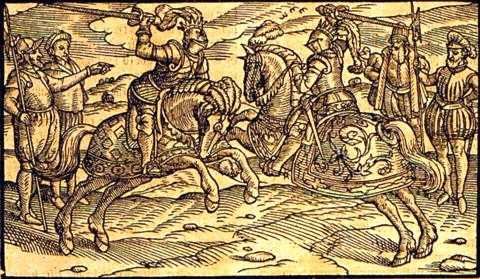
15th century woodcut from the War Of the Roses.

Similar to York’s lies and conspiracy-mongering, many Republicans have refused to accept the legitimacy of Joe Biden’s election, and some are actual proponents of Q Anon conspiracies!

A lot of Republicans deserve blame for fanning the flames of rebellion on January 6th, but arguably former President Trump deserves most of the blame. Even Rush Limbaugh admitted that Trump spread a huge amount of conspiracy theories without believing in any of them. He does this because he wants Americans to be afraid of imaginary threats that he claims he can solve. What’s easier to solve than a problem that doesn’t exist? Much like York, Trump tried to hold onto power by pressuring his supporters to pressure the Capital, feeding them lies about election fraud, and a secret democratic Satanic cult. Thus radicalized, they resolved to do what Cade’s mob did: “Kill all the lawyers.” Unfortunately, there are a lot of lawyers in the Senate.

As Dick the Butcher points out, most people don’t actually believe Cade is truly John Mortimer, they are just so angry at the king and the oppressive English government, that they are willing to follow him in a violent mob to take their vengeance upon the monarchy. This is why they try Lord Saye and execute him just for the crime of reading and writing! Similarly, the mob attacking the capital was made up of die-hard conspiracy adherents, and people just angry at the Democratic Party.

https://www.washingtonpost.com/technology/2021/01/20/qanon-trump-era-ends/

Like I said before, Cade and his mob is just a pawn in the machinations of York. Eventually the king’s enforcer, Lord Clifford convinces most of them to abandon Cade, and Cade himself dies a humiliating death- on the run from the law and starving, Cade is murdered by a farmer after trying to steal some food. After Joe Biden became the 46th President, many of the conspiracy group Q-Anon, who had many prominent members in the January 6th riot, began to disbelieve and abandon the conspiracies of the group. However, as this news story shows, some Q-Anon supporters are die-hard adherents and will never abandon their conspiracy theories, and some, like York’s supporters, are being recruited by other extreme groups. Sadly, as York shows, sometimes a riot is a rehearsal for another riot. In Shakespeare’s Henry VI, Part III, York finally amasses an army and challenges the Lancastrians in all-out war. Hopefully, the US government will hunt down and arrest these violent insurrectionists before they have the chance to do the same.

Example 3: Sir Thomas More

In the unfinished play “Sir Thomas More, a racist mob again attempts to attack London. This time they have no political pretenses; they want to lynch immigrants who they believe are taking English jobs. As I said in my “Who Would Shakespeare Vote For?” post, More’s speech is a perfect explanation of why this behavior cheapens and denigrated a country’s image, and weakens its ability to command respect from the rest of the world. Last time I posted a video of Sir Ian McKellen speaking this speech, but this time.. well just watch:

Shakespeare On Epidemics

My purpose with this post is to provide some hope and comfort by showing how Shakespeare and other Elizabethans dealt with epidemics and survived. The thing to remember is, although we are dealing with a pandemic, we are still far better prepared for it than any time in history. Furthermore, I want to draw on lessons from the past to offer hope and wisdom for people going through an epidemic.

Side note: Shakespeare refers to several diseases in his plays including “The plague,” (Bubonic Plague), “The Pox,” (syphilis), “Dropsy,” (edema), and “Falling sickness,” (epilepsy). I will mainly focus on the plague because of its strong connection to both Shakespeare’s life and career, as well as the continuing anxiety it causes to this day. I am also focusing on the plague to try and make parallels with Covid 19, a disease that, while less lethal and harder to detect, is still a pandemic that like the plague has transformed much of daily life since its inception, and could continue to grow, abate, and revive if we as a society aren’t careful.


Shakespeare’s plays also frequently allude to plagues and plague imagery, especially his most famous play, Romeo and Juliet.

First of all plague is an important plot element; an outbreak of plague prevents Romeo from getting the message that Juliet is alive, so plague inadvertently kills them both.

Plague also serves as a motif for the destructive forces that lead to the play’s tragic conclusion. After Mercutio curses “A plague on both your houses,” his death sets the events in motion that kills most of the principal the characters, as if his curse somehow infected all of them with a deadly virus.

Immortal Longings Artwork for “Romeo and Juliet” by Elizabeth Schuh, used with permission.

https://www.slideshare.net/mobile/PaulHricik/the-universe-of-romeo-and-juliet-by-paul-hricik


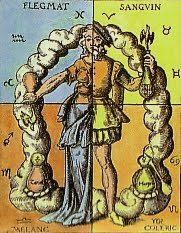
Shakespeare exploited a unique cultural knowledge of plagues to help his audience engage with Romeo and Juliet. If you click on the link to my presentation above, you’ll see that Elizabethans believed that four liquids called humors controlled health and behavior. A humorous man was someone who was out of ballance with the humours and thus was ridiculous for failing to control his emotions. The humor choler was associated with anger and in dangerous imbalances was thought to cause terrible fevers and even plague. Hence, when characters like Romeo and Tybalt get angry, his audience knew that one way or another, that anger will kill them.

Medieval illustration of the four humours. Top left to bottom right; Phlegm, Blood (Sanguine), Melancholy, (black bile), and choler (yellow bile).


Shakespeare also uses plague as a metaphor for the hate of the two families that infects and kills the young lovers, as well as Tybalt, Paris, and Mercutio.

The play was first published in 1595, two years after a plague outbreak so bad that the theaters were all closed, so Shakespeare’s audience had a visceral reaction to this plague imagery when they saw it in the theater, especially after a year of being quarantined away from the theaters because of that exact same disease!

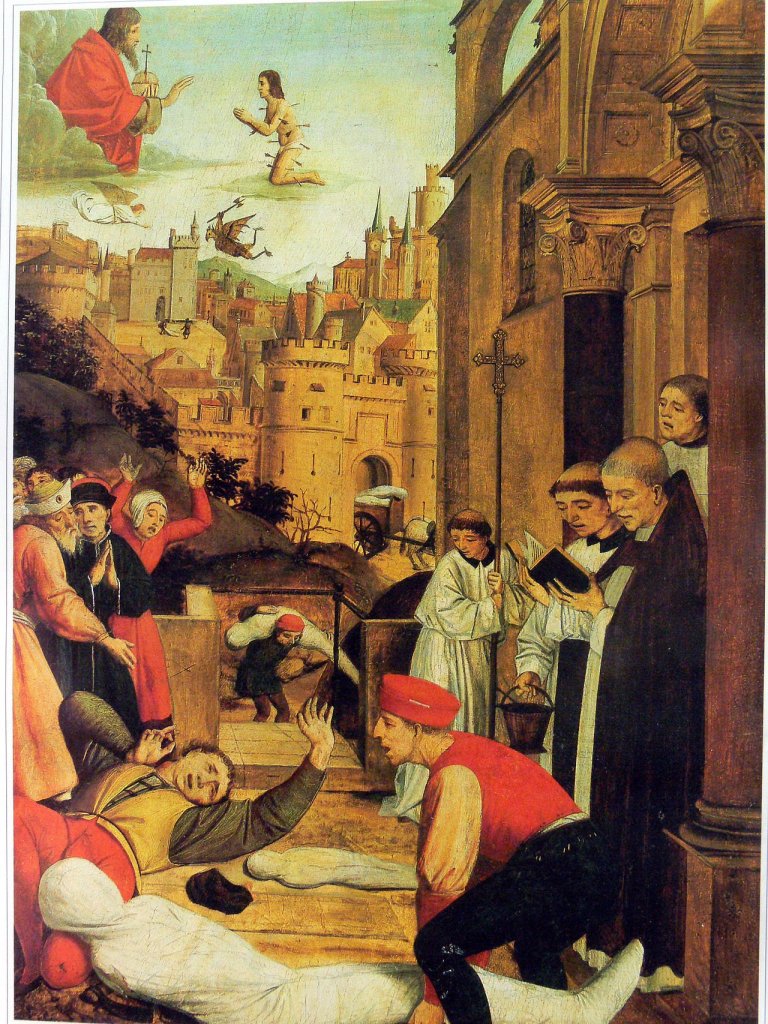
Saint Sebastian pleads with Jesus for the life of a gravedigger afflicted by plague during the Plague of Justinian. (Josse Lieferinxe, c. 1497–1499)

“Scourge and Minister”

Some of Shakespeare’s plays mention plague indirectly in relation to its perceived nature as a divine punishment. Since the very beginning of the plague,, writers, clergy, and many others perceived the plague as a divine punishment, designed to destroy the wicked, like the 10th plague in the Bible that decimated the enslaving Egyptians.

To “scourge oneself” is also a verb for whipping. In the 14th century, a group a people called the flaggelants, who voluntarily scourged themselves in the hope that God would end the disease as a result of their suffering.

Woodcut of flagellants (Nuremberg Chronicle, 1493).


Shakespeare uses both meanings of scourge in many of his plays. In Henry IV, the king is filled with remorse for usurping the throne from King Richard, and worries that his future progeny will become a scourge upon him:

I know not whether God will have it so,

For some displeasing service I have done,

That, in his secret doom, out of my blood

He’ll breed revengement and a scourge for me;

King Henry IV, Part I, Act III, Scene ii.

Sometimes a scourge is a person sent to destroy a sinful person or group of people. Shakespeare refers to the character of Richard III several times as a scourge upon the families who fought in the Wars Of The Roses.

In Shakespeare’s first cycle of four history plays, we see the families of York and Lancaster take turns usurping the throne, and committing numerous acts of murder, treason, and blasphemy. In the play that bears his name, Richard III kills the Yorkist royal family and then is murdered himself by Henry Tudor, systematically destroying the families of York and Lancaster. Thus, in Shakespeare’s propaganda version of history, he depicts Richard as a scourge who purges the throne of usurper and traitors, paving the way for the “virtuous,” Henry Tudor and his dynasty.

The ending shot of the BBC’s 1978 TV version of “Richard III.”

The Real Plague
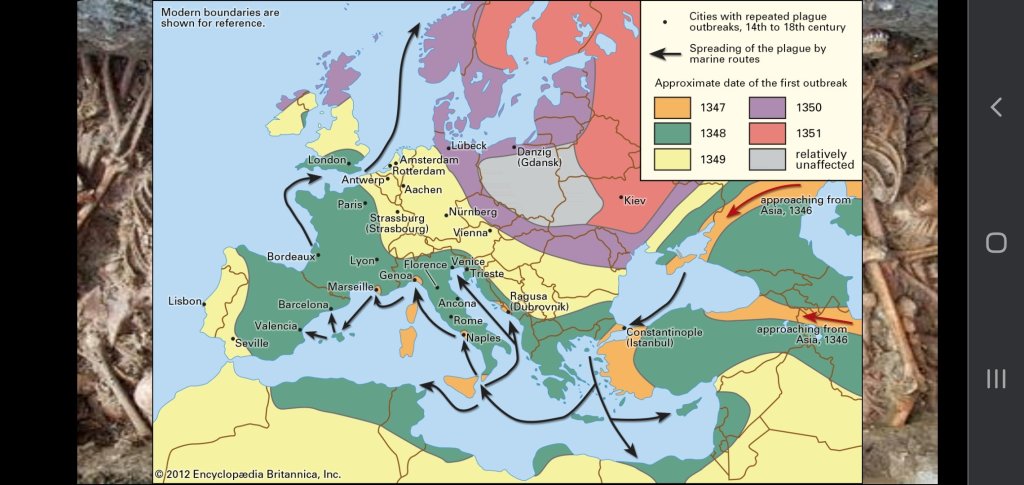
The black death, also known as Bubonic Plague, was first documented in 1347. Like Covid 19 it was first discovered in China, though it might not have originated there. Some historians argue that the Huns might have carried the plague into China and trade routes from the East carried it into Europe. By 1349 it reached England.


Everyone knew what to look for from those infected with the plague: first came fevers and chills. The next stage was the appearance of small red boils on the neck, in the armpit or groin. These lumps, were called buboes, (hence the term Bubonic Plague)

The buboes grew larger and darker in colour as the disease grew worse. From there the victim would begin to spit blood, which also contaminated with plague germs, making anyone able to spread the disease by coughing. The final stage of the illness was small, red spots on the stomach and other parts of the body caused by internal bleeding, and finally death.

We see death coming into our midst like black smoke, a plague which cuts off the young, a rootless phantom which has no mercy or fair countenance. Woe is me for the shilling in the armpit. . . It is an ugly eruption that comes with unseemly haste. It is a grievous ornament that breaks out in a rash. The early ornaments of black death.-Jevan Gethin, poet who died from plague in 1349.

Detail from The Temptation of St Anthony, 1512. Note the swollen buboes on the stomach, arms, and legs.

John Flynn, an Irish Friar described the plague in apocalyptic terms, writing a journal for posterity, but expressed doubt that ” Any of the race of Adam would even survive.” With the horrifying spread of the epidemic, it is not hard to understand why Flynn felt that way: In 1348, there were 100,000 people living in London, but after the plague spread, the city lost 300 people every day!

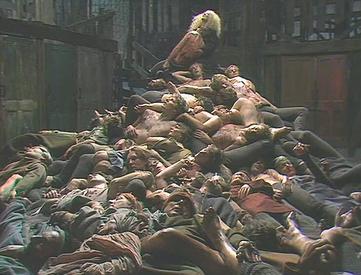
https://www.google.com/amp/s/www.history.com/.amp/news/quarantine-black-death-medievalContainment/ “treatments”Plague carts like in Monty Python (Dreary) carried plague bodies out of the city and burned them.
• In France, bodies were thrown in rivers (Deary)

  • Quarentines: The word quarantine is Italian for 40 days. It refers to the Venetian practice of taking suspected plague victims to an island for 40 days before allowing them to enter Venice or other populated areas. The rationale was that in the Bible, the number 40 occurs many times when a person or group of people require some form of purification; the 40 days of flooding in Genesis, the 40 years that the Jews journey to the promised land, and the 40 days of fasting Christ endured before he began his ministry to name a few examples. Bubonic plague has an incubation period of less than 40 days so the quarantine actually worked- people would go to the island, then the disease would run its course and not spread out as long as it was contained. The problem was that these quarantines were also essentially leper colonies and without treatment, the infected were basically sent to die.

Social distancing in Elizabethan England

By 1564, the year Shakespeare was born, there had been several outbreaks, but also a system designated to contain the disease. The rich went to the country. Plague bodies were burned. Theaters were closed to keep the disease from spreading. There were also body inspectors, (similar to coroner’s or death investigators today,) who inspected the bodies to look for the cause, then burned them and the clothes. Funerals for plague victims were held at night, to discourage crowds from attending, similar to our own practice of encouraging people to shop and go outside during non-peak hours.

Treating” it: The biggest comfort I can give here is to remind people that although like the plague, we are dealing with a disease with no known cure, we still have a much better understanding of how to treat viruses than our Elizabethan forebears. Some of the “cures,” from Shakespeare’s day are downright silly, when they aren’t expensive, dangerous, and above all, ineffective.

Real plague “cures”
• Kill cats and dogs
• A poultice made of Marigold flowers and eggs
• Arsenic powder (which is highly toxic)
• Crushed emerald powder.
• Pluck a chicken and place its rear end on the patient’s buboes, known as the Vicary Method.

To bring the aftermath of the plague into a modern context, I’d like to allude to some comments from the news. Recently a few Republicans have alluded that the cost of people staying home from work would cause irreparable harm to the American economy, and alluded to the notion that a few deaths might actually benefit the economy as a whole, including Texas Lieutenant Governor Dan Patrick and Republican pundit Glenn Beck.
Now at first glance these comments are gruesome and heartless, but they have a veneer of historical precedent: some people did prosper because of the black death. Laborers could charge more from their landlords simply because most of them had died, and some younger men managed to skirt the laws of primogeniture and inherit their families’ wealth because of the death of their oldest siblings. Shakespeare himself was the third child of Mary and John Shakespeare, but his elder siblings both perished due to plague. Again, to be fair to these Republicans, there is a historical facet to their arguments, however this is a very narrow and very incomplete version of history.


https://youtu.be/QNo-r20wqqg
Looking forward from the first century after the Black Death, the loss of life and resources was devastating for the workforce and caused a series of catastrophes for centuries to come. Though some peasants benefited from the lack of serfs, the depleted workforce meant work became harder and more expensive, and the coming centuries were plagued again by revolts, wars, and famine.

Wat Tyler, leader of the Peasants Revolt, rides out to negotiate with King Richard’s army.

Just 30 years after the first outbreak of plague in England, the peasants rose in revolt against their lords for the first time in 300 years, in no small part, due to the hardships caused by the plague.

Portrait of King Richard the Second

The king who punished the peasants was Richard Richard the Second, whom Shakespeare famously dramatized as an arrogant, egomaniacal, incompetent man-child who was eventually deposed and executed in the Tower of London. I think certain people who are tempted to “make sacrifices,” to protect the American economy would do well to look at this historical tragedy and avoid the political consequences of this kind of thinking.

In conclusion, though we are dealing with a frightening pandemic that we currently don’t know how to treat, we can take comfort from the fact that our forebears faced far worse diseases and survived. History has shown that social distancing works and that basic sanitation and the tireless work of healers and scientists can slow a disease, cause it to ebb, and eventually irradicate it. But until science discovers a treatment for Covid-19, it is up to all of us to flatten the curve for the sake of our country, world, and our future.

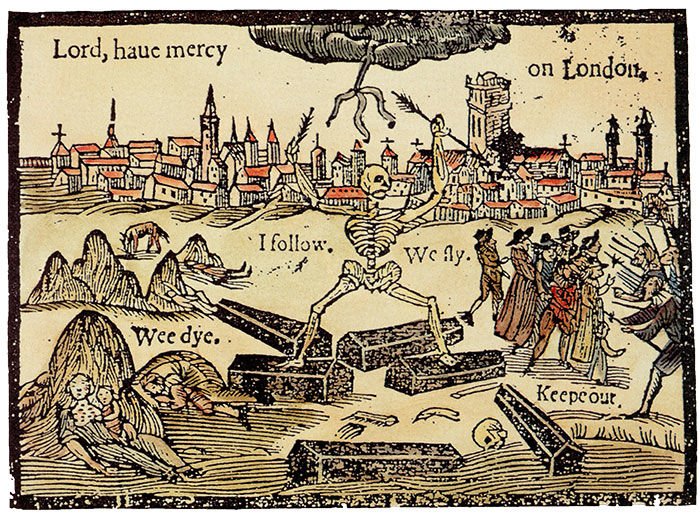
Plague woodcut. Note the wealthy people on the right who fled the plague, and the poor families dying on the left.

Like I have said, the working poor as a whole, suffered greatly because of the plague, especially since they were denied the means to avoid it. They lived in tightly packed, unsanitary environments and were unable to leave them without their lord’s permission, whereas we have a choice. This why it is crucial that we all do our part by staying away from crowds, observing proper hygiene, and offering support to our healthcare workers who are on the front lines of this war against coronavirus, and for whom we all pray for to stay healthy in turn.

Continue reading

Crafting a Character: Brutus

Happy Ides of March every one. I hope you have enjoyed all the posts for my Roman week. If I have time, I will try to post a few more, since I have not touched on Cymbaline or Titus Andronicus.This will not be an in depth character analysis. I won’t go into every scene and speech of Brutus’. My goal is to look at the history and the actions of Brutus in the play to show why he is such an amazing and ambigous character.

Marcus Brutus was born in 85 BC. Shakespeare’s source for the play, Plutarch’s lives of the Noble Greeks and Romans, mentions that his desire to kill Caesar might have been tied to his family: Brutus’ ancestor was Lucius Junius Brutus, the man who drove out the last king of Rome, and first consul. Below is the famous painting of Lucius foiling a plot to restore the monarchy, but to do so, he had to sentence his own sons to death:

Jaques Louis David, The Lictors Bring to Brutus the Bodies of His Sons, 1789.

https://www.khanacademy.org/humanities/monarchy-enlightenment/neo-classicism/v/david-the-lictors-returning-to-brutus-the-bodies-of-his-sons-1789

This was how seriously the Brutus family took defending the Roman Republic, they valued it even beyond their own family.

Brutus’ mother was Servilia, half sister of Caesar’s longtime critic, the senator Cato. He even married Cato’s daughter Portia! So you can see that once Caesar starts acting like a king, Brutus must have felt a tremendous amount of pressure from his Family to stay true to his Republican ideology. On the other hand, Servillia was actually Caesar’s mistress and Brutus owed his life to Caesar. After Brutus fought against Casesar, they reconciled after the Battle of Pharsalus in 48 BC:

Most of those who were taken alive Caesar incorporated in his legions, and to many men of prominence he granted immunity. One of these was Brutus, who afterwards slew him. Caesar was distressed, we are told, when Brutus was not to be found, but when he was brought into his presence safe and sound, was pleased beyond measure- Plutarch, retrieved from: http://penelope.uchicago.edu/Thayer/E/Roman/Texts/Plutarch/Lives/Caesar*.html

Despite his close ties to Caesar, Brutus chose to betray and assassinate him, so the question remains, why?

In the play and in Plutarch, Brutus is persuaded by Cassius Longinus, his brother in law and colleague in the Roman Senate. As you remember from my post on “Friends, Romans, Countrymen,” there are three basic kinds of persuasive speech, and Cassius uses all three:

1. Ethos “If you do know that I do fawn on men, and hold them hard, and after scandal them… then hold me dangerous.”

2. Logos- Cassius points out a series of embarrassing stories about Caesar that set up the following argument:

• Caesar is weak and frail

• Gods cannot be frail

• Why is Caesar treated like a god?

3. Pathos

• The people

• Fear of tyranny

• Brutus’ family honor- this is the real knife that kills any doubt Brutus had. Cassius reminds Brutus of his ancestor Lucius and how he would rather die than see a king in Rome again.

The soliloquy

Brutus. It must be by his death: and for my part,
I know no personal cause to spurn at him,

But for the general. He would be crown’d:
How that might change his nature, there’s the question.
It is the bright day that brings forth the adder;
And that craves wary walking. Crown him?—that;—
And then, I grant, we put a sting in him,
That at his will he may do danger with.
The abuse of greatness is, when it disjoins
Remorse from power: and, to speak truth of Caesar,
I have not known when his affections sway’d
More than his reason. But ’tis a common proof,
That lowliness is young ambition’s ladder,
Whereto the climber-upward turns his face;
But when he once attains the upmost round.
He then unto the ladder turns his back,
Looks in the clouds, scorning the base degrees
By which he did ascend. So Caesar may.
Then, lest he may, prevent. And, since the quarrel
Will bear no colour for the thing he is,
Fashion it thus; that what he is, augmented,
Would run to these and these extremities:
And therefore think him as a serpent’s egg
Which, hatch’d, would, as his kind, grow mischievous,
And kill him in the shell.

• This speech is a direct predecessor for “To be or not to be,” and Macbeth’s “If it were done,” soliloquy. https://youtu.be/IoDwXjKIenI

  • All three speakers are talking about murder and can’t bring themselves to say either the word murder, nor mention the name of the man who will die.

• All references to murder are in passive voice, as if Brutus wishes a lightning bolt would kill Caesar, so he doesn’t have to accept the responsibility of killing.

•Compared to Hamlet and Macbeth, Brutus’ text is flat, The speech depends on the actor to show the torment in his soul.

  • One question that the actor must answer for himself is, is Brutus really concerned for the well being of Rome, or does he want Caesar dead for another reason?

After the soliloquy, Brutus throws himself into the role of head conspirator: https://youtu.be/ibzqdoV-BcU https://youtu.be/ibzqdoV-BcU

You can see in this video that Brutus speaks eloquently about how just the cause is and how only Caesar will die. This illustrates that Brutus is well spoken but not pragmatic. As we all know, Marc Anthony eventually gets the crowd to turn on Brutus and will become part of the army that hunts him and Cassius down. The dramatic irony is what helps the argument that Brutus is the real tragic hero of this play.

The murder and its aftermath

The rest as they say, is history. On March 15th, 44 BC, Brutus and the conspirators stabbed Caesar 17 times. In the play, before Caesar dies, he utters the famous line, “Et tu, Brute? Then fall Caesar!”

The line stands out because it is the only time anyone in this Roman play speaks in Latin. Now, I have heard a compelling argument from Professor J. Rufus Fears, that this might actually be a misquote, and what Caesar really said will amaze you. As I have mentioned, Brutus’ mother was Caesar’s mistress and the two of them were very close. At the time of Caesar’s death he was 40, while Caesar was 16 years his senior. Why did Caesar forgive Brutus fighing against him? Is it not possible that what he actually said was: “Et tu, son?” That’s a question for directors and actors, but it does heighten Brutus’ emotional conflic. Much like his ancestor Lucius, Marcus Brutus is caught between his ideals and his family.

During the funeral, Brutus has a very well crafted speech where he lays out his reasons for killing Caesar. He sets himself up as the friend of Rome. This video from the Royal Shakespeare Company explores the techniques that Brutus uses to get the crowd on his side: https://youtu.be/nyPlvuv8SSk

After Antony makes his speech however, the mob burns Brutus’ house and even slaughters a man just because he shares a name with one of the conspirators. Brutus and Cassius take their armies and flee Rome, and prepare to take on Antony and Octavian. The adversity Cassius and Brutus go through pushes them together and they behave like brothers; they fight and reconcile constantly: https://youtu.be/K9EAxjVC22M

In a way, these men are two sides of the same coin: Cassius is fiery but pragmatic while Brutus is stoic and idealistic. It’s like a tragedy in and of itself that these men weren’t melded into one man with Brutus’ heart and Cassius’ mind.

Is Brutus A Traitor?

Unlike Macbeth, Shakespeare’s text leaves it ambiguous as to whether Brutus was right or wrong to kill Caesar. Even Antony, who leads an army against him, ends the play by calling Brutus “The noblest Roman of them all.” Shakespeare also gives us few clues to Brutus’ motivations other than the speech I quoted earlier. Mainly we have to go on Brutus’ actions and their consequences.

One moment that I think perfectly encapsulates the ambiguity of Brutus’ actions is the moment where he’s visited by Caesar’s ghost. In other tragedies like Macbeth and Richard III, the villain is tormented by the ghost or ghosts of people he murdered. The ghost serves as a manifestation of the murderer’s guilty conscience and torments him before his death. When Brutus sees Caesar, he does not follow this trope. He isn’t horrified, not struck by guilt, in fact, he wishes that the ghost would stay longer.

Julius Caesar by William Shakespeare

Julius Caesar book cover

MENU

In Act 4, why does Caesar’s ghost appear? I don’t understand why Caesar’s ghost shows up. I dont understand the significance of that scene.

Expert Answers info

JUANAMAC

eNotes educator

| CERTIFIED EDUCATOR

Shakespeare, as other Elizabethan writers, uses the idea of ghosts in his plays usually as a foreshadowing of events to come. In “Hamlet,” Hamlet has to deal with working out what to do with his father’s request for revenge, and also, whether the ghost is indeed his father. In “Macbeth“, Macbeth has to deal with the Ghost of Banquo showing up to dinner, literally haunting him. In “Richard III“, Richard deals with the ghosts of the men he has wronged right at the start of the play.

This haunting is significant also in “Julius Caesar“. The Ghost of Julius arrives on the eve of battle to literally haunt Brutus. Brutus had hoped that by killing Caesar he would enact change in Rome, however, the Roman Empire goes on, as does the reign of Caesar (albeit, a new Caesar).

As Brutus goes into battle, and the battle doesn’t go his way, he again turns to Julius Caesar, blaming him for the outcome of the battle,

O Julius Caesar, thou art mighty yet!
Thy spirit walks abroad, and turns our swords
In our own proper entrails. (5.3.94–96)

Shakespeare’s ghosts are visible to one person (as well as the audience, clearly) so those who react to the ghost are the ones who are supposed to learn from the arrival of the ghost, heeding the message from beyond the grave.

Enter the Ghost of CAESAR

How ill this taper burns! Ha! who comes here?
I think it is the weakness of mine eyes
That shapes this monstrous apparition.
It comes upon me. Art thou any thing?
Art thou some god, some angel, or some devil,
That makest my blood cold and my hair to stare?
Speak to me what thou art.

GHOST

Thy evil spirit, Brutus.

BRUTUS

Why comest thou?

GHOST

To tell thee thou shalt see me at Philippi.

BRUTUS

Well; then I shall see thee again?

GHOST

Ay, at Philippi.

BRUTUS

Why, I will see thee at Philippi, then.

Exit Ghost

Now I have taken heart thou vanishest.
Ill spirit, I would hold more talk with thee.

The ghost itself also resists the clearcut definition as a sign of a guilty conscience. It doesn’t accuse Brutus of murder, it doesn’t curse in fact, all the ghost says is that Brutus will see him at Philippi. Unlike Richard III or Macbeth, the ghost utters no curses or scare Brutus out of his mind.

The only conclusion that Brutus gleans is that his end is near. According to Dr. John Langdon, many Elizabethan ghosts serve as a shorthand to indicate that the play’s denouement is on its way. Brutus seems aware of this as well- he knows that if he sees a ghost, he’s likely to be one soon. Yet the reality of his impending death doesnt change Brutus; he doesn’t express remorse like Richard III or hopelessness like Macbeth, if anything his stocism and seeming world weariness makes him seem more like a hero like Hamlet during his “Not a whit, we defy augery,” speech. This passive embrace of fate is at the core Brutus and it illustrates how hard it is to truly decide if he is a villain or a hero.

Though Shakespeare wrote the character of Brutus as ambiguous, over the centuries many artists and cultures have passed judgment on Brutus. Dante in his book Inferno example places Brutus and Cassius in the lowest circle of Hell, who along with Judas Iscariot, are being forever devoured by Satan himself, imagined below in a medieval illustration as a three-headed beast. You can see the name Brut in the head on the right.

By contrast, during the French Revolution, many statesmen referred to Brutus as a hero for his noble attempt to destroy a corrupt monarchy.

One day men will be astonished by the fact that humanity in the eighteenth century was less advanced than in the time of Caesar. Then a tyrant was slain in the midst of the Senate with no formalities but thirty blows of a dagger and with no other law save the liberty of Rome Louis Antoine de Saint-Just, November 13th, 1792, (2 months before the execution of Louis XVI).

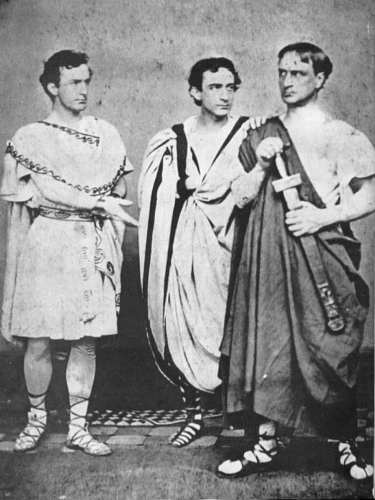
As I have written before, in the 20th and 21st centuries, America has a somewhat more complex relationship with the character of Brutus. On the one hand, America was founded on the principle of resisting tyranny; it’s even on the state flag of Virginia, which is why some early productions of the play make Brutus a hero. On the other hand, as you see above, rebels and traitors like John Wilkes Booth have also taken inspiration from Brutus. His father and brother’s middle name was Brutus and all three brothers performed in the play one year before John turned theater performance into American tragedy.

Like Brutus, Booth seemed amazed with the world’s reaction to his deed, for after he assassinated the president, he wrote this in his journal:

[W]ith every man’s hand against me, I am here in despair. And why; For doing what Brutus was honored for … And yet I for striking down a greater tyrant than they ever knew am looked upon as a common cutthroat.”

John Wilkes Booth, April 21, 1865.

The most recent controversy over Brutus’ actions is the 2017 Shakespeare in the Park production of Caesar directed by Oscar Eustis. As I wrote before, when portraying Caesar as an American president, it tends to anger the political party of his supporters, but the play shows how unplanned political violence can destabilize a country. In these productions, Brutus seems a bit of a well meaning dupe or an naive patsy acting out of fear. On the other hand in cultures that have suffered many violent uprisings, Brutus is a figure that is all to common in places like Uganda, Iran, and the Taliban controlled world: https://youtu.be/5HU8SA33j2w

Brutus is a great character because Shakespeare keeps enough of his motives in the dark to allow for new interpretations, but also showing a man with relatable desires and fears get swept up in a dangerous and unpredictable time.

Why Everyone Should Read (Or Teach) “The Merchant Of Venice.”

I am disgusted by the recent violence in Charlottesville VA. The fact that in 2017, White supremacists threatened, hurt, and killed innocent Americans is despicable and truly disheartening. I won’t go into my political views here since this tragedy transcends politics and forces everyone in this country to re-examine who we are and what we stand for as a people, and do our part to help prevent this kind of mindless hatred.

I’m not a politician, I’m not a policeman. My area of expertise is Shakespeare, so I am going to try to make a case for why the study of Shakespeare can help people, (especially young people), learn about the world, examine new points of view, and try to improve the world. I will then add a list of resources for teachers and students to deepen your understanding of the play.

My first argument for the play is that Merchant has two of the best speeches about intolerance ever written.

You’ve probably heard of this speech, (spoken by the Jewish moneylender Shylock), and I’m also well aware of the fact that, in context, it is not entirely about peaceful coexistence and tolerance, but it nevertheless establishes Shakespeare’s argument that condemns bigotry and violence, particularly against Jews:

Hath not a Jew eyes? hath not a Jew hands, organs,
dimensions, senses, affections, passions? fed with
the same food, hurt with the same weapons, subject
to the same diseases, healed by the same means,
warmed and cooled by the same winter and summer, as
a Christian is? If you prick us, do we not bleed?
if you tickle us, do we not laugh? if you poison
us, do we not die? and if you wrong us, shall we not
revenge? If we are like you in the rest, we will
resemble you in that. If a Jew wrong a Christian,
what is his humility? Revenge. If a Christian
wrong a Jew, what should his sufferance be by
Christian example? Why, revenge. The villany you
teach me, I will execute, and it shall go hard but I
will better the instruction.
Merchant, Act III, Scene i.

img_5431

Al Pacino when he did this speech said that it has the eloquence and power of Dr. Martin Luther King. Patrick Stewart initially had the same reaction, but later realized that Shylock turns midway through and the speech becomes a justification for revenge. What’s clever here is that Shakespeare manages to give Shylock two good arguments against bigotry; by emphasizing how Jews are no different than any other racial or religious group, and also warning that oppressing a people will only result in more retribution and pain on both sides. This is what he means when he says: “The villainy you teach me, I will execute.” We’re seeing this sort of reaction right now with the recent surge of violence by both white supremacists and the Antifa; without tolerance and common decency, chaos and bloodshed reins.

Another speech, much less well-known, is this speech of the Prince Of Morocco, one of Shakespeare’s only black characters. The speech below is the first time he speaks while attempting to woo the heroine Portia:

Prince of Morocco. Mislike me not for my complexion,
The shadow’d livery of the burnish’d sun,
To whom I am a neighbour and near bred.
Bring me the fairest creature northward born,
Where Phoebus’ fire scarce thaws the icicles,
And let us make incision for your love,
To prove whose blood is reddest, his or mine.
I tell thee, lady, this aspect of mine
Hath fear’d the valiant: by my love I swear
The best-regarded virgins of our clime
Have loved it too: I would not change this hue,
Except to steal your thoughts, my gentle queen. Merchant Of Venice, Act II, Scene i.

People often forget that this speech condemns pre-judging a person based on the color of their skin. Morocco tells Portia, (who in all probability has never seen a black man before), to not judge him by his appearance. His tone is gentle, but it is not apologetic. He says he won’t change his skin color for anything, (except maybe if it would win her heart). The Prince is a dignified and proud representative of his country and his race.

My second argument for reading or teaching this play is that it reveals how bigotry and racism is usually tied to money and profit. In Act IV, Scene i, Shylock points out the hypocrisy of his Christian brethren in keeping slaves, which they justify by saying that they are not people, but property:

  • Shylock. You have among you many a purchased slave, Which, like your asses and your dogs and mules, You use in abject and in slavish parts, Because you bought them: shall I say to you, Let them be free, marry them to your heirs? Why sweat they under burthens? let their beds Be made as soft as yours and let their palates Be season’d with such viands? You will answer ‘The slaves are ours:’ so do I answer you: The pound of flesh, which I demand of him, Is dearly bought; ’tis mine and I will have it. If you deny me, fie upon your law! There is no force in the decrees of Venice. I stand for judgment: answer; shall I have it? Merchant, Act IV, Scene i.

Shylock turns this hypocrisy back on the Christians by saying basically, “How can you call me inhuman when you debase and subjugate your fellow creatures?” The answer to both questions of course, is that it is economically convenient. Shylock earns his money by lending money at interest, and threatens dear penalties if not repaid on time. Similarly, the Christians need Shylock because their religious practices forbid them from lending money, so they have to go to him instead of other Christians. We see echoes of this unfortunate tendency today: the white supremacists in Charlottesville were chanting: “Jews will not replace us,” which clearly exposes their fear of losing political and economic influence to minorities. In addition, our country has refused countless immigrants from poor, war-torn countries which we justify to ourselves by saying the cost of letting them in is too great.

The play’s comic sub-plot also has many lessons for today’s world. The hero Bassanio undergoes dramatic transformation from a spoiled prodigal son to enlightened married man. At the play’s beginning, he has a close friendship with the merchant Antonio, that might be played as a one sided homosexual relationship. Antonio is very affectionate to Bassanio, and lends him a large amount of money without any expectation of repayment, which has sometimes been interpreted as a hinting of Antonio’s unrequited love for Bassanio. Though Basanio doesn’t reciprocate any romantic feelings, he eventually saves Antonio’s life, and at least tries to repay him for his kindness.

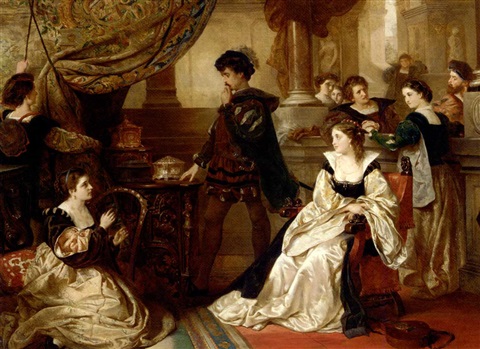
robert-alexander-hillingford-the-three-caskets--the-merchant-of-venice,-act-iii,-scene-ii
Robert Alexander-Hillingford: The Three Caskets, The Merchant Of Venice, Act III, Sceneii

Bassanio also takes a very feminist attitude towards the play’s heroine Portia- he understands that being married means making your spouse a partner, and giving her an equal say. At the beginning of the play, he sails to an island called Belmont, to try to win Portia’s hand, by correctly solving a riddle. You may have heard of the three caskets, gold, silver, and lead. If Bassanio guesses right, he wins Portia and her fortune. Bassanio chooses the correct casket, but halts afterwards, and does something unexpected; he asks Portia herself if she wants to marry him. He doesn’t treat her as his prize, and throughout the play asks her opinion, and her permission before he acts, just as a good husband should.

Fair lady, by your leave;
I come by note, to give and to receive.
Like one of two contending in a prize,
That thinks he hath done well in people’s eyes,
Hearing applause and universal shout,
Giddy in spirit, still gazing in a doubt
Whether these pearls of praise be his or no;
So, thrice fair lady, stand I, even so;
As doubtful whether what I see be true,
Until confirm’d, sign’d, ratified by you. Merchant Of Venice, Act III, Scene ii

I would argue that, although Portia is a far more important character, Bassanio is the moral center of the play. He is the only person who treats Shylock like a human being, by trying to reason with him and pay Antonio’s debt, instead of spitting in Shylock’s face like Antonio, or forcing him to convert like the characters at the end of the play. Bassanio also is one of the only characters who call Shylock by name, everyone else just calls him “Jew.” Thus, audiences and students can learn from this kind of person; the kind of person Christ said could be saved and become a true Christian, because he acknowledges his sins and tries to correct them. Bassanio is the prodigal son in this play, and we benefit from the parable of his life.

By contrast, some of the other characters, Christian and Jewish, are examples of the kind of morality that we all wish to discourage in our children, and society in general. Though they are outwardly pious, the Christians like Antonio and Portia, are capable of vindictive, cruel, and definitely impious behavior. Portia, (probably due to her sheltered life on Belmont), can be deeply racist and prejudicial. She is prejudiced against the Prince of Morocco because of his race, hoping that “All of his complexion,” will fail to win her love. In addition, when she poses as a judge presiding over the court case between Antonio and Shylock, she throws vengeance at Shylock, even though she barely knows either of them. She strips Shylock of his property and nearly gets him sentenced to death, even though she preaches mercy to him in her most famous speech. If you look at the contrast between her words and actions, she is a deeply hypocritical person. Shakespeare shows how toxic it can be to raise a child in an isolated environment. Portia’s isolation makes it harder for Portia to relate to and understand different types of people, and it planted her predjudices within her heart.

Antonio for his part, seems to define himself by how “un-Jewish” he is, believing that generosity and mercy are anathema to all Jews, particularly when Shylock confronts Antonio in the courtroom:

I pray you, think you question with the Jew:
You may as well go stand upon the beach
And bid the main flood bate his usual height;
You may as well use question with the wolf
Why he hath made the ewe bleat for the lamb;
You may as well forbid the mountain pines
To wag their high tops and to make no noise,
When they are fretten with the gusts of heaven;
You may as well do anything most hard,
As seek to soften that—than which what’s harder?—
His Jewish heart: therefore, I do beseech you,
Make no more offers, use no farther means, Merchant, Act IV, Scene i.

Although Jesus preached loving ones neighbor, and being the Good Samaritan to other religions, Antonio seems to think that being a true Christian, means being Anti-Jew. He is a counter example of piety that audiences and students can learn to mollify and avoid within themselves.

My final example of religious counter examples, Shylock himself, shows how prejudice can destroy a man if he lets it. At the beginning of the play, Shylock has had to endure losing his wife, having Antonio spit on him, mock him, encourage his enemies, and call him a host of dehuminizing names. That’s not even taking into account the horrible Venetian ghettos of the 1590s, in which Shylock would have been forced to live were he a real Venetian Jew. One quote that helps explain his behavior comes from Henry Norman Hudson in 1882:

[In Shylock] “we see the remains of a great and noble nature, out of which all the genial sap of humanity has been pressed by accumulated injuries.” – Shakespeare: His Life, Art, and Characters, H. N. Hudson, Ginn and Company, Boston, p. 291. “

Scholars and actors have emphasized ever since the end of the Second World War, that, although Shylock is still guilty of reprehensible acts, his cruelty is a reaction to the cruelty he has had to endure, or as he puts it: “The villainy you teach me, I will execute.

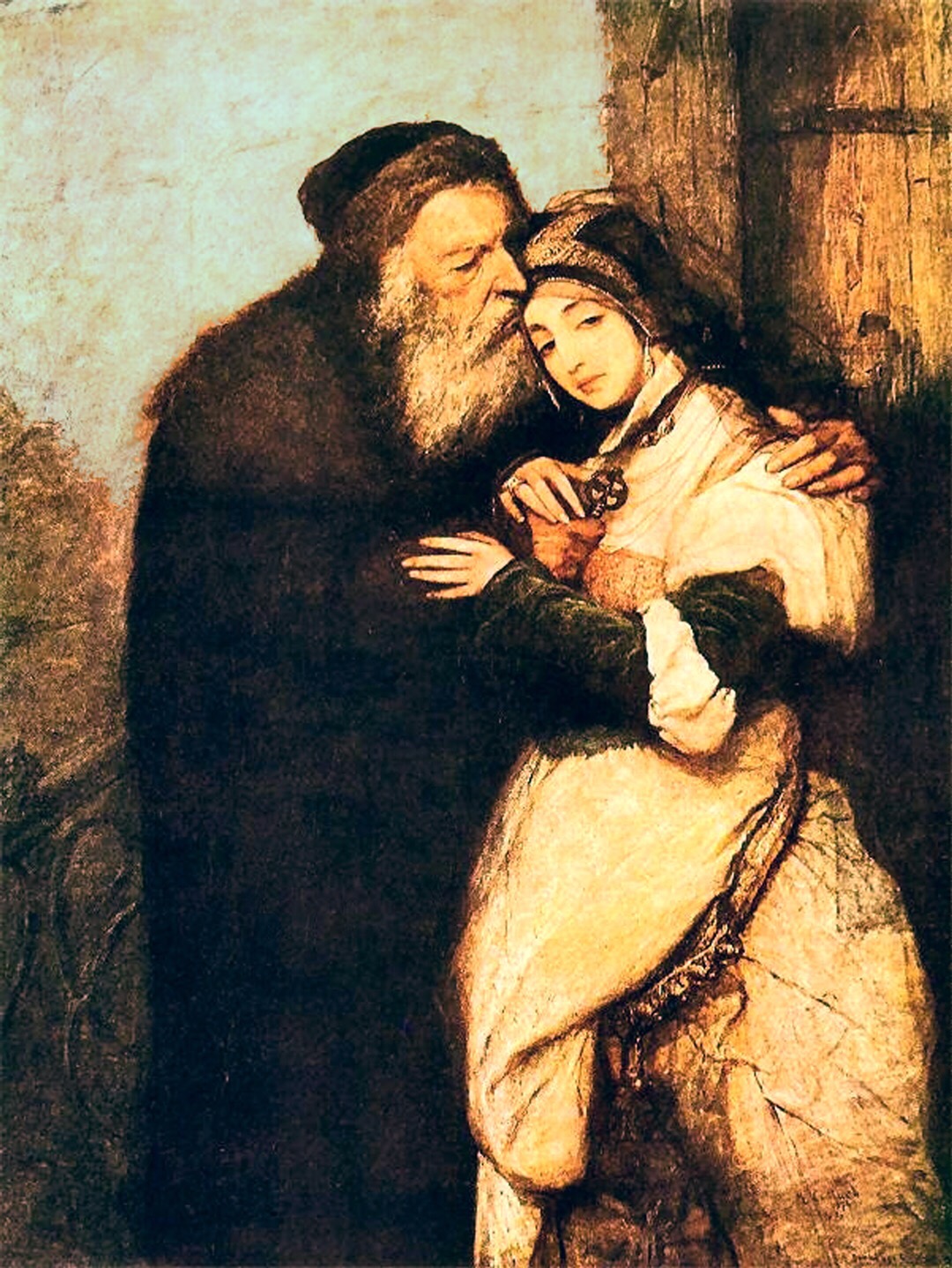
img_5433
Maurycy Gottlieb: “Shylock and Jessica,” 1876

Shylock’s lack of joy and love manifests itself by the way he treats everyone in the play. He keeps his daughter locked away from anyone, which later compels her to run away with the Christian Lorenzo, (while stealing a huge amount of Shylock’s money). Shylock then rages against the citizens of Venice, especially Antonio, whom he blames for his losses, and concocts a plan to kill him by taking a pound of flesh away from his heart.

Shylock’s pain and hardships have turned him into the kind of bloodthirsty Jewish stereotype his enemies have always assumed to be. At the same time, he constantly points out the cruelty and hypocrisy of Christians, calling them no better than himself. In the end though, through Portia and the Duke sentencing Shylock to will his money to Lorenzo, and convert to Christianity, Shylock has to become what he hates, and surround himself with people who will never accept him; an ending that fills the audience with pity and maybe even remorse.

Now, there are compelling arguments that teaching this play can actually encourage stereotypes, which it can, and has in ages past. I read several articles that debate this issue in various ways. I’d like to discuss two articles written within one year of each other that are particularly fascinating. The first one was an article from The New Yorker by Professor Steven Greenblatt, who claimed that Merchant is “Shakespeare’s Cure For Xenophobia.” The other was a Washington Post article that argues that in the interest of keeping negative Jewish stereotypes from perpetuating themselves, this play should be ignored altogether.

On the other hand, as Professor Greenblatt says, the genius of the play is that it shows stereotypes, but it also shows the people under them. If you compare Shylock in The Merchant Of Venice, to other contemporary Jewish characters like Barrabas in Marlowe’s Jew Of Malta, he is a much more compelling, complete, interesting, and at times moving character. Love him or hate him, Shylock inevitably gets under your skin. He’s a man who strips the varnish off our culture and exposes the hypocrisy, greed, and prejudice that lurk just beneath the waters of the Rialto, (as well as the modern Potomac and the Hudson). The saving grace of this play is that it forces us to examine ourselves- how do we treat people, how do we see people who are different than us? What makes our points of view good and bad, and what can we do to heal our misunderstandings? Though this play cannot answer these questions, it encourages us to confront them, to open a dialogue, and hopefully, open avenues for change.

Artwork: For a wonderful selection of pictures of Portia, please visit: http://themerchantofveniceportia.weebly.com/fair-portias-counterfeit.html

Elizabeth Shuh: “Merchant Of Venice.” Reprinted with permission from Immortal Longings.com

Portrait of Edmund Keene as Shylock, circa 1815

Portrait of Jessica by Luke Fildes, 1888

Music: Where is fancy bred?

Resources

  1. Schmoop.com Summary of The Merchant Of Venice: https://www.shmoop.com/merchant-of-venice/summary.htmlhttps://www.shmoop.com/merchant-of-venice/summary.html
  2. Shakespearehelp.com- lesson plans for teachers on The Merchant Of Venice: https://www.shakespearehelp.com/the-merchant-of-venice-lesson-plans/
  3. Teaching English.org: Lesson Plans for Shakespeare’s Merchant Of Venice: https://www.teachingenglish.org.uk/sites/teacheng/files/Mercy%20in%20Shakespeare’s%20The%20Merchant%20of%20Venice%20Lesson%20Plan.pdf
  4. Thug Notes: Merchant Of Venice (explicit language) https://m.youtube.com/watch?v=Tw9q2P2N028
  5. Varsity Tutors: Merchant Of Venice: https://www.varsitytutors.com/englishteacher/merchant
  6. Intermediate Worksheets: Merchant Of Venice: http://www.macmillanreaders.com/wp-content/uploads/2010/08/The-Merchant-of-Venice-Worksheet.pdf
  7. Prestwick House: Worksheets for Students: Merchant Of Venice: https://www.prestwickhouse.com/samples/200958.pdf
  8. Shakespeare In the Schools: The Merchant Of Venice- Evaluating Values: https://witf.pbslearningmedia.org/resource/ca3e6c02-0eb6-436f-b605-f741673dd399/evaluating-values-merchant-of-venice/https://witf.pbslearningmedia.org/resource/ca3e6c02-0eb6-436f-b605-f741673dd399/evaluating-values-merchant-of-venice/
  9. Internet Shakespeare Editions: The Merchant Of Venice- http://internetshakespeare.uvic.ca/m/lifetimes/plays/the%20merchant%20of%20venice/
  10. RSC Production History: The Merchant Of Venice: https://www.rsc.org.uk/the-merchant-of-venice/about-the-play/stage-history